January 2019
YOUR GLOBAL PARTNER
In this issue:
SIEVE CLEANERS FOR PLANSIFTERS Why high-quality products pay off and positively influence the yield in the mill
• How to combat the 2018/19 ‘Mycotoxin Challenge’
Milling and Grain . Volume 130 . Issue 1 . January 2019
• Rice fortification • Troubled China opts to reduce protein in animal feed • Methionine in feed
See our archive and language editions on your mobile!
• Breizh Algae Tour 2018
Event review Proud supporter of
Volume 130
Issue 1
millingandgrain.com
Commercial Series Material Handling Incline conveyors offer flexibility and reliability Our materials and engineering make the difference Elevators & Conveyors engineered for strong, reliable, commercial performance Globally recognized for customer service and quality products, our team of experienced Dealers and Staff will assist you in determining the system that will suit your needs.
ÂŽ
chief.co.uk
agri.chiefind.com
Grain Storage
Dryers
Material Handling Systems
Catwalk and Tower Systems
Lemanco Bulk Storage Systems
Caldwell Grain Conditioning
silos-phenix.com
COMMERCIAL BINS
• 48 m Diameter Bins (20321-48262 mt) • Peak Load Rating (6804-45360 kg) • Hopper Bins (3.7 m-14.6 m)
COMMERCIAL DRYERS
• Tower Dryers (23-281 t/h) • QuadraTouch ProTM Controls • Balanced Moisture Content
STEEL BUILDINGS
COMMERCIAL SWEEPS
BUCKET ELEVATORS
COMMERCIAL CONVEYORS
• Auger & Paddle sweeps available • Capacity includes 141-281 t/h • Patented Pivot Point • Industrial Grade Pushers
• Low Impact Head Design • Heavy Gauge Trunking • Patented Squaring Plates • Support Towers
• Industrial Strength • Built To Last • Higher Elemental Resistance • Capacity includes (984-1688 t/h) • Dust-tight and waterproof • Patented hip-style weather-tight cover • Catwalks
Sukup Worl d H eadquart ers - S hef f i e ld , Io w a U SA • w w w.su ku p .co m • in fo @su ku p .co m For service in Europe contact:
Sukup Europe A/S Hedensted, Denmark Tel +45 75 68 53 11 • Fax +45 75 68 54 70 info@sukup-eu.com • www.sukup-eu.com
Pneumatic or Mechanical Ship Loaders & Unloaders Port Equipment - Turnkey Projects
1968 2018
1350 machines installed in more than 100 countries! VIGAN Engineering s.a. Rue de l’Industrie, 16 - 1400 Nivelles - Belgium Tél.: +32 67 89 50 41 • Fax : +32 67 89 50 60 • www.vigan.com • info@vigan.com
VOLUME 130 ISSUE 1
January 2019
Perendale Publishers Ltd 7 St George’s Terrace St James’ Square, Cheltenham, Glos, GL50 3PT, United Kingdom Tel: +44 1242 267700 Publisher Roger Gilbert rogerg@perendale.co.uk International Marketing Team Darren Parris Tel: +44 1242 267707 darrenp@perendale.co.uk Martha Cornwell Tel: +1 913 2083770 marthac@perendale.com Fred Norwood Tel: +1 405 834 2043 fredn@perendale.com Latin America Marketing Team Iván Marquetti Tel: +54 2352 427376 ivanm@perendale.co.uk New Zealand Marketing Team Peter Parker peterp@perendale.co.uk Nigeria Marketing Team Nathan Nwosu Tel: +234 8132 478092 nathann@perendale.co.uk
Production Editor Rebecca Sherratt rebeccas@perendale.co.uk Features Editor Matt Holmes matth@perendale.co.uk International Editors Dr Roberto Luis Bernardi robertob@perendale.co.uk Professor Wenbin Wu ˘ wenbinw@perendale.com Mehmet Ugur Gürkaynak mehmetg@perendale.com
FLUTING MACHINES
Managing Editor Vaughn Entwistle vaughne@perendale.co.uk
ISSUE HIGHLIGHTS
60 A practical guide for nutritionists 64 Mycotoxin Challenge
Circulation & Events Tuti Tan tutit@perendale.co.uk
FACES
Grain & Feed Milling Technology magazine was rebranded to Milling and Grain in 2015
6-44
FEATURES
54 Sieve cleaners for plansifters
Design Manager James Taylor jamest@perendale.co.uk
©Copyright 2018 Perendale Publishers Ltd. All rights reserved. No part of this publication may be reproduced in any form or by any means without prior permission of the copyright owner. More information can be found at www.perendale.com Perendale Publishers Ltd also publish ‘The International Milling Directory’ and ‘The Global Miller’ news service
2
NEWS
66 Thermal phenomenon and analysis of a grinding
Development Manager Antoine Tanguy antoinet@perendale.co.uk
89 - Deadly atmospheres: Eradicating pests through fumigation
machine’s roller
70 Wheat- Lessons from 2018
74 Rice fortification 76 Responding to technology challenges in mill equipment manufacture
132 People news from the global milling industry
PRODUCT FOCUS
50
CASE STUDY
104
80 Troubled China opts to reduce protein in animal feed
82 Methiopedia: Methionine in feed! 84 Four Chinese institutes join forces to advance milling technology
EVENTS
112 Event listings, reviews and previews
STORAGE
FUMIGATION 90 Aluminum phosphide 96 CO2
100 Nitrogen
TRAINING
46 Building the next generation of leaders at the AFIA Conference
COLUMNS
12 Mildred Cookson 40 Rebecca Sherratt
4 GUEST EDITOR Barbora Dubovcova
108 MARKETS Mehmet Ugur Gürkaynak
130 INTERVIEW Travis Young
COVER IMAGE: Sieve cleaners for plansifters: Why high-quality products pay off and positively influence the yield in the mill See more on page 54
ISSUE HIGHLIGHTS YEAST
A practical guide for nutritionists
From a palatability enhancer to a source of nutrients and functional ingredients, yeast and yeast derivative products are versatile and natural ingredients to keep in mind when formulating food for pets.
PAGE 60 WHEAT
RICE Rice fortification at scale to prevent micronutrient deficiency
Micronutrient deficiency affects, globally, over 2.1 billion people and has an immense impact on human health, cognitive development, education, economic development and productivity.
PAGE 74
FUMIGATION
ALUMINUM PHOSPHIDE
Maintaining grain quality from grain-infesting insects is a never-ending challenge. To help, Milling & Grain asked two industry professionals from Douglas Products to share their experience using aluminium phosphide fumigant to protect stored grain.
PAGE 90
FUMIGATION CO2
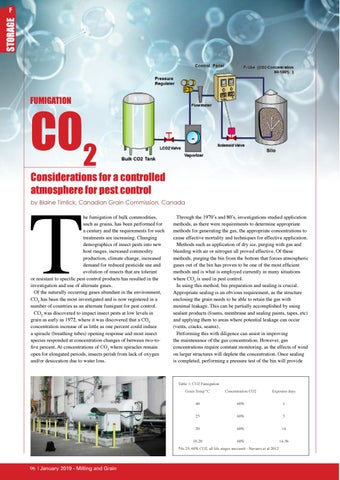
The fumigation of bulk commodities, such as grains, has been performed for a century and the requirements for such treatments are increasing.
PAGE 96 FUMIGATION NITROGEN
The grain industry worldwide is highly dependant on fumigants for controlling stored grain pests, which cause about 15-20 percent of losses every year.
WHEAT - LESSONS FROM 2018
As we enter into a new year, the statistics for 2018 are analysed and we discover that last year was one of uncertainty and turbulence
PAGE 100
PAGE 70
FOOD
STORAGE
FEED
PROCESS
ROLLS
SOY
Responding to technology challenges in mill equipment manufacture
Troubled China opts to reduce protein in animal feed
Ocrim Spa has two factories in Cremona, Italy. One is in the centre of town and is the historic home of this milling equipment manufacturer, and a new factory complex outside the town, on the banks of the local river, where it has four manufacturing spaces connected by a wide corridor and a separate area of dispatch, beside a three-story office block.
Wheat is the world’s largest food crop, and the global demand for wheat flour is large every year. The milling industry has become an important basic industry in the global food industry.
PAGE 76
PAGE 66
GRINDING Thermal phenomenon and analysis of a grinding machine’s roller
Adisseo has launched a new edition of their Methiopedia, a technical guide on methionine sources used in animal feeds.
Over the past few months, the controversy surrounding China and the heightened tariffs on soybeans has only continued to cause more problems for China. Now, in an attempt to solve this issue and save costs, China is considering placing restrictions on the amount of protein used in animal feeds, specifically for pigs and poultry.
PAGE 82
PAGE 80
METHIONINE Methiopedia: The future's bright for methionine in feed!
Leonardo Roller Mill DEVELOPMENT | FUTURE | DESIGN | KNOW-HOW | UNIQUENESS
THE REVOLUTION IS UNSTOPPABLE
#MILLINGREVOLUTION
omasindustries.com
RESEARCH & DEVELOPMENT MADE IN ITALY
Digitalisation: Unlocking machine potential to meet the global food challenge With the world’s population expected to increase from 7.1 to 9.7 billion people by 2050, feeding everyone will be a global challenge, requiring contribution throughout the complex food value chain. Consumers also want to know where their food has come from and how it has been grown, harvested and processed. They are also interested in its environmental impact and whether its growers were paid fairly. Until now, the industry has only been able to dream of solutions for providing consumers with food that they can trust. But now, with the opportunities opened up by digitalisation, we are closer to capturing sustainably the food system’s full value. For nutritious food to be available to billions of people around the globe each day, valuable commodities must be transported in bulk, traded, stored, refined and distributed via various channels. And while being transported, they can be exposed to everything, from extreme weather and poor storage conditions, to physical, chemical and biological contamination, as well as intentional adulteration and food fraud. These, together with a lack of supply chain coordination, can contribute to significant losses in both food value and volume. This is a high price to pay. The FAO estimates that as much as a third of food produced worldwide for human consumption is lost or wasted – approximately 1.3 billion tonnes every year. This avoidable waste of energy, water, labour and land (used for producing that food) is unacceptable, particularly in a world where almost a billion people are starving. However, digitalisation is inspiring exciting new solutions that can address these issues, enabling processes to be adjusted to optimise yield and save energy, prevent further waste or contamination and remove defective produce. The LumoVision optical sorter, merges physical and digital technology to provide real-time information about toxin levels in corn (maize) – a staple food relied on by a third of the world’s population. It brings together highly advanced cameras, an algorithm for aflatoxin detection and physical sorting technology that removes infected kernels. Digitalisation has also enabled the creation of apps such as Safefood.ai, which monitors and collects relevant signals from international food authorities, news sources and social media, providing real-time alerts about the ever changing food safety and quality hazards. Early warnings help businesses to lower the risk of food safety incidents and better protect themselves from
ISSN No: 2058-5101
expensive product recalls and reputational damage. Smart sensors and algorithms can unlock the potential of food processing machinery, such as those used in nut roasting, extrusion and feed pelleting. With systems such as ProcessPro, it is now possible to continually monitor the level of bacteria that is being reduced during these traditional processes. Another good example is PreMa, which gathers information about temperature and humidity in silos, and triggers a warning if conditions favour unwanted bacterial growth, to prevent mould infection and mycotoxin contamination. Digitalisation offers numerous opportunities to improve processes, increase value and reduce food waste and energy consumption. Additionally, digital data storage can enhance transparent communication throughout the value chain. Digitalisation can also create opportunities for new business models and new digital services, that build greater trust in the food value chain. As a prerequisite for a successful partnership, the exchange channels and data storage must be robust and secure. If we share information collaboratively, we can all make better decisions going forward. It benefits us all if we embrace this approach. For example, Bühler, Microsoft and Whitworth Brothers, are working together on a pilot project to trace wheat grain “from farm to fork” using blockchain technology, to provide full traceability and transparency. Having access to reliable contaminant mitigation, trustworthy information and real-time quality monitoring are not new challenges for food producers. However, digitalisation enables the industry to deal with these challenges better than ever, so we are better placed to provide enough healthy food to feed the everincreasing global population. To learn more about the digital solutions available from Bühler, visit https://digital.buhlergroup.com/insights/ This issue of Milling & Grain magazine, an exciting new beginning to 2019, also reflects this emphasis on new, innovative technology to help the food industry perform beyond our expectations and needs. "In this issue, Milling & Grain discuss a variety of topics, such as the wheat forecast for 2019, analysis of roller mill rolls, silo fumigation and much more! We hope you enjoy Milling & Grain’s New Year issue! Barbora Dubovcova is a Food Safety Manager within the Data Analytics & Services at the Bühler Group, a leader in food technology solutions for more than 150 years.
Milling and Grain has a cooperative partnership with COFCOET
Annual Subscription Rates Inside UK: UK£100 Outside: US$150/€133 More Information www.millingandgrain.com http://gfmt.blogspot.co.uk
40 YEARS OF TESTED STRENGTH
One Tapco Nylon Elevator Bucket Supports a 9700 Pound* H1 HUMMER Ambient Temperature: 17 °F (-8 °C)
TAPCO’S CC-XD (Xtreme Duty) gray nylon elevator bucket supports a 9700 lb. H1 Hummer vehicle. Testing confirms that it will support over 20,000 lbs., more than two Hummers!
TAPCO’S CC-XD (Xtreme Duty) blue polyethylene bucket will support 9,000+ lbs.
Tapcoinc.com
TAPCO’S CC-HD (Heavy Duty) blue polyethylene bucket will support 5,000+ lbs.
314.739.9191 / St. Louis, Missouri USA No 814
*4399 kg
Milling
News
IFIF and FAO strengthen collaboration at 17th annual meeting
T
he International Feed Industry Federation (IFIF) and the Food and Agriculture Organisation of the United Nations (FAO) held their 17th annual meeting at FAO Headquarters in late 2018, to further strengthen their collaboration on critical issues to ensure safe, nutritious and sustainable feed and food. Mr Bukar Tijani, FAO Assistant Director-General for Agriculture and Consumer Protection, welcomed delegates and highlighted the importance of private partnerships to support the FAO goals to the IFIF delegates representing over 80 percent of global compound feed production. The meeting was officially opened by Dr Berhe G Tekola, Director of the FAO Animal Production and Health Division and Dr Daniel Bercovici, IFIF Chairman, who welcomed delegates and reiterated their commitment to this longstanding partnership and agreed to continue to strengthen their work together to tackle the challenges facing the feed and food chain. Mr Bercovici said, “our joint meeting with the FAO once again underlined our strong partnership and IFIF is committed to continue to support the FAO initiatives on capacity development for feed safety, the Global Agenda for Sustainable Livestock and LEAP, as well joint efforts on feed and food safety at the Codex Alimentarius. “IFIF looks forward to our upcoming sixth Global Feed & Food Congress and 12th International Feed Regulators Meeting (IFRM) in Bangkok on 11 – 14th March 2019, which is another great example of IFIF FAO collaboration positively impacting the feed and food chain”, he continued. Mr Bercovici added that, “together with the dedicated colleagues at the FAO we contribute to building a solid science-based approach to support safe and sustainable animal nutrition to bring quality and affordable food to a growing world population, producing more with less and even better under diverse production systems. “The high quality of exchanges and cooperation towards the United Nations Sustainable Development Goals (SDGs) continue to build on our achievements and together with all IFIF members I am pleased our relationship continues to strengthen year to year.”
6 | January 2019 - Milling and Grain
In one of our features this issue, by international manufacturing company Satake, they discuss their successes with optical sorters, a key innovative technology for the food industry. Optical sorters serve as a brilliant way to sort through materials, to spot and remove defective and foreign material, and are commonly used, not just in the food industry, but also in waste recycling, pharmaceuticals and various other industries. Optical sorters are one of a variety of technologies that have crucially helped shape the way food technology functions and prospers in the modern age. Innovations has also found their way into client’s smartphones. The way to run a mill or food facility is now through your phone. Denmark-based company, Tagarno, have created exciting new measurement software for FHD microscopes, to examine grain and small bulk materials such as rice, through your smartphone. Mühlenchemie have also similarly found ways to utilise smartphones with their latest technology: the Mühlenchemie Digital Navigator informs users of the specific regional requirements needed for flour standardisation, in their region of the world. Now, in 2019, we are all wondering, what future innovations will be created this year? Breakthroughs in food technology are happening all the time. Milling & Grain’s News and Product Focus sections regularly update readers with all the latest in machinery innovations, alongside features, which go more in-depth into how much innovations function and provide advantages to your business or workforce. Milling & Grain’s GRAPAS Innovations Awards are also another key example of the successes of food innovation technology. The annual awards ceremony and conference, held at Victam International in Germany this June, will host the biggest and best in new food machinery. The success of this awards ceremony and conference, year after year, proves that the food industry only continues to prosper and create more magnificent works of technological marvel, despite ongoing issues of climate change and environmental turbulence, that continue to plague our crops and many products we work with. You can find out more about the GRAPAS Innovations Awards on page 40.
GF
MT
gfmt.blogspot.com
High Quality Technology for Milling Industry
Balaguer Fluting Machine BR-D247
Faster Fluting Process The combined roll grinding and fluting machine BR-D247 combines a faster fluting process with a very solid tool holder achieving the best and most reliable fluting machine in the market. Very solid tool holder
No vibration when the tool hits the roll, achieving a perfect flute without deviations.
Multi-tool system
The machine allows to work with single point and multi-tool. 6 steady rests included.
Easy to use
Intuitive control integrated in one panel. Automatic adjustment of the cutting depth.
Technology
www.balaguer-rolls.com Facebook
Youtube
Over 25,000 good reasons to choose Gusti® Plus NUTRIAD PALATABILITY: HELPING NUTRITION HAPPEN Cattle are very sensitive to taste and with over 25,000 taste receptors in their mouth they can detect the slightest change in their feed. This makes formulating diets that fit the nutritional and economic requirements of production whilst maintaining acceptable palatability an ongoing challenge to the ruminant nutritionist. GUSTI® Plus is a tried and tested palatability solution developed using our extensive knowledge and experience of what makes feed attractive to cattle. It provides a uniform taste to feed that will mask unpalatable ingredients and changes in diet formulation to ensure consistent high feed intake. Better acceptance of your feed means healthy productive animals and profitable farmers. It’s all about helping nutrition to happen as nutrition can only begin once feed is eaten.
Interested in how we can make your feed taste great? Visit nutriad.com for more information or to find your local contact. A PA006-06
Milling News
£2 million donation boosts agriculture research at RAU
F
ollowing a generous donation of UK £2 million to the Royal Agriculture University (RAU) in Gloucestershire, PhD research is thriving, especially in topics such as growing soybeans into profitable, low-carbon crops. The RAU has received this research investment thanks to the John Oldacre Foundation, which supports the agricultural sciences and is a long-term funder of doctoral study at the university. Two John Oldacre scholars at RAU are already supported by nearly £190,000 and are working on crop science projects that will be of long-term benefit to the UK’s food security. The new endowment of £2 million will ensure future research of this kind at the RAU in perpetuity – an estimated two new PhDs per year. It will also enhance links with the agricultural research community, including a collaboration with the National Institute of Agricultural Botany (NIAB). Pedzisai Nemadziba, from Zimbabwe, one of the current PhD students, is developing strategies for the UK to successfully grow large-scale soybean crops, which have
lower reliance on fertilisers and are becoming a growing part of our diet. The majority of the UK’s soya is currently imported and genetically modified. Another student, Caitlin Willis, is “investigating insecticide resistance in UK populations of oil seed rape pests”, in this case in conjunction with the non-profit Rothamsted Research Institute. These projects will be supervised by Dr Nicola Cannon and Dr Xianmin Chang. Professor Joanna Price, Vice-Chancellor of the Royal Agricultural University said, “We are proud to receive this transformational investment in our doctoral research, building on three decades of support for the RAU by the John Oldacre Foundation. “Investment in PhD students is critical for ensuring that we address future challenges facing agriculture and for the RAU to make an impact in areas like global food security, crop resilience and climate change.”
FEFAC welcomes EU plant protein production report
F
EFAC welcomes the European Commission report on the development of plant proteins in the EU published on November 22, 2018. FEFAC hopes the new political interest at both EU and national level will create the momentum to stimulate the availability, quality and competitiveness of EU plant protein production. Compound feed manufacturers are prepared to continue to source more EU-grown proteins to participate in the development of economically viable chains, provided they are a feasible option compared to traditional protein sources. FEFAC stresses the importance of animal nutrition science and precision livestock feeding as key tools for making the most efficient use of available protein sources, for example, by offering the best amino-acid profile to respond to physiological requirements of farm animals.. FEFAC President Nick Major presented the views of compound feed manufacturers at the conference ‘The Development of Plant Proteins’ in the European Union in Vienna, Austria. He stated that, “the ambition to stimulate EU protein crop production is very sensible given the reduced importance of the EU as an importer on the global market of soybean meal in combination with the dependency on very few exporting countries”. Major also pointed to the report’s finding that the development of premium feed/food markets will be the main driver for the market uptake of vegetable protein grown in Europe. In that light, he encouraged the European Commission to harmonise the rules for product claims for food of animal origin fed on “nonGM feed” in order to guarantee a level playing field and increase market transparency. .
X V I I N T E R N AT I O N A L C O N F E R E N C E
APRIL 10-11, 2019 KYIV, UKRAINE
PREMIERE EVENT FOR THE GLOBAL LEADERS OF GRAIN AND OILSEED INDUSTRY
700+ Delegates
500+ Companies
GENERAL SPONSOR
E XC LU S I V E E XC H A N G E S P O N S O R
SPONSORS
REGISTRATION www.blackseagrain.net
50+ Countries
ORGANIZER
SUPPORTED BY
CONTACTS conference@ukragroconsult.org Tel/Fax +38 (044) 220 5242
Milling and Grain - January 2019 | 9
Albion Mills, the view from the canal side
W Nelstrop & Co Albion Flour Mills, Stockport, Cheshire Milling journals of the past at The Mills Archive by Mildred Cookson, The Mills Archive, UK
walls were so damaged that it was necessary to level them. The only things salvaged were the engine and boiler, and a few fittings in a building separate from the main block. Mr Nelstrop, not put off by the fire, at once decided to make good the loss of this fine mill and set about the erection of a new building with the main lines drawn up by Henry Simon. The structure was designed to hold a mill plant of 15 to 20 sacks capacity, with a full wheat cleaning plant, and room being allowed for further expansion of the mill plant and with ample space warehousing. In the meantime, a contract had been entered into, with Henry Simon, for the installation of all the necessary plants, as well as a system of grain silos. The new mill was started up on November 7, 1894, and “gave the most satisfactory results”. The new mill extended beyond the 48 feet square foundations of the old and measured 154 x 62 x 55ft.
Last year I had the pleasure of visiting this family run mill, seeing it running smoothly, with my visit enriched by that particular smell of freshly baked bread from their test bakery. This started me wondering, just how many tonnes of flour have been made in that near-200-year-old building? According to The Miller (6 January 1896, p 879) the history of Nelstrop’s can be traced back to the 1820s when William Nelstrop moved to the recently built steam-powered flour mill. It was managed by a Mr Oldfield, the maternal grandfather of George Nelstrop, the sole proprietor in the existing firm of W Nelstrop & Co. Mr Oldfield also ran the Park Mill, in Stockport. Both mills were fitted out with 10 pairs of millstones. Park Mill burned down in 1868, which created the opportunity to increase the capacity of the Albion Mill, which was then greatly extended and worked well. In 1883 it was considered one of the best millstone plants in the kingdom. Mr Nelstrop had, however, decided to adopt the roller system and instructed Henry Simon to equip the mill with a 15-sack roller plant. This order was promptly carried out, and proved a great success. Sadly, a disastrous fire on Wednesday April 5, 1893, destroyed the entire Entoleter at Castleford Mill, Yorkshire mill and wheat-cleaning plant. The massive 12 | January 2019 - Milling and Grain
Roller floor (Courtesy of Nelstrops)
The Simon 2-roller mill
Simon ventilated vertical whizzer
The structure was divided into three sections by partition walls extending three foot through and above the roof. The first of these walls ran longitudinally through the centre, cutting one half off for the warehouse. A transverse wall bisected the other half, cutting 48ft from the lower end for the wheat silos and the wheatcleaning department. The remaining 106ft constituted the mill proper, and was large enough to receive an additional 10-sack plant. A tower extending 20ft above the highest point in the roof contained a cistern capable of holding 10,000 gallons of water. The mill was sited alongside the Stockport canal so was well situated for receiving the raw materials and distributing the finished produce. In the warehouse the flour was packed on the first floor. At one end of this floor was an iron trap door that opened when sacks were ready for loading into the barges beneath. There were 10 silos for dirty wheat, each with a capacity for 1120 sacks together with four assimilating silos with a capacity of 500 sacks each. These were placed one above the other, one floor deep, but connected by a series of valves below the floors,
Simon rotary plane scalper
all of which could be opened or closed simultaneously by the movement of one lever. In addition there were five silos that could hold 200 sacks each for clean wheat. Along with other machinery the wheat cleaning plant comprised two dustless rotary separators, four Cranston scourers, two Boby graders, 18 cockle and barley cylinders, two dustless Victor brushes and one Simon No 1 washer, two whizzers and one dryer. The mill plant had 26 pairs of 40 x 10in rolls, two pair of 24 x 9in rolls and three pairs of 14 x 7 in rolls; eight rotary and sixreel scalpers and graders, 20 Reform purifiers and 20 three sheet centrifugal dressing machines. The Miller noticed that one of the double 40in rollers had the shop number 9999. The nominal capacity of the mill was 15 sacks, but could be exceeded. On the first floor there were 26 pairs of 40 x 30in rolls, mounted in four roll frames, two pairs of 24 x 9in rolls fitted in a four-roll frame and three pairs of 14 x 7 in rolls mounted in one frame. On the second floor were 14 Reform purifiers in pairs, and on the third floor were six purifiers, eight rotary graders and scalpers, again arranged in pairs, while on the top floor were 20
Grain and Flour Analyzer Experts Ash
Moisture Protein
Gluten Falling Number
• 50+ years knowledge and expertise • Functional and compositional analysis • Flour, grains and oilseeds www.perten.com
Milling and Grain - January 2019 | 13
Milling and Grain supports the aims and objectives of the Mills Archive Trust, based in Reading, England. The history of milling no matter where it has taken place - is being archived by the Trust. For well over 100 years milling technology has been global with many magazines serving or having served our industry from flour and food to feed and oilseed processing and now to fish feeds. A most recent contribution to the Trust’s collection is a complete century of past edition of the now out-of-print ‘NorthWestern Miller’ from the United States. We are proud to present here, front cover illustrations from this valued and longserving publication as a visual reminder of the important contribution past magazines provided to our industry.
YOUR GLOBAL PARTNER
Art in the Archive We are a charity that saves the world’s milling images and documents and makes them freely available for reference. We have more than two million records. We aim to cover the entire history of milling, from its ancient origins up to the present day. Find out what we have and how you can help us grow.
millsarchive.org The Mills Archive Trust Registered Charity No 1155828
Milling News
Nelstrop’s New Albion Mills showing chimney and canal
Albion Mills Stockport in the 1970s (Mills Archive)
The family was the first to use the Simon Entoleter milling system which enabled the control of a much higher level of water absorption. In the 1990s when the second mill was built they were the first millers in the world to commercialise the use of Peritec in flour milling, a process which removes the outer layers of bran from the wheat before milling. This, in turn, produced a flour of brighter colour and free of bran specks while retaining the nutritional components. The holdings at the Mills Archive mean that I can only provide geographical and historical snapshots. If you would like to know more please email me at mills@millsarchive.org
centrifugals and six reels, placed two-high. The motive engine for the mill was a horizontal compound condensing type identical to that saved from the fire, built by Murgatroyd of Stockport. Both in the construction and fitting out of the mill every endeavor had been taken to prevent a fire, there being no communication between the mill and the cleaning department, or between the latter and the warehouse or packing room, or between the warehouse and the mill, other than by outside iron galleries. During the Second World War all the central Manchester roller mills were destroyed and family mills, like Nelstrop’s in the suburbs, stepped up production to meet the urgent needs of the people. A second mill was added to the site in the 1990s and continues to run to this day. It is interesting to note that during the excavation for a new office complex a millstone was discovered. Was this millstone evidence of a windmill which originally stood on the site
CUSTOM AQUATIC FEED SOLUTIONS ARE WAITING Surround Yourself with Unparalleled Resources for Extrusion and Drying Systems Do you know what aquatic feed you need to produce – but unsure of the next steps? Wenger will put unsurpassed technology and process expertise to work, developing flexible solutions specific to your operation. We expertly evaluate and guide the development and processing applications for floating, sinking, shrimp and micro aquatic feeds. Every one of our systems is customized, serving you best by going beyond a standardized approach. Let us help you solve production challenges now. Email us at info@wenger.com today.
FLOATING
SINKING
SHRIMP
SALMON
MICRO
PHONE: 785.284.2133 | EMAIL: INFO@WENGER.COM | WENGER.COM USA
|
BELGIUM
|
TAIWAN
|
BRASIL
|
CHINA
Milling and Grain - January 2019 | 15
Milling News
Alltech cuts the ribbon on new UK office A newly built office in Lincolnshire, England, was opened by Dr Mark Lyons, Alltech President and CEO, and Mrs Deirdre Lyons, Alltech Co-founder and Director of Corporate Image and Design, at an official ribbon-cutting ceremony on Thursday, December 6, 2018. The 70,000-square-foot innovative design was initiated by Deirdre Lyons in late 2015 to accommodate Alltech’s growth in an office-only site. It features an open reception area, five meeting rooms, including a purpose-built training room, offices and dedicated creative spaces. A building that cultivates collaboration was the vision for the new Alltech office in Stamford. While the initial design work started three years ago, ground was broken on the new building in November of 2016. The office now reflects the nature of Alltech’s late founder, Dr Pearse Lyons, with open spaces designed to nurture creativity and innovation. “Our new building, designed by Mrs Lyons, brings together many of our Alltech teams for greater collaboration and improved service to our customers in animal and crop nutrition,” said Alric Blake, Chief Operating Officer of Alltech. “We look forward to welcoming customers, colleagues and friends, old and new, to Alltech Stamford.” In conjunction with the new building, manufacturing operations were relocated to a larger, more suitable site 12 miles outside of Stamford. Stamford has been home to Alltech’s UK offices since 1988. Today, the team includes 120 highly skilled specialists who work hand in hand with feed, farming and food businesses to achieve performance targets through nutritional innovation. In addition to serving as the primary base for Alltech’s Chief Operating Officer and the global leaders of Alltech’s core animal nutrition platforms, Alltech Stamford is also home to Alltech’s UK team and Alltech E-CO2, which provides tools and services to improve the sustainability and efficiency of farming operations. “Dr Pearse Lyons established a culture of creativity and innovation at Alltech,” said Mr Blake. “Our new UK office reflects that spirit as the company continues to grow and carry the mission forward.” Milling and Grain - January 2019 | 17
I
Milling News
Phileo launches new generation Actisaf Sc 47 HR+
n response to the latest technological requirements of the feed industry, Phileo have recently announced the release of their new feed formula, Actisaf Sc 47 HR+. Actisaf® Sc 47 HR+ is a concentrate of live yeast Saccharomyces cerevisiae processed in a micro spherule form. It is the reference yeast probiotic for most farm animal species with European registration in 13 different species and stages including ruminants, swine, horses, etc. Actisaf® improves fibre digestion, improves and stabilises microflora balance for better performance and delivers better quality end products. From animal health to food safety, Actisaf® is an innovative solution for all participants in the food chain, such as veterinarians, nutritionists, feed millers, farmers and consumers. “The new generation Actisaf® Sc 47 HR+ yeast probiotic is the result from an advanced process development”, explains Anne Desmons, Phileo Product Manager. “Feed producers are facing new challenges due to technical requirements, such as the use of higher heat treatments or cost optimisation issues: the new generation Actisaf® Sc 47 HR+ is equipped to meet extreme feed processing challenges while also delivering better profits on
animal health and performance for the feed industry.” “This is due to Actisaf® Sc 47 HR+ staying alive and being more resistant to modern pelleting processes. First reactions on the launch has been very positive and I am looking forward to the roll out in the coming weeks”, continues Anne Desmons. The new Feed Tech Service is a complementary initiative to better support feed manufacturers’ specific needs. The new service will be offering the three main pillars of technical assistance, information sharing and in-depth training to better serve Phileo’s customers. Phileo’s knowledge has increased over the past ten years, enabling us to now give customers a clearer view of the resistance of probiotics to the multifactorial challenges which occur in feed during pelleting. Meta data analysis of more than 2000 feed samples, carried out annually, is the basis for Phileo’s newly developed numerical platform. “With these two premium innovations, we want to communicate more with our industrial partners who use our products in their feeds, sharing our technical expertise with them as we have many concerns and objectives in common’, says Anne Desmons.
John FitzGerald awarded the special NOAH award for contribution to animal health
J
ohn FitzGerald, former Secretary General of The Responsible Use of Medicines in Agriculture Alliance (RUMA) and Operations Director at the Veterinary Medicines Directorate (VMD), has become the fourth recipient of the Special NOAH Award for the Contribution to Animal Health. Announcing his recognition at the NOAH Dinner in London, NOAH Vice Chair Jamie Brannan said, “during John’s time at RUMA, the alliance transformed from an advisory organisation to really driving change across the main livestock sectors.". RUMA spoke out during John’s tenure, to address misconceptions about how antibiotics are actually used on farms. While not discounting the good practice already in place, there was a significant breakthrough in responsible use of antibiotics in UK farming while John was at the RUMA helm: this continues under new Secretary General Chris Lloyd.
Milling and Grain - January 2019 | 19
Milling News
The Mark Cornwell Memorial Scholarship Fund
TARGET US$75K
Milling4Life is seeking companies in our industry, both within the USA and worldwide, prepared to contribute to 'The Mark Cornwell Memorial Scholarship Fund'. Supporters who donate to the fund will be recognized for their contribution each time applicants are called upon to take up the scholarships. Donations from individuals are also very welcome, and will be acknowledged via the M4L website (donations can also be made anonymously).
18%
Registered Charity No. 1172699 Thank you to our latest supporter "Mark had an amazing, positive outlook on life. He was inspiring and kind...a wonderful soul who will be missed by all." Anonymous
http://bit.ly/markcornwell 20 | January 2019 - Milling and Grain
Thank you to the companies that have already supported the Scholarship Fund
UPDATE AFIA establishes IFEEDER scholarships in honour of Mark Cornwell
M
illing4Life (M4L) charity has engaged with the American Feed Industry Association (AFIA) foundation, the Institute for Feed Education & Research (IFEEDER) to establish scholarships in perpetuity in the name of Mark Cornwell. Milling and Grain magazine lost a friend and colleague last year with the passing of Mark Cornwell, its partner in the USA. Mark passed away in August 2017 at the age of 60. He had worked for 23 years with the magazine World Grain and more recently with Milling and Grain magazine, serving the grain handling and processing industries in both the food and the feed sectors continuously for almost 30 years. M4L is raising funds to support students wishing to study either grain storage, handling and food processing and/or feed manufacturing in the USA. Scholarships will be in perpetuity if sufficient funds can be raised. The target is UK£55,000 (US$75,000). M4L has engaged with the IFEEDER to annually award scholarships in the name of Mark Cornwell, as part of the broader IFEEDER scholarship program. The scholarships will support students wishing to study feed manufacturing via a variety of learning institution throughout the USA, and Kansas State University course offerings in grain sciences, grain handling and processing which is one of the prominent institutions for scholarship recipients. Once established, student applicants can be local, national or international and will be evaluated against a predetermined scholarship specification with the view of awarding the most deserving students who are planning careers in the grain storage, handling and processing industries – including both flour and feed sectors.
One small trial. One giant leap for your methionine savings. Evonik PROXYMet
s at u t i Vis booth E IPP 2525 A
Scan the QR code to watch the PROXYMet video
Seeing is believing. We know that. Which is why we’ve engineered PROXYMet™, a product designed to confirm the superior nutritional value of MetAMINO® versus methionine hydroxy analog. In addition to published studies and trials: With PROXYMet™ you can easily verify the facts yourself in your own facility. To set up a free trial contact your local Evonik representative today! www.evonik.com/animal-nutrition
Milling News
EuroTier expands across the globe
T
he EuroTier 2018 attracted 155,000 visitors from more than 130 countries. The success of the show made the organisers decide to organise EuroTier in other parts of the world as well. “With 2,597 exhibitors and 155,000 visitors, including 46,500 from outside Germany, EuroTier 2018 demonstrated its importance as the world’s leading trade fair for animal production,” says Dr Reinhard Grandke, CEO of the German Agricultural Society (DLG). Dr Grandke addressed that the proportion of visitors from outside Europe increased significantly. Registered visitor numbers from North and South America, and the Middle and Far East were higher than ever before. The organisers of EuroTier, the DLG, revealed last week that the show shall also make a presence in various other regions, such as China, South America and the Middle East. All new exhibitions will be named ‘EuroTier’, despite being held in different continents. Of each show, the first edition shall be held in 2019. For the organisation, the DLG will be working with local partners. In choosing the locations, the organising DLG decided to use a similar approach as the VIV livestock shows, which have had their shows in the Middle East and China for a few years.
HAMEX® HAMMERMILL Hamex® mills distinguish themselves through the very fine grinding of high-fat products. Dinnissen hammermills are designed from experiences in the field, characterised by high efficiency, stability and durability. Our expertise and experience enable us to find the right solution for every situation! www.dinnissen.nl
AR
S OF
INNO
VA
TI ON
70
YE
More information
19
22 | January 2019 - Milling and Grain
48-2018
IS 2019 THE YEAR YOU WILL TRANSFORM YOUR MILL MAINTENANCE? Rotaflex cleans more cost effectively than anything else. That’s why millers in more than 60 countries have already joined the Rotaflex Revolution!
Rotaflex Mill Spout Cleaning System • No fumigants • Unrivalled results • No downtime • One-man operation • Used in more than 60 countries • Creates maintenance savings • Easily used by just one operator
ROTAFLEX. ONE SYSTEM THAT WILL TRANSFORM YOUR CLEANING PROCESS FOREVER. BUY NOW AND SAVE 20% ON YOUR ROTAFLEX SYSTEM Visit: www.rotaflex.com
Email: info@rotaflex.com
Telephone: +44 1268 786999
Milling News
O
Vortex announces senior management reassignments
ver the past 10 years, Vortex has experienced strong growth – with more on the horizon, explained Jeff Thompson, president at Vortex. “As our entire organisation grows in size and complexity, managing the company will require more specialised focus and coordination, going forward.” With that, Vortex is pleased to announce several reassignments within its senior management team: Jeff Thompson will continue to serve as President, managing the company’s daily business operations. He has been with Vortex since 2002. Travis Young will assume the role as Chief Executive Officer (CEO) and will manage the strategic direction of Vortex, as well as other entrepreneurial investments made by the company’s stakeholders. Previously, Young served as Executive Vice President of Marketing & Global Strategy at Vortex, overseeing the company’s Marketing team. He has been with the company since 2004. Brian Burmaster has been appointed Senior Vice President of Global Sales. He will oversee all Vortex sales, customer service, application engineering and product design activities, including those at the company’s global offices in Europe, Central America and Asia. He has served as Vice President of Sales at Vortex since 2010. He has been with the company since 2006. Cory Downing has been appointed Senior Vice President of Corporate Manufacturing & Development. He will oversee all Vortex manufacturing and development activities, which includes supply chain management,
Direct hit!
Take the lead in flour analysis
engineering, new product development, special projects, and facilities management. This lends well to his previous experience as a Plant & Process Engineer at Parker Hannifin for nearly eight years. Downing has served as Vice President of Engineering at Vortex since 2007. He has been with the company since 2005. Monty Leach has been appointed Vice President of Enterprise Resource Planning (ERP) & Standards. He will oversee the ERP and Safety & Standards teams. Leach has served as Vice President of Manufacturing at Vortex since 1986. Eric Montoy has been appointed Corporate Marketing Director and will assume oversight of the Vortex Marketing team. Montoy has served as Corporate Brand Manager at Vortex since 2016. He has been with the company since 2012. These reassignments enhance Vortex’s senior management structure to account for growth, specialty and succession. “With these revisions to the organisational structure and their related reassigning of company leaders, we now have a senior management structure that provides stronger focus and direction over our key functional areas,” explained Lee Young, Executive Chairman & Co-Founder of Vortex. “Our company has had impressive success in its 40+ year history and we believe the future holds potential for continuing a high level of success. We have great employees and a leadership team that gives us a high degree of confidence in Vortex’s future. We have and will continue to enjoy this success alongside our loyal customer base.”
Be ahead of the game with the Farinograph-TS! Always stay on the ball: Track your measurement at any time from everywhere: Farinograph-TS and its MetaBridge software – a powerful team for your flour analysis. Now you can reinforce your team with a highly skilled technician: The new water dosage system Aqua-Inject with automatic titration helps you to boost precision and efficiency. Curious? Contact us. We would be pleased to advise you on the Farinograph-TS. Brabender® GmbH & Co. KG www.brabender.com
Visit us: Booth B5.154
24 | January 2019 - Milling and Grain
WWW.NOVUSINT.COM/IPPE2019
Realize the Hidden Value Decrease mortality, reduce condemnations, improve egg production and positively impact your customer’s profitability when you formulate with MINTREX® chelated trace minerals compared to other mineral sources.
®NOVUS and MINTREX are trademarks of Novus International, Inc., and are registered in the United States and other countries. ©2018 Novus International, Inc. All rights reserved. 4186_WATT FY19
Milling News
Perdue Agribusiness opening new grain facility
T
o meet the rising demand for organic feed ingredients for Perdue Foods and other companies in the region, Perdue Agribusiness recently announced a US $30 million investment to open an organic grain receiving and storage facility at Tradepoint Atlantic, in Eastern Baltimore County. The facility will also include grain and oilseed processing/milling and support more than 25 new jobs. “Tradepoint Atlantic at the Port of Baltimore is ideally located to receive grain and supply organic customers throughout the Mid-Atlantic region,” said Dick Willey, President of Perdue AgriBusiness. “We work directly with local farmers and traders in the United States, Europe, South America, and Asia to source organic grain and soybeans. This new complex will be a key part of an integrated supply chain that enables us to increase business and reduce the cost while maintaining the quality of our organic products.” “We’re on a mission to make organic chicken more accessible to more consumers, but the limiting factor is the availability of organic grain,” said
Perdue Farms CEO Randy Day. “Expanding our grain operations at Tradepoint Atlantic and the Port of Baltimore will support the continued growth of our organic poultry production in the region.” Perdue is the leading producer of USDA certified organic chicken and the Perdue brand is the number one brand of chicken in the US. “Perdue has called Maryland home for nearly 100 years, and our administration is excited about their latest commitment to Baltimore County and our state,” said Governor Larry Hogan. “Global companies like Perdue who continue to invest and grow in our state prove that Maryland is truly open for business.” To assist with project costs, the Maryland Department of Commerce has approved a $350,000 grant through Advantage Maryland (formerly the Maryland Economic Development Assistance Authority and Fund (MEDAAF)). Baltimore County is working with the company and the County Council on approval of a conditional loan.
Alapala complete new Project in Olam Ghana
A
lapala have recently successfully completed a new Project in Olam Ghana. The project is a flour mill capacity extension, ensuring that Alapala are able to better serve their 22,000 customers worldwide, in over 70 countries. In 2011, Olam Ghana has opened its flour mill, with a production capacity of 500 tonnes per day, which was built and made prosperous by Alapala’s colleagues expertise. In order to meet the increase in demand in Ghana, Olam has increased its total production capacity to 1,100 tonnes per day. 100 tonnes per day was made in the first phase of the project and 500 tonnes per day in the second phase, thanks to the hard work and dedication of Alapala. In addition, the mills storage capacity was increased with an additional 40,000 tonne silo, which was manufactured by Alapala. Alapala are proud to have encouraged this investment, that is technologically innovative, sensitive to the environment, and will make a real difference to the milling industry.
Ottevanger Milling Engineers is a leading global supplier of production equipment and processing lines for the grain processing and compound feed industry. Our expertise lies in engineering, manufacturing, project management, and cereal processing. We plan, design and manage the construction of complete production facilities or individual lines for processes such as:
Visit us at IPPE Hall A Stand 1554
www.ottevanger.com 26 | January 2019 - Milling and Grain
A Triott Company
» Feed mills » Premix and concentrate plants » Aqua feed and Pet food installations » Cereal processing lines » Biomass installations
Milling News
Mühlenchemie conduct research at the Canadian International Grains Institute
T
he use of enzyme systems and other additives, in the production of pasta, is being researched at the Canadian International Grains Institute (CIGI) by flour treatment experts, Mühlenchemie. The main objective was to gain a deeper insight into the effects of enzymes and other flour improvers at short mixing times. The tests were carried out on CIGI’s pilot pasta plant under the overall control of the applications technologist Ulrike Thomas and Dr Lutz Popper, Mühlenchemie’s scientific director. A not-for-profit institute providing pre-market and inmarket technical support for the Canadian grain sector, CIGI provides independent know-how to millers and endusers on the processing of Canadian cereals. During the project, funded by Mühlenchemie, the pasta specialists
from CIGI and the flour experts from Mühlenchemie sought to determine what effects enzyme systems and other additives achieve at short mixing times. Numerous tests showed that the improvement systems are effective but have to be modified, as compared to systems for long mixing times. “This cooperation with CIGI helped Mühlenchemie towards a better understanding of the effects of our enzyme compounds under different mixing conditions”, Dr Lutz Popper explained. “This is valuable information for developing the new product range ‘EMCEpasta’, which is intended to meet the special requirements for pasta processes with short mixing times.” Mühlenchemie is hoping to continue such an exchange of information with CIGI to benefit other applications.
27TH EDITION
internationalmilling.com 28 | January 2019 - Milling and Grain
OUT NOW GET YOUR COPY TODAY! bit.ly/buyIMGD
Milling News
Grain Craft revitalise their Kansas
G
milling facilities rain Craft, America’s largest independent flour milling company, recently completed a year-long improvement project to expand and upgrade areas of the McPherson, Kansas flour mill. These improvements were implemented to increase warehouse storage and to enhance both packing and loading efficiency for the mill. The McPherson mill was originally built in 1906 as The Wall-Rogalsky Milling Company. In 2000, it was sold to Cereal Food Processors and in 2014 it was acquired by Milner/Pendleton who renamed the companies Grain Craft. This expansion marks the largest in the mill’s history. The second largest expansion occurred in 1995 with the addition of the second mill. “The driving factors for this important investment is Grain Craft’s strong commitment to its customers and employees”, said Pete Frederick, Grain Craft President. “The strategic improvements we have made at McPherson position us for future growth and enhance our ability to provide a high level of service to our customers.” In addition to the warehouse expansion, the mill added a new wheat unloading facility. This new facility features a high-speed wheat receiving pit with a dump through scale that accommodates trucks to unload wheat and weigh simultaneously – allowing trucks to unload quickly and efficiently. This has doubled the original unload capacity.
During the expansion, Grain Craft added new equipment in various areas of the McPherson mill to increase productivity, enhance safety for the employees and solidify the ability to meet current and future customer demands. McPherson is Grain Craft’s primary small packaging mill which influenced the equipment upgrade of multiple new packing lines and robotic palletisers. These additions have improved packing and loading capabilities significantly. The company continues to mill and pack the original W-R flour sold by Wall-Rogalsky. Additionally, Grain Craft was able to make environmentally-friendly improvements with the incorporation of insulated metal panels to reduce HVAC demand and reconfiguration of the loading and unloading patterns will provide enhanced safety by reducing truck volume in high traffic areas. “This mill has been a part of this town for more than a hundred years,” said Clint Church, McPherson Plant Manager. “We are proud to not only solidify its continued heritage but to also contribute to the betterment of the community through better traffic patterns and a revitalised building aesthetic to downtown McPherson.”
Progress Pellet Mill
Visit us at IPPE Hall A Stand 1554
Specialist in Pelleting Equipment info@ptn.nl - www.ptn.nl Milling and Grain - January 2019 | 31
www.golfettosangati.com info@golfettosangati.com
Milling News
First Latin American poultry nutrition conference sponsored by Nutriad
M
ultinational feed additives producer Nutriad, supported the first Latin American Poultry and Nutrition Conference (LPN) held in Miami, USA as a premium sponsor. The event attracted more than 1,500 industry professionals representing broiler and egg production companies from Mexico, Central America and South America, as well as feed producers and academics. Technical workshops allowed for interactive sessions on the key topics that challenge the poultry industry in the Americas and beyond. Nutriad was present with senior commercial and technical management and once more confirmed its commitment to the Latin American poultry industry. Well know researchers presented the various technical workshops. Guilherme Bromfman, a mycotoxin specialist for Nutriad spoke on ‘The impact of Mycotoxins in Antibiotic Free Production’. In his presentation, Mr Bromfman highlighted that most problems that poultry producers face when trying to remove antibiotic growth promoters (AGP) from the diet, can be directly influenced by a mycotoxin contamination and overall grain quality. The various studies presented by Mr Bromfman, showed that the quality of raw materials used in AGP diets, should be carefully selected and monitored, as low-quality grains can have lower nutritional value and can cause an impact
Resource-Full Get an Updated Edition Today Find everything you need for grain, feed and seed at Seedburo Equipment Company. In print or online, we are stocked with inventory to keep your facility running smoothly. Get Seedburo’s latest catalog edition, in hand, on your countertop by requesting a printed copy at: www.seedburo.com or by phone, 800-284-5779.
800-284-5779 | 312-738-3700 | www.seedburo.com | sales@seedburo.com 34 | January 2019 - Milling and Grain
on weight gain and feed conversion. Mycotoxins, when present, play an important role in the deterioration of the intestinal health of animals, even more so in production free from growth promoters, since these can affect the gastrointestinal tract in different ways: increase the impact of the coccidia, negative effect on the intestinal mucosa, increased colonisation of pathogens, impacting the absorption of nutrients from the intestinal microflora imbalance and a deregulation of immunity and efficiency of vaccines. “We are proud to be premium sponsors of the first LPN. It further confirms our commitment to the Latin American poultry industry, in supporting an event that brings industry professionals and researches together in an exchange of information aimed at improving nutrition and health standards across the industry, against the backdrop of changing consumer preferences and increased government regulation”, Mr Bromfman said. “We believe that Nutriad can support finding solutions for today’s and tomorrow’s challenges, however we can only be truly successful if we manage to combine insights, experiences and knowledge across the entire chain.”
Milling News
Bunge reveals new wheat mill in Yucatán
B
unge North America, the North American operating arm of Bunge Limited, announced that it has opened its new wheat mill in the southeast region of Mexico. The Del Mayab mill is located 20 kilometers from Puerto Progresso, a strategic location for serving key customers in southeast Mexico. This site provides logistical advantages since wheat brought in through the nearby port can easily be delivered to the mill and the flour produced can be efficiently exported to other countries in Latin America. “This expansion of our footprint ensures that Bunge can continue to meet the needs of our customers with a reliable supply chain and the ability to produce high quality ingredients at a competitive cost,” said Daniel Maldonado, Managing Director, Mexico. “The location and design of this mill allow us to create a world-class operation with a strong local presence.” The facility was engineered for the best productivity, quality, safety and environmental performance possible. Its state-of-the-art technology will improve yields, ensure product quality and reduce energy consumption. “Through our network of wheat mills in Mexico, Bunge has built a reputation for providing high quality products at competitive prices,” said Jennifer Uribe, Commercial Director. “We look forward to providing bakers and families in this region a high level of service and flours that produce breads that are richer, softer and fluffier – the trademarks of our brands, including Espiga, Escudo Plus and Villa Rica.” The Del Mayab mill will serve the states of Yucatán, Campeche, Quintana Roo, Chiapas and Tabasco. This region is home to 10 percent of Mexico’s population and is growing faster than any other area of Mexico. The facility will sell flours in bulk and in bags to serve both large food companies and small bakeries. It employs nearly 50 workers and generates additional economic benefits for the region.
Perdue Agribusiness opening new grain facility
T
o meet the rising demand for organic feed ingredients for Perdue Foods and other companies in the region, Perdue Agribusiness recently announced a US $30 million investment to open an organic grain receiving and storage facility at Tradepoint Atlantic, in Eastern Baltimore County. The facility will also include grain and oilseed processing/ milling and support more than 25 new jobs. “Tradepoint Atlantic at the Port of Baltimore is ideally located to receive grain and supply organic customers throughout the Mid-Atlantic region,” said Dick Willey, President of Perdue AgriBusiness. “We work directly with local farmers and traders in the United States, Europe, South America, and Asia to source organic grain and soybeans. This new complex will be a key part of an integrated supply chain that enables us to increase business and reduce the cost while maintaining the quality of our organic products.” “We’re on a mission to make organic chicken more accessible to more consumers, but the limiting factor is the availability of organic grain,” said Perdue Farms CEO Randy Day. “Expanding our grain operations at Tradepoint Atlantic and the Port of Baltimore will support the continued growth of our organic poultry production in the region.” Perdue is the leading producer of USDA certified organic chicken and the Perdue brand is the number one brand of chicken in the US. “Perdue has called Maryland home for nearly 100 years, and our administration is excited about their latest commitment to Baltimore County and our state,” said Governor Larry Hogan. “Global companies like Perdue who continue to invest and grow in our state prove that Maryland is truly open for business.” To assist with project costs, the Maryland Department of Commerce has approved a $350,000 grant through Advantage Maryland (formerly the Maryland Economic Development Assistance Authority and Fund (MEDAAF)). Baltimore County is working with the company and the County Council on approval of a conditional loan.
Extend your product range with your very own idea of malt flours.
www.schulz-craftmalting.com KASPAR SCHULZ Brauereimaschinenfabrik & Apparatebauanstalt GmbH. Bamberg – Germany
36 | January 2019 - Milling and Grain
Milling News
M
New Mühlenchemie visuals follow on from 2006 campaign
ühlenchemie’s key visual in 2006 became an international symbol of good flour improvers. The image of six children from five continents about to bite into a super long baguette was a symbol for taking pleasure in first class products. True to the claim, “Food for Generations”, the familyowned company from Hamburg decided to reunite its models for a campaign update. Now, in the bloom of youth, poised to take their place in the world, the young adults return to the crisp flour-based product with which Mühlenchemie has helped entire generations on their way. Back in 2006, when Mühlenchemie first published these key visuals, the focus message was the added benefit of flour improving agents. The idea was an image that communicated the message in all its aspects, one that not only banged the drum for the rheological properties and baking functions but showed reasons for adding value to the product. At the time the children were between six and eight years old; they were chosen to illustrate how flour improvement and flour fortification benefit growing children and show bread as a food to enjoy. Back then, the campaign was a milestone in the art of communicating technical data: no longer did the advertising place the product parameters at the core of communication, but the added value to be derived from them, revealed in photos with emotional and universal appeal. At the beginning of the year, Carsten Blum, Mühlenchemie Marketing Manager, who in collaboration with the founder, Volkmar Wywiol, has been instrumental in revamping the brand image, asked himself what had become of the children in the original campaign and how
38 | January 2019 - Milling and Grain
they had fared since. A new idea took shape; he decided, after a twelve-year interval, to reconnect the young adults with their childhood campaign. “Following the relaunch of our logo at the beginning of this year, we wanted to update our advertising visuals while remaining true to the essence of Mühlenchemie - a modern, international enterprise driven by customers’ needs, that thinks first of the solutions, and then of the products” Mr Blum says. It was a difficult but successful quest. All the original young models were found and agreed without hesitation to act, once more, as brand ambassadors in support of Mühlenchemie. Just as they had done before, the six bit into the never-ending baguette and casually posed for new motifs. “We were so pleased to meet the children after all these years,” says a delighted Volkmar Wywiol, Mühlenchemie’s founding partner and marketing mastermind. “They have grown into such fine people, and to some extent this is also a reflection of our brand and our products.” Flour is a natural product and it is therefore susceptible to fluctuating crop qualities. Bakeries and millers, however, need to be able to rely on consistent quality. Mühlenchemie supplies customised solutions to such problems, thus helping millers and bakers to improve this basic foodstuff and new generations to grow up. The company itself sets a prime example: the founder, Volkmar Wywiol, and CEO Torsten Wywiol, have just been awarded the title of Family Enterprise of the Year 2018. The award, presented by the NTES Academy for Family Enterprises (PwC Group) is in recognition of the successful strategy of continuing, now in the second generation, to rely on the values and structure of a family company.
Milling News
grapas 2019 Innovations Awards and Conference by Rebecca Sherratt
The GRAPAS Innovations Awards are drawing ever-closer, and the most influential food machinery companies have already registered an interest in attending the awards, including Bühler, CPM Europe, Brabender, Bastak, Famsun, Siwertell and many more, whilst Dinnissen's Pegasus Wingdoor Mixer has been entered, as one of the thrilling new innovations for the awards.
INNOVATIONS AWARDS International companies from all over the globe will be exhibiting their products to thousands of Victam International attendees, and your company could be there beside them, or even crowned as the GRAPAS Innovations Awards winner! The GRAPAS Innovations Awards are made to the most innovative food machinery technology, created in the past two years. The winners of the awards will receive the coveted GRAPAS trophy and each applicant will get a chance to present their innovation at the GRAPAS Conference, on June 13th, 2019 in Cologne, Germany. Companies who apply for the award will receive a multitude of benefits, including free entry to Victam International and the GRAPAS Conference, a free booth at Victam International, to showcase your innovative product, alongside extensive coverage before and during the GRAPAS event. Your company, and product, will be featured extensively in Milling & Grain magazine’s ‘Special Focus’ and ‘Product Focus’ sections, alongside our extensive press coverage of the event. Entries will also be featured on our Global Miller and IMD blogs, alongside our weekly newsletters. This brilliant opportunity serves as a great chance for companies to get their latest food machinery innovations seen by an international audience, so apply now!
How to apply
Applications for the GRAPAS Innovations Awards are simple: simply contact Rebecca Sherratt, or Tuti Tan, and we can forward you the necessary form to complete. All we need is a description of your innovative product, and what it brings to the food/milling industry. Companies will also need to register to attend Victam International, which can be done via Victam’s official event website- registration is due to open later this month.
GRAPAS Conference
Registration for the GRAPAS Conference is also open now! Take advantage of our early-bird prices and get your tickets whilst they are reduced. For more information, please contact us: Rebecca Sherratt – rebeccas@perendale.co.uk Tuti Tan – tutit@perendale.co.uk Tel: +44 1242 267700 40 | January 2019 - Milling and Grain
GRAPAS EMEA 2019:
The grain & rice processing event steps into maturity
T
he GRAPAS conference was first launched in Europe in 2011, as the grain and rice industry is of great importance to the VICTAM International exhibitors and visitors. The conference has grown successfully in Europe and Asia over the past years, drawing in millers and exhibitors from around the world. In consultation with the key stakeholders, the Victam Corporation will position GRAPAS as a separate event, with its own branding, in order to draw in more visitors from the grain industry and offer them a full service event. The new name will be GRAPAS EMEA and will take place at the KoelnMesse in Cologne, Germany from June 12 – 14, 2019 and is co-located with VICTAM International 2019. Major international companies like CPM, Yemmak, Bühler and Rosal have signed up and will participate in the GRAPAS EMEA trade show as it adds extra value to participating in the exhibition. Alongside the exhibition, which will also include a grain pavilion, the successful GRAPAS and Global Milling Conference will be organised on Thursday, June 13, 2019. It will be a full day of informative and innovative presentations from the milling industries best and brightest! Milling & Grain magazine will once again present the coveted GRAPAS Awards, in recognition of the most innovative development for millers, that is on display in the exhibition halls. As the Victam Corporation and the Victam Foundation highly value and promote innovations and developments within the international feed and grain industry, they will make a large investment in visitor promotion and guarantee that the visitor numbers from the grain and rice industries will go up significantly. The Victam team will work closely with important partners like the local associations and exhibitors and will invest in buyers’ missions to GRAPAS EMEA 2019. The buyers’ mission program encompasses a visit to the exhibition, where important exhibitors like Cimbria, GSI, Yemtar and many others will show their innovations, attendance of the GRAPAS conference, a technical excursion to a local grain miller, and a social program. The delegates will be invited to join the GRAPAS matchmaking program, which facilitates business meetings between exhibitors and delegates prior and during the event. We expect buyers’ missions from East-Europe, Africa and the Middle East. For further information about GRAPAS EMEA 2019, the buyer missions and the grain pavilion, please contact the team of Victam Corporation by calling +31 33 246 4404 or send an e-mail to expo@victam.com, or contact Rebecca Sherratt of Milling & Grain magazine at rebeccas@ perendale.co.uk or by calling +44 1242 267700. For further information about GRAPAS EMEA 2019, the buyer missions and the grain pavilion, please contact the team of Victam Corporation by calling +31 33 246 4404 or send an e-mail to expo@victam.com, or contact Rebecca Sherratt of Milling & grain magazine at rebeccas@ perendale.co.uk or by calling +44 1242 267700.
#WeCreateSolutions
AUTOMATION FOR
FLOUR
With more than 10 years of experience in the FEED, FLOUR & SILOS sector, serving the Middle-East from OfďŹ ces in Dubai, Jeddah, Riyadh and Khobar, we are the bridge between manufacturers and end users.
We have assisted and advised on both Turn Key Plants and the upgrading of existing plants, installing future proof automation systems that allow for remote support with detailed network diagnostics.
www.asm.net info@asm.net
FEED
SILOS
TRAINING
har�on�ou� coe���tence of technology and nature
www.tan s.com.tr
We are proud to be with you in the journey of harvesting seedlings with our technology and advancing mill solutions that have been advancing for 62 years to add blessings to what they give to the earth.
Milling News
Satake Manufacturing (Suzhou Co) celebrate their 20th anniversary
I
n 1980’s China, most rice milling factories were not automated. Satake established their sales office in Beijing to sell fully automated rice milling machinery. Satake Manufacturing (Suzhou) Co, Ltd was established in order to manufacture and sell rice and flour milling machinery, along with optical sorters in 1997, due to a growing demand for Satake products. The factory was extended in 2004 to expand their export to Asia, Europe, USA and Africa, and now acts as the core factory among Satake group. Sales offices were established in Harbin, Jiamusi, Changchun, Shenyang, Chengdu, Guangzhou, Xian, Wuhan, in addition to Suzhou, to expand sales in China. General Manager, Chen Kefei says, “the Suzhou Factory marks its 20th anniversary on November 12th. The circumstances surrounding us, and demand from our customers, have significantly changed, but we celebrate our anniversary due to the support of our customers and administrative agencies. Our original aims remain undiminished.” The Suzhou Factory looks forward to continue to develop and celebrate a 50th anniversary by building on its technical and service advantages gained by offering rice processing machinery, from rice field to table.
Ocrim’s adventure continues with the AI-LATI Blog
T
hroughout 2019, OCRIM’s blog, AI-LATI, aims to be an information container for projects and events related to the Cremonese Company, but above all it intends to be a constructive source for the whole milling sector.
The blog was born a year ago, in order to make people approach consciously and consistently with the company reality, dropped in the context of the agri-food chain, which is experiencing continuous changes and changes. Ocrim, therefore, through a blog, is told in real time. The Ocrim team wants to make its customers feel the most important part of its business. www.ai-lati.eu (English) - www.ai-lati.it (Italian)
www.perryofoakley.co.uk sales@perryofoakley.co.uk +44 (0)1404 890300
Since 1947
The UK’s Most Experienced Manufacturer of Materials Drying & Handling Equipment
Capacities of up to 1000tph available - Heavy duty, galvanised construction - Ranges suitable for grain & bulk materials • Continuous Flow Grain Driers • Belt Driers • Chain & Flight Conveyors
• • • •
Belt & Bucket Elevators Belt Conveyors Aspirator Cleaners Levelling Conveyors
• Augers & Screw Conveyors • Ducting & Valves • Twin Trace Conveyors
Call now to discuss your drying & handling needs! 44 | January 2019 - Milling and Grain
Mycofix 5.0 ®
Absolute Protection Powered by science to actively defend against multiple mycotoxins* With 3 combined strategies
ADSORPTION BIOTRANSFORMATION BIOPROTECTION
* Authorized by EU Regulations No 1115/2014, 1060/2013, 1016/2013, 2017/913 and 2017/930 for the reduction of contamination with fumonisins, aflatoxins and trichothecenes.
mycofix.biomin.net
Naturally ahead
MYCOFI
X
Mill
Training San Antonio, Texas, recently held the American Feed Industry Association’s (AFIA) 19th annual Equipment Manufacturers Conference (EMC). More than 60 industry professionals attended, to examine and discuss the future of the industry, along with topics such as recruitment, training, and the
Building the next generation of leaders at the AFIA Conference cultivation of employee culture. One method in which AFIA’s Equipment Manufacturers Committee is investing in future leaders is through the EMC Scholarship Fund, administered by the Institute for Feed Education and Research. This fund raises money for college students pursuing various degrees in animal food manufacturing. Testifying to the scholarship funds benefits, the committee debuted a short video that provided a history of the fund, along with testimonials from young professionals and students, who have benefitted from the scholarship. Another highlight of the conference included a panel comprised of feed production professionals, who discussed topics such as factory acceptance testing, start-up and commissioning of equipment, as
well as common frustrations experienced with equipment suppliers. Conference attendees also heard from industry leaders on some of the current policy issues impacting the industry, including the latest work to develop international feed machinery standards. The 2019 Equipment Manufacturers Conference will take place November 6-8, 2019, in Marco Island, Florida, US.
Flour Milling Training Seven steps to success Safety, Health and Hygiene
● Internationally recognised distance learning programme ● Developed for millers by industry professionals ● Studied every year by hundreds of millers worldwide
Wheat and the Screenroom Mill Processes and Performance Product Handling, Storage and Distribution Flour Power and Automation Flour Milling Management
Enrol students and you will benefit from more knowledgeable and competent millers and colleagues, with consequent improvements in performance.
To enrol or find out more, contact: nabim 21 Arlington Street London SW1A 1RN UK Tel: +44 (0)20 7493 2521 Fax: +44 (0)20 7493 6785 email: info@nabim.org.uk www.nabimtraining.com 46 | January 2019 - Milling and Grain
Mill
Training
For the second time this year, milling professionals gathered at the Kansas State University (KSU) IGP Institute for the Bühler–KSU Executive Milling course that took place November 5–9, 2018.
Bühler–KSU Executive Milling Course offered hands-on milling training Generally focused on Bühler equipment and grain milling practices, the course also touched on wide variety of topics including wheat variety usages, machine and flowsheet technology, cleaning, milling and product systems, along with performance factors that may influence the milling process. “We had individuals from backgrounds of human resources, wheat buyers, a corn miller and even somebody from a cosmetics company. There was a large amount of discussion throughout the course, and everyone seemed to get the most out of it,” says Jason Watt, Bühler Instructor of Milling. Throughout the week-long course, the 11 participants visited the Hall Ross Flour Mill to gain an in-depth, hands on look into mill machinery, systems, processing and handling. Mr Watt explains that he and Carl Hahn, flour milling expert from the Bühler Training Centre in Uzwil, Switzerland, saw deep interest by the participants during the hands-on milling experiences as participants
Like most agriculture-related jobs, consistency is a key factor in flour milling. It is a major determinant in flour quality, milling efficiency and machine operations — all of which are topics covered by the International Association of Millers (IAOM)– Kansas State University (KSU) partnership courses. Through hands-on training, course participants engaged in classroom discussions, experienced real-life practices at the Kansas
Training professionals on milling fundamentals and optimisation techniques State University Hal Ross Flour Mill and learned quantitative tools and techniques to help influence and impact their grain industry futures. During the IAOM-KSU Basic Milling Principles course, participants delved into topics including wheat classes and uses, wheat and flour testing practices, cleaning and conditioning systems, the milling systems, granulation curves and flowsheets. “We had 19 participants from the US, Taiwan and Mexico. The participants had the opportunity to learn about the different classes of wheat, the milling systems, and how to set up the mill for those different wheat classes,” says Shawn Thiele, flour milling and grain processing curriculum manager. “We spent time in labs, milling all six classes of wheat and looking at how granulation distribution and optimal conditioning can affect the mill performance and product quality. The participants also spent time in the Shellenberger Hall baking lab, understanding how flour quality affects the baking process and seeing first-hand the effects of 48 | January 2019 - Milling and Grain
took the theory from the classroom and applied it in the mill. The IGP Institute offers several other training courses in the flour milling and grain processing area. Trainings are also offered in grain marketing and risk management, and feed manufacturing and grain quality management.
different wheat flours on breads and cakes.” The participants were able to gain a wide variety of knowledge, one of which includes a deeper look into the theory behind the practices taking place in flour mills today. “I knew a lot of the terms and what’s there, but I didn’t know how they all interacted,” says Robert Walker, Project Engineer at General Mills. “I really enjoyed getting to piece it all together, put definitions behind words and see it all come together.” As an expansion to the IAOM-KSU Basic Milling principles, the IAOM–KSU Advanced Milling Principles course offerings included topics on analysing and improving grain processing flows, understanding variables that impact production efficiencies and techniques and tools to enhance the troubleshooting skills of mill personnel. “The advanced milling courses had great success with a total of 26 participants from around the United States, Taiwan, Brazil and Mexico. The courses were very hands-on and included a lot time training in the Hall Ross Flour Mill,” says Thiele. He explains that the offering focuses on more in-depth understandings of mill flows and equipment operations and how to optimise mill processes, efficiencies and consistencies in a mill. During classroom discussions, students learned about mill equipment, flow designs and techniques to aid millers in making more informed decisions around mill efficiency. Students were then able to apply their knowledge with hands-on exercises on the Hal Ross flour mill. These trainings are example of the many hands-on flour milling and grain processing training courses offered by the IGP Institute. In addition, the IGP Institute provides trainings in the areas of feed manufacturing and grain quality management, and grain marketing and risk management.
Famsun TPH200/260 Raw Material Extruder
PRODUCT FOCUS January 2019 In every edition of Milling and Grain, we take a look at the products that will save you time and money in the milling process.
This versatile extruder is specialised for the feed and grain industry, and works with full-fat soy, rice, wheat, corn flour and much more. Its modular design comes with many optional features, such as double- or single-flightscrews, shear locks and die plates, so part changes can easily and efficiently be carried out. This extruder also boasts easy operation, thanks to its META system, and a by-pass to avoid blockages. The Famsun TPH is available in two models: the TPH200 and TPH260, with varying power ranges (between 110-250kW) and differing capacities to suit each and every customer need.
www.famsungroup.com
Bastak Moisture Meter 16000 Bastak’s Moisture meter 16000 model has lots of advantages in order to easily obtain moisture results in the field. The 16000 works with a 9V battery, boasting high-precision, easy handling and fast measurements. With automatic temperature correction, with a range to over 30 percent moisture, the Bastak Moisture Meter 16000 is an irreplaceable bit of kit. 14 different calibration programmes are also available for the meter, for different grains and powders such as wheat, barley, rye and oats. The meter is also lightweight and easy to carry, with a bright, sharp LCD display. The unit is small and easy to use, with dimensions 230x150x120mm.
www.bastak.com.tr
Fawema FA 454 The Fawema FA 454 bag packaging machine operates with pre-made bags, suitable for flour and flour mixes. The machine comes equipped with 12 continually operating filling hoppers, to ensure a quick and efficient packaging process. The Fawema FA 454 boasts a rapid and simple format change, which can be set to between 10 and 30 minutes, a synchronised bottom belt and side guiding system for precise bag forming, minimal dust emissions and an integrated vibration device in the bottom belt, resulting in a very compact final product. The model is able to handle bag sizes of 260x80x550mm, up to 420x200x1000mm maximum. Various extras are also available that can come equipped on the machine, such as metal detectors, check weigh systems and auger filler.
www.fawema.com
Ocrim new titanium rolls
Pektus Cleaner A 09/ A 12
Ocrim’s innovative new grinding rolls are all made of chilled-iron cast alloy, available with varied hardness according to the requirements of the client. The duration of the roll is thus directly dependent on its hardness. The fluting of a cast iron roll is preserved and, therefore, maintains its characteristics for longer periods of time when the roll has high hardness values (e.g. 530 HB). Ocrim’s professional titanium coating grants the rolls a considerable increase in the surface hardness values and consequently increases the duration of the fluting over time, to keep the ideal configuration of the plant as unaltered as possible. The longer life of the titanium-coated rolls, although with a higher starting cost, results in fewer plant stops to change rolls, which involve loss of productivity, lower costs related to savings for the renewal of fluting and/or the purchase of new rolls, and reduced plant yield losses, which instead inevitably occur with traditional rolls due to faster loss of their fluting profiles.
The latest Petkus Cleaner is a combined multipurpose air screen cleaning machine, suitable for the final seeding of cereals, corn, bean and fine seeds at an exemplary standard. The cleaner’s screen layer can be utilised and adjusted, according to user requirements, for grading, sorting, sifting and scalping. The Petkus Cleaner A 09 and A 12c come with three sieve layers. The A 12 is slightly bigger in some dimensions, boasting larger screen dimensions, air volume of wheat (9,000 rather than the A 09’s 7,000) and a slightly larger carrying capacity. The cleaner is provided with an inlet buffer bin and feeding drum, combined with a weight-balanced intake flap. The pre-suction system also removes all dust and lightweight trash before the screening process takes place.
www.ocrim.com 50 | January 2019 - Milling and Grain
www.petkus.com
FOCUS
SPECIAL FOCUS
Flexicon Twin Bev-Con Flexible Screw Conveyor
Newly released from Flexicon, the Twin Bev-Con Flexible Screw Conveyor system is a vital device for transporting bulk materials. With a common hopper and mobile base constructed and attached, this new conveyor boasts ease-of-use and flexibility in adaptation. Ready to plug-in and run, the self-contained system can fill two vessels with the same material simultaneously. Mounted on a frame with locking castors for in-plant mobility, it can be utilised in multiple locations, and rolled to a wash-down booth. The hopper is equipped with dual discharge adapters, each of which charges a Bev-Con flexible screw engineered to move freeand non-free-flowing bulk materials that pack, cake, smear, fluidise, compress, or are otherwise problematic to convey. The hopper is designed with a steep backwall and diametrically opposed sidewalls, having panel sections which are skewed outward on a horizontal axis, forming a trapezoidal area. The divergent angles reduce the ability of non-free-flowing materials to establish a bridge between the hopper sidewalls, instead causing material to topple and flow toward and down the steep backwall. The hopper walls converge to form a trapezoidal inlet to the conveyor interface adapter, which also employs shear planes and vertical walls, to direct material into a rotating flexible screw more positively than with previous rectangular interface adapters. As material is conveyed, rotation of the screws causes them to self-centre in the polymer conveyor tubes, eliminating or minimising contact with the tube wall, preserving material integrity. The rolling action of material also prevents the separation of blended products
comprised of disparate sizes, shapes and bulk densities. Flexicon’s Twin Bev-Con Flexible Screw Conveyor is suitable for a variety of materials, ranging from chemicals, pharmaceuticals and cosmetics. It also serves for a variety of food items, such as fruits, nuts, grain, cocoa powder and raw vegetables. Moist, sticky materials also won’t pose a problem, with the stick-resistant coating on the conveyor. The screws are the only moving parts contacting material and are driven beyond the point at which material is discharged, eliminating wear and contamination related to product contacting seals and bearings. Discharge housings of the conveyors are supported by dual booms cantilevered from the mobile base, allowing discharge of material into processing equipment or storage vessels up to 3.5m above the plant floor. The hopper has a capacity of 550 litres and is designed with a steep back wall and diametrically opposed side walls skewed to form a trapezoidal area, the divergent angles causing non-free-flowing material to topple into the conveyor charging adapters. The unit is constructed of 316 stainless steel, and features sanitary quick-release clean out caps, quick-disconnect discharge box access covers, wash-down motors, and a stainless control panel with stainless conduit and liquid-tight compression fittings that permit wash down during changeovers and/or when conveying of corrosive materials. HMI controls allow manual and automatic start/stop and speed adjustment.
www.flexicon.com Milling and Grain - January 2019 | 51
#
01
ur o o t e Welcom ! r o t a g i v a N l a t i Dig ight nd the r s, fi n a c u Here yo eatment agent ives. flour tr or addit s t n ie d ingre om hemie.c c n le h e u vigator.m www.na
A member of the Stern-Wywiol Gruppe
#shareyourexperiences
Mühlenchemie. German Quality Worldwide.
Mühlenchemie the flour specialist
“It’s not enough to improve flour. You have to understand it.” Marvin Jaeger, Area Sales Manager South-East Afrika, Mühlenchemie
Compensate. It’s something we’re called on to do when weather and temperatures lead to uneven grain quality. Our flour improvers are adapted to regional conditions and ensure that flour has consistently excellent working properties. Fortified with micronutrients, they also help improve the supply of vitamins and minerals to people around the world. So that later generations are healthy too.
#understandingflour
www.muehlenchemie.com
F
FILIP’s double cleaners are excellent for use e.g. in Buhler Nova and Novapur sieves.
Sieve cleaners for plansifters: Why high-quality products pay off and positively influence the yield in the mill
P
by Mirko Filip, Filip Sieve Cleaners, Germany
lansifters play a key role in daily mill operations. In the different passages they are responsible for the sifting and classifying of semolina and flours. Their efficiency depends, among other things, on how intensively and effectively the sieve surfaces are cleaned. But many commercially available sieve cleaners currently available on the market show dramatic differences in quality and workmanship, depending on the manufacturer. As simple as a sieve cleaner may look at first glance, it can be very different in terms of its efficiency, due to its workmanship, material, design, size and weight. German company Filip Sieve Cleaners has almost 100-years experiences in the sieve cleaning business. Filip has focused on manufacturing sieve cleaners for the milling industry and has years of experience in world-wide exports of its products. Filip ships their cleaning equipment to countries all over the world – direct to milling groups and individual mills as well as through their global network of foreign representatives. Filip also supply
54 | January 2019 - Milling and Grain
well-known mill builders around the world and manufacturers of sieve cloths and frames.
Material, weight and design of the sieve cleaner
When used in plansifters, sieve cleaners are exposed to very heavy loads. During 24 hours of continuous operation, they have contact with the sieve frame approximately 350,000 times. Because of this, a sieve cleaner must be made of a plastic that is equally hard it is elastic, so the sieve cleaner does not break apart, and so no parts of the sieve cleaner can break off. Fragments of a broken sieve cleaner can destroy the sieve cloth and contaminate the product that is being sifted. What’s more, broken sieve cleaners can no longer clean the sieve cloth. The result is that the quality of the flour drops, and the mill may have to be stopped, which costs the miller both time and money. On the other hand, the plastic from which the sieve cleaner is made must not be too hard. With the horizontal swing of the plansifter, which puts the cleaners in dynamic motion, a material that is too heavy can attack the screen boxes and cause unwanted damage within the sieve field - especially in wooden screen
F
The brushing components on FILIP products are handled and cut with care.
boxes. It is therefore of utmost importance to choose exactly the right degree of plastic hardness. So, the material must be flexible and sufficiently elastic, while having a certain level of hardness, so that it can withstand the stresses in the plansifter and so that it does not wear out prematurely. The same is true of the weight of the sieve cleaner. Sieve cleaners that are too light cannot move dynamically with strong product flow in the sieve field. In the worst case, they remain at a standstill within the sieve field, which means that no large-scale sieve cleaning can take place. This reduces the net sieving area and thus the yield. If the sieve cleaner is too light and remains at a certain point for too long, it can also cause the sieve mesh to break under punctiform loading. This means that sieve cleaners require a specific weight, so that they remain agile in the sieve compartment, despite the high amount of product. Sieve cleaners, for plansifter sieves without backwire, must be so heavy that, on the one hand, they can carry the product out onto the sieve pan and at the same time clean the sieve cloth effectively and evenly. Furthermore, it’s important to make sure that the material of the sieve cleaner is heat resistant. Depending on the geographical location of the mill (climate) and season (heat), very high temperatures can occur in the plansifter. In certain passages, the flour can also be very warm (e.g. C 1 – C 3). The operating temperature inside the machine must not cause the cleaner to deform. Deformed cleaners no longer reach the sieve mesh evenly so that effective and uniform sieve cleaning cannot take place. In order for the cleaner not to become brittle during its service life and therefore to break prematurely, the material must also be resistant to fats and enzymes. M&G_gennaio.pdf
1
11/01/19
Straight edges of the bristles and the exact height for the corresponding plansifter sieve: FILIP’s QM ensures always perfect products.
14:05
C
M
Y
CM
MY
CY
CMY
K
Milling and Grain - January 2019 | 55
F In addition to material and weight, the design/shape of a sieve cleaner is crucial for its cleaning efficiency. Why is that? Because a sieve cleaner cleans most efficiently at its outer perimeter. Cleaners with the ‘arched’ triangular shape have been widely recognized as being the most efficient shape of this purpose. With Filip double cleaners, the 22 studs or 21 bundles of bristles are arranged over the entire surface of the cleaner, ensuring above-average screening performance - even in difficult passages (e.g. C 4, C 7, C 10) or with products that are difficult to sieve. In summary: more cleaning elements on the top of the cleaner lead to a better sifting performance. The shape and arrangement of the bristles or studs also lead to the fact that the Filip cleaner ideally reaches the corners of the sieve compartments. Thus, the net sieve area increases and, as a result, the yield. Extremely effective corner and edge cleaning, thanks to bristle or stud material, set right into the corners, thus increasing the net sieve area.
The ideal combination of shape, size, weight and material composition: FILIP’s double cleaner - here with black nylon bristles for wire mesh - is resistant to fats and enzymes. Double cleaner for plansifter sieves without backwire
The quality of the brushing material
In the previous section it has been clarified why the shape, weight and material of the cleaner body are so very important. However, the right material selection does not only refer to the body of the cleaner, but at least as pronounced on the brushing material of sieve cleaning brushes. Here as well, the quality of the material and its workmanship determine how well a cleaner cleans the mesh (synthetic or metal mesh) and how durable a cleaner performs its work in the plansifter. With regard to the trim material, Filip offers its cleaners in two versions: sieve cleaners with studs for primary sieves for wire and synthetic mesh with a mesh opening of more than 250 μm and sieve cleaners with bristles for flour sieves. Sieve cleaning
CUTTING-EDGE TECHNOLOGY WITH INNOVATION PRODUCED IN THE HEART OF LATIN AMERICA BEST COST BENEFIT OF THE MARKET
FAST AND PERSONALIZED SERVICE
WORLD LEADING TECHNOLOGY
PROJECTS TAILORED TO THE NEEDS OF THE CLIENT
56 | January 2019 - Milling and Grain
F
Sieve cleaning brush for plansifter sieves with backwire Extremely effective corner and edge cleaning thanks to bristle or stud material set right into the corners – thus increasing the net sieve area.
brushes can be supplied with black nylon for wire mesh of 90 – 250 μm, natural hair or white nylon for synthetic mesh with 90 – 250 μm. By the way: it is still the unanimous opinion of millers worldwide that sieve cleaners with bristles clean the sieves at the best - especially in passages like C1 - C10 or in general when sticky product is being sifted. When using natural hair Filip uses very high-quality material – namely horse mane. Due to its nature, natural hair manages to get into the small mesh openings of the fabric very effectively and “poke it free”. For hygiene reasons, nylon is used more and more as a trim material in many mills today. Again, the selection of the right material is crucial for a gentle effective sieve cleaning. The nylon should not be too hard due to its strength because it then can attack the mesh. The result would be broken sieves and thus unwanted maintenance on the plansifter. On the other hand, the nylon trim material must be strong enough to effectively clean the mesh. As with the material properties of the cleaner body, it is also important for the nylon to process exactly the right material composition. Due to the many years of experience, Filip has succeeded in finding exactly the right material thickness for the trim material. In addition, care must be taken to ensure that the bristles have exactly the height that corresponds to the distance between the sieve pan and sieve cloth, within the sieve box of the plansifter, without backwire. Already a tenth of a millimetre can decide whether a sieve cleaner reaches the fabric or not or - if the bristles are too long - it gets stuck between sieve mesh and sieve pan, which means that the cleaner cannot clean the fabric evenly anymore.
SILO CONSTRUCTION & ENGINEERING
Milling and Grain - January 2019 | 57
F The trim material is also of great importance, how the bristles are anchored in the cleaner body. Should the bristles not be appropriately fixed in the brush, housing individual bristles or bundles of bristles may come loose and fall into the sifted product, thus polluting it. Filip has developed a method that ensures that the bundles of bristles are firmly and securely anchored in the cleaner body – even under the extreme processing conditions in the plansifter.
Food compatibility (FDA/EU)
Although shape, size, weight and functional workmanship play a very important role in the quality of a sieve cleaner, one of the most important quality features of sieve cleaners is the food compatibility. The reason for this is obvious: in the mill, sieve cleaners come into direct contact with the product to be sifted – thus with foodstuffs. For this reason, the food safe suitability of the materials Filip uses is of the utmost importance. The plastics used in the Filip range are made from materials that contain only substances recognized as safe in connection with food. Filip products are certified to the strict regulations in place in the US and Europe. Mills who want to offer the highest quality to their customers should use sieve cleaners, which are food safe - not least in the name of hygiene and safety.
Conclusion
Since there is a direct relationship between the plansifter efficiency and effective sieve cleaning, the choice of the right sieve cleaner is crucial for the high output of the sifter and thus for the net yield of the mill. As a review: sieve cleaners can differ dramatically in terms of quality and workmanship. Whether a sieve cleaner effectively
Mirko Filip
cleans - including hard to reach corners - whether it lasts long and protects the operational environment, whether it is foodcompatible and meets the requirements of the EU and the FDA, depends on a variety of parameters: shape, size, weight, material and workmanship. High quality in sieve cleaners is worthwhile, because both the flour quality and the yield can be positively influenced by a high-quality sieve cleaner. Admittedly, the decision for a high-quality sieve cleaner may mean higher initial costs for the purchase. However, the slightly higher additional costs are offset by a longer life span, better flour quality, a higher yield and less maintenance in the plansifter. www.filip-gmbh.com
Genuine for over 50 years!
Grain Cooling
GRANIFRIGOR™ The most natural way of grain preservation •
Protection against insects & fungi
•
Without chemical treatment
•
Short amortisation period
•
Low energy demand
•
Independent of ambient weather
•
No respiratory losses
F r i g o r Te c G m b H • i n f o @ f r i g o r t e c . d e • w w w. f r i g o r t e c . c o m
58 | January 2019 - Milling and Grain
F
A practical guide for nutritionists Multiple benefits and applications of yeast and yeast derivatives for pet nutrition
F
by Francesca Susca, PhD, Lallemand Animal Nutrition
rom a palatability enhancer to a source of nutrients and functional ingredients, yeast and yeast derivative products are versatile and natural ingredients to keep in mind when formulating food for pets. Yeast has been utilised as far back as ancient Egypt to leaven bread and ferment wine. Saccharomyces cerevisiae remains the most used organism in the food industry, and today it is used for the annual production of 60 million tons of beer and 30 million tons of wine! Its exceptional fermentative and nutritional properties make yeast a valuable source of ingredients for pet nutrition too. But not all yeasts nor yeast products are equivalent. After reviewing the multiple benefits and applications of yeast and yeast derivative products, this article aims to classify these products according to their composition, nutritional value, biological activities, and regulatory status, as well as their production process.
Figure 1: Production process of yeast cell walls and yeast extracts
60 | January 2019 - Milling and Grain
All about yeast
Animals have been fed various forms of yeast and yeast derivatives products for more than 100 years. The use of yeast as a feed material or feed additive, in both poly and monogastric animals to help maintain health and well-being, has grown over the past 20 years, following the search for natural feed additive alternatives and growing scientific documentation of probiotics and yeast derivatives in both human and animal nutrition. Yeasts are unicellular eukaryotic microorganisms of the fungi family. The yeast cell wall is made of glucans, glycoproteins, mannans and chitin. The intracellular chemical components of yeast cells include among others: amino acids, peptides, carbohydrates, salts, nucleic acids and enzymes. The combination of these compounds make yeasts useful nutraceuticals for human nutrition but also attractive as nutritional supplements in animal feed. There are about 60 different genera of yeasts, which are comprised of about 500 different species. Only a few of these species are used commercially, and Saccharomyces is one
F of them. Based on DNA homology, four distinct species of Saccharomyces have been identified. All of them are of industrial importance, but thanks to its exceptional fermentative capacities and nutritional properties, Saccharomyces cerevisiae is the predominant microorganism used in food, beverage and baking. It is also the main yeast used in feed production processes. Within the specie, there are thousands of different strains, each with a unique genetic makeup, leading to different outcomes in terms of metabolisms and activities. For example, there are hundreds of different strains of S. cerevisiae that can be used in winemaking, leading to different wine characteristics and aromatic profiles. It is the same in animal nutrition: specific strains have demonstrated to be beneficial for ruminants, others for monogastrics, and it is also possible to combine specific strains to achieve a certain benefit. Therefore, selecting the right yeast strain for a given application is critical and requires a high level of knowledge and expertise. When it comes to formulating yeast products for petfood, there are several things to consider in order to make the most appropriate choice, including: • The specific properties of the yeast strain • The composition of the yeast derivative product • The desired benefits • The industrial process to be applied • The regulatory status
Live yeast
Live yeast is used for several different applications, such as
Table 1: Main functions of various yeast and yeast derivatives products Composition
Function
Whole Cell Yeast
Live (e.g. S. cerevisiae boulardii)
Inactive
Yeast Fractions
Anti-inflammatory and immune properties Regulation of intestinal microflora Integrity of intestinal structure Flavour enhancer Source of nutrients
Inactive - mineral enriched
Natural source of organic minerals (e.g: Se)
Yeats extracts
Flavour enhancer Source of nutrients (e.g.: proteins, nucleotides)
Cell Wall Products (MOS + ß-glucans) Purified ß-glucans Specifically selected associations of yeast fractions
Immunostimulation Pathogens binding properties Prebiotic effect Immunostimulation Synergistic immunomodulation Enhanced pathogens binding properties Amplified prebiotic effect
in bread, beer and winemaking, but also in human and animal nutrition as probiotics. One good example of live yeast used as a probiotic in both human and animal nutrition is Saccharomyces cerevisiae boulardii. Isolated for the first time in 1920 from litchi infusion, it has been recognized for its benefits in human medicine for more than 50 years. In 1993, the first S. c. boulardii product was registered in the EU for animal nutrition. Today, it is marketed in more than 60 countries for either human or animals.
THE PROFIT CENTER STORAGE + CONDITIONING + MATERIAL HANDLING + STRUCTURES TURN YOUR OPERATION INTO PROFIT CENTER
®
VISIT GSIAFRICA.CO.ZA
124 Ridge Road, Laser Park, Honeydew, Ext 15, Gauteng P O Box 4012, Honeydew, 2040, South Africa Phone: +27 (011) 794 4455 Fax: +27 (011) 794 4515 Email: sales@gsiafrica.co.za Website: www.gsiafrica.co.za
Milling and Grain - January 2019 | 61
F There are hundreds of research and publications on using S. c. boulardii in humans. Its benefits in farm animals have been already demonstrated, and some research on its beneficial effects in dogs has been already published, supporting its beneficial effects in promoting digestive health. Live yeast fed to animals are classified as zootechnical feed additives.
Whole inactive yeast cell
Whole yeast cells go through an inactivation process and are classified as feed materials. Whole yeast cells are mainly used as a palatability enhancer or as a natural source of nutrients such as B vitamins, high quality protein and minerals in petfood. Yeast contributes to the umami flavor characteristic but also can be used to reduce the addition of salt without affecting the flavor. In addition, yeast can be enriched in vitamins or minerals. For instance, selenium-enriched yeast is produced by growing a specific yeast strain in the presence of measured amounts of inorganic selenium (Se). During yeast cell growth, this selenium is naturally incorporated by the growing yeast within amino acids to form selenomethionine and selenocysteine. Selenium-enriched yeast is documented as a source of highly bioavailable selenium for human and animal nutrition. For cats and dogs, selenium is an essential micronutrient required to sustain basic functions, such as antioxidant status, immune and thyroid functions.
Yeast fractions
After yeast inactivation, it is possible to go one step further by using a separator to obtain different yeast fractions: the yeast extracts and the yeast cell wall products (See Figure 1). Both fractions are considered as feed material falling into the yeasts products category of the European Register of Feed Material.
Yeast extracts
Yeast extracts are the soluble portions of the yeast. They are comprised of more than 60 percent proteins. They represent a valuable source of proteins, nutrients and minerals and can also be used as natural flavor enhancers thanks to their great content (around six percent) of glutamic acid.
Yeast cells walls
Yeast cell walls are rich in beta-glucans and mannan oligo saccharides (MOS), which are well known for their pathogenbinding and immune-modulation activities. They can contribute to microbiota balance and digestive well-being. Production processes have a great influence on the end-product qualities, the MOS contents and, hence, efficacy. In particular, yeast cell walls issued from a primary production process with a selected yeast strain should be preferable (compared to byproducts from brewery or distillery production), thanks to the specific and carefully controlled production process, which ensures a consistent quality, purity and homogeneity of the final product. Thus, whenever choosing a yeast cell wall product, the following should be considered: • What is the origin of the product? • What is the strain and is it unique and specific for the benefit I want to achieve? • Has it gone through a specific production process? • Is the composition guarantee? It is also important to look at the product sample appearance to understand the level of purity of the product, which gives a good insight into the quality of the product. Cutting-edge techniques such as atomic-force microscopy (AFM) and single-molecule force spectroscopy (SMFS) allowed 62 | January 2019 - Milling and Grain
Lallemand to have a better understanding of the relationships between yeast structure and its function. Yeast cell walls are usually defined by their quantitative biochemical composition, such as percent of mannans, ß-glucans, nucleotides, etc. We discovered that, while these parameters are important, they are not the only ones to consider. Physical characteristics (conformation, repartition of the molecules along the yeast cell wall, etc.) also have a significant influence on the properties of yeast fractions. As said earlier, yeasts’ biological properties are linked to the yeast strain genome. AFM has also shown that each strain reacts differently depending on the production process applied. Thus, for each strain, it is essential to determine the ideal production conditions that will yield the desired properties. This knowledge has enabled us to select strains with different, complementary properties, each with its own optimal production process but with a synergistic effect on the immune system demonstrated in vitro. Some preliminary results demonstrating the synergistic effect of such a specifically studied association of yeast fractions in supporting gut health and reinforcing the immune system in healthy dogs are available. In the in vitro phase, a significant increase of the beneficial bacteria has been seen, while in the in vivo the fecal IgA are already significantly increased, 21 days after supplementation, demonstrating the immunomodulatory properties of such a synergistic alliance of specifically selected yeast fractions.
Conclusions
From use as a flavor enhancer to a source of nutrients to functional ingredients, yeast is definitively a versatile natural ingredient to keep in mind whenever formulating food for beloved pets. www.lallemandanimalnutrition.com
SEFAR NYTALÂŽ. The name you can trust.
F
DA
Headquarters Sefar AG Hinterbissaustrasse 12 9410 Heiden – Switzerland Phone +41 898 57 00 filtration@sefar.com
www.sefar.com
NT
O
LI
A
FO
Since 1830, Sefar is the single-source supplier to millers for all products for sieving, grading, and dust filtration as well as connector sleeves, sieve cleaners and tensioningDequipment. SAFETY
CO MP
F
How to combat the 2018/19
‘Mycotoxin Challenge’
M
by Robert Hamilton, Olmix, France
ycotoxins are toxic chemical molecules produced by fungi. They resist high temperature and anti-mould treatments. Mycotoxins are found in all cereals, oilseeds (soya bean, rapeseed) and forages. Grain maize, maize & whole-crop silages, corn by-products followed by cereals and various fibre supplies are the highest risk raw materials. Mycotoxins are polycontaminates, with trichothecenes (DON, T-2, HT-2) and fumonisins being the most occurring worldwide. Mycotoxins are synthesised during plant growth (exacerbated at times of stress), during crop handling, processing and storage. They can be divided into two defined types: field mycotoxins and storage mycotoxins. All animal species (ruminant & mono-gastric) are sensitive to mycotoxins (mycotoxicosis) which represent a serious threat to health and productivity, causing immune suppression with a variety of symptoms, economic loss and, in worst-case scenarios, even death. Mycotoxin disorders are species dependant but share many common symptoms, such as reduced feed intake, diarrhoea, decreased fertility rates and liveweight gain with increased veterinary costs, symptoms which are not usually directly linked to mycotoxicosis. These effects occur with high contamination but can also occur under chronic exposure to low levels of several mycotoxins. The first target of mycotoxins is the digestive tract. Several mycotoxins also have synergetic effects on gut functions including lower nutrient absorption, intestinal barrier damage and impaired immune function, lowering overall performance in relation to meat and milk production and reproductive success. Due to last year’s prolonged hot, dry summer and the much earlier than expected feeding of winter forage stocks, grass silage supply has tightened with reserves either very low or nonexistent. Maize silage yields have been extremely variable depending on location, with certain areas experiencing quantity issues (minus 20-30%). Grass silage is being targeted at production animals with low yielders and dry stock being feed alternatives. Forage extending products Mycotoxin-contaminated maize
64 | January 2019 - Milling and Grain
Above: Ulva algae (Green seaweed)
have low availability and increased in price, reportedly around 15 percent. Typically, when grass silage stocks are tight, more concentrates are fed to compensate, which can lead to butterfat issues. If more available maize is being fed, especially to later lactating cows and dry cows, then over conditioned animals may be seen, which could lead to metabolic issues. If we were to experience a cold, wet, delayed spring this will only exasperate the present situation further.
F
Mycotoxins are found in all cereals, oilseeds (soya bean, rapeseed) and forages. Grain maize, maize & whole-crop silages, corn byproducts followed by cereals and various fibre supplies are the highest risk raw materials. Mycotoxins are polycontaminates, with trichothecenes (DON, T-2, HT-2) and fumonisins being the most occurring worldwide.
How to efficiently protect animals
The last resort is, therefore, to work on reducing the intestinal absorption of mycotoxins, by incorporating a toxin binder in the feed at the right dosage. Unfortunately, binder products sold in the market place are not all equal, so it is important to use a product with proven efficacy and a product that will bind the appropriate issue-causing toxins, thereby reducing mycotoxins to a manageable level and protecting the animals. Several materials can be used to bind different mycotoxins. Polycontamination being the dominant case, the use of a toxin binder that can adsorb a wide range of mycotoxins is necessary. The form of toxin binder may also be adapted to the type of feed. For dairy diets or mash feed, it is strongly recommended to use a micro-granulated toxin binder that will
ensure a good homogenisation in the feed. In fact, the homogeneity of the toxin binder in the diet is very important to ensure a “meeting point” between mycotoxins and toxin binder. Olmix solution gathers all these qualities in a single product, including unique algae and clay technologies. All in all, mycotoxins are a threat to dairy herd performance, due to the toxicity they can exert individually, or together in the case of polycontamination. Managing mycotoxin risk, to prevent any impairment in performance, entails the implementation of an adequate control plan to properly evaluate the risk, and an appropriate interpretation of the results, in order to take the adequate measures in terms of diet formulation and toxin binder usage. Olmix has developed a full set of comprehensive tools to help nutritionists implement a smart mycotoxin risk management on farms. www.olmix.com
IMPORT / EXPORT FUMIGATION SERVICES All services can be provided using Aluminum Phosphide, Methyl Bromide, Eco2Fume, or Sulfuryl Fluoride.
Vessel (All Commodities) Ships Barges Warehouse Space Bagged Commodities Container Import Export
Plant Protection and Quarantine [PPQ] Import Cargo / Export Cargo Air Freight Cargo Equipment Cleaning General Pest Control ProFume® Fumigations Precision ULV Fogging Programs Customized Facility Spray Applications Empty Storage Spray Applications
www.centralse.com
For more information on our services, please call +1 (800) 527-8215 central_ad1.indd 1
Milling and Grain - January 201929/06/2018 | 65
15:01
F
Thermal phenomenon and analysis of a grinding machine’s roller by Wu Wenbin, Henan University of Technology, China
W
heat is the world’s largest food crop, and the global demand for wheat flour is large every year. The milling industry has become an important basic industry in the global food industry. Roller mills are also growing more common as flour production equipment on the market, and they are the core and key equipment for all varieties of milling processes. The grinding roller is the heart of the roller mill, and its performance directly affects and determines the quality and taste of the flour. However, there are some problems that can arise in the production process, mainly due to the shearing, extrusion, and friction between the grinding roller and the material, as well as the difference in technical parameters such as the rotational speed, the rolling distance and the speed ratio of the grinding roller. When there is a large pressing force between two rollers, the pressing and rubbing of the material by the grinding roller
66 | January 2019 - Milling and Grain
causes a large amount of frictional heat between the roller and the material. The heat of friction generation is mainly related to the speed difference of the fast and slow rolls, the roll diameter, the roll length, the rolling distance, and the pressure between the rolls. At the same time, in the non-steady state, due to the deformation heat, friction heat and heat conduction of the material, the grinding roller continuously absorbs heat from the roller surface during the rotation process, causing the surface temperature of the grinding roller to gradually rise and for heat to transfer to the inside of the grinding roller, causing grinding. There is a large amount of heat accumulation inside the roller. The start-up performance and isothermal performance of the mill are an important indicator to measure the performance of the mill’s grinding roller. The uniformity of the roller surface temperature can greatly affect the quality and taste of the flour. The heat absorption section of the grinding roller is mainly based on heat conduction and obeys the Fourier heat conduction law. The heat dissipation section is mainly composed of convective heat transfer and radiation heat transfer in a limited space. The success of the start-up performance mainly depends on the assembly quality of the grinding roller of the mill, and the
PINGLE. PROFESSIONAL MANUFACTURER OF GRAIN MACHINERY ★ INTEGRATED MILLING SOLUTION PROVIDER ★ ISO 9001:2015 CERTIFIED
Аdd: Zhengding, Shijiazhuang,Hebei,China Tel: +86-311-88268111 Fax: +86-311-88268777 E-mail:pingle@pingle.cn / www.plflourmill.com
F isothermal performance primarily depends on the temperature uniformity of the roll surface during the working process. In the actual processing of the flour mill, in order to improve the efficiency and maximum output, the mill generally does not stop working for a long time. The long-time grinding causes the heat generated by the grinding roller to gather in the roller body and the mill cavity. The surface temperature of the grinding roller can reach 60 ° C ~ 80 ° C, and the quality of the flour will be affected to varying degrees within a certain range. I have conducted a temperature measurement test on the one metre fast roll surface of a MDDK1000/250 mill in YiMin Flour Mill, Hebi City, Henan Province, China. Five test points were selected equidistantly on the roll surface, and were measured every 20 minutes from the start of the mill and recorded. The curve of the roll surface temperature can be judged for yourselves (see figure one). It can be seen from Figure one that the temperature change of the roll surface shows a slowly rising trend within 0~340 minutes. It is explained that, due to the existence of the temperature difference between the roller surface and the roller body, the friction heat generated by the friction surface of the fast roller is slowly transferred from the roller surface to the inside of the roller body, and slowly accumulates inside the roller body, and the internal temperature of the roller body gradually increases. Ascending, the temperature difference between the inside and outside is gradually reduced. When the roll surface temperature was increased to 75 ° C at 340 minutes, the temperature gradually stabilised and the temperature inside and outside the roll reached equilibrium. According to the first law of thermodynamics, the heat flowing into the roller body at this time is equal to the heat
flowing out of the roller body. I also conducted a temperature measurement test on the onemetre fast roll surface at the QuXia Flour Mill in Taixing City, Jiangsu Province, China. When the roll surface temperature reaches the steady state after the mill is turned on, the point is measured equidistantly on the roll surface, (see figure two) As can be seen from figure two, the roll surface temperature is about 77 ° C, and the roll surface temperature uniformity is relatively good. After the high-temperature grinding process, the loss rate of protein and other nutrients in wheat is about 80 percent. The higher the processing precision, the heavier the loss of nutrients of flour and the lower the nutritional value. The research results show that the flour extraction rate is at 60 percent, compared with wheat flour. B vitamins lost about 85 percent nutrition, vitamin E lost 50 percent nutrition, and iron, calcium, zinc and so on lost 80 percent, 50 percent and 8 percent respectively. Due to processing, the nutritional quality of the flour has been affected. More than 2 billion tons of grain are processed every year in the world, including about 600 million tonnes of wheat. Roller mills are widely used in the milling of various grains. It is the main processing equipment for wheat flour. Its related equipment has been designed and manufactured in the world for more than 200 years. In view of the large global demand for flour, the high temperature of the rollers surface will have a great impact on the quality of the flour. How to reduce the temperature of the roll body and improve the quality of the powder is a topic that global grain machine enterprises and many grain machine researchers need to pay attention.
The perfect partner for process automation Our Solutions: › › › › › › ›
Design and engineering Build and installation MCC and PLC panels Software engineering PLC/SDADA MES application Batch Explorer Integration to other software packages Turn Key installations incl. training Service & Support
More information? www.inteqnion.com info@inteqnion.com www.inteqnion.com
Milling and Grain - January 2019 | 69
F
Wheat
LESSONS FROM 2018 As we enter into a new year, the statistics for 2018 are analysed and we discover that last year was one of uncertainty and turbulence
by Rebecca Sherratt, Production Editor, Milling and Grain
W
heat production overall, in 2018, declined by an average of 28 million metric tonnes (mmt), and wheat feeding was reduced by 4mmt. 2018 was the fifth year in a row, wherein consumption of wheat rapidly outpaced production, an ongoing problem that is only continuing to expand as the global population increases so drastically. Production of wheat in 2018 came to 731mmt, compared to 2017, which saw 759mmt produced. 746mmt of wheat was used in 2018, compared with 2017, where 741mmt of wheat was used throughout the world. Wheat production, from country to country, varies significantly. Whilst globally, we saw a decline of 28mmt of wheat production, some countries had an increase in production, including the US (+4mmt) and North Africa (+2mmt). Other countries in the green include Kazakhstan, Mongolia, Brazil, Argentina, Peru, Bolivia, Algeria, Mali, Sudan, Kenya and South Africa. Countries that saw a decline in wheat production include Russia (-15mmt), the EU (-14mmt), Australia (-3mmt), China, Japan, Turkey and Sweden. Exports in 2018 also were subject to some remarkable changes, and these were not just limited to the US and China. Despite the trade-war between the two countries, North America still ended 2018 with +2mmt of exports and South America with +3mmt of exports. Other countries subject to increases in exports include Canada (+2mmt), China, India, Algeria and South Africa.
Russia also saw a decline in exports by -6mmt, Australia by -2mmt and Ukraine by -1mmt. Others who suffered declined exports in 2018 include Mexico, Colombia, the UK and Tanzania. Some countries maintained relative balance with their exports, including Kazakhstan, Pakistan, Nigeria and Namibia. Global stocks-to-use for major exports, excluding the US, also come to a record-low level of 15 percent. This low statistic is somewhat worrying, especially when comparing it to 2009, when these numbers were as high and prosperous as 26 percent.
70 | January 2019 - Milling and Grain
F
Yields were lower than average for the majority of EU countries, including Germany (6mmt), Sweden (5mmt), Poland (4mmt) and Finland (3mmt). Countries with yields similar to their average yields include France (7mmt), Italy (3mmt) and Greece (3mmt). Positive yields were displayed in Croatia (5mmt), Spain (4mmt) and Portugal (2mmt).
Droughts cause declines 2018 proved to be a year of adverse weather conditions, some countries suffering from prolonged rainfall, whilst others suffered overwhelming heatwaves, killing off thousands of crops. Many countries suffered from a drought, including Australia, Canada and the EU. Australia suffered from a reduced wheat area of 10 percent and the exceptionally dry weather did not help matters for them. With their driest September on record, Australian yields dropped significantly. The rainfall, from October 1-18th, helped assist their crops in the West, but Eastern crops were not saved in time. As a result, Australian wheat production decreased by 53 percent. Australia suffered many declines, with wheat production down 13 percent (18.5mmt), compared to 2017 (21.3mmt), and exports fell by 10 percent (13mmt), compared to 2017 (14.5mmt). Persistent dryness in Canada resulted in a 2018 yield of -6mmt of spring wheat and a -4mmt percent decrease in durum wheat yield. Crops were either forced to be harvested before being of a desirable quality or were left in the field and suffered from a decline in worth. This was then followed by five weeks of incredibly
snowy and cold weather in Canada, throughout September and October. Despite this, Canada ended the year with a +5 percent increase in production of wheat (31.5mmt, 24mmt of which was exported), compared to their beginning stocks of 6.2mmt. In the EU, wheat area reduced by an average of -3mmt, due to the abnormally dry and warm weather. The only place to receive above-average rain was Spain, and the EU was reported to have a remarkably low vegetation health index. Yields were lower than average for the majority of EU countries, including Germany (6mmt), Sweden (5mmt), Poland (4mmt) and Finland (3mmt). Countries with yields similar to their average yields include France (7mmt), Italy (3mmt) and Greece (3mmt). Positive yields were displayed in Croatia (5mmt), Spain (4mmt) and Portugal (2mmt). EU wheat production reduced by nine percent to 138mmt, and exports fell by one percent (23mmt). Russia also suffered from droughts from June through to August, with their average wheat area reduced by five percent, and their average yield down by 14 percent. Their most successful areas for production and yield were North Caucasus, and
Milling and Grain - January 2019 | 71
F Southern Russia, alongside Southern Siberia. Despite their production decreasing by a shocking 18 percent, their production of 70mmt still remains their third highest output to date. Similar can also be said for their exports, which reduced by 15 percent, but remain their second-highest numbers, with 35mmt. Recovery for the US China’s trade-war with the US has caused major changes for both countries. The 25 percent soybean tariff has not affected US wheat production negatively, with their total wheat planted being a four percent increase, up to 19.3 million hectares (Mha). Their total harvested wheat came to 16Mha (+6%). This year, the US produced 12.1 million acres (ma) of hard red spring wheat (+1.8ma), 2ma of durum (-0.3ma), 4.1ma of soft white (-0.1ma), 5ma of soft red winter (+0.3ma) and 23.2ma of hard red winter (-0.6ma). US wheat production increased by eight percent in 2018, to 51.3mmt, compared to 2017’s 47.4mmt. Exports also increased by 14 percent, to 27.9mmt, compared to 24.5mmt in 2017. Despite exports to China reducing significantly and causing problems for the US with the storage and exportation of soybeans, exports have largely been relocated to Brazil and other countries, to combat this issue, although this is not expected to remain a sustainable solution. Exports of other products have continued to retain healthy numbers, with US still at the top of the charts as the country with the most exportable supplies, followed closely by Russia, Canada, the EU, Ukraine, Australia and Argentina. Soybean acres in the US, in 2019, are expected to be gradually shifted to wheat, to combat the reduced demand, especially so in US Northern Plains. The US are aiming to reduce planted soybean area by seven percent.
Australia. Supplies continue to dip, but the new year might bring some stability. Future outlook Despite the trade war, the US have a promising 2019 ahead, and new US wheat plantings are expected to rise, from six percent to eight percent, due to slightly higher wheat prices. Their plans to minimise the damage caused by the soybean tariffs seem promising and could lead to only further profits with other produce, such as corn and wheat, which will soon be produced in much more bountiful quantities. The US Wheat Associates predict that their hard red winter wheat area will increase by five percent, and their hard red spring to increase by up to 15 percent. Durum wheat, in contrast, they predict will be reduced by between 10 and 15 percent, making durum just four percent of total wheat area in the US. Planted area of durum in the US may decrease and undergo a similar change to soybeans, if markets do not turn favourable. Canadian durum wheat is also suffering decreases, durum area possibly decreasing by as much as 25 percent. Argentina also looks hopeful, as their statistics in 2018 were so close to record-setting, that, if good weather follows, they could have a very prosperous 2019. EU soft wheat plantings are expected to expand in 2019/20 by six percent. This will be enacted by a switch from rapeseed to soft white, due to lower returns on rapeseed, and the 2018 drought severely affecting rapeseed harvests.
Wheat: GOI sub-index Wheat slightly declines this month, with an annual change of thirteen percent, reflecting the turbulent year. This looks set to stabilise, as we go ahead into 2019. Utilisation is set to increase, with the feed use of wheat steadily increasing. Stocks have upgraded at a rather drastic rate, due to projected build-ups in China. Soybean: GOI sub-index 2019 looks set to be a better year for soybeans, as both the US and China stabilise their plans for substitute imports and exports. US exports are picking up, as they begin to establish enhanced exporting relationships with other countries, namely Brazil. India is also producing particularly favourable soybeans. Maize: GOI sub-index Maize also suffered slightly, seeing a sudden drop at the end of October and early November. This soon picked up, and the crop continued to sell favourably. Trade of maize is set to reach a peak in 2019, due to large export availabilities. Barley GOI sub-index Barley is continuing to decline throughout November and December, largely due to the droughts in many parts of Europe, Russia and Milling and Grain - January 2019 | 73
F
Rice fortification
at scale to prevent micronutrient deficiency
M
by Becky Tsang, FFI Technical Officer for Asia Managing Rice Fortification Initiative and Walter von Reding, Managing Director, Bühler Flour Service, Bühler, Switzerland
icronutrient deficiency affects, globally, over 2.1 billion people and has an immense impact on human health, cognitive development, education, economic development and productivity. Studies have shown properly implemented and monitored fortification programs for staple foods, like wheat flour or maize, is a cost-effective way to increase vitamin and mineral intake among the general population. Rice is the world’s second most commonly consumed cereal grain, with a consumption of about 480 million tons (estimate 2018) and is expected to reach 570 million tons by 2025, but, so far, rice has been rarely fortified in recent years. Rice fortification technology has been further developed, over
74 | January 2019 - Milling and Grain
the last years, from different players. As a result, rice fortification, at scale, is gaining momentum as a feasible and cost-effective strategy to address micronutrient deficiencies. Hot and also cold extrusion, with drying technologies unlock the potential for rice fortification technically, by producing high quality fortified rice kernels with valuable micronutrients, nicely embedded in the starchy food matrix with minor losses during the cooking respectively the steaming process. For example, Bühler’s hot extrusion process, for production of high quality reconstituted and fortified rice kernels, made from broken rice and rice flour, enables scaling-up rice fortification technically without compromising on the quality of the rice kernels. The concentrated, fortified rice kernels can be added to the polished white rice kernels at different points of the supply chain, depending on the business model and local requirements. Bühler, as a member of the Food Fortification Initiative (FFI), actively supports the implementation of rice fortification
F “The FFI, with its members, sees potential for fortified rice to have a health impact in 12 countries in West Africa. Some of these countries fortify wheat flour, but rice is more commonly consumed"
programs globally, with the different partners in countries where rice is mainly the stable food and micronutrients deficiency is a serious issue. Rice fortification fits to Bühler’s vision - for innovations for a better world and is key initiative to meet the group sustainability targets. The FFI, with its members, sees potential for fortified rice to have a health impact in 12 countries in West Africa. Some of these countries fortify wheat flour, but rice is more commonly consumed. In these 12 countries, fortification of imported rice, plus the limited volume of domestically grown rice that is industrially milled, has the potential to reach over 146 million people. To get started, FFI is assessing rice fortification options in Nigeria and working with the World Food Program (WFP) on rice fortification in Cote d’Ivoire and Senegal. Latin America is also a potential area for growth in rice fortification. Most countries in the region have mandatory wheat flour fortification, but rice is an equally important staple food. Also, Costa Rica has demonstrated the importance of fortifying multiple foods to reach different populations and meet nutrition goals. In 2018, with WFP support, Peru released standards for fortified rice to be used in social programs. This is seen as an early step towards making rice fortification mandatory throughout the country. In November 2018, Solomon Islands leaders amended the national standard for rice to include mandatory fortification, making it the seventh country globally to have such legislation. Fortification of wheat flour is already mandatory in Solomon Islands, but rice is more commonly consumed, especially outside of the capital of Honiara. Consequently, fortifying both flour and rice will increase the
chances of improving nutrition for the country’s nearly 600,000 residents. The new rice standard will be effective by May 26th, 2019. It will apply to large-scale domestic production, as well as imported rice; nearly all rice in Solomon Islands is imported. The FFI provided technical support to Solomon Islands as the country pursued rice fortification. In addition to Solomon Islands, countries with rice fortification mandates are Costa Rica, Nicaragua, Panama, Papua New Guinea, Philippines, and the United States. In addition, some rice is also fortified for social safety nets, market-based activities, and voluntary programs. www.buhlergroup.com
For more information:
FFI Rice Fortification- www.ffinetwork.org/implement/Rice.html World Health Organization 2018 guideline for fortification of rice with vitamins and minerals as a public health strategy - http://apps.who.int/iris/bitstream/hand le/10665/272535/9789241550291-eng.pdf?ua=1 Technical manual for rice fortification in a toolkit from the Global Alliance for Improved Nutrition (GAIN) and PATH- www. gainhealth.org/wp-content/uploads/2015/05/here.pdf Rapid qualitative assay for fortified rice, developed by FFI for non-laboratory use, such as regulatory monitoring. See the standard operating procedures and the documentation for the assay - http://ffinetwork.org/implement/documents/Rice_Rapid_ Assay_Documentation.pdf Worksheet for stakeholders in countries considering mandating fortification of rice imports Milling and Grain - January 2019 | 75
F
Responding to technology challenges in mill equipment manufacture
O
by Roger Gilbert, Milling & Grain
crim Spa has two factories in Cremona, Italy. One is in the centre of town and is the historic home of this milling equipment manufacturer, and a new factory complex outside the town, on the banks of the local river, where it has four manufacturing spaces connected by a wide corridor and a separate area of dispatch, beside a three-story office block. This second site – referred to as its Port Factory - is expected to be enlarged further in the coming years and is reflecting the demands being placed on the milling industry’s suppliers that it produces more efficiently and quicker with greater return on investment. The ‘Port Factory’ is meeting that challenge. It runs a two-shift system, with the expectation to move to three shifts in the future, to maximise production. It has already adopted a new industry approach, where one highly-qualified staff member operates three machines and takes responsibility for their maintenance. “The market needs this approach,” says Alan Castellucci, Ocrim’s new Head of Production, who joined the company from an Italian agricultural machinery manufacturer, producing over 50,000 machines per year. “We are being obliged to provide these changes to reduce our operational costs. This is my experience. I see this approach in Europe regarding custom production. He says logistics in his previous industry cannot yet be replicated in the manufacture of milling machinery, but some aspects can be adopted. He also says the milling machinery industry should be looking towards using 3D printers, to provide specific components from metal, for example. 76 | January 2019 - Milling and Grain
“This is happening in the automotive industries, where car parts are ‘printed’ as they are needed on the assembly line. Printed, not only in plastics, but also, now, in metals. “In five years, this technology will be widespread, but it may take longer to reach our industry. Certainly, it will be here within 20 years. Future production will be this way,” he adds.
25kg bags are ‘shaped’, before being passed to the polariser to be placed on the pellet. The palletising can be done mechanically or by using a robotic arm. The choice is the customers; however, the robotic arm saves space and is faster in moving the sacks. All are controlled by PLC
F The ‘Internet of Things’ was developed for consumer use, but we now need an ‘Industrial Internet of Things’ to optimise sectors of a factory to meet the needs of companies such as Ocrim,” he adds. Ocrim employs some 280 people in its two Cremona factories. 154 are in production with 75 of those working at the Port Factory. It’s likely that this number will double over the next five years with plans to double the size of its Port complex.
The seals of the new doors for the plansifters are velvet-lined, to ensure they retain their complete seal
Milling and Grain's Darren Parris experiencing a virtual reality session on rollermill maintenance which will be used help mill operators remotely
Ocrim has made modifications in plansifters, to improve durability and to save space and weight
One employee works two of his three roll fluting machines
Rolls - Fitting, fluting, coating
Following a walk-around the machinery floor and seeing the bays of three machines being operated by single workers, Mr Castellucci took us to the roller forming section, where rolls bought in from Balaguer, in Spain, as raw rolls, have their spindles inserted, prior to fluting. Fitting the spindles in rolls “is the most critical part of the roll production process and to the roller mill,” says Mr Castellucci. “There are exact diameters of the opening recorded on each blank roll,” he says, pointing to the number
COMING THIS JANUARY!
LANKA LIVESTOCK‘19 SRI LANKA’S NO.1 FEED & LIVESTOCK INDUSTRY SHOW
17-19 JAN 2019 SLECC, COLOMBO, SRI LANKA
SRI LANKA’S NO.1 INT’L FEED & LIVESTOCK PRODUCTION EXHIBITION
17-19
JAN
2019
SLECC, COLOMBO, SRI LANKA
Booths are selling fast, reserve your location NOW! Contact : Mr Winston (winston@ambtarsus.com) +6011 233 07258 or +603 2692 6888
www.lankalivestock.com
Milling and Grain - January 2019 | 77
F written on the end of the roll, “And their spindles have to be inserted precisely, using the same diameters, and within 0.010-0.012mm. We use nitrogen to shrink the metal spindles so that they fit perfectly. This ensures they are not stressed, and will not break up, over the years of use they will go through.” He says the company is moving to QR codes to replace the numbering system, to allow the process to be automated and to keep accurate records of each roll produced. “It will also allow us to use sensors to record information such as temperature, speed and power used in the total process of manufacturing each roll. Already, operators have been specially trained to work with the chemicals involved in the process of titanium-plating rolls. “Titanium will give rolls a significantly extended lifetime over expectations from classic rolls. Even existing rolls, when they come in for re-fluting, can be titanium hardened. “The process takes 40 hours to coat a roll, and 10 rolls can be coated at a time. Currently, we are starting the coating on a Friday evening and removing the rolls from the chemical tanks on the Monday. This is a very special job, and operators can only operate the equipment if they are fully trained and have the necessary card for the machine.” At present, this section of the factory has six fluting machines working automatically - four GFAs and two GFIs – with two operators. The company also produces some 15-plus fluting machines for sale to customers each year.
Plansifters and sieves
One of the most labour-intensive sections of Ocrim Port factory is the manufacturer of plansifters and their sieves. This is where the company is slowly introducing anti-microbial materials, to help minimise the rise of contamination occurring during the milling process. Plastics are used to provide sturdy, yet flexible, frames into which aluminium-framed sieves, with either nylon or stainless-steel screens, are fitted. The nylon screen cloth is moistened, before being stretched across the alloy frames, and tensioned to a pre-determined weight, prior to a robotic arm 78 | January 2019 - Milling and Grain
A pet food production unit with two 80cm, heavy rolls is ready for shipment
This cut-away section of the new titanium roll shows the depth of hardening each rolls receives
OCRIM thanks its staff for 2018
Plansifters are produced in all shapes and sizes
Worker and robotic-arm work together in producing correctly tensioned sieves
OCRIM decided to thank 2018, a year full of successes and gratifications, through an event held on December 18, in one of the symbols of the city of Cremona, The historical theatre of ‘Amilcare Ponchielli,’ in the heart of Cremona, Italy, was the venue for a special evening in late December 2018 held by Ocrim to thank its staff for a successful 2018. The Gaga Symphony Orchestra, an eclectic orchestra formed by about 60 extravagant young musicians from various conservatories, together with the choir of the Liceo Musicale Antonio Stradivari of Cremona, entertained its many guests for two hours of concert of real enthusiasm. Present at the event, in addition to all the representatives of the Agri-Food Chain Choice, also personalities from the world of politics and journalism to attend an event organized by a company, which is one of the most important pieces of the economy and growth of Cremona and surroundings. “Through this event, we wanted our invited guests to live with us the excitement we have experienced through an evening of music,” says the company. The company adds that this was a good way to thank all staff and supporters “for a wonderful end to 2018 and to announce an exciting start to the New Year.”
F applying fast-acting glue with fixer. The completed sieves are then heat-treated before final finishing. Meanwhile, the sieve bases are heat-welded, and their side panels attached, before having the sieves inserted. They are then stacked, ready to be assembled with the plansifters. In order to make plansifters more efficient in a mill environment, the company has moved away from steel frames of tradition plansifters, which have up to a third of their interior space taken up with motors and vibration units. Using independent and separate alloy-cabinets, which contain a between 26-to-30 sieves in each, which can be fitted around a single condensed motor/vibrator unit, means an increase in sieving capacity by one-fifth, compared to traditional planshifters. “This is a relatively new concept and is working well,” says Mr Castellucci. “The new plansifters reduce overall weight significantly, reduce transportation costs, arrive in better condition, takes up less floor space for the same amount of throughput, reduces the number of pipes and cabling required and can be assembled on site,” he says.
End of the line
Milling and Grain tours Ocrim’s Port Factory (from left): Alan Castellucci, Gianluca Bolci, Eloisa Martino and Roger Gilbert and Darren Parris from Milling and Grain
Other plans are for greater automation of production, with new machines connected to the cloud, so that operators can run the machines remotely. In late 2017, Ocrim, following its policy to bring all manufacturing in-house, purchased FBC a company which had been supply it with end-of-line bag sack handling and palletising systems. “Having this in-house gives us an advantage in how we develop this area of the business in future. We have to think by design, and for the benefit of our customers, if we want to stay competitive in the future,” concludes Mr Castellucci, at the end of our visit.
The Easy Way to Control Moisture Digital Moisture Sensors for Grain, Rice and Animal Feed
Hydro-Mix HT
High Temperature
• • • • • •
Hydro-Mix XT
Each sensor is a single, self-contained unit incorporating all functionality
Hydronix Ducting System
Easy to install in drying, ducting, conveying or mixing processes Simple ducting installation using the Hydronix System Hydronix digital measurement technology for precise results Wide moisture measurement range Simple to install, calibrate and maintain
enquiries@hydronix.com
www.hydronix.com
Milling and Grain half page horizontal 190 x 132 plus 3mm bleed.indd 1
Milling and Grain - January 2019 | 79 01/10/2018 12:43:47
F
TROUBLED CHINA OPTS TO REDUCE PROTEIN IN ANIMAL FEED
O
by Rebecca Sherratt, Production editor, Milling & Grain
ver the past few months, the controversy surrounding China and the heightened tariffs on soybeans has only continued to cause more problems for China. Now, in an attempt to solve this issue and save costs, China is considering placing restrictions on the amount of protein used in animal feeds, specifically for pigs and poultry. Farmers and members of the agriculture industry are, however, unhappy with this option, declaring that this use could easily lead to less healthy and protein-deficient livestock. If this issue is not rectified soon, then problems could multiply.
The soybean dilemma
China is now struggling especially hard with these soybean tariffs, as we are now entering the top-buying season, where China would typically import the majority of their soybeans. The trade-war between China and the US has been brimming over since April, and the impacts of the war are beginning to cause major issues for China and the US. The US implemented these tariffs to combat what is said to be China’s unfair trade practices. Beijing retaliated to this, by also raising import tariffs on a multitude of US exports, such as cotton and dairy, however, this has only made the issue worsen. President Trump, has stated that the pressure these tariffs will put on China will eventually force China to address trade complaints from the US for various problems, such as intellectual property theft. This isn’t the first increase of tariffs that the US have gotten involved in, as Trump also raised tariff costs for cheese exported from Mexico. Chinese soymeal prices have escalated by a whopping 20 percent since early June, to an all-time high of 3,539 yuan (US $511) per ton. It is not surprising that reductions to imports have had to be made, as in 2017 alone China imported a massive 95 million tonnes of soybeans from abroad, 70 million tonnes of which was made into soybean feeds for animals, notes Li Defa, of the Chinese Academy of Engineering and China Feed Industry Association. “Soybean substitutes will be the automatic choice, given the price hikes on soybeans”, notes Hu Bingchuan, an agriculture researcher with the Chinese Academy of Social Sciences. However, if these are used extensively, then prices for substitutes could also soar. “Soybean usage can be reduced as buyers opt for more cost-effective substitutes. So far, the global crop market has remained a buyer’s market. Over the past several decades, prices of agricultural products have stayed stable amid long-term adequate supply”, he continued. Whilst Asia has turned somewhat to getting their soybean imports from other countries, namely Brazil, Argentina and India, this has not proven a wholly effective substitute.
Impacts on the US
Speaking at the US Wheats Association’s Crop Quality Seminar in London, on November 12th, Regional Vice-President of the US Wheat Associates (UWS), Mr Ian Flagg, described in detail the issues this trade war is causing for America. “One of the major implications we have [due to the trade war], is that the US is designed to produce a lot, store a lot, and sell when the market is in our favour. But, right now, we have so many soybeans, with a very low cash price, the farmer 80 | January 2019 - Milling and Grain
F can either sell at a loss, or store it. And when there is no end in sight, how long can you store it? It is very difficult to make decisions”, says Mr Flagg. Soybean exports from the US are now having to be drastically diversified, but this isn’t solving the issue. Ian Flagg suspects that much of the US soybean area will be replaced with wheat and corn in the early months of 2019, in an attempt to rectify this issue. “It is causing a big issue with logistics. China counts for more than 50 percent of soybean export, we have to increase sales to other destinations but it’s not enough to replace China”, he continues. “If the trade dispute continues, and I see no reason why it would not at this point, some US soybean area would be replaced with corn and wheat in 2019.”
The considered solution
A possible solution to this issue, China’s Feed Industry Association have considered, is limiting the quantity of crude protein and phosphorus in feeds for pigs and white-feathered broilers at varying growth stages. According to a document published on the Chinese Feed Industry Association’s website, this method would “reduce consumption of raw materials for feed and reduce environmental pollution from animal farming.” Prior to the development of this issue, guidelines have only ever stated the minimum protein requirements within feed, a maximum level has remained unspecified. This new solution is estimated to reduce China’s soybean imports by 10 million tonnes, a significant saving for the country in this time of crisis. Under the proposed guidelines, farmers were advised to feed pigs, that weighed over 100kg, feeds containing between 10-12.5 percent protein. Experts suggest that even these numbers are
too low, with most farmers feeding their swine feeds which are 13-14 percent protein. Li Defa notes, however, that supplemental artificial amino acids could offer the same energy to farm animals, in place of the missing protein. “If the new guidelines get implemented, the amount of soymeal in feed will drop, as now there would be a cap for protein levels”, says a manager at one of China’s major feed producers, who wishes to remain anonymous. Some individuals feel like the protein reduction will not be an issue for farmers. Chen Gang, Vice President of the China National Vegetable Oil Association, says that soybean meal is only one of many sources of protein in animal feed, as it can be obtained from canola, cottonseed meal, peanut and sunflower seed.
Effects of protein reduction
China’s Feed Industry Association have sought public opinion on this controversial issue, which will need government approval before being put into action. In response to this suggestion, Beijing imposed 25 percent tariffs on $34 billion worth of US products, including soybeans. If these changes take place, then swine fodder will typically cost only 30 yuan (US $4.30) per tonne, a big reduction to its current costs under strict tariffs. The official Feed Industry Association document notes that China “has been relying on imports for feed proteins for too long, which has become a bottleneck that hinders the development of our feed industry and animal farming.” Experts believe that the changes will be implemented soon, and that most farmers will still remain eager to respect these changes, to avoid further issues within the industry. Whatever the future holds, it looks uncertain.
CRUSHING ROLLER MILL ECONOMIC CRUSHING Feed mixtures, cereals, legumes and oilseeds, up to 60 t/h
AMANDUS KAHL GmbH & Co. KG Dieselstrasse 5–9 · 21465 Reinbek Hamburg, Germany +49 (0) 40 72 77 10 info@akahl.de · akahl.de
Milling and Grain - January 2019 | 81
F
Methiopedia:
The future's bright for methionine in feed!
New edition of the reference book about methionine Adisseo has enriched its Methiopedia, the reference guide on methionine forms, used in animal feeds. The book offers a complete description of the three forms of methionine: L-Methionine, DL-methionine and OHMethionine with their characteristics and properties. It also compiles trials results on nutritional and technological aspects. Compared to the first edition, this new book is enriched with another five years of research, scientific review and increase knowledge in methionine. Metabolism, utilisation of methionine forms by animals and also formulation considerations are tackled and enriched in this new release of Methiopedia. You will also find new data on methionine sources comparison: trials comparing L-Methionine, DL-Methionine and OHMethionine in broilers, trials on ducks, swine, literature review of methionine sources comparison in fish species, etc. Technology is also at the heart of this new edition: methionine distribution equipment, recommendations on their maintenance, specific results obtained for liquid OH-Methionine like energy savings during pelleting are presented among other subjects. The book is intended for nutritionists, purchasers, formulators, quality and technical managers within the premix and feed industries, as well as students, who want to enhance their knowledge of methionine and its use. Adisseo customers can get a copy of this book by contacting their local sales representative.
82 | January 2019 - Milling and Grain
A
by Matt Holmes, Features editor, Milling & Grain
disseo has launched a new edition of their Methiopedia, a technical guide on methionine sources used in animal feeds. Five years after the first edition, Methiopedia Volume Two offers a complete description of the available forms of methionine with their characteristics and properties. It also compiles new trial results on nutritional and technological aspects. Adisseo says Methiopedia is intended for nutritionists, purchasers, formulators, quality and technical managers within the premix and feed industries, as well as students and scientists, who want to enhance their knowledge of methionine and its use. The introduction to Methiopedia Volume Two says, “Adisseo wishes to offer to the end users all the relevant information concerning methionine, an essential amino acid in animal nutrition".
A comprehensive guide
The book offers a complete description of the three forms of methionine: L-Methionine, DL-methionine and OH-Methionine with their characteristics and properties. It also compiles trials results on nutritional and technological aspects. Compared to the first edition, this new book is enriched with another five years of research, scientific review and increased knowledge in methionine. Metabolism, utilisation of methionine forms by animals, and also formulation considerations, are tackled and enriched in this new release of Methiopedia. There is also new data on methionine source comparisons: trials comparing L-Methionine, DL-Methionine and OH-Methionine in broilers, trials on ducks, swine, and literary reviews of methionine source comparisons in fish species. Technology is also at the heart of this new edition: methionine distribution equipment, recommendations on their maintenance, specific results obtained for liquid OH-Methionine. Energy savings during pelleting are also presented, amongst other subjects. The book is intended for nutritionists, purchasers, formulators, quality and technical managers within the premix and feed industries, as well as
F students, who want to enhance their knowledge of methionine and its use.
Intricacies of methionine
The new volume includes several topics around methionine, divided into six chapters: • Methionine: Chemical forms and commercial products available for animal nutrition • Metabolism and utilisation by the animal • The relative value of the different methionine sources • Formulating feed with supplemental methionine sources • Effects of methionine sources beyond protein synthesis • Technological aspects In his introduction to Methiopedia, Jaap van Milgen of the Institut National de la Recherche Agronomique (INRA), a French public research institute dedicated to agricultural science, said “L-Met is the biologically active form of methionine. D-Met has to be converted by the animal into L-Met. Interestingly, methionine is one of the few amino acids where the D-enantiomer can be efficiently converted into the L-enantiomer. “Methionine is one of the building blocks of body protein and muscle protein contains approximately 2.7 percent Met. Because the carbon chain of methionine cannot be synthesised by the animal, methionine has to be provided by the diet, either through protein in feed ingredients, such as soybean meal, or through supplementation of the diet by one of the forms of Met (i.e. DL:Met, DL-HMTBA or L-Met)”, Mr van Milgen continues. “To reduce the environmental impact of animal production, there have been considerable efforts to reduce the protein content in livestock feeds. This can be achieved, without the loss of
performance, if the amino acid profile of the feed corresponds as closely as possible to the amino acid requirement of the animal. The use of different forms of Met and other free amino acids has been crucial to achieve this.” He goes on to say, “this second edition of Methiopedia, by Adisseo, provides very useful information for professional animal nutritionists. It describes the metabolism and utilisation of different methionine sources by the animal and provides useful information for feed formulators and on the technological aspects of incorporating methionine sources in animal feed.” Dr Yves Mercier, Rhodimet Scientific & Technical Support Manager, told Feedinfonews, “from a nutritional point of view, new efficacy data on various species are shared: in vivo methionine sources comparison trials, but also experiments and calculations on sources conversion or metabolism. “These last years, the focus was put on the interest of OHMethionine beyond protein synthesis, for example, its value as an organic acid, its interest in specific nutritional strategies from sows to finishing pigs (meat quality for example), etc. “Apart from nutrition, technology is at the heart of this 2018 edition, with new information on methionine distribution equipment (description, functioning, recommendations for monitoring, etc.), performance results of methionine products distribution in feed: homogeneity, energy savings during pelleting using OH-Methionine, etc. The methionine market and available products are also briefly developed, including new products”, Dr Mercier concludes. Adisseo customers can get a copy of this book by contacting their local sales representative. https://feedsolutions.adisseo.com
Milling and Grain - January 2019 | 83
F
Four Chinese institutes join forces to advance milling technology
C
OFCO Engineering and Technology Co Ltd (COFCO ET) under COFCO Corporation, are one of the global top 500 companies, which is formed by the former four scientific, research and design institutes (Wuxi, Zhengzhou, Xi’an and Wuhan) of China’s State Administration of Grain. The four different departments of COFCO ET were founded in the 1960s and specialise in technology research and development in the grain and oil industries including wheat, rice, oil and fat, corn, feed processing, grain logistic and storage. It also specialises in engineering design, consulting and contracting plus equipment manufacture. COFCO ET has a strong team of experts which it cultivates, to develop a batch of professional grain technology leaders who have great influence in their respective fields, says the company. 84 | January 2019 - Milling and Grain
Within its team are 251 ‘National Registration Engineers’ including specialists in architecture, structural engineers, cost engineers, machinists, electricians, supervising engineers, construction engineers, quality engineer, etc. With the most complete and the highest level of qualifications within this industry in China, COFCO ET has won more than 200 national awards in its respective areas and activities. By placing more emphasis on technological innovation, the organisation brings more economic benefit to companies and ensures COFCO ET is able to reach advanced international levels in the same period. “Over more than 40 years and through generations of relentless effort, our company has carved out successful experience in wheat, rice, oil and fat, corn, feed processing industry with new and sophisticated technology,” says the company. With its prestigious reputation, its customers are spread
F throughout the country and to over 20 overseas countries and regions including Russia, Ukraine, Thailand, Kazakstan, Uzbekistan, Greece, India, etc. “The flour engineering department of our company has been engaged in technical consulting in flour, coarse grain processing projects, process engineering design engineering and general contracting service. “Material proportioning and pre-mix, positive and negative pressure conveying, ventilation and dust removal technology, complete engineering contracting of food, chemical, pharmaceutical and building materials industries and so on are covered,” COFCO ET adds.
Feed
“The feed engineering department of our company has been engaged in the research and design works about feed processing technology and equipment for a long time. “We provide general contracting services for feed processing engineering projects, including standardised and customised designs, equipment manufacturing, equipment installation, production line adjustments for customers, according to different capacities, from five tonnes per hour and eight tonnes per hour to 10, 12, 15 and 20 tonnes per hour in single lines.”
Biochemical
For the oil and fat department, its business involves oil project process design of pre-treatment, pressing and extraction from oilbearing crops, refining of oil and fat and auxiliary projects that include equipment fabrication and installation, projects contract, technical services, development of new products, downstream processing of oil by-products and global trading.
COFCO ET’s biochemical engineering department has long been engaged in starch with maize, cassava, wheat as the raw material for deep processing. The main products are starch, starch sugar, modified starch, alcohol and other fermentation products with the relevant sewage treatment. Relying on advanced technology, exquisite technology and 3D factory design, the department is in a leading level in this industry.
Rice
Vision and mission
Oil and fat
The rice engineer department is mainly responsible for large and medium-sized rice processing production lines, engineering consulting, engineering design, equipment and engineering general contracting service. “Meanwhile, we establish good cooperation, communication and common development relationship with domestic and international well-known grain equipment manufacturers,” COFCO ET adds.
COFCO ET has a vision “To be the leading domestic and international renowned technology service provider for cereal, oil and food engineering” and has a mission to “provide the best return on investment of engineering services, creating value for customers, shareholders, employees and industry.” “We are the integrative-technology leader and innovationtechnology provider for cereal and oil industry, committed to promoting the progress of the industry,” COFCO ET conclude.
Future-proofing your feed production starts with co-creating the perfect fit. Let’s talk new construction. Let’s talk modernization.
Y CIT PA CA
HEALTH SA FET YE NV IRO NM EN DO T SI
All great ideas start with a dialogue. What’s your ambition?
INTAKE
NG
COATING
IN GR
CIENCY EFFI GY ER EN DING
THE PERFECT FIT
We at van Aarsen believe that sharing know-how and co-creation are essential in finding the perfect fit. Whether you are looking to modernize or expand your feed production, want to replace aging machinery with future-proof innovations, or need advice in the planning and setup of a completely new feed mill, Van Aarsen is the knowledge partner for you. Take a look at the customer stories on our website and discover how we realize our customers’ ambitions.
O
EE D
OF
W NE RS HI P
SA FE TY
T OS LC TA TO
G IN OL CO
MI XIN G
FLEXIB ILITY
L
G IN AD O
IN ION DIT CON
PEL LET ING
G
F
CONTINUITY
www.aarsen.com/customer-stories KALMAR LANTMÄN
2017-12-01, Adv. feed Mill OPTIMIZE190x132_MAG .indd 1
Milling and Grain - January 2019 | 87
15-10-2018 17:04:27
漀渀 琀栀攀 眀愀礀 琀漀 琀栀攀 昀甀琀甀爀攀
刀☀䐀 吀伀倀 ㈀㔀
圀攀 愀爀攀 愀洀漀渀最 琀栀攀 琀漀瀀 ㈀㔀 挀漀洀瀀愀渀椀攀猀 琀栀愀琀 椀渀瘀攀猀琀 洀漀猀琀 椀渀 刀☀䐀 猀琀甀搀椀攀猀 椀渀 吀甀爀欀攀礀⸀ 圀攀 愀爀攀 琀栀攀 猀攀挀琀漀爀 氀攀愀搀攀爀 椀渀 刀☀䐀 椀渀瘀攀猀琀洀攀渀琀猀⸀
眀眀眀⸀洀椀氀氀攀爀愀氀⸀挀漀洀 、䴀䄀币 䴀愀欀椀渀愀 匀愀渀愀礀椀 䄀⸀币⸀ 㐀⸀ 伀爀最愀渀椀稀攀 匀愀渀愀礀椀 䈀氀最攀猀椀 㐀 㜀⸀ 匀欀⸀ 一漀㨀㠀 㐀㈀㌀ 䬀漀渀礀愀ⴀ 吀ﰀ爀欀椀礀攀 倀 㨀 ⬀㤀 ㌀㌀㈀ ㈀㌀㤀 㐀 䘀 㨀 ⬀㤀 ㌀㌀㈀ ㈀㌀㤀 㐀㐀 眀眀眀⸀洀椀氀氀攀爀愀氀⸀挀漀洀 ⴀ 椀渀昀漀䀀洀椀氀氀攀爀愀氀⸀挀漀洀
STORAGE
Deadly atmospheres: Eradicating pests through fumigation by Vaughn Entwistle, Managing Editor, Milling & Grain
So far, in this series, we have covered the Usual Suspects: the pests most frequently found in grain storage. Then, we examined the first line of defence—pest-resistant bins and silos. We reported on two of the most popular options for preserving grain quality and inhibiting the growth of insect populations: aeration and grain coolers. Next, we reviewed Bayer’s new high-tech rodent monitoring system and then featured grainmonitoring technology that logs grain temperatures, and which can detect infestations based on temperature increases in the grain. Now, in our fourth instalment, we finally reach the point where the rubber meets the road: fumigation, possibly the most certain method of exterminating mature pests, larvae, and their eggs in a silo or bin. We begin with the most popular fumigant gases: Phosphine and sulfuryl fluoride, which are in use all over the world. Although popular choices, they cannot be used on any organic grains. Moreover, we live in a world of increasing regulation and many countries are encouraging the use of alternative fumigants, which are less toxic, and which do not contribute to greenhouse gases. And so, we are also covering the use of these socalled “controlled atmospheres” using gases such as carbon dioxide and nitrogen. These gases are also lethal, but kill by depriving pests of oxygen, rather than by toxicity. We at Milling & Grain are not advocating the use of one gas over another; each has advantages and disadvantages. We are merely presenting information received from academics and experts in the field for the education and edification of our readers.
STORAGE
F
FUMIGATION
ALUMINUM PHOSPHIDE Fumigation using aluminum phosphide
M
by Dick Bigler and Slade Baker, Douglas Products Inc, USA
aintaining grain quality from grain-infesting insects is a never-ending challenge. To help, Milling & Grain asked two industry professionals from Douglas Products to share their experience using aluminium phosphide fumigant to protect stored grain. Next month, Milling & Grain will publish part two, the use of sulfuryl fluoride fumigant.
economical, penetrates well and can be used on virtually any grain storage structure, everything from an on-farm bin to tarpaulin enclosures, country elevators, and grain terminals; it can also be used in-transit on barges, rail cars, or ships. Our PH3® phosphide label directions allow for fumigation of raw agricultural commodities, processed foods and animal feed ingredients. It has no known effects on commodities when used according to the label. It can be used on seed and does not harm germination and can be used on some other food products. The label covers the range of dosages for various storage structures.
Why is fumigation important?
How long has aluminium phosphide been used?
Baker: We all want — and food regulations require — safe and nutritious food. Grain-infesting insects are a leading threat to grain quality. Fumigation is an important and proven means to eliminate target pests in grain and other commodities as well as pest harbourages in the storage facility. Fumigation is a word I hear mistakenly used to refer to fogging treatments. It’s true that both are used to control pests in a space, but what fogging does is use application equipment to generate insecticide particles into the air as a smoke, fog or mist. With a fogging treatment, insecticide is suspended into the air, but the insecticide only penetrates grain or insect harbourages to a limited degree in the structure and targets adult and immature stages. Depending upon airflow, equipment used, and applicator skill, the insecticide may not even reach all the intended treatment areas. In contrast, with fumigation the gas molecules will diffuse throughout the enclosed space and penetrate to reach pests in grain and harbourages. Fumigation is lethal to all life stages of target pests when the proper concentration of the gas is held over the necessary exposure time. Bigler: I would add that fumigation is highly important both as prevention and infestation treatment, now that grain is being stored longer and longer. In some areas, grain is being stored for multiple years. So, over time you might put into storage a certain grade factor, which does not automatically assume it will have that same grade factor when the grain is removed from the structure. Running aeration fans helps stabilise grain, but you also need to monitor for heat, moisture and manage pests.
Facts about aluminium phosphide
Baker: Aluminium phosphide is extremely easy to use,
90 | January 2019 - Milling and Grain
Bigler: It is not clear when aluminium phosphide was invented, but we know it was used as a fumigant in Germany as early as in the 1930s, and then used during World War II to treat German stores of grain. After the war, there were patent disputes between two manufacturers, one in East Germany and one in West Germany. Those lawsuits were eventually thrown out, and in the later 1970s, companies in other countries began to manufacture and market phosphide products. Aluminium phosphide has been used in the US since at least the early 1960s. Douglas Products started marketing aluminium phosphide products in the early 1980s and later purchased the aluminium phosphide labels from Drexel in 2008. Today, we are a registrant and we market phosphine in our PH3 branded tablet and pellet formulations.
What is the difference in the two formulations?
Baker: Both products perform similarly. Tablets weigh three grams and release one gram of hydrogen phosphide gas. Tablets are packed in aluminium flasks containing 500 tablets each. Pellets weigh 0.6 grams each and release 0.2 grams of hydrogen phosphide gas. Pellets are packed in aluminium flasks containing either 1,660 or 2,500 pellets. Both are solid formulations that contain 60 percent active ingredient with 21 kilograms of material per case. One tablet of five pellets produces a concentration of 25 ppm of hydrogen phosphide gas in a volume of 1,000 cu. ft. The pelleted formulation tends to react and release a little faster, about a 24-hour faster difference, and tends to be used more often in northern climates where it is cooler. Tablets tend to be used more often in southern states where the climate is warmer.
cimbria.com
GROWING INTO THE FUTURE TAKING CARE ADDING VALUE SOLUTIONS FOR HANDLING AND STORAGE OF GRAIN AND SEED Cimbria develops and manufactures an entire range of equipment and solutions for seed processing and grain storage. Thorough technical engineering experience and in-depth product knowledge enable us to supply solutions for cleaning, grading and treatment of various seed and grain products. Special focus is kept on effective sorting and cleaning, gentle handling and storage, crop-purity, safe and dust-free operation and low running costs.
CIMBRIA UNIGRAIN A/S Praestejorden 6 | DK-7700 Thisted Phone: +45 96 17 90 00 E-mail: unigrain@cimbria.com
CONVEYING | DRYING | SEED PROCESSING | ELECTRONIC SORTING | STORAGE | TURNKEY | SERVICE
STORAGE
F What happens chemically with phosphine?
Bigler: When exposed to the air, aluminium phosphide pellets or tablets react with moisture in the air to produce hydrogen phosphide gas, often commonly referred to as simply ‘phosphine’. The chemical properties of hydrogen phosphide are what make it a great fumigant. The combination of its low boiling point, specific gravity and vapour pressure causes it to penetrate grain and fill the space without natural or mechanical ventilation. When the fumigation is completed, the gas desorbs rapidly from the commodity and treated space. The residue, for the most part, is aluminium hydroxide. The residue can be disposed of without hazard and is not an issue for food, unless the grain is intended for use by a company that has a no-residue policy. If so, the aluminium phosphide tablets or pellets can be placed inside commercially available permeable gasbags during the application to allow the residue to be confined within the bags.
Are there important use precautions or restrictions?
Bigler: Neither phosphine nor hydrogen phosphide is recommended for use in flourmills, feed mills or warehouses, where electronics and other equipment could be damaged by corrosion. Hydrogen phosphide gas is corrosive to metal, especially gold and silver contact points. That is not a problem generally in grain storage, but it can be in mills or other facilities where there is computer equipment. One option is to remove the equipment or to protect it from the gas by sealing it. Another option is to fumigate using ProFume® gas fumigant (sulfuryl fluoride) which is not corrosive to metals. Exposed to water, or high parts per million concentrations, poses a fire or explosion hazard. Baker: Aluminium phosphide is a federally restricted-use pesticide, so it can only be used by licensed professionals. A farmer can use it for their own on-farm storage bins if they have the necessary licensing, but a farmer cannot apply it commercially at other locations.
What would you tell a mill or elevator manager who might be unfamiliar with fumigation?
Bigler: This is important — any fumigation involves both a science side and an art side. On the science side, the two constants are the gas and the cubic feet of the space to be fumigated. These two factors are a given and won’t change. The gas will do what it does. Each gram of hydrogen phosphide is equal to 25 ppm of hydrogen phosphide gas per 1,000 cubic feet. The space to be fumigated is a constant, but remember that you are fumigating a space, not how many bushels of grain are inside that space. So, if you have a 300,000-cubic-foot bin, but it is only 1/4 full of grain, you still must fumigate the entire 300,000 cubes. Geometry formulas determine the cubic feet and from that the operator’s manual determines the necessary dosage for the intended duration of the fumigation. All other factors involve the art of the fumigation itself.
And the art side of a fumigation?
Bigler: There are interrelated variables with a fumigation, but the first thing I would say is to look at your past fumigation results. If the results have been good and there have been few problems, then don’t change what you have been doing. But if the results are not what you need or expect, then start addressing those other factors. 92 | January 2019 - Milling and Grain
The place to start is back to the science side, to double-check your space and dosage computations. If those are correct, then look at the variables. The most overlooked part of any fumigation is how tightly sealed the structure is. The atmospheric conditions in the commodity are important because moisture content is critical to the release of hydrogen phosphide. For example, wheat at about 70°F (21°C) and 11 to 11.5 percent moisture, gives you a relative humidity of about 60 percent, which is fine. But if the moisture level drops below 8eight percent, then release of the gas will take too long. Label dosage rates are based on normal temperatures. The higher the temperature, and the moisture content in the commodity, the faster it will release the gas. But if the temperature is below 40°F (4.4°C), the release of the gas will be slow, and you will want to wait until it warms up. Keep in mind that insect activity slows or even ceases when commodity grain temperatures are cooler unless you have a hot spot. Another important variable is to know what the gas will do inside that structure. You want to make sure it reaches the entire space. You have to look at the column of grain. So, if the bin is full and you are not getting the desired results, you need to look at air movement in that bin. Hydrogen phosphide gas is light and active and tends to rise instead of moving down, so look at recirculating the air if there are fans. In a column of grain or in flat storage you can pulse the air by running fans for an hour or two and then shut them off for some time to allow the gas to equalise in the space. Steel tanks and ships tend to be tighter and hold the gas better than concrete, and new facilities are generally tighter than older ones. With any container it’s important to inspect and seal openings and vents.
What can be done to help ensure results?
Bigler: In stored grain you need a kill and what determines that is the concentration of fumigant active ingredient over the time of exposure. That is ‘CT’ in fumigation talk with C being concentration and T time. You can achieve the same results with less fumigant over more time versus more fumigant over a shorter period. The important point is the fumigation needs to be extended out long enough. A lethal CT can be ensured by taking readings of concentrations using concentration lines to draw air samples at three or four levels within the grain column. Baker: Management needs to work with fumigators, whether they are in-house or contracted. The role of fumigation is to prevent insect damage or stop it when necessary. But fumigation is only one part of an integrated pest management program. The condition of the facility, day-to-day operations, empty bin treatments, how new grain is brought in and more play a role in maintaining grain quality. It’s the job of the fumigator to make sure management understands what fumigation can and cannot do. It’s the job of management to listen to their expert advice.
Any other advice?
Bigler: No two grain facilities are the same, so if your results are not as good as desired, we’re available to take your questions and offer suggestions. We are experienced former fumigators and are available to help with any type of fumigation. As a leader in fumigation, Douglas Products is committed to safe use of fumigants by offering training on the use of safety equipment, site signage and product stewardship training. www.douglasproducts.com
WHETHER CORN, WHEAT OR SOY, IPPE FEEDS ALL YOUR BUSINESS NEEDS
atLanta, ga Usa | FEB. 12 - 14, 2019 R EgIstER now at www.ippexpo.org
Join us for the 2019 IPPE where everything you need to manufacture animal foods is on display. Feed your business needs, and connect with more than 30,000 industry professionals in feed, meat, poultry and more at one powerhouse of a show in February!
ÂŽ
ÂŽ
GRAIN SYSTEMS
No matter what configuration you are looking for Behlen can design and engineer the facility you need. We offer some of the largest capacities in the industry which means better installed cost per ton!
For more information go to: behlengrainsystems.com or Call: 800.553.5520
Behlen is the GLOBAL solution for all of your grain storage needs. Our equipment is engineered to the highest standards; you can count on it to stand up to the rigors of today’s tough commercial and industrial applications.
ur o y p e e k o t ow h s w o n k n e l Beh ! t u o s t n e m le e e h t d n a n i grain
INNOVATIVE ROOF SYSTEM Behlen puts steel where it counts for outstanding strength and durability.
UNIQUE WALL SYSTEM Behlen flat-sided wall corrugation provides extra strength and a superior weather seal.
behlengrainsystems.com
EAVE TENSION RING Extra Heavy-Duty Tension Pipe provides superior resistance to wind damage.
800.553.5520 ÂŽ
STORAGE
F
FUMIGATION
CO2
T
Considerations for a controlled atmosphere for pest control by Blaine Timlick, Canadian Grain Commission, Canada
he fumigation of bulk commodities, such as grains, has been performed for a century and the requirements for such treatments are increasing. Changing demographics of insect pests into new host ranges, increased commodity production, climate change, increased demand for reduced pesticide use and evolution of insects that are tolerant or resistant to specific pest control products has resulted in the investigation and use of alternate gases. Of the naturally occurring gases abundant in the environment, CO2 has been the most investigated and is now registered in a number of countries as an alternate fumigant for pest control. CO2 was discovered to impact insect pests at low levels in grain as early as 1972, where it was discovered that a CO2 concentration increase of as little as one percent could induce a spiracle (breathing tubes) opening response and most insect species responded at concentration changes of between two-tofive percent. At concentrations of CO2 where spiracles remain open for elongated periods, insects perish from lack of oxygen and/or desiccation due to water loss.
Through the 1970’s and 80’s, investigations studied application methods, as there were requirements to determine appropriate methods for generating the gas, the appropriate concentrations to cause effective mortality and techniques for effective application. Methods such as application of dry ice, purging with gas and blending with air or nitrogen all proved effective. Of these methods, purging the bin from the bottom that forces atmospheric gases out of the bin has proven to be one of the most efficient methods and is what is employed currently in many situations where CO2 is used in pest control. In using this method, bin preparation and sealing is crucial. Appropriate sealing is an obvious requirement, as the structure enclosing the grain needs to be able to retain the gas with minimal leakage. This can be partially accomplished by using sealant products (foams, membrane and sealing paints, tapes, etc) and applying them to areas where potential leakage can occur (vents, cracks, seams). Performing this with diligence can assist in improving the maintenance of the gas concentration. However, gas concentrations require constant monitoring, as the effects of wind on larger structures will deplete the concentration. Once sealing is completed, performing a pressure test of the bin will provide
Table 1: CO2 Fumigation Grain Temp ℃
Concentration CO2
Exposure days
40
60%
1
25
60%
5
20
60%
14
10-20
60%
14-56
*At 25, 60% CO2, all life stages succumb - Navarro et al 2012
96 | January 2019 - Milling and Grain
Preservation is key
www.bentallrowlands.com
E: info@bentallrowlands.co.uk
STORAGE
F information of how well the bin was sealed and, therefore, how effective the fumigation might be. Pressure testing is performed by sealing the bin as required and then applying air pressure to the sealed structure. In general, 500 Pa is a suitable limit for pressure, but 100-200 Pa may be the limit of some structures or sealing methods. Therefore, it is suggested to initially attempt a pressure test at 100 pa and then measure the time of pressure decay from the upper limit of the pressure applied to half of that pressure. Slightly higher pressures can then be used as a mechanism for determining the fumigation potential of the structure. An approximate time of about 300 seconds from maximum pressure to half of that pressure should be observed to provide assurance that the gas concentration required for an effective fumigation can be achieved and maintained. Other considerations are required for effective CO2 fumigation: wind speed and structural composition and integrity are two of the most important. Wind movement, especially across the top of grain storage, can influence the gas loss from a bin and concrete, if not sealed, can allow for CO2 to be absorbed. Gas loss from a concrete storage bin is strongly correlated to the ambient wind speed and barometric pressure. The absorptive uptake rate of CO2 by concrete is dependent upon the gas concentration and at rates of 60-70 percent CO2, up to five percent of the CO2 can be absorbed within 24 hours of application. Without proper sealing, gas losses attributable to wind and natural leakage will generally average 16 percent per day. Therefore, it is very important to have the capability to add more gas to maintain CO2 levels. In order to perform an effective fumigation with CO2, a number of considerations are required. Before the fumigation, knowledge of the temperature and moisture content of the grain to be fumigated is needed to determine both the application rate and the length of time the grain needs to be fumigated. Pearman and Jay found that mortality of stored product insects, due to CO2 fumigation, was greater when the grain moisture content (and therefore the relative humidity in the grain mass) was lower. Therefore, consider aerating cereals prior to CO2 fumigation to a level below 14% moisture content to improve the efficacy. Like utilising any gas for purposes of fumigation, CO2 requires an even distribution at the desired concentration. With CO2 fumigation, this can be achieved in a number of ways. Using dry ice or generation of CO2 via combustion has proven effective but is somewhat awkward. Using dry ice or generation of CO2 via combustion has proven effective but is somewhat awkward. Direct application of CO2 gas, which can be controlled, is a more efficient means for large bulk fumigation of products such as grains. With advances in sensor technology and gas recirculation techniques, gas can be added at a known rate and can easily be distributed within a well-sealed storage structure, by purging through a full floor aeration system, or by using extended application pipes in addition to a recirculation system. One of the easiest ways to perform a highly effective CO2 fumigation is by using sensors that can automatically add more gas when concentrations drop below desired levels. While this method is efficient and effective, it also illustrates an indices of leakage, so a manager can observe how much CO2 is being used over time and compare this with predetermined calculations. The results can demonstrate appropriate or ineffective sealing. In sensor-monitored systems, gas is typically stored on site in a 98 | January 2019 - Milling and Grain
large gas cylinder (usually 2000lb or 908 kg). To achieve greater than a 60 percent concentration approximately 5 lb/100 cubic feet is required. Therefore, to treat large concrete grain storage (bins of approximately 37,000 cubic feet) close to 2000 lb is required (this includes initial purging, application and top up over the course of the fumigation). The gas stored is typically in liquid phase. Therefore, a vaporiser is required to change the state from a liquid to a gas. Flow meters and pressure regulators are then used to manage the application rates. The control panels of these systems can then be set to required limits (a high point where the system stops and low point where the system engages to add more gas). The gas is usually applied from the bottom of the bin as purging the bin of oxygen is most effective in this way as CO2 is 1.47 times heavier than air. The control panel can be set for 60-70 percent and the lower limit can be set for 20-30 percent. The initial purge forces the air out, and when the gas front reaches the top of the bin the desired concentration is reached throughout the bin and the upper limit sensor stops the addition of gas. Given aspects of leakage and sorption, in addition to the delivery demands of clients for grains, the fumigation time of using any fumigant needs to be as short as possible. CO2, like other fumigant gases, works well at higher temperatures. At a grain temperature of 25째C, a successful fumigation with CO2 can be completed in five days and compares well to fumigants, such as phosphine. However, when grain temperature reaches 20째C, 14 days is required, and when the temperature is 10째C, 56 days are required. Thus, given vessel loading requirements and export demands, fumigation in port locations when grain is below 20째C is not viable and thus would force export fumigations to occur on vessels. While this in itself is not a problem, performing a fumigation in the last stage of a process may result in problems that can cause import challenges or rejection of the commodity by the buyer. Additionally, maintaining gas concentrations over longer periods can be considerably more expensive given leakage and sorption. The use of the type of system described would be for a large production operation, a large storage facility or a processing enterprise as the cost requirements for the aforementioned system can be high to install. However, after installation, costs are only for the product used. Training requirements are also encouraged in order to understand the safety aspects of the gas. A leaky bin may allow for the gas to collect in low-lying areas in unventilated spaces (e.g. hopper valve areas below ground). If the concentration reaches levels above 8.5 percent, human health ramifications can occur within 60 minutes. As mentioned, CO2 is heavier than air so in an undisturbed lower area, concentrations can increase in the proximity of a CO2 fumigation. The gas is odourless and therefore a properly calibrated gas sensor badge for CO2 (like those that should be worn for any fumigation) should be worn by those working in the area. Integrating CO2 into a pest management plan can be a very effective part of mitigating insects in the commodities being stored. As with any fumigation, care is required to ensure that the fumigation is successful. The control that is observed is only as good as the weakest part of the system being implemented, so it is vitally important to review the pest management plan. Aspects of cleaning, inspecting, monitoring pest presence, and ensuring proper applications of reactive measures such as CO2 fumigation can assist in assuring product quality is maintained and that customers are satisfied. www.grainscanada.gc.ca
SUPERIOR RELIABILITY THAT HOLDS HECTARES
OF EFFORT AND
YOUR FUTURE Superior offers farm and commercial bins that give you storage volume up to 795,000 bushels (21,500 metric tons).
+1.701.428.3853
SUPERIORBINS.COM
STORAGE
F
FUMIGATION
NITROGEN
T
Nitrogen in silos keeps the grain quality high and pests and residues away! by Dr Manjree Agarwal, Murdoch University, Western Australia
he grain industry worldwide is highly dependant on fumigants for controlling stored grain pests, which cause about 15-20 percent of losses every year. The most commonly used fumigants are phosphine and methyl bromide, of which methyl bromide has been phased out after the Montreal protocol (a 1987 agreement to limit the use of ozonedepleting gases), and excessive usage of phosphine has resulted in a resistance problem with many stored grain pest species. There is, therefore, a problem with currently used fumigants: there is no ideal fumigant as many are flammable and have high mammalian toxicity, and the choice of possible new fumigants for grain is very restricted. Even if an alternative fumigant were selected, the lengthy, time-consuming testing and registration procedures would present a formidable barrier to its adoption and usage. Hence, there is an urgent need for a non-chemical method for effective, safe, and cheap control of stored grain pests, which does not have any registration requirements. Modified Atmosphere (MA) or Controlled Atmosphere (CA) is one of the answers to this problem. MA involves the alteration of natural gases used in storage, such as carbon dioxide, oxygen and nitrogen, to create a lethal condition for pests. This has been practiced for centuries and has been promoted in recent years as a biorational substitute for chemical fumigants. Sometimes, in the use of controlled atmospheres, the cost of the gas may be a hindrance to adoption. Carbon dioxide has been used as a viable alternative to phosphine for the control of insects attacking stored products; but CO2 is efficient only when concentrations higher than 40 percent are maintained for long periods, and so, in the long run, it becomes an expensive affair. In that respect, N2 (nitrogen) for use in low O2 (oxygen) treatments is less expensive and can be generated from ambient air (which has close to 80 percent concentration of nitrogen), via use of membrane-adsorption technology. Replacing oxygen with nitrogen not only helps in killing some of the stored grain pests but is also cheap, safe to both humans and the environment, with no registration requirement. It also maintains the natural quality of grain and pulses, including the colour, which is one of the important attributes for pulses and beans. This creates a win-win situation in all different scenarios.
100 | January 2019 - Milling and Grain
Researchers from Murdoch University, Professor Yonglin Ren and Dr Manjree Agarwal, in collaboration with industry partners (especially grain bulk handlers and Plant Biosecurity CRC), explored the use of nitrogen as a complementary technology to the use of conventional fumigants. The systematic laboratory scale trails were initially undertaken to find optimum dosage and treatment time. From this, developed efficacy data and optimal nitrogen operating levels were discovered, for the control of key pests found in Australian grain storage facilities. A key finding was that an atmosphere comprising 99 percent nitrogen was required for a minimum of 14 days to provide control of all stages of grain insects in storage. Thereafter, trials were undertaken on medium scale wheat storage facilities to evaluate the cost-effectiveness and suitability of nitrogen generator and gas application methods. From these small and medium scale trails, “Controlled Atmosphere” offers a completely chemical-free treatment for disinfestation and protection of stored grain. Insect pests can also be controlled by reducing oxygen to very low levels within a silo. The levels required are obtained by purging the silos with nitrogen, generated through a nitrogen generator placed on a mobile truck or trailer. Although sound in principal and efficacy, there were major applied research challenges to implementation of this technique on an industrial scale. These included the need for a practical and relatively cheap source of inert gas, the application of the gas to the storages, and the requirement for a well-sealed system to avoid any leakage. To overcome these challenges, we partnered with a nitrogen generator company, to develop a more economical nitrogen generator, which uses atmospheric air to generate nitrogen using membrane technology. This technology generated greater than 99 percent purity of nitrogen within two to four hours—enough to purge a farm silo of 75 to 200 tonnes capacity. After a successful farm trial, the technology was used to treat a bulk handler’s grain terminal, with a capacity 2000 to 10,000 tonnes concrete vertical silo, which can be treated within four days, maintaining the required level of nitrogen for 14 days, which is the optimal condition to control all stages of stored grain pests. The nitrogen treatment not only effectively controlled stored grain pests, but also maintained the quality of wheat, canola fatty acid content and the colour of pulses, chickpea and faba beans.
Grain care, our commitment
In Symaga Silos we are passionate about storage and always look forward to the next grain care challenge. Consolidated as one of the main manufacturers of industrial silos, Symaga is currently involved in the biggest storage projects around the world. Our commitment is to offer better, all-technical, global, and tailored services to each project. We account for over 7,000 projects, with more than 28 million m³, in more than 140 countries.
Symaga To Roll Out New Project Department We are improving our technical capacity with a new PROJECT DEPARTMENT, innovating to give tailor-made solutions to every new challenge in grain handling. Our professional team is ready to assist you in your new venture. . New Department made up of Project leaders, focused on - Comprehensive planning with precise timings - Seamless follow-up with a single contact point - Prompt problem-solving
GRAIN TECH INDIA 28 - 30 August, Bangalore, India Stand: G24
symaga.com • +34 91 726 43 04 • symaga@symaga.com
Industry Profile
Bastak Instruments
F
At the forefront of Turkish technology
ounded by Zeki Demirtaşoğlu in 1999, Turkish-based company Bastak have spent the past 19 years creating premium-quality milling machinery for international clientele. Starting out small, as sole producers of flour additives and quality-control instruments, Bastak soon flourished to produce products for more than just the agriculture industry, also serving government institutions, bakeries, starch production and seed laboratories, following their addition of an export market in 2003. Bastak’s key focus is that of globalisation. They praise themselves on their dedication to attend frequent trade fairs and exhibitions, gathering a new audience of never before seen clientele who they can build a strong working relationship with. They are regular attendees at the International Association of Operative Millers (IAOM) and the International Association for Cereal Science and Technology (ICC). Their globalisation really took to the skies with the introduction of their own Foreign Trade Department in 2003, and their clients nowadays are spread throughout the world.
Products
Bastak Instruments clearly have their eyes on the future. Their missions and goals state that they want to ‘prioritise the use of developing and changing technology’ and be ‘appropriate for world trends’, something that is clearly reflected in the aesthetics of their machines, with their professional, monochrome finishes. The Turkish company create a wide range of machinery for milling, ranging from grain sampling probes, grain analysers, 102 | January 2019 - Milling and Grain
sample dividers, hectolitres, moisture meters and analysers and roller mills. Samolina Roller Mill 4500s This range of premium flour mills consist of two sections, a crushing and a grinding section for a variety of grains. An 850-micron sieve is installed for near-perfection separation. This roller mill has the capacity of grinding at 100gr per minute, with a flour efficiency of between 40-70 percent, depending on wheat quality. Moisture Meter 16000 This piece of technology takes only between two-to-five seconds to measure moisture in flour and wheat, as well as being capable of measuring moisture in 12 other products, such as oat, corn, beans and soybeans. The digital screen boasts ease-of-use and gives fast, reliable net results. Hectoliter 7000 The Hectoliter 7000 is an unusual but nifty bit of kit that measures the density of grains such as wheat, rice, corn and lentils. This six-part tool, consisting of a measuring container, filling container, transfer container, float, blade and digital balance calculates the flour productivity, in accordance with bulk material density, size and uniformity. The blade is made of premium stainless steel, and the body made of drought brass, according to world standards.
Putting customers first
Bastak Instruments also clearly place a great focus upon customer satisfaction. At events and conferences their priority is often upon communication and connecting with the many clients and businesses who they meet worldwide. After purchase of their machines, they still ensure to keep the customer happy. Bastak Instruments offer complimentary training sessions for
Industry Profile
their clients, with all their machines, ensuring that businesses can get their new tech up and running confidently as soon as possible. Certificates are granted post-training course, and regular meetings and further training are also available twice a year, every year. Bastak ensure to maintain their connections with their clients and offer continual support.
Zeki Demirtaşoğlu
Founder Zeki Demirtaşoğlu has a long history with the agricultural industry, starting off with his studies at Ankara Mehmet Rüstü Uzel Technical Chemistry School. Mr Demirtaşoğlu then went on to teach for the Gazi University Faculty of Agriculture, Food Science and Technologies. Demirtaşoğlu eventually obtained a master’s degree also, before going on to work hands-on in 1997 as a quality control manager and business manager at a variety of companies. The real success story took shape when Demirtaşoğlu decided in 1999 to start his own company, Bastak Instruments, and the rest is history.
Take a closer look! … because that’s what we do, too. On every single FILIP cleaner, we monitor every detail throughout the entire manufacturing process. We know that our proven quality will guarantee effective sieve cleaning within your plansifters. And that, in turn, will ensure a high yield from your passages.
Efficient. Quality. Cleaning.
FILIP GmbH • Müllereibürsten • Anemonenweg 4 • D-33335 Gütersloh Telephone: +49 (0)5241 29330 • Telefax: +49 (0)5241 20321 E-mail: info@filip-gmbh.com • www.filip-gmbh.com
SIEVE CLEANERS
Milling and Grain - January 2019 | 103
F CASE STUDY
CASE STUDY
Success of optical sorters in the South Pacific region In 2017, Satake introduced their latest optical sorter RGBR, which is equipped with full colour and infra-red InGaAs cameras, along with shape detection technology. The vast technology of RGBR machinery has proven its application in wide variety of industries in the South Pacific Region.
S
atake Australia has installed many RGBR machines this year in industries including rice, wheat, corn (maize) and coffee. Satake Australia’s optical sorting sales engineer, Sid Jain, says, “In 2018, the RGBR machine has been the most successful machine for our market. Its high-resolution full colour RGB camera, Satake’s automatic sensitivity creation software and four millimeter ejectors allowed this machine to provide high quality product with maximum yield.” RGBR is a true full colour optical sorter, it can see 16 million colour variations with precision of 0.17mm/pixel. The high frame rate and finer resolution allows RGBR cameras to see subtle differences in colour with ease. On top of that, the InGaAs IR cameras in RGBR machines can remove many different types of foreign matter including rocks, clear and coloured glass, soft and hard plastic, etc. “We have done various tests removing foreign matters which were difficult to remove before and the latest InGaAs IR cameras on the RGBR machine has proved its place in the optical sorting industry”, Mr Jain adds. The RGBR machines are equipped with Satake’s 3S Automatic Sensitivity creation algorithm. With this system, the operators only need to provide samples of good product and rejects they wish to remove from the product to the machine. The algorithm automatically locates bad areas of the reject and creates a rejection profile. To put this in context, for many machines in the industry, the profiles are created after a fair amount of testing. If a facility is running multiple products, operators have to change lamps, filters and, in some cases, backgrounds in optics area of the machine every time they switch the product. Whereas, on RGBR, this happens at a touch of the button, users can just change the profile 104 | January 2019 - Milling and Grain
from one product to the other in few seconds. The operating system is very intuitive and easy to use, it is like using an app on the mobile phone. This has made operators’ jobs incredibly easy and allows them to adjust parameters without a fuss. For the conveyance of products, RGBR machines have three options for chute types; flat, for products requiring high capacity, flat-grooves for medium-sized product, and u-grooves for smaller products like rice, seeds, etc. Three chutes, of 336mm width each, are equipped with the RGBR 3401 series, and five chutes on the 5401 series. Other chute widths are available on machines, equipped with secondary and tertiary sorting, to maximise the reject concentration. There are also three options for ejector types to suit small products like brassicas and clover, medium products like coffee, lentils, beans and large products like walnuts and macadamias. RGBR optical sorters will soon have remote support functions available, which will allow Satake customers to get online support and data extraction for analysis. Satake is envisaging to have this feature taken further into the AI domain to work with rest of the machinery in a plant. Mr Jain says “We have sold RGBR machines for many different applications including rice, coffee, wheat, corn etc. With further upgrades coming to the hardware and software of RGBR machines, we will be able to tackle difficult products like nuts and plastics etc. The future of RGBR optical sorter is surging in Australia and because of its competitive price I see the sales increasing in coming years.” Satake Australia also had great success with its small-scale optical sorters, FMS2000, and FMS2000F. This single chute optical sorter has surprised everyone in the industry with capacity of up to 1,500kg/hour on coffee and rice, up to 3,000kg/hour on lentils and beans, and up to 5,000kg/hour on wheat.
The FMS uses same cameras as RGBR with chute width of 240mm, giving it a finer resolution of 0.14mm/pixel. Mr Jain states, ”we have installed FMS machines in various applications including rice, coffee, lentils, confectionary, plastics, seeds etc. The low maintenance and a very competitive price have put Satake Australia ahead of other competitors in the market in respect to quality-cost ratio.” Mr Jain further emphasized Satake’s constant improvement in customer service for the success in the region. “Our system improvement has resulted in supplying parts to our customers more rapidly than before. All consumable
parts are kept in our warehouse in Penrith and ready to be shipped.” Satake Australia’s success resulted in a record number of colour sorter sales in 2018. Rather than individual equipment sales, many of its colour sorters were provided as part of turnkey projects, those made possible by strong support of Satake Australia’s own engineering and installation teams. Today, Satake Australia also supplies cleaning, milling and storage equipment to the rice, beans, nut, plastic, feed and grain milling industries. Satake Australia’s division in Allora Queensland also provides storage solutions to farmers and processors from 5 tonnes up to 5000 tonnes. www.satake.com.au
STORE SMART STORE SQUARE
Expander AL300 + TCS 500 x 3000
Extruders and Expanders
www.tsc-silo s.co m
Visit us IPPE Ha at Stand 15ll A 54
Almex extruders are used for : » Pet Food extrusion » (floating) Aquafeed extrusion » Animal Feed extrusion » Oil seed extraction » Cereal processing extrusion » Compacting » Pre-conditioning prior to other processes
info@almex.nl
Visit us at IPPE Hall A Stand 1554
www.almex.nl
Milling and Grain - January 2019 | 107
PROFILE: RUSSIA Membership of International Organisations
The United Nations, the Council of Europe, the Organisation for Security and Co-operation in Europe, the World Trade Organisation, the Eurasian Economic Union, the Commonwealth of Independent States, the Organisation of the Joint Security Treaty, the Organisation of the Black Sea Economic Cooperation, the Conference on Cooperation and Confidence-Building Measures in Asia, Southeast Asia Union of Countries, International Atomic Energy Agency.
Geographical location by Mehmet Ugur GĂźrkaynak With 17,075,400 km2, Russia is the largest country in the world and borders 14 different countries.
With 17,075,400 km2, Russia is the largest country in the world and borders 14 different countries. These are Azerbaijan, Belarus, China, Estonia, Finland, Georgia, Kazakhstan, North Korea, Latvia, Lithuania, Mongolia, Norway, Poland and Ukraine. Russia is generally located in the temperate climate zone. Eastern Siberia is experiencing a continental climate, while the far east of the country is under the influence of monsoon rains. Three-quarters of the territory of the country is flat plain. There are mountain ranges in the Far East and Central Siberia. The flatness is located between the Urals of Eastern Europe, and the Altai Mountains, with Western Siberia. Most of the Caspian coasts are below sea level.
Economic structure
The area of the country is very large and distances between labor, natural resources and business centers are economically disadvantageous. The majority of the rivers in the country make it difficult to reach the sea. For this reason, transportation costs in the country are much higher than
108 | January 2019 - Milling and Grain
World wheat exports and major exporter countries (Million tons) Countries
2008/09
2009/10
2010/11
2011/12
2012/13
2013/14
2014/15
2015/16
2016/17
2017/18
Russia
18,3
18,8
4,0
21,6
11,2
18,6
22,4
25,5
27,8
36,3
US
27,6
23,9
35,1
28,6
27,5
32,0
23,2
21,1
28,7
25,2
EU (28)
11,2
24,5
20,8
22,1
15,6
32,3
35,7
35,1
27,6
24,2
Canada
18,7
18,5
16,2
17,5
19,6
23,5
23,9
21,7
20,2
21,9
Australia
14,7
14,8
18,6
24,7
18,6
18,6
16,6
16,2
22,6
17,0
Ukraine
13,0
9,3
4,3
5,4
7,1
9,6
11,2
17,4
18,1
17,0
Argentina
6,8
5,1
9,6
13,0
3,7
2,3
5,3
9,6
13,9
12,8
Kazakhstan
5,8
8,0
5,6
11,1
7,2
8,4
5,7
7,4
7,4
7,3
137,3
128,6
126,1
146,5
141,9
156,5
153,1
166,2
175,7
173,8
World
Source: IGC, 2018 Note: EU (28) data; The EU (27) from 2006/07 to 2012/13 is for the EU (28) from 2013/14. As seen from the table above, Russia has shown a steady increase in exports in the last five years.
the international average costs. In terms of industry, Moscow, Yekaterinburg, Nizhny Novgorod and St Petersburg are more developed. With the land reform, the Land Law allows private property and trade of commercial and urban lands, but foreigners are only allowed to lease agricultural lands for up to 49 years. If we take a look at the import and export figures of Russia for 2017, they have increased drastically: 2017 exports, USD 357.083.135 million. 25 percent increase,
compared to the previous year. 2017 imports, USD 226,966,395 million. 25 percent increase, compared to the previous year. According to data from 2017, Russia’s primary exporters are Germany, China, Belarus, the Netherlands and Turkey. Russia’s primary imports are from the USA, China, Belarus, Germany and Italy. According to 2017 data, wheat exports are at the top of the list of exports, as well as industrial products.
ANDRITZ partnership We will go all the way with you
Your partner for Feed & Biofuel Technologies
ANDRITZ Feed & Biofuel A/S Europe, Asia, and South America: andritz-fb@andritz.com USA and Canada: andritz-fb.us@andritz.com
ANDRITZ offers a broad ran ge of aftermarket services, which includes service, sup port and followups, repairs and spare and wear parts. ANDRITZ is a global leading supplier of technologies, sys tems and services of advanced industrial equipment for the feeding and fueling feed indu stries. We design and manufac ture all key process equipment as well as offer complete plant solutions.
www.andritz.com/ft
109 | January 2019 - Milling and Grain
Yield of wheat production in major producer countries (Ton/Ha) Countries 2008/09 2009/10 2010/11 2011/12 2012/13 2013/14 2014/15 2015/16 2016/17 2017/18
Distribution and sales channels
St Petersburg is the main port of entry for the European region of Russia, and the port of Vladivostok is used for the entrance from the far east. The majority of domestic freight transport is done by railways. In terms of its geographical location, Russian railways are a very important part of the Eurasian railway network, and are directly connected to the European and East Asian railway networks. However, connection to North American transport systems can be achieved through ports. According to 2014 data, total rail network length in Russia is 87,157 km. The main airports in the capital, Moscow, are Sheremetyevo, Domodedovo and Ostafyevo. Main ports are Arkhangelsk, Astrakhan, Kaliningrad, Kazan, Khabarovsk, Kholmsk, Krasnoyarsk, Moscow, Murmansk, Nakhodka, Nevelsk, Novorossiysk, PetropavlovskKamchatskiy, Saint Petersburg, Rostov, Sochi, Tuapse, Vladivostok, Volgograd, Vostochnyy, Vyborg kh.
Agriculture & livestock
Agricultural production is carried out in western Siberia and the southern regions of the country. Animal husbandry area is mainly in the north of the country. Occasional drought allows only 32 percent of the country to be used for agriculture. On the other hand, the territory of the country has a 45 percent forest area, which is a very important export item for Russia. 90 – 95 percent of cereal production is carried out in Central, South, Volga and Siberia Regions. The European side of the Ural Mountains to the west, the Central, South and the Volga regions, is the winter grain region of the country. In this region, 80 percent of the winter cereals are grown. Most of the producers of feed seed production also produce meat. Similar companies have an important share in the Russian grain market.
110 | January 2019 - Milling and Grain
EU (28)
5,68
5,43
5,27
5,28
5,20
5,57
5,84
5,97
5,34
5,80
China
4,81
4,88
4,75
4,84
4,98
5,06
5,24
5,39
5,33
5,41
Ukraine
3,71
3,09
2,68
3,35
2,80
3,39
3,94
3,83
4,14
4,06
Arjantin
1,96
2,75
3,51
3,23
2,66
2,67
2,80
2,86
3,30
3,56
Canada
2,85
2,79
2,82
2,96
2,86
3,59
3,10
2,88
3,57
3,34
Russia
2,45
2,31
1,91
2,26
1,77
2,23
2,50
2,39
2,68
3,17
US
3,01
2,98
3,10
2,93
3,11
3,17
2,94
2,93
3,54
3,11
India
2,80
2,91
2,84
2,99
3,18
3,12
3,15
2,75
2,85
3,10
Pakistan
2,45
2,66
2,65
2,72
2,69
2,79
2,82
2,78
2,78
2,93
Turkey
2,20
2,54
2,43
2,69
2,67
2,84
2,40
2,88
2,69
2,76
Australia
1,58
1,57
2,03
2,15
1,76
2,01
1,92
1,97
2,72
1,74
Kazakhstan
0,93
1,16
0,68
1,64
0,73
1,07
1,05
1,19
1,21
1,24
World
3,08
3,06
3,00
3,17
3,05
3,26
3,29
3,30
3,39
3,45
Source: IGC, TURKSTAT, 2018 Note: EU data; The EU (27) from 2006/07 to 2012/13 is for the EU (28) from 2013/14.
Wheat sowing areas in the world and in major producer countries (Million ha) Countries 2008/09 2009/10 2010/11 2011/12 2012/13 2013/14 2014/15 2015/16 2016/17 2017/18 India
28,0
27,8
28,5
29,1
29,9
30,0
30,5
31,5
30,2
31,8
Russia
26,0
26,7
21,8
24,9
21,3
23,4
23,6
25,6
27,0
26,8
EU (28)
26,7
25,6
26,1
26,2
25,5
25,7
26,7
26,8
27,0
26,1
China
23,4
23,6
24,3
24,3
24,3
24,1
24,1
24,2
24,2
24,0
US
22,7
20,2
19,0
18,5
19,7
18,3
18,8
19,1
17,8
15,2
Australia
13,5
13,9
13,5
13,9
13,0
12,6
12,4
11,3
12,6
12,2
Kazakhstan
13,5
14,8
14,3
13,8
13,5
13,1
12,4
11,6
12,4
11,9
Pakistan
8,6
9,0
9,0
8,9
8,7
8,7
9,2
9,2
9,2
9,1
Canada
10,0
9,6
8,3
8,6
9,5
10,4
9,5
9,6
8,9
9,0
Turkey
8,1
8,1
8,1
8,1
7,5
7,8
7,9
7,8
7,7
7,8
Ukraine
7,0
6,8
6,3
6,7
5,6
6,6
6,3
7,1
6,5
6,6
Argentina
4,3
3,3
4,5
4,5
3,0
3,5
5,0
3,9
5,6
5,2
223,0
222,8
217,9
220,9
215,8
219,6
222,0
223,5
222,2
219,3
World
Source: IGC, TURKSTAT, 2018 Note: EU data; The EU (27) from 2006/07 to 2012/13 is for the EU (28) from 2013/14.
World wheat production and major producer countries (Million tons) Countries 2008/09 2009/10 2010/11 2011/12 2012/13 2013/14 2014/15 2015/16 2016/17 2017/18 EU (28)
151.5
139.3
137.5
138,1
132,6
143,2
156,1
159,6
144,2
151,2
China
112.5
115.1
115.2
117,4
120,8
121,9
126,2
130,2
128,9
129,8
India
78.6
80.7
80.8
86,9
94,9
93,5
95,9
86,5
86,0
98,5
Russia
63.8
61.7
41.5
56,2
37,7
52,1
59,1
61,0
72,5
84,9
US
68.4
60.1
58.9
54,2
61,3
58,1
55,1
56,1
62,8
47,4
Canada
28.6
26.8
23.3
25,3
27,2
37,5
29,4
27,6
31,7
30,0
Ukraine
25.9
20.9
16.8
22,3
15,8
22,3
24,7
27,3
26,8
27,0
Pakistan
21.0
24.0
23.9
24,2
23,3
24,2
26,0
25,5
25,6
26,5
Turkey
17.8
20.6
19.7
21,8
20,1
22,1
19,0
22,6
20,6
21,5
Australia
21.4
21.8
27.4
29,9
22,9
25,3
23,7
22,3
34,4
21,2
Argentina
8.4
9.0
15.9
14,5
8,0
9,2
13,9
11,3
18,4
18,5
Kazakhstan
12.5
17.1
9.6
22,7
9,8
13,9
13,0
13,7
15,0
14,8
Others
76.4
85.4
83.9
86,3
83,1
93,2
87,8
93,5
87,2
86,4
World
687
683
654
700
658
717
730
737
754
758
DĂźnya 687 683 654 700 658 717 730 737 754 758 Source: IGC, TurkStat, 2018 Note: EU data; The EU (27) from 2006/07 to 2012/13 is for the EU (28) from 2013/14. According to IGC data; Production in the EU, China, India, Russia and Ukraine has increased, compared to the previous year. As can be seen from the table, wheat exporter countries increased by 17 percent in Russia, five percent in EU (28) and one percent in Ukraine.
4B Designs and Manufactures Components for Bucket Elevators and Conveyors Elevator Buckets
Elevator Bolts
Hazard Monitoring Systems
Belting & Splices
Speed Switches
Conveyor Chain
Belt Misalignment Sensors
With sales and technical support offices in North America, Europe, Asia, Africa, Australia and China along with a worldwide network of distributors, 4B can provide practical solutions for any application no matter the location.
Engineering Solutions Since 1888
Bearing Temperature Sensors
Plug Switches
www.go4b.com/milling
Industry events 2019 Agro and Poultry East Africa 2019 JANUARY
17 – 19/01/19 - Lanka Livestock 2019 Sri Lanka WEB: www. lankalivestock.com
FEBRUARY
12-14/02/2019 - IPPE USA WEB: www.ippexpo.org
MARCH
05-07/03/19 AgraME 2019 UAE WEB: www. agramiddleeast.com/en/ 9-12/03/2019 - GEAPS Exchange 2019 USA WEB: www.geaps.com 13-15/03/19 - VIV Asia Bangkok WEB: www.viv.net/ events/viv-asia-2019bangkok 20-23/03/19 - IDMA Turkey WEB: www.idma.com. tr/en
A
gro and Poultry East Africa 2019, held on February 22-24, 2019 will be taking place at the Sarit Centre in Nairobi, Kenya. The event will feature a variety of exhibitors, from the agriculture, animal health, poultry, feed, fertiliser, irrigation and tractor industries, exhibiting their latest innovations for consumers and businesses alike. The annual exhibition brings in clients from over 16 countries worldwide, featuring a wide variety of exhibitors, including Yemsa Makina, Poultec NV, Agro Unitek, Vitalac, Jamesway and much more.
T
19th annual ICC Conference he International Association for Cereal Science and Technology (ICC) and the University of Natural Resources and Life Sciences, Vienna, have collaborated to announce the annual ICC Conference, taking place in Vienna, Austria. The conference will be a great forum of discussions between ICC Members and food scientists, producers as well as product developers outside the “ICC family”. This conference will be the place to learn, collaborate, network and build bridges from cereal science to technology and vice versa. By creating a better understanding for the hot topics in the
N.1 INTERNATIONAL TRADE SHOW FROM FEED TO FOOD FOR ASIA
Over 1400 visitors attended the previous Agro and Poultry East Africa exhibition, and numbers are only expected to increase for 2019. The event serves as a brilliant chance for companies to widen their scope and enhance their visibilities in Asia, and the event also plays host to many African companies which serve as unique, local businesses. Importers, manufacturers, investors, traders, government officials and the media will all be attending, to ensure the event is a success.
different areas long lasting bridges shall be built to contribute together to the urgent needs in the cereal business today. ICC19 will cover all aspects in the field such as production, processing, nutrition, analysis, new products and technologies, food safety and quality assurance including state-of-the art reviews by authoritative speakers and updates on new developments and research in international projects as well as academia. ICC19 offers a wide forum for all disciplines and sectors involved in cereal research, production and utilisation, where also new technologies can be presented. The conference is taking place between 24-25th April, 2019 and registration is now open.
VIV ASIA 2019 BANGKOK, THAILAND MARCH 13-15
ENGINEERING
supported by organised by
112 | January 2019 - Milling and Grain
WWW.VIV.NET
PROCESSING OF POULTRY AND EGGS, RED MEAT, FISH AND DAIRY PRODUCTS Completing the total Food Chain
sales@kjrolls.com www.kjrolls.com
Advantages of Our Rolls
• Helps to reduce energy costs
• Shorter downtime of the mill
• Longer roll life
• Better toughness & wear resistance
• Less maintenance costs
Materials
• Roll Grinding & Fluting Machine
• Roll Fluting Machines
• Roll Grinding Machine
• Roll Sand Blasting / Frosting Machine
Kay Jay Chill Rolls Pvt Ltd 27 Industrial Area Phase – II, Panchkula – 134 113, India. Tel: +91 9878 000 859 Fax: +91 172 256 8156 Email: sales@kjrolls.com
MANUFACTURER IN GERMANY
Walzen Irle GmbH www.walzenirle.com MANUFACTURER IN INDIA
Irle Kay Jay Rolls Pvt Ltd www.ikjrolls.com
Industry events
VIV Asia 2019 towards the future of food engineering
V
IV Asia is back on March 13-15 2019 as the leading Feed to Food international show in Asia. The grand show preview took place at the Nanjing InterContinental in China at the presence of the international and Chinese press, a selection of industry leaders and partners. The show fills up the whole BITEC in Bangkok with more than 1250 exhibitors representing all species and sectors of the value chain At the VIV Asia grand show preview, Mr Wang Yimin, Vice President of Hejun Consultant Co Ltd and Director of Hejun Agriculture Research Centre, presented the current Chinese market’s leading role in Asia with regards to consumption upgrading trends, growing meat processing requirements and new opportunities from new retailing, e-commerce and block chain. The Asian market’s development is leading to higher investments in advanced technologies and processing equipment that are used to add value to the animal protein end-products. Mrs Panadda Kongma, Project Manager of VIV Asia, continued at the grand show preview by underlining the multi-species nature of the event, focusing on poultry meat, eggs, pork, grains, aquaculture and dairy. Mrs Kongma added, “From the exhibitor perspective, the poultry sector is the most complete sector that is present at VIV Asia. While the others are not that complete, they are definitely represented, with the pork production sector’s suppliers taking the lead, after poultry and eggs. “Due to the multi-species approach, the feed and pharmaceutical suppliers offer a great palette of excellent products already. As we
speak, the global VIV Asia team is working on strengthening the Pork Genetics & Reproduction and Farm Equipment sections.” This time VIV Asia brings in also a new collaboration with the International Feed Industry Federation. As Mr Ruwan Berculo, Director VIV worldwide announced, “The 6th Global Feed & Food Congress will be held in Bangkok, Thailand, on 11-13 March 2019 under the theme ‘The future of Feed & Food – are we ready?’” It will bring together leaders from the global feed and food chain and will offer in synergy with VIV Asia an outstanding combination of contents to all the professional visitors heading to Bangkok this coming March.”
Early rEgistration opEns in January! For more information, contact USRPA staff at: info@usriceproducers.com or + 1 (713) 974-7423 Or visit our website at:
www.RiceMTConvention.com 114Millng | January - Milling and Grain and Grain2019 Ad.indd 1
12/11/2018 11:07:18 AM
Industry events
US Wheat Associates Crop Quality Seminar by Rebecca Sherratt, Production editor, Milling & Grain On Monday 12th November 2018, at the Radisson Blu Portman Hotel in London, UK, the US Wheat Associates (USW) presented their annual Crop Quality Seminar to a group of millers, bakers and national food industry figureheads. The three-hour conference discussed a variety of contemporary issues surrounding wheat, not just of American origin, but at an international capacity. The event provided vital feedback on the outlook for the six types of US wheat (hard red winter, hard white, hard red spring, soft red winter, soft white and durum), along with how they have performed under market conditions. The conference was hosted 41 times in total, in 28 different countries. The conference consisted of three speakers, the first of whom being Mr Ian Flagg, Regional Vice-President of the USW, who introduced the event and discussed in depth the elephant in the room: the Chinese tariffs on US imports, and how this has affected US soybean stocks. Following this, USW’s Regional Marketing Director for Europe, Mr Rutger Koekoek, gave a detailed overview on the world’s wheat supply and demand. Systematically analysing key countries in the wheat industry one-by-one, Mr Koekoek informed attendees on 2018 market conditions, and the USW’s predictions for 2019 wheat prices and production rates. To conclude the event, Mr Jim Peterson, Policy and Marketing Director of the North Dakota Wheat Commission, focussed more upon US hard red spring and durum wheat crops, delivering an attractive proposal to suppliers and shippers in the audience, concerning the benefits of US wheat. The audience, consisting of a variety of industry colleagues, including members of the National Association of British and Irish Millers (NABIM), Frontier Agriculture, Whitworth Bros, Allied Milling and Baking and much more, listened attentively to the discussions presented, and were given the opportunity to ask questions and explore topics further, in the delightful lunch following the conference.
The soybean dilemma
The trade dispute between China and the US, which has been hot on everybody’s lips since its announcement back in April 2018, was discussed at length during the conference. The 25 percent tariff has caused catastrophic issues for the US soybean market, with a bushel of soybeans in March costing US $10, which took mere months to then reduce to a mere $7 per bushel. American soybean farmers have had no choice but to either sell their soybeans at a significant loss, or store them, in the hope of a profitable solution. In the passing months following China’s announced tariffs, Ian Flagg explains the issues the US have been 116 | January 2019 - Milling and Grain
having, with allocating space for their ever-expanding soybean harvests. “One of the major implications we have, is that the US are designed to produce a lot, store a lot, and sell when the market is in our favour. But, right now, we have so many soybeans, with a very low cash price, the farmer can either sell at a loss, or store it. And when there is no end in sight, how long can you store it? It is very difficult to make decisions”, says Mr Flagg. The US have had to diversify where they sell most of their soybeans, but the issue still persists. In relation to this, China’s lack of soybeans has reportedly led them to diversifying into an expanded use of oilseeds, sunflower seeds and canola. Ian Flagg suspects that much of the US soybean area will be replaced with wheat and corn in the upcoming months of 2019, in an attempt to rectify this issue. “It is causing a big issue with logistics. China counts for more than 50 percent of soybean exports, we have to increase sales to other destinations but it’s not enough to replace China”, he continues. “If the trade dispute continues, and I see no reason why it would not at this point, some US soybean area would be replaced with corn and wheat in 2019.” Russia was also mentioned, as an alternative source of crops for China, in light of the ongoing tariffs. Planted areas and production of oilseeds in Russia also increased in 2018. The unfulfilled quote for US soybeans that are now no longer being exported to China, comes to an alarming 125 million metric tonnes. The US is clearly under duress and are hopefully for an efficient and profitable solution to this ongoing issue.
The global market
The USW’s Marketing Specialist, Mr Koekoek, gave an engaging presentation, discussing the worldwide outlook of wheat in 2018. Wheat production worldwide, he noted, has reduced 28 million metric tonnes (mmt), to 731mmt, compared to 2017 where 759mmt were produced. To add to the problem, this is the fifth year in a row where consumption is outpacing production. “Globally, wheat production is down 29mmt. The biggest production increases this year are recorded in the US, of four mmt, and North Africa, Morocco and Nigeria, Indonesia, have very favourable, moister conditions this year, and their production
Industry events was up two mmt”, Mr Koekoek reports. “The biggest production decreases this year include Russia, down 15mmt, the EU, down 14mmt, and Australia, down four mmt.” Reporting on one of the US’s major exporters, Canada, Mr Koekoek divulged details about how their own crops fared in 2018. Despite Canada’s total harvested spring wheat area in 2018 being a nine percent increase compared to 2017, and a seventeen percent increase for total harvested durum wheat area, the persistent dryness during the growing season caused some declines in harvests. Canadian yield of spring wheat saw a decline of six percent, whilst their durum wheat yield saw a drop of four percent. Their five weeks of extreme snow, throughout the September and October of 2018, also left Canada struggling. “The temperatures in September were much colder than average, they were down four to five degrees colder than normal. This resulted in a Canadian wheat production, this year, of 31.5mmt, up five percent from last year. The USDA is projecting Canadian wheat export at 24mmt and, if realised, will be up nine percent”, he continues. The presentation also discussed the EU, and the effects of the lengthened drought on many parts of Europe. Northern Europe had a remarkably dry and warm summer, where rainfall was only half, or less, of its normal quantity. This led, Mr Koekoek notes, to the failure of many crops, causing a decrease in yield, by an average in the EU of seven percent. Average wheat area was also reduced by three percent. Unlike the EU, Argentina saw an increased amount of rainfall, when compared to previous years. Despite improved moisture conditions in Western Argentina, Argentinian wheat production
still decreased from 21mmt in 2017, to 19mmt in 2018. Australia had the driest September on record, with frost throughout much of summer and early autumn, which negatively affected crops. Whilst the eventual rainfall helped in the West, the rainfall came much too late to save the crops in Eastern Australia, resulting in Eastern Australia’s wheat production to be forecast to fall a colossal 53 percent. As Mr Koekoek discussed the various droughts and frosts what have plagued various countries worldwide, the effects of climate change on the world’s wheat production are hard to ignore.
The US Wheat Associates
The USW describe their mission being to ‘develop, maintain and expand international markets, to enhance wheat’s profitability for US wheat producers and its value for their customers’. Since 1959, the USW have been producing annual crop quality reports, which they gather from their partner laboratories, and deliver as seminars to international food industry experts to raise awareness of contemporary stocks and production rates. The USW also assist the US wheat industry by resolving issues with the purchasing and shipping of wheat, sponsoring courses and workshops for those in the food industry, gathering market data and expanding awareness of wheat foods via trade shows and seminars. My very first trade event proved remarkably informative, and the USW successfully organised a conference that gave all attendees a brilliant chance to voice their questions and concerns, regarding the outlook for 2018 and the turbulent wheat prices and statistics, as well as offering attendee’s crucial information, to help businesses decide on their financial choices and options for the new year.
HIGH EFFICIENCY HAMMER MILLS The Hammermill GHM is a large, industrial class, rotating hammer mill for grinding raw materials up to 20 mm down to the required particle size. The adjustable, asymmetric shape of the grinding chamber enables a significant increase in impact forces and a smooth flow of product through the grinding chamber. This results in 20 to 30 % higher capacity and less wear on the screens. QHE Systeem Replacing the worn hammers on a regular basis is very important to maintain the highest quality feed. Replacing these hammers was a time consuming, two man job. This led to us looking into a quicker and more efficient solution and resulted in the QHE system. This new system makes it a lot easier to gain access to the hammers. Replacing the hammers is therefore no longer a two man
More information about this QHE-System? Scan this QR-code
WWW.WYNVEEN.COM 118 | January 2019 - Milling and Grain
A Triott Company
job but can be done by one person.
Industry events
World Flourmilling Technologies Conference and Exhibition
T
he Turkey Flourmilling and Industry Machinery Manufacturers Association’s (DESMÜD) organised a successful conference and expo, the very first of its kind. The event took place on November 22-25th, 2018, in Antalya Xanadu Hotel under the name ‘World Flourmilling Technology Conference and Exhibition’, with six major sponsorships, 25 stands and 210 exhibitors. At the end of 2017, the Turkish milling industry reached an increase of 34 percent in revenue, with over US $1 billion in revenue from exports. Important industry figures contributed to this success, and came together at the conference to discuss the Turkish flour sector and its recent technological innovations. There were also avid discussions about how Turkey can both maintain and improve their impressive position in the international market. The economic situation and current developments within Turkey, along with their future goals by 2023, have been determined as reaching the export revenue target of US $7 billion. For this purpose, DESMÜD is working to ensure that the cooperation and interoperability between the public and private sector institutions will develop to reach the required infrastructure and continue the right policies for the Turkish flourmilling machinery manufacturing industry. To ensure Turkey’s continuity as a major flourmilling international competitor, they also aim to increase their competitiveness. Under the sponsorship of Yenkar, Obial,
120 | January 2019 - Milling and Grain
Turkey Yasinoğulları Motor, Altınbilek, My Silo and AMD Rolls, the first day of the confernce featured various social events for networking opportunities, as well as opening cocktail and dance performances.
Speeches and discussions
Conference opening speeches were held on the second day of the event. The speeches were made by Mr Zeki Demirtaşoğlu, Chairman of DESMÜD, Mr Sefa Yeğin, Representative of Yenkar Rolls, (who were also the main sponsors of the event), Mr Günhan Ulusoy, Chairman of the Turkey Flour Industrialists Federation (TUSAF), Mr Ülkü Karakuş, Chairman of the Turkey Feed Manufacturers Association (Türkiyem-bir), Mr Nihat Uysallı, Board Member of Ankara Chamber of Commerce (ATO) and Mr Hasan Ali Çelik, Deputy Minister of Industry and Technology, in his 66th term. Mr Zeki Demirtaşoğlu gave some very insightful figures, during his speech: • As of the end of 2016, Turkey’ s share in world machinery exports was 0.7 percent • The sector in which Turkey give the most foreign trade deficit, after the energy sector, is the machinery sector. At the end of 2016, US $10 billion of product was exported and $20 billion were imported • As of the end of 2017, exports increased to US $14.6 billion in Turkey and, by the end of 2018, it was expected to increase by 16 percent to $17 billion. • According to the Turkey Statistical Institute (TUIK), in 2017, Germany was in the first place position for machinery
Industry events
A successful event
exports, with a share of 17 percent exports • As of September 2018, the average export volume of the machinery sector was US $6.1 per kg • Turkey’ s total manufacturing enterprises are 338,512 factories. 13,371 of these factories are machine manufacturers • The number of people employed in the machinery sector in Turkey is 220,409 workers. This makes six percent of the total manufacturing sector • The Turkish machinery sector ranked fifth worldwide, with a 6.09 percent share in the value added
Presentations
A variety of presentations were also delivered at the conference. Mr Tuncay Turşucu discussed “Protection in Fluctuating Markets”, whilst Mr Haluk Ziya Türkmen’s presentation, “Corporate Transformation and Sustainability” discussed the future of sustainably working. Mrs Tülin Kuşgözoğlu’s presentation was entitled “Who will remain in the future?” In the evening of the same day, Burcu Güneş’ brillaint concert took place. On the second day, the conference continued with the presentations of Mr Martin Scanlon “Critical Importance of Flour Milling in Obtaining Functional Properties”. Milling & Grain’s own Group President, Mr Darren Parris also delivered a intriguing presentation, entitled “The Best Kept Secret in Turkey’. Mr Hamid Köksel’s talk was called “In the World of Milling Education” and Mr İsmail Karaarslan’s was entitled “Public Resources, Production and Export Support”. The conference ended on November 25th. All participants had the opportunity to meet together to discuss details and intricacies, regarding the sector and their own businesses. 122 | January 2019 - Milling and Grain
The main purpose of the Association of Flourmilling and Sector Machinery Manufacturers is to ensure unity in the sector, to act together, to increase awareness in the country of flourmilling and to continue the pioneering position in the world export order in a stronger way with the support of the state. In this sense, the organisation is of great importance. This important event, supported by the ministries of industry and agriculture, has been supported by the participation of many civil society organisations and important people from the business world. At the same time, a subject that is frequently emphasised in the organisation is the opening of a milling field in Vocational and Technical High Schools, which is seen as an important step for the sector. In this context, the presence of Deputy Minister of Education, Mr Mahmut Ozer, signed an agreement with the Ministry of Education, entitled the “Vocational and Technical Education Cooperation” protocol. Turkey’s wide range of associations and cooperatives is a major source of pride for the milling sector in the country. The association will have a great deal of influence in determining the curriculum of the milling department to be opened through this protocol and will carry out this projects together within the sector.
Industry events
Breizh Algae Tour 2018 A new feed solution
I
by Matt Holmes, Features Editor, Milling & Grain nnovative company Olmix held its Breizh Algae Tour 2018 in Berlin with experts from around the globe in animal nutrition present and speaking. Brittany-based Olmix Group’s annual symposium shed light on the company’s algaebased biosolutions to produce more and better in a changing world. Delegates included 400 customers and partners from 51 different countries at the tour which took place between November 11-14th, 2018. The 2018 edition focused on how to boost the natural defences of animals, plants and humans through natural, innovative and environmentally friendly solutions, and on how to move towards a low carbon agri-food chain by reducing the use of food chemicals, chemical fertilisers, pesticides and antibiotics. After a warm opening speech by Mr Hervé Balusson, Olmix Group’s CEO & Founder, the conference programme counted on the participation of several international speakers to discuss some of the major concerning issues and challenges for sustainable agriculture and sustainable husbandry. “There is a need to go from linear agriculture to circular economy and that is only reachable if we reduce the carbon footprint. For instance, we can produce top level fertilisers, not only in terms of agronomy, but also in terms of carbon production. These could be based on natural resources such as algae”, Mr Marc Le Mercier, from Liger, France, said at the first lecture of the morning. However, even with the best fertiliser in the world, humanity might not be able to face issues such as climate change. Indeed, according to Mr Le Mercier, there is a clear necessity to use a new crypto-currency that creates value while respecting the earth, as well as ensuring a low-carbon economy. “Decarbonating our life is the key for an alternative economy. We have to bet on energy that is renewable, bio-friendly, and to produce from local resources. Nowadays, producers agree with that approach and they are committed to that integrated
124 | January 2019 - Milling and Grain
production that creates local wealth. “To achieve this, they will be using a transparent and digital currency known as “clean coin”. This will guarantee products origin while stimulating low-carbon economy” Mr Le Mercier says. The long way that producers have to face to move towards economical sustainability requires new respectful strategies, natural alternatives and a clear communication flow between producer, consumer and society. When it comes to sustainable farming and plant care growth, there is no way that would be ever possible without placing soil fertility in the centre of the industry. “Sustainability can only exist when there is economical sustainability and sustainable farming can only exist with a sustainable soil. “Nowadays we are using more chemicals for the same production, we are dealing with many environmental and climate issues, there is less biodiversity and a clear resilience of the soil... We have to feed the plant in the centre! Let’s move from linear thinking to circular thinking”, Mr Henk Westerhof of the Skylark Foundation in the Netherlands, advised during the second presentation of the Breizh Algae Tour. And the same rule can be applied to livestock: reducing the use of antibiotics via natural alternatives is the way to be followed, thus opening the path to circular economy. Dr Ho Hoang Dung, from Viphavet, Vietnam, was clear on this matter: “In Vietnam antibiotic resistance is an issue of major concern. It is very easy for us to get antibiotics. In Vietnam there are from 50-70 percent of backyard farms. “Farmers just go to the pharmacy and get the medicines they think they need. However, people are now more worried about food safety and they are literally looking for a clean label when they go to the supermarket. Antibiotic-free production is not an option, but a must”.
Using animal protein
And talking about sustainability, that was also the main topic
Industry events that Mr Wagner Macedo, from the Brasil Central Negócios Agropecuários, Brazil, the last speaker of the morning, introduced to the audience. Mr Macedo’s presentation was entitled, ‘How can we use animal protein to feed people with responsibility?’: “We have to be responsible with consumers and use the feed to grow animals with responsibility. “We are responsible for the consumer and we have to make a good and honest appointment between both sides. Healthy environment means healthy animals and healthy animals means healthy humans; it is all about one health.” On the day where Olmix Group aimed to present its latest innovation of its immunity range, Algimun the Breizh Algae Tour offered several high-quality speeches within the afternoon’s technical programme on the complexity of the immune system, from theory to practical consequences. First, it was Dr Bernd Kaspers, from the University of Munich, Germany, the one to shed light on the two arms of the immune system –innate and adaptive immune systems– and how to develop its efficient response against pathogens. “The immune system has to be faster than pathogens. That’s why the innate response is so quick. Adaptive will take more time to build but has a memory to act quickly the following time”. Following this, Dr Maarten de Gussem discussed impaired immunity and its practical implication in the field by highlighting the necessity to always quantify the cost of activating the immune system: “To have a good performance we need to quantify what the cost of activation is. Immune organs are known to be important and their functioning too, and now we are more interested in the cost of immunity and in how to grow animal faster. “So, the rating of the important organs is changing and the gut
and its health is more and more looked at”, he said. After a presentation on extraction technology to get the biologically active sulfated polysaccharides from algae (Olmix’s MSP®) by Ms Pi Nyvall Collen, Olmix Scientific Director and a short reminder on the first product for immunity to be used in drinking water (Searup, launched in 2013) by Mr Matthieu Le Goff (Olmix Group), Algimun® was officially launched. Recent research between Olmix Group and French National Public Institute for Agronomic Research (INRA) led to the demonstration of MSP® effect on immune mediator modulation in cellular models, including the identification of the metabolic pathways involved in this activation. (Berri et al. 2016 and 2017). This specific extract originated from green algae was then named MSP® IMMUNITY. Then, another research study conducted at the Intestinal Biotech Development, France (IBD) allowed to identify a red alga extract able to improve gut epithelium integrity by triggering the production of mucins and reinforcing tight junctions. The extract, now named MSP®BARRIER strengthens the first line of defence of animals against pathogens. These two MSP® extracts are included in Algimun. “Algimun has a long-term protection, supports the shift between innate and adaptive immunity and its efficacy has been demonstrated in several scientific trials made in broilers. “Its aim is to boost animal defences during the whole cycle and it is to be used for home-mixers, feed millers, integrators and premixers”, Ms García said. The delegation enjoyed an exclusive tour of Berlin and a lunch at the impressive Reichstag building which is home to the German Parliament.
BORN TO STAY ALIVE
NEW GENERATION Sc 47
The yeast probiotic reference
HR+
To respond to the increasing technological requirements of feed manufacturers, Phileo developed the new generation Actisaf® Sc 47 HR+, with highest resistance to the main stress factors encountered by the yeast probiotic during pelleting process: COMPRESSION & FRICTION - HEAT - HUMIDITY Compatibility with ACIDS in the feed formula comes as the 4th constraint taken into consideration in this multifactorial approach.
phileo-lesaffre.com
Milling and Grain - January 2019 | 125
Suncue Company Ltd sales@suncue.com www.suncue.com Tornum AB +46 512 29100 www.tornum.com
To be included into the Market Place, please contact Tom Blacker +44 1242 267700 - tomb@perendale.co.uk
Air products Kaeser Kompressoren +49 9561 6400 www.kaeser.com
R-Biopharm +44 141 945 2924 www.r-biopharm.com
TSC Silos +31 543 473979 www.tsc-silos.com
Cetec Industrie +33 5 53 02 85 00 www.cetec.net Imeco +39 0372 496826 www.imeco.org
Croston Engineering +44 1829 741119 www.croston-engineering.co.uk Lambton Conveyor +1 519 627 8228 www.lambtonconveyor.com Petkus +49 36921 980 www.petkus.com Silo Construction Engineers +32 51723128 www.sce.be
126 | January 2019 - Milling and Grain
VAV +31 71 4023701 www.vav.nl
Petkus +49 36921 980 www.petkus.com
Yemtar Feed Mill Machines +90 266 733 8550 www.yemtar.com
Elevator & Conveyor Components 4B Braime +44 113 246 1800 www.go4b.com J-System info@jsystemllc.com www.jsystemllc.com
Inteqnion +31 543 49 44 66 www.inteqnion.com
Lambton Conveyor +1 519 627 8228 www.lambtonconveyor.com
Coolers & driers A-MECS Corp. +822 20512651 www.a-mecs.kr
Morillon +33 2 41 56 50 14 www.morillonsystems.com
Chief Industries UK Ltd +44 1621 868944 www.chief.co.uk
Bühler AG +41 71 955 11 11 www.buhlergroup.com
Adifo NV +32 50 303 211 www.adifo.com
Bin dischargers
INDUSTRIES UK
Tapco Inc +1 314 739 9191 www.tapcoinc.com
Computer software
Mühlenchemie GmbH & Co KG +49 4102 202 001 www.muehlenchemie.de
Bentall Rowlands +44 1724 282828 www.bentallrowlands.com
Sweet Manufacturing Company +1 937 325 1511 www.sweetmfg.com
A-MECS Corp. +822 20512651 www.a-mecs.kr
Satake +81 82 420 8560 www.satake-group.com
Bakery improvers
Bulk storage
STIF +33 2 41 72 16 80 www.stifnet.com
Colour sorters
Fischbein SA +32 2 555 11 70 www.fischbein.com/eastern
Denis +33 2 37 97 66 11 www.denis.fr
Elevator buckets
GMP+ International +31703074120 www.gmpplus.org
Bag closing
TMI +34 973 25 70 98 www.tmipal.com
Yemtar Feed Mill Machines +90 266 733 8550 www.yemtar.com
Certification
Amino acids Evonik Nutrition & Care GmbH +49 618 1596785 www.evonik.com/animal-nutrition
Yemmak +90 266 7338363 www.yemmak.com
Sukup +1 641 892 4222 www.sukup.com
Analysis
Romer Labs +43 2272 6153310 www.romerlabs.com
Wenger Manufacturing +1 785-284-2133 www.wenger.com
Silos Cordoba +34 957 325 165 www.siloscordoba.com
INDUSTRIES UK
Petkus +49 36921 980 www.petkus.com
Chief Industries UK Ltd +44 1621 868944 www.chief.co.uk
Sweet Manufacturing Company +1 937 325 1511 www.sweetmfg.com
Consergra s.l +34 938 772207 www.consergra.com
Tapco Inc +1 314 739 9191 www.tapcoinc.com
FrigorTec GmbH +49 7520 91482-0 www.frigortec.com
Yemtar Feed Mill Machines +90 266 733 8550 www.yemtar.com
Geelen Counterflow +31 475 592315 www.geelencounterflow.com Famsun (Muyang) +86 514 87848880 www.muyang.com
VAV +31 71 4023701 www.vav.nl
Enzymes
Petkus +49 36921 980 www.petkus.com
AB Vista +44 1672 517 650 www.abvista.com
Sukup +1 641 892 4222 www.sukup.com
JEFO +1 450 799 2000 www.jefo.com
Extruders
Grain handling systems Cargotec Sweden Bulk Handling +46 42 85802 www.cargotec.com
Almex +31 575 572666 www.almex.nl Andritz +45 72 160300 www.andritz.com Extru-Tech Inc. +1 785 284 2153 www.extru-techinc.com Insta-Pro International +1 515 254 1260 www.insta-pro.com Wenger Manufacturing +1 785-284-2133 www.wenger.com Yemmak +90 266 7338363 www.yemmak.com Yemtar Feed Mill Machines +90 266 733 8550 www.yemtar.com
Feed nutrition AB Vista +44 1672 517 650 www.abvista.com Adisseo + 33 1 46 74 70 00 www.adisseo.com Biomin +43 2782 8030 www.biomin.net Delacon +43 732 6405310 www.delacon.com DSM +41 61 815 7777 www.dsm.com
iness, ce is crucial. e in ours.
preservatives and flavouring substances that all share Production returns will follow suit – be it meat, fish,
om for your local contact.
Evonik Nutrition & Care GmbH +49 618 1596785 www.evonik.com/animal-nutrition JEFO +1 450 799 2000 www.jefo.com Novus +1 314 576 8886 www.novusint.com Nutriad +32 52 40 98 24 www.nutriad.com
Feed milling Kay Jay Rolls +91 9878 000 859 www.kjrolls.com Ottevanger Milling Engineers +31 79 593 22 21 www.ottevanger.com Wynveen +31 26 47 90 699 www.wynveen.com Van Aarsen International +31 475 579 444 www.aarsen.com
INDUSTRIES UK
Chief Industries UK Ltd +44 1621 868944 www.chief.co.uk Cimbria A/S +45 96 17 90 00 www.cimbria.com Lambton Conveyor +1 519 627 8228 www.lambtonconveyor.com Petkus +49 36921 980 www.petkus.com Sukup Europe +45 75685311 www.sukup-eu.com Sweet Manufacturing Company +1 937 325 1511 www.sweetmfg.com Tapco Inc +1 314 739 9191 www.tapcoinc.com Yemtar Feed Mill Machines +90 266 733 8550 www.yemtar.com
Hammermills Alapala +90 212 465 60 40 www.alapala.com
CHOPIN Technologies +33 14 1475045 www.chopin.fr ERKAYA +90 312 395 2986 www.erkayagida.com.tr Next Instruments +612 9771 5444 www.nextinstruments.net Perten Instruments +46 8 505 80 900 www.perten.com Petkus +49 36921 980 www.petkus.com
Level measurement BinMaster Level Controls +1 402 434 9102 www.binmaster.com FineTek Co., Ltd +886 2226 96789 www.fine-tek.com
Loading/un-loading equipment Golfetto Sangati +39 0422 476 700 www.golfettosangati.com Neuero Industrietechnik +49 5422 95030 www.neuero.de Vigan Engineering +32 67 89 50 41 www.vigan.com
Mill design & installation
Bühler AG +41 71 955 11 11 www.buhlergroup.com
Alapala +90 212 465 60 40 www.alapala.com
Dinnissen BV +31 77 467 3555 www.dinnissen.nl
Bühler AG +41 71 955 11 11 www.buhlergroup.com
Ottevanger Milling Engineers +31 79 593 22 21 www.ottevanger.com
Genç Degirmen +90 444 0894 www.gencdegirmen.com.tr
Selis +90 222 236 12 33 www.selis.com.tr
Golfetto Sangati +39 0422 476 700 www.golfettosangati.com
Viteral +90 332 2390 141 www.viteral.com.tr
IMAS - Milleral +90 332 2390141 www.milleral.com
Van Aarsen International +31 475 579 444 www.aarsen.com Wynveen +31 26 47 90 699 www.wynveen.com Yemmak +90 266 7338363 www.yemmak.com Yemtar Feed Mill Machines +90 266 733 8550 www.yemtar.com Zheng Chang +86 2164184200 www.zhengchang.com/eng
Laboratory equipment
Ocrim +39 0372 4011 www.ocrim.com Omas +39 049 9330297 www.omasindustries.com Ottevanger Milling Engineers +31 79 593 22 21 www.ottevanger.com Petkus +49 36921 980 www.petkus.com Sangati Berga +85 4008 5000 www.sangatiberga.com.br
Viteral +90 332 2390 141 www.viteral.com.tr
Bastak +90 312 395 67 87 www.bastak.com.tr
Satake +81 82 420 8560 www.satake-group.com
Yemmak +90 266 7338363 www.yemmak.com
Brabender +49 203 7788 0 www.brabender.com
Selis +90 222 236 12 33 www.selis.com.tr
127 | January 2019 - Milling and Grain
Silo Construction Engineers +32 51723128 www.sce.be Tanis +90342337222 www.tanis.com.tr
Yemtar Feed Mill Machines +90 266 733 8550 www.yemtar.com
Palletisers
TMI +34 973 25 70 98 www.tmipal.com
Moisture measurement
ervatives and flavouring substances that all share
CHOPIN Technologies +33 14 1475045 www.chopin.fr
Pelleting Technology Netherlands (PTN) +3 73 54 984 72 www.ptn.nl
Hydronix +44 1483 468900 www.hydronix.com
Viteral +90 332 239 01 41 http://viteral.com.tr
Ocrim +39 0372 4011 www.ocrim.com Pelleting Technology Netherlands (PTN) +3 73 54 984 72 www.ptn.nl
Yemtar Feed Mill Machines +90 266 733 8550 www.yemtar.com
Petkus +49 36921 980 www.petkus.com
Zheng Chang +86 2164184200 www.zhengchang.com/eng
Pingle +86 311 88268111 www.plflourmill.com
Process control
Selis +90 222 236 12 33 www.selis.com.tr
DSL Systems Ltd +44 115 9813700 www.dsl-systems.com
Tanis +90342337222 www.tanis.com.tr
Inteqnion +31 543 49 44 66 www.inteqnion.com
Imeco +39 0372 496826 www.imeco.org Mondi Group +43 1 79013 4917 www.mondigroup.com Peter Marsh Group +44 151 9221971 www.petermarsh.co.uk
128 | January 2019 - Milling and Grain
Kay Jay Rolls +91 9878 000 859 www.kjrolls.com
Plant
FAWEMA +49 22 63 716 0 www.fawema.com
Yemmak +90 266 7338363 www.yemmak.com
Henry Simon +44 0161 804 2800 www.henrysimonmilling.com
Rentokil Pest Control +44 0800 917 1987 www.rentokil.co.uk
Packaging
TMI +34 973 25 70 98 www.tmipal.com
IMAS - Milleral +90 332 2390141 www.milleral.com
Pest control
Next Instruments +612 9771 5444 www.nextinstruments.net
Cetec Industrie +33 5 53 02 85 00 www.cetec.net
Genç Degirmen +90 444 0894 www.gencdegirmen.com.tr
Yemmak +90 266 7338363 www.yemmak.com
or your local contact.
NIR systems
Alapala +90 212 465 60 40 www.alapala.com
Yemtar Feed Mill Machines +90 266 733 8550 www.yemtar.com
Adisseo + 33 1 46 74 70 00 www.adisseo.com
Nutriad +32 52 40 98 24 www.nutriad.com
Roller mills
Pellet Press
Mycotoxin management
duction returns will follow suit – be it meat, fish,
Tanis +90342337222 www.tanis.com.tr
Imeco +39 0372 496826 www.imeco.org
Zaccaria +55 19 3404 5700 www.zaccaria.com.br
Biomin +43 2782 8030 www.biomin.net
Leonhard Breitenbach +49 271 3758 0 www.breitenbach.de
Cetec Industrie +33 5 53 02 85 00 www.cetec.net
Yemtar Feed Mill Machines +90 266 733 8550 www.yemtar.com
ness, e is crucial. e in ours.
Kay Jay Rolls +91 9878 000 859 www.kjrolls.com
A-MECS Corp. +822 20512651 www.a-mecs.kr
Wynveen +31 26 47 90 699 www.wynveen.com
Brabender +49 203 7788 0 www.brabender.com
Fundiciones Balaguer, S.A. +34 965564075 www.balaguer-rolls.com
Ottevanger Milling Engineers +31 79 593 22 21 www.ottevanger.com
Unormak +90 332 2391016 www.unormak.com.tr
Safe Milling +44 844 583 2134 www.safemilling.co.uk
Yemtar Feed Mill Machines +90 266 733 8550 www.yemtar.com
Yemmak +90 266 7338363 www.yemmak.com
Rolls Entil +90 222 237 57 46 www.entil.com.tr
Roll fluting Fundiciones Balaguer, S.A. +34 965564075 www.balaguer-rolls.com Kay Jay Rolls +91 9878 000 859 www.kjrolls.com
Reclaim System
Temperature monitoring Agromatic +41 55 2562100 www.agromatic.com
Vibrafloor +33 3 85 44 06 78 www.vibrafloor.com
Sifters
CHOPIN Technologies +33 14 1475045 www.chopin.fr
Filip GmbH +49 5241 29330 www.filip-gmbh.com
Dol Sensors +45 721 755 55 www.dol-sensors.com
Petkus +49 36921 980 www.petkus.com
Inteqnion +31 543 49 44 66 www.inteqnion.com
Selis +90 222 236 12 33 www.selis.com.tr
Supertech Agroline +45 6481 2000 www.supertechagroline.com
Silos Behlen Grain Systems +1 900 553 5520 www.behlengrainsystems.com Bentall Rowlands +44 1724 282828 www.bentallrowlands.com
Tanis +90342337222 www.tanis.com.tr
Training Bühler AG +41 71 955 11 11 www.buhlergroup.com
Chief Industries UK Ltd +44 1621 868944 www.chief.co.uk
IAOM +1 913 338 3377 www.iaom.info
CSI +90 322 428 3350 www.cukurovasilo.com
IFF +495307 92220 www.iff-braunschweig.de
Lambton Conveyor +1 519 627 8228 www.lambtonconveyor.com
Kansas State University +1 785 532 6161 www.grains.k-state.edu
MYSILO +90 382 266 2245 www.mysilo.com
nabim +44 2074 932521 www.nabim.org.uk
Obial +90 382 2662120 www.obial.com.tr Petkus +49 36921 980 www.petkus.com Silo Construction Engineers +32 51723128 www.sce.be Silos Cordoba +34 957 325 165 www.siloscordoba.com Sukup +1 641 892 4222 www.sukup.com Symaga +34 91 726 43 04 www.symaga.com Tanis +90342337222 www.tanis.com.tr Top Silo Constructions (TSC) +31 543 473 979 www.tsc-silos.com
Ocrim +39 0372 4011 www.ocrim.com
Vibrators Tanis +90342337222 www.tanis.com.tr Vibrafloor +33 3 85 44 06 78 www.vibrafloor.com
Weighing equipment Imeco +39 0372 496826 www.imeco.org Mondi Group +43 1 79013 4917 www.mondigroup.com TMI +34 973 25 70 98 www.tmipal.com
Yeast products Leiber GmbH +49 5461 93030 www.leibergmbh.de
Our directory, soon to be in its 27th incarnation, has continued to provide those in the food and feed industries with the best source for contacts from around the globe. Every year, our directory only continues to expand, and new companies are joining all the time. The International Milling Directory reaches a massive group of industry experts and customers, as we regularly distribute copies worldwide at trade shows and various events. Only recently, our team have distributed copies at Vietstock 2018, JTIC and many more events!
Latest updates
27TH EDITION
OUT NOW GET YOUR COPY TODAY! bit.ly/buyIMGD This month, we have had five new companies enter our database: • Anyang Flyer Steel Silo Engineering Co - China • BIM DJ Softech - USA • EBM Manufacturing - USA • Grain Milling Technology – India • Guangzhou Marchi Packaging Equipment Co – China
Member news Bühler appoint Andy Sharpe as President and CEO Nutriad, in conjunction with Cairo University, Egypt, launch their new MycoGut Academy The Scoular Company announce their investment in Rogers Grain, focussing on advancement of their corn and soybean business Ottevanger Milling Engineers recently welcomed the Taiwan Feed Association Group to their offices for a visit Technex officially open their new compound-feed plant in the Zheleznogorsky district, Russia.
The International Milling Directory is free to join. List your company, products and services today at:
internationalmilling.com Milling and Grain - January 2019 | 129
the interview
Travis Young, Chief Executive Officer (CEO) of Vortex
Vortex was founded in 1977, by Travis Young’s grandfather, Neil Peterson, and his father, Lee Young. Travis grew up in the material handling and engineering industry and has now continued to revolutionise the industry for the past two decades. Mr Young has a Bachelor of Arts in Marketing and International Business from Kansas State University.
How does Vortex maintain a high level of consistency and quality in each and every one of their products?
We are always up to the latest ISO standards for manufacturing, which proves our engineering quality and accountability. We quality check every single product before it is shipped out, and those tests vary from product to product. So, if a product needs to seal a certain pressure, we benchtest every one; we don’t take a sample out and test it. That way we know when a product goes out of the facility, it has been tested – every single one – to uphold these standards.
Vortex is very heavily involved in grains and food, and the feed side. Today, Vortex is 26 percent food-feed, 20 percent minerals, 25 percent original equipment manufacturers (OEM) etc… How would you explain this development? Has it been company-driven? Have you sought out to diversify into those industries, or has it happened organically? It’s a bit of both. I think when you’re seeking to provide value for people, you get entered into conversations and it comes naturally. Also, the products themselves are designed to be versatile, so they cross over industries quite a lot.
By nature of where Vortex was born, in the wheat fields of Kansas, it was quite evident that’s where our first opportunities would be, in the flour and feed mills. My grandfather was a bit of a pioneer in material handling and pneumatic conveying systems for the grain and milling industry. That’s where he really honed his craft as a pneumatic conveying engineer. He then started getting into other materials and developed miniature systems to test velocity, pressure, and material bulk density. Through his experience in doing that for the grain and milling industry, he created our core products which we still sell today. So, when he got his first patent in 1980 it was really born from his experience in the feed and grain industry.
Vortex has grown over the last 20 years and in 2006, a division was established in the UK. What is the story behind that? What made you move to set up here, in Europe and the UK?
When I started, Vortex had less than 100 employees. Now, we have more than 400 employees; so it has grown quite a lot. In 2006, I sat down with the Vortex Sales Manager, who said the company wanted to grow and expand our export business. Because of my background in international business and previous work abroad, I recommended we start with Canada and Mexico. It quickly dawned on us that our customers are multinational customers, and that was both an opportunity and a threat. As the world was really going into this globalisation cycle, logistics were easy to get. We realised international growth was both our offense and defence. We didn’t have any customers here (in the UK) that we were talking to directly. Because we had no brand recognition in Europe, we came over and spoke to our OEM customers. It took three to four years to really establish our brand. It takes a long time, so we always approach business decisions with a long-term perspective.
130 | January 2019 - Milling and Grain
If you are looking to convince someone to change their loading bay from an existing system with socks to your loading chute system, how would you go about it from a return on investment perspective? In what way would you quantify that this is going to cost you, but you are probably going to get that back? What would the tangible cost-savings be that you think might persuade them? Dust management is difficult to quantify when it comes to return on investment. Sure, you will have some spillage and waste, but bespoke engineering offers savings by significantly reducing spillage and waste. But what I think most operators have weighing on their mind is liability. What is the cost of an employee getting hurt because they’ve slipped on materials accumulating on the floor, or ill because they’ve developed respiration problems? You have crystalline silica, for example, that is a huge issue. If someone breathes in silica dust, they can develop silicosis – a fatal lung disease. There are risks that grain and milling companies are exposed to also. If you have a dust explosion because of fugitive dust in a loading bay, that’s the company’s responsibility. Infestations are also big issues in mills, and if you allow grain and flour dust to just sit, then you allow spoilage to contaminate your own product. And so it’s the well-being of everyone. My take on it, really, is you’re preventing these major liabilities. What is that worth to you?
Are there any new projects that Vortex is working on right now?
Yes, I would say there are three things that we are working on that will be newer to the industry. One is the ship loader for handling grain. We are starting to do a lot more of these projects. This ship loader moves bulk materials at one tonne per second. Like all loading chutes, it is also gravity-fed. We’re really starting to push that in the industry. The other thing is that our loading chutes are now certified for ATEX Zone 20 internal and 21 and 22, for dust environments. This means our equipment adheres to the highest standards for dust explosion prevention. Our equipment has been certified and designed so that it cannot create a source of ignition to airborne dust, which is fairly critical in the grain and flour industries. All of our valve equipment also has that rating. The third project is we’ve developed a pivoting chute diverter valve, designed for handling highly abrasive products with a lot of throughput; so that certainly includes grain. The bucket pivots back and forth to distribute into different legs, and we have some pretty high tolerances for that, so you get minimal dusting into other legs. We can make the bucket out of Hardox 400, so you’ve got an AR400 bucket with AR400 legs, as standard. Our equipment is really meant for lifetime use. We have also made it very maintenance-friendly. You can access and remove the bucket to do inspections of it while the valve remains in situ. We have designed it for the end-user.
PEOPLE THE INDUSTRY FACES Andrew McShane elected AIC Chairman
A
ndrew McShane has been elected Chairman of the Agricultural Industries Confederation, taking over from Nick Major who has held the post for the past two years.
Andrew McShane
Andrew, who is Managing Director of Hutchinsons, has worked his way up through the agrisupply industry and so has an insight into many aspects of AIC’s remit. He became interested in crop protection while studying for biochemistry at Edinburgh then went on to do an MSc in the topic at Cranfield and Silsoe. “It is an exciting and challenging time to be taking over with Brexit looming and a new UK agriculture bill being debated. Representing a very high proportion of the agrisupply industry, AIC has a strong voice. “Thanks to its experienced team, the confederation is well equipped to work with governments and other stakeholders towards solutions that ensure UK agriculture remains commercial and sustainable.”
Everson Perez joins Sweet Manufacturing
S
weet Manufacturing is pleased to welcome Everson Perez as its new International Sales Engineer. His responsibilities will include providing customers worldwide with technical assistance for project layout, design and equipment specifications.
Everson is an established Mechanical Engineer with multiple years of experience in the agricultural industry.
Everson Perez
He is bilingual in Spanish and English and brings an extensive knowledge and hands-on working experience with material handling and processing equipment. Everson has experience in providing sales and technical support to customers all over the world, including Latin America.
Everson is originally from Venezuela and has a Bachelor of Science Degree in Mechanical Engineering from UNEXPO University in Barquisimeto, Venezuela.
Eric Montoy new Corporate Marketing Director
E Eric Montoy
ric Montoy has been appointed Corporate Marketing Director of Vortex Global and will assume oversight of the Vortex Marketing team. He will report directly to Travis Young.
Montoy has served as Corporate Brand Manager at Vortex since 2016. He has been with the company since 2012. Previously, Montoy served as Art Director at Leo Burnett, a globally active and industryleading advertising agency based in Chicago. Notable Leo Burnett clients include General Motors (GM), Fiat, McDonald’s, Coca-Cola, Kellogg’s, Proctor & Gamble (P&G), Samsung, and Pfizer, among others.
Nerak Weise hires new Business Development Manager
J
ason Burrill is Nerak Weise’s new Business Development Manager, who is in charge of promoting the company’s bulk-handling range. Having 19 years’ experience with a direct competitor, Mr Burrill brings extensive experience in bulk-handling, especially in the use of animal feed, food and bio-mass.
“We’re delighted to welcome James and have already been impressed by his technical knowledge, sales drive and general zest for life”, commented Nerak Sales Director, Simon Musgrave.
Jason Burrill
Wayne Cleveland recognised for 15 years in the US Grains Council
T
he US Grains Council (USGC) recently recognised Mr Cleveland for 15 years of service to the organisation, during its 58th Annual Membership Meeting in Denver, Colorado. Throughout those years of trade teams, overseas missions and more, Cleveland emphasised that relationships remain the most critical value of his involvement.
Wayne Cleveland
“The Council has always provided sorghum with a consistent market,” Cleveland said. “We could never have done that on our own as an industry. It is based on knowledge and relationships that have been forged since the inception of the Council. That we are a part of the Council is really of comfort to our industry.”
132 | January 2019 - Milling and Grain
Human capital is the key to success in changing markets. Take advantage of the full potential of your plant by having your operators and maintenance crews trained. At our training center we oer the following: Expert Milling 18.02. - 22.02.2019
Mechanical Maintenance 25.03. - 29.03.2019
Corn Milling 18.02. - 22.02.2019
Electrical Maintenance 01.04. - 05.04.2019
Internet of Things in Milling 11.03. - 15.03.2019
Milling Technology I 29.04. - 10.05.2019
Oat Milling 18.03. - 22.03.2019
Milling Technology II 13.05. - 24.05.2019
www.buhlergroup.com/trainingcenter
Innovations for a better world.