F
Optical sorting
T
A BRIGHTER, BETTER, AND CLEARER VIEW by Dr Heike Knörzer, Petkus, Germany
he future of seed and grain sorting is a bright light. Is it? Indeed, advanced optical sorting systems with divergent optics and illumination techniques are a booming trend. The range of optical sorting systems is increasing and more and more vendors are on the market. Sometimes, general promises such as steady sorting accuracy levels of >99 percent are proclaimed. Theoretically it is possible. Often it is also practically possible. But as nature is highly variable and never constant, accuracy levels for all lots or sorting tasks of 99 percent are not realistic. But the fact is, that optical sorting can rescue production and prevent tremendous revenue loss. In certified oat seed production in Europe, there is a zero tolerance for wild oat. A Spanish oat seed producer faced the issue of having 5714 kernels of wild oat in one tonne of mechanically cleaned oat seed (0.02 percent). The official certificate would have been labelled with “not certified”, as his own 5.5 kg sample analysis with 31 wild oat kernels indicated. Ten hectares of seed production most probably lost and to be sold as commodity. With an average oat yield of two t/ha and a commodity price on the CBoT stock exchange with €250/t, the difference in revenue between commodity oat and seed oat would have been €5,600; excluding the higher price of the field production. With a yield of 5 t/ha, the difference would be €14,000. The sample was sent to the Roeber Institut GmbH, a member of the Petkus Group, in WuthaFarnroda, Thuringia, Germany, 60 | December 2018 - Milling and Grain
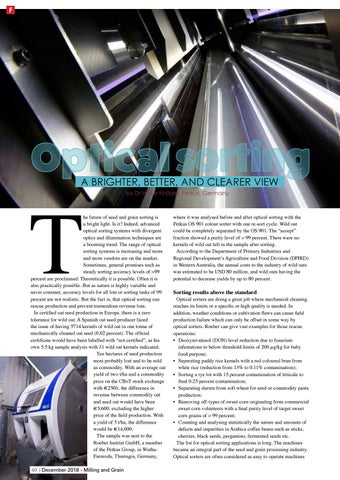
where it was analysed before and after optical sorting with the Petkus OS 901 colour sorter with one re-sort cycle. Wild oat could be completely separated by the OS 901. The “accept” fraction showed a purity level of > 99 percent. There were no kernels of wild oat left in the sample after sorting. According to the Department of Primary Industries and Regional Development’s Agriculture and Food Division (DPIRD) in Western Australia, the annual costs to the industry of wild oats was estimated to be USD 80 million, and wild oats having the potential to decrease yields by up to 80 percent.
Sorting results above the standard
Optical sorters are doing a great job where mechanical cleaning reaches its limits or a specific or high quality is needed. In addition, weather conditions or cultivation flaws can cause field production failure which can only be offset in some way by optical sorters. Roeber can give vast examples for those rescue operations: • Deoxynivalenol (DON) level reduction due to fusarium infestations to below threshold limits of 200 µg/kg for baby food purpose; • Separating paddy rice kernels with a red coloured bran from white rice (reduction from 13% to 0.11% contamination); • Sorting a rye lot with 15 percent contamination of triticale to final 0.25 percent contamination; • Separating durum from soft wheat for seed or commodity pasta production; • Removing off-types of sweet corn originating from commercial sweet corn volunteers with a final purity level of target sweet corn grains of > 99 percent; • Counting and analysing statistically the nature and amounts of defects and impurities in Arabica coffee beans such as sticks, cherries, black seeds, pergamino, fermented seeds etc. The list for optical sorting applications is long. The machines became an integral part of the seed and grain processing industry. Optical sorters are often considered as easy to operate machines