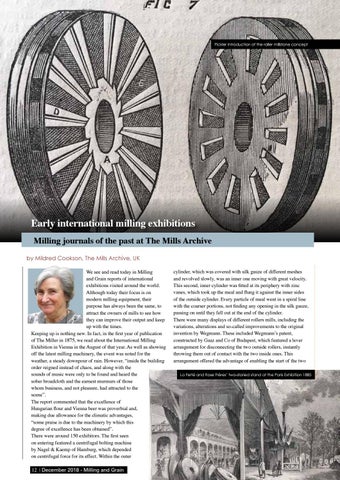
Pickler introduction of the roller millstone concept
Early international milling exhibitions Milling journals of the past at The Mills Archive by Mildred Cookson, The Mills Archive, UK We see and read today in Milling and Grain reports of international exhibitions visited around the world. Although today their focus is on modern milling equipment, their purpose has always been the same, to attract the owners of mills to see how they can improve their output and keep up with the times. Keeping up is nothing new. In fact, in the first year of publication of The Miller in 1875, we read about the International Milling Exhibition in Vienna in the August of that year. As well as showing off the latest milling machinery, the event was noted for the weather, a steady downpour of rain. However, “inside the building order reigned instead of chaos, and along with the sounds of music were only to be found and heard the sober broadcloth and the earnest murmurs of those whom business, and not pleasure, had attracted to the scene”. The report commented that the excellence of Hungarian flour and Vienna beer was proverbial and, making due allowance for the climatic advantages, “some praise is due to the machinery by which this degree of excellence has been obtained”. There were around 150 exhibitors. The first seen on entering featured a centrifugal bolting machine by Nagel & Kaemp of Hamburg, which depended on centrifugal force for its effect. Within the outer 12 | December 2018 - Milling and Grain
cylinder, which was covered with silk gauze of different meshes and revolved slowly, was an inner one moving with great velocity. This second, inner cylinder was fitted at its periphery with zinc vanes, which took up the meal and flung it against the inner sides of the outside cylinder. Every particle of meal went in a spiral line with the coarser portions, not finding any opening in the silk gauze, passing on until they fell out at the end of the cylinder. There were many displays of different rollers mills, including the variations, alterations and so-called improvements to the original invention by Wegmann. These included Wegmann’s patent, constructed by Gaaz and Co of Budapest, which featured a lever arrangement for disconnecting the two outside rollers, instantly throwing them out of contact with the two inside ones. This arrangement offered the advantage of enabling the start of the two La Ferté and Rose Frères’ two-storied stand at the Paris Exhibition 1885