November 2018
YOUR GLOBAL PARTNER
In this issue:
THE USUAL SUSPECTS Pest infestation in stored grain
• Roller mill update • Measuring protein directly on the combine
Milling and Grain . Volume 129 . Issue 11 . November 2018
• Bright prospects for Nigeria’s animal feed market • Wireless grain monitoring using IoT technology • The Zheng Chang Group 100-year anniversary
Event review Proud supporter of
Volume 129
Issue 11
millingandgrain.com
ÂŽ
Trusted. Tested. True
Catwalks and Tower Systems Easy assembly Engineered for safety and reliability Customized to complete your grain
Grain Storage
Dryers
Material Handling Systems
Catwalk and Tower Systems
Lemanco Bulk Storage Systems
Caldwell Grain Conditioning
handling system Globally recognized for customer service and quality products, our team assist you in determining the system that will suit your needs.
COMMERCIAL BINS
COMMERCIAL DRYERS
STEEL BUILDINGS
COMMERCIAL SWEEPS
BUCKET ELEVATORS
COMMERCIAL CONVEYORS
• 47.548m Diameter Bins (20320.9-48262.2 mt) • Tower Dryers (22.5-281.2 t/h) • Peak Load Rating (6803.8-45359.2 kg) • QuadraTouch ProTM Controls • Hopper Bins (3.65m-14.6m) • Balanced Moisture Content • Auger & Paddle sweeps available • Capacity includes 140.6-281.2 t/h • Patented Pivot Point • Industrial Grade Pushers
• Low Impact Head Design • Heavy Gauge Trunking • Patented Squaring Plates • Support Towers
• Industrial Strength • Built To Last • Higher Elemental Resistance • Capacity includes (984.3-1687.5 t/h) • Dust-tight and waterproof • Patented hip-style weather-tight cover • Catwalks
Su k u p World Headquarters - S heff ie ld , I o wa USA • www. su ku p . co m • in f o @ su ku p . co m For service in Europe contact:
Sukup Europe A/S Hedensted, Denmark Tel +45 75 68 53 11 • Fax +45 75 68 54 70 info@sukup-eu.com • www.sukup-eu.com
Pneumatic or Mechanical Ship Loaders & Unloaders Port Equipment - Turnkey Projects
1968 2018
1350 machines installed in more than 100 countries! VIGAN Engineering s.a. Rue de l’Industrie, 16 - 1400 Nivelles - Belgium Tél.: +32 67 89 50 41 • Fax : +32 67 89 50 60 • www.vigan.com • info@vigan.com
VOLUME 129 ISSUE 11
November 2018
Perendale Publishers Ltd 7 St George’s Terrace St James’ Square, Cheltenham, Glos, GL50 3PT, United Kingdom Tel: +44 1242 267700 Publisher Roger Gilbert rogerg@perendale.co.uk International Marketing Team Darren Parris Tel: +44 1242 267707 darrenp@perendale.co.uk Martha Cornwell Tel: +1 913 2083770 marthac@perendale.com Fred Norwood Tel: +1 913 6422992 fredn@perendale.com Latin America Marketing Team Iván Marquetti Tel: +54 2352 427376 ivanm@perendale.co.uk New Zealand Marketing Team Peter Parker peterp@perendale.co.uk Nigeria Marketing Team Nathan Nwosu Tel: +234 8132 478092 nathann@perendale.co.uk
Production Editor Rebecca Sherratt rebeccas@perendale.co.uk Features Editor Matt Holmes matth@perendale.co.uk International Editors Dr Roberto Luis Bernardi robertob@perendale.co.uk Professor Wenbin Wu ˘ wenbinw@perendale.com Mehmet Ugur Gürkaynak mehmetg@perendale.com Design Manager James Taylor jamest@perendale.co.uk Circulation & Events Tuti Tan tutit@perendale.co.uk Development Manager Antoine Tanguy antoinet@perendale.co.uk ©Copyright 2018 Perendale Publishers Ltd. All rights reserved. No part of this publication may be reproduced in any form or by any means without prior permission of the copyright owner. More information can be found at www.perendale.com Perendale Publishers Ltd also publish ‘The International Milling Directory’ and ‘The Global Miller’ news service
Grain & Feed Milling Technology magazine was rebranded to Milling and Grain in 2015
64 - CNC fluting machines
FLUTING MACHINES
Managing Editor Vaughn Entwistle vaughne@perendale.co.uk
ISSUE HIGHLIGHTS
2
NEWS FEATURES
53 THE ROLLER MILL UPDATE
54 The improvement of roller mills 56 The innovative use of modern materials
60 Titanium rollers 64 CNC fluting machines
FACES
6-42
70 Measuring protein directly on the combine 74 Growing Nigeria’s soybean industry
PRODUCT FOCUS
48
CASE STUDY
96
82 Keeping livestock fed throughout winter
84 The usual suspects - Pest infestation in stored grain
88 Trade body puts pest control under the spotlight in the grain industry
78 Bright prospects for Nigeria’s animal feed market
128 People news from the global milling industry
STORAGE
88 Wireless grain monitoring
EVENTS
104 Event listings, reviews and previews
TRAINING
44 GEAPS 500: Introduction to Grain Operations
COLUMNS
12 Mildred Cookson 22 Raghavan Sampathkumar 33 Tuti Tan 34 Sven-Olof Malmqvist
4 GUEST EDITOR Vaughn Entwistle
100 MARKETS Matt Holmes
126 INTERVIEW Stephan Lange
COVER IMAGE: Inside a Zheng Chang demostration silo, used as a welcome centre for visitors attending the 100 year anniversary celebration, inx liyang, China - See more on page 106
ISSUE HIGHLIGHTS #3 FLOUR
Measuring protein directly on the combine
Farmers have commented that if they bought everything that was going to save them money, then they would go broke. No wonder farmers are sceptical about new claims from suppliers that their new product, invention or service is the next big thing in agriculture. This article sets out a number of research findings going back for more than 50 years about the importance of getting the yield and protein balance correct in cereal crops.
RAGHAVAN
Impacts on the food industry and consumers’ health
SPECIAL SERIES
STORAGE
PEST CONTROL
Every year, the second Friday of October is celebrated as “World Egg Day”. On this day, it is important, as industry stakeholders of the food industry, to ensure spreading truthful information about the nutritional superiority of eggs.
A silo full of grain is like a bank vault stuffed with cash—the result of a farmer’s investment in hard work
PAGE 22
PAGE 90
Wireless grain monitoring using IoT technology
PEST CONTROL The usual suspects
The world population is projected to grow to between 9 to 10 billion people by the year 2050. This means that humanity faces a major dilemma as food production must increase by 70 percent from current levels to feed the increased population.
PAGE 84
PAGE 70
FOOD
STORAGE
FEED
PROCESS
SOYBEAN ROLLERMILL SPECIAL SCIENCE & TECHNOLOGY: The improvement of roller mills
PAGE 54
The innovative use of modern materials
PAGE 56
SOYBEAN GROWING NIGERIA’S SOYBEAN INDUSTRY
CNC fluting machines
PAGE 64
Nigeria has continued to battle a ballooning import bill for soybean and soybean products despite the West African country being one of the top three producers of the crop in Africa, alongside South Africa and Zambia.
PAGE 74
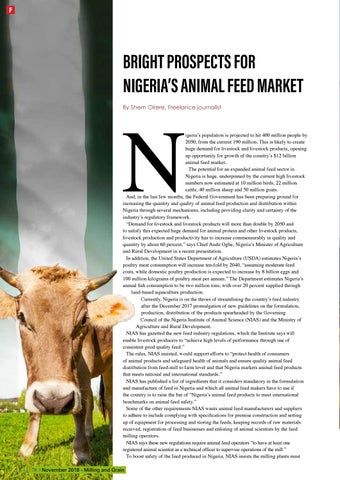
BRIGHT PROSPECTS FOR NIGERIA’S ANIMAL FEED MARKET
Nigeria’s population is projected to hit 400 million people by 2050, from the current 190 million. This is likely to create huge demand for livestock and livestock products, opening up opportunity for growth of the country’s $12 billion animal feed market.
PAGE 78
Bran finisher1950
The revolutionary technological path that never ends
Polygonal bran finisher 2018
www.ai-lati.eu
www.ocrim.com
Information sharing for a better world—why we publish We live in an age of increasing volatility. As I write these words, the geopolitical situation around the world is arguably more turbulent than it has been in decades. We face threats of global proportion: mass human migration, civil wars, and conflicts both hot and cold—and all this while the population continues to soar and climate change complicates our efforts to respond to a host of challenges that follow in its wake. At times, the fate of civilisation may seem bleak. However, as history has shown, the human race is enormously resilient and resourceful. Moreover, the very best of humanity rises to the fore when enterprising people share their knowledge and know-how across international borders to solve problems, to help humanity and to heal the planet. Here at Perendale Publishers we are proud of the fact that Milling and Grain is international in scope and circulation, and is printed and mailed in six languages. It is actually a cost for
us to do this, but we do it because we believe it is vital to share important information among all peoples and all nations. In his speech to the UN' FAO in Rome, our company’s publisher, Roger Gilbert, famously formulated the quote about our “need to feed 9.5 billion people by the year 2050.” Our magazine remains committed to helping the worldwide milling industry meet this challenge. There was recently a story in the news about the oldest bread in the world. This should remind our readers that the cultivation of wheat and the milling of that wheat into various forms of bread is one of the oldest human technologies. Our publication is the longest standing publication in the grain handling and milling sector having been continually published for 128 years. As such it has reported on everything from the earliest iterations of aspirators to the precision roller mills of today, and the earliest corn grinders to the cutting-edge optical colour sorters. The world is and always has been contentious and beset by challenges. However, we at Perendale Publishers believe that things can always get better. It merely requires the application of knowledge and the resolve of the human will. Vaughn Entwistle Managing Editor, Milling and Grain Magazine
A ONE-DAY CONFERENCE FOR MILLERS OF FOOD, FLOUR & RICE
13 June 2019 Cologne, Germany
TAKING PLACE AS PART OF
See more information on page 40
Milling and Grain has been invited to establish a cooperative partnership with COFCOET, which is part of the world renowned Chinese food and agricultural organisation COFCO. MAG will be reporting on the development of the Chinese milling industry and its production units under this new agreement which will see copies of MAG being distributed – in Chinese – to readers throughout its milling sectors. (See reports on page 26 and 94) Founded in 1952, COFCO is one of the largest SOEs of those under the direct supervision of China’s State Council. Besides the foodstuff business, COFCO has developed itself into a diversified conglomerate, involving planting, cultivation, food-processing, finance, warehouse, transportation, port facilities and is a top 500 enterprise chosen by Fortune Magazine.
Annual Subscription Rates Inside UK: UK£100 Outside: US$150/€133
ISSN No: 2058-5101
More Information www.millingandgrain.com http://gfmt.blogspot.co.uk
40 YEARS OF TESTED STRENGTH
One Tapco Nylon Elevator Bucket Supports a 9700 Pound* H1 HUMMER Ambient Temperature: 17 °F (-8 °C)
TAPCO’S CC-XD (Xtreme Duty) gray nylon elevator bucket supports a 9700 lb. H1 Hummer vehicle. Testing confirms that it will support over 20,000 lbs., more than two Hummers!
TAPCO’S CC-XD (Xtreme Duty) blue polyethylene bucket will support 9,000+ lbs.
Tapcoinc.com
TAPCO’S CC-HD (Heavy Duty) blue polyethylene bucket will support 5,000+ lbs.
314.739.9191 / St. Louis, Missouri USA No 814
*4399 kg
News
NOV 18
Milling
The Mark Cornwell Memorial Scholarship Fund
''A scholarship fund, in honour of the late Mark Cornwell, has been established by the charity Milling4Life, together with the American Feed Industry Association, and the Institute for Feed Education & Research. Milling & Grain magazine lost a dear friend and colleague last year with the passing of Mark Cornwell. After working for 23 years for World Grain and Milling & Grain magazines, he passed away in August 2017. The Mark Cornwell Scholarship Fund is raising funds to support students wishing to study grain storage, handling and food/feed manufacturing in the US. Scholarships will be in perpetuity if sufficient funds can be raised. The target is UK £55,000 (US $75,000). So far, UK £10,000 (US $15,000) have been donated, thanks to the giving members of Milling & Grain magazine and Tapco Inc. M4L is seeking companies in our industry, both within the USA and worldwide, prepared to contribute and who will be recognized for their contribution each time applicants are called upon to take up the scholarships. Individual donations are also welcomed and will be acknowledged via the M4L website, if they wish to be identified.'' Thank you to our latest supporter "Here at Tapco Inc. we have built a long, strong relationship with Mark Cornwell and it was a sad day that he was taken from us so soon. His commitment to the grain milling and grain handling sector was globally recognized and he will be sorely missed. Tapco Inc. recognizes the benefits of training young new talent in our industry and as such we wholly endorse this initiative to set up a trust fund in Marks name and in perpetuity for future millers and grain handling engineers." Paul Taylor, Tapco
TARGET US$75K
18%
Burnt bread crumbs were recently discovered in the Black Desert in Amman, Jordan, by Dr ArranzOtaegui, of the University of Copenhagan, which predated what we previously thought was the oldest evidence of bread-making in the world. Breadmaking, now, is traced back to an incredible 12,000 BC, an astonishing fact to comprehend. The history of bread is one that spans centuries. Evidence of breadmaking has also been traced back to Ancient Egypt, through artistic depictions and engravings of the baking process. One very common technique of baking, as it were, was to use dough, with sugar and water inside, and leave it for a day or two, in order to later use it as a sourdough starter. The first idea of an oven, that could be pre-heated, is said to have arisen from the Greeks. In the Middle Ages, bread had quickly cemented itself as a staple food, stale bread used as an absorbent plate. The 19th century soon saw a rise in imported bread, and so it soon. Grew in popularity once more. Industrialisation also greatly advanced bread-making technology with the invention of the bread-slicing machine in 1912. Our current, popular methods with bread have been in place since roughly the 1980s. It is amazing how the grain industry dates so far back. Despite the advancements that we are now discussing in 2018, soon to be 2019, that are innovative and completely change the shape of the grain industry, we forget just how old this sector is. It is, possibly, one of the oldest industries that has ever existed, starting with the simple concept of food itself. It is impossible to overestimate the importance of such a vital sector, as without it the human race would undoubtedly have run out of food resources and sustainable nutrition many centuries ago. Yet, with the modernisation of the world, it is a sector that continues running, but is largely dismissed and forgotten by those not involved in the industry. The food placed on people’s tables carries such enormous weight and history behind it, and yet, to so many individuals this history is unknown. This is one of the multiple reasons why Milling and Grain strives to raise awareness and inform people about the grain industry, and the importance such a vital business holds for people worldwide. The Global Miller is part of this aim to reignite people’s interests in the grain industry, as it a sector that truly blossoms open with interesting facts and news, when one becomes exposed to it. As this industry continues to advance, who knows what new discoveries we will find?
GF https://milling4life.charitycheckout.co.uk 6 | November 2018 - Milling and Grain
MT
gfmt.blogspot.com
The double sandblasting nozzle achieves a faster sandblasting process while compressing air consumption.
www.balaguer-rolls.com Twitter
18 BR-SM
Youtube
www.golfettosangati.com info@golfettosangati.com
Milling News
World Food Day 2018: GODAN guidelines
A
guide for governments, regarding viewership of agricultural data has been launched by the Open Data Charter and Global Open Data for Agriculture (GODAN). Launched 16th October, 2018, on World Food Day, the Open Up Guide for Agriculture aims to help governments to prioritise and publish relevant datasets for agricultural development. GODAN supports the proactive sharing of open data to make information about agriculture and nutrition available, accessible, and usable to help governments, businesses, other organisations and individuals make better decisions to achieve food security worldwide. GODAN Executive Director Andre Laperriere says, “the Open Up Guide for Agriculture is something that our partners have been asking us for; a framework to help governments prioritise agricultural datasets to open along with examples of how open government data is improving agricultural production and farmer livelihood worldwide. The guide makes it easier for governments to take that step to open datasets responsibly, and see that impact as soon as possible.” According to a statement released by the Food and Agricultural Organisation of the United Nations for World Food Day, after a period of decline, world hunger is on the rise again. The world today is facing a major food security challenge. As the world’s population grows to around 10 billion by 2050, the global agriculture system is under pressure to provide sufficient nutritious food to meet the demand. Achieving food security through
sustainable agriculture in the next 15 years is a global priority for the United Nations, as enshrined in the Sustainable Development Goals. This can only be achieved by sustainably increasing agricultural productivity, while creating more resilient food production systems, and shaping more accessible and equitable markets. Making agriculture data open facilitates the development of solutions to food security in ways that would otherwise be expensive, time intensive or impossible. It enables more efficient and effective decision making by stakeholders at all levels, it fosters innovation that everyone can benefit from, and drives organisational and sector change through transparency in food production chains. The guide was created for policymakers and civil society who want to inform decision makers on open data and agriculture, and understand how open data can make a difference for the agricultural sector and food security. It can be used by those who want to start developing an open data strategy for agricultural transformation in their country or region.
Grain and Flour Analyzer Experts Ash
Moisture Protein
Gluten Falling Number
• 50+ years knowledge and expertise • Functional and compositional analysis • Flour, grains and oilseeds www.perten.com
Milling and Grain - November 2018 | 11
The New Roller Mills at Prouvy
The new roller mills, Prouvy, France, on the carter system Milling journals of the past at The Mills Archive by Mildred Cookson, The Mills Archive, UK An account in “The Miller” in November 1886 described the opening of another mill risen from the ashes, this time in France. In July 1885 a disastrous fire claimed the mill belonging to the Société Nouvelle des Moulins de Prouvy, a company established in 1884 in the village five miles from Valenciennes. The mill already had an international pedigree, with elements uniting France, England and Belgium. Representatives of each country attended the opening ceremony including, from England, Bryan Corcoran, Gilbert Gilkes and William Marriage. The original mill had been erected around 1874, taken over in May 1984 by the Société and fitted with 36 pairs of stones. By the end of 1884 12 pairs of stones were thrown out and replaced in early 1885 by a roller plant capable of producing twenty 280lb sacks of flour per hour. A spectator of the fire in July reported “(the mills) were brick built and slated, worked by water and steam, having four large waterwheels inside the mill. The engine and boilers were in separate compartments, having a window one foot square only to communicate by. The mills were lofty, well built, clean, well lit with large windows and lighted by gas at night.” Undaunted by the disaster, the company resolved to rebuild the mill and to replace the Carter roller plant, destroyed in the fire, by another of like capacity. Mr Carter completed the work in the last days of September 1885. The mill was well connected with the town of Prouvy by rail, tramway and the River Escaut and thus with the greater part of France and Belgium. The calculated capacity of the mill (18 sacks/hour) was rapidly exceeded and on the opening day reached nearly 20 sacks/hour followed later by 21 sacks/hour. The motive power for the mill, screen room and warehouse came from a pair of twin engines and four water-powered four 12 | November 2018 - Milling and Grain
turbines. The River Escaut was connected to the mill by means of a headrace, which took the water above one of the locks. After passing through the turbines and under the mill, the water rejoined the river about half a mile below the lock. The resultant fall was around 7ft with the supply of water about 16,000 -20,000 cubic feet/minute. Sir Frederick Bramwall, Past President of the Institute of Civil Engineers, had advised the use of the “Vortex Turbine” made by Gilbert Gilkes & Co of Kendal. They ordered four 60 hp turbines to be placed immediately below the main drive. The power was transmitted by means of morticed bevel gearing, so arranged that any of the turbines could be thrown in or out of gear
The Wegmann Victoria Porcelain Roller Mill
The Purifier or First Floor
The Roller or Ground Floor
without stopping the mill. The roller mill itself was a substantial brick building of four floors, ground floor and basement. The basement had the usual shafting by which the machinery on the floors above was put into motion. The four rows of roller mills on the floor above were driven by means of belts from two shafts, each shaft driving two lines of machinery and two shafts being connected together by four cotton ropes. The mill had 37 elevators for conveying the various products to the different machines on the several floors. On the ground floor 24 double rollers were placed in four rows of six machines each, for the reduction of the wheat and the flouring of the middlings. These roller mills comprised 10 Carter grooved chilled iron four-roller mills for the breaks, 10 Carter smooth chilled iron four-roller mills and four Wegmann porcelain roller mills. The wheat before the first break machine was graded into three sizes, after which it was broken on a Carter grooved roller mill, grooved for the first break. The product of the first break was then elevated to the first break scalper, the tailings of which were broken
The Dressing or Fourth Floor
on the second break machines. The rest of the breaks were done in the same way. The reduction of the middlings were done on 10 Carter smooth chilled iron four-roller mills and the extra purified semolina on four Wegmann porcelain two-roller mills. The first or purifier floor had two Stanniar bran dusters and the Van Gelder grader for sizing the wheat before going to the first break machine on the floor below. There were three Carter gravity purifiers, two of which were fed from the tail sheet and tailing of the chop reel. The purified middlings were reduced on the four Wegmann roller mills for patent flour. 10 silk reels about 20ft long were on the next floor. Two were used as chop reels for dressing the products from the second, third and fourth break scalpers. The dressing from the tail sheets and tailings of the two chop reels went to the gravity purifiers and the product was dusted on two long silk reels on this floor. Four of these reels were used for re dressing the flour, and the remaining one graded the middlings obtained from the reduced semolina from the gravity purifiers, after it had been dressed by a centrifugal and the flour taken away. On this floor were also
ANDRITZ partnership We will go all the way with you
Your partner for Feed & Biofuel Technologies
ANDRITZ Feed & Biofuel A/S Europe, Asia, and South America: andritz-fb@andritz.com USA and Canada: andritz-fb.us@andritz.com
ANDRITZ offers a broad ran ge of aftermarket services, which includes service, sup port and followups, repairs and spare and wear parts. ANDRITZ is a global leading supplier of technologies, sys tems and services of advanced industrial equipment for the feeding and fueling feed indu stries. We design and manufac ture all key process equipment as well as offer complete plant solutions.
www.andritz.com/ft
Milling and Grain - November 2018 | 13
WHETHER CORN, WHEAT OR SOY, IPPE FEEDS ALL YOUR BUSINESS NEEDS
atLanta, ga Usa | FEB. 12 - 14, 2019 R EgIstER now at www.ippexpo.org
Join us for the 2019 IPPE where everything you need to manufacture animal foods is on display. Feed your business needs, and connect with more than 30,000 industry professionals in feed, meat, poultry and more at one powerhouse of a show in February!
Milling News The Wheat Cleaning Department
The Staniar Bran Duster
The Vortex Turbine
possers or jiggers and sack valves for packing the flour and offals. On the next floor the, while the products of the second, third and fourth scalpers were dressed by reels. the products of the fifth and sixth break scalpers were dressed by a centrifugal. This floor also held six more centrifugals driven by means of one quarter twist belts from the shafting on the fourth floor, and a line of shafting which drove the scalpers and the centrifugals on the floor above. On the fourth floor was a long silk reel, 12 Carter centrifugals placed in two rows, and a single leg purifier. One row of centrifugals was driven by means of a quarter twist belt from the shafting on the third floor and the remaining row of centrifugals
and elevators driven by belting from a line shaft on this floor. In all, 18 centrifugals, two for dressing and re dressing the product from the fifth and sixth breaks, two for dressing the reduced semolina from the first reduction rolls and one used for dressing the tailings of the flour re-bolting reels, the product of which was flour and the tailings were then reduced again for the second reduction. Two centrifugals were used for the dressing of the product from the four Wegmann porcelain roller mills on the first middlings reduction, the rest were used for dressing the various reductions. After the opening ceremony and tour of the mill there was a reception held in Valenciennes, where Mr Carter said he felt that in erecting this plant his task had been a pleasant one from first to last, and it gave him special pleasure to thank the directors of the Prouvy Milling Company for all the kindness he had received at their hands. He had felt an additional interest in building this mill from the fact that the gentleman under whom he had served his apprenticeship in the art of milling had himself done some very remarkable work as an erector of flour mills in France.
Milling and Grain - November 2018 | 15
Milling News
Biomin breaks ground on new Erber Group production site in Haag am Hausruck, Austria
E
rber group’s affiliated company, Biomin, that develop top-quality, antibiotic-free nutrition products for profitable and sustainable animal production recently broke ground on a new production site. The facility, located in Upper Austria, is scheduled to begin operations in December 2019 and symbolises Biomin’s further growth and expansion. “We have decided to invest in Austria in a sustainable and forward-looking way. This is proof that Erber Group’s significant international growth is also manifest in Austria. The new Biomin production site is only one of the several big steps in the years to come,” says Jan Vanbrabant, PhD, Erber Group CEO, at the production site in Haag am Hausruck, Austria. The new production site will produce natural mineral feeds and premixes, which help to improve the performance of swine, poultry, beef cattle and dairy in a sustainable manner. The construction process will take approximately 12 months. Markus Edlinger, MBA, Managing Director of Biomin added, “we are very happy that construction will start soon. The new site will only be 20 minutes by car from the existing production facility. We are building one of the
We Deliver.
Pictured (from left to right) Austrian National Parliament Member Manfred Hofinger, Markus Edlinger (Managing Director BIOMIN), Mayor Konrad Binder, ERBER CEO Dr Jan Vanbrabant, Lukas Erber. Image courtesy of @Sebastian Philipp
world’s most modern mineral feed production sites here in Upper Austria, and it will be the basis of Erber Group’s strategy for the future.” Austria National Parliament member, Manfred Hofinger, came to the ground-breaking ceremony on behalf of Upper Austria Governor Thomas Stelzer. He expressed his pleasure about the start of the construction. “We are proud that an international group of companies like Erber and its affiliate Biomin are investing a euro amount in the double-digit millions in a site here in Haag am Hausruck. This permanently safeguards jobs and strengthens added value for the entire region on a longterm basis.”
Your partner for high quality ring dies
Seedburo Equipment Co. has delivered testing, inspection and grading equipment to the grain, feed and seed industries for over 100 years. We pride ourselves on providing quality, stateof-the-art equipment. What can we deliver for you today?
VISIT US AT THE EUROTIER 2018 BOOTH: 21D10
NTEP UGMA Medidor de Humedad GAC2500-INTL
800-284-5779|312-738-3700|sales@seedburo.com
100_WeDeliver_Seedburo.indd 1
16 | November 2018 - Milling and Grain
29/03/2016 13:48
WWW.PCE.EU
Milling News
T
Ag Barometer drops to lowest level in two years he latest Purdue University/ CME Group Ag Economy Barometer reading has proven especially foreboding, as agricultural producer sentiment has reportedly dropped to its lowest level since October 2016. Producers have expressed deep concerns over worsening of farm financial conditions. The September barometer reading was 15 points down, when compared to August’s reading. The barometer is based on a monthly survey of 400 agricultural producers from across the country. Since then, readings have only continued to decline. Large declines were also seen in the barometer’s two sub-indices, the Index of Future Expectations, which fell 10 points, and the Index of Current Conditions, which fell 25 points, both compared to their respective August readings. “The barometer readings have been unusually volatile over the past few months,” said James Mintert, the barometer’s principal investigator and director of Purdue University’s Centre for Commercial Agriculture. “Concerns
about the ongoing impact of trade conflicts, and especially China’s tariffs on imports of US ag products, continue to reverberate throughout the US agricultural sector.” Producers indicated that financial conditions on their farms deteriorated significantly as 2018 unfolded and their expectations for the future also weakened. In September, 54 percent of farmers surveyed said their farm’s financial condition was worse than a year earlier, up from 38 percent who felt that way in June. The September survey also indicated that 33 percent of producers expect their farm’s financial condition to be worse a year from now, up 15 points compared to responses received to the same question in June. Trade conflicts and tariffs continue to be a source of angst among US farmers. When asked whether they expect trade conflicts to lower their farm’s net income, more than 70 percent of producers surveyed said they expect lower income in 2018 because of trade disruptions with a large majority of respondents saying they expect an income decline of more than 10 percent.
Biomin host successful World Nutrition Forum
A
nimal nutrition company Biomin hosted 800 delegates from 76 countries in Cape Town, South Africa, for the eighth World Nutrition Forum, from October 3-5, 2018. The theme of the scientific conference was S.C.O.P.E., or ‘Scientific Challenges and Opportunities in the Protein Economy’. More than 40 expert speakers addressed topics such as latest market trends and scientific developments. Networking opportunities were also experienced in the multitudes as attendees enjoyed experiencing the richness and diversity of the local culture. “Growing global incomes provide opportunities for entire animal protein industry, but the added production must be safe, affordable, sustainable and environmentally friendly”, reminded Dr Vanbrabant, Managing Director of Biomin and CEO of Erber Group. Don't miss our special report on Biomin's World Nutrition Forum in December's edition of Milling and Grain.
The Easy Way to Control Moisture Digital Moisture Sensors for Grain, Rice and Animal Feed
Hydro-Mix HT
High Temperature
• • • • • •
Hydro-Mix XT
Each sensor is a single, self-contained unit incorporating all functionality Easy to install in drying, ducting, conveying or mixing processes
Hydronix Ducting System
Simple ducting installation using the Hydronix System Hydronix digital measurement technology for precise results Wide moisture measurement range Simple to install, calibrate and maintain
enquiries@hydronix.com
www.hydronix.com
18 | November 2018 - Milling and Grain
Milling and Grain half page horizontal 190 x 132 plus 3mm bleed.indd 1
01/10/2018 12:43:47
Grain care, our commitment
In Symaga Silos we are passionate about storage and always look forward to the next grain care challenge. Consolidated as one of the main manufacturers of industrial silos, Symaga is currently involved in the biggest storage projects around the world. Our commitment is to offer better, all-technical, global, and tailored services to each project. We account for over 7,000 projects, with more than 28 million m³, in more than 140 countries.
Symaga To Roll Out New Project Department We are improving our technical capacity with a new PROJECT DEPARTMENT, innovating to give tailor-made solutions to every new challenge in grain handling. Our professional team is ready to assist you in your new venture. . New Department made up of Project leaders, focused on - Comprehensive planning with precise timings - Seamless follow-up with a single contact point - Prompt problem-solving
Visit us Visit us
Vietnam International 02 - 06 Nov., GRAIN TECH INDIA Can-Tho, Vietnam 28 30 August, Stand 265-271
Bangalore, India Stand: G24
ALIM 11 - 14 Nov., Puerto Varas, Chile Stand 43
POULTRY INDIA 28 - 30 Nov., Hyderabad, India Stand N11-N13
symaga.com • +34 91 726 43 04 • symaga@symaga.com
Mühlenchemie’s affiliate in China is ready for the World Food Programme
F
ollowing a wide-ranging audit by the Global Alliance for Improved Nutrition (GAIN), Mühlenchemie’s
production facility in Suzhou now meets all the quality requirements for supplying the United Nations World Food Programme (WFP) with
The world’s leading trade fair
13 – 16 November 2018 Hanover, Germany Hotline: +49 69 24788-265 | expo@DLG.org www.eurotier.com | facebook.com/eurotier
including
20 | November 2018 - Milling and Grain
RZ_Anzeige_ET_2018_130x180_EN.indd 1
29.06.18 12:03
micronutrient premixes. GAIN was commissioned by the World Food Programme to ensure that it maintains the highest quality standards in the production of foods for the WFP. This is the fourth Mühlenchemie plant to be NGO-certified after Germany, Mexico and the USA. It widens the company’s international network of production facilities in which fortified foods can be produced locally according to the same high-quality standards. Nearly two billion people worldwide suffer from “hidden hunger”, a vitamin or mineral deficiency. Those who suffer worst are women of child-bearing age, since micronutrient deficiency in the mother has a negative effect on the pre- and postnatal development of her children. Fortification of flour and the distribution of micronutrientenriched foods is one approach to address this problem. With a network of 18 applications laboratories and five production plants, extending from Europe through Africa to Central America and Asia, Mühlenchemie responds to the worldwide demand for vitamin and mineral premixes for use in flour fortification. In addition to selling solutions for flour standardisation on the free market, Mühlenchemie now meets the quality requirements to participate in tenders for contracts with the WFP in Asia, too. The audit confirmed that the plant in Suzhou meets the stringent requirements of the WFP. The certificate now permits the facility to offer vitamin and mineral premixes for “Super Cereal”, the nutritious maize and soy mixture of the United Nations World Food Programme. To ensure continuous quality management, Mühlenchemie has also invested in a humidity chamber in which real-time stability tests of its own can be carried out on-site, without recourse to outside laboratories.
Milling News
The Raghavan Report Food myths & celebrities: Impacts on the food industry and consumers’ health by Raghavan (‘Ragha’) Sampathkumar Every year, the second Friday of October is celebrated as “World Egg Day”. On this day, it is important, as industry stakeholders of the food industry, to ensure spreading truthful information about the nutritional superiority of eggs and concerted action from all stakeholders for busting myths about food, in general. Let us first take eggs as nutritional food. Eggs are one of the nature’s powerful foods packed with essential nutrients such as proteins, vitamins and minerals that are better in quality and bioavailability than most of the comparable foods. For example, eggs contain choline, an essential nutrient that helps brain development and cognitive abilities in children. Similarly, the protein in egg white is possibly the best quality protein with a biological value (BV) of a perfect 100, more than all others. However, since last few years, several reports about linking eggs to various kinds of illness including cardio-vascular diseases, bad cholesterol etc have been spread on several social media channels. An ordinary consumer, who might or might not have clear understanding of science and nutrition, will be made to believe whatever posted on social media as truthful information. However, after certain point and getting overloaded with information, the consumer gives up and does not think much further rationally. Ultimately, the purpose of such misinformation i.e. to confuse the consumers is achieved. However, this has huge negative implications on food industry and also the consumers. Truth does not travel as fast as lies. But due to fears spread based on unknown and unfounded claims, the food industry suffers loss of reputation and it is nearly impossible to counter the negative publicity with the limited resources that the industry has. All these negatively impact the way consumers decide about what food to consume and 22 | November 2018 - Milling and Grain
influences their preferences. Added to this are celebrities showcasing their latest ‘food fads’ on social media, which influences a huge number of people particularly, youth across the world. This trend is unfortunately growing as people blindly follow the celebrities without considering their situation in terms of socio-economic status, country’s development and also future generations. Today’s youth have much greater opportunities to seek information but that must be authentic and reliable. When in doubt, who should be consulted? A celebrity or an expert? Hence, I urge today’s young generation not to blindly believe in the celebrity endorsements and/or shifting their preference to different kinds of diets. When in doubt, they should rather consult a nutritionist to get the correct information. Food fads are not new but with the advent of social media, their reach and impact have grown multi-fold. It is visible from the way diets across the world are converging and the world’s dependence for calories has increased on a few crops in the last four or five decades. As a result, a significant number of indigenous crops that once used to be major food, have almost disappeared from the menu. Hence, the food industry in Asia must act now to improve its reach and educate consumers about food and nutrition. It is no longer a discussion of cost of doing business. It is actually “cost of losing” business. Further all the stakeholders connected with food, health and nutrition domains, must come forward to bust the myths starting from their family level. Regulators, on the other hand, need to take stern action against those who are making false claims and spreading unfounded myths. Policy makers must take a holistic view about the interplay of different sectors – agriculture, human medicine, veterinary sciences, etc. But ultimately if every consumer starts asking the right questions - “Is it true?”, “Should I really follow a celebrity for advice on food?” – the entire society stands to benefit.
PINGLE. PROFESSIONAL MANUFACTURER OF GRAIN MACHINERY ★ INTEGRATED MILLING SOLUTION PROVIDER ★ ISO 9001:2015 CERTIFIED
Аdd: Zhengding, Shijiazhuang,Hebei,China Tel: +86-311-88268111 Fax: +86-311-88268777 E-mail:pingle@pingle.cn / www.plflourmill.com
Milling News
Evonik sponsors new feed mill at Nong Lam University, Vietnam
N
ong Lam University, Vietnam, has recently opened a new, state-of-the-art feed mill for production of pelleted trial feeds as part of a scientific collaboration with feed additive specialist company, Evonik. The new facility promises to enhance research into animal nutrition and sustainable feed production, and to support training for students. It is well established that pellet quality is crucial in commercial feed production. The new pellet feed mill is dedicated to research trials and will provide a valuable resource to foster technological advancement of a more sustainable feed industry in the country. “We are very excited about this new partnership with the Faculty of Animal Science and Veterinary Medicine at Nong Lam University,” said Detlef Bunzel, Head of Applied Feed Technology, Evonik Nutrition & Care GmbH. “Together, we will be able to improve the quality of research into nutritional concepts, feed technology and new products, and thus foster growth of the local industry.” Located at the Nong Lam University campus in Ho Chi Minh City, the facility will produce mass feed for research trials and is designed for handling various small batches, while minimising cross-contamination. As well as providing a basis for better research, the feed mill will also be a crucial teaching resource. Vietnam is an important and growing market for specialist animal nutrition, driven by an increasing demand for safe and healthier food, according to Dr Jan-Olaf Barth, Vice President for Evonik Nutrition & Care, Asia South. He emphasised, “we welcome the opportunity to contribute to the development of a sustainable food production value chain through a close partnership with local research institutions and our customers. “Good quality animal protein should be accessible,
affordable and available to everyone, as part of a healthy human diet. By sharing expertise and resource with academic institutions such as Nong Lam University, we can move closer to that vision.”
Milling and Grain - November 2018 | 25
F
Rising living standards support greater milling innovation in China
C
OFCO Engineering and Technology Co Ltd, under COFCO Corporation, “is an international renowned technology services leader for cereal, oil and food engineering,” says this mainstay Chinese engineering company in its Vision Statement. And “Providing the best return on investment through engineering services, creating value for customers, shareholders, employees and industry” alike is its mission. This Chinese organisation is an integrative-technology leader and innovative-technology provider for the cereal and oil crushing industries and is committed to promoting the progress of the industry within China and increasingly abroad. “Our company is specialising in technology R&D in the grain and oil industries – processing such crops as wheat, rice, oil and fats, corn, feed processing, grain logistic and storage – in addition to engineering design, consultation, turnkey project service, supervision and manufacturing of full set of manufacturing equipment,” says COFCO International. Its customers are widely spread and include more than 20 countries and regions such as China, Russia, Ukraine, Thailand, Uzbekistan, Greece, India, Venezuela and Sudan. With the remarkable improvement of people’s living standard within China and also abroad, customers have higher requirements for flour quality, it adds. “So, we put forward new flour mill technology, which is
Genuine for over 50 years!
Grain Cooling
GRANIFRIGOR™ The most natural way of grain preservation •
Protection against insects & fungi
•
Without chemical treatment
•
Short amortisation period
•
Low energy demand
•
Independent of ambient weather
•
No respiratory losses
F r i g o r Te c G m b H • i n f o @ f r i g o r t e c . d e • w w w. f r i g o r t e c . c o m
26 | November 2018 - Milling and Grain
in contrast to traditional process, stresses on strengthening the break roller mill to enhance the sequential scraping; widening the front-stage reduction roller mill to realise gentle milling and refined segmentation; enlarging purifying scope to intensify classification; increasing sifting area to improve screening efficiency”. This process can effectively reduce the damage to starch, ensuring flour quality and raise flour extraction rate. By design In order to reduce generation of damaged starch, we improve flour milling process design by extending contracting length of material and grinding roller. At the same time, we increase contracting area of material and grinding roller by taking use of large-diameter grind roller, says the company. “We also appropriately reduce grinding pressure in flour milling process so as to greatly reduce damaged starch content in finished product.” Roller mill, one of the main pieces of equipment in flour milling process, takes critical function in flour milling technology. Roller mills made by COFCO Engineering and Technology makes some improvement in traditional triwheel roller drive mechanism. “We change rigid-eccentrically tension pattern to elasticeccentrically tension pattern, which leads to smooth and steady grinding process and reliable quality of flour production.” This approach has acquired a PCT patent (Patent Number: EP2913111B1). “We also change roller-dismounting mode from “one roller after one another to overall-dismounting of roller supporting part”, which significantly cuts down grinding roller dismounting time and greatly increases production efficiency of flour mill plants, the company adds. “Pursuit of superior flour is our ultimate aim in flour milling process. We should supply not only innovative manufacturing technique, but also unique processing equipment based on different quality of raw grains. Optimal engineering proposals, which is precision engineered to achieve the highest efficiencies yet versatile and flexible, will always be specifically customised for our clients’ needs.”
30
th
YEARS
A N N IV E R S A R Y
UNIVERSAL RECLAIM SYSTEM
E L P M I S • T R A M S • E F A S FIND THE PERFECT
ing inciple of undermin Based upon the pr les of bulk materials. residual pi e foot of ating action at th A continuous vibr sive layers of product, es a pile abates succ flowing, until complete e cohesive or fre sidual pile. clearance of the re
SOLUTION BIOMASS
d
Guarantee Total Clearance
Pellets • Wood chips • Sawdust Bagass • Coffee grounds
AGROFOOD
Soybean meal • Sugar • Cereals Oil seeds • Flour
INDUSTRIES
Potash • Fly ash • RDF • Plastics
CONTACT US
30 YEARS
WORLDWIDE EXPERIENCE
ISO 9001 : 2015 AB Certification
VIBRAFLOOR
Z.A. 27 rue de la Tuilerie 71640 Dracy-le-Fort / France Phone: +33 (0)3 85 44 06 78 Fax: +33 (0)3 85 44 06 79 E-mail: vibrafloor@vibrafloor.com
w w w . v i b r a f l o o r. c o m
Powe red by innova tio n
Milling News
Iowa State University professor receives 2018 Sukup Award
D
r Manjit K Misra, Director of the Seed Science Centre at Iowa State University in Ames, Iowa, was the lucky recipient of the 2018 Sukup Global Food Security Award. The award was presented by the American Society of Agricultural and Biological Engineers (ASABE) and recognises brilliant contributions to global food security through research, outreach, and teaching in post-harvest seed science, technology, and policy. Dr Misra received the award at ASABE’s annual international meeting in Detroit, Michigan. The Seed Science Centre is the world’s largest public facility devoted to seed technology, and Misra has had a transformational
impact on food security by applying engineering principles to seed technology and systems. The Sukup Global Food Security Award was endowed by Sukup Manufacturing Co and consists of an engraved crystal trophy featuring a globe, and a $1,000 cash prize. “Providing food around the world is critical to both increasing prosperity and also alleviating hunger and suffering among our most vulnerable global citizens” says Charles Sukup, President of Sukup Manufacturing, who presented the award. “Seed is a fundamental building block of food security, and Dr Misra’s leadership has greatly contributed to developing and preserving the
viability of seeds. We are thrilled to recognise his important work with the 2018 Sukup Global Food Security Award.” Dr Misra has received numerous awards from several organisations in recognition of his research and professional accomplishments. He is the recipient of the Distinguished Service Award from the American Seed Trade Association, for Leadership, Vision, and Exemplary Service to the US Seed Industry; Engineer of the Year, Iowa Section, American Society of Agricultural Engineers; and has served on the Scientific Advisory Council, American Seed Research Foundation, since 1991.
Ottevanger Milling Engineers is a leading global supplier of production equipment and processing lines for the grain processing and compound feed industry. Our expertise lies in engineering, manufacturing, project management, and cereal processing. We plan, design and manage the construction of complete production facilities or individual lines for processes such as:
VISIT US AT THE EUROTIER 2018 BOOTH: 21J10 www.ottevanger.com 28 | November 2018 - Milling and Grain
A Triott Company
» Feed mills » Premix and concentrate plants » Aqua feed and Pet food installations » Cereal processing lines » Biomass installations
4B Designs and Manufactures Components for Bucket Elevators and Conveyors Elevator Buckets
Elevator Bolts
Preventative Maintenance & Hazard Monitoring Systems
Belting & Splices
Speed Switches
Conveyor Chain
Belt Misalignment Sensors
With sales and technical support offices in North America, Europe, Asia, Africa and Australia along with a worldwide network of distributors, 4B can provide practical solutions for any application no matter the location.
Engineering Solutions Since 1888
Bearing Temperature Sensors
Plug Switches
www.go4b.com/milling
Milling News
Biomin launches Spectrum Top 50 advanced mycotoxin detection service
B
iomin has introduced an innovative new mycotoxin detection service for customers throughout the world. Spectrum Top 50 allows for the identification of over 50 different mycotoxins and metabolites in finished feed and raw materials. “Regular testing for regulated mycotoxins is an accepted part of an effective mycotoxin risk management program,” says Ms Ursula Hofstetter, Head of Global Product Management Mycotoxins at Biomin. “With Spectrum Top 50, customers will have access to a powerful new method to uncover previously undetected masked and emerging mycotoxins lurking in their feed in addition to the regulated ones,” explains Ms Hofstetter. “We expect customers to benefit from getting a full view of the mycotoxin situation in their feed, and the speed and scope of Spectrum Top 50 is unmatched in the market.” Scientific research and guidance from authorities have signalled that there is cause for concern regarding masked mycotoxins that cannot be detected by conventional
methods, as well as so-called ‘emerging’ mycotoxins whose effects are still being discovered. For example, masked and certain acetylated forms of deoxynivalenol (DON or vomitoxin) are readily transformed back to DON in the intestine, and then able to pose a threat to animal health and performance. “Applying the most advanced scientific solutions to issues our clients encounter due to mycotoxin contamination has always been a guiding principle for us as a company,” states Jan Vanbrabant, Managing Director of Biomin and Executive Board Chairman of Erber Group. The mycotoxin detection service to help Biomin clients identify mycotoxin issues closely complements its leading mycotoxin deactivating feed additive, Mycofix. “With Spectrum Top 50, we have extended our mycotoxin risk management offering to help customers achieve state-of-the-art detection and protection,” notes Ms Hofstetter. Spectrum Top 50 relies upon liquid chromatography coupled to tandem mass spectrometry technology using a method developed by Romer Labs. “The new service demonstrates the clear synergies that benefit customers of ERBER Group companies,” concludes Mr Vanbrabant.
www.perryofoakley.co.uk sales@perryofoakley.co.uk +44 (0)1404 890300
Since 1947
The UK’s Most Experienced Manufacturer of Materials Drying & Handling Equipment
Capacities of up to 1000tph available - Heavy duty, galvanised construction - Ranges suitable for grain & bulk materials • Continuous Flow Grain Driers • Belt Driers • Chain & Flight Conveyors
• • • •
Belt & Bucket Elevators Belt Conveyors Aspirator Cleaners Levelling Conveyors
• Augers & Screw Conveyors • Ducting & Valves • Twin Trace Conveyors
Call now to discuss your drying & handling needs! 30 | November 2018 - Milling and Grain
漀渀 琀栀攀 眀愀礀 琀漀 琀栀攀 昀甀琀甀爀攀
刀☀䐀 吀伀倀 ㈀㔀
圀攀 愀爀攀 愀洀漀渀最 琀栀攀 琀漀瀀 ㈀㔀 挀漀洀瀀愀渀椀攀猀 琀栀愀琀 椀渀瘀攀猀琀 洀漀猀琀 椀渀 刀☀䐀 猀琀甀搀椀攀猀 椀渀 吀甀爀欀攀礀⸀ 圀攀 愀爀攀 琀栀攀 猀攀挀琀漀爀 氀攀愀搀攀爀 椀渀 刀☀䐀 椀渀瘀攀猀琀洀攀渀琀猀⸀
眀眀眀⸀洀椀氀氀攀爀愀氀⸀挀漀洀 、䴀䄀币 䴀愀欀椀渀愀 匀愀渀愀礀椀 䄀⸀币⸀ 㐀⸀ 伀爀最愀渀椀稀攀 匀愀渀愀礀椀 䈀氀最攀猀椀 㐀 㜀⸀ 匀欀⸀ 一漀㨀㠀 㐀㈀㌀ 䬀漀渀礀愀ⴀ 吀ﰀ爀欀椀礀攀 倀 㨀 ⬀㤀 ㌀㌀㈀ ㈀㌀㤀 㐀 䘀 㨀 ⬀㤀 ㌀㌀㈀ ㈀㌀㤀 㐀㐀 眀眀眀⸀洀椀氀氀攀爀愀氀⸀挀漀洀 ⴀ 椀渀昀漀䀀洀椀氀氀攀爀愀氀⸀挀漀洀
Milling News
STRONG ENOUGH TO FACE EVERYTHING!
The milling and grain industry globally by Tuti Tan, Perendale Publishers Hello and welcome to your November update about the International Milling and Grain Directory. Copies of our 2018 directory are still reaching plenty of consumers and industry professionals, as we have recently distributed copies at VIV Europe in the Netherlands and SPACE in
France. Our directory goes from strength to strength and only continues to expand. New companies are joining all the time. If you are not already part of our directory, why not sign up now? The milling and grain industry continues to expand globally, and our elite directory reflects the increasing diversity of this unique marketplace. October has been a busy month for companies joining our directory, as all these companies below have joined us: • • • •
Harsha Enterprises – Turkey Law Marot Milpro Inc – Canada Malcolm Ross - UK Ozan Mill – Turkey
Leiber® Beta-S – β-glucans for: Improvement of the cellular & humoral defence mechanisms Support of immunological competence in larval & juvenile stages Improvement of feed conversion
Alternatively, if you are interested in exploring our directory for a company that suits your own individual needs, we are available online. Searching in our directory for companies couldn’t be easier, with multiple search tools to help you find the perfect company you are looking for.
Visit us: EuroTier | 13.–16. November Hall 20 | Stand B51
www.internationalmilling.com @intlmilling facebook.com/internationalmillingdirectory AND GRAIN
leibergmbh.de
Milling and Grain - November 2018 | 33
Milling News
Romer Labs Analytical Laboratory is first to earn GMP+ B11 certification for feed safety assurance
L
eading provider of diagnostic solutions for the agricultural, food and feed industries, Romer Labs, has revealed that its ISO 9001-certified and ISO 17025-accredited laboratory in Tulln, Austria, is the worldwide first to receive GMP+ B11 Certification for Feed Safety Assurance. This certification, obtained for the analysis of Aflatoxin B1 as part of a multi-mycotoxin LC-MS/MS method, specifically guarantees that the analysis of feed additives, feed materials, premixes and feed samples is performed in a manner that assures the reliability of its results. “The GMP+ B11 certification is an important step for us,” says Helmut Rost, Laboratory Manager of Romer Labs Diagnostic GmbH. “We have proven not only that we adhere to the criteria of the ISO certifications we already have, but also that we are committed to continual improvement of our analytical services.” “While this GMP+ B11 certification emphasises the quality of our services, we also take it as a welcome challenge to continually strive for excellence. It is not enough just to be accurate; we also aim for reliability, transparency and traceability in our work. The GMP+ B11 certification is part of the promise we make to our customers”, he continues. Romer Labs currently operates four fully accredited service laboratories in Austria, the United Kingdom, Singapore and the United States. Beyond mycotoxins, Romer Labs offers analytical services for a broad range of analytes, including GMOs and food allergens.
YOUR GLOBAL PARTNER
34 | November 2018 - Milling and Grain
Do not fool yourself! by Sven-Olof Malmqvist, M4L Board of Trustees, Owner at Grytåsa Just arrived back from China and made some reflections. The cuisine they have in Eastern China, or at least in Nanjing, the capital of the Jiangsu province, is very fresh and tasty, much better than in many other places in China. The Moutai, the distilled Chinese liquor produced from fermented sorghum, can taste very different depending on the brand. Another note in my book is the number of people, even in a remote city, is massive. When taking the high-speed train from Shanghai to Nanjing I asked someone about the population and the reply was that it is not a big city, just seven to eight million people. In Sweden we have a total number of nine million, so you understand where I am coming from! Walking around in these cities feels quite safe even during the evening/night but one thing you have to be observe is the silent electrical vehicles suddenly turning up behind you. I ´d really like to have a couple of those at my farm, very practical ones, worked like small trucks. Another fancy one I saw, in an office, was very tiny and could be folded and carried on the train and onto other mean of transportation. My main reason for going to China was, of course, the VIV feed show located in Nanjing with a number of exhibitors, both domestic and international. I met a whole bunch of potential suppliers of feed material and feed additive, some with old fashioned products but also some with some new innovative inventions. I had also the opportunity to visit some plants as well further inland. The good thing with these kinds of events are that you will make new contacts when you least expect it, and your network grows, which is good for the business as such. But if you think that China is the heaven of inexpensive labor you better think again. There are many other countries you should consider in that case, but if you are after good, intelligent, innovative, hardworking people go and invest in China. The working morale is high, and you will be surprised how far they have come already. And think about the buying power the growing middle class have, it´s heaven if you have the right product to sell.
Sven Olof is an experienced export manager with a demonstrated history of working in the chemicals industry. He is skilled in marketing management, market planning, business planning, international business and sales management. He is a strong sales professional who graduated from the Swedish University of Agricultural Sciences, Malmoe.
SEFAR NYTALÂŽ. The name you can trust.
F
DA
Headquarters Sefar AG Hinterbissaustrasse 12 9410 Heiden – Switzerland Phone +41 898 57 00 filtration@sefar.com
www.sefar.com
NT
O
LI
A
FO
Since 1830, Sefar is the single-source supplier to millers for all products for sieving, grading, and dust filtration as well as connector sleeves, sieve cleaners and tensioningDequipment. SAFETY
CO MP
Milling News
From left: T.J. Biggs, Global Animal Products; Joyce Bowman; Kirk Bowman, PerforMix Nutrition Systems; Cathy Bandyk, Westway Feed Products, Liquid Feed Committee Chair; Mitch Anderson, PerforMix Nutrition Systems
Kirk Bowman enters the AFIA liquid feed hall of fame
T
he American Feed Industry Association’s (AFIA) 2018 Liquid Feed Hall of Fame inductee has been named as Kirk Bowman. AFIA’s Liquid Feed Committee presented the award, the highest award offered in the liquid feed industry, to Mr Bowman at AFIA’s Liquid Feed Symposium, held in California. “With more than 33 years in the liquid feed industry, Kirk Bowman is a highly regarded leader in designing facilities and systems for specialised feed production and transportation,” says Paul Davis, PhD, AFIA’s Director of Quality, Animal Food Safety and Education. Mr Bowman currently serves as Director of Operations for PerforMix Nutrition Systems, where he is responsible for overseeing the operations of three liquid suspension facilities and one dry mineral premix plant. Throughout his career, he has been instrumental in designing and building four facilities from the ground up, in Idaho and Washington, as well as redesigning an existing plant in Kansas. He has also designed several custom feeding solutions, transportation tankers and trailers to meet the needs of liquid feed transportation, and custom software solutions unique to the liquid feed industry. Mr Bowman served on AFIA’s Production Compliance Committee for several years. Before working with PerforMix, he managed the University of Idaho’s feed
69 JTIC es
6
CONFÉRENCES
mill facilities for two years and served as a nutrition consultant for dairy operations in southern Idaho. He holds a bachelor’s degree in Animal Science from the University of Idaho. The Liquid Feed Symposium is the country’s largest gathering of liquid supplement leaders in manufacturing, nutrition, quality, sales and marketing. The annual Liquid Feed Hall of Fame award recognises outstanding individuals in the liquid feed industry, who receive a plaque to commemorate their achievements. There have been only 19 prior inductees.
JOURNÉES TECHNIQUES DES INDUSTRIES S CÉRÉALIÈRE
PORTE DE LA VILLETTE
Bio : Comment la filière s’organise-t-elle pour répondre à la demande ?
Protéines végétales : Un levier d’innovation pour nos industries céréalières.
Récolte 2018 : Comment travailler et caractériser les blés.
Mélange d’espèces et associations variétales. Risques et opportunités.
Qualité technologique de la récolte d’orges brassicoles.
Vers la transformation de la filière céréalière.
DES SESSIONS DE PRÉSENTATION ET UN ESPACE D’EXPOSITION pour mettre en avant les nouveautés et les travaux de recherche
38 | November 2018 - Milling and Grain
1
135
EXPOSANTS
1300
#JTIC 2018
attendus par jour
www.jtic.eu
VISITEURS
Milling News
grapas Innovations Awards 2019 Hello! My name is Rebecca Sherratt, and I’m Milling & Grain’s Production Editor. You might have read some of my previous articles in the magazine over the past few months.
INNOVATIONS AWARDS
This year, I also have the honour of being in charge of organising the GRAPAS Innovations Awards 2019, which will be held during the VICTAM International Exposition in Köln, Germany, from 12-14th June 2019. Victam has opened its GRAPAS Innovations Awards to the global industry. Following this year’s successful awards ceremony in Bangkok, Thailand, during Victam Asia 2018, the GRAPAS award was presented to three leading flour and food milling companies. The GRAPAS Innovations Awards are made to the most innovative and economically beneficial equipment, process or service introduced in recent times to the milling sector processing grains and cereals for food production. All GRAPAS Innovations Awards recipients will be published in an edition of Milling and Grain magazine along with a review of the event itself. This issue will not only reach MAG print readers but will be promoted widely through the magazine’s social media to ensure maximum
awareness of the Award winner within the milling industry globally. “GRAPAS is no longer restricted to just those companies exhibiting at the international exhibition. GRAPAS reflects the best innovations in food milling and we welcome all applications”, says Roger Gilbert, Publisher of Milling & Grain magazine. “We want GRAPAS to become the recognised award for the very best developments in milling technology and advice”, he adds. Nominations are now being called for from all sectors of food milling and from both the exhibiting and nonexhibiting companies alike. The GRAPAS Innovations Awards is a brilliant event that is vital to attend, to keep up with the latest technological innovations. Does your business have a revolutionary new technology for the milling sector, that needs recognition and has been designed after January 2017? If so, then we here at Milling & Grain strongly encourage you to enter the GRAPAS Innovations Awards, for a chance to let your product gain the attention it deserves! For more information please contact us: Rebecca Sherratt - rebeccas@perendale.co.uk Tuti Tan - tutit@perendale.co.uk (Tel: +44 1242 267700)
When it Comes to Aquafeed Production Carefully Choose Who You Partner With for Equipment Solutions MAX.
393.31 [9990]
MAX.
391.31 [9939]
15.00 [381]
MIN.
29.19 [741] F085 SHIMPO
36.91 [937]
31.19 [792]
MIN.
Ă12.00 [305]
67.28 [1709] 39.00 [991] 101.44 [2577]
30.38 [772] BIN Inlet
DCC Inlet
1.93 [49]
In the aquafeed business, you either 18.00 [457] sink or swim. 1.00 Contact Extru-Tech NPT today at 785-284-2153 or visit us online at www.extru-techinc.com
Extru-Tech Offers Smooth Sailing [6855] 3 Purpose Built Aquafeed Equipment Solutions _ 3 Floating or Sinking Feeds from a _ Single System 3 Advanced Densification _ Technology 199.38 3 Consistent Sub[5064]1.0mm Feed with No Waste _ 3 Team of Professional Aquafeed _ 12.56 [319] Equipment Specialists 15.88 [404] 24.59 [625]
03 54
51
06
0
15.00 [381]
256T
108.28 [2750]
P.O. Box 8 1.00 NPT [STEAM] 100 Airport Road Sabetha, KS 66534, USA 57.69 Phone: 785-284-215366.50 [1465] [1689] Fax: 53.25 785-284-3143
2.00 NPT [WATER]
2.00 NPT [STEAM]
3/4 NPT
2.00 NPT 80 NORGREN
0
88.00 [2236]
160
extru-techinc@extru-techinc.com www.extru-techinc.com 48.00
MAXUM SIZE 10
[1219]
40 | November 2018 - Milling and Grain
ET-302.indd 1
102.13 [2594]
52.19 [1325]
2
278.03 [7062]
End of Head
CYL. Disch.
269.88
What the Competition Offers
3 _ High Maintenance 3 _ Many Promises 3 _ Limited Capacity
19.16 [487]
64.83 [1647]
108.59 [2759]
30.00 [762]
[1353]
2/2/18 10:01 AM
284.00 [7214]
SUPERIOR RELIABILITY THAT HOLDS HECTARES
OF EFFORT AND
YOUR FUTURE Superior offers farm and commercial bins that give you storage volume up to 795,000 bushels (21,500 metric tons).
+1.701.428.3853
SUPERIORBINS.COM
Milling News
Nutriad opens refurbished UK office
C
ester, UK, recently became the location of Nutriad’s new, refurbished and renovated offices. The UK is also home of the Palatability Center of Excellence for the global group, so proves to be a place of prosperous connections for the agricultural group. The renovated office provides an open and light workspace where that provides all the facilities for local employees and international visitors. Nutriad CEO, Erik Visser, was present in Chester for the ribbon cutting and celebration with local employees. “The new office space creates a great atmosphere for our team to creatively work on innovative solutions for our customers and support our sales teams with best in class supply chain,� commented Visser. Nutriad delivers products and services to over 80 countries through a network of own sales offices and distributors. Supported by four application laboratories and five manufacturing facilities on three continents.
42 | November 2018 - Milling and Grain
Realize the Hidden Value
Optimize high protein diets in the nursery or reduce feed costs for growing pigs. CIBENZA® DP100 is the an intrinsically heat stable protease to help you realize more value from the ingredients in your rations.
Visit www.novusint.com/CIBENZA
® NOVUS and CIBENZA are trademarks of Novus International, Inc., and are registered in the United States and other countries. ©2018 Novus International, Inc. All rights reserved. 4186_Perendale_FY19
Mill
Training All grain companies need trained and skilled operators and maintenance people. GEAPS and Kansas State University (K-State) have designed Hands-On Training (HOT) Programme to train grain workers on real, operating grain conveying equipment.
Hands-on training (HOT) programme for learning milling machinery Over the course of two and a half days, people have the chance to work directly on a variety of specialised equipment, such as distributors, bucket elevators, bin sweeps, chain conveyors, screw The IGP Institute and the US Grains Council (USGC) collaborated to hold a customised course for the USGC trade team in Kansas City. Carlos Campabadal, IGP Institute Feed, Manufacturing and Grain Quality Management Curriculum Manager, and Jay O’Neil, O’Neil Commodity Consulting and former IGP Institute senior economist, co-taught the course.
Risk management course goes underway for corn starch manufacturers Grain industry professionals, including corn starch manufacturers, are constantly accumulating their knowledge of markets and trade to enhance and improve buyer experiences. The courses focus was to teach Indonesian corn starch manufacturers how to purchase US corn. The course included lectures on US grain export systems and quality analysis, an
conveyors and belt conveyors. This serves as a real chance to get some hands-on experience and dedicated guidance, for those new to the milling and agriculture industry, or those who want some expert tips on the handling of these machines. Safety and lubrication are key components of the HOT program. Before starting the training, participants complete a three hourlong online module on safety, lubrication and the development and implementation of comprehensive preventative maintenance programs. This interactive training will take place December 11-13, 2018 at Kansas State University in the Hal Ross Flour Mill. Attendance is capped at 30 participates to ensure personal attention and sufficient time operating equipment. The course cost is $1,375 for GEAPS members and $1,725 for non-members.
introduction to Chicago Board of Trade (CBOT) futures market and an introduction to hedging, and other topics. Throughout the day participants listened to lectures and engaged in discussions. “We often discuss quality, quantity and availability when promoting the US advantage. However, the support, education and transparency we provide through these courses and other trade missions help set us apart from alternative origins,” says Caleb Wurth, Assistant Regional Director of Southeast Asia–US Grains Council. “As customers increase their interest in US origin grain, so increases their need for sound risk management tools. We thank Jay, Carlos and IGP for giving our customers the risk management tools they need to successfully purchase US coarse grains.” The IGP Institute offer a multitude of courses, all as innovative and helpful as the last and regularly scheduled for people from all aspects of agriculture. In addition, the IGP Institute provides trainings in the areas of feed manufacturing and grain quality management, grain marketing and risk management, and grain processing and flour milling.
Extend your product range with your very own idea of malt flours.
www.schulz-craftmalting.com KASPAR SCHULZ Brauereimaschinenfabrik & Apparatebauanstalt GmbH. Bamberg – Germany
44 | November 2018 - Milling and Grain
AMINONIR® Advanced – Discover the next generation of NIR
Feeling ground down by NIR? Free up your time with AMINONIR® Advanced, the new service that analyzes unground samples – at the point of delivery. Determine raw material and finished feed content in minutes, to optimize your inventory management and feed specification, and control costs. It’s fast, accurate and covers the largest number of feed ingredients used by the industry. Get started now! animal-nutrition@evonik.com www.aminonir.com
Euro Visit Tier 201 8 us a Boo t Hall 22 th # C23
INGREDIENT ANALYSIS
FINISHED FEED ANALYSIS
ALL PARAMETERS FROM ONE SCAN
BEST NUTRITIONAL MATRIX
Mill
Training Registration for GEAPS 500: Introduction to Grain Operations, is due to open on December 5th, 2018. Serving as an introduction to employees new to the grain industry, the course provides comprehensive, but easy-to-process information regarding operations and handling procedures in the milling industry.
GEAPS 500: Introduction to Grain Operations Stressing safety, the course focusses on how grain travels through a facility and covers main elevator types; components and equipment; grain receiving procedures; sampling, testing and grading; binning; housekeeping and maintenance; fumigation; outbound procedures; and other fundamental grain facility functions. GEAPS 500 is intended to serve as an introduction to the key purposes, equipment and processes of grain handling facilities. The course aims to provide basic and practical information about the most common grain facility operations, serving as a primer for those who could benefit from an introductory look at the grain handling and operations profession. The course also is intended to cover the most common hazards at grain facilities, and to emphasize safety at all facility levels and operations. The course is for new hires or recently employed operations staff, non-operations staffers who need to learn more about storage and
The Grain Elevator and Processing Society (GEAPS) are running a course, from January 8-February 12, 2019, involving the various intricacies of materials handling. This course is the first in a three-part series and focuses on the properties and flow characteristics of grains and other dry bulk materials. Students will be able to determine various material characteristics and their effect on the selection and sizing of bins, spouting and screw conveyors.
GEAPS 550: Materials Handling One
Creating a resilient UK Agri-food supply chain Wednesday 14 November 2018 With key changes, including Brexit, occurring within the next year join the only conference dedicated to the UK agri-supply industry as it looks ahead to learn of opportunities for success.
handling procedures, front-line supervisors with responsibilities for training, students, interns, and other people considering jobs or careers in grain operations. The first session of this course is running January 8-February 12, 2019, whilst a second course will also run later in the year, between August 6-September 10th, 2019.
This course aims to teach its attendees the basic principles of dry bulk material flow; material properties and characteristics; bin capacities and pressures; types, selection and sizing of spouting, valves, distributors and gates; components, designing, sizing and powering of screw conveyors. Materials Handling One is designed for people with responsibilities relating to management, operation and maintenance within grain storage or handling and processing facilities—specifically, grain-facility owners/operators; elevator superintendents; location or regional managers; designers, engineers and maintenance personnel; university students and anyone with a professional need to learn more about grain and ingredient handling characteristics and the equipment used in grain and processing facilities.
Early Bird Discount book before 21 September 2018
2019
Keynote speakers include: GOVERNMENT MINISTER Defra
GEMMA COOPER Neilsen Marketing
MINETTE BATTERS NFU President
FRASER BLACK Crop Health & Protection
SIR PETER KENDALL Chairman, AHDB
LYNDSAY CHAPMAN Centre for Innovation & Excellence in Livestock
Join us for a day of information and inspiration with industry leaders.
Chaired by Charlotte Smith, BBC Farming Today
Pre-event networking supper 13 November 2018
Book now at www.agribusiness.org.uk
46 | November 2018 - Milling and Grain
Perry Belt Drier
PRODUCT FOCUS November 2018 In every edition of Milling and Grain, we take a look at the products that will save you time and money in the milling process.
The Perry Belt Drier is ideally suited to drying almost any non-flowing product or more granular products that require a lower throughput capacity. Popular applications have included biomass, anaerobic digestate, grain & seeds. The Perry Belt Drier is available in various widths up to three metres long, with the choice of an optional cooling section. A PLC touchscreen also has internet connectivity, and the machine is also available in stainless steel. Multiple heat sources are also available for the device, such as biomass, steam, oil, kerosene and gas.
www.perryofoakley.co.uk
Tagarno microscopes
Flo-Thru Sanitary Screener
View your seed and grain samples in magnification on a screen to easily perform processes such as varietal identification or seed purity and germination capacity testing. By being able to zoom in on your sample, you can quickly complete processes such as seed germination testing, variety identification and purity determination of a seed or grain test with e.g. wheat, barley or rye seeds. This makes it easy to identify foreign varieties, mites or fungal diseases in a sample.
Kason’s new Flo-Thru Sanitary Screener is the perfect tool for removing oversized particles and foreign matter from dry bulk materials and solids-laden slurries. The Sanitary Screener works rapidly and does not require a large amount of space in which to work. The screener employs two unbalanced-weight gyratory motors mounted on opposing exterior sidewalls of the screening chamber, instead of one motor positioned beneath it, reducing minimum height requirements significantly. Mounted on suspension springs, the Flo-Thru design also allows vertical alignment of the top inlet and bottom outlet, allowing on-size material to rapidly descend through the screen in a straight-through path at high rates into downstream equipment or receiving vessels. Oversize material is ejected through a spout at the periphery of the screen.
www.tagarno.com
www.kasoneurope.com
NCR-80 Radar
Guttridge HiLoad Bucket Elevator
The 80 GHz sensor from BinMaster can focus its powerful signal in a narrow four-degree beam to penetrate dust and accurately measure solids in silos up to 80 feet tall. The threaded NPT sensor is between 1-1.5 inches long, and also has optional Class II certifications, to be suitable for use in hazardous locations. BinMaster’s radar can perform reliably in dense dust with an accuracy within 0.2 inches. The laser can be precisely aimed to avoid the flow stream, internal structure, or sidewall buildup. For convenient viewing of data at ground level, the NCR-80 can pair with a variety of BinMaster digital panel meters, for clear measurements and statistics and clear visibility in sun glare, dust, fog, and across distances.
The Guttridge HiLoad Bucket Elevator is a well-established, high efficiency design aimed at the heavy duty grain storage, animal feed milling and general industrial markets. Guttridge customise their HiLoad Bucket Elevators in many different ways to suit customer requirements. Head and boot designs are optimised to suit modern, high efficiency bucket systems. The bucket elevator is available in a range of materials, such as stainless steel, a galvanised version and special paint finished. Heat and oil resistant belts are also available. The heavy duty curved sweep plate ensures maximum efficiency and durability, and the split top hood grants easy access to the head pulley.
www.binmaster.com
www.guttridge.com
48 | November 2018 - Milling and Grain
FOCUS
SPECIAL FOCUS
Tubular Push Conveyor TUBO LBGA
The innovative conveyor system TUBO LBGA revolutionises material transport in mills. Contrary to conventional mechanical or pneumatic conveying systems, grains, grist, semolina or flour is not pulled anymore but smoothly pushed by the TUBIT push elements. The result: Gentle material handling, no loss of weight due to dehydration, improved sanitation, maximum safety as well as the possibility of a flexible plant design. In addition, TUBO eliminates the need for additional protective measures against explosion because the closed transport takes place at low speed. Gentle and energy-saving pushing instead of pulling: The new tubular push conveyor system TUBO LBGA from Bühler uses an innovative new principle. TUBIT push elements push grains, grist, semolina or flour instead of pulling them. The TUBO system replaces in some areas of the mill the pneumatic conveyor and mechanical conveyor systems with elevators. TUBO is suitable for both vertical and horizontal transport of free-flowing product (whole grains) and non-free flowing products (grist, semolina and flour). Bühler followed a new approach in developing and realising the TUBO idea. Instead of pulling the product - be it grain or flour - it pushes product through a pipe. The secret of the conveyor system lies in the individual conveying components. TUBITS, as they were named, are specially developed push elements. They are made of different plastics with excellent slip characteristics. By pushing the TUBITS through the pipe, they don’t need to be connected together with a chain, cord or similar. The individual push elements are simply loosely arranged in the conveyor pipe without fixed connection. In the drive station, the TUBITS are driven by bolts attached to chains that run in parallel. From the drive station, the TUBITS take the bulk product and move it within their chambers very gently and carefully to the respective outlets. After emptying, the TUBITS are effortlessly pushed further along by the elements behind them without consuming any energy. As soon as they reach the last curve at the top, they fall effortlessly down and gently into the drive station where they are again sent off on their journey. The new Bühler transport system minimises grain breakage thanks to optimal friction when moving product. In spite of its slow transport speed, high volumes can be conveyed with TUBO LBGA. In addition, weight loss through dehydration of product is greatly reduced compared to pneumatic conveyor elements.
The conveyor system provides increased sanitation by minimising product residue and almost completely emptying the feed line. The TUBIT push elements additionally prevent product from becoming segregated. The tubular push conveyor TUBO LBGA makes threedimensional transport possible because the push elements are not attached. This reduces the number of transfer points. All together, the TUBO system makes flexible plant design with multiple inlets and outlets possible – at lower building heights, compared to other mechanical conveyor systems. Finally, the TUBO system makes protection against explosions unnecessary because it is a closed system that operates at low speed. With that, TUBO increases protection of product and reduces the investment costs. The TUBO conveying system is available in two sizes: As TUBO 5 (pipes with 5” diameter) for smaller throughputs and TUBO 6 (pipes with 6” diameter) for larger throughputs. Both versions are available with gravity spouting in steel or stainless steel.
www.buhler-group.com Milling and Grain - November 2018 | 49
#
11
ur o o t e Welcom ! r o t a g i v a N l a t i Dig ight nd the r s, fi n a c u Here yo eatment agent ives. flour tr or addit s t n ie d ingre om hemie.c c n le h e u vigator.m www.na
A member of the Stern-Wywiol Gruppe
#shareyourexperiences
Mühlenchemie. German Quality Worldwide.
Mühlenchemie the flour specialist
“It’s not enough to improve flour. You have to understand it.” Marvin Jaeger, Area Sales Manager South-East Afrika, Mühlenchemie
Compensate. It’s something we’re called on to do when weather and temperatures lead to uneven grain quality. Our flour improvers are adapted to regional conditions and ensure that flour has consistently excellent working properties. Fortified with micronutrients, they also help improve the supply of vitamins and minerals to people around the world. So that later generations are healthy too.
#understandingflour
www.muehlenchemie.com
Increase your profits with intelligent solutions Your challenge may be to invest in a bulk handling solution that ensures profitable and sustainable growth for your business. Our expertise is to provide just that solution. Thanks to totally-enclosed conveyors, the operation with Siwertell equipment is free from dust and spillage.
Ship unloaders
Road-mobile ship unloaders
siwertell.com Part of Bruks Siwertell Group
Ship loaders
Conveying systems
Bulk terminal solutions
Parts & Service
SPECIAL FEATURE
ROLLER MILL UPDATE Roller mills have changed drastically in the past few centuries since their first invention. Roller mills began on mainland Europe in the 1830s, with an engineer named Jacob Sulzberger. Sulzberger was reconstructing a mill in Frauenfeld, Switzerland, when he considered the idea of placing three rolls placed upon one another. Despite some problems with this idea, it mostly worked upon its creation, and so the idea soon developed. Sulzberger soon went on to install refined roller mill machinery throughout the world, including Italy, Hungary and Germany. Further advancements were made by Prussian engineer Gustav Buchholz, who made the first machine with six pairs of rollers in a single frame and also creating an early version of what would be the ‘break’ section of a roller mill in the mid-1800s. By 1881, the first automatic roller mill had been invented, and the National Association of British and Irish Millers (NABIM) soon rose awareness of this brilliant bit of technology by displaying these new machines at various exhibitions. Before anyone knew it, the roller mill soon became an integral and indispensable part of the milling industry, and no company is complete without it. Roller mills are now available in a variety of shapes and sizes, from between two-roller mills and five- or even six-roller mills. Other mills have also been invented and refined as time has gone on, which compliment the roller mill, such as hammermills and ball mills for various other industries, such as mining. As technology only continues to innovate and expand, what will the future of the roller mill hold?
F
SCIENCE
R
& TECHNOLOGY
The improvement of roller mills by Wu Wenbin, Henan University of Technology, China
ollers are the key components of roller mills. The manufacturing quality and precision of the rollers decides the flour quality and, therefore, the success of the mill as a whole. China’s roll production, after half a century of development, and the efforts of several generations, is constantly improving in terms of technical level and equipment. Successively the chill cast iron, the centrifugal casting process to produce high quality roll, has been upgraded repeatedly. Especially, since the turn of the new century, the main production
54 | November 2018 - Milling and Grain
factory has switched to electric furnaces and improved formulae, rapidly improving the quality of products. The product technical performance of wear resistance and hardness uniformity has received universal enhancement, the roll surface hardness in the 68 o ~ 74 o, whilst the depth of the roll martensite layer is between 8-13 percent (20 mm or so) of diameter. The roll surface, after polishing, is grooved into tooth rolls. The roll surface after polishing and sand blasting is not a smooth surface anymore, therefore treatment is needed so that surface roughness stays around approximately 2.8- 5.0 o below. Because domestic rollers have proven excellent performance, they have not only completely replaced imported products, to meet the
F domestic demand, but have also been so successful that batches have been exported abroad. Taixing Xiqia roll factory, founded in 1995, is the producer of flour mill rollers, feed roller precision parts, grease rolls and are proven malt crushing roller professional manufacturers. The formulation, production technology and technical performance of the product, in strict accordance with the national standard production manufacture and testing standards, uses double metal rollers with centrifugal casting cast iron. The high strength rollers have no surface defects and greatly improve the quality of the castings and yield. The outer layer of the cast iron roll is abrasion-resistant chilled alloy cast iron, with an inner lining for superior comprehensive mechanical properties of gray iron. The base has nickel chromium alloy cast iron with added elements vanadium, and titanium, with the benefit of increased wear resistance. The application of 500 Hz power is equipped with a high-power inverter, each furnace used in the production process taking only a few minutes to melt the metal down, improving the production efficiency. Component analysis has spectrometry to replace chemical analysis testing materials, using spectrum analysis to measure the block percentage of 18-20 kinds of element content in the molten iron samples.
The whole process takes approximately 10 minutes, and it is fast and convenient to adjust the formula, to produce slightly different, yet still high-quality, rollers. In 1997, the domestic trade industry expert panel reviewed Taixing Xiqia rollers as being “in the domestic leading level, capable of replacing most imported products.” Again in 2009, the national food industry well-known expert group review, identified Taixing Xiqia’s rollers as “low hardness, high wear resistance of vanadium titanium roller technology quality, which has reached the international advanced level.” Taixing Xiqiao roll factory, with the Henan University of Technology and Buhler, participated to draft the new roller country standards in 2013, guiding the roller production and manufacturing in the country to a prescribed set of suitable standards to benefit consumers. Taixing Xiqiao rollers also are suitable with the domestic industry’s well-known enterprises and institutions, their company having established long-term cooperation relations with many international business figureheads, such as Beijing GBS. The companies both regularly share updates on product developments, offer training courses, technical guidance and optimisation services on machinery. Henan University of Technology and other colleges also work together to establish the relationship between the manufacture learning research cooperation and the businesses utilising this new technology. Currently, with their product being used globally and especially prominently throughout China, including Hebei, Henan, Shandong and the Anhui province, Taixing Xiqiao are proving valuable roller mill figureheads. Products are sold directly to Italy, Brazil, Malaysia, Vietnam, South Africa and other countries, and the future for Taixing Xiqiao is particularly bright.
HAMEX® HAMMERMILL Hamex® mills distinguish themselves through the very fine grinding of high-fat products. Dinnissen hammermills are designed from experiences in the field, characterised by high efficiency, stability and durability. Our expertise and experience enable us to find the right solution for every situation!
AR
S OF
INNO
VA
TI
YE
www.dinnissen.nl
ON
70
More information
19
48-2018
Milling and Grain - November 2018 | 55
F
The innovative use of modern materials
E
by Yoshihiro Kunimitsu, Satake, Japan
xtending flute/corrugation life and enabling chills to be refurbished up to 15 times, modern metallurgical developments have widened the miller’s range of options extensively. Inevitably, they have also complicated the selection process, requiring large amounts of relevant technical and other data to be assembled and analysed. This can be a time-consuming task, without the benefit of long-term experience in process and equipment development, such as that which Satake Europe has built up over the past century.
Roll chill alternatives
As the largest roll manufacturer in the UK, Satake offers a portfolio of three different types featuring new materials available from suppliers based around the world. Satake Europe specialises in manufacture using one of three key materials for the roll body: Standard rolls - Chilled iron, centrifugally cast and dynamically balanced for greater precision, providing a consistent uni-form hardness, C12 rolls - High chrome alloy, giving an average life twice that of a standard cast iron roll, resulting in reduced mill downtime for roll changing ‘Self matting’ rolls - With a material composition formulated to maintain a heavier frosted finish for special reduction applications Whatever the material - and chilled cast iron rolls remain the traditional choice for much break and reduction work - the outer surface of fluted/corrugated rolls must be resistant to abrasive 56 | November 2018 - Milling and Grain
wear in order to retain the required profile. The surface must be hard but not brittle, to avoid chipping, and it is important that the roll chill can be machined with conventional tools, avoiding unnecessary cost when end of life arrives and re-fluting. Smooth rolls require an outer surface that can be “frosted”, creating a matt or non-glazed surface which will effectively grip the product and be resistant to abrasive wear.
Quality and safety
The quality of the grinding and fluting processes, whether being carried out on a new roll or during refurbishment, determines the performance of the roll and, thus, the quality of the end product. Attention to quality and safety issues has contributed to Satake Europe’s claim that its Bredbury facility is a ‘Centre of Excellence’. An integral part of each refurbishment is the careful inspection of each roll or roll pack module before any work can begin. This exercise is followed by the compilation of a complete inspection report, detailing the findings, recommendations for action required and associated costs. In Satake Europe’s experience, one in ten rolls sent for refluting displays defects which could have a fundamental effect on mill performance and safety - such as a damaged spindle, less than the recommended chill diameter, or chill quality which could affect reduction performance. All of these would be identified and reported on, supported by relevant data compiled using a combination of engineering skills and high-tech instrumentation. Many of the defects can be rectified, and Satake Europe offers the full range of remedial operations, including re-gudgeoning, reducing the need for such defective rolls to be scrapped. Along with roll refurbishment, end bearing replacement is also requested by many customers. Once the completed report has been e-mailed or faxed to the customer and work instructions agreed, rolls are ground until a
F
smooth, parallel surface is obtained. Re-fluting, using tungsten carbide fluting bits, restores the profile to the exact specification required for the client’s application. The number and profile of the flutes, relevant to the application of the roll, have been developed over many years and are specified to high levels of accuracy. Satake Europe offers a standard range of more than 100 different flute profiles, with bespoke arrangements available. Smooth rolls are ground with either a taper or camber to a tolerance of four microns over a diameter of 250 mm. The frosted finish, necessary to ensure immediate grip when the rolls go into grind, is achieved by blasting highly abrasive particles at the surface using automated shot blast equipment. Before dispatch final inspection takes place and, in some cases, roll balancing. This ensures the shortest possible interval between delivery, installation and regaining full production in the mill. Satake Europe offers a standard roll refurbishment turnaround of three weeks plus an emergency shorter turn around service if required. To ensure that refurbished roils arrive back at a client’s mill
58 | November 2018 - Milling and Grain
in the same precision-ground condition as when they left the fluting cell, Satake Europe has devised a special pallet design. On completion, the rolls are coated with rust-preventing food-safe oil, covered in rust-preventative paper and sealed in a protective plastic sleeve before being mounted on the pallet, accompanied by documentation detailing destination, flute specifications and a unique roll number. This ensures complete traceability for each individual roll and enables a statistical history to be maintained which can prove invaluable when monitoring mill throughput. The centre, from which the company offers a full range of customer services, backed by global facilities for stateof-the-art research, development and manufacture, includes a demonstration area, parts warehouse and a workshop. The roll production facility incorporating custom-built machinery, laid out in a cellular style and standing on 12-feet deep foundations to eliminate vibration transfer, provides the capability to produce 250 new rolls and refurbish 2,000 rolls per year for customers in Europe, the Middle East and Africa.
F
THE OCRIM REVOLUTION FOR CUTTING-EDGE MAINTENANCE
T
Titanium rollers
by Eloisa Martino, Marco Galli and Daniele Rossini, Ocrim S.p.A, Italy
he correct operation of an entire milling plant is determined by many factors, including some related to the design, the performance of all the machines, as well as correct and timely maintenance. Ocrim has studied and designed the best way to optimise and enhance the mill’s operation, linked to the performance of the rolling mills, in order to optimise both time and maintenance costs. This led Ocrim to focus on the grinding rollers, designing a solution that would incorporate as many benefits as possible for the end user. For this market request, the solution presented by Ocrim involved including titanium coated rollers for the fluted passages in the grinding process, ensuring a much longer life of the rollers currently used by the entire milling industry. The Ocrim Research & Development Department, following this new engineering strategy, carefully studied the results related to the titanium coating of the rollers, in order to be able to share The grinding process with its customers the important opportunities that this innovative product can offer. The wheat grains are crushed to obtain flour and semolina, thanks to a combined action, involving grain cutting and its compression. The diagrammatic study to obtain the best possible yield from the plant is strongly affected by the state of the fluting of the rolling mill rollers. With new fluting it is possible to
60 | November 2018 - Milling and Grain
obtain the nominal yield of the plant because it is in the best conditions to achieve what is envisaged by the diagram, therefore it is crucial that the profile of the roller fluting is maintained for as long as possible. The grinding rollers are all made of chilled-iron cast alloy with different hardness, according to the requirements or the technological diagram. The duration of the roller is thus directly dependent on its hardness. The fluting of a cast iron roller is preserved and, therefore, maintains its characteristics for longer when the roller has high hardness values (e.g. 530 HB). In this regard, the Ocrim Research & Development Department has conducted several research studies and trials, achieving tangible results through the application of a special titanium coating for the corrugated rollers. This coating causes a considerable increase in the surface hardness values and consequently increases the duration of the fluting over time, to keep the ideal configuration of the plant as unaltered as possible. The titanium coating of the rollers is carried out using cuttingedge technology, called Plasma Assisted Chemical Vapor Deposition (PACVD), which ensures the best possible results. This sophisticated operation consists in creating a multilayer coating, for a total thickness of about three microns of titanium nitride (TiN) and titanium boride (TiB). This ensures the combination of the best characteristics of the two materials: the high hardness of the TiB and the low coefficient of friction of the TiN. Given the very low thickness of the coating, one cannot talk about the
F
Above: Surface coating on a flat surface... Below: Surface coating on the fluting
hardness of the roller, but of the surface hardness of the roller (microhardness) which reaches the significant value of 2200 HV, which is four times higher than the hardness of the commonly-used traditional rollers, which can reach up to 560 HV (in the best cases). The titanium coating, protecting the points of greater operation/pressure, ensures greater resistance to wear, while in the other points it maintains its characteristics, providing protection against oxidation and reducing the surface friction of the product. All this leads to considerable savings in energy and maintenance costs. In order to scientifically demonstrate the validity of this solution and application on working machines, the wear was simulated by means of two cylindrical Profile of the fluting with worn coating, after one year of use specimens, rotating at two different speeds, placed in contact under a controlled load. The test showed how the uncoated cast iron specimen starts to wear out (to lose material) from the beginning, while the titaniumcoated specimen suffers negligible wear during operation. Once the layer of coating material is worn, the wear continues at the same speed as the uncoated specimen.
THE PROFIT CENTER STORAGE + CONDITIONING + MATERIAL HANDLING + STRUCTURES TURN YOUR OPERATION INTO PROFIT CENTER
ÂŽ
VISIT GSIAFRICA.CO.ZA
124 Ridge Road, Laser Park, Honeydew, Ext 15, Gauteng P O Box 4012, Honeydew, 2040, South Africa Phone: +27 (011) 794 4455 Fax: +27 (011) 794 4515 Email: sales@gsiafrica.co.za Website: www.gsiafrica.co.za
Milling and Grain - November 2018 | 61
F Downstream of the laboratory test, a field test was conducted at an important Italian mill. After installing the rollers and adjusting them, it was requested not to make further adjustments until the next check. The passage under examination showed an average granulometry of the incoming product of 1368 microns. With new rollers the average granulometry of the outgoing product was 885 microns, after 100,000 tonnes of processed product the granulometry shifted to 950 microns. Despite the high production, the average outgoing product granulometry value has not changed much, synonymous with an insignificant wear of the roller, unlike what would have happened with traditional cast iron rollers. To support the above, Ocrim has used an innovative contactless electronic device, developed by the Ocrim Research & Development Department, which quickly assesses the state of wear of the corrugated cylinder. Thanks to this device, the technologist can decide whether or not to renew the fluting, because the (portable) sensor rests on the cylinder and is able to instantly detect the percentage of wear, compared to the new cylinder.
Results and conclusions
Based on the “field” results obtained, the rollers with titanium coating are therefore economically more advantageous than the traditional ones, since they last longer. The longer life of the titanium-coated rollers, although with a higher starting cost, results in the following: • Savings, in terms of time and maintenance costs, because with this technology, Ocrim guarantees, in a B1 passage, an average duration of about three years with no maintenance • Fewer plant stops to change rollers, which involve loss of productivity
Granulometry trend
• Lower costs for the renewal of fluting and/or the purchase of new rollers • Reduced plant yield losses, which instead inevitably occur with traditional rollers due to faster loss of their fluting profiles. From the analyses carried out already with a production of 7200 tonnes per year, considerable savings are obtained by using titaniumcoated rollers, confirming the validity of this new Ocrim product. The Ocrim titanium-coated rollers are already fully in production and on the market and are already used by many customers in their plants, with full satisfaction and with results that exceeded expectations, as they are even more satisfactory than the tests conducted.
MYCOFI X
Mycofix®
Absolute protection Powered by science to actively defend against multiple mycotoxins* With 3 combined strategies
ADSORPTION BIOTRANSFORMATION BIOPROTECTION *Authorized by EU Regulation 1060/2013.
mycofix.biomin.net Naturally ahead
62 | November 2018 - Milling and Grain
F
CNC
Y
FLUTING MACHINES
By Mr Ömer Yeğin, Yenar, Turkey enar is a company with 25 years’ experience, but a vision that extends into the next 100 years. When we set out on this path, some of our prestigious competitors were half a century old and some were a hundred years old. But we have closed this gap with our strong, dynamic and competent efforts, and with the right strategies we have consolidated our position in the sector in a short period of time. As Yenar, we have been maintaining our business of more than 20 years in the sector, in our modern production plant established on a 40,000 m2 area, of which 23,000 m2 is covered in manufacturing facilities. Since 1995, our equipment range of manufacturing rolls have continued to serve the food and
64 | November 2018 - Milling and Grain
feed industries. As of 2014, Yenar factories have increased their capacity to build rolls with a maximum diameter of 820 mm and a length of 2,200 mm in length. Producing 22,000 rolls per year in various sizes soon led to Yenar becoming one of the world’s largest roller mill manufacturers today. Yenar exports its products to more than 75 countries worldwide, just in 2018 alone. Yenar has combined its experiences and power in roll manufacturing to produce three different sizes of fully-automatic CNC roll fluting and grinding machines and a sand blasting machine for smooth rolls for the food sector. The milling process is defined as the separation of the husk parts of the grain from the endosperm by passing though different stages. The most important element in this stage is the roller mill rolls. Each parameter of the roll affects the efficiency, tonnage, quality and energy consumption. Therefore, it is very important to choose the right brand and to adjust the rolls perfectly. Yenar is a world-class manufacturer of roller mill rolls and has two types on offer; cracking rolls and smooth rolls. Cracking rolls are harder than smooth rolls, whereas the rolls used to convert the intermediate products into flour are called smooth rolls. Yenar uses high-alloyed elements, that have received full marks from our quality control laboratories, in order to produce the highest quality and performance rolls. At Yenar, we do not leave our business to chance, maximum reliability and quality are indispensable in every product.
F
Therefore, all production processes are kept under control. In our advanced laboratory, our production process is always supported by surface roughness, groove’s angle profile measurements, microstructure analysis, hardness and various other quality control tests. Yenar are utilising “CNC and ROBOTS” technology at every stage of the production process for high-quality and trouble-free production. Equipped with the latest technology, our rolls are produced mechanically, according to technical drawings, with minimal need for human interference and error. It is very essential that the fluting process is done correctly, according to the diagram engraved on the roll. Incorrect fluting operations may result in loss of efficiency.
There are two types of combined fluting and grinding machines offered by Yenar, which are available in three sizes; 350x1500 mm, 450x2100 mm and 600x2100 mm for flour milling rolls, feed milling and oil milling rolls. The machines are designed to work efficiently and are designed completely different from the existing machines on the market, with an emphasis on innovation. Yenar always works with the principle of “perfect machines mean perfect rolls” and performing fluting operations with our own 13 CNC fluting machines, we can produce up to 50 rollers a day, all top quality and highly refined. The cutting depth of the flute is calculated automatically, according to the miller’s diagram engraved onto the roller. You simply input the number of total flutes on the circumference of
SILO CONSTRUCTION & ENGINEERING
Milling and Grain - November 2018 | 65
F
the roll, or flutes per cm, alongside the angles, land, roll diameter and spiral on the touch screen. This ensures that the fluting cycle is very simple and can be used by any operator. If the roll has worn grooves on its surface, your capacity will be decreasing, because the roll cannot break the wheat. This will result in high ash flour and energy consumption. Re-fluting the roll is vital to rectify this issue. With these machines, provided by Yenar, one can perform the cylindrical grinding process then fluting cycle seamlessly. If the spiral on the diagram will not change, or the existing grooves must not be removed, then the roll can be given a light grind on its surface to delete the flutes slightly, then simply re-flute the existing grooves. If this is not done, then the grooves must be removed. Yenar’s combined fluting and grinding machine presents three options for grinding roll types, which are cylindrical, camber and chamfer. The fluted rolls must grind in a cylindrical profile as aforementioned. Another matter is that, after a while, the surface of the smooth roll may become shiny. In such circumstances, the rolls are grinded, as a chamfer or camber, by choosing one of the selected on-screen profiles on the machine. Following this, the roller is then sand blasted with aluminum oxide into a properly grinded profile roll, to reach the requested surface roughness for sand blasting machines. Yenar have always been a customer-oriented company, and we ensure our customers recieve only the best. Often when Yenar visit flour mills, if we notice said business does not have access to a Crane, we supply them one, ensuring they get the most out of their equipment and processes. As Yenar, we allocate five percent of turnonver to R&D activities. The investments we have made in last five years have helped us to gain a stronger position in the sector. At the begining of 2018 our company built an additional 6,000 m2 closed area to produce 40 machines per year, which will be ready at the beginning of 2019. As Yenar, we will be proud to bring yet more new machinery to the agriculture sector very soon. 66 | November 2018 - Milling and Grain
Over 25,000 good reasons to choose Gusti® Plus NUTRIAD PALATABILITY: HELPING NUTRITION HAPPEN Cattle are very sensitive to taste and with over 25,000 taste receptors in their mouth they can detect the slightest change in their feed. This makes formulating diets that fit the nutritional and economic requirements of production whilst maintaining acceptable palatability an ongoing challenge to the ruminant nutritionist. GUSTI® Plus is a tried and tested palatability solution developed using our extensive knowledge and experience of what makes feed attractive to cattle. It provides a uniform taste to feed that will mask unpalatable ingredients and changes in diet formulation to ensure consistent high feed intake. Better acceptance of your feed means healthy productive animals and profitable farmers. It’s all about helping nutrition to happen as nutrition can only begin once feed is eaten.
Interested in how we can make your feed taste great? Visit nutriad.com for more information or to find your local contact. A PA006-06
F
Where the tradition meets innovation
Founded in 1954, Alapala Machine is the oldest and wellknown company of Alapala Group, and takes its ranks among the top two companies of the world in its industry, going forward on a vision to be a leader.
100+ countries, over 600 turn-key projects
Alapala Machine builds turnkey plants of any desired capacity and is one of the top exporters in Turkey, exporting 95 percent of its production. It has a considerable number of turnkey references in over 100 countries in all four continents.
The Alapala supply program • • • • • • • • •
Flour Mills – soft, hard and durum wheat Maize mills Rice mills Feed mills Silos and storage systems for all products Weighing, conveying and packaging systems Flour blending systems Industrial Steel Buildings Spare parts
PROJECT: Olam Ghana
PROJECT: Alapala established Serbia’s highest production capacity flour mill
Establishing the highest production capacity flour mill in Serbia, Alapala always makes a name for itself at the top of the industry fod chain. The plant in Serbia will have a production capacity of 300 tons/day. According to the plant officials, 70 percent of the total production is intended for the domestic market and the rest will be exported to the neighbouring countries like Macedonia, Bosnia-Herzegovina, Croatia, Slovenia, Slovakia, Czech Republic and Bulgaria.
68 | November 2018 - Milling and Grain
We successfully delivered the Flour Mill Production Capacity Expansion Project in OLAM Ghana, the leading agricultural company that supplies food and industrial raw materials to 70 countries and more than 22,000 customers worldwide. In 2011, OLAM Ghana has opened its flour mill with a production capacity of 500 tons/day, which was built with the Alapala experience and innovation. In order to meet the increase in demand in Ghana, OLAM has increased its total production capacity to 1,100 tons/day, with 100 tons/day in the first phase and 500 tons/day in the second phase of the project, thanks to the Alapala’s expertise. In addition to the increase in production capacity of the mill, its storage capacity was increased with an additional 40,000 ton silo which was manufactured by Alapala. As Alapala, we are proud to add a successful reference to our projects that follow the latest technology, sensitive to the environment which made a difference in the milling industry.
#WeCreateSolutions
AUTOMATION FOR
FLOUR
With more than 10 years of experience in the FEED, FLOUR & SILOS sector, serving the Middle-East from OfďŹ ces in Dubai, Jeddah, Riyadh and Khobar, we are the bridge between manufacturers and end users.
We have assisted and advised on both Turn Key Plants and the upgrading of existing plants, installing future proof automation systems that allow for remote support with detailed network diagnostics.
www.asm.net info@asm.net
FEED
SILOS
TRAINING
F
Measuring protein directly on the combine
F
by Phillip Clancy, Next Instruments, Australia
armers have commented that if they bought everything that was going to save them money, then they would go broke. No wonder farmers are sceptical about new claims from suppliers that their new product, invention or service is the next big thing in agriculture. This article sets out a number of research findings going back for more than 50 years about the importance of getting the yield and protein balance correct in cereal crops.
What is the yield and protein balance?
The growth and development of plants undergoes a number of stages; emergence, tillering, flowering and filling. Water is the major driver for successful plant and seed development. There are many other nutrients that influence the plants development, but nitrogen is definitely the next most important driver for plant development. The primary objective of all plants is to reproduce by producing seeds to carry forward the genetic information in the next crop. Plants are programmed through millions of years of evolution to modify the plants growth cycle to ensure that some seeds are produced to procreate the next crop. As such, if there are insufficient nutrients available at the various stages of development, then the plant will reduce the number of stems, heads or even seeds to ensure that what nutrients are available are used to ensure that seeds are eventually produced and released. These changes to the plant’s development effect the yield potential for the plant. Nitrogen is the key nutrient that dictates how the plant will make these changes during the stages of the plant development. Proteins are composed of approximately 17.5 percent of nitrogen by weight. As such, measuring the protein in the seeds at harvest provides a direct measurement of the availability and uptake of nitrogen in the plants. By measuring protein in real-time on a combine harvester and combining the data with the yield and GPS coordinates, provides a means of generating field maps including: protein, yield, nitrogen removal, gross margin and protein/yield correlation.
70 | November 2018 - Milling and Grain
What is the significance of protein to yield balance?
In 2013, Greg McDonald and Peter Hooper, University of Adelaide, School of Agriculture, wrote an article for the GRDC, titled, ‘Nitrogen decisions – Guidelines and rules of thumb’. They referenced a paper written in 1963 by JS Russell for the Australian Journal of Experimental Agriculture and Animal Husbandry, where he “described the idea of using grain protein concentration to assess the likelihood of N responsiveness in wheat cropping systems. He suggested that yield responses were most likely when grain protein concentration was < 11.4 percent”. McDonald and Hooper went on to say that, “based on recent trial data, the general conclusion still appears valid: 100 percent of all trials where grain protein concentration of the unfertilised control was <8.5 percent were responsive to N and would have given yield response of 14kg/ kg N.” “When grain protein concentration was >11.5 percent, only 32 percent of the trials were responsive to N and the mean yield response was zero”. They concluded, “while this relationship can’t be used to make in-season N decisions it may be useful in helping to assess the degree of N stress during the previous season and making post-harvest assessments of N management strategies, which can help in future planning.” Steve Larocque, Beyond Agronomy, Alberta, Canada, publishes a newsletter that is read by more than 8000 precision farmers and agronomists. Mr Larocque pointed out in his newsletter that there is a fine balance in applying nitrogen to a barley crop where the objective is to optimise the yield
F
and restrict the protein to less than 13 percent. He states, “the hard part is finding the right nitrogen rate to produce maximum yield with a protein that falls below 13 percent but higher than 12 percent. When you’re malt protein is lower than 12.5 percent you know you’re leaving yield on the table. If you shoot too high you end up with high protein and no malt selection.” Mr Larocque referred to the balance as the “sweet spot” where the yield was optimised and the protein grade realised the highest crop payments. If the protein concentration in the final grains seeds is less than 11.5 percent in wheat and 12 percent in barley then the crop has not had sufficient nitrogen available to achieve the full yield potential. The soil nitrogen may have been low or it may not have been accessible to the plant at the correct times. Nonetheless, all the research supports the premise that yield response would have been positive to N fertilisation if the protein levels in the grains is less than 11.5 percent.
Relationship between nitrogen and protein
Protein is a generic term used to characterise a large class of bio molecules that have common chemical characteristics. In truth, proteins are polymer chains formed from peptides which are made up of amino acids. Humans and animals eat proteins so that they can digest the proteins and release the amino acids from them in order to rebuild body tissues, e.g. skin, muscle, organs etc. Plants such as wheat, soy beans, corn, rice etc make amino acids which after digestion in the human or animal gut, then go to make peptides which then go to make proteins. The proteins found in the seeds of a plant have approximately 16-18 percent nitrogen in them. As such for every load of grain stripped from a field, then there is a portion of the load that is protein and nitrogen. For example, if the protein content of the soy beans is 20 percent then 200kg of each tonne of grain is protein. And out of this 200 kg of protein there is 16 percent nitrogen, i.e. 32kg. This means that for every tonne of soy bean harvested, 32kg of nitrogen is removed from the soil. Of course, nitrogen is found in other parts of the plant tissue, but in the majority of plants nitrogen ends up in the seeds as protein. The more complete story Yield maps measure the mass of grain that is stripped per acre or hectare. Yet, for the last 25 years, yield maps have been used as a proxy for nitrogen uptake. Protein maps provide an assessment of the plant’s performance as a function of the available nitrogen. Together protein and yield maps provide a more complete picture of the nitrogen uptake and availability across the fields. Milling and Grain - November 2018 | 71
F In a perfect world there needs to be an instrument that measures the nitrogen in the soil throughout the plant’s growth and development cycle. At this time, there is no instrument that can perform such a measurement in realtime. However, an On Combine NIR Analyser, such as the CropScan 3300H, is designed to measure protein, oil and moisture in grain and oil seeds as they are harvested. Since protein is a direct measure of the nitrogen in the seeds, then this instrument can be used to generate a nitrogen removal map.
Case studies
Broden Holland, Young, NSW, installed a Model 3000H Grain Analyser with his new CaseIH 7240 Combine, leading up to the 2016 harvest. The Model 3000H collected protein, oil and moisture data at approximately every 15-20 metres across their 4500ha farm where they grow wheat and canola. Combining historical yield data and protein data, they have been able to develop three zones to apply urea at three different rates as top dressing. Broden quickly linked low protein response to crop performance, he developed a simple application strategy: By simply converting protein data collected from the Model 3000H into a zonal urea application, he was able to increase the protein levels across the fields. In 2016, the field had only .21 hectares that produced H1 grade wheat. In contrast, in 2017, 87.9 hectares realised H1 grade. As well, there were 38.8 hectares that realised APW grade in 2016 and H2 grade in 2017. A rough estimate of the increase in crop payments from this field were $2482, or $13.60 /ha. Assessing the yield and protein response post-harvest is critical to assess whether the VRA had a positive or negative outcome.
The 2017 yield response shows to be a 40 percent reduction in the variation in yield, across the field, as compared with the 2016 yield map. Adam Gurr, Brandon, Manitoba, also installed a CropScan 3000H in 2017 onto his Claas Lexion combine. His soybean maps provide examples of how protein varies in crops other than cereals. The protein varies across this field from 20 percent to 37 percent, with an average of 32 percent for loads delivered to the elevator. It is generally expected that soybeans will exhibit an inverse relation between yield and protein, i.e. the dilution theory.
In conclusion
Farmers generally farm for 40 harvests. As such they only get 40 chances to “get it right”, so to speak. In order to change things, then they need tools to be able to measure the parameters that influence their crops. The CropScan 33300H On Combine Analyser provides the missing piece of the PA puzzle, the nitrogen uptake and availability.
Progress Pellet Mill
The perfect partner for process automation Our Solutions:
VISIT US AT THE EUROTIER 2018 BOOTH: 21J10
› › › › › › ›
Design and engineering Build and installation MCC and PLC panels Software engineering PLC/SDADA MES application Batch Explorer Integration to other software packages Turn Key installations incl. training Service & Support
More information? www.inteqnion.com
Specialist in Pelleting Equipment info@ptn.nl - www.ptn.nl 72 | November 2018 - Milling and Grain
info@inteqnion.com www.inteqnion.com
VISIT US AT THE EUROTIER 2018 BOOTH: 21J10
F
N
GROWING NIGERIA’S SOYBEAN INDUSTRY By Shem Oirere, Freelance journalist
igeria has continued to battle a ballooning import bill for soybean and soybean products despite the West African country being one of the top three producers of the crop in Africa, alongside South Africa and Zambia. The Nigerian government, in partnership with the private sector, is on the campaign trail to expand the acreage under soybean production and also promoting the growth of both the poultry and fisheries industries, the two main drivers of the country’s soybean market. Through the State-sponsored Agricultural Transformation Agenda Support Programme (ATASP), which targets sustainable increasing of incomes for smallholder farmers and rural entrepreneurs in the production, processing, storage and marketing of the selected commodity value chains including soybean, Nigeria has sought to create a domestic market for soybean in both raw and processed form and hence trigger increased production. Nigeria’s domestic soybean production is estimated at 500,000 metric tons despite an existing huge potential to produce more. Increased production has been constrained by several stiffing factors that the Nigerian government, in partnership with the private sector, is attempting to address through ATASP that was launched in February 2015 and runs to February 2019. The country’s Federal Ministry of Agriculture identifies lack of credit for farmers, inadequate investment in soybean processing, limited use of farm inputs, haphazard extension services, archaic land tenure systems that locks out many from accessing land as a factor of production, as some of the challenges constraining the growth of Nigeria’s soybean industry. With an average soybean farm sizes of 1.5ha, Nigeria’s annual average production is around 680,000 tons, nearly 25 percent of the country’s national demand of of 2.7 million tons. The deficit is met through imports from major global producers such as Argentina and USA. An estimated 120,000 metric tons of soybean including raw soybeans flour was imported during the 2015/2016 season according to government records. The Nigerian buyers paid an average 18 percent and 19 percent more for the imports, compared to prices in USA and Argentina respectively. In an effort to reduce the high soybean importation bill, Nigeria has outlined measures that will promote expansion of the animal production sector with more emphasis on poultry and fisheries so as to catalyse growth of domestic production of the crop that is largely grown in the middle belt, particularly Benue State and also Adamawa, Kwara, Katsina, Taraba, Kano and Kaduna. For example, ATASP targets increasing production of poultry and fisheries by 51 percent and 20 percent respectively. As Africa’s largest egg producer and with the fame of having the second largest chicken population after South Africa, Nigeria has been working on providing more than 260,000 Grant Parent Stock and 40 million parent stock for commercial layer flock over the last four years according to the ATASP. And for the larger Nigerian animal production segment, growth remains constrained, hence the low appetite for products such as animal feeds with a high soybean ingredient in their formulation. Various reports have shown how dominance of low yielding animal breeds, inadequate access to feeds and grazing, conflicts between crop farmers and pastoralists, low animal products processing capacity and deficiency in value addition have failed to inspire growth in demand for soybean products. And in what appears to be a confirmation of the growing production deficit in the soybean industry, the ATASP says the government “will address shortage of soybean meal/cake to commercial feed mills by introducing unconventional protein source ingredients that have been developed by Raw Materials Research and Development Council such as vegetable carried blood meal, rumen content blood and also ensuring greater, availability of brewers’ dried gran from the breweries.” The country’s poultry market is valued at $600 million according to the Ministry of Agriculture. ATASP also promises to combine both public and private partnerships to ensure “increased local production of soybean and alternative protein sources for poultry feed.” As part of the ATASP, the Nigerian government hopes to have in place a fish farm certification process to ensure quality standards across the industry’s value chain in addition to increasing aquaculture production to more than one million metric tons in the short term and reducing the importation of such products and also inputs. Growth of Nigeria’s fishing industry is expected to be a key driver in the increasing demand for soybean production in the country. Under the ATASP, Nigeria hopes to scale up annual fish seed
74 November 2018 2018--Milling Millingand andGrain Grain 74 || November
F production to 1.25 billion in addition to producing 400,000 metric tons of fish feed every year. The Fisheries Society of Nigeria says for the country to grow its fisheries industry effectively, and hence create demand for associated markets such as soybean, the government needs to set up a Fisheries Commission at the national level with affiliates at the State and local government levels in addition to providing an updated and effective national regulatory and legislative framework for fisheries and aquaculture. The society says large, medium and small fish industry entrepreneurs should also be supported with financing through the setting up of a special fund for their benefit. Currently, Nigeria’s annual fish demand stands at 2.66 million metric tons according to government statistics, but the country’s production stands at less than 0.7 million metric tons. The Food and Agriculture Organisation (FAO) estimates Nigeria’s fish imports at 60 percent of the country’s total consumption. The constrains in soybean production cuts across all Nigerian agricultural sector, which FAO says includes “reliance on rain-fed agriculture, smallholder land holding, poor planting material, low application of fertilizer and weak agricultural extension systems.” Nigeria’s private sector is expected to play a key role in growing the soybean market across the industry’s value chain with companies such as Olam, the country’s largest buyer of domestic soybean, and Nestle expected to lead in creating capacity both to produce and consume the commodity. For example, Olam says on its website part of its Nigerian investment and capacity building is on “soybean processing, including on-going work with local companies to improve efficiencies and capacity utilisation.” “We also want to enhance smallholder livelihoods and are
76 | November 2018 - Milling and Grain
partnering with the International Institute of Tropical Agriculture, Ibadan to promote high-quality seeds for farmers across Nigeria that are tailored to the country’s climactic conditions,” the company says. The company has recently established a 220ha trial seed farm in Kaduna, with a strategy to increase the country’s soybean production from 500,000 metric tons to 2 million metric tons in five to seven years so as “not only to make Nigeria self-sufficient on plant proteins, but a net soybean exporter.” To endear the Nigerian soybean export crop to international buyers, Olam says both the public and private sector have to address the “negative quality perceptions that Nigerian beans suffer.” Olam lists some of the quality challenges Nigeria’s soybean crop faces in the global market as “aflatoxin content, high presence of foreign matter, low oil content and excessively dried.” “While Olam was able to convince global buyers to overlook some of these parameters, these remain major issue that need to be resolved to make Nigeria a credible exporter of soybeans,” the company says in one of its fact sheets on the Nigerian operations. Meanwhile, Nestle Nigeria, an affiliate of Swiss transnational food and drink company Nestle, has for the last few years partnered with University of Agriculture Abeokuta to sensitise Nigerian soybean producers on good production practices and the economic benefits of the crop as part of the company’s strategy to meet its supply needs in the West African country. The partnership, which targets suitable soybean growing areas of Lagos, Ogun, Ondo and Oyo to the south west, has come up with two major varieties of TGX1019-2EB and TGX 1448-IE which Nestle says have proven “promising” and passed parameters such as “high yield, disease resistance and seed quality.”
F
BRIGHT PROSPECTS FOR NIGERIA’S ANIMAL FEED MARKET
N
By Shem Oirere, Freelance journalist
igeria’s population is projected to hit 400 million people by 2050, from the current 190 million. This is likely to create huge demand for livestock and livestock products, opening up opportunity for growth of the country’s $12 billion animal feed market. The potential for an expanded animal feed sector in Nigeria is huge, underpinned by the current high livestock numbers now estimated at 10 million birds, 22 million cattle, 40 million sheep and 50 million goats. And, in the last few months, the Federal Government has been preparing ground for increasing the quantity and quality of animal feed production and distribution within Nigeria through several mechanisms, including providing clarity and certainty of the industry’s regulatory framework. “Demand for livestock and livestock products will more than double by 2050 and to satisfy this expected huge demand for animal protein and other livestock products, livestock production and productivity has to increase commensurably in quality and quantity by about 60 percent,” says Chief Audu Ogbe, Nigeria’s Minister of Agriculture and Rural Development in a recent presentation. In addition, the United States Department of Agriculture (USDA) estimates Nigeria’s poultry meat consumption will increase ten-fold by 2040, “assuming moderate feed costs, while domestic poultry production is expected to increase by 8 billion eggs and 100 million kilograms of poultry meat per annum.” The Department estimates Nigeria’s annual fish consumption to be two million tons, with over 20 percent supplied through land-based aquaculture production. Currently, Nigeria is on the throes of streamlining the country’s feed industry after the December 2017 promulgation of new guidelines on the formulation, production, distribution of the products spearheaded by the Governing Council of the Nigeria Institute of Animal Science (NIAS) and the Ministry of Agriculture and Rural Development. NIAS has gazetted the new feed industry regulations, which the Institute says will enable livestock producers to “achieve high levels of performance through use of consistent good quality feed.” The rules, NIAS insisted, would support efforts to “protect health of consumers of animal products and safeguard health of animals and ensure quality animal feed distribution from feed-mill to farm level and that Nigeria markets animal feed products that meets national and international standards.” NIAS has published a list of ingredients that it considers mandatory in the formulation and manufacture of feed in Nigeria and which all animal feed makers have to use if the country is to raise the bar of “Nigeria’s animal feed products to meet international benchmarks on animal feed safety.” Some of the other requirements NIAS wants animal feed manufacturers and suppliers to adhere to include complying with specifications for premise construction and setting up of equipment for processing and storing the feeds, keeping records of raw materials received, registration of feed businesses and enlisting of animal scientists by the feed milling operators. NIAS says these new regulations require animal feed operators “to have at least one registered animal scientist as a technical officer to supervise operations of the mill.” To boost safety of the feed produced in Nigeria, NIAS insists the milling plants must
78 | November 2018 - Milling and Grain
F be located “away from polluted areas prone to flooding, pest infestation, presence of waste and not less than 200m from livestock production area in case of a farm mill.” Previously Nigeria had been listed alongside South Africa, Algeria, Tunisia, Kenya and Zambia as some of the fast-growing animal feed markets in Africa according to a survey by AllTech Global ranking. Nigeria was ranked number 40 globally in the 2015 AllTech Global rankings and is one of the African feed markets that recorded more than 30 percent, at a time when the overall feed industry growth for Africa, with 2081 feed mills and total feed tonnage of 39.5 million metric tonnes, averaged 13 percent although the survey concludes the continent “presents the greatest growth opportunity for the feed industry.” Streamlining of the Nigerian animal feed industry value and supply chain is expected to pay dividends for feed manufacturers and also the national economy, which grew at estimated 0.8 percent in 2017, up from –1.5 percent in 2016 and is likely to rise to 2.5 percent by the end of next year. Feed producers such as Premier Feeds Mills, a subsidiary of Flour Mills of Nigeria PLC (FMN) and Olam, have lately reported growth in their production volumes and expansion of their business units within Nigeria, a result of a surge on demand for animal feeds in the West Africa country. For example, Premier Feeds Mills, which gets its feedstock from the 10,000-hectare farm in Niger state’s Kaboji region, expanded its manufacturing operations in 2017 by opening an additional 10 tons/hour extrusion line to meet the high Nigerian and international animal feed market demand. “Our company has continued to record giant strides across major
market segments, even as we continue to consolidate our strategy to drive efficiency and grow our footprints in our agro-allied division,” says Peter Coumantaros, the FMN founder and chairman. “We are halfway through a restructuring process for crop production with the focus on aligning the 2018 season to white maize, wheat and soy seed production,” he said. In late 2017, commodities and agribusiness company Olam also commissioned a 720,000 ton/year feed milling facility in Nigeria specializing in the production of heat-treated mash and pelleted feeds. This is in addition to a new ultra-modern hatchery for generation of day-old chicks for both layer and broiler alongside a fish feed manufacturing plant. The higher operational efficiency in large-scale and modern feed mills in Nigeria such as Premier Feed Mills and Olam is expected to reduce feed production cost and prices according to USDA. This is in spite of the challenges of inadequate public power supply, infrastructure deficiencies, high cost of borrowing, high inflation rate, weak consumer demand, and a concern for security in some parts of the West African country that Coumantaros says are still a hurdle for Nigeria’s manufacturing sector. USDA says Nigeria’s animal feed segment “remains underdeveloped mostly due to high production costs.” “Most poultry, aquaculture and other livestock operations in Nigeria spend about 70 percent of their operational costs on feed, indicating its huge demand in the sector.,” USDA said a report released in April 2018. “Over the last 5 years, Nigeria’s Animal Feed sector has continued to attract both local and foreign investors, and it is expected to remain the leading grain user in the country,” it said.
Extruders and Expanders Almex extruders are used for : » Pet Food extrusion » (floating) Aquafeed extrusion » Animal Feed extrusion » Oil seed extraction » Cereal processing extrusion » Compacting » Pre-conditioning prior to other processes
info@almex.nl 80 | November 2018 - Milling and Grain
VISIT US AT THE EUROTIER 2018 BOOTH: 21J10
www.almex.nl
F
KEEPING LIVESTOCK FED THROUGHOUT WINTER
T
By Rebecca Sherratt, Production editor, Milling and Grain
he impact of the summer heatwave around the world is far from over, as farmers are continuing to be fearful regarding their available access to animal feed. The heatwave, resulting in the drying up of grass and other feeds, has meant that the approaching winter will be a potentially dangerous time for farmers, who have yet to recover from the heatwave, with insufficient feed stores saved up for their livestock in the winter. An emergency summit discussing this issue took place back on August 1, 2018, following farmer’s complaints that minimal action had taken place. In the UK, the Government have acted to try and minimise the problems created by this issue, to ensure the safety and comfort of all cattle and livestock in the country. In the driest summer for the UK since 1961, actions need to be taken to ensure the agriculture industry does not suffer.
Ensuring sustainability in feed
The EU Commission has made their current rules more flexible, allowing farmers in Europe to be able to now grow grass and edible forage in areas that previously were not allowed for grazing. Prior to this arrangement, the Ecological Focus Area (EFA) stipulated that certain areas of land must be left fallow or sown with crop mix that is not permitted to be grazed upon, to save it for winter crop shortages. Guidance, published by Defra, contains 40 Countryside Stewardship options, which can be adjusted for 2018 without penalty, providing that agreement holders notify Natural England by the end of 2018. Penalties for famers who fail to establish EFA areas to preserve crops for winter, will also be waived in light of the ongoing crisis. Michael Gove, Defra Secretary, states that “it is only right that we do what we can to support farmers who have been placed under the most pressure. I am pleased that these flexibilities will offer some help to livestock farmers by opening up new sources of fodder ahead of the winter.” Many farmers have also learnt that cows lose appetite in the heat. Some farmers have had to feed their livestock directly via hand, whereas they would usually be self-feeding in the fields. Winter feed, or silage, has also started to be used a significant amount already to ensure that cows obtain sufficient moisture and food. This does, however, add additional, time-consuming manual work into a farmer’s job, and so this is not an ideal solution to combat animal feed and appetite. The summer heatwave also followed a long, cold winter, which means that farmer stores of feed have been low, and now are only starting to recover from the winter of 2017. As our autumn now continues to worsen, many farmers are fearful of a harsh winter that 82 | November 2018 - Milling and Grain
F might deplete stores more than they have prepared for. The National Famer’s Union (NFU) has thankfully opened up a ‘fodders bank’, a free service which allows members access to both animal feed and bedding. This service has remained open throughout summer and most of autumn. Alongside the feed issue, water for livestock has also been a troublesome point of discussion. During the summer drought, many animals were not given sufficient shade and quickly became dehydrated. Much of the traditional shelter in farming over the years has been reduced, such as hedgerows and trees, in order to make more efficient use of farming machinery.
Looking forward
Another concern we may face is the National Drought Group’s (NDG) estimations that water restrictions will likely take place on Spring 2019, if winter rainfall continues to be below average. This time of uncertainty will continue to cause much concern for farmers worldwide. Despite these unnerving statistics and estimations, other statistics also state that we are managing to produce more animal feed than previous years, and so demand might become much more manageable to supply for. The Agriculture and Horticulture Development Board (AHDB) note that feed production at the beginning of 2018 increased by 16 percent between January and May, when compared to previous years. Feed production for sheep was also up eight percent, up to 235,800 tonnes. During 2018’s second quarter, between April and June, UK feed production totalled 81, 300 tonnes. This is a slight increase, compared to 2016 where 80,000 tonnes of feed were produced. Budgeting your feed is one key method to get through the winter, and many farmers are already planning for this eventuality. Applying small quantities of Nitrogen (20-30 kg N/ha) where there may be heavy dew in the mornings will boost grass growth for cattle to feed upon. It has also been recommended to search for alternative sources of feed, such as hay, straw, by-products or waste vegetables.
Milling and Grain - November 2018 | 83
STORAGE
F
THE USUAL SUSPECTS
SPECIAL SER
T
Pest infestation in stored grain
#3
STORAGE IES
by Vaughn Entwistle, Managing Editor, Milling and Grain
he world population is projected to grow to between 9 to 10 billion people by the year 2050. This means that humanity faces a major dilemma as food production must increase by 70 percent from current levels to feed the increased population. Approximately one-third of the food produced (about 1.3 billion tonnes), worth about US $1 trillion, is lost globally during postharvest operations every year. Some of this is due to moulds and mycotoxins, but a high percentage of food is lost due to pest infestations. An infestation is often hard to detect in the early stages, when there are still very low concentrations of insects. However, even a single insect in every kilogram of wheat will mean that a truck load of grain has the potential to introduce tens of thousands of pests into a silo, storage bin or grain warehouse. For the farmer, pest infestations lead directly to revenue loss. A mill might reject an entire shipment of grain because of the presence of a single insect. In countries such as Australia the potential impact on exports could prove catastrophic, so the country has a ‘nil tolerance’ policy.
Aeration and grain cooling
One favoured option to prevent/limit insect infestation is increased air circulation to cool the grain mass while in the silo— especially when the grain is first introduced. Newly stored grain is ‘alive’ and continues to increase in temperature inside the silo due to respiration where the grain essentially “breathes,” and “sweats”, taking in oxygen while releasing carbon dioxide, heat, and water vapour (and therefore weight). One common solution is the use of aeration fans, which forces 84 | November 2018 - Milling and Grain
cooling air through the grain bulk, up into the silo head space, and out through vents in the top of the silo. Aeration dries the grain and rapidly drops the temperature, preventing condensation from forming in the top of the silo, which can then drip down and moisten the top of the grain, providing ideal conditions for mould growth. Cooling the grain through aeration also reduces the chances of insects hatching. Grain coolers take this concept one step further. Using the same technology as refrigerators, grain coolers blow chilled air up through the grain bulk. These units can typically cool grain faster and to a much lower temperature than aeration fans alone: 30°C down to the low 20s°C (55-50°F). What’s more, grain temperatures below 15°C (60°F) inhibit most insect activity, while temperatures above that allow insects to grow and breed. As insects cannot control their body temperature, they are inactive at low temperatures (below 8°C for insects and 3°C for mites). Moisture content of grain below 13 percent stops the growth of most moulds and mites. Moisture content below 10 percent limits the development of most stored grain insects and pests. In addition to actual moisture content of the grain, the volume of stored grain also affects the rate of cooling. In all cases, it is important not to overfill a silo. The silo is correctly filled when the top of the grain is level with the sides of the silo walls. This leaves a so-called ‘head space’, a large airspace above the grain which allows warm, humid air to rise out of the grain mass and then be vented out the top of silo.
Monitoring
It is important to monitor stored grain. Physical inspections are especially critical after initial storage, with continual inspections until the grain has cooled to 10 to 13°C (50-55°F). Many silos are now equipped with sensors that monitor temperature and
F humidity throughout the grain mass. Temperature probes hung inside the silo can register “hot spots” and alert the operator to take action to avoid loss of quality and commercial value, or even spoilage. Stored grain should be carefully monitored for the following: • Grain quality • Grain temperature • Insects and insect density • Mould growth • Bad odours A localised increase in temperature or “hot spot” can often indicate the presence of moisture or insects in the grain mass. Grain probes pushed into the grain mass can take samples at various levels to verify the presence of pests in the grain. An alternative is the use of pitfall probe traps that remain in the grain. If checked weekly, these traps allow users to determine the numbers and species of pests in the grain. This then allows the selection of the most appropriate type of fumigant to employ.
The usual suspects
The following is a list of the most commonly found insect pests in stored grain. Note: this is just a partial list. Obviously, specific insects will vary by geographical region.
Primary pests
These insects are capable of penetrating and infesting intact grain kernels. They often have an immature stage that can readily develop inside a grain kernel. Lesser grain borer (Rhyzopertha dominica) Granary weevil (Sitophilus granaries)
Secondary pests
These insects cannot infest intact grain, but can feed on broken kernels, grain debris, and high moisture weed seeds, as well as grain already damaged by primary insect pests. • Rusty grain beetle (Crptolestes ferrugineus) • Red flour beetle (Triboleum castaneum) • Confused flour beetle (Tribolium confusum) • Saw-toothed grain beetle (Oryzaephilus surinamensis) • Flat grain beetle (Cryptolestes spp.) • Warehouse moth (Ephestia spp) • Indian meal moth (Plodia interpunctella) • Warehouse beetle (Trogoderma variable) • (Other secondary pests include mites, booklice, and various moths.)
Fumigation
Grain fumigation can provide the answer at an early point in the insect’s life cycle, eliminating even very low initial levels of pest infestation. Fumigation can be used in grain stacks and silos, grain bins, and in shipping containers. The major advantage of fumigation with gases is that insects can be controlled without needing to move the grain. In port silos, both fumigation and insecticide spraying are applied. Intensity of treatment can be lower in the ports than in the silo because of higher turnover of grain mass in the bins.
Phosphine
One of the most common fumigants is phosphine gas, generated from aluminium phosphide or magnesium phosphide. It is available as pellets or tablets that are placed within the grain and which release phosphine gas when exposed to moisture in the air.
CUBES ARE A SPECIALTY WHY CUBES? Premium quality for Horses, Cattle, Goats and Other High Profit Low Investment KAHL Flat Die Pellet Mills for Feed Specialties
AMANDUS KAHL GmbH & Co. KG Dieselstrasse 5–9 · 21465 Reinbek Hamburg, Germany +49 (0) 40 72 77 10 info@akahl.de · akahl.de
Milling and Grain - November 2018 | 85
The stored grain is first covered with a plastic sheet, and then gas is allowed to permeate through the commodity for around 14-28 days (with exact duration dependent on temperature). The fumigant must be kept in contact with the insects for at least seven days to kill all stages of the insect’s life cycle that usually exist in stored grain. This means that silos and storage bins must be sealed gas-tight to maintain a sufficient concentration of phosphine gas. When all of these conditions are successfully achieved, not only are adult pests killed, but also their eggs. Because of this, grain fumigation is a very effective way to counteract weevils, moths, beetles, mites and any other stored food pests – including sawtooth grain beetle, foreign grain beetle, fungus beetle and flour beetle. Phosphine can be used for the safe fumigation of foods, without leaving behind harmful residues. The Phosphine fumigant leaves minimal residues, which is acceptable to most markets. Another advantage is that phosphine can also successfully permeate packaging, such as cardboard, while leaving the packaging intact. In many parts of the world, phosphine can only be sold and used by certified pesticide applicators.
How fumigants kill
As far as is known at present, fumigants enter the insect mainly by way of the respiratory system. The entrance to this system in larvae, pupae and adults is through the spiracles, which are respiratory openings found on the thorax and abdomen of insects. The spiracles are connected to the trachea - tubes within the insect’s body. Air enters the trachea via the spiracles and the oxygen then diffuses into the insect’s body. To enter insect eggs, gases diffuse through the shell (chorion) of the egg or through
specialised “respiratory channels”. It has been shown that some gases may diffuse through the integument of insects, but at present the comparative importance of this route for the entry of fumigants is not known. An important variable in the poisoning of an insect by a fumigant is influenced by the rate of respiration of that insect; any factor that increases the rate of respiration tends to make the insect more susceptible. Conversely, low temperatures, such as those created by aeration, and especially grain coolers, slow insect respiration, so that the grain coolers may be required to be shut down and grain temperatures allowed to rise so the fumigants can take effect.
Adding carbon dioxide
Carbon dioxide, in certain concentrations, may stimulate the respiratory movements and opening of spiracles in insects. With different fumigant gases acting on different insects, there seems to be an optimum amount of carbon dioxide needed to provide the best insecticidal results. Excessive amounts of carbon dioxide tend to exclude oxygen from insects and thus interfere with the action of the fumigants. When employing fumigants such as ethylene oxide and methyl formate, the addition of carbon dioxide may work to advantage both by reducing the fire or explosion hazards and by increasing the susceptibility of the insects. On the other hand, with fumigants that are non-flammable, the advantages of adding carbon dioxide may be offset by the extra cost and work required to handle the additional weight of containers. There are a variety of fumigants currently being used around the world. Most rely upon silo, grain bin and warehouse structures
Future-proofing your feed production starts with co-creating the perfect fit. Let’s talk new construction. Let’s talk modernization.
Y CIT PA CA
HEALTH SA FET YE NV IRO NM EN DO T SI
V isi t u s
a
EuroTier t St and 21F
13-16 N o
ve m b e r
Han ove r G e r m an y
28
2018
All great ideas start with a dialogue. What’s your ambition?
INTAKE
NG
IN GR
CIENCY EFFI GY ER EN DING
THE PERFECT FIT
We at van Aarsen believe that sharing know-how and co-creation are essential in finding the perfect fit. Whether you are looking to modernize or expand your feed production, want to replace aging machinery with future-proof innovations, or need advice in the planning and setup of a completely new feed mill, Van Aarsen is the knowledge partner for you. Take a look at the customer stories on our website and discover how we realize our customers’ ambitions.
O
EE D
OF
W NE RS HI P
SA FE TY
T OS LC TA TO
G IN OL CO
MI XIN G
FLEXIB ILITY
L
G IN AD O
COATING
STORAGE
F
IN ION DIT CON
PEL LET ING
G
F
CONTINUITY
www.aarsen.com/customer-stories KALMAR LANTMÄN
86 | November 2018 - Milling and Grain
2017-12-01, Adv. feed Mill OPTIMIZE190x132_MAG .indd 1
15-10-2018 17:04:27
F being adequately sealed against air leaks, or through the use of plastic sheeting/tarpaulins to contain the gas sufficiently for a period of days while the fumigant does its job. This is very important to maintain the efficacy of the gas. It is vital that the level of phosphine remain greater than 200 ppm for as long as possible, with a recommended minimum of 100 hours to kill all life stages of the pest insects. When fumigations fail, it is often because of air leaks or insufficient time. This contributes to insect resistance to phosphine, which been detected in China, India, the Dominican Republic and Australia. It takes many years and great expense to develop and test new compounds. Therefore it is important that insecticide resistance is prevented from spreading. With certain fumigants, such as ethylene oxide and methyl formate, the addition of carbon dioxide may work to advantage both by reducing the fire or explosion hazards and by increasing the susceptibility of the insects. On the other hand, with fumigants that are non-flammable, the advantages of adding carbon dioxide may be offset by the extra cost and work required to handle the additional weight of containers.
and well regulated. However, due to regulatory changes, and the need for organic-labelled grains to remain chemical free, the use of controlled or modified atmospheres (CAs) have recently come into vogue. This refers to the creation of a localised atmosphere within the silo or grain bin by the introduction of various gases such as carbon dioxide, nitrogen, or ozone. Although not currently in widespread use, Nitrogen has several advantages over other gases: nitrogen constitutes 78 percent of ‘air’, thus air is a rich, free source of nitrogen; nitrogen is not toxic; the use of nitrogen would greatly reduce occupational health and safety and environmental risks; nitrogen provides a residue-free grain; nitrogen has no known resistance problems; nitrogen does not react with construction materials; and finally, there is no need for ventilation before grain can be marketed. The following articles in this special report have been provided by companies/academics that are highly expert in the application of their chosen gas and should hopefully provide Milling & Grain readers with an informed discussion on the advantages and drawbacks of each gas.
Dangers of fumigants
Many pesticides and fumigants can cause mild or severe poisoning. Long-term exposure to them can cause cancer. Workers most commonly absorb pesticides and fumigants through their skin. The chemicals can also be breathed in or swallowed. Only qualified professionals should mix, load, or apply pesticides. Equipment should be inspected before each use, checking for leaks. Containers or buildings should never be entered if fumigants might be present unless a hazard assessment is conducted. If fumigants are found, workers should leave the area immediately and notify a supervisor. In many parts of the world, phosphine can only be sold and used by certified pesticide applicators. There are other issues with the use of these gases. Methyl bromide is known to be an ozonedepleting gas, and thus may be the target of increasing regulation. ProFume (sulfuryl fluoride) is known to be a potent greenhouse gas. Lately, countries such as Australia have reported a rise in phosphineresistant pests. As a result, new formulations of gas, such as a mixture of phosphine and carbon dioxide, are being experimented with.
Alternative fumigants— controlled atmospheres
The use of phosphide is proven
Take a closer look! … because that’s what we do, too. On every single FILIP cleaner, we monitor every detail throughout the entire manufacturing process. We know that our proven quality will guarantee effective sieve cleaning within your plansifters. And that, in turn, will ensure a high yield from your passages.
Efficient. Quality. Cleaning.
FILIP GmbH • Müllereibürsten • Anemonenweg 4 • D-33335 Gütersloh Telephone: +49 (0)5241 29330 • Telefax: +49 (0)5241 20321 E-mail: info@filip-gmbh.com • www.filip-gmbh.com
SIEVE CLEANERS
Milling and Grain - November 2018 | 87
STORAGE
F
TRADE BODY PUTS PEST CONTROL UNDER THE SPOTLIGHT IN THE GRAIN INDUSTRY by Dee Ward-Thompson, BPCA Technical Manager, UK
The impact pests can have in the milling and grain industries needs little introduction. In this article, Dee Ward-Thompson, gives an insight into some of the current issues in pest control – and sets out the major factors of note for the sector. Keeping stock
Rats and mice love grain. It’s one of their favourite foods and is used as the base for a number of rodent poisons we see on the market today. As a result, grain conservation can be significantly impacted if an infestation takes hold in silos or bins. In environments seen by rodents as a giant free-for-all food store, it’s important that a professional pest controller applies a range of skills to protect the contents from attack. Excluding rats and mice from grain stores should be the first line of defence. A large part of pest prevention is thinking ahead and identifying potential causes and entry points before infestations occur. Professionals won’t just place rodenticide around the site. They will also do ‘proofing’ work to keep grain stores pest-proof. This might be as simple as sticking wire wool in gaps or applying mouse-proof mastic. Making improvements on every visit will soon create rodent-hostile surroundings.
Joined-up thinking
The successful outcomes from this approach have seen more companies delivering Integrated Pest Management (IPM) services, working more collaboratively with the client as opposed to in isolation to achieve good practice. IPM builds a complete picture of effective preventative methods which can be delivered by a variety of methods including inspecting premises on a routine basis and reporting on the status of pest infestations, organising and undertaking a programme of treatments, as well as using pest control equipment or chemicals to control and eliminate target pests. Good practice also results in fewer products being used, and the adoption of resilient preventative methods and practices – which is particularly significant in light of recent research.
The issue of resilience
BPCA has been highlighting the importance of expert pest control for many years – and a report revealed this year illustrates 88 | November 2018 - Milling and Grain
clearly why it’s so important. A study by the University of Reading has revealed a new generation of rats carrying a genetic mutation that makes them resistant to conventional poison. The report, commissioned by the Campaign for Responsible Rodenticide Use (CRRU), has identified “the massive extent of L120Q resistance across central southern England.” While the report highlights the situation in the region, it makes it clear that the data is not available for the rest of the UK. That means resistance is in rat species across a swathe of the country. The report also states that rats without the genetic mutation are being killed off by poison, so the resistant species are taking their place, leaving a growing population of resistant pure-breds. This rise in resistance could be due to a number of factors, and it is most likely the spread has been accelerated by the application of rodenticides, by amateurs doing it themselves, or employing an unqualified individual to try to resolve the problem. Linked to resilience is the issue of responsibility. In his recent blog, ‘Pests in farms and in grain stores,’ Martin Cobbald, Director of a BPCA Member Company, talked about this approach and provides insight into the CRRU rules, which stipulate that if rodenticide is put down, then it should only be in response to a live infestation. Martin advises that if rodenticides have to be used, then a proper site environmental assessment needs to be done to help prevent secondary poisoning – and that rodenticides should never be used for monitoring purposes as this could cause undue risk of harm to the surrounding environment. This, he says, this pushes towards monthly visits as a minimum and, especially, a heavy focus on proofing and habitat management.
The implications
All this points to the fact that pest issues need to be tackled head-on to prevent a problem that has all the potential to become an issue of major national concern and it’s vital that the grain and milling industry, sectors which can suffer significant impact from rodent activity, take the right steps now and are protected professionally to prevent a challenge in years to come. Clearly there is the financial impact of lost stock. As well as rats and mice eating their way through feedstuff, this can manifest itself in other ways. This can include clustering insects, which generate heat, causing the product to spoil, thereby wasting stock.
"Through the development of a routine maintenance cycle programme, a complete picture of effective preventative controls can be built, and relevant actions introduced"
Other issues to consider include the safety implications caused by chewed electricity cables – as well as the dangers of rodenticide misuse, particularly in relation to resistance issues discussed above. However, one of the most important factors is obviously food safety. There are many ways this can be compromised by a pest infestation. One example is through rodents causing a contamination issue with their urine, droppings, fur, and dead bodies. And there are many other scenarios where pests can compromise food safety by being on the premises.
Being protected professionally
It is a legal requirement that foodstuffs are protected from pests and potential contaminations, as per the Food Safety Act. Professional pest control should be considered as a vital tool in adhering to this legislation. The most effective method to ensure protection and compliance is to introduce a pest management maintenance cycle programme, with regular, targeted activity undertaken by a professional management professional. The pest management maintenance cycle proposal slots into an organisation’s scheduled operations to offer value and peace of mind. As well as tackling rodents, pest management professionals can also address other troublesome pests in grain silos and bins, including the wide range of moths, beetles and weevils they attract, to ensure complete protection.
Through the development of a routine maintenance cycle programme, a complete picture of effective preventative controls can be built, and relevant actions introduced. This will include inspecting premises on a routine basis and reporting on the status of pest infestation, organising and undertaking a programme of treatments, as well as using the latest equipment and techniques to control and eliminate target pests.
EFFICIENT DRYING PERFORMANCE CAN DRIVE PROFITABILITY. Wenger Customized Dryers, Audits and Upgrades Are Designed to Match the Task Customization is key to a dryer meeting specific product needs. And Wenger delivers unsurpassed quality in custom convection drying with options at virtually all major decision points – single or multiple pass and stage, a variety of widths, heat sources, and capacities. Additionally, our dryer audit program provides thorough inspection and re-balancing of your current drying process. Upgrade opportunities for existing systems can be true game-changers. Know more about Wenger dryers as the best choice for a new process or for replacing or enhancing older, less efficient dryers. Email us at info@wenger.com today.
PHONE: 785.284.2133 | EMAIL: INFO@WENGER.COM | WENGER.COM USA
|
BELGIUM
|
TAIWAN
|
BRASIL
|
CHINA
Milling and Grain - November 2018 | 89
F
STORAGE
F
Wireless grain monitoring using IoT technology
A
by Vaughn Entwistle, Managing Editor, Milling And Grain
silo full of grain is like a bank vault stuffed with cash—the result of a farmer’s investment in hard work, long hours, and capital expenditure. But cash locked in a bank vault cannot degrade, whereas a silo full of grain can lose its value due to mould, fungus, and mildew, and even suffer potentially catastrophic losses due to an infestation of pests such as rodents and insects. Most banks add an additional layer of security in the form of alarm systems to protect what’s stored in their heavy steel vaults. Now there are monitoring systems available that allow companies to safeguard and monitor the conditions inside their grain storage facilities 24/7.
TeleSense
TeleSense, a California-based company, recently introduced its new monitoring system the TeleSense GrainSafe™. The system allows operators to quickly set up a remote monitoring solution to monitor all kinds of storage units, including sheds, silos, bins and bulkheads. GrainSafe works with most grains (such as wheat, corn, barley, etc.) and is an effective solution for continuously monitoring temperature, moisture, and poisonous gases in stored grains, and for receiving immediate alerts if any parameter breaches the user-defined, acceptable range.
Monitoring potential hazards
The most critical factors in grain storage are moisture and temperature. High moisture content in grain, at certain temperatures, can promote the growth of moulds and fungi. Grains stored with high moisture levels can spoil and become unfit for food, and can even spontaneously ignite under ideal conditions. Temperature is another factor that can affect the quality and storage period for grains. Higher temperatures affect grain quality and the ability of stored seeds to germinate over time.
Monitoring temperature with existing temperature cables
For storage units that already have temperature cables installed, TeleSense has developed a Wireless Junction Box (WJB) that interfaces with existing temperature sensing setups and converts them into a potent wireless remote monitoring and predictive solution system. The WJB continuously collects temperature data and sends it to the cloud for analysis. It preserves the investment in existing cables while upgrading them to the latest wireless IoT 90 | November 2018 - Milling and Grain
technology. It is ideal for remote monitoring of grain storages that may be located far away.
Grain storage units without existing temperature cables
For storage units that do not have existing temperature sensing cables, TeleSense developed a portable solution: the SensorBall™. A number of SensorBalls can be tossed into a grain pile or a horizontal storage (or a truck or a railcar) to collect the data wirelessly. The SensorBall contains sensors for temperature and humidity and is ideal for use in grain bulkheads. The sensors are battery powered and communicate wirelessly with an on-site gateway which transmits the data to the cloud for processing. Monitoring software in the cloud analyses the data and issues immediate alerts via SMS (Short Message Service sent via cellular/mobile telephone) when any sensor readings are outside of user-defined ranges. Installing a SensorBall is as easy as turning it on and placing it within the layers of the stored grain. The SensorBalls are powered by simple AA batteries that typically provide a
year’s service. The sensors are recovered for reuse once the grain has been removed.
Aids compliance
Whether collected through SensorBalls, or through existing temperature cables, the data is wirelessly transmitted to the cloud. Monitoring software in the cloud analyses the data and issues immediate alerts via SMS or email when any sensor readings are outside of user-defined ranges. The color-coded dashboard provides users with an instant bird’s eye view of all their stored grain and its current conditions regardless of where they are located. Historical data on temperature and humidity allows users to compute several quality parameters and detect possible hot spots with the storage structure. TeleSense gives users peace of mind knowing that their stored assets are continuously being monitored for temperature, humidity and ideal storage conditions; resulting in reduced spoilage, higher grain quality, increased profits and safety. www.telesense.com
F
REVOLUTIONARY GRAIN TEMPERING FOR VISIONARY MILLING
NOVEMBER
PERFECTLY SYNCHRONIZED TECHNOLOGIES FOR FOOD AND FEED HUGE SAVINGS IN ENERGY, TIME AND SILO SPACE MORE WHITE FLOUR INCREASED SEMOLINA YIELD SUPERIOR WATER ABSORPTION VIBRONET ®
VIBMMS
JTIC
EVENT CENTER PARIS, FRANCE
VIBSMC
07. 08.
STAND G30
INCREASE YOUR PROFIT 12% LIQUID ADDITION IN ONE PASS REDUCED TEMPER TIMES 29 HOURS UNIFORM GRAIN MOISTURE IMPROVED FLAKE QUALITY SUPERIOR GELATINIZATION
MOISTURE CONTROL WATER DOSAGE
ACCELERATED GRAIN DAMPENING WEIGHING
WATER MONITORING AFTER TEMPERING
VIBRONET® GRÄF GMBH & CO. KG CEREAL DAMPING SYSTEMS NEUMÜHLE 1 35633 LAHNAU GERMANY VIBRONET.COM INFOVIBRONET.COM
HIGH EFFICIENCY HAMMER MILLS. The Hammermill GHM is a large, industrial class, rotating hammer mill for grinding raw materials up to 20 mm down to the required particle size. The adjustable, asymmetric shape of the grinding chamber enables a significant increase in impact forces and a smooth flow of product through the grinding chamber. This results in 20 to 30 % higher capacity and less wear on the screens.
A Triott Company
VISIT US AT THE EUROTIER 2018 BOOTH: 21J10
Features » Designed for dual direction of rotation » Electro-pneumatic operated product guide valve » Adjustable breaker plates » Built on heavy base frame with shock absorbers » 6 rows of hammers » Suitable for frequency control
WWW.WYNVEEN.COM Milling and Grain - November 2018 | 91
ÂŽ
ÂŽ
GRAIN SYSTEMS
No matter what configuration you are looking for Behlen can design and engineer the facility you need. We offer some of the largest capacities in the industry which means better installed cost per ton!
For more information go to: behlengrainsystems.com or Call: 800.553.5520
Behlen is the GLOBAL solution for all of your grain storage needs. Our equipment is engineered to the highest standards; you can count on it to stand up to the rigors of today’s tough commercial and industrial applications.
ur o y p e e k o t ow h s w o n k n e l Beh ! t u o s t n e m le e e h t d n a n i grain
INNOVATIVE ROOF SYSTEM Behlen puts steel where it counts for outstanding strength and durability.
UNIQUE WALL SYSTEM Behlen flat-sided wall corrugation provides extra strength and a superior weather seal.
behlengrainsystems.com
EAVE TENSION RING Extra Heavy-Duty Tension Pipe provides superior resistance to wind damage.
800.553.5520 ÂŽ
Industry Profile
Pingle
T
Delivering excellence
“Lifetime is limited - reputation is unlimited: I will not be forgotten if I’m known” hat is the motto of the Hebie Pingle Flour Machinery Group Company in Xipingle Town Zhengding County Shijiazhuang, Hebei, China and adopted by the staff who assemble each day in front of the company’s head office to hear messages from the company’s management and sing rousing songs to start the day.
A top turnkey flourmill export company focuses on staff training
Hebei Pingle Flour Machinery Group Co Ltd was established in 1991 and specialises in grain machinery project manufacturing and turnkey installations from a very diverse range of processing equipment. The company ranks in China’s ‘Top 10 Grain Machinery Brands’ and is among the ‘Top 100’ private enterprises operating in Hebei. It has a Triple-A credit rating by the Agricultural Bank of China and is a ‘Top Exporter’ for Shijiazhuang Province. “Our company was awarded the ’Shijiazhuang Grain Processing Equipment Project Technology Research Centre’ in 2011 and ’Shijiazhuang Enterprise Technology Centre’ in 2013,” says the company clearly in its museum that visitors tour on visiting the company’s new head office that stands along-side its traditional offices. These achievements reflect the goals set for the company by its original chairman Mr Li Jlanjun, who established the company’s first activities as a Single Flour Mill Repair Factory in 1991. Today, the company has expanded its operations which includes its ‘Single International Trading Company’ that engages in commodity and technology importation and exportation related to a range of equipment that not only covers flour milling but also cement equipment and marble processing. It also works together with the Beijing Milling Research Institute, which is engaged with process design, the construction and research into grain processing plant and is based on 30 years of experience in domestic milling practices. This Research Institute is one of the most authoritative and
94 | November 2018 - Milling and Grain
respected organisations within China’s milling sector. The company is also working with the Ethiopian Pioneer Cement Manufacturing Plc, which is a Sino-Ethio Joint-Venture company, to engage in clinker production with an annual output of 400,000 tonnes and which owns mining rights in limestone, gypsum, iron ore and clay mines. That is a similar structure to a second joint-venture company with the Ethiopian Pioneer Cement Milling and Packing Company which has a total turnover of some 620 million RMB and has more that 1600 employees. Its first turnkey flour mill export was to Kazakhstan in 1997 and this led the company to develop an enthusiasm for providing turnkey projects to countries outside China. It became the Hebei Pingle Group in 2003 and by 2009 had expanded into Ethiopia. Co-operating with the Beijing Flour Milling Scientific Research Institute as a strategic partner came to fruition in 2011. The parent company produces 100-1000-tonne complete flour milling turnkey projects and offers a complete range of equipment. “We have developed a range of cereal processing equipment for the grain and brewing industries. We have over 80 business agencies worldwide and export to over 30 countries from Canada to Brazil, from India to Vietnam and from Egypt and Ethiopian to Russia,” says Pingle’s General Manager Wu Junyong. Pingle rates itself as a ’first Chinese flour milling company’ and is among the most professional production enterprises of its kind in the country. Milling and Grain magazine has had the pleasure of visiting the company twice over the past two years and to look at their scale of production and quality of manufacture including new technologies now being adopted. The company is well-known throughout China and complies with all relevant ISO 9001-2000 standards and operates a technical centre and a food processing and engineer technology research centre. At present, Pingle proudly boasts that it possesses one of the best domestically-leading design teams and the biggest technical staff in milling in China, which has benefited from the introduction of ‘solid works’ and ‘simulation’ to boost new product development which over recent years has completely replaced the company’s former technical base. “We have reached a design level that integrates construction design, milling engineering design, electrical automatisation and product research and development. Sophisticated R&D
Industry Profile
technologies ensures our products are leading the industry and create more value for our clients,” says Wu Junyong. It has a goal of ensuring zero-defects in products produced by encouraging staff members to produce products that are not only satisfying for the client but also for themselves. “This way everyone pays attention to quality and each link guarantees that quality products come in being.”
People orientated
Pingle is a people-orientated company employing over 1500 people and believes that its enterprise is dependent on talent ‘management’ and talent ‘competition’ and uses these concepts to create the conditions for growth in terms of trained and staff motivation. By maximising the wisdom of its employees, the company says it is about to bring about growth for its business development which reflects the employees’ own values. “Training is the largest welfare we can provide to employees and employee development is the best return to staff,” says Wu Junyong.
is efficient compared to a single flour plan layout. Pingle’s design department pays attention that the manufacturing section is within a steel structure that is not only stable but also elegant. In addition to flour and maize mills, the company also produces specialised machinery for milling red pepper, beans, buckwheat, dehulled oats, highland barley, rice, glutinous rice, oil cakes and other grain raw materials as well as materials used in brewing. The company’s future goal is to continue the development of highend grain milling machinery in pursuit of the best manufacturing and service quality based on high-end technology for its international customers.
STORE SMART STORE SQUARE
Maize milling projects
While Pingle flour milling equipment and projects are now found all around the world, the production of turnkey maize mills are a speciality of Pingle and besides completing several key projects in China in recent times, the company has also installed multiple maize production units throughout Africa and in countries such as Tanzania, Mozambique, Malawi, Togo, Zambia, Ethiopia, Angloa, Kenya and Nigeria. These turnkey projects range in tonnage from 10 to 20, 30 to 50, 100, 200 and 300 tonnes daily production units. Its maize processing equipment is dedicated to producing lowfat, fine maize flours, meals and grits. The complete process line in a Pingle maize mill includes three main sections • Raw maize cleaning – sifting, air separation and destoning • Breaking and de-germination section – breaking grading and germ selection • Crushing and milling section – crushing, milling and germ processing By configuring these sections slightly differently the maize mills can easily produce different grits, meals and flours simultaneously or a single flour product. The mills are held within a steel structure platform that is adapted to provide an easy-to-operate and energy efficient production system that
VISIT US AT THE EUROTIER 2018 BOOTH: 21J15 www.tsc-silos.com
Milling and Grain - November 2018 | 95
F CASE STUDY
CASE STUDY
Carr’s Flour Mills Visiting Carr’s Flour Mills gave me a real insight into the life of a working mill. The original mill was founded in 1836, by Jonathan Dodgson Carr, who built it on the principles of quality, innovation and understanding the needs of customers.
T
he Maldon mill, in Essex, still retains those core values and has been completely transformed into a truly 21st century operation. The mill was built in 1896 for Samuel Garrett. It later belonged to William Green and Sons, then Green Bros, and subsequently Carr’s. Along with the other Carr’s mills it was purchased by
Whitworth Bros in 2016. Together, with Carr’s other mills at Silloth and Kirkcaldy, it processes 300,000 tonnes of wheat a year. Inside the mill, state of the art modern milling equipment takes centre stage – from the enormous sifters to the Buhler roller milling machines. They
96 | November 2018 - Milling and Grain
F
test protein levels, sift out any foreign matter in the wheat, including metal and examine for mycotoxins. Carr’s opened up its mills to a group of around 30 people for a special open day. The group included farmers from the Dengie region of Essex and bakers from across the UK. Wilfrid Dorrington, of Dorringtons Bakery in Sawbridgeworth along with Chris Hughes, Dorringtons general manager and Sam Robinson of the Good Things Brewing Co joined the group. The Good Things Brewing Co has discovered a way of
dehydrating its spent grain for the baking industry. They produce so called ‘super flour’ which is gaining traction in the wheat market for its quality. It is a truly ethical company reusing and recycling whatever it can in the process of making top quality artisan beer. Sam Robinson was keen to find out how Carr’s could educate them about the milling process. He was fascinated to learn about how Carr’s deal with its waste products. It was quite an eclectic group of people – many had been buying flour from Carr’s for many years. We toured the
Milling and Grain - November 2018 | 97
F CASE STUDY distribution function of the mill – watching the massive lorries load up with either bulk flour or bags of flour – from wholemeal to special artisan flour for the smaller bakeries. The amount of flour they produce is simply amazing, as well as animal feed, which is sifted out from the wheat at an early stage of the milling process. The outer layer of the wheat is removed ready for moulding into animal pellets. The bran husks are all removed and separated from the endosperm before going on to be sifted in huge sifting machines which rumble along 24 hours a day seven days a week. The mill never stops and it is down to the logistics team to always be on hand to pick up either a bulk load of flour or pallets of ready packeted flour. Huge pallets of the packeted flour sit waiting to be transported to the waiting bakeries on a fleet of lorries. Before being shipped out to the customers, The flour is tested again and again to ensure its quality is top notch. Each load of wheat is tested before it enters the milling process with sophisticated machines which test the protein levels of each load to ensure it is correct for flour. They receive wheat
from across the globe at Carr’s. As well as wheat from the Dengie farming community in Essex, it collects wheat from Canada and France and Germany to mill. Canadian flour is milled, providing a strong flour for baking which is needed in some mixes of flour. They don’t add any enzymes during the milling process to ensure the flour they produce is clean and natural. Carr’s have to deal with the constantly moving wheat markets and have a special wheat buyer Struan Cessford who says this year has been relatively challenging in the UK. The dry weather has created a hard grain which is lower in protein levels and needs more conditioning – soaking in water. “We source only the best wheat from home and abroad, and we have invested heavily in the latest milling technology,” says Simon Cheek, Sales Manager. “Our flours are created with attention to detail, supplying everyone from home and independent bakers to retail multiples and major food retailers. And in an often volatile wheat market, our people work closely with our customers to minimise the impact of unexpected price spikes.” Knowing customer needs to is integral to the philosophy at Carr’s. They know the market and adapt to whatever the market needs. It is this attention to detail which singles out Carr’s as a top-quality mill and it is the attention to its staff which makes it a special place to work. 98 | November 2018 - Milling and Grain
INTERNATIONAL GRAINS COUNCIL: GRAIN MARKET REPORT The outlook for world total grains
by Matt Holmes, Features editor, Milling and Grain As a cut in anticipated wheat shipments is balanced by increases for maize and barley, the forecast for total grains trade is unchanged, at an all-time peak of 370m t
The outlook for world total grains (wheat and coarse grains) production in 2018/19 is raised by 4m t m/m (month on month) to 2,063m. Because of adverse weather there are further cuts to crop estimates in the EU (-9m t mm) and Australia (-3m), but these are outweighed by gains elsewhere, including for the US (+12m), Ukraine (+2m) and Argentina (+2m). Grains consumption has edged up m/m, mainly on higher feeding, as an increase for maize outweighs reductions for wheat and barley. With a larger estimate for world opening inventories, the projected end 2018-19 carryover is raised by 6m t, to 583m, still a steep y/y (year on year) contraction of UK £66m. As a cut in anticipated wheat shipments is balanced by increases for maize and barley, the forecast for total grains trade is unchanged, at an all-time peak of 370m t. Due to offsetting adjustments, the outlook for world soybean supply and demand in 2017-18 is little changed from July, with stocks seen contracting by 12 percent y/y. Reflecting an upgraded outlook for US yields, global production ion 2018/19 is predicted 7m t bigger m/m, at a record of 366m, an 8 percent y/y gain. With consumption placed only marginally higher than previously, this results in an upward revision to stocks of 7m t, to 51m, with the increase of more than one-fifth y/y largely stemming from heavy accumulation in the US. The Council’s prediction for world import demand is kept at a new high of 154m t, up by one percent y/y. The projection for world rice output in 2018-19 is maintained at a record of 491m t, a one percent y/y increase. However, due to a higher figure for carry-in stocks – mainly owing to adjustments for India, and a small reduction to total use, aggregate inventories are raised by £2m t to 123m, modestly tighter y/y. The outlook for trade in 2019 is broadly unchanged from before, at a record of about 48m t. After two-sided activity, the IGC Grains and Oilseed Index (GOI) was almost unchanged m/m, as declines for soyabeans and maize were balanced by net gains for wheat barley and rice. Overview World total grains (wheat and coarse grains) production is expected to show a second consecutive annual decline in 2018-19 to 2,063m t (-1 percent y/y). Led by reduced outturns in Europe and the CIS, the global wheat harvest is seen falling (-42m t) for the first time in six years, while barley output could be the lowest since 2012-13. After a drop in the previous year, the maize crop is predicted to rebound, although this is mainly on potential improvements in South America where planting for 2018-19 is only just beginning. A projected 22m t y/y increase in grains consumption includes gains for food, feed and industrial uses, taking world total usage to an all time high of 2.129m. Because of tighter supplies, use of wheat (-1m t) and barley (-4m) are seen falling, likely transferring some demand to maize (+28m), particularly in the livestock sector. Record use amid smaller availabilities will see a second successive drawdown of grain stocks, with the speed of contraction accelerating to 66m t, from 15m in the season before. Inventories in the major exporters could recede by 40m t, to a five year low of 134m, while a 20m fall is envisaged in China. A new peak for trade at 370m t, includes record shipments of maize and barley, but declines for wheat and sorghum. Total grains: Supply and demand summary As heavy shipments to Europe, Argentina and other destinations more than offset a fall in China’s purchases, world soybean trade in 2017-18 is
100 | November 2018 - Milling and Grain
IT’S TIME TO REVOLUTIONISE YOUR MILL SPOUT CLEANING.
• No fumigants • Unrivalled results • No downtime • One-man operation • Used in more than 60 countries ROTAFLEX. ONE SYSTEM THAT WILL TRANSFORM YOUR CLEANING PROCESS FOREVER.
EXCLUSIVE DISCOUNT WHEN YOU MENTION THIS ADVERT Visit: www.rotaflex.com
Email: info@rotaflex.com
Telephone: +44 1268 786999
forecast to rise by three percent y/y. Global output in 2018-19 is predicted to expand by eight percent y/y to a record of 366m t, on bigger harvests in major producers. Although total use could grow further, aggregate carryovers are seen up by more than one fifth y/y to a high of about 51m t, almost entirely tied to accumulation in the US. A retreat in deliveries to Argentine and China is expected but increased shipments to the EU and elsewhere should push up global trade to a high in 2018/19, albeit with y/y growth of one percent substantially below past averages. Underpinned by potentially bigger sales to China, Brazil’s exports are expected to edge up a new peak as US dispatches fall slightly. Soybeans: Supply and demand summary Following the previous year’s heavy expansion, world rice trade is set to grow further in 2018 on demand from buyers in Far East Asia in particular. Tentative prospects for 2018-19 place global rice output at a new peak as a decline in production in China is more than offset by bigger outturns elsewhere in the region. Carryovers may fall slightly on a modest tightening of China’s reserves, but major exporter’s inventories are likely to hold steady after the steep declines of the past. As trade stays high, India should maintain its position as the leading exporter.
Rice: Supply and demand summary The IGC GOI was unchanged m/m as net gains in wheat and barley export prices were countered by late-month declines in soyabeans. Price weakness during the second half of August was mainly tied to bearishly interpreted elements of USDA’s WASDE report, outside market influences and excellent US rowcrop yield prospects. Wheat: GOI sub-index Boosted by confirmation of similar harvest in Europe and the Black Sea region and with support too from faltering outlooks in Australia and Canada, the IGC GOI wheat sub-index gained by a net three percent. Maize GOI sub-index The IGC GOI maize sub-index was little changed compared to the month before. While US and South American prices were softer, strong advances were recorded in Ukraine, where buoyant export demand is expected in the season ahead. Rice: GOI sub-index Owing to a modest pickup in overseas buying interest and rainrelated harvest days in Thailand and Vietnam, the IGC GOI rice sub-index firmed by one percent m/m.
IMPORT / EXPORT FUMIGATION SERVICES All services can be provided using Aluminum Phosphide, Methyl Bromide, Eco2Fume, or Sulfuryl Fluoride.
Vessel (All Commodities) Ships Barges Warehouse Space Bagged Commodities Container Import Export
Plant Protection and Quarantine [PPQ] Import Cargo / Export Cargo Air Freight Cargo Equipment Cleaning General Pest Control ProFume® Fumigations Precision ULV Fogging Programs Customized Facility Spray Applications Empty Storage Spray Applications
www.centralse.com
For more information on our services, please call +1 (800) 527-8215 central_ad1.indd 1
102 | November 2018 - Milling and Grain
29/06/2018 15:01
Industry events NOVEMBER
T
Paris Grain Day 2019
7 – 8/10/18 - JTIC France WEB: www.jtic.eu 7 – 8/10/18 - SOLIDS Dortmund 2018 Germany WEB: www.solids-dortmund.com 7 – 9/10/18 - AFIA Equipment Manufacturers Conference USA WEB: www.cvent.com 13 – 16/11/18 - Eurotier Germany WEB: www.eurotier.com/en/
he third Paris Grain Day conference will be held on January 31 and February 1, 2019 at the hotel Le Méridien Etoile in Paris. The two-day interactive event includes a day of conferences with world-class experts, speaking about the primary drivers of the grain markets and a cocktail dinner. Dan Cekander, a grain markets’ expert and Warren Preston, Deputy Chief Economist at USDA, will come to explain how these prices’ ratios combined with the US insurance
system can influence farmers in their decisions of crop rotation. Paris Grain Day 2019 will be particularly focussing on the decline of grain production in eight major exporting countries, the stabilisation of wheat pricing for the first time since 2013, and the USDA predictions for decline in stocks and how this will affect farmers and traders. By the end of the conferences, the audience will vote to establish the Paris Grain Day Consensus, which will summarise participant’s opinion for the calendar year 2018.
2019 FEBRUARY 12-14/02/2019 - IPPE USA WEB: www.ippexpo.org
MARCH 9-12/03/2019 - GEAPS Exchange 2019 USA WEB: www.geaps.com
T
AFIA strikes liquid gold at 48th Liquid Feed Symposium
he 48th annual Liquid Feed Symposium in San Diego, California, was held by the American Feed Industry Association (AFIA) recently, bringing together leaders in the liquid supplement industry to hear from experts on the latest intelligence, research and innovation happening in the field and to commend outstanding COMING THIS JANUARY! individuals. “At this year’s Liquid Feed Symposium, 163 highly engaged people within the liquid feed industry came together to learn about ways to
LANKA LIVESTOCK‘19 SRI LANKA’S NO.1 FEED & LIVESTOCK INDUSTRY SHOW
17-19 JAN 2019 SLECC, COLOMBO, SRI LANKA
SRI LANKA’S NO.1 INT’L FEED & LIVESTOCK PRODUCTION EXHIBITION
17-19
JAN
2019
SLECC, COLOMBO, SRI LANKA
Booths are selling fast, reserve your location NOW! Contact : Mr Winston (winston@ambtarsus.com) +6011 233 07258 or +603 2692 6888
www.lankalivestock.com
104 | November 2018 - Milling and Grain
F
improve their businesses and the entire industry,” says Paul Davis, PhD, AFIA’s Director of Quality, Animal Food Safety and Education. In a presentation on committing your business to “agvocacy,” Kim Bremmer of Ag Inspirations highlights ways for people to communicate with consumers about agriculture. She recommended communicating with EASE, a system which emphasises engagement, acknowledging questions and concerns, sharing the basics and earning trust. “People don’t buy what you do, they buy WHY you do it,” she says. “Make every conversation count!” LFS covered a number of other hot topics, including updates on regulations and legislation affecting the liquid feed industry, ingredients and nutrition, customer service, the environmental impact of livestock and more. The 49th annual Liquid Feed Symposium will take place in Omaha, Nebraska, Sept. 9-11, 2019.
Eighth International IDMA Exhibition rom 20-23 March 2019, IDMA will be hosting the annual International IDMA Exhibition, a conference for those specialising in various grains, such as rice, semolina, bulgur, pulses and pasta. Milling machinery will also be showcased, along with employers and managers from biscuit markets. Professional managers, investors and employees engaging in the grain and milling process will be present, from over 144 countries, where they can communicate, connect and expand their markets. The latest technologies will be showcased whilst various presentations and discussions will also be taking place, with industry figureheads giving talks on the latest in grain innovations. The event will be taking place at the Istanbul Expo Centre, in halls 9-10-11 in Yeşilköy, Istanbul.
F Industry events
100-year anniversary The Zheng Chang Group by Tuti Tan, Events and circulation manager, Milling and Grain
T
he Zheng Chang Group came together to celebrate 100 years of leading animal feed production in China. Perendale Publishers were represented at the auspicious celebrations by Tuti Tan, Circulation and Events organiser. More than 100 dignitaries joined with senior staff members from Zheng Chang as they looked back on 100 years of innovation at the forefront of animal feed technology. The atmosphere of the celebration was warm and the performances such as “Encouraging the New Era”, “Innovating the World” and “The Power of Endeavour” all represented Zheng Chang’s 100-year culture and century glory. President Hao Bo gave a speech to the gathered delegation at the stadium in Liyang Jiangsu. He said, “innovation is the fount of Zheng Chang’s permanent development. Zheng Chang was founded by the name of Zheng Chang Oil Mill in 1918 and transformed into a public-private joint venture in 1956 and renamed Liyang Grain Machinery Factory in 1969. “It was successfully restructured in 2003 into the Shanghai Zeng Chang International Machinery Engineering Company Ltd to start exploiting the international market we responded to the national “One Bet One Road” initiative in 2014 and founded Zheng Chang Brazil Co Ltd in 2015 as the first base in South Africa. “By then we had automated manufacturing, and filed in many gaps. Up to now Zheng Chang has grown into a national grain storage engineering company that specialises in offering stable, reliable storage projects and total solutions.” He went on to outline Zheng Chang’s development, praising the “decades of professionalism and craftmanship” which has enabled Zheng Chang to become a “global leading feed equipment, storage equipment and integrated system service provider.”
106 | November 2018 - Milling and Grain
F
“Zheng Chang has made groundbreaking achievements in many areas, such as having built more than 3600 feed and storage projects at home and abroad, attracted all types of global enterprises top invest in Liyang, and shared its fruits with others. “In the past century full of hardships, Zheng Chang has grown so big and strong: the staff of Zheng Chang has moved ahead at a steady pace to continue the writing of the centennial history and create brilliance with the spirit of struggle, innovation, valiancy, pioneering and devotion with support and help from the leaders at all levels, our clients and friends. “Looking today we are in endless struggle – innovation has made Zheng Chang China’s only company with intellectual property rights for feed and storage equipment.” Mr Hao Bo praised Zheng Chang’s core culture of “concentration, innovation, integrity, stability, harmony, value creation and result orientation.” He said he hoped Liyang would become the “feed machinery capital of the world” and the “home of Chinese feed machinery.” “Not only is Zheng Chang a time-honoured Chinese enterprise, but it is aspiring to go global on behalf of Chinese brands. “Zeng Chang is growing into a leading wealth factory with sustainable profitability, to build a better future.”
Milling and Grain - November 2018 | 107
Industry events
London and South East Milling Society:
AGM 2018
T
by Matt Holmes, Features editor, Milling & Grain he Annual General Meeting of the London and South East Milling Society took place on a warm October evening in central London. Dozens of representatives from mills across the UK attended the event, which was held in the impressive headquarters of NABIM – the National Association of British and Irish Millers – in Arlington
Street, Piccadilly. The evening began with a thank you for the all the activities which took place in 2018, including a visit by the group to company Bühler. Treasurer of LSEMS David Ferns said, “It has been a great year with great support from across the industry.” Mr Ferns added that LSEMS was a sound financial state and the group was able to successfully keep the subscriptions at £40. “The accounts are safe and secure,” he said. The itinerary for the rest of 2018 and 2019 was outlined, starting with the Christmas Fair at Arlington Street on December 11 and a international fayre. On February 12, a celebration of Chinese New Year will be held at a restaurant to be arranged. On March 12 there will be a talk by Sam Millar, Quality Director at Warburtons, which will also take place at 21 Arlington Street in London. The Summer Technical Conference for LSEMS will take place in June, at a venue to be decided, and then in September the group will go on a trip to Jaguar Landrover in Solihull, followed by a visit to the National Motor Museum. The dates for these events are yet to be confirmed. LSEMS then welcomed their new president: James Palmes, who is managing director of Michael Ross & Sons, technical yarns specialists based in Stockport, Manchester. Michael Ross supplies technical yarn to millers. “I am extremely pleased and honoured to be elected President. I want to attract millers from across all sectors of milling – we have two new millers with us tonight so I see we have already started to do that.”
108 | November 2018 - Milling and Grain
Outgoing President Nick Hinton wished his successor all the best and said he had left LSEMS in a healthier position than it was when he took over. Mr Hinton said, “I think we have done quite well – the industry is shrinking but membership numbers are good.” He added there was a genuine shortage of youngsters coming onto milling. The main speaker was the new president of NABIM, George Marriage, who gave an impassioned speech about the state of milling in the UK. He spoke about his plans to extend the communication arm of NABIM. He praised the work of NABIM and said it was particularly important in preventing contamination of raw materials used in the flour milling process. NABIM has advised the Food Standards Agency about the impact of mycotoxins, heavy metals and mineral oils on raw materials. George Marriage was introduced as the new President of Nabim - the National Association of British and Irish Millers.
Industry events Alapala Smart Automation Systems
Perfect mĹll MANAGEMENT AnywherE With Alapala Smart Automation Systems, you can control your mill remotely and instantly, monitor production results and share them with your team. Value your business with Alapala. Experience the ultimate production experience with mentor of milling Alapala’s leading solutions.
www.alapala.com Alapala
info@alapala.com /alapalagroup
/alapala2013
www.alapalaworld.com
Industry events
George Marriage present the Nabim gold medal to Liz Fowles for her thesis on identification of wheat.
“The Food Standards Agency will listen to what we have to say,” he said. He also spoke about the important role NABIM plays in training and education saying it was a model other sectors could follow. A distance learning course, run by NABIM, had been accessed by 40 percent of the milling industry, with 10 percent of those going on to take advanced exams with NABIM. He said NABIM had overseen a 25 percent increase in productivity over the past 10 years. “We are in an industry where people feel valued – this is a great association,” he said. Mr Marriage also spoke of the need for the milling industry to attract young people. “It is not easy – many people will only remember Dusty Miller – but hopefully with increased communication we can attract more young people.” The floor was thrown open for questions from the audience and it began with one of the millers asking when gluten was going to be seen in a good light again. Mr Marriage said, “It is very difficult to counter this – how are we going to bring gluten into the good side of things again, I
George Marriage, of Nabim, shaking hands with James Palmes, the new President of LSEMS
don’t know it is not easy.” He was also asked about ancient grains to which he replied, “I think they are called ancient grains for a reason.”
The NABIM Gold Medal
After his speech he awarded the NABIM Gold Medal to Liz Fowles for her thesis on the identification of wheat. It was only the second time the gold medal had been awarded in the past three years. Liz, who works for Heygates in Northamptonshire said she had worked long and hard on her thesis. “It is nice to have your hard work acknowledged,” she said happily. The London and South East Milling Society was founded in 1947 is an independent society who connect various members of the milling industry in the UK. They provide an opportunity for social interaction and networking for industry workers, friends and relatives who want a chance to discuss the milling sector with others from similar backgrounds. LSEMS regularly run events for its members and welcome anyone who is interested in milling to come and join their society. Milling and Grain - November 2018 | 111
Industry events
IAOM 2018 Manila Philippines
T
by Vaughn Entwistle, Managing Editor, Milling & Grain
he 9th annual International Association of Operative Millers (IAOM) conference took place over the 30 September-2 October 2018 at the Manila Marriot hotel in Manila, Philippines. This is a comparatively small show, but was well attended by both millers and many of the big names in the milling industry.
Pre-conference workshop
Friday kicked things off with a preconference workshop facilitated by Dr Bhadriraju Subramanyam PhD, a professor who teaches at the Department of Grain Science and Industry at Kansas State University in the United States. Dr Subramnyam (or “Dr Subi�, as he is affectionately known) heads an impressive research program that is focused on food and feed safety with an emphasis on the procedures necessary to assure proper sanitation. Dr Subi is an expert in this field and his workshop covered many aspects of the discipline, ranging from heat disinfection of mills, to the latest gases used for fumigation.
112 | November 2018 - Milling and Grain
The 9th annual International Association of Operative Millers (IAOM) conference
sales@kjrolls.com www.kjrolls.com
Advantages of Our Rolls
• Helps to reduce energy costs
• Shorter downtime of the mill
• Longer roll life
• Better toughness & wear resistance
• Less maintenance costs
Materials
• Roll Grinding & Fluting Machine
• Roll Fluting Machines
• Roll Grinding Machine
• Roll Sand Blasting / Frosting Machine
Kay Jay Chill Rolls Pvt Ltd 27 Industrial Area Phase – II, Panchkula – 134 113, India. Tel: +91 9878 000 859 Fax: +91 172 256 8156 Email: sales@kjrolls.com
MANUFACTURER IN GERMANY
Walzen Irle GmbH www.walzenirle.com MANUFACTURER IN INDIA
Irle Kay Jay Rolls Pvt Ltd www.ikjrolls.com
Industry events
Industry events
(Dr Subi was a fascinating and highly knowledgeable speaker, and we are planning to feature some technical articles authored by him in future issues of Milling & Grain.)
Keynote address
Ricardo Pinca, the Executive Director of the Philippines Association of Flour Millers provided the keynote address. Mr Pinca spoke about the origins and growth of the Philippine flour milling industry. Currently, the Philippine market is experiencing a healthy level of competition between its 21 local flourmills. Most recently, there has been an influx of imported flour, especially from Turkey. Challenges include the volatility and price of good quality wheat caused by a number of factors, including increasing fuel/freight charges, and the depreciation of the Philippine Peso versus the US dollar. The conference program for the next two days was divided between Educational Sessions and What’s New sessions where companies introduced their latest products to hit the market place. Here are some of the highlights:
The use of microbial materials in flourmills
Simona Dijiuni of Ocrim discussed how Ocrim is employing anti-bacterial materials in many components used in its milling machinery. She noted that silver has been used since the time of the Romans because of its antimicrobial properties. To avoid the problem of ablation scratching off coatings, Ocrim uses incorporated antimicrobial solutions that remain in the product for its entire lifetime. These materials stop the replication of harmful organisms.
The flour miller’s and baker’s best friend
Swedish company Perten is a huge name in instrumentation used in the milling industry. At IOAM they were showcasing one of their newest products, the Perten Inframatic 9520. Specially designed for flour millers and professional bakers, the IM 9520 is their most recent Near Infra-Red (NIR) instrument, designed specifically for flour and semolina. This simple to use bench-top instrument can analyse samples in less than 30 seconds and provides a precise measurement of ash, moisture, protein and other key Milling and Grain - November 2018 | 115
Industry events components. This reduces claims and returns from millers and allows bakers to check that the flour they are using is precisely what they ordered. The What’s New sessions ran from Monday through Tuesday and featured presentations from many of the companies exhibiting in the show hall.
The solution to dust is in the bag
Innovations in bagging continue to dazzle and some of the very latest in bagging technology was on display at IAOM. A common theme demonstrated by technology fielded by companies such as Fawema, Statec Binder, and Premier Tech Chronos, is the move to special equipment that provide nearly dustless filling of flour bags and packaging that means little-tono dust from flour bags on supermarket shelves. The advantages in safety in mills (reduced risk of dust explosions) and the hygiene benefits in supermarkets (no dust leaking from packaging to attract pests) are obvious. Premier Tech Chronos showed a video of their bagging solution that fills flour sacks with an uncanny level of repeatable precision (almost to the gram!).
Roll with the changes
David Belageur of Belageur Rolls gave a very interesting presentation. His company currently exports 99 percent of its production to over 130 countries. To maintain its cutting edge technology, Belageur invests 40 percent of its yearly income back into research
and development. The company had brought to the show its Optical Fluting Test. This is a revolutionary optical tool which enables a quick and accurate measurement of the roll flutes’ state. Fluting parameters with a four µm accuracy in dimensional measurements and a ±0,1º accuracy in angle measurements can be obtained. The operation of the OFT is simple and intuitive. The worker just needs to enter the fluting parameters and the OFT will obtain a picture of the flutes by 3D optical measurement. The measurement parameters available in the Optical Fluting Test are: the flute pitch, land, angle, radius, depth, wear and spiral. In the event that one of these measurements exceeds the allowed tolerances, the system will send out a notification. The company also showed off its new mini OFT, which is 25 percent smaller than the original.
The Turkish Contingent
Turkey now ranks as one of the major powers in the milling industry and many proud Turkish companies were exhibiting at IOAM, including Erkaya, Gmach, Yenar, ALapala, Gazel Makina, Henry Simon, IMAS and Vitteral" 116 | November 2018 - Milling and Grain
Solutions from PETKUS
Dry Milling in the biotechnological value chain Grain Handling and Storage
Strong Seed. Member of the PETKUS Group
www.petkus.com
Healthy Grain. PETKUS.
Tornum AB +46 512 29100 www.tornum.com Wenger Manufacturing +1 785-284-2133 www.wenger.com
To be included into the Market Place, please contact Tom Blacker +44 1242 267700 - tomb@perendale.co.uk Silos Cordoba +34 957 325 165 www.siloscordoba.com
Air products Kaeser Kompressoren +49 9561 6400 www.kaeser.com
Sukup +1 641 892 4222 www.sukup.com
Analysis R-Biopharm +44 141 945 2924 www.r-biopharm.com Romer Labs +43 2272 6153310 www.romerlabs.com
Amino acids Evonik Nutrition & Care GmbH +49 618 1596785 www.evonik.com/animal-nutrition
Bühler AG +41 71 955 11 11 www.buhlergroup.com
Satake +81 82 420 8560 www.satake-group.com
Lambton Conveyor +1 519 627 8228 www.lambtonconveyor.com Petkus +49 36921 980 www.petkus.com Silo Construction Engineers +32 51723128 www.sce.be
118 | November 2018 - Milling and Grain
Elevator & Conveyor Components 4B Braime +44 113 246 1800 www.go4b.com J-System info@jsystemllc.com www.jsystemllc.com Lambton Conveyor +1 519 627 8228 www.lambtonconveyor.com
Inteqnion +31 543 49 44 66 www.inteqnion.com
Petkus +49 36921 980 www.petkus.com
Coolers & driers
Sweet Manufacturing Company +1 937 325 1511 www.sweetmfg.com
A-MECS Corp. +822 20512651 www.a-mecs.kr
Denis +33 2 37 97 66 11 www.denis.fr
Croston Engineering +44 1829 741119 www.croston-engineering.co.uk
Yemtar Feed Mill Machines +90 266 733 8550 www.yemtar.com
Adifo NV +32 50 303 211 www.adifo.com
Mühlenchemie GmbH & Co KG +49 4102 202 001 www.muehlenchemie.de
INDUSTRIES UK
VAV +31 71 4023701 www.vav.nl
Computer software
Bakery improvers
Chief Industries UK Ltd +44 1621 868944 www.chief.co.uk
Tapco Inc +1 314 739 9191 www.tapcoinc.com
A-MECS Corp. +822 20512651 www.a-mecs.kr
Imeco +39 0372 496826 www.imeco.org
Bentall Rowlands +44 1724 282828 www.bentallrowlands.com
Sweet Manufacturing Company +1 937 325 1511 www.sweetmfg.com
Colour sorters
Petkus +49 36921 980 www.petkus.com
Bulk storage
STIF +33 2 41 72 16 80 www.stifnet.com
GMP+ International +31703074120 www.gmpplus.org
Cetec Industrie +33 5 53 02 85 00 www.cetec.net
Morillon +33 2 41 56 50 14 www.morillonsystems.com
Elevator buckets
Certification
Fischbein SA +32 2 555 11 70 www.fischbein.com/eastern
Bin dischargers
Yemtar Feed Mill Machines +90 266 733 8550 www.yemtar.com
TSC Silos +31 543 473979 www.tsc-silos.com
Bag closing
TMI +34 973 25 70 98 www.tmipal.com
Yemmak +90 266 7338363 www.yemmak.com
INDUSTRIES UK
Yemtar Feed Mill Machines +90 266 733 8550 www.yemtar.com
Chief Industries UK Ltd +44 1621 868944 www.chief.co.uk
VAV +31 71 4023701 www.vav.nl
Consergra s.l +34 938 772207 www.consergra.com FrigorTec GmbH +49 7520 91482-0 www.frigortec.com
Enzymes AB Vista +44 1672 517 650 www.abvista.com
Geelen Counterflow +31 475 592315 www.geelencounterflow.com Famsun (Muyang) +86 514 87848880 www.muyang.com
JEFO +1 450 799 2000 www.jefo.com
Extruders
Petkus +49 36921 980 www.petkus.com
Almex +31 575 572666 www.almex.nl
Sukup +1 641 892 4222 www.sukup.com
Andritz +45 72 160300 www.andritz.com
Suncue Company Ltd sales@suncue.com www.suncue.com
Extru-Tech Inc. +1 785 284 2153 www.extru-techinc.com
Insta-Pro International +1 515 254 1260 www.insta-pro.com Wenger Manufacturing +1 785-284-2133 www.wenger.com Yemmak +90 266 7338363 www.yemmak.com Yemtar Feed Mill Machines +90 266 733 8550 www.yemtar.com
Feed nutrition Biomin +43 2782 8030 www.biomin.net Delacon +43 732 6405310 www.delacon.com DSM +41 61 815 7777 www.dsm.com
iness, ce is crucial. e in ours.
preservatives and flavouring substances that all share Production returns will follow suit – be it meat, fish,
om for your local contact.
Evonik Nutrition & Care GmbH +49 618 1596785 www.evonik.com/animal-nutrition JEFO +1 450 799 2000 www.jefo.com Novus +1 314 576 8886 www.novusint.com Nutriad +32 52 40 98 24 www.nutriad.com
Feed milling Kay Jay Rolls +91 9878 000 859 www.kjrolls.com Ottevanger Milling Engineers +31 79 593 22 21 www.ottevanger.com Wynveen +31 26 47 90 699 www.wynveen.com Van Aarsen International +31 475 579 444 www.aarsen.com Viteral +90 332 2390 141 www.viteral.com.tr Yemmak +90 266 7338363 www.yemmak.com
Grain handling systems Cargotec Sweden Bulk Handling +46 42 85802 www.cargotec.com Cimbria A/S +45 96 17 90 00 www.cimbria.com Lambton Conveyor +1 519 627 8228 www.lambtonconveyor.com
Yemtar Feed Mill Machines +90 266 733 8550 www.yemtar.com
Hammermills
Mill design & installation Alapala +90 212 465 60 40 www.alapala.com
Alapala +90 212 465 60 40 www.alapala.com
Bühler AG +41 71 955 11 11 www.buhlergroup.com
Bühler AG +41 71 955 11 11 www.buhlergroup.com
Genç Degirmen +90 444 0894 www.gencdegirmen.com.tr
Dinnissen BV +31 77 467 3555 www.dinnissen.nl
Golfetto Sangati +39 0422 476 700 www.golfettosangati.com
Ottevanger Milling Engineers +31 79 593 22 21 www.ottevanger.com
IMAS - Milleral +90 332 2390141 www.milleral.com
Selis +90 222 236 12 33 www.selis.com.tr Viteral +90 332 2390 141 www.viteral.com.tr Van Aarsen International +31 475 579 444 www.aarsen.com Wynveen +31 26 47 90 699 www.wynveen.com Yemmak +90 266 7338363 www.yemmak.com Yemtar Feed Mill Machines +90 266 733 8550 www.yemtar.com Zheng Chang +86 2164184200 www.zhengchang.com/eng
Laboratory equipment
Ocrim +39 0372 4011 www.ocrim.com Omas +39 049 9330297 www.omasindustries.com Ottevanger Milling Engineers +31 79 593 22 21 www.ottevanger.com Petkus +49 36921 980 www.petkus.com Sangati Berga +85 4008 5000 www.sangatiberga.com.br Satake +81 82 420 8560 www.satake-group.com Selis +90 222 236 12 33 www.selis.com.tr
Bastak +90 312 395 67 87 www.bastak.com.tr
Silo Construction Engineers +32 51723128 www.sce.be
Brabender +49 203 7788 0 www.brabender.com
Tanis +90342337222 www.tanis.com.tr
CHOPIN Technologies +33 14 1475045 www.chopin.fr
Wynveen +31 26 47 90 699 www.wynveen.com
Perten Instruments +46 8 505 80 900 www.perten.com
Yemtar Feed Mill Machines +90 266 733 8550 www.yemtar.com
Petkus +49 36921 980 www.petkus.com
Zaccaria +55 19 3404 5700 www.zaccaria.com.br
Level measurement BinMaster Level Controls +1 402 434 9102 www.binmaster.com FineTek Co., Ltd +886 2226 96789 www.fine-tek.com
Loading/un-loading equipment
Petkus +49 36921 980 www.petkus.com
Golfetto Sangati +39 0422 476 700 www.golfettosangati.com
Sukup Europe +45 75685311 www.sukup-eu.com
Neuero Industrietechnik +49 5422 95030 www.neuero.de
Sweet Manufacturing Company +1 937 325 1511 www.sweetmfg.com
Vigan Engineering +32 67 89 50 41 www.vigan.com
Moisture Measurement Hydronix +44 1483 468900 www.hydronix.com
NIR systems Next Instruments +612 9771 5444 www.nextinstruments.net
Packaging Cetec Industrie +33 5 53 02 85 00 www.cetec.net Imeco +39 0372 496826 www.imeco.org
119 | November 2018 - Milling and Grain
Mondi Group +43 1 79013 4917 www.mondigroup.com
Kay Jay Rolls +91 9878 000 859 www.kjrolls.com
CSI +90 322 428 3350 www.cukurovasilo.com
Peter Marsh Group +44 151 9221971 www.petermarsh.co.uk
Leonhard Breitenbach +49 271 3758 0 www.breitenbach.de
Lambton Conveyor +1 519 627 8228 www.lambtonconveyor.com
TMI +34 973 25 70 98 www.tmipal.com
Alapala +90 212 465 60 40 www.alapala.com
Yemtar Feed Mill Machines +90 266 733 8550 www.yemtar.com
Pellet Press
Symaga +34 91 726 43 04 www.symaga.com
Petkus +49 36921 980 www.petkus.com
Pelleting Technology Netherlands (PTN) +3 73 54 984 72 www.ptn.nl
Pingle +86 311 88268111 www.plflourmill.com
Viteral +90 332 239 01 41 http://viteral.com.tr
Top Silo Constructions (TSC) +31 543 473 979 www.tsc-silos.com
Temperature monitoring Agromatic +41 55 2562100 www.agromatic.com
Selis +90 222 236 12 33 www.selis.com.tr
Yemtar Feed Mill Machines +90 266 733 8550 www.yemtar.com
Dol Sensors +45 721 755 55 www.dol-sensors.com
Tanis +90342337222 www.tanis.com.tr
Yemmak +90 266 7338363 www.yemmak.com
Inteqnion +31 543 49 44 66 www.inteqnion.com
Unormak +90 332 2391016 www.unormak.com.tr
Pest control
Yemtar Feed Mill Machines +90 266 733 8550 www.yemtar.com
Roll fluting
Plant
Fundiciones Balaguer, S.A. +34 965564075 www.balaguer-rolls.com
Yemtar Feed Mill Machines +90 266 733 8550 www.yemtar.com
Kay Jay Rolls +91 9878 000 859 www.kjrolls.com
Reclaim System Vibrafloor +33 3 85 44 06 78 www.vibrafloor.com
Process control Sifters
Filip GmbH +49 5241 29330 www.filip-gmbh.com
Inteqnion +31 543 49 44 66 www.inteqnion.com
Petkus +49 36921 980 www.petkus.com
Safe Milling +44 844 583 2134 www.safemilling.co.uk
Selis +90 222 236 12 33 www.selis.com.tr
Rolls
120 | November 2018 - Milling and Grain
Sukup +1 641 892 4222 www.sukup.com
Pelleting Technology Netherlands (PTN) +3 73 54 984 72 www.ptn.nl
TMI +34 973 25 70 98 www.tmipal.com
Fundiciones Balaguer, S.A. +34 965564075 www.balaguer-rolls.com
Silos Cordoba +34 957 325 165 www.siloscordoba.com
Ocrim +39 0372 4011 www.ocrim.com
Imeco +39 0372 496826 www.imeco.org
Entil +90 222 237 57 46 www.entil.com.tr
Silo Construction Engineers +32 51723128 www.sce.be
Kay Jay Rolls +91 9878 000 859 www.kjrolls.com
Cetec Industrie +33 5 53 02 85 00 www.cetec.net
DSL Systems Ltd +44 115 9813700 www.dsl-systems.com
Petkus +49 36921 980 www.petkus.com
IMAS - Milleral +90 332 2390141 www.milleral.com
A-MECS Corp. +822 20512651 www.a-mecs.kr
Zheng Chang +86 2164184200 www.zhengchang.com/eng
Obial +90 382 2662120 www.obial.com.tr
Genç Degirmen +90 444 0894 www.gencdegirmen.com.tr
Palletisers
Rentokil Pest Control +44 0800 917 1987 www.rentokil.co.uk
MYSILO +90 382 266 2245 www.mysilo.com
Roller mills
Silos Bentall Rowlands +44 1724 282828 www.bentallrowlands.com Chief Industries UK Ltd +44 1621 868944 www.chief.co.uk
Supertech Agroline +45 6481 2000 www.supertechagroline.com
Training Bühler AG +41 71 955 11 11 www.buhlergroup.com IAOM +1 913 338 3377 www.iaom.info IFF +495307 92220 www.iff-braunschweig.de Kansas State University +1 785 532 6161 www.grains.k-state.edu nabim +44 2074 932521 www.nabim.org.uk Ocrim +39 0372 4011 www.ocrim.com
Weighing equipment Imeco +39 0372 496826 www.imeco.org TMI +34 973 25 70 98 www.tmipal.com
Yeast products Leiber GmbH +49 5461 93030 www.leibergmbh.de
the interview
Stephan Lange, Brabender Managing Director
Stephan Lange is the Managing Director of German-based process machinery company Brabender GmbH & Co. KG, with over 19 years of experience as a director of mechanical and plant-engineering companies. Mr Lange has worked at Brabender now for over 4 years, and also has previous experience at Switzerland-based production company Buhler. What was it that got you, specifically, into this market, into agriculture and lab equipment? Why did you choose Brabender?
During all my business life I have had the possibility to work in the field of machinery and plant equipment companies. Starting in 1988 in manufacturing of radomes (airplane noses) I went to photovoltaics and later to a company in Austria involved in the combined heat and power (gas-engines) industry. In 1999 I started to work in the food industry. For ten years I dived into the coffee processing industry. I had also been involved as a consultant for two years, for a consultancy close to Munich before I joined Bühler in one of their subsidiaries in Germany. When I was approached by Brabender with its flat hierarchies and a clear assignment to support market growth by emphasising new market segments, this sounded very tempting. I wanted to utilize my previous experiences for the benefit of Brabender and its customers.
Where are Brabender’s markets growing at the moment, where are you selling most of your equipment?
In our 95-year history geographically the largest installed base is Europe. Not just recently, but for more than ten years, the Far East has become the most important sales region. This market has grown more than others. Especially China with its sheer size and demand for lab equipment is very important for us. Nowadays, also the African and the Latin American region are more and more in our focus as we have extended our applications for rice and maize flour, amongst others. Market growth is not linear for us. When an industry in a specific country is increasing its output, this does not mean automatic growth for us. We are not very much linked to the production of goods e.g. in the food industry. We are rather serving the labs for larger manufacturers and of course universities and industries. This is a niche market.
Not looking at regions or countries, what are the market segments with the largest growth in your product portfolio?
Most of our resources and expertise goes into the food and feed extrusion segment. This is not a new section for us. But it is becoming more demanding “by the minute”.
But what is “new” in the extrusion industry? Where do you experience a change?
One good example is the feed industry. It seems that companies in this field have been able to sell a straightforward amount of different products for many years. The development for new recipes and products was not as demanding as today. In recent months (rather than years) many new additives need to be included in the feed products for livestock farming. The consumers in many countries are caring more and more about what they eat. And with what or how the animal was fed during its life. Health studies and sustainability issues seem to be drivers to more diverse products of feed producers. One big issue picking up momentum at the moment is “fish meal vs. insect meal”. Aqua feed producers have used certain percentages of fishmeal – not to be considered a sustainable resource – in
122 | November 2018 - Milling and Grain
their products. What consequences does it have, when fish meal is substituted by insect meal – partly or completely? In combination with other fairly young nutrition additives all of a sudden the demand for new tests, new recipes, new products and new studies has increased tremendously.
What is Brabender’s part in this?
The more new recipes and products a company has to invest into, the more trials are needed. Typically new products are tested in small quantities. Often our customers produce some 5-50kg. If you try to manufacture this amount on productionscale extruders you can sometimes not push the start and stop button quick enough. And on machines of these sizes it is difficult to reach a homogeneous product quickly. Larger manufacturers that do not have the necessary lab equipment turn to institutions or universities to use their equipment. But if you do e.g. 80 new recipes and a total of 2.000 kg per year, you can most likely not do all of them at once. Sometimes you need new results “tomorrow”. No time to involve universities in different cities. And maybe you are working on something so confidential that you do not wish to share. This is where our extruders can be very efficient. With a fairly small footprint they fit in labs or consume a small part of the production area. In some cases a single-screw extruder will do the job. But the more versatile instrument is our twin-screw extruder with capacities of 5-25kg/h.
There is no doubt that Brabender are the high-end of the lab extrusion industry. Many countries have taken their production and work global, Bühler have done so, Mühlenchemie have taken their production to China, to a market where they know people can afford services. Is that a thought process that Brabender have ever gone through? We have production in the US, New Jersey and we are reshaping our agents, especially also the service technicians in the worldwide agencies. But, due to the sheer number of products we produce, it doesn’t make much sense to produce them elsewhere because the numbers are too small for any specific product.
What about being approached by training facilities? Bühler have an African milling school for instance, with a nice lab with Brabender equipment set up in, specialising in flour and milling. Is that the sort of environment you’d want to try and get some of your extrusion equipment into?
We feel honoured to be able to work very intensively with the African Milling School (AMS). Bühler has done absolutely the right thing at the right time. We congratulate the team of Bühler to the success of the raising numbers of students at the AMS. As far as we know extrusion is not yet one of their main focuses at the school. But if they do, they would probably install their production scale extruders. Not that we are competitors, their smallest extruder, as far as capacity is concerned, is way larger than our largest. So, there is no competition of that kind. But if Bühler wishes to also have a lab extruder for educational purposes at the AMS, we would be glad to support them.
PEOPLE THE INDUSTRY FACES Rebecca Winkert joins the US Grains Council
W
inkert will serve as a liaison between the membership and communication departments and manage website content, assist with membership meeting planning and implementation, maintain membership records and complete other various administrative duties.
Rebecca Winkert
“Rebecca’s energy and enthusiasm is a welcome addition to the team,” says Lyndsey Erb, USGC director industry relations. “Her background in project management and communications will serve the Council’s membership well.”
Prior to the Council, Winkert worked as a management and sales lead for Francesca’s Collections. She also gained experience as a social media and communications specialist for the University of Maryland’s Department of Aerospace Engineering and various communications and project management positions with the National Aeronautics and Space Administration’s (NASA’s) Goddard Space Flight Center. Winkert earned a master’s degree in Business Administration and a bachelor’s degree in Digital Media and Visual Communication from the University of Maryland.
Vortex appoints new representative agent for Egypt
V
ortex Global Limited is pleased to announce the appointment of Alriad International Agencies & Trading as its new representative agent for Egypt, the head of which is Ashraf Salama.
Ashraf Salama
Founded in 1982, Alriad International Agencies & Trading is headquartered in Cairo, Egypt. The company’s mission is to be a trusted agent that represents high-quality, international brands. Alriad, and Mr Salama, take great pride in being accessible to their customers, in order to deliver guidance, consultation and support in choosing industrial machines and technologies. With leading innovation brands and technologies, Alriad is Egypt’s leader for industrial applications across different manufacturing sectors. With the addition of Vortex Global Limited’s vast product portfolio, Mr Salama is pleased to announce that Alriad can now offer slide gates, diverter valves, loading solutions, and engineered solutions for the dry solids handling industries.
Charles Sukup inducted into the National Academy of Engineering
C
harles Sukup, President of Sukup Manufacturing Co, was inducted into the National Academy of Engineering (NAE) in a ceremony held in Washington, DC. He is one of 83 new members and 16 foreign members elected February 7, 2018.
Charles Sukup
“I was surprised and deeply honored when I learned that I had been elected to the National Academy of Engineering,” says Sukup. “I am grateful to be among the innovative engineers named to the Academy who have made numerous, important contributions to engineering worldwide. My inclusion in NAE is also a direct reflection of the company founded by my father Eugene and the many dedicated employees who create the Sukup products that store and protect the world’s grain supply.”
Sebas van den Ende appointed as new General Manager for Victam International 2019
V
ictam International 2019 now benefits from Mr Sebas van den Ende, as their new General Manager. Mr van den Ende has over fifteen years of experience in the exhibition industry, first at RAI Amsterdam and after also Brazil, where he set-up his own exhibition company.
Sebas van den Ende
The board of directors and team at Victam International 2019 expressed gratitude to Henk van de Bunt for his support as interim general manager for the past few months. Henk will remain connected with Victam as a member of the Victam Foundation, owner of Victam International.
Andrew McShane has been elected Chairman of the UK’s Agricultural Industries Confederation
A
ndrew McShane has been elected Chairman of the UK’s Agricultural Industries Confederation and takes over from Nick Major who has held the post for the past two years. Andrew who has worked his way up through the agri-supply industry and has an insight into many aspects of AIC’s remit.
Andrew McShane
His interest in crop protection developed while studying for biochemistry at Edinburgh and went on to do an MSc in the topic at Cranfield and Silsoe. He started his career in a general merchant involved in feed, grain purchasing and providing arable inputs. He developed into an agronomist and also moved into sales management. He joined Hutchinsons in 1993 and was appointed Managing Director 10 years ago. Andrew has a strong commitment to industry stewardship and the role of science in crop production.
124 | November 2018 - Milling and Grain
Bßhler pellets are known for their quality. When it comes to high-quality pellet production, companies all over the world put their trust in Bßhler’s know-how. We master all of the process steps and will provide you with the respective key technologies: From drying and milling to pelletizing and cooling, all the way to bagging and loading. The intensive training of your employees is as much a matter of course as reliable service, thus ensuring that your machine will have a long, problem-free service life. Talk to our specialists!
grinding material handling
cleaning
www.buhlergroup.com
mixing
bagging
end product
Innovations for a better world.
pelleting