Mather & Sons, an Edinburgh supplier of oatmeal machinery
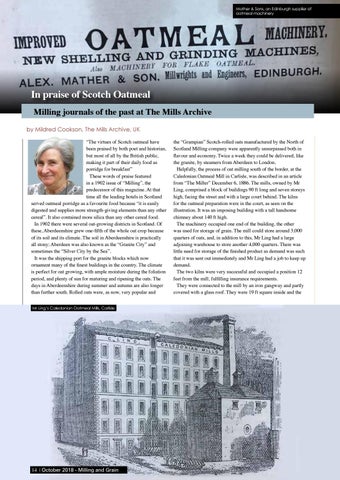
In praise of Scotch Oatmeal Milling journals of the past at The Mills Archive by Mildred Cookson, The Mills Archive, UK “The virtues of Scotch oatmeal have been praised by both poet and historian, but most of all by the British public, making it part of their daily food as porridge for breakfast” These words of praise featured in a 1902 issue of “Milling”, the predecessor of this magazine. At that time all the leading hotels in Scotland served oatmeal porridge as a favourite food because “it is easily digested and supplies more strength-giving elements than any other cereal”. It also contained more silica than any other cereal food. In 1902 there were several oat-growing districts in Scotland. Of these, Aberdeenshire grew one-fifth of the whole oat crop because of its soil and its climate. The soil in Aberdeenshire is practically all stony; Aberdeen was also known as the “Granite City” and sometimes the “Silver City by the Sea”. It was the shipping port for the granite blocks which now ornament many of the finest buildings in the country. The climate is perfect for oat growing, with ample moisture during the foliation period, and plenty of sun for maturing and ripening the oats. The days in Aberdeenshire during summer and autumn are also longer than further south. Rolled oats were, as now, very popular and Mr Ling’s Caledonian Oatmeal Mills, Carlisle
14 | October 2018 - Milling and Grain
the “Grampian” Scotch-rolled oats manufactured by the North of Scotland Milling company were apparently unsurpassed both in flavour and economy. Twice a week they could be delivered, like the granite, by steamers from Aberdeen to London. Helpfully, the process of oat milling south of the border, at the Caledonian Oatmeal Mill in Carlisle, was described in an article from “The Miller” December 6, 1886. The mills, owned by Mr Ling, comprised a block of buildings 90 ft long and seven storeys high, facing the street and with a large court behind. The kilns for the oatmeal preparation were in the court, as seen on the illustration. It was an imposing building with a tall handsome chimney about 140 ft high. The machinery occupied one end of the building, the other was used for storage of grain. The mill could store around 3,000 quarters of oats, and, in addition to this, Mr Ling had a large adjoining warehouse to store another 4,000 quarters. There was little need for storage of the finished product as demand was such that it was sent out immediately and Mr Ling had a job to keep up demand. The two kilns were very successful and occupied a position 12 feet from the mill, fulfilling insurance requirements. They were connected to the mill by an iron gangway and partly covered with a glass roof. They were 19 ft square inside and the