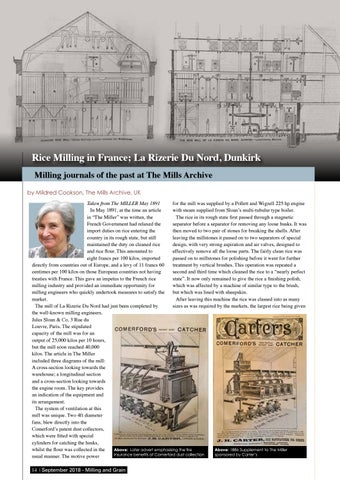
Rice Milling in France; La Rizerie Du Nord, Dunkirk Milling journals of the past at The Mills Archive by Mildred Cookson, The Mills Archive, UK for the mill was supplied by a Pollett and Wigzell 225 hp engine Taken from The MILLER May 1891 with steam supplied from Sloan’s multi-tubular type boiler. In May 1891, at the time an article The rice in its rough state first passed through a magnetic in “The Miller” was written, the separator before a separator for removing any loose busks. It was French Government had relaxed the then moved to two pair of stones for breaking the shells. After import duties on rice entering the leaving the millstones it passed on to two separators of special country in its rough state, but still design, with very strong aspiration and air valves, designed to maintained the duty on cleaned rice effectively remove all the loose parts. The fairly clean rice was and rice flour. This amounted to passed on to millstones for polishing before it went for further eight francs per 100 kilos, imported treatment by vertical brushes. This operation was repeated a directly from countries out of Europe, and a levy of 11 francs 60 second and third time which cleaned the rice to a “nearly perfect centimes per 100 kilos on those European countries not having state”. It now only remained to give the rice a finishing polish, treaties with France. This gave an impetus to the French rice which was affected by a machine of similar type to the brush, milling industry and provided an immediate opportunity for but which was lined with sheepskin. milling engineers who quickly undertook measures to satisfy the After leaving this machine the rice was classed into as many market. sizes as was required by the markets, the largest rice being given The mill of La Rizerie Du Nord had just been completed by the well-known milling engineers, Jules Sloan & Co, 3 Rue du Louvre, Paris. The stipulated capacity of the mill was for an output of 25,000 kilos per 10 hours, but the mill soon reached 40,000 kilos. The article in The Miller included three diagrams of the mill: A cross-section looking towards the warehouse; a longitudinal section and a cross-section looking towards the engine room. The key provides an indication of the equipment and its arrangement. The system of ventilation at this mill was unique. Two 4ft diameter fans, blew directly into the Comerford’s patent dust collectors, which were fitted with special cylinders for catching the husks, whilst the flour was collected in the Above: Later advert emphasising the fire Above: 1886 Supplement to The Miller insurance benefits of Comerford dust collection sponsored by Carter’s usual manner. The motive power 14 | September 2018 - Milling and Grain
Issuu converts static files into: and more. Sign up and create your flipbook.