GRAIN AND OILSEED EXPORTING A bedrock of support for Port Constanta’s new grain terminal
by Roger Gilbert
“Feeding the world - We are a part of the agriculture supply chain with the challenge of feeding the world” - Andreas Zivy, President and Chairman of the Swiss-based Ameropa Group
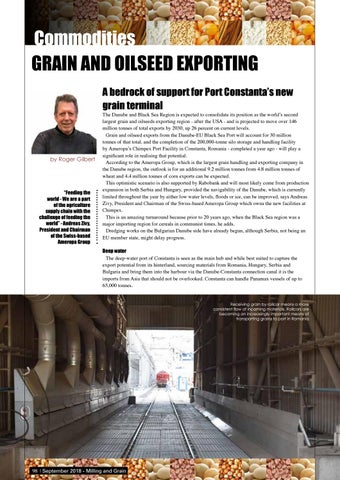
The Danube and Black Sea Region is expected to consolidate its position as the world’s second largest grain and oilseeds exporting region - after the USA - and is projected to move over 146 million tonnes of total exports by 2030, up 26 percent on current levels. Grain and oilseed exports from the Danube-EU Black Sea Port will account for 30 million tonnes of that total, and the completion of the 200,000-tonne silo storage and handling facility by Ameropa’s Chimpex Port Facility in Constanta, Romania - completed a year ago - will play a significant role in realising that potential. According to the Ameropa Group, which is the largest grain handling and exporting company in the Danube region, the outlook is for an additional 9.2 million tonnes from 4.8 million tonnes of wheat and 4.4 million tonnes of corn exports can be expected. This optimistic scenario is also supported by Rabobank and will most likely come from production expansion in both Serbia and Hungary, provided the navigability of the Danube, which is currently limited throughout the year by either low water levels, floods or ice, can be improved, says Andreas Zivy, President and Chairman of the Swiss-based Ameropa Group which owns the new facilities at Chimpex. This is an amazing turnaround because prior to 20 years ago, when the Black Sea region was a major importing region for cereals in communist times, he adds. Dredging works on the Bulgarian Danube side have already begun, although Serbia, not being an EU member state, might delay progress. Deep water The deep-water port of Constanta is seen as the main hub and while best suited to capture the export potential from its hinterland, sourcing materials from Romania, Hungary, Serbia and Bulgaria and bring them into the harbour via the Danube-Constanta connection canal it is the imports from Asia that should not be overlooked. Constanta can handle Panamax vessels of up to 65,000 tonnes. Receiving grain by railcar means a more consistent flow of incoming materials. Railcars are becoming an increasingly important means of transporting grains to port in Romania
98 | September 2018 - Milling and Grain