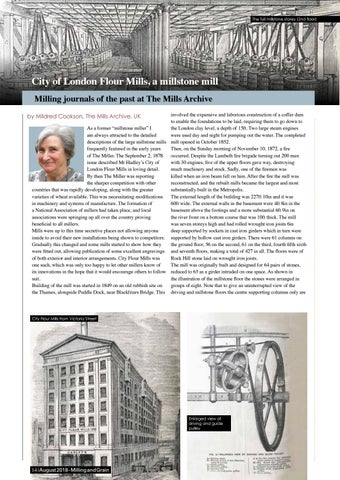
The full millstone storey (2nd floor)
City of London Flour Mills, a millstone mill Milling journals of the past at The Mills Archive involved the expensive and laborious construction of a coffer dam to enable the foundations to be laid, requiring them to go down to the London clay level, a depth of 15ft. Two large steam engines As a former “millstone miller� I were used day and night for pumping out the water. The completed am always attracted to the detailed descriptions of the large millstone mills mill opened in October 1852. Then, on the Sunday morning of November 10, 1872, a fire frequently featured in the early years occurred. Despite the Lambeth fire brigade turning out 200 men of The Miller. The September 2, 1878 with 30 engines, five of the upper floors gave way, destroying issue described Mr Hadley’s City of much machinery and stock. Sadly, one of the firemen was London Flour Mills in loving detail. killed when an iron beam fell on him. After the fire the mill was By then The Miller was reporting reconstructed, and the rebuilt mills became the largest and most the sharper competition with other substantially built in the Metropolis. countries that was rapidly developing, along with the greater The external length of the building was 227ft 10in and it was varieties of wheat available. This was necessitating modifications 60ft wide. The external walls in the basement were 4ft 8in in the in machinery and systems of manufacture. The formation of basement above the footings and a more substantial 6ft 9in on a National Association of millers had taken place, and local the river front on a bottom course that was 10ft thick. The mill associations were springing up all over the country proving was seven storeys high and had rolled wrought iron joists 6in beneficial to all millers. deep supported by sockets in cast iron girders which in turn were Mills were up to this time secretive places not allowing anyone inside to avoid their new installations being shown to competitors. supported by hollow cast iron girders. There were 61 columns on the ground floor, 56 on the second, 61 on the third, fourth fifth sixth Gradually this changed and some mills started to show how they were fitted out, allowing publication of some excellent engravings and seventh floors, making a total of 427 in all. The floors were of Rock Hill stone laid on wrought iron joists. of both exterior and interior arrangements. City Flour Mills was The mill was originally built and designed for 64 pairs of stones, one such, which was only too happy to let other millers know of its innovations in the hope that it would encourage others to follow reduced to 63 as a girder intruded on one space. As shown in the illustration of the millstone floor the stones were arranged in suit. groups of eight. Note that to give an uninterrupted view of the Building of the mill was started in 1849 on an old rubbish site on the Thames, alongside Puddle Dock, near Blackfriars Bridge. This driving and millstone floors the centre supporting columns only are
by Mildred Cookson, The Mills Archive, UK
City Flour Mills from Victoria Street
Enlarged view of driving and guide pulley
14 | August 2018 - Milling and Grain