June 2018
YOUR GLOBAL PARTNER
In this issue:
DUST EXPLOSIONS Three part special
• Fortification: Helping to ensure adequate intake of essential B Vitamins • Nutrition security in India
Milling and Grain . Volume 129 . Issue 06 . June 2018
• Improving diet palatability to stimulate sow feed intake • Natural vs chemical coccidiostat • IAOM USA 2018
Event review Proud supporter of
Volume 129 Issue 06 millingandgrain.com
Our team of experienced Dealers and Staff
will help you determine the system that will suit your needs. Chief Agri has a full line of grain storage, conditioning, handling, and drying products that can be engineered to fit your site.
chief.co.uk
|
Storage
agri.chiefind.com
Handling & Support Structure
|
Conditioning
silos-phenix.com
Dryers
COMMERCIAL BINS
COMMERCIAL DRYERS
STEEL BUILDINGS
COMMERCIAL SWEEPS
BUCKET ELEVATORS
COMMERCIAL CONVEYORS
• 47.548m Diameter Bins (20320.9-48262.2 mt) • Tower Dryers (22.5-281.2 t/h) • Peak Load Rating (6803.8-45359.2 kg) • QuadraTouch ProTM Controls • Hopper Bins (3.65m-14.6m) • Balanced Moisture Content • Auger & Paddle sweeps available • Capacity includes 140.6-281.2 t/h • Patented Pivot Point • Industrial Grade Pushers
• Low Impact Head Design • Heavy Gauge Trunking • Patented Squaring Plates • Support Towers
• Industrial Strength • Built To Last • Higher Elemental Resistance • Capacity includes (984.3-1687.5 t/h) • Dust-tight and waterproof • Patented hip-style weather-tight cover • Catwalks
Su k u p World Headquarters - S heff ie ld , I o wa USA • www. su ku p . co m • in f o @ su ku p . co m For service in Europe contact:
Sukup Europe A/S Hedensted, Denmark Tel +45 75 68 53 11 • Fax +45 75 68 54 70 info@sukup-eu.com • www.sukup-eu.com
Pneumatic or Mechanical Ship Loaders & Unloaders Port Equipment - Turnkey Projects
1968 2018
1350 machines installed in more than 100 countries! VIGAN Engineering s.a. Rue de l’Industrie, 16 - 1400 Nivelles - Belgium Tél.: +32 67 89 50 41 • Fax : +32 67 89 50 60 • www.vigan.com • info@vigan.com
VOLUME 129 ISSUE 06
June 2018
Perendale Publishers Ltd 7 St George’s Terrace St James’ Square, Cheltenham, Glos, GL50 3PT, United Kingdom Tel: +44 1242 267700 Publisher Roger Gilbert rogerg@perendale.co.uk International Marketing Team Darren Parris Tel: +44 1242 267707 darrenp@perendale.co.uk Tom Blacker Tel: +44 1242 267700 tomb@perendale.co.uk Martha Cornwell Tel: +1 913 6422992 marthac@perendale.com Fred Norwood Tel: +1 913 6422992 fredn@perendale.com Latin America Marketing Team Iván Marquetti Tel: +54 2352 427376 ivanm@perendale.co.uk New Zealand Marketing Team Peter Parker peterp@perendale.co.uk Nigeria Marketing Team Nathan Nwosu Tel: +234 805 7781077 nathann@perendale.co.uk Production Editor Zasha Whiteway-Wilkinson zashaw@perendale.co.uk Features Editor Vaughn Entwistle vaughne@perendale.co.uk International Editors Dr Roberto Luis Bernardi robertob@perendale.co.uk Professor Wenbin Wu wenbinw@perendale.com ˘ Gürkaynak Mehmet Ugur mehmetg@perendale.com Design Manager James Taylor jamest@perendale.co.uk Circulation & Events Tuti Tan tutit@perendale.co.uk Development Manager Antoine Tanguy antoinet@perendale.co.uk ©Copyright 2018 Perendale Publishers Ltd. All rights reserved. No part of this publication may be reproduced in any form or by any means without prior permission of the copyright owner. More information can be found at www.perendale.com Perendale Publishers Ltd also publish ‘The International Milling Directory’ and ‘The Global Miller’ news service
Grain & Feed Milling Technology magazine was rebranded to Milling and Grain in 2015
80 - Dust dangers: Dust explosions have posed a long-standing threat to the grain and milling industry ISSUE HIGHLIGHTS
2
NEWS
6-44
FEATURES
52 Fortification: Intake of essential B Vitamins 54 Nutrition security in India 56 US Sorghum
60 The Rice milling business 62 Microbial regulators in
FACES
antibiotic free piglet
66 Diet palatability sow feed
70 Piglets: Synergistic effects of hops and magnesium 70 Natural vs chemical coccidiostat
124 People news from the global milling industry
PRODUCT FOCUS
50
CASE STUDY
102
80 DUST DANGERS - #1 causes and cures 82 DUST DANGERS - #2 Monitoring for unexpected events
90 Colour sorters STORAGE
98 Square bin storage
86 DUST DANGERS - #3 The dangers of dust explosions in flour mills 102 DUST - Case study
EVENTS
104 Event listings, reviews and previews
TRAINING
46 Information about industry training courses
COLUMNS
12 Mildred Cookson 18 Raghavan Sampathkumar 29 Tom Blacker 38 Chris Jackson
4 GUEST EDITOR Ruwan Berculo
104 MARKETS John Buckley
122 INTERVIEW Sergio Antolini
COVER IMAGE: Kice Industries: Dust explosions in the grain and milling industries usually start inside process equipment such as mills, dryers, mixers, classifiers, conveyors, and storage silos and hoppers. Dust explosions can cause catastrophic loss of life, injuries and destruction of facilities and assets - see more on page 86
ISSUE HIGHLIGHTS FORTIFICATION
Helping to ensure adequate intake of essential B vitamins
Everyone needs a small daily supply of thiamine and riboflavin to get energy from the food they eat and to help make red blood cells.
PAGE 52 SORGHUM
DUST DANGERS NUTRITION Nutrition security - Holistic policies will ensure India’s nutrition security
SILOS Square bin storage
In the next decade, nutritional security must be given top priority by the policy makers.
Once again Cimbria had a busy year with many interesting square silo installations around the world.
PAGE 54
PAGE 98
A deadly problem - causes and cures
PAGE 80 Monitoring for unexpected events
PAGE 82 The dangers of dust explosions in flour mills
US engaging international buyers
PAGE 86
Even in the toughest of times, the on-the-ground presence around the world and rapid response by US Grains Council (USGC) staff can turn a crisis into an opportunity to build lasting markets.Â
PAGE 56
FOOD
STORAGE
FEED
PROCESS
PIGLETS Performance effect of combined microbial regulators in antibiotic free piglet feed
PACKING Another one bites the dust
After lengthy technical research conducted in conjunction with strategic industry partners, Fawema from Germany is delighted to report that the they have successfully installed and commissioned their first flour packing machinery for one kg retail flour packs, which now delivers Dust-Tight Paper Bag Packaging.
PAGE 102
COLOUR SORTERS Surviving acquisition and takeover to become a leader in modern-day colour-sorting technology
When you are successful, others would like to share your success. For the past 10 years the Italian SEA Group which introduced colour sorting to the Italian market as long ago as 1970, has been struggling to cope with.
PAGE 90
SOWS Improving diet palatability to stimulate sow feed intake during lactation in summer
Feed intake during lactation is critical to ensure the sow is able to satisfy the nutritional needs of her growing litter whilst maintaining body condition.
PAGE 66
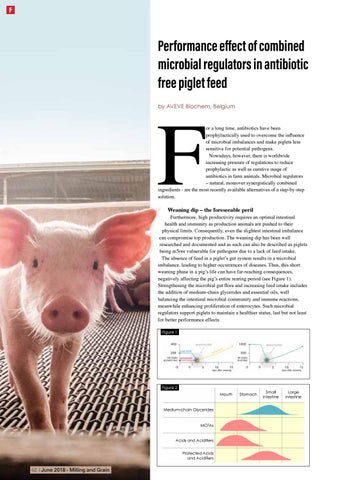
For a long time, antibiotics have been prophylactically used to overcome the influence of microbial imbalances and make piglets less sensitive for potential pathogens.
PAGE 62
Roller mill 1950
The revolutionary technological path that never ends
Roller mill 2018
www.ai-lati.eu
www.ocrim.com
From Feed-to-Food We have it, and that’s unique The Olympics, the FIFA World Cup … unique events lots of people love the world throughout. As a sector in agrifood, we have this too. People all around the world love our unique, ‘once-everyfour-years’ VIV Europe event, that ranges from Feed-to-Food. This coming June 20, 21 and 22, 2018 the city of Utrecht in The Netherlands hosts you and many thousands of your colleagues: Directors, technicians, nutritionists, traders, from the East and from the West. All are welcome! Geopolitically, our world has become truly turbulent. We’ve known such times in the past, when I was a kid and way before I was born. However, today, with such significant shifts in power, we’re completely re-arranging the world map. That’s what is new today. There is not a single corner on our planet that will be left behind or left untouched. Who takes the lead? China, India, Russia, Turkey, Iran … Which leader jumps on stage to lead, and to connect! If I am to be asked in another four years, I might be able to give you the answer. But not right now! We have brave and visionary leaders within our industry. R&D-wise we’ve got outstanding researchers to ensure we reach sufficient increases of our food supplies in both quality and quantity. We have demanding consumers, including you and me too, who require food that looks good, tastes good and feeds us well. And we’ve got families in less developed regions of the world that just want healthy food or stay-alive food. We need you, we need all of us: To tackle challenges that lie right in front of our feet. Co-operation is key. Who says it’s not? But then again, in all fairness, do we really co-operate?
Are you that leader who will jump on stage to lead and connect?! Question yourself: Why do you get out of bed every morning? What is your true meaning in life? Challenge yourself to do well, to be better, to think globally. To act, right where you put your feet each day. Reading this well-established magazine comes with that responsibility. It’s with full dedication that we at VIV Worldwide try to make a difference also by taking up our responsibilities. It’s about being good at what you do. And trying to excel at it. That’s our mission. To serve you best. To create that stage that you can climb upon. For all professionals who play on the feed-to-food sector, VIV Europe provides that stage. Most professionals reading this publication focus on feed and its related topics. That’s why I am so pleased to have the chance to address you. Feeding the world starts with feed, not to ignore vegetarians and vegans; not at all. On a global scale however, it’s our duty to produce sufficient, safe and nutritious animal protein products for human consumption. Feed comes first. For which we need land, water, technology and healthy trade relations. That’s where geopolitics knocks on our door. As a sector we can act. We can break through barriers that contain us. VIV Europe opens its doors on Wednesday June 20, 2018. During three full show days, we will welcome over 25,000 professionals from around the world. The exhibition and related conferences address key topics, clearly centered around feed and farm production and food production. It’s essential to have all leaders along the supply chain together at the same time. VIV Europe 2018 will yet again be that venue. So let me finish with the invitation I started with: ‘Leaders within our sector, from all corners of the world, jump on our stage, take the lead and connect.’ We have provided that stage, one that is unique for our agrifood sector. Ruwan Berculo, Director VIV Worldwide
YOUR GLOBAL PARTNER
Have you seen our brand new website? Stay up-to-date with the latest news Read the online version of Milling and Grain for FREE! Find our archive content by topic Try it today at:
millingandgrain.com
Annual Subscription Rates Inside UK: UK£100 Outside: US$150/€133
ISSN No: 2058-5101
More Information www.millingandgrain.com http://gfmt.blogspot.co.uk
40 YEARS OF TESTED STRENGTH
One Tapco Nylon Elevator Bucket Supports a 9700 Pound* H1 HUMMER Ambient Temperature: 17 °F (-8 °C)
TAPCO’S CC-XD (Xtreme Duty) gray nylon elevator bucket supports a 9700 lb. H1 Hummer vehicle. Testing confirms that it will support over 20,000 lbs., more than two Hummers!
TAPCO’S CC-XD (Xtreme Duty) blue polyethylene bucket will support 9,000+ lbs.
Tapcoinc.com
TAPCO’S CC-HD (Heavy Duty) blue polyethylene bucket will support 5,000+ lbs.
314.739.9191 / St. Louis, Missouri USA No 814
*4399 kg
News
JUN 18
Milling
T
Debranning line installed in Italy
he growing demand in the Italian market for 'peeled products' has led to the Terrabio company, close to Urbino, improving its facility with a debranning line, suitable for processing a huge number of different products. The challenge for this company, a client of Cimbria in Italy, was to correctly process products that range from spelt to sunflower, and from wheat to barley, whilst achieving a final result that meets the specifications required by the food industry. Scrutiny of the flow sheet has been important to double check all the different processes and to correctly match the budget of the customer for validation of its business plan. Seven years ago the company installed a seed cleaning line dedicated to a number of bio products, such as legumes and cereals. The proposed flow is suitable for working on products that need only an impact action on the kernel (e.g. sunflower, for example), on products that only need to be peeled (e.g. wheat, barley) and on products that need both (e.g. spelt). The flow sheet includes capacity for future developments to increase the precision of cleaning of the finished products, based on the likely increase in market demand. The plant, which is an electromechanical turnkey solution, has been designed to fit the existing warehouse just in front of the existing seed cleaning line. Erection of the plant took two-and-a-half months to complete and to begin commissioning of the different tests. Commissioning of the plant has been an exciting experience, spent understanding the optimum adjustments on the different parts of the line to better meet the customer’s needs, says the company. "In two days of tests, wheat, barley, spelt, lentils, chickpeas, peas, etc were processed. The plant commissioned in Terrabio represents an important step towards a new product field; the debranning process for all these kinds of products is still at a stage where most of the producers are trying to implement a standard process.” Italy has installed an important reference for a flexible industrial plant that can provide stability in terms of results at a capacity that matches market demand, it adds. 6 | June 2018 - Milling and Grain
History is replete with examples of advanced civilisations that thrived for centuries only to collapse and implode in a relatively short period of time (often less than a human lifetime) when climate change caused crop failure and famine. Mesa Verde in Montezuma County, Colorado, USA, is an amazing complex of cliff dwellings constructed beneath the protective overhang of a massive cliff. Built by Ancestral-Pueblans, the well-preserved site dates back to the late 1190s. The ruins provide clear evidence of an advanced and thriving civilisation. However, archaeology has shown that years of successive droughts caused repeated crop failures that forced the sudden abandonment of the site and caused its mysterious inhabitants to vanish from the historical record. The more recent example of the potato famine in Ireland, (1845-1849). killed one million people (an eighth of the population) and provides a chilling warning about the danger of a lack of dietary diversity. Despite these sobering lessons from history, we are by no means free from a similar threat. By 2050, the planet must feed a population projected to reach 9.7 billion. This would be a challenging goal in the best of circumstances, but now, faced with the worsening effects of climate change, that goal seems even more daunting. Currently only around 150 different crops are cultivated in any significant quantities. Even more alarming, ninety percent of the world’s calorie intake comes from just 30 crop species. It is not a very good model for diversity. In terms of food supply, our planet is already in a precarious position, with large swaths of the globe inhabited by humans who are already suffering the effects of undernourishment. Agricultural science has advanced in leaps and bounds during the latter half of the twentieth, and the beginning of the twenty-first century. But despite this, the effects of climate change now threaten to outpace those advances. Changing diet, changing minds—in general, humans dislike change—especially when it comes to diet. Every nation has its own unique diet and cuisine, based on tradition and which foodstuffs can be grown and sourced locally. With modern transportation, however, the hunter-gatherers stalking modern supermarkets are free to consume foods transported from half a world-away, including fruits and vegetables that would normally be out-of-season and impossible to grow in their own climate. The bleak lesson of the Irish Famine shows the dangers of a society grown dependant upon monocultures. The challenge for the future is to move away from traditional grains to hardier strains that resist climatic extremes while still providing high levels of protein. The Global Crop Diversity Trust has been leading these efforts, while the Svalbard Global Seed Vault (SGSV) is seedbank located in an underground vault on a Norwegian island to offer a “fail-safe” insurance against an incremental or catastrophic loss of crop diversity. We need genetic diversity in our crops to avoid the effects of blight and disease. We need crops that can resist environmental stressors while maintain yield. We need crops that can sustain an affordable living for farmers. Moreover, we need sustainability. We live in a finite world with finite resources. The only thing we know that has no foreseeable limit is human population and the number of mouths we will have to feed.
GF
MT
gfmt.blogspot.com
Upgrade your roller mill by using Balaguer Rolls only. Ask your roller mill supplier to provide Balaguer Rolls on your machines. Follow us. Facebook
YouTube
www.balaguer-rolls.com
VISIT OUR STAND AT
Stand B20-D31 Fiera Milano - Milan, Italy May 29 - June 1 2018
Milling News
A hammer mill to conquer the world
T
he CSE Bliss company of Oklahoma, USA, specialises in rotary feeders, magnets and hammer mills for the feed industry and provides all the associated wear and spare parts. The capacities of their machines range from just six to over 600 horsepower. “They will grind anything you want to put through them, from feed grains to wood, from pet food to raw materials for chicken, cattle and pig feeds,” says Rick Bliss the company’s CEO. “They are capable of doing just about anything,” he told Milling and Grain earlier this year at the IPPE in Atlanta, Georgia, USA. Brother Jason, who is the company’s president, says that while the company is USA based, it is expanding globally with its first sales into New Zealand at the start of this year. “We’re going to take over the world in terms of hammer mills,” he muses when
interviewed by MAG. Our first hammer mill has gone in the New Zealand rendering industry.” In fact, the company services between 15 and 20 different industrial sectors however, the poultry feed industry is its most dominant sector. Hammer mill can also include the company’s unique rotary feeder and its magnetic set-up that eliminates tramp metal from raw materials prior to grinding. CSE Bliss can provide almost any wear part for an existing hammermill, it claims. It produces precision lasercut wear liners and screen carriages which do not loose shape and provide permanent seals. It also provides complete hammermill refurbishing including rotors, screen carriages, directional gates, hammers, pins, spacers, screens and cutter bars.
www.perryofoakley.co.uk sales@perryofoakley.co.uk +44 (0)1404 890300
Since 1947
The UK’s Most Experienced Manufacturer of Materials Drying & Handling Equipment
Capacities of up to 1000tph available - Heavy duty, galvanised construction - Ranges suitable for grain & bulk materials • Continuous Flow Grain Driers • Belt Driers • Chain & Flight Conveyors
• • • •
Belt & Bucket Elevators Belt Conveyors Aspirator Cleaners Levelling Conveyors
• Augers & Screw Conveyors • Ducting & Valves • Twin Trace Conveyors
Call now to discuss your drying & handling needs! 10 | June 2018 - Milling and Grain
Three in five livestock producers expect to use more phytogenic feed additives this year
M
any in the livestock industry expect to increase their use of phytogenic feed additives (PFAs) in 2018. According to a recent survey of more than seven hundred agribusiness professionals, a full 60 percent of respondents reported that their PFA use would increase over the next 12 months. Plant-based feed additives – specifically essential oils, plant extracts, herbs and spices – are known to have a range of biologically active properties that can be applied to modern animal production. These include anti-oxidant, antiinflammatory, anti-microbial and digestion enhancing effects. “We continue to see strong demand for PFAs from all sectors of the animal protein industry,” commented Michael Noonan, Global Product Line Manager Phytogenics at Biomin. “As the awareness and understanding of the benefits of scientifically tailored PFAs such as Digestarom® is growing, their commercial application becomes
more widespread.” Scientific findings underscore the fact that phytogenic feed additives can reduce the microbial threat and promote intestinal health, which is imperative for optimal performance and profitability. Furthermore, reported results of market research in various countries suggest that consumers look favourably on the addition of phytogenic feed additives to animal feed. These industry expectations, coupled with consumer acceptance, indicate the strong growth in demand for phytogenic feed additives for farm animals globally, in line with projections that the PFA market will reach the US$1 billion threshold by 2023. The upcoming survey builds on similar work published in 2017. “As a leading global supplier of PFAs, we are in constant contact with clients, researchers, valued distributors and our skilled sales and client support teams throughout the globe,” noted Mr Noonan. “Through discussions with clients,
trials and scientific research, we are continually highlighting the advantages that PFAs offer to the feed and livestock industries,” explained Mr Noonan. “Our scientific knowledge of PFAs and on-the-ground customer support throughout the world provide us the means to help our clients achieve the best outcomes,” Mr Noonan concluded. More than 700 nutritionists, business owners, veterinarians and consultants located in over 80 countries provided their views on the use of phytogenic feed additives in livestock in the recent Biomin Phytogenic Feed Additive survey. The full results of the actual Biomin Phytogenic Feed Additives Survey will be published in June 2018.
Milling and Grain - June 2018 | 11
Sun Flour Mills Bow River Lea Front
The Sun Flour Mills Bromley by Bow Milling journals of the past at The Mills Archive by Mildred Cookson, The Mills Archive, UK The Sun Flour Mills have been of interest to me since the early days of the Mills Archive when we were given the collection of Guy Cornwell. This included the calligraphic certificate given to his grandfather, William, on his retirement in 1926, expressing appreciation for his work for the company since its foundation in 1887. The story of company’s foundation, written by William, who started as manager in 1887 and ended as Managing Director, can be read in our archive catalogue (search for CORN-08). The full story of the original owners, the Brown family, has been published by the Mills Archive in our Research Publication series. This impressive series of books is financed by our Research and Education Fund, a Fund that we hope will grow in the future so that we can produce so much more on our milling heritage. We are very grateful to Perendale for helping to get the Fund started; there are more details about the Funds activities and potential here: http://tinyurl.com/y8j5hden.
The Simon Dustless Self-contained Wheat Aspirator
12 | June 2018 - Milling and Grain
The Simon Fanless Purifier
This article concentrates on the Sun Flour Mills at Bromley by Bow, established after a devastating fire at the recently built Sun Flour Mills on Sun Street, Waltham Abbey. The Bromley by Bow mills were described in detail in The Miller of December 3, 1894 and February 4, 1895. Situated on the River Lea, the mills were directly connected to the River Thames, one of the world’s greatest commercial highways. While the Lea flowed by one side of the walls, the other side was served by another waterway, locally known as the Limehouse New Cut. The mill was a substantial brick building. Originally a rice mill dating from 1865, by 1895 it was well adapted for the purpose of flour manufacture. In the illustration from the River Lea side the receiving ship elevator occupies the foreground, while in the rear the massive tower supported a 7,640-gallon tank for the Grinnell sprinkler system, which was fitted throughout the mill. The silo house was on the left and the mill on the right with its flour warehouse and wheat-cleaning department. The whole range of buildings was divided into four distinct sections, each separated by fireproof walls and iron doors and galleries. The tops of the partitioning walls dividing the sections can be clearly seen in the view from the New Cut or land side, where the finished products were loaded into the carts for onwards
Advert for Cyclone dust collector
transport. In this view the mill proper, with the boiler and engine house, lay at the extreme left of the buildings with the second wall on the left dividing the mill from the flour warehouse. Subsequent walls marked the boundary before the wheat-cleaning department and the last partitioned the screening house from the silo installation and the wheat-receiving house. This mill was fitted out in 1890 with a 12-sack roller plant by Henry Simon, but as trade was increasing very rapidly, Mr Simon was soon commissioned to increase the mill output to 16 sacks. The motive power for the mill was from a 350-hp. horizontal engine built by Pollitt and Wigzell of Sowerby Bridge. The transmission of power from the 16ft fly wheel to the three main shafts of the mill was by 16 ropes of one and a half inches. The engines were fed by two Galloway 30ft by eight ft boilers. The basement of the mill was occupied by the elevator bottoms and by three lines of shafting from which power was transmitted to the plant on the floors above. On the first, or roller, floor there were five double break mills fitted with 40in by 10in rolls and nine reduction mills fitted with nine inch by 32in rolls. There was also one screening mill, fitted with a double set of lightly corrugated rolls and used for the reduction of screenings. All the sets of rollers were held in the
Sun Flour Mills, The New Cut Front Transverse Section
The Simon New Reform Purifier
Genuine for over 50 years!
Grain Cooling
GRANIFRIGOR™ The most natural way of grain preservation
S P E C I A L I S T I N S Q U A R E S I LO S
•
Protection against insects & fungi
•
Without chemical treatment
•
Short amortisation period
•
Low energy demand
•
Independent of ambient weather
•
No respiratory losses
www.tsc-silos.com F r i g o r Te c G m b H • i n f o @ f r i g o r t e c . d e • w w w. f r i g o r t e c . c o m
Milling and Grain - June 2018 | 13
Milling and Grain supports the aims and objectives of the Mills Archive Trust, based in Reading, England. The history of milling no matter where it has taken place - is being archived by the Trust. For well over 100 years milling technology has been global with many magazines serving or having served our industry from flour and food to feed and oilseed processing and now to fish feeds. A most recent contribution to the Trust’s collection is a complete century of past edition of the now out-of-print ‘NorthWestern Miller’ from the United States. We are proud to present here, front cover illustrations from this valued and longserving publication as a visual reminder of the importance contribution past magazines provided to our industry.
YOUR GLOBAL PARTNER
Art in the Archive We are a charity that saves the world’s milling images and documents and makes them freely available for reference. We have more than two million records. We aim to cover the entire history of milling, from its ancient origins up to the present day. Find out what we have and how you can help us grow.
millsarchive.org The Mills Archive Trust Registered Charity No 1155828
William Cornwell Certificate
strong and rigid frames familiar in Simon plants. On the second, or purifier, floor there were six double “Reform” purifiers. Two of these machines were of the blanket type, two were connected with ‘Cyclone’ dust collectors and two were of the latest “dustless” pattern. Tail aspirators had been introduced here, and worked well. The third floor was chiefly occupied with a set of rotary sieve scalpers. Four of these machines were for treating the first, second, third, and fourth breaks, while the fifth sieve was used as a semolina grader. It was said that all of the sieves were beautifully balanced, with an even and easy swing. The fitting of the room also included a bran duster, a screenings duster, and a re-dressing reel. The elaborate wheat cleaning plant was supplemented by a “Simon” dustless aspirator preparing it for the clean wheat bin on the first break. The report emphasised that its action and use in the flow met with the emphatic approval of Mr Cornwell, the mill manager. Apparently at that time no mill in England had the same capacity or possessed a more complete and efficient wheat cleaning plant than the Sun Flour Mills at Bromley. Although the roller plant and wheat cleaning machinery had been erected by Henry Simon, the silos and initial wheat handling system in the adjacent department, separated from the mill by fireproof walls, were the work of Thomas Robinson and Son.
Brown Family Research Publication
The drawing of the transverse section shows how barges brought along the River Lea right under the mill were discharged by the elevator which was 36 ft high with a discharging capacity of 40 tons per hour. The elevator cup chain passed over a deflecting roller and the grain was then tipped into a hopper and ran down a spout to the bottom of the elevator to the automatic scales. The silo installation consisted of 33 silo bins, each 36 ft deep and 9 ft square, built of flat pieces of wood nailed one on the top of the other overlapping each other. The mouthpieces of the bins were formed from cast iron plates shaped hopper wise, which rested on girders. The bins fell into three distinct sets, 12 for purely storing, 14 for mixing and six for blending with the final silo serving for the storage of English wheat, which did not arrive by river but was delivered to the mill by wagon. The geographical and historical spread of our holdings at the Mills Archive mean that I can only provide snapshots; if you would like to know more please email me at mills@millsarchive.org.
Milling and Grain - June 2018 | 15
Milling News
T
AFIA’s board of directors welcomes new leadership he American Feed Industry Association’s Board of Directors met May 15-16, 2018, for its annual spring meeting in the nation’s capital, where they elected a new chair and several Board and Executive Committee members, discussed priority issues impacting the animal food industry with their legislators and conducted other official business. The Board, which is comprised of 48 industry representatives, spoke with members of Congress about the lengthy and costly animal food ingredient review and approval process, some of the association’s international trade priorities, and critical animal research and health provisions that the industry would like to see included in the 2018 Farm Bill. They also heard from Rep. David Rouzer, R-N.C., who spoke about the upcoming farm bill, trade and the state of US agriculture. “Hopefully, at the end of this week, we’ll come out unscathed on a farm bill,” Mr Rouzer told the Board. Even if the House bill does not move forward, Mr Rouzer seemed confident that Congress would pass a farm bill soon. “We’ll have a farm bill one way or another, it just may not be this iteration of it.” On the topic of trade, Mr Rouzer told the Board that he is “not alarmed by the rhetoric used or proposed tariffs” by this administration on China, saying he believes it is a tactic used as “a point of negotiation” by the president. He also added that he believes the United States will come to an agreement on the North American Free Trade Agreement soon, saying that “If President Trump was going to get out of NAFTA, he would have done it already.” As part of the official business meeting, the Board of Directors recognised Lee Hall of Hallway Feeds for his leadership as the association’s Board chairman during the 2017-18 year. Hall now transitions into his one-year chairmanship of the Institute for Feed Education and Research’s (IFEEDER) Board of Trustees. “Lee has been a great leader this past year, bringing his own perspective and energy to the Board,” said AFIA President and CEO Joel G. Newman. “I look forward to
On Combine NIR Analyser for corn
N
ext Instruments has released a new version of the CropScan 3000H On Combine Analyser, specifically for measuring corn or maize. The CropScan 3000H is a dedicated NIR analyser that is mounted to a combine harvester in order to measure protein, oil and moisture in grains and oil seeds. Although suitable for dry corn or maize, higher moisture corn presents a challenge in getting the kernels to flow consistently. The new version of the CropScan 3000H uses a
16 | June 2018 - Milling and Grain
seeing him continue that leadership throughout his year as chair of the IFEEDER Board of Trustees.” In addition, the Board officially elected Bruce Crutcher, managing director for Micronutrients USA, LLC, as its new chairman. His one-year term is effective May 1 through the end of AFIA’s fiscal year April 30, 2019. “As a long-time member and supporter of both AFIA and IFEEDER, who also led the establishment of the AFIA Sustainability Initiative, I’m excited about the leadership Bruce will bring as the new chairman,” said Mr Newman.
modified flow cell that makes it easier for the corn kernels to flow down through the Sample Head. On combine measurements of protein, oil, moisture and starch are now possible for corn up to 25 percent moisture. The benefit to corn producers lies in the ability to measure the Nitrogen that is taken for the soil in the form of protein in the corn kernels. Proteins contain approximately 17 percent Nitrogen by weight. As such for every bushel or tonne of corn harvested there is approximately .7lb or 12.8kg (based on a protein level of 8%). By measuring the protein content and the yield, then a Nitrogen Removal Map can be generated. This
map can then be used to develop Variable Rate Nitrogen Fertilisation prescriptions. The net results can be an optimisation of the yield across the field and a reduction in fertiliser usage. The CropScan 3000H has been used around the world for measuring wheat, barley, canola, sorghum, oats, lentils, peas, soy beans and lupins. The new version Sample Head handles these seeds as good as the original Sample Head, if not better. The extension of the CropScan 3000H to accommodate corn means that this revolutionary technology can now be used to benefit a larger base of farmers across North and South America, Europe, Asia and Africa.
The Raghavan Report Global food & feed security: Asia’s priorities by Raghavan (‘Ragha’) Sampathkumar I was speaking at a conference where the audience were predominantly from animal-agribusiness sector across Asia. In terms of growth, the region particularly South Asia and South East Asia are growing relatively faster than their neighbours. Observing the depth and range of conversations, a few points emerged clear and I present those as crisply as possible here. 1. Feed security is oft-neglected concept: While the entire world is aware of the importance of food security for survival of the human race, often we forget the underlying issue that animal protein is an integral part of our diets and it needs to be affordable too. When food prices at the consumer or wholesaler levels rise, everyone seems to be highly charged. However, prices of feed ingredients and raw materials are, for long and continue to, remain volatile. This doesn’t always raise the alarm among the stakeholders. But, imaging the cascading effect of price escalation in meat and other protein that are power-packed with nutrients. 2. Alternative feed ingredients are becoming affordable and attractive: Owing to intensive research on feed formulations and technological advancements in using alternative feed ingredients such as algae, seaweed and other biomass in the recent years are bearing fruition. Worldwide, more focus is being given to ensure these feed ingredients that are not mainstream right now, will be widely used in the near future so that the prices of traditional raw materials can be kept at an optimal level. Further, some of the ingredients are environmentally-friendly too. So, they are really promising and this particular segment is set to evolve further with time. 3. Sustainability is now a business-mandate: More and more evidence start emerging that it makes economic and commercial sense to invest in improving the sustainable models of production and doing business. For example, to get protein, we need to feed animals, protein. Then we need to extract protein from the waste to use it again in the feed and that closes the loop. This is a simpler narration of the protein cycle but this can be applied to any material that is used as feed raw materials. 4. Food safety is a shared responsibility: As I repeatedly mention that food safety is a greater responsibility that transcends organizational and sectoral boundaries. Hence, every link and every entity in the food chain must understand their responsibilities and act accordingly. For example, media must be cautious and scrupulous to first understand the truthfulness of any story or claim that is being made by anyone. Since consumers today are getting heaviily influenced by social media, their perceptions get shaped and based on which, their opinions are formed on any subject or issue. This ultimately resonates in public policy making impacting the entire value chain. 5. Consumers are becoming more demanding but more confused as well: It seems to be an interesting trend that the consumers are expecting more from the industry in terms of transparency on how food is produced until it reaches their plates. However, they seem to be more confused about it as they are bombed with information from every corner. Ultimately, at one point they seem to raise their hands up in the air and say “hey, I just don’t get it”. It is the responsibility of the food industry and all concerned to ensure their questions as well as myths and unfounded claims are addressed appropriately through all possible channels.
Raghavan Sampathkumar is a food and agribusiness leader with a 360 degree understanding of the complex Geo Political, Environmental, Socio Economic, Techno - Commercial and Cultural perspectives of Agri Food value chain. He worked in various subsectors including agro inputs, international trade, biotech, and animal nutrition across Asia-Pacific and currently he is with Compound Livestock Feed Manufactures Association (CLFMA) of India as its Executive Director. He regularly writes for international publications on agri-food trends, food security and sustainability themes. Also, he pens his poems and thoughts in his personal blog - www.asmalltownkid.wordpress.com. 18 | June 2018 - Milling and Grain
BlockGrain launches Australia’s first ever agricultural token sale
B
lockGrain, the agricultural supply chain blockchain platform that aims to connect buyers and sellers of agricultural produce and ensure traceability of products for consumers, has announced it is launching token sale on the Ethereum blockchain. The token sale follows a successful trial of its beta version designed and tested over the course of the last two years by grain farmers and commodities brokers looking to manage and control their stock more efficiently. BlockGrain.io aims to raise funds to develop the world’s first ever blockchain focused exclusively on agricultural supply chains and erasing inefficiencies that currently see up to 30 percent of cereal crops, 40 percent of root crops, and 20 percent of meat and dairy lost. Caile Ditterich, CEO, BlockGrain explained, “Our token sale marks the next step in development from being an idea, to a fully tried and tested beta platform used by commodities brokers and farmers. With the world’s population set to reach 10 billion by 2050, agricultural technology will have to improve if the world is to feed itself, food waste due to inefficient supply chains has to be eliminated and we provide a tangible solution to this very pressing problem.” The platform is looking to create an industry-wide software solution that supports farmers and key ancillary companies on a single, independent, global platform. Such a platform would avoid problems associated with data fragmentation and antiquated checking procedures that impact cash flow for smaller producers.
Milling News
Method for identifying key regulator genes may speed improvements in fertiliser use and other efficiencies
W
hen a plant is introduced to an abundant patch of water or fertiliser, a cascade of genetic and molecular actions leads to beneficial physiological responses such as root development and increased biomass. Identifying the genes involved in the early molecular responses has been difficult, but a Purdue University scientist has led an effort that can identify the genetic mechanisms and predict targets for improving crop plants. Kranthi Varala, an assistant professor in the Department of Horticulture and Landscape Architecture, is first author of a report published today in the “Proceedings of the National Academy of Sciences” that describes a method for identifying the genes activated when plants are exposed to external stimuli. The process, called temporal transcriptional logic for plant response, streamlines searches that can often involve tens of thousands of genes that work together in complex ways. He collaborated with colleagues from the University of Illinois and New York University. “Putting together experimental and computational methods, we developed a general methodology that can be applied to almost any area of interest, whether it’s plant stress, pathogen interactions or nutrition aspects,” Varala said. “Even in animal systems, any time an organism has to respond to something external, you have to have a methodology to find what is controlling that response.” Arabidopsis plants were grown for in the absence of nitrogen, a critical plant nutrient. After two weeks, some plants were given nitrogen while others went without. Gene expression was measured 11 times, from the moment of nitrogen application through two hours. Gene activity changes in the nitrogen-fed plants were compared against the gene activity in plants that didn’t receive the nitrogen. Those genes that increased or decreased activity, when compared to the controls were
considered likely to be involved with a plant’s nitrogen use. In particular, the scientists were interested in the transcription factors, genes that essentially act as controls for other genes. When a transcription factor is activated, it turns up or down the activity of its target genes. Using a machine-learning algorithm, they predicted which genes work together to influence nitrogen use. The results identified 155 transcription factors and 608 other genes - out of 28,000 total - that are closely linked to nitrogen use in plants and predicted how changes to the transcription factors might influence this process. Tests on plants with some of those transcription factors knocked out showed which were actually associated with the predicted genes and controlled plant growth, root development and other physiological responses. Overall, the prediction algorithm was correct one in three times. “That might not seem high, but when you think about 28,000 genes and the number of combinations there might be, getting one-third of these correct is highly significant,” Varala said. The small set of transcription factors identified in this research are now targets for improving a plant’s ability to take nitrogen from the soil and use it as efficiently as possible, reducing the number of fertilisers that might need to be used in future crops. “If we can apply less fertiliser and get the same crop yield, that’s both an ecological and economic success,” Varala said. “To do that, you have to know how the plant responds to nitrogen and how it uses that nitrogen.” Going forward, the method can be used to narrow the scope of genes associated with responses to heat, drought and other plant stresses. The National Institutes of Health and the National Science Foundation supported this research.
Cargotec to establish a joint venture specialised in dry bulk handling
synergies with the rest of our businesses. By joining forces with JCE Group, we are able to create a company that will be a significant player in the bulk material handling with a globally competitive and specialised product portfolio,” says Antti Kaunonen, President, Kalmar. “This is a true partnership between two strong brands, as they complement each other very well both in terms of product portfolio and market coverage. Siwertell will benefit from BRUKS’s strong position in the US market whereas BRUKS will gain access to their Asian network, knowledge and exposure. Together we will be a full line supplier for almost all types of bulk materials”, says Per Karlsson, Managing Director, Siwertell. “Together we will have a strong position in the dry bulk handling industry and attractive growth opportunities in new markets and customer segments including biomass, bioenergy and biofuels industries. This cooperation will add customers, competence, additional knowledge, capabilities and products to support the future growth of the new company”, says Peter Jonsson, Group CEO, BRUKS.
C
argotec has signed an agreement with JCE Invest AB to establish a joint venture, Bruks Siwertell Group, specialised in dry bulk handling. The new joint venture will own Siwertell AB (previously part of Kalmar Business Area within Cargotec) and BRUKS Holding AB (previously part of JCE Group). Both companies are world-leading suppliers of bulk materials handling solutions. Cargotec will own 48 percent of the shares, and JCE Invest AB will own the rest, 52 percent. The ownerships are included to venturers’ consolidated financial statements in accordance with the applicable regulation. The transaction has been signed and closed on May 9, 2018. “This joint venture supports Cargotec’s strategy to focus on container ports, heavy industrial segment and logistics. Siwertell’s business is outside these core focus areas, with different customers, customer locations and limited
20 | June 2018 - Milling and Grain
eurhythmical collaboration of nature and technology
www.tanis.com.tr
We are proud to be with you in the journey off seed from sowing to the harvest with our developing technology and milling solutions since 62 years in order to add abundance to what soil gives us.
Milling News
AFIA announces three annual award winners
T
he American Feed Industry Association announced the winners of three annual awards last night at a Board of Directors’ dinner in Arlington, Va. AFIA Names Pete Calderon Member of the Year: AFIA named Pete Calderon, general manager for Scott Equipment, as its Member of the Year. The Member of the Year award is presented to an AFIA member who exhibits outstanding support in achieving the organisation’s goals and objectives throughout the year. With the exception of the 83 members of the Food Safety Modernisation Act working group who received the award in 2014, only 38 individuals have received this award. AFIA Honours Charles Olentine with Distinguished Service Award: AFIA honoured Charles Olentine, Ph.D., owner and president of Consult-NC, with its Distinguished Service Award in recognition of his lifelong service to the industry. Since 1981, AFIA has given the Distinguished Service Award, the industry’s highest honour, to those elite members of the US feed industry who have provided outstanding support to the association and the entire feed industry throughout their careers. To date, 34 individuals have received the award. AFIA Honours Fred Fairchild with Lifetime Achievement Award: AFIA honoured Fred
24 | June 2018 - Milling and Grain
Fairchild with the AFIA-Kansas State University Feed Manufacturing Lifetime Achievement Award for his contributions to the feed industry through business and education. The award recognises and honours US animal food industry retirees, or those who are no longer serving the industry or allied industries, who have made a significant contribution to the animal food manufacturing business in the United States throughout their careers. AFIA and KSU first presented the award in 1995, and only 19 individuals have received the award to date.
BAKERpedia partners with AIB International on new food safety section
B
AKERpedia, the world’s largest go-to digital technical resource for commercial bakers and food innovators has partnered with AIB International (AIBI) to develop a new food safety section for bakers, bakeries, and quality assurance managers. The new section on the website features 30 topics. This recent collaboration is a direct response to the increased demand by bakeries for assistance with interpreting the Food and Drug Administration’s (FDA) Food Safety Modernisation Act (FSMA). Timely knowledge and information sharing is critical as bakeries and bakers work to comply with new regulations. “Since 2014, it has provided cutting-edge technical information that empowers the industry,” said Dr Lin Carson, CEO of BAKERpedia. “The production of highquality sanitary food products is essential to the success of commercial bakers and bakeries. This partnership will help our users improve the quality, safety and efficiency of the commercial baking ecosystem.” AIBI offers the baking industry expert commercial bakery training and consulting, in addition to food safety inspections, audits and training. Partnering on this technical content only solidifies AIBI’s position as the baker’s food safety expert. “AIBI is truly a one-stop-shop for all of the needs a bakery might have in its quest to produce quality baked goods that are safe to eat,” said Brian Strouts, Vice President, Baking and Food Technical Services. “This kind of partnership creates synergies for both sides of our organisation.” Topics included in the new food safety section are sanitation, personnel practices, body fluids, allergens, transportation and storage, integrated pest management, maintenance, sanitary design, chemical control, air and water quality, operational methods, physical foreign material, temperature control, traceability, recall, microbial control, environmental monitoring, customer complaints, quality control, regulatory overview, FSMA, HACCP, selfinspections and internal audits.
Milling News
A
Impressive improvements for roller mill
new high-capacity roller grinding mill for the feed sector was on display at IPPE 2018 in Atlanta, USA at the end of January. Scott Mayo of Ferrell-Ross was on hand to explain that the new 12 by 52 two-high mill had many improvements over the former mill. A dual-drive, with two 250ph motors in the back of the mill, which ‘spins at approximately 1100rpm’ gives the latest version the capacity to grind up to 35 tonnes per hour on ‘number two’ corn down to the size of about 700 microns. “So that improvement alone is going to give us about twice the capacity of the older mills yet occupy the same footprint. That’s going to be a big plus for feed producers,” he says. Other new features include the magnet and managing the roll gap. “We have a much-improved magnet system in this mill. A roll feeder up on top has an easy-clean, high-draw, heavy-pull magnets system that can be cleaned off and put right back in. “The au-gap adjustment combines the major gap opening to allow you to set the final gap more precisely to give the best product size. You can bring the rolls back to that point at any time to give you a consistent grind,” he explains further. “The sampling ports, where you put a sampling rode in, have a pull-out rod that makes for easier sample-taking. In addition, the company has changed one of the machine’s two 75lbs doors for a lighter 23lb door. “Up here,” Mr Mayo pointing to the upper door, “we have a light-weight door at 23lb, this is a nice feature to protect operators handling the doors to avoid back injuries.” To one end the company has now created a cabinet-style belt guard “which is more of a European approach” to give the machine a cleaner look with swing-out doors “Inside the cabinet there is placing to hang tools, for example. There are see-through panels as well, so you can inspect the belts without opening the doors themselves. “Finally, we have introduced a brand-new split in our dust seals to prevent product escaping and allows an operator to change them without taking out the whole roll assembly, which is a big time saving,” he concludes. Milling and Grain - June 2018 | 27
漀渀 琀栀攀 眀愀礀 琀漀 琀栀攀 昀甀琀甀爀攀
刀☀䐀 吀伀倀 ㈀㔀
圀攀 愀爀攀 愀洀漀渀最 琀栀攀 琀漀瀀 ㈀㔀 挀漀洀瀀愀渀椀攀猀 琀栀愀琀 椀渀瘀攀猀琀 洀漀猀琀 椀渀 刀☀䐀 猀琀甀搀椀攀猀 椀渀 吀甀爀欀攀礀⸀ 圀攀 愀爀攀 琀栀攀 猀攀挀琀漀爀 氀攀愀搀攀爀 椀渀 刀☀䐀 椀渀瘀攀猀琀洀攀渀琀猀⸀
眀眀眀⸀洀椀氀氀攀爀愀氀⸀挀漀洀 、䴀䄀币 䴀愀欀椀渀愀 匀愀渀愀礀椀 䄀⸀币⸀ 㐀⸀ 伀爀最愀渀椀稀攀 匀愀渀愀礀椀 䈀氀最攀猀椀 㐀 㜀⸀ 匀欀⸀ 一漀㨀㠀 㐀㈀㌀ 䬀漀渀礀愀ⴀ 吀ﰀ爀欀椀礀攀 倀 㨀 ⬀㤀 ㌀㌀㈀ ㈀㌀㤀 㐀 䘀 㨀 ⬀㤀 ㌀㌀㈀ ㈀㌀㤀 㐀㐀 眀眀眀⸀洀椀氀氀攀爀愀氀⸀挀漀洀 ⴀ 椀渀昀漀䀀洀椀氀氀攀爀愀氀⸀挀漀洀
Milling News
O
Omnia acquires Oro Agri
Upcoming events of interest Tom Blacker, International Milling and Grain Directory Dear all in the grain and feed industries, this month, things are heating up at Perendale, and it’s not just because the English spring has finally decided to put in an appearance. I just enjoyed attending the Northern England Milling Society’s AGM near Huddersfield and networking lunch with many millers, manufacturers and association heads. This month I added three new companies, two based in China and one in India: KEMC flour miller of Anyang, Henan, China and Teco, also of Anyang, Henan, China who manufacture pellet presses. Also, I welcomed Electronet Equipments Pvt Ltd, based in Maharista, India, who make lab equipment, including moisture analysers: We have a number of important shows coming up on the calendar. Zasha Whiteway-Wilkinson, Production Editor will be heading to London from June 19-20, 2018, to attend the International Grain Council’s annual conference, while our Marketing staff, myself included, will be visting Duxford near Cambridge on June 6, 2018 for Cereals UK, and on June 19, 2018, to London to join with the London & South East Milling Society who will be meeting at Bühler Sortex. This will all be of course just before the whole team sets off to VIV Europe 2018 in Jaarbeurs - Utrecht, the Netherlands, for one of the biggest world expos from feed to food. Meanwhile, Peter Parker from Perendale’s New Zealand office will be flying the Perendale flag at the co-located shows of the Poultry Information Exchange (PIX) and Australasian Milling Conference (AMC), PIX/AMC 2018. This will be held at the Gold Coast Convention and Exhibition Centre, Australia, from June 3-5, 2018. As always, I am still actively encouraging more memberships! Joining and being a member of the grain and milling industry’s major directory, present for over 27 years continuously at the forefront of technology. Being included in the directory allows you to engage with customers and find new products and markets. Whether you need heavy equipment for your facility or the smallest machinery part, being included in the directory allows you to be found. It is free to join, all we require are a few key details and once our staff approve the entry, you can start to take advantage of its many benefits. www.internationalmilling.com @intlmilling facebook.com/internationalmillingdirectory
AND GRAIN
mnia Holdings Limited, a South African corporation, announced effective April 30, 2018 it has completed its acquisition of Oro Agri SEZC Limited to expand its sales and marketing capabilities in agricultural markets around the world. Omnia’s Agriculture division is the market leader in plant nutrition products in South Africa and Southern Africa and is recognised as an international player in the bio-stimulant market with product sales in 28 countries. Oro Agri is a manufacturer of agricultural adjuvants, bio-pesticides and foliar nutrients for agricultural, greenhouse, nursery and turf applications with sales in over 80 countries. It will now operate as a division of the Omnia Group. “The purchase puts Omnia’s agricultural business on an accelerated growth path. Their established global distribution network will provide additional channels for products and will expand their international footprint. We see a great opportunity to take advantage of their experience in these global markets,” is how Adriaan de Lange, Omnia group managing director explains the rationale behind the acquisition. He continues, “It also diversifies our risk across a greater number of agricultural markets which is a strategy Omnia will continue to pursue with possible future acquisitions.” Erroll Pullen, Oro Agri CEO, also sees great opportunities in joining the Omnia Agricultural Division, “The companies’ operations complement each other. Omnia is particularly strong in Africa while Oro Agri has well established operations in the U.S., Brazil and Europe. We will also support each other in shared markets such as South America, Australia and South Africa.” He adds, “In addition, Omnia’s products mesh very well with our existing product line globally and on-going product development efforts around the world. Being part of Omnia will not only strengthen our R&D capabilities but also allow us to immediately market a more complete product portfolio including plant nutrients in certain parts of the world. In South Africa and Sub-Sahara Africa where Omnia is a market leader in plant nutrition, and where Oro Agri has a significant presence in the plant protection market, both entities will continue to focus in their respective fields of expertise. In this region, more focus will be placed on joint product development which would eventually benefit all customers of the group. This is not only a great deal for both companies globally but also for our distributor and grower customers around the world.” Milling and Grain - June 2018 | 29
Milling News
Ag Barometer declines for second month amid looming trade war concerns
T
rade war concerns continue to drive a sharp decline in producer sentiment toward the agricultural economy, according to the Purdue University/CME Group Ag Economy Barometer. The April barometer reading of 125 was 10 points lower than a month earlier and 15 points below the February reading. The barometer is based on a monthly survey of 400 agricultural producers from across the country. The drop-in producer sentiment was driven by declines in both the Index of Current Conditions, which fell 11 points to 123, and the Index of Future Expectations, which fell nine points to 126. The Index of Current Conditions was at its lowest level since May 2017, while the Ag Economy Barometer and the Index of Future Expectations were at their lowest levels since March 2017. “Producers’ weakening perceptions of current conditions in the production agriculture sector, along with a decline in their expectations for future economic conditions, were the main drivers of the barometer’s overall decline,” said James Mintert, the barometer’s principal investigator and director of Purdue University’s Center for Commercial Agriculture. “There seems to be a spill over effect that is driving concern among agricultural producers,” Mintert said. “Negative perceptions about exports spill over into lower expectations for commodity prices, and then that changes producers’ views about farmland prices.” The trade dispute with China continues to be an area of concern. The biggest issue is the possible impact on US soybean exports, 30 percent of which go to China. A majority of producers said they expect a sharp decline in the November soybean futures contract price, possibly to below breakeven.
YOUR GLOBAL PARTNER
The Purdue/CME Group Ag Economy Barometer fell sharply in April, dropping from 135 to 125 amid continuing trade concerns. (Purdue/CME Group Ag Economy Barometer/James Mintert)
The April survey also showed a decline in the number of producers expecting good times for the livestock sector, with just 45 percent saying they felt optimistic about the future compared to 59 percent a month earlier. This is the largest one-month drop since data collection began in fall 2015. “There was already a sharp drop in hog prices that took place from mid-to-late winter, then add to that the impact of China’s 25 percent tariff on U.S. pork imports,” Mintert said. “It adds a layer of doubt regarding the profitability of pork production and appears to be affecting producers’ plans to increase hog production.” The survey also asked producers about their perspectives on farmland values. There was a noticeable decline from mid-winter, with 46 percent feeling optimistic about higher land values in five years compared to 53 percent in February. Producer sentiments toward large investments on their farms and used machinery values stayed mostly unchanged compared to a month earlier, with 28 percent of respondents saying it was a good time to make large farm investments, one percent lower than in March.
GO MOBILE!
Milling News
The low level of efficiency of food processing industries Clifford Spencer, Goodwill Ambassador, NEPAD and Chairman, Milling4Life The low level of efficiency of food processing industries like milling in developing countries is to a considerable extent the result of conditions external to the industries themselves, i.e. to the difficulties and inefficiencies of agriculture, transport and other infrastructure. In most developing countries these problems are now being addressed so the milling industry is now being freed up to develop side by side with newly installed power generation, transport and other infrastructure. Simple food processing industries have long been established in most developing countries and it comes quite often as a shock to a visitor from a developed country to witness the dearth of these industries in developing countries. However this situation is now changing under the impact of new technology and is growing side by side with increasing agricultural outputs. The more sophisticated food industries are developing rapidly because purchases of made-up foods are forming a higher proportion of household expenditure in developing countries and therefore expand very quickly at low income levels. Food is also widely traded internationally and food processing industries can play an important role in export but this can only ethically take place once domestic demand is satisfied. The contribution of food processing industries to value added in manufacturing in developing countries falls into different phases corresponding to different stages of overall industrialization. The relative importance of food processing industries does reduce with industrialization, but in underdeveloped countries these industries have yet to grow in relative importance as well as in absolute size. As a result in most developing countries there is very considerable potential for growth in primary food processing industries such as milling. Of most note is that industries like milling are one of the most important industrial sectors in the developing world. So the obvious outcome is that improving milling productivity in a country will have a marked effect on the local total industrial productivity and also indirectly helps to provide the essential reserves of skilled labour which together with the vitally important areas of management and capital are often desperately needed for further industrial development. A good example of this situation is that which has been so eloquently described in the writings of Roger Gilbert who long ago identified the very clear link in the relationship between the establishment of the milling industry and efficiency of feed production for the livestock industry with 32 | June 2018 - Milling and Grain
overall country development. This is because food processing industries are the most important manufacturing subsector in developing, countries, but they are invariably their least efficient. As a result a substantial improvement in their performance not only boosts the growth of manufacturing but I know from firsthand experience as a working farmer it also stimulates agricultural development and improves the associated human nutrition from improved farming. Indeed in my diplomatic position in Africa I see the growing concern with agricultural performance and this disenchantment makes the economic climate very favourable for a new emphasis on the milling industry in most developing countries. This is a situation that I believe should interest millers and skilled operators reading this article and looking for new opportunities in the industry. As the problems of food processing industries like poor quality, irregular supply and often times high delivered end cost of raw materials are solved, with substantial improvements in agricultural transport and storage then opportunities arise. Those in the milling industry can increasingly take advantage of economies of scale and by-product utilization which will enable them to manufacture products of high quality at costs comparable to those in developed countries, and to expand their share of the world's trade in processed foods. As grain is the staple food product of developing countries, providing up to 80 percent of food intake, then it is grain milling which requires the most urgent attention in these economies. The bulk of grain in developing countries is presently milled by small mills which operate at a low level of productivity, produce low grade milled products, have low grain recovery, and do not utilize bi-products. To ensure the maximum gains from agricultural development and improvements in agricultural practice now taking place this should be strongly linked to investment in transport, storage and in milling itself. Investment in milling is particularly important and with that importance comes huge opportunity to the milling industry. Our charity Milling4Life, which is the brainchild of Roger Gilbert whom I mentioned earlier in this column, will work tirelessly to help improve the milling industry in developing countries. I am very happy in that respect to report that Roger is my vice-Chairman, motivator and advisor in the charity’s important work in stimulating and encouraging the development of the milling industry. That is particularly so in those countries which need its support and those communities that will most benefit from its urgent establishment of suitable milling and the associated key storage facilities.
Milling News
Vortex announce new representative agent in India
V
ortex Global Limited, a solids and bulk handling components company, is pleased to announce the appointment of Enge Plas Automation (S) Pte Ltd as its new representative agent in India. Since 1984, Enge Plas Automation (S) Pte Ltd has delivered system components to bulk solids handling industries throughout Southeast Asia. Based in Singapore, Enge Plas also operates offices in Malaysia and Indonesia. Now, the company will support its ongoing international expansion by opening a global office in India. But the two companies are no strangers to one another. For the last 12 years, they have been representing Vortex products in Malaysia, Indonesia, Singapore, Thailand, and the Philippines, among other Southeast Asian markets. Kutbi Daruwala, director and general manager at Enge Plas Automation (S) Pte Ltd, said: “We are thrilled to be extending our services to the Indian market, and are proud to be associated with the outstanding sales and services offered through Vortex Global Limited.” “Having worked with the company for the past 12 years, I expect this will be a very successful move for Vortex sales efforts in the Indian market,” said Laurence Millington, managing director at Vortex Global Limited. “The Vortex Global staff is looking forward to working with Enge plas to create new opportunities in this territory.”
Kutbi Daruwala, director and general manager at Enge Plas Automation (S) Pte Ltd
The Training Register operates on the same platform as the highly successful internationalmilling.com Events Register. Our vision is to produce an easily accessible hub which will list both milling and aquaculture related training courses, workshops and educational opportunities from around the world, much the same as the Events Register does for conferences and expositions. “If you, your company or organisation is organising a milling or aquaculture course we would love to work with you. No training course is too big or too small for any of our readers to attend.”
Milling
TRAINING
internationalmilling.com ONLINE | PRINT | MOBILE 34 | June 2018 - Milling and Grain
30
th
YEARS
A N N IV E R S A R Y
UNIVERSAL RECLAIM SYSTEM
E L P M I S • T R A M S • E F SA FIND THE PERFECT
ing inciple of undermin ls. pr e th on up d se Ba lk materia residual piles of bu e foot of ating action at th A continuous vibr sive layers of product, es a pile abates succ flowing, until complete e cohesive or fre sidual pile. clearance of the re
SOLUTION BIOMASS
d
Guarantee Total Clearance
Pellets • Wood chips • Sawdust Bagass • Coffee grounds
AGROFOOD
Soybean meal • Sugar • Cereals Oil seeds • Flour
INDUSTRIES
Potash • Fly ash • RDF • Plastics
CONTACT US
30 YEARS
WORLDWIDE EXPERIENCE
ISO 9001 : 2015 AB Certification
VIBRAFLOOR Z.A. 27 rue de la Tuilerie 71640 Dracy-le-Fort / France Phone: +33 (0)3 85 44 06 78 Fax: +33 (0)3 85 44 06 79 E-mail: vibrafloor@vibrafloor.com
w w w. v i b ra f l o o r. co m
Powere d by i n n ova t i o n
VIBRAFLOOR USA LLC
3484 East Country Club Road, Salina, KS / United States Phone: +1 405-834-2043 E-mail: f.norwood@vibrafloor.com
Milling News
D
Dr Eckel receives EU funding for major research project
r Eckel Animal Nutrition researches and develops innovative additives that help produce, use and store animal feed in a more effective and resource-efficient manner. Sustainable, climate-friendly and animal-friendly food production is one of the major challenges of modern agriculture. The state of Rhineland-Palatinate has approved extensive funding for the development of a new product by medium-sized family business. The company based in Niederzissen, Germany, has been working towards more efficient feed use and improved animal welfare for more than twenty years. According to the Food and Agriculture Organization of the United Nations (FAO), more than 800 million people are still threatened with hunger. Meanwhile, about 30 per cent of all resources worldwide—raw materials, soil, water and energy—go to waste, because food still rots in the fields, spoils due to mould or pests, gets damaged in transit or is destroyed. At the same time, extensive farming and intensive animal husbandry cause further problems such as soil over-fertilisation, drinking water pollution and climate-wrecking gas emissions. Policymakers, consumers, traders and producers are equally answerable for solutions to these global challenges. The company is currently investing around EU€700,000 in a new research and development project, for which it is receiving funding from the European Regional
Development Fund (ERDF) within the scope of the InnoTop programme of the state of Rhineland-Palatinate. The aim of the project is to develop a sanitising multifunctional additive for animal feed that can be used globally and that should help make valuable resources and animal feed more durable in accordance with FAO guidelines. Their development team is collaborating with external partners, both local and foreign, on new combinations of active ingredients, measurement methods and production technologies to achieve this ambitious project goal. Tilman Wilke, Product Development Team Manager, and Dr Michael Wilhelm, Technical Sales Team Manager, are very pleased and proud of the funding approval: both departments have put a lot of effort into thoroughly preparing for this project, achieving this success. For Dr Bernhard Eckel, Head of Business Development and Sales, funding is not only an important tool for planning and implementing such large research and development projects, “Of course, funding provided by the Investment and Economic Development Bank of Rheinland-Pfalz (ISB) is a major risk buffer. However, this approval primarily confirms our commitment to contributing innovative solutions pertinent to our area, namely: resource-efficient and sustainable food production suitable for humans, animals and the environment.”
Maximizing your grinding efficiency starts with innovative thinking. High capacity feed production. Full grinding flexibility. Healthy business.
V ISIT US
AT
pe VIV Eu8r.oC026
Stand J0une 2018 20 -22
Utrecht
The complete grinding solution for high quality, flexible and fast grinding results. The intelligent design of the GD hammer mill with large breaker plates guarantees an extremely effective grinding process which leads to high quality and fast grinding results. This hammer mill combined with an automatic screen exchange system and frequency controlled motor offers full grinding flexibility. By selecting the right screen and adjusting the hammer tip speed, any desired particle size and structure can be produced. The automatic screen exchange positions the screens in just one minute, maximizing the capacity of your hammer mill.
www.aarsen.com/machines/hammer-mills
2018-03-22, GRINDING 36 |Adv. June 2018190x132mm.indd - Milling and1
Grain
22/03/2018 10:03
Different global production systems by Chris Jackson, Export Manager UK TAG As I travel the world and see so many different production systems it never ceases to impress me, the way that farmers adapt their production systems to suit their environment and the restrictions that their land areas impose upon them. Currently travelling in China, we are seeing massive production bases interspersed with small scale production, using every small parcel of land to grow crops and vegetables. This is a very impressive sight for me coming from the United Kingdom, where land is more and more being given over for recreation and the creation of decorative gardens - whilst our population rely on supermarkets to supply them with instant meals. These traditional small-scale producers have not lost the skills needed to maximise their crop yields by natural means. The latest technology developed by our scientists is now being made available to them to help them maintain and increase production. Genetics will be the first step forward to increase yields and increase disease resistance to produce healthier crops and livestock. Having achieved this where I am travelling now in Sichuan Province, it is very obvious that for perishable vegetable crops rapid access to markets is essential distance and terrain do not make this an easy task. Although the government have invested heavily in a superb road system building and development is necessarily taking place at an alarming pace which is inevitably putting more pressure on the major limiting factor land space. Marketing and cooperation between the villages must be a way forward to get products to the markets in a fit condition. 38 | June 2018 - Milling and Grain
In common with all countries that I visit, the young people do not wish to stay at home to farm, long-term this is not good as inherited skills are lost. This visit moves on to inspect some very large-scale pig breeding farms. In order to improve food safety, the Government is encouraging large scale production. This is because it can be easier to control the food safety measures needed, getting meat produced hygienically and healthily into the food chain. Anti-microbial Resistance is a well-recognised concern with antibiotic use, much more easily regulated in large units that can employ professional veterinary services. These units rely on good quality feeds being produced and delivered by mills that can use the latest technologies to produce a range of diets for the animals formulated to fit each stage of production whilst being palatable. Capital investment needs to be high and we have seen this week at a major exhibition world class technology for all stages of production on offer. To justify this outputs have to be high and markets secured. Even here in China, which has an insatiable appetite for pig meat, prices are volatile. Therefore, for business to be successful they need to be technically efficient in their production methods, using and maintaining stock of high genetic merit these must have rations made allowing them to fulfil their merit. Again, I repeat the need for excellent milling and feed production. Encouraging and motivating staff to run these units remains a world-wide challenge and is evident here. Above all, we all have one thing in common, we all rely on food and clean water. As our world population continues to expand, our challenges are increased to secure the worlds food supply. @AgrictecExports
Continuing to earn BRC’s highest audit score for food and beverage safety
F
or the eighth consecutive year, MGP achieved the British Retail Consortium’s (BRC) highest score of Grade AA following completion of a recent food and beverage safety audit at the company’s protein and starch facility in Atchison. Just prior to that, the company’s Lawrenceburg, Ind., distillery repeated its Grade AA rating at the conclusion of the fifth BRC audit at that facility. The Atchison distillery BRC audit is currently scheduled for late this summer, marking the sixth such annual audit at this facility, which also has consistently earned the BRC’s highest rating. The BRC standards allow for a Grade AA if five or fewer non-conformances are cited out of 256 total audit items. BRC food and beverage safety audits are approved by the Global Food Safety Initiative (GFSI), which benchmarks standards for third-party audits. “Consecutive Grade AA BRC ratings are certainly accomplishments in which all of our employees can take much pride,” said David Whitmer, corporate director of quality and alcohol R&D and innovation, “These successful audits support our reputation for supplying high quality products to our customers while providing added assurance from an internationally recognized independent source that we are committed to food and beverage safety.” As Whitmer noted, MGP undergoes three BRC audits each year--one for each of the company’s two distilleries and another for the company’ protein and starch ingredients operation.
Alapala Smart Automation Systems
Perfect mĹll MANAGEMENT AnywherE With Alapala Smart Automation Systems, you can control your mill remotely and instantly, monitor production results and share them with your team. Value your business with Alapala. Experience the ultimate production experience with mentor of milling Alapala’s leading solutions.
www.alapala.com Alapala
info@alapala.com /alapalagroup
/alapala2013
www.alapalaworld.com
Milling News
$
Lallemand Animal Nutrition offers scholarships for fourth year
13,500 in ‘Forward’ scholarships to be awarded in 2018, applications due August 3, 2018. For the fourth consecutive year, Lallemand Animal Nutrition will offer Lallemand ‘Forward’ Scholarships for students pursuing degrees in agriculture. The scholarship program is available to students in the United States, Mexico and Canada. The 2018 program offers: three US$2,500 undergraduate scholarships, one US$3,000 master’s program scholarship and one US$3,000 doctoral scholarship. In the last three years of our scholarship program, we received an outstanding number of applicants with a strong passion for the industry,” says Jeff Ast, Commercial Director, Lallemand Animal Nutrition, Americas, “Our continued investment into the program is driven by our company goals of enhancing knowledge and production practices, while continuing to help drive the animal agriculture industry forward.” The requirements for undergraduate students to apply are: • Must be a full-time student, pursuing a four-year degree in an agricultural programe. • Hold junior status or higher (minimum of 60 credit hours). • Have a minimum cumulative GPA of 3.0 on a 4.0 scale, or equivalent.
A
Submit a resume, transcripts and a 500-word essay on the topic: Describe a current issue in the animal agriculture industry and offer your solution. The requirements for master’s and doctoral students to apply are: • Must be enrolled in an accredited master’s or Ph.D. program in animal or agricultural sciences or related field. • Have a minimum cumulative GPA of 3.0 on a 4.0 scale, or equivalent • Submit a resume, transcripts, synopsis of current work/project and a 500-word essay on the topic: Describe a current issue in the animal agriculture industry and offer your solution. The scholarships will be awarded at the beginning of the fall 2018 semester. Lallemand Animal Nutrition is committed to optimising animal performance and well-being with specific natural microbial product and service solutions. Lallemand ‘Forward’ encompasses the specifically chosen service solutions that enhance people, knowledge and production practices. All scholarship submissions are due to Lauren Kasten at lkasten@lallemand.com by Friday, August 3, 2018.
Syngenta responds to EU court ruling
s written by Syngenta, “Today’s European General Court ruling is disappointing and unfortunate. We stand by our past decision to challenge the European Commission’s decision-making process concerning our thiamethoxam technology, as it relied on a hypothetical risk to implement partial restrictions on neonicotinoid chemistries, outside legally approved regulation.” They continue, “Predictable regulatory frameworks and their consistent application by regulators enable companies like Syngenta to innovate and thus support European farmers and ultimately European
S
consumers with locally produced, safe and affordable food. “The handling of this specific case reflects our more general concern at the approach the European Commission is taking to regulating technology in agriculture. The evolution of modern farming technology and responsible, science-based environmental management is imperative if we are to sustainably produce affordable, safe and local food to feed more than nine billion people by 2050 and take care of our planet. Predictable, transparent and science-based regulation must lie at the centre of meeting this challenge. Scientific and regulatory excellence in Europe has increasingly
Satake to exhibit at FOOMA Japan 2018
atake will exhibit at FOOMA JAPAN 2018 (International Food Machinery & Technology Exhibition), held from June 12-15, 2018, at the Tokyo International Exhibition Center (Tokyo Big Sight). FOOMA is the largest trade show in Asia for food technology, and this year, it is exhibited by over 790 companies involved in every stage of the food production process. The show, hosted by the Japan Food Machinery Manufacturers’ Association, is in its 41th year. Satake will exhibit and demonstrate five different groups of machinery and poster panels, under the 40 | June 2018 - Milling and Grain
theme “Challenge! Satake”. In the group for grain conditioning and processing machinery, Satake will exhibit a new Sake rice milling machine, a rinse free rice production machine and a commercial rice milling machine, along with other new machines such as Satake’s well-established Henry Simon brand flour mill. In the group for optical sorters, Satake demonstrates a chute type “PIKASEN α PLUS” and belt type “BELTUZA XeNO”, both equipped with NIR cameras and shape sorting for similar colour impurities and deformed impurities. In the group for test/analytical equipment, Satake demonstrates
become politicized. This has negatively affected all interested parties and above all, has damaged consumer trust.” Finally, they explain, “Looking forward, today’s ruling must be seen as an opportunity to build stronger foundations for transparent dialogue and scientific understanding with European regulators and all other stakeholders. We want to send a clear message that scientific innovation is in our view the only effective way to address the joint challenges of achieving food security and protecting the environment. We remain committed to innovating, within a reliable regulatory framework, in order to help EU agriculture, become more sustainable while ensuring the financial security of EU farmers.” various equipment such as the new “Rice Analyzer” equipped with Wi-Fi connection. In the group for cooking and food processing machinery, Satake demonstrates both the “Pressurized IH Rice Cooking Unit” which cooks rice evenly without deforming the kernel, and the “Semi-Automatic Small-Scale IH Cooking System”. In the group for Value Added Products and Home Appliances, Satake exhibits “Magic Rice” with 2 new flavors along with a demonstration of “GABA Mill”, a home-use rice milling equipment that can produce GABA rice. Satake booth is in East 7 Hall (Booth No. 7Y-24).
SEFAR NYTALÂŽ. The name you can trust.
F
DA
Headquarters Sefar AG Hinterbissaustrasse 12 9410 Heiden – Switzerland Phone +41 898 57 00 filtration@sefar.com
www.sefar.com
NT
O
LI
A
FO
Since 1830, Sefar is the single-source supplier to millers for all products for sieving, grading, and dust filtration as well as connector sleeves, sieve cleaners and tensioningDequipment. SAFETY
CO MP
Milling News
Feed Acid Review offers new insights into the future of the feed industry
F
or the first time, Perstorp is publishing an extensive review of the feed industry as it is today, and gathered research and predictions from experts all over the world to predict where it’s going in years to come. Starting on May 9, 2018, the Feed Acid Review 2018 will be distributed as a downloadable eBook with its objective being to help and inspire people at every point in the value
42 | June 2018 - Milling and Grain
chain of the feed industry. From farmers to feed producers, this eBook covers topics that will have an impact on future ways of working, as well as offering insights into today’s market. Roger Mann, Executive Vice President Perstorp Feed & Food, says of the review, “Our Feed & Food business area has always had both feet planted firmly in the market. This review emphasizes Perstorp’s position
as thought leader in this market, and it’s great to see so many people come together to share their expertise with the world. Feed & Food is a focus area for Perstorp, and it’s vital for us to give something back to the market. Through this review, we’re offering valuable insights for the people that will help the industry grow and improve in the long term.” The Feed Acid Review 2018 is based on months of research, as well as interviews with scientists, professors, farmers, nutritionists and many more. In addition, it contains insights from many of the business area leaders from within Perstorp, who talk about innovations in products and how they are shaping the future of the industry. The Feed Acid Review 2018 puts many important topics into the spotlight, including: Expert opinions from market analysts, researchers, nutritionists and feed industry actors that talk about where the industry is today, and what to expect for the future; Smart farming, and how technology is changing the way farmers will manage their feeding practices and livestock. A recent trial in Europe has produced some eyeopening results, and connected devices are set to become commonplace over the coming years; The future of organic acid use in feed for preservation and animal gut health, and what the industry can do to improve and maintain it. Experts talk about advances in know-how and technology, and how these additives can play an important role in the international reduction in the use of antibiotics as growth promoters.
Milling News
Pig feed intake in tropical conditions
N
utriad, headquartered in Belgium, was a Gold Sponsor of the Pig Feed Quality Conference that was held in Bangkok (Thailand) on April 26 –27, 2018. This year’s conference centred on nutrition of the sow, increasing feed intake in tropical conditions and reducing feed costs. Their expertise on swine nutrition and health in general and on feed intake, was at full display during the event. At critical points during pig production appetite and feed intake are often compromised by a variety of factors such as weaning, diet transition, unpalatable feed ingredients and heat stress. Ab Greven, Commercial Manager Palatability, presented on “Animal Behavior and Feed Intake.” Mr Greven explained
Krave® AP and Delistart® K-Link stimulates feed intake in tropical climates. Sensory learning helps piglets to show less food neophobia and improve feed intake pre- and postweaning. An extra 10 percent feed intake of piglets in the week after weaning can be realised by applying this innovative concept. Other benefits of the sensory learning are improved sow feed intake, more and heavier piglets at weaning, improved litter uniformity and improved daily weight gain. BK Chew, Regional Director APAC, added “Climate is the first limiting factor for efficient pig production. We see negative impacts including reduction in feed intake, decrease in sow milk production and increase in embryo mortality. Nutriad understands that feed intake in lactating sows in hot climates is a major challenge to the modern genotypes. Introducing a proven concept like Krave® to the sow’s diet becomes a nutritional strategy of choice to stimulate voluntary feed intake in the high temperature conditions we find across Asia.”
CRUSHING ROLLER MILL ECONOMIC CRUSHING – Feed mixtures, cereals, legumes and oilseeds, up to 60 t/h
AMANDUS KAHL GmbH & Co. KG Dieselstrasse 5–9 · 21465 Reinbek Hamburg, Germany +49 (0) 40 72 77 10 info@akahl.de · akahl.de
44 | June 2018 - Milling and Grain
Mill
Training The US Soybean Export Council teams with the IGP Institute to host a training on poultry nutrition for Middle Eastern and North African professionals. As part of the US grain industry’s efforts to teach international professionals about the US grain commodities that their countries purchase through trade, the IGP Institute held the US Soybean
Poultry nutrition training held for Middle East and North Africa Export Council (USSEC) Middle East and North Africa Feed Manufacturing Training May 7–11, 2018. The course hosted 12 participants from countries in the North African regions including Egypt, Morocco and Tunisia. “This course is a great example of the commitment of the IGP Institute and USSEC to train US soybean and soybean meal buyers in advanced feed manufacturing topics that helps them improve their process,” says Carlos Campabadal, feed manufacturing and grain quality specialist and course coordinator. The topics covered in this training included US feed production; particle size reduction; batching and mixing; energy audits; feed mill management; quality control in a feed mill; pelleting; pellet cooling and liquid applications; extrusion; grain, soybean and feed ingredient storage and mycotoxin control; quality differences of soybean meal by origin; the effects of feed processing on poultry nutrition; steam systems; and worker safety in feed mills. Not only did the course participants learn from lectures and presentations, but they also toured Midwest Ag Services Feed Mill in Seneca, Kansas and applied their knowledge in KSU’s O.H. Kruse Feed Technology Center during a workshop that covered particle size determination, mixing uniformity and pellet quality determination. “We’ve learned good practices from the course in feed
The American Feed Industry Association has opened registration for a Preventive Controls Qualified Individual for Animal Food training. The course, being held July 24-26, 2018, at the Inn at Opryland in Nashville, Tenn., is one way to meet the requirements for a preventive control qualified individual (PCQI).
Register now for AFIA’s upcoming PCQI training “The PCQI training course provides participants a thorough understanding of the Food Safety Modernization Act rule for preventive controls for animal food and how to comply with its 46 | June 2018 - Milling and Grain
manufacturing, safety and quality control and how to manage the products in the process,” says Mustafa Ben Rejeb, technical sales manager at Sanders in Tunisia. “These practices now help me understand what we have to do to have the best quality of pellets in the process, which will help me in my job.” This is just one example of the specialised trainings offered by the IGP Institute. In addition to these trainings, IGP also offers courses in the areas of grain marketing and risk management, grain processing and flour milling, and feed manufacturing and grain quality management.
requirements at their facilities,” said Gary Huddleston, AFIA’s director of feed manufacturing and regulatory affairs. The Food Safety Modernization Act requires one or more PCQIs in each facility to develop and apply an animal food safety plan. Developed by the Food Safety Preventive Controls Alliance (FSPCA), the 20-hour course provides the “standardised curriculum,” which is recognized by the Food and Drug Administration as adequate for PCQI training. The course is limited to 60 registrants. Register by June 15, 2018, to receive the early-bird rate of US$650 for AFIA members and US$750 for non-members. The American Registry of Professional Animal Scientists has approved the course for 10 continuing education units. Participants will receive a certificate from the FSPCA upon completion of the course.
Mill
Training
The distance education program at the IGP Institute strives to provide valuable education through online trainings and courses. This effort is reflected as the Grain Elevator and Processing Society (GEAPS) | Kansas State University partnership received the International Program of Excellence Award through the University Professional and Continuing Education Association (UPCEA) in March 2018. This award identifies educational programmes and services,
International program of excellence awarded to GEAPS|K-State Program administrative practices, collaborations and partnerships, and research when considering a recipient. The UPCEA encourages its member institutions and organisations, to extend their outreach globally and to facilitate global professional training and online education in creative and innovative methods. “The IGP Institute has a strong partnership with GEAPS and is honoured to accept this award,” says Brandi Miller, online education and professional development coordinator and associate director at the IGP Institute. “We continue to engage with GEAPS membership and develop programming to meet the domestic and international needs of the grain storage industry.”
Within the criteria of the award, the nominee must demonstrate innovation, creativity and commitment in achieving an international impact, and contribute to further internationalise the field of professional, continuing and/or online education. In 2017, IGP offered 44 distance courses for more than 900 participants, with 34 of those being GEAPS courses. The courses offered throughout the year provide an in-depth focus on a wide range of topics including, but not limited to, grain quality management; materials handling; quality management systems; entry level safety; electrical safety; milling principles; facilities planning and design; and aeration systems design and fan operational management. In addition to distance courses offered, the IGP Institute also offers on-site trainings in flour milling and grain processing, feed manufacturing and grain quality management, and grain marketing and risk management.
Flour Milling Training Seven steps to success Safety, Health and Hygiene
● Internationally recognised distance learning programme ● Developed for millers by industry professionals ● Studied every year by hundreds of millers worldwide
Wheat and the Screenroom Mill Processes and Performance Product Handling, Storage and Distribution Flour Power and Automation Flour Milling Management
Enrol students and you will benefit from more knowledgeable and competent millers and colleagues, with consequent improvements in performance.
To enrol or find out more, contact: nabim 21 Arlington Street London SW1A 1RN UK Tel: +44 (0)20 7493 2521 Fax: +44 (0)20 7493 6785 email: info@nabim.org.uk www.nabimtraining.com 48 | June 2018 - Milling and Grain
Grain care, our commitment
In Symaga Silos we are passionate about storage and always look forward to the next grain care challenge. Consolidated as one of the main manufacturers of industrial silos, Symaga is currently involved in the biggest storage projects around the world. Our commitment is to offer better, all-technical, global, and tailored services to each project. We account for over 7,000 projects, with more than 28 million m³, in more than 140 countries.
Symaga To Roll Out New Project Department We are improving our technical capacity with a new PROJECT DEPARTMENT, innovating to give tailor-made solutions to every new challenge in grain handling. Our professional team is ready to assist you in your new venture. . New Department made up of Project leaders, focused on - Comprehensive planning with precise timings - Seamless follow-up with a single contact point - Prompt problem-solving
GRAIN TECH INDIA 28 - 30 August, Bangalore, India Stand: G24
symaga.com • +34 91 726 43 04 • symaga@symaga.com
Optical sorter FMSR series
PRODUCT FOCUS June 2018 In every edition of Milling and Grain, we take a look at the products that will save you time and money in the milling process.
The new FMSR series uses Satake’s latest RGB technology which incorporates shape sorting capabilities to remove unwanted products such as discoloration and irregularshape defects from small products like coffee beans. The FMSR series is designed based on the popular “FMS series Optical Sorter” sold in Asia. It utilises pre-assembled core components, optics for example, manufactured in Japan for the highest sorting performance.
www.satake-group.com
Pneumatic Dense phase Conveying System Gericke PTA/PHF 20 The pneumatic dense phase conveying systems offers multiple benefits: minimum air consumption, high product loading and throughput, little wear on the piping and preserving the product quality. Gericke has developed a small conveying pressure vessel, which, with its 20 litre volume, requires only the headroom of 660 mm. The compact conveyor transmitter PTA / PHF 20 is suitable from fine powders up to granules of 15 mm. Even very light products with bulk densities of 0.1 kg/l up to very heavy steel balls of five kg/l have already been conveyed successfully.
www.brabender.com
Unique R Series Designed for sanitary food industry applications, the R Series from HRS Heat Exchangers uses a rotary scraper rod which is capable of reaching velocities of 300 rpm, providing high levels of shear and mixing at the heat transfer surface which dramatically increases heat transfer rates. The scraper rod features both a helical mixing spiral (which reduces the pressure drop in the tube) and a series of scraper blades. The R Series is suitable for a range of uses in bakeries, including heating, cooling, pasteurization, crystallisation and evaporation.
www.hrs-heatexchangers.com
Bulk Bag Conditioner
Flat bottom bin sweep
A new BLOCK-BUSTER® Bulk Bag Conditioner from Flexicon Corporation features a laser safety curtain that automatically stops the system’s hydraulic rams, scissor lift and turntable if the laser beam is obstructed, eliminating the need for safety-hinged doors and interlock switches for operator safety. The conditioner loosens densely packed bulk solid materials in bulk bags by means of hydraulic rams with specially contoured end plates that press and release opposing sides of the bag. A hydraulically-actuated, variable-height scissor lift with accordion style dust skirt and turntable allows conditioning of the bag on all sides at all heights.
This product by Kice Industries is suitable for use in NFPA compliant filters or bin designs avoiding the requirement for tall hopper sections. The design has a “total height of 10.5 inches”, which means it can fit equipment into spaces otherwise not possible, as well as eliminating the requirement for costly floor penetrations. The unit incorporates a sweep-arm with an FDA compliant neoprene wiper, and a simple bottom mounted direct drive motor assembly for reliable operation and ease of maintenance.
www.flexicon.co.uk 50 | June 2018 - Milling and Grain
www.kice.com
FOCUS
SPECIAL FOCUS
Large Bag Metal Detectors
Built-in Contact Communication software with USB data transfer For suppliers of powders and bulk solids, inspecting for metal offers an effective and HACCP compliant method to collect and contaminants while accommodating larger and varying pack store data at critical control points. sizes, ranging from 25kg to 50kg (50 to 110lb), can be quite a In addition to the bigger metal detector aperture, bulk bags logistical challenge. Industrial metal detection heavyweight, often require heavy-duty conveyors. For installation convenience Fortress Technology, has a solution - the innovative Large Bag and maximised system performance, Fortress Technology can Metal Detector, universally known by users as the Big Bag King supply the entire system, with an integrated Vector conveyor. (BBK). Depending on application, customers can opt for a wash down In the world of bulk metal detection, larger aperture sizes epoxy resin aperture lining or a wipe down dry liner. typically mean reduced sensitivity. With the BBK, this isn’t the case. Thanks to its specialised coil structure and advanced electronics, the system is able to detect 2.0 mm stainless steel in most bulk packs of dry product. It also detects ferrous and non-ferrous metal as small as 1.5 mm. Built specifically for inspecting bulk food items, including flour, corn, grains and rice, pharmaceutical and nutraceutical powders, confectionery, and even personal care products, no other system in the world comes close to this performance and sensitivity claims the company. It is the only bulk metal inspection system in the world to use a special RF (radio frequency) noise reduction Rugged and robust, Fortress Large modification, which dramatically Bag Metal Detectors are designed reduces the detector’s susceptibility to inspect larger sized products between 50-100 lb. in heavy to RF interference. processing plants Given the prevalence of loud industrial equipment and transport vehicles in bulk factories, the Fortress To optimise efficiency, heavy-duty conveyors, gravity inspection and BBK features a BSH extra-rugged Lab QA metal detectors can be outer casing. This is designed to added to bulk processing lines suppress vibration caused by other equipment running in close proximity to the metal detector, which can interfere with signals leading to false rejects. Having the choice of aluminum epoxy painted or stainlesssteel casing also ensures long-term reliability and performance in heavy processing environments and plants. As with all of Fortress Technology’s metal detectors, the BBK meets the company’s ‘Never Obsolete’ commitment. This means that should supplier codes of practice change over time, the Fortress metal detector can easily be upgraded to the very latest processing unit and software.
www.fortresstechnology.com Milling and Grain - June 2018 | 51
#
06
F
FORTIFICATION Helping to ensure adequate intake of essential B Vitamins
E
by the Food Fortification Initiative, Atlanta, USA
veryone needs a small daily supply of thiamine and riboflavin to get energy from the food they eat and to help make red blood cells. While these nutrients are found naturally in many foods, some people may not get an adequate amount. Consequently, 65 countries add thiamine and riboflavin to at least one industrially milled cereal grain, according to the Food Fortification Initiative (FFI). Thiamine (vitamin B1) and riboflavin (vitamin B2) are among eight B vitamins. The others are niacin (B3), pantothenic acid (B5), B6, biotin (B7), folic acid (B9) and B12. These vitamins are naturally found in fish, poultry, meat, eggs, dairy products, and leafy green vegetables. Despite the food sources, getting enough of these B vitamins can be challenging for people who do not eat diversified diets. Some people may not have access to nutrient-rich foods, some may avoid eating animal products, some may not be able to afford a wide selection of foods, and others may prefer less nutritious foods. In addition, people cannot store B vitamins. These vitamins are water soluble, which means any excess is eliminated in urine. As a result, people need to consume B vitamins every day. Whole grains provide some B vitamins, but most nutrients are in the grains’ outer layers, which are removed during milling. Fortification restores the vitamins or adds more nutrients as needed by consumers. While all the B vitamins are essential for health, this article will focus on thiamine and riboflavin. Both nutrients are important for growth, development, and function of human cells.
Thiamine
“Thiamine deficiency can cause loss of weight and appetite, confusion, memory loss, muscle weakness, and heart problems. Severe thiamine deficiency leads to a disease called beriberi with the added symptoms of tingling and numbness in the feet and hands, loss of muscle, and poor reflexes,” according to the US National Institutes of Health. People with alcoholism may also develop a thiamine deficiency condition known as WernickeKorsakoff syndrome, which causes tingling, and numbness in the hands and feet, severe memory loss, disorientation, and confusion. 52 | June 2018 - Milling and Grain
Above: Riboflavin with its bold colour can be blended well with flours, but it is not used in rice fortification
To fortify wheat flour, 6.4 parts thiamine per million parts flour will restore the thiamine that is in wheat naturally but removed in the milling process, according to FFI. Lena Kampehl of Mühlenchemie said thiamine mononitrate is the most commonly used form of thiamine for wheat flour fortification; 64 countries include thiamine in their standards for wheat flour fortification. For maize flour fortification, the World Health Organization recommends 3.9 parts thiamine per million parts maize flour. The recommended compound is thiamine hydrochloride. Sixteen countries include thiamine in their standards for maize flour fortification. For rice fortification, suggested nutrient levels range from 2.0 to 0.35 parts thiamine per million parts rice. The exact amount to use is determined by the population’s average rice consumption. The recommended compound is thiamine mononitrate. Seven countries include thiamine in their standards for rice fortification.
Riboflavin
Riboflavin deficiency can cause skin disorders, hair loss, sore throat, liver disorders, and problems with reproductive and nervous systems. Riboflavin deficiency can also lead to anaemia, which causes debilitating fatigue and contributes to maternal deaths. To fortify wheat flour, 4.0 parts riboflavin per million parts flour will restore the riboflavin that is in wheat naturally but removed in the milling process. The compound used for fortification is simply called riboflavin; 62 countries include riboflavin in their standards for wheat flour fortification. For maize flour fortification, the World Health Organization recommends 2.0 parts riboflavin per million parts flour. The recommended compound is riboflavin. Sixteen countries include riboflavin in their standards for maize flour fortification. The bold yellow colour of riboflavin (pictured above) affects the colour of fortified rice, making rice that has been fortified with riboflavin unacceptable to consumers. Rice can be fortified with other nutrients including iron, folic acid, zinc, niacin, and vitamins A, B6, and B12, without any colour changes. With wheat flour fortification, the colour of riboflavin is addressed by ensuring homogenous distribution of the vitamins and minerals in the nutrient premix and by not using more than the recommended amounts. Also, riboflavin is destroyed by exposure to sunlight. As a result, foods with riboflavin should be stored in opaque containers
F that do not allow the food to be exposed to light.
Multiplying return on investment
Flour and rice are most commonly fortified with iron to prevent iron deficiency anaemia and folic acid to reduce the risk of serious birth defects of the brain and spine. Yet no single vitamin or mineral provides all the nutrition that people need. Fortifying flour and rice with several nutrients, including thiamine and riboflavin, multiplies the country’s return on the millers’ investment, said Scott J. Montgomery, FFI Director. Countries that have been fortifying flour and rice for years would likely benefit from reviewing their standards and the population’s nutritional needs to see if additional nutrients should be included. Such a review could also compare the levels in the standard with current recommendations. Countries that are not yet fortifying their industrially milled grains would benefit from considering multiple nutrients in the standard so that fortification maximises its potential health benefits. For information how to promote, plan, implement, or monitor grain fortification programs, contact FFI at info@ffinetwork.org.
References
US National Institutes of Health. Thiamine Fact Sheets for Consumers. https://ods.od.nih.gov/factsheets/Thiamin-Consumer/ Food Fortification Initiative. Plan for fortification – standards. http://www.ffinetwork.org/plan/standards.html World Health Organization guideline. Fortification of maize flour and corn meal with vitamins and minerals. http://www.who. int/nutrition/publications/micronutrients/guidelines/maize-cornfortification/en/
While the ingredients of this sandwich would provide many B vitamins, consumers may not have a diversified diet for a number of reasons.
New York Academy of Sciences. Proposing nutrients and nutrient levels for rice fortification. https://nyaspubs. onlinelibrary.wiley.com/doi/10.1111/nyas.12478 US National Institutes of Health. Riboflavin Fact Sheets for Consumers. https://ods.od.nih.gov/factsheets/RiboflavinConsumer/
Accurate and Portable Grain Analyzers
• 50+ years knowledge and expertise • Moisture, protein, oil and more • Grains and oilseeds www.perten.com Milling and Grain - June 2018 | 53
F
I
Nutrition security
Holistic policies will ensure India’s nutrition security by Compound Livestock Feed Manufacturers Association (CLFMA), Mumbai, India
“
n the next decade, nutritional security must be given top priority by the policy makers beyond just increasing food production and the livestock sector is poised to play a major role in it” said B Soundararajan, Chairman of CLFMA of India, commenting on the announcement of the US$200 million grant by the World Bank to India for addressing malnutrition among children. The funding is said to be predominantly for the National Nutrition Mission aka POSHAN Abhiyaan, an overarching scheme for holistic nourishment of vulnerable sections of the population. “The time has come for us to focus on holistic nutrition and health of the billion-plus population and make concerted efforts towards reducing malnutrition particularly among children. They are our future and we need to ensure they remain our top priority while making policies at the Central and State levels”, commented Soundararajan. For example, India’s per capita egg consumption – 63 per person a year - is only a third of the recommendation by the National Institute of Nutrition. Already several State governments, under their policy initiatives to address malnutrition, are already supplying eggs in their mid-day meal schemes for school children. “Eggs are packed with essential nutrients and are one of the wholesome and healthiest foods especially for children. By including an egg in the mid-day meals every day, the problems of under-weight, wasting and stunting among school children can be addressed effectively. We are surprised as to why there are many other States that are yet to include eggs in their mid-day meal schemes” he wondered. Similarly, at 4.4 kg per person a year, India has one of the lowest meat consumption figures globally. Chicken meat, fish and seafoods contain several essential amino acids, which aid in muscle, bone and brain development as well. “Animal protein (meat, milk and egg) is one of the easiest and most affordable means to achieve wholesome nourishment. They perfectly compliment plant proteins as our country has such a unique culinary heritage of over thousands of years that combine both vegetarian and non-vegetarian foods perfectly while not compromising health for taste or vice versa. While children that belong to the poorer sections of the society need nutritious diets, the wealthier ones need to be educated about healthy eating and balanced nutrition,” opined Soundararajan.
54 | June 2018 - Milling and Grain
He further added “Our country enjoys such a demographic dividend that most others can only imagine. It is the advantage of having a greater share of young population. We need to leverage it to the fullest extent in the next few decades. We cannot afford to let it pass by not addressing the roadblocks. But for that holistic and inter-sectoral approach in policy making is vital. We need to be promoting innovative technologies that not only improve crop yields but inherent nutritional composition as well. Policy makers and regulators must take a balanced, logical and long-term view while evaluating innovations including genetically modified crops. Simultaneously, we need to step up consumer education and create awareness about how food is really produced. Of late, there has been a significant increase in negative propaganda by some vested interests against the food industry as a whole and consumers are heavily influenced by their half-truths and unfounded claims. What these groups refuse to understand is all these have profound impact on the health and nutrition of people ultimately.” Soundararajan concluded by saying “While several global funding agencies and other non-profit organisations are willing to support us in our fight against malnutrition, we must continue to review our current food, agriculture, and health policies for their effectiveness and their impacts on the ground. It must be regular, unbiased and rigorous. At CLFMA, we are concerned not only about our industry (livestock) but the country’s overall nutrition security, economic growth and prosperity in a larger perspective. We continue to work with diverse stakeholders to strongly advocate for holistic policies where agriculture, food, health and nutrition sectors meet.”
About CLFMA
CLFMA of India is the apex association or the voice of the country’s dynamic livestock sector. Having had many illustrious leaders such as Adi Godrej at its helm as Chairmen in the past, the 50-year old industry association is recognised as one among the highly reputed in India. It currently has over 230 members representing diverse subsectors of animal protein value chain including feed manufacturing; poultry, dairy and aquaculture business; animal nutrition and health, veterinary services, machinery and equipment; processing, distribution and retailing of meat; and ancillary services such as banking.
sales@kjrolls.com www.kjrolls.com
Advantages of Our Rolls
• Helps to reduce energy costs
• Shorter downtime of the mill
• Longer roll life
• Better toughness & wear resistance
• Less maintenance costs
Materials
• Roll Grinding & Fluting Machine
• Roll Fluting Machines
• Roll Grinding Machine
• Roll Sand Blasting / Frosting Machine
Kay Jay Chill Rolls Pvt Ltd 27 Industrial Area Phase – II, Panchkula – 134 113, India. Tel: +91 9878 000 859 Fax: +91 172 256 8156 Email: sales@kjrolls.com
MANUFACTURER IN GERMANY
Walzen Irle GmbH www.walzenirle.com MANUFACTURER IN INDIA
Irle Kay Jay Rolls Pvt Ltd www.ikjrolls.com
F
US Sorghum Engaging international buyers
E
by the US Grains Council, Washington DC, USA
ven in the toughest of times, the on-theground presence around the world and rapid response by US Grains Council (USGC) staff can turn a crisis into an opportunity to build lasting markets. 20 vessels of US sorghum were in transit to China when the country announced an immediate 178.6 percent preliminary anti-dumping duty on US sorghum on April 18, 2018. The Council, as the export market development organisation for the US sorghum industry, went immediately to work - fielding calls by members and international customers looking for alternative markets for these sorghum shipments. Buyers responded just as quickly to the situation and vessels were re-routed, albeit at a significantly discounted price, to markets including Spain, Saudi Arabia and many others. Now, the US Department of Agriculture (USDA) is reporting new sales of US sorghum to even more markets, thanks in large part to the Council’s efforts to prepare and keep buyers informed of the sorghum situation. “The intense efforts of the Council’s global network to find alternative markets for US sorghum demonstrates how responsive we are as an organisation,” said Deb Keller, USGC chairman and farmer from Iowa. “This work is emblematic of who we are and
56 | June 2018 - Milling and Grain
what we have done since the organisation was founded in 1960. “This is the Council doing what it does best and we are very proud of it.” Sorghum has served as a cornerstone commodity of the Council since the organisation’s inception. Since that time, the Council has worked to develop worldwide markets for US sorghum, resulting in a long list of countries with experience using the coarse grain, including Japan, Spain, Saudi Arabia, South Korea, Morocco and Mexico. For example, US sorghum producers from Kansas and Texas tapped into logistical advantages during a direct sales mission to Mexico organised by the Council and the United Sorghum Checkoff Program (USCP) in June 2017. The dutyfree provisions in the North American Free Trade Agreement (NAFTA) have led to increasingly-integrated logistics for the grain trade in the second largest market for US sorghum. Mexican end-users now prefer US sorghum over local sorghum supplies for high-protein, quality feed, but the US grain also must compete on price. Japan and Spain have been long-time, significant markets for US sorghum. However, in recent years, they have not purchased substantial quantities of US sorghum due to strong demand by Chinese importers. Nevertheless, the Council has continued to maintain contacts in these countries. The Council’s long history working in China prepared the
F
organisation for the threat of another market shutdown. As a result, when China announced investigations against US sorghum in February 2018, the Council had already laid the groundwork and immediately sprang into action to find potential alternative markets. The Council worked with the Texas Grain Sorghum Producers Board and Association and the Texas Department of Agriculture to immediately redirect a trade team of US farmers and agribusiness members to Spain from their originally scheduled visit to China. In March 2018, the team of six engaged with Spanish importers and end-users to promote the return of US sorghum to the Iberian Peninsula. The delegation included a
sorghum farmer from the Texas Panhandle and grain traders as well as representatives from farm cooperatives, the ethanol industry and the Texas Department of Agriculture. “Spain knows US sorghum,” said Alvaro Cordero, USGC manager of global trade, who participated in the overseas mission. “We wanted to make sure they were fully aware of the market opportunity and ensure, when prices were right, Spain would be the first country to buy US sorghum.” T he delegation spoke during two conferences in Barcelona and Madrid. Eighty Spanish end-users, feed millers and traders attended the conference in Barcelona at La Llotja Grain Exchange, the oldest grain exchange in Europe, while
Milling and Grain - June 2018 | 57
F 35 participants attended the second conference in Madrid at the Federation of Agri-Food Cooperatives and Traders. The delegation provided the Spanish audience real-time information on the US sorghum crop and the outlook for prices. The group also answered questions from participants about logistics and timing of the crop. “The message was very down to earth and clear,” Cordero said. “We explained the situation of what is going on with the industry and prepared the ground in case China walked out of the market because of tariffs.” The Council continued to monitor developments and provide information to Spanish grain buyers after the trip concluded. When the sorghum tariff was announced by China, Spanish customers were among the first the Council contacted. Since the Chinese announcement, the Spanish market has purchased 430,000 tons (16.9 million bushels) of US sorghum, including the shipments diverted from China and 49,500 tons (1.95 million bushels) of new sales of US sorghum. Elsewhere in the world, Cordero and Ramy Taieb, USGC regional director for the Middle East and North Africa, were on the ground in Saudi Arabia the week the new tariff was announced. Building on existing engagement in the market, the pair met with buyers to discuss the distressed sorghum vessels and how US sorghum could help meet Saudi Arabia’s growing feed demand. The Saudi Arabian market is no stranger to US sorghum. The Council regularly brings teams of Saudi buyers to the United States to learn more about US sorghum production, quality and logistics. After the meetings in April, seven Panamax shipments of US sorghum, equalling about 500,000 tons (19.6 million bushels), were re-routed to Saudi Arabia. The two shipments of US sorghum arrived at Saudi ports on May 5 and the subsequent vessels will discharge at the pace of two every two weeks. “There is significant interest in sorghum from local buyers,” Taieb said. “They see an opportunity on not only price, but also an alternative coarse grain they can use and easily adapt to their processes.” In addition to these large markets, the Council continues to highlight the economic and nutritional advantages of US sorghum to buyers, as the organisation has done since the beginning. The Council has distributed the latest USCP feeding guidelines for sorghum and is talking candidly and frequently with customers to promote the coarse grain. The Council is aware of US sorghum sales to the Philippines, Japan and South Korea. New sales are also now being reported to markets including Colombia and Taiwan. “All of these sales represent an opportunity to turn these markets into future, consistent buyers of US sorghum,” Keller said. “The Council’s sorghum promotion is not only helping find homes for the displaced Chinese shipments, but also driving new demand for the upcoming crop.” Back in the United States, representatives from the Council and the National Sorghum Producers are also in ongoing conversations with the Office of the US Trade Representative (USTR) and USDA’s Foreign Agricultural Service (FAS) on responses to Chinese duties and new programming that could mitigate its long-term impacts on the sorghum industry. The cumulative results of these direct conversations and information-sharing with end-users as the Chinese sorghum tariff situation continues to unfold embodies the work the Council does 24 hours a day, seven days a week, 365 days of the year, on behalf of US farmers and agribusinesses - to develop markets, enable trade and improve lives. 58 | June 2018 - Milling and Grain
F
The Rice milling business
quality and profit
I
by Yoshito Matsumoto, Manager, China Marketing, Satake Corporation
n many Asian countries, product quality has not been considered as top priority by the rice milling industry for a long period of time. Rice has been acknowledged as a stable food in the area, whose market consisted of no competition from other products and no demand for higher product quality. In other words, rice is treated differently from other regular food products as far as market price is concerned. Today, it is common for rice packaging to carry the term “quality rice”. What is meant by quality? The definition is unclear. Many consumers believe it includes the rice exhibiting a good appearance, with rice also having a high degree of whiteness and along with a polished reflective surface. However, technically speaking, that is not correct in terms of rice both as a vegetation and as a food product. High whiteness degree is achieved by excess milling. Once such rice is cooked, starch flows out from grains giving inferior taste. High whiteness degree also often results in less milling yield with a consequence for rice millers of reduced profit. Higher milling degree consequently does not benefit the mutual interests of both consumers and the industry. In the long history of Satake, one of the top priorities has always been contributing to the mutual benefit of all parties involved – the rice, the millers and the consumers. In Japan, China, and many other Asian countries, the rice Figure 1
60 | June 2018 - Milling and Grain
milling industry is often a low profit industry, easily affected by variable cost such as the raw material, rice paddy. Figure 1 shows a typical profit/cost relationship of a rice milling facility. This particular data was gathered by Satake in Jilin province, People’s Republic of China, in 2011 from 100ton/day facilities, paddy basis, which is considered as a middle to large scale rice mill. The X axis shows operation ratio, whilst the y axis shows Sales and Cost. Although commodity price in China has been increasing continuously, the cost structure of rice mills has not changed much. Sales amount and Product cost is shown as linear curves, and product cost through y-intercept coefficient standing out fixed cost respectively. Gap between 2 curves indicate profit and loss. The gradient of the cost curve indicates variable cost. In the research, the cost of raw materials made up more than 90% of the sales amount, and the break-even point was 39.8% of full operation capacity. It was found that rice mills in this area was a typical variable expense type industry. Conducting similar research in other rice mills in Asian countries, this cost construction was more or less same. In general, there are 4 basic methods to increase business profit. The first is to increase operation/production rate but it has less impact in improving the fundamental cost structure. The second is to decrease fixed cost, such as equipment cost for the rice milling industry. However, as the figure above shows, fixed cost is low in the rice industry so this would give less impact to the cost structure. Third is to decrease variable costs, particularly the rice paddy cost in the rice milling industry. In many cases, paddy production and consumer consumption is determined by the market demand and both are well balanced. The rice milling industry would have difficulty controlling its purchase price. The forth way is a completely different approach. Increase the quality of the product and add a value that the market are prepared to accept. In the rice milling industry, that means to produce “quality rice” in the true sense, to earn both the consumers’ acceptance and to increase the profit margin through a higher selling price. In the next article, we shall explore what Satake has been promoting to the rice millers to improve their businesses profit margins, using not only its timeproven processing machinery but also its know-how in rice!
F
Performance effect of combined microbial regulators in antibiotic free piglet feed
F
by AVEVE Biochem, Belgium or a long time, antibiotics have been prophylactically used to overcome the influence of microbial imbalances and make piglets less sensitive for potential pathogens. Nowadays, however, there is worldwide increasing pressure of regulations to reduce prophylactic as well as curative usage of antibiotics in farm animals. Microbial regulators – natural, moreover synergistically combined ingredients - are the most recently available alternatives of a step-by-step solution.
Weaning dip – the foreseeable peril
Furthermore, high productivity requires an optimal intestinal health and immunity as production animals are pushed to their physical limits. Consequently, even the slightest intestinal imbalance can compromise top production. The weaning dip has been well researched and documented and as such can also be described as piglets being m5ore vulnerable for pathogens due to a lack of feed intake. The absence of feed in a piglet’s gut system results in a microbial imbalance, leading to higher occurrences of diseases. Thus, this short weaning phase in a pig’s life can have far-reaching consequences, negatively affecting the pig’s entire rearing period (see Figure 1). Strengthening the microbial gut flora and increasing feed intake includes the addition of medium-chain glycerides and essential oils, well balancing the intestinal microbial community and immune reactions, meanwhile enhancing proliferation of enterocytes. Such microbial regulators support piglets to maintain a healthier status, last but not least for better performance effects. Figure 1
Figure 2 Mouth
Medium-chain Glycerides
MCFAs
Acids and Acidifiers Protected Acids and Acidifiers
62 | June 2018 - Milling and Grain
Stomach
Small intestine
Large intestine
F Figure 3 Control
Proximal small intestine: Distal small intestine:
Medium chain supplemented
V/C = 1,6 - V/C = 1,9*** (p=0.001) V/C = 1,9 - V/C = 2,2*** (p=0.001)
Medium-chain glycerides (MCGs) – The highly effective antibacterial compound
Medium-chain fatty acids are known to have an effect on bacterial growth. However, not all medium-chain fatty acids have the same effect, as some bacteria are sensitive to specific chain lengths of fatty acids. Caproic acid (C6:0) for instance, has a relatively strong effect against E. coli and salmonella strains – more than most other medium-chain fatty acids. In combination with caprylic acid (C8:0 E. coli and salmonella are targeted. It has been shown that medium-chain fatty acids have a better microbial regulatory effect, reflected in their lower
V = Villil; C= Crypt
minimum inhibitory concentration (MIC) values than other organic acids. Moreover, they target a broader spectrum of bacteria (both gram-positive and gram-negative bacteria). Besides their acidic function, some medium-chain fatty acids, like caproic acid have lipophilic properties that they can dissolve in fats. That way, they can disrupt cell membranes of pathogenic microorganisms. When used in piglet feed, it is important to get the medium-chain fatty acids right there in the digestive system where they will be most effective. By esterifying the medium-chain fatty acids using glycerol they can be bound in glyceride molecules.
Maximize capacity, conditioning, and control. WENGER’S AQUAFLEX XT HIGH CAPACITY EXTRUDER When maximum volume matters, the Wenger AQUAFLEX XT High Capacity Aquafeed Extruder is the choice, processing up to 12,000 kg/hour. Equipped with either our High Shear Conditioner (HSC) or High Intensity Preconditioner (HIP), the AQUAFLEX XT is ideal for aquatic feeds as small as 0.5 mm. Precise control of finished product density delivers either high capacity floating or sinking feeds. Know more about the industry-changing designs and customized options of AQUAFLEX. Email us at info@wenger.com today.
PHONE: 785.284.2133 | EMAIL: INFO@WENGER.COM | WENGER.COM USA
|
BELGIUM
|
TAIWAN
|
BRASIL
|
CHINA
Milling and Grain - June 2018 | 63
F Lipases synthesised in mouth, stomach and gut will work on the esterified medium-chain fatty acids, respectively medium-chain glycerides, ensuring a gradual release (lipolysis) as opposed to free medium-chain fatty acid (MCFAs) products. Because of their ‘slow-release’ effect they will be effective in the stomach and continuing on in the digestive tract. The maximum release and efficacy will be in the small intestine. Besides the antimicrobial effect, medium-chain glycerides support the gut health (larger villi and smaller crypt depths; see Figure 3). This positive influence on gut health leads to enhanced uptake and use of nutrients. Medium-chain glycerides are also known to have a positive modulating effect on the immune system. If the immune system is less stressed, it needs less energy and amino acids for its maintenance, which implies that more nutrients become available for the growth of the animal. The efficacy of this strategy has been proven in both in vitro and in vivo trials.
Phytogenic components (PCs) – The most effective natural antimicrobial
PCs (trivially named essential oils) made from herbs and spices, have a long tradition as aromas in human food. These phytogenic substances also have a place in medicine and are known for their wholesome effects. Aromatic compounds of oregano, thyme and chili pepper in a phytogenic mixture, have been shown a positive influence on several physiological processes in the animal. PCs are also known to contribute to a balanced microbial gut flora. Extracts stimulating the production of digestive enzymes, enhancing digestion and absorption of nutrients have been documented. They also have an anti-oxidative function.
The antimicrobial action of phytogenic components is twofold. Small hydrophobic active compounds will be absorbed by the cell membrane of pathogenic cells resulting in a higher permeable membrane through which the cell contents will leak out. In reverse, other antimicrobial components of the phytogenic blend will be able to enter the cell. There they will interfere with the bacterial growth. The PCs can be combined to become antibacterial for both gram-positive as gram-negative bacteria, affecting E. coli, salmonella, clostridia but also eimeria types. Encapsulating a blend of selected phytogenic components in a vegetable fat matrix, the formulation provides stability during the production process. A side-effect is that, just like in the previous paragraph, the matrix will ensure a slow release effect throughout the piglet’s digestive tract. In addition, it will remain active at high intestinal pH. It has been shown that addition to piglet feed lowers animal mortality and improves animal performance, like FCR and growth. In combination, medium-chain glycerides and phytogenic blends can complement each other – and even be synergistic, i.e. the spectrum of activity is broader than the sum of its parts. Both active components disrupt the cell membrane integrity of pathogenic bacteria through different places of interaction, because of the difference in hydrophobicity, molecule size and charge. The interaction of these molecules will enhance their effect and will provide each other with easier access to the cytoplasm. In addition, lower dosage rates are needed. AveMix® Plus combines and augments antimicrobial effects of these ingredients. Decrease in animal mortality is documented, as well as an increase in their feed intake. avevebiochem@aveve.be
When it Comes to Aquafeed Production Carefully Choose Who You Partner With for Equipment Solutions MAX.
393.31 [9990]
MAX.
391.31 [9939]
15.00 [381]
Ă12.00 [305]
MIN.
29.19 [741] F085 SHIMPO
36.91 [937]
31.19 [792]
MIN.
67.28 [1709] 39.00 [991] 101.44 [2577]
30.38 [772] BIN Inlet
DCC Inlet
1.93 [49]
In the aquafeed business, you either 18.00 [457] sink or swim. 1.00 Contact Extru-Tech NPT today at 785-284-2153 or visit us online at www.extru-techinc.com
Extru-Tech Offers Smooth Sailing [6855] 3 Purpose Built Aquafeed Equipment Solutions _ 3 Floating or Sinking Feeds from a _ Single System 3 Advanced Densification _ Technology 199.38 3 Consistent Sub[5064]1.0mm Feed with No Waste _ 3 Team of Professional Aquafeed _ 12.56 [319] Equipment Specialists 15.88 [404] 24.59 [625]
03 54
51
06
0
15.00 [381]
256T
108.28 [2750]
P.O. Box 8 1.00 NPT [STEAM] 100 Airport Road Sabetha, KS 66534, USA 57.69 Phone: 785-284-215366.50 [1465] [1689] Fax: 53.25 785-284-3143
2.00 NPT [WATER]
2.00 NPT [STEAM]
3/4 NPT
2.00 NPT 80 NORGREN
0
88.00 [2236]
160
extru-techinc@extru-techinc.com www.extru-techinc.com 48.00
MAXUM SIZE 10
[1219]
64 | June 2018 - Milling and Grain
ET-302.indd 1
102.13 [2594]
52.19 [1325]
2
278.03 [7062]
End of Head
CYL. Disch.
269.88
What the Competition Offers
3 _ High Maintenance 3 _ Many Promises 3 _ Limited Capacity
19.16 [487]
64.83 [1647]
108.59 [2759]
30.00 [762]
[1353]
2/2/18 10:01 AM
284.00 [7214]
F
Improving diet palatability to stimulate sow feed intake during lactation in summer
F
by Simon Eskinazi, Technical Manager Palatability, Nutriad Ltd, Belgium
eed intake during lactation is critical to ensure the sow is able to satisfy the nutritional needs of her growing litter whilst maintaining body condition. Of the many factors that can limit production efficiency climate can have the greatest influence, particularly during the summer. In heat stress conditions, appetite and voluntary feed intake decreases in order to reduce the thermic effect of feed digestion (TEF). Numerous strategies to alleviate this problem have been explored, such as cooling buildings or animals and increasing diet nutrient density to compensate for reduced feed intake. Improving diet palatability through the addition of flavouring additives also offers the potential to stimulate sow feed intake during this critical period. This study was undertaken to evaluate the supplementation of different levels of a proprietary flavouring (KRAVE® AP) in diets for sows during lactation and its impact on their productive and reproductive performance.
Materials and methods
A total of 300 mixed parity high-prolific sows (Danbred) were divided into three replicates of 100 sows. Within each replicate, sows were distributed in a completely randomised experimental design among three dietary treatments according to body weight, backfat thickness and parity (1st, 2nd and 3rd – 4th parity) at weaning. Sows were allocated of three treatments: T1. Control diet T2. Control diet + 250g/t KRAVE® AP T3. Control diet +500g/t KRAVE® AP The sows were individually housed in farrowing crates with controlled access to feed fed at a rate of 2kg for the sow and 0.5kg/piglet and water ad-libitum. Each treatment consisted of 100 repetitions with each animal considered as an experimental unit. Within 48 hours after birth piglets were ear tagged and cross fostered as necessary to standardise litter size at 15 66 | June 2018 - Milling and Grain
F piglets. Piglets were not offered Table 1: The impact of KRAVE® AP on sow and litter performance during lactation creep feed during the lactation T3. KRAVE® AP P T1. Control T2. KRAVE® AP period. 250g/t 500g/t Daily maximum, minimum, Number of Sows 99 99 98 mean, and variance of daily Average Parity 2.45 2.44 2.45 ns ambient temperature and Piglets per litter (after cross 14.83 14.82 14.80 ns relative humidity were averaged fostering) and analysed for the entire Lactation duration (days) 23.3 23.4 23.7 ns experimental period. Body 6.02b 6.60a *** Daily Feed Intake 5.08c protein, fat, and energy contents Av. piglet weight at birth (kg) 1.39 1.37 1.34 ns at farrowing and at weaning were estimated according to 13.07ab 13.45a * Av. No. of piglets weaned/sow 12.95b c b the equations of Dourmad et 6,16 7,00a *** Av. piglet weight at weaning 5,86 (kg) al. (1997). Protein, lipid, and 9.55b 12.99a *** Av. Sow milk production (kg/ 8.59b energy losses during lactation day) were estimated as the difference Means across rows with different superscript are significantly different ***P<0.001, *P<0.05 between calculated values determined at farrowing and at weaning. Daily milk production over the lactation period was calculated from litter growth rate, 14.80, respectively for T1, T2 and T3). litter size between d 2 and 24, and milk DM using the equation The level of KRAVE® AP inclusion had significant influence from Noblet and Etienne (1989). The sows’ performance and (P<0.05) on feed intake, the feed consumption of T3 sows physiological parameters were measured during lactation. Litter was higher than T2 and T1 (6.60 vs. 6.02 vs. 5.08 kg d-1, parameters were collected at farrowing and at weaning. respectively). When compared among sows fed KRAVE® AP, the higher level of inclusion (T3) showed a 9.6% (P<0.05) improvement in feed intake compared with T2 sows. There was Results and discussion no difference in sow body weight loss between the treatments. A summary of results is shown in table one. As for the litter size at weaning, T3 sows showed a higher Average minimum and maximum temperatures and relative (P<0.05) number of weaned piglets when compared to T2 and T1 humidity levels measured during the experimental period were 32.1 and 16.5̊C, and 96.1 and 37.1%, respectively. Litter size was (13.45 vs. 13.07 vs. 12.95 respectively). There was an effect of treatment (P<0.05) on litter daily gain where litters from T3 sows the same at start of trial for all treatments (i.e. 14.83; 14.82 and
Almex extruders are used for : » Pet Food extrusion » (floating) Aquafeed extrusion » Animal Feed extrusion » Oil seed extraction » Cereal processing extrusion » Compacting » Pre-conditioning prior to other processes
info@almex.nl
www.almex.nl
Milling and Grain - June 2018 | 67
A Triott Company
Extruders and Expanders
Visit us at VIV Europe 20-22 june
F
showed a higher daily gain when compared to T2 and T1 (3.37 vs. 2.75 vs. 2.58 kg/d respectively). Average weaning weight was also higher for piglets from T3 sows when compared to T2 and T1 (7.00 vs. 6.16 vs. 5.86 kg respectively). Average daily milk production was 43% higher (P<0.05) in the T3 sows when compared with the T2 and T1 fed sows (12.99 vs. 9.55 vs. 8.59 kg/d). It could be suggested that the increase of milk production is directly connected to an increase of nutrient availability for milk production from feed intake.
Conclusion
Under tropical conditions, lactating sows reduce voluntary feed intake in order to reduce heat production due to the thermic
effect of feed; this reduced voluntary feed intake has negative consequences on body reserves mobilisation, milk production, and future reproductive and productive career of the sow. The use of feed flavours may allow an increase in voluntary feed intake and partially attenuate the negative effects of tropical climate on performance of sows and their litters. This experiment has demonstrated that the strategic use of KRAVEÂŽ AP to stimulate an increase in sow voluntary feed intake can benefit milk production and as a consequence improve litter performance all of which can help attenuate the negative effects of heat stress conditions on the nursing sow. References available on request from author s.eskinazi@nutriad.com
MYCOFI X
MycofixÂŽ
Absolute protection Powered by science to actively defend against multiple mycotoxins* With 3 combined strategies
ADSORPTION BIOTRANSFORMATION BIOPROTECTION *Authorized by EU Regulation 1060/2013.
mycofix.biomin.net Naturally ahead
68 | June 2018 - Milling and Grain
What a mix-up! Best results with MetAMINO®
Add ease of handling – and eliminate inconsistencies. Liquid methionine sources can be tricky to mix with feed components. Dry MetAMINO® not only offers proven superior bioefficacy, it also eliminates clumping and ensures consistently homogenous mixing. Delivered in dry crystalline form, MetAMINO® mixes easily and con sistently with other feed ingredients. MetAMINO®: not just better – best results. www.metamino.com
F
Synergistic effects of hops and magnesium on piglet behaviour and performance
I
by Anne MĂśddel, Dr Michael Wilhelm, Tilman Wilke Dr Eckel Animal Nutrition GmbH & Co. KG, Germany
n most countries of the world, animal welfare is increasingly becoming a major concern. This poses a challenge, when we look at the potential threats to the animal as well as to the livestock producer. An important aspect is the stress level of the animal. Stress is considered an environmental impact, which overloads the nervous system. This has a negative effect on the animal, causing suffering and behavioural changes. These factors can be regarded as an indicator for animal welfare. Large-scale commercial piglet production comes with a number of potential stressors, such as handling, stocking, transportation, ranking fights, heat and high humidity, poor air quality and lack of materials for rooting and playing. One of the behavioural indicators for this is tail-biting (caudophagy) in production systems where tail-docking is omitted due to animal welfare policies. In addition to long-term and fundamental changes of the system (building, management, ventilation, group sizes), pig producers have a need for supportive measures on the farm to improve animal welfare. One solution could be a novel type of feed additive, which increases the stress resistance of the animals.
Innovative combination as support
Hops (Humulus lupulus) is known for its calming and stress-reducing effect and is used as a traditional natural medicine for humans. Several different mechanisms are seen to be responsible for this effect. The main mechanism is an increased activity of the neurotransmitter gamma-aminobutyric acid (GABA) in the central nervous system by affecting receptors in the brain. This sedating effect supports a good night’s sleep. For decades, Magnesium has been considered an anti-stress mineral. In fact, the dietary supplementation with magnesium shows several effects. It reduces stressrelated hormones, e.g., in pigs during transport. Especially highly bioavailable magnesium sources reduce stress indicators in pigs, e.g., blood cortisol and meat colour. It is assumed that magnesium supplementation improves the ability to cope with stress by inhibiting pathways of the nervous system. The hypothesis of this study is that a feed additive composed of hops and highly bioavailable magnesium (MagPhyt) has a calming effect on rearing pigs and thus leads to reduced severity and occurence of tail-biting in long-tailed animals. The goal of the trial was to measure frequency and severity of indicators of stress-related tail-biting in rearing pigs post weaning and assess the influence on performance.
70 | June 2018 - Milling and Grain
F Efficacy confirmed in independent trial
The effectiveness of MagPhyt was confirmed by an independent study at the Bavarian State Research Centre for Agriculture (LfL), Germany. This feed additive is a combination of specifically selected compounds from hops and highly bioavailable magnesium in its fumarate and acetate salt forms (provided by Dr. Eckel Animal Nutrition, Niederzissen, Germany). 80 piglets were equally allocated into a 2x2 factorial design (short-tail/long-tail x with/without additive, see Table 1). Feed was provided via automated feeding stations with integrated weighing of each individual animal and the live weight (lw) was recorded weekly for the individual animal. Two feeding phases were applied for all animals (Phase 1: up to 16 kg lw; Phase 2: up to approx. 28 kg lw). The control diet was based on wheat, barley and soybean meal and the additive was used at a rate of 4 kg per ton in exchange for wheat. By including the feed additive, the magnesium content of the diet increased from 2.2 to 2.8 g/kg in Phase I and from 2.2 to 2.6 g/kg in Phase II. The weekly scoring of the faeces, which was conducted due to a potentially negative effect of higher magnesium levels, showed that the consistency was normal in all groups (grade 2). In the piglets of group 1.2 and 2.2 (long-tailed animals), the degree of tail-biting was assessed twice a week by the same person. The applied tail-biting scoring scheme was established by the Bavarian State Research Centre for Agriculture in previous studies.
Feed additive enables same weight gain with undocked pigs
Piglets were put in the pen with about 8.5 kg lw while the experiment started at an average lw of 9.2 kg. After feeding Phase I (PRF1), lw was 16.2 kg on average. After six weeks, at an average lw of 27 kg, the experiment was terminated. The average daily gain of the groups over the entire trial is shown in Figure 1. It was observed that the groups receiving MagPhyt performed better than the respective control groups and both tail-docked groups showed a higher daily weight gain compared to the undocked piglets. Overall, the daily weight gain of the tail-docked piglets receiving MagPhyt was significantly higher in comparison to the other groups (+10.6 %, compared to tail-docked control). Another remarkable result was that this feed additive enhanced the performance of the undocked piglets, up to the level which was achieved with the tail-docked animals.
Ottevanger Milling Engineers is a leading global supplier of production equipment and processing lines for the grain processing and compound feed industry. Our expertise lies in engineering, manufacturing, project management, and cereal processing. We plan, design and manage the construction of complete production facilities or individual lines for processes such as:
» Feed mills » Premix and concentrate plants » Aqua feed and Pet food installations » Cereal processing lines » Biomass installations
A Triott Company
Visit us at VIV Europe 20-22 june
www.ottevanger.com Milling and Grain - June 2018 | 71
F Significant reduction of tail-biting
Injuries occurred in both groups without tail-docking (figure 2), but the group receiving MagPhyt was affected to a lesser extent. In the control group, the first injuries were already visible in the first week. In the treatment group, first injuries were observed about one week later. Injuries increased in both groups up to the fourth week. At the end of the trial, 45 percent of the animals in the control group showed mild to severe signs of injuries. In the treatment group with feed additive, a considerably lower share of 17 percent was observed. The mean values of the whole experiment were 1.07 versus 0.90. Bleeding scores increased from the third week on. In weeks five and six, significantly better scores were determined within the feed additive groups, which are reflected in the lower mean scores (control: 0.30, treatment: 0.17). Swellings increased from week three in both groups. However, less severe incidences of tail swelling were observed in the treatment group and the increase of poor grades was slower (mean swelling score, control: 0.53, treatment: 0.42). Significant differences were determined in weeks three and five (control: 95%, treatment: 73%). The feed additive group also showed a lower percentage of serious tail losses (total loss of the tail in group 1.2: 10 percent versus 0 percent in group 2.2., see Figure 3) and better mean scores were achieved (control: 1.05, treatment: 0.90) In comparison with the control group, all scoring parameters in the treatment group improved. Consequently, the treatment with the feed additive had a positive effect on these stressrelated behavioural problems.
MagPhyt supports welfare and performance
Supplementation of the feed additive MagPhyt, made from hop compounds and highly bioavailable magnesium sources, had a positive effect. The feed consumption and daily weight gain within the tail-docked and long-tail piglets increased in comparison to the respective control groups. The long-tail piglets receiving this feed additive achieved the same daily weight gain as the tail-docked control group. The tail-docked piglets with MagPhyt showed a higher daily weight gain. In animals without tail-docking, injuries and bleedings related to tail-biting occurred later, less often (reduced incidence) and less pronounced (reduced severity) when the feed additive was used. In conclusion, it can be stated that MagPhyt can be regarded as a complementary measure to cope with productivity and animal welfare challenges in pig production systems.
VIV China 2018 September 17-19, 2018 | Nanjing, China
International trade show from Feed to Food for China WWW.VIV.NET 72 | June 2018 - Milling and Grain
ŽNOVUS and CIBENZA are trademarks of Novus International, Inc., and are registered in the United States and other countries. Š2017 Novus International, Inc. All rights reserved. 3987_Perendale
F
Natural vs chemical Coccidiostat
C by Growell, India
Performance of broilers supplemented with natural anticoccidial Coxynil Intake
WG
(1 to 20 days)
(1 to 41 days)
Vaccine
834
649
1,284
3928
2441
1,610
Monensin +Salinomycin
878
694
1,264
3829
2491
1,537
Coxynil + Vaccine
857
671
1,276
3840
2452
1,566
Coxynil
876
686
1,275
3737
2444
1,529
Coxynil Control
FCR
intake
WG
occidiosis continues to be a challenge for poultry, cattle and pig production worldwide. This singular pathogen causes an enormous economic burden to the industry. Vaccines & chemical coccidiostats (anticoccidials) are widely used with a great variety of results. Numerous concerns have arisen concerning the use of chemical coccidiosis deterrents, namely that these drugs can enter the wider food chain causing antibiotic resistance as well as other health concerns not limited to adverse effects from exposure. Though governments have tried to intervene, this article suggests that natural, plant-based anticoccidials can safely replace chemical deterrents, thus protecting human and animal health and saving billions for this industry at large while also promoting the sustainability of cattle, poultry, and pig production. FCR
800
651
1,230
3738
2424
1,542
Control EPM
21,30
10,30
0,025
68,46
22,72
0,026
CV%
5,00
3,10
3,93
3,59
1,85
3,40
Countermeasures Against Pollution by Agricultural Chemicals. https://www.env.go.jp/en/water/wq/ wemj/agri.html 2 Boxall, Allistair B.A. et al. Are Veterinary Medicines Causing Environmental Risk? Environmental Science and Technology https://pubs.acs.org/doi/abs/10.1021/es032519b 1
EPM – Average standard error; CV – Variation Coefficient; P > 0,05 Researchers : Prof Dr Ana Vitória Fischer da Silva, Prof Dr Alex Maiorka, Prof Dr Elizabeth Santin & Prof Dr Sebastiao Aparecido Borges at FEDERAL UNIVERSITY OF PARANÁ , BIOLOGIC SCIENCES SECTOR , DEPARTMENT OF PHYSIOLOGY - Natural Anticoccidial (Coxynil) for broilers
Sr. No.
Treatment groups
Number of birds
Treatment of coccidiostat
Dose of coccidiostat
Oocyst challenge
1
CA
20
----------
-------
------
2
CB
20
Salinomycin- 6% w/w
1 kg/ton of feed
------
3
CC
20
Coxynil - Herbal coccidiostat
250 mg/kg of feed
------
4
CD
20
Coxynil - Herbal coccidiostat
300 mg/kg of feed
-------
5
IA
20
----------
----------
20,000
6
IB
20
Salinomycin-6% w/w
1 kg/ton of feed
20,000
7
IC
20
Coxynil - Herbal coccidiostat
250 mg/kg of feed
20,000
8
ID
20
Coxynil - Herbal coccidiostat
300 mg/kg of feed
20,000
74 | June 2018 - Milling and Grain
Examples of the published side effects of chemical coccidiostats
Before describing the solution that may be possible in natural anticoccidials, it is helpful to look at the problem of chemical anticoccidials with more specificity. It has been suggested that residues of ionophores in food could cause adverse effects on the health of humans. These substances possess potent cardiovascular properties (KabellETAL, 1979; Fahim and Pressman, 1981). Inotropic effects of lasalocid, the antibacterial drug commonly found in feed additives called Bovatec and Avatec, has been found in vitro, damaging the human heart muscle. (Levy and Inesi, 1974). Another chemical anticoccidial, narasin, has been found to pass into an egg yolk, meaning the drug will easily pass into human food supplies (Catherman ET AL, 1991). Yet another, Decoquinate, is only absorbed to a small extent (SemanETAL, 1989) and is reported to have very low toxicity (Fowler, 1995). Low toxicity is also reported for diclazuril (Fowler, 1995), however, Amprolium, may be found in eggs up to 10 days after withdrawal from animal feed (Kan ET AL, 1989). Amprolium is reported to be fairly atoxic, and it is not permitted in the feed after the beginning
F of egg laying. Passage of halofuginone into eggs has also been reported (Lindsay and Blagburn, 1995). For some substances, such as lasalocid, maduramicin, narasin and halofuginone, withdrawal times are shorter in Swedish national regulations than in EU. Their ionophores may cause irritation and allergic reactions in humans (Mancuso et al 1995, Fowler 1995). Moreover, ionophores are toxic for many non-target species. Some interact with antibiotics and chemotherapeutics which may increase the risk of intoxication. With this cursory evidence presented, it is clear that some kind of toxicity is inevitable with the use of chemical anticoccidials. When humans consume meat, eggs, milk and other products of animals which feed on these chemicals, their health is put at risk. Additionally, the environment including bodies of water such as rivers, streams, lakes, oceans, and the soil also become contaminated. The extent of this contamination is widely researched in many countries (Environmental Government of Japan, et al. Tokyo, 2017). What is widely understood by the scientific evidence presented is that far too little is known about the degradation of chemical anticoccidials, their metabolites, and the
Table 1: Average weekly body weights. (g) Before oocysts challenge.
Gr./ week
CA
CB
CC
CD
IA
IB
IC
ID
137.3
130.8
138.1
138.8
136.6
133.4
138.1
137.6
II
304
287.2
308.1
322.5
298.9
281
312.3
316.4
III
513.95
472.2
524.1
551.5
503.4
461
526.7
550.6
318.42bc
296.73ab
323.43c
337.6c
312.97abc
291.8a
325.7c
334.87c
I
Average
* Significant at 5% level. b) After oocysts challenge. Gr./ week
CA
CB
CC
CD
IA
IB
IC
ID
IV
790.3
727.5
797.85
826
564.98
529.9
632.8
668.6
V
1030.3
965.8
1084.9
1136
724.99
730.8
848.4
887
VI
1345.6
1256.4
1413.1
1484.8
954.99
989.2
1144.7
1203.4
Average
1055.4d
983.23c
1098.6de
1148.9e
748.32a
749.97a
875.3b
919.67bc
** Significant at 1% level.
ANDRITZ partnership We will go all the way with you
Your partner for Feed & Biofuel Technologies
ANDRITZ Feed & Biofuel A/S Europe, Asia, and South America: andritz-fb@andritz.com USA and Canada: andritz-fb.us@andritz.com
ANDRITZ offers a broad ran ge of aftermarket services, which includes service, sup port and followups, repairs and spare and wear parts. ANDRITZ is a global leading supplier of technologies, sys tems and services of advanced industrial equipment for the feeding and fueling feed indu stries. We design and manufac ture all key process equipment as well as offer complete plant solutions.
www.andritz.com/ft
Milling and Grain - June 2018 | 75
F effect of the compounds over the long-term. (Alistair B. A. Boxall, et al. 2003).
A plant-based solution
A natural plant based product, Coxynil was compared to established chemical coccidiostats and the finding is summarised and analysed as such: In a university trial by Federal University of Paraná, Biologic sciences sector, department of physiology, Brazil in 2003, Coxynil was compared against Monensin with or without vaccine with following results (figure 1):
EPM – Average standard error; CV – Variation Coefficient; P > 0,05
Researchers: Prof Dr Ana Vitória Fischer da Silva, Prof Dr Alex Maiorka, Prof Dr Elizabeth Santin & Prof Dr Sebastiao Aparecido Borges at Federal University of Paraná, Biologic sciences sector, department of physiology - Natural Anticoccidial (Coxynil) for broilers. Additional research (10) was conducted at the Department of Pathology, Bombay Veterinary College, Parel, Mumbai, India, to study the pathological and immunological changes in Broilers following experimental coccidial infection and to evaluate the effects of Coxynil – a herbal coccidiostat Vs. Salinomycin on these changes and overall performance (figure 2). Coxynil proved to be extremely beneficial over Salinomycin in terms of body weight gain, feed intake, feed conversion ratio and immunity parameters. Highlights of the conclusion include: Coxynil (Herbal) medicated groups revealed higher titers than Salinomycin treated birds. Coxynil (Herbal) had beneficial effects on weight gain, feed intake, feed conversion ratio and reduced the severity of lesions. It was effective as a feed additive and natural coccidiostat. In yet another study (9) on Efficacy of coxynil as herbal anticoccidial, published in Journal of Veterinary Parasitology, 26(1) 2012: 75-76, the following was found. With Coxynil (Liquid), wherein Broiler birds with established Cecal coccidiosis were treated with Coxynil Liquid successfully and OPG were observed post treatment: “A remarkable decrease in faecal OPG was observed which became zero in 10 days in all eight samples. Similarly decrease in OPG in litter material was also observed showed (Table1). Periodic observation of the flock showed general improvement of health condition of birds. There was significant reduction in sporulation percentage after treatment. From the third day onwards, no sporulation of oocysts was observed.”
Coxynil as a herbal deterrent on goats
A case of Coccidiosis in Kids (Osmanabadi, an Indian Meat Speciality breed of Goats), aged about three to four months was reported to Parasitology Department, Nagpur Veterinary College, Nagpur on February 2, 2001. Animals under observation were numbered from one to 10. 10 animals were tested for coccidial oocysts per gram of faeces and their readings (mixed infection of Eimeria ninakohlyakimovae and Eimeria parva) are as under: Animal No. - Oocysts per gram, Number of faeces 1 30000 6 38000 2 33000 7 30000 3 40000 8 31000 4 25000 9 29000 5 27000 10 20000 76 | June 2018 - Milling and Grain
Table 2: Average weekly weight gains (g). a) Before oocysts challenge. Gr./ week
CA
CB
CC
CD
IA
IB
IC
ID
I
92.2
85.8
91.9
92.7
90.3
87.6
91.3
92.3
II
166.7
156.4
170
183.7
162.3
148
174.2
178.8
III
209.95
185
216
229
204.5
180
214.4
234.2
Average 156.28bcd 142.4ab Total
468.85
427.2
159.3cd 168.47d 152.37abc 138.53a 159.97cd 168.43d 477.9
505.4
457.1
415.6
479.9
505.3
CC
CD
IA
IB
IC
ID
b) After oocysts challenge. CA
Gr./ week
CB
IV
276.35
255.3
273.75
274.5
61.58
68.5
106.1
118
V
240
238.3
287.04
310
160.01
200.9
215.6
218.4
315.3
290.6
328.2
348.8
230
258.4
VI Average
277.22de 261.4cde 296.33e 311.1e
150.53a 175.93ab
831.65
451.59
Total
784.2
888.99
933.3
527.8
296.3
316.4
206abc
217.6abcd
618
652.8
** Significant at 1% level.
Table 3: Average weekly feed intake (g). a) Before oocysts challenge. CD
IA
IB
IC
ID
139.22 131.27 137.85
138.12
137.25
132.27
139.68
138.45
311.72 300.28
302.6
330.66
287.27
303.4
313.56
325.41
III
466.08 423.65 434.16
471.74
470.35
421.2
435.23
480.11
Average
305.67 285.07 291.54
313.51
298.29
285.62
296.16
314.66
917.02
940.52
894.87
856.87
888.47
943.97
Group/week I II
Total
CA
CB
855.2
CC
874.61
NS- Non Significant b) After oocysts challenge. Group/week IV
CA
CB
CC
630.07 589.74 626.88
CD
IA
IB
IC
ID
625.86
193.97
239.75
385.14
403.56
V
619.2
679.92 711.85
725.4
475.22
548.45
605.83
604.96
VI
819.78
726.5
854.56
650.9
671.84
802.97
838.46
823.78
Average 689.68cd 665.39cd 720.84cd 735.27d 440.03a 486.68ab 597.98bc 615.66cd Total
2069.1 1996.2 2162.5
** Significant at 1% level.
2205.8
1320.1
1460
1793.9
1847
F On February 3, 2001, that is the next day, Oocysts count per gramme of faeces was as under: 6 4000 1 6000 7 3000 2 4000 8 6000 3 5000 9 2000 4 7000 10 1000 5 3000 On February 4, 2001, Oocysts count was reduced significantly. Very few numbers of oocysts were seen only by sedimentation technique. On February 5, 2001, all faecal samples were found negative for oocysts by sedimentation technique. The test was repeated on February 6-7-8, 2001, where the reading was found to the same. Coxynil was given for five days continuously i.e. from February 2-6, 2001. The case study was carried out by Dr S.W. Kolte, Assistant Professor, Parasitology and Dr N.V. Kurkure, Assistant Professor, Pathology both of Nagpur Veterinary College, Nagpur, India.
A case study on “Coxynil” in coccidiosis in sheep
The clinical symptom was severe diaorrhea with greenish color with very heavy infection. Coxynil was given at 25 mg per kg of body weight - Kids were weighing about three to four kg - for simplicity Coxynil was added at 100 mg per kid - given as single dosage.
A case of coccidiosis in Adult Sheep, aged about four years was reported to Parasitology Department, Nagpur Veterinary College, Nagpur in March 2001. A total of seven Sheep were observed, average weight being 40kg. The Sheep were tested for coccidial oocysts per gramme of faeces and their readings (mixed infection of Eimeria ninakohlyakimovae and Eimeria parva) were varied between 2000 to 3000 oocysts per gram of faeces (by Stoll’s method). The clinical symptom was severe diaorrhea with greenish colour with very heavy infection. Coxynil was given only once -
Roller Mill HE
The perfect partner for process automation
Visit us at VIV Europe 20-22 june
info@ptn.nl - www.ptn.nl
A Triott Company
The new Roller mills series HE are developed to crush or grind various materials, such as grain, oilseeds, biomass and others with an optimum result and low energy requirements. Advantages » More capacity with same energy level » Rollers are exchangeable from front and the sides » 50% more revision options of the rollers
Visit us at VIV Europe 20-22 june
Our Solutions: › › › › › ›
Design and engineering Build and installation MCC and PLC panels Software engineering PLC/SDADA MES application Batch Explorer Integration to other software packages Turn Key installations incl. training, service & support
More information? www.inteqnion.com info@inteqnion.com www.inteqnion.com
Milling and Grain - June 2018 | 77
F
Table No. 4: Weekly FCR. a) Before oocysts challenge. Group/week
CA
CB
CC
CD
IA
IB
IC
ID
I
1.51
1.53
1.5
1.49
1.52
1.51
1.53
1.5
II
1.87
1.92
1.78
1.8
1.77
2.05
1.8
1.82
III
2.22
2.29
2.01
2.06
2.3
2.34
2.03
2.05
Average
1.86
1.91
1.76
1.78
1.86
1.96
1.78
1.79
NS- Non Significant b) After oocysts challenge. Group/week
CA
CB
IV
2.28
2.31
2.29
2.28
3.15
3.5
3.63
3.42
V
2.58
2.4
2.48
2.34
2.97
2.73
2.81
2.77
VI
2.6
2.5
2.51
2.45
2.83
2.6
2.71
2.65
2.35
2.98
2.94
3.05
2.94de
Average
2.48
2.40
abcd
ab
CC
2.42
abc
CD
IA
a
IB
e
IC
de
ID
e
* Significant at 5% level.
at three times the normal dosage - to verify the efficacy at a single dose (normal dosage being at 25 mg per Kg of body weight of 40kg each). Therefore, Coxynil was added at three grammes per Sheep - given as a single dosage. From the next day onwards, faecal samples were checked everyday up to 15 days, and the faecal oocysts count was Nil. After the 15th day, screening of faecal samples was stopped. The study concludes efficacy of “Coxynil” in Single dosage (75 mg per Kg of body weight) in Coccidia of Sheep, without any negative side effects. The case study was carried out by Dr S.W. Kolte, Assistant Professor, Parasitology of Nagpur Veterinary College, Nagpur, India. A review article was published “Control of Avian Coccidiosis: Future and Present Natural Alternatives” by Hindawi Publishing Corporation BioMed Research International Volume 2015, Article ID 430610, 11 pages. An open access source “Avian Coccidiosis, New Strategies of Treatment” - By Rosa Estela Quiroz-Castañeda - Published: March 21st 2018 - DOI: 10.5772/intechopen.74008 - lists Coxynil as natural product available.
Conclusion
It is evident that a natural anticoccidial, Coxynil, has been tried and tested against chemical antibacterial agents over a long period and across various geographies. Such non-chemical products are desperately needed and may be looked at as reliable replacements to the widely used chemical coccidiostats which are prevalent in the industry.
References :
1) Avian Coccidiosis, New Strategies of Treatment https://www. intechopen.com/books/farm-animals-diseases-recent-omictrends-and-new-strategies-of-treatment/avian-coccidiosis-newstrategies-of-treatment 2) Synonyms listing of Coxynil : https://synonymsbot.com/ coxynil?lang=en
3) “Botanicals: an alternative approach for the control of avian 78 | June 2018 - Milling and Grain
coccidiosis” by R.Z. ABBAS1 *, D.D. COLWELL2 and J. GILLEARD3
http://www.ucalgary.ca/jsgilleard/files/jsgilleard/botanicals-2012.pdf 4) “Chemical Anticoccidials, resistance and residues – Possible natural alternatives” https://www.einpresswire.com/ article/340018601/chemical-anticoccidials-resistance-andresidues-possible-natural-alternatives 5) Listing of research papers on coccidiosis : http://www.fyto-v. nl/pub_data/table_summary.php?table=literatuur
6) Antibody Response in Broiler Chickens Infected with Different Developmental Stages of Eimeria Tenella https://symbiosisonlinepublishing.com/immunology/ immunology68.pdf
https://www.scientiaricerca.com/srbcim/SRBCIM-01-00001.php 7) Reference on internet on Coxynil : http://supfam. cs.bris.ac.uk/SUPERFAMILY/cgi-bin/dcbo. cgi?type=CC;po=MESH:C514510
8) Publication in Korea about Coxynil : Feed additives in broiler diets to produce healthy chickens without in-feed antimicrobial compounds by Jaehong Yoo, Gun Hee Park, Jong Seung Sung, Honam Song, So young Shin, Won Ho Jung, Jung Min Heo* , Department of Animal Science and Biotechnology, Chungnam National University, Daejeon 305-764, Republic of Korea http://journal.zipot.com/ file/7TNMXH3wKTg8IzXHHhuW_b/*/kjoas_201412_025. pdf?_=2&authcred=anVzZXJfY3Jvc3NkYjpKb3VybmFsKTk4 https://jmp.ir/article-1-712-fa.pdf 9) http://indianjournals.com/IJOR. ASPX?target=ijor:jvp&volume=20&issue=2&article=012
10) https://en.engormix.com/poultry-industry/articles/herbalcoccidiostat-on-pathology-of-coccidiosis-in-broilers-t34414.htm 11) https://www.government.se/49b726/contentassets/ f09ed76c354441b6b5e4d51f1f637101/chapter-5-8antimicrobial-feed-additives
Finally, producers of beef, poultry, eggs, milk, and other animal products will benefit from education about an effective, nonchemical alternative to preventing coccidiosis infections. www.growell.com
#1 F
DUST DANGERS
D
A deadly problem - causes and cures by Vaughn Entwistle, Features Editor, Milling and Grain
ust explosions have posed a long-standing threat to the grain and milling industry. One of the earliest documented accounts hearkens back to the 18th century in Turin, Italy. An explosion occurred at Mr Giacomelli’s Bakery Warehouse, and was recorded by a Count Morozzo, who described how flour dust was ignited by an ignition source in the form of a lamp mounted to help flour handlers see. The resulting explosion propagated in multiple directions injuring two employees working in the warehouse. We learn in Morozzo’s report that the flour was extremely dry, and therefore had less moisture than usual. This tragic scenario has been repeated time and again right up to the modern day. And even though the causes of are now readily understood, dust explosions keep happening.
Causes of dust explosions
There were seven reported grain dust explosions at U.S.food and agricultural facilities in 2017, two more than in 2016, but still below the 10-year average of 9.3 explosions per year. According to an annual report issued by Purdue University’s Department of Agricultural and Biological engineering. The number of incidents has steadily declined over the years, thanks largely to observing good prevention practices such as keeping facilities clean, training employees, keeping equipment in good working order and more recently by the use of dust detection systems, and dust explosion suppression systems. Experts in the field created the “Dust Explosion Pentagram” to describe the five constituent elements common to dust explosions: Oxygen. (a major component of the air we breathe) Ignition. A lit cigarette, a spark from static electricity, malfunctioning machinery, or even overheated equipment—all can trigger a fireball. Confinement. When dust particles are contained, such as in a grain silo or inside a mill, they can accumulate. Dust particles can remain suspended in confined spaces for days. When it finally combusts, the confinement will cause intense pressure to build and push the explosion through the entire 80 | June 2018 - Milling and Grain
facility. Confined dust explosions have the power to lift roofs from buildings or buckle solid concrete floors. Fuel. Flour dust explosions are well-known, but almost anything in the form of dust can burn: dried milk powder dust, fishmeal dust, sugar dust, flavourings dust, wheat dust, corn dust, and even non-food-stuffs such as phenolic resin dust, and metal dusts, to provide just a partial list. Dispersion. Dust explosions typically occur when the amount of dust suspended in the air reaches a critical threshold. Too little dust in the air and nothing happens. Similarly, too much dust with too little air might actually suppress an explosion. However, when the critical ratio of dust to air is reached, a simple spark can create a huge fireball. As the explosion propagates through a mill or similar facility, it will often raise more clouds of confined dust, causing a chain reaction of explosions.
Trouble at the mill
In 2004, nabim (National Association of British and Irish Millers) commissioned a study which tested 10 samples common to bread making for their explosive characteristics: • Wholemeal • A high protein white • Gluten breadmaking flour (no • Dust collector stock (mill added gluten) head end) • A Chorleywood • Wheatfeed breadmaking flour • Wheat dust • A biscuit flour • Screen room filter dust • A heat-treated cake flour Their study concluded that gluten had the highest explosive risk, being more sensitive to electrostatic sources of ignition. And while the potential for a dust explosion is present at all mills, risks can be mitigated by following some basic steps:
F • Avoidance of dust clouds • Elimination of ignition sources
• Containment • Suppression • Venting
An elevated level of danger
The problem is even worse in grain elevators and silos. Because grain is being moved in quantity, grain elevators continue to have the highest incidences of dust explosions, often with tragic results. Most accidents happen in the latter half of the year when grain is drier and also more likely to be moved. The worst grain elevator explosion in recent times was the December 22, 1977, blast at Continental Grain Co. in Westwego, La. USA, that killed 36 people. A U.S. Bureau of Mines study found that mixed grain dust is nine times more explosive than coal dust, corn-starch 35 times more explosive and wheat starch 50 times more explosive. Temperatures in a blast area can exceed 1,000 degrees Fahrenheit!
Modern solutions to this age-old risk
Thankfully, many modern technologies have evolved that can either warn of, prevent, or greatly mitigate the risk of a dust explosion, while others can actively contain and suppress an explosion. The four basic strategies are: • Detection • Extraction • Isolation • Suppression There is now a website: www.mydustexplosionresearch. com that is endeavouring to create a database of these incidents.
Milling and Grain - June 2018 | 81
#2 F
DUST DANGERS
Monitoring for unexpected events
by John Korpi, Sales Director, Sintrol, Finland
Where there is dust, there is the problem. Operators often have to rely on a visible dust cloud to give them information that something is wrong.
T
But what if there are no operators present? The future of dust monitoring is automated, continous and in real time he progress of technology in industrial bulk and powder handling has brought enormous improvement to operational efficiency and productivity. As production volumes have increased and industrial personnel staff has shrunk, threat management against dust explosions has become more challenging. Grain, sugar and other food industries are spending a lot of time, effort and money on the prevention of dust explosions. Usually required by law, any organisation processing or handling combustible dust must perform an analysis of their dust hazards (DHA). The main focus is usually on the typical points in the process where primary explosions tend to occur such as baghouses, silos, enclosed conveyors, cyclones etc. Focusing on possible secondary explosions is extremely important since historically secondary explosions are the most fatal. Material discharge from the process is common and usually suggests an interruption in the process. Continuous real time monitoring for such interruptions is often very beneficial as another line of defence.
A rugged and reliable measuring method to help mitigate the risks of dust explosions
Sintrol manufactures high quality, low maintenance dust monitors for the detection and monitoring of dust concentrations. 82 | June 2018 - Milling and Grain
Historically the most common applications for Sintrol dust monitors have been inline industrial dust measurement solutions for process control, filtration leak detection and emissions monitoring. The years of experience in high dust industrial environments and a proven measuring technology brought the development of the DUMO, a unique ambient air monitor that can withstand the high dust concentrations present in factories. The measuring principle: When solid particles come into contact with or pass by an insulated conductive probe, they induce a charge. This charge is then amplified, filtered and converted into a signal that is proportional to the dust concentration. This phenomenon of measuring the charge of particles is in general know as triboelectric monitoring and with development and progress, Sintrol’s Inductive Electrification Technology evolved. This measuring principle is suitable and preferred to be used in high dust environments because it isn’t as sensitive to contamination as other measuring principles. A unique auto setup procedure allows for easy start-up and commissioning. The auto setup function is activated in normal process conditions. Once activated, the dust monitor will automatically establish a “normal air baseline” and will scale the operating range and alarm settings. In some cases, if needed it is possible to correlate the output to mg/m3. Along with other credentials, the DUMO EX for high dust
F
values is certified for use in Dust Zone 22, and the DUMO EX G for potentially explosive areas is certified for Gas Zone 1 and Dust Zone 21. IECEx and North American Class II, Div I approved versions are also available. 24/7 dust monitoring in high-risk areas will immediately alert operators when abnormal dust levels are detected. If there are abnormal dust levels, it will allow the operators to define the source and areas and react quickly. No longer do plants have to rely on operators to notice a dust cloud to alert of possible events.
We Deliver.
The chances are low, and the risks are real
The dangerous mentality of “we have never had an explosion” can be fatal. Most dust explosion occurrences are complete surprises in facilities that have been operating for decades. The awareness of explosions has improved, and operators are implementing numerous safeguards and precautions to keep the working environments safe. However, while dust can be controlled, managers often run into the problems of not getting information of interruptions or
Your partner for high quality ring dies
Seedburo Equipment Co. has delivered testing, inspection and grading equipment to the grain, feed and seed industries for over 100 years. We pride ourselves on providing quality, stateof-the-art equipment. What can we deliver for you today?
Visit us at VIV Europe 20-22 june
NTEP UGMA Medidor de Humedad GAC2500-INTL
800-284-5779|312-738-3700|sales@seedburo.com
WWW.PCE.EU 100_WeDeliver_Seedburo.indd 1
29/03/2016 13:48
Milling and Grain - June 2018 | 83
F
unexpected events. Too often, the dust cloud of an unexpected event is left up to operators to notice. As plant cleanliness and good housekeeping practice is crucial to minimise accumulation of combustible dust, unmanned areas are often high-risk areas. Monitoring for dust clouds and monitoring dust to avoid dust accumulations can alleviate the hazards considerably.
Risk areas / typical points of measurement • • • • • • • •
High-risk area examples in milling and grain handling are: Enclosed bin-deck areas Pelletising areas Receiving tunnels Hammer mill areas Enclosed silo skirt areas Mixing rooms High risk processing areas (upsets such as leaking gaskets)
When working with combustible dust, companies usually have numerous precautions, policies, procedures and equipment in place so that when they all work together, it will maximise safety. Real time dust monitoring for the detection of upset dust conditions can be just one more safeguard to help mitigate the risks. Good housekeeping practice and confidence in dust management should be the norm. Manual grab samples have their place, but it is time for operators to stop relying on them as their primary method of measuring dust. Why not use dust, one of the biggest nuisances in bulk and powder handling as a process variable to track for unsafe working environments or in some cases possibly warn for potential explosive environments? www.sintrolproducts.com
Australia’s foremost poultry and milling industry conference is set to return to the Gold Coast in 2018 for the biggest and best event yet!
84 | June 2018 - Milling and Grain
#3 F
DUST DANGERS
D
The dangers of dust explosions in flour mills by David Link, Technical Sales Manager, Kice Industries, United States
ust explosions in the grain and milling industries usually start inside process equipment such as mills, dryers, mixers, classifiers, conveyors, and storage silos and hoppers. Dust explosions can cause catastrophic loss of life, injuries and destruction of facilities and assets. There have been many serious incidents dating back to 1878 the Washburn ‘A’ Mill, then the largest flour mill in the US, exploded. The blast claimed 18 lives and destroyed a large amount of the surrounding area. More recently, on February 7, 2008 a sugar dust explosion and subsequent fire at a sugar refinery in Georgia caused 14 deaths and left many workers seriously injured. These incidents are all preventable. For any given dust type the ease with which dust ignites and the rates with which they burn, vary considerably with factors. The key factors include the primary particle size distribution of the dust, the dust concentration distribution in the cloud, and the cloud turbulence. Two of these factors are entirely dependent on the actual process in which the dust cloud is generated and sustained. This article will give a basic background on dust, factors on the explosion and potential ignition sources. And finally, ways to prevent accidental dust explosions including measures such as explosion isolation that can stop a more serious event from occurring. The 1878 explosion led to reforms in the milling industry to reduce dust in the air during milling and to improve 86 | June 2018 - Milling and Grain
housekeeping. Sanitation and cleanliness became a battle cry, and more attentiveness to the issue began. Part of the problem early on was the ubiquitous open conveying systems that allowed dust to spread all over the mill. Bucket, screw, and drag systems were the typical mechanical devices available until pneumatics came along, and while many mechanical systems are still in use today, the dust they generate is being contained and collected by modern dust control systems.
The nature of dust
Microscopic airborne particles are released into the air at various stages of the processing facility, especially where raw grain enters the initial grinding area, but the sifting and packaging areas can also generate a lot of particulate matter. Every area along the line where product is handled generates dust that needs to be contained. It is important to ensure that employees are not exposed to excessive amounts of airborne particulates. It is equally important to contain that particulate matter from a general sanitation and housekeeping standpoint to meet current industry standards. A common mistake is to believe that because a plant has been operating for years without a fire or dust explosion, it must be safe. This is never a valid basis for determining whether a facility is doing a good job preventing dust explosions. Combustible dust explosions are a risk in many areas of a mill. Facilities create dust particles that can become airborne and dispersed throughout the plant. It’s when these particles are in a combustible environment that they represent a significant risk for an industrial accident. The serious hazards associated with handling fine dust and
F
powdered materials may be overlooked by many plant personnel because they are not fully understood. The presence of dust in a factory is now at the top of the list of items to inspect during an audit. Facilities must now implement a strategic plan for managing combustible dust at their locations and be proactive in mitigating these dust issues. The National Fire Protection Association (NFPA) sets standards and codes to protect buildings against fire and explosion risks, and the Occupational Safety & Health Administration (OSHA) is enforcing these standards with increasing vigilance.
Regulatory standards (NFPA) and what it means for Dust Control
NFPA 652: Standard on the Fundamentals of Combustible Dust, 2016 Edition was issued by the NFPA in 2015. The scope of the standard is to provide the basic principles of and requirements for identifying and managing the fire and explosion hazards of combustible dusts and particulate solids. The intent is to provide overarching minimum requirements for combustible dust and to reference the appropriate specific NFPA standards for a given industry or material that is being handled, but it does not supersede those existing standards. 8.3.3.3.6* The air-material separator (AMS) selected for the system shall be designed to allow for the characteristics of the combustible dust being separated from the air or gas flow. Equipment that emits dust should have suction vent connections and/or suction hoods attached. These connect to a manifold, which then connects to a separator (cyclone and/ or baghouse dust filter). With a baghouse filter, efficiencies could exceed 99 percent depending on the type of filter media and dust characteristics. Dust characteristics must be carefully considered during filter selection and system design. Filter bags and “dust cake� on the surface of media act to separate particles from incoming dirty airstream, resulting in clean air exiting the baghouse to the atmosphere.
Cyclone efficiency is highly dependent on many factors including particle size distribution, particle density, cyclone design/dimension and quality of fabrication/installation. With a cyclone application, the dust-laden air creates a downward moving vortex in the cyclone, and solid particles are thrown outside by centrifugal force. The dust then drops out of the air flow under gravity as the air vortex reverses and clean air exits at the top of the cyclone. Another crucial aspect of NFPA 652 is the requirement of the Dust Hazard Analysis (DHA). The owner/operator of a facility is responsible for ensuring a DHA has been completed in accordance with the standard where materials have been determined to be combustible or explosible. This is a retroactive requirement. Existing facilities are allowed three years from the effective date of the standard (September 7, 2015) to complete a DHA. Reasonable progress towards completing a DHA shall be made during this time. The standard allows for two options for determining the combustibility or how explosive the dust or particulate material is. First, historical facility data or published data that are accurate representations of current materials and process conditions. Second, analysis of representative samples according to defined test methods in the standard. There are several labs that can perform the required testing and analysis according to the methods required. Specific to the milling and grain industry, NFPA 61: Standard for the Prevention of Fires and Dust Explosions in Agricultural and Food Processing Facilities, 2017 Edition was also recently updated. This standard addresses the requirements for facility construction, ventilation and venting, heat transfer operations, dust control measures, equipment design and installation, explosion prevention and protection, pneumatic conveying, and building fire prevention. This standard was reorganised from 13 Chapters into 9 Chapters that align with NFPA 652. It now also includes the requirements for performing and documenting a DHA. Milling and Grain - June 2018 | 87
F big dividends over time. It also helps prevent sanitation and health problem. No dust control system is 100 percent effective, but flour explosions are becoming less common, as mills continue to improve sanitation and worker health and reduce the potential for disaster.
Expectations of a good Dust Collection System:
Which technology to use and when?
It is important to understand the characteristics of the material being handled and the process conditions. These NFPA standards provide guidelines for addressing hazardous material. However, there is not a single solution for all applications. Defining these requirements begins during the design phase or project improvement phase of a facility and continues through the operation and maintenance of the plant. The best solutions are a function of evaluating the risk conditions (DHA), understanding owner/operator requirements, and the options available:
Risk Conditions (DHA)
• Determine hazards of materials (Kst, Pmax, MIE, MEC, AIT, MIT, etc.) • Identify and assess operating hazards and zone requirements • Rating required for the protected equipment (i.e., Pred for material air separator) • Control of possible ignition sources (spark detection, prevention, spark resistant, static) Additional Owner/Operator Requirements Suppression Passive isolation Active isolation Direct venting (with or without ducting) Flameless venting Equipment location Authority Having Jurisdiction (AHJ) or specific insurer requirements • Operating costs and maintenance • Manage and communicate hazards • • • • • • •
An important element of your strategy - dust collection system
It is essential to understand how the dust collection system integrates into the overall risk assessment and operation of your facility. A well-designed system that is compliant can assist greatly in managing any dispersed dust. It can also provide important energy and maintenance savings for your facility, giving you a reduced cost of operation as opposed to a unit with a lower initial price.
Containing and capturing dust:
Before dust can be controlled, it must be contained first. Most often, this means making sure equipment is “tight” and gasketed properly. Equipment that emit emits dust should have suction vent connections and/or suction hoods attached. These connect to a manifold, which then connects to a separator (cyclone and/ or baghouse dust filter). The entire dust control system is placed under a vacuum using a suction fan. In many mills, five-pound bags are being filled with flour particles 24/7. As the bags are filled with flour, the displaced air containing flour dust is collected and filtered. The recovered flour that is returned to the product stream pays 88 | June 2018 - Milling and Grain
• • • • • •
Reduce fugitive dust inside the facility and on equipment Protect the assets (people, equipment, and facilities) Reduce the “tracking of dust” everywhere Increase storage capacity Reduce potential for explosions Better product flow ability
Maintaining the Solution
An important item that affects the continued performance of a dust control system is proper maintenance. When it comes to maintenance, dust control systems are often overlooked and ignored. If a piece of machinery (such as a conveyor) goes down, the whole operation is interrupted. Such a disruption cannot be ignored and requires immediate attention. However, if a dust control duct gets plugged with material, it is often not even noticed since the suction will often get worse progressively. Soon, the dust control system is rendered ineffective due to lack of attention. The solution is to include the dust control system in your planned maintenance program. Regularly inspect the system, just as you do with other equipment, to make sure it is operating properly. Check not only the obvious things, such as fan drive belts and bearings but also for a plugged cyclone, a worn-out elbow, a plugged-up duct or hood. Many of these problems will affect the amount of suction at the hood. Therefore, by taking an air reading (static pressure) at the hood and comparing it with the reading recorded when the system was originally installed, it can be determined if the system is still functioning properly. This type of reading is simple to take, and the equipment required to do it with is inexpensive and easy to use. It is important to realise that a properly designed and balanced system operates properly only if that design is maintained. In other words, any change made to the system (such as, adding an additional pickup point or blanking off an existing pickup point) will adversely affect the operation of the entire system. The system was designed for a certain amount of air to flow through a certain size duct. There is only a certain quantity of air the system is designed to handle. When additional pickup points are added to the system, the total quantity of air does not change but is merely robbed from the existing pickup points. Likewise, when pickup points are blanked off, the system is starved for air at that point, and the air velocity in the duct drops, causing the dust to settle out and plug the line. Whenever any change in a system is contemplated, the design calculations must be rechecked to see if such a change could be properly incorporated into the existing system and, if so, what modifications would have to be made to permit it. Many good dust control systems (as well as, air systems of all types) have been rendered totally ineffective by modifications made without design considerations. Working with an experienced and reputable system designer will help ensure you are installing a safe and cost-effective solution. Kice Industries has been designing, analysing and building dust control systems and equipment for over 70 years. When designing a dust control system, one must consider many factors. Kice engineers understand the principles of handling air and apply their experience to every situation. www.kice.com
11-14 SEPT. 2018 RENNES - FRANCE
More than 1.440 exhibitors in 11 halls in 2017 and 250 booths outdoors. An exhibit area of 16 Ha. Free farm visits program.
More than 114.000 trade visitors, including 14.000 international from 128 countries. More than 70 conferences, Espace for the Furture and Innov’Space. > Obtain your free pass on: www.space.fr
THE INTERNATIONAL EXHIBITION FOR ANIMAL PRODUCTION LE SALON INTERNATIONAL DES PRODUCTIONS ANIMALES
@SPACERennes #SPACE2018 +33 2 23 48 28 90 / international@space.fr
F
Challenging acquisition and takeover to become a leader in modern-day colour-sorting technology
W
by Roger Gilbert, Publisher, Milling and Grain
hen you are successful, others would like to share your success. Ten years of steady growth of the Italian SEA Group, which introduced the color sorting in the Italian market in 1970, led to expect more and more ambitious results from themselves. Today, under the Cimbria brand, this Italian company’s desire to lead the industry in this development remains undaunted and finds itself teamed-up with a major international grain handling and storage company. Milling and Grain stopped -off in Imola, Italy in mid-April to meet Michela Pelliconi, the export sales director for Cimbria SEA, which is now part of the American AGCO Group. Ms Pelliconi joined the company in 1985 when it was SEA Italy, and since then has helped to continue its remarkable growth in the development of electronic colour sorters which the
90 | June 2018 - Milling and Grain
company has remained loyal to since the inception and its first machine in 1970. Although the Cimbria mechanical cleaning technology was well-known in Italy since many years, it was not until 2012 that it recognised that the SEA Group offered the ‘missing link’ of colour sorting technology in its grain and seed handling profile. From the small Danish village of Sundby Thy and under the guidance of the three Olesen brothers 71 years ago, Cimbria had grown into a group consisting of more than 900 employees, with offices, dealers and agents throughout the world. Today, Cimbria remains a one-stop-shop and one of the world’s leading suppliers of drying, conveying, storage, sorting and seed processing technology. However, like SEA, Cimbria’s success had not gone unnoticed and shareholding and acquisition has been a part of its growth and activity since 2007 – which included entities such as EQT, AXCEL and Silverfleet - and culminated in 2016 when it was acquired by the large American ACGO Group. AGCO itself is a global leader focused on the design, manufacture and distribution of agricultural machinery. AGCO products are sold through five core brands, Massey Ferguson, Challenger, Fendt, Valtra, and GSI. The later operating in the same business sector as Cimbria. Going forward it is easy to
F see that Cimbria and GSI make a perfect match to challenge the world’s biggest and most technologically advanced supplier of products and systems for grain storage and seed processing industry. With 20 production facilities on five continents and local sales representatives worldwide, AGCO has an unmatched global footprint and global reach.
Innovative solutions in sorting
With our range of optical sorting systems, Cimbria offers innovative sorting solutions that are customised for the task at hand. The sorting systems are fully automatic and harbour the latest technology, ensuring both high quality and efficiency, whilst keeping the quantities of rejected seeds and grains to a minimum. Many of the SEA staff remain from the days prior to the rush of acquisition. In 2010 the company employed just 30 staff, today it employed 70. And they enjoy the fact their subsidiary is back in the industrial sector with industry-led development and motivation. When Milling and Grain made its impromptu visit in midApril, all the latest colour sorting machines were on display for testing purposes in its laboratory including the latest SEA Chromex, an evolution from the SEA Chrome with full-colour RGB 4096-pixel cameras that ensure the industry’s highest level of optical resolution of 0,06 mm. It has infrared cameras (NIR and InGasAS) and shape-sizing systems that in addition to other options are capable of separating any defective grains and foreign bodies for the most challenging sorting tasks. SEA Chromex sorters run set up to 16 filters with double camera RGB set-up with up to four VGR frequencies. All four
HIGH EFFICIENCY HAMMER MILLS. The Hammermill GHM is a large, industrial class, rotating hammer mill for grinding raw materials up to 20 mm down to the required particle size. The adjustable, asymmetric shape of the grinding chamber enables a significant increase in impact forces and a smooth flow of product through the grinding chamber. This results in 20 to 30 % higher capacity and less wear on the screens.
A Triott Company
Visit us at VIV Europe 20-22 june
Features » Designed for dual direction of rotation » Electro-pneumatic operated product guide valve » Adjustable breaker plates » Built on heavy base frame with shock absorbers » 6 rows of hammers » Suitable for frequency control
WWW.WYNVEEN.COM Milling and Grain - June 2018 | 91
F cameras are working together and have the capacity to combine the RGB full-color technology with NIR and InGaAs, with wheat sorting up to 7 tonnes per channel. For example, the machines can sort barley from wheat without relying on InGasAs cameras, which is however available fo absolute security. “Our machines are the top of technology at this moment, the best ones on the market with the highest technical edge. Over the past two or three years we have become a strong competitor in the area of RGB,” says Ms. Pelliconi. Cimbria colour sorters have between one to seven chutes on four types of frames - from one to three, five and seven. All the machines are produced in Imola. Cabling, mounting. assembly, calibration and work with customer prior to shipping is all carried out in the one location.
Going where the grains are
Managing Director, Antonio Uzzo
In electronic sorting terms, the company has seen most growth is in North and South America, Europe, Maghreb and Africa. “The world has changed over the past 30 years. Who will be the big players in another 30 years? That’s a question too difficult to answer, however, we are focused on staying ahead in terms of technology and meeting what the customer demand,” says Ms Pelliconi. “Since 2012 the company has been through three acquisitions, and now the company is part of the AGCO industrial group and we can focus on what we do best.” Not everything is related to sorting simple grains. Export Sales Manager, Michela Pelliconi Other more complex crops require different and more challenging sorting solutions. “One of our key markets we serve are coffee producers. In the past the green beans used to be sorted at processing, but today that has shifted to production locations with colour sorters being located at the large producer establishments,” she adds. And that means the company must travel and exhibit in more of the individual coffee producing countries rather than just at the large European food exhibitions, for example. “For the grain and feed industries it is slightly different again”, she says. “The colour sorting machines can be simpler in their operation and do not require all the high-technological advances that is now available. “However, for food and seed processing it’s another story,” she adds. “There, all the latest The facility in Imola advances do play a role in ensuring clean products.” As if to stress the importance of client support, While the later SEA Chromex can accurately separate grains we were shown the company’s service department where a team with different spectral properties to secure the highest purity and of technicians deal with customer queries and software updates food safety, overall it is not one single technology that keeps for machines. processed products clean from aflatoxins and other contaminants. “Our people in the service department are remotely connected “It’s still a combination of technologies, mechanical as well and service machines to improve efficiency. The reliability of our as electronic, that provide us with the best results,” says Ms machines for all customers, particularly those furthermost away, Pelliconi. is very important to us,” she adds. 92 | June 2018 - Milling and Grain
YOUR GLOBAL PARTNER
GO MOBILE
Read all of your favorite Milling and Grain content while on the go with our purpose built app - available on Apple and Android devices
Industry Profile
The LMM group
Q
Producing grain dryers and grain cleaners with a global reach
uebec based company, The LMM group (Law-Marot-Milpro) can trace its origins to 1913, when Quebec native Ovide Broillard funded a business called ‘The SelfActing Pump Company.’ The business expanded until in 1920, the “Machinerie Omega” society was formed and by 1950 the company focused its efforts on equipment primarily designed for feed mills. In 1992, the LMM Group resulted from a merger between the Canadian subsidiary of the French group ‘AgroAlliance’ and the Quebec-based “Machinerie Omega”.
A merger of minds
The commercial products of Agro-Alliance were destined for the grain sector, whereas the expertise of “Machinerie Omega” was primarily devoted to grain mills and animal feed mills. At the recent GEAPS show in Denver, Colorado, USA, we sat down with company president Yves Labelle to discuss the company’s origins, areas of expertise, and international reach. “LMM is actually two companies in one,” Mr Labelle explained, “The French company holds shares in the Canadian company, which is one of the reasons why I am also the president of the French company.” The company’s Canadian offices are located in Hyacinthe, Quebec. LMM sell primarily grain driers and cleaners, which it manufactures in its large, state of the art factory facility, also located in Hyacinthe. 94 | June 2018 - Milling and Grain
What sets LMM Grain Driers apart from the rest?
Certainly, there is no shortage of drier manufacturers serving the grain industry, but LMM driers boast some unique features that make them stand out. After a few moments studying the huge LAW drier on display at GEAPS, one of the first major differences became obvious. One side of the drier was covered with a flurry of coloured arrows, which illustrated the whirling, circuitous route that the air takes through the drier.
Recycling air results in energy ROI (Return on Investment)
“The air flow in our grain drier is very different from other brands,” President Labelle said. “Our drier has up to 62 percent air recovery, with less air escaping from the machine and more air recovered.” He went on to explain how the high level of recovered heated air reaps many benefits. The first is in energy efficiency— recovering heated air dramatically boosts the efficiency of the drier while reducing the amount of fuel required to heat the air. “We can predict very precisely the amount of energy required to evaporate one kg of water.” Labelle said. “Because we’re able to predict that we can accurately forecast operating costs. This number is especially important to a customer looking to recoup their investment.” The amount of water dried depends upon the grain and the country. “For example, Labelle said, “If you take the United Kingdom, you may have barley that comes in at 28 percent moisture. You have to bring that number down to 14 percent
Industry Profile
BALANCE IS EVERYTHING!
before you can safely store the barley. That means 14 percent of the incoming weight of grain has to be removed in the form of steam/water vapour. As another example, in Northern France they grow corn that is often harvested at 35 percent moisture content and they must bring it down to 14 percent.”
Leiber brewers’ yeast products for:
Better grain brings higher prices
“But fuel saving is just one aspect,” Labelle went on to say. “Grain quality is another. If your grain is superior, you will get a better price for it. Recycling air is gentler on the grain. The design of our LAW driers is specifically tailored to remove moisture without affecting the quality of the grain. The recirculated air design promotes even drying, because as the grain travels through the grain column, the falling grain resettles in a different position with every minute, so it’s mixing as it’s drying. The grain is never exposed for more than a minute to very high heat. However, with the design of some driers, kernels can lie exposed to very high heat for long periods,” he continued. Labelle explained that careful drying is equally important in terms of conversion: if the starch content of grain is not degraded by the drying process, then the conversion is better when the grain is fed to livestock. “However,” Labelle added, “that is often not true when using older technology equipment where the drying is often too aggressive.” He then offered another example. “Let’s say that you’re a farmer in Scotland. Your barley is wet when you harvest it and you want to dry it. But you don’t want to dry it in a way that will kill the germination potential of your kernels, so you mustn’t over dry it.”
Improve bioavailability of nutrients & active ingredients Stimulation and support for the body‘s natural defences Binding and inactivation of pollutants & mycotoxins
leibergmbh.de
Milling and Grain - June 2018 | 95
Produktanzeige Bierhefe 90 x 270 Schwein Milling and Grain Spanisch 04/16.indd 1
09.05.16 10:54
Industry Profile
Greater energy efficiency and reduced emissions
The LAW drier design saves energy by preventing excessive air loss and recirculating heated air, which directly reduces the amount of fuel. “The filtering system is very important in reducing dust emissions,” Labelle claimed. “Our machine meets all EPA requirement so it’s used by very large processors often located near large towns. They need better performing equipment with a high capacity and low emissions. So they choose LAW driers for greater energy efficiency and lower environmental impact.
Lower maintenance costs and greater reliability with remote diagnosis/servicing
Labelle explained that LAW driers are robust, and use heavy-duty construction that requires low maintenance, a feature, which is especially important for processors who operate year-round. The construction uses mostly galvanised steel, but some components are made out of stainless steel—especially in the upper portions of the drier where humidity is higher. Inside the drier the grain is continuously gravity fed and unloaded at the bottom. Customers buy from us because of the sophistication of the equipment,” Labelle said. “Everything is controlled by a PLC so we can remotely service the equipment over the Internet using a modem. The way the machines are programmed they can self-diagnose. If you have a failure of any kind, they will stop the equipment and then report which component is responsible for the failure. We’ve also got a mapping of the drier so the engineer can diagnose what part is faulty. The PLC is programmed so many processes are automated. Particularly in Western countries, finding employees that will spend their entire working lives in a grain terminal or feed mill is becoming a thing of the past, so owners are looking more and more at automated systems.”
Scalable and infinitely expandable
The LAW driers feature a modular design. They can be built in the factory or assembled in-situ. “There’s almost no limitation on through-put,” Labelle said, “because it’s modular so we can stack 96 | June 2018 - Milling and Grain
more modules height-wise or width-wise. In this way we can almost achieve any capacity. Obviously, our systems are aimed more at commercial, industrial-sized applications, rather than for small farms.”
Cleaning up in grain town
LMM also distributes Marat grain cleaners produced by the French side of the business. As with LAW driers, the MARAT grain cleaners offer a unique design with many advantages. “Typically, grain cleaners work by shaking the grain,” Labelle explained. “This means that they create so much vibration that the mill building they are installed in must be especially reinforced to withstand the vibrations.” He went on, “By contrast, the Marat grain cleaner employs a rotary drum system that is vibration free. This means there is no need to specially reinforce the building it is installed in. The drum system also means maintenance is low, which the customers like. It is very versatile. It can scalp, and it can precisely size and grade the kernels. Plus it’s gentle for the grain and the building it’s installed in.”
Worldwide distribution
The LMM Group has a worldwide network of agents and dealers which enable the company to serve the main graingrowing regions of the globe and nearly 30 percent of its business is aimed at exports. Thanks to the French side of the business combined with the Quebec, Canada, manufacturing base, LMM is well established in both the North American and European markets. “If the two companies were one,” Labelle explained, “40 percent of our combined business would derive from North America. We’re already active in the former French colonies of Africa.” He added, “And we’re looking at South America. Moreover, thanks to its unique Canada/France split, LMM is able to offer a unique PSP: “People buy from us because of the quality and workmanship, of our equipment.” “Plus, European-designed equipment made in North America is very popular,” he summarised. www.lmm.info
DESIGN DOES MATTER • Behlen puts steel where it counts for outstanding strength and durability. • Largest capacities in the industry better installed cost per ton. • Wide selection of sizes to meet customer needs.
UNIQUELY DESIGNED WALL SYSTEM. • Flat-sided trapezoidal corrugation provides a superior weather seal.
EXTRA HEAVY-DUTY TENSION PIPE. • Structural eave tension/ compression ring provides superior resistance to wind damage to silos, full or empty.
www.behlengrainsystems.com 800.553.5520
Behlen Mfg. Co. has been ISO registered since 1999.
STORAGE
F
SQUARE BIN STORAGE
O
Supplying the feed and food industry
by Cimbria A/S, Denmark nce again Cimbria had a busy year with many interesting square silo installations around the world. Also, on the Scandinavian market, there has been increased activities and enterprise, and Cimbria has supplied a number of square silo constructions for the feed and food industry.
Silo facilities for fish feed at Cargill, Norway
At the EWOS fish feed factory at Bergeneset in Norway, which now belongs to Cargill, Cimbria supplied an installation of a new bulk silo for fish feed pellets. The site is situated in the very north of Norway, close to Tromsø in the town of Bergneset, where EWOS has one of its three production locations for fish feed in Norway. The plant consists of a square silo system with 27 silo cells. The silo has been raised with a steel deck being mounted at a height of approximately six m. below the deck, there is a flat storage area for storing big-bags.
98 | June 2018 - Milling and Grain
As the silo is designed for storage of fish feed pellets, the importance of gentle handling of the product has very high priority. After the feed pellets leave the production department, they are sifted on two sieves mounted in a tower above the silo. After the sieves, there are buffer bins and the pellets are transported from here to the storage bins by means of an X-Y robot-car moving along and across the silo deck on specially designed rails. Underneath the silo deck, reception bins with the same volume as the moving car are installed, thus enabling the bins to be emptied very fast. Emptying of the silo takes place by means of belt conveyors connected to the existing conveyor system running to the quay for loading onto ships. As the silo is installed so close to the sea, the silo walls and decks are manufactured as hot-dip galvanised in order to provide as much protection for the steel as possible. The parts for both the Marine Harvest and Cargill orders were delivered directly to the sites by ship from the port in Thisted.
Storage of coffee beans
Since its foundation in 1960, the Danish-based company BKI Kaffe A/S (Brazilian Coffee Import) has delivered quality coffee to Danish consumers, whilst in recent years exports to the rest of Scandinavia have increased significantly. Today, BKI roasts and packs coffee from all over the world at its high-tech coffee plant in Højbjerg near Aarhus, in Denmark. BKI is one of the biggest operators in the coffee market and is the only 100 percent Danish-owned coffee producer with production facilities in Denmark selling to the retail and food service sector. Food safety and quality are important at BKI, which aims to produce safe foodstuffs of high quality. The enterprise is certified and BKI’s employees receive ongoing training in food safety and quality. Recently, BKI Kaffe ordered an extension of its square silo installation. This involved 72 new silo cells with ancillary steel constructions and conveying equipment for integration with the
SUPERIOR RELIABILITY THAT HOLDS HECTARES
OF EFFORT AND
YOUR FUTURE Superior offers farm and commercial bins that give you storage volume up to 795,000 bushels (21,500 metric tons).
+1.701.428.3853
SUPERIORBINS.COM
STORAGE
F
existing installation. The new silo is being installed on top of the roof of an existing building for logistical reasons and due to constraints in terms of space. In connection with the facility, great importance is attached to its suitability with respect to foodstuffs in accordance with EN 1935/2004/EC, which means, among other things, that: The silo cells are delivered with a specially approved powder coating that has been certified in connection with the storage of green and roasted coffee beans. The steel for the silo cells meets the requirements concerning maximum content of lead, cadmium and arsenic. Conveyors are equipped with wearing plates that are suitable for use with foodstuffs, and they are produced in standard pre-galvanised plate. Chains and wheels are treated with liquid paraffin. Belts in elevators are fitted with belts suitable for use with foodstuffs. Elevator buckets are manufactured in steel. Gear motor and bearings are greased with non-toxic oil. The new facility will be a fully-modern facility designed in accordance with the latest principles with regard to food safety in accordance with Eurocode building and construction standards.
Marine harvest – Norway
In recent years Cimbria have received a regular number of orders for the extension and completion of silo and conveyor systems for the Norwegian company: Marine Harvest.
Last year, the order list included an extending of the second finished product silo with an extra 3,100 m³ of storage capacity for fish feed pellets. The silo block was extended with five rows of silo cells. First of all, the gable cladding was removed and secured it in a safe place for reinstallation after extension was complete. The steel work and service floor below the silo bins were extended for the new cells, after which the silo extension was built up, including new roof frames. After installing the silo, the job was completed with cladding of the new silo extension and refitted the existing gable.
About Cimbria
Cimbria was established in 1947 and is today an international organisation with 900 employees in 30 companies throughout the world. Since 2016, Cimbria has been a part of AGCO corporation. Cimbria offers storage, equipment and processing plants for the grain and seed industry and transport and conveying equipment for bulk handling. The company has an experienced, highly qualified workforce, its own development and construction department and modern production facilities, which enable it to construct and manufacture all of the solutions in accordance with the individual requirements of each client. www.cimbria.com.
Extend your product range with your very own idea of malt flours.
www.schulz-craftmalting.com KASPAR SCHULZ Brauereimaschinenfabrik & Apparatebauanstalt GmbH. Bamberg – Germany
100 100 | |June June2018 2018--Milling Millingand andGrain Grain
Solutions from PETKUS
Dry Milling in the biotechnological value chain Grain Handling and Storage
Strong Seed. Member of the PETKUS Group
www.petkus.com
Healthy Grain. PETKUS.
F CASE STUDY
CASE STUDY
Another one bites the dust After lengthy technical research conducted in conjunction with strategic industry partners, Fawema from Germany is delighted to report that the they have successfully installed and commissioned their first flour packing machinery for one kg retail flour packs, which now delivers Dust-Tight Paper Bag Packaging.
F
or many years, one of the main challenges for millers has been in trying to eliminate occasional flour dust spillage from conventional paper bags. With this challenge in mind, Fawema began the process to “fight …… and bite” into the problem of dust emission with the objective of being able to offer new technology which was both simple to implement and cost-effective for the flour miller. Retailers in particular have been demanding improvements in the way that food products, and especially powdery food products such as flour and associated products are packed and delivered to them. Flour dust residue on supermarket shelves is a problem which they are naturally keen to avoid. Not only was the hygiene question of dust an issue but also the vitally important aspect of food security and the requirement to have tamper-proof products. Cost-effectiveness was the key element in the project: if the initiative was to be of interest from the millers´ point of view, then it had to be a cost-effective solution for them. The message coming from the market was loud and clear; the industry needed innovation both on the packing machinery, but also on the packaging materials i.e. the ready-made paper bags which the vast majority of mills utilise for packing retail flour
102 | June 2018 - Milling and Grain
destined for supermarkets, grocery stores etc. In order to achieve a workable solution, Fawema appreciated the need to talk in technical detail with leading paper converters (individual companies around the world who purchase paper in bulk and then convert it into the finished, printed paper bags), which are then filled and closed automatically on the Fawema equipment. It was clear that the expertise of the bag makers, in their particular geographical areas of the world, would need to be “married” with the expertise of Fawema as manufacturers of the packing machinery, in order to achieve a system that had perfect functionality and compatibility, while at the same time ensuring that the new type of dust-tight sealable paper bags were locally available from regular bag suppliers thus guaranteeing rapid delivery, easy replenishment and avoiding costly long-distance shipments and high importation levies. Furthermore, the new sealable paper bags had to be able to work on either new or existing Fawema flour packing machinery with a system that was economically viable, and which ensured that the production output speed of the packing line was not unduly affected. With the criteria clearly defined, the technical aspects of creating a new section of the Fawema packing machine and creating a new sealable paper bag were projected and ultimately placed into production and the first results firmly indicated that the initiative was on the right track. Before any definitive trials could be carried out at a reference mill, however, lengthy tests first had to be done at Fawema´s manufacturing base near Cologne in Germany and this took several months to complete. The new, dust-tight paper bags, which have been devised, incorporate a narrow inner layer of dry adhesive on the top part of the bags. As the bags are identical to conventional paper bags, except for the additional very fine adhesive, the converters (the bag makers) can easily integrate the new adhesive applicator unit into their existing bag making machines. The adhesive is tested, approved and certified according to European food safety regulations and already, some bag suppliers are able to deliver the new bags to the market. Fawema´s part of the project is in providing apparatus within the packing machine to work with the new bags and this consists of a cleverly-designed and integrated thermo-application station that immediately activates the dry adhesive on the paper bags. One of the primary objectives was in making sure that the seal
F was strong, but not too strong. The consumer needed a bag which was tightly sealed but which could still be opened simply without ripping or damaging the pack in any way, except of course on the bag mouth itself. The way in which this was achieved was a perfect balance between sealing time and temperature. Fawema´s new sealing device also had to ensure that the production speed of the packing machine wasn´t reduced. The Fawema packing machinery operates at high speed and it was imperative that the new innovation didn´t diminish the output of the line. Thanks to the immediate activation of the sealing, the throughput of the line isn´t affected at all.
In conclusion:
The final results achieved are perfect and everybody involved is happy. The retailers: because they can now aspire to dust-free shelves and tamper-proof food products packed in environmentallyfriendly paper bags leaving no carbon footprint. The millers: because this innovation now gives them an additional marketing tool, reduces wastage and allows them to continue using paper bags without the need to radically change the way of packing or make costly changes to their existing equipment. The consumers: because they can continue to buy top quality flour packed in familiar paper brick packs, safe in the knowledge that the product is risk-free from any potential external agents. www.fawema.com
Milling and Grain - June 2018 | 103
WORLD FEED & GRAIN MARKET REVIEW Will a Russian crop retreat extend wheat price rise?
by John Buckley
The USDA reports strong global demand supporting firm barley prices so far in 2017/18, revising up its forecast for world trade to 28m tonnes, seven percent over the five-year average. China, Iran and Turkey have all been importing more than expected although key buyer Saudi Arabia has recently been taking less as it works down large stocks, having so far imported 10 percent more than at this time last year.
Wheat prices have had a volatile period so far in 2018. Following the 32 percent rise in first quarter, detailed in our last review, soft wheat on the world-leading CBOT futures market contract dipped back by 12 percent only to jump again in April to a new, near 10 month high of US$5.40/bu (about US$198.50/tonne) – which was roughly where it peaked last summer. Yet that spike also seemed to be wilting quickly as this issue went to press in mid-May amid more bearish supply data. The April price rise was driven mainly by ongoing concerns about the impact of low planted acreage, droughts and freezes on the US winter wheat crop, especially the key bread-wheat, hard red winter. By early May, analysts were also worrying about reports of dry conditions threatening Russian and Australian crops (the latter not yet planted) as well as wet, cold weather holding up planting of Canadian and US spring wheat crops (with their normally large high quality hard wheat component). Not for the first time this season, the sudden upward price response caught out speculative players on the CBOT contract, forcing them to cover some of their net short bets (on prices falling) and in the process, exaggerating the price rise. With some rain promised for Russian crops and the US winter crop finally starting to improve its condition rating, markets were easing back again in mid-May as the USDA released its keenly awaited first take on 2018 world wheat crop prospects. These held a few interesting surprises too. The tables show some of the detail but to summarise the main crop points: The US crop estimate was not lower than last year’s, as many in the trade expected, instead coming in 2.2m tonnes higher. Among the other key wheat suppliers, the USDA saw Australia and Canada adding 2.5m tonnes each, Argentina a further 1.5m. But there was a sting in the tail – the crop forecast for the now leading exporter Russia was just 72m tonnes – down 13m from last year’s record 85m – so more or less back to its 2016 level. Is that just a tad too cautious? The forecast was based on a cut in harvest area of almost five percent to 26m ha but more importantly a yield retreat of nearly 11 percent. Even with the recent dryness issue, there seems room here (as there was last year) for some significant upward revision to that forecast. Either way, does that spell a more bullish forward scenario? Probably not. Russia is estimated to supply over 21 percent of world wheat exports this season but, even with the low USDA crop figure above, is still forecast to contribute over 19 percent - some 36.5m tonnes in 2018/19. The offsetting factor is its record starting stock of some 11.7m tonnes, for the second year running about double the average of recent seasons. Russia is also expected to reduce its own wheat consumption by about 3m tonnes. Nonetheless, its stocks at the end of next season are expected to roughly halve, back to ‘normal.’ If, on the other hand, the USDA has considerably under-rated the crop (as it did last year), the carryover could stay high. Also seen lower are Indian, EU, Turkish and Pakistani crops. In most of the Northern hemisphere, there are still many weeks, months in some cases, of the growing season to run – so these early USDA pointers can be taken with a fair pinch of salt, the southern hemisphere crop numbers with a larger sprinkling. Still, markets have a starting point for supply - a global crop of about 748m tonnes – about 10m less than last year’s and starting stocks of 270m – plus 15m. And as always, it must be remembered that not all these supplies are available to the market. About 47 percent of the global carryover is held in China, (expected to rise to 52% by the close of the new season) and subject to state control – much of it thought to be of dubious value for the food sector, possibly even for feed too. Within the total, stocks will decline in some major exporting countries – Russia, as mentioned above, the
104 | June 2018 - Milling and Grain
USA and Europe as Maize supply/demand outlook well as India and, in 2017/18 2018/19 aggregate, the smaller USA 371 356.6 consumers. China 215.9 225 However, even after EU 62.1 61 its expected small 2017 crop, the US will end Brazil 87 96 this season with 29m Argentina 33 41 tonnes of wheat and by Ukraine 24.1 30 the close of 2018/19 a India 27.1 26 still hefty 26m – over Russia 13.2 19 80 percent of its annual World Total consumption needs inc others 1036.7 1056 or 46 percent of its Consumption 1069 1092 combined domestic and Ending stocks 195 159 export demand. The World trade 150.3 157.6 largest share of these – about half - is hard red winter bread wheat. In essence, the US supplies are there if the global market needs them as are Russian and other sources. Will there be some supply issues for the higher quality wheat types in the season ahead? Some mild unease was apparent in this sector this month amid the North American planting delays mentioned above, which could yet result in less planted area than
40 YEARS
expected. Dryness in Western Australia also 2017/18 2018/19 needs to be monitored. China 129.8 129 There has already been EU 151.6 150.4 a strong upturn in the India 98.5 95 cost of US hard spring wheats in the past two Russia 85 72 seasons, especially in USA 47.4 49.6 terms of the higher Canada 30 32.5 protein premiums (see Australia 21.5 24 chart) – leading to Argentina 18 19.5 gains of as much as Ukraine 27 26.5 60-70 percent from World Total the 2016 lows for top (inc others) 758.4 747.8 grade 14.5 percent Consumption 743.8 753.9 Dark Northern Spring. For the soft/common Carryover stocks 270.5 264.3 wheat sector, the World trade 183.7 187.6 quality outcome will as usual be determined mainly by whether it gets the right drier sunny conditions prior to and during harvest. The lion’s s hare of world wheat consumption growth next season is expected to be from self-sufficiency. Nonetheless, USDA does expect to see a larger expansion in world trade to a new record 187.6m tonnes compared with almost static Main wheat producers
VIV EUROPE 2018 JAARBEURS, THE NETHERLANDS Amsterdam 30 min
JUNE 20-22
WORLD EXPO FROM FEED TO FOOD WWW.VIV.NET 105 | June 2018 - Milling and Grain
1.4m growth in the season now drawing to a close. The growth forecast is spread over a whole host of countries but led by major importers like Brazil and Egypt. As usual there will be winners and losers on the exporter side of the market, the former led by Europe, which the USDA expects to regain 5m tonnes of the near 10m tonnes of annual business it has lost in recent years to the competition from Black Sea exporters. USDA is more guarded on US export potential, however, adding just 1m tonnes to next season’s total which, at 25m is not the worst performance of recent years but still way below its longerterm average. For prices, USDA has a wide range of possibilities in the US market, viewing an average ex-farm return between US$4.50/5.50 per bushel – a median US$5 versus this season’s estimated US$4.70. The futures markets also continue to point higher by 11 percent one year hence and about 17.5 percent over current levels for the spring of 2020. Maize costs near two-year highs Dry weather has taken a heavier than expected toll on this year’s Latin American maize harvests. Worst-hit Argentina’s crop is now expected to reach only 33m tonnes compared with 40m expected earlier in the year and 41m actually produced in 2017. High hopes had been pinned on its larger neighbour Brazil coming to the rescue with another mega crop. However, this too has been pruned back – from an expected 95m tonnes in March to just 87m recently. Last year, Brazil produced 98.5m tonnes. For maize importers the impact has been softened by the larger than usual stocks both producers have carried in from the previous season of plenty. However, that means smaller stocks to start the next (2018/19) season so a probable greater sensitivity to any weather issues which may occur then. The USDA’s first look at 2018/19 global maize crops in May suggests Brazil could recover to produce 96m tonnes and Argentina rebound to the 41m tonne level. If the weather cooperates more, that spells reasonably adequate, if not abundant export supplies from Latin America. For the fourth largest corn exporter, Ukraine, USDA is looking for a potential crop rebound from last year’s relatively low 24m tonnes to as much as 30m, allowing a substantial increase in exports. Up and coming supplier Russia is also expected to produce a bigger 2018 crop – possibly a record 19m tonnes versus last year’s 13.2m, again allowing more for export. The EU’s own maize harvest on the other hand is seen fairly stable at around 61m tonnes, around the average of the previous two years. Increased maize usage within the bloc is expected to keep its import demand high, near to the current seasons estimated 16.5m tonnes. As usual at this time of year, maize market attention has also been heavily focused on how the US planting outlook will 106 106 | |June June2018 2018- -Milling Millingand andGrain Grain
influence supplies and prices worldwide. Cold wet weather has been delaying sowing and the possibility has emerged that some planting plans may not be fulfilled or that yield potential might suffer. At this stage though, the USDA is sticking with an 88m acre planted area forecast (versus last year’s 72.7m and 2016’s 86.7m and yields at a relatively robust 174 bushels/acre (last year 176.6 and in 2016 174.6bpa. That suggests a crop of about 357m tonnes – about 14m less than last year. Based on fairly steady US consumption (317m tonnes) and 4m less exports (53m), that works through to a US ending stock of about 43m tonnes – down 13m on the year but not small by historical comparison. Global maize stocks are also expected to drop as consumption increases by 22.5m tonnes, leading to a carryover of 159m. That would be down almost 36m on the year and 68m under the 2016/17 peak and the lowest for several years. Against record consumption it also generates a low 14.5 percent stock/use ratio. That may be enough to continue supporting maize prices near the recent higher levels, at least until the US crop is safely in the ground and preferably, up and running too. On that front, the latest update from USDA’s crop scouts was a little more encouraging, estimating 62 percent had now been sown – close to the long-term average, albeit with the some wide state-wise variations, some well ahead and others far behind normal. Nationally, average crop emergence seems fairly normal but some mixed weather in the near-term forecast suggests this factor will remain a key market focus in the weeks ahead. The USDA is currently forecasting US ex-farm maize prices in a range of US$3.30/4.30/bu for the new season that starts in September, compared with US$3.25/3.55 projected for the current season. The CBOT futures market projects values nine percent higher by mid-2019 but levelling off in the subsequent season. Other Coarse grains The USDA reports strong global demand supporting firm barley prices so far in 2017/18, revising up its forecast for world trade to 28m tonnes, seven percent over the five-year average. China, Iran and Turkey have all been importing more than expected although key buyer Saudi Arabia has recently been taking less as it works down large stocks, having so far imported 10 percent more than at this time last year. In the season so far global barley exports clocked up a 10 percent increase. Exports were led by Australia but its share shrank somewhat amid rising competition from Russia, now the second largest supplier, overtaking Ukraine, which filled that slot last year. Current pointers suggest 2018/19, starting stocks will be again at record low levels. Estimates of Chinese barley imports – already up 17 percent for the season to date, continue to increase and in 2018/19 season should propel this buyer into the top importer slot, ahead of Saudi. Brazil rescuing soya supply? Soya supply concerns have kept oilseed meal costs firm this
spring in the US, Europe and other leading markets. As expected, the USDA’s latest world supply forecasts have trimmed more off the current, drought-hit Argentine crop (at 39m tonnes, down 8m since March) but added output to Brazil’s (at 117m, plus 4m). And some private analysts think the latter number could end up well over 119m tonnes. With another 1m added to Paraguay’s crop too (10m), it leaves the world total around 337m tonnes – only about 4m below the March figure, if still about 12-15m tonnes below last season’s crop. Unsure how far the Argentina figures would drop and ahead of the US planting season, the CBOT soya bean futures market trended higher during the earlier part of our reporting period but has flattened out since. Two big restraints have curbed speculative buyers’ enthusiasm. One was the fact that the global soybean market continues to carry forward massive, record surplus stocks from previous bumper crop years. At the start of this season, these had reached 96.4m tonnes compared with 78.4m the previous year and as little as 62.5m in 2013/14. The lion’s share of these was held in Brazil and Argentina, partially due to farmers there holding back for better prices. So, the 2017/18 crop setback has been cushioned to some extent. The other big bearish factor has been President Trump’s attempts to force a more advantageous US trading relationship with the USA’s top soybean customer China. This strategy and the Chinese government threat to impose punitive tariffs on US produce have resulted in this trade virtually halting in the past two months. Despite US hopes that Trump rhetoric may soften, or the Chinese agree to some sort of compromise over trade issues, the loss of this trade flow remains a potential dampener on the US soya market. That said, the need to shift sources of supply from the world’s largest soya meal exporter Argentina to other sources – chiefly the US and Brazil – has kept the meal sector firm. The USDA expects Argentina to crush 40.7m tonnes of beans this season, down from 43.3m in 2016/17, reducing its meal production from 33.3m to about 31.1m tonnes and its exports in meal form from 31.3m to 29m tonnes. The gap is expected to be filled by Brazil (meal exports up from 13.8m to 15.6m tonnes) and the USA (from 10.5m to 11.5m). Although this is a season of overall growth of 10m tonnes in global soya meal consumption, the lion’s share is seen, as usual, within the rapidly growing Chinese livestock market (+5.6m tonnes) with world total imports seen stable (for the fourth year running) at just below 65m tonnes. So, less pressure from the demand side of the market. Looking to the next crop season that starts in October, the US is currently expected to plant some 89m acres to soybeans and harvest just over 88m. the USDA has been expecting a further retreat in yields from the 2016 high of 52 bu/acre to about 48.5 (versus last year’s 49.1) resulting in a 116.4m tonnes crop (versus last year’s record 119.5m). US crush has jumped to record levels recently to feed increased demand from foreign buyers seeking replacement for Argentina’s shortfalls and from domestic consumers using more too. The US has also been making unusual soybean sales to Argentina as the latter tries to shore up its crush throughout to defend its export (and domestic) market share – although these are nowhere near enough to offset the lost trade to China.
108 | June 2018 - Milling and Grain
USDA in May also took its first long shot at Latin American 2018/19 crop potential, viewing Brazil steady around 117m tonnes and Argentina recovering from 39m to 56m, for a world total of about 355m – or about 18m more than this season’s. It expected demand to grow a bit more slowly, by 14m tonnes although that would still be enough to reduce carryover stocks in late 2019 by 5.5m to about 87m tonnes. Although that would be 9.0m under the 2016/17 record surplus, it would hardly be a tight supply by historical comparison. Where does all this leave future soya price prospects? The USDA seasonal forecast has meal within a rough $300-336/tonne range – a bit cheaper than this season’s estimated $360. The futures markets also have soya meal about eight percent cheaper this time next year, again assuming a recovery in Argentine production. In the other major oilseed sectors, the USDA expects rapeseed output to advance by about 1m tonnes on modest gains in European and Australian production. While USDA goes along with the Canadian government’s recent lower-than-expected planting/production forecast for 2018, many in the Canadian trade think that under-rates what could well be a record large crop – so canola supplies might be revised up. Prices of canola have been propped to some extent by ideas that Canada might sell more to China to replace the cut-off in the latter’s imports of US soybeans, although so far China has been favouring Brazilian soya. For sunflower seed, the USDA sees the world crop increasing by about 2.6m tonnes to a new peak of almost 50m based on bigger harvests in Russia, Ukraine and Argentina outweighing a slightly smaller EU crop. Along with bigger palm kernel and copra production (versus smaller groundnut and cottonseed crops) it adds up to world oilmeal production rising four percent or some 14m tonnes.
Industry events JUNE
03 – 05/06/18 - PIX AMC Australia WEB: www.pixamc.com.au 03 – 05/06/18 - Purchasing Seminar USA WEB: www.purchasingseminar.com 04 - 06/06/18 - 7th International Dietary Fibre Conference The Netherlands WEB: www.dietaryfibre.org 06 – 09/06/18 - Biofach Latin America Brazil WEB: www.biobrazilfair.com.br/2018/ en-gb 13 – 14/06/18 - Cereals 2018 UK WEB: www.cerealsevent.co.uk 13 – 15/06/18 - 1st International Conference of Wheat Landraces Italy WEB: wheat-landraces.ifoam.bio 18 – 19/06/18 - IGC Grains Conference 2018 UK WEB: www.igc.int/en/ 20 – 22/06/18 - VIV Europe The Netherlands WEB: www.viveurope.nl/en/Bezoeker. aspx 21/06/18 - Petfood Extrusion & Treats Conference The Netherlands WEB: bit.ly/petfoodextrusion
JULY
04 – 06/07/18 - Indo Livestock Indonesia WEB: www.indolivestock.com 11 – 13/07/18 - Food Ingredients Asia China China WEB: www.figlobal.com/fi-asia-china 15 – 18/07/18 - IFT 18 USA WEB: www.iftevent.org 26 - 28/07/18 - Livestock Taiwan 2018 Taiwan WEB: www.livestocktaiwan.com
AUGUST
20 - 22/08/18 - Krishi India 2018 expo India WEB: www.krishiindiaexpo.com 21 – 23/08/18 - Food Ingredients South America Brazilwww.figlobal.com/southamerica 22 – 24/08/18 - Agritechnica Asia 2018 Thailand WEB: http://ifw-expo.de/exhib/ agritechnica-asia-2018 31/08/18 – 02/09/18 - GrainTech India 2018 India WEB: www.graintechindia.com
110 | June 2018 - Milling and Grain
IGC Grains Conference 2018
S
hare the latest insights into the current grains, rice and oilseeds issues and meet top international buyers, sellers and other leading decision makers from the industry and governments at the IGC Grains Conference on June 19-20, 2018. Preceding the conference, a Networking
V
Reception will be held on the 18 June at the Institute of Directors, Pall Mall, where a guest speaker will provide insights on trade policy developments. Our speaker panel features internationally recognised experts in the grains industry, ready to discuss and debate a range of key topics.
VIV Europe 2018 – 40th anniversary spectacular
IV Europe 2018 will be held in Jaarbeurs, The Netherlands between June 20-22, 2018. Held in the exhibition complex located in the heart of The Netherlands, travelling from Amsterdam Schiphol Airport or Amsterdam Central Station to Jaarbeurs-Utrecht is only a short journey. This event is the chance to experience the famous Dutch capital entertainment and explore the unparalleled vitality of a historical city such as Utrecht. The central theme for this edition of the show is “Sharing Data = Better Poultry”. There will be a special section onsite known as “The Innovation Gallery”, where companies will show the most interesting innovations in this field regarding the datadriven poultry production. Kip van Oranje (“Orange Chicken”) will be collaborating with VIV Europe this year and share their knowledge on “Oranje” poultry innovations. Kip van Oranjes stimulates and facilitates farm-based innovations in the production of quality poultry products and connects them with new supplychain strategies based upon a sense of collective responsibility concerning food-productionrelated challenges including animal health and welfare, trade, and environmental and consumer affairs. Meeting these challenges requires not only new products and production systems, but also a new approach to effective collaboration along the chain from farm to consumer. Together, we contribute to viable and sustainable poultry production by
connecting innovative poultry people, companies and brands within one platform. Each event hosted at the show is designed for global agri-food industries producers applying smart methods to improve efficiency, quality and sustainability. The profiles of the exhibitors expected to attend by species are: poultry-broilers, poultry-layers, dairy cows, cattle/calves, fish/shrimps and pigs. By segments they are: feed, feed ingredients and additives, animal health, breeding and hatching, farm production, processing and handling, media and consultancy, logistics/refrigeration/ laboratory testing equipment and services, IT and automation services and sustainable energy. VIV Europe is organised every four years and has a specialised focus on poultry meat and eggs. This event however is part of the general week “International Week of Smart Food Production” – and will represent the 40th anniversary of the show. You can find a full and comprehensive exhibitor list here: expomatch.viveurope.nl
by Darren Parris, Group President, Milling and Grain
IAOM conference and expo 2018 - a significant global event attracting both exhibitors and visitors from many countries around the globe Another year and the Milling family of North America came together in Atlanta Georgia for the 122nd Annual IAOM Conference and Expo. Every year the show just get bigger and better and in reality is no longer just a North American show. Whilst IAOM is doing an excellent job in growing both tangibly and the awareness of all of the global chapters of IAOM, the North American event is steadily turning into a significant global event attracting both exhibitors and visitors from many countries around the globe. Offering something for every miller IAOM in 2018 offered the opportunity for professional development with four educational tracks happening simultaneously on the Wednesday and two on the Thursday. High on the agenda for the current president Stephen Doyle was the opportunity to listen to the presentation from the keynote speaker for the Centre for Disease Control and the prevention of foodborne illness outbreaks. Along with the many high-profile visitors of IAOM we welcomed GĂźnes 112 | June 2018 - Milling and Grain
Industry events Ulesoy the Chairman of the Turkish Flour federation who made time in his busy schedule to come and support all the Turkish exhibitors as well as the flour industry as a whole. Check out what he had to say when I managed to sit down with him at the show in a future feature. As well as the inspiring talks at the conference we were also privileged to have the opportunity to watch the innovative product showcased hosted on each of the individual booths. Fawema spoke about the new generation of packaging machines where they highlighted the latest incarnation of the FA217, Fawema’s small retail packer one-10 pounds, which delivers even more benefits to the customer.
Milling and Grain - June 2018 | 113
Ocrim VR Training Providing a means to support daily maintenance and training Ocrim Spa demonstrates its investment into the very first experience of immersive and interactive Virtual Reality. This 3d Model provided by OCRIM was created to simulate realism. The goal is to ensure that the Virtual reality becomes a means to support for the daily activity of maintenance and training with a view to extend this experience to the whole milling process.
Milling and Grain - June 2018 | 115
With its ultra-hygienic, easy to clean design and fast change over time, this machine has been built with the future in mind. Additional heat sealing bars allow the customer to seal both paper and plastic bags, giving customers the ability to pack value added products as well as traditional flour mixes on just one line. Haver & Boecker spoke about the HAVER SEAL technology prevents material loss as an inflatable sleeve in a specifically designed filling spout inflates during the filling process. After dust free filling, the bag is carefully extracted from the spout and the specially designed bag valve is welded shut by an ultrasonic sealing system. Most producers will likely see a payback on their new SEAL technology in less than 12 months. Bühler went on to highlight their TUBO conveying system, which will possibly set a new standard for moving granular and powdery products. This revolutionary design is the future now, TUBO conveys materials in a closed pipe without a cord using Tubit pusher elements. This significantly reduces friction and energy consumption, allowing the raw material to be moved much more gently. TUBO represents the ultimate in flexibility for the plant design, operational safety and cleanliness. With many other product showcases including Kice’s new flat-bottomed sweep hopper option with a direct drive system and OCRIMS Virtual reality and SATAKE’s high capacity, high colour resolution optical sorter. There was innovation on hand yet again making IAOM a destination never to be missed – because if you do miss it - you will miss out.
116 | June 2018 - Milling and Grain
WE APP MORE
MYCOMAN速, THE MYCOTOXIN MANAGEMENT APP Nutriad Mycotoxin Management introduces MycoMan速 for the animal feed industry. The app is a perfect tool to manage the negative effect of molds and mycotoxins in practice. Based on analysis of the main mycotoxin levels MycoMan速 shows you directly how serious the impact on the animal is, which Nutriad product is most appropriate, what dosage is needed, and by email you receive a full report of your analysis. This enables you to make the right decision on-the-spot. Download MycoMan速 for free from Apple (IOS) store and Google (Android) Play store.
A MM009-10
Yemmak +90 266 7338363 www.yemmak.com
To be included into the Market Place, please contact Tom Blacker +44 1242 267700 - tomb@perendale.co.uk
Air products Kaeser Kompressoren +49 95616405883 www.kaeser.com
Analysis R-Biopharm +44 141 945 2924 www.r-biopharm.com Romer Labs +43 2272 6153310 www.romerlabs.com
Amino acids Evonik Nutrition & Care GmbH +49 618 1596785 www.evonik.com/animal-nutrition
Bag closing
Colour sorters A-MECS Corp. +822 20512651 www.a-mecs.kr
Satake +81 82 420 8560 www.satake-group.com
Petkus +49 36921 980 www.petkus.com Silo Construction Engineers +32 51723128 www.sce.be
118 | June 2018 - Milling and Grain
J-System info@jsystemllc.com www.jsystemllc.com Lambton Conveyor +1 519 627 8228 www.lambtonconveyor.com Petkus +49 36921 980 www.petkus.com Sweet Manufacturing Company +1 937 325 1511 www.sweetmfg.com Yemtar Feed Mill Machines +90 266 733 8550 www.yemtar.com
Coolers & driers
FrigorTec GmbH +49 7520 91482-0 www.frigortec.com
Lambton Conveyor +1 519 627 8228 www.lambtonconveyor.com
4B Braime +44 113 246 1800 www.go4b.com
Inteqnion +31 543 49 44 66 www.inteqnion.com
Morillon +33 2 41 56 50 14 www.morillonsystems.com
Croston Engineering +44 1829 741119 www.croston-engineering.co.uk
Elevator & Conveyor Components
Adifo NV +32 50 303 211 www.adifo.com
Consergra s.l +34 938 772207 www.consergra.com
Chief Industries UK Ltd +44 1621 868944 www.chief.co.uk
Yemtar Feed Mill Machines +90 266 733 8550 www.yemtar.com
Computer software
Denis +33 2 37 97 66 11 www.denis.fr
Bentall Rowlands +44 1724 282828 www.bentallrowlands.com
VAV +31 71 4023701 www.vav.nl
GMP+ International +31703074120 www.gmpplus.org
Imeco +39 0372 496826 www.imeco.org
Bulk storage
Tapco Inc +1 314 739 9191 www.tapcoinc.com
Certification
Petkus +49 36921 980 www.petkus.com
Bin dischargers
Sweet Manufacturing Company +1 937 325 1511 www.sweetmfg.com
TSC Silos +31 543 473979 www.tsc-silos.com
Cetec Industrie +33 5 53 02 85 00 www.cetec.net
Mühlenchemie GmbH & Co KG +49 4102 202 001 www.muehlenchemie.de
STIF +33 2 41 72 16 80 www.stifnet.com
Sukup +1 641 892 4222 www.sukup.com
Bühler AG +41 71 955 11 11 www.buhlergroup.com
Bakery improvers
Elevator buckets
Silos Cordoba +34 957 325 165 www.siloscordoba.com
Fischbein SA +32 2 555 11 70 www.fischbein.com/eastern
TMI +34 973 25 70 98 www.tmipal.com
Yemtar Feed Mill Machines +90 266 733 8550 www.yemtar.com
VAV +31 71 4023701 www.vav.nl
Enzymes AB Vista +44 1672 517 650 www.abvista.com
Geelen Counterflow +31 475 592315 www.geelencounterflow.com Famsun (Muyang) +86 514 87848880 www.muyang.com
JEFO +1 450 799 2000 www.jefo.com
Extruders
Petkus +49 36921 980 www.petkus.com
Almex +31 575 572666 www.almex.nl
Sukup +1 641 892 4222 www.sukup.com
Andritz +45 72 160300 www.andritz.com
Suncue Company Ltd sales@suncue.com www.suncue.com
Extru-Tech Inc. +1 785 284 2153 www.extru-techinc.com
Tornum AB +46 512 29100 www.tornum.com
Insta-Pro International +1 515 254 1260 www.insta-pro.com
Wenger Manufacturing +1 785-284-2133 www.wenger.com
Wenger Manufacturing +1 785-284-2133 www.wenger.com
Yemmak +90 266 7338363 www.yemmak.com Yemtar Feed Mill Machines +90 266 733 8550 www.yemtar.com
Feed nutrition
iness, ce is crucial. me in ours.
preservatives and flavouring substances that all share Production returns will follow suit – be it meat, fish,
om for your local contact.
Hammermills Alapala +90 212 465 60 40 www.alapala.com Bühler AG +41 71 955 11 11 www.buhlergroup.com
Biomin +43 2782 8030 www.biomin.net
Dinnissen BV +31 77 467 3555 www.dinnissen.nl
Delacon +43 732 6405310 www.delacon.com
Ottevanger Milling Engineers +31 79 593 22 21 www.ottevanger.com
DSM +41 61 815 7777 www.dsm.com
Viteral +90 332 2390 141 www.viteral.com.tr
Evonik Nutrition & Care GmbH +49 618 1596785 www.evonik.com/animal-nutrition
Van Aarsen International +31 475 579 444 www.aarsen.com
JEFO +1 450 799 2000 www.jefo.com
Wynveen +31 26 47 90 699 www.wynveen.com
Novus +1 314 576 8886 www.novusint.com
Yemmak +90 266 7338363 www.yemmak.com
Nutriad +32 52 40 98 24 www.nutriad.com
Yemtar Feed Mill Machines +90 266 733 8550 www.yemtar.com
Feed milling Oryem +90 332 239 1314 www.oryem.com.tr
Zheng Chang +86 2164184200 www.zhengchang.com/eng
Laboratory equipment
Ottevanger Milling Engineers +31 79 593 22 21 www.ottevanger.com
Bastak +90 312 395 67 87 www.bastak.com.tr
Wynveen +31 26 47 90 699 www.wynveen.com
Brabender +49 203 7788 0 www.brabender.com
Van Aarsen International +31 475 579 444 www.aarsen.com Viteral +90 332 2390 141 www.viteral.com.tr Yemmak +90 266 7338363 www.yemmak.com Yemtar Feed Mill Machines +90 266 733 8550 www.yemtar.com
Grain handling systems Cargotec Sweden Bulk Handling +46 42 85802 www.cargotec.com Cimbria A/S +45 96 17 90 00 www.cimbria.com Lambton Conveyor +1 519 627 8228 www.lambtonconveyor.com Petkus +49 36921 980 www.petkus.com Sukup Europe +45 75685311 www.sukup-eu.com Sweet Manufacturing Company +1 937 325 1511 www.sweetmfg.com Yemtar Feed Mill Machines +90 266 733 8550 www.yemtar.com
CHOPIN Technologies +33 14 1475045 www.chopin.fr Erkaya +90 3123952986 www.erkayagida.com.tr Petkus +49 36921 980 www.petkus.com
Level measurement BinMaster Level Controls +1 402 434 9102 www.binmaster.com FineTek Co., Ltd +886 2226 96789 www.fine-tek.com
Loading/un-loading equipment Golfetto Sangati +39 0422 476 700 www.golfettosangati.com Neuero Industrietechnik +49 5422 95030 www.neuero.de Vigan Engineering +32 67 89 50 41 www.vigan.com
Mill design & installation Alapala +90 212 465 60 40 www.alapala.com Bühler AG +41 71 955 11 11 www.buhlergroup.com
Genç Degirmen +90 444 0894 www.gencdegirmen.com.tr Golfetto Sangati +39 0422 476 700 www.golfettosangati.com IMAS - Milleral +90 332 2390141 www.milleral.com Ocrim +39 0372 4011 www.ocrim.com Omas +39 049 9330297 www.omasindustries.com Ottevanger Milling Engineers +31 79 593 22 21 www.ottevanger.com Petkus +49 36921 980 www.petkus.com Satake +81 82 420 8560 www.satake-group.com Silo Construction Engineers +32 51723128 www.sce.be Tanis +90342337222 www.tanis.com.tr Wynveen +31 26 47 90 699 www.wynveen.com Yemtar Feed Mill Machines +90 266 733 8550 www.yemtar.com
Moisture Measurement Hydronix +44 1483 468900 www.hydronix.com
NIR systems Next Instruments +612 9771 5444 www.nextinstruments.net
Packaging Cetec Industrie +33 5 53 02 85 00 www.cetec.net Imeco +39 0372 496826 www.imeco.org Mondi Group +43 1 79013 4917 www.mondigroup.com Peter Marsh Group +44 151 9221971 www.petermarsh.co.uk TMI +34 973 25 70 98 www.tmipal.com Yemtar Feed Mill Machines +90 266 733 8550 www.yemtar.com
119 | June 2018 - Milling and Grain
Palletisers Cetec Industrie +33 5 53 02 85 00 www.cetec.net Imeco +39 0372 496826 www.imeco.org TMI +34 973 25 70 98 www.tmipal.com
Pellet Press
Petkus +49 36921 980 www.petkus.com
Ocrim +39 0372 4011 www.ocrim.com
Silo Construction Engineers +32 51723128 www.sce.be
Pelleting Technology Netherlands (PTN) +3 73 54 984 72 www.ptn.nl
Silos Cordoba +34 957 325 165 www.siloscordoba.com
Unormak +90 332 2391016 www.unormak.com.tr
Yemtar Feed Mill Machines +90 266 733 8550 www.yemtar.com
Reclaim System
Yemtar Feed Mill Machines +90 266 733 8550 www.yemtar.com
Safety equipment
Vibrafloor +33 3 85 44 06 78 www.vibrafloor.com
Plant
REMBE GmbH +49 2961 740 50 www.rembe.com
Zheng Chang +86 2164184200 www.zhengchang.com/eng
Sifters Filip GmbH +49 5241 29330 www.filip-gmbh.com
DSL Systems Ltd +44 115 9813700 www.dsl-systems.com
Rolls Entil +90 222 237 57 46 www.entil.com.tr Fundiciones Balaguer, S.A. +34 965564075 www.balaguer-rolls.com Leonhard Breitenbach +49 271 3758 0 www.breitenbach.de
Roller mills Alapala +90 212 465 60 40 www.alapala.com Genç Degirmen +90 444 0894 www.gencdegirmen.com.tr
120 | June 2018 - Milling and Grain
Agromatic +41 55 2562100 www.agromatic.com Dol Sensors +45 721 755 55 www.dol-sensors.com
Fundiciones Balaguer, S.A. +34 965564075 www.balaguer-rolls.com
Rentokil Pest Control +44 0800 917 1987 www.rentokil.co.uk
Safe Milling +44 844 583 2134 www.safemilling.co.uk
Temperature monitoring
Roll fluting
Detia Degesch GmbH +49 6201 708 401 www.detia-degesch.de
Nawrocki Pelleting Technology +48 52 303 40 20 www.granulatory.com/en
Top Silo Constructions (TSC) +31 543 473 979 www.tsc-silos.com
Yemtar Feed Mill Machines +90 266 733 8550 www.yemtar.com
Yemmak +90 266 7338363 www.yemmak.com
Inteqnion +31 543 49 44 66 www.inteqnion.com
Symaga +34 91 726 43 04 www.symaga.com
Tanis +90342337222 www.tanis.com.tr
Viteral +90 332 239 01 41 http://viteral.com.tr
Process control
Sukup +1 641 892 4222 www.sukup.com
Petkus +49 36921 980 www.petkus.com
Pelleting Technology Netherlands (PTN) +3 73 54 984 72 www.ptn.nl
Pest control
IMAS - Milleral +90 332 2390141 www.milleral.com
Petkus +49 36921 980 www.petkus.com
Silos
Inteqnion +31 543 49 44 66 www.inteqnion.com Supertech Agroline +45 6481 2000 www.supertechagroline.com
Training BĂźhler AG +41 71 955 11 11 www.buhlergroup.com IAOM +1 913 338 3377 www.iaom.info IFF +495307 92220 www.iff-braunschweig.de Kansas State University +1 785 532 6161 www.grains.k-state.edu
Bentall Rowlands +44 1724 282828 www.bentallrowlands.com
nabim +44 2074 932521 www.nabim.org.uk
Chief Industries UK Ltd +44 1621 868944 www.chief.co.uk
Ocrim +39 0372 4011 www.ocrim.com
CSI +90 322 428 3350 www.cukurovasilo.com J-System info@jsystemllc.com www.jsystemllc.com Lambton Conveyor +1 519 627 8228 www.lambtonconveyor.com MYSILO +90 382 266 2245 www.mysilo.com Obial +90 382 2662120 www.obial.com.tr
Weighing equipment Imeco +39 0372 496826 www.imeco.org TMI +34 973 25 70 98 www.tmipal.com
Yeast products Leiber GmbH +49 5461 93030 www.leibergmbh.de
the interview
Sergio Antolini, Paglierani, CEO
Sergio Antolini is CEO of Paglierani, the Italian company specialized in the design and manufacture of packaging and bagging systems for solid products in powder, granulated and flaked form from cement, sugar, pet food, flour and chemical and petrochemical. It’s a company globally known for their vast experience, high reputation and latest technological developments and innovations in ‘mechatronics’. Founded in 1926 by the grandfather of brother’s Sergio and Alberto Antolini, and developed by their father Primo Antolini - born in 1921 – the Paglierani company works alongside that wellrespected Italian milling manufacturer Ocrim. Sergio is dedicated to the commercial activities while his older brother Alberto takes responsibility for the industrial aspects and for R&D. Milling and Grain carried an interview with Alberto Antolini, the CEO of Ocrim in December 2014. Today we have the pleasure of reporting our interview with Sergio in his head quarters in San Marino Two brothers running two very successful Italian companies (Paglierani & Ocrim) must be unique and there must be a fascinating story behind your success. Can you explain how it all began? My grandfather, on my mother’s side, moved when he was young to the United States during the First World War. He initially worked in the steel industry. However, in the town where he lived there was a big cement factory and he developed a friendship with the owner who gave him an opportunity to make and service whatever equipment was necessary to run his plant.
He took this authorisation upon himself to make a check weighing system and as a result the owner asked him to make a packaging system for his cement. My grandfather designed a value system which he gradually designed for the cement industry.
But how did cement packaging in the USA end up as milling in Italy?
He returned to Italy after the war, and around the years 193540 - which also became a terrible period of war – he reported to all these industrial people in Italy who were connected to one another in the cement industry and my grandfather then started the business for packing cement, gypsum, plaster and for all types of materials in Italy. In 1960 he decided to return to the USA to visit his brothers who were still living there. In the 1960's that was not a short trip. He stayed for approximately six months. My grandfather had two daughters, my aunt and my mother. My father was a primary school teacher for 6 to 11 year olds. When my grandfather went back to the USA he gave the keys to his small work shop to my father, so when he returned he and my father, who left teaching, expanded the business to the fields of wheat milling and animal feedS. Success was increasing gradually, year after year, where references were built up making Paglierani more and more recognized for reliable packing machines. For sure Paglierani is the oldest manufacturer in the world with the same family and the same company.
How did you become involved in Paglierani and Ocrim? My brother Alberto and I entered the family business in 1970 when I was 24 and my brother was 25.
It’s a funny story. We both became connected with Ocrim when I was 16 years old and I recall my father being asked by Ocrim to take up a very big job in Cuba where they had seven mills to build. After one to one and a half years I went to Cuba when I was 17 and travelled with the mill engineers To assist and gain experience and where i would spent two months each year in The following summers, this was the first connection with the company. Soon after Paglierani started A relationship with Ocrim for different jobs all around the world. The then owners of Ocrim decided to sell to financiers. But this group which now
122 | June 2018 - Milling and Grain
owned the company faced a financial crisis. In 1985 Ocrim shares were given by the banks to a group of Cremona entrepreneurs to revive the company. At that time our company, Paglierani, had a credit with the Ocrim company and The new owner proposed to Paglierani to converted the credit into shares. The first step was Paglierani with a quarter of the company’s shares which over the years became half of the company’s shares. The controlling investors were from different fields and at a certain point in time there was a decision to sell the company and the land where Ocrim is today. In short, we gained full control just 10 years ago and started fresh. Alberto moved to Cremona to revitalize the company (very succesfully)
The company came in financial crisis. Why did you want it and how did you manage to overcome such a negative position?
Frankly speaking, when we took control we had two possibilities; one, to close the company or two, to put forward our best efforts and make Ocrim work. We decided to respect the name and respect the company that Ocrim has been. We made the sacrifice to keep the business intact. At that time, to give you an idea, the company had a turnover of €45 million with 70 percent of its manufacturing being out sourced.
But why not opt for the first option?
The point is this, this is our temperament for good or bad. We wanted to respect the market and the company’s clients. Not only that but respecting also the people who worked for Ocrim and its suppliers. It’s always easy to simply say ‘sorry’ to everyone but this shows no recognition to suppliers or the families of the workers. We were not of the opinion to take the first option.
Wasn’t this a risk?
Ocrim had a real interior potential because despite the defeat they maintained a good reputation, respect within the situation and respect of the clients. Alberto and I were close to 50. We had to start again. We have done our best. The market has regard for what we have done.
What advice would you give to others starting out on their own and trying to build a meaningful business?
You have to be prepared to be dedicated, you have to be prepared to suffer, you have to be prepared to spend time to the business and you have to find enjoyment in all the time you are committing. There is a ‘key’ to open all doors. But success is identifying a good key and a good door. If so, in the end, you are on the way to success. But overall you have to be dedicated. While the financial aspect is important, the key investment is your time, your ideas and your thoughts. You have to invest over a long period of time to get the results you want. “To run athletes must lean forward Stride is the result of this movement To avoid falling athletes start to run”
PEOPLE THE INDUSTRY FACES Mills Archive appoints Director of Programmes and Development
L
iz Bartram has been appointed as Director of Programmes and Development at the Mills Archive Trust. This rapidly growing charity and milling heritage asset has established itself as the Centre of Excellence for the history of mills and milling and is increasing its focus on the management and development of its services and programmes. Liz is in charge of all aspects of managing the Archive and implementing its Strategic Plan.
Liz Bartram
Chairman, Dr Ron Cookson MBE, commented “With more than five years’ experience in developing the Archive, Liz is the ideal person to take us to the next level. She will be working closely with the modern milling industry to develop mutually beneficial partnerships and build our long-term sustainability.”
First Vice Chairman, NGFA
D David Baudler
avid Baudler, Managing Director, Grain: Cargill Agricultural Supply Chain North America, Cargill Inc., Minneapolis, Minn, has been announced as the NGFA First Vice Chairman.
Mr Baudler is responsible for Cargill’s domestic and export grain across the US, Canada and Mexico. He previously served from 2011-2016 as business unit leader and president of Cargill AgHorizons US. Which was responsible for the company’s farmer-facing grain and crop input business. He grew up on a southwest Iowa farm, and received his undergraduate degree in agricultural business from Iowa State University.
Nutriad USA expands dairy team
David Mlostek
D
avid Mlostek has joined Nutriad as a Dairy Nutrition Consultant and resides in Wisconsin. He graduated from Iowa State University with a B.S. and double majored in Dairy Science and Agronomy. His network amongst dairy nutritionists and dairy farmers in Wisconsin will help establish Nutriad’s position in what is consider the dairy state.
Promoted to the role of Principal Scientist
L
iming Cai, Ph.D., has been promoted to the role of principal scientist at MGP. His primary responsibilities include providing research, applications and technical support to grow and enhance the company’s portfolio of specialty starches and proteins that address increased demand for clean label, healthy and functional food products.
Liming Cai
Dr Cai joined MGP in the role of applications scientist in 2013. He previously had served as a postdoctoral research associate in cereal chemistry at Washington State University in Pullman, Wash. He began in that position in January 2012 after spending over four years as a graduate research assistant in carbohydrate chemistry in the Department of Grain Science and Industry at Kansas State University, Manhattan.
Second Vice Chairman, NGFA
J
oAnn Brouillette, President, Demeter LP, Fowler, Ind., has been appointed as Second Vice Chairman of the NGFA.
Ms Brouillette is Managing Partner and President of Demeter LP, a privately owned and operated business with more than seven decades of service to the agricultural industry. The firm is headquarted in Fowler, Ind., with operations in Illinois and Wisconsin.
JoAnn Brouillette
She was awarded the AgriVision award from the State of Indiana in 2010 and was appointed to the Advisory Committee for Trade Policy and Negotiation by President George W. Bush in 2003 and again in 2005. She earned her undergraduate degree in business administration from Hanover College, Hanover, Ind.
Laura Rowe joins FFI as Deputy Director
L
aura Rowe has joined the Food Fortification Initiative (FFI) staff as Deputy Director. She comes to FFI from Project Healthy Children (PHC) where she worked for nine years, including the last four years as President and Chief Operating Officer.
Laura Rowe
Her experiences include strengthening health systems related to fortification program design and monitoring, managing monitoring and evaluation programmes, leading cross-culture teams, building technical capacity, and developing partnerships.
She received a dual Master of Science and Master of Public Health in international nutrition (food policy and applied nutrition) and global public health from Tufts Friedman School of Nutrition Science and Policy and Tufts School of Medicine. Her bachelor’s degree in ethnobotany is from Connecticut College.
124 | June 2018 - Milling and Grain
Your partner at every step of grain management. As the global population increases, so does demand for grain. Already millions of tons of grain are collected and handled around the world every year. Meeting constantly growing demand while maintaining high quality standards and minimizing raw material losses requires the most up-to-date plant and equipment. BĂźhler Grain Quality & Supply has the capabilities and know-how to provide you with the best solutions at every step of grain processing: engineering & automation, conveying, cleaning, drying, storing, dedusting, loading and unloading. Together with you, we can help to feed the world! www.buhlergroup.com/gq
Innovations for a better world.