F accurate and reliable but until he used it on his own farm, he did not realise how good it was. Chris farms around 1200 hectares as well as running a local Precision Ag business, Accufarm, in Strathmore. He made two comments about his experience during the 2017 harvest. Firstly, he found that the NIR moisture measurements were very accurate and this allowed him to strip his fields with more confidence than relying on the combine’s in built capacitance moisture meter. As he encountered “tougher country� he would move off to a different area where the moisture was 13 percent or below. This allowed him to continue stripping while his neighbours were stopped. He estimates that he stripped for two to four hours a day longer than his neighbours. This resulted in him finishing harvest about a week earlier. Secondly, he used the Cr3000H moisture readings to blend the wetter grain with the dryer grain to make sure that the loads were all less than 13 percent moisture. Chris also found another benefit of using the Cr3000H in his operations. He had a forward contract with Cargill for wheat above 13 percent protein. However 2017 was a low protein year on average. So, he decided to strip his fields so that each bin load was above 13 percent protein. This meant he had to differentially harvest his fields, but the potential penalties he would incur by failing to deliver the correct grade to Cargill outweighed the logistics difficulties. Once he had stripped the 250 tonne of premium grade wheat and segregated it on farm, he then continued to strip his fields as normal. He continued to segregate any high protein wheat into separate field bins in order to capture some additional protein premiums. However, he commented that many of his
neighbours were caught with contracts that they could not fill and had to either buy grain at the higher protein levels or accept the penalties.
Case Study 6: Simple VRF prescriptions based on protein
Broden Holland, Grenfeld, NSW, installed a CropScan 3000H onto his new CaseIH 7240 Combine leading up to the 2016 harvest. The CropScan 3000H collected protein, oil and moisture data at approximately every 15-20 metres across their 4500ha farm where they grow wheat and canola. Combining historical yield data and protein data they have been able to develop three zones to apply Urea at three different rates as top dressing. Broden quickly linked low protein response to crop performance, he developed the following simple application strategy: Urea Application (kg/ha) Blue Zone: Yellow Zone: Red Zone:
Protein < 10.5 = 120 kg Protein 10.6 -11.5 = 100 kg Protein 11.5 - 13.0 = 80 kg
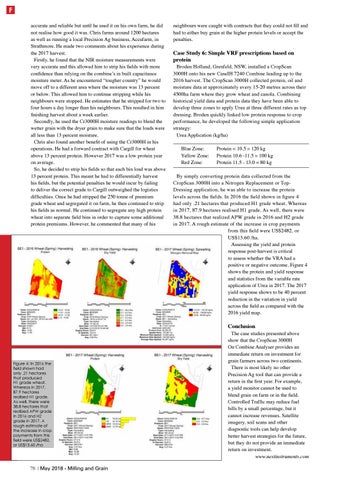
By simply converting protein data collected from the CropScan 3000H into a Nitrogen Replacement or TopDressing application, he was able to increase the protein levels across the fields. In 2016 the field shown in figure 4 had only .21 hectares that produced H1 grade wheat. Whereas in 2017, 87.9 hectares realised H1 grade. As well, there were 38.8 hectares that realized APW grade in 2016 and H2 grade in 2017. A rough estimate of the increase in crop payments from this field were US$2482, or US$13.60 /ha. Assessing the yield and protein response post-harvest is critical to assess whether the VRA had a positive or negative outcome. Figure 4 shows the protein and yield response and statistics from the variable rate application of Urea in 2017. The 2017 yield response shows to be 40 percent reduction in the variation in yield across the field as compared with the 2016 yield map.
Conclusion
Figure 4: In 2016 the field shown had only .21 hectares that produced H1 grade wheat. Whereas in 2017, 87.9 hectares realised H1 grade. As well, there were 38.8 hectares that realized APW grade in 2016 and H2 grade in 2017. A rough estimate of the increase in crop payments from this field were US$2482, or US$13.60 /ha
78 | May 2018 - Milling and Grain
The case studies presented above show that the CropScan 3000H On Combine Analyser provides an immediate return on investment for grain farmers across two continents. There is most likely no other Precision Ag tool that can provide a return in the first year. For example, a yield monitor cannot be used to blend grain on farm or in the field. Controlled Traffic may reduce fuel bills by a small percentage, but it cannot increase revenues. Satellite imagery, soil scans and other diagnostic tools can help develop better harvest strategies for the future, but they do not provide an immediate return on investment. www.nextinstruments.com