F
Impact of dietary sodium diformate on performance and litter quality in broilers
A
by Christian Lückstädt and Stevan Petrovic, ADDCON GmbH, Bitterfeld, Germany
nimal husbandry suffers from losses due to contamination with pathogenic bacteria. Their resultant impacts in animals include lower weight gains and increased mortality. On the other hand, evidence of the development of antibiotic resistant strains of bacteria that are pathogenic to humans has mounted over recent decades; and the practice of using sub-therapeutic levels of antibiotics as growth promoters in livestock production has been heavily implicated in this resistance. Worldwide, this connection has led to the erosion of consumer trust in agricultural practices that rely on this valuable medical resource. Increasingly, legislation is limiting their use. Banning the use of in-feed antibiotics in livestock, as has happened in the EU – and currently in a number of Asian countries, placed more pressure on animal producers and feed millers. In this context, organic acids have long been used to counteract Gram-negative pathogenic bacteria in animal feed; and the beneficial effects of feeding organic acids to monogastric animals on animal performance and health are well accepted. One of the first reports of improved broiler performance when diets were supplemented with single acids was for formic acid (Vogt et al., 1981). Later, Izat et al. (1990) found significantly reduced levels of Salmonella spp. in carcass and caecal samples, after including calcium formate in broiler diets. The use of pure formic acid in breeder diets reduced the contamination of tray liners and hatchery waste with S. enteritidis drastically (Humphrey and Lanning, 1988). Hinton and Linton (1988) examined how Salmonella infections could be controlled in broiler chickens, using a mixture of formic and propionic acids. They demonstrated that under experimental conditions, 0.6 percent of this organic acid blend was effective in preventing intestinal colonisation with Salmonella spp. from naturally or
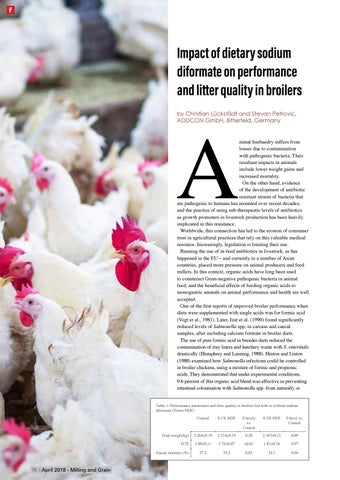
Table 1: Performance parameters and litter quality in broilers fed with or without sodium diformate (Formi NDF) Control
0.1% NDF
P-levels vs. Control
0.3% NDF
P-level vs. Control
Final weight(kg)
2.264±0.19
2.324±0.19
0.20
2.365±0.21
0.09
FCR
1.89±0.11
1.74±0.07
<0.01
1.81±0.10
0.07
57.2
53.2
0.03
54.3
0.04
Faecal moisture (%)
70 | April 2018 - Milling and Grain