The development of new technologies for feed and food milling Clifford Spencer, Goodwill Ambassador, NEPAD and Chairman, Milling4Life A fertile area for the milling industry over the next few decades is the development of new technologies and machines for milling in both the feed and food areas. Interest in the development of drought-tolerant grains is increasing in several developing countries such as India, China, and some countries of Africa because of water scarcity and increasing populations. In addition, the earmarked funds to scientific research, for purposes of improving and increasing their production and utilisation as food have also been increased. In particular the area of an expanding crop feedstock choice and with that the need for dealing with the processing of these crops previously not considered, and the potential range of new products from these crops is one that the industry can profitably address. My colleague Dr Andrew Ormerod is currently working in this area of research and I saw an email of his about the Fonio grain mill and the inventor’s Rollex Award over 20 years ago. He was asking if Sanoussi Diakite, the inventor was continuing research in relation to developing appropriate technology to process other traditional crops and if there was a network of people in the industry innovating to develop appropriate equipment for postharvest processing. Fonio is a staple crop in western Africa and because the fonio grains are so small, it is difficult to remove the brittle outer shell. For hundreds of years, African women have carried out the painstaking task of preparing fonio by pounding and threshing a grain and sand mixture with a pestle and mortar. After one hour of this tedious work, only two kilograms of fonio are available for consumption and 15 litres of precious water are needed to remove the sand. The whole process has been reduced from a one-hour job to a six-minute job. Diakité’s solution was a 50kg device that gently abrades the surface of the seed before passing through a rotating mechanism, which removes the husks. Another crop, millet is one of the most important drought-resistant crops and has resistance to pests and diseases, a short growing season, and good productivity under drought conditions, compared to the current major cereals. As a result, millet grains are now receiving specific attention from these developing countries in terms of utilisation as food as well as from some developed countries in terms of its good potential in the manufacturing of bioethanol and biofilms. Millets are not currently an important commodity in the North American and European food basket but they increasingly feature as an ingredient in multigrain and gluten-free cereal products. However, in many developing African and Asian areas, millets serve as a major food component and various traditional foods and beverages, such as bread (fermented or unfermented), porridges, and snack foods are made of millet. In addition to their 28 | March 2018 - Milling and Grain
nutritive value, several potential health benefits such as preventing cancer and cardiovascular diseases, reducing tumour incidence, lowering blood pressure, risk of heart disease, cholesterol and rate of fat absorption, delaying gastric emptying, and supplying gastrointestinal bulk have been reported for millet. Millet is usually processed by traditional processing techniques that include decorticating, malting, fermentation, roasting, flaking, and grinding to improve their edible, nutritional, and sensory properties. The three most widely available millets in the market place today – Sorghum, Pearl millet and Finger millet – are naked grains, i.e. do not have a husk layer. Processing these for human consumption is essentially a matter of cleaning and grading the grains. They are then ground up to either their flour form or into grits to make them ready for cooking. This initial ease of processing is one of the reasons for these grains to warrant further development. There are other commonly cultivated millets that have a hard cellulosic husk layer that humans cannot digest and sometimes referred to as small millets. Once removed, we get the respective millets’ rice, i.e. foxtail millet rice, little millet rice, kodo millet rice, proso millet rice, barnyard millet rice and brown top millet rice. These millet rices are then used in preparations in the same form and method that paddy rice is used in different cuisines. Large scale processing of small millets currently compromises on the nutritional value of the millet rice output by removing the bran layer completely.
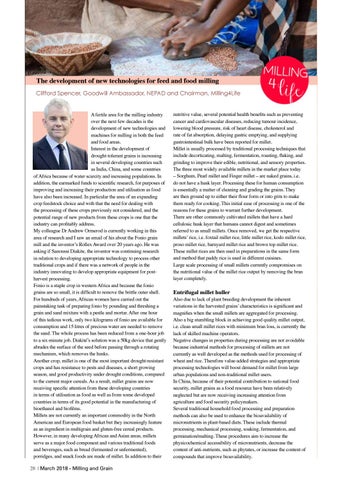
Entrifugal millet huller
Also due to lack of plant breeding development the inherent variations in the harvested grains’ characteristics is significant and magnifies when the small millets are aggregated for processing. Also a big stumbling block in achieving good quality millet output, i.e. clean small millet rices with minimum bran loss, is currently the lack of skilled machine operators. Negative changes in properties during processing are not avoidable because industrial methods for processing of millets are not currently as well developed as the methods used for processing of wheat and rice. Therefore value-added strategies and appropriate processing technologies will boost demand for millet from large urban populations and non-traditional millet users. In China, because of their potential contribution to national food security, millet grains as a food resource have been relatively neglected but are now receiving increasing attention from agriculture and food security policymakers. Several traditional household food processing and preparation methods can also be used to enhance the bioavailability of micronutrients in plant-based diets. These include thermal processing, mechanical processing, soaking, fermentation, and germination/malting. These procedures aim to increase the physicochemical accessibility of micronutrients, decrease the content of anti-nutrients, such as phytates, or increase the content of compounds that improve bioavailability.