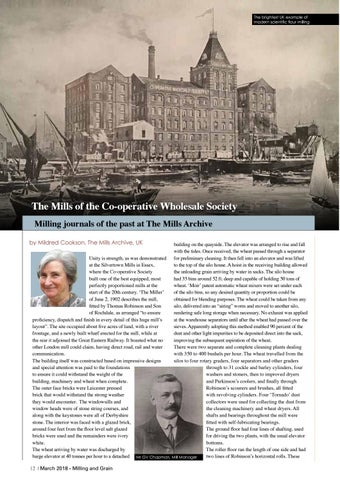
The brightest UK example of modern scientific flour milling
The Mills of the Co-operative Wholesale Society Milling journals of the past at The Mills Archive by Mildred Cookson, The Mills Archive, UK
building on the quayside. The elevator was arranged to rise and fall with the tides. Once received, the wheat passed through a separator Unity is strength, as was demonstrated for preliminary cleaning. It then fell into an elevator and was lifted to the top of the silo house. A hoist in the receiving building allowed at the Silvertown Mills in Essex, the unloading grain arriving by water in sacks. The silo house where the Co-operative Society had 35 bins around 52 ft. deep and capable of holding 50 tons of built one of the best equipped, most wheat. ‘Moir’ patent automatic wheat mixers were set under each perfectly proportioned mills at the of the silo bins, so any desired quantity or proportion could be start of the 20th century. ‘The Miller’ obtained for blending purposes. The wheat could be taken from any of June 2, 1902 describes the mill, silo, delivered into an “airing” worm and moved to another silo, fitted by Thomas Robinson and Son rendering safe long storage when necessary. No exhaust was applied of Rochdale, as arranged “to ensure at the warehouse separators until after the wheat had passed over the proficiency, dispatch and finish in every detail of this huge mill’s sieves. Apparently adopting this method enabled 90 percent of the layout”. The site occupied about five acres of land, with a river dust and other light impurities to be deposited direct into the sack, frontage, and a newly built wharf erected for the mill, while at improving the subsequent aspiration of the wheat. the rear it adjoined the Great Eastern Railway. It boasted what no There were two separate and complete cleaning plants dealing other London mill could claim, having direct road, rail and water with 350 to 400 bushels per hour. The wheat travelled from the communication. silos to four rotary graders, four separators and other graders The building itself was constructed based on impressive designs through to 31 cockle and barley cylinders, four and special attention was paid to the foundations washers and stoners, then to improved dryers to ensure it could withstand the weight of the and Parkinson’s coolers, and finally through building, machinery and wheat when complete. Robinson’s scourers and brushes, all fitted The outer face bricks were Leicester pressed with revolving cylinders. Four ‘Tornado’ dust brick that would withstand the strong weather collectors were used for collecting the dust from they would encounter. The windowsills and the cleaning machinery and wheat dryers. All window heads were of stone string courses, and shafts and bearings throughout the mill were along with the keystones were all of Derbyshire fitted with self-lubricating bearings. stone. The interior was faced with a glazed brick, The ground floor had four lines of shafting, used around four feet from the floor level salt glazed for driving the two plants, with the usual elevator bricks were used and the remainders were ivory bottoms. white. The roller floor ran the length of one side and had The wheat arriving by water was discharged by two lines of Robinson’s horizontal rolls. These barge elevator at 40 tonnes per hour to a detached Mr GV Chapman, Mill Manager
12 | March 2018 - Milling and Grain