F
Defining flour water absorption with high-precision dosage
I
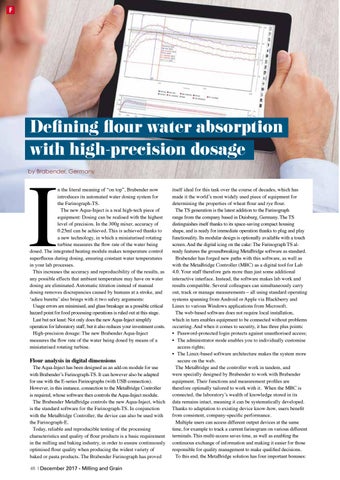
by Brabender, Germany n the literal meaning of “on top”, Brabender now introduces its automated water dosing system for the Farinograph-TS. The new Aqua-Inject is a real high-tech piece of equipment: Dosing can be realised with the highest level of precision. In the 300g mixer, accuracy of 0.25ml can be achieved. This is achieved thanks to a new technology, in which a miniaturised rotating turbine measures the flow rate of the water being dosed. The integrated heating module makes temperature control superfluous during dosing, ensuring constant water temperatures in your lab processes. This increases the accuracy and reproducibility of the results, as any possible effects that ambient temperature may have on water dosing are eliminated. Automatic titration instead of manual dosing removes discrepancies caused by humans at a stroke, and ‘adieu burette’ also brings with it two safety arguments: Usage errors are minimised, and glass breakage as a possible critical hazard point for food processing operations is ruled out at this stage. Last but not least: Not only does the new Aqua-Inject simplify operation for laboratory staff, but it also reduces your investment costs. High-precision dosage: The new Brabender Aqua-Inject measures the flow rate of the water being dosed by means of a miniaturised rotating turbine.
Flour analysis in digital dimensions
The Aqua-Inject has been designed as an add-on module for use with Brabender’s Farinograph-TS. It can however also be adapted for use with the E-series Farinographs (with USB connection). However, in this instance, connection to the MetaBridge Controller is required, whose software then controls the Aqua-Inject module. The Brabender MetaBridge controls the new Aqua-Inject, which is the standard software for the Farinograph-TS. In conjunction with the MetaBridge Controller, the device can also be used with the Farinograph-E. Today, reliable and reproducible testing of the processing characteristics and quality of flour products is a basic requirement in the milling and baking industry, in order to ensure continuously optimised flour quality when producing the widest variety of baked or pasta products. The Brabender Farinograph has proved 48 | December 2017 - Milling and Grain
itself ideal for this task over the course of decades, which has made it the world’s most widely used piece of equipment for determining the properties of wheat flour and rye flour. The TS generation is the latest addition to the Farinograph range from the company based in Duisburg, Germany. The TS distinguishes itself thanks to its space-saving compact housing shape, and is ready for immediate operation thanks to plug and play functionality. Its modular design is optionally available with a touch screen. And the digital icing on the cake: The Farinograph TS already features the groundbreaking MetaBridge software as standard. Brabender has forged new paths with this software, as well as with the MetaBridge Controller (MBC) as a digital tool for Lab 4.0. Your staff therefore gets more than just some additional interactive interface. Instead, the software makes lab work and results compatible. Several colleagues can simultaneously carry out, track or manage measurements – all using standard operating systems spanning from Android or Apple via Blackberry and Linux to various Windows applications from Microsoft. The web-based software does not require local installation, which in turn enables equipment to be connected without problems occurring. And when it comes to security, it has three plus points: • Password-protected login protects against unauthorised access; • The administrator mode enables you to individually customise access rights; • The Linux-based software architecture makes the system more secure on the web. The MetaBridge and the controller work in tandem, and were specially designed by Brabender to work with Brabender equipment. Their functions and measurement profiles are therefore optimally tailored to work with it. When the MBC is connected, the laboratory’s wealth of knowledge stored in its data remains intact, meaning it can be systematically developed. Thanks to adaptation to existing device know-how, users benefit from consistent, company-specific performance. Multiple users can access different output devices at the same time, for example to track a current farinogram on various different terminals. This multi-access saves time, as well as enabling the continuous exchange of information and making it easier for those responsible for quality management to make qualified decisions. To this end, the MetaBridge solution has four important bonuses: