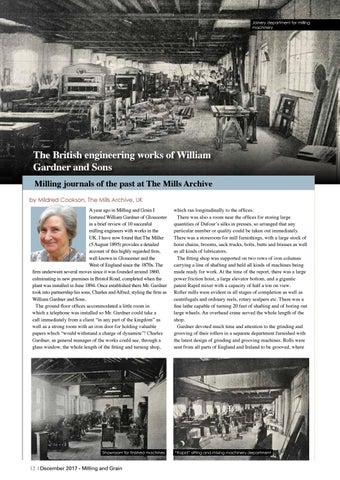
Joinery department for milling machinery
The British engineering works of William Gardner and Sons Milling journals of the past at The Mills Archive by Mildred Cookson, The Mills Archive, UK A year ago in Milling and Grain I featured William Gardner of Gloucester in a brief review of 10 succesful milling engineers with works in the UK. I have now found that The Miller (5 August 1895) provides a detailed account of this highly regarded firm, well known in Gloucester and the West of England since the 1870s. The firm underwent several moves since it was founded around 1860, culminating in new premises in Bristol Road, completed when the plant was installed in June 1894. Once established there Mr. Gardner took into partnership his sons, Charles and Alfred, styling the firm as William Gardner and Sons. The ground floor offices accommodated a little room in which a telephone was installed so Mr. Gardner could take a call immediately from a client “in any part of the kingdom” as well as a strong room with an iron door for holding valuable papers which “would withstand a charge of dynamite”! Charles Gardner, as general manager of the works could see, through a glass window, the whole length of the fitting and turning shop,
Showroom for finished machines
12 | December 2017 - Milling and Grain
which ran longitudinally to the offices. There was also a room near the offices for storing large quantities of Dufour’s silks in presses, so arranged that any particular number or quality could be taken out immediately. There was a storeroom for mill furnishings, with a large stock of hoist chains, brooms, sack trucks, bolts, butts and brasses as well as all kinds of lubricators. The fitting shop was supported on two rows of iron columns carrying a line of shafting and held all kinds of machines being made ready for work. At the time of the report, there was a large power friction hoist, a large elevator bottom, and a gigantic patent Rapid mixer with a capacity of half a ton on view. Roller mills were evident in all stages of completion as well as centrifugals and ordinary reels, rotary scalpers etc. There was a fine lathe capable of turning 20 feet of shafting and of boring out large wheels. An overhead crane served the whole length of the shop. Gardner devoted much time and attention to the grinding and grooving of their rollers in a separate department furnished with the latest design of grinding and grooving machines. Rolls were sent from all parts of England and Ireland to be grooved, where
“Rapid” sifting and mixing machinery department