F
O
in today’s feed mills
by Kevin Riley, Evonik Corporation, Kennesaw, GA, United States
ne of the biggest issues facing feed production today is feed mill capacity. This is particularly true for fully integrated poultry or swine producers, who view the feed mill as a cost center, compared with a traditional feed producer who views the feed mill as a profit center. As such, integrated feed mills are frequently asked to do more with what they have or even with less. This puts tremendous pressure on the managers of these mills to identify ways to de-bottleneck their operation without investing a tremendous amount of capital. Evonik has recognised this as an area of concern, and likewise an opportunity for us to help many of our customers. As part of our value-added technical services, we have feed mill consulting services, which are available to our customers for help and insight on how to do more with less in today’s feed mills. One way to increase throughput without significant investment is to minimise the use of liquids in feed. While a certain amount of liquids positively impacts final feed quality by reducing dust
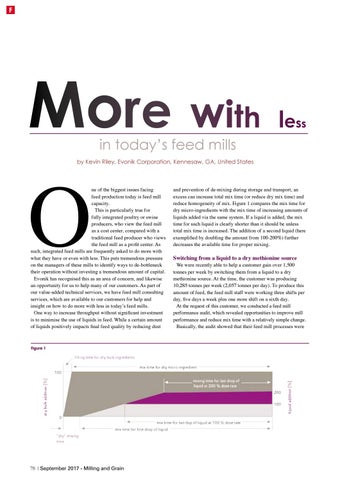
Figure 1
78 | September 2017 - Milling and Grain
and prevention of de-mixing during storage and transport, an excess can increase total mix time (or reduce dry mix time) and reduce homogeneity of mix. Figure 1 compares the mix time for dry micro-ingredients with the mix time of increasing amounts of liquids added via the same system. If a liquid is added, the mix time for such liquid is clearly shorter than it should be unless total mix time is increased. The addition of a second liquid (here exemplified by doubling the amount from 100-200%) further decreases the available time for proper mixing.
Switching from a liquid to a dry methionine source
We were recently able to help a customer gain over 1,500 tonnes per week by switching them from a liquid to a dry methionine source. At the time, the customer was producing 10,285 tonnes per week (2,057 tonnes per day). To produce this amount of feed, the feed mill staff were working three shifts per day, five days a week plus one more shift on a sixth day. At the request of this customer, we conducted a feed mill performance audit, which revealed opportunities to improve mill performance and reduce mix time with a relatively simple change. Basically, the audit showed that their feed mill processes were