July 2017
YOUR GLOBAL PARTNER
In this issue:
HOW TO PREVENT A DUST INFERNO • The effect of damaged starch in flour milling • Preservation with organic acids • Supplemented feeds for broiler chickens • Bagging, palletising and stretch wrapping • IDMA 2017
Event review Proud supporter of
Volume 128
Issue 7
millingandgrain.com
Our team of experienced Dealers and Staff
will help you determine the system that will suit your needs. Chief Agri/Industrial has a full line of grain storage, conditioning, handling, and drying products that can be engineered to fit your site.
Storage
Handling & Support Structure
Conditioning
Chief Agri: +1 308-237-3186 Chief UK: +44 1621 868944 chief.co.uk
|
agri.chiefind.com
|
silos-phenix.com
Dryers
COMMERCIAL BINS
COMMERCIAL DRYERS
COMMERCIAL CONVEYORS
COMMERCIAL SWEEPS
BUCKET ELEVATORS
STEEL BUILDINGS
• 47.548m Diameter Bins (20320.9-48262.2 mt) • Tower Dryers (22.5-281.2 t/h) • Peak Load Rating (6803.8-45359.2 kg) • QuadraTouch ProTM Controls • Hopper Bins (3.65m-14.6m) • Balanced Moisture Content • Auger & Paddle sweeps available • Capacity includes 140.6-281.2 t/h • Patented Pivot Point • Industrial Grade Pushers
• Low Impact Head Design • Heavy Gauge Trunking • Patented Squaring Plates
• Capacity includes (984.3-1687.5 t/h) • Dust-tight and waterproof • Patented hip-style weather-tight cover • Industrial Strength • Built To Last • Higher Elemental Resistance
S u k u p Wo r ld H eadquarters - S heffi el d, I o w a 5 0 4 7 5 - 0 6 7 7 • w w w. su ku p . co m • in f o @ su ku p . com For service in Europe contact:
Sukup Europe A/S Hedensted, Denmark Tel +45 75 68 53 11 • Fax +45 75 68 54 70 info@sukup-eu.com • www.sukup-eu.com
Pneumatic or Mechanical Ship Loaders & Unloaders Port Equipment - Turnkey Projects PNEUMATIC UNLOADING : From 100 to 800 tons/hour Average efficiency 75%-80% All sizes of vessels All types of grains
PORTABLE GRAIN PUMPS up to 270 t/h
PNEUMATIC BARGE UNLOADER up to 600 t/h
LOADER up to 2000 t/h
SIMPORTER up to 1500 t/h
A win-win solution between customer expertise and VIGAN know-how VIGAN Engineering s.a. Rue de l’Industrie, 16 - 1400 Nivelles - Belgium Tél.: +32 67 89 50 41 • Fax : +32 67 89 50 60 • www.vigan.com • info@vigan.com
VOLUME 128 ISSUE 7
July 2017
Perendale Publishers Ltd 7 St George’s Terrace St James’ Square, Cheltenham, Glos, GL50 3PT, United Kingdom Tel: +44 1242 267700 Publisher Roger Gilbert rogerg@perendale.co.uk International Marketing Team Darren Parris Tel: +44 1242 267707 darrenp@perendale.co.uk Tom Blacker Tel: +44 1242 267700 tomb@perendale.co.uk Mark Cornwell Tel: +1 913 6422992 markc@perendale.com Latin America Marketing Team Iván Marquetti Tel: +54 2352 427376 ivanm@perendale.co.uk
88 - Grain entrapment prevention kits
New Zealand Marketing Team Peter Parker peterp@perendale.co.uk
In response to the rise in preventable fatalities from grain engulfment, SCAFCO Grain Systems Company will begin offering grain entrapment prevention kits for the entire line of flat bottom bins and a majority of larger hopper bottom bins in the near future.
Nigeria Marketing Team Nathan Nwosu Tel: +234 805 7781077 nathann@perendale.co.uk Editorial Team Rhiannon White rhiannonw@perendale.co.uk
ISSUE HIGHLIGHTS
Zasha Whiteway-Wilkinson zashaw@perendale.co.uk
NEWS
International Editors Professor Dr M Hikmet Boyacıog ˘ lu hikmetb@perendale.co.uk Dr Roberto Luis Bernardi robertob@perendale.co.uk Professor Wenbin Wu wenbinw@perendale.com Design Manager James Taylor jamest@perendale.co.uk Circulation & Events Tuti Tan tutit@perendale.co.uk Development Manager Antoine Tanguy antoinet@perendale.co.uk ©Copyright 2016 Perendale Publishers Ltd. All rights reserved. No part of this publication may be reproduced in any form or by any means without prior permission of the copyright owner. More information can be found at www.perendale.com Perendale Publishers Ltd also publish ‘The International Milling Directory’ and ‘The Global Miller’ news service
Grain & Feed Milling Technology magazine was rebranded to Milling and Grain in 2015
FEATURES
46 The effect of damaged starch in flour milling on the quality of baked goods
50 Fortification for the poorest of the urban poor
52 Preservation with organic acids
FACES
2 6-40
56 Supplemented diets for chickens 60 Lipid functionality and precise formulation
62 Phytobiotic HygenPro® in poultry and swine diets
128 People news from the global milling industry
PRODUCT FOCUS
44
CASE STUDY
94
66 A tailored solution for bakery mixes
STORAGE
70 Bagging, palletising and stretch wrapping 72 Energy savings 76 Mycotoxin testing
78 Rice testing
EVENTS
100 Event listings, reviews and previews
84 How to prevent an inferno caused by dust 88 Grain entrapment prevention kits 88 PROJECT: Major silo order completed in Egypt
TRAINING
43 Executive milling course coming in Spanish
COLUMNS
12 Mildred Cookson 18 Raghavan Sampathkumar 24 Roger Gilbert 29 Tom Blacker 30 Christophe Pelletier 36 Chris Jackson
4 GUEST EDITOR Professor Dr Mustafa Bayram
96 MARKETS Jeremy Zwinger
126 INTERVIEW Paul Phillips
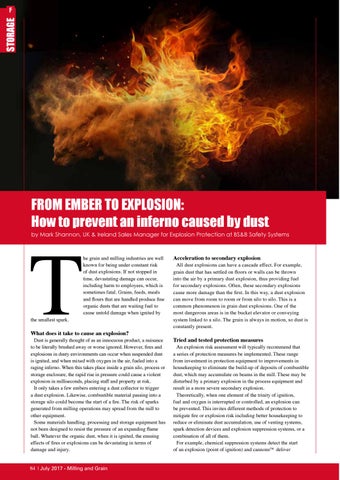
COVER IMAGE: The grain and milling industries are well known for being under constant risk of dust explosions. If not stopped in time, devastating damage can occur, including harm to employees, which is sometimes fatal. - see the feature on page 84
ISSUE HIGHLIGHTS FLOUR
The effect of damaged starch in flour milling on the quality of baked goods
The recovery of flour ingredients from wheat during processing is not without deleterious effects.
PAGE 46 ORGANIC ACIDS Preservation with organic acids - Combating food and feed waste
FORTIFICATION
SAFETY
Fortification for the poorest of the urban poor
Grain entrapment prevention kits
Mass food fortification is sometimes overlooked as a way to improve public health because it does not reach subsistence farmers who are often considered the “poorest of the poor.”
In response to the rise in preventable fatalities from grain engulfment, SCAFCO Grain Systems Company will begin offering grain entrapment prevention kits in the near future.
PAGE 50
PAGE 88
DUST How to prevent an inferno caused by dust
The grain and milling industries are well known for being under constant risk of dust explosions.
PAGE 84 PROJECT Major silo order completed in Egypt
Feeding the world’s population is an everincreasing challenge.
23 large silo plants supplied by Cimbria to Egypt were commissioned and officially inaugurated by the President of Egypt
PAGE 50
PAGE 90
FOOD
STORAGE
FEED
PROCESS
POULTRY
PACKAGING
SUPPLEMENTED DIETS
A TAILORED SOLUTION FOR BAKERY MIXES
When processors of flour, or flour-based mixtures, want to package their product into bags for sale/shipment to potential customers, the go-to machine is usually an auger type filler.
PAGE 66 GRINDING Energy savings in the milling process
The choice for a specific grinding technique is key to the quality of the end product and the output of the production process
PAGE 72
FORMULATION PACKAGING bagging, palletising and stretch wrapping
From Catalonia (Spain) to the rest of the world: who is TMI? Técnicas Mecánicas Ilerdenses, S.L. (TMI) was founded in Lleida, in the heart of the region of Catalonia (Spain), back in the year 2000 out from the hand of two experts in the field of the industrial machinery design
PAGE 70
2 | July 2017 - Milling and Grain
Leading the approach to lipids functionality and precise formulation
The fluctuating cost and quality of major protein sources used in poultry feed are forcing feed manufacturers and integrators worldwide to use cheaper but poorly digestible raw materials.
PAGE 56
Productivity in the face of a changing global context. The global increased demand toward animal protein calls for higher productivity, which must come along with higher efficiency in order to both preserve resources and dairy farms’ profitability.
In this article, we would like to review the efficacy of phytobiotics used in the different stages of poultry and swine production.
PAGE 60
PAGE 62
PHYTOBIOTIC Phytobiotic HygenPro® in poultry and swine diets
The things we produce today were utopias yesterday. Our task is to give shape to new ideas and innovate what once was magic.
Precleaning Rotary Separator
SRP
www.ocrim.com
Guest
Editor
Protein wars According to a Genographic study, gene history of human says that our first district was Africa, then geography caused to first migration of people, so our next district was to be Middle East, and then other forced migrations caused to establishment of new districts such as America, Far East Asia and Europe. When former people reached their new Continents, they acquainted to the magic of Continents plants. They found wheat, corn and rice in Middle East, America and Far East, respectively. They also had known sorghum in their origin Africa. These four products were destiny for them, anymore. They have used these products as a main nutrition and sources of protein, carbohydrate, vitamins and minerals. Today, these products are also known as four basics for food industry. Before the agricultural era, people were hunters and they supplied their proteins from meat. After the agricultural revolution, meat protein shared its potential with plant proteins. As a note, these revolutions also determined the destiny of women in the world. Hunter women were more powerful against to man than farmer women. They earned their lost powers with industrial revolution again. When we reached the industrial revolution, both meat and plants were also basics for protein. Recently, something started to change on perception of protein. Protein is one of the most important components of the food industry and its products today. Gluten as a wheat protein is being showed as big issue by some due to its’ potential allergen effect. Next time, zein as a corn protein will perhaps become another issue. There is big propaganda for gluten, which has started to affect the wheat product industries especially pasta, flour, biscuit and particularly bread. In some countries, these are main food products, which are used to feed people. Due to negative propaganda about wheat protein, people started to far from wheat products. But, we need to generate a new protein source for people. This issue will also affect the cereal industry. For example, in some places bread production has started to decrease due
®
12 September 2017
www.buildmyfeedmill.com
to low consumptions. It affected the flour milling industry. If people are fed with animal protein, it will cause other problems especially environmental and economic. In the future, we expect that the population increase rate would be high before the “Industry 4.0 declaration”. To feed high population we need to find cheap protein sources, grain proteins could be a good solution. In contrast, Industry 4.0 will change the population increase rate and it will cause a decrease in the population. Additionally, people will prefer non-allergenic proteins and low carbohydrate containing products. A new war is going to start among proteins. Who will win? The grain industry needs to find a new strategy to win the approaching war in the near future. As a first solution, the grain industry should be innovative. New R&Ds are required. Powers should be combined. Additionally, there will be a good potential for blended legume and grain proteins or products. Cereals are rich and poor for some compounds similar to legumes. If both protein sources are combined, grain industry will obtain high protein and proper products. Also, increasing legume consumption will increase the plantation. Instead of animal protein, this plant as protein source will preserve the earth against chemical pollution and carbon dioxide emission. The grain industry has still been using basic classical processes and well-known products. Innovation feeding rate to industry is very limited. Significant R&D studies are also limited. The grain industry based on innovation is generally behind the dairy, chocolate, confectionary and beverage industries. In the near future, whichever industry supplies protein to consumer, it will be winner of the future. So, the grain industry should focus on the innovative products and technologies. Professor Dr Mustafa Bayram, TABADER Association’s Chairman (Grain and Pulses Processing Technologies, Storage and Analysis System Association) (University of Gaziantep, Faculty of Engineering, Department of Food Engineering)
Build My Feedmill is a new conference concept brought to you by the team at Milling and Grain magazine. It aims to bring you the latest technological and process developments by the most forward thinking speakers and companies, in a format based on the process flow chart of a feedmill. The quick fire presentations will bring you right up to date with the latest thinking for all the key areas in the feed milling process. The first Build My Feedmill conference was held at VIV Asia in 2017, and we would like to invite you to join us for the next installment to be held as part of Asia's largest and most influential grain, rice and feed event - CICFO 2017
Annual Subscription Rates Inside UK: UK£100 Outside: US$150/€133
ISSN No: 2058-5101
More Information www.millingandgrain.com http://gfmt.blogspot.co.uk
News
JUL 17
Milling
Flourmi
®
The unique, one day flow-chart feed and flourmill conferences to visit China
C
hina International Food & Feed Processing Industry Exhibition (CICFO) takes an international perspective of food and feed processing, aiming to provide comprehensive solutions. Since its establishment in 2013, the scale of the show, and the scope of its display has grown rapidly alongside a myriad of professional visitors. This year it will present a wide range of food and feed manufacturing equipment, and facilitate technical exchanges and trade development! CICFO 2017 will be held at the Beijing International Exhibition Center from September 11th to 13th, 2017. The exhibition area will exceed 30,000 square meters, of which 27,000 square meters will be displayed in the exhibition area. This enormous area will be populated by more than 450 exhibitors, of which the almost one third are of international background, and more than 28,000 attendees.
Build My Feedmill 2017 will be presented alongside its sister event named Build My Flourmill, in conjunction with CICFO. Together, they will feature food products, food ingredients and additives, noodles and bread production systems, Machinery, granulation machinery, granulation machinery, feed additives, weighing, ingredients, mixing, sorting, packaging, testing, storage, transportation, drying, unloading, dust and explosionproof industrial robots and other related equipment and automation equipment. 6 | July 2017 - Milling and Grain
Welcome to our July edition of Milling and Grain! Over half way through 2017, of what has been a very busy and successful year for us. For a first off note, we’d like to bring attention one of our columnists, Christophe Pelletier. Christophe has been writing for us for two years and time after time has delivered thought provoking, informative and inspiring columns. It is with regret that this month will be Christophe’s last column with us for a little while as he is off to learn more about this industry he loves so much. To read some of his previous work you can find his columns either on our blog, ‘The Global Miller’ or on our online editions of Milling and Grain. Thank you Christophe for everything that you have brought to Milling and Grain, we can’t wait to see what you do next! Secondly, seems the warm weather is somewhat inspiring as our articles are coming in thick and fast! Safety cannot be underestimated in this industry, often we focus on the safety and health of the animals we work with, which is all very well but it is equally if not more important to focus on ourselves and those working on the front lines of animal feed. On that note, one of the highlights of this issue is a storage feature by Mark Shannon, BS&B, “From ember to explosion” discussing the dangers of dust and how easy a serious disaster can occur if proper safety measures are not taken. On a similar note of the importance of safety in storage, SCAFCO discuss the high risks of grain entrapment in grain bins. It notes the unnerving figure that over the past 50 years, more than 900 cases of grain engulfment have been reported, with a fatality rate of 62 percent. Focusing on dairy cow nutrition, Alfredo J.Escribano, DVM, PhD, writes on the global increase in demand for animal protein. He discusses how a lack of nutrition can cause the cow to enter a Negative Energy Balance, compromising the triangle composed by metabolic health, fertility and milk production. He talks about how to combat these issues and how the approach to lipids functionality and precise formulation can help. For events this month our big review is on the highly successful IDMA conference, which took place back in April in Turkey. With lots of pictures of our time at the event as well an article on who and what made this years event so special, it’s a really nice follow on from the brief intro we had in our June edition and the features we ran then from the event. Another place our team were able to visit was Cetec Industrie in France. We have put together a case study of the visit in which we talking about the bagging machines, packaging solutions and their highly impressive robot palletizer. Finally, for our interview we were lucky enough to have a chat with Paul Phillips, President of Maxi-Lift and the immediate past Chair of the Board of Directors and Executive Committee of the AFIA – his interview goes into depth of his background and how he became such a notable face in the industry, as well as where he thinks the grain handling industry will be in the decades to come!
GF
MT
gfmt.blogspot.com
Milling News
T
Improvements of the Svalbard Global Seed Vault he Svalbard Global Seed Vault is the world’s backup for crop collections. It currently safeguards more than 930,000 different varieties. It has been reported that the Seed Vault has seen water intrusion due to melting permofrost. The Royal Ministry of Agriculture and Food in Norway, the Crop Trust, and NordGen would like to assure seed depositors and the public that the seeds are completely safe and no damage has been done to the facility. The Royal Ministry of Agriculture and Food and Statsbygg, Norway, is taking appropriate measures to ensure the protection of the Seed Vault and improve the construction to prevent future incidents. Globally, the Seed Vault is, and will continue to be, the safest backup of crop diversity. After nine years of operation, the Svalbard Global Seed Vault is facing technical improvements in connection with water intrusion in the outer part of the access tunnel because the permafrost has not established itself as projected. The seed vault is owned by the Norwegian government and administered by the Ministry of Agriculture and Food (LMD). Statsbygg is responsible for the administration of the physical installation and the technical operation of the vault. LMD has entered into a 10-year operating agreement with the Nordic Genetic Resource Center (NordGen), which is responsible for the operations of the seed vault and the International foundation Global Crop Diversity Trust (GCDT), which is contributing financially. Safety measures The seeds in the seed vault have never been threatened and will remain safe during implementation of these measures, the measures are being carried out to provide additional security to the seed vault, based on a precautionary (“better safe than sorry” approach). The measures will provide the most optimal maintenance and surveillance of the installation. Description of the measures: • Removal of heat sources in the access tunnel will protect against water intrusion resulting from potential climate change. • Drainage ditches will be constructed on the mountainside
to prevent melt water from platâfjellet accumulating around the access tunnel and to protect against water intrusion resulting from any climate change. • The construction of waterproof walls inside the tunnel will provide additional protection for the actual vault. • Alternatives for a new access tunnel to the seed vault will be explored with the aim to improve safety in a long-term perspective. • Statsbygg is carrying out a research and development project that will monitor the permafrost on Svalbard. • Statsbygg has moved the transformer station out of the tunnel. This provides safer operation, easier maintenance and has removed a heat source. • The seeds will remain safe during implementation of the measures. The seed vault has been considered a success. It has widespread support and a well functioning operation. Stasbygg is now implementing measures that will continue to protect the seed vault in the future. Some improvement measures are being implemented to prevent the season-dependent intrusion of water into the seed vault’s access tunnel. When water intrudes into the outer part of the seed vault, the water is immediately pumped out again by pumps that work around the clock. Any melting of the permafrost has a very long-term perspective. It is “better to be safe than sorry”, Statsbygg is carrying out a research and development project that will follow the development of the permafrost on Svalbard. The seed vault on Svalbard is a very safe installation for the preservation of copies of the world’s seeds. The seeds are stored deep inside the mountain, which is kept frozen by both permafrost and artificial freezing. Statsbygg provides 24-hour surveillance of the technical installation to ensure the seeds are safe. When water intrudes into the outer part of the seed vault, the water is immediately pumped out again by pumps that work around the clock. The effect of the measures will be continuously assessed in the coming years. If they are not sufficient, further and more extensive measures will be implemented. The measures will be implemented from now to 2018.
Symaga beat their own manufacturing record
S
ymaga Group has beaten its own manufacturing record in the first semester of 2017: with 23 million tonnes of steel processed, they have experienced a 10 percent growth compared to 2015 and 2016, our previous historic records. This expansion has been followed by a 10 percent increase of their workforce, reaching 250 employees in 2017 for the whole Symaga Group. Leading worldwide projects, such as the ones being developed in Ukraine 8 | July 2017 - Milling and Grain
of 240,000 tonnes worth of storage facilities and a new port terminal in Odessa, along with further expansion in Asia, Africa and Middle East, has allowed them to reach these figures. Symaga is currently involved in key grain storage projects all around the world.
Because of their state-of-the-art fully automated factory, they can provide storage solutions for different fields such as breweries, animal feeding, port facilities, flourmill, ethanol, drying, and storage of raw materials for the plastic industry.
Milling News
BASIS award winner for novel cover crop research
T
he much-anticipated award winner for the BASIS ‘Paul Singleton Project of the Year Award’ is announced as Rosalind Martin, for a cover crop project, which could aid integrated weed management strategies on arable farms. The winning project investigates how cover crop ‘debris’ affects pre-emergence herbicide efficacy and wheat crop emergence. Ms Martin, Bayer, commercial technical advisor, North West, commented, “In recent years, there has been a surge in interest in the use of cover crops and direct drilling establishment techniques. However, when cover crops are sprayed off and winter wheat is direct drilled, the cover crop debris remains on the ground. It is then unknown how this may impact crop emergence and the efficacy of preemergence herbicides.” Rosalind was inspired to conduct the project when she visited David White, ‘Dog and Spade Farmer’, local to Cambridge, during her training at Bayer. Rosalind’s project was conducted in 2015 on David’s farm, on a medium-pressure blackgrass site, and included a robust herbicide programme as well as several cultural control measures, such as delayed drilling. Rosalind explained, “The trial compared two plots, one where the cover crop debris was removed by hand and one where the debris was left in its natural state. The results showed that there was no difference between the two sites, in
Stephen Jacob, Rosalind Martin, James Christian-Ilet
terms of weed and crop emergence.” She continued, “The conclusion is that this style of integrated weed management can give good control of medium pressure blackgrass, and also indicated that debris doesn’t affect crop emergence. Further work will need to be carried out in order to establish the effect of cover crop debris on pre emergence herbicide efficacy. However, initial research, conversations with growers and a literature review suggest that they may not affect their efficacy.” Rosalind is delighted with the win, which was judged against the top five projects that are a fundamental element of the ‘Certificate in Crop Protection’ training from BASIS. She summarised, “It’s a real honour to win. The course was really enjoyable as it was so relevant to my job and benefitted me hugely, in terms of knowledge and career development. I’d recommend it to anyone interested in agronomy."
The perfect partner for process automation Our Solutions: Design and engineering Build and installation MCC and PLC panels Software engineering PLC/SDADA MES application Batch Explorer Integration to other software packages Turn Key installations incl. training, service & support
info@inteqnion.com www.inteqnion.com
10 | July 2017 - Milling and Grain
UNIVERSAL RECLAIM SYSTEM
E L P M I S • T R A M S • E F SA FIND THE PERFECT
ing inciple of undermin Based upon the pr les of bulk materials. residual pi e foot of ating action at th A continuous vibr sive layers of product, es a pile abates succ flowing, until complete e cohesive or fre sidual pile. clearance of the re
SOLUTION BIOMASS
ed
Guarante Total Clearance
Pellets • Wood chips • Sawdust Bagass • Coffee grounds
AGROFOOD
Soybean meal • Sugar • Cereals Oil seeds • Flour
INDUSTRIES
Potash • Fly ash • RDF • Plastics
CONTACT US
20 YEARS
OVER WORLDWIDE EXPERIENCE
ISO 9001 : 2015 AB Certification
VIBRAFLOOR
VIBRAFLOOR USA LLC
Z.A. 27 rue de la Tuilerie 71640 Dracy-le-Fort / France
3484 East Country Club Road, Salina, KS / United States
Phone: +33 (0)3 85 44 06 78 Fax: +33 (0)3 85 44 06 79 E-mail: vibrafloor@vibrafloor.com
Phone: +1 405-834-2043 E-mail: f.norwood@vibrafloor.com
w w w. v i b ra f l o o r. co m
Powe red by innov a tion
Clarence Street Mill - Rescued Plan of Offices, 1896
Milling in Hull: Part one “Fine Buildings Combined With Up-to-date Machinery”
Milling journals of the past at The Mills Archive by Mildred Cookson, The Mills Archive, UK In February this year, the Mills Archive rescued several hundred files from the basement of the Hull architect practice of Gelder and Kitchen. More than 600 files on roller flourmills, along with thousands of others on civic, domestic and industrial buildings were threatened with imminent destruction. The roller flourmill files each contain many architectural drawings outlining new mills or modifications to existing mills covering the UK throughout the 20th century. Sir Alfred Gelder did a great deal of work for his friend and fellow Methodist, Joseph Rank. Much of what we salvaged relates to Rank flour mills, with the earliest, dating from 1890, concerning his Clarence Mills in Hull. In due course we will tell the full story on the Mills Archive website (millsarchive.org) but I thought it appropriate to write a short series about Rank’s flour mills and the picture of milling in Hull at the start of the 20th century. Much of the information comes from my own files and from two articles in ‘Milling’ in June 1904. Hull, formally known as Kingston-upon-Hull, is on the River Hull as it enters the Humber estuary. Development of port facilities in the nineteenth century on the River Hull had a major impact on milling companies: in 1837 the inward tonnage of grain was only 360,000 whereas by 1903 it had increased to 4,112,614 tonnes. This ten-fold increase was due to the opening of the Alexandra Dock, which was regarded as the finest dock at that time on the East Coast. The importance of this milling centre increased when the Hull and Barnsley Railway and Dock Co revolutionised the history of the grain trade of Hull by collecting flour free of charge from the mills, in contrast to rival railway companies who continued charging. In 1822 Hull had around thirty millers named and by 1904 none of these survived in the production of flour, but it is interesting to note that since 1884, when roller mills came into their own, the list is extensive. The Rank name was by then standing out. In the 1860s and 70s James Rank was at Stepney Mills, and in 1875 Joseph Rank had taken over Mr Waddingham’s mill in Holderness Road. In 1879 James Rank died and Joseph Rank 12 | July 2017 - Milling and Grain
took over Stepney mills; he had by then also taken occupancy of West’s Mill on the Holderness Road. The first roller flourmill erected in Hull was Groves Mills, but Joseph Rank was soon to follow. In 1888 he built a steel-roller plant on the banks of the River Hull, with capacity of 20 sacks per hour but with room to expand to 60, as well as the first discharging elevator in the country and a silo of 20,000 quarters capacity. The great Clarence Mills of Messrs Joseph Rank were built in 1891 and had the distinction of being the largest on the East Coast. They were situated in the centre of the city on the East bank of the River Hull close by to a swing bridge, about half a mile from where the river enters the Humber. Mills A and B were situated side by side to the left of the sprinkler tower in the illustration. They were to the right of the office building on the corner and occupied the whole of the four floors, with the A and B warehouses on their right. Six line shafts in the basement drove the smooth roller mills on the first floor, which were arranged in six lines and comprised 50 double Simon mills, most of them being 40 inches x 10, the remainder being 32 inches x 10. On the second floor were two lines of Simon Double “Reform” dustless purifiers with ten in each line. At the time of the 1904 article changes were in hand on the third floor. When finished more than half of this room would be devoted to rollers with six lines of Simon break mills, 40 inches x 10 and two lines of Simon’s “Reform” dustless double purifiers, 10 in all. On the top floor two lines of centrifugals, 108 in total were arranged in tiers, three high, and all three-sheet Simon machines. This uniformity looked very sensible, making the individual floors look smart. The most remarkable feature about both the plants was the placement of the break mills on the third floor. There were four breaks with the scalping being done on reels and centrifugals. The cleaning house for both plants contained five rotary separators and graders, a large complement of cylinders, three milling separators, three “Eureka” scourers, three Simon washers, five Simon whizzers, three columns of dryers and four “Victor” brush machines. The cleaning capacity was 90 quarters per hour. The imposing central building on the corner provided office and accommodation on the first two floors while the floors above were for sacked good and general stores. As can be seen from the rescued Gelder and Kitchen drawings, the facade was
dated 1896. The arrangement in the C mill is not shown on the photograph as it was situated on the far side of the property. The output of the A mill was 30 sacks per hour, whereas that of the B and C mills was 35. On the first floor of C mill were six lines of Simon double roller mills, 15 sets for the breaks and 18 for the reductions. The next floor had ten Simon “Reform” dustless double purifiers. On the
A small sample of the Gelder and Kitchen files
The Atlantic Flour Mills, Barry Docks, Cardiff
third floor were five other purifiers of the same pattern by Simon and a number of reels and centrifugals for scalping; the number of breaks being four. The top floor held 40 Simon three-sheet centrifugals and seven reels. The cleaning department capacity was 35 quarters per hour. Steam power for the mills came from four Lancashire boilers; there were five altogether, with one always laid off for cleaning. Water was taken from the river and converted to steam at a pressure of 180 psi. The main drives were all by cotton ropes, 16 from the flywheel of each engine. By 1904 the Clarence Mills at Hull had been expanded to 100 sacks per hour. An article the following week in ‘Milling’ continues the descriptions of Rank mills in recognition of Joseph Rank becoming the President of nabim. In particular they mention the Premier Flour Mills to be built at the Victoria and Albert docks in London and the Atlantic Flour Mills at Barry docks in Cardiff. Both mills were built to the Simon system, which had just been ordered. The illustration of the Atlantic Mills was made for ‘Milling’ from drawings, specially prepared by Roger Oldham, using plans and elevations supplied by the Architects Messrs. Gelder and Kitchen of Hull, which is where this article started! The geographical and historical spread of our holdings at the Mills Archive mean that I can only provide snapshots; if you would like to know more please email me. mills@millsarchive.org
Clarence Flour Mills Clarence St, Hull 1890 to 1904
Genuine for over 50 years!
Grain Cooling
GRANIFRIGOR™ The most natural way of grain preservation •
Protection against insects & fungi
•
Without chemical treatment
•
Short amortisation period
•
Low energy demand
•
Independent of ambient weather
•
No respiratory losses
F r i g o r Te c G m b H • i n f o @ f r i g o r t e c . d e • w w w. f r i g o r t e c . c o m
Sir Arthur Gelder as Mayor of Hull
Joseph Rank, 1904 President of nabim
Milling and Grain - July 2017 | 13
Milling and Grain supports the aims and objectives of the Mills Archive Trust, based in Reading, England. The history of milling no matter where it has taken place - is being archived by the Trust. For well over 100 years milling technology has been global with many magazines serving or having served our industry from flour and food to feed and oilseed processing and now to fish feeds. A most recent contribution to the Trust’s collection is a complete century of past edition of the now out-of-print ‘NorthWestern Miller’ from the United States. We are proud to present here, front cover illustrations from this valued and longserving publication as a visual reminder of the importance contribution past magazines provided to our industry.
YOUR GLOBAL PARTNER
Art in the Archive We are a charity that saves the world’s milling images and documents and makes them freely available for reference. We have more than two million records. We aim to cover the entire history of milling, from its ancient origins up to the present day. Find out what we have and how you can help us grow.
millsarchive.org The Mills Archive Trust Registered Charity No 1155828
Milling News
The Mills Archive appeal:
Can you help save a vital part of the world’s flour milling heritage?
display some stunning and evolving mill- related artwork and these will be available to view by anyone around the world. Unless the milling community acts now to care for this vulnerable and increasingly rare material, we will pass the point at which it can be rescued. Can you help? To find out more, or to make a donation, please email: mills@millsarchive.org
Cryloc Rotary Screens The two screen decks are specially designed for hammer mills, which grind on different sieve perforations, or in combination with a crumbler. In the sieve feed of the two screen decks is an electro-pneumatic operated valve which can rotate between the upper and lower screen. Suitable for: Raw materials prior to grinding Pellets and crumbs Extrudates and expandates
info@wynveen.com - www.wynveen.com
A Triott Company
T
he Mills Archive, possibly the world’s largest specialist milling archive and library, is an educational heritage charity based in the UK (registered charity no 1155828). Since 2002 they have provided a safe home for images and documents relating to traditional wind- and watermills, which they make freely available on their website and online catalogue (millsarchive.org). We now include the care and conservation of roller flourmill records, a hugely significant part of the world’s milling heritage and vital to the educational story of the evolution of milling. Since they announced their intentions to establish the world’s first roller flourmill archive, in this magazine and elsewhere, they have been given more than 1,500 loose issues of the important “Northwestern Miller” journal from the USA. The journals capture the important revolution in the milling world during a period of rapid technological change from wind and watermills too much larger factorystyle mills. The new collection extends from 1886 to 1973 and is the largest set available to the public in Europe and possibly worldwide. In 2015 they received a grant of almost £9,000 from the Mercers’ Company to bind and house these journals, in order to protect their fragile state and prevent further degradation. However, since receiving this grant, the collection of the Northwestern Miller has grown, and they are left with a £2,500 shortfall to cover the cost of binding. The Mills Archive are looking for a company or an individual who recognises the value of these journals and who wishes to make a difference by covering this shortfall. If you would like to donate to this project and ensure that this collection is preserved and made available to the world, they would love to hear from you. The journals are very fragile, and by supporting this appeal, you will prevent this from happening to more issues. Once bound, the journals will become publically accessible for the first time. The charity are also working to scan some of the best examples of the front covers, which
versatility in feed processing Milling and Grain - July 2017 | 15
Milling News
Mondi wins three awards for plant safety
T
he Paper Shipping Sack Manufacturers’ Association (PSSMA) has announced the winners of its Safety Awards Programme. This included three Mondi Industrial Bags plants in North America, which won PSSMA awards for plant safety in recognition of the “Best annual safety experience”. The winning plants were Louisville (Kentucky), Arcadia (Louisiana) and Salt Lake City (Utah). Moreover, Arcadia and Louisiana achieved zero incidents rates in 2016. Mondi Salt Lake City won for the best annual safety experience in the category of plants reporting more than 300,000 man-hours. The plant is SQF (Safe Quality of Food) level three certified and mainly serves the building products/cement, chemical/mineral, pet and food industries. Salt Lake City produces three main bag types: pasted valve, pinch bottom and PeelPak® for the dairy industry. Mondi’s Louisville and Arcadia plants both won for the best annual safety experience in the category of 150,000– 225,000 man-hours with zero reportable incidents. The Louisville plant continues its successful year with no recordable incidents. Jason McCarty, Safety, Health and Environment Manager at Louisville, stated, “This is mainly due to a strong safety culture with the production employees and management’s
commitment to safety. Supervisors incorporate safety into their daily routines. Everyone looks out for one another and doesn’t hesitate to speak up about safety issues.” Mondi’s Louisville plant manufactures woven polypropylene industrial bags used in the food and animal feed industries. Arcadia is a major supplier of refuse multiwall paper bags: biodegradable, recyclable and ideal for composting. It specialises in the production of refuse and PSOS (square bottom) bags. According to Mark Ushpol, President of Mondi Industrial Bags in North America, the awards reflect Mondi’s Zero Harm safety philosophy and fundamental values set out in The Mondi Way. He commented, “Passion for performance, caring and acting with integrity are Mondi’s core values. Across all of our plants, the teams work effectively to cultivate a safe, productive and harmonious work environment that supports engagement in safety, ultimately leading to the results and accolades that flow from this.”
Your global technology process supplier for the animal feed industry ANDRITZ is one of the world’s leading suppliers of techno logies, systems, and services relating to advanced industri al equipment for the animal feed industry. With an in-depth knowledge of each key process, we can supply a compatible and homogeneous solution from raw material intake to finished feed bagging.
ANDRITZ Feed & Biofuel A/S Europe, Asia, and South America: andritz-fb@andritz.com USA and Canada: andritz-fb.us@andritz.com
16 | July 2017 - Milling and Grain
www.andritz.com/ft
The Raghavan Report Healthy eating in Asia: How can the global grain industry be a part of it? by Raghavan (‘Ragha’) Sampathkumar Recently, I participated in an event on traditional varieties and cultivars of major and minor cereals and staple crops in India. Many of these such as pearl millet, finger millet, foxtail millet, and pulse crops such as horse gram were once part of everyday diets of Indians. But in the last few decades, these crops were gradually replaced by a few major ones, i.e. rice, wheat and maize – all grabbing a major share in daily calorie intake. However, it was heartening to see an enormous amount of diversity in terms of germplasms in crops including rice, wheat, millets and even some native trees. As a food & agribusiness professional, I was very excited as I can connect each of these with the greatest challenges that global agriculture faces today. For example, I noticed a traditional rice variety naturally rich in iron content, which can effectively be used to mitigate anaemia. There was a medium duration rice variety, which grows in hilly tracts and does not require as much water as the one grown in the plains and delta regions. Another rice variety was claimed to be well suited for people suffering from diabetes and another variety was well known for its aroma. Interestingly, there was a unique variety of rice that was claimed to be the preferred one when a newly wed groom visits his spouse’s home. It was such an enriching and learning experience for me personally. Even though the event was organised in one of the metropolitan cities of India, it was really amazing to see a large number of people who seemed to be curious to know about agriculture. I noticed parents getting to know about these crops for the first time and explaining to their kids about what they used to see during their childhood in villages. It was also a platform for the audience to learn about urban agriculture including home gardening and terrace gardening. When I looked at the enthusiastic crowd, I realised a few things that could be useful for the grain industry. Firstly, the concept of ‘health through food’ is gaining ground much faster in the developing countries as life-style related diseases such as obesity and associated problems such as diabetes and cardiovascular diseases are emerging as new threats particularly in the middle-class and also wealthier segments. Then, there are niche opportunities that can be explored by resurrecting some of the erstwhile popular traditional varieties and cultivars and pitching them against certain health issues. However, it depends on building effective market linkages at the front end and contract farming arrangements at the back end of the food chain. Further, there is a growing curiosity among the consumers to know what is happening in the food chain and how food is produced. On a positive note, this is an opportunity to educate them properly about new innovations that are till date not well understood widely. This is perhaps most important as public perception is one of the most important determinants that can influence the policy making process. In the next column, I will be sharing more ideas that I was able to gain from the interesting event. If you have any feedback or would like to discuss anything mentioned in this column further, please send me an email on: vnsraghav@gmail.com Or if you’d like to read more of my work, have a look at my blog: asmalltownkid.wordpress.com
Raghavan (‘Ragha’) Sampathkumar is a seasoned food and agribusiness professional with 360 degree understanding of the complex political, socio-economic, environmental and cultural perspectives of the Agri-Food value chain. He has more than 13 years of experience working in various subsectors of food & agribusiness including agro commodities, international trade, agri-inputs, biotech, and animal nutrition sectors across Asia-Pacific. 18 | July 2017 - Milling and Grain
Sonny Perdue responds to President Trump’s Paris Accord announcement
T
he US Department of Agriculture (USDA), have released the statement of Agriculture Secretary Sonny Perdue on President Donald Trump’s Paris Accord Announcement. Mr Perdue announced, “President Trump promised that he would put America first and he has rightly determined that the Paris accord was not in the best interests of the United States. In addition to costing our economy trillions of dollars and millions of jobs, the accord also represented a wilful and voluntary ceding of our national sovereignty. The agreement would have had negligible impact on world temperatures, especially since other countries and major world economies were not being held to the same stringent standards as the United States.” He continued, “The Earth’s climate has been changing since the planet was formed – on this there is no disagreement. At USDA, we rely on sound science and we remain firmly committed to digging ever deeper into research to develop better methods of agricultural production in that changing climate. Floods, droughts and natural disasters are a fact of life for farmers, ranchers and foresters. They have persevered in the past, and they will adapt in the future – with the assistance of the scientists and experts at USDA. To be effective, our research and programmes need to be focuses on finding solutions and providing state-of-the-art technologies to improve management decisions on farm and forest lands.”
Confidence in our grain systems now, durability we can pass on. Brock grain systems and Brock dealers have
handling, conditioning and structures.
been helping grain facilities protect their grain since 1957. It is a relationship built on trust,
BROCK SOLID™ means you can count on your
commercial-grade quality and long-lasting
grain systems today and for years to come.
results. Bushel after bushel, you can count
Contact your Brock dealer at
on Brock for reliable grain storage,
brocksolid.com/dealers.
Storage | Handling | Conditioning | Structures
+1 574.658.4191
Milling News
F
Agricultural drone revolution ollowing advances in drone technology, leading agricultural qualifications provider, BASIS, is raising awareness of its unmanned aerial systems (UAS) register and agri-awareness course at this year’s Cereals event. Users who have a CAA approved drone pilot training qualification, are being encouraged to apply to become a member of the UAS register to ensure their use in agriculture is maximised and they are keeping up to date with industry developments. Stephen Jacob, Chief Executive Officer, BASIS, remarked, “The use of drones is becoming more widespread due to advances in aerospace engineering and sensor technology reducing in cost. They’re a valuable tool in the cropping toolbox, but the data they yield must be interpreted correctly and their safe use is crucial - and the module covers these two key areas.” He continued, “BASIS is always looking to facilitate the latest industry advances, and drones are increasingly being employed on farms to collect data at high spatial resolutions, and compare differences in crops by the centimetre rather than the metre. They also provide immediate visual information about large areas of crop which helps with fast decision making.” Summarising, Stephen said, “The BASIS Agri-Awareness course is a stand-alone course providing drone operators with a level of understanding and knowledge of the agricultural sector. The course provides individuals with training to ensure they get the best from their drones on farm.” Candidates that complete the training will automatically be added onto the UAS register and Individuals that already hold a CAA qualification with experience in agriculture may also qualify for direct entry onto the register and are encouraged to speak to BASIS.
AMANDUS KAHL GmbH & Co. KG Dieselstrasse 5–9 · 21465 Reinbek Hamburg, Germany
COMPLETE FEED MILLS PLANTS AND MACHINES
+49 (0) 40 72 77 10 info@akahl.de akahl.de
TURN-KEY SOLUTION Turn-key feed mills and plants for compound feed, shrimp and fish feed, pet food, premix / concentrate, roughage, straw, green forage.
20 | July 2017 - Milling and Grain
ABP120 Automatic Bag Placing Bagging Line
Heavy duty design More than 20 bags/minute
Able to handle pp woven bags (w or w/o pe liner), pp laminated, paper, etc. Flat or gusset reforming User friendly operator interface
Milling News
Find out whethe r you need to be come to purchase and apply rodenticide qualified s on farm
Rodenticide stewardship confusion
I
(Beef and Lamb, Cereals) • Quality British Turkey Ken continues, “It’s important to note that this interim measure will apply until the end of this year, unless the approved farm assurance schemes in question bring their standards fully in line with the CRRU Code of Best Practice.” The widely publicised CRRU (Campaign for Responsible Rodenticide Use) stewardship initiative dictates that as of April 1, 2017, farmers who are NOT members of an approved farm assurance scheme will have to take a course, and pass an exam, to show rodenticide use competence to allow them to purchase the products themselves. There are approximately 11 different qualifications to choose from, including online training courses, such as one run by the British Pest Control Association (BPCA), which include a BASIS exam after completion. www.thinkwildlife.org/crru-code Do you need to purc professional rode hase and apply nticides on your farm?
t’s been reported that there’s confusion from farmers as to whether they need to attend a rodent control course, to purchase and use rodenticides on-farm. Ken Black, rural hygiene manager from Bayer commented, “Farmers are reminded that if they are members of a stewardship farm assurance scheme which has among its standards a structured, documented and audited programme of rodenticide pest management, they do not need to enrol on a course until after December 2017.” Members of the following schemes do not require an additional qualification to purchase or apply rodenticides until December 31, 2017: • British Egg Industry Council Code of Practice for Lion Eggs • Duck Assurance Scheme (Breeder Replacement, Breeder Layers, Hatcheries, Table Birds, Free-Range Table Birds) • Agricultural Industries Confederation (Compound Feeds, Combinable Crops and Animal Feeds) • Red Tractor Farm Assurance (Beef and Lamb, Dairy, Combinable Crops and Sugar Beet, Fresh Produce, Pigs, Poultry) • Quality Meat Scotland (Cattle and Sheep, Pigs) • Farm Assured Welsh Livestock (Beef and Lamb) • Scottish Quality Crops • Northern Ireland Farm Quality Assurance Scheme
NO
YES
You don’t need to become qualifie d or attend a trainin but if you do want g course to purchase profes sional rodenticides the future you will need to become in qualified, or emplo controller y a pest
Are you a mem ber of one of the following farm assurance schemes?
• British Egg Indust ry Council Code of Practice for Lion • Duck Assurance Eggs Scheme (Breeder Replacement, Breede Layers, Hatcheries, r Table Birds, Free-R ange Table Birds) • Agricultural Indust ries Confederation (Compound Feeds Combinable Crops , and Animal Feeds ) • Red Tractor Farm Assurance (Beef and Lamb, Dairy, Combinable Crops and Sugar Beet, Fresh Produce, Pigs, Poultry) • Quality Meat Scotla nd (Cattle and Sheep , Pigs) • Farm Assured Welsh Livestock (Beef and Lamb) • Scottish Quality Crops • Northern Ireland Farm Quality Assura nce Scheme (Beef and Lamb, Cereal s) • Quality British Turkey • Laid in Britain
NO
You now have three options…
YES
You can become qualified to purchase and apply professional rodenticides by participating in a CRRU accredited course, at a training centre or online
You don’t need to become qualifie d or attend a trainin course yet. g However, this will be reviewed by 31 December 2017, all assurance schem and es must continue standards are in to display that their line with the CRRU code of practice
You can purchase and apply amate ur rodenticides up to 1.5kg in pack size
For more inform
ation, and a full
list of CRRU accre
Bayer 230 Cambridge Science Park Milton Road, Cambr idge CB4 OWB Tel: 00800 1214 9451 Email: pestsolutions@ bayer.com www.environmentalsc ience.bayer.co.uk
dited training cours
es, please visit
You can employ the services of a professional pest controller
www.thinkwildlife.o rg/cr
www.thinkwildlife.org.u
k
MYCOFI X
Mycofix®
Absolute protection Powered by science to actively defend against multiple mycotoxins* With 3 combined strategies
ADSORPTION BIOTRANSFORMATION BIOPROTECTION *Authorized by EU Regulation 1060/2013.
mycofix.biomin.net Naturally ahead
Milling and Grain - July 2017 | 23
ru-code/
Moving forward and encompassing all Roger Gilbert, Publisher and M4L Trustee We received the official registration number for our new charity ‘Milling 4 Life’ on April 24, 2017. We are now registered as a Charitable Incorporated Organisation (Charitable number: 1172699) in the UK. A reminder of the charity’s’ objectives, “To promote sustainable development for the benefit of the public by the relief of poverty and the improvement of the conditions of life in socially and economically disadvantaged communities through the development of food and feed milling processes and storage and agriculture.” Alongside, “Sustainable development means development which meets the needs of the present without compromising the ability of future generations to meet their own needs.” We have been running this column in the magazine for some months now, with our trustees sharing the task. For background, you might recall we announced the formation of the charity in Ethiopia last November while attending the IAOM Middle East meeting Addis Ababa. That might have been a little premature given we only received official confirmation of our status six weeks ago, but we had the opportunity to meet with African Union representatives at a major event held in Africa for African millers, and discuss how the industry and storage sector in particular could assist with progressing both flour, feed and aquafeed milling among key countries under the African Union’s umbrella. In fact, we highlighted the opportunity to make a significant impact with a meeting on crop storage. Fifty percent of all harvested crops throughout Africa do not make it into the production process and are wasted. It would be invaluable if we, the industry, together with the industry’s storage suppliers, could help African agriculture address this problem and reduce this unacceptable level of wastage. Better and more appropriate storage would also mean that crops coming out of storage, ready for use in feed 24 | July 2017 - Milling and Grain
and food production, would be in better shape. We left that meeting with the possibility of setting up a trial storage facility that the African Union could promote to its member states as one possible solution in given circumstances. That project is still in the formation stages. Small and large The charity is not just about large projects only. Its primary focus is ‘to relive poverty through the adoption of milling processes’. One key activity of the charity will be to identify and bring to events, such as expos, conference and training venues - for one-week intensive learning experiences -individuals from developing countries who we consider are making a contribution to improving milling outcomes in their own countries. We will be working with national associations and others in a selection of developing countries to identify the most deserving. With that in mind we welcome any suggestions from our readers on how we might go about identifying deserving projects and to learn how you feel the charity might help. While the charity has been formed by Milling and Grain magazine, it is our clear intention to make this an industry vehicle that can gather in funds without prejudice from companies and individuals in support clearly defined projects with specific goals. The six trustees of the Charity have undertaken to ensure that 100 percent of every donation coming from industry or individuals will go towards a given project. Donors can follow the projects they are supporting through regular, updated reports on the M4L website (which is still under development). We already have one donation of €1500 and soon, with a bank account in place, we will be able to accept donations from anywhere in the developed world. We might be considered naive to think that we can change the world, however we intend to start out taking one small step at a time toward that objective, and see what we can do to bring relief to those who suffer malnutrition and hunger by using the best that we have to offer - milling knowledge, experience and support.
Milling News
Positive trends for the Italian processing and packaging sector Innovation and success in the industry Tom Blacker, International Milling and Grain Directory In June, there was a great deal of promotion and interest in the directory when attending the International Grains Council annual conference in London, UK from attending individuals, exhibiting companies and the organisers themselves. Being a highly intercontinental set of attendees and speakers provided good presentations on micro-economic and macro-economic issues. Alexander Waugh from nabim spoke in a highly detailed flour milling session with representatives from Ardent Mills of the United States of America and Honeywell Mills of Nigeria. A 2017 directory was given out to every single attendee, which was a super resource for all there. Also, in Germany this June I attended the Grapas conference and the FVG Select exhibition in Cologne, Brabender Instruments in Duisburg, as well as ‘The Crop Trust’ in Bonn. All were greatly productive and could be themed by showing how much innovation and success in the industry can be credited to such few people. Looking ahead to July, the groundwork for the updates to the 2018 edition have already begun. Please check your profile online and update it as necessary. A deadline for information and content updates will be announced in this magazine’s August column and on the weekly newsletters. Also in July are two international aquaculture exhibitions and conferences in Cape Town and Kuala Lumpur with WAS and APA respectively. It will be very exciting to publish the 26th edition and I look forward to welcoming loyal members back and new members in. If you wish to submit a product for the Equipment Guides, please contact me on the contact details below. I am here for the service and benefit of our members and place great importance on you. Advertising in the print edition is still available and full sets of prices can be given to you on request; please contact me to place advertising. Follow us on social media and sign up to the newsletters, all found through the website. @intlmilling facebook.com/internationalmillingdirectory AND GRAIN
T
he final figures and forecasts for the Italian processing and packaging sector confirm the industry’s growth in the second half of 2016, with the majority of companies expecting to see the positive trend continue over the first months of 2017. Major perceived threats include the competitive and macroeconomic climate, prices of commodities, labour costs and taxation. An industrial sector in a good state of health with an annual turnover in excess of 44 billion euros and a strong export propensity which opens up exciting business opportunities is the picture of the Italian processing and packaging industry painted by the Ipack-Ima Monitor, the half-yearly business study conducted over a sample of companies representing the entire supply chain. The industry, consisting of manufacturers of processing and packaging machinery, suppliers of components and producers of materials, serves a range of downstream industrial sectors divided up into a number of business communities: Food, Fresh and Convenience; Meat and Fish; Pasta, Bakery, Milling; Beverage; Confectionery; Chemicals, Home and Industrial; Health and Personal Care. The results of the study reveal a sector that saw between zero and five percent growth in the first half of 2016 across most of its product categories and business communities, factor that significantly boosted the positive sentiment of business leaders in the current half year. Exports in particular have proved to be the driving force behind sales, while the first six months of 2017 were expected to bring higher growth in the domestic market, boosted directly or indirectly by the ‘hyper amortisation’ measures for purchases of capital goods launched by the Italian Government. The final figures for the second half of 2016 reveal strong sales growth in the Health and Personal Care segment both in Italy and abroad (>5% for more than 40% of companies). While positive forecasts have increased, projections of very strong growth have declined. The survey also performed an in-depth analysis of the risks perceived by companies in the sample in terms of their business profitability. Albeit with varying intensities in different production segments, the main threats are the increasingly fierce competitive climate (20% of the respondents), macroeconomic factors impacting sales (12%), rising prices of raw materials and energy (one in four of respondents), labour costs (13%) and adverse changes to the tax regime (12%). Threats that directly impact the financial management of companies, such as access to credit and the relevant costs, appear less significant and were reported by fewer than four percent of respondents. Milling and Grain - July 2017 | 29
The Pelletier Column Thank you for your attention
by Christophe Pelletier This month will be my last column. It has been a great pleasure and an honour to have the opportunity to write this monthly column for you. “So many projects, so little time” is the best way to describe why I am taking a bow. The future of food and agriculture has become a mainstream topic nowadays. I wish to go beyond all the current thinking and bring something new to the conversation, just like I did when I started my Food Futurist blog. But then, my being not satisfied by the narrative about feeding nine billion people by 2050 was the motivation to get in the arena. The result has been very exciting. In particular, meeting, talking to and with many people from many different backgrounds in many places, and contributing to help my audiences envision the possibilities have been among the greatest joys of my professional career. The two books I published in 2010 and 2012 on the topic have brought me great pride, especially when I see how many of my predictions have come true, and how my reflections on the subject are also still very relevant today. It is time to go one step beyond. I still am not satisfied about the current narrative and I will explore new ways to bring a message in three areas: vision, leadership and organisation, and responsible value marketing. But enough about me, and back to you. If the challenges to feed a growing population are real and tough, the reality is that it can be done. It will not happen by accident and much change needs to take place in our attitude, both in terms of production systems as of consumption habits. The wheels are in motion, but they need to gather more momentum than is the case today. That is where vision and leadership will play an essential role, not only to give directions but also on the speed of the process. To succeed - enthusiasm, positivity, altruism, collaboration, pragmatism, open mind, curiosity and commitment will be essential. Most sectors of food and agriculture seems to think they have the mission –and the potential- to save the world and fix it all on their own. That is not the case. Nobody can do it alone, but everybody can bring a significant and positive contribution to overcoming the challenges. Just like in 30 | July 2017 - Milling and Grain
team sports, it is quite important for all leaders to take the time to take a higher view around the field to see where all the other players are and to whom to pass the ball to build up the offensive and score the goals. The potential is there. There is plenty of talent and there are plenty of players available to get on to the field. They just all need a game plan; they need to know who else is on the team, what their talents and skills are and how they complement their own. They also need a game plan and a solid strategy to concretise willingness into results. In some way, we are all on the same team. We all can contribute to making food and agriculture better and secure food supplies for decades and centuries ahead. We all need to have a clear idea how to make that contribution. There will be sacrifices to make but we must understand the bigger picture and adhere to it. We must also play a proactive role in shaping the process. As every society has the leaders is deserves, the world will have better leaders only if we raise the bar, set higher standards to them and demand that they play for the world team, as future food security and prosperity is a global exercise. Like I wrote earlier, nobody can do it alone. Isolation and self-centeredness do not look like success strategies. The future must be actually written in the future tense. There is a tendency to write the present in the future tense and call it the future. It is not. Doing this is actually more hoping on a linear evolution that does not challenge the status quo. We need something more powerful. Giving a fresh coat of paint on the past is not likely to be very helpful, either. Yes, the past and the present are important. That is where we can learn from successes and failures. In that regard, the present and the past are essential to building the future, but at some point it is necessary to cut the ties and jump in the unknown. It is always scary and it brings resistance. The solution is foresight and preparedness, which build confidence. I wish you all the best. I will still be around with a vision of the future, and to quote a machine powered by many of the new technologies that get us all excited lately: “I’ll be back!” Christophe Pelletier is a food and agriculture strategist and futurist from Canada. He works internationally. He has published two books on feeding the world’s growing population. His blog is called “The Food Futurist”.
Milling News
Weather forecasts used to predict myctoxin challenges
U
sing a compilation of data from past weather patterns, combined with regional mycotoxin levels of past six years, multinational feed additives producer Nutriad have created a model to generate predictive information on future mycotoxin challenges, that could help the industry to act rather than react. This model will be made available in the USA, where Nutriad are cooperating with renowned meteorologist Thomas Novak of Novak Weather Consultants. Plant, animal, and human epidemics are influenced climatically, hence forecasts of weather have already been developed to guide control strategies for many important diseases worldwide. Now Nutriad will relate weather-based plant disease forecasts to recent climate change models, and provide a prediction on the effects of climate change on the occurrence of mycotoxins. Weather is a key player on crops contamination, as different mould grows in different temperatures and humidity, and can be stressed by climate changes in
different stages of their lives. A higher than usual rainfall stimulates mould growth, while a drought can stress them thus increasing the risks of mycotoxin production. The same can occur with temperature, as higher or lower than usual temperatures can influence moulds to produce mycotoxins. Nutriad CEO Erik Visser stated, “Nutriad has obtained a leadership position in mycotoxin management, working closely with customers around the world, sharing information and developing practical solutions for all species. Around the world our product specialists work with producers, independent laboratories and universities on the development of highly effective mycotoxin deactivators. At the same time we are supporting the industry knowledge on how mycotoxins affect animals and how the challenges can be minimised. After the publication of mycotoxin surveys in various countries, the launch of our app Mycoman, Nutriad now introduces the mycotoxin forecast model. It further underlines our commitment to continuously work on supporting customers to take conscious decisions related to mycotoxin risk control.” Over the next six months Nutriad will monitor weather conditions across the US and later in the summer the company will a threat matrix measure for mycotoxin challenges in the 2017 small grains and corn crops. The threat warning will define levels as low, medium or high and on the first of each month they will provide weather data that projects conditions forward for 30 days.
The Training Register operates on the same platform as the highly successful internationalmilling.com Events Register. Our vision is to produce an easily accessible hub which will list both milling and aquaculture related training courses, workshops and educational opportunities from around the world, much the same as the Events Register does for conferences and expositions. “If you, your company or organisation is organising a milling or aquaculture course we would love to work with you. No training course is too big or too small for any of our readers to attend.”
Milling
TRAINING
internationalmilling.com ONLINE | PRINT | MOBILE 34 | July 2017 - Milling and Grain
Trace minerals launched in USA The importance of networking and co-operation by Chris Jackson, Export Manager UK TAG During the last month I have been travelling again, taking UK companies with the support of our Government to exhibitions in China, Indonesia
and the Philippines. In these countries agriculture and food production is a major sector, employing by far the largest proportion of their population. Whereas their Governments are actively encouraging the industry, low rural incomes still remains a real problem with the small-scale farmers unable to access the funding that is available to them. Where real efforts are being made to improve infrastructure so that produce can reach markets timely and in good condition, the benefits are easily seen along with the establishment of effective co-operatives both for production and marketing. The latter two are in the farmers’ hands, and where education shows the benefits of these developments their incomes will undoubtedly rise. For livestock farming in China and the Philippines, pigs with their higher and quicker production are liked. Hence a quicker increase in incomes is easy to achieve. Indonesia with its reliance on cattle, sheep and goats the problems are not as quickly resolved, but with better feed and genetics real improvements are beginning to be seen. Good quality feeds for livestock rely on our colleagues in the milling industry to deliver products of high quality, with the correct balance of carbohydrates, protein, minerals along with amino acids that are readily available for the animals digestion. To improve farm production large-scale investment is needed, which means in turn that returns on capital have to be both achievable and sustainable. To achieve this the farm support schemes as practiced in the EU need to be phased out and the market needs to find its own level as in the Australian model. Here in the UK we are now approaching another harvest time for cereals, with second cut silage and hay making well in hand. It is also the time of year that 36 | July 2017 - Milling and Grain
our local agricultural shows are in full swing, giving farmers the opportunity to show their excellent breeding stock in the judging rings. This to modern geneticists may seem old fashioned and quaint but to my mind it has definite benefits for our livestock industries. In the pursuit of increasing animal performance and feed efficiency we must not lose sight of confirmation, for profitability. With these efficiencies we have in the pig world cut the amount of land required to produce meat by 70 percent in the last 50 years. For the UK livestock industries, the showing rings make sure that the modern animals confirmation creates an animal that is capable of reproducing with a strong skeleton that is capable of carrying the weight of muscle that our meat industry demands. The showing ring also requires the animals to be docile and therefore able to live in welfare friendly conditions that are so important to our modern consumers demands allowing them to be efficient producers without aggression. This aspect of our industry also demonstrates the connection between the stock handlers and their charges, as an enormous amount of time dedication, patience and care is given to each animal brought forward into the show ring. These shows are also an opportunity for farmers and producers from all sectors to see machinery along with technologies that they may not have been aware of that might help their business. At the local level there are also suppliers of products keen to encourage new customers to trade with them. As farming can now quite often be an isolated occupation these events are good for interaction and the swapping of ideas and excellent social occasions. Along with the shows and often sales especially important for the UK sheep and cattle industries here we have field days for cereals where new varieties and technologies are shown and are therefore very valuable training exercises for our industry. @AgrictecExports
T
he American pork sector continues strong in 2017, driven by the export market and slightly lower hog weights. Companies across the sector are investing in new plants and supply is set to increase by three percent to four percent this year. With this positive outlook in mind, the World Pork Expo (WPE) in Des Moines, Iowa (USA) was set to be a success. At the WPE, multinational feed additives producer Nutriad shared information on its leading technologies and new product lines. During the show, Nutriad launched its NutriTrace® minerals, a new line of organic minerals, developed by using state-of-the-art technology, which finally offers the industry new ideas on mineral nutrition. According to Guilherme Bromfman, Business Director for Nutriad in the Americas, “The NutriTrace® product line is a great addition to the company’s portfolio as it represents an improvement on the industry standards, the same way our other technologies do, showing once again Nutriad’s strength in science and research.” The WPE also offered Nutriad the opportunity to present and discuss its recently concluded safety studies in support of the precision delivery coated sodium butyrate, Ultramix C®. Steve Moreland, VP Technical Services for Nutriad commented, “The safety studies, conducted in several renowned institutes in North America and Europe, required an investment close to a half million dollars. Nutriad considers such an investment and commitment a must, as we need to make sure our customer’s brand is protected.”
Milling News
W
Striving for better ithin the markets where Dinnissen operates, customers place high demands on process and technology knowhow and applied solutions. As a result, the company have achieved their goal of full ISO 9001:2015, ISO 14001:2015 and ISO 27001:2013 certification. Quality Wouter Kujipers, Operational Director commented, “As an organisation we’ve shown continued steady growth for years. This has convinced us that our success has resulted from customer focus, ongoing innovation and striving for quality.” In the past, the company believed there were various reasons for not going for the ISO 9001 certification. However, owing to the standard’s new ‘High Level Structure’ (HLS), and for existing and future customers, this certification will endorse the fact that quality and continuous innovation are fundamental to the organisation’s DNA. Environment Their environmental management system is an important tool for formalising principles and monitoring progress. This way of working is believed to lead to the organisation being raised to a higher level in the environmental field,
38 | July 2017 - Milling and Grain
as they have said that they set a high priority on the environment. This is evidenced by the fact that an environmental management system has been set up in accordance with the requirements of the ISO 14001 standard. However, managing environmental risks and reducing environmental impact are not separate tasks; they form part of their day-to-day operations, hence why the environmental management is integrated within the ‘High Level Structure’ quality management system. Information security The general sharing of information is playing an increasingly important role in our society. The expectations within the company are that information security will become an increasingly important aspect, not only for society but also for our business operations. The management has chosen not to wait, but to react proactively. Wouter Kuijpers explained, “In order to demonstrate to stake holders such as customers, suppliers and employees that we take this very seriously, we have certified our information security management system in accordance with the requirements of ISO 27001: 2013.” He summarised, “As an organisation we want to be and remain a reliable partner for all stake holders. The ISO certification will contribute to this end.”
F
www.entil.com.tr
July 2015 | 63
Milling News
Chinese herd managers visit specialists in brewers’ yeast
A
group of herd managers from Chinese dairy operations made a visit to Leiber’s Bramsche headquarters. Christoph Schröder, Product Manager for Livestock, welcomed the deleation and attended to them during their stay. The group of Chinese visitors got an idea of Leiber’s production facilities and the high quality requirements. Top priority was given to enabling German and Chinese herd managers to share their experiences. In this connection, the group visited three specialised dairy farming operations in the Osnabrück and Emsland region. Practical questions concerning silage and calf rearing met with great interest. The different ways to make use of Leiber® BT brewers’ yeast with ruminants were gone into at length. Leiber GmbH specialises in refining brewers’ yeast products. The company’s product portfolio offers a number of different product solutions: pure brewers’ yeast, brewers’ yeast bonded to substrates with additional effects and capabilities, special products with specific effects, up to brewers’ yeast extracts and autolysates.
YOUR GLOBAL PARTNER
Almex extruders are used for : » Pet Food extrusion » (floating) Aquafeed extrusion » Animal Feed extrusion » Oil seed extraction » Cereal processing extrusion » Compacting » Pre-conditioning prior to other processes
info@almex.nl
www.almex.nl
40 | July 2017 - Milling and Grain
A Triott Company
Extruders and Expanders
READ MILLING AND GRAIN FOR FREE ON YOUR MOBILE! bit.ly/readMAG
4B Designs and Manufactures Components for Bucket Elevators and Conveyors Elevator Buckets
Elevator Bolts
Preventative Maintenance & Hazard Monitoring Systems
Belting & Splices
Speed Switches
Conveyor Chain
Belt Misalignment Sensors
With sales and technical support offices in North America, Europe, Asia, Africa and Australia along with a worldwide network of distributors, 4B can provide practical solutions for any application no matter the location.
Engineering Solutions Since 1888
Bearing Temperature Sensors
Plug Switches
www.go4b.com
Preservation is key
www.bentallrowlands.com
E: info@bentallrowlands.co.uk
Mill
Training The IGP Institute has teamed up with Bühler, Inc. to offer a milling course in Spanish. The milling industry is constantly improving and integrating modern technologies with people who are passionate for developing the best products domestically and globally. Kansas State University’s IGP Institute, in conjunction with Bühler, Inc., will host its Bühler-KSU Spanish Executive Milling course August 28 – September 1, 2017 at the IGP Institute Conference Centre in Manhattan, Kansas.
Executive milling course coming in Spanish The course is designed as an introduction to flour milling and flour quality, grain cleaning and functionality. Jason Watt, Bühler instructor of milling, explains that the course is an asset for those wanting to broaden their knowledge of the flour milling industry. He comments, “It is a great course for new managers, sales personnel or customer service representative as well as anyone wanting to learn the basics of milling. This course will give them an understanding of the flour milling process and allow them to be successful in the industry.” Course topics for this training include raw materials, cleaning systems, milling systems, finished product handling and storage,
performance evaluation in a flour mill and factors that influence an investment decision and basics in aspiration. This course will also include hands-on exercises demonstrating the influences of wheat characteristics on yield and mill performance, special systems for mycotoxin reduction and top quality flour production, machine and flow sheet technology, system design and various tempering philosophies, among other topics. Participants do not need any past milling experience to take the course. The course is designed for mill owners, directors and managers. Former course participant, Eugenio de la Mora, enjoyed the many aspects of the course. She remarks, “As a planning director, people report to me for financing, plant design and food technology. The theory used in this course was complete and helpful. The IGP Institute has left a tremendous impression with the knowledgeable people and outstanding facilities.” This is just one example of the trainings offered through IGP Institute. In addition to grain processing and flour milling, IGP offers courses in the areas of grain marketing and risk management, and feed manufacturing and grain quality management.
Milling and Grain - July 2017 | 43
Tiger CC Maxi-Lift Inc. is adding depth and versatility to their Tiger line with a new seven-inch projection Tiger CC bucket. The Tiger-CC now has 21 available sizes ranging from 10x7 to 28x10 in polyethylene, nylon and urethane.
PRODUCT FOCUS
All Tiger-Tuff buckets, whether the traditional design or the CC style, are made for high volume/throughput applications that take a toll on wear components in an elevator. River and rail terminals, export houses, crushing operations and feed facilities will all benefit.
July 2017 In every edition of Milling and Grain, we take a look at the products that will be saving you time and money in the milling process.
The Tiger-CC provides longer life, less breakage and more capacity with its strength, toughness and sheer durability. Byron Smith, Vice President of International Sales explained, “The traditional CC shape, coupled with Tiger-Tuff’s very thick wear surfaces, make it unbeatable.” In 1996, Maxi-Lift introduced Tiger-Tuff to the marketplace. With millions sold worldwide, the largest grain, feed, processing, fertiliser and ethanol companies specify Tigers.
www.maxilift.com
HD-STAX Maxi-Lift Inc is adding its HD-STAX bucket lines with the 4x3 HDSTAX bucket HD-STAX utilises a tapered design that allows for the deep stacking of buckets for the purpose of reducing storage space and improving shipping economies. Byron Smith, Vice President of International Sales remarked, “It has a thicker and wider, three-sided wear lip, which will make this bucket second only to the Tiger Tuff in durability. Secondly, it is a nesting or ‘stackable bucket’. This allows us to pack up to three times more buckets per box, skid, or container.” The three-sided wear lip with thicker corners provides a longer life when used in digging applications. It is suited for all grain and feed applications and is exclusively offered in white polyethylene.
Featuring this month in our product focus section are four sturdy, matter of fact, statement products. The two buckets featured are expansions on a current range of bucket lines, making the already good containers, even better. Over to Eastern Europe and more on the technology side, is a high temperature sensor designed (implecibily) to detect moisture in your products. Finally, keeping it clean is the Sanitary bulk tote dumper, made for your food processing.
The HD STAX is now available in sizes ranging from a 4x3 bucket to an 18x8.
www.maxilift.com
Hydro-Mix HT
Sanitary bulk tote dumper
Launched at the IDMA show in Istanbul, this new sensor is manufactured from food safe materials specifically for use in animal feed, grain, rice, nuts and liquids.
National Bulk Equipment, Inc. have introduced a sanitary tote dumper designed specifically for food processing, pharmaceutical processing, and plastics/medical device applications where compliance with FDA, USDA, 3-A, BISSC, or international standards is required.
It is a high temperature sensor that will measure moisture in materials that have a process temperature of up to 120°C. This makes it ideal for installation before or after dryers or in mixing systems. It comes with fixing plates making them easy to install flush with the internal wall in drying, ducting, conveying and mixing systems. It is designed for use in flowing materials with readings being taken 25 times per second as the material passes across the ceramic sensing face. With Digital Inputs/Output, a choice of measurement modes, free configuration and calibration software and a global sales and support network, Hydronix is already the supplier of choice for many OEM equipment manufacturers, system integrators and end-users.
www.hydronix.com 44 | July 2017 - Milling and Grain
This also supports process practice protocols where 3-A Accepted Practices or other GMPs are necessary. This NBE application-specific, sanitary tote dumper design includes WIP features, such as: 304-2b stainless steel framework, sheet and plate, and components, all with continuous-weld seams ground to a No. 4 finish; a fully enclosed, 304-2b stainless steel, hydraulic pump cabinet with viewing window and tool-less access; non-metal components that provide excellent resistance to corrosive materials and high-temperature, high-pressure, highly aggressive cleaning;including container carriage capacities from 750 to 16,000 pounds; custom-designed discharge hoods; and fully integrated automation and controls, centralised to a single, menu-driven, UL listed HMI,
www.nbe-inc.com
FOCUS
SPECIAL FOCUS Dinnissen has broadened the deploy-ability of its mixers, which have been improved in several areas; also considering the role of the mixer in the overall operation is why the validation of mixing processes has now been added to their services. Dinnissen Process Technology is engaged in the development and manufacture of process equipment such as grinding mills, mixers, bulk bag filling systems and turnkey projects for the food industry, animal feed industry, pharmaceuticals and chemicals. The company is a specialist in prudent, hygienic and rapid mixing of powders, pellets and granules.
Improved D-Topline
The ‘Improved D-Topline’ is a model based on the familiar Pegasus double-axle paddle mixer. The geometry of the installation is modified in such a way that the upper sides of the mixing chamber lean in towards each other, resulting in a drop shape. The negative angle of inclination in the upper side of the mixing chamber reduces the risk of product adhesion. It can be equipped with an additional hatch (‘front hedge’) on the front. This feature makes it much easier to inspect or clean the mixer. In some cases, thanks to this hatch, a version can be offered where the paddle axle assembly can be driven entirely from the mixing chamber. The product is provided with a divisible shaft seal, allowing the installation to be CIP-cleanable.
Improved D-Topline and Dinnissen ‘concepts’ This consists of a skid comprising a docking system for vessels, which can be deposited into the mixer dust-free, which can then move the mixer up and down to mix and fill the same vessel again. The great advantage of the ‘All in one’ concept is that the various components are perfectly matched to each other. This means that a consistently high-quality product can be guaranteed. There is no segregation of the product, and moreover the process is completely dust-free and explosion-proof.
Validation
The increasing interest in the role of the mixer in the overall production process translates into the need to have the mixer validated. A validation makes it possible to determine which set of parameters will result in the raw materials being homogeneously mixed to produce an end product of the required quality. Thus, making it possible to reproduce the mixing processes. Also interested in validation data, as it will allow them to further optimise their mixers, Dinnissen has now added a validation of its mixing processes, which may, if required, be undertaken by an independent agency.
‘All in one’ concept
The ‘All in one’ concept is Dinnissen’s response to the demand for fully integrated process lines. An example is the mixing line that has recently been shipped to a customer in the United States. Main picture: The improved D Topline mixer is easy to clean
Right: The improved D-Topline with an extra access hatch at the front
www.dinnissen.nl Milling and Grain - July 2017 | 45
#
07
F
The effect of damaged starch in flour milling on the quality of baked goods
T
by Dr Mahmoud Riad, Egyptian Milling Society, Secretary General
he recovery of flour ingredients from wheat during processing is not without deleterious effects. High-speed rollers and mechanical disruption of the wheat kernel bring about some damage to starch granules. While milling procedures are designed for maximum recovery of starch and the minimum inclusion of bran, they invariably result in a small but significant amount of starch damage. Regardless of what type of milling is used five to 12 percent of the starch granules are damaged (Viot 1992). This in turn changes flour characteristics in dough mixing and bread baking. This phenomenon is also true for the production of noodles and tortilla, which are also sensitive to small changes in starch chemistry.
What is Damaged Starch?
It is a starch granule that is broken up into pieces. Not only does it increase water absorption and affect dough rheology, it increases food supply to the yeast and is more susceptible to fungal alpha amylase. Starch represents 67-68 percent of whole grain wheat and between 78-82 percent of the flour produced from milling. The semi crystalline structure of the starch granule in the grain kernel can be damaged by mechanical operations, particularly the milling process. Damaged starch (DS) is important in bread making: it absorbs four times its weight in water as compared to 0.4 for native starch. Damaged starch granules are also subject to preferential attack by specific enzymes (α- and β-amylases). Some of these enzymes are incapable of attacking an intact granule because of the protective coating on the granules. The term “Damaged starch” is somewhat of a misnomer as the word “damaged” has a negative connotation implying something to be avoided.
The importance of damaged starch:
It increases water absorption and provides extra nutrition for the yeast. A high level of damaged starch would result in sticky dough that produces a weak sidewall and a sticky crumb (if enough amylolytic enzymes are available). The level of starch 46 | July 2017 - Milling and Grain
damage directly affects the water absorption and the dough mixing properties of the flour and is of technological significance.
Positive and negative effects on bread quality:
In fact, damaged starch should be optimised as it has both positive and negative effects on bread quality. Increasing damaged starch increases the water retention capacity of the flour; however, too much DS leads to sticky dough, strong proofing, and undesirable browning of crust. The optimum DS value varies with the use of the flour and is greatly dependent upon the flour protein content, the alpha amylase activity, and the type of bread to be made from the flour. Most baked products around the world have specifications in terms of quality and functionality of flour used, and DS is one of these specifications. Flour with high DS cannot be used for the same purpose as the one with a low DS content. Figure 1
Figure 2
F Factors affecting the amount of damaged starch in the flourmill (Figure 1): • The type of wheat. • The amount of water addition in tempering. • Rolls surface and speed. • Rolls spiral and differential. • Degree of grinding in rolls. • Rolls temperature. Millers can manipulate damaged starch (DS) content of flours through wheat choice, grain preparation and mill setup and adjustments. The wheat choice is based on the impact of the grain hardness: the more resistant to milling, the greater the DS. This 'hardness' can be partly modified when preparing the wheat for milling. At milling, particular attention is given to the moisture conditioning and tempering time for the grain to be milled. From a proper conditioning or selection of the wheat, it is possible to increase or decrease the DS at the mill. Furthermore, hardness is higher when the protein content is higher; thus, a direct correlation between the protein content and DS. Nevertheless, the mill set-up and adjustments are the major ways of influencing the end flour DS. This study focuses on those aspects.
Effects of damaged starch on the final product:
Water absorption by starch that becomes damaged can improve baking properties up to a critical level above which properties of flour are negatively affected. Alongside with the action already determined on hydration, starch damage has an action on dough plastic characteristics, proofing and bread crust color. Effects on proofing characteristics can be shown if we know
that amylases cannot attack a native starch granule. More damage means more attacks are possible. Breaking the granule molecules liberates water, simple sugar is present and creates: intense yeast activity (a lot of CO2) coloration possibility higher. Higher input of water allows keeping the loaf fresh longer. But simple sugar release provokes a very red crust. If intense, damaged starch can be responsible for: sticky crumb, no volume bread and too red bread.
The impact of the starch damage on the rheological behaviour of dough
The damage Starch has an impact on the alveo graph curve and the rheological properties. The Mixolab® analyses carried out on the flour show that an increase in the damaged starch
DESIGN BUILD
Norwood and Company
EXPAND With four generations of experience in the grain, feed, flour milling and wood industries our family would be more than happy to help you design, build, repair or expand any new or existing grain facilities We also offer a large variety of new and used grain equipment to help meet your needs norwood_hp.indd 1
REPAIR Contact us on: Fred Norwood, President; Tel: +1 405 834 2043 Brandon Norwood, Vice President; Tel: +1 785 822 4109
www.norwoodandco.com Milling and Grain - July 2017 10/02/2015 | 47
17:30
F Figure 3
and greater sensitivity to enzymes (the amylases in particular). The action of the amylases occurs more quickly and in a more intensive manner. The damaged starch action impacts the whole bread-making process. It is essential to adapt and quantify damaged starch content in accordance with the desired end use. The SDmatic / Mixolab® couple is perfectly suited to this challenge.
Conclusions:
Figure 4
The damaged starch cannot be avoided during the milling process. • It can be controlled at the mill level. • It can have a positive influence on the water absorption. • It can lead to disastrous results during bread making. • Enzymatic methods are not simple. • However, it is necessary to find the optimum.
References:
content results in an increase in the water absorption capacity (approximately 0.5% hydration for each additional UCD); a decrease of the viscosity of the starch paste obtained during the gelatinisation process and reduced stability under heat (increased liquefaction); indicating higher amylasic activity. Decrease of the starch retro gradation indicating better shelf life (Figures 2 and 3). There is a clear explanation. The damaged starch presents a water absorption capacity ten times greater than the native starch,
Ben Amara, Hamed. “SDmatic in the Mill: control and optimization.” - Powerpoint presentation, Moulin Neofar – Azazga – Algeria, 2009. Charles Loubersac: “Damaged starch in the flourmill: how to reduce the electricity bill” - A thesis Submitted in partial fulfillment of the requirements for the degree Master of Agribusiness Kansas State University Manhattan, Kansas 2012. Chopin Technology IAOM Asia Pacific 2012 Manila “From Wheat to Flour: Impact of Starch Damage on Processes and How to master it” Dubat Arnaud “The importance and impact of Starch Damage and evolution of measuring methods.” Chopin Tribune, 2007: 3.
SILO CONSTRUCTION & ENGINEERING
48 | July 2017 - Milling and Grain
CIMBRIA.COM
GROWING INTO THE FUTURE TAKING CARE ADDING VALUE SOLUTIONS FOR HANDLING AND STORAGE OF GRAIN AND SEED Cimbria develops and manufactures an entire range of equipment and solutions for seed processing and grain storage. Thorough technical engineering experience and in-depth product knowledge enable us to supply solutions for cleaning, grading and treatment of various seed and grain products. Special focus is kept on effective sorting and cleaning, gentle handling and storage, crop-purity, safe and dust-free operation and low running costs.
CIMBRIA UNIGRAIN A/S Praestejorden 6 | DK-7700 Thisted Phone: +45 96 17 90 00 E-mail: unigrain@cimbria.com
CONVEYING | DRYING | SEED PROCESSING | ELECTRONIC SORTING | STORAGE | TURNKEY | SERVICE
F
M
Fortification for the poorest of the urban poor by the Food Fortification Initiative
ass food fortification is sometimes overlooked as a way to improve public health because it does not reach subsistence farmers who are often considered the “poorest of the poor.” Yet more people now live in cities than rural areas, and 30 percent of urban dwellers live in slum conditions. Consequently, to dismiss fortification for its limited coverage is to dismiss an opportunity to improve the nutrient intake of a significant proportion of the population, including the urban poor who shop in informal markets. In 2014, 54 percent of the world’s population lived in urban areas, compared to 30 percent in 1950, according to the United Nations (UN) World Urbanization
• • • •
Lack of access to improved water supply. Lack of access to improved sanitation. Overcrowding (three or more persons per room). Dwellings made of non-durable material. These conditions likely do not include gardens for growing vegetables or places to keep animals for fresh milk, eggs, or meat. Instead, the urban poor tend to purchase food from informal markets such as street vendors, according to the 2017 Global Food Policy Report from the International Food Policy Research Institute (IFPRI). Yet private sector partners with the Food Fortification Initiative (FFI) said it is very likely that flour sold in informal markets is from industrial mills. Baked goods in these markets are also likely made with flour from industrial mills. As a result, adding vitamins and minerals to flour in industrial mills has the potential to reach the poorest of the poor urban residents.
Above: Baked goods sold in informal markets, such as these items for sale in Honiara, Solomon Islands, are likely to be made from industrially milled flour. Photo by Becky Tsang
Prospects, 2014 Revision. The report estimates that by 2050, 66 percent of the world’s population will be urban. Africa and Asia, which are currently more rural than urban, are projected to be 56 percent and 64 percent urban, respectively, by 2050. Living in a city does not always mean being more affluent. The UN’s Sustainable Development Goal 11 estimated that 880 million people lived in “slum-like conditions” in 2014. Nearly half the urban slum population – 431 million people – lived in six countries: China, India, Nigeria, Brazil, Pakistan, and Bangladesh. Urban slums are defined as having at least one of the following four characteristics: 50 | July 2017 - Milling and Grain
“In Asia’s open markets, wheat flour is usually sold in one to two kilogram bags.” said Greg Harvey, CEO of Interflour, one of Asia’s largest wheat milling companies. Harvey is also Chairman of the FFI Executive Management Team (EMT). He continues, “The small bags may be directly manufactured by flour millers, or the vendor may scoop a small quantity of flour from a 25-kilogram bag to sell to the customer. The small bags usually have no label or branding, but the flour in the larger bag is likely from an industrial mill. Bread products sold in informal markets may be packaged and branded from an industrial manufacturer or they may be fresh baked goods from a neighborhood bakery.”
F “Small-scale operations typically purchase flour in 25-kilogram bags from distributors who have purchased flour from industrial mills. That is the pattern in Latin America as well.” said Mauro Cerati, Vice President, Global Milling and Global Account Development for Bunge Limited and also a FFI EMT member. As an example, Cerati noted São Paulo, Brazil, a city of 20 million people. The poor population is concentrated in neighborhoods called “favelas.” Residents typically have limited access to transportation, and they frequently shop in informal markets or small, family-run shops near their homes. Cerati said industrial mills provide flour to more than 60,000 bakeries in San Paulo, including small shops called “padarias” which serve both formal grocery stores and informal markets. Most states in India distribute wheat kernels instead of wheat flour to the low-income population who qualify for the Public Distribution System (PDS). "Recipients typically take their wheat allotment to small chakki mills for milling into flour. In these settings, fortification is not practical, sustainable, or cost effective, and the mills lack mechanisms for safety and quality control" said Rita Bhatia, FFI Senior Advisor in India. She noted that urban residents who do not qualify for PDS usually buy flour instead of grain because it saves them the extra time and effort of getting the wheat milled. In a few states, governments are beginning to distribute industrially milled wheat flour instead of wheat kernels. These are the opportunities for fortification to impact millions of people in India. The urban poor are not the only city dwellers who would benefit from fortification. Urban consumers with higher wages tend to buy prepared and processed foods, and the demand increases when women are in the workforce, according to the IFPRI report. Convenience foods are typically high in salt, fat,
oils, and sugar rather than nutrients. As a result, even affluent urban residents may need the nutrients added to staple foods through fortification. Instant noodles are an example of a convenience food, which can be made with fortified flour. One difference between flour and rice sold at informal markets is that vendors typically sell one type of flour but multiple types of rice, said Becky Tsang, Food Fortification Initiative (FFI) Technical Officer for Asia. The vendors are likely dealing with many rice suppliers, some of which might be so small that fortification is not feasible. Yet a recent analysis of rice imports to countries in West Africa indicated that fortification of rice imports had the potential to reach 130 million people – mostly urban residents - in 12 countries. It is unreasonable to expect government authorities to monitor flour or rice fortification in thousands of informal markets or bakeries throughout sprawling metropolitan areas and far-flung village markets. However the milling industry is centralised in most countries. This means internal monitoring by mill staff and external monitoring at mills by government authorities can ensure that fortification meets the country’s standards before the product is disbursed to bakeries and formal and informal markets. Already 3.9 billion people globally live in urban areas. The number of people who could benefit from fortification of industrially milled flour and rice will increase as people move to cities and improved infrastructure allows industrially processed foods to spread to rural areas. Since these trends will probably continue, a comprehensive national nutrition program will include both a plan to reach the remaining subsistence farmers and fortification of industrially produced foods to reach the remaining population.
Hagberg falling number test made easier, safer and faster ! The Hagberg falling number test is widely accepted as a reliable method to detect sprout-damaged grain.
EASY TO USE
SAFE
• 7” touchscreen: improved interactions and better readability.
• Induction heating system: no boiling water.
• Innovative test tube: bottom removes for easy cleaning.
• Aluminum test tubes: no breakable glassware.
More information:
www.chopin.fr
Amylab_FN_Pub_ANG_190x132.indd 1
QUICK • Test results in 90 seconds: increases throughput of samples.
20, Avenue Marcellin Berthelot 92396 Villeneuve-la-Garenne - France
19/04/2017 Milling and Grain - July 2017 | 5116:49:54
F
Preservation with organic acids
Combating food and feed waste
F
by Christian Lückstädt, Technical Director, Feed, ADDCON GmbH
eeding the world’s population is an everincreasing challenge. Since the earth’s seventh billionth citizen was born in 2011, supplying the population with sufficient food is a more pressing issue today than it has ever been, increasing the pressure on livestock producers to produce sufficient, safe protein sources for human consumption efficiently and sustainably. At the same time, reducing the current level of food and feed waste, which represents up to 50 percent of the four billion tonnes of food production every year, according to the IMECHE-report (2013), may be one way to help us rise to the challenge.
Preservation - part of the solution
Feed or raw material wastage during storage happens worldwide, but differs in its nature and development due to climate conditions. While in a developed country such as Australia, wastage of up to 0.75 percent in grain is the maximum loss, which may still be tolerated, whereas in Ghana up to 50 percent may be experienced. India and Pakistan on the other hand will lose annually 21 and 3.2 million tonnes of feed raw materials, respectively. In order to avoid such microbial losses, feed hygiene assurance is a fundamental issue. However, microorganisms are ubiquitous and total sterility cannot be achieved. The application of organic acids in livestock nutrition and feed preservation has been known for decades and is documented by many scientific studies. Acidifiers make a fundamental contribution to feed hygiene, since they suppress the growth of mould and thus restrict the potential production and detrimental effects of mycotoxins as well as preventing contamination and nutrient losses by bacterial and mould growth in the feed. Furthermore, bacterial degradation of the feed is inhibited. Consequently, the feed’s safety and animal health are guaranteed by adding organic acids, and can secure animal performance and 52 | July 2017 - Milling and Grain
safeguard overall economic animal production. Organic acids are well known for inhibiting a broad spectrum of moulds, bacteria and yeasts. The efficacy of different organic acids for inhibiting microbial growth can be compared using their minimum inhibitory concentration (MIC, Table 1). Table 1: The efficacy of different organic acids for inhibiting microbial growth using minimum inhibitory concentration (modified after Sava, 2011)
Aspergillus flavus
Formic Acid
Propionic Acid
Sorbic Acid
Benzoic Acid
0.50
0.25
0.45
0.50
Cladosporium sp.
0.50
0.25
0.50
0.50
Staphylococcus aureus
0.13
0.25
0.75
0.85
Escherichia coli
0.10
0.50
0.75
0.70
Candida albicans
0.25
0.50
0.20
0.50
Propionic acid has a broad efficacy and is the most efficacious of the organic acids against fungi. On the other hand, formic acid is more efficacious against bacteria, while benzoic acid is highly effective against yeast. In feed legislation, these organic acids are registered as preservatives, but at higher inclusion levels in feed, their positive effects on animal health and performance are also well documented. Even in a hygienic environment, feed can be infected to a certain degree with fungi, bacteria or yeast, with a typical recontamination pattern during the journey from the feed plant after pelleting to the farm silo (Figure 1), especially when no chemical stabiliser, such as an organic acid, is added.
Preservation in action – liquid application
Successful preservative products need to guarantee the preservation and stabilisation of feed, while offering easy, user-friendly handling to the customer. This need formed the impetus behind the development of a non-corrosive premixture of
F
Figure 1
Modified after Peisker, 2011 Figure 2
Figure 3
propionic acid and its salt with benzoic acid (Kofa® Feed). A series of preservation trials were carried out under standardised conditions at the Chamber of Agriculture in Lower-Saxony, Germany. A number of commercially available compound feeds, obtained from pig and poultry farms, were used for the trials. The feed samples were blended with 10 percent cereal waste, to mimic natural microbial infection. The moisture content of the feed was kept at 15 percent. Prepared feed was treated with different concentrations (1, 3, 5 and 10 kg/t) of Kofa Feed (premixture of propionic acid, sodium propionate, benzoic acid) and stored for 28 days under aerobic conditions in an incubator at ambient temperature (25°C), representative of the typical maximum length of storage of compound feed. Relative humidity was kept stable at 80 percent. Results under challenge conditions (constantly high relative humidity, high moisture content of feed) as well as a high initial microbial contamination revealed that Kofa Feed (NC preservative) is able to inhibit the growth of spoilage indicating bacteria and moulds highly significantly (P<0.001), as well as that of yeast in poultry and pig feed. Figure 2 shows the highly significant impact of the NCpreservative against yeast. Inclusion of 1 kg/t of the product resulted in a significant reduction of yeast by 98 percent, while the higher doses achieved a significant >7 log reduction (or a reduction by 100%) of yeast in the layer feed.
Reduction by 99.95 percent
The use of 1 kg/t NC-preservative resulted in a significant >3 log reduction (or a reduction by 99.95%) of moulds in the stored feed for fatteners (Figure 3). Many experts consider mould counts of 106 CFU/g as high,
Introducing
AgraStrip® WATEX Fast and simple mycotoxin testing 1
Extract
2
Dilute
3
Analyze
For more information visit www.romerlabs.com/en/watex
Milling and Grain - July 2017 | 53
F and expect a negative impact on the animal fed with such a feed (e.g. Manitoba Agriculture, Food and Rural Development). It has been shown in a wide range of trials that the combination of ingredients in Kofa Feed is able to have a significant impact at dosage levels between one and three kg/t against bacteria, moulds and yeast in compound feed for various species. The control of feed hygiene is of eminent importance as it inhibits the loss of its nutritional value and prevents stress on the animals caused by large numbers of microbial contaminants. A wide range of trials under European conditions, have shown that the combination of ingredients in Kofa Feed is able to have a significant impact at dosage levels between one and three kg/t against bacteria, moulds and yeast in compound feed for pigs and poultry. As such, Kofa Feed can play a vital role in achieving a state of biosecurity.
Preservation with dry acidifiers
For feed mills that prefer to use dry mould inhibitors, ADDCON also supplies a similar product in powder form (ADDCON XF Superfine), which, due to its small particle size, mixes as well as liquid products. This product contains the acid salts of the three most important organic acids with antimicrobial action – formic acid, propionic acid and benzoic acid. Several trials conducted in Europe and Asia confirm the beneficial impact on feed hygiene in poultry and pigs. For example, in laying hens, the efficacy was established at a governmental institute in the Ukraine. The State Scientific Control Institute of Veterinary Medicinal Products tested the preservative under commercial conditions over a four-month storage period. Feed containing 1.0 kg/tonne ADDCON XF Superfine with a moisture content of 12 percent
was stored at temperatures between 18 and 23°C. Microbial counts and feed quality parameters were measured and compared to negative controls. Initial microbial counts were in the range of 50,000 cfu/g for both groups, which is within the normal range for eastern European feed, according to a Polish study from 2013. After 120 days of storage, microbial count and crude protein level were measured. Final microbial count in the control group increased by a factor 10, while in the treated group, it remained within the same range. This increased microbial load resulted in a decrease in feed nutrient content, as measured be the crude protein content, which decreased in the controls from 15.2 to 14.9 percent, whereas it remained stable in the control group. This test showed that ADDCON XF Superfine is very effective in preserving layer feed during storage and maintaining its nutritional value at low dosages.
Efficiency essential to food security
To ensure we can sustainably meet the food needs of over three billion extra people on the planet by 2075, initiatives need to be taken to reduce the substantial quantity of food wasted annually around the world. As reported by the Institution of Mechanical Engineers in the UK (IMECHE), a potential 60-100 percent more food could be provided by simply eliminating losses, while simultaneously freeing up land, energy and water resources for other uses. This is an opportunity that should not be ignored. Reduction of microbial spoilage during storage, which poses a major threat to feed and therefore food security, due to the use of sustainable preservatives, such as organic acids, can easily be implemented as part of this strategy.
Sometimes round is better...
store SMART, store SQUARE Top Silo Constructions B.V. Aalten - The Netherlands www.tsc-silos.com follow us on: Bridge2Food_Advert_2017_Protein_Summit_WFS.indd 1
54 | July 2017 - Milling and Grain
16.05.17 14:38
DESIGN DOES MATTER • Behlen puts steel where it counts for outstanding strength and durability. • Largest capacities in the industry better installed cost per ton. • Wide selection of sizes to meet customer needs.
UNIQUELY DESIGNED WALL SYSTEM. • Flat-sided trapezoidal corrugation provides a superior weather seal.
EXTRA HEAVY-DUTY TENSION PIPE. • Structural eave tension/ compression ring provides superior resistance to wind damage to silos, full or empty.
www.behlengrainsystems.com 800.553.5520
Behlen Mfg. Co. has been ISO registered since 1999.
F
SUPPLEMENTED DIETS
Significant cost savings obtained when broiler chickens are fed proteasesupplemented corn-soy based and low digestible protein diets
T
by Manathaya Taelibhong, Glenmer B. Tactacan, Kabir Chowdhury, Supornchai Sri-Nhonghang, and Yuwares Ruangpanit Jefo I&D; Jefo Thai; and Kasetsart University he fluctuating cost and quality of major protein sources used in poultry feed are forcing feed manufacturers and integrators worldwide to use cheaper but poorly digestible raw materials such as meat and bone meal, rapeseed meal, sunflower meal, and distillers dried grain
solubles (DDGS). These alternative raw materials are usually poorly characterised, possess an imbalanced amino acid profile, and may contain some anti-nutrients limiting their use in animal feed. Due to their lower nutritional value (lower digestibility, higher anti-nutritional content), diets formulated with these alternative raw materials often lead to poor performance of the animals. Currently, various dietary strategies are being used to improve the quality of feed ingredients and alleviate their adverse effects on animal performance. These strategies include but not limited to phytogenic compounds, probiotics, organic acids, and enzymes. Enzymes are one of the most frequently used feed based solutions available today. Among the enzyme groups, phytase, carbohydrases, and proteases are used to improve mineral, energy, and protein digestibility of the feed. Among the commercial protease enzymes, most are genetically modified mono-component proteases that may or may not be protected to prevent degradation during the manufacturing process. Some of them are also in liquid form for post-pelleting applications. Some multi-enzymes containing proteases are also available and being widely used by the industry. In this study, effects of a multi-component protease (a protease complex – Jefo Nutrition Inc., Canada) derived from a non-GMO bacterial fermentation was assessed in broiler chicken in two different diets. One is a regular cornsoy based diet and the other is corn-soy-rapeseed mealmeat and bone meal based diet. The protease complex was used on both diets modified using the nutrient uplift associated with the protease.
56 | July 2017 - Milling and Grain
F Methods
Figure 1: Apparent total tract digestibility (ATTD) of crude protein of broiler chickens fed the four treatment diets
Figure 2: Feed cost/kg gain of broiler chickens fed with adequate or reduced diets formulated with either traditional or alternative protein sources and supplemented with or without the protease complex
A total of 1200 day-old male birds (Ross 308) were randomly assigned to receive one of the four treatment diets (Table 1 and 2) for 35 days (10 replicates and 30 birds per replicate). The positive control (adequate) group was formulated based on corn and soybean meal while the negative control (adequate) group was formulated based on corn and soybean meal with a portion of soybean meal partially replaced by a combination of rapeseed meal and meat and bone meal. Both control groups were formulated to meet the nutrient recommendation of Ross 308. Using the Jefo protease nutrient uplift, two other reduced diets (positive and negative control reduced) were formulated and supplemented with the protease complex at 125 g/MT. The cost per unit metric tonne of feed was calculated based on the existing prices of feed ingredients in Thailand at the time of the study. The parameters tested were bodyweight gain (BWG), feed intake (FI), feed conversion ratio (FCR) at 0-7, 0-17, and 0-35 d, and feed cost per unit bodyweight. At the end of the trial, fecal material from all four treatments were collected to assess apparent total tract digestibility (ATTD) of crude protein.
Findings
Overall, BWG and FCR numerically decreased and increased, respectively, in birds fed the NC (adequate) diet compared to the birds fed the PC (adequate) diet. No significant differences were observed in terms of overall growth performance in birds fed nutrient reduced diet supplemented with Jefo protease and birds fed nutrient adequate diet (Table 3). No differences were also observed in the apparent total tract digestibility of crude protein among the dietary treatments (Figure 1).
Milling and Grain - July 2017 | 57
F Table 1. Composition and calculated nutrient analysis of experimental starter diets (0-17 d) Ingredients
Table 2. Composition and calculated nutrient analysis of experimental grower diets (17-35 d)
Treatment PC (adequate)
PC (reduced + P)
Ingredients
NC NC (adequate) (reduced + P)
Treatment PC (adequate)
PC (reduced + P)
NC (adequate)
NC (reduced + P)
Corn
52.47
55.83
52.88
56.25
Corn
60.95
64.30
59.37
62.73
Dehulled SBM (48.6% CP)
28.74
26.06
24.23
21.55
DH SBM (48.6% CP)
24.33
21.68
19.73
17.07
Full fat soybean (35.5% CP)
12.00
12.00
12.00
12.00
Full fat soybean (35.5% CP)
8.00
8.00
8.00
8.00
Rapeseed meal (36.3% CP)
-
-
3.00
3.00
Rapeseed meal (36.3% CP)
-
-
5.00
5.00
Meat and bone meal (51.3% CP)
-
-
2.00
2.00
-
1.00
1.00
2.30
1.51
2.29
1.50
Meat and bone meal (51.3% CP)
-
Soybean oil MDCP (16.9% Ca, 21.6% P)
2.06
2.07
1.47
1.48
Limestone (38.7% Ca)
1.02
1.04
0.72
0.74
Salt
0.32
0.32
0.29
0.29
Sodium bicarbonate (27% Na)
0.20
0.20
0.20
0.20
Choline chloride (60%)
0.05
0.07
0.03
0.04
Premix
0.20
0.20
0.20
0.20
L-lysine
0.14
0.19
0.19
0.23
DL-methionine
0.25
0.24
0.24
0.24
-
0.01
0.01
0.02
Pelex dry
0.20
0.20
0.20
0.20
Salinomycin (12%)
0.05
0.05
0.05
0.05
-
0.0125
-
0.0125
Total
100.00
100.00
100.00
100.00
Price/ton (USD)
448.24
437.08
443.52
432.04
ME (kcal/kg)
3025
3025
3025
3025
Crude Protein
22.50
22.00
22.50
22.00
Calcium
0.90
0.90
0.90
0.90
Available phosphorus
0.45
0.45
0.45
0.45
Digestible lysine
1.213
1.213
1.213
1.213
Digestible methionine
0.554
0.554
0.552
0.553
Digestible cysteine
0.320
0.310
0.322
0.311
Digestible methionine + cysteine
0.874
0.874
0.874
0.874
Digestible threonine
0.754
0.752
0.752
0.752
Digestible tryptophan
0.246
0.237
0.24
0.231
L-threonine
Jefo protease
Soybean oil
2.78
1.99
3.50
2.72
MDCP (16.9% Ca, 21.6% P)
1.58
1.59
1.26
1.27
Limestone (38.7% Ca)
1.03
1.05
0.84
0.86
Salt
0.33
0.33
0.31
0.31
Sodium bicarbonate (27% Na)
0.20
0.20
0.20
0.20
Choline chloride (60%)
0.07
0.08
0.03
0.04
Premix
0.20
0.20
0.20
0.20
L-lysine
0.10
0.14
0.14
0.18
DL-methionine
0.18
0.18
0.17
0.16
-
-
-
-
Pelex dry
0.20
0.20
0.20
0.20
Salinomycin (12%)
0.05
0.05
0.05
0.05
-
0.0125
-
0.0125
Total
100.00
100.00
100.00
100.00
Price/ton (USD)
427.28
415.52
426.72
414.40
ME (kcal/kg)
3100
3100
3100
3100
Crude Protein
19.50
19.00
19.50
19.00
Calcium
0.80
0.80
0.80
0.80
Available phosphorus
0.36
0.36
0.36
0.36
L-threonine
Jefo protease
Calculated analysis (%)
Calculated analysis (%)
Digestible lysine
1.000
1.000
1.000
1.000
Digestible methionine
0.459
0.459
0.450
0.451
Digestible cysteine
0.291
0.281
0.300
0.290
Digestible methionine + cysteine
0.750
0.750
0.750
0.750
Digestible valine
0.954
0.934
0.945
0.925
Digestible threonine
0.656
0.640
0.654
0.640
Digestible isoleucine
0.885
0.861
0.856
0.831
Digestible tryptophan
0.208
0.200
0.207
0.199
Digestible valine
0.838
0.819
0.834
0.815
Digestible isoleucine
0.765
0.741
0.742
0.718
Despite no differences in performance and ATTD CP digestibility among the treatments, feed cost/kg gain in birds fed the protease supplemented diets were significantly better compared to those fed their respective ‘adequate’ diets (Figure 2).
Finally
It can be concluded from the study that the use of alternative protein sources in broiler diet led to overall poor growth performance. However, supplementation of the protease complex in nutrient reduced diet formulated on either traditional or alternative protein sources helped to maintain broiler performance similar to those fed the nutritionally adequate diet. Finally, the use of the protease complex can help improve cost efficiency and overall profitability in commercial broiler production while allowing better flexibility for animal nutritionists and formulator to work on a wider range of protein sources. 58 | July 2017 - Milling and Grain
Table 3. Growth performance of broiler chickens fed with adequate or reduced diets formulated with either traditional or alternative protein sources and supplemented with or without Jefo protease. Treatment
0-7 d BWG FI (g) (g)
0-18 d FCR
BWG (g)
FI (g)
0-35 d FCR
BWG (g)
FI (g)
FCR
PC (adequate)
130.6 134.2 1.028b 687.2a 979.5 1.425 2594.2 3881.3 1.496
PC (reduced) +P
130.2 134.1 1.030b 673.2b 961.5 1.428 2559.9 3884.6 1.517
NC (adequate)
127.6 135.2 1.060a 671.8b 969.0 1.442 2553.5 3895.2 1.525
NC (reduced) +P
127.0 133.5 1.051ab 669.0b 974.3 1.456 2543.2 3897.8 1.532
Chickens agree: growing takes guts. DISCOVER OUR DIGESTIVE PERFORMANCE APPROACH Intestinal integrity is one of the most complex issues in animal nutrition. Yet, it is a key success factor in the development of healthy, high-performance animals. For more than 50 years we have been studying the interaction between feed composition, environmental infection and the animal’s digestive tract, on the understanding that future use of antibiotics will be reduced. Nutriad’s nutritionists and veterinarians were the early pioneers in the ® ® ® use of coated and non-coated butyrate. We developed our ADIMIX , EVACIDE and APEX product range to improve digestive efficiency and intestinal health. We would like to share our in-depth knowledge and hands-on experience with you. It’s good for you, and great for your chickens.
Interested? Let’s get in touch: Visit nutriad.com for your local contact.
F
LEADING THE APPROACH TO LIPIDS FUNCTIONALITY AND PRECISE FORMULATION
T
by Alfredo J. Escribano, DVM, PhD
Productivity in the face of a changing global context
he global increased demand toward animal protein calls for higher productivity, which must come along with higher efficiency in order to both preserve resources and dairy farms’ profitability. This context is leading to important changes in dairy cows’ nutrition. This will be even more severe as more productive animals are being selected also in search of higher environmental sustainability. Thus, covering dairy cows’ energy requirements remains being a challenge. Intake (DMI) is one of the main factors hindering that cows are able to take from diet all energy they need. DMI is reduced during late pregnancy and early lactation, being cows not able to eat as much as they need. Consequently, cows usually enter Negative Energy Balance (NEB), which has tremendous effects on cows’ health and farms’ profitability, since it compromises the triangle composed by metabolic health, fertility (open days) and milk production. In order to cover dairy cows’ energy requirements it is needed to increase the energy density of the ration, which is carried out by increasing the carbohydrates and/or lipids level of inclusion. On the one hand, lipids allow reducing the rumen health-related problems caused by high inclusions of carbohydrates (ruminal acidosis). It is also fair to say that the inclusion of lipids can also have negative externalities if guidelines of administration are not followed. However, after years of improved scientific knowledge, the drawbacks related to feeding ruminants with fats have been overcome, and there is no doubt of the benefits that the use of lipids have led to the industry, either in terms of animal performance or fertility (Rodney et al., 2015), which redounds on global food security (access to food at affordable prices). Nowadays, academy (and little by little also the industry does so) is going further, looking for details, precision and efficiency. In this sense, the understanding and modulation of animal’s metabolism is becoming an interesting field of action and product development. Particularly, glucose levels in the transition period are a really important one. NUTRION has a leadership position in the applied research and product development in these areas.
Dairy cows’ nutrition
Dairy cows’ nutrition practice must be efficient while keeping an eye on food security, milk quality and human health. As a consequence of all these improvements, milk production per cow has increased a lot during the last decades, which has been in part due to the increase in cows’ feed intake. This, however, has led to reductions in diet digestibility (particularly, in 60 | July 2017 - Milling and Grain
F lower apparent digestive efficiency), as Potts et al. (2017) demonstrated in their recent study after analysing data from 1970 of the US dairy industry. However, due to dairy cows’ greater production efficiency (more milk / unit of feed consumed and digested), production efficiency has increased (Potts et al., 2017); being this last the key parameter to evaluate overall technical efficiency. It is important also from the food security point of view as a higher technical efficiency reduces the competition for feed/food resources between animal and humans. Moreover, in many countries the dairy industry is not rewarding higher milk yields at the prices farmers need (the typical example is the European dairy industry –and particularly the Spanish oneafter the quota system). Currently, higher milk prices come from milk quality parameters (mainly fat %), and this requires specific formulation based on a strong scientific/technical knowledge.
Fatty acids formulation: NUTRION’s approach to Lipids functionality and precision
As it happened with aminoacids, fatty acids are not only perceived as providers of energy but also as functional components of the diets with metabolic and economic implications. Due to this, nutritionists have started to consider formulating for specific fatty acids and their ratios, as they have important implications in many aspects, such as the overall digestibility of the diet, rumen health, feed efficiency, immunity, reproductive performance, and human health. However, there are no still recommendations for fatty acids in dairy cows. Palmitic acid (C16:0) has become recurrent in nutritionist conversations, as it has been proposed (and showed to be) as an effective tool to increase milk fat percent, and much of research has been carried out on this during the last years. In parallel, unsaturated fatty acids are also on the spotlight, as
improvers of milk fat healthiness, fertility rate. Also, their effects on immunity modulation are considered (although this point is nowadays more on the academic side). NUTRION Internacional has been focused on lipids from its beginning, which has allowed to achieve a leadership position based on a strong scientific knowledge and on-farm experience. In line with the points discussed above, NUTRION understands the contribution of the different fats on the dairy sector, actively developing new products with particular purposes such as efficiency, milk quality, and/or milk yield. In this sense, NUTRION is involved in different research programs where the effect of its products on quality (milk fat -DHA and EPA-, meat quality), performance and health are being evaluated. Moreover, metabolism is another filed of study in NUTRION. Particularly, glucose resistance and its blood levels are of key relevance in dairy cows. Thus, our team and partners are carrying out studies with new products of efficacy in this field. These lasts, our partners, are one of our inspiration sources. We are an open and flexible team ready to hear about their real needs and work hand with hand to find the best tailor-made solutions to achieve their productive goals (increase performance, modulate products’ fatty acid profile) whichever their productive orientations (milk, meat, eggs) and animal species are (ruminants, swine, poultry, aqua, and pets). In addition, NUTRION takes into consideration global concerns, and utilises different fat sources (olive, coconut, rapeseed, linseed, etc.) to manufacture and develop its products. New products development is part of NUTRION’s daily job environment, and this is a motivating one as here we all know that we are, apart of a science-based company, a company which is making its own positive contribution in all sustainability dimensions: social, economic and environmental. www.nutrion.es/en
Maximize capacity, conditioning, and control. WENGER’S AQUAFLEX XT HIGH CAPACITY EXTRUDER When maximum volume matters, the Wenger AQUAFLEX XT High Capacity Aquafeed Extruder is the choice, processing up to 12,000 kg/hour. Equipped with either our High Shear Conditioner (HSC) or High Intensity Preconditioner (HIP), the AQUAFLEX XT is ideal for aquatic feeds as small as 0.5 mm. Precise control of finished product density delivers either high capacity floating or sinking feeds. Know more about the industry-changing designs and customized options of AQUAFLEX. Email us at info@wenger.com today.
PHONE: 785.284.2133 | EMAIL: INFO@WENGER.COM | WENGER.COM USA
|
BELGIUM
|
TAIWAN
|
BRASIL
|
CHINA
Milling and Grain - July 2017 | 61
F
The benefits of using Phytobiotic HygenPro® in poultry and swine diets
I
by Ing. Ewa Sujka, DVM Ignacio Lopez, DVM Sonia Tellez.Lípidos Toledo S.A. n this article, we would like to review the efficacy of phytobiotics used in the different stages of poultry and swine production. We would like to present the mode of action and performance under conditions of intensive production. In the scope of this study will be considered the unique combination of essential oils and organic acids available on the market under the brand HygenPro®. The usage of antibiotic growth promoters (AGP) in poultry and livestock production was very common along years, however nowadays presents many problems of legal, technical and sanitary nature. From a technical point of view, the main disadvantage is that AGP are not selective over the intestine microbiota, so they affect both pathogen and saprophyte bacteria. Eventually, once the AGP has been excluded from the diet, a delay can be observed in a growing rate and increased incidence of enteric diseases. It is due to the lack of adaptation of intestine immune system toward bacteria’s that are potential harmful and due to the elimination of beneficial microflora which may counteract this negative impact. Together with AGP is commonly used zinc oxide, especially in swine production for control of enteric bacteria, however the legal frame for its used become very strict recently, because of environmental contamination. In the long run zinc oxide presents also technical inconvenience based on the detriment of lactic acid bacteria’s and consequently reduction of feed intake, negative impact on intestine structure and overall on farm performance of the animal. A described scenario of legal and technical arguments makes the eubiotic feed additives, to gain in popularity and suppose an efficient alternative for antibiotics and zinc oxide used as growth promoters. In this group of ingredients prebiotics, organic acids, enzymes, probiotics and essential oils should be mentioned.
Figure 1 -0 -1 -2 -3 -4
ESOPHAGUS STIMULATION OF DIGESTIVE ENZYMES SECRETION
LIVER GALLBLADDER
-5
STOMACH
PANCREAS
pH 1.4 - 2.1
-6 SMALL INTESTINE
-7
pH 4.4 - 6.6
-8 -9 -10 -11
LARGE INTESTINE
pH 6.5 - 7.4
-12 -13 -14
62 | July 2017 - Milling and Grain
APPENDIX
RECTUM
GRAM (-) BACTERIACONTROL, IMPROVED DIGESTIBILITY, SAPROPHYTE MICROFLORA GROWTH
GRAM (+) BACTERIA AND FUNGI CONTROL, SAPROPHYTE MICROFLORA GROWTH
F Figure 2
UPGRADE THE WEIGHT CLASS! Figure 3
Figure 4
All ingredients are an important progress in pathogen control, however recent studies confirm that the combinations of essential oils with protected organic acids, are the most efficient remedy, to control the growth of intestine bacterial pathogen and significantly improves zootechnical performance. Organic acids and essential oils are the group of feed additives most common and deeply studied as for use in monogastric species. In vitro trials confirm that essential oils have antibacterial, antioxidant and immunomodulation properties. The combined action of organic acids together with essential oils shows synergy, in the control pathogen bacteria and the stimulation of growth of saprophyte microflora. Active components have a sparing effect, allowing organic acids to penetrate bacteria cell membranes more efficiently, increasing its permeability and allowing penetration in a non-dissociated form. The bactericide and fungicide effects of certain combinations of essential oils is strengthened when acting in acid environment. In vitro studies confirm that essential oils inhibit formation of flagella in E. coli and stick together flagella of Salmonella spp. Essential oils apart from their bactericide effect, shows prebiotic properties, improving intestine integrity and modulating saprophyte microbiota. That is why the use of combinations of organic acids together with essential oils confirms its efficacy especially in the control of intestinal dysbiosis, acting against both Gram-negative and Gram-positive bacterial pathogens. The use of phytobiotics is specially justified in the diets for young animals, where immature stomachs and intestines do not reach the level of secretions high enough to digest in efficient way. Organic acids used in this phase allows to reduce the buffer capacity of the feed, its retention in stomach and intestine and increase feed intake together with reduction of the risk of diarrhoea.
CeFiŽ pro – effective nucleotides for: Support in the development & integrity of intestinal mucosa Increases immunity & resistance to infections and stress Positive effect of cell reproduction & cell regeneration
leibergmbh.de
Milling and Grain - July 2017 | 63 Produktanzeige CeFipro 90 x 270 GeflĂźgelmast Milling and Grain 04/16.indd 1
03.05.16 13:47
F The question mark about the use of phytobiotics is the correct choice of its active ingredients, dose and cost. Development of profitable solutions with a broad margin of safety can be achieved taking advantages of synergies exiting among different botanicals together with organic acids. In the case of organic acids, the main doubt is about their efficacy in the distal parts of the intestine. Therefore, it is crucial to provide a product based on the technology of gradual and controlled release of active components, quickly for the stomach and small intestine and slowly for the components to be released in the distal parts of large intestine. This goal may be achieved using special protection matrix, which acts independent of the presence of digestive juices, enzymes and pH levels (Figure 1.) In order to evaluate the efficacy of phytobiotc HygenPro®, based on the combination of essential oils with protected organic acids has been performed In vitro and In vivo trials. In vitro studies comprehend determination of Minimum Inhibitory Concentration (MIC) for several essential oils as well as for organic acids in both protected and not protected form. Once the In vitro stage of studies was culminated and the innocuity of the end mixture confirmed, In vivo trials were performed, with the aim to confirm its’ on-field-efficacy and profitability, the results of this trials are shown in following lines. Experiments on Pietrain breed pigs were carried out at several farms in the north of Spain working with Isowean system. The weaning was done by four weeks old; performance was controlled along five months and compared with five months corresponding to the same period of trial but obtained in the previous year. The farm management and diet were equal, the only difference was the feed additive used two kg of HygenPro® vs five kg of 99 percent benzoic acid. The results confirm that it is possible to increase the flow of animals in Isowean by 14.6 percent without any negative impact on mortality in the post-weaning period (4.3% mortality in HygenPro® group vs 4.4% in Benzoic Acid group). In the transition period the reduction of mortality (0.9% in HyenPro group vs 2.7% in Benozoic Acid group; Figure 2.) was observed as was the reduction of Feed Conversion Ratio was by 9.44 percent (1.718 in HygenPro® group vs. 1.896 in Benzoic Acid group; Figure 3.). No significant difference in feed intake was observed. For the evaluation of the effect of HygenPro® in the growing and fattening stage the group of 1500 Pietrain breed pigs was fed with the feed containing 2kg/Mt of HygenPro® and the results were
Figure 5
compared with the control group fed without any additives. The results confirmed the reduction of mortality (2.9% vs 1.09%) and slight improvement in FCR (2.41 vs. 2.39). In poultry, the use of phytobiotic HygenPro® is also an interesting option for control of enteric pathogens and to improve zootechnical parameters. The on-field trials in broilers, were carried out in Russia (region of Belgorod). Two groups, control and experimental were taken, 8100 heads each. Both of them were kept and fed in equal conditions with the exception of addition of 2kg/Mt of HygenPro® in experimental group. Obtained results confirmed improved Feed Conversion Ratio and Average Daily Gain, what made passible to obtain more meat per square meter of farm (47.22kg vs. 44.94kg). Improved profitability was confirmed by European Production Efficiency Factor - EPEF (289 vs. 257). During a field experiment run during six months at one of the broiler breeder farms in Russia, an antibiotic zinc bacitracin was replaced by the phytobiotic HygenPro®, the target of the study was to replace with full safety conventional antimicrobial treatment used for prophylaxis purpose. The experiment comprehends two groups approx. 41,000 heads each, with hens of 27-42 weeks of age, in Control group zinc bacitracin was included in feed and in treatment group 2kg/ Mt of HygenPro®. No significant difference was found between both groups, even though the survival rate in experimental group was lower by 0,55 percent, the overall productivity was kept on unchanged level (FCR and eggs produced by hen; Table 1.). On laying hens, commercial farm trials conducted in Spain shown positive impact of the product on overall zootechnical performance. The trial was done with a hens Lohmann white breed, during first 17 weeks of laying period. What was observed was a reduction of mortality by one percent and increase of productivity 84.265 eggs per hen in HygenPro® group vs 82.205 in Control group (Figure 3). Feed conversion ratio was reduced by 0.19 percent in HygenPro® group (2.84 vs.3.03). Also, interesting effect on egg size was observed, the number of small and medium size eggs was reduced and large and extra-large eggs increased (Figure 4).
Conclusions
The use of phytobiotics as an alternative to antibiotic growth promoters was widely studied under the scope of sanitary and technical advantages. Among different phytobiotics commonly used, seems that the most efficient combination is of essential oils together with protected organic acids as they fulfil the condition of profitability and safety in use. In vitro and In vivo studies on different monogastric species, confirm the viability of use of phytobiotics in livestock production and the possibility to reduce the consumption of conventional antimicrobial agents. 64 | July 2017 - Milling and Grain
F
W
A TAILORED SOLUTION FOR BAKERY MIXES “Magnum Systems Dual Auger Packer”
hen processors of flour, or flour-based mixtures, want to package their product into bags for sale/shipment to potential customers, the go-to machine is usually an auger type filler. Flour by its nature is not a consistently fluidisable material and thus not a good candidate for air packers and not free flowing enough to work on gravity type fillers. Add in the ingredients in a typical bakery mix (sugar, shortening baking soda, and flavorings) and these poor flow characteristics become amplified along with the increased sensitivity to cross contamination. Most auger fillers have a single auger and were designed to handle industrial minerals. They are simple machines that are designed to be robust and work on the same material day in and day out but they are the slowest of all fillers and food grade was usually not part of the original design basis. In the early 1990s there was a surge in demand of bakery mix production and packaging with the invention of the home bread machine that every housewife got for Christmas. While the standard auger fillers worked with the mixes, they had three major drawbacks: • They were slow • They were not accurate enough • They were not cleanable So to answer this demand, Magnum System’s Taylor Products brand set out to design an auger filler that not only solves these drawbacks, has previsions for filling various container types, prevent dust, and pairs with automated bag placing based on automation/manpower required. The bagging machine created was the APO Dual (Auger Packer Open Mouth Dual). • The two augers (one 8” and one 4”) increase speed of fill. • The two augers increase the accuracy and repeatability of target fill. • Designed with a drop bottom chamber, removable augers and agitators ensures ease of cleaning. • Multiple Discharge adapters allow for container versatility.
66 | July 2017 - Milling and Grain
• Inflatable spout ensures superior dust control. • Paired with bag placing equipment allows automation if required - 3A dairy certified design available. The APO Dual is a “Gross Weigh” filler, meaning that the container being filled is weighed as it is filled. It uses two horizontally mounted augers, one eight inch and one four inch to meter and control material flow. These augers each have a positive shut-off cap to ensure halted flow when they stop for increased accuracy assurance. Located above the auger inlet, a ribbon type agitator ensures consistent flow and even feed to the augers. The augers discharge through an enclosed chamber to an inflatable spout where the container (or its liner) is normally attached for filling. The unit is load cell based with a digital scale. To begin a fill cycle, an operator places a container onto the inflatable spout and signals the process to start by either a hand bump or foot switch. The spout is inflated to form a dust tight seal and both augers begin to fill. At the first pre-act condition, typically around 65 percent of the target fill, the larger auger stops its fill, while the smaller auger continues to fill. At a second pre-act condition, the smaller auger, which is equipped with a variable speed drive, slows to a dribble speed for the final top off. By using this sequence maximum efficiency in balancing speed and accuracy is achieved. When finished, the scale verifies that the bag is within the processors over/under acceptable limits from the target fill weight. If acceptable, the inflatable head is deflated and the container released. If out of tolerance range, an alarm is signaled and the operator must clear it to proceed, alerting the operator to an upset condition.
Speed of fill
Speed of filling is related to the product bulk density, flow ability of the material, size/weight of the container to be filled and operator efficiency. It is also interdependent and inversely related to required accuracy (In other words: faster fill typically equals less accuracy). Assuming a flour-based material between 0.48 to 0.72 g/cc (30 – 45 lbs. /Ft³) and a 25 Kg bag to be filled, the APO Dual can fill bags at a rate of up to six bags/minute with proper operator interaction.
F
Accuracy & repeatability of target fill
Container versatility
As stated, accuracy and speed are interdependent. At the fill rates listed above, typical fill accuracy on the APO Dual would be 0.1 Kg at +/- 2 standard deviations of repeatability. Speeds of the augers and their pre-act condition triggers can be adjusted to increase or decrease either speed or accuracy, but the other measure would typically be inversely affected.
The APO Dual can fill open top containers from 10 to 100 Kg. The base machine is configured for open mouth bags in the range of 10 to 50 Kg to be filled. Optional features allow for box/drum filling of up to 100 Kg by placing an attachment onto the front weighing mast.
Ease of cleaning
The standard APO Dual unit transitions the feed of the twin horizontal augers to the bag fill point in an enclosed transition chamber. This hopper includes a dust take away spout that can be connected to the processor’s dust collection system to capture any displaced air during fill. The bottom of the transition chamber is equipped with an inflatable spout. This spout inflates at the beginning of a fill cycle to form a dust tight seal to the bag or
The APO Dual comes standard with a drop bottom clean out provision that allows the entire bottom of the unit to be lowered for cleaning to provide complete operator access to the internal product contact areas of the machine. In addition, options are available for front of machine access to the augers and agitator and motorisation of the drop bottom to decrease cleaning turnaround time.
Dust generation
Milling and Grain - July 2017 | 67
F liner being filled so that no dust escapes to the atmosphere during the fill process.
Automation/manpower required
The APO Dual can be used by operator hand placing bags onto the spout then starting the fill cycle, then removing the bags by hand and reforming the bag tops for introduction to a sealer or sewing head. It can also be combined with the Taylor Open Mouth Placer (TOMP) to automate these functions. The TOMP includes: a bag magazine for the operator to place bags into; bag hanging arms to open a bag and place it onto the bag spout for filling; a reforming mechanism for taking the top of the filled bag and reforming it for introduction to the bag closing device. While the APO Dual with its speed and versatility is the most common filler we provide to processors of flour and bakery mix materials, Magnum System’s Taylor Products brand also provides:
The APO
Similar to the APO dual but with only a single 100 mm auger. This configuration provides most of the same features as above, at a lower rate and capital equipment cost. The trade-off is speed. The APO typically fills at four bags/minute versus the APO Dual capable of filling at six bags/minute.
The APV
An auger filler for valve bags as opposed to open mouth bags. Used by some processors, valve bags provide a more “brick like” package than open mouth bags, as valve bags are not required to leave “freeboard” (empty space) at the bag top for sealing/ closing of the bag. This tighter package often increases shipping efficiencies by allowing more bags to be placed on a pallet. While traditional valve bags are not widely used in the food industry because of their inability to positively seal, options today which include tuck sleeves and ultra-sonic sealing provide alternatives for some processors. Note: because of restrictions of valve sizes, the APV is only available as a single auger configuration. It is available with an option for an open-mouth adapter kit, making the unit very popular with co-packers who can purchase a single machine to fill both valve and open-mouth bags.
In summary
The APO Dual is a versitile packer that combines ease of use, speed, accuracy and repeatability in a standard package that is clean, cleanable and cost efficient to implement. Its speed of use, ease of cleaning and reduction of dust creation allows operators to be more efficient and productive. The APO Dual’s accuracy and fill versatility allows processors to better meet their customer’s demands and expectations.
68 | July 2017 - Milling and Grain
All the key parts of milling...
For your milling machines of any brand
Get the most out of your machine with Depart Economy Parts, which are designed, manufactured and tested for optimum performance, reliability and long service life.
We care your spare
www.departspares.com
info@departspares.com
F
Bagging, palletising and stretch wrapping
F
TMI recently opened a subsidiary in the USA, and has introduced a success case, which is the best option for bagging, palletising and stretch wrapping of powdery products.
rom Catalonia (Spain) to the rest of the world: who is TMI? Técnicas Mecánicas Ilerdenses, S.L. (TMI) was founded in Lleida, in the heart of the region of Catalonia (Spain), back in the year 2000 out from the hand of two experts in the field of the industrial machinery design, whom provided the company with all the knowledge and experience accumulated over more than 30 years working in the sector. Starting up as manufacturers of palletising systems and mainly focused on the industrial bagging sector, it did not last long before the company expanded its business towards the dosing and bagging of any kind of solids. Nowadays, TMI designs, produces and installs complete turnkey lines, offering a wide range of solutions from semiautomatic or automatic systems for the dosing, weighing and filling of bags, as well as its closing, check weighing and palletising to the final stretch wrapping of the pallets with multiple load protection options. Additionally, the lines can be equipped with centralised software for the monitoring and remote supervision of the equipment. Fruit of the company’s fast and sustained growth, TMI machines can be found operating in more than 35 countries all over the five continents, with established distributors in more than 25 countries that ensure something essential for TMI and the key to its success. We call it our “proximity concept”, meaning no less than a quality of service to the level of the equipment.
Passion for the innovation
But if something characterises TMI, it is its’ constant strive and commitment with innovation in every aspect of the chain, investing an average of five percent of its turnover in the R+D+I department. Thanks to this innovation capacity, a spread range of solutions adapted to the specific needs and criteria of the five different sectors that TMI caters (food, agro-feed, chemical & petrochemical, mining and recycling) has been developed: • Automatic and semiautomatic bagging systems for open mouth and valve bags. • Automatic bagging systems from flat or tubular film (FFS). • Big bag filling systems. • Dynamic check weighers. • High level palletising systems by means of side pushing. • High level palletising systems by means of motorized gripper. • Cartesian gantry type palletisers. • Robotic palletising cells. • Automatic turntable stretch wrappers. • Special solutions for pallet protection. 70 | July 2017 - Milling and Grain
Case of success: Complete and complex packaging line for flours and powdery products
Harinera de Tardienta (Haritasa) is located in the middle of an important wheat-producing area of Aragon, and has produced an excellent range of high-quality flours and semolina flours since 1954, becoming one of the most important flour milling groups in Spain. In 2011, Haritasa faced the challenge of modernising its factory. On one hand, they needed to change the packaging format from the classical valve bag, where the valve remained open, to a more hygienic and fully closeable open mouth bag. At the same time, the other goals were to increase the total output capacity and to get more flexibility in packaging formats, all of this, with the constraint of the reduced available space in the packaging and warehousing areas. Haritasa put their confidence on TMI, whose proposal met all of these needs. With the time, the relationship between both companies became so close that TMI turned into a technological partner rather than just a supplier.
Increase the throughput
The flourmill looked for highly reliable bagging systems, as they were attending an increasing demand in bagged products. Furthermore, the warehousing area was lacking capacity to stock large quantities of finished products so the delivery trucks were accumulating at the door of the mill, waiting for the product to be bagged to distribute. At the time of the investment, the mill was equipped with old and manual bagging systems and packed the flour in valved bags without possibility of closing the valve. In a sector that was more and more sensitive to the hygiene on the finished product, a closed bag was a requirement. So Haritasa seized to opportunity to also apply this change on bag formats. Being more flexible was also a demand, as the mill packed a large variety of different products (wheat flours, whole grain, rye, semolina, etc.) into different bag sizes and formats, ranging from five to 50kgs.
The challenge of the building
The Spanish flourmills are often very peculiar constructions, as the original flourmills of artisan production have turned, over the years, into modern factories that in many cases conserved the original building. For this reason, they do not usually have much space. Adapting the machinery that Haritasa needed for its modernisation to fit the reduced space available in the packaging hall was a challenge, but was not the only one. The packaging machines were to be installed in the third floor, whilst the space for the palletising and stretch wrapping
F equipment of the end of line was in the basement and at a significant distance, which was covered by a set of curves, slides and belt conveyors among other bag transport’s solutions.
The final solution
TMI’s engineering team started working with all these needs in mind and finally found out the solution to fit in all the pieces of the giant jigsaw. • The final solution consisted of three bagging systems: • An automatic bags placer mod. ILERSAC S would pack the five kg bags. • A six-spout carousel with automatic bag placer mod. ILERSAC R for the large bags. • A semiautomatic machine mod. ILERFIL A for the special flours. Main characteristics ILERSAC S • Automatic feeding and filling of SOS bags with handle, block bottom and side gussets. • Dust free filling spout with external clamps. • Full bag handling and stretching device by means of robotic grippers. • Dust aspiration points. • Vertical stacking of empty bags. • Dosing and weighing system adapted to the needs of the product. Properties of the ILERSAC R • Six dust free filling spouts with external clamps, lightweight carrousel. • High capacity empty bags feeder, by means of a belt conveyor.
• Three product-settling stations by means of pneumatic shakers. • Output capacity over 1,000 bags/hour. • Pillow type, block bottom or side gusseted in paper, PE or laminated WPP. • Full bag handling and stretching device by means of robotic grippers. • Dosing and weighing system adapted to the needs of the product. Semiautomatic bagging system model - ILERFIL A • Gross weight system. • Dust free filling spout with external clamps. - The three of them can discharge the full bags onto a unique and complex conveying system linked to a single palletiser mod. ILERPAL H placed three stories below and 40 meters away the packaging hall. After the palletiser, the pallets are protected by an automatic stretch wrapping system mod. ILERGIR, equipped with a top cover dispenser ILERTOP. This solution allows achieving an overall output beyond 50 tonnes per hour, and handling open mouth bags ranging from five to 50kg. In short, Haritasa is one of the most emblematic projects of TMI. For the initial difficulties presented, and how these have been resolved, it was an exemplary complete line “turn-key” project in a complicated environment. In addition to demonstrating a great adaptability, TMI were able to meet all of Haritasa’s demands in production and proved, once again, the human potential and high quality of its engineering department.
Milling and Grain - July 2017 | 71
GRINDING F
Energy savings in the milling process
T
by Ottevanger
Above: A GHM hammer mill with feed device and double, automatic screen exchanger.
he choice for a specific grinding technique is key to the quality of the end product and the output of the production process. The milling process requires a significant amount of energy, which makes it worthwhile to monitor. In general, the grinding of raw materials is accounted for 20 percent of the energy consumption in the feed industry. This means that there is often room for cost saving.
No concessions
Making concessions will jeopardise the quality of the end product, from both a technical and a nutritional point of view. A technical reason for having a sound milling process is to create a solid basis for downstream processes such as mixing, expanding, pelleting and extrusion. The essential parameters of a milling process are the obtained structure and the particle size. Also, the milling process should have a sufficient capacity (t/h) and a low energy consumption (kWh/t). In addition, there are many other important aspects, such as maintenance (wear), explosion protection, noise level, and dust emissions.
Quality screens
For a reliable, efficient milling process it is important to use quality screens and it’s recommended to take mill manufacturer specifications into account. This ensures that the screens meet
A GHM hammer mill with feed device and direct aspiration.
the requirements as regards: • open area • material thickness • type of material • type of perforation (Conidur or standard).
Two variants
In the feed industry, hammer mills are commonplace. Ottevanger Milling Engineers supplies two variants: mills with small diameters for 3.000 rpm and mills with large diameters for 1.500 rpm. Both variants have the same degree of reduction and the same hammer tip speed. The first category of hammer mills are compact but have a lower capacity. The larger mills (for 1.500 rpm) not only have a higher capacity, but they also produce less noise and heat in the milling chamber.
Squash effect
Hammer mills with adjustable breaker plates allow you to achieve a ‘squash effect’ by making the milling chamber asymmetrical. The particles then ‘bounce’ between the hammers and the breaker plates, which means they undergo a double impact and the desired structure is achieved faster. This means that less power is required to achieve a certain capacity, which results in significant energy savings. Of course, it is also possible to use the squash effect to increase capacity using the same power. Moreover, energy consumption can also be reduced by using hammer mills that are fitted with high-efficiency motors (EF3).
3.000 rpm
The 3.000 rpm machines are available in various types with an installed power varying between 30 and 250 kW. The smallest models being the Perfect 30, 650-375 and 650-550 with 30-55 kW motors are fitted with a 3mm screen. These hammer mills can reach capacities up to seven and 12 tonnes/hr on corn. The largest 3.000 rpm machines types 670-750 and 670-1150, can reach capacities up to 25 and 35 tonnes/hr respectively. The hammer mills 650 and 670 both have the possibility for easy screen replacement without stopping the production process.
1.500 rpm
72 | July 2017 - Milling and Grain
The 1.500 rpm mills are the types 1200-750, 1200-1000 and 1200-1250, with an installed power of 132 - 400 kW. These larger machines have capacities up to 38, 50 and 60 tonnes/hr on corn. Both hammer mill designs are capable of dual rotation. This allows the motor to go either clockwise of counter clockwise, making best possible use of the hammers and breaker plates. Energy consumption for corn milling (with a 3mm screen perforation) is around 4,5 kWh/t. The 1200BA Hammer mill series has a fully automated screen changing system.
G
Investing in your grain care
Symaga Silos In the last few years Symaga made a great effort investing in cutting-edge technology and in human resources. As a result, we are one of industrial silo leaders worldwide, and we are able to offer better full technical service, more global and tailored to each project. We have surpassed 6,000 projects, with more than 24 million of built m³ and presence in more than 120 countries.
Symaga Group is awarded with the Seal for Innovative SME This recognition, from the Ministry of Economy and Competitiveness (MINECO), is awarded to companies that have lead innovative projects in the last years.
Symaga is your reliable storage.
Visit us
GRAIN TECH INDIA 28 - 30 August, Bangalore, India Stand: G24
symaga.com • +34 91 726 43 04 • symaga@symaga.com
F Feed device
Pre-screening
For an efficient milling process, the hammer mill should be From an energy saving point of view pre-screening the product fitted with an optimally operating feed device. A good feeding before milling can optimise milling processes. The fines are device should have the following properties: separated from the coarse, bypassing the hammer mill. This way • It should ensure an even distribution of the product fed to the only the coarse material is being ground, reducing the workload hammer mill. of the hammer mill. There are also benefits to be gained from • It should ensure a variable load-dependent product fed to the optimising the particle size of milled grain in combination with hammer mill. the pellet compressibility. Another trend is to use a hammer • It should filter out impurities (ferrous mill in combination with a rollermill/ particles and stones). structurizer. A sample grinding; left at a low speed (50 m/s) A smooth, consistent product feed avoids and right at a high an irregular load on the motor and uneven, Screen replacement versus frequency speed (100 m/s) excessive wear of the hammers and the control screens. If a feed manufacturer produces a large variety of recipes it means that the hammer mill needs to be flexible. This has to do Aspiration with the different requirements that are set In order to keep dust emissions from regarding the structure of the products to hammer mills to a minimum while keeping be milled. This can be handled by varying the performance to a maximum, a negative the tip speeds or changing the screens. The pressure must be created in the milling use of an automatic screen changing system chamber by using an aspiration system. cuts changeover times and avoids the need This (virtually) prevents the dust from for human interventions. An alternative is a frequency-controlled escaping the mill. Aspiration also helps to cool the product, hammer mill. The frequency control makes it possible to vary which improves product quality. The dust filter in the aspiration the speed and set a unique combination of tip speed and screen system can be fitted directly onto the bunker below the hammer perforation. Resulting in a different structure with the same mill but this is not the most efficient solution. After all, the perforation without changing the screens. dust emitted during the pulse cleaning cannot precipitate freely In the feed industry Ottevanger Milling Engineers has various because of the upward airflow. A better solution is to extract the solutions for the particle size reduction of raw materials, such as dust to a separate dust filter, where dust can be easily separated hammer mills and roller mills. Clever use of these machines can from the airflow. This kind of indirect aspiration realizes a higher greatly reduce the energy consumption of your milling process. performance of the filter.
74 | July 2017 - Milling and Grain
F
Mycotoxin testing
Which solution is right for me?
T
by Philipp Gruber (DI), Product Manager Mycotoxins, Romer Labs, Austria
Rapid tests
he food and feed industry now has more choice than ever when it comes to testing for the presence of mycotoxins in commodity raw materials and finished feed. But which test should you use in your situation? Here we explore some key factors to help your decisionmaking. For decades, taking samples and sending them away to an analytical service provider has been the most common method for determining the presence of mycotoxins. In recent years, on-site rapid test methods have become widely available, offering simplicity and ease-of-use to quickly detect mycotoxins on site. With more options to choose from, finding the right tool is not always simple.
The two most popular on-site methods are strip tests and ELISA (enzyme-linked immunosorbent assay) tests. The key differences are illustrated in Figure 1. Strip tests are designed to give results as soon as possible, though they can only process two samples at a time. They are widely used for testing agricultural raw commodities at reception points. In combination with novel water extraction technologies that omit the use of hazardous organic solvents, such on site tests are an easy and safe solution for nonlaboratory users. ELISA test kits can test up to 44 samples simultaneously. In general, ELISA is the option of choice when you have six or more samples: the price difference is quickly recuperated due to the need to buy fewer kits and it also saves time.
On-site testing vs. analytical service
Analytical service testing
The first step is to decide whether to conduct the test yourself on-site such as in the field or at the production facility, or send the samples to an analytical service laboratory. That decision depends on three main considerations:
1) Required testing throughput
For high volume or frequent testing (high throughput), it might be worth conducting on-site tests, as the costs per sample are generally lower. If you only perform occasional testing or have low throughput, sending your samples to an analytical service lab might be more convenient.
2) Acceptable time to results
On-site rapid tests will deliver results within an hour. This makes rapid tests useful tools when decision time is short, including when deciding whether or not to accept a delivery when it arrives on site. From start to finish, third party analytical service result delivery takes on average one week.
3) Quality of results
On-site testing can be categorised as a screening tool because it provides a quick indication as to the presence of one analyte per test. Reference methods available at an analytical service laboratory are much more robust, offering greater reliability on a larger number of analytes. 76 | July 2017 - Milling and Grain
When sending samples to an analytical service lab you must decide which technology should be used. In addition to classic ELISA, reference methods like HPLC (high performance liquid chromatography) and LC-MS/MS (liquid chromatographytandem mass spectrometry) can be chosen. The key differences are illustrated in Figure 2. Reference methods analyse your sample for multiple toxins in one go. For example, the LC-MS/ MS multi-mycotoxin method offered by Romer Labs is capable of analysing up to 18 toxins at a time. The growing popularity of rapid tests for mycotoxins creates more choice for millers and farmers. There are many factors to consider when choosing the right mycotoxin detection tool for your situation. On-site testing methods offer a number of advantages, namely speed, cost and ease of use. The reference methods available from an analytical service laboratory will provide greater precision for a larger number of analytes, delivering a more complete picture of any contamination. Rapid tests are a good option for the screening of raw commodities. For finished feed, an analytical service or validated rapid test may be used. For an effective mycotoxin detection program, it may be worth considering a combination of tactics that best fit your requirements.
Test by yourself
Using a strip test such as the AgraStrip WATEX from Romer
F Figure1
Labs is simple, does not require a lab, and provides quantitative results on-site. By using water extraction technologies such as WATEX, no hazardous organic solvents need to be used and testing is safe for users.
So how does it work?
Add your sample and the provided buffer bag to the filter extraction bag. Add plain water, shake for two minutes and let it settle
Figure 2
"Using a strip test such as the AgraStrip WATEX from Romer Labs is simple, does not require a lab, and provides quantitative results on-site"
for another two minutes. Dilute the extract with the toxin specific dilution buffer. Transfer the diluted extract into a conjugate well in the incubator and add a test strip. Incubate for three minutes. Transfer the strip to the AgraVision reader and read the result. These quick and affordable results cannot be produced by any other commercial test method, which therefore shows its unique strength in reception point analyses.
Milling and Grain - July 2017 | 77
F
Rice
F
The latest inspection technology that secures quality, safety and security by Akiko Fujita and Takao Maehara, Satake Corporation, Japan
or the safety of rice, there are inspection technologies to measure cadmium, radioactive substances, and pesticide residue etc., which are stipulated in the Food Sanitation Act of Japan. For the security of rice, there are inspection technologies for DNA identification, visual and introspective inspection, and traceability analysis etc., which are required by agricultural product inspections and the Food Labeling Act. These inspections and analysis have been consigned to professional inspection agencies in most cases, as it requires high levels of expertise and know-how. The situation has been changing as measuring technology has advanced and rapid and easy measuring methods have been developed, and some inspections and measurement can be done at production, processing and logistic sites. As a result of changing demands for rice within Japan - small batch production for diversified products in quick distribution is now required. For such demands, we now present the three major measurement and analysis methods to ensure both safety and security of rice.
INSPECTION TECHNOLOGY FOR SAFETY Cadmium Test - As a result of the Food Sanitation Act having been revised in February 2011, the cadmium concentration standard in rice was changed from less than 1.0 mg/kg to 0.4 mg/ kg. In the field, absorption control measures such as flooding control are performed before and after heading season to reduce cadmium. Only 0.3 percent is higher than the standard. (Figure 1) In this case, the screening test is effective. The screening test easily and rapidly identifies samples within the standard from those outside the standard. If the sample may be over the standard, the concentration is measured by a higher precision analysis method subsequent to the screening test. The fluorescent X-ray spectrometer has advantages including pre-treatment is unnecessary, it is non-destructive and can be directly measured, it conducts rapid analysis, and all the while no chemicals affecting humans or the environment are used. It is 78 | July 2017 - Milling and Grain
Figure 1: General Investigation in Japan from 1997 to 1998
Figure 2: Fluorescent X-Ray Spectrometer
popular as the rice cadmium screening method. (Figure 2) The test flow is shown in Figure 3. As the screening test, the rice kernel is measured to rapidly analyse if levels of cadmium are at 0.1mg/kg or higher. Most samples are lower than 0.1mg/kg and rice safety is confirmed by this test. If the sample measures at 0.1mg/kg or higher, a more detailed quantitative analysis is performed. In the quantitative analysis, the sample is milled to maintain its consistency and before more detailed measurement using more detailed methods for accuracy. Measuring conditions and validation test are performed according to the “Rice Cadmium Quantitative Method Guideline using the Fluorescent X-Ray Analysis� prepared by the X-Ray working group of The Japan Society for Analytical Chemistry in 2014. Satake received the ISO17025 laboratory accreditation in 2015 for the first time in Japan.
F
Figure 3: Fluorescent X-Ray Analysis Flow Figure 4: Radioactive Material Measuring Device using the CsI Scintillation Spectrometer
Radioactive Substances Test - After the accident at the Fukushima I Nuclear Power Plant of Tokyo Electric Power Co., Ltd. in March 2011, the radioactive cesium standard was set to 100Bq/kg as the standard of Food Sanitation Act (Act No.233 in 1947) in April 2012. For the measuring method of radioactive cesium, the “nuclide analysis method by gamma-ray spectrometry” using the highresolution germanium semiconductor is prescribed, but it is expensive and takes time to analyse. The Ministry of Health, Labor and Welfare’s newly prepared “Food Radioactive Cesium Screening Method” is defined. Its resolution is eight to 12 percent but using the scintillator such as NaI and CsI, it has a short measuring time, due to the high counting rate. (Figure 4) This method has become accepted because it is also non-destructive with a measuring time of five to 10 minutes. Pesticide Residue Test - The positive list system was enforced in 2006 and the uniform limit is set at 0.1mg/kg for about 800 components. It is impossible to comprehensively analyse all components using one method and it is necessary to use various methods. In this field, product safety can be rapidly and easily evaluated by means of the high sensitivity biosensor screening test. (Figure 5) The insect’s neurotransmitter system process is applied to the sensor. It is not the quantitative analysis of pesticide components but is the screening method to check existence or nonexistence of a pesticide. 49 of farm products can be analysed as of 2015 and other farm products will be available according to the customer’s request.
Your partner for high quality ring dies
WWW.PCE.EU
ANIMAL PROTEINS • Hemoglobin • Plasma
• FEED ADDITIVES • INGREDIENTS • RAW MATERIALS
www.internationalproteinllc.com Tel: +1-201-224-3700 Email: info@internationalproteinllc.com Milling and Grain - July 2017 | 79
F INSPECTION TECHNOLOGY FOR SECURITY (*Japan only at this moment) Appearance/Interior Quality Evaluation - Qualitative evaluation of product appearance is executed through direct inspection of the agricultural products. The Rice Analyzer indicates value instead of visual inspection and allows quality evaluation or feedback to the production site through numerical presentation of objective information (Figure 6). As the measuring principle, the equipment obtains reflection and transparent color images from front, rear and side aspects by three sensors. Then it executes high-speed image processing with the data divided to two thousands per a grain of rice. It is able to calculate length, width, thickness, and area (estimated) through analysing a total of six types (three directions and two types) of the color images. One thousand grains can be measured in approximately 40 seconds after simply inputting a sample and pushing the measuring button! For interior quality evaluation, the Rice Taste analyser is used (Figure 7). The equipment can measure amylose content, protein content, fatty acid degree and moisture by inputting 200cc of rice and pushing the measuring button without any preprocessing. DNA Test - It is obligatory for rice to indicate its production area, variety, production year and proportion by the Food Labeling Act, and such information is verified by an agricultural products inspection. As mentioned in the previous section, the inspection is done visually, so it is a suitable method to evaluate rice distributed in bulk in case of receiving or dispatching after harvest for short periods at low cost. However, a DNA test is used for when high accuracy is needed such as for suspected samples or when differentiating between mixed rice varieties. A DNA test doesn’t have the speed compared with the Rice Analyzer or Rice Taste Analyzer. At this time, due to technical developments, it is able to provide results within two hours. As a result, a DNA test is in use within rice milling plants, rice cooking plants and distributors including retailers. The system comprises three parts; DNA Analyzer, personal computer for operation and a 2D code reader (Figure 8). Although small instruments like pipette and tabletop centrifuge are used, however the system can be installed on two laboratory tables including working space. DNA chip cards are used as consumables. Within it, 21 genes along with the necessary agents are embedded to identify rice variety. When the extracted nucleic acid is added to the sample injection port, solution is provided along with mixing automatically. One form of the card executes DNA amplification by the LAMP method and detection by a current-sensing type DNA chip. Although some manual working for 15 minutes is necessary to extract the DNA, the final results can be obtained after approximately 1.5 hours once the DNA has been injected into the card and scanned in the device (Figure 9). There are 310 varieties that can be identified, including rice for human consumption, rice suited for sake brewing, glutinous rice and rice for animal feeding. Traceability (Specifying Production Area) - In recent years, mislabeling incidents have occurred frequently, so it is necessary to take precautionary measures. As legal measures, the Rice Traceability Act has been enacted on the July 1, 2011. In addition to brown rice and milled white rice covered by the JAS Act (now as the Food Labelling Act), rice processed food (rice snack, sake etc.) has been covered and restaurants have to indicate production area by law.
Figure 5: Pesticide Residue Analyzer (ACA2000A)
Figure 6: Rice Analyzer (RGQI10B)
Figure 7: Rice Taste Analyzer (RLTA10B)
Figure 8: DNA Analyzer “Genelyzer II” and Rice Variety Identification Test Kit
Figure 9: DNA Analyzing Flow
Many kinds of laboratory methods have emerged; the light element isotope ratio-analysis with a s table isotope measuring device, the heavy element isotope ratio-analysis with doublefocusing high resolution ICP-MS, the element concentration composition analysis with quadruple ICP-MS, the DNA analysis with the PCR method and so on. However it is difficult to say that a definite technology is established because the specifying method is different depending on the production area to be specified. Milling and Grain - July 2017 | 81
F Trace element simultaneous analysis
Figure 10: Cluster Analysis Result
Figure 11: Principal Component Analysis Result
82 | July 2017 - Milling and Grain
As an example, the method to specify the production area with the element concentration composition analysis is introduced. The scope of countries totals five and the top four of minimum access rice import countries (USA, China, Thailand and Australia) plus Japan. We executed t‎he trace element simultaneous analysis by ICP-MS (inductively coupled plasma mass spectrometer) with a total of 205 samples. Through cluster analysis and principle component analysis with the 13 elements, which exhibit significant differences between domestic and foreign rice, it was concluded to divide them broadly into two types (Figure 10, 11). Based on this information, we developed the Neural Network specifying model and executed the analysis. As a result, it shows high specifying performance with a percentage of correct answers for domestic rice of 98.7 percent that for foreign rice is 99.2 percent. In order to specify country of origin of foreign rice, it is difficult with element composition only. So it is necessary to combine other information. In Japan, rice is a staple food and categorised as fresh food. Consequently, its safety is a problem of deep concern to people and there is a great need for each inspection. Recently the public opinion of Japanese quality has been raised all over the world. The export volume of rice and rice products has been increased approximately 3.5 times since 2011 to 2015 and the amount of money invested was over US$200 million. The Ministry of Agriculture, Forestry and Fisheries of Japan set a target for an export amount of US$600 million by 2020. It is expected that these measures to guarantee the safety of rice has become one of the most important factors to guarantee “Japanese quality�.
STORAGE
F
FROM EMBER TO EXPLOSION: How to prevent an inferno caused by dust
T
by Mark Shannon, UK & Ireland Sales Manager for Explosion Protection at BS&B Safety Systems
the smallest spark.
he grain and milling industries are well known for being under constant risk of dust explosions. If not stopped in time, devastating damage can occur, including harm to employees, which is sometimes fatal. Grains, feeds, meals and flours that are handled produce fine organic dusts that are waiting fuel to cause untold damage when ignited by
What does it take to cause an explosion?
Dust is generally thought of as an innocuous product, a nuisance to be literally brushed away or worse ignored. However, fires and explosions in dusty environments can occur when suspended dust is ignited, and when mixed with oxygen in the air, fueled into a raging inferno. When this takes place inside a grain silo, process or storage enclosure, the rapid rise in pressure could cause a violent explosion in milliseconds, placing staff and property at risk. It only takes a few embers entering a dust collector to trigger a dust explosion. Likewise, combustible material passing into a storage silo could become the start of a fire. The risk of sparks generated from milling operations may spread from the mill to other equipment. Some materials handling, processing and storage equipment has not been designed to resist the pressure of an expanding flame ball. Whatever the organic dust, when it is ignited, the ensuing effects of fires or explosions can be devastating in terms of damage and injury.
84 | July 2017 - Milling and Grain
Acceleration to secondary explosion
All dust explosions can have a cascade effect. For example, grain dust that has settled on floors or walls can be thrown into the air by a primary dust explosion, thus providing fuel for secondary explosions. Often, these secondary explosions cause more damage than the first. In this way, a dust explosion can move from room to room or from silo to silo. This is a common phenomenon in grain dust explosions. One of the most dangerous areas is in the bucket elevator or conveying system linked to a silo. The grain is always in motion, so dust is constantly present.
Tried and tested protection measures
An explosion risk assessment will typically recommend that a series of protection measures be implemented. These range from investment in protection equipment to improvements in housekeeping to eliminate the build-up of deposits of combustible dust, which may accumulate on beams in the mill. These may be disturbed by a primary explosion in the process equipment and result in a more severe secondary explosion. Theoretically, when one element of the trinity of ignition, fuel and oxygen is interrupted or controlled, an explosion can be prevented. This invites different methods of protection to mitigate fire or explosion risk including better housekeeping to reduce or eliminate dust accumulation, use of venting systems, spark detection devices and explosion suppression systems, or a combination of all of them. For example, chemical suppression systems detect the start of an explosion (point of ignition) and cannons™ deliver
dry chemical extinguishing agents into a developing internal deflagration. It suppresses further flame propagation and protects interconnecting process equipment from any spreading explosion damage. Chemical suppression and isolation systems often work in tandem. These cannons can be installed in the boot, head and legs of a bucket elevator system, for example. Otherwise, if ignition or an explosion does occur, a flame can propagate at high speed up or down the legs and spread to other parts of the connected system whilst building explosive pressure. Spark detection devices detect hot particles, sparks and flame that might become the ignition source for a fire or explosion if allowed to travel on through pneumatic ducting and conveyors towards other materials handling equipment. The most advanced flame free™ vents intercept, extinguish and retain all burning materials, preventing them from hazardous release into the surrounding environment. These are all vetted methods by which effective control of ignition, combustion and explosions can be safely controlled.
Consider isolation between the cyclone and dust collector
Because secondary explosions have greater potential for damage, it is important to always isolate connected equipment or vessels. Closer examination of the relationship between certain types of equipment gives scope for further targeted protection to prevent the spread of an explosion. Take the cyclone for example: a duct conveys all waste materials to it, whether heavy or fine. The heavier materials drop down the centrifuge to a collection bin below, avoiding the dust collector. The ‘fines’ (fine material) are conveyed by another
duct to the dust collector, which disposes of them in another bin below. The two systems’ components should be isolated from each other to prevent a possible deflagration from passing from one to the other. This could be achieved by installing a chemical isolation cannon on the inlet and outlet of the cyclone and on the dust collector to prevent the risk of explosion propagating from one vessel to the other. In many instances, venting the cyclone with an explosion panel is the usual and sole measure employed. Not all factories protect their cyclones with suppression or isolation. However, wherever you’ve installed a vent, accompanying isolation measures should be present as well. So, if there’s an explosion in the dust collector, it can’t propagate back into the cyclone. In this kind of explosion, propagation through ducts to other equipment presents one of the greatest risks for explosive disaster.
Why protect against dust explosions?
From a business viewpoint, economic loss due to halted production is an undesirable and unprofitable position to be in. There are other advantages to adequately safeguarding your process facility against dust explosion risk; possible insurance benefits in terms of reduced premiums if an employer demonstrates due care and diligence by installing correct explosion controls. As an employer, there is a legal obligation to comply with regulations for the purposes of safety. To ensure that this is done, robust risk management strategies need to be put in place and reviewed regularly. Endangering or losing the lives of workers because of a dust explosion is a loss too great to put a price on and a cost to reputation that any business can ill-afford.
7-Cs.nl AARSEN7004
STORAGE
F
Producing feeds profitably starts with innovative thinking. Efficient feed production. Healthy business.
Optimize your pelleting process with the CU Dynamic, a new generation of pellet mills. The CU Dynamic pellet mill facilitates an optimized operation and production rate. The motoroperated roller adjustment represents optimized feed quality, more efficiency and real savings on maintenance. The intelligent active roller slip control virtually eliminates downtime caused by roller slip: a major leap forward in pellet mill technology.
www.aarsen.com/optimizing-pelleting-process
2017-01-30, Advertentie CU Dynamic A5.indd 2
86 | July 2017 - Milling and Grain
30-01-17 12:09
STORAGE
F
I
Grain entrapment prevention kits
by SCAFCO Grain Systems Company
n response to the rise in preventable fatalities from grain engulfment, SCAFCO Grain Systems Company will begin offering grain entrapment prevention kits for the entire line of flat bottom bins and a majority of larger hopper bottom bins in the near future. In the past 10 years, the number of grain entrapments on farms and in commercial grain storage facilities has increased. Purdue University Professor, Dr William Field, has tracked these mostly preventable accidents for more than thirty years. Over the past 50 years, more than 900 cases of grain engulfment have been reported, and the fatality rate is 62 percent. The worst year in recent history was the 2010 grain storage season, in which there were over 50 grain entrapments and 28 fatalities.
Dynamics of entering grain bins:
People enter bins for a variety of reasons, but the predominant reason for most entrapments has been “out of condition” grain that won’t flow to the center discharge point. People enter the bin to attempt to dislodge the blockage, and many times the grain collapses under them or starts to flow rapidly to the discharge opening, drawing the person inside the bin into the grain mass, where they become entrapped or completely engulfed by stored grain. Often, a contributing factor in these accidents is failure to shut off the unloading auger or conveyor. A simple safety rope attached to the person inside the bin may not be enough to restrain the person from being entrapped in grain. It is very difficult for the attendant standing outside the bin to restrain the weight of the person inside the bin if the grain flow or collapse of a hidden dome pulls him down into the grain. If the trapped person is engulfed above his knees, he cannot extract himself from the grain mass and requires assistance to prevent further engulfment. Like quicksand, flowing grain can pull a 165-pound man down to waist level in seconds and bury him in less than a minute. Once grain gets above the knees, the amount of friction and pressure exerted on a person’s body makes escape without assistance nearly impossible. 88 | July 2017 - Milling and Grain
The group working on safety standards:
The Grain Elevator & Processing Society (GEAPS) had campaigned for awareness of these rising numbers of fatalities before 2010, but after that devastating season, they became more aggressive in their efforts to educate the grain storage industry about the hazards of grain entrapment. They also pursued training for fire department rescuers of personnel trapped inside grain storage structures. For the past nine years, the American Society of Agricultural and Biological Engineers (ASABE) has partnered with GEAPS in an effort to provide a consensus standard for grain bin entry in order to prevent grain entrapments. This effort focused on the bin manufacturers to design bins with tools to assist those who enter the bins to deal with grain that has gone out of condition. The group met periodically and was comprised of engineers from grain systems companies, industry and university experts. Engineers from Behlen, Brock, Chief, GSI, MFS, SCAFCO, Sukup, AGI/Westeel, Sioux Steel, Hutchinson Mayrath, and Green Galvanized Stairs participated in the group. Industry and safety representatives from Star of the West Milling, Nationwide Insurance, NGFA, SATRA participated, and an OSHA representative was consulted. University representatives on the committee included Dr Carol Jones of Oklahoma State University, Dr William Field from Purdue University, and Dr Bob Ahern of the University of Illinois. SCAFCO’s Daniel Wambeke, P. E., has lead this group for the past five years. The committee has authored a proposed standard, X624 Grain Bin Entry, which has undergone many revisions. The final ballot to obtain consensus agreement will take place soon. The focus of X624 has been to prevent grain entrapments. There are several basic rules recommended for persons entering the bin to prevent grain entrapment: • Never enter the bin unless you believe there is no other way to solve the storage or unloading problem. • Always shut off all filling and discharge augers and conveyors. The industry byword for this rule is “Lockout-Tagout,” and must be followed in commercial operations according to the requirement of the Occupational Safety & Health Administration (OSHA). • Never enter the bin by yourself. Always have an “observer”
watching you outside the bin to assist you in case problems develop. • Use a “Entrapment Prevention Anchor Kits.” This kit consists of a quality personnel harness, an approved safety rope, a prusik rope brake and a knot-passing pulley. The “bin entry kit” is to be used with the new grain entrapment prevention anchor points that North American bin manufacturers are starting to provide their customers for installation in new or existing grain storage bins.
Entrapment Prevention Anchor Kits:
Bin entry kits are available for purchase from the SCAFCO Grain Systems Sales Department.
STORAGE
F The basic tools required to prevent entrapment for personnel entering the bin are relatively simple: two anchor points inside the grain bin, and safety lines which connect the person entering the bin to a person who is outside watching. SCAFCO has developed two “anchor points” for installation in any bin: one to be installed inside the roof inspection hatch and one connected to the roof compression ring. Each anchor point comes with a small decal indicating a warning to the users. Using the anchor points, the safety rope, the prusik brake, and the attendant outside the bin playing out the rope in small increments not more than 12” at a time, the person inside the bin can be restrained from falling more than 2’0” (in grain up to his knees), keeping him from being engulfed in the grain mass. Using this system, the person can safely extract himself from the grain around his legs. The other elements required to supplement the anchorage points are a “clothes line” rope (a simple 1/4” (6 mm) nylon rope and a knot passing pulley to attach to the peak anchorage point). Attach the “clothes line” rope to the anchorage point near the roof inspection hatch with a pulley and wrap it around the knot passing pulley at the peak anchorage point. This rope is used to pull the rated safety rope up to the peak, through the knot passing pulley and back to the entrance point. Once the person entering the silo is inside the silo, the safety rope can be attached to his harness. Additions of this equipment to any bin will improve safety, meet OSHA requirements, and help prevent grain entrapments. Always have an attendant outside the bin before entering any bin with grain. We’ve been there and we’ll be there. We’re SCAFCO.
Containerised Mills outputs 1 - 45 ton/h » » » » » » »
All components reliable and tested Assembled and checked in factory before dispatch Container sized support frame included All electric components included Low freight costs and easy handling Saving on civil & building cost Minimum installation time on site
Modular solutions for: › Compound feed production › Pet food › Aqua feed › Cereal processing plants › Soybean processing › Premix / concentrates plants Type: C30-15-15
www.ottevanger.com Milling and Grain - July 2017 | 89
A Triott Company
» Proved concept with many outstanding references
STORAGE
F
STORAGE PROJECT Major silo order completed in Egypt
2
3 large silo plants supplied by Cimbria to Egypt were commissioned and officially inaugurated by the President of Egypt, H.E Abdel Fattah el-Sisi, during a mammoth event in El-Marashda, near Luxor, on May 14, 2017. This project is believed to be the largest order for silo plants ever made, comprising a total storage capacity of no less than 1.38 million tonnes of wheat, and with a contract value of more than 100 million US dollars. Around 400 VIPs were gathered at the silo site where Egyptian President H.E. Abdel Fattah el-Sisi, the Egyptian Prime Minister and three other ministers were present during the six-hour event. The President headed the official opening of the silo, in addition to appearing via a video link in order to open three other silo installations and new infrastructure projects.
The President visited the control room and inspected the plant in operation as it received and discharged grain. Cimbria garnered huge praise in connection with the role it has played in the successful completion of the mega project on time. With per capita consumption of around 250 kg/year, Egypt is a major grain consumer, as well as being the world’s biggest importer of wheat, with an annual import of 17 million tonnes of different grain products. Furthermore, local production takes place on four percent of Egypt’s rural land, primarily in the Nile Delta and in areas on the banks of the Nile all the way down to the Sudanese border. The locations of the plants stretch from the Mediterranean Sea and Sinai all the way down to Aswan, in addition to a plant that has been constructed in the Sahara desert 600 km west of Aswan, 90 | July 2017 - Milling and Grain
where an oasis provides water for wheat production. The Government of Egypt selected the sites, with priority being given to grain-producing and grain-consuming areas throughout the country where silos did not previously exist, in addition to extensive, newly reclaimed and cultivated desert areas where water has been made available for irrigation and new cities are being built – in the Sinai desert, for example. In the past, the majority of locally produced grain was stored in open outdoor sack storage or bag storage facilities, with losses of up to 30 percent as a consequence. Handling this grain in bags has proved costly, as a result of which the Egyptian government decided to switch to modern bulk handling and fully enclosed storage silos in order to improve food security and minimise post-harvest losses. Cimbria supplied all conveying equipment, cleaners, laboratory equipment, silos, electronic control units featuring SCADA/PLC, spare parts for three years of operation and delivery to Egypt. The project also included the supervision of the installation of equipment and electrical systems at all facilities simultaneously. During the installation phase, the company had up to 46 supervisors and managers working in Egypt. Following installation, a training programme was conducted in which 20 Egyptian employees at each plantreceived instruction in operation and maintenance. Final capacity testing was performed prior to handing over the many new plants. Each of the plants has a silo capacity of 60,000 tonnes, including conveying and cleaning facilities with a capacity of 200 tonnes per hour. Total silo capacity will thus amount to 1.38 million tonnes. All of the silo plants have received grain from the current wheat harvest that began in April. 12 of the 23 plants are for the government-owned Ministry of Supply and Home Trade. These plants will be used for locally produced grain and as buffer and intermediate storage facilities for imported wheat. The remaining facilities are for the Egyptian Ministry of Agriculture and Land Reclamation and are installed at remote locations throughout the country, thus enabling farmers to deliver and sell locally produced grain.
Industry Profile
Cetec “Innovations and new technology at the core” Our French Editor Antoine Tanguy from here at Milling and Grain magazine was lucky enough to visit ‘Cetec Industrie’ back in May this year to examine their latest products and innovations so that we could give an up close and personal view of the company and our time there. This won’t be the last time we write about our visit and the company, as we still have plenty of interesting insights from the trip that we want to share with you, so keep an eye out for our follow up in the near future! Cetec Industrie (Centre d’études techniques) is a french company that designs, build and sell bagging solutions, family oriented and originating from family, it was created by both the uncle and the father of the current director, Régis Labrue. The company although now a bagging related company was originally specialised in designing and building industrial complexes, it was in 1971 that the company changed their name to Cetec Industrie, interesting also when the director decided to reorient the activities to industrial machines and lines. The dynasty company is based near Périgueux, France, the name Périgueux originally came from the word ‘Petrocorii’ a Latinisation of Celtic words meaning “the four tribes”, the Gallic people who held the area before the Roman conquest, Périgueux was their capital city.
From then to now
In 1982, Cetec sold its first bagging machine to Coop d’Angoulême, Master Food’s subcontractor. The pet food company liked the flexibility and functioning of the machine and decided to order more for its other plants. So it is since the 1980s that Cetec has specialised in bagging solutions. Nowadays, the French company keep selling bagger but developed its activities. Indeed, they now create and sell palletiser, weighing systems and wrapper in order to offer its clients complete lines. Cetec is capable of offering tailored solutions that fit specific needs and constraints, even though it represent just 30 percent of their sales. Cetec sells its products mostly in France (65%) and Europe (Italy, Spain, Benelux). Even though they are able to sell their products worldwide. Cetec provides all the usual closing systems (sewing, glue, etc.) and also innovative ones. The company owns patents on some of their technologies, such as the closing system with double fold and an easy opener. This system allows user to open easily the bag, create a spout and close the bag without any residue that drops in the product. That is why our industry is particularly fond of this system, because it respects the regulations and norms on food safety. The bag also stays in one piece, so the tracking is exponentially better than other bags. Companies are able to know the origin of this bag 92 | July 2017 - Milling and Grain
(batch) with a QR/barcode and also reuse their bag. Innovation and new technologies are at the core of Cetec Industrie. It allows them to differentiate from their competitors and always satisfy the changing needs of their clients. The company received in 2009 and 2016 prizes for their innovations.
Striving for perfection
Cetec employs around 80 people, 20 of whom work in the office; seven people are handling the design and the 3D-modeling of the machines that will then be build and the other employees work in the 5000 square meters factory, where the machines are built and assembled, piece-by-piece. Cetec recently invested in new machines, such as a laser cut machine to raise their productivity. The machines and lines are then assembled to test them and see if everything is working as it should. They are then disassembled and sent to the client. Once the machine or the line has arrived by the client, Cetec’s employees goes there to assemble the line, teach the operators how to run the machine and verify once again that everything works perfectly – showing their commitment to perfection and efficiency running at 100 percent. Cetec Industrie’s machine has a one-year guarantee, but the company is ready to take in charge costs if the problem comes from the design or the construction of the machine. Moreover, Cetec is able to, thanks to a modem, access the machine from a distance in order to help operator to detect and solve a problem, they also offer their client the maintenance and spare parts.
Customer base
Cetec’s clients are feed, food, petfood, flour, sugar producers, etc, they have extended their customer base and are always finding new industries that are interested in their products. Indeed the uses of their machines are numerous, for example, recently they have sold a complete line directly to an agricultural firm. So, whether your need for bagging solutions are low or high, Cetec is able to find a suitable solution for you that respects your budget. Cetec’s clients like the flexibility of their machines, the professionalism of their employees and the improvements and development of new technologies and machines. Recently, the company offered to add a robot to their machine that allows the client to improve its productivity. Finally, to leave you on a tenterhook, Cetec Industrie has a new project on the way that will satisfy many future needs of their client. Milling and Grain will report on that in the near future.
漀渀 琀栀攀 眀愀礀 琀漀 琀栀攀 昀甀琀甀爀攀
刀☀䐀 吀伀倀 ㈀㔀
圀攀 愀爀攀 愀洀漀渀最 琀栀攀 琀漀瀀 ㈀㔀 挀漀洀瀀愀渀椀攀猀 琀栀愀琀 椀渀瘀攀猀琀 洀漀猀琀 椀渀 刀☀䐀 猀琀甀搀椀攀猀 椀渀 吀甀爀欀攀礀⸀ 圀攀 愀爀攀 琀栀攀 猀攀挀琀漀爀 氀攀愀搀攀爀 椀渀 刀☀䐀 椀渀瘀攀猀琀洀攀渀琀猀⸀
眀眀眀⸀洀椀氀氀攀爀愀氀⸀挀漀洀 、䴀䄀币 䴀愀欀椀渀愀 匀愀渀愀礀椀 䄀⸀币⸀ 㐀⸀ 伀爀最愀渀椀稀攀 匀愀渀愀礀椀 䈀氀最攀猀椀 㐀 㜀⸀ 匀欀⸀ 一漀㨀㠀 㐀㈀㌀ 䬀漀渀礀愀ⴀ 吀ﰀ爀欀椀礀攀 倀 㨀 ⬀㤀 ㌀㌀㈀ ㈀㌀㤀 㐀 䘀 㨀 ⬀㤀 ㌀㌀㈀ ㈀㌀㤀 㐀㐀 眀眀眀⸀洀椀氀氀攀爀愀氀⸀挀漀洀 ⴀ 椀渀昀漀䀀洀椀氀氀攀爀愀氀⸀挀漀洀
F CASE STUDY
CASE STUDY
Grain quality analysis
I
Lantmännen Cerealia Oat Mill in Sweden boosts its quality analysis with ‘easy-to-use’ image analyser
n Milling & Grain’s 2016 December issue, we featured an article about the new Cgrain Value analysis instrument that analyses grain quality using advanced image analysis with single kernel technology. Since then, the new technology has rendered further success. The instrument has, among other things, been installed at the Lantmännen Cerealia Oat Mill in Sweden, which handles 45,000 metric tonnes of oats per year and the instrument gives the mill information that has led to savings in several steps in the production process.
Unique patented design enables full surface analysis of every kernel
Cgrain Value is an image analysis instrument that assesses grain quality on the basis of single kernel analysis in most grain. Cgrain Value currently has applications for wheat, rye, triticale, barley, oats and dehulled/naked oats. Defects that can be analysed are for example foreign cereals, foreign matter, weed seeds, pink fusarium in barley and green (immature) kernels. In addition to the visible defects, the user furthermore receives additional statistics regarding the lot as size measurements and can be used for sieving analysis. The instrument has a patented design with mirrors that enables almost the entire surface of every kernel to be analysed. This is especially important when looking for defects that might only be visible on part of the kernel and gives the analysis a very high repeatability. Cgrain Value can replace the manual assessment done today. The manual analysis is highly dependent on trained personnel, is time consuming, subjective and laborious. Cgrain Value provides an objective analysis and increases the reliability of the analysis as well as releasing time from staff and provides a better work environment.
Users choose the analytical parameters according to the application
Depending on the use, different grain consumers value grain quality in different ways. For a certain grain handler, impurities as foreign cereals can be the most important parameter, while 94 | July 2017 - Milling and Grain
for another grain user, size ranges or hygienic quality are more important, while foreign grains are of lesser importance. When replacing a manual analysis with a high tech image analysis instrument, it is important to work close to the customer to find the parameters that are important to the grain quality for the current purpose. Cgrain AB has now implemented a number of successful installations at grain facilities by close cooperation and adaptations to customers’ wishes. An example of this is the Lantmännen Cerealia Oat Mill in Sweden.
Operators appreciate easy use
Installation of the instrument at Lantmännen’s oat mill in Sweden took place in the fall of 2016. Here the focus has been on the assessment of foreign cereals, as well as sieving analysis. Even peeled oats are determined in oats. Additionally, there are applications for finding oats with hull left in oats after peeling. The instrument is used today at the grain reception in the oat mill, and operator Robert Söderberg is one of the users who has been involved since the installation of the instrument. He comments how, “It was easy to get started and use the instrument because Cgrain Value is easy to use and I felt that it helped me right away. You feel certain that you haven’t missed anything and know that each grain lot has had the same assessment. I am very pleased with Cgrain Value and feel that it has improved our quality analysis.”
Cgrain Value increases production efficiency and reduces product waste
Slobodan Carapic is the production manager at Cerealia in Järna and is very satisfied with the installation of Cgrain Value, he remarked, “For the first time since I started in the grain industry we know the percentage of dehulled/naked oats in our deliveries of oats. This allows us to take this into account in our process. In our deliveries this year we see that the level of peeled oats has varied between one and 12 percent. Now, at high levels of peeled oats we can alter the sieves during the cleaning to improve the efficiency and get a higher yield. With this information we can take care of the oats and increase the yield in the cleaning section.” They can detect foreign grain in oats with a higher accuracy than manually, which is extremely important to ensure the product quality. With the higher detection of foreign grain with Cgrain Value, product waste can be reduced. Another benefit with the instrument is that they get very good
statistics about their deliveries. This enables monitoring of how quality from different suppliers looks, in order to continuously work on getting better raw materials.
Many uses for new technique
In addition to the installation of Cgrain Value at Lantmännen’s Oat Mill in Sweden, the instrument is also used for payment analyses on rye, wheat and oats, as well as in seed breeding for development work. In addition, several instruments will be installed for analysing pink fusarium in malting barley deliveries from farmers in Sweden in the near future. The possibilities are farreaching with this new technology.
Further development
Cgrain AB has already a large set of applications for almost all grain but is continuously working to develop new applications according to customer needs. Currently further development is done on durum wheat and rapeseed.
ln record time!
The quick and reliable way to test gluten You have never tested the gluten quality of your grain products this quickly before. Be it flour, whole grains, baking mixtures or vital gluten the GlutoPeak generates a unique rheological profile in record time. Do you want to cross the finishing line quickly? Get in touch with us!
–
GlutoPeak
Brabender® GmbH & Co. KG www.brabender.com
AZ_GlutoPeak_EN_ES_AR_TR_CN_190x132.indd 3
Milling and Grain - July 2017 | 95
14.06.2017 11:21:52
GLOBAL WARMING Vs GLOBAL COOLING A down Dalton Index - Expect the unexpected and re-evaluate our big assets
A report of a keynote presentation made by Jeremy Zwinger, CEO and President of The Rice Trader, Farm and Trade and International Commodity Trader in the USA to this year’s Thai Rice Convention held in Bangkok from May 29-312, 2017
“Today, the world doesn’t really evaluate food in the way it should. Without food, we get famine and instability and sorrow. By supplying food the Thai industry, the US industry and many other players around the world provide peace and happiness"
There’s much talk about global warming, but Thai Rice Convention 2017 keynote speaker Jeremy Zwinger, CEO and President of The Rice Trader, Farm and Trade and International Commodity Trader in the USA, says, “Actually, I am more concerned about global cooling.” A key factor in determining crop yield and production is watching solar radiation cycles, “and like a clock - every 11 years - the solar cycle is extremely clear. It peaks and then drops.” The Chinese have been watching this cycle for the past 500 to 1000 years, he adds. “You can watch solar energy change by the number of sunspots that occur, and every 11 years the sun goes through its high-energy and low-energy cycles. But also, and very critical to all of us, we have been in an extreme high-energy cycle since the 1950s which has surely been helping production and also helping to produce greenhouse gases.” He added for information that the more carbon dioxide in the atmosphere the easier it is for plants to grow, as that is what they use. “A plant takes in carbon dioxide, and makes oxygen while humans take up oxygen and we produce carbon dioxide.” He says this situation is concerning. “If we go into a low solar cycle, what happens to food production? I have asked myself this question over the last 18 months, in the beginning I was not a believer, but I am going to explain to you that this cycle is already happening. “Today, the world doesn’t really evaluate food in the way it should. Without food, we get famine and instability and sorrow. By supplying food the Thai industry, the US industry and many other players around the world provide peace and happiness. Take that food supply away and what do we have? He says our generation has been blessed, blessed by leaders who have looked ahead, “but they cannot stop the simple system of the way the sun work, and the way that agriculture works.” Mr Zwinger told the 800-plus delegates attending the conference that a key trend to watch closely were the solar cycles and to “expect the unexpected”. Over the past 400 years the world has experienced and passed from a ‘Maunder Minimum’ through a ‘Dalton Minimum’ and today to a ‘Modern Maximum’ in the number of sunspots occurring annually. “This is extremely important, and there is a detectable trend occurring. If you look back, not only is there this 11 year cycle of the sun, there are also long-term cycles as well. There is one
96 | July 2017 - Milling and Grain
called the golden index which is every 200 years, and another every 300 years. These can bring massive changes.” He says the current data suggests world is already in a down cycle. “This is not theoretical, we are already in it and people that have spent their entire careers on this will confirm that we are in a down ‘Dalton Index’. During the last Down Dalton Index, which occurred between 1800-1830s, there was a significant reduction in good crops. Normally a ‘bad crop’ would represent a 20, 15 or 10 percent reduction in yield however a ‘bad crop’ during a Down Dalton cycle could see crops fail by as much as 40 percent, and a doubling of bad crops worldwide, especially in the Northern Hemisphere. He also pointed to the dramatic effects the Jet Stream has not only on weather but also on agriculture and the very cold temperature Zonal Oscillations during to active sunspot periods can bring to the Northern Hemisphere. One of these years during the last Dalton index, 1816, was called ‘the year with no summer’. In that year there was frosting in the Northern Hemisphere all through June, July and August. “Today the world is saying that we have enough food, even though rice is tight. They are saying we have enough wheat, we have enough soybeans, so why would you react and why should we invest? We are not evaluating our big assets to the extent we really should."
Mr Zwinger quotes NOAH and other key agencies confirming the Dalton index and a downward solar cycle which will result in less energy to the planet and a strong correlation between the solar cycle and the temperature, lower temperature which bad for crops. Dalton Index also being massive increases in volcanic activity. In 1816 for example, the year of no summer, Mount Tambora in Indonesia erupted. In that Dalton index, six of the eight most violent volcanic activities occurred. “So we have a clear cycle with clear data, the summary of which is that if we are now in a down Dalton Index, which will come on us in the next 15 years, This is very significant,” he adds. People talk about global warming, but it will probably be the opposite, he says. “This isn’t theoretical, the cycle is already showing that we are on a downswing into a Dalton. While this is concerning it doesn’t change much right now other than we have to value very highly, the trade, the exporters and the direction we are going in. “Whenever I try to explain this, I really want to be wrong about the impact of solar cycles. Hopefully I am, hopefully we can look at this in five years and laugh at how I was looking at the sun spots. However I very much believe that this is a piece of information that should have been talked about, that has not been talked about and one that is definitely going to affect production.” GGSA 90x143mm:Ad 22/06/2017 16:24 Page 1
South America
Progress Pellet Press
11-13 September 2017 I Buenos Aires, Argentina
250 delegates
115
companies
An international take on the South American grains and oilseeds market
Specialist in Pelleting Equipment info@ptn.nl - www.ptn.nl
98 | July 2017 - Milling and Grain
A Triott Company
globalgrainevents.com/south-america
Industry events JULY
n 06 - 08/07/2017 - VIV TURKEY Turkey WEB: vivturkey.com pages/VIV-Turkey/134525046664462 vivturkey n 25 – 27/07/17 - ASIA PACIFIC AQUACULTURE 2017 Malaysia WEB: was.org WorldAquacultureSociety wrldaquaculture
AUGUST
n 02 - 04/08/17 - AQUA FISHERIES CAMBODIA 2017 Cambodia WEB: veas.com.vn n 15 - 18/08/17 - AQUA NOR 2017 Norway WEB: aqua-nor.no AquaNorExhibition n 24-26/08/17 - ORGANIC EXPO-BIOFACH JAPAN Japan WEB: organic-expo.jp n 02 - 04/08/17 - AQUA FISHERIES CAMBODIA 2017 Cambodia WEB: veas.com.vn n 15 - 18/08/17 - AQUA NOR 2017 Norway WEB: aqua-nor.no AquaNorExhibition n 24-26/08/17 - ORGANIC EXPO-BIOFACH JAPAN Japan WEB: organic-expo.jp n 28 – 30/08/17 - 8TH EDITION GRAINTECH INDIA 2017 India WEB: graintechindia.com
SEPTEMBER
n 11 -13/09/17 - CICFO China WEB: cicfo.com n 12 – 15/09/17 - SPACE France WEB: uk.space.fr n 14 – 16/09/17 - BIOFACH AMERICA, ALL THINGS ORGANIC USA WEB: biofach-america.com
Bridge2Food Protein Summit 2017 Protein is in the global spotlight as we strive to meet the nutritional needs of a population set to hit 9.5 billion by 2050 and European food and protein markets will evolve considerably in the coming years. ‘High’ protein is still hot in Europe and Western worlds and consumer awareness of the benefits of plant-based foods is growing. Debates on availability of proteins and impact on food security, economy and geo-politics, as well as the impact of protein production on the climate will intensify. Global transition is imminent in the food, pet food and feed industries. All this and more will be discussed at Bridge2Food’s 10th Protein Summit 2017, September 26-28, 2017 (Reims, France). Europe’s largest annual protein industry networking platform will bring together Industry and Public Policy Leaders to discuss, co-operate, build and shape future strategies. 400+ experts from Food, Feed and Pet food; Protein ingredients, Technology & Research industries will join a five in one covering the whole protein value chain. Growing more plant protein in Europe is important from a sustainability, climate and self-sufficiency point of view, and demand for plant protein ingredients is increasing as there is many economic opportunities. Consumers are seeking more healthy and sustainable diets and increasing their plant-based foods intake and Governments and industry are working together to increase the shift from animal-based to plant-protein diets.
2017 Protein Awards
The Summit will also host the second Protein Awards, which will celebrate the innovators creating new plants, alternative and animal based products and ingredients plus those developing the technology to meet the increasing demand for affordable, healthy and sustainable protein. The closing date for entries is August 30, 2017 when an expert panel of judges will select a shortlist of finalists. The winners will be announced on September 27, 2017.
SPACE 2017 Space 2017 will take place from Tuesday to Friday the 12-15 September, at the exhibition centre of Rennes, France. It will be the only event of its kind in the world in 2017 for all animal production (Bovine [milk and meat], poultry, pig, sheep, goat and rabbit sectors). Space is firmly placed in a dynamic to serve ‘Livestock’. It will be the source of many innovations, exchanges and debates between professionals of the sector about the challenges to face in the future. This 31st edition is expected to have 1,450 exhibitors including 500 internationals coming from 30 countries. The show estimates that around 100,000 professional visitors will come, including 15,000 international visitors from 120 countries. Whilst at the show these attendees will have a choice of 50 conferences and symposiums. There will be four days of a high quality genetic presentation, including one European competition (Simmental), two National competitions (Charolais and lle de France) and thirdly 11 interregional competitions. The Research and Development village will become the ‘Espace for the future’ and will focus on: ‘Robotic to serve breeders’.
100 | July 2017 - Milling and Grain
Industry events
International Seminar on Animal Health and Nutrition: algae to reduce the use of antibiotics
T
he third edition of the technical seminar took place in Guangzhou, China, from the April 27-28 2017. This year the event shed light on the natural alternatives to reduce the use of antibiotics and the situation of the animal production in Asia. For the third consecutive year, Olmix Group hosted the Olmix International Seminar on Health and Nutrition in Asia. This year’s edition welcomed more than 120 attendees from 12 different countries who gathered at the Sheraton Grand Guangzhou Huadu Resort for two days of high-level technical conferences and workshops. Following the philosophy of Olmix, the event mainly focused on the risk of the overuse of antibiotics in animal production and how marine algae technology and its unique active molecules, the sulfated polysaccharides, can help us to raise animals without antibiotics and chemical additives. Mr Sébastien Balusson, Olmix’s Deputy CEO, opened the event by welcoming all the attendees and giving an overview of the Olmix’s global strategy. Mr Balusson highlighted the latest research and innovations carried out by the Group recently that aim to reach a full healthy food chain. Dr Fan Fuhao, General Director of the Center of Quality Test and Supervision for Breeding Swine, MOA (Guangzhou), was the first to go on stage, where he shared some key points of the swine market in China and gave some scientific solutions to ensure animals’ health and welfare in the farm. He remarked, “We can do many things to guarantee the best conditions both in animal husbandry and agriculture. When it comes to pig farming, we should focus on four goals: ensuring the welfare of animals, decreasing toxicity rates, boosting herd immunity and improving the health degree of animals.” Secondly, Mr Michel Guillaume, Olmix’s Technical Director, took the lead and shared with the audience an interesting presentation about antibiotics in animal production. He pointed out the high risk associated with an overuse of antibiotics and got into detail by giving the key points of this critical situation in Asia: He explained, “There are several examples of bacterial resistance to antibiotics in Asia. Streptococcus suis is one of the most important causes of bacterial mortality in piglets and Streptococcus suis type two is an emerging human pathogen in Southeast Asia. In 2005, a total of 215 cases of human Streptococcus suis infections (38 deaths) were reported in Sichuan, China. All infections occurred in backyard farmers who were directly exposed to infection during the slaughtering process
102 | July 2017 - Milling and Grain
Industry events
of pigs that had died of unknown causes.” Last, but not least, Dr Hervé Demais, from the Biovet Conseil, explained how specific algal sulfated polysaccharides extracts (branded MSP®) interact with immunity in animal production: “Olmix MSP® have the capacity to increase of specific immune response mediators’ expression by differentiated IPEC-1 cells – Olmix MSP extracted from Ulva armoricana green algae exhibits an antimicrobial activity and stimulates cytokine expression by intestinal epithelial cells”.
The results of the Olmix’s antibiotic-free programme
After discussing the alternatives to the use of antibiotics in animal production, the plenary sessions could not close without showing some real results on the matter. Mr Olivier Biannic, Olmix’s Antibiotic-free Production Manager, took the chance to present the latest results of the Olmix’s antibiotic-free programme. “Saga program - a comprehensive program that use the synergetic properties of Olmix range of products and different MSP®, confirmed the possibility to raise 94 percent of piglets without antibiotics and allows to produce up to 93 percent of poultry flocks antibiotic-free still increasing the performances.” Mr Biannic’s message was clear: Antibiotic-free demand is now coming from the market and the market is ready to pay between 15-20 percent more than conventional. Olmix is able to help and bring the support to produce antibiotic-free alternatives thanks to algae. Algotherapy and algae benefits are also a very good and positive approach that will give an added value to the meat, milk and eggs. To close the plenary session, Mr Quang Thanh Trinh, Olmix Asia Pacific Manager, went on stage to share with the attendees the Olmix Group’s internal and external strategy that make the company able to provide innovative and natural solutions and meet the needs of its customers and partners worldwide.
Workshops: poultry, swine and aquaculture
Besides the plenary sessions, several workshops took place during the two days of the event in order to address the main challenges in poultry, swine and aquaculture production. The poultry workshop focused on the main issues concerning the poultry sector nowadays, such as mycotoxin management, vaccination practices or feed digestibility, among others. On the other hand, the swine workshop came up with some of the latest updates of this industry in the world but particularly in China. ‘Disease Challenges in Swine in Asia’, ‘Management of Biosecurity and Bioexclusion in Large Pig Units’ and ‘Raw Materials and By-products: Latest Trends for Optimal Performance’ were some of the presentations. Milling and Grain - July 2017 | 103
PLANÈTE ÉLEVAGE RENNES PLANET LIVESTOCK FRANCE PLANÈTE ÉLEVAGE RENNES RENNES PLANET 12-15 PLANÈTE LIVESTOCK ÉLEVAGE September FRANCE RENNES PLANET LIVESTOCK FRANCE PLANET LIVESTOCK FRANCE RENNES FRANCE RENNES FRANCE
More than 1.400 exhibitors (1/3rd international)
More than 100.000 trade visitors,
An exhibit area of 156.000 sqm.
380 journalists, including 98 international.
700 animals on show.
Free farm visits program.
in 11 halls and 250 booths outdoors.
including 12.000 international.
SPACE 2016 figures
INTERNATIONAL VISITORS,
e.fr
pre-register on: www.spac
SPACE: THAT THE EXPO PLETE COM OFFERS A RODUCTS P F RANGE O ES FOR ALL IC AND SERV : POULTRY, S R O T SEC ), AIRY, BEEF (D E L CATT D EEP AN SWINE, SH S. RABBIT @SPACERennes @SPACERennes #SPACE2017 #SPACE2017
SALON INTERNATIONALDES DESPRODUCTIONS PRODUCTIONS ANIMALES LE LE SALON INTERNATIONAL ANIMALES INTERNATIONAL EXHIBITIONFOR FOR ANIMAL ANIMAL PRODUCTIONS THETHE INTERNATIONAL EXHIBITION PRODUCTIONS @SPACERennes @SPACERennes #SPACE2017 #SPACE2017
@SPACERennes international@space.fr / Tel. +33 223 48 28 80
#SPACE2017 LE SALON INTERNATIONAL DES PRODUCTIONS ANIMALES E SALON INTERNATIONAL DES PRODUCTIONS ANIMALES THE INTERNATIONAL EXHIBITION FOR ANIMAL PRODUCTIONS LE SALON INTERNATIONAL DES FOR PRODUCTIONS ANIMALES THE INTERNATIONAL EXHIBITION ANIMAL PRODUCTIONS HE INTERNATIONAL EXHIBITION FOR ANIMAL PRODUCTIONS THE INTERNATIONAL EXHIBITION FOR ANIMAL PRODUCTIONS
phideel.fr - rennes
PLANÈTE ÉLEVAGE PLANET PLANÈTELIVESTOCK ÉLEVAGE PLANET LIVESTOCK
I th
From Turkey, with opportunities... Milling MIllIng
Feed
Pulses & Rice RIce
Pasta & Biscuit BIscuIt
Supplier SupplIer Industry
f you were not there, you missed a superb MEET US IN opportunity to do business with more than IDMA EXHIBITION 7,000 visitors from around the globe.
There was much apprehension about the seventh IDMA International Exhibition, showcasing the Flour, Semolina, Rice, Corn, april Bulghur, Feed Milling Machinery and Pulse, Pasta, Biscuit Technologies industries. Traditionally IDMA has been seen as the www.idma.com.tr biggest meeting platform for the grain and pulses processing industry on an international scale, the question on the May 4, 2017 was: Will it live up to its potential and maintain its dominance as a world leading expo for the milling industry? As with many exhibitions, IDMA has its doubters and this year as well as doubters IDMA had InterPack in Germany at the same time, internal political issues and Terrorism. And we all know its times like this that the true professionalism and backbone of a show either rise to the surface or fizzle out and fail. Having spent every day at the show I can report first hand that the turn out was tremendous and the business conducted was in the multi-millions of dollars zone, so if for some reason you were not able to attend, it would be fair to say you probably missed a trick or two. In all my years of attending Milling exhibitions in an industry worth more than 10 billion dollars, it is no exaggeration to put IDMA expo as one of the leading Milling events on the planet. And when you consider that it is only held every two years with the next taking place in 2019 it works well with supplier’s time and budget schedules. This is my fourth IDMA and one thing that separates IDMA from many other expos is the breadth of industry support that it receives, with close ties and links to over 30 industry organisation from around the globe bringing a mix of visitors from many regions especially the Middle East, Africa and Asia. All key regions seeking development and technology in both the Food and feed milling sectors. The success of any show or exhibition should never be solely calculated by those who visit your stand or booth, we all know you have to be assertive and get out there and grab the business whilst you can. If the level of business achieved at a show is disappointing you will always have to ask yourself, “did I do enough to go out there and grab the business”, for example you must
2019
106 | July 2017 - Milling and Grain
As the visitors signed in and the various conferences got under way the opening talks took place each given by a leading dignitary from one of the many supporting global organisations. It is this level of both Government and industry support that attracts so many international visitors to IDMA.
have translators if Turkish is not your first language and you must be proactive! “Emek olmadan yemek olmaz” as they say in Turkish, “no food without labour” and at IDMA you are up against almost 250 exhibitors of which almost 90 are international, from outside Turkey. So, with 33,000sqm to walk and three halls to navigate including one hall dedicated to feed you have to be ahead of the pack.
Days two and three were extremely busy at different times in each of the three halls. With as many as 7,000 professional visitors attending at any given time. Our own survey of many of our
Just the start: Opening ceremony
The four days took off with a steady flow of visitors on Day one. The opening ceremony was conducted as tradition dictates and the ribbon cut announcing the beginning of what would be four busy business days. As the visitors signed in and the various conferences got under way the opening talks took place each given by a leading dignitary from one of the many supporting global organisations. It is this level of both Government and industry support that attracts so many international visitors to IDMA. Milling and Grain - July 2017 | 109
we saw Satake and Alapala showcase the brand new Henry Simon roller Mill with inline IR technology, bringing back to life the type of innovation that Henry Simon was famous for around the globe. Here Peter Marriott and the team from Henry Simon UK were explaining the extensive benefits of this new technology.
Yenar not only selling its world class precision rolls but also its high tech refluting machine, being demonstrated by Ali Gรถktus and his team.
Marcel Berendsen from Frigortec
Orhan Can, Diana Petkova, Ivan Boradjiev, Hakan Akal and Ferhan Can from ITG-Infotech Group
Left to right: Gunhan Ulusoy, Tom Blacker and Ali Riza Menemenlioglu
We are proud at Milling and Grain of our diverse and comprehensive coverage of all sectors of the milling industry from Flour and Rice milling through to Feed and Pasta and much more. In addition to the in depth coverage we bring to the milling industry we are proud of the growth of our different language editions published throughout the year including Spanish, Arabic, Chinese, French and especially Turkish as we managed to distribute more than 800 copies at this event. We also mail to over 1,500 Turkish millers in every edition. If you would like to meet us in person visit us at VIV Turkey Booth F02 in Hall 11.
Mr. Mohamad Nasif, Mr. Abdullah Colak, Mr. Bulent T. Helvacikara, Mrs. Emel Vurdem, Mr. Bahadır Colak and Mr. Gokhan Çınar from Yemtar Pavneet Singh from ISW COrp, Ali Magboul and Muhammad Zubair from Gojr Flour
Kubilay Küpeli and Canan Išik from Hydronix
partners revealed that pretty much everyone had achieved some significant business with some full turnkey contracts agreed and signed in the tens of millions of dollars.
Internationally attended
With some North Americans being put off because of the Turkish Coup and some spurious act of violence and a number of Europeans choosing to attend their local expo in Germany taking place at the same time, it is no surprise to see that neither visitors from North America or Europe appear in the top 20 visiting countries. Melex Malkoc and colleague representing Brabender Okhan Suzbir, Elise Guden, Mehmet Karaca, Modal, Temel Harmankaya, Modal, Mertcan KunduracÄą and Nikunj Khanderval from Selis
So its fair to say that if you only do business with North Americans or Europeans, IDMA may not be the best show to attend, but still, do not dismiss it as although North Americans and Europeans did not appear in the top 20, they were still evident in their numbers and many of the exhibitors were from these regions.
What makes SweetÂŽ grain handling systems the best choice for you?
Abdellatif Izem from the National Federation of Millers in Morocco
Ahmet Gurgun from Axor Ocrim SRL
All the team from Anamed and Analitik Group Cenk Engin, Ünal Özsoy, Michael Saathoff, Hakan Akbay, Burcu Aydin and Thomas Hanke from Mühlenchemie
Daan van Kempen and Auke Markerink from TSC
David Balaguer and Salome Sebiha Yaba from Fundiciones Balaguer Ravindranath and Sunil Kumar from MillTech Machinery
Rustem Babayev, Mehmet Serif Ozpolat, Baris Ozpolat, Emel Kanli, Cuma Koyuncu, Mustafa Cansiz, Ali Ozpolat and Altug Hosafoglu from Ozpolat
Linda Bouzidya from Chopin Technologies
Commitment to Excellence SUPERIOR CRAFTSMANSHIP
INTEGRATED FLEXIBLE DESIGN
SERVICE, SERVICE, SERVICE
Made in the USA
www.sweetmfg.com
Industry events
Ahmed Abdelrahman, Hüsamettin Yedier, Hasan Tosun, Tahir Atila, Murat Apakhan, Mustafa Özdemir, İsmail Özdemir, Muhammed Uzun, Gökhan Mantı, Mehmet Temir, Mehmet Güney, Mehmet Ali Uslu, Ali Emre Gökalp and Ebubekir Akbaş
See the percentages of visitors from each of the top 20 visiting countries; you will note the high volume from North Africa and the Middle East as well as Russia and CIS countries. With many of the larger stands featuring bars and cafés the hospitality was second to none. Check out some of the photos we took on day two and three, hardly room to swing a cat, and yet business was being done at every opportunity. Although they were not in the top 20 percent of individual
114 | July 2017 - Milling and Grain
Tim Twesten, Amandus Kahl Manfred Chittka, F. H. Schule Mühlenbau
Industry events
Advanced Feature Dryer
The Complexity of Balancing Sanitary Drying and Efficiency
Serhat Yalçın, Ünal Tunçyürek, Ertan Kaya, Begüm Okutan, Murtaza Çolakov and Semih Koçak from Erkaya
countries, Europe still represented 30 percent of total visitors to IDMA, however the Middle Eastern countries share of 45 percent superseded this. Africa had a staggering 20 percent share of all the visitors. Please see the attached graph that showing there has been an increase since the last IDMA expo of visitors from Asia and Africa. Please note that Turkey is excluded from this graph. For Milling and Grain this was an excellent expo. We took 1000 copies of our magazine in Turkish, 300 in English, 100 in Arabic, 100 in Chinese, 50 in Spanish and 50 in French and we managed to give them all away at the stand whilst attracting many new customers and readers to the magazine. So if you’re an advertiser, your message just reached a far greater audience.
Has Now Been Mastered
“Skyrocketing” figures and expansive demographics
As with every IDMA expo, it not only attracts a myriad of international manufacturers exhibiting there will always be a diverse group of visitors from many different backgrounds. As IDMA was traditionally an exhibition for the Flour milling industry for both Corn and Semolina, it is no surprise that the percentage of visitors from this sector remains dominant at around 52 percent.
The Quick Clean Advanced Feature Dryer from Extru-Tech, Inc., with industry-leading fines handling, ease-of-cleaning access and other key engineered sanitation features, has elevated food safety to the next level. Put your process in compliance and well ahead of industry standards. Contact a dryer specialist today at 785-284-2153 or visit us online at www.extru-techinc.com.
P.O. Box 8 100 Airport Road Sabetha, KS 66534, USA Phone: 785-284-2153 Fax: 785-284-3143 extru-techinc@extru-techinc.com www.extru-techinc.com
Filiz Aybakar in the middle with 12 customers from IRAQ ET-280A.indd 1
Milling and Grain - July 2017 | 115
1/7/16 2:11 PM
Chinese exhibitors
Also in attendance at IDMA was our Chinese editor Professor Winben Wu from Henan University of Grain Milling, he attended with a contingent of Chinese and Taiwanese exhibitors. As one of the growing consumer and manufacturing markets on the planet it is not surprising that we would see a growth in visiting exhibitors from China and Taiwan. With companies like Pingle who are one of if not China’s largest Flour Milling Machinery companies who are capable of complete full turnkey projects through to specialist roll manufacturers and precision screen cutters, China were proudly displaying their products to the globe at IDMA.
BUCKET ELEVATOR
JETBELT TM
MODEL G
BULK-FLO TM
MODEL RB
316.264.4604 tramcoinc.com 116 | July 2017 - Milling and Grain
UK +44 (0) 1482 782666 Euro-Tramco BV +31 33 4567033
Mr Mehmet Ugur Gurkaynak and Mr Teoman ALTINOK from Entil with Darren Parris from Milling and Grain magazine
From left to right: Emre Tan, Eray Tan, Zuleyha Tan, Tacettin Tan, Ahmet Nebiy Yoney, Erhan Incioglu, Vigrab Mnatsakanian, Ali Radjab on the Tanis stand
Müslüm Demircan, Turgay Kaluç and Cemil Baris Abatan from Ekin Gida
118 | July 2017 - Milling and Grain
3000F Flour and Grain Analyser
However, one of the biggest developments whilst not unexpected as a considerable amount of work was put in to attract this demographic was the increase in Feed Milling visitors, whilst feed has often featured at IDMA, this year they dedicated a whole hall to just feed and it showed. This percentage of visitors skyrocketed from only five percent in 2015 to an impressive 20 percent in 2017 with excellent feed back from all Feed machinery manufacturers that we spoke to. You can see on the table that both Rice and pulse-processing visitors has remained the same at 12 percent and all other sectors such as pasta, Bulhgur and biscuit also remain the same. This shows a changing demographic in both the IDMA expo and Milling internationally as more flour millers expand to include rice, pasta or feed within their repertoire. As well as the many international visitors and continued growth in Turkish visitor numbers, IDMA played host to some new innovation and technology. We saw Yenar not only selling its world class precision rolls but also its high tech re-fluting machine, being demonstrated by Ali Göktus and his team. In addition to this we saw Satake and Alapala showcase the brand new Henry Simon roller Mill with inline IR technology, bringing back to life the type of innovation that Henry Simon was famous for around the globe. Here Peter Marriott and the team from Henry Simon UK were explaining the extensive benefits of this new technology. We would like to say thank you to all the partners of Milling and Grain magazine for making such an exceptional show, and also a big thanks to the Parentez group for putting on yet another successful event under very difficult circumstances.
See our images from this years IDMA at http://bit.ly/idma17pictures
The CropScan 3000F Flour is a Near Infrared bench top analyser designed for the rapid measurement of flour and whole wheat grains.
Touch Screen Operation
Protein and Moisture in Wheat
Protein, Moisture, Ash, Water Absorption and Starch Damage in Flour and Semolina
Results in less than 1 minute
Weighbridge software available
Internet software available
Remote diagnostics and support
For more information email us or visit our website
sales@nextinstruments.net www.nextinstruments.net Tel: +612 9771 5444 Next Instruments Milling and Grain - July 2017 | 119
Yemtar Feed Mill Machines +90 266 733 85 50 www.yemtar.com
Elevator & Conveyor Components 4B Braime
To be included into the Market Place, please contact Tom Blacker +44 1242 267700 - tomb@perendale.co.uk
+44 113 246 1800 www.go4b.com
Analysis R-Biopharm +44 141 945 2924 www.r-biopharm.com Romer Labs +43 2272 6153310 www.romerlabs.com
Amino acids Evonik Nutrition & Care GmbH
Westeel
J-System
+1 204 233 7133
info@jsystemllc.com
www.westeel.com
www.jsystemllc.com
Certification
+1 519 627 8228
GMP+ International
www.lambtonconveyor.com
+31703074120
Sweet Manufacturing Company
www.gmpplus.org
+1 937 325 1511
Colour sorters
+49 618 1596785
Bühler AG
www.evonik.com/animal-nutrition
+41 71 955 11 11
Bag closing
Lambton Conveyor
www.sweetmfg.com VAV +31 71 4023701 www.vav.nl
www.buhlergroup.com
Enzymes
Fischbein SA
Satake
+32 2 555 11 70
+81 82 420 8560
AB Vista
www.fischbein.com/eastern
www.satake-group.com
+44 1672 517 650
Cetec Industrie +33 5 53 02 85 00 www.cetec.net Imeco +39 0372 496826 www.imeco.org ItalPack +39 0541 625157 www.italpack.net TMI +34 973 25 70 98 www.tmipal.com
Bakery improvers Mühlenchemie GmbH & Co KG +49 4102 202 001 www.muehlenchemie.de
Bin dischargers Denis +33 2 37 97 66 11 www.denis.fr Morillon +33 2 41 56 50 14 www.morillonsystems.com
Bulk storage
www.abvista.com
Computer software Adifo NV
JEFO
+32 50 303 211
+1 450 799 2000
www.adifo.com
www.jefo.com
Inteqnion
Equipment for sale
+31 543 49 44 66
ExtruTech Inc
www.inteqnion.com
+1 785 284 2153
Coolers & driers Consergra s.l +34 938 772207 www.consergra.com FrigorTec GmbH +49 7520 91482-0
www.extru-techinc.com
Extruders Almex +31 575 572666 www.almex.nl
www.frigortec.com
Andritz
Geelen Counterflow
+45 72 160300
+31 475 592315
www.andritz.com
www.geelencounterflow.com
Insta-Pro International
Famsun (Muyang)
+1 515 254 1260
+86 514 87848880
www.insta-pro.com
www.muyang.com Suncue Company Ltd sales@suncue.com www.suncue.com
Wenger Manufacturing +1 785-284-2133 www.wenger.com
Tornum AB
Yemtar Feed Mill Machines
Bentall Rowlands
+46 512 29100
+90 266 733 85 50
+44 1724 282828
www.tornum.com
www.yemtar.com
www.bentallrowlands.com
Wenger Manufacturing
Chief Industries UK Ltd
+1 785-284-2133
+44 1621 868944
www.wenger.com
www.chief.co.uk Lambton Conveyor
Elevator buckets
Feed nutrition Biomin +43 2782 8030 www.biomin.net
STIF
Delacon
+33 2 41 72 16 80
+43 732 6405310
www.stifnet.com
www.delacon.com
Silo Construction Engineers
Sweet Manufacturing Company
DSM
+32 51723128
+1 937 325 1511
+41 61 815 7777
www.sce.be
www.sweetmfg.com
www.dsm.com
Silos Cordoba
Tapco Inc
Evonik Nutrition & Care GmbH
+34 957 325 165
+1 314 739 9191
+49 618 1596785
www.siloscordoba.com
www.tapcoinc.com
www.evonik.com/animal-nutrition
VAV
JEFO
+31 71 4023701
+1 450 799 2000
www.vav.nl
www.jefo.com
+1 519 627 8228 www.lambtonconveyor.com
TSC Silos +31 543 473979 www.tsc-silos.com
122 | July 2017 - Milling and Grain
iness, ce is crucial. me in ours.
preservatives and flavouring substances that all share Production returns will follow suit – be it meat, fish,
Kemin Industries Inc
Van Aarsen International
Omas
+1 800 752 2864
+31 475 579 444
+39 049 9330297
www.kemin.com
www.aarsen.com
www.omasindustries.com
Novus
Wynveen
+1 314 576 8886
Ottevanger Milling Engineers
+31 26 47 90 699
www.novusint.com
+31 79 593 22 21
www.wynveen.com
www.ottevanger.com
Yemtar Feed Mill Machines
Satake
+90 266 733 85 50
+81 82 420 8560
www.yemtar.com
www.satake-group.com
Zheng Chang
Silo Construction Engineers
+86 2164184200
+32 51723128
www.zhengchang.com/eng
www.sce.be
om for your local contact.
Nutriad +32 52 40 98 24 www.nutriad.com
Feed milling Oryem +90 332 239 1314 www.oryem.com.tr Ottevanger Milling Engineers +31 79 593 22 21 www.ottevanger.com Wynveen +31 26 47 90 699 www.wynveen.com Van Aarsen International +31 475 579 444 www.aarsen.com Viteral +90 332 2390 141 www.viteral.com.tr Yemtar Feed Mill Machines +90 266 733 85 50 www.yemtar.com
Grain handling systems Cargotec Sweden Bulk Handling +46 42 85802 www.cargotec.com
Laboratory equipment
Wynveen +31 26 47 90 699
Bastak
www.wynveen.com
+90 312 395 67 87 www.bastak.com.tr
NIR systems
Brabender
Next Instruments
+49 203 7788 0
+612 9771 5444
www.brabender.com
www.nextinstruments.net
CHOPIN Technologies
Packaging
+33 14 1475045
Cetec Industrie
www.chopin.fr
+33 5 53 02 85 00 www.cetec.net
Erkaya +90 3123952986
Imeco
www.erkayagida.com.tr
+39 0372 496826 www.imeco.org
Hydronix
Mondi Group
+44 1483 468900
+43 1 79013 4917
www.hydronix.com
www.mondigroup.com
Level measurement
Peter Marsh Group
BinMaster Level Controls
+44 151 9221971
+1 402 434 9102
www.petermarsh.co.uk
www.binmaster.com
TMI
Cimbria A/S
FineTek Co., Ltd
+34 973 25 70 98
+45 96 17 90 00
+886 2226 96789
www.tmipal.com
www.cimbria.com
www.fine-tek.com
Lambton Conveyor
Loading/un-loading equipment
Palletisers Cetec Industrie
+1 519 627 8228
Golfetto Sangati
+33 5 53 02 85 00
www.lambtonconveyor.com
+39 0422 476 700
www.cetec.net
www.golfettosangati.com Sweet Manufacturing Company +1 937 325 1511 www.sweetmfg.com Yemtar Feed Mill Machines +90 266 733 85 50 www.yemtar.com
Hammermills
Imeco
Neuero Industrietechnik
+39 0372 496826
+49 5422 95030
www.imeco.org
www.neuero.de
TMI
Vigan Engineering
+34 973 25 70 98
+32 67 89 50 41 www.vigan.com
Mill design & installation
www.tmipal.com
Pellet Press Pelleting Technology Netherlands (PTN)
Alapala
Alapala
+90 212 465 60 40
+90 212 465 60 40
www.alapala.com
www.alapala.com
www.ptn.nl
Bühler AG
Bühler AG
Viteral
+41 71 955 11 11
+41 71 955 11 11
www.buhlergroup.com
www.buhlergroup.com
Dinnissen BV
Golfetto Sangati
+31 77 467 3555
+39 0422 476 700
Detia Degesch GmbH
www.dinnissen.nl
www.golfettosangati.com
+49 6201 708 401
Ottevanger Milling Engineers
IMAS - Milleral
+31 79 593 22 21
+90 332 2390141
www.ottevanger.com
www.milleral.com
Viteral
Ocrim
+90 332 2390 141
+39 0372 4011
www.viteral.com.tr
www.ocrim.com
+3 73 54 984 72
+90 332 239 01 41 http://viteral.com.tr
Pest control
www.detia-degesch.de Rentokil Pest Control +44 0800 917 1987 www.rentokil.co.uk
123 | July 2017 - Milling and Grain
Plant Zheng Chang +86 2164184200
+90 382 2662120
www.breitenbach.de
www.obial.com.tr Silo Construction Engineers
+90 444 0894
Process control +44 115 9813700
Obial
+49 271 3758 0 Genc Degirmen
www.zhengchang.com/eng
DSL Systems Ltd
Leonhard Breitenbach
+32 51723128
www.gencdegirmen.com.tr
www.sce.be
Roller mills
Silos Cordoba
Alapala
www.dsl-systems.com
+34 957 325 165
+90 212 465 60 40
Inteqnion
www.siloscordoba.com
www.alapala.com
+31 543 49 44 66
Sukup
Genc Degirmen
www.inteqnion.com
+45 75685311
+90 444 0894
Nawrocki Pelleting Technology
www.dancorn.com
www.gencdegirmen.com.tr
Symaga
+48 52 303 40 20 www.granulatory.com/en Safe Milling
IMAS - Milleral
+34 91 726 43 04
+90 332 2390141
www.symaga.com
www.milleral.com
+44 844 583 2134
Top Silo Constructions (TSC)
Ocrim
www.safemilling.co.uk
+31 543 473 979
+39 0372 4011
Publications
www.tsc-silos.com
www.ocrim.com
International Aquafeed
Westeel
Pelleting Technology Netherlands (PTN)
+44 1242 267706
+1 204 233 7133 www.westeel.com
+3 73 54 984 72
www.aquafeed.co.uk International Milling Directory
www.ptn.nl
+44 1242 267703
Unormak
www.internationalmilling.com
+90 332 2391016
Milling and Grain
www.unormak.com.tr
+44 1242 267707
Ugur Makina
www.millingandgrain.com
+90 (364) 235 00 26
Dol Sensors
www.ugurmakina.com
+45 721 755 55
Rolls Entil
www.dol-sensors.com
www.balaguer-rolls.com
Reclaim System Vibrafloor +33 3 85 44 06 78 www.vibrafloor.com
Safety equipment REMBE GmbH +49 2961 740 50 www.rembe.com
With thousands of products and services listings related to the milling industry and a comprehensive search system - whatever your business is looking for ...
... find it, with the International Milling and Grain Directory
internationalmilling.com
Sifters
Inteqnion +31 543 49 44 66 www.inteqnion.com
Training BĂźhler AG +41 71 955 11 11 www.buhlergroup.com IAOM +1 913 338 3377 www.iaom.info IFF +495307 92220
Filip GmbH
www.iff-braunschweig.de
+49 5241 29330
Kansas State University
www.filip-gmbh.com
+1 785 532 6161 www.grains.k-state.edu
Silos Bentall Rowlands +44 1724 282828 www.bentallrowlands.com
nabim +44 2074 932521 www.nabim.org.uk Ocrim
Chief Industries UK Ltd
+39 0372 4011
+44 1621 868944
www.ocrim.com
www.chief.co.uk CSI +90 322 428 3350 www.cukurovasilo.com J-System info@jsystemllc.com www.jsystemllc.com Lambton Conveyor +1 519 627 8228 www.lambtonconveyor.com MYSILO +90 382 266 2245 www.mysilo.com
124 | July 2017 - Milling and Grain
www.agromatic.com
+34 965564075
www.balaguer-rolls.com
PRODUCTS & SERVICES
+41 55 2562100
Fundiciones Balaguer, S.A.
www.entil.com.tr
+34 965564075
Agromatic
Roll fluting
+90 222 237 57 46
Fundiciones Balaguer, S.A.
Temperature monitoring
Weighing equipment Imeco +39 0372 496826 www.imeco.org TMI +34 973 25 70 98 www.tmipal.com
Yeast products Leiber GmbH +49 5461 93030 www.leibergmbh.de
Milling MIllIng
th
Feed
Pulses & Rice RIce
Pasta & Biscuit BIscuIt
MEET US IN IDMA EXHIBITION
2019
april
www.idma.com.tr
Supplier SupplIer Industry
the interview
Paul Phillips
Paul Phillips graduated from West Texas A&M in 1992 with a Bachelor’s degree in Marketing. This was to be the start of a very successful and very full career within the agricultural industry. Paul received his MBA in 1995 from The University of Texas before attending several postgraduate courses including one in marketing at The Harvard Business School. He is currently the President of Maxi-Lift, Inc., a worldwide manufacturer of plastic elevator buckets. He is also the Vice President of Marketing for Southwest Agri-Plastics, a sister company that manufacturer plastic products for the cattle, swine, chicken and egg industries. Mr Phillips previously served as the Chairman on the Board of Directors and Executive Committee of the AFIA (American Feed Industry Association), he has served as a Representative of the AFIA to the International Feed Industry Federation in conjunction with the Food and Agricultural Organization of the UN, and has served as the past Chairperson for the Equipment Manufacturers Committee of AFIA. He chaired the Exhibitor Advisory Committee for the joint meeting with AFIA, the U.S. Poultry and Egg Association, and the North American Meat Institute and was selected as the Member of the Year for AFIA in 2011. Finally, Paul also holds several patents for new products used in the agricultural, industrial, and horticultural industries.
How did you come to be working in the elevator bucket building business?
I had several different options including working as the third generation in our family business. My grandfather was an entrepreneur and had started three different businesses. My dad continued in his footsteps. I decided to work on a farm during my high school and college days and enjoyed the agriculture community. While Maxi-Lift is primarily a manufacturer of plastics products, it is intricately involved in the agriculture sector and it seemed to fit me better.
Has living in one of the best grain - wheat and maize - areas in the world provided innovation opportunities for your business? Being in the heart of the the agricultural world and working with other extremely knowledgeable people in the agriculture industry, it is common to find innovative ways to improve the production and processing equipment to help our customer move more product, faster, and more efficiently.
Everyone is pushing to move more tonnes or bushels to achieve their necessary targets for shipments on rail or for export. With several of our new products, we are able to greatly increase the capacity of the plants, allowing them to turn corn, soybeans, and wheat faster.
How important is good handling and storage in terms of millers achieving maximum yields of product from grains?
Good storage and handling is critical to the success of the final product. Any type of damage to the corn or wheat will have a big impact on the value of the crop, in addition to the yield and nutrients found in them. For example, we continue analysing the amount of damaged and broken grain from moving corn, soybeans, and wheat through bucket elevators. We want to preserve the entire kernel as it flows through the process without damaging it.
Is grain-handling technology universally understood? I believe the more developed countries around the world have the newer technology that allows them to produce higher quality, more efficient, longer lasting systems. They tend to be more engineering focused and proactively help resolve many of the issues of grain handling and storage equipment. They use the latest software programs to not only design the equipment, but also to improve the flow of the material through the bucket elevators, conveyors, and spouts.
126 | July 2017 - Milling and Grain
I also believe that other countries are starting to play catchup with the more developed countries. They are investing in their people, building better systems, and trying to improve their equipment so that it can meet the higher, tougher demands of customers.
What were your biggest achievements as Chairman of AFIA?
The American Feed Industry Association is the leading feed organisation in the USA. Its members produce over 75 percent of all the commerical feed. AFIA is unique in that they bring all areas of the feed industry under one roof. This integration brings a strong diversity to the group, while also allowing each member to understand the industry more completely. Working side-by-side with each other on committees and the Board, this group helps resolve the important issues of the feed industry from every aspect. I have been involved with AFIA for over 15 years, working with the Equipment Manufacturers Committee the longest, and later with the Board of Directors and the Executive Board. In 2015, I was nominated to be chair-elect, and this past year I served as the Chairman, it was a great honor to serve the feed industry in this role. We accomplished a lot over the past year. I just finished my term in May, and will be working as the Chairman of the IFEEDER Foundation this next year to help support feed research and education for our membership as well as for the agricultural community.
Where do you see the grain handling industry in 20 years time? The grain handling industry is growing in a few different directions.
First, the world will have to continue to produce more grain, feed, and flour to feed the booming population around the world. This means that we will have to find ways to not only grow more on less land, but also be able to move it more efficiently around the world. Second, the lesser-developed countries need help from the other nations to learn better techniques for growing, storing, processing, and utilising these grains. We have to clearly understand our duty and obligation to find ways to help those who are less fortunate build their own food resources so that they can grow and thrive to support their own people and economy. Over the coming years, it will be vital for us to find ways to help them sustain their own food systems which includes grain, feed, and flour.
PEOPLE THE INDUSTRY FACES Dr Wei Wang becomes Technical Manager for China
M
ultinational feed additive producer Nutriad announced the appointment of Dr Wei Wang as Technical Manager for China.
Dr. Wei completed a total of 10 years of studies in animal nutrition, obtaining a BSc in Animal Science at Southwest University of Science & Technology, a MSc in Swine Nutrition at Sichuan Agriculture University and PhD in Applied Biological Science, Swine Nutrition at Ghent University.
Dr Wei Wang
As part of an ongoing strategy to increase its presence in this dynamic market, Nutriad is growing technical and commercial support teams in China, allowing them to further improve their constant engagement and support to customers.
BK Chew, APAC Director Nutriad, commented, “China is the main growth engine within APAC and the appointment of Dr Wang will enable increased technical support for our applications in mycotoxin management and gut health.” Dr Wang said, “I have always been fascinated by converting scientific knowledge on animal nutrition and health into practical solutions. As such I have admired Nutriad from the outside for many years and am excited to now become part of the Chinese team and support the company on its next steps in China.”
Dr Marcin Korczynski becomes Technical Support Manager
D
r Korczyński has been with Pancosma for six years before taking on his new role with the company. He obtained his PhD in animal sciences in 2011 and has previous experience in product development and formulation.
This is the latest of a few appointment announcements for Pancosma as they expand their sales team dedicated to the Central and Eastern European region. This is part of the company’s efforts to strengthen their presence in the region.
Dr Marcin Korczynski
Dr Korczyński will report to Ronal Kräft, Sales Director for Central, Eastern and Northern Europe.
Dawid Kolacz appointed Area Sales Manager
D
awid Kolacz is one of Pancosma’s new team members as the company announces his appointment to their sales team dedicated to the Central and Eastern European region.
His appointment is part of the ongoing efforts by Pancosma to strengthen their presence in the region. He will report directly to Ronald Kräft, Sales Director for Central, Eastern and Northern Europe.
Dawid Kolacz
Dawid is trained in animal nutrition and has prior sales experience in the area of premixes and feed additives.
Michael McDowell joins Brock Grain Systems
M
ichael (Mike) McDowell has joined Brock Grain Systems as a District Manager for the West Region of the United States, according to John Tuttle, West Region Market Development Manager for the CTB Inc. business unit.
McDowell will be working with dealers to grow their business and increase their familiarity with the line of storage, handling, conditioning and structural products for grain that Brock Grain Systems offers to their customers.
Michael McDowell
A 2013 graduate of IOWA State University, Ames, Iowa, Mike holds a bachelor’s degree in agriculture studies with a minor in agronomy. Previously, he was a territory manager for a Canadian agricultural equipment company. A native of Iowa, Mr McDowell currently resides near Des Moines, Iowa.
Veronica Rovelli promoted to Senior Director
V Veronica Rovelli
eronica Rovelli, of the American Feed Industry Association (AFIA), has been promoted to Senior Director of meetings and events. Miss Rovellie has been with AFIA since 2008 and is responsible for the planning and implementation of all AFIA meetings, webinars and the International Feed Expo.
Sarah Novak, AFIA vice president of membership and public relations commented, “Veronica is a true model of AFIA’s values. She always put members’ needs first, she is a team player, and she sets a bar of excellence in everything she does. This promotion is well deserved.”
128 | July 2017 - Milling and Grain
Innovative solutions for global challenges. World´s population and therefore the demand for food is increasing. Every year, millions of tons of grain are collected, stored and handled around the globe – and the upward trend is unbroken. Only the most up-to-date plant and equipment can guarantee rapidity and quality while minimizing raw material losses. In order to meet the increasingly stringent challenges, Bühler Grain Logistics provides with its capabilities the best possible solutions – for conveying, cleaning, drying, storing, dedusting or loading and unloading the most important commodity on earth. Our contribution to feed the world - together with you! www.buhlergroup.com/grain-logistics
Your grain is our passion.
Innovations for a better world.