F
Rice
F
The latest inspection technology that secures quality, safety and security by Akiko Fujita and Takao Maehara, Satake Corporation, Japan
or the safety of rice, there are inspection technologies to measure cadmium, radioactive substances, and pesticide residue etc., which are stipulated in the Food Sanitation Act of Japan. For the security of rice, there are inspection technologies for DNA identification, visual and introspective inspection, and traceability analysis etc., which are required by agricultural product inspections and the Food Labeling Act. These inspections and analysis have been consigned to professional inspection agencies in most cases, as it requires high levels of expertise and know-how. The situation has been changing as measuring technology has advanced and rapid and easy measuring methods have been developed, and some inspections and measurement can be done at production, processing and logistic sites. As a result of changing demands for rice within Japan - small batch production for diversified products in quick distribution is now required. For such demands, we now present the three major measurement and analysis methods to ensure both safety and security of rice.
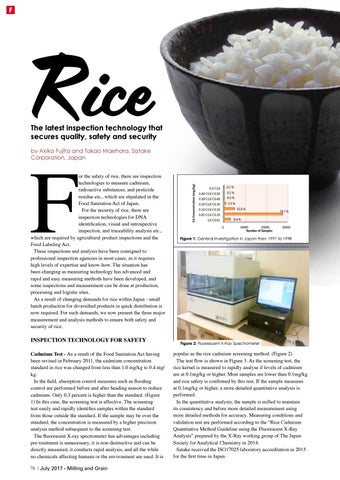
INSPECTION TECHNOLOGY FOR SAFETY Cadmium Test - As a result of the Food Sanitation Act having been revised in February 2011, the cadmium concentration standard in rice was changed from less than 1.0 mg/kg to 0.4 mg/ kg. In the field, absorption control measures such as flooding control are performed before and after heading season to reduce cadmium. Only 0.3 percent is higher than the standard. (Figure 1) In this case, the screening test is effective. The screening test easily and rapidly identifies samples within the standard from those outside the standard. If the sample may be over the standard, the concentration is measured by a higher precision analysis method subsequent to the screening test. The fluorescent X-ray spectrometer has advantages including pre-treatment is unnecessary, it is non-destructive and can be directly measured, it conducts rapid analysis, and all the while no chemicals affecting humans or the environment are used. It is 78 | July 2017 - Milling and Grain
Figure 1: General Investigation in Japan from 1997 to 1998
Figure 2: Fluorescent X-Ray Spectrometer
popular as the rice cadmium screening method. (Figure 2) The test flow is shown in Figure 3. As the screening test, the rice kernel is measured to rapidly analyse if levels of cadmium are at 0.1mg/kg or higher. Most samples are lower than 0.1mg/kg and rice safety is confirmed by this test. If the sample measures at 0.1mg/kg or higher, a more detailed quantitative analysis is performed. In the quantitative analysis, the sample is milled to maintain its consistency and before more detailed measurement using more detailed methods for accuracy. Measuring conditions and validation test are performed according to the “Rice Cadmium Quantitative Method Guideline using the Fluorescent X-Ray Analysis� prepared by the X-Ray working group of The Japan Society for Analytical Chemistry in 2014. Satake received the ISO17025 laboratory accreditation in 2015 for the first time in Japan.