GRINDING F
Energy savings in the milling process
T
by Ottevanger
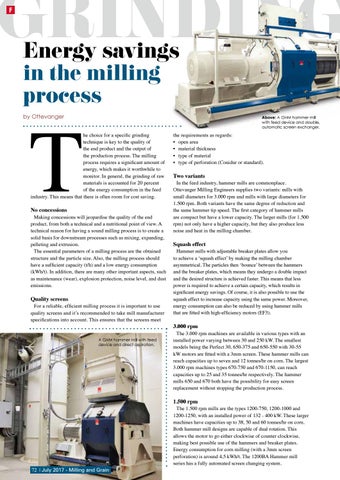
Above: A GHM hammer mill with feed device and double, automatic screen exchanger.
he choice for a specific grinding technique is key to the quality of the end product and the output of the production process. The milling process requires a significant amount of energy, which makes it worthwhile to monitor. In general, the grinding of raw materials is accounted for 20 percent of the energy consumption in the feed industry. This means that there is often room for cost saving.
No concessions
Making concessions will jeopardise the quality of the end product, from both a technical and a nutritional point of view. A technical reason for having a sound milling process is to create a solid basis for downstream processes such as mixing, expanding, pelleting and extrusion. The essential parameters of a milling process are the obtained structure and the particle size. Also, the milling process should have a sufficient capacity (t/h) and a low energy consumption (kWh/t). In addition, there are many other important aspects, such as maintenance (wear), explosion protection, noise level, and dust emissions.
Quality screens
For a reliable, efficient milling process it is important to use quality screens and it’s recommended to take mill manufacturer specifications into account. This ensures that the screens meet
A GHM hammer mill with feed device and direct aspiration.
the requirements as regards: • open area • material thickness • type of material • type of perforation (Conidur or standard).
Two variants
In the feed industry, hammer mills are commonplace. Ottevanger Milling Engineers supplies two variants: mills with small diameters for 3.000 rpm and mills with large diameters for 1.500 rpm. Both variants have the same degree of reduction and the same hammer tip speed. The first category of hammer mills are compact but have a lower capacity. The larger mills (for 1.500 rpm) not only have a higher capacity, but they also produce less noise and heat in the milling chamber.
Squash effect
Hammer mills with adjustable breaker plates allow you to achieve a ‘squash effect’ by making the milling chamber asymmetrical. The particles then ‘bounce’ between the hammers and the breaker plates, which means they undergo a double impact and the desired structure is achieved faster. This means that less power is required to achieve a certain capacity, which results in significant energy savings. Of course, it is also possible to use the squash effect to increase capacity using the same power. Moreover, energy consumption can also be reduced by using hammer mills that are fitted with high-efficiency motors (EF3).
3.000 rpm
The 3.000 rpm machines are available in various types with an installed power varying between 30 and 250 kW. The smallest models being the Perfect 30, 650-375 and 650-550 with 30-55 kW motors are fitted with a 3mm screen. These hammer mills can reach capacities up to seven and 12 tonnes/hr on corn. The largest 3.000 rpm machines types 670-750 and 670-1150, can reach capacities up to 25 and 35 tonnes/hr respectively. The hammer mills 650 and 670 both have the possibility for easy screen replacement without stopping the production process.
1.500 rpm
72 | July 2017 - Milling and Grain
The 1.500 rpm mills are the types 1200-750, 1200-1000 and 1200-1250, with an installed power of 132 - 400 kW. These larger machines have capacities up to 38, 50 and 60 tonnes/hr on corn. Both hammer mill designs are capable of dual rotation. This allows the motor to go either clockwise of counter clockwise, making best possible use of the hammers and breaker plates. Energy consumption for corn milling (with a 3mm screen perforation) is around 4,5 kWh/t. The 1200BA Hammer mill series has a fully automated screen changing system.