F
Preservation with organic acids
Combating food and feed waste
F
by Christian Lückstädt, Technical Director, Feed, ADDCON GmbH
eeding the world’s population is an everincreasing challenge. Since the earth’s seventh billionth citizen was born in 2011, supplying the population with sufficient food is a more pressing issue today than it has ever been, increasing the pressure on livestock producers to produce sufficient, safe protein sources for human consumption efficiently and sustainably. At the same time, reducing the current level of food and feed waste, which represents up to 50 percent of the four billion tonnes of food production every year, according to the IMECHE-report (2013), may be one way to help us rise to the challenge.
Preservation - part of the solution
Feed or raw material wastage during storage happens worldwide, but differs in its nature and development due to climate conditions. While in a developed country such as Australia, wastage of up to 0.75 percent in grain is the maximum loss, which may still be tolerated, whereas in Ghana up to 50 percent may be experienced. India and Pakistan on the other hand will lose annually 21 and 3.2 million tonnes of feed raw materials, respectively. In order to avoid such microbial losses, feed hygiene assurance is a fundamental issue. However, microorganisms are ubiquitous and total sterility cannot be achieved. The application of organic acids in livestock nutrition and feed preservation has been known for decades and is documented by many scientific studies. Acidifiers make a fundamental contribution to feed hygiene, since they suppress the growth of mould and thus restrict the potential production and detrimental effects of mycotoxins as well as preventing contamination and nutrient losses by bacterial and mould growth in the feed. Furthermore, bacterial degradation of the feed is inhibited. Consequently, the feed’s safety and animal health are guaranteed by adding organic acids, and can secure animal performance and 52 | July 2017 - Milling and Grain
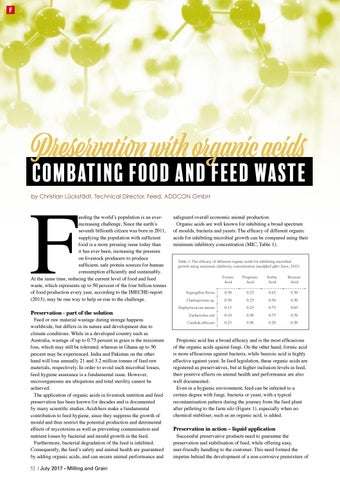
safeguard overall economic animal production. Organic acids are well known for inhibiting a broad spectrum of moulds, bacteria and yeasts. The efficacy of different organic acids for inhibiting microbial growth can be compared using their minimum inhibitory concentration (MIC, Table 1). Table 1: The efficacy of different organic acids for inhibiting microbial growth using minimum inhibitory concentration (modified after Sava, 2011)
Aspergillus flavus
Formic Acid
Propionic Acid
Sorbic Acid
Benzoic Acid
0.50
0.25
0.45
0.50
Cladosporium sp.
0.50
0.25
0.50
0.50
Staphylococcus aureus
0.13
0.25
0.75
0.85
Escherichia coli
0.10
0.50
0.75
0.70
Candida albicans
0.25
0.50
0.20
0.50
Propionic acid has a broad efficacy and is the most efficacious of the organic acids against fungi. On the other hand, formic acid is more efficacious against bacteria, while benzoic acid is highly effective against yeast. In feed legislation, these organic acids are registered as preservatives, but at higher inclusion levels in feed, their positive effects on animal health and performance are also well documented. Even in a hygienic environment, feed can be infected to a certain degree with fungi, bacteria or yeast, with a typical recontamination pattern during the journey from the feed plant after pelleting to the farm silo (Figure 1), especially when no chemical stabiliser, such as an organic acid, is added.
Preservation in action – liquid application
Successful preservative products need to guarantee the preservation and stabilisation of feed, while offering easy, user-friendly handling to the customer. This need formed the impetus behind the development of a non-corrosive premixture of