CASE STUDY
New feed plant boosts local development AWILA Anlagenbau GmbH has erected a plant in Bangladesh for flexible animal feed production next to fish and crab breeding ponds in the rural, yet densely populated region in the north of the country
M
any Third World countries and newly emerging markets are increasingly trying to add value, generate more production and create new jobs in their own region, in order to become more independent of expensive imports. These countries are however, often dependent on technology from industrialised nations for their development. One example is Bangladesh. As one of the most densely populated countries in the world, Bangladesh’s development is
90 | May 2017 - Milling and Grain
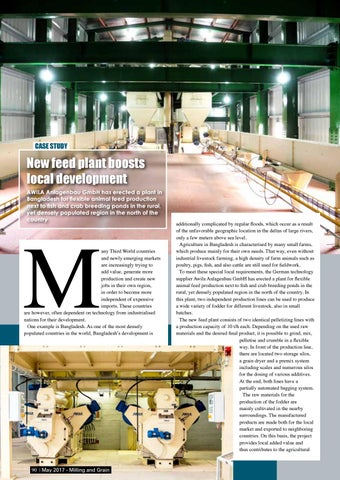
additionally complicated by regular floods, which occur as a result of the unfavorable geographic location in the deltas of large rivers, only a few meters above sea level. Agriculture in Bangladesh is characterised by many small farms, which produce mainly for their own needs. That way, even without industrial livestock farming, a high density of farm animals such as poultry, pigs, fish, and also cattle are still used for fieldwork. To meet these special local requirements, the German technology supplier Awila Anlagenbau GmbH has erected a plant for flexible animal feed production next to fish and crab breeding ponds in the rural, yet densely populated region in the north of the country. In this plant, two independent production lines can be used to produce a wide variety of fodder for different livestock, also in small batches. The new feed plant consists of two identical pelletizing lines with a production capacity of 10 t/h each. Depending on the used raw materials and the desired final product, it is possible to grind, mix, pelletise and crumble in a flexible way. In front of the production line, there are located two storage silos, a grain dryer and a premix system including scales and numerous silos for the dosing of various additives. At the end, both lines have a partially automated bagging system. The raw materials for the production of the fodder are mainly cultivated in the nearby surroundings. The manufactured products are made both for the local market and exported to neighboring countries. On this basis, the project provides local added value and thus contributes to the agricultural