STORAGE
F
From rice to animal feed:
W
Why choose Hopper-bottom silos? By Anna Marie Martin, SCAFCO Grain Systems, USA
hen purchasing a storage solution for your farm or commercial enterprise, there are many important factors to consider before you choose the type of silo that will fit your needs and budget. Hopper bottom silos stand out from other storage and handling systems because they are often easier and less problematic to unload. Opening just one discharge gate on a hopper silo can allow grain to flow out by gravity, with no mechanical equipment required. The biggest advantage of hopper bottom silos is they allow total cleanout by gravity without the use of sweep augers. There is less material handling equipment, less electricity needed for unloading, and much less maintenance required. Foundations for hopper bottom silos are more economical compared to flatbottom silos, because they can be erected without subterranean trenches. Hopper silos with larger storage requirements can also be stiffened for extra security, expanding their capacity. Hopper bottom silos have long served as working silos for repetitive receiving and discharge of grain. This application is especially useful for holding wet grain or rice before it enters a grain dryer. Also, these silos can be elevated on a structure, allowing the truck driver to drive up underneath the silo for ease of loading, without the need for expensive turnarounds. Hopper bottom silos are the best choice if your operation meets the following criteria: • You need a short-term storage solution • You need ease of loading and discharge of stored materials • You require a quick transfer of stored materials to a truck or train SCAFCO Grain Systems, a leading US manufacturer of steel
84 | May 2017 - Milling and Grain
storage systems and grain handling equipment since 1961, sees a trend toward customer interest in hopper bottom silos. The company has supplied hopper silos at numerous facilities where in years past, only flat-bottom silos would have been considered. SCAFCO hopper bottom silos are available in capacities from 3MT to 1,500MT (130 bu. to 55,000 bu.) in a wide variety of sizes. They maintain a high level of performance because of G-115 (min. 350 gr/m2 zinc) coated steel on all their roofs, support structures and steel sheets. These corrugated sheets have a 67mm (2 ⅔ in) pitch. With support structures made from hot-dip galvanised structural steel, they are ready for years of maintenance-free service. Hopper bottom silos can be built with support structures rated for earthquakes, which ensure a proper foundation for structures in areas with frequent seismic activity. SCAFCO engineers work with customers to meet their needs for storage with a versatile array of hopper silo features and accessories. From companies that require massive storage, to customers with much smaller needs like microbreweries, the following installations illustrate a wide variety of applications.
Wheat
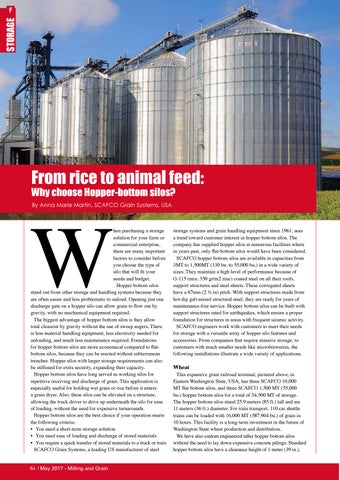
This expansive grain railroad terminal, pictured above, in Eastern Washington State, USA, has three SCAFCO 10,000 MT flat bottom silos, and three SCAFCO 1,500 MT (55,000 bu.) hopper bottom silos for a total of 34,500 MT of storage. The hopper bottom silos stand 25.9 meters (85 ft.) tall and are 11 meters (36 ft.) diameter. For train transport, 110 car shuttle trains can be loaded with 16,000 MT (587,904 bu.) of grain in 10 hours. This facility is a long-term investment in the future of Washington State wheat production and distribution. We have also custom engineered taller hopper bottom silos without the need to lay down expensive concrete pilings. Standard hopper bottom silos have a clearance height of 1 meter (39 in.),