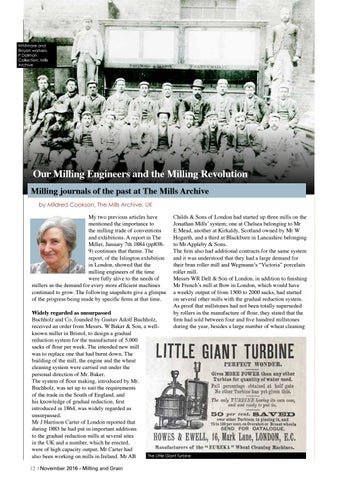
Whitmore and Binyon workers, P Dolman Collection, Mills Archive
Our Milling Engineers and the Milling Revolution Milling journals of the past at The Mills Archive by Mildred Cookson, The Mills Archive, UK My two previous articles have mentioned the importance to the milling trade of conventions and exhibitions. A report in The Miller, January 7th 1884 (pp8389) continues that theme. The report, of the Islington exhibition in London, showed that the milling engineers of the time were fully alive to the needs of millers as the demand for every more efficient machines continued to grow. The following snapshots give a glimpse of the progress being made by specific firms at that time.
Childs & Sons of London had started up three mills on the Jonathan Mills’ system; one at Chelsea belonging to Mr E Mead, another at Kirkaldy, Scotland owned by Mr W Hogarth, and a third at Blackburn in Lancashire belonging to Mr Appleby & Sons. The firm also had additional contracts for the same system and it was understood that they had a large demand for their bran roller mill and Wegmann’s “Victoria” porcelain roller mill. Messrs WR Dell & Son of London, in addition to finishing Mr French’s mill at Bow in London, which would have a weekly output of from 1500 to 2000 sacks, had started on several other mills with the gradual reduction system. As proof that millstones had not been totally superseded by rollers in the manufacture of flour, they stated that the firm had sold between four and five hundred millstones during the year, besides a large number of wheat cleaning
Widely regarded as unsurpassed Buchholz and Co, founded by Gustav Adolf Buchholz, received an order from Messrs. W Baker & Son, a wellknown miller in Bristol, to design a gradual reduction system for the manufacture of 5,000 sacks of flour per week. The intended new mill was to replace one that had burnt down. The building of the mill, the engine and the wheat cleaning system were carried out under the personal direction of Mr. Baker. The system of flour making, introduced by Mr. Buchholz, was set up to suit the requirements of the trade in the South of England, and his knowledge of gradual reduction, first introduced in 1864, was widely regarded as unsurpassed. Mr J Harrison Carter of London reported that during 1883 he had put in important additions to the gradual reduction mills at several sites in the UK and a number, which he erected, were of high capacity output. Mr Carter had The Little Giant Turbine also been working on mills in Ireland. Mr AB 12 | November 2016 - Milling and Grain