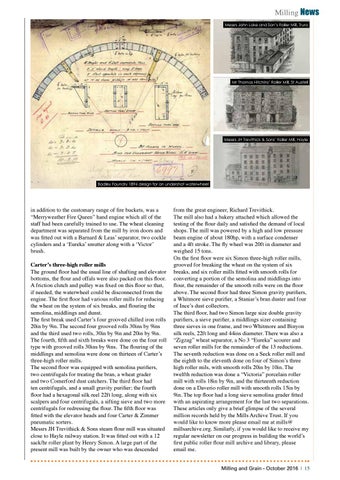
Milling News Messrs John Lake and Son’s Roller Mill, Truro
Mr Thomas Hitchins’ Roller Mill, St Austell
Messrs JH Trevithick & Sons’ Roller Mill, Hayle
Bodley Foundry 1894 design for an undershot waterwheel
in addition to the customary range of fire buckets, was a “Merryweather Fire Queen” hand engine which all of the staff had been carefully trained to use. The wheat cleaning department was separated from the mill by iron doors and was fitted out with a Barnard & Leas’ separator, two cockle cylinders and a ‘Eureka’ smutter along with a ‘Victor’ brush. Carter’s three-high roller mills The ground floor had the usual line of shafting and elevator bottoms, the flour and offals were also packed on this floor. A friction clutch and pulley was fixed on this floor so that, if needed, the waterwheel could be disconnected from the engine. The first floor had various roller mills for reducing the wheat on the system of six breaks, and flouring the semolina, middlings and dunst. The first break used Carter’s four grooved chilled iron rolls 20in by 9in. The second four grooved rolls 30ins by 9ins and the third used two rolls, 30in by 9in and 20in by 9in. The fourth, fifth and sixth breaks were done on the four roll type with grooved rolls 30ins by 9ins. The flouring of the middlings and semolina were done on thirteen of Carter’s three-high roller mills. The second floor was equipped with semolina purifiers, two centrifugals for treating the bran, a wheat grader and two Comerford dust catchers. The third floor had ten centrifugals, and a small gravity purifier; the fourth floor had a hexagonal silk reel 22ft long, along with six scalpers and four centrifugals, a sifting sieve and two more centrifugals for redressing the flour. The fifth floor was fitted with the elevator heads and four Carter & Zimmer pneumatic sorters. Messrs JH Trevithick & Sons steam flour mill was situated close to Hayle railway station. It was fitted out with a 12 sack/hr roller plant by Henry Simon. A large part of the present mill was built by the owner who was descended
from the great engineer, Richard Trevithick. The mill also had a bakery attached which allowed the testing of the flour daily and satisfied the demand of local shops. The mill was powered by a high and low pressure beam engine of about 180hp, with a surface condenser and a 4ft stroke. The fly wheel was 20ft in diameter and weighed 15 tons. On the first floor were six Simon three-high roller mills, grooved for breaking the wheat on the system of six breaks, and six roller mills fitted with smooth rolls for converting a portion of the semolina and middlings into flour, the remainder of the smooth rolls were on the floor above. The second floor had three Simon gravity purifiers, a Whitmore sieve purifier, a Staniar’s bran duster and four of Ince’s dust collectors. The third floor, had two Simon large size double gravity purifiers, a sieve purifier, a middlings sizer containing three sieves in one frame, and two Whitmore and Binyon silk reels, 22ft long and 44ins diameter. There was also a “Zigzag” wheat separator, a No 3 “Eureka” scourer and seven roller mills for the remainder of the 13 reductions. The seventh reduction was done on a Seck roller mill and the eighth to the eleventh done on four of Simon’s three high roller mils, with smooth rolls 20in by 10in. The twelfth reduction was done a “Victoria” porcelain roller mill with rolls 18in by 9in, and the thirteenth reduction done on a Daverio roller mill with smooth rolls 15in by 9in. The top floor had a long sieve semolina grader fitted with an aspirating arrangement for the last two separations. These articles only give a brief glimpse of the several million records held by the Mills Archive Trust. If you would like to know more please email me at mills@ millsarchive.org. Similarly, if you would like to receive my regular newsletter on our progress in building the world’s first public roller flour mill archive and library, please email me. Milling and Grain - October 2016 | 15