F CASE STUDY
CASE STUDY
Improving raw material quality for millers When China discovered that they were losing a significant amount of harvested crop through poor storage, it was decided that something at a national level had to be done about it; that’s what is happening there today
U
by Roger Gilbert for Milling and Grain nlike many developed countries, where quality deterioration of crops can see three to five percent of stored materials become unusable, the figure in China can be as high as 15 percent. Government recognition of the problem has resulted in support for farmers, starting from immediate post-harvesting, to ensure drying is
carried out successfully. One milling industry player has stepped forward to provide the equipment necessary for such a change in handling methods, and that company is Satake. “In China a lot of rice is damaged in storage due to humidity and this is particularly an issue on farms where farmers do not have the machinery to dry,” says Satake Manufacturing (Suzhou) Co Ltd General Manager Nagafuchi Eiichiro. “Many are still using radiant heat from the sun, which is extremely primitive, to do the job and this leads to a lot of waste.” China’s agricultural department is now convinced that farmers should be using machinery to dry their crops.“While we are still concentrating on our flour milling and colour sorting business, we want to diversity, so we are also entering the agricultural industries so-called pre-harvest area in rice and other crop drying.” With equipment now to hand it’s just a matter of farmers receiving the governmental subsidy in order for the sales to be made, he added.
Think Satake … think sorter
When you think Satake you think colour sorters and as an industry leader, it was very much appreciated when they invited Milling and Grain to visit the company’s Suzhou factory to tour its facilities late last year. General Manager Nagafuchi Eiichiro, Tanak Toshiyuki and their team of specialists, which included our guide for the afternoon, hosted us. Satake established its manufacturing operation in China in 1997 80 | September 2016 - Milling and Grain
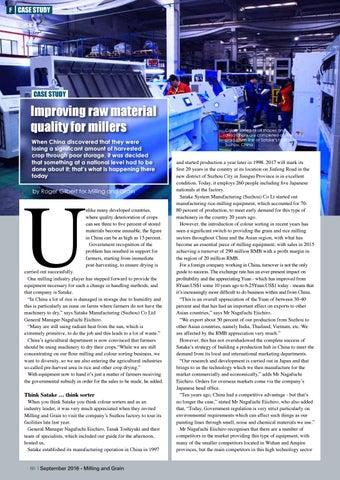
Colour sorters of all shapes and descriptions are completed on the production line at Satake’s factory in Suzhou, China
and started production a year later in 1998. 2017 will mark its first 20 years in the country at its location on Jinfeng Road in the new district of Suzhou City in Jiangsu Province is in excellent condition. Today, it employs 260 people including five Japanese nationals at the factory. Satake System Manufacturing (Suzhou) Co Lt started out manufacturing rice-milling equipment, which accounted for 7080 percent of production, to meet early demand for this type of machinery in the country 20 years ago. However, the introduction of colour sorting in recent years has seen a significant switch to providing the grain and rice milling sectors throughout China and the Asian region, with what has become an essential piece of milling equipment; with sales in 2015 achieving a turnover of 290 million RMB with a profit margin in the region of 20 million RMB. For a foreign company working in China, turnover is not the only guide to success. The exchange rate has an ever-present impact on profitability and the appreciating Yuan - which has improved from 8Yuan:US$1 some 10 years ago to 6.25Yuan:US$1 today - means that it’s increasingly more difficult to do business within and from China. “This is an overall appreciation of the Yuan of between 30-40 percent and that has had an important effect on exports to other Asian countries,” says Mr Nagafuchi Eiichiro. “We export about 50 percent of our production from Suzhou to other Asian countries, namely India, Thailand, Vietnam, etc. We are affected by the RMB appreciation very much.” However, this has not overshadowed the complete success of Satake’s strategy of building a production hub in China to meet the demand from its local and international marketing departments. “Our research and development is carried out in Japan and that brings to us the technology which we then manufacture for the market commercially and economically,” adds Mr Nagafuchi Eiichiro. Orders for overseas markets come via the company’s Japanese head office. “Ten years ago, China had a competitive advantage - but that’s no longer the case,” stated Mr Nagafuchi Eiichiro, who also added that, “Today, Government regulation is very strict particularly on environmental requirements which can effect such things as our painting lines through smell, noise and chemical materials we use.” Mr Nagafuchi Eiichiro recognises that there are a number of competitors in the market providing this type of equipment, with many of the smaller competitors located in Wuhan and Ampire provinces, but the main competitors in this high technology sector