Case Study
The Ups and Downs of Floor Transfers by Cindy Lane Moore PT, DPT Editor’s Note: This case study is published in advance of the July 20, 2021 Journal Club webinar and accompanies the article: Ardali G, States RA, Brody LT, Godwin EM, Characteristics of older adults who are unable to perform a floor transfer: Considerations for clinical decision-making. J Geriatr Phys Ther 2020; 43(2):62-70.
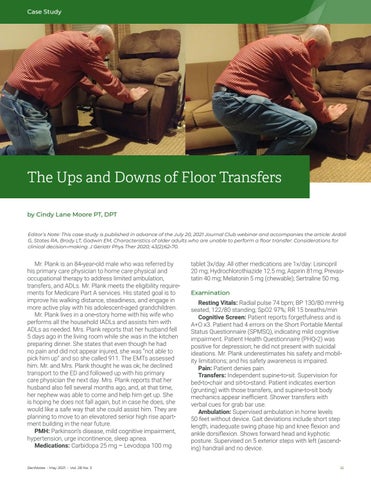
Mr. Plank is an 84-year-old male who was referred by his primary care physician to home care physical and occupational therapy to address limited ambulation, transfers, and ADLs. Mr. Plank meets the eligibility requirements for Medicare Part A services. His stated goal is to improve his walking distance, steadiness, and engage in more active play with his adolescent-aged grandchildren. Mr. Plank lives in a one-story home with his wife who performs all the household IADLs and assists him with ADLs as needed. Mrs. Plank reports that her husband fell 5 days ago in the living room while she was in the kitchen preparing dinner. She states that even though he had no pain and did not appear injured, she was “not able to pick him up” and so she called 911. The EMTs assessed him. Mr. and Mrs. Plank thought he was ok; he declined transport to the ED and followed up with his primary care physician the next day. Mrs. Plank reports that her husband also fell several months ago, and, at that time, her nephew was able to come and help him get up. She is hoping he does not fall again, but in case he does, she would like a safe way that she could assist him. They are planning to move to an elevatored senior high rise apartment building in the near future. PMH: Parkinson’s disease, mild cognitive impairment, hypertension, urge incontinence, sleep apnea. Medications: Carbidopa 25 mg – Levodopa 100 mg
GeriNotes • May 2021 • Vol. 28 No. 3
tablet 3x/day. All other medications are 1x/day: Lisinopril 20 mg; Hydrochlorothiazide 12.5 mg; Aspirin 81mg; Prevastatin 40 mg; Melatonin 5 mg (chewable); Sertraline 50 mg. Examination Resting Vitals: Radial pulse 74 bpm; BP 130/80 mmHg seated, 122/80 standing; SpO2 97%; RR 15 breaths/min Cognitive Screen: Patient reports forgetfulness and is A+O x3. Patient had 4 errors on the Short Portable Mental Status Questionnaire (SPMSQ), indicating mild cognitive impairment. Patient Health Questionnaire (PHQ-2) was positive for depression; he did not present with suicidal ideations. Mr. Plank underestimates his safety and mobility limitations; and his safety awareness is impaired. Pain: Patient denies pain. Transfers: Independent supine-to-sit. Supervision for bed-to-chair and sit-to-stand. Patient indicates exertion (grunting) with those transfers, and supine-to-sit body mechanics appear inefficient. Shower transfers with verbal cues for grab bar use. Ambulation: Supervised ambulation in home levels 50 feet without device. Gait deviations include short step length, inadequate swing phase hip and knee flexion and ankle dorsiflexion. Shows forward head and kyphotic posture. Supervised on 5 exterior steps with left (ascending) handrail and no device. 22