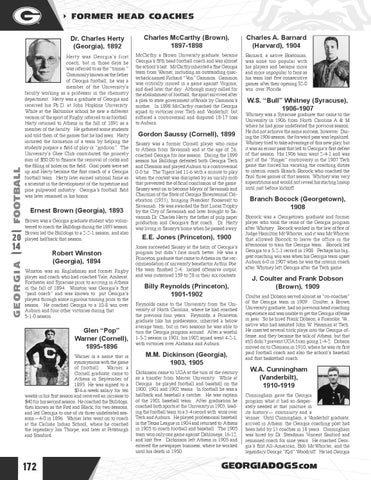
former head coaches Dr. Charles Herty (Georgia), 1892 Herty was Georgia’s first coach, but in those days he was referred to as the “trainer.” Commonly known as the father of Georgia football, he was a member of the University’s faculty working as a professor in the chemistry department. Herty was a graduate of Georgia and received his Ph.D. at John Hopkins University. While at the Baltimore school he saw a different version of the sport of Rugby, referred to as football. Herty returned to Athens in the fall of 1891 as a member of the faculty. He gathered some students and told them of the games that he had seen. Herty initiated the formation of a team by helping the students prepare a field of play or “gridiron”. The University’s Glee Club contributed the princely sum of $50.00 to finance the removal of rocks and the filling of holes on the field. Goal posts were set up and Herty became the first coach of a Georgia football team. Herty later earned national fame as a scientist in the development of the turpentine and pine pulpwood industry. Georgia’s football field was later renamed in his honor.
Ernest Brown (Georgia), 1893 Brown was a Georgia graduate student who volunteered to coach the Bulldogs during the 1893 season. Brown led the Bulldogs to a 2-2-1 season, and also played halfback that season.
Robert Winston (Georgia), 1894 Winston was an Englishman and former Rugby player and coach who had coached Yale, Amherst, Rochester and Syracuse prior to arriving in Athens in the fall of 1894. Winston was Georgia’s first “paid coach” and was known to put Georgia’s players through some rigorous training prior to the season. He coached Georgia to a 10-8 win over Auburn and four other victories during that 5-1-0 season.
Glen “Pop” Warner (Cornell), 1895-1896 Warner is a name that is synonymous with the game of football . Warner, a Cornell graduate, came to Athens in September of 1895. He was signed to a $34-a-week salary for ten weeks in his first season and received an increase to $40 for his second season. He coached the Bulldogs, then known as the Red and Black, for two seasons, and led Georgia to one of its three undefeated seasons—4-0 in 1896. Warner later went on to coach at the Carlisle Indian School, where he coached the legendary Jim Thorpe, and later at Pittsburgh and Stanford.
172
Charles McCarthy (Brown), 1897-1898
Charles A. Barnard (Harvard), 1904
McCarthy, a Brown University graduate, became Georgia’s fifth head football coach and was almost the school’s last. McCarthy inherited a fine Georgia team from Warner, including an outstanding quarterback named Richard “Von” Gammon. Gammon was critically injured in a game against Virginia, and died later that day. Although many called for the abolishment of football, the sport survived after a plea to state government officials by Gammon’s mother. In 1898 McCarthy coached the Georgia squad to victories over Tech and Vanderbilt, but suffered a controversial and disputed 18-17 loss to Auburn.
Barnard, a native Bostonian, was none too popular with his players and became more and more unpopular to fans as his team lost five consecutive games after their opening 52-0 win over Florida.
Gordon Saussy (Cornell), 1899 Saussy was a former Cornell player who came to Athens from Savannah and at the age of 26, coached Georgia for one season. During the 1899 season his Bulldogs defeated both Georgia Tech and Clemson and played Auburn to a controversial 0-0 tie. The Tigers led 11-6 with a minute to play when the contest was disrupted by an unruly mob that prevented the official conclusion of the game. Saussy went on to become Mayor of Savannah and Chairman of the State of Georgia Bicentennial Celebration (1933), bringing President Roosevelt to Savannah. He was awarded the first Lucas Trophy by the City of Savannah and later brought to Savannah Dr. Charles Herty, the father of pulp paper production and Georgia's first coach. Dr. Herty was living in Saussy's home when he passed away.
E.E. Jones (Princeton), 1900 Jones succeeded Saussy at the helm of Georgia’s program but didn’t fare much better. He was a Princeton graduate that came to Athens on the recommendation of university benefactor Arthur Poe. His team finished 2-4, lacked offensive output, and was outscored 159 to 28 in their six contests.
Billy Reynolds (Princeton), 1901-1902 Reynolds came to the University from the University of North Carolina, where he had coached the previous four years. Reynolds, a Princeton graduate like his predecessor, inherited a below average team, but in two seasons he was able to turn the Georgia program around. After a woeful 1-5-2 season in 1901, his 1902 squad went 4-2-1, with victories over Alabama and Auburn.
M.M. Dickinson (Georgia), 1903, 1905 Dickinson came to UGA at the turn of the century as a transfer from Mercer University. While at Georgia he played football and baseball on the 1900, 1901 and 1902 teams. In football he was a halfback and baseball a catcher. He was captain of the 1901 baseball team. After graduation he coached both sports at the University in 1903, leading the football team to a 3-4 record with wins over Tech and Auburn. He played professional baseball in the Texas League in 1904 and returned to Athens in 1905 to coach football and baseball. The 1905 team won only one game against Dahlonega, 16-12, and lost five. Dickinson left Athens in 1905 and entered the newspaper business, where he worked until his death in 1950.
W.S. “Bull” Whitney (Syracuse), 1906-1907
Whitney was a Syracuse graduate that came to the University in 1906 from North Carolina A & M where he had gone undefeated the previous season. He did not achieve the same success, however. During the 1906 season, the forward pass was legalized. Whitney tried to take advantage of this new play, but it was an errant pass that led to Georgia’s first defeat of that season. His 1906 team went 2-4-1 and was part of the “Ringer” controversy in the 1907 Tech game that forced his vacating the coaching duties to interim coach Branch Bocock who coached the final three games of that season. Whitney was very superstitious and would not reveal his starting lineup until just before kickoff.
Branch Bocock (Georgetown), 1908 Bocock was a Georgetown graduate and former player who took the reins of the Georgia program after Whitney. Bocock worked in the law office of Judge Hamilton McWhorter, and it was McWhorter that allowed Bocock to leave the office in the afternoons to train the Georgia team. Bocock led Georgia to a 5-2-1 record in 1908. Perhaps his biggest coaching win was when his Georgia team upset Auburn 6-0 in 1907 when he was the interim coach after Whitney left Georgia after the Tech game.
J. Coulter and Frank Dobson (Brown), 1909 Coulter and Dobson served almost as “co-coaches” of the Georgia team in 1909. Coulter, a Brown University graduate, had no previous head coaching experience and was unable to get the Georgia offense in gear. So he hired Frank Dobson, a Roanoke, Va., native who had assisted John W. Heisman at Tech. He inserted several trick plays into the Georgia offense, and they became the talk of Athens, but that still didn’t prevent UGA from going 1-4-2. Dobson moved on to Clemson in 1910, where he was its first paid football coach and also the school’s baseball and first basketball coach.
W.A. Cunningham (Vanderbilt), 1910-1919 Cunningham gave the Georgia program what it had so desperately needed at that juncture in its history— continuity and a winner. Until Cunningham, a Vanderbilt graduate, arrived in Athens, the Georgia coaching post had been held by 13 coaches in 18 years. Cunningham was hired by Dr. Steadman Vincent Sanford and remained coach for nine years. He coached Georgia’s first All-American, Bob McWhorter, and the legendary George “Kid” Woodruff. He led Georgia