‘Seven Revolutions’
comes to the classroom
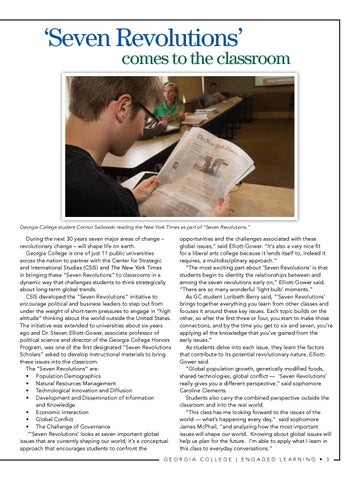
Georgia College student Connor Sadowski reading the New York Times as part of “Seven Revolutions.”
During the next 30 years seven major areas of change – revolutionary change – will shape life on earth. Georgia College is one of just 11 public universities across the nation to partner with the Center for Strategic and International Studies (CSIS) and The New York Times in bringing these “Seven Revolutions” to classrooms in a dynamic way that challenges students to think strategically about long-term global trends. CSIS developed the “Seven Revolutions” initiative to encourage political and business leaders to step out from under the weight of short-term pressures to engage in “high altitude” thinking about the world outside the United States. The initiative was extended to universities about six years ago and Dr. Steven Elliott-Gower, associate professor of political science and director of the Georgia College Honors Program, was one of the first designated “Seven Revolutions Scholars” asked to develop instructional materials to bring these issues into the classroom. The “Seven Revolutions” are: • Population Demographics • Natural Resources Management • Technological Innovation and Diffusion • Development and Dissemination of Information and Knowledge • Economic Interaction • Global Conflict • The Challenge of Governance “’Seven Revolutions’ looks at seven important global issues that are currently shaping our world; it’s a conceptual approach that encourages students to confront the
opportunities and the challenges associated with these global issues,” said Elliott-Gower. “It’s also a very nice fit for a liberal arts college because it lends itself to, indeed it requires, a multidisciplinary approach.” “The most exciting part about ‘Seven Revolutions’ is that students begin to identity the relationships between and among the seven revolutions early on,” Elliott-Gower said. “There are so many wonderful ‘light bulb’ moments.” As GC student Loribeth Berry said, “’Seven Revolutions’ brings together everything you learn from other classes and focuses it around these key issues. Each topic builds on the other, so after the first three or four, you start to make those connections, and by the time you get to six and seven, you’re applying all the knowledge that you’ve gained from the early issues.” As students delve into each issue, they learn the factors that contribute to its potential revolutionary nature, ElliottGower said. “Global population growth, genetically modified foods, shared technologies, global conflict — ‘Seven Revolutions’ really gives you a different perspective,” said sophomore Caroline Clements. Students also carry the combined perspective outside the classroom and into the real world. “This class has me looking forward to the issues of the world — what’s happening every day,” said sophomore James McPhail, “and analyzing how the most important issues will shape our world. Knowing about global issues will help us plan for the future. I’m able to apply what I learn in this class to everyday conversations.”
GEORGIA COLLEGE | ENGAGED LEARNING • 3