Empowering the subsea survey industry www.hydro-international.com
Issue 4 2023 Volume 27
Pushing subsea boundaries with hybrid AUV/ROV
A leap in underwater capabilities and efficiency
Pioneering ocean mapping for a better world
01_cover.indd 1
Investigating change at historic shipwreck sites
Enhancing seagrass monitoring with robotics and deep learning
05-10-2023 14:45
THE DRONE REVOLUTION
UNDERWATER
Hydrus 9 km Range 3 km Depth 4K @ 60 fps Camera Up to 3 hrs Endurance
Hydrus Micro-AUV Hydrus is the drone revolution of the underwater world, with the most advanced navigation and communication systems of any subsea vehicle. It contains a DVL, USBL, INS, acoustic and optical modem, all tightly integrated. This enables highly reliable, fully autonomous underwater missions at your fingertips. Hydrus produces stunning imagery, even in challenging low light and turbid conditions. It also provides obstacle detection and collision avoidance. Its small size and weight mean it can be carried and launched by a single person, and can even travel with you on a plane.
Scan the QR code or visit www.advancednavigation.com
00_AdvancedNavigation_Hydro_4-2023.indd 6
03-10-2023 12:09
Contents
Director Strategy & Business Development: Durk Haarsma Financial Director: Meine van der Bijl Editorial Board: Huibert-Jan Lekkerkerk, Mark Pronk, BSc, Marck Smit, Auke van der Werf Head of Content: Wim van Wegen Copy Editors: Serena Lyon Marketing Advisor: Myrthe van der Schuit Circulation Manager: Adrian Holland Design: ZeeDesign, Witmarsum, www.zeedesign.nl
Hydro International is an independent international magazine published six times a year by Geomares. The magazine and related e-newsletter inform worldwide professional, industrial and governmental readers of the latest news and developments in the hydrographic, surveying, marine cartographic and geomatics world. Hydro International encompasses all aspects, activities and equipment related to the acquisition, processing, presentation, control and management of hydrographic and surveyingrelated activities. Subscription Hydro International is available on a subscription basis. You can subscribe at any time via https://www.hydro-international.com/ subscribe. Subscriptions will be automatically renewed upon expiry, unless Geomares receives written notification of cancellation at least 60 days before the expiry date. Advertisements Information about advertising and deadlines are available in the Media Planner. For more information please contact our marketing advisor (myrthe.van.der.schuit@geomares.nl) or go to www.geomares-marketing.com. Editorial Contributions All material submitted to the publisher (Geomares) and relating to Hydro International will be treated as unconditionally assigned for publication under copyright subject to the Editor’s unrestricted right to edit and offer editorial comment. Geomares assumes no responsibility for unsolicited material or for the accuracy of information thus received. In addition, Geomares assumes no obligation for return postage of material if not explicitly requested. Contributions must be sent to the head of content wim.van.wegen@geomares.nl.
9
12
Combining AUV and ROV capabilities in a modular, hybrid unit improves functionality, while subsea docking technology expands the operational window of such a vehicle, allowing it to carry out multiple work programmes in a single deployment.
In an era of environmental challenges and economic uncertainties, nations are earnestly seeking innovative ways to enhance the quality of life for their citizens. Kiribati, a small island nation in the Central Pacific, is a leading example of how targeted investments in maritime infrastructure can yield significant benefits.
26
31 41
Shipwrecks are integral to our underwater landscape. UNESCO reports three million wrecks globally, posing marine spatial planning challenges. A Ulster University PhD project sought to grasp wreck stability on the seabed, using hydrographic surveys, geophysical data, and fluid dynamic simulations.
Underwater USBL positioning, while often perceived as inaccurate, can be reliable in decent conditions. Instances of reduced accuracy or erratic readings, even during calibration, are not uncommon. Nonetheless, it is crucial to strive for precise positioning during mobilization and calibration. If sub-optimal accuracy is detected, cross-check for setup errors.
16 The Nippon Foundation-GEBCO Seabed 2030 Project hopes to inspire the complete mapping of the ocean, which covers over 70% of the Earth’s surface, by 2030. This ambitious endeavour requires global cooperation but promises a sustainable future.
34 19 In the challenging ocean environment, skilled professionals use advanced technology for precision mapping and data collection. This includes tasks like safety navigation, coastal management, and seabed mapping in remote and harsh conditions. Teledyne Marine excels in these environments, aiding ocean science with innovative tools and solutions.
23 Seagrass meadows are vital ecosystems, contributing to marine biodiversity, carbon sequestration, and coastal protection. While their importance is now widely acknowledged and studied in ocean research, monitoring them remains costly and challenging.
36 22 On 24 January this year, the EU declared the Galileo High Accuracy Service operational for testing, and it is scheduled to become fully operational in 2024. This free signal adds precise point positioning options to capable receivers. The Galileo HAS is being presented as an alternative to the current commercial offerings, so what can we expect from this new signal?
Empowering the subsea survey industry www.hydro-international.com
Geomares P.O. Box 112, 8530 AC Lemmer, The Netherlands T: +31 (0) 514-56 18 54 F: +31 (0) 514-56 38 98 hydro-international@geomares.nl hydro-international.com No material may be reproduced in whole or in part without written permission of Geomares. Copyright © 2023, Geomares, The Netherlands All rights reserved. ISSN 1566-9076
Issue 4 2023 Volume 27
Pushing subsea boundaries with hybrid AUV/ROV
A leap in underwater capabilities and efficiency
Pioneering ocean mapping for a better world
01_cover.indd 1
Investigating change at historic shipwreck sites
Enhancing seagrass monitoring with robotics and deep learning
Cover Story Featured on the front cover of this edition is the Sonobot 5, the renowned EvoLogics USV. The Sonobot 5 boasts a sophisticated and seamlessly integrated design, facilitating efficient solo transportation and deployment. Equipped with robust thrusters and a substantial full-day battery capacity, it stands as the most compact and user-friendly autonomous vehicle available, complete with the capability to accommodate a professional-grade multibeam sonar system. (Image courtesy: EvoLogics GmbH)
05-10-2023 14:45
Issue 4 2023
03_contents.indd 3
3
05-10-2023 15:30
From the seafloor to the surface… Teledyne Marine delivers solutions
Teledyne Marine is a group of leading-edge undersea technology companies that have been assembled by Teledyne Technologies Incorporated. Through acquisitions and collaboration, over the past 16 years Teledyne Marine has evolved into an industry powerhouse, bringing the best of the best together under a single umbrella. Each Teledyne Marine company is a leader in its respective field, with a shared commitment to providing premium products backed by unparalleled service and support.
www.teledynemarine.com
00_Teledyne_Hydro_4-2023.indd 6
03-10-2023 15:56
Editorial
Kiribati
Experts are extremely concerned about the temperature of the Pacific Ocean. This year, we found that the sea surface water has not been this warm since satellite measurements began. This can have major consequences: for marine life, for example, but also for our climate, because a warmer ocean absorbs less CO2. The ocean absorbs almost a quarter of all the CO2 we emit, something not everyone is aware of. People are aware of the role of the large tropical rainforests such as the Amazon, but our oceans are just as crucial. If the water absorbs less CO2, more remains in the atmosphere, driving climate change further, also on land. Rising sea levels caused by climate change also pose major problems, and low-lying coastal areas around the world, home to many metropolises, will face major challenges in the coming century. The prospects for small islands in the Pacific Ocean are dramatic: they have a high chance of being the first to disappear due to the consequences of climate change. Kiribati, a very remote archipelago in the South Pacific, is one such collection of small islands. Earlier this year, in the Dutch newspaper Algemeen Dagblad, Maarten van Aalst, chief director of the KNMI (Royal Netherlands Meteorological Institute) and professor on climate and disaster resilience at the University of Twente, talked about his visit to Kiribati back in 2002: “On landing, when I looked at the coastline from above, I saw the vulnerability of the archipelago. On the island itself I also saw that the threat did not only come from the slowly rising sea level, but that there were also periods of water scarcity, partly due to longer droughts and a growing population.” In Kiribati, Van Aalst came face to face with the risks of
climate change. Now, over 20 years later, our knowledge of climate change and its far-reaching consequences for our living environment has increased significantly. It affects everyone, and therefore many disciplines, including our own: hydrography. This is why we pay regular attention to the impacts of climate change on the hydrographic sector, and how the sector can help combat its consequences.
In this edition of Hydro, we zoom in on the consequences of climate change as experienced in Kiribati. The article (see page 12) is about how our field contributes to providing a future in challenging times. The hydrographic surveys described are not merely technical exercises, but vital tools that inform strategic decisions affecting the safety and economic well-being of Kiribati. In an era of environmental challenges and economic uncertainties, Kiribati demonstrates how targeted investments in maritime infrastructure can yield significant benefits. Comprising 33 atolls and coral islands in the Central Pacific, Kiribati is highly vulnerable to climate change and sea-level rise due to its low-lying geography. While its remote Outer Islands offer untouched natural beauty, limited trade opportunities hinder economic growth. To address these challenges, the Kiribati Outer Islands Transport Infrastructure Investment Project (KOITIIP) is conducting hydrographic surveys, aerial imagery, Lidar and other data collection methods to enhance maritime safety and support economic growth in Kiribati. Kiribati certainly does not stand alone, in fact it is a symbol – just like Tuvalu, for example, 3,000 kilometres away – of the consequences that rising sea levels can have. At Hydro International, we will pay continued attention to the issue outlined in this editorial; we simply cannot avoid it.
Wim van Wegen, head of content
Issue 4 2023
05_editorial.indd 5
5
05-10-2023 14:18
Kongsberg Discovery launches new multibeam echosounder to unlock secrets of seafloor Kongsberg Discovery has officially unveiled the EM 2042, a next-generation multibeam echosounder poised to redefine underwater data collection. With the capability to extend operational weather windows, offer unparalleled flexibility and deliver high-quality data, the EM 2042 empowers users in their quest to comprehend, safeguard and harness the ocean’s depths. This groundbreaking device boasts a lightweight design, easy installation, robustness and the capacity to gather pristine seabed data even in the most remote and challenging environments. The grand launch of the EM 2042 took place at the Forum for the Exchange of Mutual Multibeam Experiences (FEMME) conference in Edinburgh, UK, hosted by Kongsberg Discovery. The event, held during the 17th edition of the FEMME, serves as an open forum exclusively for users of Kongsberg’s multibeam product range. FEMME facilitates the exchange of experiences and ideas among participants, inspiring innovation and contributing to improved system performance through workshops, demos, presentations and papers. Kongsberg Discovery reports that the EM 2042 is 60% lighter than its predecessor, the EM 2040, boasts lower power consumption, and has been engineered for effortless configuration and deployment across various vessel sizes, including uncrewed surface vessels (USVs). It can be conveniently mounted both within a vessel hull and over the side, requiring only one cable connection to the topside. In the unfortunate event of damage during operation, the EM 2042 has been designed to minimize repair time – which is known as a traditionally costly and timeconsuming process. The Kongsberg EM 2042 owes its exceptional data quality to its high-fidelity in-house INS integration (Seapath). The EM 2042 also provides true multifrequency backscatter functionality. It features automatic system detection and setup, courtesy of Seapath and EM technology, and provides real/true yaw stabilization to maximize operational windows in varying weather conditions.
EM 2042, the next-generation multibeam echosounder poised to redefine underwater data collection. (Image courtesy: Kongsberg Discovery)
6
Canadian tech specialists unite for underwater advancement Two Canadian underwater technology specialists, Voyis and Deep Trekker, have joined forces to achieve an exceptional integration: the successful fusion of Voyis’ cutting-edge Discovery camera with Deep Trekker’s Revolution ROV. Deep Trekker Revolution ROV equipped with This landmark collaboration Discovery camera. (Image courtesy: Voyis) showcases the prowess of Canadian innovation and ingenuity, aiming to propel the field of underwater surveys and inspections into an unprecedented era of advancement. Deep Trekker’s Revolution ROV showcases Canadian engineering excellence. This underwater vehicle is designed to perform exceptionally in demanding aquatic environments. It offers impressive stability and manoeuvrability, thanks to its distinctive rotating head, which enables precise attachment positioning for tools such as imaging sonar and grabbers. The Revolution ROV is versatile and suitable for a wide range of tasks. It can reach depths of up to 305 metres and is equipped with six powerful thrusters that provide precise control for both vertical and lateral movements, even in challenging currents. This flexible thruster setup ensures not only stability but also allows for fine-tuned adjustments during inspections and surveys. The ROV’s rugged construction, featuring a carbon fibre shell, anodized aluminium, stainless steel body and sapphire lens cover, underscores its durability and reliability. The collaboration between Voyis and Deep Trekker was tested and proven successful during trials in Tobermory, Ontario. Both teams worked together to achieve this success and test the ROV capabilities for piloting and inspection.
INFOMAR unveils unprecedented detail in Irish Blue Scale coastal maps INFOMAR has presented the Blue Scale Map Series: a compilation of 18 meticulously crafted, high-resolution bathymetric maps showcasing the coastal waters of Ireland. Conceived and developed by a dedicated team of hydrographers, data processors and cartographers, these maps intricately reveal the coastal topography in an unprecedented level of detail. Established in 2006, the Integrated Mapping for the Sustainable Development of Ireland’s Marine Resource (INFOMAR) programme stands today as a highly extensive and pioneering seabed mapping initiative. Generously funded by the Department of the Environment, Climate and Communications, this collaborative endeavour between the Marine Institute and Geological Survey Ireland strives to comprehensively map Ireland’s seabed, thereby providing an essential baseline bathymetry dataset to underpin the future management of the country’s marine resources. Stretching over a length of 3,171km, Ireland’s coastline boasts a collection of Europe’s most distinctive and dynamic environments. The newly introduced Blue Scale Map Series marks the culmination of over a decade’s worth of effort, brilliantly illuminating the intricate landscapes that lie beneath the waves. Every map within this series has been meticulously composed to incorporate the latest highresolution INFOMAR bathymetry data.
Issue 4 2023
06-07-08_headlines.indd 6
05-10-2023 14:21
Headlines
Argeo’s AUV fleet expansion drives ocean exploration forward Argeo, a prominent player in the marine minerals, oil and gas and renewables sectors, is making significant strides in enhancing its operational capacity. This progress comes as the company confirms its Letter of Intent for the acquisition of two Hugin Superior AUVs (autonomous underwater vehicles) and one Hugin 6000 AUV. This substantial expansion solidifies Argeo’s position as a leader in the industry. Argeo CEO, Trond Crantz, proudly declares that this investment will establish them as the world’s premier AUV fleet operator. The first Hugin Superior is scheduled for delivery in early Q4 2023, followed by the second Hugin Superior in Q1 2024. The full scope delivery will be completed with the Hugin 6000 in Q1 2025. By 2025, Argeo’s AUV fleet will consist of a total of seven units, significantly boosting the company’s operational capacity and enabling superior productivity. This strategic move positions Argeo uniquely within the marine minerals, oil and gas and renewables segments, greatly increasing efficiency and productivity.
GEOxyz introduces advanced Geo Ocean VII offshore survey vessel GEOxyz, a prominent European service provider specializing in marine site investigation, asset integrity and The Geo Ocean VII is configured to operate as terrestrial survey, a seismic support vessel, boasting comprehenhas revealed its sive equipment for a variety of geophysical and newest addition geotechnical survey missions. to the fleet – the advanced offshore survey vessel the Geo Ocean VII. Currently in the final stages of preparation in dry dock before its inaugural voyage, the Geo Ocean VII is undergoing the installation of industry-standard technologies, ensuring efficient and effective operations. Measuring an impressive 56 metres in length, the new vessel is equipped with advanced station-keeping capabilities, including dynamic positioning and tracking (DP-T). It features multiple moon pools, an A-frame, a robust six-ton deck crane and the capability to conduct a wide range of surveys, including geophysical, shallow geotechnical (VC, CPT) and environmental assessments. As a multidisciplined offshore vessel, the Geo Ocean VII is fitted to serve as a seismic support vessel and is fully equipped to handle various geophysical and geotechnical survey tasks. The vessel offers 30 berths and boasts an offshore crane and survey systems for rapid equipment deployment, making it a versatile platform for subsea operations.
“The introduction of these highly advanced AUVs from Kongsberg, integrated with Argeo’s advanced sensor systems, is a strategic move that propels us ahead of the competition,” noted Trond Crantz. “With this purchase, Argeo will be the leading commercial player with the Hugin Superior in its fleet, significantly enhancing our operational capacity and reaffirming our industry leadership.”
With its extended coverage and long-range sensors, the Hugin Superior delivers top-tier capabilities and productivity. (Image courtesy: Kongsberg)
ZEVI funding for hydrogen USV and refilling station on the Thames SEA-KIT International has won funding from the Zero Emissions Vessels and Infrastructure (ZEVI) competition to design and manufacture a hydrogen-fuelled uncrewed surface vessel (USV). The company will partner with maritime decarbonization disruptor Marine2o for the build of land-based infrastructure to produce green hydrogen via renewable energy and the electrolysis of water. Dubbed ZEPHR, which stands for Zero Emissions Ports Hydrogen Refilling Survey Vessel, the project aims to extend vessel operation for port operators and stakeholders through complete energy transferral, from readily accessible green electricity to 100% green hydrogen production, compression, storage and dispensing. Engineering design and sustainability specialists Marine Zero will support Marine2o with regulatory compliance and the design and integration of the dispensing facility. The Port of London Authority (PLA), a consortium partner, will host the hydrogen refilling station on the River Thames in London and subsequently operate the ZEPHR USV. John Dillon-Leetch, PLA’s port hydrographer, said: “Our support of this exciting project underlines our commitment to creating a net zero future on the tidal Thames. Embracing innovation and new fuel technologies utilized on ZEPHR will enable us to be more sustainable and efficient in the production of the essential hydrographic data and products that we provide to all mariners on the Thames.”
ZEPHR, the Zero Emissions Ports Hydrogen Refilling Survey Vessel. (Image courtesy: SEA-KIT International)
Issue 4 2023
06-07-08_headlines.indd 7
7
05-10-2023 14:21
Mapping rivers and lakes with an autonomous watercraft
The USV, furnished with autonomous capabilities and an array of sensors for both surface and underwater mapping, is actively engaged in the TAPS project. (Image courtesy: Fraunhofer IOSB) Surveying bodies of water accurately is a challenging task. Authorities and port operators are required to provide up-to-date maps of riverbeds and port facilities. Until now, this has required the use of special mapping vessels and a great deal of manpower. This is costly and is not being carried out with the frequency and precision that will be required for future applications, such as autonomous shipping. For this reason, a team of researchers at the Fraunhofer Institute of Optronics, System Technologies and Image Exploitation (IOSB) has developed an easy-to-operate, unmanned watercraft that autonomously surveys bodies of water such as rivers, lakes and harbours both above and below the surface and produces corresponding 3D maps. Watercourse maps provide important information, for example about the depth of the watercourse, the soil and bank conditions, the bed structure, the longitudinal and transverse profiles, the embankment, adjacent parcels of land, port facilities, bridge structures, the condition of the watercourse and much more. These maps need to be compiled and updated regularly by the relevant authorities, which is very costly as the surveys are currently carried out manually with the help of specialists on mapping vessels. It is far less expensive to carry out underwater and surface mapping using autonomous watercraft. Researchers at Fraunhofer IOSB in Karlsruhe have developed such a system as part of the TAPS project (German-language acronym for ‘semi-automatic navigation system for rivers and lakes’) based on a commercial uncrewed surface vessel (USV). Connected only to a central workstation or control station on land, the survey vessel maps all types of inland waters and their surroundings, surveying both above and below the water surface. Coastal applications are also feasible, since in its current form the system can map depths of up to 100 metres. Using its GPS, acceleration and angular rate sensors, as well as a Doppler velocity log (DVL) sensor that enables the boat to incrementally feel its way along the bottom of the body of water, the vessel can move autonomously. The data from the various sensors is merged to guide the semi-automatic navigation system. For mapping above water, laser scanners and cameras are used in combination with mapping software developed at Fraunhofer IOSB, enabling the devices to reconstruct high-precision 3D models of the surroundings. The underwater mapping, in turn, is carried out with the help of a multibeam sonar, which is integrated into the sensor system and creates a complete 3D model of the bed. “Our navigation system is semi-automatic in that the user only needs to specify the area to be mapped. The surveying process itself is fully automatic, and data evaluation is carried out with just a few clicks. We developed the software modules required for mapping and autonomous piloting ourselves,” explained Janko Petereit, scientist at Fraunhofer IOSB.
8
Investigating the world’s largest undersea waterfall in the Atlantic Ocean The University of Barcelona is leading an expedition to investigate the world’s largest waterfall, which is actually located underwater between Iceland and Greenland. Although the physical oceanography has been extensively studied, this research is aimed at exploring unknown aspects such as sediment transportation, relief modification and topographic influence. Deep-sea information will be gathered for a whole year, until September 2024. The largest waterfall in the world is located in the Denmark Strait between Iceland and Greenland. More than three kilometres high, it has a flow of cold, dense water that exceeds three million cubic metres per second. This gigantic current is generated in the Arctic, where surface water cools, gains density, sinks and makes its way to lower latitudes, following the topography of the seabed. The submarine relief of the Denmark Strait – which goes from 500m to more than 3,000m deep in the space of a few kilometres – causes this bottom current to accelerate and overflow in the form of an underwater waterfall until it reaches the great troughs of the northern Atlantic Ocean. This phenomenon plays a decisive role in the Atlantic thermohaline circulation – and therefore in the global climate – and is key to the functioning of the deep-sea ecosystems in the area.
The remarkable underwater waterfall within the Denmark Strait in the North Atlantic stands as one of the world’s most potent cold-water surges, boasting the highest vertical descent. (Image source: University of Barcelona)
Issue 4 2023
06-07-08_headlines.indd 8
05-10-2023 14:21
Feature
A leap in underwater capabilities and efficiency
Pushing subsea boundaries with hybrid AUV/ROV By Casey Glenn, Oceaneering International
Combining AUV and ROV capabilities in a modular, hybrid unit improves functionality, while subsea docking technology expands the operational window of such a vehicle, allowing it to carry out multiple work programmes in a single deployment. Offshore oil and gas development is characterized by complex conditions and demanding environments in which remotely operated vehicles (ROVs) have become the technology of choice for carrying out critical, subsea functions. From a vessel, a skilled ROV pilot can safely and effectively execute tasks ranging from traditional inspections to equipment installation and challenging deepwater repairs. However, as capable and reliable as ROVs are, they have some limitations. In most applications, ROVs are tethered and operated from a vessel or platform. This ultimately limits the depth, speed and – in the case of a platform – operational area in which they can be deployed. Another consideration is the cost of the vessel, which must remain on location for the duration of the ROV project as a launch and recovery platform for the ROV and accommodation for the ROV crew.
For some tasks, such as gathering inspection data, operators have been able to cut costs by using autonomous underwater vehicles (AUVs) in place of ROVs. In these types of applications, AUVs provide a more cost effective option because they are not tethered to an expensive vessel and can complete preplanned missions without direct control from a pilot. Operators can simply programme the AUV for a mission, deploy it and download the data for processing and analysis when the dive has been completed. Although AUVs are useful, that usefulness is hindered by the traditional single propulsor designs of an AUV versus the multipropulsor ROVs, which precludes stopping, hovering and orbiting to more closely inspect anomalies or gather additional data when the initial data acquired are inadequate. Multiple propulsors also enable much greater manoeuvrability and an ability to handle adverse water conditions in tidal areas. By combining brand new control hardware and accurate positioning sensors with secure, dependable communication, bespoke software and high-energy long-life batteries, the Oceaneering International development team has designed the hybrid Freedom AUV/ROV, which can receive wirelessly transmitted instructions, use advanced situational awareness to accurately position itself subsea, and collect and transmit QA/QC data to ship or shore for analysis. The vehicle has a working range of up to 120km, a depth rating of 6km, a top speed of 3m/s, and is designed with high reliability and a long service life. The addition of a subsea docking station allows the Freedom to remain deployed for up to six months without resurfacing for maintenance. The vehicle can operate in three modes: it can be piloted remotely via a tether, it can receive through-water communication (to provide real-
Panoramic shot of Oceaneering International’s ‘living lab’ test facility in Tau, Norway.
Issue 4 2023
09-10-11_featureglenn.indd 9
9
05-10-2023 14:25
The Freedom AUV/ ROV’s design optimizes it for various tasks, such as high-speed pipeline inspection, free span and crossing inspections, subsea structure inspection, bathymetric mapping and high-resolution image mapping.
time control), or it can work autonomously, relying on designed-in software and hardware capabilities to complete its subsea mission. Another feature worth mentioning is its self-monitoring constraints subsystem, which allows it to determine when to break away from a mission and return to the seabed docking station for various systemand mission-defined parameters. Designing-in flexibility The Freedom AUV/ROV is 4.2m long, 1.5m wide, 1m high and constructed around a carbon fibre frame that houses syntactic foam wrapped in carbon fibre to deliver strength without adding unnecessary weight. The base unit comprises three modules: a core section, a forward section with thrusters, and a rear section fitted with thrusters for mobility as well as acoustics. Key to the flexibility of the hybrid unit are its modular components and standardized, system-agnostic interfaces, which enable simple plug-and-play connectivity with a range of sensors and tools. The primary components of the Freedom AUV/ROV are connectors and cabling, an intelligent Power and Ethernet Module (iPEM), batteries, subsea computing, propulsion, sensors and lights. Using modular building blocks not only reduces the cost of construction, but decreases maintenance time, improves reliability and increases the unit’s operational life. Equally important is the fact that this forwardthinking design allows these building blocks to be usable on all future ROV and AUV systems.
10
This design allows the Freedom AUV/ROV to be optimized to meet diverse work scopes and requirements, including high-speed, close-proximity autonomous inspection of pipelines in a single pass, autonomous free span and crossing inspections, general visual and instrumented inspection of subsea structures (orbital), bathymetric mapping using a multibeam echosounder, high-resolution bathymetry mapping via laser, and high-resolution image mapping via a 12MP camera. Critical components streamline operations One of the most significant elements of the hybrid unit design is the connectors and cables, which have historically posed challenges during tool integration and launch and recovery operations. The challenge during tool integration is that the tools used by ROVs were sourced from multiple vendors, so they all had different connector configurations. The Freedom team designed this out by developing a universal plug-and-play connector system and sharing the connector requirements with vendors so that they could supply sensors designed for the interface. System configuration for the controls and sensors was simplified by eliminating serial communications from the backbone infrastructure, which also saved money and reduced integration time. The plug-and-play distributed subsea control system is built on an iPEM configured so that additional iPEMs or plug-and-play devices can be easily connected. Designed with a minimum ten-year service life, the iPEM is lightweight, compact and designed for robustness and corrosion resistance. An iPEM consists of multiple subcomponents that include Ethernet switching, high-voltage and low-voltage DC bus switching, bidirectional power flow control, insulation monitoring and timing signal multiplexing. iPEMs are highly modular and can be tied together to maximize reliability for the overall Ethernet communications backbone and high-voltage DC bus. The communication speed is up to 10Gbps (gigabits/second) on main trunks between iPEMs, computers and shore support equipment and 10Mbps to 1Gbps for all other devices, depending on the needed application. Intelligent fusing switches high- and low-voltage channels using high-speed analogue protection and software-controlled fusing profiles to mimic normal fuses and protect the end devices and cables under fault conditions. The insulation between the seawater (chassis) and power lines is monitored for every port and bus. Ports can be galvanically isolated if a fault is detected, and faulted ports can be continuously monitored after isolation. Specially designed subsea batteries enable long-term deployment of the Freedom. The batteries are designed with a high cycle life lithium chemistry to deliver the most compact
Issue 4 2023
09-10-11_featureglenn.indd 10
05-10-2023 14:25
Feature and highest energy density possible and can charge and discharge several thousands of times with minimal degradation. The vehicle is fitted with battery modules comprising 36 cells in a series-parallel configuration for appropriate voltage and amperage and to provide redundancy and ample power. A battery management system uses a multi-tiered safety strategy to ensure the cells are at safe voltages and temperatures, that the batteries are not being charged or discharged too quickly, and that no critical health parameters are out of bounds. If an anomaly is identified, the cell module is isolated to protect equipment and operators. The AUV/ROV computer housing is also designed for modularity. The base configuration is two chambers – each holding a computer and emergency electronics – comprising only two end caps and the base housing. The compact end cap is a standalone computer rated to 6,000m water depth. It is fitted with redundant seals and includes a pressure relief valve and jacking screw holes so that it can be easily disassembled from the housing for future upgrades. Intermediate caps can be stacked on either side to provide more chambers. The computers and emergency electronics are all in separate, isolated chambers, so any single chamber faults do not affect others. This construction also allows any chamber to be opened for maintenance without breaking the seals on the other chambers. Like the other building blocks, the thruster that controls the AUV/ ROV’s movement has a common modular design to ensure ease of production and consistent performance over a ten-year operational life. The thruster design relies on having a fully integrated unit with motor and drive in one housing, allowing easy maintenance and simplicity of design for long-term reliability. Sensors are essential to the unit’s situational awareness and ability to collect accurate survey-grade data. The unit is fitted with a Sonardyne AvTrak 6 acoustic system to maintain communication between a vessel, the Freedom while subsea, and a Sonardyne SPRINT-Nav 500 inertial navigation system (INS) that provides incredibly accurate position data to the vehicle within the water column by measuring roll, pitch, heading and velocities. The position is aided by an inbuilt Doppler velocity log, and the INS is continually updated from the Sonardyne Ranger 2 ultra-short baseline system. The vehicle also utilizes redundant Valeport BathyPacks, which provide accurate depth and altimeter data and generate precise sound velocity and water density measurements to improve the accuracy of the data from the sonar instruments. Two Norbit forward-looking sonar systems deliver horizontal and vertical scanning for obstacle avoidance capability, while a downward-facing Teledyne Reson SeaBat
About the author Casey Glenn is electrical engineering lead for Oceaneering International, where he has led electrical engineering projects for over 11 years. He has called Norway home for the past four years and has been deeply involved with the Freedom project since its start in 2017. His passion for engineering is more than just a job – it’s a quest for knowledge, a hands-on adventure where he constantly discovers new things and integrates them into products.
T20 multibeam echosounder allows the unit to perform environmental mapping, gather inspection data and detect and track pipelines. A Voyis ULS-500 laser imaging system along with downward- and forward-facing Imenco Goblin Shark HD wide-area internet protocol cameras feed into the sensor fusion system, which identifies the most suitable sensor to direct flight control for a given function. The need for efficient high-voltage DC lighting at depth led to an LED light designed to deliver nearly 200 lumens per watt with a relatively high colour-rendering index. The LED is driven from a 400VDC bus (main batteries), which removes unnecessary step-down conversions. Light output for a single module is as high as 23,000 lumens, with dimming control down to 6% of full intensity delivered via an analogue or PWM signal. Delivering value through innovative design The Freedom AUV/ROV is designed for long-term, deepwater surveys. The unit’s modular design allows it to be outfitted quickly and provides a framework for enhancing the unit’s capabilities. In addition, using modular building blocks reduces the cost of construction, decreases maintenance time, improves reliability and extends the unit’s operational life. Real-world deployments have proven the unit’s functionality, and additional enhancements are underway that will expand the AUV/ROV’s capabilities, enabling it to carry out even more complex and demanding subsea tasks.
Acknowledgement This article is based on paper OTC-32520-MS Next Generation Building Blocks of an Autonomous Subsea Vehicle, presented at the Offshore Technology Conference held in Houston, Texas, from 1-4 May, 2023. The author would like to thank SPE for permission to rewrite the technical paper for publication.
The Freedom AUV/ROV is designed for long-term, deepwater surveys.
Issue 4 2023
09-10-11_featureglenn.indd 11
11
05-10-2023 14:25
Kiribati Outer Islands Transport Infrastructure Investment Project
Towards a positive future for Kiribati By David Crossman, Christopher Yeager, Ruairidh MacKenzie and Paul Takabiri
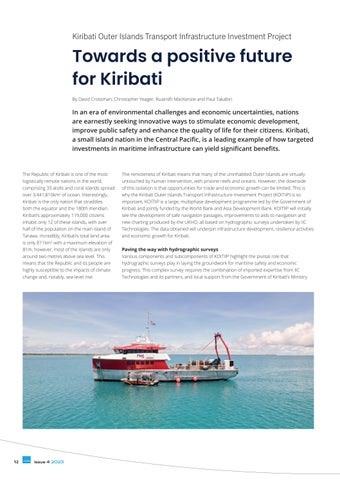
In an era of environmental challenges and economic uncertainties, nations are earnestly seeking innovative ways to stimulate economic development, improve public safety and enhance the quality of life for their citizens. Kiribati, a small island nation in the Central Pacific, is a leading example of how targeted investments in maritime infrastructure can yield significant benefits.
12
The Republic of Kiribati is one of the most logistically remote nations in the world, comprising 33 atolls and coral islands spread over 3,441,810km2 of ocean. Interestingly, Kiribati is the only nation that straddles both the equator and the 180th meridian. Kiribati’s approximately 119,000 citizens inhabit only 12 of these islands, with over half of the population on the main island of Tarawa. Incredibly, Kiribati’s total land area is only 811km2 with a maximum elevation of
The remoteness of Kiribati means that many of the uninhabited Outer Islands are virtually untouched by human intervention, with pristine reefs and oceans. However, the downside of this isolation is that opportunities for trade and economic growth can be limited. This is why the Kiribati Outer Islands Transport Infrastructure Investment Project (KOITIIP) is so important. KOITIIP is a large, multiphase development programme led by the Government of
81m; however, most of the islands are only around two metres above sea level. This means that the Republic and its people are highly susceptible to the impacts of climate change and, notably, sea-level rise.
Paving the way with hydrographic surveys Various components and subcomponents of KOITIIP highlight the pivotal role that hydrographic surveys play in laying the groundwork for maritime safety and economic progress. This complex survey requires the combination of imported expertise from IIC Technologies and its partners, and local support from the Government of Kiribati’s Ministry
Kiribati and jointly funded by the World Bank and Asia Development Bank. KOITIIP will initially see the development of safe navigation passages, improvements to aids to navigation and new charting produced by the UKHO, all based on hydrographic surveys undertaken by IIC Technologies. The data obtained will underpin infrastructure development, resilience activities and economic growth for Kiribati.
Issue 4 2023
12-13-14-15_featurecrossman.indd 12
05-10-2023 15:50
Feature
The remote, pristine Outer Islands of Kiribati offer limited economic prospects due to their isolation. The Kiribati Outer Islands Transport Infrastructure Investment Project (KOITIIP), a multi-phase initiative funded by the World Bank and Asia Development Bank, aims to address this by improving navigation safety, aids to navigation and charts through hydrographic surveys by IIC Technologies. This data will drive infrastructure development, resilience efforts and economic growth in Kiribati.
of Information, Communications and Technology (MICT) and KOITIIP staff for the conduct of aerial imagery, Lidar and airborne laser bathymetry (ALB) capture, boat-based multibeam echosounder (MBES) data gathering, tide data, geodetics, oceanographic observations and more. Component 1 of the project is the cornerstone of all ensuing activities, focusing on improving inter-island navigation safety. The utilization of advanced technologies such as ALB and MBES are employed to conduct hydrographic surveys around four target islands that will not only significantly improve navigation safety, but also inform subsequent initiatives that deal with maritime infrastructure enhancements. Elevating ship safety Subcomponent 2.1 aims to improve ship navigation safety through a myriad of strategies. One such strategy involves the replacement and installation of new aids to navigation. These are critical for enhancing resilience to climatic conditions such as high winds and intense precipitation, all of which can impair navigation. The upgrading of these systems will be informed by the hydrographic surveys, ensuring optimized, data-driven decision-making. Rehabilitating maritime infrastructure Subcomponent 2.2 aims to rehabilitate island access infrastructure based on the findings from the hydrographic surveys. Engineering studies, civil works and environmental and social safeguards will be
undertaken. Infrastructure improvements range from constructing jetties, passenger terminals and concrete ramps to small-scale dredging and seawall upgrades. Maritime benefits and economic uplift The expected maritime benefits are wide-ranging. Strengthened transport infrastructure will facilitate the sustained delivery of basic goods, create greater access to markets and social services, and improve transport reliability. Furthermore, safer and more efficient maritime operations will enhance the livelihoods and overall quality of life for the citizens of Kiribati. Indirectly, these maritime improvements contribute to broader national development objectives. The increase in trade activity is likely to lead to greater tax revenue, which can be funnelled into projects related to roads, healthcare and education. Also, the availability of reliable maritime transport is expected to bolster tourism, thereby having a multiplier effect on the local economy. Survey conduct The establishment of both geodetic and tidal control was a crucial aspect of this operation, given the lack of infrastructure and historical data in the region. Furthermore, the creation of high-accuracy tidal models will aid in the monitoring of sea-level rise and its potential impact. To accomplish this, IIC installed shore-based pressure gauges, GNSS boats and seafloor-mounted pressure gauges.
Issue 4 2023
12-13-14-15_featurecrossman.indd 13
13
05-10-2023 15:50
The MBES data acquisition was undertaken utilizing survey launches operated from a mothership. The mothership acted as the base of operations and ensured that the presence of the crew did not put unmanageable strain on local resources. Further, engagement with local fishermen and inspection of satellite and drone imagery proved useful for scouting routes and identifying hazards and possible navigation passages through the reefs. A requested outcome of the project was the desire to encourage local economies through the conduct of the survey work. To achieve this, IIC utilized local logistics and provision of stores wherever possible, stayed with local communities, hired village personnel, local coxswains and divers where appropriate, and rented local boats and vehicles. These activities provided a welcome financial boost for many of the Outer Island villages and allowed IIC personnel to develop relationships and engage with the locals.
Shore-based gauges were used as the primary units to allow for live monitoring of tidal data. GNSS boats were an innovation developed to allow monitoring of the tides and currents in preset locations in a manner that had minimal impact on the seafloor. Local boats were hired and acoustic doppler current profilers, GNSS systems and satellite communications were established in these vessels, powered by solar panels with local villages paid to oversee the safety of the boats and conduct regular checks on system functionality. The climate in Kiribati is fantastic for tourists and visitors, but can be harsh on equipment and personnel in the field for prolonged periods. Despite remaining within stated specifications, several shore-based gauges failed due to heat, humidity and accidental damage by island residents. In a similar fashion, the extreme rainfall resulted in the failure of several GNSS boat installation components. To overcome these environmental challenges, additional protection was added to equipment and seafloor-mounted pressure gauges were installed and found to be the safest and most efficient method for obtaining reliable tide data. As the area was largely unsurveyed, it was exhilarating for the Lidar team to be the first to see the bathymetry. Large coral outcrops that were previously only known to local divers and fishermen will now be available to the world in the form of Lidar and MBES data. In the first few flights, the team observed perfectly formed coral domes peaking over 20 metres from the seafloor. Eventually, hundreds of these mounts presented themselves in subsequent sorties, contrasting with plateaued bars in the immediate offshore margin and numerous varieties of coral and reef structures – the bathymetry in Kiribati is truly world-class. Wherever the team went, they were met by interested and engaged locals, all of whom were willing to help. At one point, the aircraft was in danger of being damaged by large chunks of coral during the take-off and landing procedures as the runway and surrounding area was made of coral. After a discussion with the locals, they crafted a bespoke pad for the aircraft to sit on and run its engines without the fear of coral being swept up and damaging the fuselage or propellors.
14
Another interesting aspect of this project was the requirement for engagement with local communities on the Outer Islands. This was undertaken under the leadership of KOITIIP staff and comprised meetings at each of the Islands, initially with the Islands’ Mayor and Secretary, then briefing at the Full Village Council. This Council comprised meeting with the elders or leaders from each of the villages in large traditional meeting huts. At these meetings, IIC, MICT and KOITIIP personnel described the activity, the outcomes for the Island and its people, and requested permission for access, local support to look after the equipment, and local logistics and vessels. These formal occasions were a privilege to be a part of, with the communities appreciating the benefits being presented and quickly – and normally emphatically – offering assistance. During these periods, the team made use of the local facilities, dining and living with the locals. On these Outer Islands, the locals depend on a balance of subsistence living by gathering food from the land and the sea, supplemented by some imported staples such as rice. Observing this enforced onto the team the importance of the work being undertaken, as it will assist in ensuring sustainable management, planning and preservation of both the land and ocean environments and therefore this way of life for future generations. Conclusion This article is too short to properly describe KOITIIP, its outcomes for the Kiribati people, the beauty of the environment, the challenges, the innovation or the incredible people involved. However, on completion of the surveys, the Government of Kiribati will have world-class, seamless coverage of the land and the seafloor, which it can use to plan and develop economic growth, improve safety and increase resilience. These hydrographic surveys are not merely technical exercises, but vital tools that enable informed, strategic decisions affecting the safety and economic well-being of Kiribati. By meticulously planning and executing these maritime improvements, Kiribati is setting a remarkable example of how to harness the power of maritime resources for national development. This is an investment in the present that promises a safer, more prosperous future for all. By taking a holistic approach that involves local communities, using cutting-edge technologies and focusing on long-term sustainability, Kiribati is not merely navigating its waters but steering a course towards a brighter future.
Issue 4 2023
12-13-14-15_featurecrossman.indd 14
05-10-2023 15:50
Feature
About the authors David Crossman is a Cat A surveyor and managing director of IIC Technologies Australasia. He has been in the hydrographic survey industry for over 30 years, initially with the Royal New Zealand Navy before joining IIC just over four years ago. Christopher Yeager has worked in the nautical charting/surveying field for over ten years on a wide range of surveying, charting and S5/S8 instruction contracts that include NOAA, CHS, KHOA, Panama Canal Authority, USGS, USACE and several private industries. His interest in the field stemmed from seeking adventure and challenge. Ruairidh MacKenzie is an IHCS Certified Level 2 hydrographic surveyor and hydrographic survey manager at IIC Technologies. He has been a surveyor for six years, with most of his career spent surveying the Canadian Arctic. Ruairidh is an avid underwater photographer and enjoys spending as much time in the ocean as he can.
More information Further information on Kiribati can be found in the Hydro International article by Wim van Wegen: Navigating climate change: Kiribati’s efforts to address sea-level rise, dated 14 March 2023.
Paul Takabiri is the project manager, Outer Island Implementation Unit, for KOITIIP under the Government of Kiribati Ministry of Finance and Economic Development. Paul is responsible for the successful conduct and outcomes of KOITIIP and has been intimately involved in the direct support and facilitation of the data gathering efforts outlined in this article.
Your source for hydrographic news, developments, and technology Stay informed with the the latest technology, industry news and cases Connect globally with a vibrant community of diverse industry professionals Amplify your voice by sharing your research, case studies, industry vision and technology
Join us
Issue 4 2023
12-13-14-15_featurecrossman.indd 15
15
05-10-2023 15:50
Charting the ocean’s depths: Seabed 2030 and global collaboration
Pioneering ocean mapping for a better world By Jamie McMichael-Phillips, Seabed 2030, and David Millar, Fugro
Delving into the mysteries of the planet’s final frontier – the ocean – has long captivated human curiosity, with the origins of ocean exploration dating back to 5,000 BC. But even today, the ocean largely remains a mystery, concealing vital knowledge. The Nippon Foundation-GEBCO Seabed 2030 Project hopes to inspire the complete mapping of the ocean, which covers over 70% of the Earth’s surface, by 2030. This ambitious endeavour requires global cooperation but promises a sustainable future. The Earth, with its vast ocean and uncharted depths, has always been an enigmatic realm, holding mysteries that elude human comprehension. Only a fraction of the seafloor has been explored, leaving the majority of this critical ecosystem shrouded in darkness, yet the ocean’s influence extends far beyond its depths.
change as the ocean captures a staggering 25% of all human-made carbon emissions. In this era marked by unprecedented environmental challenges, comprehending the intricacies of the planet’s vast ecosystems has never been more paramount.
Providing over half of the oxygen produced on the planet, the ocean sustains life on Earth. It is the lifeblood of communities – offering food and livelihoods to over three billion people around the globe – and often the unsung hero in the fight against climate
The idea for Seabed 2030 was first conceived at the 2016 Forum for Future Ocean Floor Mapping in Monaco. At this pivotal event, scientists, hydrographers, oceanographers, policymakers and environmentalists from various sectors across the globe convened to address the critical knowledge gap in the planet’s submerged frontier. Seabed 2030 was officially launched the following year at the first-ever United Nations Ocean Conference in New York. The project was also one of the first flagship programmes of the United Nations
Born out of a collective global effort, The Nippon Foundation-GEBCO Seabed 2030 Project is an initiative that not only reflects the growing awareness of the fundamental role of the ocean, but also exemplifies the power of international collaboration in pursuit of a common goal.
Example of high-resolution, in-transit bathymetry acquired by Fugro superimposed over low-resolution data from existing GEBCO database.
16
Issue 4 2023
16-17-18-19-21_featuremcmichael.indd 16
05-10-2023 15:25
Feature Decade of Ocean Science for Sustainable Development (Ocean Decade), and is aligned with SDG 14: ‘to conserve and sustainably use the oceans, seas and marine resources for sustainable development’. Multifaceted benefits of a complete map The benefits of creating a detailed and comprehensive seabed map are multifaceted. Enhancing the knowledge and understanding of the seafloor allows for increased awareness of key geological processes, the adoption of best practices for resource management, and the ability to make informed decisions to ensure a sustainable future for the planet. A comprehensive seabed map sheds light on the intricacies of ocean floor topography, underwater volcanoes and tectonic plate movements, offering a wealth of information that aids the prediction and mitigation of natural disasters such as tsunamis and earthquakes. It also supports environmental conservation efforts. The ocean is home to a range of marine ecosystems, many of which remain undocumented. Mapping the seabed provides vital insights into these ecosystems, enabling the identification of critical habitats and vulnerable species so that targeted conservation efforts to preserve the delicate balance of life in the ocean can be implemented. Resource management is another area that benefits greatly from a complete map of the ocean floor. With accurate information about the seabed’s composition and resources, nations can make informed
decisions about its sustainable management, including that of fishing resources. Seabed 2030’s goal encompasses all these tangible benefits and more. It is inspired by the recognition that a healthier, betterunderstood ocean is key to addressing the global challenges present today – from food security to climate change. It is a call for a global commitment to ensure the well-being of the planet. The role of global collaboration Seabed mapping is no new feat, and ocean mapping has taken place since the early days of maritime exploration. In fact, the General Bathymetric Chart of the Oceans (GEBCO), the only organization with a mandate to compile global bathymetry data, just this year celebrated its 120th anniversary, having been founded in 1903. Fast forward to 2017, and Japan’s largest philanthropic organization, The Nippon Foundation, joined forces with GEBCO to create Seabed 2030, to act as a catalyst to the long-standing efforts. GEBCO itself is a joint programme of the International Hydrographic Organization (IHO) and the Intergovernmental Oceanographic Commission (IOC) of UNESCO. When Seabed 2030 was launched in 2017, only 6% of the ocean had been mapped to modern standards. This figure has grown considerably, with just under a quarter – 24.9% – of the entire ocean floor now charted in the GEBCO grid. Mapping the entire ocean floor is an ambitious task that can only be achieved through international collaboration. Since its inception, Seabed 2030 has entered into over
The Fugro Equator, one of the vessels providing in-transit bathymetry for Seabed 2030.
Issue 4 2023
16-17-18-19-21_featuremcmichael.indd 17
17
05-10-2023 15:25
technology, which allowed the company to collect high-resolution bathymetry while travelling to and between projects. This philanthropic ‘in-transit’ bathymetry programme started in the Americas region with just one survey vessel in 2016. Today, more than nine of the company’s global survey vessels are participating, with contributions of Fugro bathymetry now totalling more than 2.36 million km². By 2025, the company aims to have 90% of its global fleet collecting in-transit bathymetry in support of Seabed 2030.
The Fugro Blue Essence USV in the North Sea, built by partner SEA-KIT.
50 partnerships with governments, industry, academic institutions and more across the globe, without which its goal would be unattainable. Spotlight on Fugro Fugro is one of the founding members – and the first private sector member – of Seabed 2030. Its involvement dates all the way back to the 2016 Forum for Future Ocean Floor Mapping, when Seabed 2030 was merely a concept. Recognizing that global progress in ocean mapping would require a cross-sectoral approach, Fugro leveraged its expertise as an international survey company to support this ambitious initiative. The company focused its support on two key areas: encouraging its marine-based customers to share privately owned ocean mapping data, and acquiring and sharing data itself. The first path proved more difficult than anticipated. While Fugro had many positive conversations with customers about data sharing, moving from general interest to concrete agreements proved challenging for multiple, complex reasons. For instance, a company may have been willing to share the bathymetry developed for an offshore energy project, but the government-issued lease agreement they operated under may not have allowed it. Meanwhile, Fugro had far greater success with its own data development and sharing programme. This was made possible by early investments in remote command-and-control
Expanding private sector involvement through the Ocean Decade As with Seabed 2030, Fugro was involved in the early planning stages of the Ocean Decade. Through that process, the company realized that making privately-owned bathymetry available for public use would be best accomplished not through bilateral discussions with customers, but through engagement with the private sector community. This is what ultimately led to Fugro and IOC/ UNESCO forming a partnership agreement in November 2021 to improve the coordination of, and access to, global ocean science data. Through this partnership, the parties have formed a working group to help build a digital ecosystem to manage and distribute ocean data and interoperable marine science. They are also forming a group of private sector companies that collect or own ocean science data. Known as the Ocean Decade Corporate Data Group, this collective aims to address the challenges of sharing ocean data, developing solutions and best practices for industry.
Members of the Ocean Decade Corporate Data Group at the first in-person meeting held on 25–26 September 2023. (Image courtesy: IOC/UNESCO)
18
Issue 4 2023
16-17-18-19-21_featuremcmichael.indd 18
05-10-2023 15:25
Feature
Delegates at the Forum for Future Ocean Floor Mapping pose for a photo. (Image courtesy: Rebecca Marshall)
Fugro and IOC/UNESCO officially launched the Corporate Data Group in February this year. It comprises eight members from a diverse range of marine industry sectors, with plans to expand to 15. While its work encompasses a wide spectrum of ocean science interests, bathymetry has taken centre stage as a fundamental data layer with a well-established foundation, thanks to the efforts of Seabed 2030 and the robust infrastructure provided by the GEBCO grid. Seabed 2030 is collaborating with the working group in an advisory capacity, sharing insights gained from its interactions with the private sector regarding data sharing challenges. Its guidance is helping to inform a comprehensive strategy for making more privately owned bathymetry accessible to the public. This includes tackling sensitive issues related to government permissions for releasing data developed within lease agreements or permits. The role of technology and partnerships By integrating existing bathymetric data from all sectors into the GEBCO grid, it is estimated that we can chart an additional 15–20% of the world ocean. If achieved, that still leaves a lot of ocean to map and a lot of questions about how that will be completed. Once again, partnerships and technology will lead the way. On the partnership front, contributions of new bathymetry will remain important, but the introduction of large-scale mapping programmes will also be required. Existing regional intergovernmental partnerships, such as the All-Atlantic Ocean Research and Innovation Alliance (AAORIA), can serve a critical function in supporting these efforts by providing a platform for collaboration and funding. Technology-wise, all signs point to remote and autonomous technologies. When Seabed 2030 was first conceived, there were
no robots surveying the ocean, but today uncrewed surface vessels (USVs) collecting deepwater bathymetry are a proven reality. Collaboration has played a starring role in this advancement, perhaps most notably through the Shell Ocean Discovery XPRIZE. This global, three-year competition incentivized the development of rapid, uncrewed high-resolution ocean mapping technologies, including the winning SEA-KIT USV technology that is now used by Fugro in Europe, Australia and the Middle East. The goal now is for industry to scale USV and other remote and autonomous capabilities so that high-resolution ocean basin mapping can be accomplished for well-organized regional partners safely, efficiently and with minimal environmental impact. United in discovery Seabed 2030 was created to act as a catalyst to the long-standing endeavour already underway to chart the ocean – but its mission cannot be achieved alone. It is the result of unwavering collaboration among nations, institutions and corporations alike – and Fugro’s unwavering commitment to Seabed 2030 exemplifies the power of private sector involvement in addressing the most pressing global challenges. Through cutting-edge technology, innovation and expertise, Fugro has helped to significantly advance the project’s mission, bringing us closer to the day when we will have a complete map of our ocean’s depths. In mapping the ocean floor, a path towards a more resilient, equitable and sustainable future is charted. The completion of this monumental task by 2030 requires the continued support and collaboration of governments, industry partners, research institutions and individuals worldwide. The international community must redouble its efforts and invigorate innovation.
Issue 4 2023
16-17-18-19-21_featuremcmichael.indd 19
19
05-10-2023 15:25
GREENER, FASTER, SAFER DRIX MULTI-MISSION UNCREWED SURFACE VESSEL Faster and better data gathering Reduced carbon footprint Unrivaled platform stability and data gathering Remote-controlled and supervised autonomous operations From coastal to offshore environments
00_Exail_Hydro_4-2023.indd 6
03-10-2023 12:08
Feature
About the authors
Image shows areas of the global seafloor that are considered mapped within the GEBCO grid. The regions coloured grey depict the coverage of mapped areas within the 2022 release of the GEBCO grid and the areas coloured red show the additional coverage included in the 2023 release. (Image courtesy: The Nippon Foundation-GEBCO Seabed 2030 Global Center)
Jamie McMichael-Phillips is director of The Nippon Foundation-GEBCO Seabed 2030 Project. A hydrographic surveyor and former Royal Navy captain, Jamie has worked in a range of leadership roles, from running his own marine data gathering missions to directing defence geospatial strategy and plans for the UK. He has managed governmentto-government relationships for geospatial cooperation and has led on outreach and capacity-building of fledgling organizations in marine data collection, assessment and cartography. Prior to assuming his current role, Jamie chaired the IHO’s Worldwide ENC Database Working Group for over nine years, where he was responsible for monitoring the global footprint of electronic charts required for safe navigation at sea.
A snapshot of the data captured by the multibeam sonar on Oden. The red arrow shows where Oden is, with the hashed area yet to be scanned. Captured by Seabed 2030 Center co-head Professor Larry Mayer on the expedition to the 2019 Ryder Glacier, Greenland.
David Millar is Fugro’s government accounts director for the Americas, based in the Washington DC area. He oversees the development and execution of partnerships with national governments, the United Nations, the World Bank and other multilateral development banks, as well as Fugro’s collaborative science in the region. David also leads Fugro’s global support of and participation in Seabed 2030 and the UN Ocean Decade. A current member of the GEBCO Guiding Committee, he has more than 30 years of experience in ocean mapping, marine geophysics and hydrographic surveys.
Unveiling the Earth’s hidden depths to acquire the knowledge needed to safeguard the planet for generations to come has now become a uniquely important goal in which everyone has a role to play.
Saab Seaeye
EMPOWERING World leading electric underwater robotics saabseaeye.com
Issue 4 2023
16-17-18-19-21_featuremcmichael.indd 21
21
05-10-2023 15:26
GEOxyz, pushing boundaries for safe remote operations. With a stellar reputation built on excellence and innovation, GEOxyz offers an extensive array of survey services tailored to meet your specific needs, all while keeping a sharp focus on integrating the latest technologies. With a steadfast dedication to staying ahead of the curve, GEOxyz owns a diverse fleet of Unmanned Surface Vehicles (USVs) renowned for their remarkable autonomy. These USVs can be expertly controlled from remote control centers worldwide, either aboard of a mother vessel or from our offices onshore, making data acquisition not only safer but also more environmentally friendly and efficient. In the ever-evolving landscape of maritime regulations, GEOxyz is resolutely dedicated to adherance and safety. GEOxyz has recently achieved the MCA Workboat certification for its Unmanned Survey Vessel “Geodrone 6800”.
Partner up with GEOxyz today
_Geoxyz_Hydro_4-2023.indd 6
(ref. 2nd edition of The Safety of Small Workboats and Pilot Boats – A Code of Practice, published by the Maritime and Coastguard Agency of the Department of Transport.)
In a world where precision, efficiency, and compliance are paramount, GEOxyz stands as the beacon of uncompromising data quality. Using a secure SD WAN solution, connecting all their offshore and nearshore vessels, USVs and remote control rooms; data acquisition, data processing and remote steering can be safely performed from our offices worldwide. Offering a comprehensive suite of remote survey services and an unwavering commitment to technological advancement, GEOxyz is your trusted partner in achieving all your survey objectives.
www.geoxyz.eu
04-10-2023 14:17
Feature
Employing innovative technology to protect vital ecosystems
Robotics and deep learning to revolutionize seagrass monitoring By David Hull, HydroSurv, United Kingdom
Seagrass meadows play an invaluable role as critical ecosystems that contribute significantly to marine biodiversity, carbon sequestration and coastal protection. In recent years, the importance of these underwater habitats has gained widespread recognition, and they have been increasingly studied and documented in ocean scientific research. Nevertheless, observation and monitoring remain significantly challenging and cost-intensive endeavours.
As a natural solution to combat climate change and protect against marine biodiversity loss, seagrass meadows contribute vital ecosystem services both to coastal communities and to society as a whole. Acting as nurseries to marine species, they offer shelter and food sources to fish and other marine organisms, purify seawater and stabilize the seabed – reducing the effects of coastal erosion. They are perhaps
gaining most attention from scientists and policymakers for their ability to sequester carbon at rates surpassing terrestrial rainforests, making them a prime example of a nature-based solution to address climate change. However, there is a significant obstacle standing in the way of developing protection and restoration schemes for these valuable ecosystems, and that is the sporadic and often incomplete observation evidence currently available to characterize and monitor meadow sites. Since today’s monitoring programmes remain heavily reliant on diver-based methods, spatial coverage and precision of repeatability are constrained, and labour-intensity inevitably puts pressure on the budgets available.
The HydroSurv REAV-28 uncrewed surface vehicle.
Issue 4 2023
23-24-25_featurehull.indd 23
23
05-10-2023 14:31
Fundamentally, knowledge gaps continue to hamper efforts to gather the essential evidence that informs planning and decisionmaking for protection and restoration. Consequently, stakeholders fail to reach the tipping points of scale where the value of the ecosystem services provided can be converted into fiscal mechanisms that provide the sustained funding needed to manage these important natural capital assets. Enhancing our monitoring techniques, data collection and management processes is vital to facilitate effective conservation strategies, especially at a time when these invaluable natural assets are exposed to an array of environmental threats. Time is of the essence to deliver trusted, validated solutions to the practitioners who need them. Non-invasive, budget-friendly robots In October 2022, Hydro International published an article that featured the collaborative research and development work being undertaken by HydroSurv, working with the University of Plymouth and Valeport. Central to their approach was the deployment of small, battery-powered uncrewed surface vessels (USVs) as a non-invasive data acquisition platform capable of surveying wide spatial areas rapidly. At 2.8m long, HydroSurv’s REAV-28 is a multi-purpose vessel capable of rapid deployment and recovery from beaches and foreshores adjacent to work sites, with optimized sea-keeping for operations in the coastal environment and daywork endurance. Leveraging this platform to substitute the work performed by small workboats and divers has the potential to reduce CO2-equivalent emissions by up to 97%, while slashing the cost of project execution.
metres. Because the survey areas are relatively shallow, selection of a single-beam unit represents the most practical balance between sufficient resolution and cost management. Importantly, the VA500 is positioned at a significantly lower price point than multibeam units. A key component of the data processing was the use of deep learning algorithms developed by the University of Plymouth. SeagrassNet is a deep learning algorithm that employs recurrent neural network (RNN) techniques to detect and classify the presence of seagrass and the elevation and echo strength of the seagrass canopy, enabling a determination of relative density. This is made possible because, whereas the standard VA500 altimeter receives multiple signal echoes and must determine which echo corresponds to the seabed, the customized instrument used in this project provides the full echo response. All measured echoes along with their strength and sharpness are subsequently analysed in the processing algorithm. Technology advancement in ground truthing and sediment analysis While HydroSurv and the University of Plymouth have every confidence that their recent advances in the domain of submerged aquatic vegetation show significant potential to revolutionize seagrass monitoring, the project team has since gone beyond the state-of-
Geolocated ground-truth camera observations in EasySurv. (Image courtesy: HydroSurv and University of Plymouth)
The USV was fitted with a payload that included the Valeport VA500 altimeter, typically used for precise underwater positioning on autonomous, remotely operated or towed underwater vehicles. This instrument was specifically selected for its advanced digital signal processing techniques. Using these techniques, the VA500 effectively filters out ambient noise and focuses on signal returns. Exclusively for this project, Valeport made custom modifications enabling acoustic profiles to be correlated at up to 10Hz. Seagrass sites are generally found in shallow water, often at depths of less than eight
24
Geolocated sediment analysis observations with metadata. (Image courtesy: HydroSurv and University of Plymouth)
Issue 4 2023
23-24-25_featurehull.indd 24
05-10-2023 14:31
Feature
About the author
Ground-truth camera-zoom seagrass image. (Image courtesy: HydroSurv and University of Plymouth)
the-art. With co-funding from Innovate UK and the Department for Environment, Farming & Rural Affairs (DEFRA), the partnership has further optimized the integrated robotic survey system to provide additional georeferenced, co-acquired datasets to further inform the health and environmental characteristics of seagrass sites. Significant upgrades have been made to the USV and its payload, including two new underwater camera systems and an advanced profiling winch. The first camera is a self-contained, high-resolution ground-truthing camera. Its purpose is to compare the acoustic ground discrimination data with precise, georeferenced photographic data, delivering an accurate visual reference to complement the processed acoustic data. Additionally, a new sediment analysis camera, equipped with a macro lens, lands in direct contact with the seabed to capture detailed frame stills. These images are subsequently analysed using a digital grain size algorithm, integrated into the SeagrassNet application, allowing practitioners to classify the type of sediment present. These new datasets, in conjunction with supplementary data from hull-mounted Valeport chlorophyll a and turbidity sensors, offer a more complete solution for comprehending and confirming the accuracy of our processed acoustic data. By incorporating these photographic datasets, it is possible to also obtain valuable insights into the condition of the seagrass and the suitability of the seabed sediment for restoration efforts. In the second year of fielding the technology system, the team has further improved the accuracy of the VA500 datasets by adding measurements from a hull-mounted Valeport sound velocity sensor. To support these precise operations, HydroSurv has developed a new control application for the OSIL micro-profiling winch. Parameters for stand-off altitude, touchdown duration and speed can be configured for each camera system, including the ability to maintain the camera at a constant altitude underway. The use of the USV to perform this operation substitutes another operation that would otherwise be carried out by a workboat. Actionable insight in the cloud The aggregated datasets from the machine learning processing algorithms are hosted in HydroSurv’s ‘EasySurv’ application. This solution enables practitioners to determine seagrass biomass characteristics and assess carbon sequestration potential, which in turn facilitates planning of conservation and regeneration projects.
David Hull is an accomplished entrepreneur working in the field of USVs. In 2019, David founded HydroSurv, a research-informed provider of USV technology focused on impact-led use cases that harness the potential of surface robotic systems. Under David’s leadership, HydroSurv has delivered more than 50 USV projects, including the design, construction and deployment of 18 USVs for customers in the UK, Europe, North America and Asia Pacific regions. Currently, David’s focus lies in developing large-scale commercial pilots in the realm of natural capital assessment, asset inspection and hydrographic survey, where he is committed to driving the adoption of sustainable technologies in industrial use.
Since the use of robotics can significantly reduce resurvey intervals, the aim of the EasySurv application is to enrich the temporal comparison between datasets. Therefore, 2D heatmap comparisons for the seagrass metrics can be compared using drag-and-drop functionality, without the need for specialist GIS skills. In the current DEFRA-funded project, the EasySurv application now shows the georeferenced ground-truth camera data as layers alongside the acoustic data and the sediment analysis data processed using the SeagrassNet machine learning toolchain. Ultimately, the aim has been to create a more accurate, efficient data processing pipeline to reduce reliance on expert data processors. By combining the automated data pipeline with affordable automated vessels, the project team hopes to democratize seagrass data and enable practitioner access to the data needed for natural capital assessment and monitoring. The way forward: scale deployment Significant development activity has been undertaken since the collaboration between the University of Plymouth and HydroSurv was initiated in 2021. From the outset, a well-defined, mutual vision to deliver a comprehensive, all-in-one solution was the foremost aim. In the DEFRA co-funded work of 2022, the project team was able to resurvey worksites on behalf of the Environment Agency that were originally surveyed under the previous project and other University of Plymouth research. The next stage in the development roadmap is to scale deployment of the technology solution, to improve and demonstrate temporal comparison. To this end, HydroSurv is engaged with a range of stakeholders and has now configured large-scale pilot projects with three of these to field the system over an extended period.
Issue 4 2023
23-24-25_featurehull.indd 25
25
05-10-2023 14:31
Combining repeat hydrographic and geophysical surveys with computational fluid dynamics
Investigating change at historic shipwreck sites By Jan Majcher, Green Rebel, Ireland
Shipwrecks are an integral part of our underwater landscape. According to UNESCO, there are three million wrecks worldwide, and these create various marine spatial planning challenges. To address these challenges, their longterm stability on the seabed needs to be understood. A PhD project conducted at Ulster University attempted to understand the factors affecting wreck sites on the seabed, through high-resolution hydrographic and geophysical surveys combined with detailed desk-based assessment involving computational fluid dynamic simulations. Many historical shipwrecks are viewed as war graves, as the ships were lost in tragic circumstances in naval warfare in the First and Second World Wars. They also act as time capsules, providing insight
into technological solutions of their time and life on board. Beside their heritage and archaeological values, shipwrecks are known as hotspots of marine biodiversity, which also attracts sport divers and fishers, and can be associated with pollution threats. With many offshore renewable sites being planned for development, shipwrecks are also frequently treated as impediments to ocean engineering and navigational hazards. On the other hand,
Figure 1: 3D, multibeam echosounder-data derived model of the HMS Vanguard shipwreck.
26
Issue 4 2023
26-27-28-29_featuremajcher.indd 26
05-10-2023 15:26
Feature
About the author Jan Majcher holds a Master’s in Oceanography from the University of Gdansk, Poland, and a PhD in Environmental Science from Ulster University, Ireland. His academic research focused on submerged man-made legacy objects such as shipwrecks and unexploded ordnance in the context of their stability on the seabed and the processes driving their destruction or preservation. Jan is currently employed as a marine geoscientist at Green Rebel (Ireland), where he processes hydrographic and geophysical data to support offshore wind energy developments in Europe.
Figure 2: Structural change model for the HMS Vanguard site. (a) Point cloud – 2015 survey, (b) point cloud – 2019 survey, (c) difference model for the interval 2015–2019. (From Majcher et al., 2022)
having rested on the seabed for so long, they are good proxies of how man-made structures interact with the natural ocean environment. Despite these diverse interests from many parties, most wrecks remain largely unresearched. Shipwrecks undergo deterioration, the pace of which is regulated by a set of environmental and anthropogenic factors commonly referred to as site formation processes. Understanding these factors is important to develop effective management strategies for these fragile underwater archaeological sites. High-resolution digital elevation models resulting from detailed hydrographic and geophysical surveys can aid site characterization and monitoring and our understanding of the complex factors influencing the submerged legacy on the seabed. Scope of the project The PhD project at Ulster University investigated 12 shipwrecks in the Irish Sea, all over 100 years old. Repeat hydrographic and geophysical survey data, an oceanographic model and computational fluid dynamics were used to study site formation processes, focusing on hydrodynamic forces and seabed changes. High-resolution multibeam echosounder data was used to create detailed 3D models of the sites, which were subsequently applied not only to conduct archaeological research but also provided a means to show otherwise inaccessible shipwrecks to the wider public. An example of a 3D model of one of the shipwrecks is shown in Figure 1. The method developed made it possible not only to capture the shipwrecks, but also the ambient seabed bathymetry in a time-
Figure 3: MBES survey-derived DEMs representing SS Polwell, SS Tiberia and SS Hare sites. Extensive scour signatures have developed due to the presence of the shipwrecks. (From Majcher et al., 2020)
efficient manner. This is important, as it allows the detection of change in the shipwreck structures and the seabed around them. Detecting change in shipwreck structures Capturing changes in wreck structures is no easy task. Commonly, photogrammetric survey techniques are used in archaeology to capture artefacts, allowing the creation of effective 3D renders. Such surveys can be repeated and the resulting models compared, thus recording changes at centimetric scales. However, this approach is time-consuming for large objects such as shipwrecks, which require thousands of photographs prior to constructing the 3D models. Additionally, the sites selected for this study were all located in relatively inaccessible, deep waters with highly restricted water visibility. For these reasons, high-resolution acoustic marine remotesensing techniques were chosen for the PhD project. Specifically, the Irish Marine Institute’s research vessel Celtic Voyager, equipped with a Kongsberg EM2040 multibeam echosounder, was used to acquire high-resolution data repeatedly in 2015 and 2019. The shipwrecks were scanned with multiple slow passes over their structures at varying angles (Westley et al., 2019), providing millions of elevation data points in just a few hours of surveying. Subsequent
Issue 4 2023
26-27-28-29_featuremajcher.indd 27
27
05-10-2023 15:26
data processing and the application of 3D visualization techniques revealed structural changes as shown in Figure 2. Apart from recording intricate structural details such as the impact hole, which caused the sinking of the vessel, a comparison of the data acquired in 2015 and 2019 allowed an assessment of the damage sustained by the wreck in this period. For example, the gunwales deformed and one of them slid down (Fig. 2c, 1 and 2) and the mainmast dropped, causing further erosion of the seabed around it. The information extracted from such models can serve to investigate shipwrecks as process-response systems at some equilibrium state. This state can be disrupted and the resulting change of one structural element can cause further disorganization at the site before it reaches another equilibrium state. The factors causing the initial disruption are either natural or anthropogenic and can be investigated further using the acquired in situ and modelled data. Detecting change in the surrounding seabed Shipwrecks may be surrounded by sediment waves of various sizes or by rock outcrops, and because wrecks act as obstacles affecting local current flows, they often cause seabed scour. This process can
Figure 4: DEMs of difference representing seabed changes between 2015 and 2019 at the: (a) SS WM Barkley site and (b) FV St. Michan site. (c) Close-up of recent trawl marks visible at the St. Michan site in 2019 (hillshaded DEM). (Adapted from Majcher et al., 2021)
Figure 5: Simulated flow patterns around the HMS Vanguard shipwreck. (From Majcher et al., 2022)
28
result in deep depressions around a shipwreck, exposing its parts. A quick look at the DEMs of some shipwreck sites reveals that their presence can cause extensive disruption to the seabed, significantly changing the bathymetry around them (Fig. 3). Seabed change may displace and damage a wreck or cause its complete or partial burial or exposure. Therefore, seabed change at the sites selected for the project was recorded in situ in detail (Majcher et al., 2021). The sites, situated in various parts of the Irish Sea, reflect a variety of oceanographic and geological conditions: tidal currents, wave patterns, sediments and geomorphology differ significantly between the sites. Some of the studied sites experienced extreme changes, for example the seabed height changed by up to 4.9m mear a wreck in four years (Fig. 4a), while others remained almost static during the same period (Fig. 4b). An interesting observation was noted at the relatively static site of the fishing vessel wreck St. Michan, where trawl marks directly intersecting the site appeared between 2015 and 2019 (Fig. 4b, c). Fishing activities conducted in the area may therefore have contributed to the state of the shipwreck on the seabed. Understanding change using computational fluid dynamics The observed wreck and seabed changes were investigated further using numerical models (Majcher et al., 2022). Output from the Regional Ocean Modeling System, provided by the Marine Institute Ireland, and the acquired multibeam echosounder data were used with computational fluid dynamics to simulate current flows at the sites. The simulations showed that wreck structures do indeed cause substantial changes to local current flows, triggering the development of vortices and enhancing shear stresses at the seabed (Fig. 5). The distribution of flow-exerted forces and vortices at the wreck sites helps to draw conclusions about their future preservation potential. It was observed that some of the sites are prone to further changes, as they are subject to high shear stresses and turbulence, which promote seabed erosion and re-deposition. This therefore shows which sites may be prone to accelerated disintegration. Conclusion The PhD project aimed to extend the knowledge about site formation processes affecting heritage shipwreck sites. A combination of timeeffective marine remote sensing and oceanographic and numerical modelling methods was applied to understand wreck sites as process-response systems. This made it possible not only to record and understand past changes, but also to make future predictions. The developed approach can help to establish management strategies for the sites, backed by an in-depth, data-informed assessment. This is important, considering how many shipwrecks there are on the seabed around the world. UNESCO estimates that there are three million shipwrecks worldwide, which are often densely distributed in semi-enclosed, busy seas such as the Irish Sea (around 18,000 shipwrecks in total around Ireland according to the Underwater Archaeology Unit in Ireland) and the Baltic Sea (8,000–10,000 shipwrecks according to the Baltic Marine Environment Protection Commission). While many of these are considered to be historically important and part of our common underwater cultural heritage,
Issue 4 2023
26-27-28-29_featuremajcher.indd 28
05-10-2023 15:26
Feature they often pose environmental pollution risks. Knowing how these sites change under various natural and anthropogenic processes is therefore important for many parties.
Acknowledgements This research was made possible thanks to the collaboration of a team of multidisciplinary scientists from diverse scientific backgrounds: my supervisors Rory Quinn (Ulster University), Ruth Plets (Flanders Marine Institute in Belgium) and Chris McGonigle (Ulster University) and collaborators/advisors Fabio Sacchetti (Marine Institute Ireland), Thomas Smyth (University of Huddersfield), Mark Coughlan (Irish Centre for Research in Applied Geosciences) and Kieran Westley (Ulster University). The PhD project emerged as a result of the Integrated Mapping for the Sustainable Development of Ireland’s Marine Resource (INFOMAR) project’s ship-time application grants: APP-CV15021, CV16031 titled ‘World War I shipwrecks in the Irish Sea: commemoration, visualization and heritage management’, APP-CV19027 titled ‘Geohazard Investigation in the Irish Sea using Seismic and Seabed Mapping Techniques’ and Ulster University’s Vice-Chancellor’s Research Studentship.
References Majcher, J., Plets, R., & Quinn, R. (2020). Residual relief modelling: digital elevation enhancement for shipwreck site characterisation. Archaeological and Anthropological Sciences, 12(6). https://doi.org/10.1007/s12520-020-01082-6 Majcher, J., Quinn, R., Plets, R., Coughlan, M., McGonigle, C., Sacchetti, F., & Westley, K. (2021). Spatial and temporal variability in geomorphic change at tidally influenced shipwreck sites: The use of time-lapse multibeam data for the assessment of site formation processes. Geoarchaeology, 36, 429–454. Majcher, J., Quinn, R., Smyth, T., Plets, R., Mcgonigle, C., Westley, K., Sacchetti, F., & Coughlan, M. (2022). Using difference modelling and computational fluid dynamics to investigate the evolution of complex, tidally influenced shipwreck sites. Ocean Engineering, 246, 110625. Westley, K., Plets, R., Quinn, R., McGonigle, C., Sacchetti, F., Dale, M., McNeary, R., & Clements, A. (2019). Optimising protocols for high-definition imaging of historic shipwrecks using multibeam echosounder. Archaeological and Anthropological Sciences, 11, 3629–3645.
Density corrected depth data directly from one instrument. The Bathy2 is an enhancement of the MIDAS Bathypack offering Valeport’s proven survey industry
Bathy2
The latest evolution in bathymetric measurement To find out more contact sales@valeport.co.uk +44 1803 869292 | www.valeport.co.uk
standard sensors to generate precision Sound Velocity and Density profiles for highly accurate depth and height data.
Issue 4 2023
26-27-28-29_featuremajcher.indd 29
29
05-10-2023 15:26
Integrated INS on Nucleus1000 for full navigation capabilities on small subsea vehicles The Nucleus1000 navigation sensor suite is now available with full INS (inertial navigation system) capabilities, enabling absolute position outputs obtained using the Nucleus’s on-board inertial and acoustic sensor package.
Users can now add a convenient source of basic positioning to their vehicle without substantial time, cost and payload demands. The Nucleus only needs to be provided with a GPS position to begin navigating using absolute positioning.
Equipping the sensor package with a full INS enables true navigation (latitude/longitude or X/Y output) for small AUVs, ROVs and USVs.
Prior to this, users would have to fuse data from multiple different sensors to obtain a reliable position output, either through their own software or additional third-party packages.
In addition to a dedicated INS data stream, the Nucleus software can show a vehicle’s location in real time on a map using inputs from its sensors and Nortek’s navigation algorithms.
Thanks to the Nucleus1000, small vehicles now have access to earth-referenced positioning in a preconfigured, pre-synchronized package.
The most compact, affordable and accurate complete navigation system of its class
30_Nortek Showcase.indd 6
04-10-2023 10:24
Feature
A guide for survey professionals and video inspection coordinators involved in underwater video surveys, especially using ROVs.
Minimizing positional errors during ROV visual inspection By Praveen Karoth, India
Underwater positioning with USBL is not as inaccurate as many people think, provided it is used in a favourable environment. The author has seen numerous instances where the accuracy of underwater positioning is much lower than that achievable on land, and where an erratic reading or a less accurate position is accepted, even during system calibration. However, the accuracy maintained during mobilization and calibration should be as precise as possible and, if found to be sub-optimal, a cross check should be made for any errors in the set-up. Overview of positioning accuracy During video surveys, the end product is always the video containing audio descriptions of the subjects of the survey and a video overlay depicting the time, position and other required data. The descriptions shown in the video overlay must be aligned with the subject in the video at the accuracy level required for the project. To achieve this, we need to understand all of the factors that determine the accuracy of the positioning systems used in any given survey. These must
be understood not only by the surveyor, but by the entire crew, to ensure precise positioning. Two types of positioning systems are used in such surveys: a. Surface positioning This covers GPS, DGPS, DGNSS or any other satellite-based positioning system. The most accurate of these will provide an accuracy of about 1–3mm on a fixed platform and less than 0.5m in surveyable sea conditions. However, the precision maintained in the offset measurement in the vertical and horizontal axes of the vessel can play a major role in achieving the above-mentioned accuracy for calculated positions used during the survey. b. Underwater positioning This covers systems such as USBL and LBL. These are not independent positioning systems; rather, they derive positions based on the range and bearings from or to a known position provided by the surface positioning system. Any error in the surface positioning system or the measurement of the offsets will therefore directly affect the positioning accuracy of the underwater positioning system. Underwater positioning systems are reliable to sub-metre accuracy on static deployment, and the accuracy in normal working environments with accepted levels of disturbance is less than 2m. Any error in the surface positioning system or the measured offsets will increase the error to above 2m, which will be unacceptable in most cases.
Figure 1: Translational dilution of errors in 3D plane on projection to 2D plane.
Accuracy enhancement in 2D projections Although positioning errors are in three dimensions, any error in the vertical axis will be less than the error in the horizontal axis when
Issue 4 2023
31-32-33_featurekaroth.indd 31
31
05-10-2023 15:27
affecting the accuracy of the survey. During pipeline inspections, the ROV might skip tracing the pipeline lay and length accurately due to positioning errors, especially when surveying sharp turns or spools in the pipeline. The only way to overcome this is to ensure that the ROV is fitted with a gyro (Fig. 2).
Figure 2: Position errors due to compass heading error.
Calibration and verification When a vessel is mobilized for visual inspection, special attention must be paid to calibration and verification of the equipment and data exchange. This must be done after full mobilization of the vessel. The calibration and verification must be carried out in the most suitable sea conditions available and as accurately as possible. Any anomaly found in the process must be addressed, and not ignored because the error is within project specifications. The reason for this is that precision during calibration will provide ample error allowance during the actual survey and therefore ultimately save time and resources. Any change in the configuration or equipment after calibration and verification is not advisable. However, if it cannot be avoided, verification should be repeated after any change. Surveyors around the world use different methods for gyro calibration. If the vessel is in dry dock, sunshot or angular measurements using a total station can be adapted for gyro calibration, while the taped offset method provides the best results for small vessels alongside berths. Sunshot or total station methods are prone to errors in this scenario.
Figure 3: ROV positioning for horizontal (above) and vertical features (below) in visual inspection.
translated to the two-dimensional planes of the survey (Fig. 1). To ensure better accuracy, we must consider the z-axis values accurately while carrying out the offset measurements to achieve a precise position in acceptable roll, pitch and heave conditions. Role of gyro in maintaining survey accuracy There was a time when we relied on magnetic compasses for angular measurements. However, technology has given us the luxury of precise angular measurements or headings with a very high update rate. In hydrographic surveys worldwide and onboard vessels, magnetic compasses have been replaced by gyros and many have migrated to state-of-the-art optical gyros with integrated heave compensators. Since we rely on calculated positions with reference to a precise positioning system during surveys, the heading accuracy and the update rate play a crucial role in the total accuracy of the survey. Even if we use a calibration-free gyro, it is important to carry out gyro verification accurately to remove any mounting errors during the mobilization of equipment for the project. ROVs generally use magnetic compasses/fluxgates since they are only needed to navigate the ROV. However, if the ROV is used for video inspection purposes where calculated positions are used for camera offsets/the focal point, more accurate heading information is a must. Fluxgates are prone to erratic readings in areas with high magnetic flux, adversely
32
During any surveys involving offset logging, special attention must be paid while measuring the offsets and feeding the values into the system. A gyro error of two degrees will cause an error of 1.5m over a 50m-long baseline, while an offset measurement error of 1m in the same scenario will increase the error to 2.5m or more. ROV mobilization for visual inspection During visual inspection using an ROV, the utmost attention should be paid to mobilizing the ROV since the end result of the survey is the video collected using the ROV. Visual inspection carried out by a diver, with positions acquired by placing the equipment/USBL beacon on top of the feature in the video, provides the most accurate position, which is seen in the video as a video overlay. However, an ROV cannot achieve that kind of accuracy due to accessibility constraints during the survey. The ROV has a USBL beacon, but pilots cannot always position this beacon exactly on top of the feature. To overcome this, an offset position is created for the ROV beacon that provides the position of a point slightly ahead of the ROV. This point is usually made to align with the focal point of the centre camera at the normal tilt angle used during the survey. As a result, the position received during the survey will be of the object that falls in the centre of the centre camera video output. This provides a much higher precision than an ROV sitting on top of the feature, assuming that this is even possible. In this set-up, the ROV crew must ensure that all the position fixes acquired with the centre camera have the same pan and tilt as during the offset measurements, to ensure the accuracy of the focal point position (Fig. 3). The accuracy of the gyro and the offset
Issue 4 2023
31-32-33_featurekaroth.indd 32
05-10-2023 15:27
Feature measurements of ROV nodes are equally crucial in attaining the best result. Guidelines for mobilization and calibration for visual inspection a. Rig up the equipment following project requirements b. Carry out offset measurement precisely in 3D c. Carry out gyro calibration and feed the accepted corrections into the survey system d. Carry out ROV gyro comparison with survey gyro and apply corrections if necessary e. Carry out DGNSS verification and node verification f. Collect SVP data and update the SV profile in the USBL system g. Perform static node verification for USBL using beacons h. Carry out transit checks to verify surface positioning system accuracy i. Carry out USBL box-in and spin checks and apply corrections to the USBL system j. Carry out four beacon fixes around a known object 90 degrees apart and verify the accuracy k. Compare the position of the known object on the centre of the GVI main screen with the overlay display
About the author Praveen Karoth is a veteran Indian naval hydrographic surveyor and a graduate in Hydrographic Surveying from The Institution of Surveyors, India. He was a lecturer in Hydrography in General Commission for Surveys, Saudi Arabia, before chasing his passion for offshore construction surveys in the Middle East.
manual/human error since these can be corrected by adhering to the procedure described above. Other errors due to factors that cannot be corrected will determine the actual accuracy of the survey. If the result of these procedures is an accuracy that meets the industry standard, the survey can begin. Above all, it takes good teamwork and understanding to produce the best results during visual inspection involving ROVs.
These procedures ensure the most reliable data acquisition, and any error occurring due to non-compliance may be regarded as a
Courtesy of Cadden
Making Hydrographers’ Tasks Easier
Navsight Marine Solution
Qinertia
State-of-the-art Motion & Navigation Solution
The Next Generation INS/GNSS Post-processing Software
www.sbg-systems.com
Issue 4 2023
31-32-33_featurekaroth.indd 33
33
05-10-2023 15:27
From ice shelves to deep currents
Teledyne’s role in advancing ocean science Working in the ocean environment can be challenging and dangerous. It requires skilled professionals using cutting-edge technology to measure and map the physical features of the underwater environment, whether for navigational safety, coastal zone management, mapping of physical structures or seabed topography. Often, data is collected in remote locations or locations with unpredictable and harsh weather conditions. There may be limited visibility and extreme depths with submerged hazards such as wrecks or debris. Remote areas can make hydrographic surveys a significant challenge requiring equipment reliability for data collection and accuracy. Teledyne Marine is no stranger to working in harsh and challenging environments worldwide, using advanced technologies to enhance data collection efficiency and precision. Teledyne Marine, a leading provider of marine technology solutions, has been at the forefront of ocean science, developing tools and technologies that enable scientists and engineers to explore, monitor and collect data throughout the world’s oceans.
Effective monitoring of environmental change requires sustained and widespread observations. The span of these marine observations is from the sea surface to the sea bed, from polar to tropical regions and on a timescale from seconds to years. To meet this challenge, ocean scientists and engineers have deployed proven observational methods and required new ways to take measurements. They explore, monitor, observe, detect, collect and classify. Teledyne products used in this pursuit include profiling floats for observing global circulation, uncrewed gliders for measuring upper-ocean waters, various vehicles for mapping, inspection and survey, navigation systems for pinpoint positioning, echosounders for mapping sea beds, releases and buoyancy for deep sea moorings, modems for underwater communications and profilers for measuring water currents. Monitoring ice shelves in Antarctica Ice shelves in Antarctica have become an iconic image of Earth’s changing climate, and scientists are working to understand the mechanisms that drive their melting. Underice heat flux affects the rate of deterioration
34
of an ice shelf, and a specific research focus is a mechanism called ‘channelling’. The melting of ice at great depths causes upwelling of fresh water, which melts the underside of the shelf, forming channels in the ice that work their way upward. This leads to the weakening of the ice shelf, eventual cracking and, finally, complete detachment. Using uncrewed vehicles under ice is an emerging method for investigating these large detachments. This approach reduces the risk to human life in gathering this type of data and enables researchers to reach remote locations and depths. Teledyne Slocum gliders, which are capable of moving at various depths throughout the water column, have become indispensable tools for monitoring ice melting beneath Antarctic ice shelves. Their ability to operate autonomously in harsh and remote environments and their advanced sensing capabilities offer an unprecedented view of the intricate interactions between ice and seawater. By providing crucial data on ice shelf melting, these gliders contribute significantly to climate research, allowing scientists to make informed decisions on environmental conservation and the sustainable management of our planet’s valuable resources.
Ice-breaking ship from the U.S. Antarctic programme.
Issue 4 2023
34-35_sponsoredarticle.indd 34
05-10-2023 15:51
Sponsored article
Teledyne ADCP.
Unravelling the secrets of the Southern Ocean The Southern Ocean is vital to the Earth’s climate and global ocean circulation, absorbing large amounts of CO2 and heat that would otherwise remain in the atmosphere. The Southern Ocean is a sensitive indicator of the worldwide ocean’s response to changing climate and has expansive regions where strong, deep flows meet rough bottom topography. Despite its remote and challenging location, modern technology has allowed oceanographers to conduct enduring studies in areas like the Drake Passage, infamous for its rough seas. Researchers have used current profilers to uncover widespread, intense mixing near the Drake Passage and over irregular topography, offering insight into the region’s influential deep currents. Several international teams have mounted field programmes looking for deep signatures of turbulent mixing created by breaking underwater internal waves. In addition to heat transfer, this process also causes vertical exchange of other water properties, such as nutrients. Research cruises through the Southern Ocean have lowered current profilers during hydrographic casts for two decades. Transects of full-depth current profiles have revealed the spatial distribution of the region’s solid and deep currents. These current profiles provide input to a statistical description of mixing in the ocean, giving researchers a valuable picture of how mixing nutrients in the Southern Ocean influences climate regulation, carbon sequestration, ecosystem dynamics, ocean productivity, global ocean circulation, ocean-atmosphere interaction and climate change impacts. Comprehensive knowledge of nutrient dynamics in this region is vital for addressing pressing environmental challenges, promoting marine conservation efforts and formulating effective climate change mitigation and adaptation strategies globally. Innovative solutions for infrastructure Teledyne’s marine technology is not limited to ocean research; it has also proven instrumental in infrastructure maintenance and safety. For instance, the Minnesota Department of Transportation (MnDOT) utilized Teledyne’s 3D mechanical scanning sonar to inspect bridge footing damage and scour, a dangerous phenomenon caused by swift-moving water that can compromize bridge supports. The sonar scanning capabilities provided by Teledyne allowed inspections even in harsh winter conditions, ensuring the safety and durability of critical infrastructure. Teledyne works extensively with civil engineering dive and inspection teams worldwide to help enhance its customers’ deliverables using 2D and 3D imaging sonar. The data from these sonars helps prioritize engineering decisions for inspection, repair and maintenance and verifies that work is completed to specifications.
Teledyne Slocum gliders, which are capable of moving at various depths throughout the water column, have become indispensable tools for monitoring ice melting beneath Antarctic ice shelves.
Teledyne hydrospatial data showing infrastructure details.
Teledyne Glider in arctic waters.
Teledyne’s commitment to advancing ocean science Teledyne’s role in advancing ocean science and technology is undeniable. Through innovative tools such as uncrewed gliders, current profilers and 3D scanning sonars, Teledyne Marine has revolutionized ocean exploration, environmental monitoring, seafloor mapping and infrastructure maintenance. By collaborating with scientists, engineers and organizations worldwide, Teledyne continues to push the boundaries of marine technology. As the challenges of exploring the ocean’s depths persist, Teledyne remains committed to providing solutions that benefit scientific research, environmental conservation and human safety on both land and sea. Teledyne Marine empowers scientists and professionals worldwide to better understand, protect and harness the vast potential of our oceans by providing essential tools and solutions. As our planet faces unprecedented environmental challenges, Teledyne Marine’s dedication to advancing ocean science offers hope for a sustainable and thriving future for our oceans and the life they support.
Issue 4 2023
34-35_sponsoredarticle.indd 35
35
05-10-2023 15:51
Feature
New signal scheduled to become fully operational in 2024
Who will benefit from the Galileo High Accuracy Service? Hydro International By Huibert-Jan Lekkerkerk, GIM International
On 24 January this year, the EU declared the Galileo High Accuracy Service operational for testing, and it is scheduled to become fully operational in 2024. This free signal adds precise point positioning options to capable receivers. The Galileo HAS is being presented as an alternative to the current commercial offerings, so what can we expect from this new signal?
The European Union (EU) regards the Galileo High Accuracy Service (HAS) essentially as an alternative to the current GNSS augmentation services such as RTK and precise point positioning (PPP) from commercial providers. The Galileo HAS should aid various target markets and applications, including geomatics, aviation/drones and maritime, as well as autonomous driving and precision agriculture. PPP as an augmentation technique The HAS uses an augmentation technique called precise point positioning (PPP), which has actually been around for a few decades but has become an increasingly important technique over the past decade or so. In PPP, just as with other augmentation techniques such as code phase differential GNSS (e.g. SBAS) and carrier phase differential GNSS (e.g. RTK), a series of corrections from a base station is required. However, rather than provide or compute corrections to the ranges, PPP takes a different approach. In PPP, the base stations function as monitor stations, computing highly accurate ephemerides in near real time. It is these highly accurate ephemerides, rather than the predicted ephemerides as received from the satellites, that are then transmitted to and applied at the user’s receiver.
a) Code phase differential GNSS, b) Carrier phase differential GNSS, c) PPP GNSS (Image courtesy: hydrografie.info)
36
Issue 4 2023
36-37-38_featurelekkerkerk.indd 23-24-25_featurelekkerkerk.indd 36 23
Code phase differential GNSS augmentation Code phase differential GNSS augmentation is a technique by which range corrections to the coded ranging signals are computed at base stations. The correction is the difference between the theoretical range between the station and a satellite, and the range as measured by the station. These corrections, which used to be mainly transmitted using terrestrial radio stations, are now usually transmitted to the user using satellites (SBAS). The system provides an absolute position with a service area of up to thousands of square kilometres. Accuracies depend on the service, but can range anywhere between a few decimetres and a few metres horizontally. Vertical accuracy is generally poor and in the order of metres. Free SBAS using systems such as EGNOS and WAAS comes as standard in every modern receiver.
On top of the more accurate orbit and clock information, the technique uses accurate error models for determining the tropospheric variations. Finally, the algorithm uses both the ranging signals and the carrier phase observations to increase the accuracy of the position determination. With this information, the receiver computes not only the receiver coordinates but also the tropospheric delay and the so-called phase ambiguities, similar to RTK. As a result, the overall horizontal and vertical position is accurate to within approximately a decimetre. Based on the author’s own recent evaluation of PPP signals, this technique is roughly two to three times less accurate than RTK under similar circumstances. The biggest
Issue 7 2023
23
15:27 05-10-2023 12:21
24
23-24-2
3
23 12:21
Feature disadvantage of PPP is the long computation times required to achieve the intended accuracy, with so-called convergence times of up to half an hour depending on the situation. Disadvantage of commercial PPP The ephemerides required for PPP are either downloaded from a global network (usually with post-processing) or broadcast from communication satellites. Up until now, when it comes to global real-time applications, only commercial signals have been available (with the exception of the QZSS CLAS signal over Asia). A number of servers provide free data, but it is used for post-processing or nearreal-time applications. A big disadvantage of commercial PPP so far has been vendor lockin, since each augmentation supplier uses their own correction format and receiver manufacturers in general only support one or sometimes two formats effectively. How does the Galileo HAS differ from other PPP services? The Galileo HAS works largely like any commercial PPP service, but with some major differences. The first is that the signal is available freely over the internet or directly through the Galileo E6-B signal. This means that if one or more Galileo satellites are in view and the user has a suitable receiver, the signals can be obtained without requiring a further (paid) licence or a special signal receiver. Because the corrections are transmitted from the Galileo satellite rather than from a geostationary communication satellite, it is much easier to receive the corrections in otherwise signal-denied areas
Carrier phase differential GNSS augmentation Carrier phase differential GNSS augmentation is the category that covers RTK and classic static GNSS methods. In this situation, a baseline difference is computed between a base and a rover. Rather than using the coded range signals, the final positions depend on the phase of the carrier wave from a satellite. Because carrier phase systems only compute a position difference between base and rover, they are relative systems. The final position is established by adding the base location to that difference. The system has a horizontal and vertical accuracy of a few centimetres, with a range of around 15-25 kilometres for most real-time applications.
such as urban canyons. Unfortunately, it seems that only a limited number of receivers have implemented the Galileo HAS so far. Hopefully, this should improve now that the Galileo HAS is declared ready for testing, with a realistic view to full operational capability in the near future.
The Galileo HAS can be a replacement for SBAS in some GIS/mapping applications Besides Galileo information, the Galileo HAS also transmits GPS information. Unfortunately, albeit unsurprisingly, Glonass and Beidou are not available, which reduces any multi-constellation receiver to a dual-constellation receiver. From a user perspective this is a disadvantage, as especially Beidou satellites have a strong presence over Asia but also have a global constellation. The service is also not formally available over most of Asia and the Pacific (90°E-125°W from 60°S-60°N). Although not explicitly stated by the EU, the area without formal service (although corrections can still be received) coincides with the service area of QZSS which operates its own, even more accurate, RTK/PPP service called the Centimeter Level Accuracy Service (CLAS).
Architecture of the Galileo HAS system (Image courtesy: EUSPA)
24
Issue 7 2023
36-37-38_featurelekkerkerk.indd 23-24-25_featurelekkerkerk.indd 37 24
Issue 4 2023
37
05-10-2023 15:27 12:21
Feature
About the author
Huibert-Jan Lekkerkerk is a contributing editor to GIM International and Hydro International, a freelance hydrographic consultant, the author of publications on GNSS and hydrography, and a principal lecturer in hydrography at Skilltrade (Cat B) and the MIWB (Cat A) in the Netherlands. He is also a member of the initial IFHS HPAS panel.
achieved vertical accuracies of between 3cm and 10cm (95% confidence) with an annual global average of around 0.06m.
Galileo HAS performance (adapted from: Naciri, N., Yi, D., Bisnath, S. et al. Assessment of Galileo High Accuracy Service (HAS) test signals and preliminary positioning performance. GPS Solut. 27, 73 (2023). https:// doi.org/10.1007/s10291-023-01410-y)
Whereas many PPP solutions require at least 15 minutes for convergence, the Galileo HAS states a typical convergence time of less than 300 seconds for Service Level 1. At Service Level 2, this decreases to 100 seconds. Initial results show that the current convergence times to the ‘Service Level’ accuracies is indeed around 300 seconds for Galileo-only and combined Galileo/GPS solutions. In early tests for GPS-only solutions, the initialization time increased to around half an hour, with results getting worse in the case of a moving GNSS receiver. What about the accuracies? The accuracy for both service levels is stated as less than 20cm horizontally and less than 40cm vertically (95% confidence level). Let’s address the ‘elephant’ in the Galileo HAS room: the stated accuracies are reasonable for horizontal accuracy, but definitely not accurate enough vertically for most stated applications within the geospatial market. Moreover, these accuracies are not yet fully achieved. Early results using both GPS and Galileo constellations show an accuracy of less than 30cm horizontally and less than 40cm vertically (95% confidence level) with a current availability of over 90% (which should increase to 99% upon full operability). Initial tests show that the Galileo HAS can actually achieve much better accuracies when taking into account a convergence time of around half an hour and using both GPS and Galileo corrections. In practice, this achieved vertical accuracies of between 0.1 and 0.2 (95% confidence). In comparison, Fugro Marinestar G2+, a commercial PPP solution using GPS and Glonass corrections,
Assuming that, from a commercial-political perspective, the EU intends to stay relatively close to the stated accuracies rather than the achievable accuracies, the Galileo HAS is unlikely to be used much for the intended applications of coastal and inland hydrographic surveys and (vertical) drone positioning. For hydrographic and drone surveys, the proposed service levels are not nearly good enough and RTK or commercial PPP solutions will continue to be used. In construction and precision agriculture, the horizontal accuracy is only good enough for certain applications and RTK will probably continue to be used for machine control for quite some time. With a horizontal accuracy that is much more in line with achievable PPP accuracies, the Galileo HAS does have a future in some GIS/mapping applications as a replacement for SBAS, giving higher accuracy and also a better signal in otherwise ‘denied’ areas such as urban canyons. Moreover, in developing nations, the system may be useful in cadastral surveys and to improve horizontal navigation of drones. Additionally, it could be useful in offshore construction and dynamic positioning applications, provided that the operators are willing to take the risk of a ‘free’ signal without further insurances. However, the major application of the Galileo HAS is probably in autonomous driving where it will provide a much more accurate position and – even more importantly – more stable correction signal. This will aid in a more accurate navigation of autonomous vehicles at a global level.
Marinestar global satellite positioning. (Image source: Hydro International) The initial release of this article appeared in GIM International, a globally recognized media brand in the geospatial industry.
38
Issue 4 2023
36-37-38_featurelekkerkerk.indd 23-24-25_featurelekkerkerk.indd 38 25
Issue 7 2023
25
15:27 05-10-2023 12:21
Ideal platform solution for high-precision survey applications
Powerful, low-maintenance electric winch system Cost-effective, high-speed survey platform
1,000 m depth rating
Modular design
Flexible and high payload capacity
MacArtney global solutions Denmark Norway Sweden United Kingdom France Italy Germany Netherlands USA Canada Brazil India Singapore China Australia
00_MacArtney_Hydro_4-2023.indd 6
03-10-2023 12:05
SMART SUBSEA SOLUTIONS Delivering data in most adverse conditions: underwater acoustic modems with advanced communication technology and networking Accurate USBL and LBL positioning of underwater assets Modem emulator and other cost-saving developer tools Autonomous surface vehicle for bathymetry, monitoring, search & rescue, and AUV support
New MULTIBEAM SONAR for the Sonobot 5 vehicle available now!
sales@evologics.com sales-us@evologics.com
00_EvoLogics _Hydro_4-2023.indd 6
EvoLogics.de
04-10-2023 10:30