GEIST 84
FIREMAN’S CARRY: Stephen Heighton
GEIST Fact + Fiction North of America
radio days Jimmy Beaulieu Kate Beaton Adam Gopnik Evelyn Lau Alberto Manguel Karen Connelly
Spring 2012 Issue 84
FACT & FICTION NORTH OF AMERICA SPRING 2012
$6.95
GEIST.COM
GEIST SPRING 2012
Boycott World gregory betts
another ventriloquist vavilovian mimicry charms against lightning In Review: Lisa Robertson Sheila Heti Clem and Olivier Martini Charlotte Gill Sandra Yuen MacKay Joshua Glenn, Mark Kingwell & Seth Gabrielle Hamilton Jane Rule David Collier
the 2nd annual geist
Erasure Poetry Contest
your Name
Erase a narrative by the infamous Canadian author Sheila Heti into your own poetic masterpiece. Big cash prizes and a literary trophy! Winning entries will be published in Geist and at geist.com. Deadline August 1, 2012 Details and an excerpt from Sheila Heti’s How Should a Person Be? at geist.com/erasure or call 1.888.434.7834
GEIST Fact + Fiction ď ? North of America
GEIST
Volume 21 · Number 84 · Spring 2012
features Boycott Canada Gregory Betts 34
As everything—even Canada—is boycotted, the world threatens to negate itself
How do you remember someone’s last days on earth? How do you keep a piece of them?
Last Day in Cheyenne Connie Kuhns 38
The Vancouver Poet Laureate explores aging, aching and orthotics
Fiercely Awake Evelyn Lau 44
Fireman’s Carry Steven Heighton 46
In the heat of a four-alarm fire, a firefighter must decide what lives are worth saving
CANADÆ Jeramy Dodds 52
The difference between hockey and heroin is that with hockey you shoot before you score
published by The Geist Foundation publisher Stephen Osborne senior editor Mary Schendlinger editorial group Michal Kozlowski—assistant publisher, Chelsea Novak— managing editor, Lauren Ogsten—online marketing manager, Ben Rawluk— circulation administrator a s s o c i a t e e d i t o r C.E. Coughlan i n t e r n s Jocelyn Kuang, Kelsea O’Connor, Jennesia Pedri, Uzma Rajan a c c o u n ta n t Mindy Abramowitz, cga advertising & marketing Clevers Media designer Eric Uhlich web a r c h i t e c t s Metro P ublisher d i s t r i b u t i o n Magazines Canada p r i n t e d i n c a n a d a by Transcontinental managing editor emeritus Barbara Zatyko first subscriber Jane Springer
contributing editors
Jordan Abel, Bartosz Barczak, Kevin Barefoot, Trevor Battye, Andrea Bennett, Jill Boettger, Brad Cran, Melissa Edwards, Robert Everett-Green, Daniel Francis, Helen Godolphin, Leni T. Goggins, Lily Gontard, Michael Hayward, Sarah Hillier, Gillian Jerome, Brian Lam, Jill Mandrake, Becky McEachern, Thad McIlroy, Ross Merriam, Billeh Nickerson, Patty Osborne, Eric Peterson, Dan Post, Leah Rae, Debby Reis, Kris Rothstein, Norbert Ruebsaat, Jane Silcott, Paul Tough, Michelle van der Merwe, Carrie Villeneuve, Kathy Vito support the geist writers and artists fund: geist.com/wafund
notes & dispatches Stephen Osborne 9 1968 Lee Towndrow 10 Sheila Heti, Ryan Kamstra, Sholem Krishtalka, Margaux Williamson Jane Silcott 13 Mimesis David Collier 14 Saskatoon Sketches Karen Connelly 16 The Speed of Rust, or, He Marries
findings 23 Kate Beaton, Peary I Thought We Were Friends; Katie Daubs, To Be Read by My Children in the Event of My Demise; Jimmy Beaulieu, Real Live Old Sea Dogs; Rob Taylor, The Slave Castle of Elmina; M.A.C. Farrant, Why Not; Adam Gopnik, Snowflakes and Icebergs; David Campion, Cowboy Wild; Adam Gilders, Another Ventriloquist; Louise Carson, My Rope; James Arthur, Charms against Lightning; Randy Fred, Round Trip; Matt Rader, Freaks, Irregulars, Defects, Oddities; and more!
columns
Stephen Henighan Alberto Manguel Dan Francis
19 54 56
Afterlife of Culture City of Words National Dreams
departments Letters 5 Libby Simon 8 In Camera Geist staff & correspondents 56 Endnotes, Noted Elsewhere, Off the Shelf Meandricus 63 Puzzle Melissa Edwards 64 Caught Mapping
cover design by eric uhlich Geist is printed on FSC Smooth Offset paper with vegetable-based inks, at an FSC-certified plant.
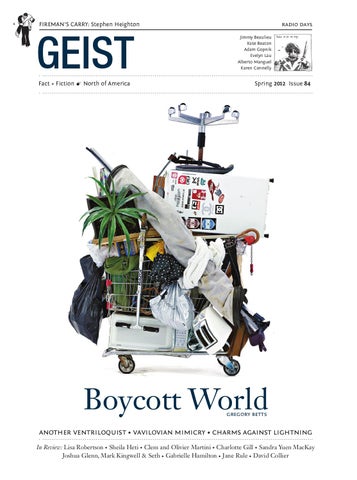
cover photo by brian howell Brian Howell has been photographing shopping carts for the last two years. Many of them he purchased, with their contents, from street vendors and scavengers in greater Vancouver. Twenty-four large-format prints (4 by 5 feet) were exhibited at the Winsor Gallery in Vancouver last spring, and a smaller selection appeared in Geist 78-79. Howell’s photographs have been shown across Canada and internationally. His latest book is Fame Us: Celebrity Impersonators and the Cult(ure) of Fame (Arsenal Pulp Press). He lives in Delta, BC, and at brianhowellphotography.com.
r e a d e r s
GEIST
w r i t e
letters living with bukowski
D
on’t I love Henry Doyle’s tale of living rough with Bukowski (“Drunken Laundry Day with Charles Bukowski,” Geist 82). Hope he found somewhere to piss at the laundry. —Andrew, Cyberspace
H
enry Doyle is the real thing. I had the honour of teaching him blogging a few years ago, and since then there’s been no stopping him. When describing his work, I say, “It’s what Bukowski would have written, if Bukowski had been a nice guy.” —raincoaster, Cyberspace Read “Drunken Laundry Day with Charles Bukowski” and the other winning entries of the 2011 Downtown Eastside Writers’ Jamboree Writing Contest at geist.com.
dividing montreal
“T
he Great Wall of Montreal” by Marcello Di Cintio (No. 82) was a good article, but readers might be led to believe that the Town of Mount Royal (TMR) is some kind of grand neighbourhood. Not so. It’s certainly wealthier than Parc-Extension, but it’s no Rosedale. I worked in an area adjacent to TMR for three years and regularly went for long walks through the ’hood. What I saw was primarily duplexes and small (900 square feet) single-family houses built in the 1940s and ’50s. None were ostentatious. In fact I was more likely to see crumbling foundations and rotting fences than anything glorious as this article describes. Most of TMR is middle class at best, and a fading middle class that had its glory years in the 1970s and has been in a
Geist is published four times a year by The Geist Foundation. Contents copyright © 2012 The Geist Foundation. All rights reserved.
slow fading decline ever since. That’s not to excuse the fence. But it’s not as drastic a class war-type situation as many people believe. It’s really more of a cultural divide. —Blork, Cyberspace
I
just passed by boulevard de l’Acadie, after having a tasty meal in one of the Indian restaurants located in Jean Talon this evening. The fence is definitely not two metres high; it hardly reaches one metre and is hidden behind a heavy, dense bush, which has grown almost two metres higher than the fence. Looking at the fence, one can easily come to the conclusion that it was built there to prevent residential kids entering the heavy traffic in the boulevard. What doesn’t come to mind is the segregation of poor from wealthy! The fence is actually lost among the thick, heavy bush, which also works as a sound barrier between the residential area and the highway. Also, the TMR buildings along the fence are of the middle-class type and don’t require a class separator from the buildings located on the other side of l’Acadie. —Eliza, Cyberspace
R
Subscriptions: in Canada: Individuals $29.95 (6 issues); Institutions $33; in the United States: $37.95; elsewhere: $37.95. Visa and MasterCard accepted. Correspondence and inquiries: subscribe @geist.com, advertising@geist.com, letters @geist.com, editor@geist.com. Include sase with Canadian postage or irc with all submissions and queries. #210 – 111 West Hastings Street, Vancouver, BC Canada v6b 1h4. Submission guidelines are available at geist.com. issn 1181-6554. Geist swaps its subscriber list with other cultural magazines for one-time mailings. Please contact us if you prefer not to receive these mailings. Publications Mail Agreement 40069678 Registration No. 07582 Return undeliverable Canadian addresses to: Circulation Department, #210 – 111 West Hastings Street, Vancouver, BC Canada v6b 1h4. Email: geist@geist.com Tel: (604) 681-9161, 1-888-geist-eh; Fax: (604) 677-6319; Web: geist.com Geist is a member of Magazines Canada and the Magazines Association of BC. Indexed in the Canadian Literary Periodicals Index and available on microfilm from University Microfilms Inc., Ann Arbor, Michigan, USA. The Geist Foundation receives assistance from private donors, the Canada Council and the BC Arts Council. We acknowledge the financial support of the Government of Canada through the Canada Periodical Fund (CPF) of the Department of Canadian Heritage.
eally great article. Just a note— on the first page it is claimed that the l’Acadie fence is along the eastern demarcation of Parc-X when it’s actually on the west (considering the 40 to be “north”). The rail yards are along the east and south. —Anonymous, Cyberspace Marcello Di Cintio responds: My investigation of the l’Acadie fence is part of my upcoming book In the Letters 5
www.geist.com
Shadow of the Wall, about physical barriers around the world. The l’Acadie fence may have little in common with, say, the West Bank wall, but barriers always impose an identity on those who live on either side. All walls, by their nature, create a “Here” and “There.” An “Us” and “Them.” I believe TMR erected the fence to protect their children from the newly widened road. After fifty years, however, those original intentions hardly matter. The fence endures more as a symbol of difference than a physical barrier. Few Montrealers, even in Parc-X, care about the fence, but those who do care see the social and economic binary the fence creates. Some, like Mary Deros and the U de M students, oppose the barrier. Others don’t. In 2001, one TMR resident told the Montreal Gazette: “We have a fence to differentiate us, and we want to keep it that way.” Aside from a short stretch near Jean Talon Boulevard, the l’Acadie fence stands two
metres tall. However, the fence borders Parc Extension to the west, not the east. I regret the error. Read “The Great Wall of Montreal” and other work by Marcello Di Cintio at geist.com.
F
d.m. fraser redux
or some reason I thought of the Vancouver writer D.M. Fraser this morning and grabbed his unfinished novel, Ignorant Armies, to take with me while I accompanied my partner Patt to the chemo ward in Sechelt. I remember Fraser in the Marble Arch beer parlour, his muffled words, his extravagant smoking technique, trying to hear what he was, perhaps, saying. And today I found him, well, just funny. I appreciate his intelligence, his mastery of the semicolon; he had me giggling in the chemo room today. When I googled him this afternoon, I saw Stephen Osborne’s piece, “Life on Masterpiece Avenue” (No. 82). —Joe Dougherty, Cyberspace
T
hank you for your lovely recollection of D.M. Fraser and of the ’70s. I experienced the Pulp Press Book Publishers editorial process over beers at the Marble Arch, during which process someone objected to my use of the phrase “my wife” in a poem because, he claimed, it was sexist. I did not know Fraser well, but 1967 being what it was, this did not prevent us from “dropping acid” together with friends at the cabin of a Pulp Press editor’s parents somewhere on the Sunshine Coast. One of the friends was a venerated local character by the name of Easter Egg. I don’t think D.M. enjoyed the “trip.” I became possessed briefly by a persona whose name was Fooby Sawbuster, so I don’t think I enjoyed it either. Apparently, during the trip, D.M. believed he could be happy if he found a woman who would love him, but she had to be only six inches tall. I often see that era through the same mist of nostalgia that seems to suffuse everything that Fraser wrote, with a soundtrack of, as he said somewhere, “female voices singing Alleluia, far away.” —Morgan Nyberg, Duncan BC Read “Life on Masterpiece Avenue” and other work by Stephen Osborne at geist.com.
T
house life
hank you so much for the article by Caroline Adderson (“Lives of the House,” No. 83). I grew up in Kerrisdale in the ’50s and ’60s. Like Pearl King, Adderson’s late neighbour, my mother, my brother and I attended St. Mary’s Anglican Church, and I attended kindergarten in the house kitty-corner from it. My mother would have been Pearl’s age. I wonder if they knew each other? My father and grandfather were both plasterers. My dad, who was born in 1910, worked on both the Hudson’s Bay store and Point Grey High School as an eighteen-year-old apprentice. Adderson’s article was the 6 Geist 84 Spring 2012
first I’d heard about urinating in the mortar to improve it—but then, that wasn’t the sort of thing my father would have told us. The horse-drawn milk wagon persisted in Kerrisdale until at least 1953. My mother told me that was the last milkman’s horse in Vancouver. As to dial phones being an exotic anachronism these days— we were pre-dial phone. We didn’t get one until the late ’50s at least. We had to go through the operator, and the phone had neither dial nor buttons on its face. You picked it up and the operator said, “Number, please.” Like the child Adderson talked to, who was able to use her rotary dial phone, I’d seen dial phones in the movies and on TV. The Americans had them before we did, I guess! —Anne Miles, Gibsons BC
I
the past returns
very much enjoyed Stephen Osborne’s sighting of Robert W. Service (“Banker Poet,” No. 81) and wish to offer a W.G. Sebald quotation in thanks. I also want to thank Geist for reproducing the Makara cover featuring my artwork (“Signs of Literary Life,” No. 82). The painting is of Sherry Hall at the Refuge Cove Land and Housing Co-op, of which we are both still members. I gave my copy of Geist to another co-op member, Bonnie MacDonald, who facilitated my Makara connection. Bonnie and I have been working together again, as I curated an installation on people and events in Bute Inlet called Naming and Claiming: the Creation of Bute Inlet for the Cortes Island Museum. It is now in the Campbell River Museum. In preparing a book based on the installation, The Glacier Museum, I’ve included the following from Sebald’s novel, Austerlitz: “It does not seem to me, Austerlitz added, that we understand the laws governing the return of the past.” —Judith M. Williams, Manson’s Landing BC
Letters 7
Read “Banker Poet,” and more from “Signs of Literary Life,” a celebration of Vancouver’s literary renaissance of the ’60s and ’70s, at geist.com.
W
power shot
hat is Christopher Grabowski talking about? In his essay “The Bear Effect” (No. 83), he claims that Bear’s Belly, an Aboriginal man photographed by the American photographer Edward S. Curtis, “holds the viewer’s eyes by looking directly into the lens of the camera.” But Bear’s Belly derives his power exactly from not looking into the camera’s lens; he’s rejecting the contract “made between two people of unequal power.” He has the power, the camera does not. —David Fox, Toronto See more work by Christopher Grabowski at geist.com.
T
cherry on top hank you very much for the wonderful pile of stuff you sent me for
receiving an Honourable Mention in the Geist Erasure Poetry Contest. I am particularly thrilled with the Geist Atlas of Canada. My seven-year-old wanted the copy of Quotations from Chairman [Don] Cherry because it is small and her best friend’s name is Cherry. —Raymond Nakamura, Vancouver Read Raymond Nakamura’s poem “Had Me At” at geist.com. While you’re there, you can read the other winners and Honourable Mentions, and check out the contest guidelines for this year’s Geist Erasure Poetry Contest. Send your letter to: The Editor, Geist letters@geist.com Fax 604-677-6319 #210-111 W. Hastings Street Vancouver, BC V6B 1H4 Letters to Geist may be edited for clarity, brevity and decorum. Authors of published letters will receive a Geist Map, suitable for framing.
i n
c a m e r a
Wireless
T
his photograph of Papa, taken in 1940, evokes a time when it was common for a man to wear a vest under his suit jacket, a time when an old wooden floor radio was one of the centres of a household. The photo shows Papa doing what he did several times a day between 1939 and 1945: he is listening with rapt attention to the news of the war overseas, broadcasts that were produced in Britain and delivered to Canadians by announcers like Lorne Greene (“the Voice of Doom”). Like thousands of families, my parents had fled their homeland in the years leading up to the war, under the growing threat of Hitler’s power and the surge of anti-Semitism. They crossed the ocean to Canada with their two small children and a few meagre belongings, and without benefit of the English language— yet they were among the more fortunate. 8 Geist 84 Spring 2012
The more catastrophic human saga unfolding beyond the radio, even as Papa listened, would not become known until after the war ended. The radio became such a focus of our lives during those years that when the war ended, I asked Papa if that meant they were going to close the radio now, and when he asked me why they would do that, I said, “What else would they have to talk about?” —Libby Simon
Libby Simon’s work has appeared in Homemaker’s magazine, Canadian Living Online, the Winnipeg Free Press and Canadian and US anthologies, as well as on CBC Radio and at imfcanada.org (Institute of Marriage and Family Canada). See her Geist work at geist.com.
notes & dispatches f r o m
t h e
n e w
w o r l d
1968 Among the loiterers of yesteryear stephen osborne
W
hen the former mayor of Vancouver known as Tom Terrific died at the end of January, he had been absent from the news for forty years; a whole week passed before word of his death percolated into the media, and local pundits began expressing their surprise that “the public” (as the media often calls itself) had been unaware that Tom Terrific was alive all these years. In a few days the shade of Tom Terrific would have faded away forever had not a video clip from the CBC archives begun to circulate via links in emails such as the one I received from a friend who was not yet born when the mayor known as Tom Terrific was elected. Have you seen this? my friend wrote: Amazing on so many levels! I clicked the link and there was the mayor of Vancouver known as Tom Terrific, standing next to the fountain in the courthouse square downtown with his hands in his pockets on a grey day in March 1968, discoursing on the subject of loitering and the rights of decent people. “We’ve got a major problem facing the city,” says the mayor to a man from the CBC who wields a foot-long microphone in one hand. The microphone has that look of the past, of the year 1968; and immediately we
understand a level of interest in this video clip is precisely the look of the past; the courthouse square too has a look about it, which is almost the same in the black-and-white video of 1968—but grainier—as the look it has today, in colour, and no longer a courthouse but an art gallery; and the square in front of it is now the art gallery square, otherwise unchanged and taken over by Occupists, who managed to hold on to it for five weeks in the fall of 2011, before their eviction on the order of the current mayor, who was three years old in 1968 and is known to ride a bicycle to work. The mayor known as Tom Terrific is saying that we’ve got a major problem. “We’ve got a scum community that has organized, has decided to grow long hair, has decided to pretend to be hippies. They should be charged, and taken, and incarcerated,
because not only do they have rights, but I think decent people have rights too.” Another level of interest is the forthright way that the mayor known as Tom Terrific expresses himself, a mode of political speech unheard of these days. He tends to stumble on diphthongs, but carries on unfazed. “Any lazy lout that lies down on the sidewalk, obstructs the traffic, should be charged with louting,” the mayor says. “I mean loitering, and I fully concur with what’s happened so far.” But what is it that has happened so far, with which the mayor fully concurs? I had to rewind the clip several times to find a partial answer by inference, from references to matters before the court and the case you have in mind: “the arrests were made because they were lazy louts who were loitering on the steps of the courthouse,” says Tom Terrific, “and they had no business doing it, and I fully support what was done, and you can have legal technicalities or you can have whatever you want, we’ve got a major problem facing the city.”
T
he problem on the mayor’s mind seems to be more than loitering, defined, via Google, as standing around without apparent purpose
photo: bill anders, crew member apollo 8, dec 24, 1968, at mission time 075:49:07 (16:40utc)
Notes & Dispatches 9
in a public place, obstructing other persons: these loiterers, or hippies, or loiterers pretending to be hippies: “every do-gooder group in town is trying to support them now,” says Tom Terrific. “Support should go to our good youth, our boy scouts, the church, the religious groups, the decent children.” Behind the mayor, shadowy forms of passersby glide out of focus across and up and down the courthouse steps, some with umbrellas, some wearing hats; most of them are men; many appear to be going somewhere, which gives them the look of not loitering. We are assured by the mayor that he is not loitering: “First off,” he says to the man from the CBC, “we are not loitering—right now, we are at work, both of us, we are trying to put on a show.” He never looks back at the people in the square who are looking at him and not putting on a show; Tom Terrific speaks for the camera, for the viewers who are not in the frame. We can say that he withholds his gaze, he speaks to people who own television sets, and of course now in 2012 he speaks to us, who are his future. The camera shifts and ragged jets of water from the courthouse fountain spew into the air on one side of the frame and then the other. The mayor’s hair is slicked back, damp from the rain or the spray from the fountain. Tom Terrific looks like an ordinary enough dad of his time in a dark suit, white shirt and narrow tie, in 1968; in fact, he looks as ordinary as everyone else in the frame: the ordinary is itself a level of interest here. Behind the mayor on the courthouse steps, a police officer with his hands on his belt sidles into view, out of focus but ostensibly at work policing the scene; from the right side of the frame, that is, from stage left, a tiny apparently elderly woman in a fur-trimmed coat and a cloche bucket hat with a bow in front edges into view and takes a position downstage centre, where she remains, unmoving 10 Geist 84 Spring 2012
and fully visible, with a purse and umbrella in her hand, staring grimly into the space between the mayor and the man from the CBC with his long microphone. “This is a group of society,” the mayor is saying, in measured rhythms, “and it’s not a racial group, as of their own choice, who chose to drop out of society, onto society,” he says. “If our country continued this way, in the next two generations, there wouldn’t be a country,” he says. The mayor is clearly prepared to go with his oration for the full six minutes and fortyseven seconds ticking off slowly in the little window at the bottom of the screen, making it feel as if 1968 minutes are longer than minutes are today; one wants to jump ahead; I clicked to the end of the clip and an image of Jesus Christ filled the frame; I presumed it to be a tech nical error, the result of the primitive technology of 1968; I backed up until the mayor known as Tom Terrific was in the frame again, talking on, talking, on and on. More men with beards had by now eased into view behind the mayor, one of them a solemn young man in a white rain slicker bunched up at the shoulder; another man in dark clothing perched on the wall of the fountain; a tall man with a medallion on his chest rising up from behind the mayor, a second, smaller “little old
Sheila Heti, Ryan Kamstra, Sholem Krishtalka, Margaux Williamson. By Lee Towndrow. After Edouard Manet, Le dejeuner sur l’herbe (1862). From C Magazine 109 (Spring 2011). Lee Towndrow began his career as a designer and photographer. Since then he has also been a Flame artist, and he was the cinematographer on Margaux Williamson’s film Teenager Hamlet. He can be found at towndrow.ca.
lady” stands behind the first. A secondary definition of loitering, according to the OED, is to walk slowly, to dawdle. These onlookers gaze impassively toward the camera as the mayor rolls on into his peroration: “And if these young people do get their way,” he says, “they will destroy Canada,
and, from what I hear across the world, they’ll destroy the world—the problems facing us are not only war, and the atomic bomb, and the hydrogen bomb, but the fact is that our youth, or part of it, is decaying, and it’s rotten,” he says. And then: silence. In the next moment the man
from the CBC turns from the mayor and thrusts the long microphone at the solemn young man in the rain slicker, who speaks incoherently for a moment and then reads aloud a few lines of Shakespeare, beginning with Our doubts are traitors, identified by a Google search as Quotation Notes & Dispatches 11
#25216 at Classic Quotes, from Measure to Measure, a play about fornication, lustful thoughts, sex in the dark, deception and slander: more levels of interest, certainly, but what is to be done with them?
N
ow I was already prepared for the appearance of Jesus Christ at the end of the clip, perhaps not a technical error after all, but intended by the CBC to reach a whole new level; but first the camera pans slowly along a lineup of people assembled for the shot in front of a current or curtain of water ejected from the fountain behind them, young men and older men, fedoras, white shirts and ties, turtlenecks, T-shirts, peering grimly into the camera; a tall man in an overcoat and fedora chews gum steadily; others smoke cigarettes. They could be watching a state funeral; they don’t look like hippies; the camera closes in and holds on the faces of the only women in the shot, two young women who remain frozen in position (the two apparently elderly women in hats have disappeared); neither of them reveals any emotion; now the image fades nearly to black and then quickens, as I was saying, as if by some technical error into the familiar rendering of Jesus Christ the Saviour, seen on the walls of Sunday schools around the world (and on the internet, where it is described as “the most popular picture of Jesus of all time”). It took an intensive Google search (keywords: 1968, courthouse, hippies) to uncover relevant news items, one of them headlined 17 Arrested in Police Hippie Swoop, describing a police action early in March 1968, against a gathering of young people in the courthouse square who were served with John Doe warrants, taken away in vans, strip-searched and thrown into cells. The loiterers, according to a ring-leader named Stan Persky, were convening a meeting of an alternative government of which he was the 12 Geist 84 Spring 2012
acting mayor, and had gathered at the courthouse, as he put it, to debate public affairs. Persky spent three days in jail on the loitering charge before his acquittal. 1968, as Google will also testify, was the great year of student uprising around the world, the invasion of Prague, the slaughter of university students in Mexico City, the assassinations of Martin Luther King and Robert Kennedy, the conspiracy trial of Dr. Spock; in 1968 sales of a guide for war resisters published in Toronto reached 50,000 copies; in 1968 the mayor of Montreal, following the example set by Tom Terrific, according to the CBC archives, “declared war on the hippies. Hippies accused the mayor of illegally harassing and jailing non-conformists. Hippie haunts were raided. Soup kitchen permits were rejected. And obscenity charges were laid against the hippies’ underground newspaper, Logos.”
T
he Occupists today are the figures of nightmare for Tom Terrific, who fell into obscurity after directing the Gastown Police Riot of 1972. Further searches on Google show the mayor known as Tom Terrific urging on the police force with its truncheons and horses and the public prosecutor’s office with its writs and its warrants in a struggle against free assembly and free speech; that struggle is resumed today as more and more of the cultural commons and the biosphere fall into private hands, and the one percent continue to appropriate larger and larger portions of the common wealth.
Stephen Osborne is publisher and editor-inchief of Geist. He is also the award-winning writer of Ice & Fire: Dispatches from the New World and dozens of shorter works— most recently “Preoccupied” (No. 83)—many of which can be read at geist.com.
l e x i c o l o g y
Mimesis jane silcott What is it about beauty that startles us so?
A
friend of mine tells me that a good story generates tension between the narrative and the lyrical, something he learned in a poetry workshop. The narrative goes along the X-axis, the lyrical along the Y-axis, or the other way round, he says. Too much X and it’s flat, too much Y and it doesn’t make sense. This makes writing sound a bit like math, which can be comforting. I like the idea of math, and I like knowing there are people in the world who quantify things that are difficult for me and make lines and angles and numbers out of them. The other night on the blackboard at the back of the classroom where I teach a writing class, someone from a previous class had drawn a graph illustrating the law of supply and demand, or maybe it was economies of scale, or maybe even the “indifference curve,” with one variable represented on the X-axis, the other on the Y-axis. In the space between was one of those perfect rising arcs that makes you think of soft hillsides of waving grasses and sunsets and other hopeful things, not dreary economic conundrums mulled over by men who look like Warren Buffett. Our topic that night was definition, so we talked about ideas like persistence and family and love and then how we could define them on paper, one way being to set a thing among its fellows in a category and then to
find the elements about it that made it unique. As the students wrote I looked at the graph at the back of the room. On the way home I happened upon a radio show about the meaning of beauty, and I drove on listening to disembodied voices doing what we had been trying to do in the class, pin
down something that shivered and slipped out from under us. I wanted someone to say what it is about beauty that startles us so and hoped they would consider proportion and the golden mean, as one of my students (a mathematician) had done in an essay, and then gone beyond that to consider why humans respond so viscerally to something that can be expressed in numbers. But the
moments of beauty the voices ascribed most passion to were acts, not visions: people doing good rather than scenes or images of looking good. Eventually someone used the word grace, and one man, David Adams Richards actually, said he’d seen people in the deepest poverty show their true selves “without mimicry.” Mimicry: I thought mimicry was a kind of party trick, not something behind which we hide our “true selves,” but the program ended before I could learn more.
A
n entry in Wikipedia defines mimicry as a perfectly respectable biological survival tactic categorized by a variety of styles. Batesian mimics, for instance, are creatures that assume the colouration of more dangerous relatives to avoid being eaten by predators, and are named for Henry W. Bates, an English naturalist, but I think of Norman Bates from Psycho instead and wonder if scientists ever consider the confusion the name might evoke. Or do they amuse themselves by thinking that Norman Bates initially looked harmless, but was actually dangerous, so the name could be a scientific paradox, a little joke in the language. Remember Janet Leigh’s scream in the shower and Bates’s shadow against the curtain: if she had not been beautiful, would he have bothered to attack her? Vavilovian mimicry is the name given to weeds that mimic the colouration and shape of the plants they grow among. Nikolai Ivanovich Vavilov was a man who looks at first glance a little like Groucho Marx, and then after closer study, a little like my grandfather, who was born four years before Groucho. This was the late nineteenth century, the moustachioed era, when men grew Fuller Notes & Dispatches 13
From Collier’s Popular Press: David Collier’s 30 Years on the Newsstand, published by conundrum press in 2011. David Collier is the author and artist of the comic book Collier’s and several books, including Just the Facts, Portraits from Life and Hamilton Sketchbooks.
brushes under their noses and looked out at cameras as if they were defending themselves from assault. Müllerian and Mertensian mimicry apply to species that borrow traits from one another to fool others into thinking they’re harmless when they’re actually dangerous, which is nefarious, if you ask me, and not a little mean-spirited, but scientists don’t attribute judgement to their categories, and they don’t spend time thinking about the sound “Mertensian mimicry” makes in the mind, but then is it reasonable to divide people into categories: scientists and non-scientists and such, or is that another sort of nefariousness— to imagine oneself fitting neatly into one category and therefore unable or unwilling to consider the usefulness of being the kind of person who can adapt and fit into another? Last weekend my family and I went to the interior of BC to visit relatives. We usually check into a quiet motel filled with other ordinary families like our own, so it’s not a time when we 14 Geist 84 Spring 2012
feel a need for performance or guardedness of any kind. But this was the May long weekend, a paradigm shift apparently, during which the town fills with people excited to be alive and drinking beer. I had booked a motel we’d stayed at before, one of those little places near the lake where the rooms are consecutively numbered units in a long one- or two-storey building that forms a squared-off horseshoe around a parking lot. We have a photo of my husband and daughter in the middle of one of those horseshoes years ago, their bodies surrounded by empty space. Their backs are to the camera and they’re walking toward the lake, which shimmers before them. They’re holding hands. My daughter, who was two at the time, wears a little blue dress that flares out from her legs. Her hand reaches up to my husband’s. You can see in her posture, in the shape her blue dress makes against the sky that this is beauty in its highest form: grace in their fingertips and in the space between them.
When we pulled into this parking lot on this night, we wondered if this truly had been the motel where we’d stayed all those years earlier. A party was in full swing at one end of the lot—a circle of motorcycles, people spilling out of an open motel-room door. As we got out of the car, two young women walked past us toward the party, their faces already smeared loose with alcohol, their bodies linked at the arm, their voices loud. They were moving in that way you do when you know you’re going toward something exciting, possibly sex, and you’re still young, and you don’t know what that’s going to mean to you, but you know you want it, or your body does. Your body is going ahead of you toward the music and the beer and the men and the smoke and the voices jangling out in the night air. We looked at each other. “Shall we just check out now?” my husband said. We found a place two doors down with no party going on and a manager who promised she never
slept on May long weekends “in order to keep a lid on things,” as she put it. There was a group of women on one side of the horseshoe who were yelling happy remarks to one another, and at the end a pod of men, greying and bearded, sat in plastic chairs, their motorcycles parked in front of them. Our room was directly above them. As we walked past, the men didn’t look up, and their voices rolled out the syllables companionably among themselves. Outside our door, I paused to listen more closely to them, my radar tuned for talk of parties. “I’ve paid every month, and I pick them up every weekend, just the way the judge outlined it, so I’m doing my bit,” one of the men said. I braced for the response, which I imagined would be bitter and tinged with longcherished wounds, but the voice was so quiet I couldn’t hear it, so I went into the room, and the night settled. We slept undisturbed except for the loud sighs of our teenage son shifting uncomfortably on his bed.
T
he next day as my daughter and I walked toward our car, one of the men smiled and said, “Are you here for the soccer tournament?” I said no, but our eyes met in that shared space that soccer parents recognize anywhere. We’ve stood on the same sidelines in the pounding rain. We’ve yelled the same words of encouragement to our kids. We spent the day among family, among the various bits of our crisscrossed DNA, where we enjoyed the new baby among us, wondering whose eyes she had and where she got her delicate limbs, and delighting in the way she communicated with us, her smiles sparking out at us, making us laugh and look at each other with a new line of connection, another rising bit of hope arcing between us. When we got back to the hotel, the men in the room below were busy packing up their bikes. My husband said, “They’re Hells Angels,” and I said, “No, they’re not. They couldn’t
be.” “They’re wearing their colours,” he said. I studied them from the safety of our room above, and saw that indeed they were, even the man with the gentle face, who had talked about soccer. They called out to one another over the sound of the bikes. One of them commented on an empty house behind the hotel, an attractive place, well proportioned, with large picture windows on either side of the front door, a place I could imagine us living in, filled with space and light. “Look,” the Hells Angel said. “We should buy that. It’d be a great place for parties.” I didn’t hear the response because they gunned their bikes at that moment and the roar of their engines slammed into us like fists, or declarations.
Jane Silcott writes essays, stories and poems, and she teaches at UBC and SFU. Her work has been published in many periodicals, most recently in Eighteen Bridges, Fiddlehead and Room. Read more of her work at geist.com. Notes & Dispatches 15
The Speed of Rust, or, He Marries karen connelly
I
t rains. My heart disintegrates for other reasons while the bald eagle gazes at me from the lifeguard’s chair. His head is not white but scuffed, dirty. He may look like a bird of prey but in fact he is a fifty-two-year-old man who has just crawled out of bed with a hangover and a wife he never loved well.
You and I walk the wide sand flats, slick grey acres of seaweed, cracked shells, crabs scuttling sideways like our desire. We are so close to the barges that we see a modern galley slave moving feverishly about on the long deck. He is silent in labour, I am silent in sympathy, listening to you tell how you think maybe you can’t marry her.
Whatever was clear and powerful about his life has been given over to the swamp-sky of March, rain in April, through June, and tomorrow is the first of July though it’s hard to consider celebrating Canada Day with anything but a scream. Which the bald eagle does: the serrated thrust of his voice shreds the grey light as he opens his wings and lifts, lifts, heaves himself into the heavy air. There he goes, flapping over our stunned heads toward the jungle that stalks Vancouver like a panther, the same jungle I fought in cold blood this morning, so much fierce bamboo.
I suddenly remember my hedge clippers lying on the grass in the back garden. Tools rust if you leave them out in this rain. They teach us, every year, not to do it again. Why it’s all wrong takes so long to explain that the tide begins to slide in around our cold feet. You could save yourself by drowning but do not: we walk back to the stony shore littered with condoms and weddings, one of which will take place in exactly forty days. You ask, a tear in your eye, How much longer will it rain?
Karen Connelly is the author of nine books, including The Lizard Cage, winner of the Orange-Broadband prize; Burmese Lessons: A Love Story; and the forthcoming poetry collection Come, Cold River. Her journalism, essays and poetry have been published in the Globe and Mail, New Humanist, National Geographic Traveller and many other periodicals.
16 Geist 84 Spring 2012
I reply, You’re lucky enough to have choices. Old lover, surprise yourself and make one. Useless advice, like all advice must be at this moment. You wring your heart on the beach while on the far shore landmines explode, men labour on prison ships, children drown in wet sand similar in weight to this wet sand but lethal, marbled with blood, impossible to walk away from. You say you cannot walk away. I say I know, I know, and think again of my clippers in the grass, the speed of rust. I say, You are a good man and she is a good woman. Kissing you goodbye, I wonder if that is how bad marriages are made: the hungry shovel of the heart wants to break the clean surface of goodness, get to the rich filth underneath. I like how mistakes wait in our hands like the orchids we crave for their beauty though we don’t know how to grow them. I like that we want to learn. I love how we fail.
Notes & Dispatches 17
Geist, now with zoom!
a f t e r l i f e
o f
c u l t u r e
Wheels stephen henighan In most parts of Canada, bus travel is one of our divided society’s last surviving democratic spaces
F
ew experiences provide such an indelible first impression of urban character as arriving in a city by bus. In contrast to the no-name sameness of airports, the bus station gives the incoming traveller a taste of the city that never fades. In Montreal, one enters the station at the end of a corridor and marches past departing passengers who line up indoors and step onto the platforms, at which buses are parked in symmetrical slantwise bays, only when boarding is announced. The traveller grasps that he is in a city of Cartesian imagination and frigid weather, where passengers wait indoors. The first steps out of the station confront him with student life and street life, a public library and a French-language university. This tells him much of what he needs to know about Montreal.
I
n the mild climate of Vancouver, by contrast, one arrives outside, next to the western end point of the national rail network, then proceeds through the post –First World War lobby of photo by mandelbrot
Pacific Central Station. The Britishtinged residues of post-colonial history are counterbalanced when the traveller leaves the station: the SkyTrain overhead to the left and the condo blocks that rise through the mist exemplify Douglas Coupland’s “city of glass”; Chinatown, off to the right, signals the importance of Asian culture. Cities such as Ottawa and Calgary are similarly epitomized by their bus stations: the compact, bilingual Ottawa station is tucked away, with civil service discretion, on a side street on the edge of downtown; the Calgary station is modern, spacious and suburban, like the city it serves. If the traveller shares the preconception that Toronto is an unfriendly city, the bus station, by far the
country’s most dysfunctional, will do nothing to refute this belief. The arrival and departure terminals are on different blocks; the unused arrival terminal is locked up and abandoned. Squads of buses idle under the departure terminal’s low roof, choking waiting passengers with fumes. In the evenings the queues flow from the entrance to the back wall; halting, honking buses nudge through the lineups to reach their bays, causing people to grab their luggage and scurry out of the way. The traveller knows that she is in a city where, since the war against the car has not yet begun, bus passengers are treated with disdain. Leaving the station, she steps out onto Bay Street, the country’s financial centre, where the sidewalks are barren of people at all hours of the night and day. The names of these hubs change as one crosses the country. In Quebec and Ontario the traveller arrives at the “terminal,” a cognate of the French terminus; Albertans use the American word “depot”; in British Columbia, in Afterlife of Culture 19
most cases, the English “station” persists. In spite of these differences, in most parts of Canada bus travel is one of our divided society’s last surviving democratic spaces. In contrast to our unreliable rail system, buses—particularly long-distance buses—have a reputation for arriving on time. This convenience means that the passenger sitting next to you may live in a rooming house or a penthouse, may be of any age or ethnicity. In my twenties, when I rode Voyageur Colonial buses back and forth between Ottawa and Montreal on a regular basis, I sat next to doctors and federal deputy ministers as well as students, grandmothers and the unemployed. This forced coexistence softens our class prejudices, which are much stronger than anyone wants to admit. On my most recent bus trip across Ontario, I sat next to a pony-tailed gent who introduced himself as a trucker and a biker and let slip that he had fathered eleven children with half a dozen women. Five hours of conversation with this man undercut my knee-jerk sense of superiority to him; by the end of the journey, I was in awe of the discipline that had enabled him to bring up his children as a single dad, and to save and invest his wages in astute ways that had left him in rock-solid financial shape. In some parts of the country, alas, encounters such as these don’t happen because bus travel has never caught on: in Saskatchewan, few passengers take the bus between Saskatoon and Regina, and buses survive only because they are run by a Crown corporation originally founded under Tommy Douglas. Even so, it is rare in Canada to encounter the attitude I found to be pervasive during my years in the United States: that middleclass white people shouldn’t travel by bus for fear of meeting people who are racially different than themselves.
20 Geist 84 Spring 2012
The bus not only connects us within regions, like the buses that I now take from Guelph to Toronto or Kitchener–Waterloo; it also gives people of modest means the chance to see the country. I owe my initial explorations of cities such as Winnipeg, Calgary, Vancouver and Victoria to the $99 cross-country fare offered by Greyhound in the 1980s. As long as you continued in a straight line, the ticket would take you from coast to coast, and you could get off whenever you felt like it. In recent years the travails of globalization have eroded this latitude for freewheeling travel. In the aftermath of September 11, 2001, Greyhound Canada began demanding passengers’ names when tickets were purchased. (I expressed my opposition to this unwarranted intrusion by giving my name as “Adam Loebsanin,” an anagram of Osama bin Laden.) The policy was later discontinued, but one must now give a return date when buying a round-trip ticket, a requirement that cuts into the individual’s freedom to wander between cities as the mood takes him. Complaints about Greyhound service, which used to be answered by efficient Canadian customer service representatives, are now fielded by abrasive agents in Texas who think that Ontario is a city. But I don’t let these frustrations deter me. Even though Greyhound is moving to online ticket sales and departures that are booked up in advance, for the moment you can still hop on a bus on impulse, without a reservation, and discover people and places you didn’t know before. Anyone who disdains bus travel misses out on one of the best educations this country offers.
Stephen Henighan’s books of travel-related short stories include North of Tourism (Cormorant) and A Grave in the Air (Thistledown). Read his Geist work at geist.com.
Afterlife of Culture 21
101001011DIGITAL0EDITION001101011
SIGN UP NOW FOR FREE CLASS SETS OF THE GEIST DIGITAL EDITION To teachers of writing, publishing and kindred subjects: You can get free digital copies of Geist for you and your students with the click of a mouse. The Geist Digital Edition is just like the print magazine: the same great content, on any web-ready device with interesting links, zoom capabilities and crisp digital display. To order a FREE class set of the Geist Digital Edition, email gic@geist.com or phone 1-888-434-7834 For more information on the Geist in the Classroom program, visit www.geist.com/gic PS. If you’re a student, hand this to your instructor!
GEIST
Fact + Fiction North of America
FINDINGS
By Kate Beaton. From Hark! A Vagrant, published by Drawn & Quarterly in 2011. Kate Beaton is an artist from Cape Breton whose work has appeared in The New Yorker and Harper’s. She lives in New York and at harkavagrant.com.
To Be Read by My Children in the Event of My Demise katie daubs From the Feathertale Review #8 (2011). Katie Daubs is a reporter for the Toronto Star. She is also a regular contributor to the Feathertale Review.
Y
ou just left my hospital bed. It’s October 14 and I don’t feel like I’ll see you again. Sorry I slept the whole time. I could hear you, but you
know me. I’m not much for talking, even when my throat isn’t coated with cancer. I’m not much for goodbyes either. I’m only sorry I didn’t have the decency to fall down the stairs and get this over with. Anyway, there’s something I’ve been meaning to tell you. I did not meet your mother at the supermarket. She doesn’t know that.
See, it was 2011. I didn’t have a job, and your Uncle Gary was dating this girl who was an idiot. She bought a mirror at the dollar store and thought she ought to have some coke to snort off it like in the movies. Gary just wanted to get laid so he figured it wouldn’t hurt. Soon we were all snorting cheap cocaine that was probably more Pez and rat poison than anything else. So Gary and me were sharing a one-bedroom apartment. His girlfriend was an unemployed leech and he got a bit of work bussing tables at Findings 23
a crappy Chinese restaurant that our landlord owned. I spent most of my days watching Bret Michaels’ reality TV show Rock of Love Bus. We never had money. In the day, Gary’s girlfriend would sit in front of the liquor store and sing. I can still hear her terrible voice, especially with all this time I have to sit and think. She sang depressing Nirvana music. I told her people were more likely to give her money if she sang something uplifting. She didn’t listen to me. Gary and I looked for work, but we didn’t try that hard. There was a recession on and it was easy to use that as an excuse. We had to start mugging people. I know you’re thinking that’s a pretty crummy thing, but we rationalized. We only robbed drunk people. We never hurt kids, especially not the ones we bought our drugs from. We weren’t really that scary. I usually had to do the mugging bits and Gary did the shouting. We watched movies to figure out what to say. And we wore nylons on our faces. We made a few hundred a week. So we see your mom alone on a street, walking home one night, and she’s listening to her iPod. We’re hiding in some bushes, near the corner in the shadows. Your mom sees us but it’s already too late. If she runs away, she knows we’ll run after her. She walks right at us. Gary starts screaming. He has a duck-hunt gun from an old Nintendo game and he’s waving it in the air. He painted the whole thing brown with some of his girlfriend’s nail polish. It had a bit of glitter in it, and Gary was pretty embarrassed about mugging victims seeing the sparkle. So he screams, “Give me your fucking money!” at her. I grab her from behind. Gary screams, “What the fuck you waiting for? Gimme your money, you ho!” Gary watched a lot of really terrible movies. Your mom, she starts looking through her purse, and she’s crying. 24 Geist 84 Spring 2012
Real Live Old Sea Dogs. By Jimmy Beaulieu. From Suddenly Something Happened, published by BDANG (conundrum) in 2010. Translated by KerryAnn Cochrane.
She says, “I only have a few bucks and a transit pass,” and she’s sobbing. I’m standing there thinking she smells pretty nice. Like one of those nice Calgon sprays you get at Walmart. Gary didn’t like it taking that long, so he just grabs her wallet out of her hands. Your mom keeps crying. Gary tells her if she calls the cops, he’ll come back, find her and shoot her.
Course, he’d have to plug the gun into the Nintendo to do that, and your mom would’ve had to be a skeet or a duck. “Count to a hundred and don’t turn around,” I growled. It was the first thing I ever said to her. We take off running. We get inside the apartment and Gary opens up her wallet. She had an IKEA gift card in
your options are limited
First published as Quelques pelures (Prix de l’Espoir Québécois 2005). Jimmy Beaulieu is a writer and publisher who lives in Montreal and at jimmybeaulieu.com.
there, a twenty-dollar bill and all her ID. Gary grabs the twenty and goes to buy some crack, and I start sifting through the leftovers. Her licence says Krista Rayne. Sounded like a stripper, but that was her name for real, as you know. I looked her up on Facebook. I know it’s her because her status said she just got robbed. I started looking through your
mom’s pics and I couldn’t stop. She was one of those girls who likes to take photos of herself looking all pouty and sexy, pair them with rap lyrics, and get comments about how hot she looks. A week went by and I kept checking her page. All her friends were writing stupid little messages as if she’d actually been shot. Your mom was milking it, from what I could see.
From the 2011 Census Employee Selfstudy, published by Statistics Canada. • Never read maps while driving. • Check the back seat and floor for intruders before opening the door. • Learn how to change a tire. • Do not open the door to a stranger, no matter whether male or female. • Do not stop to offer help to a stranded motorist. • If you think a car is following you, do not drive home. • In underground parking lots, walk to your car with your keys in your fist, get in, lock the doors and drive out of the building as quickly as possible. • [On the bus,] if you are alone or if it is late at night, sit near the driver. • Walk with an air of determination and authority and always look around you. • Hold on to handrails on stairs. • If no rail is provided, proceed with caution. • When walking, if you are followed by a car, make a visible point of taking out a pen and paper. • Stand to the side of the door when facing it to avoid being hit if the door suddenly opens outwards. • If you are threatened, leave immediately. • Never bother a dog when it is eating, resting, sleeping, or chewing on something. • Maintain eye contact. • Don’t smile when you are angry. • If you are overpowered by an armed assailant, your options are limited. • Ask for a room close to a parking spot and to the front desk. If you believe that someone has followed you onto an elevator, push the wrong floor button and get off. • Be cautious when dealing with people who smell of alcohol or marijuana. • Expect the unexpected. Findings 25
Every other day she’d update her status with some stupid thing about how she’d never be the same again. She even took a picture hugging herself on her bed. One day, about a month after we mugged her, I asked her out. I was at the neighbourhood supermarket and ran into her with my cart. “Sorry about that,” I said. It was the second thing I ever said to her. I asked her to hang out. When we were walking back from the movies she made me walk her home. Told me about how she hasn’t felt safe since she got mugged. She said the muggers had knives and guns and forced her to lie on the ground, which I think was a scene in Clueless. I asked her if she’d ever recognize the guys and she said she didn’t think so. But she was always looking for them. I went on a few more dates with her and then figured I’d better tell
Gary. He figured she’d recognize his voice for sure. He’d broken up with his girlfriend and we’d quit mugging by that point. I told Gary she wouldn’t recognize him but I wasn’t sure. See, I always changed my voice when I mugged people. Gary wasn’t so prescient. First time she meets Gary, he just nodded and mumbled. From there, he faked several throat infections until he felt comfortable. Anyway, me and your mom got married and Gary was the best man. Your mom never figured it out. Maybe she did. I guess that’s the reason I’m writing you this. When Gary died, we were cleaning out his place, and I heard her gasp from the kitchen. I walked into Gary’s room, where she was supposed to be cleaning out his drawers, and she was holding the sparkly brown duck-hunt gun. I raised my eyebrows. She stared at it,
and looked at me, looked at my hands. “Do you know what this is?” she asked. “I didn’t know Gary was gay,” I answered. “I guess we all have our secrets.” She looked at me and put down the gun. “What?” I asked. She shrugged and put the gun in her purse. “Weird thing to keep,” I said. We packed up Gary’s house and never talked about it again. I think the gun is somewhere in the house, and now I’m dead without knowing if she knew it was me. I thought I wanted it that way, but now, with the end so near, I felt I should come clean. It won’t do me any good now, but if you find out she knew, tell her I regret nothing. Take care of yourselves, Dad
The Slave Castle of Elmina rob taylor From The Other Side of Ourselves, © 2011 Rob Taylor, published by Cormorant Books Inc., Toronto. Reprinted with the permission of the publisher. Rob Taylor is a poet and co-founder of One Ghana, One Voice, Ghana’s first online poetry magazine. We were led into the Condemned Men’s Cell and as the guide moved to seal the door a woman in the group screamed and ran out into the light of the courtyard shouting that she’d felt something in there flying back and forth between the stone walls and sure enough when we quieted down we could hear its faint cries and sense its frantic little bird heart rattling in its cage of bones
but soon the guide reopened the door and we stepped out carefully, checking the soles of our shoes for feathers, except one man who waited motionlessly until he could hear the bird well enough to find it and cup it in his hands, carry it out into the courtyard and send it scrambling into the sky
so we all stood still in the musty darkness as the guide described the last days of rebellious slaves—how the soldiers would put five or six of them in and not open the door again until they were all dead and I thought for a moment of that last man waiting there with the bodies of his friends (or, more terribly, strangers) arranged in a row beside him—waiting—
and the next night over Chinese food a friend asked me what I thought of The Slave Castle of Elmina and I shudder now because all I could describe (before returning to egg noodles and the clinking of silverware on porcelain plates) was the bird, the man’s soft hands, the woman screaming out into the sun. —Elmina, Central Region, Ghana
26 Geist 84 Spring 2012
Why Not m.a.c. farrant Reprinted by permission from the publisher from The Strange Truth About Us, © 2011 M.A.C. Farrant, published by Talonbooks in 2011, Vancouver. M.A.C. Farrant was born in Australia and raised on Vancouver Island. Her other books include The Breakdown So Far ( Talon, 2008), The Secret Lives of Litterbugs (Key Porter, 2009) and Down the Road to Eternity: New and Selected Fiction ( Talon, 2009).
T
highway 17 revisited
hey were Rockatree practitioners, Keith and Ray, and he was the first person after five years of building rock stacks to be invited along. Three men in their fifties. It was a hot clear day in June. They parked the truck and walked some distance across a stony field to reach the site. As they walked Keith brought out a joint. Part of the ritual, he was told, but declined because he felt unsure of himself—nervous about how he’d perform with the rocks. At the edge of the field where the rock stacking took place they were in full view of the highway. He said the amazing part was the way people honked their horns in encouragement, or shouted out as their cars sped by: “Way to go!” “Good for you!” He said building the stacks was like giving a performance before a continually applauding audience— only the audience kept changing, kept whooshing by. They spent three hours at the site. For a while he helped Keith and Ray lift and carry rocks—there were some large ones—and then, like a disciple, he was invited to make his own stack and made, in fact, five. He said each man, as he worked, became absorbed, quiet, even though the intermittent honking of horns continued. Keith told him there was a current of energy that travelled from rock to rock as one was balanced upon the
other and that because of this the rocks seemed to snap into place in the most delicate, yet unlikely, ways. He experienced this for himself. Ray made stacks that resembled animals and searched for some time for small round matching stones to represent the ears. Keith made beautiful geometrical shapes, several over seven feet tall. His own stacks were modest but one, an oddly balanced spiral of four rocks, was said by Ray to be stunning. Each stack, he said, looked like a monument. Looked as if the earth had produced it in praise of itself and he and Keith and Ray were merely helpers. When they finished there was the satisfied walk across the field to the truck. Then a stop at the Prairie Inn for a beer, another part of the ritual. Afterwards, at Keith’s house, Keith lit another joint. This time he had a drag. When he came home he looked happy but bewildered. My daughter and I made supper while he lay on the bed staring out the window. It was some time later when he told me all this.
waiting I was putting on my boots, my husband waiting. So I asked him, generally speaking, if waiting bores him. He’d been cracking his knuckles. I said, doesn’t waiting provide us with the opportunity to scrutinize things? Like when you’re in the waiting room at the dentist’s office and time gets caught in a cement frieze? Or like the other day when you were waiting at the dollar store behind that man in the checkout line? You with your discount birthday card, the man with two coffee mugs and a stack of pale yellow towels? You said you were so close to him you could see the hairs on his neck and wasn’t that a strangely intimate thing to occur? Or the casual glances any of us may take out a window? The way traffic, pedestrians, clouds, birds, sky confirm that our lives will one day be
excluded from the scene? Doesn’t that give pause? Or now while I’m putting on my coat with you standing there in your muffler and heavy gloves. Look at the way dust swirls in a sunbeam atop the kitchen counter and how splendid that is? What about that? Fuck off, he explained. We were heading out to buy Mayday emergency survival blankets and SOS food rations. The stock in the survival bin needed rotating. We’ve been waiting years for the earthquake.
when the time comes Stars don’t cost that much, my mother-in-law said, one hundred, two hundred, five hundred dollars. Some include planets. She bought a small one near the Big Dipper and named it Irene, after herself. Somewhere there’s a proof-ofpurchase ticket from the Own A Star Foundation. Irene would point at the sky after a few drinks. That star is mine, she’d say, the dinky pinky-blue one. She liked a good time and would ask the dog during Saturday night cards: Well, what do you think of the weekend so far? We had her cremated in her fulllength mink coat. That was something you had to have back then—a mink coat. That and a Cadillac and a pair of diamond earrings. Though when the time came there was no Cadillac and we only found one earring, a stud. My husband wore it until the dog came into the story again and the earring disappeared off the bedside table. We searched the boulevard for days but all we found was crap. Let it be said that our generation also likes a good time—we have a loud appreciation for music, for easy laughs. We have our own stars, too, mainly the cerebral kind. When the time comes they’ll cremate us with our drugs, our bamboo flutes. Findings 27
Snowflakes and Icebergs adam gopnik From Winter: Five Windows on the Season, the 2011 Massey Lectures, published by Anansi in Fall 2011. Adam Gopnik, who grew up in Montreal winters, is the author of Paris Comes First, Table to the Moon and other books, as well as many articles and essays for The New Yorker.
O
h yes, what about those two metaphors? Have they survived their century? The submerged ninetenths of the iceberg and those singular snowflakes? Well, we know now that those final discoveries of the Romantic imagination of winter are both touched with more than a little myth. The mysterious, sinister, stiletto-bearing iceberg that can stab ships in the back turns out, in fact, to be largely imaginary. The nine-tenths of the iceberg sunk beneath the water simply follows a natural rule of physics and is not a peculiarity of glaciology. And far from having stuck a stiletto into the side of the Titanic, we now know that the iceberg in question merely crushed it, like an awkward
adolescent boy at a dance, popping the rivets and stays of the great ship. The iceberg is neither the radio beacon of earth consciousness nor the white shark of the seas, but just a great big, overgrown ice cube, as innocent (and dumb) as ice cubes are. And, in parallel, we might say that though “iceberg psychology” and its notion of unconscious motives still haunt us, the coming of cognitive psychology has also taught us that the overt and explicit part of thought matters most. It’s the part of the iceberg you do see that sinks your psychic ship. And snowflakes? Are they all unlike? And does that difference give us some natural evidence for individuality? It turns out that, as recently as 1988, a cloud scientist named Nancy Knight took a plane up into the clouds above Madison, Wisconsin, and there found two simple but identical snow crystals—hexagonal prisms, each as like the other as one Olsen twin is like the other. Snowflakes, it seems, are not only alike, they usually start out more
can i sell my double burial plot? Questions from You Can’t Take It With You: The Common-Sense Guide to Estate Planning for Canadians by Sandra E. Foster, published by John Wiley & Sons Canada in 1998. • I’ve prepared my will and have left my grand piano to my niece. If I need money, can I sell the piano without checking with her? • I do not want to leave my children anything. Can I leave them out of my will? • I have two daughters, one of whom I have not heard from in 10 years. Must I divide my estate between them? • I’ve been left out of my father’s will. What can I do about it? 28 Geist 84 Spring 2012
• My father has just died after a long illness. My brother was his attorney at the bank. We think that there should be more money left, but it seems to be all gone. What can we do? • My mother is 85 and refuses to give my brother and me a power of attorney. What can we do? • I’ve purchased a double burial plot. The resale value is now about $10,000. I want to take an extensive trip and be cremated. Can I sell my plot?
or less the same. But if this notion threatens to be depress ing—it was only the happy eye of nineteenth-century optimism that saw radical individuality there—one can in the end put a brighter spin on things. It turns out that, while it’s true that snowflakes often start out alike, it is their descent from the clouds into the world that makes them alter. (“As a snowflake falls, it tumbles through many different environments. So the snowflake that you see on the ground is deeply affected by the different temperatures, humidities, velocities, turbulences, etc., that it has experienced on the way,” Australian science writer Karl Kruszelnicki writes.) Their different shapes are all owed to their different paths downwards. So snowflakes actually start off all alike; it is experience that makes each one just different enough to be noticed. In a way, the passage from “Snowflake” Bentley [Wilson Bentley, a nineteenth-century Vermont man with an obsessive devotion to snow and snowflakes] to the new snowflake stories is typical of the way our vision of nature has changed over the past century: Bentley . . . believed in the one fixed and telling image; we believe in truths revealed over time—not what animals or snowflakes or icebergs really are, mystically fixed, but how they have altered to become what they are. Those ice flowers formed on that long-ago German window really are like life, in the end, if only because they are lucky to be here, and at the mercy of the elements, as we all are. The sign at Starbucks should read “Friends Are Like Snowflakes: More Different and Beautiful Each Time You Cross Their Path in Our Common Descent.” For the final truth about snowflakes is that they become more individual as they fall; that, buffeted by wind and time, they are translated, as if by magic, into ever stranger and more complex patterns, until at last they touch earth. Then, like us, they melt. spot illustrations by eric uhlich
By David Campion. From Cowboy Wild, forthcoming from Rocky Mountain Books in June.
Another Ventriloquist adam gilders From Another Ventriloquist, published by J&L Books in 2011. Adam Gilders’s fiction and non-fiction have been published in the National Post, the Paris Review and Walrus. His book Sunbird was a collaboration with the photographer Jason Fulford. He died in 2007.
S
swan
hortly after my sister’s eleventh birthday our father built a wooden ledge outside her window that he referred to as “the swan’s nest.” On those occasions when my sister crawled onto the ledge—a narrow platform with a decorative railing— our father would run up and down the stairs crying “my swan is in her nest, my swan is in her nest.”
the ventriloquist in love The ventriloquist crosses the town on his bicycle, singing loudly in French. He passes houses, factories,
and swimming pools. His lips do not move. The ventriloquist rides by on his bicycle, singing loudly in French. His lips do not move. He gazes imploringly at his girlfriend. “Make love to me,” he pleads, “one last time.” She crosses the room with stiff, wooden movements. “Who do you think I am?” she asks. On his bedside table the ventriloquist arranges his favorite possessions but purposefully leaves out his most prized item, a first-edition, 1947 manual on square dancing. These are the cherished possessions of the new me, he tells himself. Suspecting, night after night, that his estranged girlfriend is in the hall, the ventriloquist changes his act. He will no longer play the straight-man to his cynical dummy. It is now the dummy who will take the fall, signifying his new capacity for self-reflection. The audience does not respond well.
beaver It was like no beaver you had ever seen. You see that broken telephone pole over there? The beaver done that. Like no beaver you ever seen. My brother seen him come down the road, ripping and cackling like he was drunk. He runs right up to that pole, whips his five foot tail into the air and knocks the damn pole in two. My brother seen him do it. Then the beaver comes right over to Vern, that’s my brother, and he says, No one, you don’t tell no one you seen me. So Vern starts nodding his head and smiling till the beaver flies off over the lake, then Vern comes right home and tells me all about that beaver. Just when he finished telling about the beaver’s warning and all he starts spitting up these black balls, like hair balls or something, then he’s on the floor… rolling around holding his neck. We tried to reach in and pull out whatever was choking him but Vern kept biting our fingers. He rolled over onto his back without saying a word and died right there before us. Findings 29
My Rope
Round Trip
louise carson
randy fred
From Rope: A Tale Told in Prose and Verse, published by Broken Rules Press in 2011. Louise Carson is a poet whose work has been published in Event, CV2 and FreeFall. She lives in Montreal.
I
go to the withy beds by the lake and cut fresh willow: yellow, black, white, and red. I peel off the bark. Sometimes its colour bleeds into the wood. Some willow is good for furniture, some for baskets. I use them all for my rope. If they’re thick, the withies have to be pounded and split. They have to be pounded anyway to break the fibres a bit. Soaking in water softens them more, then drying shrinks and tightens. I make a thick and a thin rope, depending. The thin rope is more trouble, requires more delicate
splitting of the widdies and tighter braiding. It’s a pretty thing my thin rope when it’s finished. I use it on women. I use the thicker rope for hanging men. I don’t like to use the same piece twice. A fresh length each time and left on, disposed of` with the body. This is clean rope. Not jute picked by the dirty fingers of scummy-eyed children and their unkempt mothers under the eye of the oakum master. You might as well try to weave a rope out of` sand as out of` that stuff. People pay me for my rope with coin or food and use it as halters for animals, fastenings for doors and windows, and for fences, or to tie bundles. It is strong rope and lasts a few years.
Charms against Lightning james arthur From Many Mountains Moving 10.1, published in 2010. James Arthur is a Canadian poet who lives in Lenox, Massachusetts. His debut collection of poetry is forthcoming from Copper Canyon Press (2012).
Against meningitis and poisoned milk, flash floods and heartwreck, against daydreams Against losing your fingers, drinking detergent, earthquakes, baldness, divorce, against falling in love with a child Against lupus and lawsuits, lying stranded between nations, against secrets and frostbite, the burring of trains that never arrive Against songlessness, your mother’s depression, the death of the cedars, Siberian crane Against these talismans against lightning; the shutters swing, and clack their yellow teeth; the deep sky welters and the windows quiver
30 Geist 84 Spring 2012
An email message to Geist from Randy Fred, describing his journey from his home on Vancouver Island to Penticton, in the interior of BC. He travelled there to celebrate the 30th anniversary of Theytus Books, a First Nations book publishing company that he founded. Fred is the subject of the profile “New World Publisher” in Geist 83. He is blind. thought the best way for me to get to Penticton by myself was to catch the Greyhound. I boarded the bus in Nanaimo, and the driver dawdled at the bus depot and then at the ferry terminal. When he finally handed us our tickets to get on the boat, five of us rushed into the ferry terminal, but they had already locked the doors. We had to wait two hours for the next ferry. So I missed my 2:15 p.m. bus from Vancouver to Penticton, because we arrived at the Vancouver depot at 3:00 p.m. I had to wait until 12:30 a.m. for the next bus. It’s a good thing the McDonald’s in the station had a wireless internet connection. I did a bunch of work. 9.5 hours at the Vancouver bus depot is a very long time. I arrived in Penticton at 6:00 a.m. on Thursday. I went straight to the Days Inn to have a shower and change for the first event, at 10:00 a.m. Jeannette Armstrong read from her children’s books and poetry books. It was awesome. A class of grade 4 kids and a bunch of other people were there. The actual celebration started at 6:00 p.m. and quite a few people attended. The MP, the mayor and the president of the Chamber of Commerce showed up. Grand Chief Stewart Phillip and Chief Clarence Louie were there, as was the chief of Penticton Indian Band. Chief Clarence Louie asked me to autograph a Theytus book he had bought. He had worked with Theytus during the summer after he graduated from
I
high school. He is probably the most famous chief in Canada right now. I assumed there would be some speeches and then they would ask me to say a few words. So I was surprised and humbled when it turned out to be an evening of honouring Mr. Randy Fred. That’s what they called me. I was presented with a beautiful blanket, honouring me. Then I gave my little talk and think I did a good job as I threw in some laughs. I told Chief Stewart Phillip about my horrible trip and he offered to drive me to Vancouver, since he had to go there for a meeting. He picked me up at my hotel at 11:30 a.m. on Friday. When we got to Merritt it was a beautiful sunny day. Twenty minutes later we were driving through a terrible
snowstorm. Then we had to come to a stop at the end of a very long lineup on the road, and we ended up sitting in that spot for 1.5 hours. Apparently a semi had jackknifed across the highway. When we finally started moving, we did 5 km/h. It took us 5.5 hours to drive down the Coquihalla. I arrived at 10 p.m. at my brother-inlaw’s place in North Vancouver, where I spent the night. I finally made it home to Nanaimo on Saturday afternoon. Of course everyone in Penticton felt bad about my nightmare of a trip, so they offered to fly me up for an event next year. I told them they must give me the blind man’s tour of their beautiful building. The room where they host gatherings has a turtle covering the entire floor.
Freaks, Irregulars, Defects, Oddities matt rader From A Doctor Pedalled Her Bicycle Over the River Arno, published by Anansi in 2011. Matt Rader is the author of Miraculous Hours and Living Things. He teaches literature, creative writing and composition at North Island College, Campbell River, BC. An ill-minted coin, a monocle Chained to a tuxedo, The moon croons to strip-clubs, And late-night burrito Shops, lovers on pedicab tours Of the harbour. Placido Domingo on the stereo with merlot And fettuccine alfredo. A night for werewolves, hairy Men sporting speedos And high heels on the club stroll, “The Streets of Laredo” On ukulele and pennywhistle Down at the lido Where a shot-wrecked Aeneas Meets his new Dido.
Virgil, installed in a corner stall Puts pen to graffito: “Tally-ho! Damn the torpedoes! Bandita hearts Bandito!”1 Oh, tragic pyred Queen of Tyre, It’s Fido not Dido That translates as faithful,2 The “Fido”-fido credo On love Dante witnesses mid-canto When Aeneas snubs Dido In the second circle where she’s been unjustly gaoled For her raging—3 Now Freaks, Irregulars, Defects, Oddities, People of the low, low albedo, Let this be your motto: “Love” the word not the weirdo.
Virgil’s friend Dante’s best Fido was “A Lady Loves Me” author Calvacanti, Guido. 2 “Testicle,” to the Roman tongue, sounded out “orchido.” 3 Spanish Guy Fawkes goes by Fawkes, Guido. 1
buzzword From an untitled document found in the Geist office.
T
he buzzword in today’s business world is “marketing.” People often ask for a simple explanation of what marketing means. • Direct Marketing: You see a handsome guy at a party. You go up to him and say, “I’m fantastic in bed.” • Advertising: You’re at a party with friends and see a handsome guy. One of your friends goes up to him and, pointing at you, says, “She’s fantastic in bed.” • Telemarketing: You see a handsome guy at a party. You go up to him and get his telephone number. The next day you call and say “Hi! I’m fantastic in bed.” • Public Relations: You walk up to a guy, pour him a drink and say, “May I?” Then reach up to straighten his tie, brushing your breast lightly against his arm, and say, “By the way, I’m fantastic in bed.” • Brand Recognition: You’re at a party and see a handsome guy. He walks up to you and says, “I hear you’re fantastic in bed.” • Sales Rep: A handsome guy at a party fancies you, but you talk him into going home with your friend. • Tech Support: Your friend can’t satisfy him, so he calls you. • Junk Mail: You’re on your way to a party when you realize there could be handsome men in all the houses you’re passing. So you climb on the roof of one near the centre and shout at the top of your lungs, “I’m fantastic in bed!”
Findings 31
GEIST Fact + Fiction
•
North of America
photo by David Campion in Geist 53
“Weirdo neato canmag!”
“Maddeningly homespun!”
“Better than any spam or tv show!” —Geist subscribers write
ORDER YOUR GEIST SUBSCRIPTION AT www.geist.com/subscribe or call 1.888.434.7834
g l o b a l
v i l l a g e
Boycott Canada gregory betts
M
b oy c ott : the prospectus
y first boycott began in the woods of the Toronto ravine behind my high school, where young smokers gathered with cigarette packs and random grievances. We smoked, the American brand, decorated with camels, because that’s what kids were supposed to do, or else the Canadian brand, decorated with images of the British navy. Our landscape was punctuated by these foreign fantasies of packs of desert beasts and fleets of ocean ships. One of the tobacco-club regulars was the son of a vicepresident of McDonald’s Canada. He was a quiet chap who decided one day to make a statement about the McDonald’s empire. I remember his smirk as he told us between puffs that the McDonald’s supplier called “100% Canadian Beef” raised all its cattle in the charred remnants of the Amazonian rain forest—with the result that at least three of us vowed never again to eat at McDicks. I wasn’t even a vegetarian yet, and the boycott was on. Suddenly cartoon advertising seemed less innocent (I didn’t abandon Joe Camel, though, until later). Boycotts take many forms, and they tend to accumulate like tattoos. There are the conscious ones, designed to mitigate or erase a grievance. Then there are the subtler, constant kinds of preference-based avoidances. I remember my eldest brother scoffing, on a drive out to Nova Scotia, when I refused to enter a McDonald’s. We found common ground in the memory of our father, in his three-piece Bay Street lawyer suit, stuffed into a pale beige booth, suddenly announcing, “I don’t need to eat this crap.” The family stopped going. My brother got back in the car and we carried on to the next fast-food joint. Over the years, I’ve learned that boycotts have brought down governments, tyrannical bosses and companies, and have rearranged nearly every dynamic of our society— which water fountain we drink from, which metal brings that water to the fountain. Bottled water, meanwhile, has triggered countless boycotts of its own, including against the BPA-laced water bottles themselves. The unifying feature of these boycotts is the strategic withdrawal of capital, labour or consumption. In fact, as I’ve discovered, there are boycotts against every country in the world, every American state, every Canadian province, every major corporation. The entire globe is thus negated, contested, fraught. 34 Geist 84 Spring 2012
Joe Camel himself was killed by a boycott campaign. Over drinks in now smokeless bars, I’ve polled my friends (nearly all of whom are non-smokers), and to a one, they are all boycotters of one kind or another or of several kinds at once. No fur, no meat, no farmed salmon, no Walmart, no Starbucks (that’s mine), no strip clubs, no Body Shop, no USA, and on and on. The internet is chockablock full of boycotts from the mundane to the strident; a sublime field of contradictory claims and counterclaims. A restaurant in Quebec is boycotted because of a waitress’s off-colour quip. The entire state of Idaho is boycotted because they require applicants to bring in identification in order to get a driver’s licence (there’s a whole website devoted to the issue). A senator calls for a Florida boycott because that state doesn’t allow patients to carry guns in hospital emergency rooms. Canada is boycotted because of our seal hunt, our wolf culls, our tar-sands, our decision to (sort of ) stay out of Iraq, our imagined harbouring of the 9/11 terrorists, our resistance to “gypsies.” There’s a boycott against Tokelau, one of the poorest places in the world, because, as one blogger complains, “there’s nothing to do there.” People from the left and the right boycott the film Avatar for opposite reasons. Americans boycott Vietnam because of their treatment of retired greyhounds. Scientists boycott America because of its treatment of facts. I began a collection of boycotts, which has grown into a book-length manuscript, a gathering of boycott movements against every country in the world from continents to microstates, every state and province, and all of the largest corporations in the world. The boycott project is thus a mirror held up to a black hole, an enormous globespanning chattering of threats of economic negation. It is a collection of the calls to boycott at both the most individual and futile of phases, from the blogosphere, from Facebook boycott groups, and from the comment streams beneath provocative articles; from the constant clash of nations, corporations and citizens groups. I didn’t write a word: I withheld my tongue, my authorial duty. I merely recorded the world threatening to negate itself. Boycott, by Gregory Betts, is forthcoming from Make Now Press in 2012.
T
boycott : the found poem
he end of history. The end of time. The end of everything that stands. The end of America. The end of the affair. But will you boycott me upon reading this? Will you boycott the response after reading this? I don’t care if you boycott me, or curse me and cause me supreme amounts of pain. If you boycott me, you are only hurting me. I will be forced to suffer the consequences. You throw me in the middle of the ocean, force me to live with tigers. I can’t help but drown, belong to both of you.
Fight chaos. Chaos is not a theory. It is a planet. Actually, it is a bar. We were the house band until we weren’t allowed into the club. Where does that leave us? What choice do we have?? Hell NO!!! Chaos is the only race I fear to encounter, so: put your pants on and grab your phone; we’re going out!
Do you set out to encourage people to protest in other countries? I will never go to North America. If I weren’t British I would prefer to hate you. It’s a good thing that God still loves you. Strike that: tries to. Only one of us is trying to end the internet. I’m moving to Europe. I hope Iran nukes the shite out of you. They turn all novels and shows that originate from other countries into shit. Did you hear me? Yeah, you do. Death to capitalism, communism, authority, and god. Boycott to save Canadian seals. We are from terrorists. Canada hate: 18% people agree. Angry Nova Scotians boycott Ontario goods. Nova Scotia, angered at Ontario for not buying their goods, boycott Ontario goods. Nova Scotians are sharks!!!
I seriously have become fed up as a Quebec resident. It’s a language thing. Not only is anything with the word “Canada” taboo in this province, but it even goes as far as to pretty much downplay Canada Day. They are the worst tippers. All Quebecians are idiots because I met a guy from Quebec. I don’t care for the St Jean holiday, nor do I care for what it stands for, but I am a proud Canadian and Canada Day means a lot to me. Quebec are responsible for 55% of the world’s problems. That smell in Detroit and New Jersey are Quebec’s fault. Sometimes I don’t feel Canadian because of petty political agendas. I completely
image by gregory betts
The Boycott Project is an enormous globespanning chattering of threats of economic negation, a collection of the calls to boycott, taken from the blogosphere, the Facebook boycott group, the comment streams beneath provocative articles, from the clash of nations, corporations, and citizens groups Boycott Canada 35
agree with Fazdogg, companies should boycott Quebec, put some pressure on the government here to grow up and accept the fact that this IS Canada. If you speak French, your credibility drops. My name is Alex, AND I AM CANADIAN! It ain’t necessarily about deliberately not understanding you. Alberta has no Crown corporations. Think about it. Boycott Alberta? Show some respect to families and kids. If a modest, responsible country (Netherlands perhaps) wants to boycott Canada, then at least they are somewhat justified. If only for the sake of elegance, I try to remain morally pure. Any American who has negative things to say about Canada should just shut his mouth. Just try to pretend there is no elephant in the room, Alberta.
I hate BC. Jamie Knott likes this. Loved your posting and maybe I should post some billboards here in Alberta to boycott British Columbia as it’s not worth visiting. Hey, BC—show us your V! It’s so beautiful but the mentality is so far in left field, might as well push BC out into the ocean! They waste so much time hating Toronto. How provincial— ha ha! Plus it’s not worth it with your high taxes and HST. I can feel it when I get off the plane—it permeates through everything in the land of the wacky!! The rest of Canada is boycotting Saskatchewan because of the seal hunts there. Grisly. Alberta blows and Manitoba sucks. And, we know our economies are highly integrated. After all, we are each nation’s biggest trading partners (it’s the Americans who forget this, not us). But, we’ve heard all the threats before. Recently, a North Dakota newspaper editor felt it would be appropriate to boycott Manitoba because of our opposition to the Devils Lake outlet. No. No. This is not acceptable.
We would like to visit Nova Scotia, but Tourism NS said it is against provincial laws to overnight at a Walmart. The Huffington Post, a wellknown news website in the United States, is calling for American tourists to boycott Nova Scotia because the province has a coyote bounty in place. UPDATE. . . TOURISM NOVA SOTIA EMAILED US. It is NOT, anymore, the law that you have to stay at a designated site… The employee was misinformed. Now we will change our plans, to include NOVA SCOTIA.
New Brunswick is no place to live unless you know kiss ass. Boxing Day people, the day when people go out to shop, in NB the stores are closed. Irving Oil refinery imposing broad boycott on striking employees, union official says. This isn’t romantic. 38% people agree. Bruce’s response—Live and let live?! I think you missed the point here pal. if you want to get rid of a province get rid of Newfoundland. What are they good for besides Anne of Green Gables? A million baby seal pups are being destroyed as we speak, not for food, not for survival, but for the sole purpose of vanity so that some vain women somewhere can parade around in a coat made from baby seals! The only 36 Geist 84 Spring 2012
other purpose in killing these defenceless creatures is to cut off their penises so that some moron in China can make himself feel more virile! Live and let live!? I’m game, are you?! Where do the seals fit into this?! Boycott Newfoundland!! They talk so weird. How do I stop receiving emails from PEI??!? Fear of losing desperately needed income resulting from an ATLANTIC CANADA TOURISM BOYCOTT, is spurring a request by PEI fishermen to have the DFO seal communications office moved out of that province. You can’t stop me drinking, PEI! 10% people agree. ohmaigaawwd. Hubby is cancelling his motorcycle trip to Prince Edward Island. Yay for me!
I’m looking for a woman who cuts loose, loves dogs, and hates the Northwest Territories. Equally disturbing was the fact that the boycott renewal came on the heels of the Royal Commission’s visit to Inuit communities in Nouveau-Quebec and the Northwest Territories. Here the commission heard testimony from scores of Inuit. If you’re like me… and you hate bugs… and it’s expensive. Even the mosquitoes are expensive. You mean people actually LIVE in Yellowknife ??!??! Too many Indians. Relationships never last.
According to friends and family members, newly elected Yukon MP Ryan Leef “absolutely cannot wait” for the next session of Parliament, starting September 19th, and the chance it offers to get the hell out of the Yukon. Please please boycott the Yukon as a tourism destination until the tourism department and government get out of bed with dog abusers. It’s not wilderness. We have no idea what happens up here. In the winter that’s when we get dry Crying or Very sad. WhY DrInk AnD DrIvE WhAn yOu CaN tOkE AnD FlY!!! While there was concern for the hunters’ safety, Mr. Akesuk’s decision rested on the likelihood that animal rights activists would capitalize on the hunting scene to spark yet another boycott of Nunavut products. Why can’t you just be a big square to make colouring easier?! 30% hate Nunavut. Nunavut is, by any objective measure, 3rd world. Nunavut is the size of western Europe and only has ~30,000 people. There’s room for some earth raping. Saint-Pierre and Miquelon. Yeah, France has some islands up there in Canada. Nobody goes. Price is not worth it. French!
If I boycott you from my point of view I boycott you. I boycott you who boycott girls, without girls, you cannot exist. And I boycott you Canada!!! You don’t boycott me, I boycott you! Really, Pampers? Must I boycott you too? I boycott you blog that is full of shit. I boycott you illiterate Facebook applications. The reasons I boycott you? At first, it was simply because it was so hard. Here’s my question: should I admire you for sticking to your unnecessary, overtly sexual guns or should I boycott you because of, um, the same reasons? How can I boycott you when I never darken your doors to begin with? I boycott you Naomi Klein. This comment has received too many negative votes to show. Click hide. I boycott you because you are so ignorant that you are mixing art and politics together. Get a crash course on Art 101!!
Gregory Betts is the author of five books of poetry and one forthcoming monograph on the Canadian AvantGarde (University of Toronto Press, 2012). He lives in St. Catharines, Ontario. Boycott Canada 37
l i f e
a n d
d e a t h
Last Day in Cheyenne connie kuhns He made his sons promise not to let him die in Wyoming. He was done. He was through. He couldn’t go on.
H
ow do you remember someone’s last days on earth? A woman got on the bus at Johnson’s Corner. She sat next to me, although I offered her the seat behind me because there was more room. She was old. I helped her with her seatbelt. I didn’t feel like talking. Her short white hair was brushed back like a rancher’s wife. The silver ring on her left hand was huge. I think it was a black stone. She was glamorous in that Georgia O’Keeffe kind of way. I stared at her hands as she placed her black leather jacket across the seat in front of us. I asked her if she rode 38 Geist 84 Spring 2012
motorcycles. Not since her husband died, she said. “Are you coming from the airport?” she asked. “Yes.” She had been visiting her sister in Colorado and was heading home. I told her I had just flown into Denver from Vancouver and was headed to Cheyenne. She said she was from a small town in Nebraska “that you’ve never heard of.” I knew what she was going to say. Alliance, Nebraska. Cattle Capital of the State. KCOW: the greatest call letters of all time. When we had a dollar to spare, Patti
family photo from 1957. connie is at the front. all photos courtesy of connie kuhns.
Nicholson and I would ride our bikes out to the radio station to buy demo 45s for ten cents apiece. Andy Williams. Maxine Brown. The park had a lily pond and a magical shooting fountain, which was restored just last year. Bulldogs. Football. Box Butte County. I reached over and took her arm. “I was born in Alliance,” I said. “You look like my mother’s friend, Jean Schafer.” “My name is Jean Schafer,” she said, as if there could be two. “I’m Connie Kuhns, Dean and Wilma’s oldest daughter.” “How is your dad?” “That’s why I’m here. He’s in a hospital in Cheyenne.” So this is how it began: a long conversation with a woman who knew me as a child, who looked after my mother, a young wife ten years her junior. Jean’s four boys were legendary in the neighbourhood, kept in line occasionally by the leather strap that hung inside their back porch. She and her husband, Dick, made chokecherry wine with my parents in the summertime while we kids ran around barefoot and sweaty under a string of yellow bug lights. I hadn’t seen Jean Schafer in more than forty years. The last time was on the day we had moved away. I was twelve years old. If the signs were any less obvious, I would have to have been unconscious. I knew then that my dad would probably die this trip. Jean Schafer was not on that bus for nothing.
be the governor of Wyoming. My dad hugged my baby girl extra tight that day when we said goodbye. He always said that was what made her so shy. It’s funny, the denial a person can be in when faced with something that’s not going to end well. My mom was staying in the hospital with my dad, but upon my arrival, my sister and I booked ourselves into Little America. I couldn’t wait to go shopping and have a steak. It was my birthday. My mother examined my dad’s body like a nurse. She pointed to his lower back where his skin was deteriorating and asked me if I wanted to see the hole, which was now the size of a soccer ball. I declined. I was already taken aback by his appearance. His face and arms were swollen and his forearms were oozing. Seeping is the correct term, I think. He was so happy to see me. He had told my sister earlier that he knew he’d find a way to get me home.
I told him I was sorry for running away to California in 1969
I
ran away in the summer of 1969. I had just flunked out of my first year of college and I knew that my dad would be furious. It seemed easier to run off to California with two
I
had my first McDonald’s hamburger in Cheyenne in 1967. My friend Rue Ann had to drive over there from our small town in the panhandle of Nebraska to get her contact lenses. Mom let me go along. The last time I was in Cheyenne was over twenty years ago. I was with my husband and newborn daughter. We were catching a connecting flight to Vancouver. Someone had parked in the handicapped parking space so there was no room for my dad’s van. I stormed around the airport in a fit of tears and anger, carrying my daughter, searching for the culprit who made even a moment of my dad’s life more inconvenient than it already was. I found him in the barber shop being interviewed. He just happened to
girlfriends and no money, in an oil-burning Chevrolet that I had bought the night before for sixty-five dollars, than to face his wrath and disappointment. I still have the piece of paper he took notes on while talking to the highway patrol when he discovered I was missing. Linda Miller. Charlene Murphy. ’59 Chevy. Burbank. It was a horrible time for my mother, just one of many. I went home a few months later to pick up my stereo and look after my siblings. Mom was in Denver, in the hospital with bleeding Last Day in Cheyenne 39
The hospital let us wander the halls, crying, eating, talking on our phones
ulcers. I left the day after she was released. Dad asked me what he could do to make me stay. I was sitting in the swivel chair in front of the television. I had just announced that I was returning to California on the train the next morning. I made a joke that he could buy me a car, and then I turned the chair away from him so that he wouldn’t see me cry. I had gotten pregnant in California and I had to go back. I just couldn’t disappoint them again.
M
y Dad was in pain. I grabbed his hand and stroked his head. I introduced myself to
the nurses and checked out all of his bottles and tubes. I was anxious to be alone with my mom and sister and to catch up. I remembered that three of my best friends from high school lived in Cheyenne now, and that I needed to call them. I knew that Bobbette worked in a hospital somewhere in town. Dad liked to have the television set on. He couldn’t lift himself up high enough to see it, but he liked the sound. Most of the time it was on Fox News except when a good movie was playing. One night he described the action, scene by scene, of a favourite Western just by listening to the cowboys cock their guns and take cover behind some rocks. He was so smart. He remembered everything. But he was having some trouble making himself clear. He had told my brothers the week before that he didn’t want to die in Wyoming. He made them promise to get him out of that place and get him home. That was his message. He was done. He was through. He couldn’t go on any more. My mother would get angry at him for giving up. “We’ve been through much worse,” she would say. “I haven’t hung in there 40 Geist 84 Spring 2012
for nothing.” Or something similar. I would assure him, after my many conversations with his nurses in those first days, that he wasn’t dying. They all said that his wound would heal, but it would take time. He needed to eat. He was just weak from the infection and from a handful of successive operations to clean out his back. He told me how after the last one he thought he had died, and how he didn’t hurt any more, and how angry he was when he woke up. When my dad began to refuse food, his nurses asked me to feed him. I could tell that they really liked him and wanted him to live. Even at the very end, one of his nurses said to me when I begged him to tell me what to do, “It’s really important to never give up hope.” But after a few days of trying to get him to eat, it was clear that he was doing it just because he loved me and not because he really wanted to live. Finally, I said that I couldn’t do it to him any more. After that first night at Little America (with the best down pillows I’ve ever slept on), my sister and I moved into the hospital with our mother. They had a wing with rooms and baths just for visiting family members, at no charge. I left a phone message with my high school friend, Carol, and she came to see me immediately. She called another friend, Mary, and we spent a couple hours talking and drinking coffee down the street. The hospital’s social worker was also an old classmate, Gayla. She was the one who told me that Bobbette was the unit clerk for my dad’s floor. Her desk was right outside his room. When we were seniors, my parents had let Bobbette live with us for a while. She had asked them personally. She was having some trouble at home that I didn’t know about, something about her dad. Bobbette was on vacation when we arrived in Cheyenne. She came back. It was fitting that I should be surrounded by these women. They were my friends when my dad had his car accident back in the spring of 1967, right before our junior prom. Now, decades later, in a different place, they were my friends again. (And in the strangest twist of fate yet, my sister’s son was living with Tommy Lee, the Mötley Crüe drummer, as
family photo from 1954. connie is in the middle.
they filmed a “reality” show at the University of Nebraska. When Dad finally died, Tommy Lee shut down the filming and looked after my nephew.) When I think back now, I find it hard to believe that the hospital just let us wander the halls, crying, eating and talking on our cellphones. We were living out our drama in every corner of that place. When we weren’t leaning against the walls drinking coffee, my sister and I would go out for walks, pray in the chapel, comfort our mother and then hit the mall. One night we drove across the state line, down Highway 99, to our hometown to watch my sister’s youngest son play football in the high school homecoming game. It was a beautiful night. Crisp and clear. They crowned a king and queen at halftime. We sang our school song along with the band. The colours were vibrant. My heart was pounding. It felt like being on speed. It was all wrong and right.
T
here came a day when the hope had faded. I woke up knowing this would be the day. We overheard a nurse’s aid phone over to the kitchen. She asked that three lunches be sent over. “Make it nice,” she said. “Give them each a piece of cake.” She knew too. I phoned my brothers in Nebraska to tell them they should come to the hospital. Poor Richard was on a job in West Virginia. He was alone and guilty in a hotel room. He had made that promise not to let Dad die in Wyoming. He wanted me to put Dad in a van and just drive across the state line. He couldn’t let go. Later, Rick and Rob smoked cigars in the van as they brought Dad’s ashes back home, so in a way it worked out. Dad said to me, “How long?” I said, “Soon, Dad, soon you will be going home.” (What was I supposed to say? I could barely get any words out at all.) We gave him Dr Pepper on a sponge as we tried to figure out how to make this end for him. He talked non-stop. His last words of advice? Maybe even apologies? We couldn’t understand a word. Sometimes he would grab my arm and stare into my eyes so frantically and with such desperation while saying something over and over. Oh god, if
only I could understand what he was trying to tell me. I made sure that he knew I was sorry. I was sorry I had run away. I told him he was the best dad anyone could ever have. I was sorry for everything I had ever done that had made him worry. I sobbed. I have no idea if he understood me, but he wasn’t dead yet. In a moment of clarity, Dad did say that there were two little men in the room. One was up in the corner and the other was behind his bed. They had both come for him. He told one of them to “Get the hell out.” I was relieved to know that he was still in charge. Finally we had a meeting with the doctors. We helped Mom sit down at the big table. We all agreed that Dad needed to rest. They would give him a shot to help him sleep.
Once his van rolled over him and he was alone in the field all night
W
e had gathered like this before, the morning after Dad had been discovered lying in a field. His van lay on its side. It had rolled over and crushed him. He had been alone in the field all night with his merchandise blowing all over the great plains. When he was finally discovered by a friend who recognized
his van, it was almost too late. “I can’t feel my legs,” he said. The ground was frozen. I remember what it felt like under my feet when I walked through the crash site the next day. We were all together then. I was just sixteen and the oldest of five siblings. The phone call came around 3:00 a.m. I was already awake and waiting. “Connie. Go get your grandmother. Your dad’s had an accident.” A neighbour pulled up outside, and Mom was gone. I stood in the dark in the hallway
family photo from 1961. connie is second from the left.
Last Day in Cheyenne 41
and made phone calls. I hoped I wouldn’t get in trouble for calling long distance. When it was light I took my brothers and sister to church. Finally, in my nice navy dress, I drove thirty miles down the highway to see my dad. Mom said the first thing Dad wanted to know was if Dave had asked me to prom. “Tell him,” she said. I stood at my dad’s bed. His face and body were shredded and torn by pieces of glass. I held his hand and said, “Dave asked me to prom.” He squeezed my hand and cried.
T
hat last night in Cheyenne, Karen and I and Mom said goodnight to Dad. He was in a very deep sleep and I doubt he heard us.
Mom went to her room while Karen and I began watching Ever After on television. We knew we shouldn’t change into our pajamas; we knew we needed to stay up. At about the place in the movie where Drew Barrymore gets sold to the old man, I wondered if I should take a cross up to Dad’s room, just in case there was any doubt about which direction he should be heading. Then the nurse appeared in the doorway. “Your dad has just passed away. We checked his breathing and it was really slowing down. We didn’t have time to come and get you.” She hugged us. Mommy? We knocked at her door. And waited. I knocked again. We looked at each other and 42 Geist 84 Spring 2012
started to laugh. Suppose she had gone to bed and died as well. Then we heard a tiny sound and she opened the door. Daddy’s dead. She looked so small. Her room was dark except for the light from the hallway. She stood for a moment and then began gathering her things. Glasses. Her sweater. Kleenex. We went upstairs together in the elevator. The nurses were removing all the tubes and bottles from his room when we arrived. He looked great. His skin was warm and pink. All of his swelling had gone down. We stood around his body and I rubbed his chest. I don’t think I had ever touched my dad’s chest in my life. We just kept saying how wonderful he looked, as if that was going to make any difference. We were offered a priest. He came immediately. He was Jewish and Catholic and Greek Orthodox and very tall. He had a beard and wore a long black robe. Bases covered. We told him about the little men in Dad’s room and what Dad was trying to tell us. He said that the dying have their own language. They really do speak metaphorically. We prayed. We stood around the hospital bed holding hands, sending Dad on his way. I hoped that he was still in the room with us. When Mom turned away, I grabbed a pair of scissors and clipped a lock of Dad’s hair. Later, I would rub some of his ashes on my neck. Please give me a piece of you. The men from the funeral home looked like they had been in detox once or twice. But they were quiet and respectful. They waited until Mom had touched him one last time, then they took him away under a velvet cloth. It was four o’clock in the morning and they were wearing suits. I called my brothers again.
Connie Kuhns is a writer, photographer, radio host and concert emcee. She worked as a music journalist and historian for twenty years, and produced and hosted Rubymusic, a radio program on women in music (CFRO), for fifteen years. Kuhns was also a writer and producer for Variety Tonight, hosted by Vicki Gabereau, on CBC.
GIVE the GIFT of GEIST to the Characters in Your Life
Geist makes the perfect gift for your offbeat friends and family: for your poet sister, and your cartographer grandpa, your best friend who loves Moncton, and your boyfriend who hates Winnipeg, your mom who can’t get enough crosswords in her life, and your grandma who just loves great stories. This spring give the gift of Geist to the interesting people in your life.
GEIST Fact + Fiction ď ? North of America
Order your gift subscription at geist.com/gift or call 1-888-434-7834.
a n a t o m y
l e s s o n s
Fiercely Awake evelyn lau
gallblad d e r
vagina
Who knew you were even there? Tucked under the liver, a shrivelled and sunken pear, small sac, treasure bag of stones, a stitch in my side— you are chewing me up from the inside, your constant gnawing, your spastic contortions bruising the liver, sending its gamma readings soaring. When you attack, women say it’s like childbirth, without the happy ending.
The indignity of seeing you change, even you. Your lips used to be springy to the touch, a miniature trampoline, a little fat cushion of flesh. It seems someone let all the stuffing out. Now the inner labia, once so tidy and trim, are stretched and distended, and sometimes poke out like the tip of a tongue in a cruel tease.
You wake me in the night, announce yourself just under the ribcage, to the right, you who slept so soundly for decades, pink and plump, now fiercely awake and complaining, mottled black and diseased. I’ve fed you a rich diet of sugar and fat, groomed myself into alliteration, the typical gallbladder patient— a fat, fertile, forty-year-old female. The surgeon wants to snatch you, wiggle you out from the nest of innards and extract you through a slit in my side, but I want you to stay a while longer— your little screeching voice, your bilious mouth pushing out and pushing out its stuck stones, wedged in your neck like olive pits. You keep me in thrall with your appetite for pain, your possibility of rupture.
Evelyn Lau is serving as Vancouver Poet Laureate for 2011–14. She is the author of ten books of poetry, fiction and non-fiction, and many shorter works. A new book of poetry, A Grain of Rice, will be published in fall 2012 by Oolichan Books. 44 Geist 84 Spring 2012
That’s all you want me to say about you. Lately you’ve grown reticent as a maiden aunt in your middle age, desiring flannel nightgowns and ten o’clock bedtimes. So open to proposition in your prime, it won’t be long before you grow a white fur, prepare for hibernation.
feet
lost and found
A doctor once exclaimed, Those are some ugly feet!
Somehow the custom orthotic, a slip of plastic worth hundreds of dollars, worked its way out of my sandal in the rough landscape of the lunar beach and hid amidst sandcastles and firepits, chips of charcoal and tangles of kelp. We combed and combed the shore, the waning light against us. Watermelon moon in the cotton candy sky. It seemed then that this life was a collection of losses, a slipping down an ever steeper slope, shedding possessions and loved ones until, at the last, we shed our own mottled coat of flesh, this ragged lumpy lived-in self. Where had the California beauty gone, though the sun was setting behind the lifeguard’s blue hut, the surf drumming? All we found was what others had lost— a sneaker, two battered cellphones, a guitar pick wedged into the sand like a tiny surfboard. Row of burnt palms behind the lighthouse, decomposing sea lion in the rank breeze.
These days you don’t even look human— nothing like a model’s feet in a magazine, slim and straight as kayaks, squelching in the sparkly sand. You resemble the plaster model in the podiatrist’s office, the one he uses to demonstrate deformities. Your bunions, knobs of throbbing bone at the base of the big toe, have given birth to bunionettes. Your hammer toes are scrunched into claws, as if forever trying to grasp at something not there. Plantar fasciitis renders the morning’s first steps like those of the mermaid’s on land, a dance on knife points. Still, I feel a motherly affection for you, the runt of the litter, take you into my hands on winter nights and rub. Caked with calluses, studded with seed corns, you are like the old woman on the bus who wears a purple hat strung with birds and fruit and jingly bells— a dropout in the race for beauty, conformity. The years I stuffed you into stilettos long gone, now I coddle you with custom orthotics, sensible shoes cozy as moccasins. Soon you’ll be granted your lifelong wish and live out the rest of your days in Birkenstocks— you’ll be walking on air!
The next morning we returned to the beach, holding out hope like metal detectors, and there, in front of me, gleaming like the foot-bone of an exotic animal, the orthotic! To find something, after so many losses! The photograph of that moment shows me with arms raised in religious ecstasy, eyes closed and mouth open in a half-mad silent song of hallelujah. You would have thought I was calling down the spirits from the next world. That someone I loved had come back to me from the place where no one returns. Here in Santa Cruz, where a man in rags shakes his finger at the heavenly blue sky, shouting, Your mother was a hamster, and your father smelled of elderberry!
Fiercely Awake 45
s h o r t
s t o r y
Fireman’s Carry steven heighton In memory of John Chappelle, 1954–2007 The official line is that firefighters save people, or die in the attempt— but what about reptiles?
W
e shoulder the coffin of my friend Warren Reed down the front steps of the church and on toward the hearse’s gaping back door. It reminds me of the receiving mouth of a crematorium, that door—how a coffin will glide through and into the discreetly quiet, whitehot furnace beyond. I always wonder how they manage to keep such a ravenous blaze so quiet. I’ve read somewhere that fire, to certain ancient peoples, was an animal, as alive and on the same level as humans, horses, birds, fish, insects, everything. It’s easy—especially for someone who has fought fires, and walked inside them—to imagine how the belief arose. Fire breathes air, like us. Fire eats wood as well as the flesh of animals, the dead as well as the living. It moves on its own, it has a voice and a vocabulary, it can seed itself and propagate, it can hibernate deep in the roots of trees and fully revive, it leaves a sort of bodily waste behind, it attacks, it withdraws, it can be tamed and domesticated, and finally, when it has eaten everything, it starves or else smothers or perishes by drowning. I’ve read, too, 46 Geist 84 Spring 2012
about a certain desert tribe who believed that while animals understood the language of fire, humans had somehow lost it, along with the other animal tongues—but that each person at the moment of death regained the capacity to understand. This tribe believed their dead should never be buried but instead burned, so the living flames could guide and sing the dead into the afterlife. There will be no flames today, though— no furnace door. Firefighters seldom incline to the crematory option. Once we load my friend into the hearse, we’ll be getting into our cars and merging into the motorcade heading out to the cemetery on the outskirts of town, or what used to be the outskirts. Green and peaceful, breezy grounds, tall, stately hardwoods two centuries old. My friend’s maple coffin is—do I need to say this?—heavy on our shoulders, though it’s not the burden it might be for an average pallbearer. There are six of us, and the five who wear full dress uniform (I’m the odd one out, in my formal civvies) are all in good shape,
the way I used to be when I was signing in to the fire hall gym four times a week and carrying serious poundage into and out of burning buildings. Then there’s the fact that we’re getting used to bearing these coffins and sliding them into hearses. It’s not what you might think, either—not fatalities on the job, floors and burning walls collapsing, chemical explosions. An occupational epidemic of cancer is what it is, cancer of the brain, cancer of the liver, plenty of lung cancer, pancreatic cancer, cancer from all the burning crud we’re inhaling in all the factories, garages, condos and offices we try to save. Still, my friend feels heavy in his coffin, this virtually bombproof carapace whose protection he could have used in life, on the job, but now has zero use for. I left the department over a year ago. I’m doing sedentary work now, not exciting, but it’s a job, it’s safe, it pays decently, and to be honest I rarely miss the challenge and adrenal rush of what I used to love doing. Plus I work at home, meaning more family time and none of the strife and stress of working with others. That endless chafing of personalities. It was an awkward resignation, if you can call it that. (Did I fall or was I pushed? A bit of both. If I’d wanted to fight it, the union could have saved my job, I’m pretty sure, maybe after moving me to another hall.) So we ease my friend into the hearse and there’s a curious interlude, nobody sure who should close the back door. Standing beside us in a too-big black suit, the funeral director’s assistant—a thin, fidgety kid who looks like he should be slouching along in loose jeans and an undershirt—hesitates too. Is it his job to close the door? This might be his first funeral. For a moment we stand looking around, then downward, the crew at their own spit-buffed parade boots, me at my laceless, matte-black
shoes, shoes shaped like a platypus’s bill. They’re clean and new, not too informal, I feel, though suddenly I wonder. A couple of my ex-crewmates are having a look at them, and they seem to baffle the giant crew captain, Jack Steiger. He and I never got along too well, especially at the end. And yet he surprised me yesterday by calling and gruffly inviting me to join the rest of the crew as a pallbearer. Most people, I’ve come to see, surprise you more often, not less, as they get older. Big Steiger aims a look of hard inquiry at the apprentice and nods at the door. The kid, helpless in the face of such raw, animal ascendancy, steps forward and swings it closed.
Fire eats wood as well as the flesh of animals, the dead as well as the living
R
oom 303 was the last one I broke into, during my last fire, my last night on the job. I’d clomped upstairs in the dark with Reed and Steiger, full gear, hose and lifeline, breathing loud and laboured inside the mask. From between the room’s floorboards and out of the joins between the wainscoting and walls, spotlit by my headlamp, smoke hissed up in gauzy sheets that broke apart at waist level, scrolling and spreading through the room. And there was purple smoke, like a stage effect at a heavy metal show. A rooming house is about the worst place for a fire, short of a chemical factory. Narrow hallways, the wiring below code, a dozen rooms or more, each warehoused with the kind of fodder that fires dote on—aged mattresses, bales of newspapers and Reader’s Digest, paperbacks, LPs, dry-rotted furniture. This place was sensationally decrepit. Shredded Insulbrick over century-old clapboard. Packed with flammables and going up in a whoosh. We had four trucks out front, ladders deployed, crews fighting to dent the firestorm that had already blown out the lower windows, seeking more oxygen, more space to expand. The crews Fireman's Carry 47
were spraying from all angles, triangulating the fire’s heart, trying to buy us a few minutes upstairs. In the south alley, another hose was drenching the side-door stairwell where we’d entered and where we hoped to exit, soon. For now the lower flight of stairs was a foaming, terraced cascade, like a salmon weir. There were five of us inside. Truba and Santos were on the second floor and they would be moving fast, I knew, making sure the rooms were vacated and if possible rescuing any pets. Reed, Steiger and I had climbed to the third floor on the same mission.
I
t’s remarkable how many people take the time to lock their doors when fleeing a major fire. As if the whole event might be a burglar’s ruse. And it happens more often, not less, in the poorer buildings. We didn’t give the place any odds of surviving, and if it did survive it would be demolished, so I wasted no time putting my axe to the door, a necessity I always enjoyed: the arc and acceleration of the heavy blade overhead, powered by you and at the same time pulling your arms along for the ride, the big, gratifying crunch as you connect at the targeted spot, usually to the inside of the handle. The door of 303 burst open, one blow. Though these old doors were solid, not veneer—crafted with conscience in a conscientious time—the wood around the lock was rotten, the whole structure weakened by a few dozen tenancies of constant opening, closing, slamming. I heard another door splinter nearby. As I pushed into the room, Reed, up the hall, was calling through his portable that there was a cat in 306. Steiger called back, “Grab it and let’s move.” I peered into 303. Those hissing plies of floorboard smoke were hypnotic. It still wasn’t too smoky to see: a fridge and, surprisingly, a freezer too. Red sleeping bag on a mattress on the floor, square Arborite table with an ashtray and two beer cans, a plastic church-hall chair. A steel dolly, the kind used to move large appliances. The pasteboard wardrobe seemed to be full of fancy stuff: swaths of what looked like red velvet, black silk. And on the floor beside it, two extra-large 48 Geist 84 Spring 2012
black plastic bags, as if for industrial garbage. Bags of tires? I’m not sure why I did it—Steiger was hollering again that we had to move—but I walked over and investigated. I parted the thick, unsecured lips of the first bag and jerked back in disgust: a dark, scaled coil as thick as my upper arm. No need to feel it. I knew it was alive, or had been until moments ago— nobody lives in a single room with enormous dead snakes, though sharing the place with living ones seems almost as crazy. I backed away, turned and came out the door just as Steiger reached it. “Something in there? We got to move now.” There was a problem with the voice amp of his mask. His voice was faint, tinny—a worked-up announcer broadcasting warnings on a distant radio. “No, sir,” I shouted. “Yes. Snakes. Two, I think. Big ones. Huge.” His eyes widened behind the mask. Reed loomed out of the smoke, a Siamese cradled in his arms, oddly silent, its squinted blue eyes running. Reed said, “What is it, Terr?” “Snakes. Big ones. Maybe we should bring them?” “They moving?” Steiger asked. “No.” “Probably dead. Can’t be worrying about snakes.” “Got to get this cat out,” Reed said, and he lumbered toward the stairs. “And dangerous,” Steiger said. “Let’s go.” “I don’t think they’re dead, sir.” “Now!” Steiger said, and I followed him. We pounded down the sodden, steaming last flight to the door. Heat radiated through the inner wall, fire on the other side. We clicked out our regulators. Truba and Santos stood squared in front of the door, blocking it like riot police. A small man, facing them, wanted to get past. He hopped once, comically, surprisingly high, trying to see over them. He was bald on top and the greying fringe of his hair was a fright wig of long, tangled curls. A gaunt, excited face—yet the left side of it was passive. He was yammering in French but his urgency didn’t budge the drooping half of his face, which looked years younger, lineless, uninvolved. Reed, with the weeping Siamese, pushed past this standoff and then Steiger did too. I shouldered in
between Truba and Santos, adding my width to their wall. I grew up in Montreal and knew some French. Maybe I could help. The man wanted something from his room. This always happens, especially with the older, poorer victims. I said, “Puis-je vous aider, monsieur?” and he paused for a moment, startled, then thrust his contorted face at me and screamed, “Sauvez mes serpents!” “Those are your snakes,” I said in English. He was shouting in French again and I made out a few details. He performed in clubs, at fairs, circuses. He and his serpents. They were how he earned his bread. He was in town for only a few months. He should never have come here. “Ils sont dangereux, vos serpents?” “Non, absolument pas!” he cried, and again he tried pushing past us. Truba was getting the gist of the French. “Fuck his snakes,” he said. “Nobody’s going back in for a fucking snake.” And he leaned down over the man, his big gloved hand pointing upward as he enunciated, full volume, “Danger—okay?” “I don’t care about it!” the man said with a dense accent. “Ils sont ma vie!” Steiger was back. The heat was scorching through my gear now, into my shoulders and spine. Truba and Santos and I, and now Steiger, were a human bulkhead protecting this lunatic from the killing heat. Down one side of his double face—half-frenzied, halfresigned—tears streamed, lit silver by our headlamps, which were all focused on him. I felt for him. Steiger didn’t. “Man wants his snakes,” Santos announced. “Get him out of here,” Steiger roared. “Your snakes are all gone, okay? It’s over! Christ, this is a four-alarm fire!”
S
teiger is a giant, like I said, a buzz-cut linebacker of a man with a big, groomed Asterix the Gaul moustache that hides his mouth even when he’s yelling commands. Once, in a competition, he bore two of the smaller men in a fireman’s carry, one over each shoulder. The most daunting man I’ve ever met. Even the platoon chief shies up around him. Though I’m not a big guy myself, I’ve never been the type to scare—but let Steiger, with those coldforged eyes, level one of his alpha glowers at
you and something folds up in your soul. It’s a myth that bullies lack self-esteem. Most bullies have plenty. I never took to Steiger, never liked his crude sarcasm about my choice of books and movies in the fire hall, and now I deeply disliked how he was giving the Look to this little man. I could see it: behind the man’s eyes the resolve was wilting and I hated to see it die, that rare, rallied courage, stronger than adrenalin, that gives anyone heroic strength for a short while. It might come never, or once in a lifetime, maybe more often for a woman, giving birth (I was there both times and saw it in Tricia, especially with our firstborn—a state beyond mere inspiration). Battling fires, I guess I’ve gotten there more often than most, twice helping to rescue the children of strangers, and one time also when my younger girl was brushing a horse in its stall and it shifted and pinned her, I leapt in and—so I hear— grappled that thousand-pound mare away from her and against the back wall. Those states of pure, fearless purpose helped keep me in the crew for a long time— kept me there even with Steiger as captain. Though if it hadn’t been him, it might have been someone else. There’s always someone around to set you straight. To let you in on God’s private view about where to draw the line between what counts down here and what doesn’t. As for the official line: we save people or we die in the attempt. Dogs or cats if we can do it without dying. Budgies and gerbils if it’s possible and convenient. Reptiles, I guess, not at all. So Steiger kept bawling at the man, who kept pleading back in a flinching little voice, and the heat went on building inside my suit. I fixed my gaze on the snake man’s face so as not to let Steiger catch and command my eye. Then I turned and splashed back into the stairwell, clicking my regulator into place. The inner walls were slick, sweating grease and creosote. Behind me, a moment of near quiet—then Steiger was ordering me to get my ass back outside and the snake man was yapping instructions in a higher, hopeful voice. Steiger thumping in behind me. I was taking the steps two at a time, no hose, no lifeline. At the first turning I saw Steiger peripherally, at
The heat was scorching through my gear now, into my shoulders and spine
Fireman's Carry 49
the bottom of the stairwell, glaring up, hollering in a voice ragged with anger and disbelief. Someone was disobeying him. The smoke was heavier now. I glanced up the second-floor hallway: smoke from under the doors that Truba and Santos had closed when they fled. The last flurry of words the snake man had pitched at me settled into sense: Don’t worry. Ils ont mangé. They’ve eaten. They’re sleeping. Ils dorment dans leurs sacs. By floor three I was winded again. No one would last long up here without a mask, but the snakes still had a prayer, down on the floor, in a dormant state, léthargiques, tu comprends?, inside those bags. I pushed open the hacked door of 303 and ducked low, under the worst of the heat and smoke, and then got down on all fours. Sometimes in the final stages you have to wriggle on your stomach, a frogman searching the murky floor of a lake. My headlamp showed about two metres. I found the first bag and rose into a crouch and peeked in—that unmoving, monstrous coil—then gathered the neck of the bag in a choke hold. I was counting on heavy and it was. I remembered the dolly across the room but knew I might not find it in this smoke. I turned my back to the bag, braced my hands over my shoulder, heaved. I had the bag sealed but I hated not being able to see it. Understand this much—I wasn’t acting out of sentimentality. I’ve never cared for snakes. I’m more the mammal type. Horses, cats, big goofy retrievers. I rose with a grunt that I felt more than heard, then stumped to the door, keeping as low as possible. I wasn’t sure if there was movement inside the bag or if it was just the contents slopping against my back. A hundred and twenty pounds, at least. I almost crashed into Steiger, who filled the doorway. “We have to get out now!” The voice from his mask was minuscule, shaky. I couldn’t make
3 Days in Toronto 5 of a Kind 21 Haiku from the Sylvia Hotel Bar 33 Teeth Man of 100,000 Books
50 Geist 84 Spring 2012
out the face under the headlamp. The little voice commanded, “Leave the goddamned snake! These floors could go any time!” “I’m not leaving it, sir,” I said. It helped that his face was hidden. It helped that my voice, a bellow inside my mask, now dwarfed his. “And I’ll come back for the other if the floors hold.” I trudged toward him, to get past. What else could I do? It’s not like I was suddenly fearless. Not at all. There was the fire, there was Steiger, there was a huge tropical constrictor coiled a few inches from my throat. But where I draw the line now is nowhere. Alive is alive. Why let a thing die for being what it can never help but be? Steiger moved aside. I made for the stairs, my eyes scalded with sweat. A low, immense, steady moaning welled up from beneath us, as if the building were giving up the ghost— the sound of a fire that has found maximum sustenance and will no longer be deterred. From behind me I heard, “You’re finished now, Decker, you know that?” I started downstairs, thinking he must be close behind. At the second-floor landing I glanced up the hallway, flame visible through the smoke. At the final turn in the stairwell there was a fast crashing of steps behind me as if the captain were staggering, or being shoved downward, and as I glanced back I saw why—he had the other bagged snake over his shoulder, gripping it with just one hand. “You’re finished,” he panted, and his voice seemed smaller than ever.
Steven Heighton’s fiction and poetry have received four gold National Magazine Awards and have appeared in the LRB, Poetry, Best American Poetry (2012), Best English Stories and Tin House. “Fireman’s Carry” is excerpted from The Dead Are More Visible, copyright © 2012 Steven Heighton, published by Knopf Canada, an imprint of the Knopf Random Canada Publishing Group, which is a division of Random House Canada. Reproduced by arrangement with the publisher. All rights reserved. Read more of Heighton’s Geist work at geist.com.
Get more Geist at
GEIST com
a n t h e m
CANADÆ jeramy dodds
C
anada you must sew shut the gaff-pole holes in the seal pups’ heads before the rich can be clothed. Canada I know you’re not as bad as Germany once was. I’ll never fly Air India with a carton of geese eggs again. Canada don’t you know the beaver is a pussy. Canada I refuse to take medication for this depression when we could just talk about it. Canada I’m the bastard born of a Fille du Roi and a Coureur de Bois. Canada je me souviens aussi, but when will we let Quebec out of its oubliette. I can’t be the way you want me to be every time Clifford Olson dangles some summer schooler over Niagara Falls, or scientists have cloned Robert Pickton to man our missing persons’ helplines, or Bernardo and Homolka have Tupperwared the all-you-can-eat buffet, or Russell Williams becomes the Colonel of Truth, his flak jacket packed with panties and IUDs. I can’t sail out of a Bell booth with a six-pack and pecks. Canada I can’t follow your national food guide to save my life. Canada—where the only difference between hockey and heroin is that with hockey you shoot before you score. Canada when will you take the kryptonite off Pierre Trudeau’s chest. Canada this is me being careless in my summer swimwear. Canada what’ll happen to my Muslim mother’s back if her airliner won’t step back on the tarmac. Canada how can I explain this to the geese. Canada this is me in a burkini grinding down Wreck Beach. Canada your house of commons is like watching cats doing it doggy-style. Canada no one should hero-worship Wolfe and Montcalm, but aren’t First Nations really just second runners-up, and we the winners. This is what your right believes. Canada the crow’s feet off your eyes are trap-lines for our tears, Canada, I know you sell their skins to America. America is tearless. Canada can’t you see she’s a lot like us, and we like her, too much sometimes. Canada I’d like to tarsand and feather you for not freeing Robert Latimer sooner. When will you raise Tommy Douglas from the dead. You’re so sorry all the time, you with all the geological time in the world and me already rotting. Buffy Sainte-Marie replaced my wounded knee with raven’s sinew and virgin’s dew but Canada I’ll never outrun you. Canada this is Terry Fox putting his wa-wa pedal to the metal. Canada there is a choir of residential schoolchildren back-up singing everything I say, the Dionne quintuplets are kicking a can-can, but it only makes me want to party more. A mess of counterfeit Canadian Tire cash on my closet floor. Neil “chaas” his Caracas as our anthem
52 Geist 84 Spring 2012
pleads, Celine puckers at her kazoo while Joni finger-licks her banjo’s high-tensile pots and pans, Brian sits at his drum kit and gets on with it, but who knew that Pamela would be such a shoo-in, pounding her beautiful face on the organ. Canada this musical intermission does not mean my hatred is in remission. What happens in Canada strays from Canada, our over the counter culture. Canada the Tamil Tigers aren’t a softball team. Canada inside each Canadian is another Canadian, inside whom is a Canadian, in which is an alien. Canada when will your Indian princess greet me at the lakeshore in her cornhusk croptop and ask me down her rabbit’s hole. Canada you’re the land god gave to Cain. Canada I feel like another weather. Canada all my mistakes I make for you. Canada hold still. Yes, Canada, this my Refus Global. What me what war. Keep playing dead Afghanada. Afghanada when I was deployed to my high school prom I brought my wood-stocked Kalashnikov along. I am the bullet that carries the gun on its back. My bloodstream rolls along like a psalm. Canada slaughter is the best medicine. America is still getting a few bugs out of the latest version of the iRak. What happens in Canada strays from Canada. You know we wash our cars with drinking water. Canada did you kill Frank Cole. Dallaire’s not coming back from Rwanda it’s sinister. Serve and get served Canada. After what you’ve done, no wonder Newfoundland is overfishing for compliments. Canada are you that quiet neighbour with a queue of corpses in the deep-freeze. Do you plan to tap that or is it sovereignty or a conservative white identity, or your hyper mediocrity that insists on keeping the arctic ours. Canada I’m the bullet that carries the gun on its back. Canada you’re not as bad as America is. No one is, not even North Korea. Canada this hyperbole is like ordering a hurricane to hoist a fainted bird to its nest again. Canada I feel like another weather. Canada all my mistakes I make for you. I keep my fingers as crossed as Laura Secord’s legs that despite being human, Canada, I will be Optimus Prime of this country. Canada this is a teleprompted love song. Despite the bongos and bagpipes this is a serene scene Canada. Like you, I’m too old to die young. The tabula rasa of your Precambrian shield’s overwritten with capitalism. There, there Canada. I’m pulling off the chloroform gag that is your flag and begging you to part your swamp-reeds for me, the standard-bearer of this jubilee. Your boreal banners waving to my leave. Canada oftimes the obvious is oblivious to us. Canada oftimes no matter how stunning they are, stars sodomize our eyes.
Jeramy Dodds is the author of the collection Crabwise to the Hounds, published in 2008 by Coach House Books. He lives in Calgary.
CANADÆ 53
c i t y
o f
w o r d s
Observer and Observed alberto manguel Art echoes the human desire to be infinite and eternal, to witness everything
T
here is a story by Julio Cortázar, in one of his last collections, that tells of a woman who stops by chance in a dusty provincial hamlet and, to kill time, enters an exhibition of paintings. They are depictions of interiors, empty rooms represented in great detail, but as she wanders through the gallery, it becomes clear to her that the images have shifted, that none of the painted scenes remain static. The silhouette of a man appears in one, a female profile in another; a hazy garden is seen through a distant window. Puzzled or afraid, the woman leaves the gallery and drives away. Hours later, as she approaches her hometown, she finds herself suddenly facing the house in the painting. She gets out of the car, walks in, finds the depicted rooms and sits down at the table she has dreadfully recognized. The observed has become the observer. Between the representations of art and those of reality there are no limits, except the ones established by our uneasy conventions. The great iconoclastic interdictions throughout history speak powerfully of these hazy borders, but this uncertainty is not restricted to the visual arts. Sometime in the eighteenth century, the Hasidic scholar 54 Geist 84 Spring 2012
Rabbi Levi Yitzhak of Berditchev was asked why each of the treatises that compose the Babylonian Talmud mysteriously lacked an initial page. “Because,” the rabbi answered, “however many pages the studious man reads, he must never forget that
he has not yet reached the very first page.” Less cautious, less admonitory, less despairing, every reader knows that the same is true of the last page as well. A book, for its elected reader, may come to an end, but in fact there is no proper final page, since the unravelled story and the characters brought to life will continue their telling long after the volume has been closed. Lacking a first and a last page, the book no doubt exists as a material object in a certain point of time and space, but the words within, without a beginning and without an end, are everywhere and always, blending
into the world we live in. The notion of the world as book and the book as world make explicit the book’s (and the world’s) paradoxical quality. There is always a reader, a witness to our existence. This exorbitant existence of books is shared by libraries, the imaginary places built to hold them. Imaginary, because they hold our imagination, but imaginary also because a library exists always in potentia, not merely as a construction of stone and wood, metal and glass, but as a possibility of knowledge that extends beyond its own space (every library proves itself too small for its contents) and its time (no library is rooted in the present but flows constantly from our common past into our common future). No library is ever unoccupied. Books and libraries are imbued by two founding myths, known under the names of Babel and Alexandria. The first, erected to reach the forbidden heavens, rose from our ambition to conquer space, an ambition punished by the plurality of tongues that even today lays daily obstacles against our attempts at making ourselves known to one another. The second, built to assemble, from all over the world, what those tongues had tried
image: tower of babel (1563), by pieter brueghel the elder (1526/1530–1569)
to record, sprang from our hope to vanquish time, and ended in a fire— which, according to a legend today disproved, consumed all the painfully acquired volumes. The Tower of Babel in space and the Library of Alexandria in time are the twin symbols of these ambitions: to be ever and omnipresent. The story of Babel, in the eleventh chapter of Genesis, tells how, after the Flood, the survivors decided to build a tower that would reach into the skies, and that God sent his angels to destroy it, so that humankind would not aspire to almighty powers. Notably, God’s punishment entailed the loss of memory of the common tongue; this quality of forgetfulness, according to medieval commentators, imbued the very ruins of the place and, even today, it is said that whoever passes by the site of Babel forgets all he knows, even that one has been there. The Tower’s shape, however, has come down to us—or at least what we believe to be its shape: that of the spiral Tower of Samara, immortalized by Breughel and many others. We think we know what Babel, which never existed, may have looked like: so powerful is our conviction that nothing in the universe goes unobserved. Marks on the page, drawn or written, try to restore to the vanished Library and to the abolished Tower the qualities these edifices strove for: eternity and infinity. The imprecisions of one and the frustrations of the other become, in the unconscious echoes of writers and artists, aleatory, irrelevant. What takes the place of these imperfections is the absolute assurance of these writers’ and artists’ own existence, and of ours. Babel and Alexandria taught us that our daily landscapes are sadly subject to the hesitations of time, the variance of customs, the blind brutality of history. Proudly bereft of a first page and boasting of no conclusion, our geographies affirm for its casual explorers a tangible, rich world of open labyrinths
and secret vistas that, in spite of cautionary legends and ambitious dreams of power, rejoices unceasingly in the truth of its own invention. Reflecting on these things, I came upon a poem by Jaime Gil de Biedma, one of the best Spanish writers of his generation (he died in 1990). Here, summed up in one instance, was the experience I was trying to understand. I translated the poem into English.
peeping tom Eyes of a lonely and astonished boy Whom I surprised in the pine copse watching us Close to the Faculty of Humanities More than eleven years ago, As I was about to draw away, Still light-headed by the spit and the sand, After thrashing about, both of us half-dressed, Happy as animals. How odd that your memory, With such intense symbolic concentration Remains coupled to that moment of My first experience of requited love. Sometimes I ask myself what has become of you, And if now on nights next to a body The distant scene comes back to you And once again you peek at our embraces. That is how, from a time long passed away, Like an odd disconnected shout The image of your eyes returns to me, As an expression of my own desire. Alberto Manguel is the award-winning author of hundreds of works, most recently (in English) A Reader on Reading, All Men Are Liars and The City of Words. He lives in France. Read more of his Geist work at geist.com. City of Words 55
endnotes n a t i o n a l
d r e a m s
Noir daniel francis Photographers have become Vancouver’s new historians by bringing the disreputable side of the city back into focus
D
uring the summer of 1935 the shopkeepers of Vancouver were inconvenienced by a string of robberies carried out by a gang of hoodlums whom the newspapers dubbed both the Silk Stocking Gang, after their stocking masks, and the Blue Sedan Bandits, for the colour of their getaway car. They seemed to be uncatchable and were becoming a major embarrassment for the city’s police force. One evening W.W. Foster, police chief of Vancouver, was crossing the Granville Street bridge in a patrol car when news came over the radio that the gang had just knocked over another store. Moments later the telltale blue sedan hurtled past, and Foster and his driver, a constable named McKinnon, took up the chase. The two vehicles sped down Broadway as the cops and robbers exchanged wild gunfire. At length, the driver of the getaway car swerved into a side street, lost control and crashed. Four men jumped from the bullet-riddled wreck and took off on foot. McKinnon shot and captured one, still wearing his mask, and two others were later taken into custody.
56 Geist 84 Spring 2012
The leader of the gang, who turned out to be a teenager, confessed to twenty-eight armed robberies. This incident has many of the ingredients of what the historians Diane Purvey and John Belshaw characterize as “Vancouver Noir”: the neon-lit night-time streets of the urban jungle, a car chase, the tabloid crime scene, the resolute crime fighter battling an underworld of gangsters with nicknames taken from the pages of pulp magazines, violence and death
just around the corner. In their new book, Vancouver Noir 1930–1960 (Anvil Press), Purvey and Belshaw present a picture of a city that is a far cry from the sun-dappled scenery of the tourist brochure. Instead of sailing in the morning and skiing in the afternoon, residents of that other Vancouver are likely to be throwing dice in a Chinatown gambling den or sharing a bottle of bootleg whiskey at a downtown after-hours joint. Noir, according to Purvey and Belshaw, “is most often associated with crime, corruption, cynicism and moral ambiguity, with a netherworld of gangsters, hustlers, junkies, femmes fatales, drifters, political fixers, private eyes, city officials on the take, and charismatic cult leaders as its stock characters.” This is the lens through which they view the history of the Terminal City. The Noir era began with the financial crash of 1929, and the decades that followed were marked by a series of moral panics reflecting middleclass anxiety about crime, sex, disease, miscegenation and left-wing political
no stopping, 1944. artray photo, vancouver public library: vpl 84847. used with permission.
protest. The focus of this anxiety was the east side of Vancouver. Purvey and Belshaw argue that affluent westsiders employed the conventions of Noir to perpetuate an image of this down-at-the-heels neighbourhood as a zone of deviance where vice of all kinds flourished. The atmosphere of the mean streets is conveyed in the book’s many photographs: black-andwhite images of rain-slick pavement, crime scenes, nightclubs, mobsters and hookers. “Life in the Noir era took place in public,” write Purvey and Belshaw, “and much of it in the streets.” Which presented a problem for the city’s elites, who mistrusted the streets and what went on in them. “Civic leaders—particularly those on the west side—viewed ‘the street’ as too spontaneous a space, too dangerous and corrosive to the vision of respectable society.” It was the era of the speed graphic camera, which was used to plaster the most lurid details of urban life across the front pages of the daily paper. Vancouver Noir retrieves this disreputable side of the city’s history and presents it in all its black-and-white glory. When the history of Canadian photography is written, it will need to devote an entire chapter, or two, to Vancouver. The Pacific port has been home to some of the country’s finest snapshot artists—Philip Timms, Leonard Frank, Art Jones and Ray Munro (known together as Artray), right down to the present-day photo muralists Jeff Wall and Stan Douglas, to name just a few. Recently Fred Herzog’s work has enjoyed huge popularity, and it is the subject of another new book, Fred Herzog: Photographs (Douglas & McIntyre). Herzog arrived in Vancouver from his native Germany in 1953; his colour images, using Kodachrome technology, mark the end of the Noir era. These stunning photographs capture the city just before it transformed itself from a slightly seedy, less than prosperous regional port into the modern “city of glass”
that it has become, for better or worse. Yet a third new book that reflects on Vancouver’s history through the lens of photography is Stan Douglas: Abbott & Cordova, 7 August 1971 (Arsenal Pulp Press). The title is a reference to Douglas’s large photo mural mounted in the new Woodward’s Centre in the city’s rapidly gentrifying Downtown Eastside. The piece is a reconstruction of a scene from the infamous “Gastown Riot,” when clubwielding police broke up a peaceful, pro-drug street demonstration just a few metres from where the mural is now located. Once again the forces of reaction are deployed to suppress the spontaneity and disreputability of “the street.” The book describes how Douglas staged the reconstruction in a large parking lot using false fronts and actors, and also contains articles and interviews reflecting on the significance of the event it depicts. What these three books confirm is that photographers have become Vancouver’s most interesting historians. It is they who are providing the most intriguing versions of the past. Take Douglas’s photo mural as an example. It is a commemoration, but not a conventional one. It does not celebrate an individual like a statue would, or explain an event like a plaque, or even tell a story like a narrative. It is a new form of historical commemoration in which the event itself is re-presented with all its immediacy and ambiguity intact. Why were those people there? What were they doing? What is the meaning of the event for today’s city? “People have been clamouring to have some kind of plaque with a phrase or a paragraph that explains the events we’ve depicted,” Douglas says. “But I wanted to avoid that. I’d rather that the photograph produce a conversation…” Similarly, Fred Herzog’s bold images of the less-scenic side of the city, and the crime scene photographs in Vancouver Noir, ask us to rethink the place and our experience in it. Vancouver has long suffered from Endnotes 57
its location. Supposedly the best thing about the city is what surrounds it— the mountains, the ocean, the beaches. But the popularity of photographers like Herzog and Wall suggests that there is a hunger for looking at the city, not beyond it. It has been said that Vancouver has such a weak historical consciousness because it is overwhelmed by the beauty of its location. The historical photographers ask us to reorient our gaze away from the mountains back into the city—to look at it with fresh eyes and perhaps see it for the first time. Daniel Francis is a writer and historian who lives in North Vancouver. He is the author of two dozen books, most recently Selling Canada: Three Propaganda Campaigns that Shaped the Nation (Stanton, Atkins & Dosil, 2011). Read more of his Geist work at geist.com
zero drag and genius Mandelbrot he Wage Slave’s Glossary is a tiny, lovely book (Biblioasis), beautifully designed and illustrated by Seth, delightful to pick up and hold in your hand. The text by Joshua Glenn and Mark Kingwell is overwrought in places, and often overstuffed with song lyrics and movie dialogue intended to demonstrate familiarity with pop culture. The introduction by Mark Kingwell, who refers to himself as “the present writer,” is replete with highbrow references to the usual suspects: Russell, Weber, Hegel, Marx, Debord, Sorel, Fanon, Leary, Kerouac, Kesey, Berlin, Socrates, Plato, Galbraith, et al. The glossary is useful and extensive, and will take you from 99ers to zero drag, via assembly-line hysteria, credentialism, leisure sickness, microboredom and salary-serf— although there is no entry for quit. The book is a useful conversation starter, even or perhaps especially when you’re talking to yourself in your cubicle at the cube farm.
T
58 Geist 84 Spring 2012
S
heila Heti has the knack for writing: she’s so good at it that you can hardly see her doing it: One good thing about being a woman is we haven’t too many examples yet of what a genius looks like. It could be me. There is no ideal model for how my mind should be. For men, it’s pretty clear. That’s the reason you see them trying to talk themselves up all the time. I laugh when they won’t say what they mean so the academies will study them forever. I’m thinking of you, Mark Z., and you, Christian B. You just keep peddling your phonybaloney genius crap, while I’m up giving blow jobs in heaven. That’s from the prologue to How Should a Person Be? (Anansi), another fine and strange book by Heti, about—precisely—how one ought to be. Fiction and or non-fiction, who’s to say? The prologue is written in short sections that read very well on the screen, on which all of them can be read and tested ahead of time, so to speak, at howshouldapersonbe.com.
satire in disguise Jordan Abel t first glance, Brandy & Summer Wine: An Anthology of Personal Poems, Critiques & Biographies From the Bell, Book & Candle Poetry Club of Thunder Bay by Bill MacDonald (Borealis) seems like the kind of book that a reviewer would dismiss. Possibly because “Personal Poems” sounds more painful than intriguing. Possibly because the subtitle stirs up warnings of clichéd smalltown sentimentality. Or possibly because the reviewer hasn’t yet realized that the book is a satire—a genuinely funny and clever reflection of the homespun writing groups that pop up in every town big enough to have a bookstore. In fact, the only flaw in the book is that the disguise works too well. The design invites the reader to believe that these are works from various Ontarian
A
poets, when the truth is that MacDonald has cunningly created some entertaining personas—Seamus O’Toole, Buster Dodds, Freddy Allcock, Larry Butkiss and Floyd Goldsmith, among others— some of whom are parodies of figures in the national and international poetry scene. Once you catch on, Brandy & Summer Wine is a bold and infectious book that is impossible to ignore.
at table Michael Hayward abrielle Hamilton is the head chef and owner of Prune, a thirty-seat restaurant in New York’s East Village, and the back cover of her memoir Blood, Bones & Butter: The Inadvertent Education of a Reluctant Chef (Random House) features blurbs from prominent foodies, including Mario Batali, an American celebrity chef specializing in Italian cuisine, who vows to “burn all the books I have written for pretending to be anything even close to this” and gonzo chef and fellow author Anthony Bourdain, who declares that Blood is “simply the best memoir by a chef ever. Ever.” For me the best part of Blood was Hamilton’s account of her childhood years, she the youngest of five children who “ran in a pack—to school, home from school, and after dinner at dusk— like wild dogs.” She describes the family’s annual spring-lamb roasts, when her unconventional parents laid out “four or five whole little guys . . . over an open fire and invited more than a hundred people.” The second half of Blood gets downright gossipy. We learn more than we might wish to know about her marriage of convenience to Michele, an oldschool Italian man much her senior; and there is too much information about their two sons, their separate apartments and their argument-filled summer visits to Michele’s family villa in southern Italy. But perhaps the gossip is simply a writer’s technique, a way to persuade readers to keep turning pages until the book’s end. It worked for me.
G
vancouver re-remembered
U
Michael Turner
ntil recently, the history of Vancouver had less to do with the expired present than the future-passed, where what might happen, did (or did not), and market speculation (be that gold, furs, fish, timber or real estate) set the tone. The Vancouver Art Gallery’s exhibition of Fred Herzog’s photographs in 2007 went a long way toward recovering the unremembered Vancouver, in images; now Claudia Cornwall has done something similar, mostly in words. At the World’s Edge: Curt Lang’s Vancouver, 1937–1998 (Mother Tongue Publishing) follows the remarkable life of an East Van kid who, at sixteen, sought out Malcolm Lowry, with whom he drank and debated; eulogized Dylan Thomas, in a more-than-competent poem published in Canadian Poetry Magazine; and caroused with a less-than-competent Al Purdy. He then hitchhiked east to Montreal, where he knocked on the door of Irving Layton and asked if he could crash there while waiting to sail for Europe. And sail Lang did, from town to town, from conversation to conversation, a well-read “talker” who did not so much abandon art, à la Rimbaud, as find its equivalent in everything from boat building to software patents. But he crashed too, leaving behind a knot of contradictory remembrances that Cornwall untangles using anecdotes, poems and photos from Lowry, Purdy, Fred Douglas, Jamie Reid and others, all of whom speak of Lang as if speaking of themselves. To characterize At the World’s Edge as an oral history of Vancouver, supplemented by Lang’s own poems and photos, comes close to describing this book and its importance to those interested in what (also) happened in the city between 1950 and 1990. But given Cornwall’s note-perfect attention to detail and her seamless arrangement
of the voices Lang sang with, a “choral history” might be more accurate.
lost and found Lauren Ogston aking My Life, Jane Rule’s autobiography (Talonbooks), was nearly relegated to the world of white gloves and acid-free paper after Rule left her first draft, handwritten on yellow foolscap, to the University of British Columbia Archives in 1988. But twenty years later, Linda M. Morra, a PhD student in Ottawa, followed a vague tip and discovered the crumbling manuscript, undocumented, among the Rule papers. Yet the origin story is no more gripping than the work itself—Rule’s account of the first twenty-one years of her life from the moment she was born (an instance she could “remember remembering”). Her early years were like anyone else’s: full of angst and rebellion, discovery and disappointment. For anyone familiar with Rule’s work, Taking My Life reveals a previously unseen side of the author—one that helps to inform her entire literary career. I chose the book impulsively for reading material on the long train ride home, and it turned out to be a curious collection of diary entries, leaving me less interested in why Rule didn’t know how to do laundry and hated green ink than where I could find a copy of her classic Desert of the Heart.
T
nostalgia for the minor Michael Hayward ccasional Work and Seven Walks from the Office for Soft Architecture by the Canadian poet Lisa Robertson (Coach House) is a collection of prose pieces written during “a period of [Vancouver’s] development roughly bracketed by the sale of the Expo ’86 site by the provincial government
O
and the 2003 acquisition by the province of the 2010 Winter Oympics.” At the beginning of Occasional Work, Robertson explains that the Office for Soft Architecture came into being “as I watched the city of Vancouver dissolve in a fluid called money,” making her aware that “much of what I loved about this city seemed to be disappearing. I thought I should document the physical transitions I was witnessing in my daily life, and in this way question my own nostalgia for the minor, the local, the ruinous; for decay.” There’s an absurdist tinge to some of the material in Occasional Work, an attitude that recalls the legendary N.E. Thing Co.’s productions from Vancouver in the 1970s. Consider “The Value Village Lyric,” in which Robertson explores the aisles of the used-goods megastore and finds it to be “a kind of arcade: A catalogue of the garbage, the degradation, what doesn’t work, what’s bad or unrecognized”; you can sense Walter Benjamin’s ghost watching from the margins. Much of this work originally appeared in ephemeral publications, the kinds of documents that best capture the texture and the transient “hum” of urban life: catalogues from exhibits at independent galleries (another form of permanently threatened urban space), small literary magazines, etc.
collier cornucopia Eve Corbel or anyone who has yet to encounter David Collier, the Canadian comics artist, Collier’s Popular Press: 30 Years on the Newsstand (Conundrum Press) is a great place to start. For anyone who is already a Collier fan, it’s a bonanza. The retrospective opens with comics from The Nerve, a monthly tabloid published in the 1 9 8 0 s, then ranges through the rest of Collier’s wonderfully miscellaneous oeuvre, from the major dailies to the obscure weeklies to the literary quarterlies. Here is a Canada we recognize
F
Endnotes 59
but seldom see elsewhere in the “popular press”: Collier’s long, narrow landscape graphics from the Globe & Mail depicting (for example) the government workers’ strike in Moose Jaw in 1993 and a steam-thresher graveyard at Piapot, SK; excerpts from the Saskatoon Sketches series offering such local phenomena as the bylaw restricting pruning for Dutch elm disease and “the mysterious steaming water-hole of 8th Avenue North”; and selected 24 Simcoe Street comics (his address in Hamilton) documenting his young son’s “serious Lift the Flap Book phase,” his neighbours’ attempts to help him and his wife Jen find work (both are artists) and much, much more. In his eight other published books (most recently Chimo, about his quest to become a Canadian war artist) and throughout this new trove of “comicsas-reportage,” Collier’s writing and drawing are direct, candid, even ingenuous, but also complicated and grown up. As a writer/artist who sees unnoticeable things—obscure legislation, forgotten people, off-kilter monuments, odd bits of infrastructure—and who is still asking questions, he is truly a national treasure.
ladder to hell Patty Osborne wo brothers, Clem and Olivier Martini, have worked together to produce Bitter Medicine, A Graphic Memoir of Mental Illness (Freehand Books) in which Olivier, who has schizophrenia, tells his story through sketches, line drawings and handwritten captions, while Clem uses words to tell the same story from his and the rest of the family’s point of view. In the most forceful chapter, entitled “Interlude: The Circles of Hell,” Olivier’s drawings begin with one roughly drawn circle and a couple of crudely drawn people threatening a crudely drawn Olivier. A new, overlapping circle is added on each new page spread, and we see the devil threatening Olivier at work, at the doctor’s office and at the welfare office; and,
T
60 Geist 84 Spring 2012
ultimately, after five circles, welcoming him at the bottom of the ladder leading to Hell. Clem’s accompanying text describes a path leading from the diagnosis of a mental illness through job loss, isolation, homelessness, criminality and, finally, becoming a prison statistic. The rest of the book gives us a picture of life lived in and out of hospital, without paid work, and on and off different medications, some of which might work and all of which have drastic side effects. This is a bleak story but also a loving portrayal of a patient and a family who must figure out how to cope with a difficult disease and a bureaucratic mental health system.
I
n My Schizophrenic Life: The Road to Recovery from Mental Illness (Bridgeross Communications), Sandra Yuen MacKay gives us an insider’s view of living with schizophrenia. Her disease began to manifest itself in 1979 when she was in grade 9. She would have delusions during which she thought she had super hearing and could hear classmates outside on the street as they plotted against her. Later, in hospital, she convinced herself that the doctors were keeping her sick so that they could perform experiments on her and that one of the nurses was hypnotizing her at night to get information from her about a terrorist plot. Yuen MacKay describes being in a black tunnel that “held all my experiences, past and present, real and psychotic, in my consciousness. I lived in a web of falsehoods, linking events together that had no logical connection.” Yuen MacKay struggled on and, at different times, managed to hold down a job and attend art school, but it wasn’t until she joined an art studio for people in the mental health system that she realized she was not alone. At that point she was able to take control of her life. The writing is rough in places, but Yuen MacKay’s courage and determination, along with the descriptions of how her illness twisted her thinking and her emotions, make this an in-
triguing read and a valuable addition to the literature on mental illness.
map of the future Ben Rawluk andering into a packed city with no guidebooks, only scraps of paper with addresses written on them as a guide. . . Jamie Popowich’s Metraville (Insomniac Press) is just that: being left at a busy intersection by a lumbering bus after several hours of cross-country travel, having to orient yourself by street signs you don’t recognize and landmarks noted in blue pen on old receipts. Theoretically a short story collection, the book is a remix of imaginary material, pieces of prose and play, and, occasionally, long strings of dialogue with nothing but the voices to contend with, arguing over the inconsequential. The point is: Welcome to Metraville, a city locked inside the future, where realism drifted away on hot-air balloons and left us with the surrealism. It is, at times, a page detailing the common uses of the banana peel within city limits (everything from gang colours to hanky code to bitter retorts flung by aging spouses), and at other times an endearing anecdote cut from the Metraville newspaper. You never learn to read the street signs properly, but you will stumble everywhere, and become engaged with the city’s denizens, washed up on its shores from lost lives—an astronaut after re-entry, trying to cope with unfamiliar gravity and a host of aches and pains and ennui that come from being too close to a planetary body again, while everyone expects him to be a daring athlete. Sometimes you’re hiding in a restroom stall, trying to catch your breath while someone on the other side of the barrier whispers for help, anybody out there? But maybe that’s us, asking for help. Popo wich operates his prose like a machine, twisting dials and cranking up the pressure to make the environment shift under our feet, just enough for us to open our mouths, like we’re going to be given
W
some medicine, a special tablet, anything to make our heads stop swimming and our future shock recede.
the god dilemma Uzma Rajan his is the story of Eliza and Stan, two teachers in a small rural community struggling to connect with their students and each other. This is also the story of a young Christian boy who impregnates his Jewish girlfriend. And it is the story of Klass, Alida and Ruthie, a family struggling with the definition of love. Catch Me When I Fall by Patricia Westerof (Brindle & Glass) is a collection of short stories centred on the lives of a small Dutch Christian community in rural Alberta. There are obvious parallels between the lives of these men, women and children, and those of citydwellers. And though it may be a cliché, Westerhof shows readers that we are not all that different from each other. The religiosity can be a little tough to swallow at times, especially if you don’t understand the theology behind it, but the “God” dilemma shared by many of the characters sheds light on their actions, or on the catalysts for their actions. Overall it is an interesting and insightful read.
T
pocket detective Chelsea Novak ouchWood Editions publishes a line of mystery novels, a fact I became aware of when Secret Combinations by Gordon Cope was handed to me for review. Aside from the words “Touchwood Mystery” printed on the spine, there isn’t much marketing in evidence, even on their website. As for content, Secret Combinations wasn’t great, but it wasn’t bad either. The novel is Cope’s first work of fiction; he’s a former journalist who works as a correspondent for Euro-
T
Endnotes 61
pean trade magazines. This may explain the excess expository writing in Secret Combinations, such as Cope’s full playby-play of the actions of Jack Kenyon, the FBI agent and the protagonist. As well, the mystery is predictable. So predictable that the reader can become frustrated with the “brilliant” Jack Kenyon, who remains stumped by clues that the reader has already figured out. That said, Kenyon’s cluelessness does add to his charm as a character. By the time you figure out the book’s surprise reveal (chapter 8 at the latest), you just want to put Kenyon in your pocket and take him home with you, before he’s subjected to the awful truth.
planting memories Carrie Villeneuve remarkable blend of forestry factoids and tree-planting memories—two of the worst possible subjects to commit to paper—Charlotte Gill’s Eating Dirt: Deep Forests, Big Timber, and Life with the Tree-planting Tribe (Greystone Books) captures the
A
intense, constant flux of love and hate that tree-planters experience in their job: for the work outdoors, whether in arctic temperatures or deadly heat full of mosquitoes; for the odd campmates they see only briefly at the start and end of each day; for the bizarre injuries they have to endure—dead toe, trench foot, the claw; for the necessity of putting trees back into the holes left by loggers and the overall futility of the task. Such experiences mark a person, whether they’ve been planting for a few weeks or, like Gill, for nearly twenty seasons. Even now, fifteen years after I planted my last tree, a certain wet-dirt smell gets my blood humming and my planting hand twitching. But Gill is so brilliant at connecting the individual experience to the collective, one camp to the world, one tree to the history of trees, that you don’t have to have treeplanting in your past to be impressed with this book.
alisms of the present, satirizing both times
tan, translated by Sheila Fischman, Thom-
NOTED ELSEWHERE
at once,” wrote Chris Randle in the National
as Allen); and romance is threaded through
Recent news of Geist writers and artists, gath-
Post, reviewing Hark! A Vagrant (Drawn &
an Australian ghost town, 1930s England
ered from here and there.
Quarterly). Glen Weldon at NPR.org called
and the Spanish Civil War in Come From
Beaton a “master of comic strip pacing; sev-
Afar (Gayla Reid, Cormorant Books).
The Globe & Mail called The Wage Slave’s
eral of Hark! A Vagrant!’s funniest strips
Margaret returns home from a two-year
Glossary by Joshua Glenn & Mark Kin-
feature panels with no dialogue at all, just
sojourn at boarding school only to real-
gwell (Biblioasis) “subversive stuff,” and
a character… regarding the reader with a
ize her family no longer recognizes her (A
according to Jennifer Schuessler at the
hilarious slow-burn glare,” and Ian Daffern
Stranger at Home, Christy Jordan-Fenton,
New York Times, “the book provides ener-
noted in Quill & Quire that Beaton’s com-
Margaret Pokiak-Fenton & Liz Amini-
gized Marxists and depressed Dilberts alike
ics are “like doodles passed by your best
Holmes, Annick Press); Doug Saunders
a witty guide to terms like ‘air family’. . .
friend in history class: familiar, friendly,
shows that many of today’s problems can be
‘afternoon farmer’. . . ‘keeping up with the
funny,” and “Characters from boastful Billy
traced back to how cities handled migration
Joneses’. . . and ‘on the wallaby.’” The Uni-
Bishop to boring Lester B. Pearson, from
into urban centres (Arrival City: The Final
versity of Toronto’s independent student
loopy Hamlet to clueless Nancy Drew, are
Migration and Our Next World, Knopf Can-
newspaper TheNewsPaper.ca commented:
approached with abandon.”
ada); and a decorated academic is forced to
“faced with unemployment, wage cuts, and
return to her hometown, where her mother
the breaking of the social contract, what is
is suffering from dementia and the commu-
your average proletarian to do? He or she
OFF THE SHELF
nity is prejudiced against her biracial sons
Books received recently at the Geist office.
(In the Field, Claire Tacon, Biblioasis).
Of Autobiography of Childhood (Coach
A child has a premonition of a dam
House Books), Devon Code wrote in Quill
A young girl yammers about stealing ciga-
breaking and a nearby town drowns (Riel
& Quire that Sina Queyras “convincingly
rettes, grade 6 and her sister’s no-food diet
Nason, The Town That Drowned, Goose
renders the individual consciousness of
whilst being photographed by an internet
Lane); Sol and Lisa escape aboard the St.
each character in evocative, lyrical prose,”
pornographer (Laura Boudreau, Suitable
Louis, a ship full of Jewish passengers leav-
and Nathaniel G. Moore at the Globe and
Precautions, Biblioasis); John Glassco enjoys
ing Europe (To Hope and Back: The Journey
ought, of course, to turn to satire.”
Mail called the novel a “striking comment
youth in Paris, sipping martinis (Brian Bus-
of the St. Louis, Kathy Kacer, Second Story
on tragedy and its place in the human
by, A Gentleman of Pleasure: One Life of John
Press); and Judith Plaxton follows the
jigsaw puzzle.” A National Post reviewer
Glassco: Poet, Memoirist, Translator, and Por-
story of Felicia and Flower, two girls living
concluded that it was “definitely not a feel-
nographer, McGill-Queen’s); young women
their lives—150 years apart (Morning Star,
good novel, but one that stirs an emotional
anticipate, enjoy and miss out on sexual en-
Second Story Press).
response.”
counters (Diana Athill, Midsummer Night
Adam Gopnik’s Winter: Five Windows
in the Workhouse, Anansi International).
ARTISTS IN THIS ISSUE
on the Season (Anansi) is “informative, in-
Art is stolen, pursuit ensues and a book
triguing and a great read for all Canadians”
is written in Hot Art: Chasing Thieves and
said Paul Irish, a Toronto Star staff reviewer;
Detectives through the Secret World of Stolen
Artray Ltd. was a photography company
Alex Good at Quill & Quire observed that
Art (Joshua Knelman, Douglas & Mc-
incorporated in 1948 by two photojournal-
“the big picture—which tracks the evolu-
Intyre); eight of the most outrageous scams
ists, Art Jones and Ray Munro. To see more
tion of winter in the Canadian conscious-
of all time are brought to life in Duped!
of their photographs, visit vpl.ca/artray.
ness from a wild, outer force of nature to an
True Stories of the World’s Best Swindlers
David Campion’s photographs haev been
inner, personal, cultural phenomenon—at
(Schroeder & Simard, Annick Press); and
shown and published internationally. He
times seems overly schematic, but there are
a woman escapes poverty but squanders
and his wife, the writer Sandra Shields, are
plenty of interesting observations along the
her lease on life by stealing a pair of gloves
the authors of three books. Visit them at
way [all] cast in Gopnik’s familiar engag-
and is sentenced to death (The Hangman
davidcampion.ca.
ing voice”; the New York Review of Books
in the Mirror, Kate Cayley, Annick Press).
Mandelbrot is a photographer who has
declared it a soulful, studied meditation on
The Blue Dragon brings together new
been writing about photography since
the season that most captures our imagina-
and old romance against the backdrop of
1990. See more of his work at geist.com.
tion… highly recommended.”
an adoption in China, all depicted in se-
Eric Uhlich is an illustrator and graphic
Kate Beaton’s “witty feminist
ductive and cinematic graphic illustrations
designer. He created the artwork for the
revisionism fits nicely into [her] broader
(Michaud, Lepage & Jourdain, Anansi);
graphic novel Green Skies and for several
shtick: depicting people and characters
two lovers reunite after a nine-year es-
shorter comics, and he is the designer for
from the past with the mores and colloqui-
trangement (Love Alone, Emmanuel Kat-
Geist. Visit him at oktober.ca.
62 Geist 84 Spring 2012
The GEIST Cryptic Crossword
1
Prepared by Meandricus
9
Send copy of completed puzzle with name and address to: Puzzle #84 GEIST 210-111 West Hastings St. Vancouver, B.C. V6B 1H4 Fax 604-677-6319 The winner will be selected at random from correct solutions received and will be awarded a one-year subscription to Geist or—if already a subscriber—a Geist magnet. Good luck!
ACROSS
1 Those guys in red are supposed to obey the notes written on the mount (2) 6 Relax, just let the music take you to that land that’s slightly east of Eden 8 I hesitate to speak on this matter 9 He had several very inventive mothers who would freak out when he played 11 Scotch makes it easier to alleviate my discomfort 13 After Dot we sang and then had a little tea 14 The high one is a symbol of two clashing 15 My Asian friends love to vocalize but they keep the melody inside the box 16 Queuing up in the US has had its problems (abbrev) 17 Swiss pancakes can be really great, but aren’t they from Ireland? 19 Four of the hands took care of both of them 22 If he drinks that will it make his problems go away? 24 Bill wanted us to shake and roll while the baby was playing 26 What ignited her obsession with stories? 27 I heard that John wanted the world to make this list (abbrev) 28 Funny how the debators do it 30 Little one sounded a bit loco but the other made it to first 31 Face it, you can’t whistle while you play 33 After a long walk he got the party going but not everyone loved the egg rolls 34 My nosy neighbour whines a lot 35 Those eagles used to be at the top but it sounds like they’ve been smoking BC bud (abbrev) 36 In England, where did those pirates beam and wave? 38 Don’t fret, with this work you’ll get lots of ideas 39 Seriously, it sounds like some jumping fleas are picking away at the pot of gold 42 Up at Jim’s cove they didn’t like the dam government 44 Jean and the Arab dreamed of a super world 45 In space, you need one of those outfits that finds reserves (2) (abbrev)
2
3
4
5
6
7
8 10
11
12
13
14
15
16 17
19
31
20
18
21
22
24
25
27
28
32
23 26
29
30
33
34
35 36
37 42
38
39
43
46
47
Down
1 I heard there was a bad mood in the store’s lift 2 He took extremely good care of the purse 3 That brownie always gets into mischief 4 Her voice relied on several keys that were left in Berlin 5 Senegal is tiny but it sounds like it’s not supposed to be hard on one’s ears (2) 6 We heard more than one noise in the city when we visited pop in the country (2) 7 That sounds like a mad athlete who’s growling, screaming and distorting things (2) 10 I hear it would suit Coca but it is often unplugged or else has no electricity 11 They got to the east at different times (abbrev) 12 Add it up: one little kid plus a wee dram (2) 18 Donna was first of them but they all thought the soap sounded grand (2) 19 At 14 we could smoke and buy a kit for learning the conga 20 Sandy’s work units got lost in the dunes 21 In the old days setting a record would make us reel 23 The oral exam was held in Las Vegas
41
44
45
46 Another day we can earn something (abbrev) 47 A couple of large subs for those quick ones from Kentucky 48 That bushy one is cute and very proteinaceous
40
48
25 Dal can’t go to his mountain home again 29 Jackson voiced her opinions about those four black books being civil 32 Bruce’s boss started in 50 places (abbrev) 36 Smooth sailing for Leon once the crossbar was secure 37 What was wrong with that Cuban drug lord’s face? 40 Those French have names for a thousand things 41 In the US, Jane got mixed up in a scary place 43 Go out on a limb but not the lower left one (abbrev) The winners for Puzzle 83 were Jim Lowe and Brian Goth of Elizabethville, NY. Congrats! F R E E Z I N G R A I N
L A L M M A N M A C A I T E O R
S H F A I I L S H A M O M I O T N F A O N R E A S
S N O W
T A X I
R M T O E B N T R Y
O M E N
F L O O D D A B A O M U D U N P L E E R A L C O L D C I O P C Z A H A R L L L Y O R B A D I T T E R E M U L E R R A C K A L A S L T O C E A N
E N I P A S
C O L A
E L A N
D E N T
F R O N O R R C D R A I E K E D D O O G O T G U O Y P D S T O R
T H U N D E R S T O R M
Puzzle 63
c a u g h t
m a p p i n g
National Playlist by
Melissa Edwards with thanks to Victor Emerson “Churchill” Greg MacPherson “Nunavut” Three Dead Trolls in a Baggie “Alberta Bound” Gordon Lightfoot “Alberta Says Hello” Corb Lund and the Hurtin’ Albertans “Yukon Girl” Shuffle Demons
“The Last Canadian” Leonard Cohen
“Moody Manitoba Morning” Crash Test Dummies
modified Geistonic projection
“Ilfracombe” Hawksley Workman
“Northwest Passage” Stan Rogers
“Bobcaygeon” The Tragically Hip
“Quebec” Amos Joannides
“Yellowknife City” Godson
“My Home Town” Paul Anka (Ottawa) “Bytown” The Angstones “Kingston” Craig Cardiff
“Whitehorse” Aeroplane Trio
“Woman of Labrador” Figgy Duff “Cap Diamant” Coeur de Pirate (Quebec City)
“Cold Hands, Chapped Lips” Hot Panda (Sherwood Park)
“Song for Newfoundland” Buddy Wasisname
“Edmonton” The Rural Alberta Advantage
“Charlottetown” Forest City Lovers
“Oliver Square” Cadence Weapon (Edmonton)
“Cape Breton” David Myles
“Summer Wages” Ian Tyson (Banff)
“A Moncton” Marie-Jo Thério
“Terminal City” Doug and the Slugs (Vancouver)
“Mushaboom” Feist
“Expo Hurts Everyone” DOA (Vancouver)
“Hello City” Barenaked Ladies (Halifax)
“I Miss New Wave” Matthew Good Band (Coquitlam)
“Love This Town” Joel Plaskett (Halifax)
“Ootischenia” The Be Good Tanyas “Calgary” Transit, featuring Jann Arden
“Prairie Town” Randy Bachman
“An American Draft Dodger in Thunder Bay” Sam Roberts
“Montreal” Blue Rodeo
“Saskatchewan” Rheostatics
“Running Back to Saskatoon” The Guess Who
“Yarmouth Town” Great Big Sea “Neighbourhood #3” Arcade Fire (Montreal)
“One Great City!” The Weakerthans (Winnipeg)
“Twin Butte, Alberta” Luther Wright & The Wrongs
“Badlands Flashback” Bruce Cockburn
“Farewell to Nova Scotia” The Irish Rovers
“Montreal” Bran Van 3000 featuring Youssou N’Dour
“Carnival in Kenora” Joni Mitchell
“Helpless” Neil Young (Omemee)
“Sudbury Saturday Night” Stompin’ Tom Connors
“Waterloo” Justin Rutledge
“The Good Fortune” Weeping Tile (Parry Sound) “Escarpment Blues” Sarah Harmer
“AquaCityBoy” K-OS (Toronto)
“Emerald Street” Alexisonfire (Hamilton)
“Cold, Cold Toronto” Trooper “Lakeside Park” Rush (St. Catharines)
For more Geist maps and to purchase the Geist Atlas of Canada, visit geist.com.
64 Geist 84 Spring 2012
GEIST 84
FIREMAN’S CARRY: Stephen Heighton
GEIST Fact + Fiction North of America
radio days Jimmy Beaulieu Kate Beaton Adam Gopnik Evelyn Lau Alberto Manguel Karen Connelly
Spring 2012 Issue 84
FACT & FICTION NORTH OF AMERICA SPRING 2012
$6.95
GEIST.COM
GEIST SPRING 2012
Boycott World gregory betts
another ventriloquist vavilovian mimicry charms against lightning In Review: Lisa Robertson Sheila Heti Clem and Olivier Martini Charlotte Gill Sandra Yuen MacKay Joshua Glenn, Mark Kingwell & Seth Gabrielle Hamilton Jane Rule David Collier