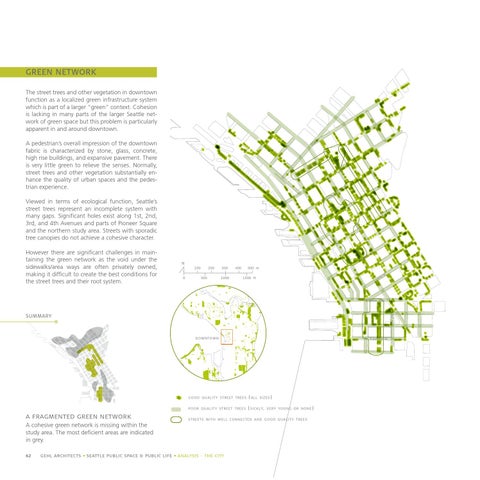
green network The street trees and other vegetation in downtown function as a localized green infrastructure system which is part of a larger “green” context. Cohesion is lacking in many parts of the larger Seattle network of green space but this problem is particularly apparent in and around downtown. A pedestrian’s overall impression of the downtown fabric is characterized by stone, glass, concrete, high rise buildings, and expansive pavement. There is very little green to relieve the senses. Normally, street trees and other vegetation substantially enhance the quality of urban spaces and the pedestrian experience.
t eS
Pin
ion
ve hA
5t
Viewed in terms of ecological function, Seattle’s street trees represent an incomplete system with many gaps. Significant holes exist along 1st, 2nd, 3rd, and 4th Avenues and parts of Pioneer Square and the northern study area. Streets with sporadic tree canopies do not achieve a cohesive character.
St
3rd
ca
ne
e Av
Se
ve tA 1s
However there are significant challenges in maintaining the green network as the void under the sidewalks/area ways are often privately owned, making it difficult to create the best conditions for the street trees and their root system.
St
Un
n rio
St
Ma
N 100 0
200 500
300 1000
400
500 m t yS err
1500 ft
Ch
Yesler Way
2nd Ave
SUMMARY
d o w nto w n
a fragmented green network A cohesive green network is missing within the study area. The most deficient areas are indicated in grey. 62
S Jackson St
g o o d q u a l i t y st re et t re e s
(all
sizes)
p o or q u a l i t y st re et t re e s
( s i c k l y,
v e ry yo u n g or n on e )
st re et s w i t h w e l l con n e c te d a n d g o o d q u a l i t y t re e s
GEHL ARCHITECTS • SEATTLE PUBLIC SPACE & PUBLIC LIFE • ANALYSIS - THE CITY