Inside:
A Delicate Bloom
Amidst Limestone
Giants PAGE 6
Ode to Native Plants: Embracing the Beauty of Local Flora PAGE 10
How Does Your Garden Grow? PAGE 22

VOLUME 4 ISSUE 2 FALL / WINTER 2023
BOTANICAL GARDEN
HUNTSVILLE
Enjoy the vibrant colors and cooler temperatures of autumn while exploring nature trails at the Garden.
 Photo by Rachel Holland.
November 17 through December 31
Walking Nights
Friday, November 17 through Sunday, November 26 (Closed Thanksgiving)
Wednesday, November 29 through Sunday, December 3
Saturday, December 16 through Sunday, December 24

Dog Nights: Mondays and Tuesdays during Walking Nights


Driving Nights
Monday, December 4 - Friday, December 15
Tuesday, December 26 - Sunday, December 31

Tickets on sale October 1 at hsvbg.org/galaxy


Galaxy Races
5K Race: Monday, November 27
3K Race: Tuesday, November 28
Presented by
GALAXY OF LIGHTS Huntsville Botanical Garden | 4747 Bob Wallace Avenue, Huntsville, AL 35805 2023
01 GARDEN COLUMNS
Hello Everyone!
As we enter the fall and winter months, it is a wonderful time to reflect on this year’s growth. The plant that started as a seed now reaches for the sky.

Each season has brought new wonders, from the vibrant blooms of spring to the lush foliage of summer and the fiery hues of autumn. Likewise, the Garden has grown as our education and conservation programs expand, and we continue to pursue our mission of connecting people to plants.
We invite you to visit the Garden during this season of change to immerse yourself in all the enchantment this period has to offer. Experience the joy of fall festivities like hayrides and pumpkin carving in October and witness the Garden’s breathtaking transformation into a sparkling wonderland during Galaxy of Lights in November and December.
In this issue, we delve into the world of native plants, exploring their inherent beauty and practicality for your own home landscape. Learn which native plants may be just what you’re looking for. Discover the why behind the Garden’s ex situ conservation efforts through the example of our Clematis morefieldii (Morefield’s leather flower) project. Then learn about the ways the Garden supports the Huntsville community through outreach.
May this issue inspire you to spend precious moments connecting with plants, whether it be within our Garden or your own backyard. The beauty and tranquility of nature await.

See you at the Garden!
Sue Wagner CEO, Huntsville Botanical Garden
Board of Directors 2023
Jeff Showalter Chair
Wes Kelley Vice Chair
Kathi Tew Vice Chair
Will Pylant Treasurer
Carla Bossard Assistant Treasurer

Carol Tevepaugh Secretary

Elaine Alspach
Tracy Barrett
David Bier
Penny Billings
Gary Bolton
Clinton Carter
Lynn Collyar
Kristina Hendrix
Leta Hornbuckle DeMaioribus
Brenda Martin
Eric Mills
Thomas Petty
Prudence Pollard
Lindsay Rice
Ruchi Singhal


Brandy Smith
Julie Stephens
Jennifer Wu
02 VOLUME 4, ISSUE 2








@HuntsvilleBotanicalGarden @hsvgarden 06 A Delicate Bloom Amidst Limestone Giants 09 Fall/Winter Garden Checklist 14 Seeds of Compassion 10 Ode to Native Plants 18 Volunteer Corner 22 How Does Your Garden Grow? What’s inside WHAT’S BLOOMING Visit us: 4747 Bob Wallace Ave. Huntsville, AL 35805 hsvbg.org Contact us: Phone: 256-830-4447 Email: info@hsvbg.org And more! 03 GARDEN COLUMNS
Program Calendar
It’s harvest time,
and nothing says fall quite like Festifall at the Garden! Our two-month celebration of the changing seasons features pumpkins, scarecrows, campouts, nature hikes and more. As the air turns crisp and the leaves begin to change color, there’s no better place to connect with nature and enjoy the beauty of autumn.
SEPTEMBER
1 Festiv-ALE
2, 16 Butterfly Release
8 Family Campout in the Garden
8, 23 Seeds to Sprouts: Dig In!
9 Family Class: Nature Journaling
9 Adult Education: Attracting Pollinators to Your Home Garden
12, 14 Nature Academy: Herbs for Kids
19 Garden Soiree
21 Fall Plant Sale (Members Only)


22, 23 Fall Plant Sale (Public)
23 Adult Education: Planting a Foundation for Backyard Diversity
23 Fall Family Field Trip
30 Monarch Tag and Release
30 Pooch Parade
Visit

OCTOBER
2-6 Fall Break STEM Camp
4 Hamburgers and Hayrides
5 Auburn Raptor Show
7 Great Garden Pumpkin Carve-Off
10, 12 Nature Academy: Garden Habitats
13 Family Campout in the Garden
13, 21 Seeds to Sprouts: "Unbe-leaf-able" Fall!

14 Adult Education: Floral Fall Centerpieces
14, 21 Fall Family Field Trip
15 Plein Air
19 Living Art
NOVEMBER
4 Family Class: Stepping into Nature: Creating Garden Stepping Stones

14, 16 Nature Academy: Nature's Inspirations
17-26, 29-30 Galaxy of Lights Walking Nights (Closed Thanksgiving Day)
20, 21 Dog Nights
27 Galaxy of Lights 5k
28 Galaxy of Lights 3k Fun Run
Driving Nights
9, 14 Adult Education: Fresh Wreaths: What to Grow and How to Make Them
12, 14 Nature Academy: Dome Sweet Dome
16 Adult Education: Holiday Table Garlands
16-24 Galaxy of Lights Walking Nights (Closed Christmas Day)
18, 19 Dog Nights
26-31 Galaxy of Lights
Driving Nights hsvbg.org/events for details and registration. 04 VOLUME 4, ISSUE 2
Fall is the optimal time to plant trees and shrubs. Let our plant experts guide you to the perfect selections for your home.


and Scarecrow Trail September – October Galaxy of Lights November 17 – December 31
Days January – February
Events Festifall
Dog
05 GARDEN COLUMNS
A delicate bloom amidst limestone giants

Huntsville Botanical Garden (HBG)’s vital work in conserving the endangered Clematis morefieldii
By Laura McPhail
rom arid deserts to the sprawling Amazon, Earth thrums with diverse life. In northern Alabama, in the shadows of the vast limestone outcrops of the Cumberland Plateau, exists a small, hardy bloom known as Morefield’s leather flower, or Clematis morefieldii. This delicate blossom is not merely a flower but an emblem of nature’s resilience and biodiversity. It is threatened with extinction and has been under the care of Huntsville Botanical Garden (HBG) since 2020.
The need for conservation
At HBG, conservation is not just an aspiration but a strategic pillar. This critical endeavor may seem intangible to many, given the less visible impact of preserving a flower compared to the widely recognized importance of, say, saving a tree. Yet every plant, including the humble Clematis morefieldii, plays a vital role in its native habitat.

F“It is flawed thinking that some native organisms are more important than others because that assumes that nature has inherent hierarchies, redundancies, or ‘useless’ things,” said HBG Curator of Living Collections Matt Candeias. “The truth is, we simply don’t yet know what function most things play in their respective habitats. What we can say is that they serve far more functions than we currently
or could every fully study and understand.”
Our biodiversity, and the ecosystems built upon it, is a delicately interwoven tapestry, each thread as critical as the next. Every loss echoes throughout the ecosystem, and the cumulative impact can be devastating.
“To lose a plant to extinction would be like popping open the
VOLUME 4, ISSUE 2 06
hood of your car and pulling out a random wire,” said Candeias. “That may not have a huge impact on your car right away, but the issue is compounding and the more often that happens, the sooner your car is going to break down, leaving you stranded…or worse.”
The Clematis challenge
Clematis morefieldii is a local hero. Endemic to the Cumberland Plateau and native to Alabama, Tennessee and Georgia, it is one of five native leather flowers in northeastern Alabama. It is a calciphile, thriving on the calcium-rich limestone outcrops of the plateau. It boldly springs from the cracks in limestone boulders, providing a habitat for various local fauna. It’s like a solitary soldier, defending an ecological niche from which others might shy away.
Despite its small size, Morefield’s leather flower can withstand harsh environmental conditions, from intense drought to trampling by hikers. It’s also worth noting the substantial role this rare plant might play in the overall health of its ecosystem, from hosting particular soil microbes to partnering with certain pollinators.
Studying this plant has not been without its challenges. The terrain is difficult, the plant can be easily overlooked amidst the lush vegetation and its propagation is a slow, delicate process.
Notwithstanding these obstacles, HBG’s Senior Director of Plant Science and Conservation Tracy Cook dedicated two years to studying this resilient species’ habitat and distribution for her master’s degree.

“If we can just protect and restore its habitat, this species has a chance at staying on the landscape for generations to come,” said an optimistic Cook.
A united front for conservation
HBG’s Clematis conservation project saw a collaboration of local and national organizations. The U.S. Fish & Wildlife service was crucial in securing funding and permits for research and collection. The Endangered Species Act (ESA) Section 6
funded collection of Morefield’s leather flower, marking the first time Alabama received such funding for plant conservation. Alabama State Parks, Land Trust of North Alabama, Alabama Natural Heritage Program and The Nature Conservancy were instrumental in providing access to plants on their properties. Several other local and regional partnerships have resulted in continuing research, including DNA work that started in 2020.

07 GARDEN COLUMNS
The battle continues
Currently, HBG is growing the Clematis morefieldii as part of its ex situ conservation collections. Despite being a slow process, with seeds taking up to five years to develop into a mature vine, the Garden continues to nurture these delicate plants. A handful of mature plants already grace the Mathews Nature Trail, offering visitors a glimpse of this unique species.

The imperiled status of Morefield’s leather flower is a sobering reminder of our biodiversity crisis. The limited range of this species combined with human encroachment and invasive species pose serious threats. Honeysuckle, privet, and nandina are taking over its habitat, and a lack of regular fire in the surrounding forests has led to increasingly dense thickets, making it difficult for the flower to thrive.
The loss of a species, whether animal or plant, creates a ripple effect throughout its ecosystem. The extinction of the Clematis morefieldii could disturb its unique interactions within the environment and potentially cause the loss of other organisms that depend upon it. Conservation efforts at HBG and beyond are pivotal to ensuring the survival of this rare species and maintaining biodiversity.

In essence, conserving Clematis morefieldii is not merely about preserving a flower but safeguarding an ecosystem, and in a larger sense, protecting the intricate, interconnected web of life. As we look ahead, it is critical to remember that each organism, no matter how small, has its role to play.
Show your support for HBG’s conservation efforts!


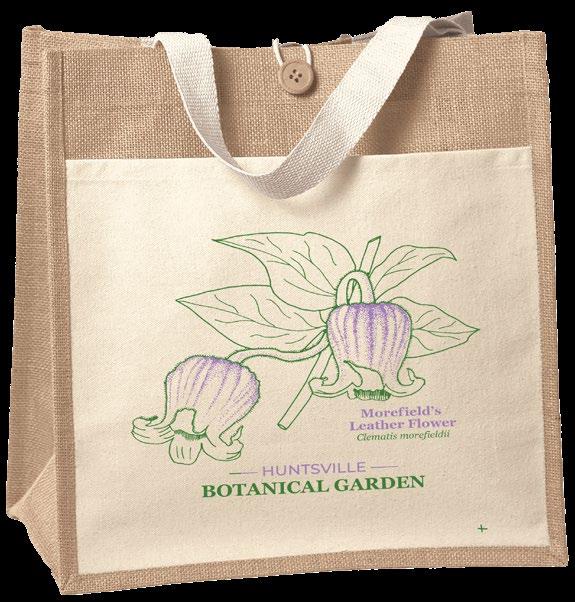
This season’s “bag with a purpose” features Morefield’s leather flower and is available exclusively at the Garden Gift Shop.
This article was prepared by Huntsville Botanical Garden using Federal funds under award number AL-E-F19AP00879 from the U.S. Fish and Wildlife Service (USFWS) Catalog of Federal Domestic Assistance (CFDA) Program 15.615 under the authority of the Endangered Species Act of 1973, 16 U.S.C. 1531 et esq., as amended. The statements, findings, conclusions, and recommendations are those of the author(s) and do not necessarily reflect the views of ADCNR.

08 VOLUME 4, ISSUE 2
Fall/Winter Garden Checklist
Follow these easy tips to help keep your garden healthy and your plants happy!

September
Dig, divide and move daylilies after they have completed their bloom.
Plant peonies.
Continue planting cool season crops of carrots, collards, kale, lettuce, mustard, onion seeds, parsley, radishes, spinach, Swiss chard and turnips.
Keep inspecting for pests and diseases.
October
Avoid pruning or removing late blooming annuals as long as possible for pollinator food!
Plant spring-flowering bulbs late this month and complete prior to Thanksgiving.
October marks the beginning of the dormant season for most woody plants. Planting new trees and shrubs in the landscape at this time minimizes transplant shock and allows some establishment before cold weather sets in.
Dig up sweet potatoes and peanuts while the weather is still warm; cure them before storing.
Disconnect hoses and winterize outdoor plumbing and water features as night time temperatures dip below 40 degrees.

November
Sow wildflower seeds such as poppies, hollyhock, bachelor’s buttons, and regional mixes.
Plant new trees and shrubs in the landscape, including roses.
December
Spread mulch over beds where early spring crops will grow to reduce winter weed seed germination.
Start reviewing and expanding your garden notes to help with next year’s plans.
Turn compost one last time, then cover it with a tarp to prevent nutrients from leaching away during winter rains.
Consider a gift membership to Huntsville Botanical Garden for the holidays. It is a dualpurpose gift, supporting the organization while providing a thoughtful, lasting present to your family and friends.
January
Make indoor bulb plantings, such as amaryllis, for decoration.
Prune damaged, diseased or rubbing branches.
If growing cover crops, mow over or turn late this month.
Check all house plants closely for insect infestations.

February
Prune your fruit trees, roses, berry bushes and other woody ornamentals. Complete this while still dormant and before spring growth begins.
Clean and sharpen your tools. Make sure you follow all safety guidelines for sharpening tools.
Get your final seed orders in to ensure you get what you want.
09 GARDEN COLUMNS
Ode to native plants:
 By Mike Shelton
Embracing the beauty of local flora in residential landscaping


From the verdant reaches of the white oak (Quercus alba) to the fragrant blooms of the native azalea, Huntsville Botanical Garden (HBG) and area landscapes echo with the harmonious interplay of native plants. These hardy and versatile plants not only enhance residential landscapes with their aesthetic allure but also contribute to the health of our local ecosystem. They attract bees, butterflies and other vital wildlife while simultaneously resisting browsing. This ode to native plants will explore their diverse features, their value in landscaping and resources that can guide gardeners in their planting choices.
An exploration of diversity and hardy beauty
At the heart of every successful garden is a well-thought-out planting plan that balances color, depth, height and structure. Native plants offer a vast repertoire of options that seamlessly fit this bill, extending beyond ornamental appeal to offer practical benefits such as low maintenance. However, it’s essential for gardeners to grasp each native plant’s growth requirements to guarantee long-term, low maintenance success.
Consider the majestic native azaleas, the “monarch of all native plants,” according to the Alabama Cooperative Extension System (ACES). These fragrant plants offer a splendid display of blossoms from spring to fall, and they can reach impressive heights under optimal growth conditions. These plants work very well in a planned landscape but thrive best in a more naturalistic setting. Ideal sites for these plants include places where sunlight filters through tree canopy or at the edge of a natural area.
They are excellent examples of the adaptability and resilience of native plants.


On the other hand, some native trees, such as the towering white oak and the ornamental pyramid magnolia (Magnolia pyramidata), contribute to the depth and height of a landscape and create a striking backdrop. The American hop-hornbeam (Ostrya virginiana), known for its sturdy wood, drought tolerance, ability to grow in any light condition and ornamental hop-like fruit, can be tucked in a woodland area or a residential landscape for added texture and interest.
Smaller shrubs like the yaupon holly (Ilex vomitoria) and wax myrtle (Myrica cerifera) add character and texture. Their dwarf cultivars are an excellent alternative to boxwoods and serve as evergreen accent plants or make great hedges. Perennials such as American wisteria (Wisteria frutescens) and anise goldenrod (Solidago chilensis) offer seasonal blooms and attract pollinators, which will ultimately enhance your garden’s biodiversity.
VOLUME 4, ISSUE 2 10
Resources to unlock the potential of native plants

Selecting the right native plants for a landscape can be a challenge, given the sheer number of options. Fortunately, several online resources can assist gardeners. The Lady Bird Johnson Wildflower Center, part of the University of Texas at Austin, and North Carolina State University Extension Gardener Plant Toolbox provide in-depth information about native plants and their care, including illustrative images for reference. ACES provides a wealth of online publications about a variety of horticultural subjects. From broad topics to specific specimen information,
ACES is an excellent resource for starting your gardening journey.
For example, ACES Lawn and Garden series includes Protecting Pollinators in Urban Areas - Use of Flowering Plants (Publication ANR-2419), an invaluable guide that offers tables of native annuals, perennials, shrubs and trees that can be beneficial for local pollinators. ACES’ guide on Native Azaleas for Alabama (Publication ANR-2747) is a good example of a guide for successfully growing a specific native plant.

Homegrown inspiration at the Garden
Of course, reading about how to grow native plants is useful, but seeing them up close and in person is a totally different experience in your landscaping endeavors. HBG is a haven for native plants and a trip to the Garden could be just the inspiration you are looking for when creating your planting plan. We encourage you to use the Garden and our horticulture experts as important resources in your gardening journey.
A walk down the Bush Azalea Trail might inspire you to include native azaleas around your landscape. Visit the young pyramid magnolias that are located at the south end of the Mathews Nature Trail to see a tree that is less commonly used in landscaping, but would work wonderfully in partial sun or shade. The American wisteria drops its leaves in the autumn and is not as aggressive as its Asian cousin. You can see this for yourself by visiting a specimen that is leisurely climbing a cedar tripod at the south end of the Mathews
11 GARDEN COLUMNS
Nature Trail. Anise goldenrod (Solidago chilensis), a fragrant, clumping wildflower that maintains a modest height of 1-2 feet, grows at the Lewis Bird Watch. These and many more native flowers, vines, trees and shrubs are on display at HBG. If you see one of our staff in the Garden, don’t be shy


about asking questions that will help your home landscape thrive. And don’t forget that you can find American wisteria and many other native plants at the Fall Plant Sale on September 22-23 (see p.5 for details)!

The journey to a native landscape

Making the shift to a native landscape is an endeavor that pays off in myriad ways. Not only do these plants create a distinct, local aesthetic, but they also contribute to the area’s ecological health by providing food and habitat for local wildlife, boosting pollinator populations and enhancing biodiversity.
The journey to transform residential landscapes with native plants requires a dash of curiosity, a


sprinkle of knowledge and a generous dollop of patience. As gardeners embark on this quest, they’ll discover a beautiful synergy between their landscape and the local ecology. Whether it’s the elegant fall bloom of muhly grass (Muhlenbergia capillaris), the modest height of the anise goldenrod or the hardy resilience of the white oak, every native plant tells a story of adaptation and survival that resonates deeply in the soul of a gardener.
American wisteria Wisteria frutescens
Wax myrtle Myrica cerifera
Yaupon holly Ilex vomitoria
Anise goldenrod Solidago odora
Muhly grass Muhlenbergia capillaries
VOLUME 4, ISSUE 2 12
Thank you to our Corporate Sponsors!
Platinum Huntsville Area Association of Realtors
ValleyMLS.com
Silver Ashford AdvisorsShane Stromei
Aviagen
Blue Cross and Blue Shield of Alabama
Dynetics
LG Electronics
Bronze Barrios Technologies
Blue Origin
CFD Research
Global Ties of Alabama
Invariant

Mission Driven Research
MTSi
RJYoung
Schoel Engineering
Signalink
Thompson Gray
Turner Construction
Venturi
Supporter
a.i. solutions
Cadence Bank
Crestwood Hospital
Green Mountain Research
PeopleTec
Radiance Technologies
The Grounds Guys of Huntsville
Van Valkenburgh & Wilkinson Properties, Inc.
Vulcan Materials
The Corporate Sponsor Program is designed to strengthen the relationship between the Huntsville Botanical Garden and the corporate community in the Greater Huntsville area. Through the annual support of theses corporate partners, we can provide first-class programs that allow children, families, and Garden guests to connect to plants and gain a deeper understanding of the role they play in their own environment. Starting December 2023, Garden Columns

This change will allow us to provide Garden Columns quarterly thereafter. You get twice the great content every year while we get to reduce our carbon footprint and postage costs. It’s a win-win!


Don’t miss out–let us know if you need to update your email address. Those who wish to continue receiving printed copies mailed to their residence must opt in by contacting membership@hsvbg.org.
Thanks for growing with us and embracing positive change.

will be delivered to
all Huntsville Botanical Garden members via email.
13 GARDEN COLUMNS
Seeds
of take root to form community connections

 By Laura McPhail
In the heart of North Alabama, Huntsville Botanical Garden (HBG) stands as a beacon of beauty and knowledge, embodying a commitment to the environment and a sense of responsibility towards its community. Yet, this haven of tranquility is more than just a sanctuary for flora. Guided by the principle of “collaborating with compassion,” the Garden has proved in 2023 that it can sow seeds of change beyond its ornate gates.
14 VOLUME 4, ISSUE 2
Gardening basics lead to home ownership


Habitat for Humanity of the River Valley (HHRV) has offered landscaping and lawn care classes to its partner families for many years as part of the Habitat for Humanity Home Ownership Program. HHRV believes that partner families benefit from learning how to properly care for their new home landscapes as many of them have not had a lawn of their own before. Participants in this program are required to complete this course in order to close on their house.
HHRV has partnered with different organizations throughout the years to make this possible. This year, HHRV reached out to the Garden for help.
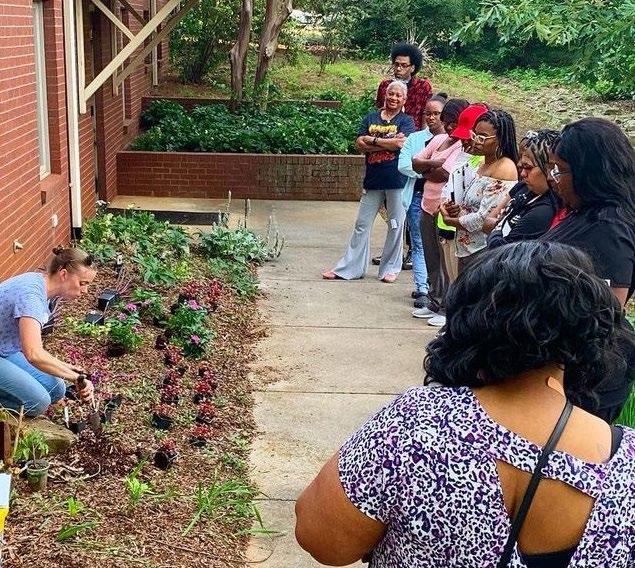
“Because of the Garden’s expertise and presence in our community, my Director of Operations, Liz Brinton, suggested that I reach out to the Huntsville Botanical Garden to collaborate with them to provide our families with the knowledge needed to be good stewards of their lawns,” said HHRV Family Services Manager Anissa Hillman.
HBG Director of Learning and Public Engagement Rebecca Turk leveraged her plant science expertise and taught the four-hour Landscaping and Sustainable Gardening course. Twelve families participated in the May class.
The curricula were designed in-house by Garden staff and included topics such as determining light exposure, garden soils, watering 101, understanding plant labels, growing your own food, mulching, turf care, sustainable gardening and more!


15 GARDEN COLUMNS
“All the partner families who took the May class have expressed how much the class taught them and were simply grateful for the opportunity,” said Hillman. “Rebecca was an amazing teacher and took her time to explain each topic in detail.”
Each family also received a starter tool/plant kit to use in their new landscapes. After completing the May class, three partner families were able to close on their houses that month.
“It was an honor to teach this course and we look forward to doing this with Habitat for Humanity annually, if not more,” said Turk. “We are making an impact in the work we do.”
Both Turk and Hill have expressed a desire to see the partnership between the Garden and HHRV grow.
“We hope to grow this partnership to have at least two classes per year,” said Hillman. “We are appreciative of this amazing opportunity to partner with Huntsville Botanical Garden and cannot wait for the next class.”
Leveling the playing field for homeless students

Beyond empowering homeowners, the Garden’s compassionate collaboration also extends to Huntsville City Schools (HCS), with a focus on students supported by the McKinney-Vento Homeless Assistance Program. The startling revelation of over 300 homeless students in the HCS System led the Garden to initiate a live appeal event at the Spring Hat Luncheon.
HBG Director of Corporate Relations Kaki Morrow announced they would “pass

the hat” at the luncheon and the proceeds aimed to sponsor at least 10 students to attend summer or fall STEM camps at the Garden–an opportunity often inaccessible due to their circumstances.
“While the plan to send as many of my homeless students to a summer camp of their choice was still in the planning stages, the Garden was always at the top of my list to partner with,” said HCS Special Populations Liaison Nicole Harden. “When I met with my families and told them they would receive two weeks of free summer camp provided by the Garden, I was met with hugs, tears, shouts of joy and enough ‘thank yous’ to last a lifetime.”
This partnership with the Garden has resulted in parents being allowed to continue their jobs without having to worry about childcare while their children are in camp. Their children also didn’t have to worry about food insecurity during that time because HCS sponsored boxed meals for them during camp.
“They [the parents] know that their children are somewhere safe during the day and actually learning something while having fun,” said Harden.
HBG staff in the Department of Advancement felt very strongly about making the ask for these funds in addition to fundraising for the Garden at the Spring Hat Luncheon.
16 VOLUME 4, ISSUE 2
“When we say our mission is to connect people to plants, we mean all people,” said Morrow. “In conjunction with funding raised at Spring Hat Luncheon and corporate pledges by OASYS, Inc. and Koda Technologies, the Garden has been able to successfully pilot this new facet of our relationship with Huntsville City Schools.”
“I’m hoping that this partnership will create a ripple effect in our community,” said Harden. “When people hear about the McKinneyVento Homeless Assistance Program, most of the time, it’s their first time hearing about the program. I’m hoping that more organizations, programs, and businesses would be more willing to help our students and their families during their time of transition.”
A future in full bloom

In the spirit of collaboration and compassion, HBG has turned its
mission into a transformative community-driven effort.
Throughout 2023, the Garden has sown seeds of hope, knowledge and opportunity, cultivating a more resilient Huntsville community.

“We want to demonstrate that when one sows seeds of compassion and understanding, what grows is a community rooted in unity and strength,” said HBG Chief Executive Officer Susan Wagner.

From empowering future homeowners through sustainable gardening knowledge to helping bridge the educational gap for homeless students, the Garden has shown that active engagement and thoughtful partnerships can yield results that transcend the bounds of a traditional botanical garden. After all, gardens, like communities, thrive best when they nourish all those within them.

17 GARDEN COLUMNS
Volunteer Corner
Individuals choose to volunteer for many reasons: to meet new friends, learn a new skill, give back to the community or expand their knowledge in a particular area. Volunteering is flexible, inclusive and fun! Multiple opportunities await as you build a legacy of family, fun, education and plant conservation alongside others with similar interests.
There is absolutely something for everyone at the Garden! Here are just a few options:
• Volunteers can spend time on our vast nature trails and learn in a fun environment. No green thumb is required! Our amazing staff will be by your side as you discover all about our native plant collection.

• Saturday and Sunday opportunities are designed for those still working a full-time schedule, so come spend the weekend with us in Horticulture.
• Events like the Galaxy of Lights support the mission of the Garden and offer volunteer opportunities for high school students to obtain community service hours. This is also a great way for corporate employees to engage in team building.

• Are you a retired teacher, but still want to help enrich the lives of the children of Alabama? Our Learning and Public Engagement team hosts field trips and camps year-round.

• Some enjoy leading shuttle tours, allowing guests with limited mobility to experience the beauty of the Garden –all 118 acres! Additional training is required.
Here’s what volunteers have to say: “As I drive past the entry columns, I eagerly anticipate the new sights, sounds and scents that each day at the Botanical Garden brings. Volunteering here gives me the opportunity for daily growth as no two days are the same. It’s a wonderful way to be a part of something that is ever-evolving.”
– Chris Rodriguez
“Volunteering at HBG is a wonderful experience. It gives me the opportunity to see different aspects of the Garden and what makes it work. There are so many areas to become involved in. The staff are wonderful and help you so much.”
– Betsy Fletcher
If you are ready to start your volunteering journey, contact volunteer@hsvbg.org today!
VOLUME 4, ISSUE 2 18


19 GARDEN COLUMNS
Behind Scenes
Designing the 2023 Galaxy of Lights

We sat down with the Garden’s Lighting Design and Programming Manager Steven Byrd to get the inside scoop on what it takes to pull off a complex holiday light experience like Galaxy of Lights. Tickets go on sale October 1!

Q. We heard there are going to be new features this year at Galaxy of Lights. Can you tell us a little about those?
A. There are! We are focusing very heavily on our interactive and immersive technologies and bringing them further into our traditional displays to bring-about incredible new experiences only seen at Huntsville Botanical Garden. For example, one new addition this season is a 200-pole light field that guests can experience during both driving and walking nights. These poles will be synchronized to music during our walking nights and showcase the movement of waves throughout an incredible landscape.
Q. When does the team start planning and how long does it take to install Galaxy of Lights?
A. Planning for the Galaxy of Lights is an allyear process which means for many of us it is the holiday season year-round! We begin planning the next season’s Galaxy of Lights in December before the current Galaxy concludes, by getting feedback from our guests about what new features they wish to see. We start meetings in February and begin compiling that feedback together to bring about the best experience possible. From March to August, planning and engineering the new experiences goes into full swing. Then by September, we are in building mode for the upcoming Galaxy of Lights experience. It is incredible experience to be a part of and I am still amazed at how quickly the time passes before we are building for the next years’ experience.

We want to see all our amazing volunteers this magical season. Look for volunteer opportunities coming to your inbox soon or contact volunteer@hsvbg.org for inquiries. Cooler temps mean Galaxy of Lights 2023 is approaching!
VOLUME 4, ISSUE 2 20
Q. Where do you get your inspiration from when designing these features?
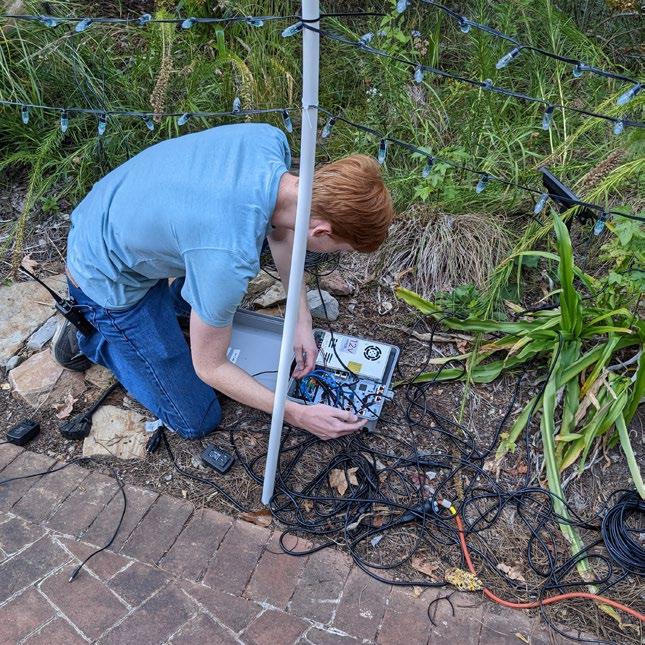


A. Our design team is so creative and experienced that it allows us to build almost anything we set our minds to. Our feedback from the community is also so important as it gives us experiences to pull from in order to create the best experience possible. I personally get a lot of my inspiration from the music I listen to and visualizing what I would love to see lights do while listening to a track.
Q. What is your favorite thing about designing and engineering Galaxy of Lights?


A. My favorite thing about designing and engineering the Galaxy of Lights experience is no doubt seeing the magic that a team of dedicated team members can create. Whether it be a design that is more straight forward or something that is as advanced as our synchronized musical experiences, watching the reactions from guests is still something that warms my heart in so many ways. Our community is so important to me and being able to be a part of the team that creates such incredible traditions for so many families is priceless.
Q. What are the main differences in the lighting technologies used for Galaxy of Lights?
A. The lighting technologies within the Galaxy of Lights vary greatly, but they all have an interconnectivity that works seamlessly. Our wireframe technology has more of a traditional feel to it which gives the feeling of being up-close and personal to such large displays. It brings a truly larger-than-life feel while also showcasing the beauty of the season to so many of our guests. The RGB and interactive technologies, which we have heavily invested in these past few years, give a much more personal feel to the experience. Whether sitting on a light swing, dancing in the magical Enchanted Grove, or playing with fog bubbles in the Icicle Forest, the two different technologies play together so well and provide an incredible wow factor.
21 GARDEN COLUMNS
Yes, you, the person reading this.
Maybe reading this heartfelt appreciation in a garden magazine doesn’t make sense to you, so allow us to explain.


Thank you.
VOLUME 4, ISSUE 2 22
Huntsville Botanical Garden (HBG) is more than just a garden. It is an immersive experience that stimulates the senses and nourishes the mind. As you wander through the expansive 118-acre landscape, you’ll be captivated by the towering trees, vibrant flowers and the symphony of colors that change with the seasons. This living museum showcases the incredible diversity of plant life, preserving and celebrating Alabama’s unique plant heritage.
However, the Garden cannot thrive without the support of its members, donors and volunteers who act as “garden emissaries.” Your contribution—time, talent, treasure or even simply spreading the word about all the Garden has to offer—plays a pivotal role in sustaining HBG’s mission to educate, conserve and engage the community. By supporting the Garden, you are enhancing the quality of life for yourself and others. And for that, we are truly grateful.
Influencing lives
If you don’t believe that your support of the Garden has a profound impact on people’s lives, don’t take our word for it. Instead, let the words below from Jordan Jenning’s April 2023 letter to the Learning and Public Engagement staff sink in. Jordan started attending youth education classes at the Garden the summer after kindergarten, and he continued to be a regular participant all the way through the Youth Volunteer Program.


All my experiences with Huntsville Botanical Garden have been amazing, since the time I was five or six years old and experiencing the Garden for the first time. And now, as I get ready to start my senior year in high school and apply for college—even though I will be halfway around the world in South Korea—I’m taking the experience of the Huntsville Botanical Garden with me.
I have decided to major in Landscape Architecture. These gardens have been my happy place for over a decade, and I want that to continue. So, I decided to dedicate my education and my future work to helping create beautiful, magical, environmentally friendly and sustainable spaces—just like the one I have experienced for so much of my life. I want to do for others what Huntsville Botanical Garden has done for me.”
23 GARDEN COLUMNS
The Garden serves as a retreat in a rapidly growing city, a place of contemplation, celebration and play. It is grounded in expert knowledge of plant science, inspiring individuals to incorporate green spaces and gardening practices into their daily lives. These connections foster not only physical well-being but also mental well-being, reducing stress, improving mood and nurturing a profound sense of connection with the natural world.
Be an agent of positive change
By donating to Huntsville Botanical Garden, you become an agent of change in your community. Your support allows the Garden to expand its educational programs, reaching more individuals like Jordan and imparting invaluable knowledge about plants and gardening practices. Together, we can empower our community with the tools and information needed to lead healthier lives.

Furthermore, your contribution helps preserve and enhance the natural beauty of our region. Alabama’s plant diversity is a treasure worth preserving, and your donation makes a tangible impact on the protection and conservation of our region’s unique plants and ecosystems.
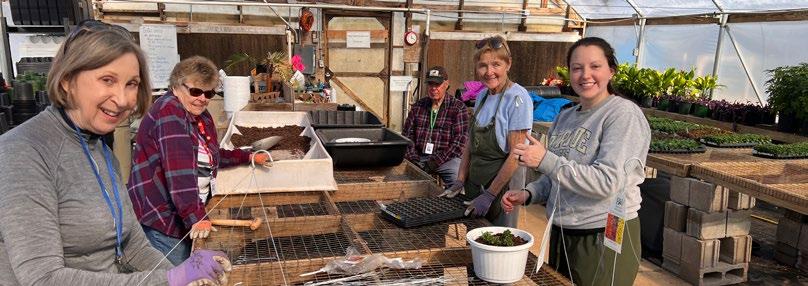
Within HBG’s carefully curated collections, over 23,600 perennials thrive, selected for their taxon, theme, conservation value or unique characteristics. These plants serve as the backbone of the Garden, complemented by 10,000 annuals that add beauty and intrigue. The dedicated horticulture and plant science experts meticulously propagate and nurture these plants, ensuring their health and vitality.
Behind the scenes, spread across 8,100 square feet, the greenhouses provide controlled environments where delicate plants can flourish and thrive. Additionally, 12,000 square feet of mats and hoop houses offer protected spaces for young plants to grow and develop before they are ready to be showcased in the garden. An additional 26,000 plants are grown annually for plant sales, many of which are propagated from plants right here in our Garden collection and can’t be found elsewhere.
These efforts not only contribute to the Garden’s visual splendor but also serve as a valuable resource for education and research. HBG’s diverse plant collections create a living laboratory where plant sciences are studied, experiments are conducted and botanical principles are advanced.
Cultivating a brighter future
There are various ways to give and make a difference today. You can donate online, mail a check or reach out to our Advancement team for more information. Every contribution, no matter the size, contributes to the growth and sustainability of Huntsville Botanical Garden. You see, your support makes a difference, and for that we are sincerely grateful. Thank you.
If you haven’t made a contribution to the Garden this year, we invite you to join us in supporting the Garden and witness firsthand the transformative power of nature. Together, we can cultivate a brighter future for our community, where the beauty of the natural world is cherished, protected and shared with all.
Watch this video to learn more about Jordan’s story

VOLUME 4, ISSUE 2 24


Coming May 2024 glassinflight.com
“Our


 Brandon Damson Damson Automotive

This magazine is printed on recycled paper by an FSC® certified printer. Like what you read? We want to hear from you! Scan QR code to take our survey. November 17 through December 31 2023
4747 Bob Wallace Ave. Huntsville, AL 35805
family has supported Galaxy of Lights for quite a long time. Now in our third generation of owning a dealership, we’re still in the community supporting important causes.”
by
Presented
