by design FLORAL DESIGN COMMITTEE
BY DESIGN – SEPTEMBER 2019 SEPT 2019
1
COVER GIRL
The Team
Joan Laracy Worcester GC, Zone I Hills Harbors Horizons Class 4: Up in the Air
Lisa Snowden Chairman Amelia Crumbley Vice Chairman Editor by design
“The White-Tailed Hornet” by Robert Frost “The white-tailed hornet lives in a balloon that floats against the ceiling of the woodshed..”
Wendy Mahoney Russell Coordinator Floral Design Workshops
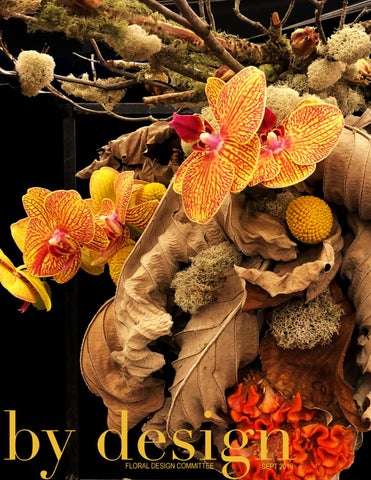
Taking her inspiration from dried cecropia leaves, Joan wove her magical hanging nest into a bough of tree branches. She secured her design to the frame using heavy gauge rusted wire and attached her material using tubes inserted into a semi-wet oasis form. Joan completed her design by using yellow Vanda orchids and billy balls to invoke the motion of hornets around the nest and orange cockscomb to give a sense of the inner hive.
Robin Hardman Co-Coordinator FDSG Workshops Kitty Wo Co-Coordinator FDSG Workshops Mary Haggerty Copy Editor by design Sara Ledbetter Layout Editor by design Allison Romig Coordinator by design Subscriptions Sally Obregon Treasurer Roberta DuBeshter WAFA Liaison Mary Harmon Executive Board Liaison Carla Morey Zone Director Liaison Missy Eliot Finance Committee Liaison
Cherry Hill Winery near Salem, Oregon. See page 4.
Subscriptions and Submissions If you would like to contribute ideas for articles, provide tips for “Random Resources,” submit your documented work for “Anatomy of a Design,” or share an entertaining tale for “A Funny Thing,” we would love to hear from you. Please contact us at ByDesignSubmissions@ gmail.com. The By Design subscription form is available by going on the GCA website “Members Area” click “GCA Committee Pages” click “Floral Design” click “By Design” click “Subscribe to By Design in Print.” If you have questions, please contact us at ByDesign@gcamerica.org.
Anne Gerald Staff Administrator
Zone Representatives Katie Barrack, Zone I Bridget Bucknall, Zone II Liz Piazza, Zone III Holly Bauer, Zone IV Kelly Asplundh, Zone V Kathy Phillips, Zone VI Peyton Wells, Zone VII Mary Moretz, Zone VIII
Oops! Correction: We apologize for failing to credit Gay Estes for all of her submissions in the June 2019 issue. Besides the article on Florescence, she penned the copy for Palm Beach, Zone IX, and Monroe. By Design appreciates the time and efforts of all of our writers and photographers. We thank you for sharing your talents.
2
BY DESIGN – SEPTEMBER 2019
Sharel Hooper, Zone IX Margaret Wilson, Zone X Chace Wolff, Zone XI Barbara Hamachek, Zone XII
contents
4
ByLine Lisa Snowden
8
5
GCA Flower Shows
Going Local
The Art of Bamboo Anne Crumpacker Portland Garden Club
For over 50 years, Anne Crumpacker has maintained a rigorous devotion to her passions. Through diligent study, she has taken risks and pushed the elements and principles of design to a refined level. Anne was an approved GCA Floral Design judge for over 18 years. Now emeritus, she has listened to her voice and overcome any anxieties she might have had. When the Floral Design group decided to meet in Portland, OR, we were thrilled to visit Anne in her studio. We were captivated as we wandered through samples of her work and listened to her story; we departed with a sense of awe and encouragement to ask ourselves about our own next steps!
10
The Myth of Persephone, The Birth of the Seasons Garden Club of Darien
12
Hills Harbors Horizons GCA Annual Meeting Hosted by Zone I
14
Nature’s Poetry Seattle Garden Club
15
Once Upon a Summer’s Day St. Paul Garden Club
16
London Calling Broadmoor Garden Club
18
Films of Enchantment, the Legacy of Walt Disney The Southampton Garden Club
19
Timeless Tacoma Treasures Tacoma Garden Club
20
Hand-Tied Bouquet Daniel Santamaria
22
2019 FDSG International
24
World Cup Philadelphia
25
The Power of Color
26
FD Workshops Dublin GC, Monadnock GC Kettle Morraine GC
28
Random Resources Martha McClellan
30
A funny thing happened… Newport
YELLOW
Barbara Hamachek BY DESIGN – SEPTEMBER 2019
3
by line Going Local no longer means riding the dreaded every stop train. Instead, over
the last 20 years, local has come to mean something quite different. It has become a movement to support and encourage community and independent farming. In recent years, this movement has expanded into the floral industry. Consumers are becoming less focused on having a specific flower no matter the time of year and are opting for seasonal organic selections. To fill the increasing demand, designers and florists are rapidly turning to local and regional farms. Whether referred to as Local, Slow Flower, or Field to Vase, the movement is countrywide and growing. Last May, the Floral Design Committee decided to venture to Oregon, one of the epicenters of local flowers, to see for ourselves. What we discovered was, in addition to growing terrific grapes for wine, the Willamette Valley alone is home to dozens of flower farms. From small scale DYI you-pick to 50-acre commercial operations, there are flowers everywhere. So many, that the farmers have produced guide pamphlets and touring maps. With only a limited amount of time, we opted for three stops. Our first stop was to Adelman’s. Once an apple orchard, Adelman Peony Garden now grows over 500 varieties of award-winning peonies. This breathtaking operation includes a demonstration garden and display house where visitors are introduced to a broad spectrum of peonies and planting possibilities. Just down the road, we toured Schreiner’s, a third-generation family-run wonderland of iris. Schreiner’s offers its visitor not only a carefully planned and curated display garden, but picnic areas and a variety of seasonal events. Our last stop took us to an enchanting boutique farm and design studio. Initially, a hobby for Beth Syphers, Crowley House Farm is a full scale all hands-on deck operation. Beth uses her high-quality blooms in her design business while offering the public a source for organic flowers and a place to study design. As a member of the Slow Flower Society and the Seattle Wholesale Growers Market, Beth mentors’ growers interested in starting a flower farm. As late afternoon approached and on full sensory overload, we reached our destination, home of “wine camp” and source of the absolutely delicious Cherry Hill pinots. Owned and operated by Jan (Indianapolis GC) and Mike Sweeney. Cherry Hill Winery is atop a knoll surrounded by valleys of grapes and was the perfect place to reflect on a day of flowers and make Floral Design Committee plans for the future. Thank you, Sweeney’s. So, what was our takeaway? Without hesitation, I’d say the entire committee came home inspired by the renewed interest in local growers, delighted by the farms rising to meet the demand, encouraged by the environmental practices being utilized, and thrilled by the benefits going local offers the community. We came home ready to see what all our zones have to offer, to spread the news and resources, and to GO LOCAL.
Lisa Snowden Chairman, Floral Design Committee
4
BY DESIGN – SEPTEMBER 2019
Going Local Today, Columbia is the source of 78 percent of cut-flower imports to our country with an additional 15 percent coming from Ecuador, Africa, China, and Europe. That leaves 7 percent for our American flower growers to share. How did this happen? In 1991, American flower farms accounted for 64 percent of the flower sales in our country. That same year, the United States lifted tariffs on some of the products from Bolivia, Colombia, Ecuador, and Peru (Andean Trade Preference Agreement). As a part of the War on Drugs campaign, the pact encouraged Columbian farmers to grow flowers instead of the coca that ends up in cocaine. These imported flowers are not subject to meeting the same standards as those grown domestically with our labor laws and environmental requirements. It is hard to compete with cheap labor and no regulations. The good news is America is experiencing a flower-farming renaissance with increased emphasis on locally sourced flowers not exposed to harmful pesticides, preserved with chemicals, cut weeks earlier, or shipped globally. Debra Prinzing, from Seattle, is credited with helping to champion the American-grown flower movement when she launched slowflowers.com in 2014. Slow Flowers is an online directory that connects consumers to flower farmers, florists who locally source their flowers, and grocery stores that offer domestic bouquets (Safeway, Whole Foods, and Trader Joe’s). In 2013, the California Cut Flower Commission teamed up with Made In USA Certified, an agency that verifies all types of products. You can look for their label, Certified American Grown, on bouquets from grocery stores and florists (it appears on the cellophane sleeves). Debra Prinzing says, “The label is a way for sellers to differentiate themselves from the competition.” What does Slow Flowers mean? Debra states in her blog, “With all due respect to my fellow garden writer Felder Rushing, who coined the phrase “Slow Gardening,” let me outline my personal definition of Slow Flowers. This is excerpted from my introduction to the book, Slow Flowers: Four Seasons of Locally Grown Bouquets from the Garden, Meadow and Farm (St. Lynn’s Press, 2013). Thanks to the culinary pioneers who popularized the Slow Food Movement, it now seems like you can put “slow” in front of any term to convey a different philosophy or approach to that subject. When I say the phrase “slow flowers,” there are those who immediately understand it to mean: I have made a conscious choice. Since then, flower farmers have come together to encourage, mentor, and support each other. They have formed regional cooperatives, like the Seattle Wholesale Growers Market (left), seattlewholesalegrowersmarket. com, where every bloom is grown on a farm in Oregon, Washington, California, and Alaska. In Wisconsin, eight growers came together to form the Fair Field Flowers cooperative which uses a co-op owned truck to deliver online orders to buyers in the Madison area. In the San Francisco Bay area, the North Bay Flower Collective was formed in 2014. This past year, Hillsborough GC hosted flower grower and floral designer, Seth Chapin from Evermore Farms, evermoreflowers.com/about, who is a member of the Collective. Zone XII members have recommended the following flower growers: Adelman’s peonyparadise.com Carol & Jim Adelman/Salem, OR
San Francisco Flower Market newsfflowermart.com/story Vendors: Brannon Street/Torchio
Oak Hill Farm oakhillfarm.net Glen Ellen, CA
Crowley House Flower Farm chflowers.com Beth Syphers/Rickreall, OR
Full Belly Farms *CSA fullbellyfarm.com list of locations on website
Schreiner’s Iris Gardens schreinersgardens.com Schreiner family/Salem, OR
Mandalion nbflowercollective.com/ mandalion-designs Mandy O’Doul/Bolinas, CA
Sky High Blooms Berkeleyside.com and Bluma Farms blumaflowerfarm.com Joanna Letz/Oakland, CA
Portland Flower Market pdxflowermarket.com Portland, OR
Santa Cruz Dahlias santacruzdahlias.com Kristine Albrecht/Santa Cruz, CA
BY DESIGN – SEPTEMBER 2019
5
Barbara Hamachek added, “By their abundance of options, Zone XII’s Slow Flower movement proves sustainable farm to table flowers are feasible. By supporting the movement, we encourage the integral part flowers play in our lives. They are a connection to our precious planet, which in turn fosters hope, love, and happiness!” Phoenix residents had an opportunity to attend a workshop at the Phoenix Desert Botanical Garden given by Debra Prinzing. Debra collaborated with local florist and growers: The Flori.Culture, thefloriculture.com Morgan Anderson/Scottsdale, AZ Anne J. of Anne E’s @azGardenFresh Whipstone Farm, whipstone.com Shanti Rade/Prescott, AZ *CSA Additional recommendations were: MiViva Designs, mivivadesigns.com Debby Mittelman/Fountain Hills, AZ Slow Flower Society member Kenly Farms/Maricopa, AZ is one of two bare-root rose growers in the US. They grow, produce, and distribute bare-root roses to nurseries and retailers Home Depot and Lowe’s. Santa Fe Farmers’ Market, santafefarmersmarket.com, boasts vendors that bring homegrown flowers every Saturday and Tuesday. An impressive variety of fresh flowers can be found at the stall of Mountain Flower Farm, www.mountain-flowerfarm. com, owned by Anne Sommariva, who has been flower farming with her family for over 25 years in Cedar Grove, NM. Heritage Belle Farms, heritagebellefarms@gmail.com in Calhan, CO, is owned by Katie Belle and Josh Miller. They are committed to growing seasonally appropriate flowers. Red Daisy Farm, reddaisyfarm.com, in Wheat Ridge, CO runs a B & B and is wholesale to the Trade. *CSA Katie Barrack (Zone I) found more than she imagined when she googled ‘pick your own flowers in Massachusetts.’ Parlee Farms/parleefarms.com, Tyngsboro, MA Pick your own flower field complete with shears and buckets. Land’s Sake Farm, landssake.org/farm/ Weston, MA *CSA Pick your own flower field complete with a design workshop. Ward’s Berry Farm, wardsberryfarm.com, Sharon, MA *CSA Large variety of flowers to pick your own listed on their website and they give you a container and shears. Quonquont Farms, quonquontfarms.com, Whately, MA Pick your own field, workshops, and farm-to-vase service for events and weddings. Barrett’s Mill Farm, barrettsmillfarm.com, Concord, MA *CSA. Pick your own field open during season. Turkey Hill Farm, turkeyhillfarm.com, Haverhill, MA Pick your own field and you can tag your own Christmas tree to pick up in November! One of the many small-scale operations on Long Island, NY (Zone III), North Fork Flower Farm (on Facebook), grows 200 varieties of flowers, herbs, ornamental grasses, and botanicals, “These cut flowers are grown locally, seasonally and ethically…the hallmark of the ‘slow flower’ philosophy.” says Liz Piazza. 66
BY DESIGN DESIGN –– SEPTEMBER SEPTEMBER 2019 2019 BY
A Peony Garden (Zone V) owned by Eleanor and Bill Tickner in Glen Mills, PA, https://rootstoblooms. com/2012/05/21/a-peony-garden/, is described as heaven on earth in May. Prices vary throughout the season between $1 and $1.50 per stem, which in the floral world is unbeatable. Kathy Phillips (Zone VI) sent us the philosophy from Local Color Flowers, a Baltimore-based floral design business, “We love flowers. We love our clients, growers, and partners. We want our clients to know where their flowers were grown. We want our growers to know how our clients appreciate their products.” They have ‘make-your-own’ classes and a weekly event called Bloom Battle where amateur arrangers gather and compete. Check out their video on their website LoCoFlo. com.
Cleveland, OH (Zone X) is fortunate to have the North Union Farmers Market organization which matches farmers with locations in Ohio to sell their bounty. “This morning cut flower bouquets were everywhere as I wandered through a colorful sea of independent growers and vendors at The Shaker Square Farmers Market. These cut and prepared bouquets may not be show-ready but will certainly last long enough for a weekend design.” reported Margaret Wilson. She says, “A simple google of ‘slow flowers in Cleveland’ also resulted in links to a few floral shops that use and sell their own material. Who knew? From small florist to large scale wedding flower designers, more and more professionals are growing their own supplies. Finding your local growers is just a search button away.”
Mary Moretz (Zone VIII) visited Floral and Hardy Farms, *ASCFG floralandhardyfarms.com, in Lexington, SC owned by Donna and Tim Mills. She came home with a bundle of flowers and cut herbs and says, “Having this fragrance in my house makes me want to dig up the lower forty and plant flowers!” 3 Porch Farm owned by growers Steve and Mandy O’Shea in Comer, GA sells to the Trade and area farmer’s markets, 3porchfarm.com.
Where to start? The directory on slowflowers.com has flower growers and florists that source locally grown flowers. Local Flowers, localflowers.org/findflowers, is the website for the *ASCFG, Association of Specialty Cut Flower Growers and their map locates growers within a 100-mile radius. The *CSA, Community Supported Agriculture, website localharvest.org has their farmer/members listed by state under ‘locations near you’ at the bottom of the home page. CSA farms sell ‘shares’ to subscribers that would like to receive produce and flower bouquets throughout the seasons. Floret Flowers has a list of their Collective members at floretflowers.com/directory which focuses on florists/growers.
Sweet Gum Farm owned by Emily Orr in Richmond, VA, Orr.emily@gmail.com, is recommended by Peyton Wells (Zone VII) who added, “She’s my favorite.” Sharel Hooper (Zone IX) frequents local grower Lines Orchids (423-886-2111) in Signal Mtn., TN owned by Scott McCandless, which offers shipping. Little Blue Stem Farm (Zone IX) in Carthage, MS is a *CSA and *ASCFG member owned by Elizabeth Foose, littlebluestemfarm.com.
We encourage you to push that button, follow the links, search your community, and by all means let us know what you find in ‘your own backyard.’ We would love to post new resources for flowers to share and support.
Thank you for sending your recommendations. Along with those that are quoted in the article, contributors are Kelly Asplundh (Huntingdon Valley GC), Lili Bassett (Piedmont GC), Lenni Griego (Arizona Columbine GC), Nancy Huseby (Piedmont GC), Phoebe Kahl (Orinda GC), Anne May (Santa Fe GC), Nettie Ramsay (Hillsborough GC), Rebecca Teasdale (The Portland GC), Virginia Tenney (Broadmoor GC), Susan Seidel (Pasadena GC), Wendy Mahoney Russell (The GC of Wilmington), and Karen Flores, Janice Meisel, Wendy Rohn (Woodside-Atherton GC).
“Autumn is a second spring when every leaf is a flower.” Albert Camus https://smokymountains.com/fall-foliage-map/ BY DESIGN – SEPTEMBER 2019
7
THE ART OF BAMBOO by Anne Crumpacker Portland Garden Club
In 2009, I made a major shift in my life and became a full-time artist. My artistic life started when I was four years old taking art classes at the Children’s Museum in Portland, launching a life-long interest in the visual arts. I had an infusion of art at Scripps. While getting a Masters’ at Reed, I took classes at the Museum Art School (now the Pacific Northwest College of Art); and I worked in the curator’s office at the Portland Art Museum. But I will be forever grateful and indebted to the Portland Garden Club for nurturing and encouraging my creativity. I have been a member for 39 years. What I loved most 8
BY DESIGN – SEPTEMBER 2019
about being a member of the PGC was entering flower shows, taking workshops, helping with and chairing flower shows, and being in the GCA Judging Program for 28 years. I have been an approved Floral Design Judge for 18 years and just went emerita last year. For all those years, flowers were my medium. I learned and mastered the elements and principles of design. It was not only invaluable to judge floral design but also understanding them is essential to creating, critiquing, and appreciating art. I studied Ikebana for 15 years with fellow PGC Floral Design Judges. This was my introduction to Japanese aesthetics which deeply influence and inform my art. And, I have traveled to Japan twice. While in the Judging Program, I took at least one class a term at Pacific Northwest College of Art (PNCA) or at Oregon College of Art and Craft (OCAC). I had a major wake-up call 15 years ago. A teacher asked me, “What if you devoted all of your time and energy to art?” What if??? I had a profound realization I wanted to be immersed in creating art, living the life I was meant to live, making the art only I can make. The question I am asked most frequently is “Why Bamboo?” I find its natural beauty to be elegant, simple, graceful, and minimal. I value its practical attributes: fast-growing, rapidly renewable, strong, resilient, and flexible. And, I appreciate a grove of bamboo functions like a single organism as the culms are interwoven and interconnected through an underground system known as rhizomes. There is a wellknown saying in Japan, “In case of earthquakes, escape to bamboo forests.” I have come to understand I have a deep connection to bamboo – which feels both visceral and spiritual – making it the ideal medium for my personal artistic expression. Two illuminating experiences led to a better understanding of this connection. Twenty-five years ago, I stepped into a freshly cut monumental bamboo installation, created by Hiroshi Tehsigahara, at the Sogestsu School in Tokyo. This environment, constructed of 40-foot culms of arched bamboo, formed a Zen-like sanctuary. In that moment, I felt a sense of deep order and connection one finds in a sacred place. The second experience was taking a 12-week class, The Artist’s Way. From writing three pages every morning, I learned bamboo was an essential part of my being. Things speak to us and we don’t always know why. I suppose, this is part of the mystery of life, of creativity, and we don’t always take time to explore why. But I wanted to delve deeper, and bamboo was clearly my medium. I was accepted into the first class of PNCA and OCAC’s joint MFA in Applied Craft and Design program in 2009. It was the ideal program since I didn’t want to be limited to fine art or craft, but a combination of the two, immersed in design as well as focused on bamboo as a medium. Being in the program was a gift and transformational experience. In the summer between my first and second year of the program, I interned with Doug and Mike Starn on the roof deck of the Metropolitan Museum of Art in New York helping them with their Big Bambu installation. I learned what serious, hardworking artists they are. I was influenced to work at a much larger scale. They taught me about interconnectedness, creativity, and following a path of discovery.
Once I graduated in 2011, I launched a creative practice which has been evolving for the past eight years. I have a studio in downtown Portland on Ash Street in the Skidmore Fountain area on the third floor of an 1872 brick building. My studio, overlooking the Willamette River, is an inspiring place to work. Most of my bamboo comes from China, where it has been cured and dried. The culms of bamboo are wrapped with masking tape to protect the skin from getting scarred during the cutting process. After the cutting, the rings are unwrapped and waxed. When bamboo is crosscut, the cellular structure of the bamboo is exposed, revealing its inner beauty and strength. The solid pieces are the membranes of the bamboo or the nodes, some of which are whole, and some have organic shapes which occur randomly during the cutting process. I have learned bamboo can crack. Now I work with the material and intentionally crack each ring of bamboo which releases the tension. I took two different directions with my art. For the first, I connect hundreds of crosscut sections with waxed linen thread into circular shapes. When seen from a distance, these works of art resemble the microscopic cellular structure of living things and of bamboo itself. The second direction, a technique I refer to as Cross Currents, represents a new way of using bamboo. Each crosscut piece is cut in half to form a semi-circle and glued on end. Using different diameters and various widths I create a wavelike or cross-current pattern. A topography is formed. An expert in the bamboo world has confirmed I have invented a new way to use the material. This is my contribution to the bamboo art field. I have created a series of luminaries which are backlit with LED lighting, controlled with a fob. Another question that I encounter is what are you communicating with your work? There are two major themes in my art: the interconnectedness of all things and Japanese aesthetics. Many of my works of art are circles, what I refer to as Ensōs. In Japanese aesthetics, an Ensō is a Zen circle. The circle is an enduring and universal symbol of interconnectedness. Within Zen design, an Ensō or circle represents enlightenment as it is both bounded and boundless. The edges of the Ensō are organic and irregular in form, symbolizing the imperfection that is a natural part of existence. Circles also communicate the collective unconscious and complexity of the unknown. The second theme is Japanese aesthetics. The problem-solving part of my process is required for me to achieve my aesthetic. I reflect on minimal design; the simplicity and clarity of expression; the close connection to nature through the bamboo; and the serenity and tranquility I experience when working with my hands. This is my meditation. I am in the flow. This has become the core of my practice I simply cannot do without. Thank you PGC and GCA. Every day I express gratitude for this creative journey.
BY DESIGN – SEPTEMBER 2019
9
The Myth of Persephone, The Birth of the Seasons Garden Club of Darien Zone II May 7-9, 2019
Persephone, the Goddess of Spring, heralded the new season when the Garden Club of Darien held a flower show and fundraiser in May. The show was held at the Tokeneke Club which allowed for all the exhibits to be shown together in one area with an abundance of natural light. With all the classes filled in every category and major awards given, the show was a success and showcased the talents of members from Zone I, II, III, and well beyond. Many of the classes across all disciplines were given commendations for creativity by the judges. Along with all the classes, there was a conservation exhibit exploring the underworld and highlighting a new composting program in Darien. We showcased a children’s exhibit where students were invited to plant sunflowers, color some goddesses, and learn about pollinators. We held the show during the week, given the busy time of year, with a suc-
cessful fundraiser on Tuesday night. The show stayed open late on Wednesday with “C-Change Conversations,” an educational presentation about the way that climate change is shaping the world, presented at an evening lecture. Both events were open to the public. We also had corporate sponsorship for the show and ran ads in the program, which helped to defray printing costs for the show. We are very lucky to have a professional graphic artist in our club who created all the signage and graphics. This allowed for a stronger marketing presence in and around town as the images were very visible and appealing. A record $70,000 was raised at the fundraiser, which will be used for conservation, education, and beautification purposes in Darien. A few projects are already in the works! Submitted by Emily D’Andrea and Debbie Murray
*To view a wonderful slide show of The Myth of Persephone, The Birth of the Seasons go to www.gcdarien.org and click on Flower Show Photos.
Dorothy Vietor Munger Award Bridget Bucknall and Emmy Ogden Hortulus Garden Club Class 1: Persephone: Goddess of Spring; Queen of the Underworld Citation: Persephone’s dual world is exemplified in this elegant design.
Harriet DeWaele Puckett Award Valerie Mead The Stamford Garden Club Class 4: Hades: God of the Underworld Citation: A uniquely creative textural and rhythmic design!
10
BY DESIGN – SEPTEMBER 2019
Best in Show in Floral Design Pam Reimers and Christina Vanderlip Hortulus Garden Club Class 5: Naiades: Water Nymphs Citation: Restrained use of components creates a design that is sparkling in its simplicity.
Sandra Baylor Floral Design Novice Award Glenn Shaw Greenwich Garden Club Class 3: Demeter: Goddess of Harvest, Fertility and the Earth Citation: Complimentary colors allow this novice design to soar.
Best in Show in Botanical Arts Jane Booth The Virginia Beach Garden Club Class I: Persephone, A crown of flowers Citation: Fit for a queen. A most magical interpretation. GCA Novice Award in Botanical Arts Garden Club of Darien Pomegranate Award Betsy Bigler Garden Club of Darien Class 2: The Six Seeds Citation: Way to sow the seeds for the future.
Botanical Arts Creativity Award Robin Stineman Garden Club of Darien Class 1: The Cycle of Life, A Herbarium Study celebrating the seasons Citation: A kaleidoscopic herbarium study of exquisitely preserved plant material.
Show Photographer Leslie Pennington BY DESIGN – SEPTEMBER 2019
11
HILLS HARBORS HORIZONS A GCA Annual Meeting Flower Show Hosted by Zone I Clubs May 17-19, 2019
Best in Show Dorothy Vietor Munger Award Gay Legg Saint George Garden Club Class 6: Ice is Out Citation: Outstanding beauty. A beautiful interpretation of Frost’s poem.
Harriet DeWaele Puckett Creativity Award Susan Everitt North Shore Garden Club of Massachusetts Class 5: Stone Walls Citation: A Tour de Force of balance.
Sandra Baylor Floral Design Novice Award Sarah Boynton Cohasset Garden Club Class 4: In the Air Citation: Your design soars! 12
BY DESIGN – SEPTEMBER 2019
Hills Horizons and Harbors flower show was a dynamic component of the 2019 GCA Annual Meeting. Beautifully staged in a light-filled room overlooking Boston Seaport, the show brought together designers from across the country to interpret a topographical theme. And the entrants did not disappoint. From rock formations to suspended organic designs, from intricately stitched botanicals to luminescent pearls the show was a visual tribute to the diversity and beauty of Zone 1. Congratulations to Carrie Waterman, Mary Huntoon, Kathy Michie, Kim Devlin-Brytz, Abby Coffin, Libby Moore, Christine Paxhia, Chris Wood, Mary Ellen O’Brien, Ginna Parker, Koko Bickford, Susan Everitt, and Anne Reardon who together envisioned, installed, oversaw, and managed this terrific show.
Best in Show in Botanical Arts Sarah Boynton Cohasset Garden Club Class 2: Harbors Citation: Shell Yea! GCA Novice Award in Botanical Arts Terry Windhorst Noanett Garden Club Class 3: Horizons Citation: Summer Best Seller!
Botanical Arts Creativity Award Cynthia Hosmer Piscataqua Garden Club Class 1: Hills Citation: Van Cleef and Verdura Watch Out!
Photography by Lisa Snowden and Becky Simonds BY DESIGN – SEPTEMBER 2019
13
NATURE’S POETRY Seattle Garden Club Zone XII May 30-June 1, 2019
Best in Show Dorothy Vietor Munger Award Marilee Ahalt and Debbi Wilson Seattle Garden Club Class 3: Pastoral Citations: Creative work with outstanding natural beauty. A lovely integration of Pot et fleur. Sandra Baylor Floral Design Novice Award Harriet DeWaele Puckett Creativity Award Jill Crutcher Seattle Garden Club Class 2: Haiku Citations: You have created a memorable and beautiful experience! Your Haiku design creates an innovative art form. A skillful work of art!
Seattle Garden Club’s Martha Lindberg Isaacson Award Barbara Feasey Seattle Garden Club Class 1: Sonnet Citation: Poetic Perfection!
Show Photographer Kim Bishop 14
First in Class, Invitational Challenge Class Joan Sterrett The Portland Garden Club Class 4: Free Verse Citation: This arrangement is spectacular with expert integration of all materials.
BY DESIGN – SEPTEMBER 2019
Once Upon A Summer’s Day
St. Paul Garden Club Zone XI June 24-27, 2019
Best in Show in Floral Design Harriet DeWaele Puckett Creativity Award Nancy Hilger and Vicky Holmen St. Paul Garden Club Class 1: Best Seat in the Garden Citations: The old-fashioned textures and plant material match the texture of the chair. The plant material is more dominant on the left of the chair, affecting the balance of the design.
Dorothy Vietor Munger Award Catherine Nicholson St. Paul Garden Club Class 5: Summer Stunner Citation: Harmonic color within a captivating design works well with the container. Movement moves away from a focal point.
Best in Show in Botanical Arts Botanical Arts Creativity Award GCA Botanical Arts Novice Award Rita Parenteau St. Paul Garden Club Class 1: Splendor In The Woodlands Citations: Dazzling yet subtle color elevates the creativity of this award winning design. Exquisite in all aspects, this exhibit shows a comprehensive understanding and presentation of the principles & elements of design. A high degree of perfection in pressed plants. Sandra Baylor Novice Floral Design Award Lisa Philander St. Paul Garden Club Class 5: Summer Stunner Citation: Socks knocked off! Dramatic interpretation of the summer solstice. Show Photographers Ellen Maas Pratt and Michelle Riedel BY DESIGN – SEPTEMBER 2019
15
LONDON CALLING Broadmoor Garden Club Zone XII June 7-8, 2019
London Calling was a Hop-On-Hop-Off adventure through the city. The Floral Design route went from the “pomp and pageantry” of Buckingham Palace to St. James Cathedral, then on to the Tower of London. Kew Gardens, the London Bridge, the National Gallery, Tate Modern and traipsing through Trafalgar Square and Portobello Road antiquing completed the trip. Hope you wore your ‘flats’ for a long day of sightseeing, the Botanical Arts designers certainly did! Along the way, if you were lucky, you might have caught a ‘Royal Wave’ fit for a Queen. Cheers to co-chairs Emilie Simon and Jenny Thatcher for a smashing good show and to Patricia Radcliffe for a wickedly clever schedule.
Dorothy Vietor Munger Award Meredith Donner and Jan Webber Broadmoor Garden Club Class 3: Heir to the Throne Citation: None provided.
Harriet DeWaele Puckett Creativity Award Jenny Thatcher Broadmoor Garden Club Class 3: Heir to the Throne Citation: A modern monarchy.
16
BY DESIGN – SEPTEMBER 2019
Best in Show Elizabeth Coates Garden Club of Santa Barbara Class 2: Brides on the Balcony at Buckingham Palace Citation: Congratulations on your Royal Wedding.
Sandra Baylor Novice Floral Design Award Ann Blackmun Broadmoor Garden Club Class 1: The Royal Wave Citation: You caught the Royal Wave.
Best in Show Botanical Arts Denise Sheridan Broadmoor Garden Club Class 1: My Flat in London Citation: Salute to Brilliance.
Botanical Arts Creativity Award Janene McCann Broadmoor Garden Club Class 2: Peak to Palace Citation: Colorado Springs (Little London) is perfectly depicted in this royal brooch.
GCA Novice Award in Botanical Arts Amy Osborne Broadmoor Garden Club Class 1: My Flat in London Citation: The design and workmanship are splendid.
Show Photographer Lynn Cool BY DESIGN – SEPTEMBER 2019
17
Timeless Tacoma Treasures Best in Show Floral Design Cheryl Miller Garden Club of Santa Barbara Class 4: Bridges, Past to Present Citation: Tacoma bridges us from past to present.
Tacoma Garden Club Zone XII June 10-13, 2019
Sandra Baylor Novice Award in Floral Design Debi Schmid Tacoma Garden Club Class 4: Bridges, Past to Present Citation: A unique interpretation of Galloping Gertie!
Harriet DeWaele Puckett Rebecca Teasdale The Portland Garden Club Class 5: Treasured Structures Citation: Creative Hot Shot!
Dorothy Vietor Munger Award Susan Ashmun Seattle Garden Club Class 1: Asian Heritage Citation: An exquisite Asian treasure.
GCA Novice Award Botanical Arts Debi Schmid Tacoma Garden Club Class 2: Pantages Razzle Dazzle Citation: Out on the Town.
Show Photographer Susan Doten 18
BY DESIGN – SEPTEMBER 2019
Best in Show Botanical Arts Cheryl Miller Garden Club of Santa Barbara Class 1: Waltzing at the Winthrop Citation: Dancing away!
Films of Enchantment, The Legacy of Southampton Garden Club Zone III June 28-29, 2019
Walt Disney
A pioneer of the American animation industry, Walter Elias Disney was recognized by The Garden Club of America in 1954 with the Frances K. Hutchinson Medal for his ‘contribution in publicizing conservation, as demonstrated by such films as ‘Beaver Valley’, ‘Nature’s Half Acre’ and others. Each of the 5 divisions of Southampton Garden Club’s flower show, Films of Enchantment: The Legacy of Walt Disney, drew inspiration from one of the titles of Disney’s full-length animated movies. Each class included a short description of the movie to motivate club members and encourage creativity.
To fundraise for the show, the club held a lecture/luncheon that featured the Horticulture Manager from Disneyworld who spoke on Disney’s Artful Gardens. Members and their guests were also treated to Fantasia, a preview reception before the show with music from Disney animated classics. The magic of Disney was on full display throughout the two days of this successful and fun flower show! Cindy Willis, Flower Show Chair Southampton Garden Club
Best in Show in Floral Design Nancy Ladd Rye Garden Club Class 5: Lady and the Tramp Citation: Pasta Puppy Perfect!
Sandra Baylor Novice Award Barbara Glatt Southampton Garden Club Class 3: One Hundred and One Dalmatians Citation: Pleasing form and use of allotted space with lush material suggests a litter of dalmatians.
Southhampton GC Huguette and Dennis Hersch Trophy for Best BA Entry Jennifer Powers Southampton Garden Club
Best in Show Botanical Arts Linda Fraser Southampton Garden Club Class 2: Dumbo Citation: Dumbo soars with the Best in Show!
Show Photographers Mary Lou Swift and Nancy Stone BY DESIGN – SEPTEMBER 2019
19
FDSG Fall Workshop
with Daniel Santamaria
Finished asymmetrical design
Fig. 1
Hand-tied Boucquet with Cane Structure
Fig. 2
Instructions: Start by creating the wire structure. Using 18 wires, measure 5" from the bottom, and start taping wires together with brown floral tape (Fig. 1). Tape up 5 more inches. Be sure to tape 2 - 3 times to create strength. Tap the bottom of the wires to the table to keep even. Prepare the stem by using bind wire to cover the 5" of brown floral tape. Go up and down the 5" space and then secure with first tail end of bind wire. Fig. 3
To make the feet start from the shorter end (5") and pull down 2 wires times 9 to create feet for the base of the structure (Fig. 2). Use bind wire to create a spider net. Leaving a tail of bind wire, start weaving up and under in a circular motion, 3 times and finishing about a 1.5" circle. Then, again using the same bind wire, start covering one spoke of the ‘feet’ at a time. Bring bind wire to the end of each spoke with a few turns, and then bind close together, returning towards the center. Repeat until all spoke feet are covered.
Fig. 4
20
Fig. 5
BY DESIGN – SEPTEMBER 2019
Divide the top portion of the wire structure in half, 9 wires on each side (Fig. 3). Trim the ends to even. Cover with bind wire (Fig. 4). Use a bucket to create a curved shape for each top wire grouping (Fig. 5).
Starting at the center bottom of the structure, begin to attach sticks to the structure using a bind wire loop (Fig. 6). Hook the wire on top of the stick. Go under the curved arm and back up the stick, and twist 2 - 3 times. Then trim the bind wire. Continue to place sticks by placing them about 1" apart (Fig. 7).
Fig. 6
Weave the unattached cane ends together with bind wire about 5" - 6" from the bottom (Fig. 8). Use a loop of bind wire in the middle of a long strand and start on one end, going under a stick and then twist. Add the next stick and twist 2 times. The number of twists gives more/or less space between sticks and is called a tatami technique. Repeat until all sticks have been woven together.
Fig. 7
To create an asymmetrical design, join 2 sticks going in the opposite direction (Fig. 9). Repeat until you have gone up both sides of the arch with sticks (Fig. 10). When adding flowers start a hand-tied bouquet using a parallel or spiral technique (Fig. 11). Begin with a large protea, placed straight; then, add hydrangea, amaryllis, anthurium, and Amaranthus. Add additional flowers to balance the design. You can place some of the flowers through the individual stick of the structure. Keep your hand on the bottom of
Fig. 11 Fig. 8
Fig. 9
Fig. 10 the bouquet and stem of the structure as you add flowers and greenery in a spiral pattern, always placing stem in the same direction. Clip the ends of the flowers after you determine their place in the design. All stems should be even at the bottom of the design to place in a glass dish filled with water. To add shorter specialty flowers, add a floral tape/bind wire covered tube to the structure. If you need to take a break or view the design from all sides, use bind wire to hold the bouquet in place.
Fig. 13 Fig. 12
After finishing your bouquet, add 2 additional sticks to the top of the design using bind wire to attach at the top and bottom (Fig. 12). This connects the base structure to the floral design. Place the wire feet of the design in a large, flat glass dish with sticks extending out along the table (Fig. 13).
Contributors Carole Bailey, Robert Dubeshter, Barbara Hamechek, Martha McClellan, Debbie Stockstill Photography by Debbie Stockstill
7
Fig. 6
Fig. 5
BY DESIGN – SEPTEMBER 2019
21
floreale internazionale
Italia
The 2019 Floral Design Study Group International Workshop (FDSG) was held in Genoa, Italy from February 3 - 8, 2019. Originally limited to 25 participants, three were accommodated from the Waitlist. In the end, 26 enthusiastic GCA floral designers, three of whom were first-time workshop attendees, shared this special educational experience with us. Participants came from every Zone except Zones V & VI, with the largest representation being five women from Zone VIII. The MeliĂ Hotel-Genova, our home base and workshop venue on Via Corsica, was perfectly situated with easy walks to beautiful scenery, historic sites, museums, concert halls, fine dining, and shopping. We contracted with the Italian Institute of Floral Amateurs (IIDFA) to have their instructors, demonstrators, and international judges Cristina Zanobini, Paola Scoccimarro, Paola Dagnino and national judges Fiorella Gaggero and Giovanni Marchiori educate us in the different Italian Design Styles. In order to reach this international judging level, they have to take classes approximately every two weeks, study and take certifying exams episodically. Successful completion of all exams means the quickest you can attain this prestigious level is twenty years! Workshop hours were full-day sessions taught by the instructors while six assistants from their school aided us with our component selections, techniques, and design construction. Design styles included Modern Line, Modern Mass, Abstract, Layered Italian, and Nuovo Stile, a contemporary design style, both with and without a container. This latest
22
BY DESIGN – SEPTEMBER 2019
design style was included in the International Rules for the Floral Art Competitions starting in 2010. Our welcome dinner was at the Palazzo Grimaldi della Meridiana, a restored palace. In 2006, this palace and the surrounding area was declared part of the UNESCO World Heritage Sites. We were warmly welcomed with a docent-led tour of the spectacular private palace followed by a splendid feast featuring fine Ligurian cuisine. The farewell dinner was held at the Villa Zerbino, a private residence available for special functions. At the farewell dinner, participants were awarded certificates of completion of the workshop by IIDFA. The instructors had high praise for our GCA members, as they very quickly grasped the more complex designs taught - high praise, indeed! Sights on the professionally guided tour included Carnignano, Molo, Maddalena, Palazzo Ducale, and many Duomos, all while exploring the winding historic streets past Palazzo Cattaneo- Adorno, Palazzo Podesta, and then enjoying a traditional lunch at the family-owned Trattoria La Santa. In the afternoon, we boarded a bus for a guided tour to the seaport towns of Boccadasse, on a beautiful bay where both boats and cars shared street parking spots and Nervi, for a panoramic walk along the shoreline while being engulfed in the early sunset. Genova, this historic seaport city, once the largest in the world, and the surrounding Ligurian Coast of Italy, is definitely worth visiting. Submitted by Roberta DuBeshter
BY DESIGN – SEPTEMBER 2019
23
FTD World Cup Competition at the Philadelphia Flower Show
FLOWER POWER At the Philadelphia Flower Show, Flower Power, attendees were engulfed with beautiful flowers, a multitude of entries for competition, and an array of interesting horticulture. This year we experienced the spectacular FTD World Cup, where floral design artists from 23 countries competed in this prestigious competition. Each competitor won on their local, regional, and national level competitions for the honor of representing their country. Prior to the World Cup, each designer knew three of the design entries they would be judged in - a structure that was 75% covered with plant material, a romantic dinner set for two, and a hand-tied twisted bouquet that had to stand alone upon completion. One assistant could help them set up their exhibits and prep for the live competitive event, but for the actual timed competition, the designer alone had to complete the design. They were then given components (like our floral design Challenge Classes, or in WAFA what is called Imposed Classes). Each timed design event was preceded with great fanfare complete with music, emcees (Per Benjamin, author of The World of Colour, see March 2019 By Design issue, and a local Philadelphia TV celebrity) introducing the exhibitors, complete with flag bearers from their home countries. This is one of the major international floral artistry competitions, and occurs approximately every three years, rotating through countries, with the last USA event in the 1980s. For the many GCA floral designers that have attended past FDSGs, we were thrilled to know two of the international judges at this prestigious event. Bjorn Kroner, from Munich, Germany, was our 2016 FDSG Workshop Designer in New Orleans and Tomas De Bruyne taught us at the 2010 FDSG International Workshop Designer in Bruges, Belgium. Attending the competition as spectators were three former FDSG International Designers - Annette von Einem (2017 Fall Workshop in La Jolla, California), Bruno Duarte (2017 International FDSG Workshop in Toronto, Canada & FDSG Fall Workshop in Palm Beach, FL) and Marie Francoise Deprez (FDSG Workshop in Paris, France). They recognized us as “GCA Ladies” and shared many details regarding the competition, rules, flower sources, structures, level of innovation, and finances. Their commentary concerning judging, including specifics on technical scores, techniques, theme, execution, and details such as the percentage of plant material needing to cover the structure was most informative. Once apprised of these nuances, it became easier to understand the judges’ point distribution, and ultimately, the semi-finalists (10 exhibitors), finalists (5 competitors), and winning designer. The educational experience was exceptional, and we were most appreciative of having met these designers through FDSG workshops. Submitted by Roberta DuBeshter
24
BY DESIGN – SEPTEMBER 2019
Bart Hassam, the 2019 Interflora World Cup winner from Australia, successfully incorporates excessively large plant material into his floral art. We were enthralled by the imaginative entries he and the other floral design competitors created.
the power of COLOR
Yellow Fever
In 1890s London, Oscar Wilde was arrested and found guilty for carrying a yellow book. Sinful implications of such books came from France, where not-so-chastely literature was bound with yellow covers. At the time of Wilde’s arrest, The Yellow Book was a British avant-garde literary periodical. Its sunny cover was a symbol of modernity, and the 1890s were later called the “Yellow Nineties.” (Wilde was toting Pierre Louys’ Aphrodite.)
The disappearance of Lead-tin yellow is a mystery. For no known reason, it wasn’t used after the mid-1750s. No one knew that it existed until 1940, when Richard Jacobi, a German researcher, found tin in yellow samples. He recreated the yellow pigment and proved to a shocked art world; Lead-tin yellow was the yellow of the Old Masters.
Nicolas Louis Vauquelin, a French scientist, discovered a new element, naming it chrome. He suggested using the pigment for paints. Artists had saturated reds and blues but lacked an equivalent for yellow. Chrome yellow and Van Gogh became synonymous. In 1888, he was in the Arles’ “Yellow House” painting sunflowers. Sadly, chrome yellow browns as it ages.
Far East artisans had used gamboge for centuries before it came to Europe in 1603. In 1832, when the Winsor & Newton shop opened, gamboge was a principle pigment. It was crushed and used to make up small brownish cakes. One drop of water yielded a fluorescent yellow. When the properties were found to be toxic, Winsor & Newton replaced the original with New Gamboge.
Gold. It is a color of reverence and awe throughout history. Since flakes of gold were found in Paleolithic caves around 40,000 B.C., civilizations have loved it, created with it, and searched for it. Metallic Gold, the color known as gold, is a simulation of the actual element itself. The first recorded use of golden as a color name in English was in 1300. A heart of, as good as, or go for – gold. BY DESIGN – JUNE 2019 BY DESIGN – SEPTEMBER 2019
25
25
FLORAL DESIGN 101 WORKSHOPS GARDEN CLUB OF DUBLIN AND MONADNOCK GARDEN CLUB, ZONE I Members of the Garden Club of Dublin were joined by members of the Monadnock Garden Club, both Zone II clubs, for a Floral Design 101 Workshop (aka FD 101). The workshop was presented by Julie Spear, the outgoing GCA Coordinator of Floral Design Workshops. Lucky us!!! We met at the Spinning Room of the Harrisville Mill, a very large, light-filled room once used to spin the wool for the Harrisville Mills, now owned by Historic Harrisville. Julie, an enthusiastic and gifted teacher, worked her usual magic on brand new designers, as well as more experienced ones. The first of two designs was a Modern Mass design. All participants were given the same container (a six-inch square white faux-wood box) and flowers (red roses, Aspidistra leaves, pink carnations, green Fuji mums, and Galax leaves). The mechanics were simply coated chicken wire placed into the container. No Oasis! Nineteen wonderful and different designs appeared by the end of the morning session. An individual critique of each design was given by Julie, who was most encouraging to all of us. After lunch, Julie demonstrated leaf manipulation techniques, which included folding, bending, stapling, pleating, knotting, and braiding foliage; in this case, Aspidistra or variegated flax. The participants were spellbound and were encouraged to look at the Leaf Manipulation Manual by Gail Emmons, a member of the Orinda Garden Club, which is available online for thirty dollars. The second design was a Modern Line design created by using curly willow branches, flax leaves, and Anthurium in a twelve-inch, low square container with a *kenzan (flower frog) as the mechanics. Once again, the participants were very excited by the sophisticated designs they created. At the end of the day, many admitted they had been scared to try these new designs but were thrilled with their efforts and are ready to sign up for FD 201! All proof that floral design can be FUN!!! Thank you to Julie Spear for her enthusiasm and willingness to share her vast knowledge and love of flower arranging!
Submitted by Laurie Appel Floral Design Chair, Garden Club of Dublin *A kenzan, also called spiky frog, is a specific device used in ikebana, a Japanese art of flower arrangement. for securing the flowers in the container. It consists of a heavy lead plate with erected brass needles where the stipes are fixed.
26
BY DESIGN – SEPTEMBER 2019
KETTLE MORRAINE GARDEN CLUB, ZONE XI Kettle Moraine Garden Club had the pleasure of hosting workshop leaders Weezie Monroe and Molly Stephan of Winnetka Garden Club, Zone XI, for the GCA Floral Design Workshop 101. 20 KMGC members, 5 which were provisional members with little or no experience in floral design, enjoyed learning the elements of a Modern Mass and Line Design. Weezie and Molly’s presentation was impressive in their knowledge of floral design, which they presented in an “easy to understand” and entertaining manner. Participants went home with smiles and two beautiful individually created designs. All present unanimously requested that KMGC schedule the GCA Floral Design Workshop 202 for 2020! Submitted by Deborah J. Treis Floral Design Chair, Kettle Moraine Garden Club
BY DESIGN – SEPTEMBER 2019
27
random resources From Readers • For Readers • By Readers
Happy Fall! A quick reminder – Full Disclaimer: Neither the compiler of this data nor the Floral Design Committee nor the GCA endorses or warrants the products, services, or methods mentioned in this column. They are tips or suggestions from you, the readers. No one vendor is recommended over the others, and the views are solely those of the readers who submitted them. Many of you have used the Abaca Sisal Mesh in the FD 201 workshops with Julie Spear, or you have seen its creative uses in flower shows. Hitomi’s designs have promoted this mesh as well. Lisa Snowden searched and found both natural and white, 20" x 18", at the Save on Crafts website. The cost is $14.99 per roll. Currently, Amazon lists Abaca Sisal Mesh in white, same size rolls, for $24.99 per roll, with free shipping. Amazon lists another vendor with natural and white for $23.13 plus shipping. CAUTION: Martha McClellan has found that you may find other Sisal Mesh listings for $13.00-$14.00. Make sure these offerings are Abaca Sisal Mesh. If not, the mesh may be synthetic, rather than plant-based.
New summer reading! Bettie Bearden Pardee’s blog was new to me, and I had the honor of visiting her garden with Jenny Lynn Bradley, Trustee’s GC, in Newport, Rhode Island, while attending the Newport Flower Show. The website address is PrivateNewport.com, and the posts are packed with beautiful photographs to inspire designers.
While not all about flower arranging, stunning arrangements are seen using the fabulous foliage and many, many roses from Bettie’s garden. She said, “You might be interested in the fact that the design of the garden was first predicated on my love of flower arranging. Each plant had to pass the litmus test... would it enhance a floral arrangement?” Many of you have seen her Parterre Bench on the opening page of the GCA garden book. Laura LeBoutillier, the star of Garden Answer, a YouTube how-to gardening vlog, was one of the featured presenters at the Newport Flower Show in June. Laura was featured with Proven Winners Plants, and you can find her everywhere - YouTube, Pinterest, and Facebook for starters. If you do not check in with the greengabes.com website, you are missing some exciting photos of designs using their popular Japanese papers. Gabriele Kubo is currently sourcing hano no ito, that very fine Japanese paper covered wire, that means “flower thread” in English. Some of you may remember using this fine paper covered wire in a past FDSG workshop. This very thin wire comes in three colors, white, green, and brown. Its thread-like quality is useful for tying or securing both fresh or dried plant material and is easily disguised in botanical arts. Hano no ito comes in rolls of 20 meters (approximately 65 feet) and costs $3.50 per roll with a price break for multiple rolls. Shipping charges will be emailed before purchasing in order to choose your method of receiving. Gabriele gave us permission to reprint her tutorial for making Kyogi rolls! Enjoy her instructions and give the Kyogi roll a try. Stay tuned! Please send material! Martha McClellan, mnmcclellan@gmail.com
28
BY DESIGN – SEPTEMBER 2019
random resources
From Readers • For Readers • By Readers From Green Gabes, a tutorial on how to make a Kyogi roll. KYOGI Wooden Papers Kyogi, these are 100% natural, unbleached, thinly shaved sheets of “akamatsu”, “red pine”, botanically Pinus densiflora, original products from Japan, traditionally used for food wrapping. Seen by European eyes, it has a Scandinavian touch with its light wooden color and mat surface. What you need: 1 sheet of Kyogi wire no. 18 (1.02 mm wire), wire cutter paper scissors, double-sided adhesive tape, sellotape (clear packing tape).
1
2
Cut the wire into 4 sticks 10 cm (approx. 4 inches in length.
Cut the Kyogi roll in half.
3
4 From the left side, measure 22 cm (approx. 8.50 inches), then add the wire sticks with 4cm (1.50 inches) distance between each other. Fix them with the sellotape (clear packing tape).
5 On the right side, add a 6cm (approx. 2 1/3 inches) long strip of double adhesive tape, pull the paper off. (3M double-sided tape is paper backed and available through craft and office supply stores).
Roll from the left side. Make sure your roll closes BEFORE the wire. This makes them disappear between the Kyogi sheets.
6
Close the roll by cautiously rolling over the double-sided adhesive tape.
7
VOILA! Here you go! You can design from here by making squares, rectangles, circles, or free shapes. Any outline can be filled with the Kyogi rolls, and of course, their diameter and height are not a fixed rate, there are thousands of variations. Looking forward to seeing YOUR variation! And, as you know, please feel welcome at any given time to post your creation in our gallery. BY DESIGN – SEPTEMBER 2019
29
A funny thing happened
on the way to Newport
The Best Laid Plans We love to enter Botanical Arts. It is always exciting, fun, challenging, and unpredictable to enter a flower show. Many working hours, sleepless nights, over planning, discussions with (sometimes) patient husbands, will make an entry worthy of a show. Along with the designing of the entry, we considered how very far the entry must travel and in which style. In our case, our entry had to travel over 1826 miles from Houston, Texas to Newport, Rhode Island. Let’s consider the options: Shipping ($500 one way) Driving (3 days non-stop) Flying (at the mercy of TSA) Trains, boats, buying an extra seat on the plane, hiring a private courier service were also considered. No matter which means of transportation, we always securely wrap, protect, and foresee any possible hazards that might impact the condition of our entry while en route to its grand destination. It takes many hours of careful planning, consultations with professional packers, commonly known as the UPS Store, and solicited advice from many garden club experts from across the country. Once again, we opted to check our double boxed precious entry with an airline. From experience, we know how devastating it is when your box does not come off the carousel at baggage claim. This year our box did arrive with our luggage, but once again, we were horrified to see how much TSA tape was wrapped around our crushed box, which was marked FRAGILE on each and every side. Those agents certainly do take inspection very seriously, but they are totally lacking in repacking skills! We heard many loose pieces of our design rolling loudly inside of the interior box. No tears, just fears! We gingerly loaded the cumbersome, 4 pound box into an oversized SUV; no Mini Cooper would do for this one. We then headed off to our Colonial Inn and for the next 45 minutes on the drive, we speculated on just what would be lurking inside that horrible sounding box, and how many pieces could have fallen off. Once we opened the box we discovered all 86 pieces (each piece had five components) on the bottom portion of the birdcage looked like they had been plucked off by a mad crow. WHAT! A few unladylike words may have been uttered!!! WHERE TO BEGIN?? All those hours of designing, painting, gluing, packing, flying, hotel reservations and driving, only to end up with a jumbled mess of golden pecans, tea leafs, mustard seeds, acorn caps, soybeans, lentils, and dried rosebuds on hotel towels to be sorted out. No tears! It was just sheer determination to restore our entry after what resembled the aftermath of a tornado inside of an 18" x 24" box. We sorted the plant material, divided the work load, got out our repair kits, and started to reconstruct our entry. The lighting in historical hotels is not the recommended wattage for close tiny detailed work. The ventilation in the hotel room was not sufficient to diffuse the fumes of the gold spray paint, which necessitated multiple trips out30
BY DESIGN – SEPTEMBER 2019
side. Other guest must have questioned what was going on in room 123. We even questioned our own sanity and why we keep entering these remotely located shows with our very fragile pieces of art. Our husbands already knew it was best for them to head to the nearest neighborhood pub to support each other’s dismay at their wives’ dogged determination to have a show worthy entry. They left the hotel but not before they asked why we didn’t do a ring or bracelet, you know, something small. After a long night of work, our entry began to resemble what it had looked like when it was packed and checked in Houston 12 hours earlier that day. When the reconstruction was completed, we knew we had done the best we could do and it was time for a celebratory /consolation glass or two of wine. The next morning dawned with rain. Transportation was once again in play. How do we get there without getting it wet? We used huge umbrellas and did not breathe a breath for the one mile ride to Rosecliff. Once inside, our entry was met with gasps of awe and enormous smiles. We could breathe again. Later that evening we received a phone call from the Botanical Arts Chair, saying we had won the blue in our class and Best in Show for Botanical Arts! We were over the moon! Overcoming many obstacles, facing fears, staying positive and focused, having a sense of humor, working with a true friend, and having husbands who innately know when not to interfere and excuse themselves, are for us what makes everything worth the efforts, sweat, frustration, and no tears. So take it from us, put on your big girl panties and enter a flower show. You never know what could happen. Win or lose it is always a great adventure!! Submitted by Mundi Elam and Dodie Jackson Photography by Richard Jackson 2019 Newport Flower Show Audubon: Artistic Adventures June 21-23, 2019 Best in Show in Botanical Arts First in Class Mundi Elam and Dodie Jackson The Garden Club of Houston Class 2: Out Birding Citation: An exquisite design with embellishment worthy of Rosecliff. Materials used: Corn husk Myrtle Pecan Deodora cone Wheat berry Bamboo Lentil Licorice root Oak acorn Crepe Myrtle Butterfly vine Rose Silver Dollar Eucalyptus
BY DESIGN – SEPTEMBER 2019
31
by design A publication of The Garden Club of America Volume XXXIII Number 4
409 Orchard Lane Fort Washington, PA 19034
Fall for an upcoming Flower Show
September 18-19, 2019 There is a Season Turn, Turn, Turn! North Country GC of LI, III September 18, 2019 Harvest Time Monadnock GC, I September 19-20, 2019 By The Lake GC of Michigan, X
September 26-27, 2019 Country Weekends, City Nights GC of Cleveland, X September 30-October 2, 2019 GCA Major Flower Show Art En Fleurs – Petal to the Metal Green Tree GC, XI
October 16-17, 2019 Top of the Rock Little Rock GC, IX
October 18-19, 2019 Changing Seasons GC of Orange and Dutchess Counties, Zone III
Upcoming workshops
Sept. 25, 2019 The Little Garden Club of Memphis, Memphis, TN, IX FD 101B & 201A Instructor: Julie Spear Contact: EJ Baird, 901-299-6716
Sept. 25, 2019 Zone VI Clubs, Owings Mill, MD, Irvine Nature Center FD 101 Instructors: Mary Jo Strawbridge & Laura Gregg Contact: Kathy Phillips, kathy@kphillipsdesign.com Sept. 29, 2019 Piedmont GC, Piedmont CA, XII FD 201 Instructors: Susan Seidel & Margy Pengilly Contact: Lisa Tuck, lisabtuck@gmail.com, 510-773-0252 Oct. 9-10, 2019 Red Mountain Garden Club, Birmingham, AL, Zone VIII FD 101 Instructor: Julie Spear Contact: Allene Parnell, 205-936-2804
October 19-20, 2019 Cornucopia Shaker Lakes GC, X
Nov. 14-15, 2019 Zone V Clubs Rosemont, PA., Radnor Methodist Church FD 101 & FD 201 Instructors: Mary Jo Strawbridge, Laura Gregg, Ginny Tietjens, Wendy Russell, Jane Godshalk Contact: Mary Jo Strawbridge, mjstraw1@gmail.com Jan. 16, 2020 Alamo Heights-Terrell Hills GC, San Antonio, TX, IX FA 101/am - FA 301/pm Instructor: Julie Spear Contact: Libby Golden, 210-289-5809
Jan. 14-15, 2020 Zone V Clubs, Rosemont, PA, Radnor Methodist Church FD 301 & FD 401 Instructors: Mary Jo Strawbridge, Laura Gregg, Ginny Tietjens, Wendy Russell, Jane Godshalk Contact: Mary Jo Strawbridge, mjstraw1@gmail.com