Politics14
Our anger at compensating torture victims shames us all
Phil McNally looks at the former detainees of Guantanamo Bay who the government have agreed to pay 'millions' in compensation to; right or wrong?
A
s usual, I was enraged while watching Question Time the other week. But this wasn’t a result of Simon Hughes’ stunning audacity in claiming that tuition fees were “not a debt”, nor was it a result of a Tory responding to criticism over their cuts with the usual right-wing platitudes about maxed-out credit cards and there being no money left. No, what particularly annoyed me this time were the responses from the panel over the issue of the compensation paid to former detainees of Guantanamo Bay, and alleged torture victims, by the British government. Kelvin Mackenzie was his usual vulgar, troglodyte self, arguing that torture was justified and that he couldn’t care less about these individuals’ “rights”. That is to be expected from him. But far more disturbing was the response from members of the panel who should have known better, including minister Chris “ban the gays from B&Bs” Grayling, who struck a tone expressing regret for the compensation paid to people tortured, while arguing that it was inevitable, and that it was cheaper to pay them off rather than fighting an expensive court case. This was echoed across the panel. The view that it is stomachturning to pay compensation to “terror suspects”, and that the public “wouldn’t understand” why this money is being paid to people who “want to harm this country”, was the view expressed almost uniformly across the media. So, in the interest of those, apparently many, people who “cannot understand” why this money is being paid, I thought I’d attempt to explain. Crucially, there is little or no evidence that any of these people actually are terrorists, or have any links to terrorism. One, Binyam Mohamed, an Ethiopian-born Briton, was detained in Pakistan after trying to return home following the bombing of Afghanistan. He was transferred to
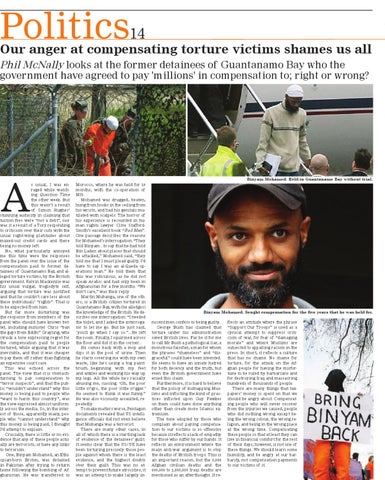
Binyam Mohamed: Held in Guantanamo Bay without trial. Morocco, where he was held for 18 months, with the co-operation of MI5. Mohamed was drugged, beaten, hung from hooks in the ceiling from his wrists, and had his genitals mutilated with scalpels. The horror of his experience is recounted in human rights lawyer Clive StaffordSmith’s excellent book “Bad Men”. One passage describes the reasons for Mohamed’s interrogation. “They told Binyam...to say that he had told Bin Laden about places that should be attacked,” Mohamed said, “they told me that I must plead guilty. I’d have to say I was an al-Qaeda operations man.” He told them that this was ridiculous, as he did not speak Arabic and had only been in Afghanistan for a few months. “We don’t care,” was their reply. Martin Mubanga, one of the others, is a British citizen tortured in Guantanamo Bay, with (he alledges) the knowledge of the British. He describes one interrogation: “I needed the toilet, and I asked the interrogator to let me go. But he just said, "you'll go when I say so.”...He left the room. Finally, I squirmed across the floor and did it in the corner... He comes back with a mop and dips it in the pool of urine. Then he starts covering me with my own waste, like he's using a big paintbrush...beginning with my feet and ankles and working his way up my legs. All the while he's racially abusing me, cussing: ‘Oh, the poor little n*gro, the poor little n*gger.’ He seemed to think it was funny.” He was also viciously assaulted, repeatedly. To make matters worse, Pentagon documents revealed that US intelligence officials did not even believe that Mubanga was a terrorist. There are many other cases, in all of which there is a startling lack of evidence of the detainees’ guilt. It seems clear that the US/UK have been torturing precisely those people against whom there is the least evidence, and the highest doubts over their guilt. This was no attempt to prevent future atrocities; it was an attempt to make largely in-
Binyam Mohamed: Sought compensation for the five years that he was held for. nocent men confess to being guilty. George Bush has claimed that torture under his administration saved British lives. Far be it for me to call Mr Bush a pathological liar, a monstrous falsifier, a man for whom the phrases “shameless” and “disgraceful” could have been invented. He seems to have an innate hatred for both decency and the truth, but even the British government have enied this claim. Furthermore, it is hard to believe that the policy of kidnapping Muslims and inflicting the kind of practices inflicted upon Guy Fawkes on them could have done anything other than create more Islamic extremism. The tone adopted by those who complain about paying compensation to our victims is so offensive because it reflects a lack of empathy for those who suffer by our hands. It reflects an environment where the main anti-war argument is to stop the deaths of British troops. This is an important reason, but the 3,000 Afghan civilian deaths and the 600,000 to 1,000,000 Iraqi deaths are mentioned as an afterthought. It re-
flects an attitude where the phrase “Support Our Troops” is used as a cynical attempt to suppress criticism of war, for fear of “damaging morale” and where Muslims are subjected to appalling racism in the press. In short, it reflects a culture that has no shame. No shame for torture, for the attack on the Afghan people for having the misfortune to be ruled by barbarians and for destroying Iraq and massacring hundreds of thousands of people. There are many things that taxpayers’ money is spent on that we should be angry about. Compensating people who will never recover from the injuries we caused, people who did nothing wrong except being the wrong colour, the wrong religion, and being in the wrong place at the wrong time. Compensating these people so that at least they can live in financial comfort for the rest of their days, however, is not one of these things. We should learn some humility, and be angry at our barbarity, not compensation payments to our victims of it.