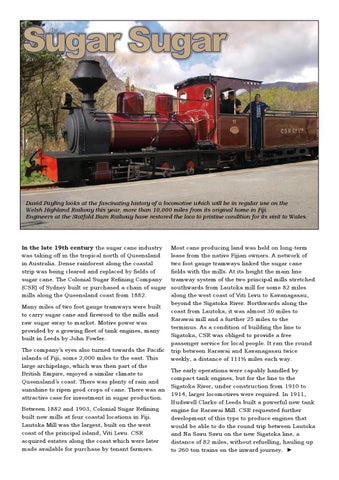
David Payling looks at the fascinating history of a locomotive which will be in regular use on the Welsh Highland Railway this year, more than 10,000 miles from its original home in Fiji. Engineers at the Statfold Barn Railway have restored the loco to pristine condition for its visit to Wales.
In the late 19th century the sugar cane industry was taking off in the tropical north of Queensland in Australia. Dense rainforest along the coastal strip was being cleared and replaced by fields of sugar cane. The Colonial Sugar Refining Company (CSR) of Sydney built or purchased a chain of sugar mills along the Queensland coast from 1882.
Many miles of two foot gauge tramways were built to carry sugar cane and firewood to the mills and raw sugar away to market. Motive power was provided by a growing fleet of tank engines, many built in Leeds by John Fowler. The company’s eyes also turned towards the Pacific islands of Fiji, some 2,000 miles to the east. This large archipelago, which was then part of the British Empire, enjoyed a similar climate to Queensland’s coast. There was plenty of rain and sunshine to ripen good crops of cane. There was an attractive case for investment in sugar production. Between 1882 and 1903, Colonial Sugar Refining built new mills at four coastal locations in Fiji. Lautoka Mill was the largest, built on the west coast of the principal island, Viti Levu. CSR acquired estates along the coast which were later made available for purchase by tenant farmers.
Most cane producing land was held on long-term lease from the native Fijian owners. A network of two foot gauge tramways linked the sugar cane fields with the mills. At its height the main line tramway system of the two principal mills stretched southwards from Lautoka mill for some 82 miles along the west coast of Viti Levu to Kavanagasau, beyond the Sigatoka River. Northwards along the coast from Lautoka, it was almost 30 miles to Rarawai mill and a further 25 miles to the terminus. As a condition of building the line to Sigatoka, CSR was obliged to provide a free passenger service for local people. It ran the round trip between Rarawai and Kavanagasau twice weekly, a distance of 111½ miles each way. The early operations were capably handled by compact tank engines, but for the line to the Sigatoka River, under construction from 1910 to 1914, larger locomotives were required. In 1911, Hudswell Clarke of Leeds built a powerful new tank engine for Rarawai Mill. CSR requested further development of this type to produce engines that would be able to do the round trip between Lautoka and Na Savu Savu on the new Sigatoka line, a distance of 82 miles, without refuelling, hauling up to 260 ton trains on the inward journey. ►