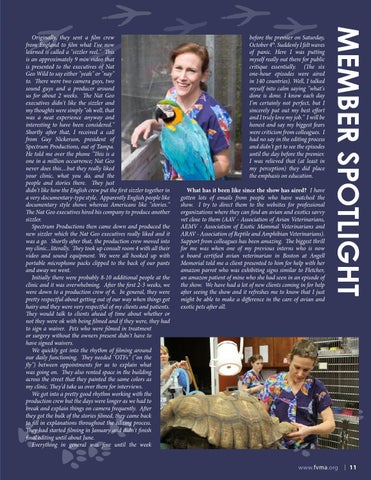
before the premier on Saturday, October 4th. Suddenly I felt waves of panic. Here I was putting myself really out there for public critique essentially. (The six one-hour episodes were aired in 140 countries). Well, I talked myself into calm saying "what's done is done. I know each day I'm certainly not perfect, but I sincerely put out my best effort and I truly love my job." I will be honest and say my biggest fears were criticism from colleagues. I had no say in the editing process and didn't get to see the episodes until the day before the premier. I was relieved that (at least in my perception) they did place the emphasis on education. What has it been like since the show has aired? I have gotten lots of emails from people who have watched the show. I try to direct them to the websites for professional organizations where they can find an avian and exotics savvy vet close to them (AAV - Association of Avian Veterinarians, AEMV - Association of Exotic Mammal Veterinarians and ARAV - Association of Reptile and Amphibian Veterinarians). Support from colleagues has been amazing. The biggest thrill for me was when one of my previous interns who is now a board certified avian veterinarian in Boston at Angell Memorial told me a client presented to him for help with her amazon parrot who was exhibiting signs similar to Fletcher, an amazon patient of mine who she had seen in an episode of the show. We have had a lot of new clients coming in for help after seeing the show and it refreshes me to know that I just might be able to make a difference in the care of avian and exotic pets after all.
Member Spotlight
Originally, they sent a film crew from England to film what I've now learned is called a "sizzler reel." This is an approximately 9 min video that is presented to the executives of Nat Geo Wild to say either "yeah" or "nay" to. There were two camera guys, two sound guys and a producer around us for about 2 weeks. The Nat Geo executives didn't like the sizzler and my thoughts were simply "oh well, that was a neat experience anyway and interesting to have been considered." Shortly after that, I received a call from Guy Nickerson, president of Spectrum Productions, out of Tampa. He told me over the phone "This is a one in a million occurrence; Nat Geo never does this....but they really liked your clinic, what you do, and the people and stories there. They just didn't like how the English crew put the first sizzler together in a very documentary-type style. Apparently English people like documentary style shows whereas Americans like "stories." The Nat Geo executives hired his company to produce another sizzler. Spectrum Productions then came down and produced the new sizzler which the Nat Geo executives really liked and it was a go. Shortly after that, the production crew moved into my clinic...literally. They took up consult room 4 with all their video and sound equipment. We were all hooked up with portable microphone packs clipped to the back of our pants and away we went. Initially there were probably 8-10 additional people at the clinic and it was overwhelming. After the first 2-3 weeks, we were down to a production crew of 6. In general, they were pretty respectful about getting out of our way when things got hairy and they were very respectful of my clients and patients. They would talk to clients ahead of time about whether or not they were ok with being filmed and if they were, they had to sign a waiver. Pets who were filmed in treatment or surgery without the owners present didn't have to have signed waivers. We quickly got into the rhythm of filming around our daily functioning. They needed "OTFs" ("on the fly") between appointments for us to explain what was going on. They also rented space in the building across the street that they painted the same colors as my clinic. They'd take us over there for interviews. We got into a pretty good rhythm working with the production crew but the days were longer as we had to break and explain things on camera frequently. After they got the bulk of the stories filmed, they came back to fill in explanations throughout the editing process. They had started filming in January and didn't finish final editing until about June. Everything in general was fine until the week
www.fvma.org  |  11