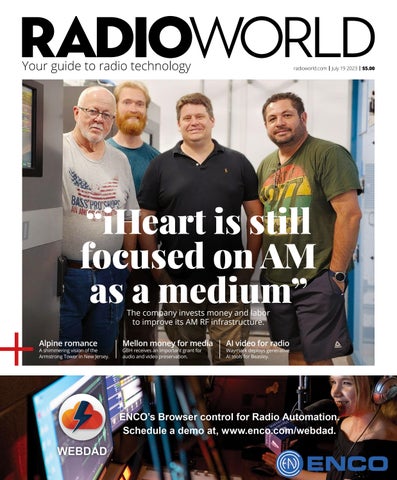
Your guide to radio technology radioworld.com | July 19 2023 | $5.00 “iHeart is still focused on AM as a medium” The company invests money and labor to improve its AM RF infrastructure. Alpine romance A shimmering vision of the Armstrong Tower in New Jersey. AI video for radio Waymark deploys generative AI tools for Beasley. Mellon money for media GBH receives an important grant for audio and video preservation.
Vol. 47
www.radioworld.com
FOLLOW US
www.twitter.com/radioworld_news
www.facebook.com/RadioWorldMagazine
www.linkedin.com/company/radio-world-futureplc
CONTENT
Managing Director, Content & Editor in Chief Paul J. McLane, paul.mclane@futurenet.com, 845-414-6105
Content Producer & SmartBrief Editor Elle Kehres, elle.kehres@futurenet.com
Technical Advisors Thomas R. McGinley, Doug Irwin Technical Editor, RW Engineering Extra W.C. “Cris” Alexander
Contributors: Susan Ashworth, David Bialik, John Bisset, Edwin Bukont, James Careless, Ken Deutsch, Mark Durenberger, Charles Fitch, Donna Halper, Alan Jurison, Paul Kaminski, John Kean, Larry Langford, Mark Lapidus, Michael LeClair, Frank McCoy, Jim Peck, Mark Persons, Stephen M. Poole, James O’Neal, T. Carter Ross, John Schneider, Gregg Skall, Dan Slentz, Dennis Sloatman, Randy Stine, Tom Vernon, Jennifer Waits, Steve Walker, Chris Wygal
Production Manager Nicole Schilling
Group Art Director Nicole Cobban
Senior Design Director Lisa McIntosh
Senior Art Editor Will Shum
ADVERTISING SALES
Senior Business Director & Publisher, Radio World John Casey, john.casey@futurenet.com, 845-678-3839
Publisher, Radio World International
Raffaella Calabrese, raffaella.calabrese@futurenet.com, +39-320-891-1938
SUBSCRIBER CUSTOMER SERVICE
To subscribe, change your address, or check on your current account status, go to www.radioworld.com and click on Subscribe, email futureplc@computerfulfillment.com, call 888-266-5828, or write P.O. Box 1051, Lowell, MA 01853.
Licensing/Reprints/Permissions
Radio World is available for licensing. Contact the Licensing team to discuss partnership opportunities. Head of Print Licensing Rachel Shaw licensing@futurenet.com
MANAGEMENT
SVP Wealth, B2B and Events Sarah Rees
Managing Director, B2B Tech & Entertainment Brands Carmel King
Managing Vice President of Sales, B2B Tech Adam Goldstein
Head of Production US & UK Mark Constance
Head of Design Rodney Dive
FUTURE US, INC.
Future US LLC, 130 West 42nd Street, 7th Floor, New York, NY 10036
All contents ©Future US, Inc. or published under licence. All rights reserved. No part of this magazine may be used, stored, transmitted or reproduced in any way without the prior written permission of the publisher. Future Publishing Limited (company number 02008885) is registered in England and Wales. Registered office: Quay House, The Ambury, Bath BA1 1UA. All information contained in this publication is for information only and is, as far as we are aware, correct at the time of going to press. Future cannot accept any responsibility for errors or inaccuracies in such information. You are advised to contact manufacturers and retailers directly with regard to the price of products/services referred to in this publication. Apps and websites mentioned in this publication are not under our control. We are not responsible for their contents or any other changes or updates to them. This magazine is fully independent and not affiliated in any way with the companies mentioned herein.
If you submit material to us, you warrant that you own the material and/or have the necessary rights/ permissions to supply the material and you automatically grant Future and its licensees a licence to publish your submission in whole or in part in any/all issues and/or editions of publications, in any format published worldwide and on associated websites, social media channels and associated products. Any material you submit is sent at your own risk and, although every care is taken, neither Future nor its employees, agents, subcontractors or licensees shall be liable for loss or damage. We assume all unsolicited material is for publication unless otherwise stated, and reserve the right to edit, amend, adapt all submissions.
Radio World (ISSN: 0274-8541) is published bi-weekly with additional issues in February, April, June, August, October and December by Future US, Inc., 130 West 42nd Street, 7th Floor, New York, NY 10036. Phone: (978) 667-0352. Periodicals postage rates are paid at New York, NY and additional mailing offices.
POSTMASTER: Send address changes to Radio World, PO Box 1051, Lowell, MA 01853.
Group chats help Dan learn
Engineer Dan Grimes is enjoying the benefits of Signal
When you want to learn about a new radio technology and discuss it with peers, where do you turn?
3 From the Editor
4 Newswatch
5 Mellon money helps preserve public media content
Please recycle. We are committed to only using magazine paper which is derived from responsibly managed, certified forestry and chlorine-free manufacture. The paper in this magazine was sourced and produced from sustainable managed forests, conforming to strict environmental and socioeconomic standards.
Paul McLane Editor in Chief
Facebook? A legacy listserv? An internal email group at your company?
Dan Grimes, a maintenance engineer at SOS Radio Network, is part of a chat group on the secure messaging app Signal that discusses engineering stuff. He finds this much more efficient than networking on broader social media.
“Facebook and Instagram are good, but it’s the oneto-ones like Signal and WhatsApp that I like. On other platforms, someone will say ‘Look what I did’ and everybody thinks ‘I want to do that,’ but you have to go off and start researching it. On Signal when someone says ‘Look what I did,’ you can ask them ‘How?’ and get some real answers immediately.”
Dan discovered Signal when he joined a bible study chat group. He and several engineering colleagues then formed a group called Multi-Gen, a name chosen because the group includes a range of ages including several young engineers.
He thinks the best size for one of these little private communities is around a dozen people. “If you get too many it gets to be real noisy. You have to have a balance, enough people doing different things to keep it interesting while keeping the chat down and making it functional.”
Signal is free and owned by a nonprofit; it uses your phone’s data connection. It emphasizes privacy and a lack of ads or tracking. You can make voice and video calls with no long-distance charges; you can share text, voice messages, photos, videos and files. But it’s the group chat that Dan likes best.
Do you have a favorite way of connecting with peers?
Let me know at radioworld@ futurenet.com
8 Workflows demand a cohesive approach
FEATURES
10 Don Norwood’s low-profile rolling rack solution
14 History above the treetops
18 “iHeart is still focused on AM as a medium”
24 How audio takes consumers down the funnel to purchase
26 Waymark brings AI-generated video to radio
OPINION
29 Readers’ Forum
No.
18 | July 19 2023
Future’s 2022 B2B Publication of the Year
THIS ISSUE NEWS
On the cover iHeartMedia’s Randy Mullinax, Nic Blomstrand, James Gay and Oscar
are shown during the WIOD(AM) project. See page 18. 3
Dan Grimes
Franco
“Franken FMs” to Be Grandfathered?
The FCC was expected to approve an order at its July meeting that would allow 14 digital LPTV stations to also air analog audio just below the regular FM band.
“The record in this proceeding reflects widespread recognition of the long history of public interest benefits provided by existing FM6 LPTV stations’ FM6 operations,” it states.
Radio broadcasters including National Public Radio and other noncommercial educational entities historically have opposed the idea. But both NPR and the NAB have since dropped their opposition to grandfathering the remaining active stations.
Most of the 14 have been on the air with STAs since the digital TV transition killed off many of their peers. Under the FCC draft, they must provide at least one stream of synchronized video and audio programming on the ATSC 3.0 portion of the spectrum at any time the station is operating. The FCC believes its rules will ensure that these stations “are first and foremost LPTV stations,” rather than operating with minimal video services.
The FCC plan would not allow expansion beyond the grandfathered 14. It also would not adopt an NPR proposal to repurpose unused Ch. 6 spectrum for FM stations.
AGs Press Carmakers on AM Radio Issue
Attorneys general in 16 states joined the choir of concern about carmakers removing AM radio from some vehicles.
The AGs, all Republicans, sent a letter to the Electric Drive Transportation Association and the Zero Emission Transportation Association expressing concern “regarding the decision of many of your members to eliminate AM radios in electric cars.”
The letter points out that “Notably … multiple electric car manufacturers have decided not to phase out AM radio. These decisions suggest that the real problem is not signal interference but a failure of certain automobile manufacturers to appreciate the importance of AM radio.”
The AGs of Alaska, Arkansas, Florida, Idaho, Indiana, Iowa, Kentucky, Louisiana, Mississippi, Montana, Ohio, South Carolina, South Dakota, Utah, Virginia and West Virginia signed the letter.
They noted AM’s role in public alerting, reliability in emergencies, broad geographical coverage and role in rural communities.
“The decision to eliminate AM radios is even more problematic in light of the Biden administration’s goal of ‘having 50 percent of all new vehicle sales be electric by 2030.’ While we oppose the Biden administration’s efforts, they underscore that removing AM radios from electric cars threatens the entire AM radio industry,” they wrote.
“Without access to their main consumers — automobile owners — AM stations, and the lifesaving signals they provide, might cease to exist.”
4 Newswatch
Writer James Careless
Mellon money helps preserve public media content
Major grant boosts the American Archive of Public Broadcasting
In a bid to preserve historically significant U.S. public radio and television programs, the Mellon Foundation recently awarded GBH $16 million to support the American Archive of Public Broadcasting.
AAPB is a joint venture of GBH, a major multiplatform creator in public media based in Boston (known as WGBH until late 2020) and the Library of Congress.
The archive digitizes, preserves and makes available content that otherwise might be lost due to the degradation of its recording media — or because people just throw stuff in a dumpster.
The AAPB was initiated by the Corporation for Public Broadcasting with a series of pilot projects before granting stewardship to the Library of Congress and GBH in 2013.
This grant money builds on previous Mellon Foundation support for the AAPB. It is the largest private philanthropic grant that GBH has ever received.
The funding will be used to identify, digitize, catalog and store content suitable for preservation, up to 150,000 items — doubling the size of AAPB’s collection. It is also intended to help develop open-source digital tools to improve content management, enhance the AAPB’s website (www.americanarchive.org) and build a culture of content preservation in the public media community.
“This grant will help us find the pockets of material that are deteriorating on obsolete media, that we are at risk of losing forever,” said Karen Cariani, the David O. Ives Executive Director of the GBH Archives and GBH project director for the AAPB.
“The main thrust of the grant is to get that material into a stable digital preservation format and include it in the AAPB archive so it can be more accessible and better known.”
The grant runs for four years, which is why GBH and the Library of Congress feel a sense of urgency to get this project moving. But the time pressure isn’t just about the availability of money.
“We know the audio tape from radio recordings will not last forever, and in some instances we’ve already found degraded material,” said Alan Gevinson, the Library of Congress’ special assistant to the chief of the National Audio-Visual Conservation Center and the AAPB project director at the Library of Congress.
“This is an urgent project that needs to be done now so that this material will survive for future generations.”
Range of voices
In order to maximize the representative variety and diversity of content being added to the AAPB under this grant, GBH and the LOC are reaching out to public radio and TV stations as well as producers who have created content for them over the years.
Cariani said that includes looking for award-winning material that may have aired once and was never heard of again. “We’re also going to continue to reach out to our community of users for content suggestions, which include scholars, journalists, filmmakers, students, educators and the general public.”
Right Karen Cariani
5 radioworld.com | July 19 2023 Radio Preservation
The author wrote about the Sangean MMR-99 radio in the July 5 issue.
Even now, the content being protected by the AAPB comprises a range of formats. For instance, “we recently received over 8,000 programs from Radio Bilingüe. This is a Spanish-language bilingual public network in the U.S. that goes into Mexico as well and that’s been around since around 1980,” Gevinson said.
“We also have a wonderful series called ‘Focus 580’ from WILL at the University of Illinois Urbana-Champaign, which was a great talk show. Whenever anybody of interest would come to the university to lecture, they would grab ’em and do an interview with them.”
“I want to point out the ‘Woman’ TV series out of Buffalo, New York,” said Cariani. “Its producer had heard about the AAPB and had been dying to get this talk show series that she had done in the 1970s on WNED in Buffalo out there again. She worked with us and the station, and we saved the entire series. It’s about women’s issues from the 1970s, and she’s got journalists and writers and scholars and activists speaking on the show. It’s really quite wonderful.
“On public radio, one of my favorites is ‘KEXP Live Performances,’” she added. “KEXP is a public radio station in Seattle and they have about 2,000 recordings of live music from the 1990s to the 2000s.”
Time and technology
Finding significant public media content for the AAPB is the first step in the preservation process. The second is to have that content digitized by third-party providers, because to play the content for digital capture, they have to use obsolete audio gear including 1/4inch audio reel-to-reel, cassette and DAT tape machines as well as Betacam 1/2-inch and U-Matic 3/4-inch cassettes and 1- and 2-inch video tape machines.
“We’re using a vendor to do this digitization in bulk, which makes it significantly cheaper and faster,” said Cariani. “Right now, they are actually out scouring the internet looking for used decks everywhere. If they can’t buy them on eBay, they’ll buy them on Craigslist.”
Meanwhile, many of the playback heads on the AAPB vendor’s stock of tape machines are wearing out, and new ones are also hard to find. So are technicians who know how to run this equipment, as baby boomers retire.
“This is why we’ve developed a fellowship program to train future archivists how to use some of this obsolete equipment,” Cariani told Radio World. “In the process of doing that, we are providing universities with the actual equipment. Unfortunately, we are finding it extremely difficult to obtain this older equipment. Doing so is as much of a challenge as tapes disintegrating.”
Stations are encouraged to contact AAPB with information about tapes and materials in their collections in need of preservation. Email aapb_notifications@wgbh.org.
Top Materials at KMUW(FM) in Wichita, Kan., are among the assets to be preserved with the help of the Mellon grant.
Above Alan Gevinson
Online trove Learn more about the American Archive of Public Broadcasting at https:// americanarchive. org/
The clock is ticking on saving the best of analog-recorded U.S. public radio and TV content (and their commercial equivalents too).
Stations and producers who do donate content to the AAPB should also “keep the originals for as long as possible, because you never know,” said Cariani. “The original recorded content is obviously always going to be the best copy until it’s unplayable. Of course, a lot of public media stations are short on space, so once the material’s been digitized, they want the storage room that housed those tapes back for something else, so often the tapes get destroyed. But we encourage people not to do that.”
“
” 6 radioworld.com | July 19 2023 Radio Preservation
This grant will help us find the pockets of material that are deteriorating on obsolete media, that we are at risk of losing forever.
Workflows demand a cohesive design approach
Mike Dorris of Inrush talks about trends in consoles and their related workflows
Mike Dorris is a managing partner at Inrush Broadcast Services, a Chicagobased integration firm. He talked with us for the ebook “Trends in Consoles 2023,” available at http://radioworld. com/ebooks.
Mike what’s the most important trend in console design?
Mike Dorris: The migration from fixed-purpose console engines to software-based mixing architectures. The ability to use any available compute resource — on-prem server, public cloud, etc. — is critical to increasing flexibility, minimizing real estate requirements and maximizing cost efficiency.
What will the console of the future look like, if we use one at all?
Dorris: We will always use a console of some kind for live production, but for many workflows, pulling a console up on a laptop at home will become just as effective as walking into a physical studio. The console will remain the center of any live broadcast studio as the necessary component to combine standard audio mixing/ routing with machine logic, muting and other customizable functions.
How widely have radio broadcasters adopted “glass” surfaces?
Dorris: We’ve helped several large and medium broadcasters who are widely adopting glass surfaces. Some other large broadcasters have merely dipped their toes in the water.
The big blocker for all adopters is how to provide tactile feel of faders and buttons to an operator. Veteran talent operate without actually looking at the surface, so switching to a glass surface that provides no real tactile response is incredibly challenging for live shows.
A good combination these days seems to be physical surfaces for
Writer Paul McLane Editor in Chief
on-air studios, and glass for production rooms where precise timing isn’t a concern.
What can be done now with scripting?
Dorris: It’s a mistake to view scripting and designing custom workflows as merely an additional add-on feature. In some cases, the scripts or workflows we have designed and written wrap around every major function of the consoles and ancillary equipment, adding facility-wide functionality that is crucial to the operational success of the broadcaster.
Modern-day integration is not just wiring the equipment; that’s only the bare minimum. The biggest impact we make for our clients today is integrating disparate software and hardware components into a unified, cohesive system.
How did the pandemic and explosion in hybrid workflows influence the design of broadcast consoles and related infrastructure?
Dorris: It has made any consoles sold today without fully functional remote-control capabilities not worth buying. Any console you purchase today should allow you to push every button, see every screen and understand exactly what your console is doing remotely. Excluding motorized faders, you should be able to do everything you would in front of the console from anywhere; any console that doesn’t offer that isn’t worth considering as your next investment.
Any suggested best practices for someone who is setting out to make a console system buying decision?
Dorris: It’s much easier said than done, but try to pick a console that is more flexible than you think you need. Getting locked into a console that has fixed hardware functions will just end up frustrating you later. Finding one with programmable things, even if you don’t need it to be programmable right now, makes your life easier when two years from now somebody needs a button to start the coffee pot.
Below Mike Dorris
8 radioworld.com | July 19 2023 NewsMaker
John Bisset CPBE
The author is in his 33rd year of writing Workbench. He handles western U.S. radio sales for the Telos Alliance and is a past recipient of the SBE’s Educator of the Year Award.
Don Norwood’s low-profile rolling rack solution
Don Norwood, an engineer with Digitrak Communications, needed to install a 7-foot rack below an HVAC soffit that provided a maximum clearance of 7 feet 3 inches.
To complicate things, the rack would need to be rolled in and out from time to time. A typical mobile base fitted on the bottom, as provided by the rack manufacturer, increased the height by 4 inches, making the assembly too tall for the location.
Roll with it
Help keep Workbench moving!
Send us your tips, which qualify for SBE recertification credit. Email johnpbisset@ gmail.com
Don discovered a variety of appliance moving bases or dollies on Amazon that can help in a situation like this.
These bases are available in a number of adjustable sizes and weight capacities. They add only about an inch to the height of your load and cost far less than mobile bases from rack manufacturers.
Here’s a handy way to make your rack or heavy furniture movable
Right
Above The low-profile wheeled solution.
10 radioworld.com | July 19 2023 Workbench
Here we’re looking at the base of the rack, which has been tipped onto its side. Mounting the wheels to the bottom was easy.
The set Don chose has a capacity of more than a half-ton. It includes three sets of wheels rather than just two. Don doesn’t know how it will hold up to frequent moving, but he only needs to move the rack occasionally and he has had no problems thus far.
The rolling bases are designed for the weight of the load and hold the rack in position. The design allows for adjustment of the length, so it was simple to bolt the wheels to the base.
The first photo on page 10 shows the kit as purchased. The second is a view of the the bottom of the rack, which has been laid on its side, with the movable base visible on the bottom. The third shows the rack resting on the movable base, ready to be loaded with equipment.
Don hadn’t come across these before and imagines they might be useful for other moving needs around the station.
In temporary situations, you only have to tilt the load high enough to
slide the rollers under one edge, one side at a time, so the device should be useful for items that are too bulky for a hand truck or too heavy to slide without some sort of assistance. Search for low-profile appliance or furniture dollies. The “Koutey 37 Moving Dolly With Wheels” for instance is rated for 1,500 pounds and costs about $30.
“Old” can work forever
After cleaning up his Western Electric REP-93A coil set, as discussed here recently, broadcast engineer Ron Hogg read the patent dates on the transformer. He saw January 1, 1916, and June 27, 1922.
His 93A version is a dual coil in a cast iron housing. Ron writes that those dates just go to show you how very long this technology has been around ... and still working great for 600/600 ohm isolation!
And San Francisco’s Bill Ruck also writes in to let us know that Western Electric specified a frequency range of 35 to 8000 cycles per second!
Speaking of program audio…
Florida engineer Wayne Eckert shared a story involving a 66 block,
those punch-down blocks that were common around analog telephone facilities and radio stations.
Trouble was called in by a station that lost its wired STL. They fell back to a wireless 900 MHz link, but it was marginal. The wireline link was a Special Circuit, so it received a priority dispatch.
The telco technician quickly determined there was no program audio at the handoff, which pushed the trouble back to Customer Provided Equipment (CPE).
This did not please the chief engineer, who demonstrated to the telco technician that there was audio coming from the studio, being fed from a different 66 block. Using a butt set, the technician listened to the audio and confirmed this. The technician removed his punch tool and, using the base of the tool, smacked the 66 block. The problem was solved and there was now program audio on both 66 blocks!
The moral of the story: It’s been Wayne’s experience that original 66 blocks are not designed to crossconnect circuits that are not carrying battery (48 VDC) and can give the engineer intermittent headaches at the worst possible time! Wayne suggests looking up the term “sealing current” to find out what happens.
nautel.com/HD HD MULTICAST+ Combined Importer/Exporter with optional Orban audio cards
12 radioworld.com | July 19 2023 Workbench
Above The completed rolling base, adjusted for the size of the rack.
History above the treetops
After we published a striking photo of an AM tower array at dusk in the May 24 issue, readers responded to our invitation to send more pictures that capture the romance of radio.
Here is the distinctive 400-foot, threearmed tower built by Edwin Howard Armstrong in Alpine, N.J., overlooking the Hudson River north of New York City. The Major built it in 1937 for use in his work that led to modern FM radio. This was the site of the world’s first FM broadcast station, W2XMN; its callsign is still etched in cement above the front door of the original station building on the site.
The photo was taken by Dave Amundsen, director of engineering of the tower’s current owner K2 Communications, in January of 2010. (You can learn about K2 at https://k2communications.net/ about/history/.) It was forwarded to us by Steve Hemphill, owner and licensee of WA2XMN, the experimental “Armstrong memorial station” that transmits on Armstrong’s old 42.8 MHz frequency.
The tower is also home to the antenna serving Fairleigh Dickinson University’s educational FM station WFDU. The structure continues to support other RF services, and it was a temporary transmitter site for some New York TV stations after the terror attacks in 2001. A building at its base houses the Armstrong Field Laboratory and serves as a museum of FM radio technology.
Send us your photos to radioworld@futurenet.com
14 radioworld.com | July 19 2023 Radio World
Writer
Nick Langan
Above Crews hydroexcavated a pit for the transmission, sample and control lines for the two stations that were added to the Houston site. Sample lines are equal length per the MoM model; excess lengths are coiled and buried to assure that lines stretch or shrink consistently from temperature changes. The crew then shoveled sand into crevices by hand prior to dumping, to keep lines in place and avoid kinking under the weight.
“iHeart is still focused on AM as a medium”
Littlejohn and Mullinax describe recent projects to protect and extend the company’s investment
At a time where the viability of the U.S. AM broadcast band has come under the microscope, what’s the prevailing attitude of iHeartMedia and the 250 AM properties it owns and operates?
Continue to invest, says Jeff Littlejohn.
“iHeart is still focused on AM radio as a medium,” said the company’s executive vice president of engineering and systems integration. “We see the importance AM has not only as an entertainment medium, but for news and information.”
Among other things, Littlejohn strongly believes in AM’s importance for emergency weather coverage. Perhaps nowhere is that more evident than in South Florida.
More than 50% of new vehicles ship with HD Radio technology
In addition to being an iconic AM signal dating to the 1920s, iHeartMedia’s news/ talk 610 WIOD in Miami has received notoriety and awards — including regional recognition from the Associated Press — for its breaking news and weather coverage, notably during Hurricanes Andrew, Katrina and Wilma.
Service during and after emergencies is one reason the Federal Emergency Management Agency values the role of AM stations.
Antwane Johnson, FEMA’s director of the Integrated Public Alert and Warning System (IPAWS), said, “People need to be made aware of threats, hazards and alerts while they are traveling. AM radio has been tested over and over during the most devastating natural disasters, and has withstood them all.”
RF site project
WIOD’s current transmitter site is in an inundation zone in North Bay Village on Biscayne Bay, risking transmission failure during any flooding event. The site is also just two blocks from a 22-story condominium, with concrete and steel almost in WIOD’s nearfield array, which could cause signal degradation.
In 2017 iHeart embarked on a project to move the WIOD site about 15 miles to Bird Drive Basin, just east of Everglades National Park along Krome Avenue.
Randy Mullinax is a leader of iHeartMedia’s engineering Tiger Team, which provides support to new buildouts and
NAUTEL HAS YOU COVERED nautel.com/HDradio
The author wrote in the March 1 issue about Jeff and Joe Geerling’s video tour of the Crestwood Master Tower in St. Louis.
18 radioworld.com | July 19 2023 AM Radio
maintains existing RF sites. He has been at the center of the WIOD move.
“The (new) location in a low-lying, wetlands area is good for propagation, and with a cardioid transmitting pattern, we’d end up sending most of the signal over Miami-Dade and Broward counties,” Mullinax said.
The project encountered several challenges. “Plowing radials into this area is extremely difficult,” Mullinax said, with crews encountering as much as five feet of muck in some areas and caprock boulders just below the surface in others. The COVID-19 pandemic raised supply chain issues, price escalations and closer scrutiny of build permits.
Ultimately, Mullinax was able to proceed thanks in part to a conservation easement via the South Florida Water District, allowing iHeart to build out its facility.
The WIOD buildout uses a Nautel NX50 transmitter, slated to operate 50 kW from a directional four-tower array during the day, with 20 kW at night from a slightly different pattern. AM expert Ron Rackley, prior to his death, was consulted on the filtering system. The site will use Orban audio processing and a Burk Technology facility remote control. Its antenna control system is from Tunwall Radio while WIOD’s phasing cabinets are from Kintronic Labs.
Persevering through the hurdles, Mullinax expects the new site to be live by the start of the peak hurricane season in August.
“We know that listeners depend on stations like WIOD,
Left
A 300-ton crane was needed to stack the towers in Miami. “It was fun to watch the crew use another 100-ton crane to assemble the larger one,” said Nic Blomstrand.
“
” 19 radioworld.com | July 19 2023 AM Radio
As a company, we’re blessed with some really good signals — 1030 WBZ, 700 WLW, 1040 WHO as examples — and we’re committed to making improvements to others where we see a need.
Below
iHeart’s Nic Blomstrand, Randy Mullinax, John McMartin, Rudy Rivas and Ronnie Williams get help from electrical contractor Hamker Enterprises to lift and install the ATU boxes onto the platforms in Miami. The boxes later were firmly anchored (with hurricanes in mind) and grounded.
so we are committed to thoughtful investment that ensures these stations will be reliable in the worst of conditions,” he said.
Littlejohn sees WIOD as emblematic of the importance of the AM medium, as evidenced by studies showing spikes in AM listening when cellular service, for example, might be overloaded.
“AM still has a really large audience,” he said. “As a company, we’re blessed with some really good signals — 1030 WBZ, 700 WLW, 1040 WHO as examples — and we’re committed to making improvements to others where we see a need.”
iHeartMedia AM signals in Honolulu — 590 KSSK, 830 KHVH, 990 KIKI — will also undergo RF enhancements this year.
Seeking more AMs
The company’s launch of BIN, the Black Information Network, in 2020 prompted it to seek several highprofile local marketing and asset purchase agreements, including at 1600 WWRL in New York, 1120 WUST in Washington, 1370 WQLL in Pikesville/Baltimore, Md., and 610 WTEL in Philadelphia.
“With the launch of BIN, there was an obvious need to get coverage in several key markets. We specifically sought out AM signals as a way to accomplish the additional market coverage,” Littlejohn said.
This commitment to AM is also in evidence in Houston. iHeart purchased 1320 KXYZ from Multicultural Radio Broadcasting. The station’s directional array sat on property considered valuable for industrial development.
With MRB willing to sell the station but not the property, iHeart would immediately have to move the facilities. Mullinax’s expertise was instrumental in integrating KXYZ into a triplex AM project in the Houston market.
In fact, iHeartMedia’s KPRC at 950 in Houston was in the same situation as KXYZ, Mullinax said.
“
” 20 AM Radio radioworld.com | July 19 2023
In almost all cases, we’ve found that the discovery of programming on FM leads to listening on AM.
“Its property was in a very industrial area near huge transmission lines and became a problematic site for us. We were already considering the possibility to diplex KPRC with KBME [790 AM, another owned station] right around the time the acquisition of KXYZ came about. We determined that not only would a triplex arrangement work, but an upgrade in signal would be achieved and valuable land freed up.”
iHeart made the decision first to diplex KXYZ with KPRC temporarily, at its legacy site, until the eight-tower KBME site could be built out to accommodate the two additional signals. Featuring Kintronic phasing cabinets and based on design consulting by the Carl T. Jones Corp., the project was completed this year.
Among other “firsts” in his career, Mullinax said, Houston was the first time he has used hydro excavation technology. “Whereas with a backhoe we may have dug through existing transmission lines, with the HydroVac, we were able to push water in the ground, and essentially dig without actually digging,” he said.
At the eight-tower triplex site, KBME runs 5 kW DA during the day and a separate 5 kW nighttime directional array. KPRC runs at 7 kW non-directional during the day and 4.3 kW via a nighttime directional array. KXYZ uses the same three-tower directional array during both day and night, 8.4 kW day and 2.8 kW night.
On the Record
iHeart’s concern for its AM assets is evident in its comments to the FCC about the idea of easing ownership subcaps.
In each of the largest Nielsen markets, a licensee can own up to eight radio stations but a subcap limits a licensee to owning no more than five in each service (AM or FM) in a given market.
While some broadcasters have pushed to eliminate caps in all but the largest markets, iHeartMedia fears that changing FM limits “could exacerbate the competitive disadvantage experienced by AM radio stations relative to FM radio stations.”
The company has asked the commission to eliminate the limits on AMs but retain the local ownership restrictions on FMs. “This moderate, targeted reform would help ensure that AM radio stations continue to provide the indispensable public interest services upon which tens of millions of American consumers rely,” it wrote.
WE
LOVE RADIO
KXYZ is using a new Nautel NX10 main transmitter with Harris DX-10 backup. Both KPRC and KBME have Harris DX-10 mains with Broadcast Electronics AM6A backup. The antenna control systems
iHeart cites the critical role AM plays in keeping the public informed about impending dangers, as well as other benefits. “Due to its lower financial barriers to entry, AM radio serves as an entry point for small businesses, as well as for women and minority entrepreneurs, seeking new or expanded broadcast opportunities at a more reasonable price point than FM,” it concluded.
Above
A drone photo by Nic Blomstrand shows the wetland nature of the WIOD site. The raised transmitter building is at bottom center.
THANK YOU FOR BROADCASTING. Trust that we’re here to support you. 22 radioworld.com | July 19 2023 AM Radio
It touches us. It unites us. It brings us hope and helps us feel less apart.
for all three stations were designed by Tunwall Radio.
“We’re very happy with the results in Houston,” Littlejohn said. “Not only did we save a signal [in KXYZ], but we improved coverage.”
Littlejohn acknowledges the limitations in audio bandwidth with AM, and as such, the company’s approach is to focus modulation on the area the listener is most likely to receive it, between 0 and 5 kHz.
Right
The engineers signed the floor in Miami with the install date before placing one of the transmitters (as marked in the yellow tape). Two new Nautel NX50 transmitters are backed by a BE AM10A moved from the previous site for redundancy.
“Environmental noise certainly wasn’t the issue in 1920 that it is today, and the simplicity of AM is both its strength and weakness. AM coverage is quite robust, but it is limited by physics by what you can do sometimes, so we try to make a tradeoff towards a long-term, high-quality operation.”
iHeart also has implemented FM translators through the FCC’s AM revitalization docket to enhance coverage in urban cores and maintain listenership after dark, such as 850 KOA’s 94.1 in Denver, 700 WLW’s 94.5 in Cincinnati and 1100 WTAM’s 106.9 in Cleveland. Interestingly, Littlejohn sees evidence that new listeners are using these FM broadcasts as a gateway.
“In almost all cases, we’ve found that the discovery of programming on FM leads to listening on AM,” he said.
23 AM Radio
Writer Mark Lapidus
The author is a veteran multiplatform media executive with 30+ years’ experience. He has been writing for Radio World since 1990. Download
report www.audacyinc. com/stateof-audio/ spring-2023/
How audio takes consumers down the funnel to purchase
Audacy challenges an assumption held by many ad buyers
Stay in this business long enough and you’ll see the old become new again.
The concept of the marketing funnel has returned in full force, and rather than fight ad agencies over the theory, Audacy has smartly delivered a report showing them how audio delivers at all levels of the funnel.
The “funnel” theory is commonly attributed to E. St. Elmo Lewis, who in 1889 posited that consumers move from awareness to interest to desire and then to action. Ridiculously, radio/audio somehow has been positioned recently by large agencies as a medium that only works at the “top of the funnel.”
In its “State of Audio: Fuel the Funnel” report, Audacy challenges that proposition by providing examples of how radio/audio works at every level. (Unfortunately, once dogma becomes embedded with ad agencies, especially with young buyers, it’s best to show how your medium works with the system, rather than debate the merits of the marketing theory du jour).
“State of Audio” lays out audio’s effectiveness. This is important to address because according to Forrester, 61% of advertisers want to improve what they call “full-funnel media investment” and say it is “a high or critical priority over the next 12 months.” If ad buyers don’t believe audio can move consumers through the funnel, the medium will suffer.
Further, in this presentation, the industry gets a significant nomenclature upgrade that speaks to today’s media buyer.
“Audio holds the title as the undisputed leader of brand-building channels — working its magic with the one-two punch of massive reach and beloved and trusted personalities,” according to Paul Suchman, chief marketing officer of Audacy.
“But if you’re thinking of audio as just a top-of-funnel play — good for sparking a conversation but not driving conversion — think again. The truth is the game has expanded in recent years, and audio is now a truly multipurpose platform.”
Thanks to precision targeting, authentic influencers whose listeners follow them across channels and advanced measurement, he said, “marketers are uncovering the bestkept secret in media: audio’s ability to drive impact at every funnel stage.”
I love how Paul positions on-air personalities as influencers, which is truly a fact. I’ve stated this numerous times, because this is the language of the day, understood
the
PM Images/ Getty Images 24 radioworld.com | July 19 2023 Promo Power
Promo Power
by young buyers, who make decisions regarding hundreds of millions of spend.
Three takeaways about the top of the funnel:
1. Radio is a reach machine. Audacy notes that audio reaches 95% of the U.S. population.
2. Use storytelling over “call to action” — This is a much cooler way to reframe commercials to the advertising community. The study encourages “campaigns that warm hearts.”
3. Podcasting at scale with addressable messaging works. Buyers listen to a lot of podcasts and hear talent doing live commercial reads. They know intuitively that this is effective.
“Mid-funnel” key takeaways include precision targeting, frequency, entertainment and trust. Finally, the “lower funnel” discussion focuses on audio being a true companion that travels with the consumer throughout the day, driving loyalty and delivering specific key performance indicators.
It will not take you long to study “State of Audio,” and even if you feel strongly that the funnel theory doesn’t hold water, the presentation is an education for anyone who understands the need to update radio’s positioning to advertising agencies.
You can download it at www.audacyinc.com/state-of-audio/ spring-2023/
Source: Nielsen Commspoint Channel Plot; Bubble size indicates maximum possible reach of channel; Social network = Facebook, Twitter, Instagram, TikTok, and Pinterest.
$
37% 35% 33% 31% 29% 27% 15% TRIAL CPM Internet ads Search Online video Instagram Facebook TikTok Pinterest Twitter Radio Streaming Radio Podcasts Audio Broadcast Digital Social network TV CTV
Check out how Radio, streaming Radio, and podcast ads compare with other platforms in terms of conversion success and CPM: Media Channel Efficiency
$$$$
25
Above A graphic from “Fuel the Funnel” shows how radio, streaming audio and podcast ads compare with other platforms in terms of conversion success and CPMs.
Writer Elle Kehres Content Producer, Radio World
Waymark brings AIgenerated video to radio
Company aims to help radio navigate CTV and OTT
Recently Waymark signed an agreement with Beasley Media Group to roll out its generative AI technology at Beasley radio stations.
Waymark says its video platform enables local businesses to “generate high-quality commercials with professional voice-over in five minutes or less.” The technology is being used at Beasley stations in Augusta, Ga., Charlotte and Fayetteville, N.C., Detroit, Mich. and Las Vegas, Nev.
The pact is Waymark’s first major step into radio, following national video deals with Spectrum Reach and Gray Television Stations. Waymark also recently expanded its work for Morgan Murphy Media, whose assets include radio stations.
Alex Persky-Stern is CEO.
Can you give us a brief overview?
Alex Persky-Stern: The simplest way to explain Waymark’s platform is that it is an AI-based video generator. It allows users to create a complete, ready-to-air commercial in minutes.
Alex Persky-Stern
We formally introduced the video creator in 2017, when we won a Google Demo Day award. At that point, it didn’t leverage any AI to operate. We started incorporating AI in 2020/2021, which is when we really started to see major acceleration in what we could offer in terms of creative power.
Media providers such as broadcasters, cable, streaming services and now radio are using Waymark to open TV advertising to small businesses. Until now, TV advertising has been dominated by large brands because, historically, only large companies with deep pockets could afford to make TV commercials. A single 30-second commercial can take days or weeks to produce, and can easily cost thousands of dollars. That’s time and money that many, many businesses in the U.S. just don’t have.
With Waymark, media providers can offer this affordable, high-quality video creative to their clients as part of an advertising package. They’ve found that this is a major value add for local businesses, and also generates more advertising spend — it’s a win-win for both parties.
Tell us about Waymark’s interest in radio.
Persky-Stern:Company aims to help radio navigate CTV and OTT. The radio industry is constantly innovating and seizing new opportunities to amplify local business marketing — that’s why it’s been an advertising staple for so long. Many radio stations have longstanding relationships with local advertisers. They have that trust and that history, and they also have the expertise and knowledge to see streaming as a powerful new opportunity. Waymark is a natural fit to help them bridge the creative gap that helps them introduce their clients to video advertising in a way they simply couldn’t before.
What are some of the top features of your AI technology?
Persky-Stern: We’ve evolved to a point where we’re using multiple AI models in the platform, and many parts of the experience are AI-driven. Our partners love the AI scriptwriting, where we generate an entire script for a commercial in seconds; the automatic branding that pulls images and creative from a business’ web presence and matches brand colors; and the latest addition — AI voice-over that adds that extra layer of polish to a commercial. All of
Right
26 Artificial Intelligence
these have been major differentiators, while still offering an unprecedented level of ease, speed and affordability to any user.
What has interest been like from radio stations?
Persky-Stern: We’ve seen a really positive response from the industry, especially with regards to selling OTT and CTV advertising.
In fact, the radio industry invented one of Waymark’s most popular uses: as a spec spot creator. In radio, it was a common practice to approach advertising clients with “spec” creative to give them a preview of what their ad could look like. They found this really helped prospects get enthusiastic about the marketing potential there. There was no way to use that “creative-first” sales approach at scale before Waymark entered the picture. Now there is, and the account executives that use it report very powerful results.
How would you address the concerns that many broadcasters share about the implementation of AI into everyday work life and the potential disruption to jobs and trusted content?
Persky-Stern: There’s no question that AI will impact the media world. At Waymark, we anticipate that we’ll see a lot of AI content — but the winners in media will be the ones who learn that it’s AI-supported content, not AI-generated content, that’s the most interesting and powerful.
We have a theory called “Humans at the Helm,” which we’ve developed after working a lot with AI ourselves. After a great deal of experimentation, we’ve consistently found that you can use AI to create things very quickly. But when you use a human creative expert to guide and elevate those results, that’s when the most interesting and compelling content comes out.
As more and more businesses adopt AI to create content, they’re going to need to find new ways to differentiate themselves from the sea of other AI content out there; and the answer will lie where it always has: in humans. We expect that what we’ll see with AI will follow the same pattern as every other technological advancement in history — that the humans who learn how to use it to amplify their own skill set will come out on top.
“
” 27 radioworld.com | July 19 2023 Artificial Intelligence
The radio industry invented one of Waymark’s most popular uses: as a spec spot creator.
28 radioworld.com | July 19 2023
in some ways compelling, letter (Opinion section, June 21 issue).
What frosts me, though, is that the industry would perceive that it needs to leverage AI versions of its existing air talent in order to increase the amount of locally relevant (pronounced “engaging and audienceretaining”) content.
If the station owners weren’t so, uh, thrifty and hadn’t believed that they needed to move to voice-tracking methodology to save The Almighty Dollar, they would still have that relevant content ... and would likely have retained a lot of the listeners they’ve lost to alternatives over the preceding decades.
It’s been said that advertising doesn’t cost, it pays. I’ve long argued — way before AI personalities came onto the collective radar — in favor of better-quality air personalities and for putting the FUN back into radio.
spreadsheets instead of programming: Just because you can do something that in Excel seems to increase your
Eric Smith
Your ink on the “team” of corporate guys mulling over EAS and how to make HD technology part of it shows how desperate the radio HD proponents are to
The only problem with the EAS is a widespread lack of trained operators at origination points and stations that won’t let the engineers program the system to auto-forward tornado alerts in real time and want the DJs or automation system to play the commercials at a higher priority than the lifesaving warning messages from the weather service.
lawmakers who are so well supported with advertising at I think it is time to turn off the HD jamming signals, play tornado warnings in real time and put the advertising on
Brad Johnson Salida, Calif.
“
” 29 radioworld.com | July 19 2023 Readers’ Forum
Just because you can do something that in Excel seems to increase your bottom-line revenue, doesn’t mean you should.
Speaking up for TIS on AM
The American Association of Information Radio Operators (AAIRO.org) is a national group of local and federal government officials who operate 10-watt AM TIS radio stations across the country solely to provide safety information to the public.
During nonemergency times, these noncommercial stations provide public service content such as parking, highway construction, special event and traffic information on a day-to-day basis. But when conventional forms of communication are compromised by wildfire, hurricanes or floods in specific areas, TIS radio stations serve as a critical backstop so emergency managers can keep the public informed.
Many TIS stations are situated in remote locations that do not have reliable cellular service and/or do not have a local broadcaster. For these reasons, the passage of the “AM for Every Vehicle Act” is of particular importance to our members and their communities. In short, the disappearance of AM radio receivers in vehicles would eliminate a service upon which millions of Americans rely daily.
Because a 10-watt signal is much more vulnerable to interference from any number of sources than the signal of even the smallest AM broadcast station, we encourage the writers of the final bill language to consider stipulating in their definition of AM reception that it be heard “clearly, without the presence of vehicle-generated interference.” At present, the bill only requires that an AM receiver be installed in each vehicle, without regard to the quality of reception. Not only will TIS reception benefit from this clearer standard, but so will the long-range reception of the AM signals from the 50,000-watt stations that are responsible for carrying national EAS broadcasts.
We suggest the following addition to the “AM for Every Vehicle Act”:
“RECEIVE — The term ‘receive’ means to receive a broadcast signal via over-the-air transmission and produce it clearly without the presence of vehicle-generated interference.”
On behalf of the AAIRO and the hundreds of agencies we serve, we strongly encourage Radio World readers to bring this point to members of Congress who serve their districts in an effort to further improve this time-sensitive, important legislation.
To quickly find your congresspeople, go to http://Congress. Gov/members and enter your Zip code. Contact info for each congressperson in your district will appear.
Bill Baker American Association of Information Radio Operators (AAIRO.org) Zeeland, Mich.
AM in EVs
I read about the difficulty of receiving AM signals in electric vehicles and would like to know: Which vehicles?
Since 2014 my wife and I have had several hybrids and wondered if a jump to fully electric would work for us. On the last day of 2020 I got an incredible two-year lease on a new Nissan Leaf model SV electric vehicle.
I loved the car. How it handled and accelerated. The roominess for a small hatchback. How it could charge on 110V (trickle), 220V (level 2) as well as 440V (CHAdeMO) fast charging. Its drawback was a range of 160 miles.
How
submit
But it had AM-FM-HD Radio with SXM and Bluetooth. Not only did it have great sound including FM HD channels, but analog AM was rock-solid and clear as could be. It sounded great near Baltimore listening to music on digital-only WWFD 820 in glorious, dare I say it, AM stereo!
Even on the last day of 2021 when my “free charging” credit ran out, I was listening from Conshohocken, Pa., to my colleague John Records Landecker on “New Years 70s Eve” on WGN 720 Chicago at 9 p.m. … while fast-charging on an EVGO pay unit!
We’ve all experienced good and bad radios in cars but don’t tell me you can’t listen to AM in an EV. You just need a good radio and Nissan has one.
Above TIS system sign approaching the South Rim of Grand Canyon National Park.
J.R. Russ Conshohocken, Pa.
to
Radio World welcomes comment on all relevant topics. Email radioworld@ futurenet.com with “Letter to the Editor” in the subject field.
30 radioworld.com | July 19 2023 Readers’ Forum
Information Station Specialists
9000