INTERNATIONAL EDITION Distributed to Europe, the Middle East, Africa, Asia, Australia, the Pacific, Canada, the Caribbean and Latin America
INSIDE PROGRAMMING
|
The News Source for Radio Managers and Engineers
|
RADIOWORLD.COM
Radio Holds Its Own at the 2018 Winter Olympics
CBC Radio
MAY 2018
advertisement
CBC Radio’s Jamie Strashin at the ski jump venue.
Courtesy of Medialaan
Although TV coverage dominated, radio broadcasters produced medal-quality coverage too BY JAMES C ARELESS • Joe goes live from a swimming pool as a grand finale to a month-long no alcohol campaign — Page 8
Lameck Masina
EN FRANÇAIS
• L a programmation dynamique du Times Radio aide à attirer plus d’auditeurs — Page 14
PYEONGCHANG, South Korea — As
they usually do, sports fans across the globe turned to television (and TV content streamed on the web) to follow the 2018 Pyeongchang 2018 Olympic Winter Games. After all, sports are best suited to be seen, as well as heard. Yet radio played its part in covering the 2018 Olympic Winter Games, as proven by the studio facilities assigned to radio in the International Broadcast Center. Managed by Olympic Broadcasting Services, the IBC was located in the Alpensia resort where many of the Olympic sports competitions (such
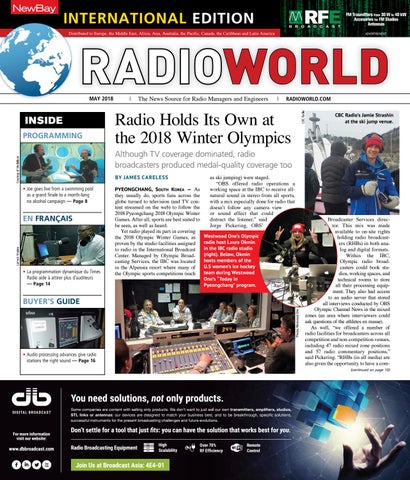
as ski jumping) were staged. “OBS offered radio operations a working space at the IBC to receive allnatural sound in stereo from all sports, with a mix especially done for radio that doesn’t follow any camera view or sound effect that could distract the listener,” said Jorge Pickering, OBS’ Westwood One’s Olympic radio host Laura Okmin in the IBC radio studio (right). Below, Okmin hosts members of the U.S women’s ice hockey team during Westwood One’s “Today in Pyeongchang” program.
Photos: Westwood One
BUYER’S GUIDE
• Audio processing advances give radio stations the right sound — Page 16
Broadcaster Services director. This mix was made available to on-site rights holding radio broadcasters (RHBs) in both analog and digital formats. Within the IBC, Olympic radio broadcasters could book studios, working spaces, and technical rooms to store all their processing equipment. They also had access to an audio server that stored all interviews conducted by OBS Olympic Channel News in the mixed zones (an area where interviewers could ask questions of the athletes en masse). As well, “we offered a number of radio facilities for broadcasters across all competition and non-competition venues, including 47 radio mixed zone positions and 57 radio commentary positions,” said Pickering. “RHBs (in all media) are also given the opportunity to have a com(continued on page 10)
You need solutions, not only products. Some companies are content with selling only products. We don’t want to just sell our own transmitters, amplifiers, studios, STL links or antennas: our devices are designed to match your business best, and to be breakthrough, specific solutions, successful instruments for the present broadcasting challenges and future evolutions.
For more information visit our website:
www.dbbroadcast.com
Don’t settle for a tool that just fits: you can have the solution that works best for you. Radio Broadcasting Equipment
High Scalability
Join Us at Broadcast Asia: 4E4-01
Over 70% RF Efficiency
Remote Control
radioworld.com | RADIOWORLD
INTERNATIONAL EDITION
◗NEWSWATCH
May 2018
www.radioworld.com FOLLOW US
www.twitter.com/radioworld_news www.facebook.com/RadioWorldMagazine CONTENT Managing Director, Content Paul J. McLane, pmclane@nbmedia.com Content Director Marguerite Clark, rwieditor@nbmedia.com Senior Content Producer — Technology Brett Moss, bmoss@nbmedia.com Content Manager Emily Reigart, ereigart@nbmedia.com Technical Advisers Thomas R. McGinley, Doug Irwin Technical Editor, RWEE W.C. “Cris” Alexander Contributors: Argentina: Jorge J. Basilago; Australia: James Cridland; Bangladesh: Md. Azizul Alam Al-Amin; Barbados: Arturo Valentino; Belgium: Marc Maes; Brazil: Carlos Eduardo Behrensdorf; Canada: James Careless; Chile: Juan G. Buenaventura; El Salvador: Soudi W. Jiménez; Estonia: Urmas Loit; Finland: Tapani Ranki; France: Emmanuelle Pautler; Germany: Thomas Völkner; Greece: Panos Polyzoidis, Andreas Tzanakos; Guatemala: Mario Rivero Nájera; Hong Kong: Martyn Green; Hungary: Drew Leifheit; Iceland: Hans K. Kristjansson; India: Frederick Noronha; Indonesia: Mark Timpany; Ireland: Kevin Branigan; Italy: Davide Moro, Giuseppe Camonita; Kenya: Gregory Lagat; Lithuania: Bernd Trutenau; Macedonia: Igor Isakovski; Malawi: Lameck Masina; Malta: Charles Flores; Morocco: Sébastien Nègre; Netherlands: Hans Knot, André van Os; New Zealand: Nick Gerritsen; Peru: Fernando Saravia; Poland: Cesco van Gool; Portugal: Nuno de Sousa; Serbia: Blazo Guzina; Singapore: Patricia Lee; Spain: Raúl Llarull; Turkey: Tayfun Kesgin; Ukraine: Stanislav Kiselyov; United Kingdom: Lawrie Hallett, Will Jackson, Andy Bantock; United States: John Bisset, Scott Fybush, Randy J. Stine; Uruguay: Eduardo Curuchet, Guillermo Pellegrino, Charly Pérez; Zimbabwe: John Masuku Production Manager Caroline Freeland Senior Design Director Karen Lee ADVERTISING SALES Senior Director of Strategic Accounts, TV/Video/Radio John Casey, jcasey@nbmedia.com, 212-378-0400 x512 VP/Market Expert, AV/Consumer Electronics, Education & Pro Audio Adam Goldstein, agoldstein@nbmedia.com, 212-378-0465 VP/Market Expert, Broadcasting, Cable & Broadband TV Charlie Weiss, cweiss@nbmedia.com, 212-378-0478 SUBSCRIBER CUSTOMER SERVICE To subscribe, change your address, or check on your current account status, go to www.radioworld.com and click on About Us, email newbay@computerfulfillment.com, call 888-266-5828, or write P.O. Box 282, Lowell, MA 01853. ARCHIVES This magazine is available for research and retrieval of select archived articles from leading electronic database and search services, including ProQuest. For microform availability, contact National Archive Publishing Company, 800-521-0600, or search the Serials in Microform listings at napubco.com. Back issues are available. For more information, contact www.proquest.com REPRINTS/PERMISSIONS This magazine may not be reproduced or quoted in whole or in part by printed or electronic means without written permission from NewBay. To obtain permissions, contact Wright’s Media, 877-652-5295.
President and CEO Steve Palm Chief Financial Officer Paul Mastronardi Chief Revenue Officer Tom Rousseau Chief Content Officer Joe Territo Controller Rick Ng EVP/Content & Business Operations Carmel King VP/Digital Media Robert Ames VP/NewBay Plus Joe Braue Managing Director/Europe Mark Burton VP/Audience Development Meg Estevez VP/Content Creation Anthony Savona VP/Information Technology Anthony Verbanac Contact: engage@nbmedia.com 28 East 28th Street, 12th Floor, New York, NY 10016 COPYRIGHT 2018, NewBay Media LLC. All Rights Reserved.
LEGENDARY INVENTOR CHANGED LIFE FOR MANY Trevor Baylis, the inventor of the “wind-up radio” technology that powers many emergency and humanitarian radio receivers today, died at his home on the United Kingdom’s Eel Pie Island (near Twickenham) on March 5. He was 80. “Trevor Baylis deserves groundbreaking credit for the first higher quality windup radio commonly available,” said Bob Crane, radio innovator and owner of the C. Crane Company retail/online electronics store. “His original BayGen radio worked well even if the rechargeable batteries were dead. The audio was pleasing.” Although not personally trained as an engineer, Baylis was fascinated by all things mechanical (an interest encouraged by his engineer father). Following an amateur swimming career — he just missed making it to the 1956 Olympics — Baylis became a professional aquatic entertainer, including performing an underwater act at a Berlin circus. The death of a friend on the trapeze made him realize that “disability is only a banana skin away,” Baylis told the Telegraph newspaper in 2014. In response, “I invented and developed a range of products for the disabled called Orange Aids,” he said. “I made more than 200 products, including one-handed nail clippers and bottle openers.” In 1991, Baylis invented the WindUp/Hand-Crank Radio, which was eventually marketed as the BayGen Freeplay Radio and sold in various bandwidth configurations. The technology works by the user hand-turning a crank that winds up a large internal spring. As the clockwork-style spring unwinds, it turns an
onboard generator that powers the radio. Some Freeplay models can charge a radio’s internal batteries for long-term use, plus the batteries of connected devices such as like smartphones. The wind-up radio’s invention “was pure chance,” Baylis told the Telegraph. “I was watching television in 1991 and there was a program on the spread of AIDs in Africa. They said a good way to tackle it was through educational radio programs, but a lot of the continent did not have access to electricity, and batteries were expensive,” he said. “I had a prototype for the wind-up radio within half an hour,” he continued. “The original ran for 14 minutes before needing to be wound up again, but it improved.” Baylis’ wind-up radio went nowhere until he showed it on BBC-TV’s “Tomorrow’s World” in 1994. This led to a backer coming forward, funding the BayGen FreePlay Radio for sale to aid groups, and eventually consumers as well. The invention of the wind-up radio inspired many manufacturers to come up with similar models; a fact that didn’t help Baylis’ fortunes due to his lack of adequate patent protection. “I got more money from the publicity around the radio than the actual radio,” Baylis told the Telegraph. “These large corporations can circumnavigate your patents.” Nevertheless, Baylis’ invention has made a difference to aid agencies such as Ears to Our World (ETOW), which provides radios to Third World communities. “We still deploy hand-crank radios in Haiti, Kenya, South Sudan, Cam-
Wiki Commons
Vol. 42 No. 5
Trevor Baylis in 2006. Besides inventing the wind-up radio, Baylis was a tireless advocate for inventors’ rights. eroon and other countries where remote areas lack a power grid,” said ETOW Executive Director Thomas Witherspoon. “Although a number of solar options exist, solar radio require forethought — setting it in the sun to charge — whereas hand-crank radios are ready anytime,” he said. “I would note that Trevor has had a profound humanitarian impact,” Witherspoon added. “Although various forms of hand-crank powered devices have been around since before WWII, Trevor made them accessible, affordable and implemented in a portable form factor. His clockwork radio changed the nature of self-powered devices.” “He has touched everyone that knew of his purpose and accomplishments,” said Crane. “His avid supporters included Nelson Mandela, the Queen Elizabeth II, Tom Hanks, and a million C. Crane customers.”
◗MARKETPLACE MediaSales Suite: Wedel Software, an international provider of broadcast software solutions, says it brings a new level of integration and connectivity to the media revenue and customer relationship management landscape. At the recent NAB Show, the company introduced a web-based CRM/Quote/Creative toolset that is integrated with its traffic/billing and analytics to provide a complete end-to-end solution for media companies. The MediaSales Suite brings customer, inventory, and revenue data together in one environment with easy access from any internet-connected device. Wedel Software works with radio, television, and cable organizations worldwide to help them manage their advertising schedules and related revenue. Info: http://wedelsoft.com
— James Careless
3
RADIOWORLD |
@radioworld_news
RadioWorldMagazine
May 2018
RadioHack Drives Lively Radio Innovation Developers and researchers recently met at EBU’s headquarters to share their vision of radio’s future GENEVA — The European Broadcasting Union’s RadioHack event, which takes place each year during the EBU Digital Radio Week, brings together hardware and software developers from various organizations, including non-EBU members, to share projects and ideas. The event aims to push technology a step further by modifying it. Radio is traditionally “live,” but it is safe to say that during each RadioHack, radio becomes “lively!” It is a place where coders, solderers and thinkers collaborate and innovate together, working on new ideas and technologies and exploring how existing ones can be linked together.
in-car hybrid radio receivers. Radio slideshows now appear in lowresolution on a receiver’s display, but on Audi’s prototype attendees could preview the same slideshows in high resolution coming from the RadioVIS service of RadioDNS. “We ask broadcasters to support and implement the RadioDNS
The broadcaster developed a skill for Amazon Alexa that allows listeners to talk to their radio station of choice. As an example, Floris Daelemans, VRT innovation researcher, prompted an Amazon Echo Dot device running Alexa: “Alexa, can you tell Radiohack I’m feeling fine and dandy?” The smart speaker acknowledged the request and whispered “Message has been sent.” In response to this, the system sent an email to the radio station and immediately the dummy RadioHack station received an email reporting that that listener is feeling fine.
Photos: Benjamin Poor, EBU
BY DAVIDE MORO
special interest broadcasters. Moving from one of the nowadays popular IPTV boxes which are very low-cost massproduced things for watching YouTube or Netflix on turn any TV into a smart TV,” he said. At Ofcom we replaced the standard Android operating system IPTV boxes usually run on with a Linux OS.” The new operating system enables researchers to control the hardware and build their own software tools. During RadioHack the modified IPTV box ran a
ASKING BROADCASTERS
Probably one of the least formal events organized by the EBU, RadioHack has no dresscode, and once inside the “laboratory,” participants find evaluation boards, software-defined radio platforms, test-bed hardware, as well as “donor” offthe-shelf devices to be “hacked.” The 2018 edition of RadioHack focused on broadcasting tools for small and community stations, new hybrid services and smart speakers. Matthias Brändli, lead developer for Open Digital Radio, fine-tuned a set of tools capable of turning any computer into a microrange digital audio broadcasting transmitter, and ran a live demo. Open Digital Radio is a nonprofit organization with the goal of enabling small and community radio stations to step from analog transmission to digital radio. “This set of tools have been tested in several locations,” Brändli explained, “and we’ve also been able to prove, using this set of technology tools, that digital audio broadcasting can be used for small coverages and for projects on a small scale.” On another topic, the entertainment system of the current Audi A8 can seamlessly switch across FM, DAB and online streaming emissions of the same station. On hand was Florian Hoffmann, a radio development engineer at Audi who worked at their development platform for
7,500+ AUI Tx Installed nautel.com
AVOID TRIPS SAVE TIME SAVE MONEY
Pictured from left to right are Ola Palm, Sveriges Radio engineer; Jean-Pierre Evain, principal project manager at EBU; Floris Daelemans, innovation researcher at VRT; and Rosie Smith, project manager, Automotive, WorldDAB.
Rashid Mustapha, senior broadcast specialist at Ofcom, explains his “hack” based on IPTV boxes to fellow attendees.
“There are multiple emotions that can be conveyed, easily and immediately shared with radio stations. With this, listeners can give an immediate feedback to the radio station,” Daelemans concluded.
NEXT GENERATION AUDIO
EBU
4
A five-level “importance” tree of a sound bite within the Orpheus Project; each level is presented with a different color on the receiver display.
standard so we can implement these predevelopment features on the next generation entertainment systems released for production,” Hoffmann said.
SMART SPEAKERS
Also during the event, Rashid Mustapha, senior broadcast specialist at the United Kingdom’s broadcasting regulatory authority Ofcom, explained how the organization is facilitating the development of innovative ideas and tools for smaller stations. “We would like to develop new ideas and software tools for small radio stations, specifically community radio and other
DAB source encoder, a DAB multiplexer and a DAB modulator, which fed a software defined radio transmitter via a USB cable. Users were able to upload and store audio content and music files to the same modified IPTV box, which also featured an embedded web-based playout system. “The modified box can also pull web streams and podcasts from the internet, so that it actually contains a complete radio station,” Mustapha added. Software defined radio peripherals and open standard digital radio encoders were part of the hack by Belgium’s Dutch-speaking public broadcaster VRT, which also focused on smart speakers.
Orpheus is a project funded by the European Union, focusing on the research and development of next generation audio. Werner Bleisteiner, creative technologist at Bayerischer Rundfunk explained how speech intelligibility, 3D audio, as well as advanced features like user-definable lengths of sound bites are among the features enabled by the Orpheus project. “We’re going to make audio more interactive and responsive, delivering audio objects to the end user device where they get assembled in the way that suits listening conditions, the preferences, and the choice of the user,” said Bleisteiner. At RadioHack, Bleisteiner demonstrated an audio piece built with five levels of “importance”; each one of them is presented with a different color on the receiver’s display. “In this example, the most important level is highlighted in red,” he said. “In case the listener wishes to listen to more levels, the user experience can become longer and more in-depth regarding information.” Through a dedicated app, developed by the Orpheus partner Elephantcandy, listeners can “readjust the length of the program to their needs.”
May 2018
◗NEWSWATCH KENYA’S NRG RADIO GOES ON AIR WITH LAWO Nairobi-based NRG Radio recently began broadcasting, offering its audience both an audio and visual experience. With Lawo crystal and sapphire radio mixing consoles and RELAY virtual radio mixers, the new local radio station and audio/video streaming A screenshot of the NRG Radio website during a live program. channel uses the tagline, “We’re gonna change the way you listen to music.” NRG Radio’s three IP-based studios feature visual integration for live video streaming to a CDN, social media or other platforms. The project, carried out by systems integrator BYCE Broadcast Systems, involved equipping the three studios, a production room and a central technical area, as well as handling transmission of the broadcast signal. BYCE Broadcast initiated the project by installing a 12-fader Lawo crystal console with integrated router, plus radio automation software with HD video playout capability and six-channel video mixing in studio one. The systems integrator also equipped the second studio with a 12-fader Lawo sapphire console, which can be expanded to 60 faders, and configured the third “virtual” studio around Lawo’s RELAY virtual console. As part of the project, the company also assembled a 24-meter mast at the client’s facility to improve transmission via a microwave point-to-point link to the Limuru broadcasting site where an eight-bay omnidirectional antenna provides coverage of about 100 kilometers. BYCE Broadcast provided the station, which broadcasts on 91.3 MHz in the Nairobi area on or via https://nrg.radio, with staff training.
ROMANIA’S ANCOM PROBING INTEREST FOR DAB Romania’s Autoritatea Naţională pentru Administrare şi Reglementare în Comunicaţii (National Authority for Communications Administration and Regulation — ANCOM), examined people’s interest in digital terrestrial broadcasting, officially launching a public consultation on March 13. Following international regulations on DAB, Romania has obtained two T-DAB national multiplexes and a DVB-T national digital terrestrial multiplex in the VHF (174–230 MHz) and UHF (470–694 MHz) bands, ANCOM announced. Since 2014, the VHF band digital terrestrial multiplex, together with the national and regional UHF band multiplexes, have been through four auctions organized by ANCOM and no operator as of yet has shown interest in acquiring the rights to use it, according to the organization. “The opinions expressed during this consultation will serve to substantiate ANCOM’s decisions on the granting of rights of use for digital terrestrial broadcasting services,” ANCOM said in a press release.
radioworld.com | RADIOWORLD
◗MARKETPLACE LX-Dante Sound Card: Digigram is introducing the LX-Dante sound card into its line of products. LX-Dante bridges professional audio software applications to Dante networks. The new sound card lets users send and receive audio to and from all Dante-enabled products on their network. Using its AES67 compatibility mode, LX-Dante also allows for the exchange of audio content with AES67 capable products.
Digigram explains that LX-Dante is automatically detected and can be configured across a network as a plug-and-play device. In addition, it features two redundant Gbps primary and secondary Ethernet ports, an embedded hardware processor, and, according to the company, offers low latency (150 μs) across standard networks. Supporting 128 x 128 redundant channels, LX-Dante is suite for applications such as such as multichannel playout, multichannel recording and multi-program ad-insertion over Dante networks. Info: www.digigram.com
5
6
RADIOWORLD |
@radioworld_news
RadioWorldMagazine
May 2018
EBU Releases Digital Radio Progress Report, Part II This month we look at DAB digital radio “Embracers” GENEVA — This month, in Part II of our four-part focus of the European Broadcasting Union’s Media Intelligence Service Digital Radio Report 2018, we look at the continent’s DAB digital radio “Embracers.” The 2018 report shows which European countries are leading the way in the transition to digital radio, which are embracing it, countries that recently launched digital radio services and those currently without a market for digital radio. The study offers detailed information on plans for each country in the four categories. According to the EBU, the report aims to “help EBU members and other stakeholders plan their digital radio strategies and support their advocacy initiatives.” We published Part I (“Leaders”) in the April issue of Radio World International, and next month in the June issue, we’ll take a look at the MIS report’s “Newbies” category. The full Digital Radio Report is available at https://tinyurl.com/EBUMIS-2018.
◗MARKETPLACE Bionic Portal: Broadcast Bionics Bionic Portal is a tool for search and insight across all stored content. The system handles auto segmentation and topic detection and allows linking and has recommendation capabilities. Bionic Portal promises to “instantly locate the most shareable and compelling content and extracts multitrack audio, video and metadata directly to your desktop tools.” In addition, Broadcast Bionics has the MOR> multi object recorder, which the company says captures “every element of live radio from the media and mixing telemetry to transcription and face recognition.” Info: http://bionics.co.uk
Introducing Record and Playback on the ViA With the inclusion of record and playback functionality, using Tieline’s ViA is like taking an entire radio studio with you on the road. No longer do you need outboard gear like mixers, compressors, recorders and playback machines – with ViA it is all on-board and ready to go! • Select input sources to record. • View and manage recordings. • Create playlists of local recordings and imported files. • Control playback routing to specified codec encoders, as well as analog and digital outputs. • Produce & record your own broadcast quality podcasts to removable media.
COMING SOON!
+61 (0)8 9249 6688 | info@tieline.com | tieline.com
RADIOWORLD |
@radioworld_news
RadioWorldMagazine
May 2018
Joe’s “Tournée Minérale” Takes Broadcast Underwater Station goes live from swimming pool as a grand finale to month-long no alcohol campaign BY MARC MAES BRUSSELS — As part of the “Tournée Minérale” campaign, commercial radio station Joe persuaded much of its audience to join its “no alcohol-month” group. On Wednesday Feb. 28, to celebrate the conclusion of the month-long campaign, Joe broadcast its evening drive from an underwater on-air studio. “Tournée Minérale” was launched last year by the Stichting tegen Kanker
Santermans and Hans Van Kerckhoven. In the Nemo 33 diving center — the world’s second deepest indoor diving pool — the Joe team installed an on-air studio in a diving bell, at a depth of 5 meters in the 33-meter deep pool.
DIVING BELL
The bell was set up for the broadcast of a one-hour radio show and the presenters were equipped with Sennheiser HMD26 headset-mics and tablets dis-
Photos courtesy of Medialaan
8
Before going underwater, presenters Rani De Coninck (left) and Raf Van Brussel (right) hosted the first part of their show from the Joe mobile studio next to the pool.
to the main Medialaan studio using a Prodys ProntoNet codec plus a redundant Mayah Centauri 3001 ISDN codec backup connection,” explained Boone. “The mobile studio is equipped with a Studer OnAir 3000 console and a Dalet+ playout system.” Both the mobile radio studio and the mobile video truck connected to the Medialaan broadcast center using PSTN intercom lines. The underwater broadcast was also captured by eight cameras serving Joe’s website, app, YouTube and Facebook Live video streaming using a WMT video codec. The underwater camera footage was directed from the OB van’s control room with a SynchroSound Aqua IIB underwater speaker in the pool giving instructions to the diver. In the weeks preceding the Tournée (continued on page 10)
Joe presenters prepared for the project with a four-week diving course.
(the Foundation Against Cancer) and the DrugLijn (Drug Line), which promotes February as “alcohol-free” month. For Joe, Rani De Coninck and Raf Van Brussel, weekday presenters from 4 to 7 p.m., became the advocates of the initiative, convincing listeners to join their group. In turn, the radio-tandem then faced a special defy — to broadcast from underwater at the end of the challenge. This year, in total, more than 100,000 people registered and participated in the special event. To celebrate the campaign’s conclusion, the station organized an underwater broadcast. The technical aspects for show were developed by Medialaan Radio project engineer Iann Castelein, with visual support from Medialaan Production Facilities’ project engineers Frank
playing the program schedule. “The tablets run our in-house Dario software, which serves as a central editing and production system, allowing presenters to prepare their show and monitor program and traffic information,” said Bas Boone, radio technical team leader with Medialaan. “All equipment (mics, headsets, tablets, cameras) were packed in waterproof Peli-cases.” The station installed a waterproof Wi-Fi access point inside the underwater bulb, creating a local Wi-Fi network serving the presenter’s tablets. “The diving bell studio’s signal is connected over fiber to our MLO1 outside broadcast van’s radio setup using a Lawo MC²36 console. The content was returned to the mobile radio set-up, next to the diving pool, and then channeled
The Joe evening drive tandem was on air in the submarine studio, enduring temperatures that exceeded 35 degrees Celsius and 100 percent humidity.
RADIOWORLD |
@radioworld_news
RadioWorldMagazine
Winter Olympics (continued from page 1)
mentary position at the venues to do narration directly where the action is taking place as well as access to a mixed zone to interview an athlete as soon as they are finished with their performance.”
CBC RADIO’S DYNAMIC DUO
Compared to the massive production crews deployed by the world’s television RHBs, the crews fielded by radio RHBs in Pyeongchang were barebones operations. For instance, the Canadian Broadcasting Corp.’s CBC Radio covered the Pyeongchang Games with just two people: Producer Andrew Parker and reporter Jamie Strashin. Working together, CBC Radio’s “dynamic duo” produced “Live” hits (direct to air live commentary), packaged reports and “Raw” audio (athlete interviews) for “Olympic Regional Radio Updates,” and local CBC Radio shows nationwide. Parker and Strashin also filed many reports to the CBC Radio News flagship morning program, “World Report” and the hourly newscast “World This Hour.” “Our priorities were focused on providing as much ‘Live’ coverage as possible to our hourly Olympic Updates, being produced/put to air by two crews in Toronto,”
said Parker. Since he and Strashin had to provide content for morning and afternoon radio shows across Canada’s five time zones, “there was a massive amount of CBC Radio real estate, regional and network, for a two-person crew on-theground to try and fill, especially considering the 14-hour time difference between Toronto and Pyeongchang.” To do this job, CBC Radio built a radio studio in the CBC Sports work-area inside the IBC. This studio consisted of a control room with a small Mackie console connected to a laptop, connected to an external monitor. “On the other side of the glass, in an extremely well-built soundproof booth, there was a table and three comfy chairs,” said Parker. On the table were three Shure SM58 microphones in stands and three pairs of Sony broadcast headphones. This set-up allowed Parker to interview up to three athletes at a time, with him conducting recorded interviews at the board using a control room microphone. “The studio was equipped with a Comrex Access Portable IP codec, so CBC studios at the headquarters in Toronto, or in regional locations across Canada, could connect directly and ‘go live’ or ‘live to tape’,” he said. “This happened on a few occasions with regional CBC shows that wanted to talk directly to an athlete from their city/area.”
May 2018
two announce booths CBC Radio had and a bullpen area,” Eaby also had access to said. “The studios were commentary positions inside the massive NBC rented by CBC Sports footprint at the IBC.” in a number of rink In addition, Westwood venues. For instance, One had commentary at the Gangneung Ice positions — “think tables Arena (figure skating/ in the stands or small short track), a prime booths in a press box,” center-ice location CBC Radio said Eaby — at nine venwas available. CBC Radio’s Andrew Parker ues including Alpine Ski“Our reporter and reporting live at the Pyeongchang ing 1 and 2, Hockey 1 producer (me) went Olympic bobsled track. and Hockey 2, the Olym‘Live’ from this posipic stadium, and the figure skating arena; tion many times, covering two sports among others. where Canadians were continual medal “At each of the nine venues, we had threats, and successfully delivered podia ‘mixed zone’ position in order to conum finishes,” said Parker. “As well, both duct quick one-on-one interviews as they Jamie and I did ‘Live’ hits from many leave the competitive arena,” he said. other venues into CBC Radio shows using “Lastly, our New York studios were a portable Comrex Access with a network staffed by a handful of people 24 hours connection.” a day providing essential production supWWO’S LARGER CREW port back home.” With 19 people on-site, Westwood “Keep in mind that our studios are One’s U.S. radio crew was gigantic combuilt from scratch at each Olympics,” pared to CBC Radio’s twosome — but Eaby noted. “Our technical folks, Zach minuscule against the roughly 2,500 Akey and Leslie Kveton, did an outstandpersonnel fielded by U.S. TV RHB NBC ing job getting us up and running, then Sports in Pyeongchang. to have almost zero technical issues for “Our main hub was inside the three weeks is truly an accomplishment International Broadcast Center in the by them.” Pyeongchang mountain cluster,” said To quote the Spiderman graphic novMike Eaby. He is Westwood One’s V.P. els, with great power comes great responof Sports Administration, coordinating sibility. In the case of Westwood One, producer of its Pyeongchang Olympic having a larger crew (by radio standards) coverage, and one of the 19 people who meant producing an incredible amount of were based at the IBC. “Our IBC studios content during the Winter Games. consisted of six rooms: Main studio, main “Each day (the night before back in (continued on page 12) studio control room, engineering room,
“Tournée Minérale” (continued from page 8)
Minérale event, presenters Rani and Raf took diving courses in the Nemo diving center. On Feb. 28, some 100 Joe listeners witnessed Raf and Rani’s live broadcast from the diving center. During the one-hour underwater program, presenters Sven Ornelis and Anke Bukinckx were the “dry-hosts” in the mobile studio. The program’s playlist featured water-related tracks like Abba’s “Waterloo” and Dire Straits’ “Twisting by the Pool.” “The biggest challenge was broadcasting from an underwater studio, in a glass sphere bowl, where temperatures exceed 35 degrees Celsius and there is 100 percent humidity.” said Castelein. “This is not at all evident.” In addition to the audio, Joe also had two cameras in the sphere capturing images for live feeds and streams. “Outside the diving bell, a cameraman operated a RED camera. In total, we had a technical crew of 15 people
Photo courtesy of Medialaan
10
The underwater studio is located 5 meters under the water.
working here for a week, so this event was quite a big production,” Boone added.
12
RADIOWORLD |
@radioworld_news
RadioWorldMagazine
May 2018
Prepare Your Station for the New EU Data Protection Regulation Radio broadcasters need to begin preparing for the GDPR directive taking effect May 25
◗COMMENTARY BY PHILIPPE HALIN The author is Halin is CEO of NeoGroupe in France and V.P. of NGI Software Inc. in Canada.
rules may appear to have been designed for the data capture of major IT firms, they can also be applied to smaller businesses, and will be enforced by national data protection agencies. In addition, with cloud usage on the rise, personal data is at even a greater risk today. This is due to the presence of “Shadow IT” — apps purchased and used by other departments without the IT department being aware of this usage. Fines for breaching the law can run up to 4 percent of an entity’s group turnover, which can add up to quite a lot of money for those stations that are part of a larger media group.
— What advantages will this new regEuropean Union’s General Data Protection ulation bring? Despite the costs and Regulation (https://www.eugdpr.org), adopted possible hassle associated with workin May 2016, will take effect May 25. All busiing toward compliance, GDPR will cernesses — including those based outside the tainly have some positive consequences. Philippe Halin EU that handle the personal data of EU citiThese include: the reduction of Shadow zens — will thus have to comply with this new IT; enhancement of best practice and ruling, designed “to make Europe fit for the digital age.” accountability within teams; the centralization and GDPR’s introduction follows the wave of data prostreamlining of personal data as well as the ability to tection laws that have been introduced worldwide in the understand which information a company is allowed to last few years. These include PDPA in Malaysia, PDPA use; and increased confidence in your brand. in Singapore and Sarbanes/Oxley in the United States. The regulations are intended to protect the unwar— Do we really collect personal data in our daily ranted usage and storage of personal data and give operation? Yes. Personal data is everywhere in your more power to individuals on how their data is being organization. It starts from a simple email address. processed and maintained. Even the simple task of sending out email listings to Radio broadcasters need to be aware of this new rulsubcontractors must now be traced. A company’s list of ing and prepare accordingly. Here are a few questions employees is also considered personal data. you may ask yourself: — How can I comply? First of all, take a look at your — Will radio stations have to comply? While the internal organization. Reinforce good practice and
MAROLLES EN BRIE, France — The
Winter Olympics (continued from page 10)
the U.S.) we produced a two-hour show that consisted of athlete interviews, highlights and talk covering all the Olympic events,” said Eaby. “We also broadcast each Team USA men’s hockey game, the Team USA women’s preliminary round game against Canada, and both men’s and women’s gold medal games. Lastly, we provided our stations with three Olympic updates (one minute of content) per hour around the clock for 17 days. Our talent was
GVSeries 3.5 kW – 88 kW Digital/Analog FM
nautel.com/GV
Smaller Footprint
GV30
running from place to place, many times calling two events in the same day.”
CHALLENGES AND ACHIEVEMENTS
Clearly, both CBC Radio and Westwood One had a lot of radio content to produce, with only relatively bare-bones crews to get the job done. “As mentioned, the biggest challenge was that there was only two of us,” said Parker. “Best intentions aside, there were few moments when I could do ‘Live’ hits myself because I was too busy coordinating the overall project or rushing to the IBC to do athlete interviews. So ideally, a third person, and in particular, another reporter, would have been invaluable,” he said. “The Alpine skiing proved to be a bit of a mess with all the scheduling issues,” added Eaby. “On three occasions, weather forced the Olympic organizers to schedule two ski events at the same time on two different mountains — and Westwood One only had one announce team. Fortunately, NBC was a huge help in getting us TV feeds from one mountain
General Data Protection Regulation: Are you ready?
double-check data protection, contracts with third parties, registries, etc. Secondly, check the security of your software applications (encryption, user accounts with expiry, data expiry, auto-deletion and proof of consent). Finally, verify your firm’s general IT etiquette — VPS, HTTPS, BYOD [bring your own device] and use strong passwords, server securing, etc. GDPR fulfillment can’t be obtained overnight, and many feel they will not be fully ready in May. However, each station needs to initiate the compliance process as soon as possible in order to demonstrate good intentions in case of an audit. There are also consultants available to help you in this endeavor. With their expertise in software development combined with in-depth knowledge of your business, these professionals can help ensure that your business is on its way to becoming GPDR-compliant.
while in our broadcast booth at another.” With so much to be done, a further challenge was ensuring that everyone didn’t get burnt out too fast, he added. “It’s a cliché, but the Olympics are truly a marathon and not a sprint. Keeping everyone focused while they lack sleep, miss friends and family back home and are running from place-to-place for three weeks is no small task. The Olympics is a grind.” Nevertheless, CBC Radio and Westwood One both created superb radio coverage during the 2018 Winter Games, despite having the smallest of crews and the biggest of missions. And despite the grind, the experience was rewarding for their hard-working crews. “Being able to broadcast Team USA women’s hockey win over Canada to a national audience certainly ranks near the top for us.” said Eaby. “Even though we didn’t do as well as we would have liked from an American perspective, having figure skating, Alpine skiing and snowboarding live during our two-hour show made for some great theater.” “We witnessed so many incredible
moments, at a winter games packed with politics, passion for sport and incredible performances,” added Parker. “Radiowise, you couldn’t get a better sound effect to work with than the exuberant chants of the North Korean cheerleading squads.” All of this begs the question: Does radio still have a meaningful role to play covering the TV-dominated Olympic Games? “Absolutely,” said Eaby. “With the multitude of platforms available nowadays, the public has options in which to consume their Olympics and we think we present a unique and exciting form of it. I’m proud of the coverage we provide to our listeners.” “Without a doubt, TV gets all the spoils — and the Olympic Games give priority to the TV broadcasters,” said Parker. “But in a time when people want a choice on how and when they get their Olympic coverage, radio still matters. Many people continue to count on and appreciate the ability of a good radio storyteller to bring the faraway action into their ears, and imaginations.”
EN FRANÇAIS L’expérience booste Times Radio
RADIOWORLD
Actualités et informations des pays francophones
PAR LAMECK MASINA
BLANTYRE, Malawi — La radio privée
Times Radio se développe rapidement grâce à son contenu éditorial et à la grande expérience média de ses propriétaires. La station est le nouveau bébé de Times Group, le plus ancien éditeur de journaux du pays, dont l’histoire des médias remonte à 1895. Sa direction déclare que la station s’efforce de devenir le meilleur radiodiffuseur du pays. À l’heure actuelle, elle est à la traîne derrière Zodiak Broadcasting, une société privée qui, depuis 10 ans, est élue meilleure station de radio du Malawi lors des prix annuels du National Media Institute pour l’Afrique australe.
Anciennement connue sous le nom de Matindi FM, la station a été acquise en 2015 par le Groupe Times auprès de ses propriétaires, Matindi Broadcasting Station Ltd., qui faisaient face à des contraintes financières dans l’exploitation de la station. Selon Masamba, l’achat de Matindi FM a été le produit d’un grand rêve après leur lancement de la chaîne Times TV en 2012. « Donc, après le lancement de la
L’EXPANSION
Lameck Masina
PARLER À TOUS
May 2018publicité
La radio offre des informations et une programmation locale. « Avec plus de 95 % de programmation locale, dont 50 % en Chichewa, notre objectif est d’offrir une expérience radio qui parle à tous les Malawiens à différents niveaux socio-économiques », dit-elle. La station est surtout connue pour des programmes comme «Galamukani» («Wake Up»), un magazine «breakfast», qui est diffusé de 5 à 8 heures. Il y a aussi «Times Talk», un programme d’actualités avec interventions téléphoniques diffusé quatre fois par semaine de 17h à 18h.
La programmation dynamique aide à attirer plus d’auditeurs
Brian Banda, animateur de l’émission populaire «Hot Current», dans le studio d’antenne de Times Radio à Blantyre.
chaîne de télévision, nous nous sommes rendu compte qu’il y avait une plateforme de plus dans laquelle nous impliquer, et c’était la radio. Nous avons acheté une station connue sous le nom de Matindi FM et nous l’avons rebaptisée Times Radio », a-t-elle déclaré. Le rebranding, dit-elle, impliquait une réorganisation de la programmation, du personnel et du matériel de studio.
« De toute évidence, lorsque nous avons pris le relais de Matindi, il y avait des programmes qui ne correspondaient pas à notre vision. Donc, nous avons dû les supprimer. Nous avons essayé de maintenir tous les membres du personnel, mais évidemment, avec l’évolution des styles de gestion et des exigences de qualification, certains n’ont pu rester », explique Masamba.
◗DU CÔTÉ FABRICANTS DES
14
La vitrine des produits broadcast professionnels les plus recents.
Traitement de l’audio Online : Wheatstone précise que comme les stations traitent davantage de nouveaux contenus — y compris les chaînes streaming — son blade multimode Aura8ip-3 devient de plus en plus populaire. L’Aura8IP-3 est au format 1U, il occupe un espace rack mais intègre huit processeurs audio stéréo multibandes indépendants avec des fonctions AGC, de compression et de limitation pour le streaming web, des fonctions de podcasting et des fonctions audio traditionnelles ou HD Radio. Le processeur audio Aura8IP-3 réunit deux technologies Wheatstone : le traitement audio à très haute résolution et le réseau audio WheatNet-IP. La société affirme que la fusion de ces éléments dans un produit constitue un moyen pratique et économique d’accéder au traitement audio partout où cela est nécessaire sur un réseau WheatNet-IP. Chaque chaîne de traitement consiste en un égaliseur paramétrique à quatre bandes suivi d’un crossover et de trois bandes de compression. Les compresseurs alimentent chacun leurs propres limiteurs, dont les sorties sont ensuite envoyées à un limiteur large bande pour un contrôle de crête serré. L’Aura8IP-3 possède ses propres E/S locales,
avec quatre paires stéréo d’audio numérique AES et quatre paires stéréo d’entrée et de sortie audio de niveau analogique, et peut fonctionner comme un moteur de traitement autonome. Comme il s’agit d’un Blade-3, il peut également se configurer lui-même en tant que partie d’un réseau audio WheatNet-IP nouveau ou existant, permettant d’avoir sa puissance de traitement sur l’ensemble de ce réseau. Comme pour les autres unités avec le Blade-3, l’Aura8IP-3 est compatible AES67. L’Aura8IP-3 est configuré et contrôlé via Ethernet avec un ordinateur. Le logiciel GUI de Wheatstone est inclus avec l’unité, ce qui permet de configurer le traitement à l’aide de commandes familières. Une interface de contrôle plus sophistiquée appelée «GUI Pro» est également disponible. Elle offre l’accès à chaque paramètre de traitement individuel pour les réglages au niveau expert. Informations : www.wheatstone.com ; en France : www.savediffusion.fr
La station diffuse des émissions telles que «The Hot Current», un programme hebdomadaire politiquement sensible, qui a valu à la station deux notifications de la part de l’Autorité de régulation des communications du Malawi pour de supposés parti-pris. Le programme est également diffusé sur Times TV et présente George Kasakula, rédacteur en chef de Times Group, qui discute de questions sensibles, y compris celles qui font allusion au gouvernement et à la corruption. Masamba précise que l’opération de la station comporte un certain nombre d’obstacles. « L’un des principaux défis est de trouver du contenu. Malgré notre experience des médias dans leur ensemble, la radio a tendance à être coûteuse parce que nous devons fournir une information permanente et actualisée. Vous ne pouvez pas rediffuser les mêmes programmes jour après jour ». Un autre défi, dit-elle, est de convaincre le monde de l’entreprise de faire de la publicité sur leur station. « Mais ce qui a fonctionné pour nous, c’est l’avantage d’avoir trois plateformes, [journaux, télévision et radio] parce que nous pouvons leur dire : ‘Si vous faites de la publicité via notre station de radio, nous vous donnerons une visibilité complémentaire à la télévision et dans les journaux’ ». La radio utilise quatre émetteurs de 100 kW stratégiquement positionnés dans les quatre régions du pays — dans le sud, le centre, l’est et le nord du Malawi. « Et très bientôt nous allons ajouter un émetteur à Dowa et un autre dans le district de Kasungu au centre du Malawi. L’équipement et tout le reste est déjà là », a déclaré McNeil Bema, technicien de Times Radio. Il ajoute qu’il y a d’autres sites de transmission que le réseau doit renforcer et que « les projets sont que dans quelques mois nous devrions être partout ». (Suite page 15)
May 2018
EN FRANÇAIS DES
◗DU CÔTÉ FABRICANTS La vitrine des produits broadcast professionnels les plus recents.
Nouveau processeur Orban : L’Optimod 8700i HD & FM est le nouveau processeur phare de la marque. Le 8700i s’appuie sur la fiabilité exceptionnelle du 8600 V4 et sa qualité sonore leader sur le marché, déclare la société. Il ajoute la connectivité audio-surIP Dante (compatible AES67 prévue courant 2018) et une double alimentation redondante et interchangeable ‘à chaud’, avec basculement automatique. Il intègre un serveur streaming permettant le contrôle et l’écoute à distance (codecs mp3 ou Opus). Les deux points forts sont un nouveau synthétiseur subharmonique adapté au programme, qui assure une basse puissante, même avec des programmes plus anciens, et le nouveau «Xponential Loudness™» qui redonnera vie à vos titres hyper-compressés, révélant les détails et augmentant l’impact tout en réduisant la fatigue et la distorsion de l’écoute, précise la société. Le correcteur de phase utilise un algorithme de traitement multidimensionnel propriétaire, qui peut simultanément corriger des problèmes de plusieurs phases, comme une combinaison d’écart entre les bandes analogiques ou le filtrage en peigne provoqué par le captage de plusieurs microphones d’un seul instrument lors de la session d’enregistrement originale. Le 8700i a également une architecture multi-processing, assurant un traitement numérique indépendant pour (Suite de la page 14)
LE MATÉRIEL
Le siège de la station est situé dans le centre commercial de Blantyre. Elle a deux autres studios, l’un à Lilongwe et l’autre à Mzuzu, une ville dans le nord du Malawi. Les trois studios utilisent des micros Heil et le studio d’antenne est équipé de consoles Axel Technology Oxygen 3 à huit canaux. Elle utilise également le délai d’antenne stéréo de Sonifex RB-PD2. Le diffuseur a également des micros Behringer HPX600 avec des enceintes de monitoring Yamaha. « Nous n’avons eu aucun problème avec l’équipement que nous utilisons. Ses performances sont conformes à ce que nous attendions : une excellente qualité sonore », a déclaré Bema. Lameck Masina couvre l’industrie pour Radio World depuis Blantyre, au Malawi.
la HD et pour la FM. Les deux nouvelles structures «MX» du 8700i (cinq bandes et deux bandes) sont semblables à celles de leurs homologues 8500 & 8600, sauf qu’elles utilisent la technologie de limitation de pointe MX 8700i, diminuant les distorsions tout en améliorant considérablement les transitoires et la clarté dans
les hautes fréquences. Cette technologie de pointe nécessite plus de délai d’entrée-sortie que les structures anciennes, aussi, Le 8700i offre une sortie spéciale ‘Monitoring’ à faible délai.
radioworld.com | RADIOWORLD
Une sortie Digital MPX utilisant une connexion AES3 192 kHz est maintenant standard, de même que deux entrées SCA numérisées. Une insertion est possible dans la chaîne de traitement pour y connecter un «Watermark» (tatoueur numérique). Les autres fonctionnalités sont un encodeur RDS/RBDS, alarmes SNMP, référence 10 MHz pour synchronisation du signal pilote stéréo à un GPS (réseaux isofréquence). Informations : www.orban.com ; www.eurocom.fr
15
16
BUYER’S GUIDE
Audio Processing
Orban Optimod 8700i Elevates Acadiana KRVS sings praises of audio quality and dynamic range
◗USERREPORT BY KARL FONTENOT
Chief Engineer KRVS(FM)
LAFAYETTE, Louisiana — KRVS is a 100 kW public FM station serving 12 parishes across southern Louisiana. The heart of Cajun and Creole country, this region is also known as Acadiana, and our programming reflects it with a mix of Cajun, Zydeco, blues, jazz, Swamp Pop, Swamp Rock and other distinctivelyLouisiana musical styles. I’m chief engineer here, but I’m seen as the “go-to” guy regionally for audio processing questions and setup, so I also help some commercial stations on occasion.
ALWAYS OPTIMOD
We were recently in the market for a new audio processor to replace our aging Orban Optimod 8500, which had been in service at KRVS since 2005. Ever since
Orban came out with the 8000A, I’ve been using their products; so selecting their latest flagship Optimod, the 8700i, was the logical step for me. My focus has always been on audio quality and dynamic range rather than loudness, and when I looked at the
8700i’s specs, I knew this was the right product for us. Prior to actual installation at the station, I set up the processing off-site and let it “burn in” for a week, during which time I tweaked and set-up the unit. Since I have been familiar with Orban for many years, I know the sound I like and how to get it easily. The 8700i comes with a number of presets for quickly establishing audio processing parameters, and I tested many of the presets on the unit. For KRVS, I have settled on the “Gregg Open” preset. Before putting it on the air I tested it in
RADIOWORLD
May 2018
my recording studio thoroughly on my Genelec 1032AM speakers.
FAVORITE SOUND
At this point my favorite sound is achieved by turning off the AGC and doing all my processing in the multiband section based on the “Gregg Open” preset. Previously, on my 8500 I used my own preset named “KRVS” based on the “Rock Smooth” preset. I tweaked the “Rock Smooth” in the advanced mode and delved into the multiband compressor attack and release parameters in the multiband settings. Another thing I like to do is decouple the FM and HD processing and set the HD parameters separately. I can achieve a smoother and fuller HD sound that way. Once I decided we were ready for final installation, that process was quick and easy. I especially liked the audio pass-through feature that Orban offered. This kept off-air downtime to an absolute minimum when installing the unit. I’m really pleased with the sound the 8700i is producing for us. We have a number of audio engineers who listen to KRVS; one caller stated he noticed the increased openness, clarity and sound staging. That caller happened to be Tony Daigle, a six-time Grammy-winning audio engineer who is an avid fan and listener of KRVS. With that kind of endorsement, I know we have the sound we need for our station. For information, contact Peter Lee at Orban Europe in Germany at +497141-2266-0 or visit www.orban.com.
Keep control of your codecs, wherever they are!
◗TECHUPDATE
On field
DM BROADCAST VIBE OFFERS NATURAL SOUND
In the studio Audio
Internet
Audio
SAN PIETRO IN CASALE, Italy — DM Broadcast’s Vibe audio processor with built-in MPX and RDS encoder provides a flexible alternative for the radio broadcaster.
Remote control
Control all the parameters of your codecs remotely and in real time via the Internet, including 4G mobile networks. AETA Remote Acess is available as an optional feature on the full range of AETA Audio Systems codecs running through IP:
• ScoopTeam • Scoopy+S
• Scoop5S / 5S-IP • µScoop
• ScoopFone 4G • ScoopFone IP
For further informations, please visit: www.aeta-audio.com
The three- or six-band Vibe processor is fed by a wideband AGC, while DSP manages the audio processing and RDS/MPX encoding. The system, which DM Broadcast says, gives radio stations a natural and clear sound, allows users to implement new functions and upgrades through software updates. In addition, an optional Ethernet streaming card lets users play MP3/AAC+ streams and files. It forms a complete stream to the MPX and RDS receiver for use as a spare audio source or STL network. In this configuration, the audio signal coming from the network is processed by the DSP and converted to analog through the MPX output, thus creating an entirely digital processing chain. For information, contact DM Broadcast in Italy at +39-051-817657 or visit www.dmbroadcast.it.
FOR RADIO Breaking Radio Silence
SCALABLE
MODULAR NATIVE AOIP
calrec.com
18
RADIOWORLD |
@radioworld_news
RadioWorldMagazine
May 2018
BUYER’S GUIDE Audio Processing
AM Jumps on FM Translator With FM-55 Wheatstone value processor sounds as good as the expensive boxes to Birmingham broadcaster
◗USERREPORT BY COURTNEY FRENCH
Owner WATV(AM/FM)
BIRMINGHAM,
A labama
—
WATV(AM) 900 has been an important part of the Birmingham market for nearly five decades, serving the AfricanAmerican community since 1976, when it changed formats from talk to R&B music. Led by Joe Lackey at that time, WATV became the No. 1 station in Birmingham almost overnight. In the years since, WATV’s format has shifted. In the late 1980s it was a forerunner to the format we now call urban adult contemporary, and in the 1990s it shifted to urban oldies. But no matter the music played, we remained loyal to our listener base and stayed focused on serving the African-American community.
PIONEER
On the technical side, WATV has been a pioneer. The station was an early adopter of AM stereo, and management at that time heavily promoted the
improved listening experience that came with the system. On-air processing has always been important and the best processing gear for the time was used. But as the 21st century dawned, WATV found itself with the same problems that many other AM stations are facing. AM stereo radios were no longer being produced, and man-made noise made listening to AM 900 a struggle for many. Fortunately, help arrived in the form of a change in the FCC rules that allowed AM stations to simulcast on FM translators. As the new owner and operator of WATV, I jumped on this opportunity, and we soon acquired a translator on 94.9 FM. We installed brand-new studios (equipped with Wheatstone E-6 and IP-12 consoles) and were ready to launch our service on the FM dial, but one last piece of the puzzle was needed: good, clean, listenable audio. We turned to Josh Bohn of Bohn Broadcast Services, who designed and constructed our new WheatNet-IP studios. He recommended the Wheatstone FM-55 audio processor. Just before the launch of WATV’s new
The GUI for the Wheatstone FM-55 allows for remote operation.
translator in February, Mike Erickson from Wheatstone visited us with a new FM-55. The goal was simple: Have dial presence but refrain from the over-thetop-processing typically heard in competitive situations. Setup was fairly straightforward; OLED screen menus walked us through it. Then, with our two sets of ears provid-
Ecreso Takes Processing Inside
Onboard five-band processor delivers natural and powerful sound
◗USERREPORT BY SYLVAIN CAVET
INTERFACE
I found the user interface clear and easy to use, offering several simplified features so a user can create their own signature sound. The presets compliment various contemporary formats such as classical, jazz, acoustic, talk and more. I was particularly struck by the quality offered by the sound processor itself; the fidelity of the timbre, the spectral balance, maintenance of stereo image, the out-
(continued on page 19)
fectly adding nice little touches; the bass and the clipper particularly deliver excellent broadcast-quality audio within a reasonable MPX power range. Overall this is an exciting new processor enhanced further by the fact it is based on a digital modulator platform with the option of future software updates. For the price range, it offers a very high quality of sound processing and an excellent integrated solution. For information, contact Christophe Poulain at WorldCast Systems in France at +33-557-928-928 or visit www.worldcastsystems.com.
Broadcast Sound Engineer COLORS BOULOGNE-BILLANCOURT, France — “Imagine offering our listeners a sophisticated listening experience which delivers quality, space and transparency without listener fatigue; sound which is simply a joy to listen to.” I regularly test new equipment and I have been very pleasantly surprised by the sound quality delivered by the new five-band sound processing option that is built into the new Ecreso FM transmitter range.
ing critical listening — Mike Erickson’s and our Program Director Chris Coleman’s — we started with a standard preset of settings that would get us close to our goal. After some listening we then started dialing in our “signature” sound. We added a little more bottom to the
standing treble, the perfect drum transients for jazz music and the transparency of the filtering for FM broadcasting all made a very positive impression. The wideband AGC, a very important stage for program stability, reacts well and keeps the program content dynamic. The five-band processor provides smooth, clear sound that users can customize. The enhancers play their part per-
May 2018
BUYER’S GUIDE Audio Processing
◗TECHUPDATE DEVA DB6400 OFFERS FLEXIBILITY BURGAS, Bulgaria — DEVA Broadcast says its DB6400 is a compact FM/HD Radio processor that includes many useful features. It incorporates an RDS/RBDS encoder, a backup audio player and HD Radio diversity delay, as well as SNMP management, BS-412 and a web interface. DEVA says thanks to the DB6400’s wideband AGC input control, a four-band EQ with DJ bass boost and a brilliance enhancer, the (continued from page 18)
bass and added in a bit more stereo enhancement — which was a sort of renaissance for us, having broadcast in mono for so long after the AM stereo movement died out some years ago.
DEPTH
We noticed right off that there was an increased depth and clarity of bass without it affecting mid and high-frequency material. Furthermore, our music library runs the gamut, and we noticed that the audio processor did a good job of evening out tonal balance across the board. We later learned that the FM-55 uses a five-band AGC technology — or iAGC — coupled to a five-band limiter and stereo generator, which gives real-time program density control for a consistent, spectrally-balanced sound regardless of density variations in incoming source material. By the time launch day rolled around, we had already locked down the sound. We turned on the switch to V 94.9 and immediately, staff and friends commented on the “incredible” bass and how clean the signal was, even in areas where reception should have been a challenge. The FM-55 costs a third of some of the high-performing processors we considered, and more than one staff member has pulled me aside to comment they couldn’t believe that a budget processor had this kind of horsepower. A big thank you to Josh Bohn, Mike Erickson, Chris Coleman and the entire team that helped us launch the new V94.9! I am excited about bringing our programming and new sound to a new audience as we continue the rich legacy of WATV for the next generation. For information, contact Jay Tyler at Wheatstone in the United States at +1-252-638-7000 or visit www.wheatstone.com.
radioworld.com | RADIOWORLD
unit allows for flexible operation and varied sound potential. Dynamic control is achieved via four-band processing plus four-band limiting. Key points in all dynamic stages are adjustable frequencies, fidelity control and sound impact, while the FM limiter offers advanced distortion control for optimal loudness. The model is also available in a more limited and economical version, the DB64-FM. For information, contact DEVA Broadcast in Bulgaria at +359-56-820027 or visit www.devabroadcast.com.
19
20
RADIOWORLD |
@radioworld_news
RadioWorldMagazine
BUYER’S GUIDE Audio Processing
May 2018
KWCO Gets Clean, Loud, Efficient
Omnia.9 shines in several applications for this Oklahoma-based radio engineer
◗USERREPORT BY PATRICK ROBERTS
Contract Engineer KXCO(FM)/KGFF(FM) OKLAHOMA
CITY,
Oklahoma
—
The first Omnia Audio Omnia.9 audio processor that we purchased was for KWCO(FM) Chickasha, a station owned by my friend Matt Mollman. We needed a processor that could do HD Radio, HD2 and analog processing, all in one unit. When we did our research, the Omnia.9 just made sense. It does all of these tasks in one easy-to-use, beautifullooking unit, and as a bonus it was affordable in the budget that we were working with. Our primary HD Radio channel and analog broadcast was one of the first classic hits stations in the U.S., and has become one of the longestrunning stations in the format.
NO ADJUSTMENTS
Known locally as “KOOL 105.5 FM,” KWCO had an opportunity several years ago to pull an over-height translator into the market for a secondary station. That station, “106.1 The Ranch,” rides on the HD2 in conjunction with the 106.1 MHz translator frequency. The translator is fed from the studio via a separate STL and the older processor we already had. I use the Omnia.9 to do the analog delay for HD Radio. It doesn’t drift the processor’s built-in delay, and I’ve never had to adjust it. The Omnia.9 lives at the 105.5 tower, fed with a GatesAir Intraplex HD Link STL into the .9. A short BNC goes right into a GatesAir exciter then into a GatesAir Flexiva FAX5 transmitter. Linear audio all the way! What I love most about the Omnia.9 is how great it sounds, especially against our competitors running older processors. There are few who can dispute that there’s a marked difference. I loved the Omnia.9 so much that, when money was available, I retired an older processor from another maker for a .9 at my full-time job at KGOU(FM)/106.3. We are an NPR pub-
VSSeries 300 W – 2.5 kW Digital/Analog FM
nautel.com/VS
Big Transmitter Features in a Small Box
lic radio station that primarily runs talk and also has music on the weekends and at night. The .9’s automatic stereo feature was a perfect solution to cut down on unnecessary hiss on cheaper radios by keeping the stereo pilot going all the time, when the material is really mono. That Omnia.9 lives at the tower, running composite audio right over to the Harris transmitter that we have there. I also bought an Omnia.9 for another contract station I take care of, KGFF(FM), in Shawnee, Okla., for their new 100.9 MHz translator, also running classic hits. I have to say, Mike and the gang at KGFF were very, very happy with its sound. KGFF, unlike KWCO, runs via satellite programming most of the day, which is, of course, bit-reduced audio. The Omnia.9 seems to mask that bit-
reduction very nicely while staying loud and, importantly, clean. After 70-some years, KGFF finally got to be on FM, a real godsend for a commercial classic hits music station that focuses on their community. They put money in all the right places to do it right, and the .9 is at the heart of that. Utilizing CPN-owned fiber from the studio to a CPN-owned water tower, we STL that signal over a digital GatesAir HD Link STL to the transmitter site, then right into the .9. It’s all linear audio from the studio to the tower. I plan on purchasing another Omnia.9 for KROU(FM)/105.7 Spencer/ Oklahoma City, when funds become available. I think it will make a marked improvement, even over our classic old Orban 8100A/XT2, especially being able to automatically turn off the stereo sig-
nal when it’s not needed. The Omnia.9 has been such an amazing tool to use, it offers a ton of flexibility and maintains its ability to be loud, all while keeping a clean sound.
For information, contact Cam Eicher at Omnia Audio/The Telos Alliance in the United States at +1-216-241-7225 or visit www.telosalliance.com.
◗TECHUPDATES INOVONICS NOVIA PROCESSES THE AIRCHAIN FELTON, C alifornia — Inovonics describes its Novia 272 as a comprehensive FM airchain processor that includes a stereo/multiplex generator and a full-function dynamic RDS/RBDS encoder. The box’s processing features offer gain-riding AGC, RMS leveling, parametric EQ, enhanced bass “punch,” multiband compression, wideband and independent high-frequency final limiting and composite clipping. The internal RDS/RBDS encoder is compatible with common playout systems to present dynamic song title and artist information. In addition to quick and easy front-panel setup, an IP interface enables remote control of the Novia 272 using any PC or mobile device. It also accepts streamed program sources, allows remote audio monitoring and provides SNMP support. A program audio failure alarm triggers local tally closures and dispatches SMS/email notifications to selected personnel. Alarms are also logged for later analysis. Setup and operation are simplified with 10 factory processing presets, and 10 additional presets may be user-defined. An internal scheduler is included for dayparting Novia products are in production and shipping from stock, the company said. For information, contact Inovonics in the United States at +1-831-458-0552 or visit www.inovonicsbroadcast.com.
BW BROADCAST OFFERS DSPXMINI ENCORE PROCESSOR CROYDEN, England — BW Broadcast’s DSPXmini Encore audio processor units are in use in various facilities including at radio stations in the United States and Japan. The company says the DSPXmini Encore audio processor is an evolution from its award-winning DSPXmini ST audio processors. It calls DSPXmini Encore an audio processor for the 21st century. It has a four-band AGC and four-band limiter within for broadcast or webstream processing. With flexible hardware and firmware, users can select between optimized processing for FM, AM and digital radio, including internet radio streams, DAB and HD Radio. For FM, there’s a stereo encoder and RDS generator, for AM — a transmitter EQ section, while for digital broadcasting the lookahead limiter promises users clean, consistent level. There is also BW’s Plan B audio backup, remote control and monitoring, factory presets, wide-ranging RMS leveling, stereo generation and peak limiting, HTML, FTP, Telnet, SNMP and RS232 connectivity and a10-year international warranty. For information, contact BW Broadcast in England at +44-208-253-0290 or visit www.bwbroadcast.com.
22
RADIOWORLD |
@radioworld_news
RadioWorldMagazine
◗TECHUPDATE
May 2018
BUYER’S GUIDE Audio Processing
THIMEO TOUTS PROCESSING TOOLS UDEN, Netherlands — Netherlands-based Thimeo Audio Technology is putting focus on its Thimeo Stereo Tool audio processor and Thimeo WatchCat file-based processing utility. The company says its Stereo Tool can be used for almost anything — the software can process FM, AM and all digital formats, both live and file-based, and can run as a plug-in in many playout programs. Stereo Tool can generate any type of sound, adds Thimeo, from open and dynamic to dense and squashed, without causing distortion or listener fatigue. When used for FM, Stereo Tool, which includes a stereo and RDS encoder, is designed to generate a signal that’s “extremely loud, dynamic and clean,” while simultaneously improving reception in fringe and multipath areas, the company says. In addition to its audio processing functions, the company says its Stereo Tool can also repair potential issues, such as digital clipping, lossy compressor artifacts and disturbing tones. For low bitrate streams, the cleaned-up audio reduces low
bitrate artifacts, allowing for improved sound at the same bitrate, or the same quality at a lower bitrate. Thimeo Audio Technology also offers Thimeo WatchCat, a file-based processing utility. WatchCat is able to convert, process and normalize files to RMS, LKFS, or peak level. Thimeo WatchCat can “watch” folders and process anything that’s placed in them automatically, or files can be dropped onto it. Custom scripting is available to perform actions for all files, and for example to process video files. Free trial versions of Thimeo Stereo Tool and Thimeo WatchCat are available at www.stereotool.com. For information, contact Thimeo Audio Technology in the Netherlands at mail@thimeo.com or visit www.stereotool.com.
BROADCAST EQUIPMENT EXCHANGE
RADIOWORLD
May 2018
Rebuilt Power Tubes 1/2 the cost of New! ol spañ E a l ab Se H
ECONCO
Se H abla Espa ñol
Tel: 800-532-6626 Web: www.econco.com Intl +1-530-662-7553 Fax: +1-530-666-7760 ADVERTISER INDEX
This listing is provided for the convenience of our readers. Radio World assumes no liability for inaccuracy.
page
advertiser 16 AETA Audio Systems 9 Axia - The Telos Alliance 17 Calrec 5 Deva Broadcast Ltd 23 Inovonics Broadcast 24 Lawo AG 4, 12, 20 Nautel 10 NeoGroupe 19 Orban 1, 14 RFE Broadcast 15 Save Diffusion 21 Thimeo Audio Technology 7 Tieline Technology 2, 11, 13 Wheatstone
website/url www.aeta-audio.com www.axiaaudio.com www.calrec.com www.devabroadcast.com www.inovonicsbroadcast.com www.lawo.com www.nautel.com www.neogroupe.com www.orban.com www.rfebroadcast.com www.savediffusion.fr www.stereotool.com/innovators www.tieline.com www.wheatstone.com
ADVERTISING CONTACTS EUROPE, MIDDLE EAST & AFRICA:
NORTH AMERICA:
RAFFAELLA CALABRESE +39-320-891-1938 Fax: +39-02-700-436-999 rcalabrese@nbmedia.com
JOHN CASEY 212-378-0400 x512 Fax: 330-247-1288 jcasey@nbmedia.com
PETE SEMBLER 212-378-0400 x324 Fax: 650-238-0263 psembler@nbmedia.com
MICHELE INDERRIEDEN 212-378-0400 x523 Fax: 301-234-6303 minderrieden@nbmedia.com
VYTAS URBONAS 212-378-0400 x533 Fax: 630-786-3385 vytas@nbmedia.com
Welcome to
Broadcast 3.0 ruby – Radio never looked so good.
DOWNLOAD ruby BROCHURE bit.ly/2kT8Obi
Feast your eyes on the new ruby mixing console. Intuitive. Uncluttered. Powerful, yet so refined. Streamlined from every angle. Optimized controls: everything you need, nothing you don’t. Only 5 cm (2”) tall, from the bottom of its exquisitely cast side frames to the tops of its carefully chosen rotary selectors. But great design goes beyond mere good looks. Which is why ruby is expertly crafted for both speed and accuracy — controls perfectly placed to fall naturally to hand. Premium-grade displays, faders and switches. Standardsbased AES67 networking. Powerful features like AutoMix smart mixing and instant one-button switching between live and production modes. Up to 96 channels of DSP and 1,920 routing crosspoints*. The cherry on top? A customizable, context-sensitive touchscreen GUI that puts virtual control of
Welcome to your command cockpit. Graphical, intuitive, customizable: ruby’s onscreen interface, powered by our VisTool GUI builder, is so much more than just meters and a clock. Multi-touch controls instantly give what’s needed to control studio devices, tweak dynamics, adjust virtual faders, meter true loudness — even design your own custom screens. The possibilities are virtually limitless.
mixer functions, playout software, studio devices, even Web feeds, social media and video, right at your operator’s fingertips. No other console is this smart. Slim, trim, and sharp as the cutting edge. Engineered and built without compromise by German craftsmen. Sprechen Sie deutsch?
www.lawo.com
Who says small can’t be mighty? ruby’s mixing engine, Power Core, is equipped with redundant IP networking, dual-redundant power capability, and tons of built-in I/O – 384 stereo channels, standard – with room to add even more. There are dozens of DSP channels, and a built-in routing switcher, too. It’s like 12 rack units of power, packed into only 1RU.