9 The relevant work, in this instance, is the painting The Meeting of Cleopatra and Anthony (1746-1747) by Giambattista Tiepolo, that adorns one of the Palazzo Labia’s main spaces. Cooper commissions Oliver Messel, the legendary English fashion, stage and interior designer, and Cecil Beaton, photographer and fashion designer, to create Cleopatra’s magnificent dress, with its swooping neckline and blue brocade, that she shows off in the company of Baron Alfred de Cabrol, her Mark Anthony. 10 Arturo López-Willshaw, a South American millionaire, member of Parisian high society and close friend of the Dalís. 11 Daisy Fellowes, wealthy French heiress of the Singer sewing-machine company, minor novelist and poet, editor-in-chief of the French edition of Harper’s Bazaar. Renowned in high society for her risqué style of dress; she is one of the first women, with Gala, to wear the Shoe-hat created in 1937 by Elsa Schiaparelli in collaboration with Salvador Dalí. 12 “18th-Century Venice recreated for a great ball”, Vogue, 15/10/1951, Greenwich, p. 94. The individual carrying the parasol in the photograph is James Caffery.
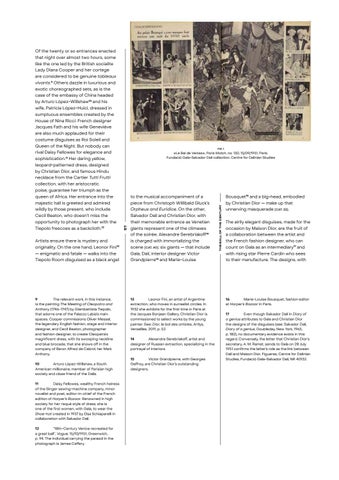
to the musical accompaniment of a piece from Christoph Willibald Gluck’s Orpheus and Euridice. On the other, Salvador Dalí and Christian Dior, with their memorable entrance as Venetian giants represent one of the climaxes of the soirée. Alexandre Serebriakoff14 is charged with immortalizing the scene [CAT. 40]: six giants — that include Gala, Dalí, interior designer Victor Grandpierre15 and Marie-Louise
13 Leonor Fini, an artist of Argentine extraction, who moves in surrealist circles. In 1932 she exhibits for the first time in Paris at the Jacques Bonjean Gallery. Christian Dior is commissioned to select works by the young painter. See: Dior, le bal des artistes, Artlys, Versailles, 2011, p. 52. 14 Alexandre Serebriakoff, artist and designer of Russian extraction, specializing in the portrayal of interiors. 15 Victor Grandpierre, with Georges Geffroy, are Christian Dior’s outstanding designers.
THE BALL OF THE CENTURY
Artists ensure there is mystery and originality. On the one hand, Leonor Fini13 — enigmatic and fatale — walks into the Tiepolo Room disguised as a black angel
FIG. 1
«Le Bal de Venise», Paris Match, no. 130, 15/09/1951, Paris. Fundació Gala-Salvador Dalí collection. Centre for Dalinian Studies
57
Of the twenty or so entrances enacted that night over almost two hours, some like the one led by the British socialite Lady Diana Cooper and her cortege are considered to be genuine tableaux vivants.9 Others dazzle in luxurious and exotic choreographed sets, as is the case of the embassy of China headed by Arturo López-Willshaw10 and his wife, Patricia López-Huici, dressed in sumptuous ensembles created by the House of Nina Ricci. French designer Jacques Fath and his wife Geneviève are also much applauded for their costume disguises as Roi Soleil and Queen of the Night. But nobody can rival Daisy Fellowes for elegance and sophistication.11 Her daring yellow, leopard-patterned dress, designed by Christian Dior, and famous Hindu necklace from the Cartier Tutti Frutti collection, with her aristocratic poise, guarantee her triumph as the queen of Africa. Her entrance into the majestic hall is greeted and admired wildly by those present, who include Cecil Beaton, who doesn’t miss the opportunity to photograph her with the Tiepolo frescoes as a backcloth.12
Bousquet16 and a big-head, embodied by Christian Dior — make up that unnerving masquerade [CAT. 33]. The airily elegant disguises, made for the occasion by Maison Dior, are the fruit of a collaboration between the artist and the French fashion designer, who can count on Gala as an intermediary17 and with rising star Pierre Cardin who sees to their manufacture. The designs, with
16 Marie-Louise Bousquet, fashion editor at Harper’s Bazaar in Paris. 17 Even though Salvador Dalí in Diary of a genius attributes to Gala and Christian Dior the designs of the disguises (see: Salvador Dalí, Diary of a genius, Doubleday, New York, 1965, p. 182), no documentary evidence exists in this regard. Conversely, the letter that Christian Dior’s secretary, A. M. Ramet, sends to Gala on 28 July 1951 confirms the latter’s role as the link between Dalí and Maison Dior, Figueres, Centre for Dalinian Studies, Fundació Gala-Salvador Dalí, NR 40132.