CAMPUS DEVELOPMENT PLAN
K ey C omponents
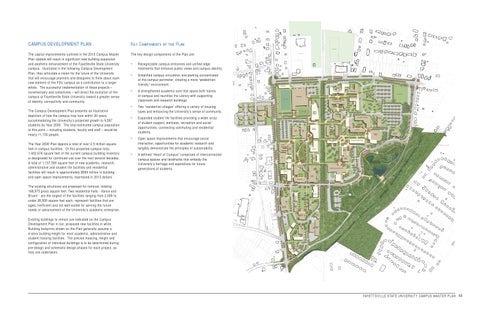
The capital improvements outlined in the 2013 Campus Master Plan Update will result in significant new building expansion and aesthetic enhancement of the Fayetteville State University campus. Illustrated in the following Campus Development Plan, they articulate a vision for the future of the University that will encourage planners and designers to think about each new element of the FSU campus as a contribution to a larger whole. The successful implementation of these projects – incrementally and collectively – will direct the evolution of the campus at Fayetteville State University toward a greater sense of identity, connectivity and community.
The key design components of the Plan are:
of the
P lan Practice Field
• •
•
•
Simplified campus circulation and parking concentrated at the campus perimeter, creating a more “pedestrianfriendly” environment.
Langdon Street
Field House
A strengthened academic core that spans both halves of campus and reunifies the Library with supporting classroom and research buildings. Two “residential villages” offering a variety of housing types and enhancing the University’s sense of community.
Residential Hall
Greek Plots
Capel Arena Football Stadium
Residential Hall
Intramural Field
Renaissance Hall
Student Health & Wellness Center
Tennis Courts
University Place Apartments
Expanded student life facilities providing a wider array of student support, wellness, recreation and social opportunities, connecting commuting and residential students.
New Residence Hall
Harris School of Business Stadium Dr.
Teacher Education Lauretta Taylor
Open space improvements that encourage social interaction, opportunities for academic research and tangibly demonstrate the principles of sustainability.
Nursing Education
G.L. Butler
Lilly Gym
Hackley Honors Hall
Continuing Education
Chesnutt Library
Humanities / Social Sciences
Student Success Center
rive
nD
row
Knuckles
.B W.T
Taylor Social Sciences
A defined “Heart of Campus” comprised of interconnected campus spaces and landmarks that embody the University’s heritage and aspirations for future generations of students.
Academic
Chick
Collins Admin.
Hood Hall
Barber Admin. Cross Creek Environmental Research / Stormwater Park
Academic Science & Technology
Academic
Rudolph Jones Student Center
Lyons Science Lyons Annex
The existing structures are proposed for removal, totaling 168,975 gross square feet. Two residential halls - Vance and Bryant - are the largest of the facilities ranging from 2,000 to under 26,500 square feet each, represent facilities that are aged, inefficient and not well-suited for serving the future needs or advancement of the University’s academic enterprise.
W.T. Brown Dr.
Visitor Center / Admissions Academic Transmission Tower
Joyner Hall Smith Hall
Seabrook Auditorium
Mary T. Eldridge Dr.
Cook Hall
Facilities
Ed g
ec
om
be
Av e
.
Bronco Square
Harris Hall
ek
Operations / Maintenance
ss
Cre
Cro
Residential Halls
Student Dr.
Existing buildings to remain are indicated on the Campus Development Plan in tan; proposed new facilities in white. Building footprints shown on the Plan generally assume a 4-story building height for most academic, administrative and student housing facilities. The precise massing, height and configuration of individual buildings is to be determined during pre-design and schematic design phases for each project, as they are undertaken.
McLeod Hall
Grace Black Circle
•
Fire Station
MLK Jr Dr.
The Year 2030 Plan depicts a total of over 2.5 million square feet in campus facilities. Of this projected campus total, 1,402,676 square feet of the current campus building inventory is designated for continued use over the next several decades. A total of 1,137,500 square feet of new academic, research, administrative and student life facilities and residential facilities will result in approximately $500 million in building and open space improvements, expressed in 2013 dollars.
•
Recognizable campus entrances and unified edge treatments that enhance public views and campus identity.
Murchison Rd.
The Campus Development Plan presents an illustrative depiction of how the campus may look within 20 years, accommodating the University’s projected growth to 9,587 students by Year 2030. The total estimated campus population at this point – including students, faculty and staff – would be nearly 11,150 people.
•
Seabrook Park
Alumni Center
n Drive
Washingto
FAY E T T E V I L L E S TAT E U N I V E R S I T Y C A M P U S M A S T E R P L A N
63