LEARNING ACROSS THE POND: HIGHER EDUCATION’S 2014 LONDON PRACTICUM By Kelli Gemmer
I
nstitutions of Higher Education are different around the world and global awareness is extremely important to the FSU College of Education. “Actually visiting higher education institutions and stepping foot on various campuses, especially those unlike FSU, is an important part of students’ development in understanding the field of higher education,” says Dr. Kathy Guthrie, associate professor of Higher Education. In response to this educational necessity, the Higher Education Program at Florida State University established its first international practicum in 2012. The practicum course was originally created in the 1960’s to help students observe and gain professional experience in the practices of higher education administration through campus visits and analysis of contemporary issues in student affairs. “It is a tradition that started back with Dr. Mel Hardee, who is a pioneer in the Student Affairs field and was instrumental in starting the graduate program here at Florida State,” says Guthrie. Practicum is a required part of the Higher Education Master’s degree track. “The purpose of this course is for students to explore different types of institutions and compare how different structures and campus cultures create environments and respond to various situations when working with students,” explains Guthrie. Students can visit local institutions only, global institutions only or they can participate in both local and global visits. This year, students toured institutions in the Tampa Bay area, but the location varies each year. The global location has been London, England, for the last three years, but they plan to explore other international sites in future years. In May, 12 students from the 2015 Higher Education cohort participated in the weeklong FSU HESA 2014 London Practicum. They had site visits at two traditional English universities, the University
13
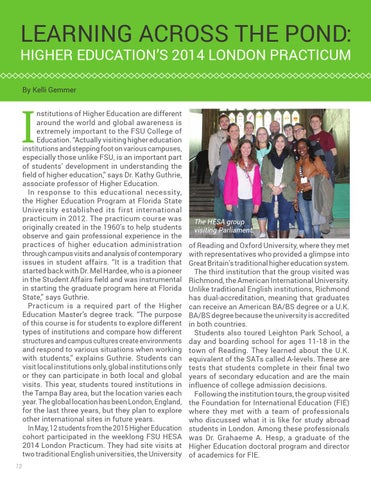
The HESA group visiting Parliament. of Reading and Oxford University, where they met with representatives who provided a glimpse into Great Britain’s traditional higher education system. The third institution that the group visited was Richmond, the American International University. Unlike traditional English institutions, Richmond has dual-accreditation, meaning that graduates can receive an American BA/BS degree or a U.K. BA/BS degree because the university is accredited in both countries. Students also toured Leighton Park School, a day and boarding school for ages 11-18 in the town of Reading. They learned about the U.K. equivalent of the SATs called A-levels. These are tests that students complete in their final two years of secondary education and are the main influence of college admission decisions. Following the institution tours, the group visited the Foundation for International Education (FIE) where they met with a team of professionals who discussed what it is like for study abroad students in London. Among these professionals was Dr. Grahaeme A. Hesp, a graduate of the Higher Education doctoral program and director of academics for FIE.