Middle School: Navigation Skills for the Information Environment Stomp, Clap-clap, stomp, clap-clap, stomp, clap.
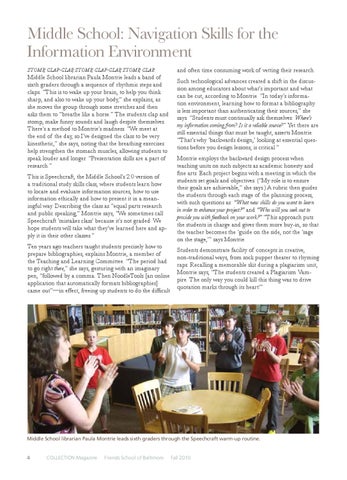
Middle School librarian Paula Montrie leads a band of sixth graders through a sequence of rhythmic steps and claps. “This is to wake up your brain, to help you think sharp, and also to wake up your body,” she explains, as she moves the group through some stretches and then asks them to “breathe like a horse.” The students clap and stomp, make funny sounds and laugh despite themselves. There’s a method to Montrie’s madness. “We meet at the end of the day, so I’ve designed the class to be very kinesthetic,” she says, noting that the breathing exercises help strengthen the stomach muscles, allowing students to speak louder and longer. “Presentation skills are a part of research.” This is Speechcraft, the Middle School’s 2.0 version of a traditional study skills class, where students learn how to locate and evaluate information sources, how to use information ethically and how to present it in a meaningful way. Describing the class as “equal parts research and public speaking,” Montrie says, “We sometimes call Speechcraft ‘mistakes class’ because it’s not graded. We hope students will take what they’ve learned here and apply it in their other classes.” Ten years ago teachers taught students precisely how to prepare bibliographies, explains Montrie, a member of the Teaching and Learning Committee. “The period had to go right there,” she says, gesturing with an imaginary pen, “followed by a comma. Then NoodleTools [an online application that automatically formats bibliographies] came out”—in effect, freeing up students to do the difficult
and often time consuming work of vetting their research. Such technological advances created a shift in the discussion among educators about what’s important and what can be cut, according to Montrie. “In today’s information environment, learning how to format a bibliography is less important than authenticating their sources,” she says. “Students must continually ask themselves: Where’s my information coming from? Is it a reliable source?” Yet there are still essential things that must be taught, asserts Montrie. “That’s why ‘backwards design,’ looking at essential questions before you design lessons, is critical.” Montrie employs the backward design process when teaching units on such subjects as academic honesty and fine arts. Each project begins with a meeting in which the students set goals and objectives. (“My role is to ensure their goals are achievable,” she says.) A rubric then guides the students through each stage of the planning process, with such questions as: “What new skills do you want to learn in order to enhance your project?” and “Who will you seek out to provide you with feedback on your work?” “This approach puts the students in charge and gives them more buy-in, so that the teacher becomes the ‘guide on the side, not the ‘sage on the stage,’” says Montrie. Students demonstrate facility of concepts in creative, non-traditional ways, from sock puppet theater to rhyming raps. Recalling a memorable skit during a plagiarism unit, Montrie says, “The students created a Plagiarism Vampire. The only way you could kill this thing was to drive quotation marks through its heart!”
Middle School librarian Paula Montrie leads sixth graders through the Speechcraft warm-up routine.
4
Collection Magazine
Friends School of Baltimore
Fall 2010