4
family finance
Budgeting for a New Year
Making the Most of Your Family Income By Heather Green
F
eeling a holiday hangover? You are not alone — for many, the holidays mean too much food, too much fun and definitely too much money spent. December credit card bills are rolling in and your bank account might be looking a bit empty after the gluttonous holiday season. Getting back on track might be a top New Year’s resolution. Or perhaps you recently lost a job or had a major life shift and need to refocus. No matter the cause, here are a few helpful hints from local families and experts to help get back on track in 2014. There are many reasons families may need to re-evaluate their budgets, from life changes to illness to other hardships. We talked to three local moms, all of whom learned how to re-evaluate their monetary priorities and accommodate life’s big surprises.
Laney and her husband have two children. Their family finances took a hit when her husband unexpectedly lost his job in November 2012. (Laney did not want her last name used for this article.) Callie Cromer’s husband Clay recently left the Coast Guard to pursue a career in
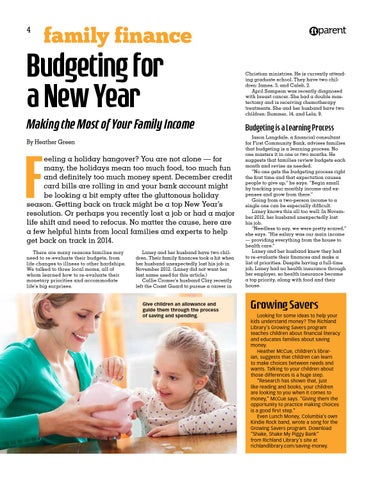
Give children an allowance and guide them through the process of saving and spending.
Christian ministries. He is currently attending graduate school. They have two children: James, 3, and Caleb, 2. April Sampson was recently diagnosed with breast cancer. She had a double mastectomy and is receiving chemotherapy treatments. She and her husband have two children: Summer, 14, and Lela, 9.
Budgeting is a Learning Process Jason Langdale, a financial consultant for First Community Bank, advises families that budgeting is a learning process. No one masters it in one or two months. He suggests that families review budgets each month and revise as needed. “No one gets the budgeting process right the first time and that expectation causes people to give up,” he says. “Begin small by tracking your monthly income and expenses and grow from there.” Going from a two-person income to a single one can be especially difficult. Laney knows this all too well: In November 2012, her husband unexpectedly lost his job. “Needless to say, we were pretty scared,” she says. “His salary was our main income — providing everything from the house to health care.” Laney and her husband knew they had to re-evaluate their finances and make a list of priorities. Despite having a full-time job, Laney had no health insurance through her employer, so health insurance became a top priority, along with food and their house.
Growing Savers Looking for some ideas to help your kids understand money? The Richland Library’s Growing Savers program teaches children about financial literacy and educates families about saving money. Heather McCue, children’s librarian, suggests that children can learn to make choices between needs and wants. Talking to your children about those differences is a huge step. “Research has shown that, just like reading and books, your children are looking to you when it comes to money,” McCue says. “Giving them the opportunity to practice making choices is a good first step.” Even Lunch Money, Columbia’s own Kindie Rock band, wrote a song for the Growing Savers program. Download “Shake, Shake My Piggy Bank” from Richland Library’s site at richlandlibrary.com/saving-money.