Sharing the spirit of St. Francis with the world V O L . 1 2 6 / N O . 8 • JANUARY 2019
THE DEATH PENALTY AND
THE
MYTH OF
INTRODUCING:
Faith Unpacked with David Dault, PhD page 14
CLOSURE
COME TO ME, ALL WHO ARE BURDENED JANUARY 2019 • $4.99 StAnthonyMessenger.org
MAKING MONEY WHILE MAKING A DIFFERENCE PEACE ACTIVIST SISTER MEGAN RICE
cover 0119.indd 1
11/30/18 9:12 AM
WHO SAID MONEY DOESN’T GROW ON TREES?
The 300-leaf Tree of Life pictured above is a classic design that allows for a wide range of presentation shapes and accommodates a large number of donor names. This carefully crafted Tree of Life can provide the perfect way to: • Recognize contributors to a building fund or fund-raising campaign • Honor contributors to an endowment fund • Salute individuals or groups for outstanding service or achievements • Create a tasteful memorial • The Tree of Life is so successful because the donor’s personalized message will be on display forever
Gregory Cave
800-989-2283
caveco33@aol.com www.churchgoods.net cover 0119.indd 2
The Tree of Life’s trunk is magnificent cast bronze. Its leaves are miniature brass plaques that we custom engrave for mounting on sculpted plexiglass backgrounds. The result is elegant and economical.
Sell just 200 memorial leaves at $500 each and earn $100,000 for your organization.
11/30/18 9:12 AM
VOL. 126 NO. 8
2019 JANUARY
COVER STORY 28 The Death Penalty and the Myth of Closure By Richard B. Patterson, PhD
Many argue the death penalty can help survivors move on with their lives. However, this counselor writes that true healing can happen only when we learn to “walk with the pain.”
18 Come to Me, All Who Are Burdened
By Maryann Gogniat Eidemiller; photography by Richard Dedo
COVER: ANTONIOGUILLEM/FOTOSEARCH
For 22 years, this annual retreat has been a beacon for those facing difficult life challenges, giving them an opportunity for fellowship and service to others.
24 Walking with Christ By Father Gary Caster
The spiritual life goes beyond religious practices and reciting prayers. At its core, it means to encounter and follow Jesus every day.
Forgiveness can indeed help survivors heal, but it isn’t that simple. Forgiveness is a process, one that can last a lifetime.
34 Make Money, Make a Difference By Susan Klemond
Impact investing can yield both financial and humanitarian gains.
40 An Interview with Sister Megan Rice By Katie Rutter
With the heart of a warrior and the soul of a peacemaker, this 88-year-old activist boldly pushes for complete nuclear disarmament in the United States.
StAnthonyMessenger.org | January 2019 • 1
Front Pages 0119.indd 1
11/30/18 9:15 AM
Di s co vering Mary, the Church, & the Papacy
◆ THE GREAT DISCOVERY Our Journey to the Catholic Church
◆ RETHINKING MARY IN THE NEW TESTAMENT
Ulf and Birgitta Ekman he Ekmans were founders of a large Pentecostal church that was the first “mega-church” in Sweden, and Ulf was the country’s most prominent Christian leader. With such prominence they were no strangers to controversy, but news of their leaving Word of Life Church to become Catholics was a bombshell in Sweden. This inspiring testimony tells why they made that difficult journey.
T
S
GRDP . . . Sewn Softcover, $17.95
RDMP . . . Sewn Softcover, $17.95
“Ulf and Birgitta Ekman spent decades as evangelists. Ulf was known as ‘Sweden’s Billy Graham’. This book is their amazing story. You don’t have to be Catholic to love it. If you’re human, it will move you.” — Dr. Scott Hahn, Author, Rome Sweet Home “Reading this book is akin to listening to husband and wife at a kitchen table, who are truly humbling and charming company. Their resolve to convert to Catholicism is a staggering testimony to quiet courage in Christ.” — Sally Read, Author, Night’s Night’s Bright Darkness: A Modern Conversion Story
Edward Sri cholars often question how much the New Testament can tell us about the Mother of Jesus. In this comprehensive work, Dr. Sri shows how the Bible reveals much more about Mary than is commonly appreciated. He examines every New Testament reference to Mary, offering a fresh, in- depth look at her that helps us know Mary better and her role in God’s plan. “An up-to-date, thoroughly exegetical analysis of every key New Testament passage on Mary. A major achievement, and must-read for anyone interested in what the Bible really teaches about the Mother of Jesus.” —Dr. Brant Pitre Co-author, A Catholic Introduction to the Bible: The Old Testament “This could only be authored by someone with a mastery of contemporary biblical scholarship who is also a lifelong scholar of Mariology – like Edward Sri. Easy to read, serious, and scholarly, here we meet the Mary whom the evangelists aimed to reveal to us.” —Dr. Matthew Levering, Chair of Theology, Mundelein Seminary
◆ THE PAPACY What the Pope Does and Why It Matters
Steve Ray and Dennis Walters his book explains that without the Pope’s divinely guided leadership, the Church would suffer the contradictions and divisions that many Christian groups know firsthand. The teaching passed down from the apostles would be subject to arbitrary, numerous interpretations. In describing the Pope’s important role as leader, it also addresses common misconceptions and objections to the papacy.
T
PPCP . . . Sewn Softcover, $15.95 “An easy-to-digest, clear introduction to all things papal. From Peter to Francis, and from Matthew’s Gospel to Revelation, it shows why the papacy has an indispensable role in salvation history.” —Karl Keating Founder, Catholic Answers; Author, Catholicism and Fundamentalism “The authors deftly untangle knotty misconceptions and make the case that Christianity will thrive in the present age only if we recover the unity that Christ intended the Petrine ministry to protect and cultivate.” Kresta, Catholic Radio Host, Kresta in —Al Kresta the Afternoon
www.ignatius.com P.O. Box 1339, Ft. Collins, CO 80522
Front Pages 0119.indd 2
1-800- 651-1531
11/30/18 9:15 AM
e , n g d s s d
VOL. 126 NO. 8
“Praised be to You, my Lord, through those who give pardon for Your love, and bear infirmity and tribulation.”
2019 JANUARY
—St. Francis of Assisi
SPIRIT OF ST. FRANCIS 10 Ask a Franciscan
14 POINTS OF VIEW 5
‘But It Was on the Internet!’
12 Franciscan World & St. Anthony Stories Our Lady of Guadalupe Province Anthony and the Easy Chair
16
Your Voice
Letters from Readers
15 Editorial
World Youth Day, We Need You
16 At Home on Earth
13 Followers of St. Francis
The Divine Belayer
Javier Garza, OFM Cap
54 Faith & Family
14 Faith Unpacked
Rebuild My Church
Keep the Children Safe
48
MEDIA MATTERS 48 Reel Time
The Nutcracker and the Four Realms
50 Channel Surfing The Romanoffs
Front Pages 0119.indd 3
51 Audio File
The Jimi Hendrix Experience | Electric Ladyland
ALSO IN THIS ISSUE 4 Dear Reader
6 Church in the News 47 Poetry
56
51 Pete & Repeat 56 Reflection
52 Bookshelf
The Grace of Enough
StAnthonyMessenger.org | January 2019 • 3
11/30/18 9:15 AM
dear reader
ST. ANTHONY
MESSENGER
Unpacking the Faith and Culture Connection
PUBLISHER
Daniel Kroger, OFM
T
he beginning of the year is always a perfect opportunity to start something new. That certainly also holds true for us here at St. Anthony Messenger. Last January, we launched our complete redesign of the magazine. Other years, we have started the year off by introducing new columns, some of which you still see in these pages, such as “At Home on Earth.” This year, we are introducing another new column for you—“Faith Unpacked.” The column is written by David Dault, PhD, host and executive producer of Things Not Seen, a radio show and podcast about the intersection of culture and faith. He is also one half of the popular podcast The Francis Effect—the other half being Father Dan Horan, OFM. In “Faith Unpacked,” David will delve into current issues, but through a uniquely faith-based lens. He will explore what these issues mean to us as people of faith. As always, we want you to play a part in this new column. Is there a particular topic you would like to see addressed? If so, send it along to FaithUnpacked@ FranciscanMedia.org, or mail it to us at Franciscan Media, 28 W. Liberty Street, Cincinnati, OH 45202. We hope you enjoy this new offering and that you have a blessed new year!
PRESIDENT
Kelly McCracken EXECUTIVE EDITORS
Christopher Heffron Susan Hines-Brigger
FRANCISCAN EDITOR
Pat McCloskey, OFM ART DIRECTOR
Mary Catherine Kozusko MANAGING EDITOR
Daniel Imwalle
CONTRIBUTING EDITOR
Sandy Howison
EDITORIAL ASSISTANT
Sharon Lape
ACCOUNT EXECUTIVE ADVERTISING
Susan Hines-Brigger, Executive Editor
Graham Galloway PRINTING
Kingery Printing Co. Effingham, IL
FATHER GARY CASTER
RICHARD PATTERSON
KATIE RUTTER
Walking with Christ
The Death Penalty and the Myth of Closure
An Interview with Sister Megan Rice
PAGE 28
PAGE 40
Richard B. Patterson, PhD, is a clinical psychologist from El Paso, Texas. He has spent much of his adult life on a quest to find a bridge between psychology and spiritual studies, which he explores on his blog, PsycheandSpirit.net. He dabbles in writing poetry, is an avid runner, and believes Red Sox baseball is a spiritual experience.
Katie Rutter has worked her entire career in Catholic journalism. In addition to her writing, this past year, Rutter was named best video producer by the Catholic Press Association. She and her husband, Brian, also produce videos for religious groups and nonprofits with their company, Thing in a Pot Productions.
writer
PAGE 24
Father Gary Caster is a priest of the Diocese of Peoria, Illinois. He has written and produced shows for EWTN and is the author of several books, including Prayer Everywhere: The Spiritual Life Made Simple, The Little Way of Lent: Meditations in the Spirit of St. Thérèse of Lisieux, and The Little Way of Advent: Meditations in the Spirit of St. Thérèse of Lisieux.
writer
writer
ST. ANTHONY MESSENGER (ISSN #0036276X) (U.S.P.S. PUBLICATION #007956 CANADA PUBLICATION #PM40036350) Volume 126, Number 8, is published monthly for $39.00 a year by the Franciscan Friars of St. John the Baptist Province, 28 W. Liberty Street, Cincinnati, Ohio 45202-6498. Phone 513-241-5615. Periodicals postage paid at Cincinnati, Ohio, and additional entry offices. US POSTMASTER: Send address changes to: St. Anthony Messenger, PO Box 189, Congers, NY 10920-0189. CANADA RETURN ADDRESS: c/o AIM, 7289 Torbram Rd., Mississauga, ON, Canada L4T 1G8. To subscribe, write to the above address or call 866-543-6870. Yearly subscription price: $39.00 in the United States; $69.00 in Canada and other countries. Single copy price: $4.99. For change of address, four weeks’ notice is necessary. See FranciscanMedia.org/subscriptionservices for information on your digital edition. Writer’s guidelines can be found at FranciscanMedia.org/ writers-guide. The publishers are not responsible for manuscripts or photos lost or damaged in transit. Names in fiction do not refer to living or dead persons. Member of the Catholic Press Association Published with ecclesiastical approval Copyright ©2019. All rights reserved.
FranciscanMedia.org
4 • January 2019 | StAnthonyMessenger.org
Front Pages 0119.indd 4
11/30/18 9:15 AM
R
.S.P.S. TION lished of St. nnati, postffices. thony 0189. bram
call n the Single notice ption-
a.org/ manun fic-
POINTSOFVIEW | YOUR VOICE Married Priests Not a Cure-All
An Open Letter on Anti-Semitism
I’m writing in regard to John F. Scanlon’s letter in the “Your Voice” column from the November issue of St. Anthony Messenger. He erroneously maintains the myth that marriage is a cure for the problem of clergy sex abuse. Furthermore, celibacy is not a vow; it’s a promise. The Cincinnati Enquirer recently reported on a male married teacher who was arrested for allegedly having sex with two female students. He maintains his innocence. His wife appears to have been complicit. Another recent story reports the case of a father who intended to cannibalize his own child whom he had murdered. The myth that marriage cures abuse continues to thrive. Spousal abuse and the abuse of one’s own children continue to run rampant. Most people give such stories little more than a passing glance. God instituted marriage for the mutual support of the couple and the continuation of the human race. God did not institute marriage as a cure for sexual maladies. I hope Mr. Scanlon reads Susan HinesBrigger’s article in the November issue (“The Church and Domestic Violence”). Just recently, in a social setting, a Catholic proclaimed, loudly so I could hear, that celibacy is “ridiculous.” As an aside, I am not aware of any priest who would have time for a family, not to mention a decade of study and preparation for ordination! One of these days I just may write an article on celibate priesthood, entitled “Think It Through.” But, then again, would anyone read it?
Thank you for the editorial by Pat McCloskey, OFM, from the October 2018 issue (“‘It’s Time, Holy Father’”). You are correct; we need leadership, not cover-ups. I suggest that we go back to the older version of rules for priests who can marry if they do so before becoming ordained. They have this rule in the Eastern Catholic Churches, so why not in the Roman Church?
I believe that the murders that took place in Pittsburgh in a Jewish synagogue on October 27, 2018, were much more grievous for our nation than most mass shootings, which are often rooted in tragic mental illness and often involve young people. But aiming an automatic rifle at a 97-year-old Jewish woman lying on the ground was not only maniacally hateful, but an act with a 2,500-year horrific legacy. I grew up in the Bradford Hills area of Syracuse, New York, where many of my neighbors and family friends were Jewish. They were kind, smart, and interesting to talk to. I was always taught to have the greatest respect for them and was grateful they were in my life. But when I grew older, ventured further into the world, and made my way through 18 years of Catholic education, I discovered antiSemitism and set about researching its long and sordid history. In the late 1700s, while thousands of Jews hid in Europe and South America, the emerging American colonies and new nation enshrined religious freedom in our early colonial compacts and our Bill of Rights. Thousands came and flourished, particularly in the South, in cities such as Charleston, South Carolina, which had a population of 600 Jews during the Revolutionary War, where many served and died. How have we gotten from 1977—when anti-Semites were scorned and jeered as they attempted to march in Skokie, Illinois—to now, where we have witnessed over 1,000 acts of anti-Semitic vandalism in 2017 alone, which have elicited little comment or outrage? Why do the mainstream media and some political figures suddenly tolerate anti-Semitic slurs from the right wing of our polity? And now we have Pittsburgh. So why does anti-Semitism persist? Maybe some in our country resent Jews because they are the “other” who are strong. All Americans need to examine how and why we became so insecure. How did we become like children afraid of the dark? No, the cause and fault of anti-Semitism lie not in the stars of our national identity, but in ourselves.
Dorothy Westermann Eau Claire, Wisconsin
Stephen Sarsfield Bowman Syracuse, New York
Father Tom Snodgrass, Retired Cincinnati, Ohio
Return to Tradition
CONTACT INFO We want to hear from you!
QUESTIONS: To better serve you, please have your address label and/or invoice available before calling. MAIL LETTERS: St. Anthony Messenger: Letters 28 W. Liberty St. Cincinnati, OH 45202-6498 E-MAIL LETTERS: MagazineEditors@ FranciscanMedia.org WEBSITES: StAnthonyMessenger.org StAnthonyMessenger.org/ subscribe PHONE NUMBERS: (866) 543-6870 (toll-free) (845) 267-3051 (Canada toll-free) (513) 241-5615 ext.141 (advertising) FAX NUMBER: (845) 267-3478 (subscriptions) FACEBOOK: Facebook.com/ StAnthonyMessengerMagazine TWITTER: Twitter.com/StAnthonyMag SUBSCRIPTION PRICES: $39 (US) • $69 (other countries) For digital and bulk rates, visit our website. MAILING LIST RENTAL: If you prefer that your name and address not be shared with select organizations, send your current mailing label to: SUBSCRIPTION HOUSE: St. Anthony Messenger PO Box 189 Congers, NY 10920-0189
StAnthonyMessenger.org | January 2019 • 5
Front Pages 0119.indd 5
11/30/18 9:15 AM
church IN THE NEWS
people | events | trends By Susan Hines-Br ig ger
VATICAN PROMPTS CHANGE TO BISHOPS’ MEETING AGENDA
Cardinal Daniel N. DiNardo, celebrates Mass during the fall bishops’ meeting.
hen the US bishops gathered in Baltimore, Maryland, this past November for their annual fall meeting, they had planned to discuss and vote on two proposals regarding their response to the clergy sex-abuse crisis. At the opening of the meeting, however, Cardinal Daniel N. DiNardo, president of the bishops’ conference, reported that the Vatican asked the bishops to delay any vote until after a February meeting with the pope and presidents of the bishops’ conferences from around the world that will focus on addressing clergy abuse, reported Catholic News Service (CNS). The two proposals the bishops were set to vote on included standards of episcopal conduct and the formation of a special commission for review of complaints against bishops for violations of the standards. Cardinal DiNardo expressed disappointment with the delay, but said: “We have not lessened in any of our resolve for actions. We are going to work intensely on these items of action. We can’t vote on them totally, but clarify them, get them more intensely canonically well, so that Rome will see that. We’re going to keep pushing and moving until we get to a point where they become action.” Even though the bishops didn’t vote on the proposals, they did spend a good amount of time discussing them. They heard from several survivors of abuse, the chairman of the National Review Board, and a psychologist about
how to help survivors heal. During the meeting, the bishops also voted to approve “Open Wide Our Hearts: The Enduring Call to Love, A Pastoral Letter Against Racism,” a pastoral letter from the full body of bishops to the lay faithful and all people of goodwill addressing the evil of racism. “Every racist act—every such comment, every joke, every disparaging look as a reaction to the color of skin, ethnicity, or place of origin—is a failure to acknowledge another person as a brother or sister, created in the image of God,” the statement points out. “Racial profiling frequently targets Hispanics for selective immigration enforcement practices, and African Americans for suspected criminal activity. There is also the growing fear and harassment of persons from majority Muslim countries. Extreme nationalist ideologies are feeding the American public discourse with xenophobic rhetoric that instigates fear against foreigners, immigrants, and refugees.” Bishop Shelton J. Fabre, of Houma-Thibodaux, chairman of the US bishops’ ad hoc Committee Against Racism and chair of the Subcommittee on African American Affairs within the Cultural Diversity Committee, said, “The entire body of bishops felt the need to address the topic of racism, once again, after witnessing the deterioration of the public discourse, and episodes of violence and animosity with racial and xenophobic overtones, that have reemerged in American society in the last few years.”
6 • January 2019 | StAnthonyMessenger.org
CIN 0119.indd 6
11/30/18 9:10 AM
CNS PHOTOS: TOP: JONATHAN ERNST/REUTERS; BOTTOM: BEATRICE NJEMANZE/MISSISSIPPI CATHOLIC
W
CNS PHOTOS: TOP: RICK MUSACCHIO/TENNESSEE REGISTER; INSET: BOB ROLLER
Cardinal Daniel N. DiNardo of Galveston-Houston, center, president of the US Conference of Catholic Bishops, opens the bishops’ fall general assembly in Baltimore. During the meeting, the bishops discussed the clergy sex-abuse crisis.
ORGANIZING COMMITTEE NAMED FOR FEBRUARY ABUSE CONFERENCE
O
CNS PHOTOS: TOP: JONATHAN ERNST/REUTERS; BOTTOM: BEATRICE NJEMANZE/MISSISSIPPI CATHOLIC
CNS PHOTOS: TOP: RICK MUSACCHIO/TENNESSEE REGISTER; INSET: BOB ROLLER
n November 23, the Vatican announced that Pope Francis had named several people to an organizing committee in preparation for a meeting on the subject of protection of minors in the Church that will take place in Rome between February 21 and 24, according to CNS. Cardinal Blase Cupich of Chicago was named to the committee, as well as Cardinal Oswald Gracias of Mumbai, India; Archbishop Charles J. Scicluna of Malta; and Jesuit Father Hans Zollner, president of the Centre for the Protection of Minors at the Pontifical Gregorian University and a member of the Pontifical Commission for the Protection of Minors. As president of the Vatican Commission for the Protection of Minors, Cardinal Seán O’Malley of Boston will serve in an advisory role to the committee. Father Zollner, who is also a licensed psychologist and psychotherapist and has accompanied abuse survivors to the Vatican, said the pope will be present at the February meeting’s work sessions. Father Zollner told Vatican News that the meeting will be a “synodal” journey, involving sharing information, reflections, prayer, penance, and proposals for concrete action. Vatican spokesman Greg Burke called the meeting “unprecedented” and said it “shows [that] Pope Francis has made the protection of minors a fundamental priority for the Church. “Pope Francis wants Church leaders to have a full understanding of the devastating impact that clerical sexual abuse has on victims,” added Burke. And while the meeting is primarily for bishops, who bear responsibility for the “grave problem,” he said, “laymen and [lay]women who are experts in the field of abuse” will also be on hand to give their input.
SCALIA, STAUBACH AMONG SEVEN WHO RECEIVED PRESIDENTIAL MEDAL OF FREEDOM
US President Donald Trump presents the Presidential Medal of Freedom to NFL Hall of Fame quarterback Roger Staubach on November 16 at the White House.
A
ntonin Scalia, the late associate justice of the Supreme Court, and football legend Roger Staubach, both Catholics, were awarded the Presidential Medal of Freedom, the nation’s highest civilian honor, by President Donald J. Trump during a ceremony at the White House on November 16, reported CNS. Five others also received the award: retiring Sen. Orrin G. Hatch of Utah, who is the longest-serving Republican senator; Miriam Adelson, physician and philanthropist; Alan Page, a former defensive tackle for the NFL’s Minnesota Vikings who went on to become a Minnesota Supreme Court associate justice; baseball legend Babe Ruth, who also was Catholic; and rock ‘n’ roll star Elvis Presley. The Medal of Freedom award recognizes people who have made an especially commendable contribution to the national interests of the United States, world peace, cultural, or other endeavors.
SAINTHOOD CAUSE FOR SISTER THEA BOWMAN UNDERWAY
A
t a Mass on November 18, Bishop Joseph R. Kopacz of Jackson, Mississippi, read the edict to officially open the sainthood cause for Sister Thea Bowman, reported CNS. Sister Thea, a Mississippi native and the only African American member of her order, the Wisconsin-based Franciscan Sisters of Perpetual Adoration, was a widely known speaker, evangelizer, and singer until she died of cancer in 1990 at age 52. Just days before the Mass, the US bishops unanimously voted in support of the cause moving forward during their general assembly in Baltimore. The “canonical consultation” with the body of US bishops is a step in the Catholic Church’s process toward declaring a person a saint. In his homily, Bishop Kopacz quoted the Old Testament reading for the day from the Book of Daniel: “The wise shall shine like the splendor of the firmament. Those who lead the many to justice shall be like the stars forever.” He spoke of Sister Thea’s wisdom, joy, and holiness, saying that today “her holiness shines upon us.” The Diocese of Jackson has launched a website—SisterTheaBowman.com—detailing Sister Thea’s life and the cause for canonization.
Sister Thea Bowman
StAnthonyMessenger.org | January 2019 • 7
CIN 0119.indd 7
11/30/18 9:10 AM
church IN THE NEWS
people | events | trends
POPE OFFERS PRAYERS FOR VICTIMS OF WILDFIRES
Assistance funds have been set up by the Dioceses of Sacramento and Los Angeles to help victims of deadly wildfires that affected California this past November. The town of Paradise, California (above), was hardest hit, leaving at least 85 people dead, 150,000 acres burned, and more than 18,000 structures destroyed. In Southern California, the Woolsey Fire killed three civilians and charred 96,949 acres.
8 • January 2019 | StAnthonyMessenger.org
CIN 0119.indd 8
11/30/18 9:10 AM
CNS PHOTO/VATICAN MEDIA
n the wake of the devastating California Service, the St. Vincent de Paul Society, wildfires that caused widespread and other partner organizations who destruction and death, Sacramento are providing fire relief and recovery for Bishop Jaime Soto celebrated Mass on victims of the wildfires. November 18 at St. John the Baptist In Southern California, residents Church in downtown Chico for all those were dealing with the Woolsey Fire near affected by the Camp Fire. The bishop Los Angeles, which killed three peoextended a special invitation to the comple and charred over 96,000 acres. In a munity of St. Thomas More Parish in November 14 statement, Los Angeles Paradise, whose church was in the direct Archbishop José H. Gómez asked all line of fire. people of faith and goodwill to join Bishop Soto asked Catholics of the him in offering prayers and support for diocese to remember in their prayers the everyone affected by the fires in Southern residents who had been displaced, had California. lost their residences, or had evacuated “The devastation of the wildfires the area. continues throughout our state. We need “We also pray for the brave men and to keep praying for those who have lost women responding to this disaster and their lives and their homes and livelibattling the fires,” Bishop Soto added in a hoods, and for all the men and women statement posted on the diocese’s website On November 18, Pope Francis offered prayers fighting the fires,” said Archbishop (scd.org). “May all those who have died Gómez. for those affected by wildfires in California. in this catastrophic inferno be granted On November 18, Pope Francis eternal repose in the merciful hands of the Lord Jesus.” offered a special prayer “to those affected by the fires that are The Diocese of Sacramento has established a fire assisplaguing California. . . . May the Lord welcome the deceased tance fund to help those who were affected by the disaster. in his peace, comfort their families, and support those who Funds will be distributed to Northern Valley Catholic Social are involved in relief efforts.”
CNS PHOTOS: TOP LEFT: STEPHEN LAM/REUTERS; INSETS: ERIC THAYER/REUTERS; BOTTOM: EPA
I
SEX-ABUSE SURVIVORS ANNOUNCE LAWSUIT AGAINST US BISHOPS
I
n November, as the US bishops were meeting in Baltimore, six clergy sex-abuse survivors announced a lawsuit against the prelates’ main organization, the US Conference of Catholic Bishops (USCCB). Minnesota lawyer Jeff Anderson was joined by three of the six survivors at a press conference near the site of the bishops’ meeting to discuss the lawsuit, which was filed in federal district court in Minnesota on November 13. According to Anderson’s firm, the lawsuit seeks “courtordered disclosure of identities of all offenders and their histories known only to the bishops who continue to keep this information secret.” It alleges that the USCCB concealed “the known histories and identities from the public, parishioners, and law enforcement of clergy accused of sexually abusing children across the country.” The USCCB did not respond to the filing, which is not unusual regarding a lawsuit.
POPE MAKES SURPRISE VISIT TO MOBILE HEALTH CLINIC
Thanks to BetterWOMAN, I’m winning the battle for
Bladder Control. Frequent nighttime trips to the bathroom, embarrassing leaks and the inconvenience of constantly searching for rest rooms in public – for years, I struggled with bladder control problems. After trying expensive medications with horrible side effects, ineffective exercises and uncomfortable liners and pads, I was ready to resign myself to a life of bladder leaks, isolation and depression. But then I tried BetterWOMAN. When I first saw the ad for BetterWOMAN, I was skeptical. So many products claim they can set you free from leaks, frequency and worry, only to deliver disappointment. When I finally tried BetterWOMAN, I found that it actually works! It changed my life. Even my friends have noticed that I’m a new person. And because it’s all natural, I can enjoy the results without the worry of dangerous side effects. Thanks to BetterWOMAN, I finally fought bladder control problems and I won!
ALL NATURAL
Clinically-Tested Herbal Supplement
Pope Francis stops to take a selfie during a surprise visit to a temporary mobile health clinic that was set up in St. Peter’s Square last November.
A
CNS PHOTO/VATICAN MEDIA
CNS PHOTOS: TOP LEFT: STEPHEN LAM/REUTERS; INSETS: ERIC THAYER/REUTERS; BOTTOM: EPA
• Reduces Bladder Leaks • Reduces Bathroom Trips • Sleep Better All Night • Safe and Effective – No Known Side Effects • Costs Less than Traditional Bladder Control Options
mobile health-care facility set up in St. Peter’s Square got a surprise visit on November 16, when Pope Francis stopped in, reported CNS. The pope spent about 15 minutes touring the medical center before walking back to his residence inside the Vatican. The temporary facility was set up from November 12 to 18 to serve the city’s homeless and poor. It was part of an initiative organized by the Pontifical Council for Promoting New Evangelization in conjunction with Pope Francis’ celebration of the World Day of the Poor on November 18. WANT MORE? Visit our newspage:
FranciscanMedia.org/catholic-news
• Live Free of Worry, Embarrassment, and Inconvenience You don’t have to let bladder control problems control you. Call now!
Also Available: BetterMAN
®
The 3-in-1 Formula Every Man Needs – Better BLADDER, Better PROSTATE, and Better STAMINA! Order online at www.BetterMANnow.com.
Call Now & Ask How To Get A
FREE BONUS BOTTLE
Limited Time Offer
888-410-3059
CALL TOLL-FREE or order online: www.BetterWOMANnow.com These statements have not been evaluated by the FDA. This product is not intended to diagnose, treat, cure or prevent any disease. Use as directed. Individual results may vary. BetterMAN and BetterWOMAN are the trademarks of Interceuticals, Inc. ©2017 Interceuticals, Inc.
StAnthonyMessenger.org | January 2019 • 9
CIN 0119.indd 9
11/30/18 9:10 AM
SPIRITOFST.FRANCIS | ASK A FRANCISCAN By Pat McCloskey, OFM
‘But It Was on the Internet!’ Are there any readings, books, or websites to explain to my 79-year-old sister that the archangel Gabriel appeared to Mary, telling her that she was favored by God to give birth to God’s Son? My sister believes something evil happened to Mary. When I told her she was wrong, she replied, “But it was on the Internet!”
Father Pat welcomes your questions! ONLINE: StAnthonyMessenger.org E-MAIL: Ask@FranciscanMedia.org MAIL: Ask a Franciscan 28 W. Liberty St. Cincinnati, OH 45202
All questions sent by mail need to include a self-addressed stamped envelope.
?
WANT MORE? Visit our website: StAnthonyMessenger.org
WE HAVE A DIGITAL archive of “Ask” Q & As, going back to March 2013. Just click: • the Ask link and then • the Archive link. Material is grouped thematically under headings such as forgiveness, Jesus, moral issues, prayer, saints, redemption, sacraments, Scripture—and many more!
I
’ll take the Annunciation account in the Gospel of Luke (1:26–38) over whatever Internet source your sister had. Nothing evil happened to Mary, who became the first and best of Jesus’ disciples. My guess is that whoever posted that other story on the Internet may think that the Incarnation was a bad idea, and this is that person’s way of discrediting God’s plan. Without the Incarnation, we would never know how much and how deeply God loves each person. We would be strongly tempted to turn God into a caricature of what the Bible presents. It would be pretty easy to regard God as simply aloof and unreasonably demanding, leading us to disregard God altogether. “All that glitters is not gold” goes the proverb. Not everything in a book, magazine, or on the Internet is necessarily true. You may or may not succeed in convincing your sister that nothing evil happened to Mary at the Annunciation, but I encourage you to trust what is clearly—and reverently—presented in the Gospel of Luke.
Treating Cremains Reverently
Although I know the Catholic Church approves of cremation, I can’t find in the Catechism of the Catholic Church what the Church requires that Catholics do with the ashes (cremains). Do they have to be buried as in a traditional burial?
A
ccording to the second section of article 2301, “The Church permits cremation, provided that it does not demonstrate a denial of faith in the resurrection of the body.” Cremains should be placed in a secure container and either buried or placed in a columbarium, a niche that is then covered, usually with the person’s name and other data on its front. The Catholic Church does not object if the secure container is placed in a large body of water, provided that all relevant laws are observed. Most Catholic cemeteries have a columbarium. At www.vatican.va, you can find the August 15, 2016, document on this from the Congregation for the Doctrine of the Faith. Why did the Catholic Church ever oppose cremation? Especially in the 18th century, some of its most zealous proponents also denied that there is a life after death and that glorified bodies can ever join the risen Jesus. The Catholic Church once rejected cremation in order to oppose a teaching so contrary to the New Testament.
TOP LEFT: MC KOZUSKO/SAM; TOP RIGHT (COMPOSITE): WJAREK AND ARTJAZZ/FOTOSEARCH; BOTTOM: PORTOSABBIA/FOTOSEARCH
Pat McCloskey, OFM
10 • January 2019 | StAnthonyMessenger.org
Spirit of St. Francis 0119.indd 10
11/30/18 9:48 AM
Quick Questions and Answers Why do people believe in God? This 89-year-old, lifelong Catholic has a question that keeps bothering him: “If everybody was happy, would anyone believe in God?”
We know that there are people who say they believe in God but who are obviously not very happy. If God is simply a way to help people cope with their disappointments and tragedies, then God’s success rate is alarmingly low. I think the best explanation for understanding why people believe in God is that they seek the whole truth about life. The God revealed in the Old Testament and New Testament is a major part of that truth, which also profoundly influences how we see ourselves and others.
Is God that strict? I am a recent adult convert to the Catholic faith. I love my faith and my Catholic life. I go to Mass on Sundays and one or two days a week, sometimes also going to eucharistic adoration. Recently I heard that if I miss Mass on Sunday or on a holy day of obligation, I will go to hell. Is this true? That seems pretty draconian. Is God really going to toss a loving believer into hell?
TOP LEFT: MC KOZUSKO/SAM; TOP RIGHT (COMPOSITE): WJAREK AND ARTJAZZ/FOTOSEARCH; BOTTOM: PORTOSABBIA/FOTOSEARCH
God’s judgment must always remain God’s judgment. The Catholic Church tries to identify things that help people live their faith or could threaten it. Wasn’t the Eucharist a major part of the reason why you became a Catholic as an adult? Of course, not every Catholic is physically able to join in celebrating Mass every Sunday. In far too many places in the world, that is a luxury because of the shortage of those able to preside at Mass. God knows each person’s heart and is perfectly able to judge accordingly. Regular worship at seemingly ordinary times helps us to prepare for eventual moments of a crisis in faith.
What is meant by the expression “the valley of the shadow of death”? I am a lifelong Catholic nearing the end of life. So much has changed over the years that I don’t understand what the Church teaches now about the passage from this life to the next. Do we still believe it is a fearsome struggle to avoid the clutches of the evil one? How can I find peace about this? Psalm 23 says, “Even when I walk through a dark valley, I fear no harm, for you [God] are at my side; your rod and staff give me courage” (verse 4). Some translations use “valley of death.” John Bunyan’s epic The Pilgrim’s Progress speaks of Christian, the main character, as moving through “the valley of the shadow of death.” Although evil is real and God’s ways are often strongly resisted, your best defense is a good conscience, formed by the teachings of Jesus and the help of other believers. Your uncertainty about passing from this life to the next is not new. Because some Christians in Thessalonika worried that deceased believers would be at a disadvantage at the Last Judgment, St. Paul wrote that they would rise first. Then Christians still alive would join them and Christ. “Thus we shall always be with the Lord” (1 Thes 4:17b). I encourage you to find your peace in Jesus Christ and his resurrection.
FOR PEACE IN THE NEW YEAR When you light a candle on stanthony.org, it will burn for five days at the National Shrine of St. Anthony in Cincinnati, Ohio. Your burning candle is a quiet reminder of your personal intention and St. Anthony’s intercession for your prayer. The friars are ready to light a candle for you! Visit stanthony.org.
The Franciscan Friars, Province of St. John the Baptist 1615 Vine St., Ste. 1 Cincinnati, OH 45202-6492 StAnthonyMessenger.org | January 2019 • 11
Spirit of St. Francis 0119.indd 11
11/30/18 9:48 AM
SPIRITOFST.FRANCIS “Would to God, my brothers, that I had a whole forest of such Junipers!”
—Francis of Assisi
FRANCISCAN WORLD
By Pat McCloskey, OFM
Our Lady of Guadalupe Province
Juniper, an early companion of Francis, was deeply joyful, humble, and prayerful. Juniper, who joined the friars in 1210, served in Gualdo Tadino and Viterbo. He was deeply spiritual and simple, sometimes to an exasperating degree. He was so generous that his superiors forbade him to give away any of his clothes. He once told a very poor man that he could not give him his tunic, but he also would not prevent the man from taking it off him! The illustration above reflects that encounter. Juniper died in 1258 and was buried in Ara Coeli Church in Rome. His feast is observed on January 28. —Pat McCloskey, OFM
?
WANT MORE? Learn about your saints and blesseds by going to: SaintoftheDay.org
ST. ANTHONY STORIES
Anthony and the Easy Chair
O
ne evening, one of my coworkers sat down in his easy chair and heard a clink-clank sound. So he flipped the chair over and a spoon fell out. His wife looked at him and rolled her eyes. He sat down and heard something again, so he flipped the chair over once more. This time, a ring came out and rolled across the floor. It was a ring that he lost two years ago. It was his father’s ring, which he thought he had lost on the golf course. Right after the ring fell out, a medallion fell out. It was a St. Anthony medallion. And by the way, St. Anthony has helped me on numerous occasions as well. —Mary Ellen, Eaton, Pennsylvania
12 • January 2019 | StAnthonyMessenger.org
Spirit of St. Francis 0119.indd 12
11/30/18 9:48 AM
PHOTO COURTESY OF JAVIER GARZA, OFM CAP
BROTHER JUNIPER
TOP LEFT: WIKIMEDIA/CREATIVE COMMONS; MIDDLE: CLOTEE PRIDGEN ALLOCHUKU/PUBLIC DOMAIN FLICKR; BOTTOM:THELATIN10/FOTOSEARCH
F
ranciscan roots go very deep in New Mexico, where Our Lady of Guadalupe Province (headquartered in Albuquerque) was established in 1985. Friar Marcos de Niza came to New Mexico in 1539, and the following year he and six other friars joined Francisco Vasquez de Coronado on a two-year exploration of the lands between the Grand Canyon and Kansas. Friar Juan de Padilla was martyred in western Kansas in 1544, the first martyr in what is now the United States. By 1681, 22 friars had been martyred in New Mexico. Spanish-born friars were expelled after Mexico’s independence from Spain in 1821. Mexican-born friars returned home after 1848 when that territory became part of the United States. All of Our Lady of Guadalupe’s first friars came from the Cincinnati-based St. John the Baptist Province. Assisted financially by St. Katharine Drexel, the friars came to St. Michaels, Arizona, in 1898 to work among the Navajos. The friars soon expanded their ministry to serve Pueblo, Hispanic, and Anglo Catholics. Since 2000, most of the province’s vocations have come from Mexico, either directly or through the transfer of young friars from the Michoacán and Jalisco provinces. In addition to local vocations, four St. John the Baptist Province friars and two friars from the Philippines work with the province’s 46 friars. Initial formation is now done with five other US provinces in Silver Spring, Maryland, and Santa Barbara, St. Katharine Drexel California.
FOLLOWERS OF ST. FRANCIS
Through a Franciscan Lens “This is what I wish, this is what I am seeking, [and] this I long with all my inmost heart to do.”
PHOTO COURTESY OF JAVIER GARZA, OFM CAP
TOP LEFT: WIKIMEDIA/CREATIVE COMMONS; MIDDLE: CLOTEE PRIDGEN ALLOCHUKU/PUBLIC DOMAIN FLICKR; BOTTOM:THELATIN10/FOTOSEARCH
T
BREAD s
FRANK JASPER, OFM
—Francis of Assisi he aphorism If you want to make God laugh, tell him your plans Javier Garza, OFM Cap would have probably resonated with St. Francis of Assisi, who had once aspired able, and he began his formation with to being a knight in the Crusades and the Capuchins in September 2008. presumed he would inherit his father’s In his time with the Capuchins, successful textile business. That all Friar Javier, now 33, has ministered to changed when he responded to God’s indigenous people in Sonora, Mexico, call to “repair my house.” The same and to the Hispanic community in could be said for Friar Javier Garza, Los Angeles, California. It turns out OFM Cap, of Monterrey, Mexico. his studies in business administration The oldest of four in a family that were part of God’s plan, since he is wasn’t very active in the Catholic now an administrator for the Capuchin faith, Javier was a 21-year-old business Custody of North Mexico. But God administration student who hadn’t yet also surprised Friar Javier with a talent received first Communion. At the time, he never knew he had. participating in the life of the Church “I very much like to photograph simply wasn’t on his radar. “I had other my life—that is to say my day-to-day priorities that seemed more imporlife, what’s around me, all the people, tant,” Friar Javier says. However, there the countryside,” Friar Javier says. His was an undeniable spiritual hunger in interest in photography began while he him, and he decided to attend weekly was in the second stage of formation, religious education classes at a local the novitiate. In that time of intense parish to prepare for first Communion. prayer and preparation, he was havIt was in these meetings that Javier ing some difficulty figuring out how met other young people striving to God wanted him to share the Catholic live more faith-filled lives. This youth faith. Friar Javier came to the profound group regularly visited a nearby realization that, through photography, Capuchin Franciscan friary, and soon he could spread the Gospel in his own enough, Javier joined them and got to unique way. know more about the Franciscan char“I believe that the Franciscan charism and life in community. The seed of ism is very sensitive, and we must be his vocation was planted, and he finally sensitive to all creation,” Friar Javier received first Communion. explains. “Perhaps it’s for that reason The more Javier read about St. that many [Franciscans] develop the Francis, the more inspired he became skill of transmitting the beauty of God to live like him. Already living in the through art.” If he could photograph spirit of Francis, he coordinated a one moment in St. Francis’ life, he group of young people who visited and says, “I think it would be his face in the spent time with the sick and elderly. moment when, one day, he heard the “In a mysterious way, a kind of ‘Why Gospel [Mk 6:7–9, where Jesus sends not?’ emerged in my heart that made forth his disciples] and, from the botme very afraid,” remembers Friar tom of his heart, he proclaimed, ‘This is what I wish, this is what I am seeking, Javier about his calling to join the Franciscans. What will the future hold? [and] this I long with all my inmost What will my family think? he wonheart to do.’” dered. But God’s voice was unmistak—Daniel Imwalle
s
ST. ANTHONY
The National Shrine of St. Anthony is located in Cincinnati, Ohio. Consecrated in 1889, it includes a first-class relic of St. Anthony and serves as a center for daily prayer and contemplation. The Franciscan friars minister from the shrine. To help them in their work among the poor, you may send a monetary offering called St. Anthony Bread. Make checks or money orders payable to “Franciscans” and mail to the address below. Every Tuesday, a Mass is offered for benefactors and petitioners at the shrine. To seek St. Anthony’s intercession, mail your petition to the address below. Petitions are taken to the shrine each week. viSit our webSite to:
StAnthony.org
s
mAil poStAl communicAtionS to:
St. Anthony Bread 1615 Vine St. Cincinnati, OH 45202-6498
s
StAnthonyMessenger.org | January 2019 • 13
Spirit of St. Francis 0119.indd 13
11/30/18 9:48 AM
SPIRITOFST.FRANCIS | FAITH UNPACKED Keep the Children Safe
By David Dault, PhD
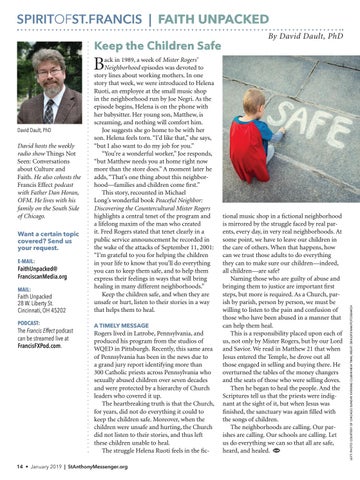
David Dault, PhD
David hosts the weekly radio show Things Not Seen: Conversations about Culture and Faith. He also cohosts the Francis Effect podcast with Father Dan Horan, OFM. He lives with his family on the South Side of Chicago. Want a certain topic covered? Send us your request. E-MAIL:
FaithUnpacked@ FranciscanMedia.org MAIL:
Faith Unpacked 28 W. Liberty St. Cincinnati, OH 45202 PODCAST:
The Francis Effect podcast can be streamed live at FrancisFXPod.com.
ack in 1989, a week of Mister Rogers’ Neighborhood episodes was devoted to story lines about working mothers. In one story that week, we were introduced to Helena Ruoti, an employee at the small music shop in the neighborhood run by Joe Negri. As the episode begins, Helena is on the phone with her babysitter. Her young son, Matthew, is screaming, and nothing will comfort him. Joe suggests she go home to be with her son. Helena feels torn. “I’d like that,” she says, “but I also want to do my job for you.” “You’re a wonderful worker,” Joe responds, “but Matthew needs you at home right now more than the store does.” A moment later he adds, “That’s one thing about this neighborhood—families and children come first.” This story, recounted in Michael Long’s wonderful book Peaceful Neighbor: Discovering the Countercultural Mister Rogers highlights a central tenet of the program and a lifelong maxim of the man who created it. Fred Rogers stated that tenet clearly in a public service announcement he recorded in the wake of the attacks of September 11, 2001: “I’m grateful to you for helping the children in your life to know that you’ll do everything you can to keep them safe, and to help them express their feelings in ways that will bring healing in many different neighborhoods.” Keep the children safe, and when they are unsafe or hurt, listen to their stories in a way that helps them to heal. A TIMELY MESSAGE
Rogers lived in Latrobe, Pennsylvania, and produced his program from the studios of WQED in Pittsburgh. Recently, this same area of Pennsylvania has been in the news due to a grand jury report identifying more than 300 Catholic priests across Pennsylvania who sexually abused children over seven decades and were protected by a hierarchy of Church leaders who covered it up. The heartbreaking truth is that the Church, for years, did not do everything it could to keep the children safe. Moreover, when the children were unsafe and hurting, the Church did not listen to their stories, and thus left these children unable to heal. The struggle Helena Ruoti feels in the fic-
tional music shop in a fictional neighborhood is mirrored by the struggle faced by real parents, every day, in very real neighborhoods. At some point, we have to leave our children in the care of others. When that happens, how can we trust those adults to do everything they can to make sure our children—indeed, all children—are safe? Naming those who are guilty of abuse and bringing them to justice are important first steps, but more is required. As a Church, parish by parish, person by person, we must be willing to listen to the pain and confusion of those who have been abused in a manner that can help them heal. This is a responsibility placed upon each of us, not only by Mister Rogers, but by our Lord and Savior. We read in Matthew 21 that when Jesus entered the Temple, he drove out all those engaged in selling and buying there. He overturned the tables of the money changers and the seats of those who were selling doves. Then he began to heal the people. And the Scriptures tell us that the priests were indignant at the sight of it, but when Jesus was finished, the sanctuary was again filled with the songs of children. The neighborhoods are calling. Our parishes are calling. Our schools are calling. Let us do everything we can so that all are safe, heard, and healed.
LEFT: PHOTO COURTESY OF CHICAGO SUNDAY EVENING CLUB/KHIEM TRAN; RIGHT: DEKLOFENAK/FOTOSEARCH
B
14 • January 2019 | StAnthonyMessenger.org
Spirit of St. Francis 0119.indd 14
11/30/18 9:48 AM
POINTSOFVIEW | EDITORIAL
World Youth Day, We Need You
The whole Church—not only participants—can benefit from the joy and spirit of World Youth Day right now.
T
his month, thousands of young adults ranging in age from 15 to 35 will gather in Panama for the international celebration of World Youth Day. Over the course of six days, participants will take in all that the host country has to offer, perform acts of community service, pray, celebrate the sacraments, and proclaim their faith—all amid a festive atmosphere of music and revelry. Many more young adults will participate in the event from afar. It is a scene that has played out for over 30 years, ever since St. John Paul II established the gathering in 1985. The first one was held the next year in Rome and has subsequently taken place every two to three years since then, on an international scale. Smaller gatherings are held yearly. According to the World Youth Day website, the event “is an opportunity to experience in first person the universality of the Church; to share with the whole world the hope of many young people who want to commit themselves to Christ and others.” The theme of this year’s event, which comes on the heels of the Synod on Young People, the Faith, and Vocational Discernment, is from the Gospel of Luke, where the archangel Gabriel tells Mary: “Do not be afraid, Mary, for you have found favor with God” (1:30). The timing of the two events occurring back-to-back, though, says Pope Francis, “is a happy coincidence. The focus, prayer, and reflection of the Church will turn to you young people, with the desire to receive and, above all, to embrace the precious gift that you are to God, to the Church, and to the world.” Perhaps the timing is not a coincidence at all, though. Perhaps it’s providential. After all, God does work in mysterious ways.
CNS PHOTO/BOB ROLLER
WE NEED HELP
World Youth Day is certainly an exhibition of all that is well with our faith. But there is the other side of that coin. This year has been a tough one for Catholics worldwide, but especially here in our own country. Stories of abuse, inaction by Church hierarchy, and the turning of a blind eye by so many to horrific crimes and actions have been splashed across the headlines for all to see. In 2002, St. John Paul II said that when he instituted the celebration of World Youth Day in 1985, he “imagined a powerful moment in which the young people of the world could meet Christ, who is eternally young, and could learn from him how to be bearers of the Gospel to other young people. This evening, together with you, I praise God and give thanks to him for the gift bestowed on the Church through the World Youth Days. Millions of young people
World Youth Day volunteers look on as a street musician performs in Colón, Panama. This month, thousands of young people will gather there to celebrate their Catholic faith together.
have taken part, and as a result have become better and more committed Christian witnesses.” Let’s hope that rings true for this World Youth Day and its participants. It’s not just the young people, though, who are in need of a revitalization of faith. We all do—no matter what our age. We need that kind of energy to remind the whole Church of the bigger picture and that we will get through this together. The community of the Church is far greater than any one of us. PERFECT TIMING
That is why this year’s World Youth Day celebration is especially important. The Church needs these young people to be reenergized in their faith and share that enthusiasm with the rest of the Church. The Church needs them and their energy now more than ever. Maybe they can carry the spirit of World Youth Day home and serve as a light in the darkness for all of us. In his message for this World Youth Day, Pope Francis said: “From the certainty that God’s grace is with us comes the strength to take courage in the present moment: the courage to carry forward what God asks of us here and now, in every area of our lives; courage to embrace the vocation which God reveals to us; courage to live out our faith without hiding or diminishing it. Yes, when we open ourselves to God’s grace, the impossible becomes a reality. ‘If God is for us, who can be against us?’ (Rom 8:31).” That’s a message that we certainly all need to hear right now—and not only those from 15 to 35. —Susan Hines-Brigger StAnthonyMessenger.org | January 2019 • 15
EDIT 0119.indd 15
11/30/18 9:14 AM
POINTSOFVIEW | AT HOME ON EARTH By Kyle Kramer
The Divine Belayer
EarthandSpiritCenter.org
?
WANT MORE? Visit our website: StAnthonyMessenger.org
L
ast fall, I did something that probably won’t win me accolades in any sensible parenting handbook: I took our kids rock climbing. Decades ago, climbing had been a transformative rite of passage for me. So when a seasoned climber friend offered to take us recently, I jumped at the chance to give my kids a similar opportunity. We spent a day on the magnificent, world-renowned cliffs of Red River Gorge in eastern Kentucky. One of the many reasons I wanted the kids to climb was to help them learn how to deal with fear. As parents, our job is to raise our kids with an appropriate amount of fear—for instance, of dark alleys or grizzly bears—so that they act sensibly, but with not so much fear that they fail to take the necessary risks that are part of the human journey. “Maximum security” is generally a term we use for a prison, not a flourishing life. There is a great paradox at the heart of rock climbing that makes it a perfect opportunity to work with fear. On one hand, to the casual observer (like, say, my dubious, but heroically trusting wife), climbing looks unbelievably dangerous: Anything that goes wrong will probably go fatally wrong. And to the not-so-casual observer—that is, the new climber hanging on to the face of a cliff for dear life—climbing can paralyze you with fear. But when done properly with the right equipment, climbing is actually safer than a
morning commute to work. Acting courageously is not feeling completely fearless—that would be inhuman. Courage, rather, is feeling the fear and still finding a way to go through with your intention. In climbing, the key to facing fear is trust: trust in your body’s abilities; trust in the harnesses, climbing rope, and anchoring systems; and trust in one’s “belayer”—the experienced person at the other end of the rope who will not let you fall. It was exhilarating to watch my kids brave their fears and, with patient coaching, find the small handholds and footholds they needed to make their way up the crags. Our 11-yearold son is a very cautious kid by temperament and, after he made it up a climb, he struggled mightily to let go, relinquish his weight fully to the rope, and allow himself to be lowered safely back to the ground. But—and I write this with button-popping parental pride—he managed it, as did our amazing 15-year-old twin daughters. FEAR AND FAITH
Climbing may help you deal with the fear that stems from our primitive fight/flight wiring. But there are other levels of fear that we must face in the journey to become fully alive as spiritual beings. In fact, some version of “be not afraid” occurs so often throughout Scripture that God must have recognized fear
16 • January 2019 | StAnthonyMessenger.org
AHOE 0119.indd 16
11/30/18 8:46 AM
LENINA11ONLY/FOTOSEARCH
Kyle is the executive director of the Passionist Earth & Spirit Center, which offers interfaith educational programming in meditation, ecology, and social compassion. He serves as a Catholic climate ambassador for the US Conference of Catholic Bishopssponsored Catholic Climate Covenant and is the author of A Time to Plant: Life Lessons in Work, Prayer, and Dirt (Ave Maria Press, 2010). He speaks across the country on issues of ecology and spirituality. He and his family spent 15 years as organic farmers and homesteaders in Spencer County, Indiana.
LEFT: COURTESY OF KYLE KRAMER; RIGHT: OLICLIMB/FOTOSEARCH
Kyle Kramer
LENINA11ONLY/FOTOSEARCH
LEFT: COURTESY OF KYLE KRAMER; RIGHT: OLICLIMB/FOTOSEARCH
HELPFUL
as a serious challenge to being faithful. Jesus invited us to be free to love and be loved by God and others, and he understood that fear was one of the biggest impediments to our freedom. I think the fear from which God would free us is not only the physical fear of death and injury, but mainly the fear of threats to our ego-self—that persona we carefully construct and defend over our lifetime, but that is not actually our truest, deepest identity. This “false self,” as Thomas Merton described it, has a fundamental insecurity: It sees itself, wrongly, as ultimately separate from God and from the rest of creation, with no rope to hold it safe. Because of this sense of alienation, the false self feels very vulnerable and defensive. Just about everything becomes a threat: the natural world with all of its vagaries, the person who disagrees with me, the other political party, the immigrants on our southern border, the people of another skin color or ethnicity, the people who are poor, sick, homeless, or otherwise different from me and my tribe. Rock climbing may be an extreme form of “fear therapy,” but there are plenty of other ways to work with fear while keeping your feet firmly on the ground. In addition to the encouragement of Scripture, we have the practice of prayer. Popularized by the late Trappist monk Thomas Keating, the “Welcoming Prayer” is one such prayer exercise, with three simple-but-not-easy steps. The first is to stop fighting the fear and simply pay close attention to it with curiosity rather than resistance or self-judgment. In most cases, the fear is something you can actually feel in your body itself; that’s worth noticing. The second step is to welcome the fear consciously. Fear almost always brings us some sort of gift, beyond helping us to survive. Fear helps us see the places in our lives where, like an inexperienced rock climber, we don’t trust that we are held and safe. According to Keating, our fears usually involve our need for security and survival, esteem and affection, or power and control—the three “energy centers” that power the false self. When we welcome fear, it can show us where our ego-self is heavily invested and strongly defended: where we need healing. The final—and hardest—step is to let go of the fear. Of course, this isn’t a one-and-done process. If you’ve ever practiced contemplative prayer, you know that almost the entire practice is one of letting ago, again and again and again, of the thoughts and feelings that keep returning. But every time you release your hold on fear, its hold on you gets a little weaker, whether you feel it or not. Fear offers the great gift of learning to trust in God, the divine belayer who will never let us go. With that trust, we can let go of our death grip on our false selves. And in a culture where our various fears are ginned up for political or financial gain, such trust is a radical act of freedom and resistance, an act that can bring about the more kind, just, loving, and healthy world that Jesus proclaimed.
TIPS Unpacking Fear 1
What fears dog you the most? Think about how they relate to your need for security and survival, esteem and affection, or power and control.
2
What fears dominate our culture and can drive our political rhetoric and our national budget priorities? How might we begin to look at them together in our public conversation?
3
In what ways, with what people, and in what kinds of situations is trust hard for you? What small steps can you make to cultivate a greater sense of safety?
StAnthonyMessenger.org | January 2019 • 17
AHOE 0119.indd 17
11/30/18 8:46 AM
COME TO ME, ALL WHO ARE BURDENED For 22 years, this annual retreat has been a beacon for those facing difficult life challenges, giving them an opportunity for fellowship and service to others.
T
here’s no predicting what Judith Huber and her team might plan for the annual Afternoon of Reflection at Our Lady of Grace Parish in Greensburg, Pennsylvania. One year, participants washed each other’s feet. Another time, a woman who volunteers at Lourdes brought rocks and water from the shrine in France so people could experience a mini-pilgrimage. A couple of years ago, a little girl modeled dresses made out of pillowcases. The handmade dresses were then sent to girls in Haiti. In a retreat in October 2017, two live chickens were brought in a cage. The chickens represented 18 flocks that retreatants purchased for Heifer International’s programs in developing countries. As different as the themes are, they have a common focus. The retreatants—all of them facing a life challenge—come together in fellowship to share their faith and to pass it forward. “Every year, we reach out to somebody else,” says the retreat’s spiritual director, Msgr. Larry Kiniry, a retired priest in the Diocese of Greensburg. “We are evangelists when we come together to do something for someone else.”
By Maryann Gogniat Eidemiller | Photography by Richard Dedo
18 • January 2019 | StAnthonyMessenger.org
art_Eidemiller_0119.indd 18
11/30/18 8:54 AM
g
D StAnthonyMessenger.org | January 2019 • 19
art_Eidemiller_0119.indd 19
11/30/18 8:54 AM
“JUDY AND THE PEOPLE AT THE AFTERNOON OF REFLECTION ARE PEOPLE WHO WANT TO CELEBRATE LIFE AND THE FACT THAT GOD CONTINUES TO BLESS THEM.” —BISHOP MALESIC Judy Huber, who began the Afternoon of Reflection 22 years ago, is served the Communion cup during the Mass that culminates each retreat. A CALL TO MINISTRY
That’s what Huber had in mind 22 years ago when Msgr. Kiniry was her pastor and she proposed organizing a faithsharing experience for people with disabilities. That included her. In 1978, Huber was misdiagnosed with multiple sclerosis. Twenty years later, she learned that she had Devic’s disease (neuromyelitis), a progressive immunological disorder that affects optic nerves and the spinal cord. She’s now completely blind, on a ventilator, and has very limited mobility. She needs round-the-clock care, and in recent years she has also battled cancer. Until 15 years ago, she was well enough to work as a coordinator of services for individuals with disabilities. That’s when she saw the need for what developed into the Afternoon of Reflection. “I discovered that many people I worked with felt isolated and alone,” Huber says. “I wanted them to know that there are others in the same situation, that there’s a support system out there, and that they needed to support each other.” Msgr. Kiniry, who has a hearing impairment, agreed with her vision. He was confident that she could pull it off. “Judy has something to offer not only to people with visible disabilities,” he says. “We all have disabilities, whether it’s physical, emotional, mental, and/or certainly spiritual. No one is
any different, and Judy has a gift to speak to all people. I truly believe that she was called to this mission.” A SENSE OF BELONGING
Seventeen people came to the first retreat in 1996. More than 150 signed up for the one held in October 2017. Many of them have spent a lifetime not fitting in with traditional retreats, and now they have one of their own. The event grows by word of mouth, bringing together people in wheelchairs, those who are blind or deaf, those with cognitive challenges, those who are ill, and those with invisible burdens. They are the people Jesus sought out in the Gospels. In Matthew 11:28, he invites them to “Come to me, all you who labor and are burdened, and I will give you rest.” “I think what draws people, first of all, is the fact that they have a deep sense of experiencing something very spiritual, something very welcoming,” Msgr. Kiniry explains. “Judy and I have always agreed that we are not the well people giving them information. They are part of what this is all about.” Beth Meier and her son, Matthew, have both benefited from recent retreats. Meier was undergoing treatment for non-Hodgkin’s lymphoma and credits the prayers and anointing at the retreat in 2016 with getting her through treatments. She is now in remission. Matthew, 22, is intellectually disabled. At the 2017 retreat,
20 • January 2019 | StAnthonyMessenger.org
art_Eidemiller_0119.indd 20
11/30/18 8:54 AM
he played the keyboard during a break for refreshments. He’s been studying music for 10 years, and, his mother notes, it has been an accomplishment that grew beyond expectations. The retreat gives him an opportunity to share his gift of music with others while experiencing what he calls a joy and peace in the fellowship. It means a lot for him to be part of the Afternoon of Reflection. During the retreat, that fellowship grows through various activities. Retreatants participate in skits, have group discussions, then share their thoughts. The room is hushed when anyone speaks because some speak haltingly or have to gather their thoughts. Some use sign language interpreters. All of them know that they will be heard and respected when they speak from their hearts. Themes focus on respect for life, living the beatitudes with concrete actions and deeds, and the humility and service of washing each other’s feet as Jesus did for his apostles. While the themes change every year, the itinerary remains the same. People learn about the needs of others and how they can respond. Toward the end of the afternoon, Mass is celebrated with a procession into the sanctuary. Retreatants give the readings and the petitions of prayer, and bring gifts to the altar. Msgr. Kiniry anoints all those present. Immaculate Conception Church in nearby Irwin sends choir members to sing at the Mass. They also bring people from their Journey to Scripture group that’s dedicated to the spiritual needs of young adults with mental challenges. “It’s very meaningful for our members to share thoughts and ideas in the discussion groups, assume various roles at Mass, and sing with the choir,” says group instructor TOP: As musicians perform, pairs of shoes line the stage at a recent retreat, emphasizing the message that attendees are called to follow in Jesus’ footsteps by helping others. MIDDLE: During Mass, Mike Daley uses Braille to give one of the readings. BOTTOM: Participant and performer Matthew Meier relishes the opportunity to not only share his musical talent but also take part in the life-affirming community fostered at the Afternoon of Reflection.
art_Eidemiller_0119.indd 21
11/30/18 8:54 AM
“HE ALWAYS LOOKED FORWARD TO HAVING THE OPPORTUNITY TO ATTEND MASS WITH PEOPLE IN SIMILAR CIRCUMSTANCES.” —NANCY BALFE Jim Balfe is anointed by the retreat’s spiritual director, Msgr. Kiniry. Balfe, who attended nearly every retreat since its inception, died in January 2018.
Bernie Cymbor. “All of us have become aware of the healing graces received as Msgr. Kiniry anoints us. We feel blessed and grateful for the opportunities that affirm our dignity as human beings and children of God. We carry that with us.” Jim Balfe, who attended nearly every retreat, passed away in January 2018. “He always looked forward to having the opportunity to attend Mass with people in similar circumstances,” his widow, Nancy, says. “The retreat is an environment where he could simply be himself and share with people who understand.” BLESSINGS GIVEN AND RECEIVED
This camaraderie extends to other individuals who attend because Huber has touched their lives. Despite her physical limitations, Huber has an active social life, hosts visitors to her apartment, and keeps in touch by phone and social media. She is passionate about bringing people into the retreat community. Reservation clerk Rita Shapiola, who has multiple sclerosis, has been involved since the beginning. “Judy needed help, and I love doing this,” she says. “Being around Judy makes me thank God for everything I have and everything I can do.” Several volunteers started out as Huber’s caregivers. Sarah Marland of Baltimore took a part-time position during her junior and senior years at nearby Saint Vincent College. She was so touched by Huber and her friends and the spirit of the retreats that she returns every autumn to volunteer.
Irene Perry is one of the volunteers who initially attended to accompany a retreatant. In her case, that was her late brother Jim Hillman. She was so touched by the joy of fellowship that he cherished that she wanted to be part of the ministry. She’s now retreat co-coordinator, and Huber calls her “my right hand.” Hillman collected rosaries and materials from the retreat to take back to residents of the personal care home where he lived. Perry bought rosaries to keep up with the demand. Then others started bringing rosaries, prayer cards, religious booklets, medals, and more. “They’re all those little things you get in the mail and don’t know what to do with,” she adds. “Whatever is left over is donated to missions and other ministries.” Passing on these items can bring blessings to others who might not otherwise have access to them and is another way the retreatants evangelize. REACHING OUT TO OTHERS
The emphasis on helping others is apparent at each year’s retreat. When the planning team considered supporting Heifer International for their project in 2017, Renee Gorski, who has taken care of Huber for years, offered to bring two of the chickens that she and her husband, Bruce, raise in their yard. She explained to the retreatants how their donations to fund flocks will change the lives of impoverished people. Chickens provide eggs and meat for families, income
22 • January 2019 | StAnthonyMessenger.org
art_Eidemiller_0119.indd 22
11/30/18 8:54 AM
from sales, and even feathers for pillows. They require minimal upkeep and are “a hand up, not a handout,” she notes. Emcee Karen Ulishney told retreatants that their donations to the global organization would be a gift that will be passed on to others when the flocks increase. The opportunities from raising chickens can help families become drivers of their own change and make a difference in the worldwide problem of hunger. This charitable outreach reflects Msgr. Kiniry’s retreat message on the greatest commandment to “love thy neighbor as thyself.” From that concept come the gifts of love, mercy, forgiveness, charity, and hope—words that were put on signs attached to shoes lined up on the stage at a recent retreat. They were symbolic of the “willingness to help our brothers and sisters” by walking in the footsteps of Jesus, he says. “Msgr. Larry is awesome,” volunteer and retreatant Rita Shapiola says. “His talks make you think and make you realize what’s out there and what you can do, even if it’s not as much as you want to do. You’re doing something, so just don’t give up.” THE FUTURE LOOKS BRIGHT
Due to the positive impact of the retreat, the diocese has been inspired to consider additional ministries for individuals with disabilities. “There are a lot of programs for youth and children, but adults with special needs are kind of on their own,” Sherwin explains. “So we’re looking at the future and what that might mean for a parish ministry. “Meanwhile, the Afternoon of Reflection has been an opportunity for individuals to grow in their spiritual journeys and to share their faith through service. Pope John Paul II and Pope Francis had special places in their hearts for people with special needs, who are closer to God. They have great faith and are not afraid to share it. They know that Jesus loves them.” Sherwin praises Huber for what she has done for the special-needs community. “She’s a testament to who she is in her faith. She loves the Lord and shares that joy and enthusiasm.” The head of the diocese, Bishop Edward Malesic, calls Msgr. Kiniry “a gem” and was moved by what he witnessed at the retreat in 2016. “Judy and the people at the Afternoon of Reflection are people who want to celebrate life and the fact that God continues to bless them,” he says. “It’s uplifting to see their faith shining through their challenges. I could feel the joy and love in the room and feel the presence of God.”
The retreat’s success has been pivotal in the Greensburg Diocese. Members of parish youth groups and students from Catholic schools have been volunteering at the retreats for years. Their presence in the ministry is a testimony to the promising future of the Church. The diocese officially became involved as cosponsor of the retreat two years ago. Bob Sherwin, managing director of Evangelization and Faith Formation, assists with planning, coordinating volunteers, and budgeting.
Maryann Gogniat Eidemiller is an author and editor whose work has been recognized with numerous journalism awards, including from the Catholic Press Association of the United States and Canada. Mother of three and grandmother of two, she lives in Greensburg, Pennsylvania, with her husband, five rescue dogs, and one cat.
Huber’s co-coordinator and “right hand,” Irene Perry, first attended the retreat years ago, accompanying her brother in this meaningful ministry.
Affirming how retreatants help others, Renee Gorski explains that their donations to fund flocks of chickens enable impoverished families to survive and thrive. StAnthonyMessenger.org | January 2019 • 23
art_Eidemiller_0119.indd 23
11/30/18 8:54 AM
WALKING WITH
24 • January 2019 | StAnthonyMessenger.org
art_Caster_0119.indd 24
11/30/18 8:50 AM
The spiritual life goes beyond religious practices and reciting prayers. At its core, it means to encounter and follow Jesus every day. By Father Gary Caster
FOTOTSEARCH IMAGES: PARK: BUDABAR; CLOUDS: TOLOKONOV
S
ome months before I was ordained, my bishop told me he planned to send me to teach at one of our Catholic high schools. The idea terrified me. I was not popular the first time around and imagined my new experience would be much the same. My bishop—ever patient with me—told me to trust his decision, be myself, and share with the students my relationship with Christ. The first and most important thing I learned was how easy it was for students to spot a phony. They had little interest in a talking head, a know-it-all, an encyclopedia (which accurately describes my first semester). I was so excited about sharing with them the beauty of the Catholic faith and having them see it the way I did that I ended up caring more about the material than I did for them. Fortunately, a disgruntled young student had the courage to bring this to my attention. He openly challenged me to explain exactly how all this material affected my life. He did not want abstract concepts and interesting theories. His direct rebuke, “What difference does any of this make?,” taught me a valuable lesson about the true nature of evangelization. Today this young man is an outstanding priest, author, and educator. Since it is impossible for me to explain the difference a life of faith makes without describing how to live it, answering this young man’s question provided me with an opportunity to describe what nourished and sustained my life with Christ. It was easy for me to talk about the real impact the Trinity, the Eucharist, the Scriptures, and so on, have on my daily life, and it generated great discussions. It was easy, therefore, to challenge them to do the same. I used to say to them:
“The best possible experience of life comes from following Christ. I should know, because I have the best life of anyone I know! The only way to disprove me is to follow Christ and see whether or not I’m right.” Everyone who has ever taken up my challenge is still following him. The question then is: How do we follow him? IT’S NOT THE THINGS YOU DO
The single greatest difficulty people face when following Christ is an effect of reducing one’s spiritual life to one’s religious practices. This is why many people leave the Catholic Church. They think that the pious, devotional, and obligatory things that comprise practicing the faith equate to having a life of faith. This is simply not true. The rosaries recited, the hours racked up before the Blessed Sacrament, all the Masses attended, chaplets prayed, and fasts obeyed do not necessarily indicate that one is following Jesus. Many people do these things— all of them good things to do—because someone told them to. Fulfilling one’s duties and obligations, while a significant dimension of any healthy relationship, is not in and of itself the relationship. Over time, many Catholics lose interest and fall away because they do not know this. God created us for himself, not for religious practices: “The Sabbath was made for man, not man for the Sabbath” (Mk 2:27). Now, lest anyone accuse me of disparaging pious practices and religious obligations, hear me out. They are not and cannot be the heart of our spiritual lives. Christ has told us in his own words that he alone must be the rock foundation on which we build our lives. This can only happen if we have actually encountered
StAnthonyMessenger.org | January 2019 • 25
art_Caster_0119.indd 25
11/30/18 8:50 AM
drinking, sleeping, working, playing, thinking, resting— every human activity and endeavor, no matter how grand or seemingly insignificant, should be rooted in the relationship I have with Jesus.
ultimately leads to resentment. This is one reason why I am glad I am not God. He does not tell us what to do and never thinks poorly of us for trying. He does not deserve our recriminations when the plans we set for ourselves do not come to fruition. Instead of being angry at failure, we should simply try again, but this time with a plan that is reasonable and workable. IT’S NOT A MEANS TO AN END
The second most common reason for failure in the spiritual life lies in treating it as a means to an end. No one should undertake a substantive life of prayer and devotion thinking it will make them holy, eradicate all suffering, or assure a comfortable, successful life. In no way is this what following Christ entails. This is just an attempt at gaming God, and it treats prayer as a form of magic. Thinking that God must do certain things for me because of what I do for God is an absolute and egregious blasphemy. God does not bend to my will or yours; as followers of Christ, we are supposed to bend to his. God is never bound by what we do, even when done out of love for him. We should undertake the things we do for God simply because we must, period. I spend time with Jesus each day not because of how it makes me feel (sometimes I really do not feel like it) or because I promised the Church I would. I do it because I cannot live without it, and, in fact, I could not get out of bed if I did not. Perhaps there are other motivations for embracing each new day, but the only one that works for me is Jesus. Those who undertake to follow Christ must never lose sight of the fact that the spiritual life is an end in itself. The spiritual practices I undertake as I adhere to Christ are all things that I must do. Without them, I would be unable to continue progressing with him on my journey to everlasting life. I should pray the rosary because I have found in the rhythm and pattern of the repeated prayers the space I need to reflect upon the life of the one I follow. If, for example, I pray the Chaplet of Divine Mercy, it should flow from a desire to penetrate more deeply the sacrificial offering of Christ’s passion and death. The awareness of my need to be with the Lord should compel me to sit before him, present in the Blessed Sacrament.
SMONTGOM65/FOTOSEARCH
Eating,
him, as did the people who followed him in the Gospels. Once we have decided to leave everything to follow Christ, it becomes readily apparent that we need help in doing so. Thus, if we want to follow him, we must seek out and grab hold of those things that nourish and sustain us in doing so. The organization of the Catholic Church is for just this purpose. The Scriptures preserved and handed down, the moral and social teachings that flow from them, and the sacramental life enlivened by the Holy Spirit enable us to adhere to Christ as we follow him toward our destiny with the Father. Even during his public ministry, Jesus made it abundantly clear that we do not follow him as individuals alone; we follow him as companions. I cannot, therefore, experience fully my relationship with Christ in isolation from his body, the Church. It would be something like the big toe trying to get around by itself without the rest of the foot! One of the many things I love about the Catholic Church is the refusal to mandate a one-size-fits-all approach to living our life with Christ. The Church simply sets before us a rich treasury of practices that enhance, encourage, enliven, and even embolden our life with Christ. While many are strongly encouraged because they prove so efficacious, the Church imposes none of them upon us. We do not have to ever pray the rosary or the Chaplet of Divine Mercy, make a holy hour, pray the Divine Office, or have a devotion to Mary or a particular saint. While we must attend Mass on Sundays and holy days, fast and abstain with the Church (according to our age and health), receive the Eucharist once a year, go to confession if we are conscious of having committed a serious sin, and financially support the mission of the Church according to our means, we are never told what to do in between. This is incumbent upon each individual believer. In other words, it is up to each one of us, and I find this refreshing. I cannot stress this point enough. Far too many people, in trying to begin a spiritual life, merely adopt the most popular spiritual practices or disciplines. Usually they take too much upon themselves, including things that do not actually nourish them. In the end, they fail, and this leads them to think poorly of themselves. Eventually they conclude that God must also think poorly of them. This
26 • January 2019 | StAnthonyMessenger.org
art_Caster_0119.indd 26
11/30/18 8:50 AM
The entire pattern of my life of prayer should be rooted in the recognition that I cannot live my life with Christ otherwise. If any of the things that make up my spiritual practices are done out of a hope for gaining something, then I should immediately stop doing them! Our Lady does not care how many rosaries one says or even if one does. However, she does care about the extent to which we are evermore opening our hearts to her son. Jesus remains the focus and foundation of her eternal life; thus, she continues to serve him by encouraging us to do the same. Jesus offers his most detailed description of judgment in Matthew 25:31–46. He does not say to those on his right: “Come, you who are blessed by my Father, for you spent 6 million hours before me, never missed a Sunday Mass, prayed 15 million rosaries, read your Bible every day, and went regularly to confession. Now enjoy the place prepared for you from the foundation of the world.” Jesus makes no mention of spiritual practices, devotional activities, or scriptural acumen. He does, however, make mention of the way in which those on his right not only recognized their neighbors’ needs, but also, more importantly, responded. Of course, I would argue that it is unlikely we could be responsive in the way Jesus describes unless our lives were rooted in his. Pious and devotional practices do not make us responsive; they keep us firmly rooted in the Lord and his goodness. This in turn informs the way we see God, ourselves, others, and the world around us. It should come as no surprise, then, that a spiritual life is not the way to get to heaven. Jesus Christ alone is the way. In order to follow him on this way, we need to be attentive to the one we are following. The spiritual life is, to put it accurately, more a description of the way we follow than a guarantee that we are, in fact, following. YOU ARE YOUR SPIRITUAL LIFE
This is perhaps the most important of all the points I want to make. What does it mean to say that one is one’s spiritual life? It means that every aspect of my life flows from and thereby expresses my relationship with Christ (or should). My spiritual life is not only the moments I am conscious of God or talking with him in personal or communal prayer. Rather, every waking moment constitutes my following of Christ. Eating, drinking, sleeping, working, playing, thinking, resting—every human activity and endeavor, no matter how grand or seemingly insignificant, should be rooted in the relationship I have with Jesus. My life with Christ had better be my life, or, essentially, I do not have a life with Christ. This article is adapted from Prayer Everywhere: The Spiritual Life Made Simple (Servant Books), by Father Gary Caster. A priest of the Diocese of Peoria, Illinois, Father Caster has worked as a high school chaplain, religion teacher, and director of campus ministry at a number of colleges and universities.
Visit our online store to order any of Father Gary Caster’s books: SMONTGOM65/FOTOSEARCH
Shop.FranciscanMedia.org
For 20% off, use code: CASTER20 StAnthonyMessenger.org | January 2019 • 27
art_Caster_0119.indd 27
11/30/18 1:26 PM
LEFT: LIGHTSPRING/SHUTTERSTOCK; TOP: PALINCHAK/FOTOSEARCH
28 • January 2019 | StAnthonyMessenger.org
artPatterson 0119.indd 28
11/30/18 9:04 AM
THE DEATH PENALTY AND
THE
MYTH OF
LEFT: LIGHTSPRING/SHUTTERSTOCK; TOP: PALINCHAK/FOTOSEARCH
CLOSURE Many argue the death penalty can help survivors move on with their lives. However, this counselor writes that true healing can happen only when we learn to “walk with the pain.”
T
he death penalty has been with us for millennia. If you take the time to read the Old Testament, you will find that the death penalty was widely accepted. We find in the words of Exodus the justification invoked to this day to defend the use of executions: “You shall give life for life, eye for eye, tooth for tooth, hand for hand, foot for foot, burn for burn, wound for wound, stripe for stripe” (21:23–25). This is known as Mosaic law and is an integral part of our legal system. And yet Jesus came to challenge it: “You have heard that it was said, ‘An eye for an eye and a tooth for a tooth.’ But I say to you, offer no resistance to one who is evil. When someone strikes you on [your] right cheek, turn the other one to him as well” (Mt 5:38–39). What a truly radical notion! In the Old Testament, one sees that violence was a way of life, and execution was a primary tool for meting out justice. But Jesus sweeps that all away. As with many things Jesus said, excuses have been made and qualifiers added: Love your enemy . . . except when he is a murderer. Then you are justified to kill him, a conclusion that sounds very much like Mosaic law.
DESIRE FOR VENGEANCE IS REAL
By Richard B. Patterson, PhD On the other hand, even if we accept Jesus’ teaching, turning the other cheek is not that simple. I can’t simply say, “Well, Patterson, you claim to be a Christian, so you must love your enemy and oppose the death penalty.” I also understand the desire for vengeance. StAnthonyMessenger.org | January 2019 • 29
artPatterson 0119.indd 29
11/30/18 9:04 AM
30 • January 2019 | StAnthonyMessenger.org
artPatterson 0119.indd 30
11/30/18 9:04 AM
PALINCHAK/FOTOSEARCH
of the Oklahoma City bombing to witness the execution of Timothy McVeigh, Attorney General John Ashcroft stated that he hoped the execution would help survivors “meet their need to close this chapter in their lives.” Whether executions provide closure depends on what we mean by that word. For most of us, closure implies a completion or conclusion. When a corporation announces store closures, that means those stores are no longer operational. So, in discussing the process of grief and trauma, closure would seem to imply a conclusion—the suggestion that there is an end point to grieving. This expectation of closure is sometimes supported within a person’s social network. At this time, I am counseling several parents of children who committed suicide. All have commented on encountering, either directly or indirectly, the message “Aren’t you over it by now?” Think for a moment of the people in your life you have lost. Are you no longer grieving? If I think of loved ones who are gone, I become aware that I may be grieving those losses for the rest of my days. My grief may not be as intense as it was at the time of the loss. But reminders of someone’s absence in my life help me see that grief goes on, that there is no closure in the sense of conclusion to my grief. There’s no point at which I dust myself off and say, “OK, I’m done missing that person.”
ANTONIOGUILLEM/FOTOSEARCH
Some years ago when I was an Army psychologist, I was tasked with evaluating a man arrested for beating his 3-month-old stepdaughter within an inch of her life on Christmas Eve. It had already been determined that the child suffered irreversible brain damage. As I was interviewing the man, I received a call from the pediatric ICU informing me she had also been blinded. I hung up and told this man that news. He shrugged his shoulders and said, “Oh, well.” In that moment, I wanted to jump across my desk, grab him by the throat, and beat him within an inch of his life! As I think about him almost 40 years later, I have the same feeling. I am not proud of that, but it also helps me to be sensitive to the feelings of survivors when it comes to discussions of the death penalty. It reminds me to be sensitive to survivors’ need for justice and, possibly, vengeance. Many justifications for executions set aside the language of Mosaic law and focus on possible benefits for the surviving family. One doesn’t so much hear the word vengeance in such discussions, but one does hear the word closure. A common justification for the death penalty is that it provides closure for the family. When Boston Marathon bomber Dzhokhar Tsarnaev was sentenced to death, the mayor of Boston expressed the hope that “this verdict provides a small amount of closure.” Similarly, when the decision was made to allow survivors
Forgiveness can indeed help survivors heal, but it isn’t that simple. Forgiveness is a process, one that can last a lifetime. THE MYTH OF CLOSURE
In her book Closure: The Rush to End Grief and What It Costs Us, Professor Nancy Berns makes the compelling argument that the concept of closure has emerged within a political context to justify the death penalty and as a “made-up concept: a frame used to explain how we respond to loss.” It has become such a common word in discussions about grief that people assume it exists and is within their reach. In fact, its prevalence reflects the hope we all have that we can heal from the devastation of tragedy and trauma. For some, closure means the conclusion to a very public process of crime, arrest, trial, and multiple appeals. Anecdotal evidence suggests that indeed the execution provides that sense of closure. But the word closure also implies healing and completion. Evidence suggests that not only does the death penalty not facilitate healing but, in fact, may interfere with it. In his 2007 study of families of murder victims, Scott Velum found that only 2.5 percent indicated a strong sense of closure resulted from the execution of the murderer. A study published in the Marquette Law Review compared survivors’ reactions in Minnesota and Texas. Killers in Minnesota were sentenced to life imprisonment, an outcome that was experienced as satisfying by survivors. Texas survivors were less satisfied by death penalty verdicts, in large part because of the prolonged appeals process. As Bill and Denise Richards, parents of a 9-year-old boy killed in the Boston Marathon bombings, wrote in the Boston Globe, asking that the government not seek the death penalty, “The continued pursuit of that punishment could bring years of appeals and prolong the most painful day of our lives.” Jody Madeira worked with and studied survivors of the Oklahoma City bombings. In her book Killing McVeigh: The Death Penalty and the Myth of Closure, she noted that Timothy McVeigh’s execution did not provide the kind of closure some survivors may have hoped for. As one survivor noted, “There won’t be closure till I am dead.”
PALINCHAK/FOTOSEARCH
ANTONIOGUILLEM/FOTOSEARCH
THE PATH TO HEALING
Are survivors then simply left in anguish, or is some form of healing possible? Perhaps rather than talking about closure, we should be talking about healing. Sociologist Loren Toussaint suggests that healing is possible through the process of forgiveness. Madeira agrees that forgiveness can help but argues that it is not the only path to healing. This is a delicate topic that must be approached carefully and without judgment. Forgiveness can indeed help survivors heal, but it isn’t that simple. Forgiveness is a process, one that can last a lifetime.
First, let’s be clear on what forgiveness isn’t. Forgiveness does not mean condoning—a distinction relevant to people dealing with someone on death row. Forgiveness does not minimize what was done. The bombings in Boston will never be acceptable. The 9/11 attacks can never be dismissed in terms of the personal trauma. The murder of a loved one will never be OK. After all, the God of my understanding is indeed a God of mercy, but also a God of justice. Then there is the common phrase forgive and forget. Not only is that often not possible, but in some cases it’s not a good idea. If someone has assaulted me, I may need to forgive that person, but it may not be a good idea for me to invite him or her over for dinner. That person may have no remorse and might assault me again. The first step in forgiving is making the decision to forgive. The important thing to realize in making this decision is that the person who will benefit most from forgiving is the forgiver. Forgiving frees the forgiver from all the negative venom of hatred and resentment. Essentially, to forgive is to reclaim power from the forgiven. Professor Madeira quotes Oklahoma City bombing survivor Bud Welch as saying about forgiving Timothy McVeigh: “I was the one that got relief from all this pain . . . and it wasn’t about McVeigh.” Sometimes we confuse forgiveness with reconnecting with someone in a loving way. That reconnecting is a decision that I may make after I have forgiven. I also have the option of not having the offender in my life. In other words, to forgive doesn’t necessarily mean to reconcile with someone. To forgive means I also have to face all my rage and anger, all my thoughts of vengeance. We can’t sidestep the emotions. I have sat with some people who experienced tragedy or trauma and afterwards stated, rather flatly, “I’ve forgiven that person,” without any acknowledgment of the pain inflicted by that person. This to me is an intellectual exercise, not an experience of true forgiveness. LEARNING TO WALK WITH THE PAIN
In exploring alternatives to the prevalent concept of closure, we also need to broaden our understanding of grief. The concept of closure may have its roots in Elisabeth KüblerRoss’ famous five stages of dying. That theory has been broadened to include grief. The fifth stage is acceptance. Like closure, this notion has many meanings. What does it mean to accept the death of a loved one? Again, some kind of finality is suggested, a sort of conclusion to the grieving. I have sat with persons who judged themselves because they did not feel they were finished grieving. Others had well-meaning friends and relatives suggest they should be “over it by now” or that they hadn’t “accepted” the death because they were still grieving. StAnthonyMessenger.org | January 2019 • 31
artPatterson 0119.indd 31
11/30/18 9:04 AM
Richard B. Patterson, PhD, is a clinical psychologist from El Paso, Texas. He has had a number of articles published in this magazine, including “Mysticism for the Masses” (August 2018). 32 • January 2019 | StAnthonyMessenger.org
artPatterson 0119.indd 32
11/30/18 9:04 AM
CNS PHOTO/PAUL HARING
Over the years I have dealt with many people who came to see me because someone else was concerned about them or, more often, because they themselves questioned whether they were grieving correctly. I recall one beautiful woman who came to see me after the death of her husband of 50-plus years. She was concerned whether she was grieving correctly. She stated that well-meaning friends had given her a stack of books on grieving. Not wanting to disappoint anyone, she read them all. When I asked what she thought after all that reading, she told me: “I’m completely confused. They contradict one another.” So what did I do? I gave her a book to read! Only it wasn’t an edition of Grieving for Dummies. It was C.S. Lewis’ A Grief Observed, his journal written the first year after the death of his beloved wife, Joy. The book has no easy answers, and, at its conclusion, it is clear that Lewis will continue to grieve. There is no nice, clean ending. No closure. Only Lewis trying to learn to walk with the pain. In dealing with losses in my own life, what works for me is to view grieving as a process of learning to walk with the pain. This suggests that, because of a particular loss, my life is changed forever. I am challenged to find a way to move forward living my life as well as possible while at the same time carrying the loss. This is especially true for those who’ve lost a loved one through some criminal act, be it murder or terrorism. To learn to walk with the pain has several facets. One is to make the decision not to let the trauma define the loved one’s life. It is to affirm that I will not be known as the parent of that girl or boy who was murdered. Rather, I will be known as the parent of a child who touched lives in a beautiful way before leaving life much too soon. Another facet of walking with the pain is to facilitate the loved one’s legacy. Such legacies may take the form of charitable donations or even the establishment of a charity. Others might establish a scholarship fund. Some get tattoos or plant trees. Such actions don’t make pain go away, but they create a legacy that has some meaning. For me, acceptance means acknowledging that life is now different, and that I will be walking with this pain until I meet my loved one again in a better place. That may be the only real closure.
LEFT: ANTONIOGUILLEM/FOTOSEARCH; TOP: PALINCHAK/FOTOSEARCH
I am challenged to find a way to move forward living my life as well as possible while at the same time carrying the loss.
The pope has strongly spoken against the death penalty to Congress. The pontiff ordered a revision to the Catechism of the Catholic Church to state that the death penalty is inadmissible and to commit the Church to its abolition.
Moving beyond the Rhetoric
THE POLITICAL RHETORIC OF OUR DAY has embraced the term pro-life. However, that same rhetoric typically limits the definition of life to life at conception. One does not hear many political pro-lifers speak out against war or against easy access to assault weapons. Life to be revered doesn’t seem to extend to our environment. Nor does it extend to the many men and women sitting on death row in our various prisons.
The new wording strengthened language St. John Paul II updated in 1997, expressing skepticism about the need to use the death penalty in the modern world. The US bishops have consistently called for an end to the death penalty in the United States. In the 2005 document “A Culture of Life,” the bishops stated: “This is a time to teach clearly, encourage reflection, and call for a common action in the Catholic community to bring about an end to the use of the death penalty in our land.” Citing Catholic teaching, the bishops called the death penalty “unnecessary and unjustified in our time and circumstances.” CNS PHOTO/PAUL HARING
LEFT: ANTONIOGUILLEM/FOTOSEARCH; TOP: PALINCHAK/FOTOSEARCH
By contrast, the Church has consistently taken a “womb-to-tomb” approach to life issues. Most recently, Pope Francis announced in August 2018 changes to the Catechism of the Catholic Church (2267) to declare the death penalty unacceptable under any circumstance. “The death penalty is inadmissible because it is an attack on the inviolability and dignity of the person,” states the pope’s revision of the Catechism, adding that the Church “works with determination for its abolition worldwide.”
To read the bishops’ document, visit: www.usccb.org/issues-andaction/human-life-and-dignity/death-penalty-capital-punishment/upload/penaltyofdeath.pdf. StAnthonyMessenger.org | January 2019 • 33
artPatterson 0119.indd 33
11/30/18 9:04 AM
34 • January 2019 | StAnthonyMessenger.org
art_Klemond_0119.indd 34
11/30/18 8:58 AM
COPYRIGHT FRANCISCAN SISTERS OF MARY. ALL RIGHTS RESERVED. REPRINTED WITH PERMISSION
COMPOSITE: FOTOSEARCH IMAGES: DOLLAR SIGN: FOCALPOINT; ARROWS: IUNEWIND; ICONS: ALEXWHITE; CLOUDS:SLENA
MAKE MONEY, MAKE A
E A DIFFERENCE Impact investing can yield both financial and humanitarian gains. By Susan Klemond
COPYRIGHT FRANCISCAN SISTERS OF MARY. ALL RIGHTS RESERVED. REPRINTED WITH PERMISSION
COMPOSITE: FOTOSEARCH IMAGES: DOLLAR SIGN: FOCALPOINT; ARROWS: IUNEWIND; ICONS: ALEXWHITE; CLOUDS:SLENA
T
he Franciscan Sisters of Mary (FSM) like to tell how their founder, Mother Mary Odilia Berger, made an impact in the streets of St. Louis in the early 1870s as she brought food and medical supplies to the sick and to the sisters in her religious congregation who were caring for them. Passersby noticed the congregation’s charity and placed donations in Mother Odilia’s basket. Today the sisters’ “basket” consists of the assets they acquired while serving in healthcare ministry, including SSM Health, one of the largest Catholic hospital systems in the United States. Now retired, they support themselves in large part through the financial returns they receive on investment of those assets. At the same time, by investing some of their assets in a new way—in impact investments—they’re directly helping to care for the environment and those collaborating in that care, especially the poor and marginalized. Since 2012, the sisters have dedicated 15 percent of their investments to bringing broader solutions to social and environmental problems by providing businesses with seed capital to grow in a way that’s not always possible with a grant. In the process, the sisters are seeking market-rate returns, adjusted for risk.
WHAT’S THE IMPACT?
Socially responsible and faith-consistent investing in the United States originated in
19th-century Protestant communities that avoided investing in enterprises that profited from alcohol, tobacco, and gambling. In the 1980s, Catholics and Protestants pressured US corporations to end operations in South Africa to end the system of apartheid. Now, a growing number of Catholic institutional and individual investors—especially millennials—seek to use tools of capitalism to benefit the environment and social causes such as assisting the poor in other countries, yet they often expect market-rate financial returns on these investments. Impact investing is defined as investments made in companies, organizations, and funds with the intention to generate social and environmental impact alongside a financial return, according to the Global Impact Investing Network (GIIN), a New York-based nonprofit dedicated to increasing the scale and effectiveness of impact investing. GIIN tracks 430 active impact investment funds worldwide. In 2017, a GIIN survey reported $114 billion (US dollars) in impact investing assets. “Impact investing is growing across the board in the values-aligned space where it’s not purely on financial return,” says Jake Barnett, institutional consultant for Graystone Consulting, an independent firm associated with Morgan Stanley. “More individuals and institutions are looking to align with their values.”
Mother Mary Odilia Berger founded the Sisters of St. Mary to take food and medicine to those in need. Now her congregation makes an impact through faithbased investing.
StAnthonyMessenger.org | January 2019 • 35
art_Klemond_0119.indd 35
11/30/18 8:58 AM
this effort could indeed be really a part of our mission in the world, our witness to the Gospel, or to our belief in Jesus Christ,” Father Finn adds.
The Franciscan Sisters of Mary have seen growth in their investment in M-KOPA, a Kenya-based seller of solar panels to rural East Africans, that has brought both a financial return for them and a measurable social return in improving the lives of East Africans and the environment. M-KOPA offers customers a power source that is cleaner, more reliable, and more affordable than kerosene. When the sisters invested in the company in 2013, it had connected 30,000 homes to solar power; by May 2017, the number had risen to more than 500,000 homes, for a projected savings of $375 million over the next four years. The sisters complement their direct investment in M-KOPA with fund impact investments in which many investors’ assets are pooled to benefit a number of organizations or companies through direct investments. “Our investment is translated not only into financial but also into the return that speaks to the human and ecological impact that’s been made,” says Sister Susan Scholl, FSM, president of the congregation. “[The sisters] want to know what we’re doing is making a difference.” The Oblates of Mary Immaculate are dedicated to peace and justice, not only in their 68 mission centers around the world but also in the management of their investment portfolio, according to Father Finn, who also is a consultant to the Oblates’ Office of Justice and Peace and Integrity of Creation. The order manages assets for Catholic institutions that include those of small dioceses in developing countries where the Oblates serve, along with religious orders and others. Since the trust was established in 1991, Father Finn and OIP Investment Trust’s management team have screened out companies and funds whose practices are inconsistent with Catholic teaching and have been involved in shareholder dialogue in companies. They began learning about having
36 • January 2019 | StAnthonyMessenger.org
art_Klemond_0119.indd 36
11/30/18 8:58 AM
BORGOGNIELS/FOTOSEARCH
SUCCESS STORIES
CNS PHOTO/CAROL GLATZ
Father Seamus Finn, OMI, chairs the Interfaith Center on Corporate Responsibility. He encourages investors to use their assets to promote Gospel values.
Individual investors may soon have opportunities to make impact investment donations, which Pope Francis has encouraged as a way of doing good with assets. The Holy Father spoke on the topic in his 2014 address at the conference promoted by the Pontifical Council for Justice and Peace on “Impact Investing for the Poor”: “Impact investors are those who are conscious of the existence of serious unjust situations, instances of profound social inequality, and unacceptable conditions of poverty affecting communities and entire peoples. . . . Investments of this sort are meant to have positive social repercussions on local communities, such as the creation of jobs, access to energy, training, and increased agricultural productivity.” The methods available for faith-consistent investing—including screening out investments that don’t align with beliefs, as well as impact investing—give Catholic investors a way to promote Gospel values with their assets, according to Father Seamus Finn, OMI, chief of faith-consistent investing for the Oblates of Mary Immaculate’s OIP Investment Trust, which manages assets for more than 200 Catholic institutions. He notes that the US Conference of Catholic Bishops has produced investing guidelines to help in aligning investment decisions with Church teaching (usccb.org/about/financialreporting/socially-responsible-investmentguidelines.cfm). “Instead of just focusing on avoiding harm that I might do and evil that I might cooperate in, is there a way that I can make a positive contribution? Is there a way that I can put money into projects or into institutions or into funds that are actually trying to do good things?” Father Finn says. It is possible to have a sustainable impact on communities and the environment while still earning a good financial return, he says. OIP Investment Trust invests 1 percent of its portfolio, or $4 million, in six impact investment funds that earn market-rate returns while providing resources for the environment, job creation, and small farmers. “At a quick glance [Catholics] have been less active in this space recognizing that
a positive impact through investing 15 years ago. “It’s a new coat people are trying on,” he says. “You can find every group trying to figure out how to put it together in a way that’s reflective or well aligned with the mission of a diocese or institution.” Another Catholic organization that is trying on this “new coat” of impact investing is Catholic Relief Services (CRS), which carries out the commitment of the US bishops to assist the poor and vulnerable internationally. In 2016, CRS made its first program impact investment to stimulate growth in a company in Madagascar, an island country off the east coast of Africa. Its $500,000 investment in Lafaza—a producer of organic, sustainable vanilla products that works with small local farmers—served as seed capital. CRS has already helped the company secure another $4 million in loans, enabling it to buy more from local farmers, says Beth Collins, CRS’ impact investing director. CRS devotes 5 percent of its reserves to established impact funds while also committing unrestricted resources to make missionaligned investments in enterprises such as Lafaza, Collins says. Those funds enabled Lafaza to attract more capital, an opportunity the company would not have had from a grant, she says. Lafaza is paying back the loan, and the CRS funds will be invested in another company to make it more sustainable—possibly one that provides clean water access in Central America. Impact investments represent a new tool CRS is using to support the critical next level of development of small businesses in emerging countries, Collins adds. CRS will continue to offer grants and other financial support to organizations in these countries. “I will define success if we can even influence the sector and ourselves to invest closer to the bottom of the pyramid,” she says. Financial returns from impact investments will be reinvested back into future investment opportunities.
BORGOGNIELS/FOTOSEARCH
CNS PHOTO/CAROL GLATZ
MORE THAN MONEY
The Franciscan Sisters of Mary are seeking a market-rate, risk-adjusted return on their M-KOPA investment, but they’ve already seen
both an environmental and a social return, says John O’Shaughnessy, FSM chief executive officer and CFO. Part of the risk associated with the investment was due to instability of the Kenyan currency, he says. M-KOPA has returned the FSM assets. While financial returns on the sisters’ impact investments vary, they are seeking an overall market rate on all their impact investments when results are available, says O’Shaughnessy, founder of the Catholic Impact Investing Collaborative (CIIC). This group was established in 2014 to share stories, build relationships, and connect Catholic impact investors. CIIC has about 50 participants from Catholic institutions and financial service organizations. Screening out morally unacceptable companies when investing is another way to approach faith-consistent investing. Ave Maria Mutual Funds consist of five diverse funds that do not contain investments in companies that promote or support activities contrary
Environmental issues, such as access to clean water, are a growing problem in developing countries around the world. Mindfully investing in companies that make these issues a priority is one way our dollars can make an impact.
StAnthonyMessenger.org | January 2019 • 37
art_Klemond_0119.indd 37
11/30/18 8:58 AM
As Mother Odilia used her basket almost 150 years ago to help the sick, increasing numbers of Catholics today are using impact investing to help those in need and the environment.
to the core moral teachings of the Catholic Church, especially on abortion, embryonic stem cell research, Planned Parenthood, and the distribution or production of pornography, says George Schwartz, chairman and CEO of Plymouth, Michigan-based Schwartz Investment Counsel, Inc., which serves as investment adviser for Ave Maria Mutual Funds. “Our morally responsible view encompasses [that,] when you own stock in a company, you’re [an] owner of the company. As an owner, our shareholders don’t want their money going to these offensive abortion [or anti-family] practices,” he says. At the same time, Schwartz adds, “We are not willing to sacrifice good returns for moral beliefs or vice versa.” GETTING STARTED
MAKING A DIFFERENCE
As Mother Odilia used her basket almost 150 years ago to help the sick, increasing numbers of Catholics today are using impact investing to help those in need and the environment. Through impact investing they can have a tremendous impact on the world, and also find more congruency between their own prayer and actions, Father Finn says. For the Franciscan Sisters of Mary, it’s less about money than about using what they have to make a difference, Sister Scholl says. “The sisters don’t have the energy or strength to be out there doing [active ministry] anymore, but we can make a difference, and we use what we have to make an impact.” Susan Klemond is a freelance writer from St. Paul, Minnesota. She enjoys writing about the Church—both the institution and its members. Her article “Young Hispanics and the US Church” appeared in the September 2018 issue of St. Anthony Messenger. MARILYNA/FOTOSEARCH
However individual investors approach faith-consistent investing, they have options, though some impact investments are better suited for larger investors because assets must be invested for longer periods, Graystone Consulting’s Barnett says. Individual investors interested in impact investing are encouraged to work with a financial adviser who can research funds. Materials for gaining economic literacy are available online, including Morgan Stanley’s “Catholic Values Investing Primer,” available on its website. Investors need to determine what portion of their assets they want to place in impact investments and the level of risk they can accept. Investments in newer impact funds that lack established track records may carry a higher risk profile, Father Finn says. “I think two of the challenges that anybody has—whether an individual or institution—are when you have a sum of money, whether $5,000 or $500 million, you’re always deciding how much return do I need and how much risk can I take and still be responsible
for whatever this money is for,” he says. CRS is developing an impact investment fund for individual donors that it plans to introduce within the next year for agriculturerelated investments, Collins says. “In particular, my hope is that we attract individual philanthropic dollars that we invest in businesses, and that money keeps working for itself.” Also, the Catholic Community Foundation of the St. Paul-Minneapolis Archdiocese is considering offering its donors an impact investment fund, says Mike Ricci, professional outreach and investments director for the foundation. “We know that our partners and donors have a heart for making an impact with their philanthropy, and we believe aligning capital with causes makes sense for all involved,” he says. “Our investment committee continues to research and discuss investment opportunities that highlight our Catholic mission in a way that also ensures good stewardship.”
38 • January 2019 | StAnthonyMessenger.org
art_Klemond_0119.indd 38
11/30/18 12:25 PM
MARILYNA/FOTOSEARCH
art_Klemond_0119.indd 39
11/30/18 8:58 AM
SISTER
MEGAN RICE AN INTERVIEW WITH
With the heart of a warrior and the soul of a peacemaker, this 88-year-old activist boldly pushes for complete nuclear disarmament in the United States. By Katie Rutter he’s been emblazoned on the front page of the New York Times, invited to a congressional hearing, and is now the subject of a feature-length documentary. Yet Sister Megan Rice, a member of the Society of the Holy Child Jesus, never set out for recognition or glory. For her, all the attention is a somewhat unwelcome consequence of her daring attempt to prod the United States into complete nuclear disarmament. “We feel that by doing direct actions that are a little dramatic, don’t do any damage, they’re nonviolent, we wake the public up. That’s the point,” she explains, speaking on the phone from the Holy Child Jesus community in Washington, DC, where she now resides. Sister Megan, a petite octogenarian with a winning smile and quiet concern for everyone but herself, felt that something dramatic was needed to turn this nation’s mind toward disarmament. She had already spent decades—and been arrested over 40 times—protesting nuclear weapons in small acts of civil disobedience. But the plan that she and two fellow activists executed on July 28, 2012, not only proved her boldness, but also sent shock waves across the country.
LESLIE E. KOSSOFF/LK PHOTOS
S
40 • January 2019 | StAnthonyMessenger.org
art_Rutter_0119.indd 40
11/30/18 9:01 AM
R
LESLIE E. KOSSOFF/LK PHOTOS
E
Every Friday, Sister Megan Rice demonstrates in front of the White House to remind political leaders and the public of the evils of nuclear weapons.
StAnthonyMessenger.org | January 2019 • 41
art_Rutter_0119.indd 41
11/30/18 5:12 PM
BREAKING IN TO THE ‘FORT KNOX OF URANIUM’
Catholic teaching has condemned the use of nuclear weapons since the inception of the A-bomb. In a 2017 statement, Pope Francis took a step further and declared that even the possession of these weapons was immoral. According to the Federation of American Scientists, as of June 2018, the United States still has approximately 6,450 nuclear weapons—a quantity second only to Russia’s 6,850 weapons but far overshadowing the country with the third-largest supply, France, which has 300. Convinced that inaction was inadmissible, Sister Megan and two others set off around 2:30 a.m., their path lit only by flashlights that they had taped to emit just a sliver of light. They soon entered the Y-12 National Security Complex in Oak Ridge, Tennessee, breaching the chain-link fence with bolt cutters. This sprawling site fabricates and stores the nation’s stockpile of weapons-grade uranium, some of which was used in the atomic bomb that devastated Hiroshima over seven decades ago. Sister Megan was 82 at the time. The quarter-mile hike through the thick forest and up the steep ridge that borders the northern grounds of the complex left her leaning on the arm of fellow activist Greg Boertje-Obed for support. The third member of the party, Vietnam veteran Michael Walli, walked ahead and attempted to beat a pathway through the brush. “It was a long hike for her, [and] we had to stop frequently for her to catch her breath,” recalls Walli, noting that Sister Megan pushed on despite a mild heart condition. After more than an hour, they reached the protected area. Self-styled as the “Fort Knox of Uranium,” the building that stores the radioactive material looks like a huge, bleached fortress. The windowless, white concrete walls are crowned with armed guard towers and surrounded by three chain-link fences that are laced with motion sensors, video cameras, and other detection technology. Signs declare that lethal force is authorized, meaning that trespassers can be shot dead on sight, no questions asked. “She is very faith-filled and hopeful, more than me even,” says Boertje-Obed. “She, from the very beginning, would say, ‘We can do this. We can do this. We can overcome these obstacles.’” Sister Megan walked right in after the men cut through the fences with bolt cutters. Walli and Boertje-Obed followed. No audible alarms went off and no guards acknowledged the intrusion for more than half an hour. A series of security failures would later be uncovered during a scathing investigation by members of the Department of Energy’s Office of Inspector General. Emboldened, the activists spread symbolism around the base of the fortress, including a Bible, white roses, and donated blood. Sister Megan draped crime scene tape near
BLESSED ARE THE PEACEMAKERS,
FOR THEY WILL BE CALLED CHILDREN OF GOD.
ALL PHOTOS COURTESY OF SISTER MEGAN RICE ARCHIVES
A crime scene photo shows the results of Sister Megan’s protest: donated blood splattered on the wall of the Y-12 National Security Complex.
42 • January 2019 | StAnthonyMessenger.org
art_Rutter_0119.indd 42
11/30/18 9:01 AM
Sister Megan was able to break in to the “Fort Knox of Uranium” and drape crime scene tape around the building.
Sister Megan, Michael Walli (left), and Greg Boertje-Obed called themselves the “Transform Now Plowshares.” StAnthonyMessenger.org | January 2019 • 43
art_Rutter_0119.indd 43
11/30/18 9:01 AM
the wall to highlight her conviction that nuclear weapons are crimes against humanity. Walli spray-painted messages on the white surface, such as “The fruit of justice is peace” and “Woe to an empire of blood.” Boertje-Obed used a small sledgehammer to dislodge a chunk of the concrete wall and “begin” the destruction of all weapons-manufacturing facilities. Eventually they were discovered and arrested, but not before the three approached an armed security guard to read a statement “indicting” the US government for its nuclear modernization program.
Sister Megan still vividly recalls. She also remembers feeling shocked at the age of 9 when she was told that the man next door was working on something so secret that he could not even tell his wife. It would be years before she learned that this man was a Columbia University biophysicist involved in the Manhattan Project. When Sister Megan was 15, the atomic bombs were dropped on Hiroshima and Nagasaki. Her mother’s brother, Walter Hooke, had been deployed as a Marine in the Pacific. After the second bomb fell, Hooke was sent to Nagasaki where he would witness firsthand the devastation that was caused by the blast. He was also tasked with driving the archbishop of Nagasaki, Paul Aijirō Yamaguchi, recently returned from mandatory government service, to the site where his decimated cathedral once stood. “The mother of the archbishop and his sister had been at Mass on the ninth of August, when the bomb hit Nagasaki, and [they] were incinerated in the cathedral,” Sister Megan relates. “[My uncle] was furious about the bomb. He was totally ‘conscientized’ by what he saw. How could his country ever do something like this?” Sister Megan entered the Society of the Holy Child Jesus in 1947 and took her final vows in 1955. Shortly afterward, she pursued a master’s degree in biology, trained at Harvard, and became the first person at Boston College to use a radioactive tracer as she studied cancer. The next four decades of her life led to her conviction that not only was the use of nuclear weapons immoral, but their very existence was a scourge to humanity. Her order sent the then-32-year-old to West Africa and tasked her with teaching impoverished communities in Nigeria and Ghana. After sleeping in classrooms without running water or electricity, Sister Megan began to become convinced that the money this country spends on defense should be invested elsewhere. “How could the United States be spending all this money on an airplane to kill people when [the African people] would see [that] an airplane should be used to enrich people, [for] relaxation and entertainment?” she wonders aloud.
“WE FEEL THAT BY DOING DIRECT ACTIONS THAT ARE A LITTLE DRAMATIC AND NONVIOLENT,
WE WAKE THE PUBLIC UP.” News of the security breach, aggravated by the fact that it was led by an 82-year-old nun, spread like wildfire. The story was on the front page of the New York Times and was broadcast by both serious and satirical news outlets across the country. Awaiting trial, Sister Megan was an invited guest at a congressional hearing that grilled Y-12 overseers for security failures. Congressman Joe Barton of Texas thanked Sister Megan for “bringing out the inadequacies of our security system.” For her bold action, however, Sister Megan ultimately ended up with a prison sentence. She, Walli, and BoertjeObed were convicted of depredation of property and sabotage, translated as “intending to harm national security.” She was sentenced to spend nearly three years in federal prison, while the men were each given over five years. Pro bono lawyers eventually appealed the sabotage ruling and had all three set free, but not before each served over two years. Yet, just as she never intended to be thrust into the limelight, Sister Megan also did not risk her life to highlight the security system—or lack thereof. Her lifelong campaign has always aimed to emphasize that these weapons should not exist at all. “It’s illegal to deal in weapons of mass destruction—immoral and illegal,” she frequently emphasizes with a characteristic vehemence. Her judgment of “illegal” refers to the 1970 Treaty on the Non-Proliferation of Nuclear Weapons that binds countries with nuclear weapons, including the United States, to move toward disarmament. A BORN ACTIVIST
From an early age, Sister Megan seemed almost destined to become an antinuclear expert and ad hoc spokeswoman. She was only 3 years old when her parents hosted peace activist Dorothy Day in their New York City home, a memory
TAKING ON A MULTIBILLION-DOLLAR INDUSTRY
The United States spent $509 billion, or 3.1 percent of the gross national product, on defense in the 2017 fiscal year, according to the Congressional Budget Office (CBO). This roughly compares to the 3.1 percent spent on Medicare, or the 3.2 percent spent on the combined “programs related to transportation, education, veterans’ benefits, health, housing assistance, and other activities,” as the CBO phrases the grouping. To look at the numbers another way, about half of lawmakers’ “discretionary spending” goes to national defense. “I consider it one of the root causes of, say, poverty in the United States, and therefore of crime,” Sister Megan says
ALL PHOTOS COURTESY OF SISTER MEGAN RICE ARCHIVES
THE FALLOUT
44 • January 2019 | StAnthonyMessenger.org
art_Rutter_0119.indd 44
11/30/18 9:01 AM
Sister Megan Rice entered the Society of the Holy Child Jesus in 1947 and made her final vows in 1955, taking the religious name Sister Frederick Mary.
ALL PHOTOS COURTESY OF SISTER MEGAN RICE ARCHIVES
of the nuclear weapons program, which requires constant upkeep and modernization. “It’s a root cause of many other issues because so much money is going into them and much, much of that money goes into the people’s pockets.” She eventually found out for herself that the multibilliondollar security contract could not keep an octogenarian nun out of Y-12. Her action was arguably the most disruptive, but over 100 more or less dramatic protests have breached security at nuclear-related sites across the country. Collectively known as “Plowshares” actions, the name comes from a
prophecy in the Book of Isaiah that predicts a peaceful world in the future where nations “shall beat their swords into plowshares” (2:4). The first Plowshares action was staged in 1980 by brothers Phil and Dan Berrigan, both priests and well-known peace activists at the time. The two men and six others snuck onto a naval base in King of Prussia, Pennsylvania, spread blood on documents, and symbolically “disarmed” nuclear weapons with a small hammer. Sister Megan would come to know the Berrigan brothers
Sister Megan (foreground center) and other activists frequently perform acts of civil disobedience—such as kneeling to block a roadway into the Kitsap-Bangor Naval Base in Washington, as seen in this 2009 photo—to protest nuclear weapons. StAnthonyMessenger.org | January 2019 • 45
art_Rutter_0119.indd 45
11/30/18 9:01 AM
personally. She would also be present when five Plowshares activists, among whom was 83-year-old Sacred Heart Sister Anne Montgomery, were sentenced to prison for similarly breaking in to the Naval Base Kitsap’s Bangor complex in Tacoma, Washington. REACHING A BROADER AUDIENCE
“IT’S ILLEGAL TO DEAL IN
Producer Helen Young interviews Sister Megan for the 2017 documentary The Priests, the Nuns, and the Bombs. The film chronicles Sister Megan’s dramatic protest of the United States’ nuclear weapons program.
to be in the limelight. “Attention will focus on what is the most startling part of [the story] and that was it,” says Young, describing Sister Megan’s bold action at the age of 82. “And I explained that to her, and she said to me, ‘OK, dearie, if I need to be your visual aid, I will be,’” Young recalls with a laugh. Sister Megan has now been the “visual aid” at over 20 screenings of the documentary, greeting audiences at locations such as the United Nations, George Washington University, the University of Notre Dame, and the Center for Study of Responsive Law and Essential Information in Washington, DC. Some high schools have requested that Sister Megan make a digital
WEAPONS OF MASS DESTRUCTION —IMMORAL AND ILLEGAL.”
Sister Megan was sentenced to 35 months in prison on one count of depredation of property and one count of sabotage for her protest at a nuclear facility.
Sister Megan has attended countless protests against nuclear weapons, including this 2011 event at the Kitsap-Bangor Naval Base in Washington.
46 • January 2019 | StAnthonyMessenger.org
art_Rutter_0119.indd 46
11/30/18 9:01 AM
OPPOSITE PAGE: LOWER LEFT: CNS PHOTO/TRANSFORM NOW PLOWSHARES/REUTERS; TOP AND LOWER RIGHT: PHOTOS COURTESY OF SISTER MEGAN RICE ARCHIVES; THIS PAGE: CNS PHOTO/KATIE RUTTER
“What I found with these people is their true motivation is so pure, and their only agenda, for want of a better word, is their compassion for humanity,” says Helen Young, a documentarian and Emmy-winning producer. Young was already following the story of Sister Anne and the four other Bangor protesters when Sister Megan staged her action. For Young, Sister Megan was a natural focal point of the documentary that she eventually would name The Priests, the Nuns, and the Bombs, unwilling as Sister Megan was
POETRY
The Presence of Your Peace
OPPOSITE PAGE: LOWER LEFT: CNS PHOTO/TRANSFORM NOW PLOWSHARES/REUTERS; TOP AND LOWER RIGHT: PHOTOS COURTESY OF SISTER MEGAN RICE ARCHIVES; THIS PAGE: CNS PHOTO/KATIE RUTTER
Sister Megan awaits the screening of a documentary on her antinuclear activism.
appearance as a Skype guest. “I have tremendous respect for all of these individuals,” says Young of the activists in her documentary. “Whether you believe or agree or disagree with their political or particular philosophy on this issue, you cannot argue with their dedication and commitment.” Sister Megan’s life continues to be dedicated to what she calls “nuclear resistance.” When she’s not touring with the documentary or at prayer with her community, she is answering e-mails or reading articles related to disarmament. Every Friday, she stands outside the White House with posters protesting the nuclear program. She still keeps up with the imprisoned, especially other activists who are serving sentences for antiwar protests. “It’s very easy to fill up a postcard,” she says with a laugh. When Sister Megan spoke at a documentary screening at the University of Notre Dame, she carried the same backpack that had been on her back during the nation’s largest nuclear security breach. But, in true form, Sister Megan was not flaunting it as an artifact. She simply needed something to carry her belongings. Katie Rutter, an award-winning video producer, editor, writer, and journalist based in Bloomington, Indiana, specializes in Catholic/Christian media. Along with her work as a freelance writer, she creates short documentaries, promotional videos, and news reports.
The presence of your peace, Lord, enables reconciliation: strengthening us in our weakness, restoring us to wholeness and friendship with you and with each other. Your friendship is our peace, allowing us to move forward, despite the ebb and flow of love and fear, joy and sorrow, life and death. Through your love for us and our respect for one another, we can become peacemakers . . . working together in harmony. The presence of your peace in us: bubbling up, extending Shalom to all! —Jeanette Martino Land
StAnthonyMessenger.org | January 2019 • 47
art_Rutter_0119.indd 47
11/30/18 9:01 AM
media MATTERS
reel time | channel surfing | audio file | bookshelf
By Sister Rose Pacatte, FSP
Sister Rose Pacatte, FSP
COMING
SOONto DVD Pope Francis: A Man of His Word Smallfoot Little Women The Wife Unbroken: Path to Redemption
?
WANT MORE? Visit our website: StAnthonyMessenger.org
Y
oung Clara’s (Mackenzie Foy) late mother leaves her a special gift, which she opens on Christmas Eve. It is a bronze egg with a note that reads: “Everything you need is inside.” But it requires a special key to open. Clara and her father go to the home of her godfather, Drosselmeyer (Morgan Freeman), an engineer, for the traditional party and opening of gifts. Drosselmeyer tells Clara, who loves physics and mechanics, that he made the egg for her at the direction of her mother and that she must seek the key. Clara follows a string with her name on it into a parallel universe. Just when she sees the key, however, a mouse grabs it and runs away. She crosses a frozen lake to find a soldier, Captain Philip (Jayden Fowora-Knight), guarding the bridge to the Fourth Realm, or Land of Amusements, but they cannot get the key. Philip leads Clara to the palace where she meets Sugar Plum (Keira Knightley), the regent of the Realm of Sweets; Hawthorne (Eugenio Derbez), regent of the Land of Flowers; and Shiver (Richard E. Grant), regent of the Land of Snowflakes. She
learns that her mother created this magical place and every creature in it with a gigantic engine that she built. The regents are at war with Mother Ginger (Helen Mirren), regent of the Land of Amusements. Because the key needed to turn on the machine is like the one for her egg, Clara and Philip retrieve the key from Mother Ginger, and Sugar Plum starts up the engine. But things are not as they seem. The Nutcracker and the Four Realms is a kind of beautiful mess. While the story is based on E.T.A. Hoffmann’s 1816 story “The Nutcracker and the Mouse King,” this most recent derivative does not feel organic; it feels forced and forged together by too much money and too little plot. Though I liked the idea of a young girl with an interest in engineering, the integrated cast, and the ballet showcase, surely Disney can produce classic stories with more depth and feeling in ways that reflect their considerable resources. A-2, PG • Fantasy battles, peril.
48 • January 2019 | StAnthonyMessenger.org
MM 0119.indd 48
11/30/18 9:38 AM
GREEN BOOK: UNIVERSAL PICTURES; THE GIRL IN THE SPIDER’S WEB: CTMG/NADJA KLIER
NEWor
THE NUTCRACKER AND THE FOUR REALMS
LEFT: SISTER NANCY USSELMANN; THE NUTCRACKER AND THE FOUR REALMS: CNS PHOTO/DISNEY
Sister Rose is a Daughter of St. Paul and the founding director of the Pauline Center for Media Studies. She has been the award-winning film columnist for St. Anthony Messenger since 2003 and is the author of several books on Scripture and film, as well as media literacy education.
THE GIRL IN THE SPIDER’S WEB GREEN BOOK
GREEN BOOK: UNIVERSAL PICTURES; THE GIRL IN THE SPIDER’S WEB: CTMG/NADJA KLIER
LEFT: SISTER NANCY USSELMANN; THE NUTCRACKER AND THE FOUR REALMS: CNS PHOTO/DISNEY
T
ony Lip (Viggo Mortensen) is a bouncer at the Copacabana in Manhattan in 1962. When the club is closed for renovations, he hears about a job as a chauffeur for Dr. Don Shirley (Oscar-winner Mahershala Ali), who lives above Carnegie Hall. Tony is an uncomplicated man with limited cultural and educational experiences. When he shows up for the job interview at Dr. Shirley’s apartment, he is confused by the African decor and is amazed when Dr. Shirley enters the room dressed as an African chief. Tony tells Dr. Shirley he can drive anything, from dump trucks to snowplows. Dr. Shirley explains that he is a psychologist and musician who is embarking on a two-month concert tour through the Deep South, sponsored by his record label. Tony takes the job. Dr. Shirley’s valet, Amit (Iqbal Theba), hands Tony a green paperback book as he leaves, which is a special motel guide for Negro motorists in the South who are not permitted to stay in whites-only establishments. Things go well at first, with most of the comedy and drama occurring as Tony and Dr. Shirley get to know one another. Tony
enlightens Dr. Shirley on the wonders of eating Kentucky Fried Chicken with your fingers; Dr. Shirley helps Tony finesse his diction and letter-writing skills to his wife. When their car is stopped by cops, Tony hits one of the officers, and the men are thrown in jail. Dr. Shirley calls the one person he knows who can help—Robert F. Kennedy, the attorney general of the United States. Dr. Shirley reprimands Tony for using violence. The musician is ashamed for having to call Kennedy, and his loneliness grows. Green Book is one of the best films of 2018, with Ali and Mortensen giving brilliant and profound performances, both confronting and challenging their African American and Italian stereotypes at the same time. Director Peter Farrelly’s empathy for the story and ability to draw such striking and nuanced performances from the actors will inspire audiences. This film will surely be remembered during the awards season. A-3, PG-13 • Racism, suggested sexuality, language, violence.
Catholic News Service Media Review Office gives these ratings. A-1 General patronage
A-2 Adults and adolescents
A-3 Adults
L Limited adult audience
O Morally offensive
L
isbeth Salander (Claire Foy)—a Swedish genius and recluse who was sexually and physically abused as a child—is at work, tracking down men who abuse women and exacting vengeance. She is hired by Frans Balder (Stephen Merchant), a computer programmer who developed a program called Firefall that can access the world’s nuclear launch codes for the National Security Agency (NSA). He has come to regret his invention and wants Lisbeth to steal it back so he can destroy it. But a mercenary street gang steals it from her and almost destroys her high-tech loft in the process. Ed Needham (Lakeith Stanfield) of the NSA tracks down Lisbeth just as the Swedish Security Forces place Balder and his son, August (Christopher Convery), into a safe house while they try to track down Firefall. When Lisbeth’s estranged sister, Camilla (Sylvia Hoeks), along with an international crime syndicate, become involved, this cat-and-mouse action thriller amps up the tension. For this reviewer, The Girl in the Spider’s Web lacks heart and compassion, choosing action over development of the flawed characters fans have come to love. Seeing Foy very competently play the vengeful, caring, and scarred Lisbeth is startling because we are used to her as the most elegant and refined Queen Elizabeth II in Netflix’s The Crown.
Not yet rated, R • Child abuse, extreme violence, language, brief nudity.
Source: USCCB.org/movies
StAnthonyMessenger.org | January 2019 • 49
MM 0119.indd 49
11/30/18 9:38 AM
media MATTERS
reel time | channel surfing | audio file | bookshelf
By Christopher Heffron IN CASE YOU MISSED IT
The Clinton Affair A&E
Amazon Prime
I
n the early morning hours of July 17, 1918, Russia’s Tsar Nicholas II, his wife, Alexandra, and their five children were hurried into the cellar of the house in which they were held captive. Bolsheviks then barreled into the room and opened fire. Those who weren’t killed outright were bayoneted. But rumors of survival quickly spread. Legend states that the Romanov women sewed royal jewels into the family’s undergarments, which deflected the gunfire. One of the children in particular, the Grand Duchess Anastasia, was rumored to have survived the carnage. This has been disproved by historians, but channel surfers with a love for history and conspiracy theories should tune in to Amazon Prime’s The Romanoffs, an anthology series about modern-day people who believe they are descendants of the last tsar of Russia. Each episode tackles a different story line, but all are threaded by a single theme: Characters believe they are part of the Romanov clan. In the first episode, the haughty Anushka La Charnay, played with precision by Marthe Keller, is a wealthy older woman in Paris who uses her alleged royal bloodline to verbally bludgeon those around her. In the second episode, a married man who believes he’s a Romanov descendant uses his supposed aristocracy to manipulate those around him. The series zigzags into different countries and cultures and looks at wealth and entitlement from various angles. The result is a thrilling—and at times deeply frustrating—look at the roots of family. Created, written, produced, and directed by Matthew Weiner, The Romanoffs isn’t afraid to celebrate depravity, and that could be the show’s lone drawback. As viewers, it’s difficult to empathize with characters who willingly—even joyfully— make moral stumbles. But strip away those needless distractions and what we have is a hard look at the lies we build to shield us from the truth. Brilliantly written and acted by an ensemble of players, this intriguing series is a skewed celebration of family history—real or imagined.
50 • January 2019 | StAnthonyMessenger.org
MM 0119.indd 50
11/30/18 9:38 AM
THE JIMI HENDRIX EXPERIENCE: EXPERIENCE HENDRIX, L.LC. AND LEGACY RECORDINGS; PETE & REPEAT: TOM GREENE
The Romanoffs
any political pundits saw a shift in the presidential race in June 1992, when William Jefferson Clinton, saxophone in hand, jammed with the house band on The Arsenio Hall Show. Until then, opponent George H.W. Bush seemed poised for a second term. But Clinton had a preternatural ability to reach young and disenfranchised voters. The Arkansas upstart, who won the presidential election the following November, promised an era of progress and integrity. He delivered on one of them. A&E’s powerhouse six-part documentary series, The Clinton Affair, is about the rise and fall of a president, yes, but what it truly exposes is the moral degradation of a man who just happened to be president—and the media who spoon-fed the sordid details to a ravenous public. Clinton insiders, a horde of lawyers including Ken Starr, journalists, and even Monica Lewinsky help guide the narrative. It’s a meticulously constructed portrait of a political prodigy who charmed a nation, accomplished a good deal politically, but yielded too easily to his sexual vices. Time, though, is a healer, and the theme of forgiveness is admirably explored.
THE ROMANOFFS: EPK.TV/SOPHIE MUTEVELIAN, INSET: EPK.TV/CHRISTOPHER RAPHAEL; THE CLINTON AFFAIR: WIKIMEDIA COMMONS
M
reel time | channel surfing | audio file | bookshelf
Editor’s Pick
THE JIMI HENDRIX EXPERIENCE | ELECTRIC LADYLAND (50TH ANNIVERSARY DELUXE EDITION)
THE JIMI HENDRIX EXPERIENCE: EXPERIENCE HENDRIX, L.LC. AND LEGACY RECORDINGS; PETE & REPEAT: TOM GREENE
ince it was released in 1968, one might think that a review of the Jimi Hendrix Experience’s third and final album, Electric Ladyland, should belong in the Retro-spective section of this column. However, the 50th anniversary rerelease of the album on November 9, 2018, deserves to be considered as a new record in its own right. Along with the original album, there are studio outtakes, exciting versions of songs that didn’t make the cut at the time, and a live performance at the Hollywood Bowl in September 1968. The 50th anniversary edition is available as a three-CD set with a Blu-ray disc that includes a documentary on the making of the album, as well as a 48-page book with Hendrix’s handwritten lyrics and never-before-seen photos. The original cover art by Linda Eastman (who married Paul McCartney a year after Electric Ladyland’s release) is finally given its proper place. A six-disc vinyl record version (with the Blu-ray disc and book) is also available. In his short life and recording career, Jimi Hendrix managed to produce a staggering amount of music, revolutionize what could be done with a guitar both in the studio and on stage, and leave an indelible mark on 20th-century music. And yet only one song from the Jimi Hendrix Experience ever charted in the United States. That song was the band’s cover of Bob Dylan’s “All Along the Watchtower,” which appeared on Electric Ladyland. Covers of classic songs, though capable of providing interesting twists and interpretations, rarely rise to the level of the original. It could be said that the Experience’s version of “All Along the Watchtower” not only matches the original, but actually surpasses it. The song starts off with these words: “There must be some kind of way outta here/Said the joker to the thief/
There’s too much confusion/I can’t get no relief.” Combined with the incredible sonic barrage unleashed by the Experience—spearheaded by some of Hendrix’s very best guitar work— the song resonated deeply with many young Americans confused, disturbed, and disappointed by their country’s entrenchment in the Vietnam War. Along with that explosive track, there’s the proto-funk and hard rock experimentation of “Voodoo Child (Slight Return)” and the oddly jazzy “Rainy Day, Dream Away” that point to an artist who was clearly expanding on both creative and technical fronts. This mix of sounds confounded some critics, who felt that the record was muddled and, at points, unapproachable. Looking back, though, many of those same critics have had to eat crow, following the massive impact and influence this album has enjoyed over the past 50 years. Though not “religious music” in the purest sense of the term, there is definitely a spiritual dimension to Hendrix’s music, and it’s evident on this album. There is wonder and awe of the cosmos, sensitive introspection, and a deepseated conviction that love is the most powerful force in the universe—even when challenged by the evils of war and racism. These are all markings of a spiritual seeker and someone keen on trying to make a connection with the divine. Hendrix never claimed to be the originator of his unique, genius musical ability. He felt that he was a conduit of energy from a pure, beneficent, and beautiful source.
PETE&REPEAT
These scenes may seem alike to you, But there are changes in the two. So look and see if you can name Eight ways in which they’re not the same. (Answers below)
GET THE Great fun for BOOK puzzlers of all ages!
Go online to order: Shop.FranciscanMedia.org For ONLY $3.99 Use Code: SAMPETE ANSWERS to PETE & REPEAT: 1) The time on the clock has changed. 2) Pete’s collar is now showing. 3) Pete is roasting a marshmallow over the fire. 4) The clock has another leg. 5) The folds in the curtain have changed. 6) There are now lines on the firewood. 7) The drawer pull on the clock is larger. 8) The underside of the mantel is now darker.
THE ROMANOFFS: EPK.TV/SOPHIE MUTEVELIAN, INSET: EPK.TV/CHRISTOPHER RAPHAEL; THE CLINTON AFFAIR: WIKIMEDIA COMMONS
S
By Daniel Imwalle
StAnthonyMessenger.org | January 2019 • 51
MM 0119.indd 51
11/30/18 12:31 PM
media MATTERS
reel time | channel surfing | audio file | bookshelf
By Julie Traubert
Addressing Our Throwaway Culture
F
THE GRACE OF ENOUGH BY HALEY STEWART Ave Maria Press
“We can begin by inviting our neighbors over for dinner, because that’s the sort of thing that changes the world.”
ull of practical strategies for conquering the lure of what Pope Francis calls our “throwaway culture,” Haley Stewart has created a valuable guidebook for living a life of authentic simplicity. Drawing on the experience of moving her family to a small apartment on a working farm (without flush toilets, among other things), Stewart sheds light on the unexpected blessings of downsizing in the pursuit of richer living. For the author and her family, less distraction, less stuff, even less money meant more freedom and a stronger faith. Her book will inspire and equip readers to make their own journey toward the elusive promised land of lasting satisfaction—a land filled with gratitude for what we have, openness to the gifts of others, and the willingness to trust in God’s providence. Stewart’s broad approach explores three main themes: “Returning to Our Roots,” “Reconnecting with What Makes Us Human,” and “Centering Our Disconnected Lives at Home.” The personal story of her conversion to Catholicism and other real-life tales are woven together with Catholic teachings in this delightful book. Chapters include reflections on simplicity, beauty, nature, family, farming, hospitality, the Internet, and family planning, to name a few. A charming description of “The Five-Hour Dinner” makes for an engaging chapter about the lost art of eating “slow” food. Stewart writes, “The physical experience of preparing, cooking, and eating together matters, but throwaway culture can’t see beyond consumption.” She emphasizes the community-building that takes place around the table. “If you do it right,” she suggests, “it will take about
five hours from beginning prep to the conversations while drying dishes.” Devoting so much time to eating dinner is “countercultural, but it’s so pleasant you won’t find it sacrificial to try it every so often.” Following each chapter, Stewart offers other such concrete, doable suggestions. People of all walks of life will find her practical advice relevant as it can be applied to even the busiest urbanites among us. At times, The Grace of Enough does suffer from the influence of certain trendy but misinformed ideas. Stewart’s harsh treatment of large-scale agriculture, for example, flatly ignores the standard practices of responsible stewardship and family values that govern most major farming operations in the United States today. She implies that modern farming techniques are irresponsible and only out “to make a quick buck.” This false accusation sadly maligns the vast majority of farmers who dedicate their entire lives to preserving God’s creation and feeding God’s people in spite of tremendous obstacles and little monetary reward. Nonetheless, Stewart’s love for the earth is evident, and her book is worth reading. Those seeking direction on how to reorient their lives toward more intentional, responsible living or those who wish to conform themselves more powerfully to the Gospel will find The Grace of Enough helpful, if not downright life-changing. Reviewed by Gina Loehr, author of five books on Catholic spirituality, wife of a Wisconsin dairy farmer, and mother of six children who live blissfully on their century-old farm with 500 cows, three bedrooms, and no television.
52 • January 2019 | StAnthonyMessenger.org
back pages 0119.indd 52
11/30/18 9:09 AM
BUILDING THE BENEDICT OPTION
OVERWHELMING PURSUIT
BY LEAH LIBRESCO
BY MARK JOSEPH
“I want social spaces . . . where it feels natural to talk about my faith without worrying.”
“It’s never too late to start being the person you want to be.”
“Transforming people one at a time is at the heart of God’s plan for the world.”
C
D
P
Ignatius Press
Our Sunday Visitor
THE BIGGEST LIE IN THE HISTORY OF CHRISTIANITY BY MATTHEW KELLY Wellspring
raving community. Searching for connection. Feeling at ease in Christian company. All these desires can be satisfied by building the “Benedict Option,” which is basically the simple act of gathering two, three, or even 10 people in God’s name and simply being together in community outside of Mass. Author Leah Libresco writes about her quest for a “thick community” as she converted to Catholicism and yearned for this connection in her daily life. She guides readers to reach out to others, building community with hosting a no-hassle dinner, movie night, or pancake breakfast. Making room in our lives for others, she urges, will open us up to more joy and peace.
o you feel that being successful equates to being happy? Many of us do, but Mark Joseph urges us to eschew this attitude. Joseph relays his own story of striving for and attaining success but admits that in spite of his achievements, he was still unhappy and unfulfilled. The book is divided into two sections, the first half detailing why we run after success and the second guiding us to resolve our issues—especially lack of self-love—to find true purpose and fulfillment. There are suggested activities and a reflection after each chapter to help you “stop chasing your life and live.”
rolific author Matthew Kelly wants to reignite happiness in your life. He shines a light on the many lies that surround us in our modern, secular culture, including the false promise in the ever-popular idea that getting more and more of what you want will increase happiness. He points out that we also lie to ourselves: “Who are you pretending to be right now?” Kelly shares his thoughts on how to heal our world and cultivate unity. Read his book to discover the biggest lie and how to combat it and fill your life with truth.
TEENS’
FOLLOW SPOT What I’m Reading: P Social Media Picks
BY KATIE PREJEAN MCGRADY
Your God Is Too Boring, by Jon Leonetti
Divine Mercy for Moms: Sharing the Lessons of St. Faustina, by Michele Faehnle and Emily Jaminet Lead with Humility: 12 Leadership Lessons from Pope Francis, by Jeffrey A. Krames The Life and Prayers of Saint Padre Pio, by Wyatt North Mercy in the City: How to Feed the Hungry, Give Drink to the Thirsty, Visit the Imprisoned, and Keep Your Day Job, by Kerry Weber
opular Catholic author and speaker Katie Prejean McGrady reaches out to young adults in this book, guiding teens on their journey to get to know Jesus. This is a funny, relatable firstperson account centering on four ways to encounter Jesus: prayer, Scripture, sacraments, and service.
Books featured in this section can be ordered from:
St. Mary’s Bookstore & Church Supply
1909 West End Avenue • Nashville, TN 37203 • 800-233-3604
web: www.stmarysbookstore.com e-mail: stmarysbookstore@gmail.com
StAnthonyMessenger.org | January 2019 • 53
back pages 0119.indd 53
11/30/18 9:09 AM
POINTSOFVIEW | FAITH & FAMILY Rebuild My Church
By Susan Hines-Brigger
“
Susan has worked at St. Anthony Messenger for 24 years and is an executive editor. She and her husband, Mark, are the proud parents of four kids—Maddie, Alex, Riley, and Kacey. Aside from her family, her loves are Disney, traveling, and sports.
Susan welcomes your comments and suggestions! E-MAIL: CatholicFamily@ FranciscanMedia.org MAIL: Faith & Family 28 W. Liberty St. Cincinnati, OH 45202
?
WANT MORE? Visit our website: StAnthonyMessenger.org
A STUMBLING POINT
In his homily, Father Ben expressed much of the same anger I suspect most of us feel. He said he hated what those involved did. And he spoke of our need to focus on the bigger picture of our faith. Keep our eyes on God, not the hierarchy, was my take on it. And while I left feeling better and somewhat relieved to finally hear righteous anger from the pulpit by someone also struggling with and suffering from the sins of others, something was still nagging at me. You see, it wasn’t my faith that I was doubting. Focusing on the bigger picture was what was actually keeping my connection with the Church there—no matter how weak it was at the moment. What was troubling me was the confusion about the fact that there seemed to be no way of getting around the institutional Church. Sure, I could believe in the larger picture when it came to things such as prayer and the sacramental nature of the faith, but I needed the Church as a means to celebrate those sacraments. I can’t consecrate the Eucharist. I can’t absolve my own sins. I can’t confirm my daughter. I need the Church for that. Where do I go now? I wondered. I can’t leave, unless I totally leave.
COMFORTING COMPANION
That was when St. Francis showed up. I have always seen Francis as somewhat of an outsider of the Church proper. For me, he represents a more hands-on, less institutional Church. But he never turned his back on the institutional Church. He worked within it to spread the Gospel in his own unique way. Since I’ve come to know him so well during my years working with the Franciscans, turning to him seemed natural. I found myself diving into his words and returning to my time in Assisi. As I did so, two phrases kept playing in my head over and over again: “Rebuild my Church” and “Let us begin again.” I reflected and prayed on them. What did they mean for me and the Church that right now I love and hate at the same time? I thought of Francis, who, though he mistook God’s message to rebuild the Church as a plea to physically repair the Church of San Damiano, took the words to heart and got to work. Perhaps that is my calling as well—to get to work patching up the holes, shoring up the foundation, finding ways to get the broken parts replaced and renewed. Of course, that doesn’t mean that I’m not still struggling and feeling lost and angry. But for the sake of my faith that I hold so dear, I’m willing to give it a try. Thank you, St. Francis, for providing inspiration and helping me along the way. Help me begin again and be part of the rebuilding of this Church—our Church—that has fallen into ruin.
LEFT: MC KOZUSKO/SAM; RIGHT: SIMPLY/FOTOSEARCH
Susan Hines-Brigger
You have to go to Mass to hear Father Ben’s homily.” That was the message I got in text after text on a Saturday night a few months ago. Just days before, I had shared on my Facebook page the column I wrote on this very page about my struggle with the latest wave in the ongoing sex-abuse crisis. “I’m done,” I had told so many of my friends. “I can’t do this anymore.” “Just go and listen,” encouraged one friend. “It might give you hope.” So the next morning, I accompanied my family to Mass—for the first time in quite a while. I’ll be honest, though. I didn’t expect much. I’ve heard the party line too many times before. I’ve reported all the different times the hierarchy said, “Never again. It’s going to be different,” only to have it happen again and things stay the same. But I went and listened . . . begrudgingly.
54 • January 2019 | StAnthonyMessenger.org
back pages 0119.indd 54
11/30/18 9:09 AM
Prepare your family for Sunday Mass with our free, weekly email.
LEFT: MC KOZUSKO/SAM; RIGHT: SIMPLY/FOTOSEARCH
Faith and Family is a weekly e-newsletter designed to prepare your family for the Sunday Gospel and to provide ways to put your faith into action. Once you enroll, each Wednesday you will receive: • • • •
the weekly Gospel passage a brief reflection on the Gospel from Father Greg Friedman, OFM discussion questions from Father Dan Kroger, OFM fun family activities from Susan Hines-Brigger, mother of four
SIGN UP TODAY!
https://info.franciscanmedia.org/faith-and-family
back pages 0119.indd 55
11/30/18 9:09 AM
reflection “I pray this winter be gentle and kind—a season of rest from the wheel of the mind.”
VLAD2000/FOTOSEARCH
—John Geddes
56 • January 2019 | StAnthonyMessenger.org
back pages 0119.indd 56
11/30/18 9:09 AM
GOD MOMENTS catholic prayer app
Do you want to feel closer to God in your life? The more you take time to think about God during the day and are mindful of His presence, the closer to Him you become. This simple app is an audible reminder for you to take those “God Moments.” Three random times each day you will hear a unique chime calling you to pause, to take a breath, to acknowledge God in the moment before you. Give Him a little time and watch how your day rises in abundance. Try it out free today!
God Moments Free
No w d Include
The God Minute is a 10 minute daily* prayer based on the Divine Office. Led by a Vincentian priest it includes reflective music, scripture and a spiritual, uplifting message to begin your day. Listen to it right on the app as you drive to work, with your coffee in the morning or taking a walk. A simple & beautiful way to pray. * Monday thru Saturday (Also available on all podcast directories or through website)
cover 0119.indd 3
11/30/18 9:12 AM
28 W. Liberty Street Cincinnati, OH 45202-6498
Drop of Faith Pink Lourdes Bracelet
Available from the Missionary Oblates
Always be near the healing powers of Lourdes with this lovely stretch bracelet. A medal featuring the image of Our Lady and Bernadette is made even more special by the addition of Lourdes water. The bubble of water rests against the wearer’s skin. Iridescent pink beads combine with silver rose-shaped beads to complete the bracelet. The Drop of Faith Pink Lourdes Bracelet will be sent to you in gratitude for your gift of $12 or more. Your donation will support the ministries of the Missionary Oblates as we serve poor and needy people in our missions around the world. Make payment out to: Missionary Association of Mary Immaculate and mail coupon to address below. $12 $20 $25 $30 $45 $_______ Check/Money Order Credit Card # _______ _______ _______ _______ Exp. Date ___ /___ Signature (required)_______________________________ Please send ___ Drop of Faith Pink Lourdes Bracelet(s). #204883 ($12 suggested donation each) Name _________________________________________ Address ________________________________________ City ______________________ State _____ ZIP _______ E-mail _________________________________________
M19ADA1A1
Missionary Oblates of Mary Immaculate National Shrine of Our Lady of the Snows 9480 N. De Mazenod Drive • Belleville, IL 62223-1160
cover 0119.indd 4 M19ADA1A1_Drop_Lourdes_Bracelet_Pink.indd 1
Back of medal contains Lourdes water
Donate Now Toll-Free At:
1-888-330-6264
Mon. – Thurs. 8:00 a.m. – 4:30 p.m. Central
To request this item on our secure internet site, visit
oblatesusa.org/ads
Follow us on Facebook: facebook.com/oblatesusaorg
Thank you for your generous support! 11/30/18 9:12 AM 10/31/18 1:37 PM