p68-70_EI8HT_V4N2.inside_RK
29/7/05
not driven by the Starbucks approach because we are driven by quality. 8: Is it Getty’s ultimate desire to kill the competition? If so, how does that further the cause of photojournalism? AM: As a photographer I’ve always loved competition. When 50 working photographers are fighting for space it inspires them to get the best pictures. We have no desire to kill the competition. 8: Would you not agree that this is what has happenned? There are less independent agencies and libraries around now than there were five years ago. AM: There’s still a lot of competition out there. Getty has tried to raise the bar with its creative talent, but I don’t think we’re killing the competition. Editorially our share is minimal. There are all sorts of other publications out there who use
10:44 am
Page 70
many different images, so the competition is still huge. There are people evolving from the industry all of the time and we think healthy competition is good. 8: Is Getty Images monopolising the stock photography market? AM: We’re a big player but I wouldn’t use the word monopoly. We have a large market share but there are a lot of specialist areas we don’t cover, so there are always going to be spaces in the market elsewhere. I don’t think we have created this all-conquering monopoly that some others seem to think we have. 8: A number of independent agencies have been told by picture desks that however low they go on the price they charge for an image, they will always be beaten by Getty Images. Do you not think this poses a threat to the creative side of the industry?
70
AM: One thing I’ve learnt in this business – and I’ll refer back to my Allsport days – is that I used to go to meetings where some people accused us of being the most expensive agency around. And then I’d go to another meeting where they told me we were the cheapest. So opinions differ and it’s exactly the same principle in the world of Getty, only the numbers are bigger. Of course it’s in Getty’s interests – because we employ about 1,800 people – that we’re not giving pictures away, but rather we’re trying to get the best money we can for the pictures we offer. 8: Are you optimistic about the future of photojournalism? AM: Hugely. Now is a time where celebrity photography is huge; we’ve gone through a phase of quite high and intrusive celebrity stuff and I’m a great believer that things are cyclical and I think people will always be interested in quality photojournalism.
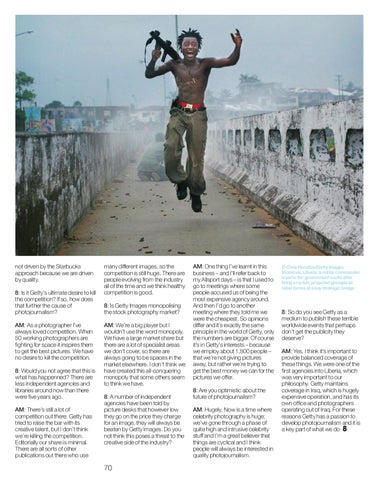
© Chris Hondros/Getty Images Monrovia, Liberia: a militia commander loyal to the government exults after firing a rocket-propelled grenade at rebel forces at a key strategic bridge
8: So do you see Getty as a medium to publish these terrible worldwide events that perhaps don’t get the publicity they deserve? AM: Yes. I think it’s important to provide balanced coverage of these things. We were one of the first agencies into Liberia, which was very important to our philosophy. Getty maintains coverage in Iraq, which is hugely expensive operation, and has its own office and photographers operating out of Iraq. For these reasons Getty has a passion to develop photojournalism and it is a key part of what we do 8