MEDIA Column
The man in charge took trouble to indulge the children, throwing tea parties, taking them for spins in his smart car. He might have expected her indulgence in return, a smiling face for the camera
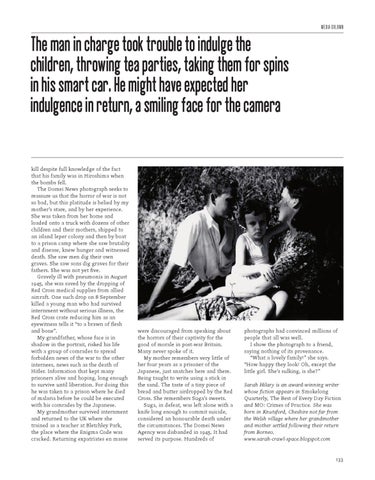
kill despite full knowledge of the fact that his family was in Hiroshima when the bombs fell. The Domei News photograph seeks to reassure us that the horror of war is not so bad, but this platitude is belied by my mother’s stare, and by her experience. She was taken from her home and loaded onto a truck with dozens of other children and their mothers, shipped to an island leper colony and then by boat to a prison camp where she saw brutality and disease, knew hunger and witnessed death. She saw men dig their own graves. She saw sons dig graves for their fathers. She was not yet five. Gravely ill with pneumonia in August 1945, she was saved by the dropping of Red Cross medical supplies from allied aircraft. One such drop on 8 September killed a young man who had survived internment without serious illness, the Red Cross crate reducing him as an eyewitness tells it “to a brawn of flesh and bone”. My grandfather, whose face is in shadow in the portrait, risked his life with a group of comrades to spread forbidden news of the war to the other internees, news such as the death of Hitler. Information that kept many prisoners alive and hoping, long enough to survive until liberation. For doing this he was taken to a prison where he died of malaria before he could be executed with his comrades by the Japanese. My grandmother survived internment and returned to the UK where she trained as a teacher at Bletchley Park, the place where the Enigma Code was cracked. Returning expatriates en masse
were discouraged from speaking about the horrors of their captivity for the good of morale in post-war Britain. Many never spoke of it. My mother remembers very little of her four years as a prisoner of the Japanese, just snatches here and there. Being taught to write using a stick in the sand. The taste of a tiny piece of bread and butter airdropped by the Red Cross. She remembers Suga’s sweets. Suga, in defeat, was left alone with a knife long enough to commit suicide, considered an honourable death under the circumstances. The Domei News Agency was disbanded in 1945. It had served its purpose. Hundreds of
photographs had convinced millions of people that all was well. I show the photograph to a friend, saying nothing of its provenance. “What a lovely family!” she says. “How happy they look! Oh, except the little girl. She’s sulking, is she?” Sarah Hilary is an award-winning writer whose fiction appears in Smokelong Quarterly, The Best of Every Day Fiction and MO: Crimes of Practice. She was born in Knutsford, Cheshire not far from the Welsh village where her grandmother and mother settled following their return from Borneo. www.sarah-crawl-space.blogspot.com 133