The Sound Advocate
In
Memory of Alece Ellis - A Champion for All Gaited Horses
Volume 4, Issue 4, 2021

Memory of Alece Ellis - A Champion for All Gaited Horses
Volume 4, Issue 4, 2021
Friends of Sound Horses, Inc. 6614 Clayton Rd. #105 St. Louis, MO 63117 info@fosh.info * www.fosh.info
President - Teresa Bippen Missouri Tbippen1957@yahoo.com
Director at Large-Bill Coon VP IJA Program-Dianne Little Utah Alberta, Canada wbotis@gmail.com ddlittle@telus.net
VP Programs/Gaited Sport Horse
Director at Large-Anita Dunham VP HIO/DQP-Lisa Harris Dianne Little Missouri Tennessee Alberta, Canada dunhamanita@gmail.com ddlittle@telus.net
Keith Dane Kirsten Kuzmanic Maggie MacAllister Hawaii Arizona Virginia kirstenk38@gmail.com breezewood@mgwnet.com
Patti Potts Pauline Stotsenberg Missouri California pottspa@gmail.com ps@yesteryearfarms.net
Stephanie J. Ruff Florida editor@fosh.info
FOSH Mission Statement
To promote all “sound,” naturally gaited horses, with a specific emphasis on Tennessee Walking Horses. (In this context, sound means not “sored”.)
Importance is placed on education in regards to the humane care for the emotional, mental and physical wellbeing, training, and treatment of all gaited horses.
FOSH will only support flat shod or barefoot horses and will never endorse any event that uses stacks and/or chains as action devices, or any mechanical, chemical, or artificial means to modify the natural gaits of the horse.
To these ends, FOSH focuses on three areas for gaited horses: 1) educating people about sound horse training principles; 2) supporting sound shows, events and activities; 3) working to end soring.
FOSH is a 501(c) (3) non-profit organization. All donations are tax deductible to the extent permitted by law. Your donation to support the FOSH mission is needed to advance the goals set forth by FOSH in conjunction with its formal mission statement.
The Sound Advocate is a digital magazine published quarterly by Friends of Sound Horses, Inc. Reproduction of any article is prohibited without the express written permission of FOSH.
FOSH accepts unsolicited submissions, but reserves the right to edit any and all submissions for content, style and space constraints. FOSH further reserves the right to refuse advertising for any reason.
At no time shall the publisher’s liability exceed the total cost of the revenue from advertising in the issue involved in any dispute.
All show suspensions and show results are printed as they are received from the reporting agencies. FOSH does not guarantee their accuracy.
FOSH does not endorse the content of any advertisement in this publication, nor does it warrant the accuracy of any advertisement.
Readers are urged and cautioned to use due diligence and to thoroughly research, including asking for references, before following through with any transaction.
FOSH does not endorse any trainer, educator, clinician, style of natural training, tack, or horse equipment to the exclusion or preference of any other. Each horse is an individual and may respond differently to particular methods.
Articles published by FOSH reflect the views and opinions of the writers and do not reflect, necessarily, those of FOSH.
Subscribers: The Sound Advocate is a benefit of membership. To ensure that you receive your issues, be sure that your e-mail address is current. To change an e-mail address, contact dunhamanita@gmail.com.
Submission of Articles, Calendar Dates, News and Photos: Send to tbippen1957@yahoo.com. Photos may not be embedded in text and must be submitted as jpeg format, minimum of 300 dpi. The deadline for each issue is the 15th of the preceding month when the issue is to be released. Submissions will not be accepted after the deadline, but may be carried over to another issue. Submissions will not be returned to the submitter.
Back Cover $300
Inside Front Cover $275
Inside Back Cover $275
Full page $125
Half page $75
Quarter page $60
Business Card $25
Directory $25
Discounts for Multiple Issues
2 issues - 10% off total fee
4 issues - 20% off total fee
6 issues - 30% off total fee
Ads will be accepted in pdf, tif or jpeg formats. Text and photos must be e-mailed separately by the 10th of the month when the issue is released. Photos must be 300 dpi. Camera-ready ads are emailed at 300 dpi. Materials should be emailed to editor@ fosh.info.
All advertisements must be paid in advance by check, money order, or credit card. Payments should be made out to FOSH and mailed to:
6614 Clayton Rd. #105 St. Louis, MO 63117
More FOSH information can be found online. Find us at www.fosh.info.
Like us on Facebook and follow us on Twitter.


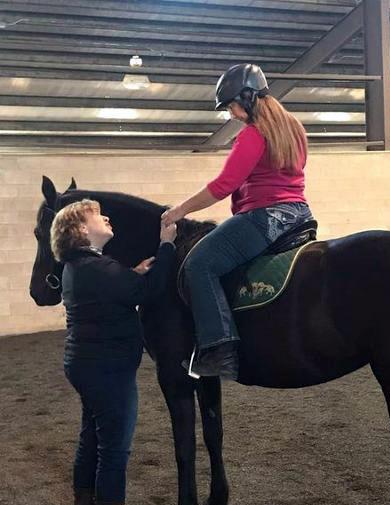
On the cover: Alece Ellis, Secretary/Treasurer of FOSH with Ellie Jensen at the 2019 Festival for the Horse at Circle E Equestrian Center in Seymour, Wisc. Ellie and Ron Jensen own Twin Artesian Stables in Suamico, Wisc. Photo by Ron Jensen.

Dear FOSH Friends and Supporters,
As I write this, it’s been a week since we learned of Board Member, Alece Ellis’s critical health condition and passing. Even now, I have a tough time accepting that she is gone. In one week, the shock has barely lessened. Her incredible zest for life, spontaneous laugh and unfailing kind concern for horses will stay with all of us forever. As a Board member, we appreciated her willingness to take on more than her fair share, keep us organized and donate her personal time attending the annual American Horse Council meetings to represent FOSH and support the PAST Act.
Alece never stopped wanting to learn about the horse—nothing was too technical, complex or scientific, and I was envious of her ability to absorb and understand all that information. Despite all her knowledge, she was not a know-it-all. I would call her a learn-it-all who generously helped anyone who needed help with their horse—no matter their age or riding ability. Many weekends were spent volunteering at equine competitions—dressage, working equitation, eventing, etc. You name it, and she was happy to help out, including long days in the booths at equine festivals and even BreyerFest.
We are heartbroken about losing Alece. We shared countless days and evenings at horse shows, Board meetings, monthly calls and touristy visits to the St. Louis Arch and even Dollywood. We crisscrossed the country for annual Board meetings from Florida to Arizona to California and Tennessee. Some of us were lucky enough to spend hours of windshield time with Alece driving to shows and events. We convened at the end of long meeting and clinic days at Ruby Tuesdays and local Mexican restaurants reminiscing about the day. Evenings would be spent piled into a hotel room watching videos of FOSH Championship shows and clinics on Alece’s laptop. Her infectious sense of humor would send all of us into gales of laughter and giggles as we realized we needed to “quiet down” due to the late hour.

Alece was kind, fun, smart and generous, and she left us way too early. We will miss her terribly.
Be safe, Teresa
Teresa Bippen FOSH President Tbippen1957@yahoo.com

We were just about to publish this issue of The Sound Advocate when the news came that Alece Ellis passed away. To say this is a loss is an understatement.
Unfortunately, I never had the good fortune of meeting Alece in person, but the interactions I had with her via email and phone were wonderful. It’s obvious how committed she was not only to FOSH, but to the horse.
In this issue, we have included a rememberance of Alece written by fellow FOSH Board member and friend Dianne Little. Her loss will be felt around the horse industry for many years to come.
My most sincere condolences to everyone who knew and loved Alece. Her loss will be felt for some time.
Also in this issue is an interview with Cheyenne Dunham, a successful Missouri Fox Trotter breeder, owner and competitor. You will find a list of Senators and Representatives in support of the PAST Act. Feel free to contact your state’s elected officials if you don’t see them on the list.
Finally, in October, I was at Equitana. Gaited horses were well represented at the event, with breed demonstrations of Tennessee Walking Horses, Rocky Mountain Horses, Kentucky Mountian Saddle Horses and Saddlebreds.
Enjoy the holiday with your family and friends. Stay safe and well and best wishes for the new year.
Stephanie
Stephanie J. Ruff Editor editor@fosh.info

The American Association of Equine Practitioners (AAEP) commends representatives Steve Cohen (TN-09), Brian Fitzpatrick (PA-01), Jan Schakowsky (IL-09) and Vern Buchanan (FL-16) for introducing the Prevent All Soring Tactics (PAST) Act on October 1. The legislation (H.R. 5441) would protect Tennessee Walking Horses, Spotted Saddle horses and Racking horses by outlawing the abusive practice of soring, which is the intentional infliction of pain to create the exaggerated gait known as the “big lick” in the show ring.
The legislation has the support of 212 additional co-sponsors in the U.S. House of Representatives. In addition, companion legislation (S. 2295) introduced in the U.S. Senate on June 24 by Sen. Mike Crapo (RID) currently has 48 co-sponsors.
The PAST Act is supported by the AAEP, American Veterinary Medical Association and hundreds of other stakeholder groups and individuals, including the American Horse Council, Humane Society of the United States, American Society for the Prevention of Cruelty to Animals and many state veterinary medical associations in the U.S.
“For many years, the AAEP has championed legislation to end this cruel practice, and the recent reintroduction of this important bill to protect horses is vital,” said Dr. Scott Hay, 2021 AAEP president. “We now will work for passage along with our more than 9,000 equine veterinarian and student members and the industry.”
AAEP members in the U.S. are encouraged to contact their representative and senators and ask them to support the bill in their respective chamber and become a co-sponsor. Contact information is available at
house.gov/representatives and senate.gov/senators.
Update: The American Horse Council (AHC) held its annual fly-in virtually on Thursday, October 28, 2021, featuring a series of industry advocates and congressional staff. The following was the update regarding the PAST Act.
Rep Steve Cohen (D- TN) shared that the PAST Act was introduced in June, with 209 co-sponsors ini-
tially, 234 now, which is majority of the house. Cohen also noted that in 2017, USDA submitted a role to the OMB (Office of Management and Budget) that would take the language from the Past Act and codify it in a way that the USDA could take action on it now. This rule change gives USDA the teeth they need to enforce the Horse Protection Act. If this rule was to be introduced, it would likely be adopted.
The following Representatives, listed alphabetically by state, support HR 5441, The PAST Act in the House of Representatives. Don’t see your Representative? Contact them and tell them to support The PAST Act.
Rep. Gallego, Ruben [D-AZ-7]
Rep. Grijalva, Raúl M. [D-AZ-3]
Rep. Kirkpatrick, Ann [D-AZ-2]
Rep. O’Halleran, Tom [D-AZ-1]
Rep. Schweikert, David [R-AZ-6]
Rep. Stanton, Greg [D-AZ-9]
Rep. Aguilar, Pete [D-CA-31]
Rep. Barragan, Nanette Diaz [D-CA-44]
Rep. Bass, Karen [D-CA-37]
Rep. Bera, Ami [D-CA-7]
Rep. Brownley, Julia [D-CA-26]
Rep. Calvert, Ken [R-CA-42]
Rep. Carbajal, Salud O. [D-CA-24]
Rep. Chu, Judy [D-CA-27]
Rep. Correa, J. Luis [D-CA-46]
Rep. Cárdenas, Tony [D-CA-29]
Rep. DeSaulnier, Mark [D-CA-11]
Rep. Eshoo, Anna G. [D-CA-18]
Rep. Garamendi, John [D-CA-3]
Rep. Gomez, Jimmy [D-CA-34]
Rep. Harder, Josh [D-CA-10]
Rep. Huffman, Jared [D-CA-2]
Rep. Issa, Darrell E. [R-CA-50]
Rep. Jacobs, Sara [D-CA-53]
Rep. Khanna, Ro [D-CA-17]
Rep. Lee, Barbara [D-CA-13]
Rep. Levin, Mike [D-CA-49]
Rep. Lieu, Ted [D-CA-33]
Rep. Lofgren, Zoe [D-CA-19]
Rep. Lowenthal, Alan S. [D-CA-47]
Rep. Matsui, Doris O. [D-CA-6]
Rep. McNerney, Jerry [D-CA-9]
Rep. Napolitano, Grace F. [D-CA-32]
Rep. Panetta, Jimmy [D-CA-20]
Rep. Peters, Scott H. [D-CA-52]
Rep. Porter, Katie [D-CA-45]
Rep. Roybal-Allard, Lucille [D-CA-40]
Rep. Ruiz, Raul [D-CA-36]
Rep. Schiff, Adam B. [D-CA-28]
Rep. Sherman, Brad [D-CA-30]
Rep. Speier, Jackie [D-CA-14]
Rep. Swalwell, Eric [D-CA-15]
Rep. Sánchez, Linda T. [D-CA-38]
Rep. Takano, Mark [D-CA-41]
Rep. Thompson, Mike [D-CA-5]
Rep. Torres, Norma J. [D-CA-35]
Rep. Vargas, Juan [D-CA-51]
Rep. Buck, Ken [R-CO-4]
Rep. Crow, Jason [D-CO-6]
Rep. DeGette, Diana [D-CO-1]
Rep. Neguse, Joe [D-CO-2]
Rep. Perlmutter, Ed [D-CO-7]
Rep. Courtney, Joe [D-CT-2]
Rep. DeLauro, Rosa L. [D-CT-3]
Rep. Hayes, Jahana [D-CT-5]
Rep. Himes, James A. [D-CT-4]
Rep. Larson, John B. [D-CT-1]
Rep. Blunt Rochester, Lisa [D-DE-At Large]
Del. Norton, Eleanor Holmes [D-DC-At Large]
Rep. Buchanan, Vern [R-FL-16]
Rep. Castor, Kathy [D-FL-14]
Rep. Crist, Charlie [D-FL-13]
Rep. Demings, Val Butler [D-FL-10]
Rep. Deutch, Theodore E. [D-FL-22]
Rep. Frankel, Lois [D-FL-21]
Rep. Franklin, C. Scott [R-FL-15]
Rep. Gimenez, Carlos A. [R-FL-26]
Rep. Lawson, Al, Jr. [D-FL-5]
Rep. Murphy, Stephanie N. [D-FL-7]
Rep. Posey, Bill [R-FL-8]
Rep. Salazar, Maria Elvira [R-FL-27]
Rep. Soto, Darren [D-FL-9]
Rep. Waltz, Michael [R-FL-6]
Rep. Wasserman Schultz, Debbie [D-FL-23]
Rep. Wilson, Frederica S. [D-FL-24]
Rep. Bishop, Sanford D., Jr. [D-GA-2]
Rep. Johnson, Henry C. “Hank,” Jr. [D-GA4]
Rep. McBath, Lucy [D-GA-6]
Rep. Scott, David [D-GA-13]
Rep. Williams, Nikema [D-GA-5]
Rep. Case, Ed [D-HI-1]
Rep. Kahele, Kaiali’i [D-HI-2]
Rep. Bustos, Cheri [D-IL-17]
Rep. Casten, Sean [D-IL-6]
Rep. Davis, Danny K. [D-IL-7]
Rep. Davis, Rodney [R-IL-13]
Rep. Foster, Bill [D-IL-11]
Rep. Garcia, Jesus G. “Chuy” [D-IL-4]
Rep. Kelly, Robin L. [D-IL-2]
Rep. Kinzinger, Adam [R-IL-16]
Rep. Krishnamoorthi, Raja [D-IL-8]
Rep. Newman, Marie [D-IL-3]
Rep. Quigley, Mike [D-IL-5]
Rep. Rush, Bobby L. [D-IL-1]
Rep. Schakowsky, Janice D. [D-IL-9]
Rep. Schneider, Bradley Scott [D-IL-10]
Rep. Underwood, Lauren [D-IL-14]
Rep. Carson, Andre [D-IN-7]
Rep. Walorski, Jackie [R-IN-2]
Rep. Axne, Cynthia [D-IA-3]
Rep. Davids, Sharice [D-KS-3]
Rep. Yarmuth, John A. [D-KY-3]
Rep. Carter, Troy [D-LA-2]
Rep. Pingree, Chellie [D-ME-1]
Rep. Brown, Anthony G. [D-MD-4]
Rep. Raskin, Jamie [D-MD-8]
Rep. Ruppersberger, C. A. Dutch [D-MD-2]
Rep. Sarbanes, John P. [D-MD-3]
Rep. Trone, David J. [D-MD-6]
Rep. Auchincloss, Jake [D-MA-4]
Rep. Clark, Katherine M. [D-MA-5]
Rep. Keating, William R. [D-MA-9]
Rep. Lynch, Stephen F. [D-MA-8]
Rep. McGovern, James P. [D-MA-2]
Rep. Moulton, Seth [D-MA-6]
Rep. Neal, Richard E. [D-MA-1]
Rep. Trahan, Lori [D-MA-3]
Rep. Dingell, Debbie [D-MI-12]
Rep. Kildee, Daniel T. [D-MI-5]
Rep. Lawrence, Brenda L. [D-MI-14]
Rep. Levin, Andy [D-MI-9]
Rep. Slotkin, Elissa [D-MI-8]
Rep. Stevens, Haley M. [D-MI-11]
Rep. Tlaib, Rashida [D-MI-13]
Rep. Upton, Fred [R-MI-6]
Rep. Craig, Angie [D-MN-2]
Rep. McCollum, Betty [D-MN-4]
Rep. Omar, Ilhan [D-MN-5]
Rep. Cleaver, Emanuel [D-MO-5]
Rep. Bacon, Don [R-NE-2]
Rep. Fortenberry, Jeff [R-NE-1]
Rep. Amodei, Mark E. [R-NV-2]
Rep. Horsford, Steven [D-NV-4]
Rep. Lee, Susie [D-NV-3]
Rep. Titus, Dina [D-NV-1]
Rep. Kuster, Ann M. [D-NH-2]
Rep. Pappas, Chris [D-NH-1]
Rep. Gottheimer, Josh [D-NJ-5]
Rep. Kim, Andy [D-NJ-3]
Rep. Malinowski, Tom [D-NJ-7]
Rep. Norcross, Donald [D-NJ-1]
Rep. Pascrell, Bill, Jr. [D-NJ-9]
Rep. Payne, Donald M., Jr. [D-NJ-10]
Rep. Sherrill, Mikie [D-NJ-11]
Rep. Sires, Albio [D-NJ-8]
Rep. Van Drew, Jefferson [R-NJ-2]
Rep. Watson Coleman, Bonnie [D-NJ-12]
Rep. Leger Fernandez, Teresa [D-NM-3]
Rep. Clarke, Yvette D. [D-NY-9]
Rep. Delgado, Antonio [D-NY-19]
Rep. Espaillat, Adriano [D-NY-13]
Rep. Higgins, Brian [D-NY-26]
Rep. Jeffries, Hakeem S. [D-NY-8]
Rep. Jones, Mondaire [D-NY-17]
Rep. Katko, John [R-NY-24]
Rep. Malliotakis, Nicole [R-NY-11]
Rep. Maloney, Carolyn B. [D-NY-12]
Rep. Maloney, Sean Patrick [D-NY-18]
Rep. Meeks, Gregory W. [D-NY-5]
Rep. Meng, Grace [D-NY-6]
Rep. Morelle, Joseph D. [D-NY-25]
Rep. Nadler, Jerrold [D-NY-10]
Rep. Reed, Tom [R-NY-23]
Rep. Rice, Kathleen M. [D-NY-4]
Rep. Suozzi, Thomas R. [D-NY-3]
Rep. Tenney, Claudia [R-NY-22]
Rep. Tonko, Paul [D-NY-20]
Rep. Torres, Ritchie [D-NY-15]
Rep. Velazquez, Nydia M. [D-NY-7]
Rep. Adams, Alma S. [D-NC-12]
Rep. Budd, Ted [R-NC-13]
Rep. Butterfield, G. K. [D-NC-1]
Rep. Hudson, Richard [R-NC-8]
Rep. Manning, Kathy E. [D-NC-6]
Rep. McHenry, Patrick T. [R-NC-10]
Rep. Price, David E. [D-NC-4]
Rep. Ross, Deborah K. [D-NC-2]
Del. Sablan, Gregorio Kilili Camacho [D-MP-At Large]
Rep. Beatty, Joyce [D-OH-3]
Rep. Chabot, Steve [R-OH-1]
Rep. Johnson, Bill [R-OH-6]
Rep. Joyce, David P. [R-OH-14]
Rep. Kaptur, Marcy [D-OH-9]
Rep. Ryan, Tim [D-OH-13]
Rep. Turner, Michael R. [R-OH-10]
Rep. Blumenauer, Earl [D-OR-3]
Rep. Bonamici, Suzanne [D-OR-1]
Rep. DeFazio, Peter A. [D-OR-4]
Rep. Schrader, Kurt [D-OR-5]
Rep. Boyle, Brendan F. [D-PA-2]
Rep. Cartwright, Matt [D-PA-8]
Rep. Dean, Madeleine [D-PA-4]
Rep. Doyle, Michael F. [D-PA-18]
Rep. Evans, Dwight [D-PA-3]
Rep. Fitzpatrick, Brian K. [R-PA-1]
Rep. Houlahan, Chrissy [D-PA-6]
Rep. Keller, Fred [R-PA-12]
Rep. Kelly, Mike [R-PA-16]
Rep. Lamb, Conor [D-PA-17]
Rep. Meuser, Daniel [R-PA-9]
Rep. Reschenthaler, Guy [R-PA-14]
Rep. Scanlon, Mary Gay [D-PA-5]
Rep. Smucker, Lloyd [R-PA-11]
Rep. Thompson, Glenn [R-PA-15]
Rep. Wild, Susan [D-PA-7]
Rep. Cicilline, David N. [D-RI-1]
Rep. Langevin, James R. [D-RI-2]
Rep. Mace, Nancy [R-SC-1]
Rep. Allred, Colin Z. [D-TX-32]
Rep. Castro, Joaquin [D-TX-20]
Rep. Cuellar, Henry [D-TX-28]
Rep. Doggett, Lloyd [D-TX-35]
Rep. Escobar, Veronica [D-TX-16]
Rep. Fletcher, Lizzie [D-TX-7]
Rep. Garcia, Sylvia R. [D-TX-29]
Rep. Granger, Kay [R-TX-12]
Rep. Green, Al [D-TX-9]
Rep. Jackson Lee, Sheila [D-TX-18]
Rep. Johnson, Eddie Bernice [D-TX-30]
Rep. Veasey, Marc A. [D-TX-33]
Rep. Vela, Filemon [D-TX-34]
Rep. Williams, Roger [R-TX-25]
Rep. Welch, Peter [D-VT-At Large]
Rep. Beyer, Donald S., Jr. [D-VA-8]
Rep. Connolly, Gerald E. [D-VA-11]
Rep. Luria, Elaine G. [D-VA-2]
Rep. McEachin, A. Donald [D-VA-4]
Rep. Scott, Robert C. “Bobby” [D-VA-3]
Rep. Spanberger, Abigail Davis [D-VA-7]
Rep. Wexton, Jennifer [D-VA-10]
Rep. DelBene, Suzan K. [D-WA-1]
Rep. Herrera Beutler, Jaime [R-WA-3]
Rep. Jayapal, Pramila [D-WA-7]
Rep. Kilmer, Derek [D-WA-6]
Rep. Larsen, Rick [D-WA-2]
Rep. Schrier, Kim [D-WA-8]
Rep. Smith, Adam [D-WA-9]
Rep. Strickland, Marilyn [D-WA-10]
Rep. McKinley, David B. [R-WV-1]
Rep. Kind, Ron [D-WI-3]
Rep. Moore, Gwen [D-WI-4]
Rep. Pocan, Mark [D-WI-2]
Rep. Steil, Bryan [R-WI-1]
The following Senators, listed alphabeticaly order by state, are in support of S.2295, the PAST Act. Is your Senator on the list? If not, contact them to encourage them to sign on.
Sen. Sinema, Kyrsten [D-AZ]
Sen. Feinstein, Dianne [D-CA
Sen. Padilla, Alex [D-CA]
Sen. Bennet, Michael F. [D-CO]
Sen. Hickenlooper, John W. [D-CO]
Sen. Blumenthal, Richard [D-CT]
Sen. Murphy, Christopher [D-CT]
Sen. Carper, Thomas R. [D-DE]
Sen. Coons, Christopher A. [D-DE]
Sen. Warnock, Raphael G. [D-GA]
Sen. Hirono, Mazie K. [D-HI]
Sen. Schatz, Brian [D-HI]
Sen. Duckworth, Tammy [D-IL]
Sen. Durbin, Richard J. [D-IL]
Sen. Moran, Jerry [R-KS]
Sen. Collins, Susan M. [R-ME]
Sen. King, Angus [I-ME]
Sen. Cardin, Benjamin L. [D-MD]
Sen. Van Hollen, Chris [D-MD]
Sen. Markey, Edward J. [D-MA]
Sen. Warren, Elizabeth [D-MA]
Sen. Peters, Gary C. [D-MI]
Sen. Stabenow, Debbie [D-MI]
Sen. Klobuchar, Amy [D-MN]
Sen. Smith, Tina [D-MN]
Sen. Daines, Steve [R-MT]
Sen. Cortez Masto, Catherine [D-NV]
Sen. Rosen, Jacky [D-NV]
Sen. Hassan, Margaret Wood [D-NH]
Sen. Shaheen, Jeanne [D-NH]
Sen. Booker, Cory A. [D-NJ]
Sen. Menendez, Robert [D-NJ]
Sen. Heinrich, Martin [D-NM]
Sen. Lujan, Ben Ray [D-NM]
Sen. Gillibrand, Kirsten E. [D-NY]
Sen. Schumer, Charles E. [D-NY]
Sen. Brown, Sherrod [D-OH]
Sen. Merkley, Jeff [D-OR]
Sen. Wyden, Ron [D-OR]
Sen. Casey, Robert P., Jr. [D-PA]
Sen. Toomey, Pat [R-PA]
Sen. Reed, Jack [D-RI]
Sen. Whitehouse, Sheldon [D-RI]
Sen. Leahy, Patrick J. [D-VT]
Sen. Sanders, Bernard [I-VT]
Sen. Kaine, Tim [D-VA]
Sen. Warner, Mark R. [D-VA]
Sen. Cantwell, Maria [D-WA]
Sen. Murray, Patty [D-WA]
Sen. Baldwin, Tammy [D-WI]
By Dianne Little, FOSH Board Member
Alece was a valuable member of the FOSH Board. She joined the FOSH EAC in 2009 and in 2011 was elected to the FOSH Board. In 2012 she was elected as Secretary/Treasurer, a position she held until her passing.
Alece joined the IJA program in 2009 as an apprentice at the annual clinic at the Florida State Fair. By 2011, she had satisfied the conditions and become a licensed IJA judge. Alece attended the 2013 IJA Gaited Dressage Clinic and, after apprentice work, became a licensed IJA Gaited Dressage judge. In 2016, she became a Senior IJA Gaited Dressage Judge. Alece satisfied the conditions for North American Western Dressage and was a NAWD judge. In addition, Alece was a senior licensed judge for the Rocky Mountain Horse Association and a licensed judge for the Missouri Fox Trotter Horse Breeders Association.
The following is from the FOSH web site.
“Alece holds judging cards for multiple gaited breeds. She scribes for USEF Judges (from L — S) at local to
national championship level shows, which has enhanced her eye for correct dressage riding in any breed.
Alece believes correct use of the training pyramid is important for any breed or discipline and is committed to building a solid foundation of rhythm and relaxation.
Alece teaches riders the importance of equine biomechanics and how to assist the horse to become balanced and supple with the use of this knowledge in their ground and under-saddle work. Alece says “the relationship between form, function and gait is my passion” and to that end, works to help riders and their horses develop a relaxed, soft and unified relationship. Alece is from east Tennessee with her two Rocky Mountain Horses and one Tennessee Walker.”
While the above description is informative, it does not describe the essence of Alece. I interacted with Alece on the FOSH Board and as Director of Judges.
This is her evaluation after her first Annual IJA Training Seminar in 2009. “The information Dianne wanted to

cover would have covered 2 days….. we perhaps needed to have brief overviews of all the breeds covered by IJA with brief video examples of each.
“The RMHA overview was very thorough – excellent job – and I was very impressed with the presentation style. I expressed my concern about the new changes to the rules with respect to excusals, disqualifications, and severe penalties resulting in no higher than a 4th placement. As an RMH member, I understand and
applaud what the SAC is trying to do, however, this is NOT the way to ‘get the message’ across. It appears the rules are now punitive…..and it would appear this is a result of poor judging in the past. It would seem to have been more appropriate to have rid RMH of the judges that are not ‘on the same page’ with the RMH platform….
“I loved the format of rotating between experienced judges (and the DQP station) during the actual show. This was very beneficial to observe

the differences between the judges with respect to their judging style, method of record keeping and ‘teaching style’ (after all, they were, in essence, to be assisting in teaching). This format – couldn’t be better!!”
After the first IJA seminar, I knew Alece would be a valuable asset to FOSH and IJA. As a result of training and experience, she was articulate and concise in her observations, opinions and constructive criticism. From IJA apprentice ship to 2020, Alece missed only one IJA Training Seminar. Her contribution to the expansion of knowledge and education of new and old judges continued in
the manner established at the first clinic. She was fair in her judging assignments and interpretation of Rule Books as written. Whenever possible and allowed, she interacted with exhibitors in a desire to expand their knowledge and relationships with their horses.
It was vital to Alece to expand her knowledge and experience - a compelling desire to expand personal boundaries and goals. Her equine library is extensive. I believe there was not an article, book or DVD that did not pique her interest. She was a sponge on all things equine, a student of the horse. She was also selective. She eliminated positions, practices and theories that did not consider the whole horse.

Alece did not push to her philosophy, but worked with individuals within their comfort zone. She followed the principle that when the student was ready, the teacher would arrive.
Alece was not born on a horse, but horses became part of her early life. Pictures of Alece as a child and young girl either riding or driving are found on the walls of her home. Bedrooms are themed English or Western – a saddle sits in a corner or a bridle or bit on walls. She was a supporter of and volunteer at the St. Louis Society Horse Show, an experience that provided the basis for advertising, organizing, announcing and communicating behind and in front of exhibitors.
Her special place was in the barn with her boys - Shadow, Houston and Reggie. Alece shared her intimate thoughts and feelings with them as she cleaned stalls, groomed, fed and touched. If you were fortunate to be in the barn during these special moments, you saw the boys following her as she discussed the events of the day. My most vivid memories of Alece occurred in her barn.
Although we lived in different countries and had different lives, Alece was my friend. I was a guest in her home and she in mine. We travelled to shows, clinics and FOSH meetings. During long drives, we discussed philosophy, observations, conclusions and plans for the future. Her memory for the big picture as well as

the small details led to many discussions.
Alece embraced every opportunity to expand her horizons. Working Equitation was a new endeavor, and she approached that in the typical Alece way with all her energy and ability to work with others. She volunteered in the ring, transported obstacles from one place to another as needed and did anything that was required for successful competition. She continued to judge shows and work with her local Dressage and Eventing organizations.
Alece will be remembered for her smile and laugh and support of others. She followed her heart and made a difference to many. She would be shocked at the expressions of grief at her passing.
Alece Ellis cared and shared. She will be missed.
Many riders work hard to learn how to make their horses and themselves better. They watch clinics, read books and study what they need to do to have a better connection with their horse. This is very commendable. So it can be frustrating when you are trying to do all the things you have learned and yet you still don’t feel comfortable out on the trails.
Sometimes you aren’t doing it wrong but you don’t have the correct mindset. Often riders are taught how to mechanically do things, but they fail to understand how the horse interprets what they are doing. If you don’t get the horse to believe that what you are doing is for the horse’s benefit, then the horse is going to defend itself just when you need him.
For example, if you shake a line and hit the horse in the jaw to back him, he will raise his head, hollow his back and push back with his front feet. He will back, but he will lose trust of the rider’s hand and rein. I don’t want him to back to avoid discomfort. I want him to back because it makes him feel

By Larry Whitesell
better in his body. I want him to rock his weight to the hind legs and lift his chest, which makes him lengthen his top line muscles, releasing tension from his body. He will soften and lower his head and use his hind legs to back, strengthening them.
When we teach a horse to turn left and right, we don’t focus on the turning. We want the horse to turn in balance so he is comfortable turning. If they turn out of balance, they tense their bodies. We use turning to help the horse understand how our hands and reins communicate with his feet, so we never have to pull on his mouth to turn. I would put a soft feel in the rein as I turn my seat and shoulders. In my mind, I believe I reward him when I feel his feet answer my feel.
He may only take a step in the right direction. Most riders reward when the horse turns, whether in balance or not. It may seem the same, but the horse perceives whatever you believe you are rewarding. Are you teaching the horse to turn or understand how you direct his feet? Either way he turns, but is he going to let you control his feet when he gets in trouble?

If the horse believes you control his feet without pulling on his mouth or pulling him out of balance, he can relax. If the horse understands your soft aids and is comfortable, he will allow you to direct his feet with no resistance. If your horse resists, then you haven’t earned the right to tell him what to do with his feet.
For example, if we want the horse to understand how our calf directs his hind leg, we might use turn on the forehand, which connects our calf to his hind leg in his brain. We would ride the move as if he knew it and put our right calf on and off. When he steps around using his right hind leg, we release and walk off. He learns if our leg comes on he should step forward with the corresponding hind leg. When I have him doing this on the right and left hind leg, then I could put both legs on and get collection or gait without holding his mouth.
Larry teaching a student to have the horse place the left front foot on 9 o’clock. Notice how round the horse is on loose rein. Photo courtesy of Larry Whitesell.
We spend a lot of time in early training teaching the horse how the reins direct his front feet and shoulders, and our seat and calf direct his body and hind legs. We use ounces of pressure. His movements become educated and not tricks. Tricks don’t work when the horse becomes energized.
When the horse knows how I move his shoulders and hips, then doing leg yield, shoulder-in, haunches-in, etc. is just combining two basic moves.
I haven’t made him do movements that he sees no value in, I have explained how I direct his feet in a way that makes him comfortable. We have a connection through clear communication.
If I trail ride, and my horse tenses up from something, I can adjust his balance by moving a foot and bringing him back to relaxation. I get to his mind. If I had just focused on getting
a movement, I couldn’t use my aids to adjust his balance and bring him back to a relaxed frame of mind. Because the horse knows I can do this for him, he is mentally connected to me when I ride. His focus is on me, and he doesn’t go down the trail looking for trouble and thinking he may have to save his own life. He believes I am security.
Jennifer Bauer www.Gaitedhorsemanship.com
Larry Whitesell
www.whitesellgaitedhorsemanship.com

Equitana USA was held as an in-person event from October 1 through October 3, 2021 at the Kentucky Horse Park in Lexington, Ky. Many breeds were on display including Tennessee Walking Horses, Rocky Mountain Horses, Standardbreds, Mountain Pleasure Horses and Saddlebreds.
At right: Ten Mountain Pleasure Horses put on a great drill team demonstration. Photo by Steve Heath.


Above: The Cherokee Stables Standarbred Drill Team allowed spectators to visit with the horses. Photo by Steve Heath.
Below: Mounted shooting was just one of the demos done with the Rocky Mountain Horses. Photo by Steve Heath.

Cheyenne Dunham has been involved with gaited horses most of her life. She took some out from riding to tell us more about her horses and accomplishments.
SA: Please tell us a little bit about yourself
CD: I grew up in Hamilton, Missouri. About 5 years ago, I moved to central Iowa after finishing my master’s degree to take a position as a grain buyer for a cooperative. I work with producers, helping them develop marketing plans for their operations.
I have a small farm up here with horses, a pony mule, two dogs and an assortment of barn cats. While the winters have taken some getting used to, the people are great, and I enjoy the community I’ve gotten involved with.
SA: How did you get involved in horses?
CD: Thanks to my family, horses were always a part of my life growing up. My grandparents raised and showed Missouri Fox Trotters and Tennessee Walking Horses, and all of us grandchildren were involved from an early age. I think the running story is that I was teething on the saddle horn in my leadline class at 18 months old. We showed almost every Saturday during the summers on an open breed circuit in Kansas City, and I kept up with it throughout high school. When I went on to college at Truman State University, I would come back home for the Kansas City shows when I could.
While I was at Truman, I joined the equestrian team and competed on their IHSA stock team. We would travel to other colleges in the region, showing horses provided by that school. Ahead of your class, you would draw a horse’s name out of a hat, and that would be the horse you would ride for your class. Talk
about a turnaround from the kind of showing I knew, where I was regularly riding the same horse I would be competing. It was a great opportunity to try something new, and I’m grateful for the experience both with riding stock horses and showing horses I was unfamiliar with on a regular basis.
SA: How long have you been riding or been involved with gaited horses?
CD: Gaited horses have made up a majority of my horse experience since they are what my grandparents had. Throughout the years, they’ve alternated between focusing on Missouri Fox Trotters and Tennessee Walking Horses, but we’ve always
had some of each around the farm.
Growing up, I was showing flat shod walking horses, and when I moved to Iowa I took my walking horse gelding with me to trail ride. The last few years, my mom and I have shifted more to fox trotters after spending several years going down to watch the big fall show in Ava, Missouri.
SA: What breed(s) do you own? Is there something special about them that appeal to you?
While we continue to breed and raise both fox trotters and walking horses back home, I currently have two fox trotters up in Iowa with me. I enjoy

the overall aspects of the Fox Trotter breed (disposition, gait, versatility, etc.) and these particular horses hold a special place for me. One is my eight-year-old Pride B. stallion, Bama that has been my go-to horse the last four years for trail riding and competing. The other is my fouryear-old Big Whiskey mare, Allie that I just started under saddle this summer. She is proving to be a quick learner and great trail horse, as well as showing some promising gait for the arena. They are both out of a mare I showed as a youth who goes back to a mare my mom showed in high school and a stallion my grandparents owned. So a lot of lines tied back to our family breeding program.
SA: What disciplines do you enjoy doing with your horses? What do you like about them?
CD: Being in Iowa, the most common question people ask when I tell them I have horses is if I barrel race - and I usually respond with, “Not very well.” But in all seriousness, Iowa has very limited options for showing gaited horses in your typical rail classes. I spend a lot of my horse time now trail riding, traveling to camp with friends in Minnesota, Iowa and Missouri. It’s a great way to develop a confident horse that can then go to the occasional show.
My stallion is probably the biggest reason I shifted away from the kind of showing I grew up doing. He had the build to do versatility, so I started looking into the versatility and

The 8-year-old Fox Trotter stallion Bama has been successful in a wide variety of classes, including ranch horse, trail, reining and cow sorting. Photo
ranch horse classes at the fox trotter show in Ava. In addition to the regular English/Western rail classes, we show in trail, reining, speed events and cow classes. I love how everyone at the versatility arena encourages each other, and I’ve made some great friends since we started showing there a few years ago. We also compete in team sorting both at Ava and here in Iowa, which has been another great new thing to learn and a way to meet people.
SA: Do you get help from a professional instructor/trainer or do you do most of the work yourself?
I start all of my horses myself. Typically that involves ground driving, a few round pen rides and then we are ready to hit the trail.
Throughout the years, I’ve had opportunities to ride with several clinicians, and my grandma and mom are always willing to offer some coaching if we are riding together. When I decided I wanted to get more into the ranch versatility, I knew I wanted to work with a trainer so I wasn’t trying to learn something new to me and teach it to my horse at the same time. A friend from college was boarding with a cow horse trainer in southern Minnesota. I had met him a few times when I was visiting her and liked what I had seen him do.
When my stallion was to a point where I felt we had a solid foundation, I called the trainer and asked if he would work with him for a few months during the winter on some reining basics with the goal of eventually doing ranch versatility. That was three years ago, and I go up there regularly now for lessons and training. It’s been great to have someone see your baseline and help you improve on it.
SA: Are there any misconceptions about gaited horses that you like to dispel?
CD: When I take my gaited horse to a stock horse show and compete in the ranch/reining/cow classes, we are definitely an anomaly. Some will
flat out say, “I didn’t realize a gaited horse could do that.” It’s true some horses are built better for different disciplines, but I wouldn’t let the fact that it’s a gaited breed limit what you want to do with your horse. This misconception isn’t just limited to non-gaited horse people either, as I’ve talked with plenty of people that own gaited horses and did not realize how versatile they can be.
SA: What advice would you give people interested in trying gaited horses?
CD: A smooth ride is usually why people want a gaited horse. Just like not all Quarter Horses trot the same, even gaited horses of the same breed will travel differently. My advice would be to connect with someone who has experience with gaited horses and try several different ones. Work with someone who is familiar with them and can coach you to bring out their best gait. My family is always helping new gaited horse owners get a feel for their horses, and we’ve had many opportunities to give people their first gaited horse experience.
SA: What is your “dream” accomplishment with your horse(s)?
CD: Winning the versatility and ranch horse overalls at Ava on my stallion this year felt like something we had been working toward for a while, so I’m not sure where we will go from there. Really just showing him to the best of his ability is
always my biggest goal, and every year we connect a few more dots. Aside from that, there are some areas in South Dakota and Arkansas I would love to trail ride eventually. I’m living my biggest accomplishment - trail riding with friends and competing on a horse I’ve raised and enjoy working with.
SA: What are your riding goals for 2022?
CD: My 2022 calendar is already filling up horse camping weekends with
friends, and we are planning to try out some new areas. In addition to that, I hope to make it to more ranch horse shows and sorting events here in Iowa. I’m also looking forward to working more with my younger mare and possibly taking her to some cow work clinics.
SA: If there was one thing that people would be surprised to know about you and/or about your horse, what would that be?


CD: The most surprising thing people might not know about me is how much showing stresses me out. Even after doing it my whole life, I still prefer trail riding.
As far as my horse, I think some people might be surprised at how great he is with kids. He’s not a particularly in your pocket type horse, but he loves to let them pet him when we are at camps or shows.
SA: Anything else you’d like to add?
CD: I think if there’s something you want to try with your horse, find a
way to make it happen. Disciplines like ranch versatility are growing in popularity, and you’d be surprised how many events you might be able to find in your area. Also, it doesn’t have to specifically be for gaited horses - just be ready for the questions when you move your horse up from the trail walk.
By Aimee Robinson
There is much to consider when selecting a blanket for your horse, including the horse’s age, body condition and coat thickness, to name only a few aspects. Additionally, horses across the country experience a variety of climates, weather conditions and stabling environments. Luckily, just as our closets hold clothes tailored to the day and season, there are different types of horse blankets available, too, so you can select just what your horse needs when he needs it.
For horse owners to best determine what kind of blanket and heaviness their horse will need, let’s first look at a few horse blanketing basic terms, such as “sheets” vs. “blankets” and “turnout” vs. “stable.”
A horse sheet is lightweight and perfect for those mildly cold or windy days. They have no fill. A horse blanket, rather, offers fill, which is essentially a form of insulation sewn into the blanket to add warmth (think of your winter coat!) The higher the fill number on a blanket, the cozier the pony on those cold days.
Sheets and blankets come in two varieties: turnout and stable, for horses in either respective environ-
ment. Turnout sheets and turnout blankets feature waterproof material to keep pasture ponies dry. Without waterproof technology, a wet horse blanket could unintentionally make your horse colder. Stable sheets and stable blankets are ideal for stabled horses and therefore not made from waterproof material. They serve an important purpose by keeping stabled horses comfy, warm and sleek.
When you are selecting a horse blanket, you will notice a few number sets under the product descriptions, noting “denier” and “fill.” Denier denotes the durability of a horse blanket or sheet. It measures nylon fiber density on the outer material of horse blankets. Denier ranges from 70 to 2400D. The higher the denier, the more durable it is for those tough-on-blanket horses (you might have one or two in mind!) As we shared earlier, fill is padding that adds an extra layer of warmth to your horse’s blanket. Both with denier and fill, the higher the number, the tougher or warmer the blanket’s material will be.
Do you know the degree of blanket warmth your pony may need and when? Refer to this easy-to-reference chart to help as a guide. But keep in mind, a 50° winter day will feel much different to a Miami pony
vs. a Milwaukee pony, so blanket accordingly as needed.
50-60° F Sheet (0g)
40-50° F Light blanket (100g)
30-40° F Light or medium blanket (150 to 250g)
20-30° F Medium or heavy blanket (200 to 300g)
Below 20° F Heavy blanket (300 to 400g)
When measuring your horse, start from the center of his chest and measure around the widest part of the shoulder, along the barrel and around the widest part of the hindquarter to the center of the tail. Keep your line horizontal to the ground. His blanket measurement will be the same as the number of inches measured. If the exact number of inches is not available to select from, size up to the nearest measurement.
Help extend the life of your horse’s blankets and sheets by properly storing them on a rack or in a blanket storage bag. This will also help protect them from opportunistic rodents who may look at a new blanket as a home or snack.
Remember, after your horse’s blankets have protected them from the
rain, snow and the muck of cold weather, it’s time for a good cleaning. You can either opt to clean blankets yourself, or you can send them to a blanket laundry service. Cleaning your horse’s blanket may be easier than you think! Just follow these steps.
Pre-wash: Use a stiff brush to remove excess hair, mud and dirt. Hose off blanket, and hang to dry. Wash: Use a horse blanket detergent.
Dry: Hang horse blankets to dry in a shady area to avoid color deterioration of the material.
Follow the blanket manufacturer’s cleaning instructions for best results.

By Jackie Zions, Equine Guelph
“We were not surprised to learn 60% of the horses in our 490 horse retrospective study had larger measurements on the left side of their withers”, says Dr. Katrina Merkies, researcher and associate professor at the University of Guelph. Undergraduate students, Julia Alebrand, Bethany Harwood, Katharine Labarge and Laura Scott digitized and compared years of measurement data gathered from a saddle fitting company, which used a flexible wither tracing tool.
The empirical evidence did indeed back up the hypothesis expecting more bulk on the left, based on what saddle fitters were already noticing in their day to day work. But what does this mean for the horse owner shopping for a shiny new saddle, manufactured in a perfectly symmetrical way?
Pressure points from an ill-fitting saddle can lead to pain and performance issues. A symmetrical saddle used on a horse that is not symmetrical can hinder progress explains Merkies, “It could prevent the horse from developing its muscles in a balanced way.”
The research study included many breeds, from fine boned Arabians and Thoroughbreds to stocky Warm-
bloods and Drafts. They came from many disciplines such as dressage, hunter/jumper as well as recreational pursuits. Surprisingly, breed did not have an effect on wither measurements in this study. While Thoroughbreds and Warmbloods had different skeletal structure, such as longer withers than the Draft breeds, it did not have an impact on the wither measurements, which were based on the horse’s musculature. My friend Flicka and Joey both tended to have bigger muscles on the left side of their withers 60% of the time.
Laterality was also considered for its possible role in muscle development. Laterality is the preference for using one side of the body over the other. The left hemisphere of the brain (logic and reasoning) controls the right side of body, and the right side of the brain (processes fearful stimuli) controls the left side.
“You may notice horses often turn to view an object they are afraid of with their left eye,” said Merkies. “They often step on or off a trailer with the left front leg first.” Merkies also mentioned an Australian study noting a preference for grazing with the left front leg ahead of the right; a tendency that apparently increases with age. Points certainly worth considering in this study, which shows a majority of horses appear to be ‘lefties’.
One unexpected finding was the curvature in the horse’s backs were slightly more dipped in horses of medium height. Merkies hypothesized this may be due to the fact that medium sized horses are more frequently ridden by adults. Kids tend to move off their ponies as they outgrow them. Saddles for the adult rider tend to have a longer seat, which may not always fit the medium sized horse’s back. If the saddle fits past the 18th thoracic vertebrae, it will put pressure on the lumbar region, which can cause a horse to tense and drop its back muscles.

Merkies cited the need for controlled studies looking at asymmetry and saddle fit following properly fitted asymmetrical horses over time.
The importance of proper saddle fit and regular fittings, at least every six months, cannot be overstated.
FOSH is pleased to announce that it has seed money grants available to support its gaited horse sound horsemanship and competition efforts. The grants are available to individuals and clubs to help defray the expenses of holding a clinic or a show.
What are some ideas to consider?
Interested in Working Equitation (WE)? Its popularity is exploding across the country. Why not hold a clinic and provide opportunities for your riders of gaited horses to learn all about this fun, new competition? Working Equitation was not slowed down by the pandemic, and there were a record number of shows last year. Even better, they enthusiastically welcome gaited horses to their competitions. Working Equitation is about dressage and trail obstacle and, at the advanced levels, working cows! You will learn even more holding a clinic and trying it for yourself. A grant can help with your facility costs and the few items you may need for the trail obstacles.
Wishing to gain a better understanding of dressage? Holding a dressage clinic may be the best way to not only learn about dressage but attract others with a shared interest.
With your new knowledge, you will become much more comfortable competing in the video competitions offered by North American Western Dressage (NAWD). A grant of seed money can help pay for your facility or travel for a clinician.
Always had an interest in Connected Riding? Use seed money to find an instructor and hold a clinic! Your horses will thank you!
Do you enjoy working with youths? How about a youth camp or clinic in the summer? Their parents will thank you!
Horse shows are likely to pick up in 2022 as COVID risks decline. Seed money could go towards your expenses to hold a show that features gaited horse classes.
Imagine the possibilities and let us help you!
Grants range from $500-$2,500. Send an email with your proposal (clinic or show, clinician, facility, date(s), number of participants) and your budget to president@fosh.info to see if your idea qualifies.

By Wendy Murdoch
Reprinted with permission. www.murdochmethod.com
If your elbows are behind your back, there is nowhere else for your arms to go.
The next step will be bracing against your stirrups and leaning back. Pulling your elbows back means you are pulling on the horse’s mouth. Often this causes the horse to throw his head in the air.
Keep your elbows in a good position by your sides. Only move your hands forward an inch or two to invite your horse to move forward, then return your elbows to your sides. Allow the elbows to move a little as you follow the horse’s movement. Shorten your reins before you stop, thus keeping your elbows by your sides so that you can use your seat more effectively.
Use this Murdoch Minute as a ‘body position self-check’ before you begin to ask your horse to slow down, stop or go forward. Adjust you reins to your position instead of adjusting your position to the reins.
And remember- enjoy the ride!


Facing page, left: The elbows are too straight. The hands are too far in front of the horn. The rider has thrown the contact away, abandoning the horse and potentially throwing herself and the horse off balance.
Facing page, right: The elbows are too far back. The rider’s hands are behind the saddle horn. The rider’s back has hollowed and stiffened.
Left: Correct elbow position. The elbows are slightly in front of the rider’s pelvis. Note that in a Western saddle this would be slightly in front of the horn. This helps to create an elastic feel on the reins.

The Florida Cracker Horse Association (FCHA) was organized and chartered in 1989 as a non-profit Florida corporation with the purpose of searching for the remnant herds of Florida Cracker Horses. Its purpose is the preservation and perpetuation of the Florida Cracker Horse as a distinct and unique Colonial Spanish breed of horse.
Since then, a registry and blood type have been established, and the stringent application process has resulted in a very consistent breed. Today, the Florida Cracker Horse is promoted as a valuable and vital part of Florida’s heritage. While still rare, there are now over 1,000 registered horses, and the number continues to grow each year.
The Florida Cracker Horse, like the cattle breed of the same name, traces its ancestry to Spanish stock brought to Florida in the 1500’s. Preparing to return to Spain, the Spanish left some of their cattle, horses and hogs to make room for their collected treasures.
The genetic heritage of the Florida Cracker Horse is derived from the Iberian Horse of early sixteenth century Spain, and includes blood of the

North African Barb, Spanish Sorraia and Spanish Jennet (gaited). Its genetic base is generally the same as that of the Spanish Mustang, Paso Fino, Peruvian Paso, Criolla and other breeds developed from the horses originally introduced by the Spanish into the Caribbean Islands, Cuba and North, Central, and South America.
Florida cowmen were nicknamed “Crackers” because of the sound made by their cow whip cracking the air. This name was also given to the small agile Spanish Horse essential for working Spanish cattle. Over the years, Cracker Horses have been known by a variety of names: Chicksaw Pony, Seminole Pony, Marsh Tackie, Prairie Pony, Florida Horse, Florida Cow Pony, Grass Gut and others.
The Cracker Horse suffered a reversal of fortune in the 1930’s. The Great Depression led to the creation of a number of relief programs, one
of which encouraged the movement of cattle from the Dust Bowl into Florida. With the cattle came the screwworm, which, in turn, led to changes in the practices followed in raising cattle.
Before the screwworm, cowmen used these horses to herd and drive the free roaming Scrub cows and Cracker cows; with the arrival of the screwworm came fencing and dipping vats and the need to rope cattle and hold them for treatment. As a result, ranchers turned to the larger, stronger Quarter Horse, and the Florida Cracker Horse lost its demand and became quite rare.
The breed’s survival over the last fifty years resulted from the work of a few families who continued to breed Cracker Horses for their own use. It
was these ranching families and individuals whose perseverance and distinct bloodlines that kept the Cracker Horses from becoming extinct. The family names include the Ayers, Harvey, Bronson, Matchett, Partin and Whaley names.
Florida Cracker Horses are small saddle horses, standing from 13.2 hands to 15.2 at the withers and weighing 700 – 1000 pounds. The head is refined and intelligent in appearance. The profile is straight or slightly concave. The throat latch is prominent, and the jaw is short and well defined.
The eyes are keen, with an alert expression, and have reasonable width between them. The eye colors are dark, with a white sclera, gray or


blue. The neck is well defined, fairly narrow, without excessive crest, and is about the same length as the distance from the withers to the croup. The withers are pronounced, but not prominent. The chest is medium to narrow in width with an inverted “V” formed between the two front legs. The shoulders are long and sloping with a 40 to 50 degree angle.
A well laid back shoulder with smooth muscling is preferred. The back is short, narrow and strong with well sprung ribs. The point of the withers and the point of the croup are equal in height. The under line is longer than the top line. The croup is sloping and short, and the tail is set medium low.
Text and photos from the Florida Cracker Horse Association. For more information, visit https://floridacrackerhorseassociation.com/.

By Aimee Robinson for www.valleyvet.com
Barn cats are kings and queens at horse farms and ranches, keeping away varmints like moles, mice and consequentially, even snakes. But even the most independent outdoor cats can benefit from added protection and routine care.
For advice on caring for barn cats, we turned to Oklahoma State University’s Assistant Clinical Professor with the College of Veterinary Medicine, Dr. Sarah Peakheart.
Purrr - Use these top tips for thriving barn cats:
1. Offer any outdoor cats (and dogs) a safe, warm place to sleep. A heated or insulated cat house is perfect for keeping outdoor cats in winter months cozy. Also, ensure they have plenty of food and fresh water. Consider a heated water bowl to help prevent frozen water during wintertime.
2. Make plenty of noise before starting up your vehicles or farm equipment, especially during the colder months when outdoor cats look for places to stay warm, like under the hood
of your vehicle. Dr. Peakheart warns others to, “Make sure you bang on the hood before starting the car to give them a chance to get out.”
3. Construct a perch or loft area, so barn cats have a safe space from potential predators. “Offer them a few choices,” encourages Dr. Peakheart. “Cats love high perches or small holes they can dive into, if needed.”
4. Spay and neuter to prevent

litters, as well as to deter them from roaming away, fighting with others and overall, from channeling their inner ‘Tomcat.’
5. Have an updated identification tag on their collar, and if possible have them microchipped, which is an easy option available at veterinary clinics during their spay or neuter procedure. This way, should they be lost or picked up by city animal welfare, there is a better chance of being reunited with them.
6. Store feed in enclosed bins or feed rooms to deter food-indulging predators, such as raccoons and others that can harm even the toughest barn cats. Dr. Peakheart warns that, “Other wildlife can spread diseases, like rabies, intestinal parasites, and fleas and ticks. Opossums can carry so many fleas, they are like walking flea salt shakers.”

7. Place common chemical-based items like horse fly spray and antifreeze safely out of sight. Some substances, even when ingested in small amounts, can cause seizures (or worse) in cats. Cats do not even have to ingest some of the fly sprays or other chemicals to be affected, just being around them while they are in use or still wet can cause damage. While they may not purposely ingest some things, they will groom it off their fur – like antifreeze, in which even the smallest amounts can cause acute kidney failure in cats.
Prioritize preventive care for healthy barn cats, including cat vaccines, parasite, flea and tick control, and heartworm prevention. Talk with your veterinarian about any additional health considerations for your barn cat.

Principle #1
All FOSH events adhere to the requirements of the Horse Protection Act.
Principle #2
Horses are to be treated with dignity, respect, and compassion.
Principle #3
Horses must be presented as sound in both body and mind.
Principle #4
The preferred way of going is natural, correct, and without exaggeration.
Principle #5
Shoeing is intended only for the protection of the foot and its structure. Where practical, barefoot horses are both welcomed and encouraged.
Principle #6
Handlers and riders are expected to use training techniques and equipment that conform to the highest humane standards as recognized by the general equestrian community.
Principle #7
Exhibitors have a duty to conduct themselves in an orderly, responsible, and sportsmanlike manner.
FOSH is a national leader in the promotion of natural, sound gaited horses and in the fight against abuse and soring of Tennessee Walking Horses. For more information about FOSH or to become a member, please visit www. fosh.info.
Southern Comfort promotes activities highlighting the smooth ride and versatility of all gaited breeds. Pursuits include trail riding, competitions, shows, exhibitions, clinics and many other equine activities. The club promotes horse safety and friendship for all that are interested in horses. Owning a horse is not a requirement. SCGHC is based in southwestern Idaho and is a flat shod exclusive club with members contributing and supporting various interests using sound, natural horses. www.gaitedhorseclub.com
The Chesapeake Club is celebrating over 25 years of promoting the versatile, naturally gaited, horse. As a member of the Maryland Horse Council, we have been the voice of the gaited community and through demonstrations, clinics and guest speakers, a resource for other disciplines to learn about the gaited breeds in our region. Members enjoy monthly trail rides, newsletters, parades, clinics, social gatherings, and friendly help. We welcome all breeds, riding styles, and experience levels from beginners to professionals. Cpwhclub. wordpress.com or jacquiecowan@comcast.net
Plan for your next lifetime partner! Come breed with us! Offering frozen semen (12 stallions in 2020) or reservations for Future Foals “do Summerwind” The Marchador is Brazil’s national horse, harking from Iberia, but bred there for 200 years. Expect to be impressed! http:// futurefoal.net or call Lynn @ 602-999-3915
Easy gaited in color. Rare gaited Morgans located in the Heart of America near beautiful Lake of the Ozarks; for photos, videos and available horses. Talk to Jim or Vali Suddarth at 417-286-4720 or gaitedmorgans@missourimorgans.com


“Soring” is the use of painful training techniques to create a flashy unnatural gait in horses. Tactics include applying caustic agents (diesel fuel, hand cleaner, etc.) to the front legs and then wrapping the legs overnight. The flesh is sore when the wraps come off, chains are used to bang on this area during training. Also injections of irritants above the hoof, tacks under the band huge weighted (”stacked” or “padded”) shoe in place, and the hoof into the quick and/or green nailing.
These training methods cause the horse to attempt to avoid the pain by picking up his front feet faster and higher and shifting his weight back onto his hind legs in a crouching stance.
This grotesque gait is called the Big Lick.



Soring was made illegal in 1970 by the Horse Protection Act, but the shoes and chains are not illegal—YET. Soring itself still goes on. Penalties are nearly non-existent, and enforcement is so lax that it persists in about 200 trainers impacting over 10,000 horses. Inspectors are directly employed by show managers, creating a clear conflict of interest. Dye and short-acting topical anesthetic creams are used to mask pain and scarring during inspections. The overwhelming majority of sored horses are Tennessee Walkin g Horses, but two other breeds, the Racking Horse and the Spotted Saddle Horse, are also impacted.


After years of education and lobbying by animal welfare groups, the bipartisan Prevent All Soring Tactics (PAST) legislation was passed in July 2019 with an overwhelming majority in the U.S. House of Representatives. The PAST Act would finally eradicate soring by eliminating the use of large stacked shoes and ankle chains in the show ring and by eliminating the industry’s self-policing scheme, replacing it with licensed USDA inspectors. It would also increase penalties for those who break the law. U.S. Senate leadership refused to bring it to the floor for a vote despite half of the Senate having signed on as cosponsors. The bill was not brought to the floor because then Senate Mjority Leadr Mitch McConnell (R-KY) refused to allow it to be brought to the floor for a vote. As we are now in the 117th Session of Congress, the PAST Act will need to be reintroduced in both the House and the Senate.
The PAST Act would close loopholes in the Horse Protection Act. Because the U.S. Department of Agriculture has allowed the industry to police
itself, those who hurt horses face minimal repercussions, get deferred disqualifications, and are typically allowed to continue carrying out the abuses that got them disqualified in the first place. PAST would replace the self-policing system with third party, independent inspectors who are trained, licensed and assigned by the USDA. The bill would also ban the devices integral to soring (the stacks and chains) and would strengthen penalties for soring.
Sen McConnell is a long-time supporter of the Big Lick industry. He and Sen. Rand Paul (R-KY) are cosponsoring competing legislation introduced by prevision sessions and supported by those engaged in horse soring, which would allow the industry to continue policing itself with no accountability. This sham alternative bill would actually make the problem worse by further weakening the USDA’s already limited authority and handing off more power to the perpetrators. It would do nothing to end the use of chains, heavy stacked shoes and other soring devices, or to establish meaningful penalties. Sen. McConnell has not yet realized that supporting the Big Lick is bad politics.


Open lesions and scarring are the results of soring.
Every major veterinary, equine, animal welfare and law enforcement organization in the U.S. has endorsed this bill (AVMA, AAEP, American Horse Council, ASPCA, USEF, National Sheriffs Association, Humane Society Legislative Fund, Association of Prosecuting Attorneys, and over 100 more.) The PAST Act is the right answer.
Absolutely not. There are many owners and trainers that never use soring to enhance the performance of their horses. Known as “flat shod” horses, these animals have natural movement and are enjoyed by tens of thousands of riders across the country. In fact, the majority of Walking Horses are flat shod. It is only a small minority of trainers who resort to the shameful practice of soring and stacked shoes—they sometimes call them “padded” shoes to try to make them sound more like a therapeutic shoe than a torture device. The entire Tennessee Walking Horse community is brought down by the actions of a few bad actors.
The latest USDA statement, as reported in the Walking Horse Report published May 21, 2018, said that “the vast majority of Horse Industry Organizations (HIOs) that inspect padded horses did not detect any HPA noncompliance when USDA was not present at a show.” USDA went on to say: “It is highly unlikely that exhibitors only present noncompliant horses for inspection when USDA is present at a horse show….USDA remain(s) very concerned about HIOs, especially those inspecting padded horses, whose rate of noncompliance is zero when USDA is not present…” Latest statistics for October 2017 to March 2018, reported in the same article, are: When USDA is not present, 3.48% fail inspection. When USDA is present, 8.17% fail, and many are not even presented for inspection (withdrawn from the show before being inspected). The reported numbers are also skewed because the totals include flat shod Tennessee Walking Horses, who are not sored but are inspected. This makes the percentage of sored horses look smaller than it is.
Last published statistics when USDA itself did inspections at the 2015 championships (“the Celebration”): an appalling 40.28% of “padded” horses were disqualified.
If you live in Kentucky, contact Sens. McConnell and Paul and tell them their alternative bill is not what you want. You want the PAST Act, S. 1007. If you live anywhere else in the United States, look up your senators and urge them to cosponsor and work to pass the PAST Act. Let’s make this the year soring ends, as Congress intended nearly a half century ago.
FOSH is a nonprofit 501(c)(3) organization that welcomes owners of all gaited horses. We support the gaited horse in all equine disciplines, including dressage, distance competitions, English and Western pleasure, and many other styles of riding. FOSH offers judges training and licensing and sponsors numerous shows. FOSH is a national leader in promoting, supporting and protecting gaited horses. To that end, FOSH is known for its work to end soring of Tennessee Walking Horses through its activism, outreach, and 60 years archive of soring articles, www.stopsoring.com.


Jo Anne Behling, Wauwatosa, WI
Esther L. Bell, TN
Pamela Brand, Carlisle, PA
Sarah Bushong-Weeks, Denver. CO
Julie Church, Pagosa Springs, CO
Mary & William Church, Pagosa
Springs, CO
Luella DeBono, Eden Prairie, MN
Beverly Foster, St. Augustine, FL
Nancy Gillespie, Pullman, WA
Cristine Holt, Dubuque, IA
Jane Howlett, Pocatello, ID
Marjorie Lacy & Walking Horse News, Edson, Alberta
Sue De Laurentis, Dripping Springs, TX
Bobbie Jo Lieberman
Dianne Little, Calgary, Alberta
Debbie Locke, Mack, CO
Ann Loveless, Ashtabula, OH
Patricia Mayer, East Aurora, NY
Maggie MacAllister, Staunton, VA
Janelle T. McCoy, Prague, OK
Frank Neal, Nashville, TN
Lori Northrup, Ellicottville, NY
Anne Northrup, Ellicottville, NY
Shellie Pacovsky, Bainville, MT
Denise Parsons
Anita Rau, Catlett, VA
Debbie Rash, Chino, CA
Southern Comfort Gaited Horse Club, ID
Bucky & Nancy Sparks, Cortez, CO
Marcy Wadington, Canon City, CO
Leslie Weiler, Pagosa Springs, CO
Laura Wyant, Chesire, OR
An Anonymous Donor
Yankee Walkers of New England
The information is current as of this writing. To get the most updated information, please contact the person listed for the event.
Larry Whitesell 3-Day Clinic
December 3 - December 5
Scottsdale, AZ
Contact Lynne - lbombinski@cox.net
Please consider adding FOSH to your list of worthy causes in making a taxfree charitable deduction or help us to promote legislation, education, and training that protects and helps gaited horses, simply by renewing your own membership or giving a gift membership to a kindred spirit.
We know you have many choices when it comes to giving. Thank you for considering FOSH.
All annual memberships include a digital, bi-monthly issue of the Sound Advocate & educational packets. Mail to: FOSH 6614 Clayton Rd. #105, St. Louis, MO 63117
Type of Membership (check one)
Annual: Single ___$30 Annual Family ___$50 Annual Youth <18 ___$20 Lifetime__$600 Organization Membership (for your gaited horse club or association) ___ $50
Please print neatly.
Name: _______________________________________________________________________
Enclosed: $____________________
How did you hear about FOSH?