The Sound Advocate
A Champion for All Gaited Horses
Volume 3, Issue 4, 2020

A Champion for All Gaited Horses
Volume 3, Issue 4, 2020
Friends of Sound Horses, Inc. 6614 Clayton Rd. #105 St. Louis, MO 63117
800-651-7993 * info@fosh.info * www.fosh.info
President - Teresa Bippen Missouri Tbippen1957@yahoo.com
Secretary/Treasurer-Alece Ellis
Director at Large-Bill Coon VP IJA Program-Dianne Little Tennessee Utah Alberta, Canada treasurer@fosh.info wbotis@gmail.com ddlittle@telus.net
VP Programs/Gaited Sport Horse
Director at Large-Anita Dunham VP HIO/DQP-Lisa Harris Dianne Little Missouri Tennessee Alberta, Canada dunhamanita@gmail.com ddlittle@telus.net
Keith Dane Kirsten Kuzmanic Maggie MacAllister Hawaii Arizona Virginia kirstenk38@gmail.com breezewood@mgwnet.com
Patti Potts
Pauline Stotsenberg Missouri California pottspa@gmail.com ps@yesteryearfarms.net
Stephanie J. Ruff Florida editor@fosh.info
FOSH Mission Statement
To promote all “sound,” naturally gaited horses, with a specific emphasis on Tennessee Walking Horses. (In this context, sound means not “sored”.)
Importance is placed on education in regards to the humane care for the emotional, mental and physical wellbeing, training, and treatment of all gaited horses.
FOSH will only support flat shod or barefoot horses and will never endorse any event that uses stacks and/or chains as action devices, or any mechanical, chemical, or artificial means to modify the natural gaits of the horse.
To these ends, FOSH focuses on three areas for gaited horses:
1) educating people about sound horse training principles; 2) supporting sound shows, events and activities; 3) working to end soring.
FOSH is a 501(c) (3) non-profit organization. All donations are tax deductible to the extent permitted by law. Your donation to support the FOSH mission is needed to advance the goals set forth by FOSH in conjunction with its formal mission statement.
The Sound Advocate is a digital magazine published quarterly by Friends of Sound Horses, Inc. Reproduction of any article is prohibited without the express written permission of FOSH.
FOSH accepts unsolicited submissions, but reserves the right to edit any and all submissions for content, style and space constraints. FOSH further reserves the right to refuse advertising for any reason.
At no time shall the publisher’s liability exceed the total cost of the revenue from advertising in the issue involved in any dispute.
All show suspensions and show results are printed as they are received from the reporting agencies. FOSH does not guarantee their accuracy.
FOSH does not endorse the content of any advertisement in this publication, nor does it warrant the accuracy of any advertisement.
Readers are urged and cautioned to use due diligence and to thoroughly research, including asking for references, before following through with any transaction.
FOSH does not endorse any trainer, educator, clinician, style of natural training, tack, or horse equipment to the exclusion or preference of any other. Each horse is an individual and may respond differently to particular methods.
Articles published by FOSH reflect the views and opinions of the writers and do not reflect, necessarily, those of FOSH.
Subscribers: The Sound Advocate is a benefit of membership. To ensure that you receive your issues, be sure that your e-mail address is current. To change an e-mail address, contact dunhamanita@gmail.com.
Submission of Articles, Calendar Dates, News and Photos: Send to tbippen1957@yahoo.com. Photos may not be embedded in text and must be submitted as jpeg format, minimum of 300 dpi. The deadline for each issue is the 15th of the preceding month when the issue is to be released. Submissions will not be accepted after the deadline, but may be carried over to another issue. Submissions will not be returned to the submitter.
Back Cover $300
Inside Front Cover $275
Inside Back Cover $275
Full page $125
Half page $75
Quarter page $60
Business Card $25
Directory $25
Discounts for Multiple Issues
2 issues - 10% off total fee
4 issues - 20% off total fee
6 issues - 30% off total fee
Ads will be accepted in pdf, tif or jpeg formats. Text and photos must be e-mailed separately by the 10th of the month when the issue is released. Photos must be 300 dpi. Camera-ready ads are emailed at 300 dpi. Materials should be emailed to editor@ fosh.info.
All advertisements must be paid in advance by check, money order, or credit card. Payments should be made out to FOSH and mailed to:
6614 Clayton Rd. #105 St. Louis, MO 63117
More FOSH information can be found online. Find us at www.fosh.info.
Like us on Facebook and follow us on Twitter.


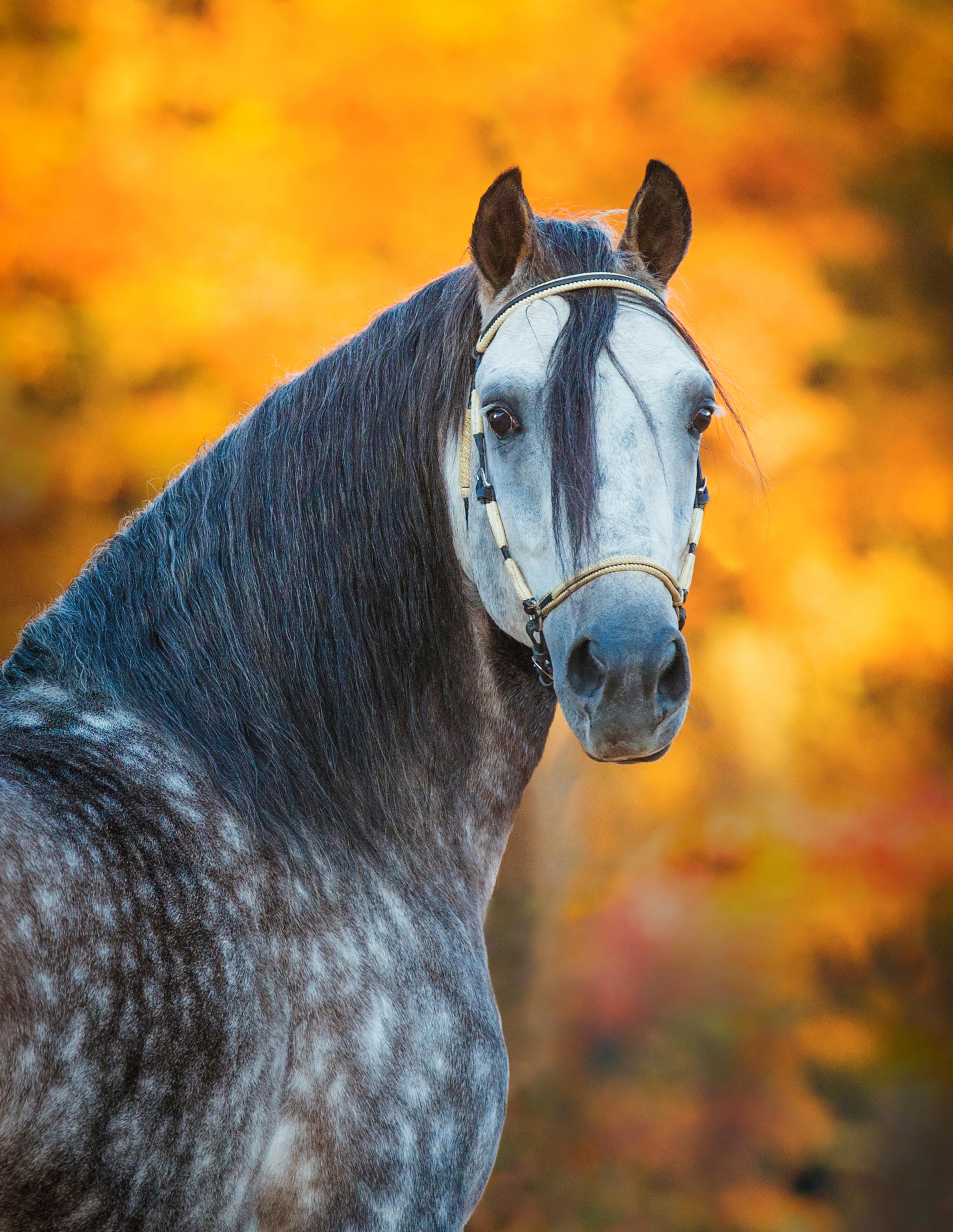
On the cover: A gorgeous fall backdrop for the gorgeous Paso Fino stallion Tormento del Coqui, who stands at El Paraiso Paso Fino Farm in Suwanee, Ga. Photo by Cheri Prill, Stunning Steeds. www.stunningsteeds.com.

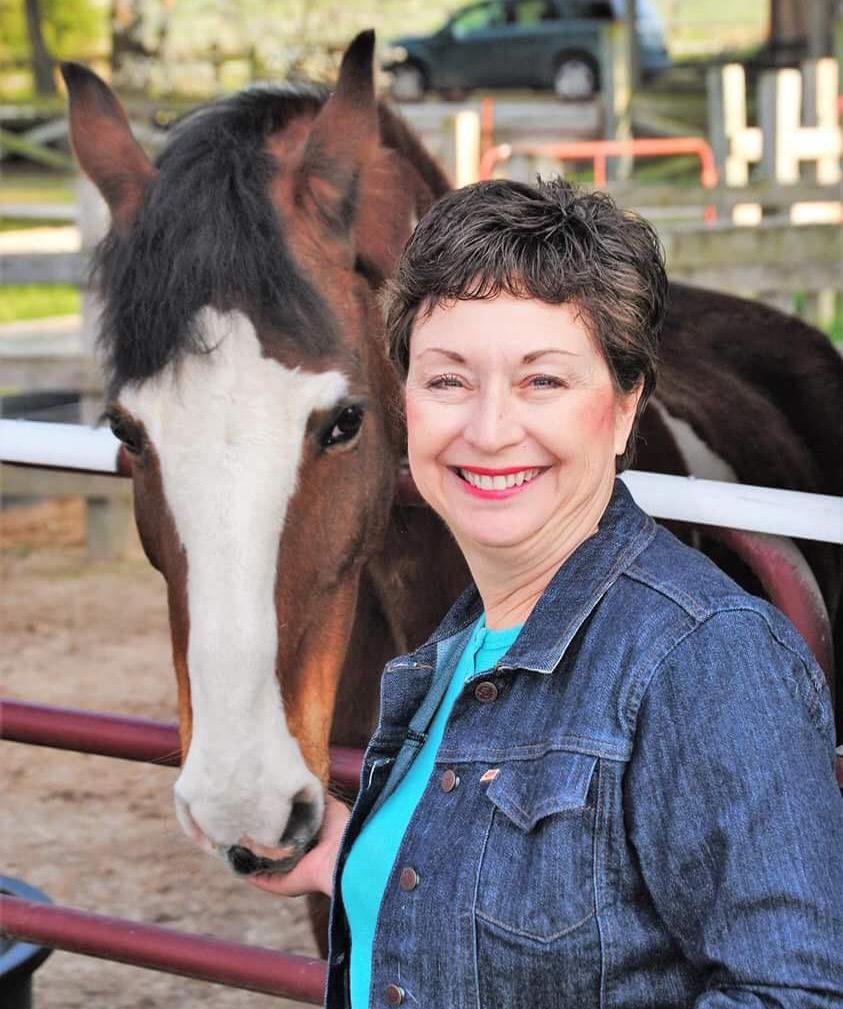
Dear FOSH Friends,
As the year ends, FOSH and I thank you for your support in 2020. As you hunker down because of the cold weather and pandemic, we hope you enjoy reading this beautiful and informative issue of The Sound Advocate. Our Editor, Stephanie Ruff, created an issue with many facets—from equine hoof health to training to member stories—in other words, something for everyone!
My next note of importance is the socalled compromise bill to replace the PAST Act, which is being touted on social media and in various press releases (see pages 7-9 for more information). Upon careful review and analysis, FOSH is firmly opposed to this bill for several reasons--and it should not even be called a compromise as the bill would significantly worsen today’s situation. Not only that, our trusted partners, the American Horse Council, American Association of Equine
Practitioners and the American Veterinary Medical Association are opposed to the bill along with 30+ equine organizations. These groups and many others are letting their voices be known in Congress that the bill will not help Tennessee Walking Horses and that they continue to support the original PAST Act. If you have any questions about either bill, please do not hesitate to contact me: President@fosh. info.
Although some equine activities were curtailed this year due to the pandemic, others took place, and we’re happy to share some great stories from our members about their competitive pursuits with their gaited horses—both virtual dressage and distance riding. We also appreciate that these individuals were kind enough to take time to detail their experiences for you to read and feel encouraged about trying something new in 2021 and beyond. To prepare for 2021, we provide training information and ideas from both Larry Whitesell and Wendy Murdoch. Both Murdoch and Whitesell are such excellent communicators of their knowledge, I have a feeling you will find many valuable nuggets of wisdom.
As you think about 2021, please don’t hesitate to reach out to me if you have any ideas for clinics or other events so we can see about FOSH assisting you. We know that this year’s shutdown scuttled many plans so we look forward to supporting you and your gaited horse friends in 2021.
For the Horse, Teresa
Teresa Bippen FOSH President Tbippen1957@yahoo.com
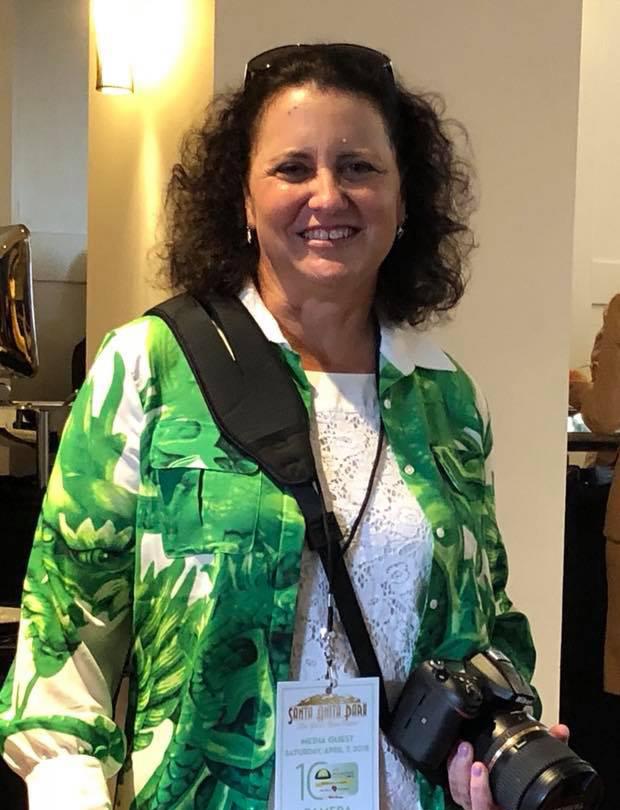
I’m writing this with Thanksgiving right around the corner. And since things pandemic-wise have actually gotten worse since our last issue, it’s going to be a different sort of Thanksgiving...just like most everything has been different this year.
Regardless of the circumstances, we can still focus on what we are thankful for. Overall, I’m grateful for my health. I have been fortunate to stay away from COVID-19 so far (knock on wood, throw salt over my shoulder, etc.)
I’m also thankful for finding FOSH
and being given the opportunity to work on The Sound Advocate. With this issue completes one year for me with FOSH. I think each one has improved, and I hope that next year will be even better.
Many thanks to Teresa Bippen, Alece Ellis and Dianne Little for their help, support and faith throughout this first year. I look forward to many more.
I am open to ideas and suggestions for articles for next year. Feel free to email me at editor@fosh.info.
My wish for you is to stay safe and healthy throughout the holidays and the foreseeable future for that matter.
Enjoy the season as much as possible, and let’s hope 2021 brings better days.
Happy Holidays and Happy New Year,
Stephanie
Stephanie J. Ruff Editor, editor@fosh.info
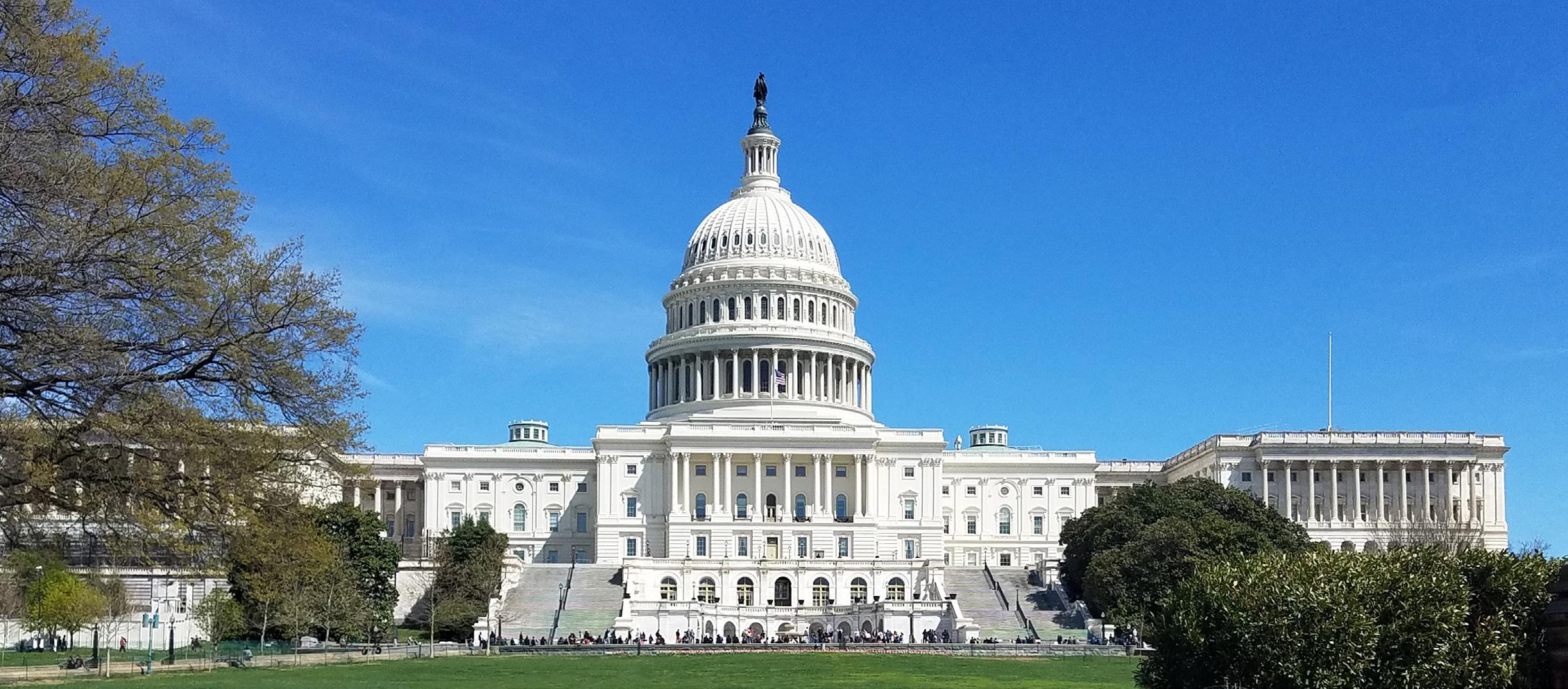
The American Horse Council (AHC), which serves as the umbrella organization for the diverse equine sector, has long supported the Prevent All Soring Tactics (PAST) Act (S. 1007), as currently introduced in the 116th Congress. The current version of the PAST Act lays out a common-sense solution to prevent the continued practice of soring and is limited in scope to Tennessee Walking Horses, Racking Horses and Spotted Saddle Horses.
AHC learned in late October that one animal welfare group and certain segments of the walking horse industry have been meeting and circulating a proposed Senate “compromise” bill which would substantially alter the PAST Act (S. 1007). After careful review and meeting with numerous industry stakeholders, the American Horse Council has formed a coalition of over 30 equine organizations which have significant concerns and are opposed to the “compromise”. AHC’s Equine Welfare and
Shows/Competitions committees overwhelmingly turned down the proposed amendments and recommended to the AHC Board of Trustees that the organization continue its support of the PAST Act (S. 1007) as written and oppose the “compromise” bill. The AHC board unanimously approved the committee’s recommendation.
A detailed analysis comparison document of the PAST Act (S.1007) and the proposed “compromise” bill may be found on the AHC website www. horsecouncil.org
Equine organizations opposed include: American Association of Equine Practitioners, American Veterinary Medical Association, US Equestrian Federation, American Connemara Pony Society, American Saddlebred Horse Association & American Saddlebred Registry, Paso Fino Horse Association, United Professional Horsemen’s Association, American Quarter Horse Association,
Pinto Horse Association of America, US Para-Equestrian Association, US Hunter Jumper Association, American Morgan Horse Association, American Hackney Horse Society, National Show Horse, National Reining Horse Association, Joint Leadership Council (consisting of American Hackney Horse Society, American Morgan Horse Association, American Road Horse & Pony Association, American Saddle Horse Association), US Eventing Association, US Dressage Association, American Saddle Horse Registry, United Professional Horsemen’s Association, Arabian Horse Association, American Vaulting Association. FOSH (Friends of Sound Horses), USA Reining, and Western Dressage Association of America.
ASPCA and HSUS also support the PAST Act as currently written and passed by the full House.
Contact: AHC President, Julie Broadway, at jbroadway@horsecouncil.org or Director of Policy and Legislative Affairs, Bryan Brendle at bbrendle@horsecouncil.org for more information or to join the coalition.
The Humane Society of the United States and Humane Society Legislative Fund are encouraging the incoming Biden administration to prioritize the reinstatement of the 2016 federal rule to address the abhorrent and widely scorned practice of horse soring in the Tennessee walking horse industry early in 2021. The rule, which the organizations supported through investigation, public awareness work, lobbying and litigation efforts, would strengthen the U.S. Department of Agriculture’s Horse Protection Act regulations by
ending the use of cruel devices integral to soring and the failed system of industry self-policing.
The soring rule, which received over 100,000 supportive public comments, including bipartisan letters signed by 182 U.S. Representatives and 42 Senators, was announced by the USDA in the closing days of the Obama Administration. But when President Trump took office, it became one of the many regulatory changes frozen and left to sit on the shelf with no explanation, no justifi-
cation, and no public comment solicited.
The HSUS and HSLF sued the USDA and the Office of the Federal Register to compel the reinstatement of the rule in a case still pending in the federal courts. But Biden has a simpler pathway. He was part of the administration that championed the rule, and as president he can easily resurrect it for implementation.
Political support for effective reforms to actually end soring is abundant in Congress. The Prevent All Soring Tactics (PAST) Act of 2019, S.1007/H.R.693, passed the House of Representatives in July 2019 with a commanding vote of 333-96 and enjoys strong bipartisan support in the Senate with 52 cosponsors there. Recently, voters polled in Kentucky and Tennessee, the two states where horse soring is most prevalent, expressed overwhelming support for the solutions of the PAST Act, which includes much of what the 2016 rule contained.
Recently, some groups have lined up with Tennessee Walking Horse proponents to introduce a new proposal led by retiring Senator Lamar Alexander as their advocate.
“We are committed to ending horse soring, but this proposal would allow the ongoing use of devices that are involved in the soring process, institute an inspection protocol that would make it more difficult to find and issue citations for soring and
allow for continued industry self-policing to trump true oversight,” said Sara Amundson, president of HSLF.
Kitty Block, president and CEO of the Humane Society of the United States, “We’re confident that focusing on the 2016 rule with the incoming administration is the right path, and that’s the one we’ll pursue in the weeks ahead.”
Virtually all of the national veterinary, horse industry, and animal protection groups that have worked to end soring through the PAST Act and the 2016 Horse Protection rule have analyzed the new proposal, and come to the conclusion that Senator Alexander’s proposal is a backward step. HSUS and HSLF have joined AAEP, ASPCA, AWI and HSVMA in a letter to Congress strongly opposing Alexander’s proposal, and the American Horse Council, a partner in the coalition in support of PAST, has also issued a statement of strong opposition on behalf of more than 30 organizations including the AVMA.
These groups are united in the conviction that the proposal is an effort to derail both the 2016 rule and the PAST Act – an inexplicable move, given the favorable climate around this issue as 2021 approaches, with a new President. HSUS’ and HSLF’s detailed analysis of the proposal’s specific problems, is available upon request.
For more information, visit www.humanesociety.org.
Courtesy of the Paso Fino Horse Association.
The Paso Fino Horse Association Board of Directors is proud to announce the 2020 Hall of Fame inductees. This award is the highest honor bestowed by the association and is given in recognition of their positive influence on the breed from either their success in the show ring, trail competitions, leadership, or breeding the amazing Paso Fino.
Presented at the 2020 Grand National Show, the PFHA is proud to award the 2020 Hall of Fame Award to Mr. Dick Miller.
In the past forty years, Dick Miller has owned more than one hundred thirty horses, competed in more than three thousand classes, won more than eighty-five national and grand national championships, competed in the Mundial World Championships four times, and has shown in thirteen states as well as England, Puerto Rico, and the Dominican Republic.
Dick’s passion for service and ded-
ication to our youth has led him to years of volunteer service at the local, regional, national, and international level. Dick served multiple terms on the Southern Regional Board of Directors and as Treasurer of the national association from 2013-2016. In addition, Dick has
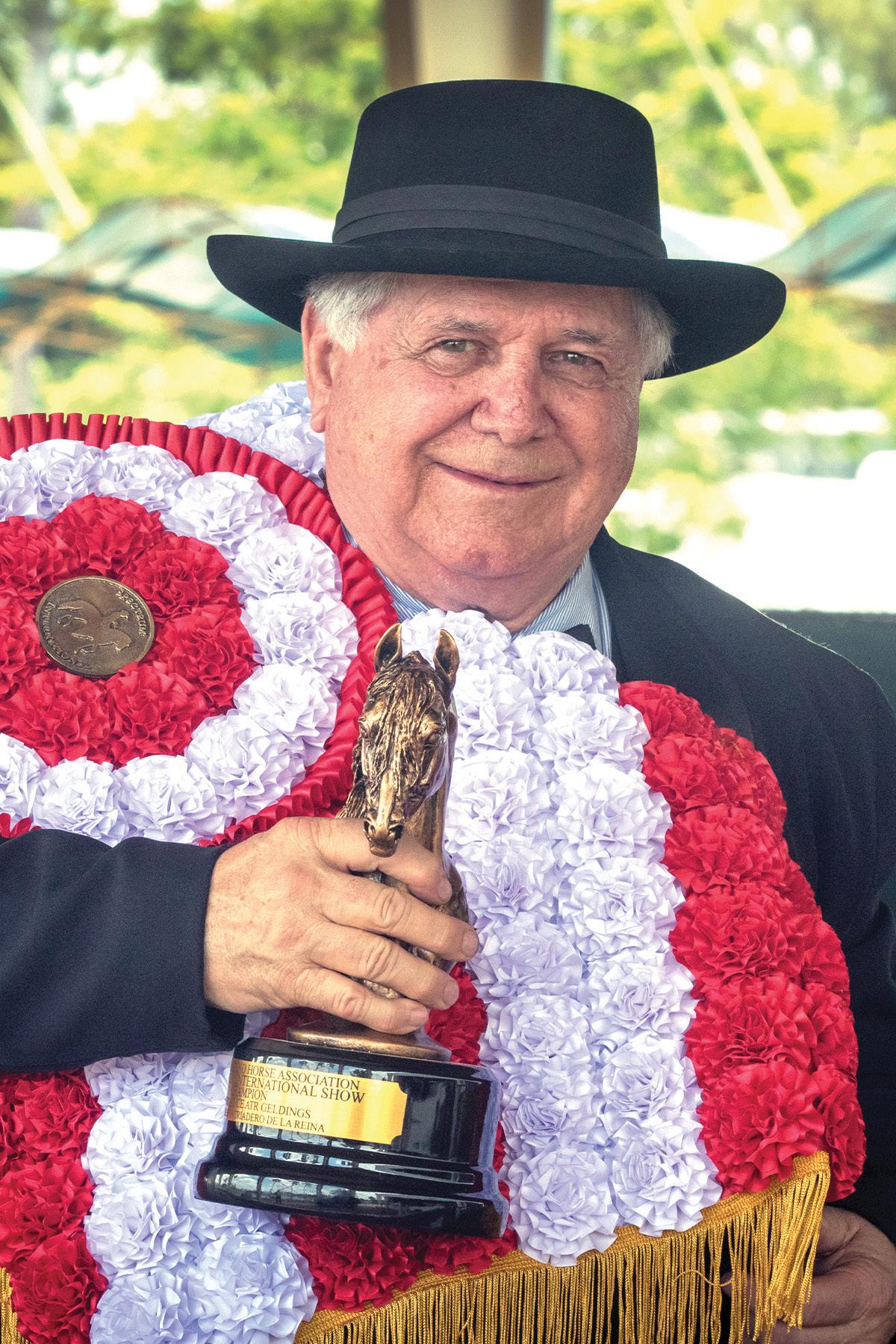
been recognized by Confepaso International Foundation, for his devoted service to the breed.
Perhaps Dick Miller’s biggest contributions have been to the youth of the association. Dick was instrumental in kick starting the Paso Fino Horse Foundation’s youth scholarship program and has been one of its biggest supporters. Through his efforts and contributions in the past fifteen years, the Foundation has awarded more than $180,000 in scholarship funds to more than fifty-five deserving youth recipients. Dick has spent countless hours in support of Team USA and served as the treasury clearinghouse multiple Youth Mundial events.
Dick Miller is a truly deserving recipient of the 2020 Hall of Fame Award.
The PFHA is proud to award the 2020 Hall of Fame Horse to JLM’S Jaranero.
Bred out of Retorno del Ocho (Resorte Cuarto) by Manuela del Conde (Capuchino), Jaranero is the sire of 223 PFHA registered offspring. Jara-
nero’s accomplishments are many, including: PFHA Top Ten Sires list 10 times, Legion of Merit, Title of Proficiency and inducted into the Spectrum Hall of Fame, National and Grand National Fino Stallions and Bella Forma Stallion Champion, Ponce International Champion Fino
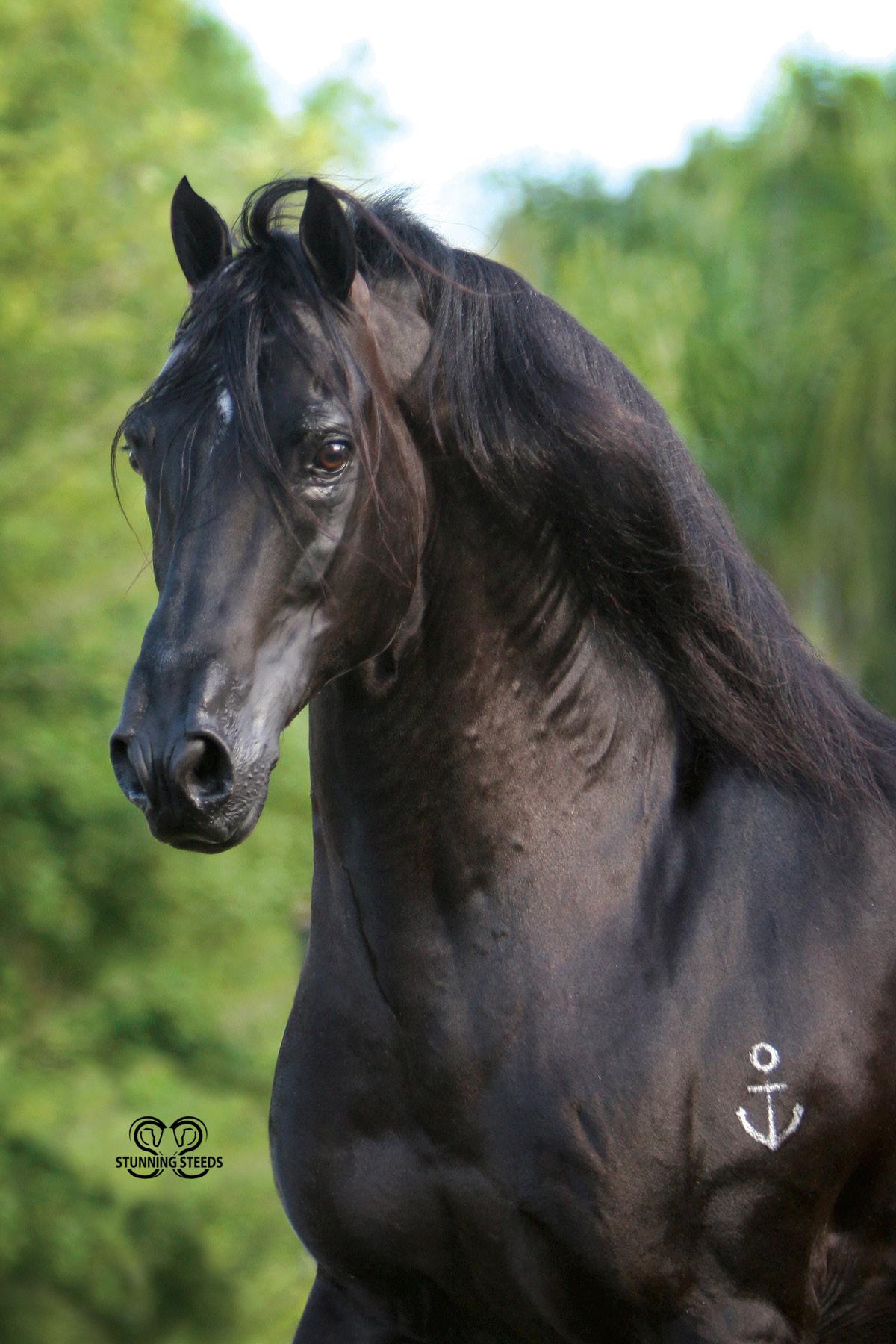
Stallions and World Champion Mundial Bella Forma. Foaled on 4/24/1995 JLM’s Jaranero celebrated his 25th birthday this spring and there is no honor more fitting than for him to be selected for inclusion into PFHA’s Hall of Fame.
The PFHA Amateur Committee offers an annual Amateur of the Year Award. The award is special recognition to one of our amateurs who demonstrates excellence in the show ring at the regional and or national level, including honors, awards and commendations as well as having shown substantial and sustained contributions to the breed at the local, regional and national level, including efforts supporting youth and promotion of the breed. Finally, a candidate must exhibit sportsmanship and skill in riding, exhibiting, management and care of the horse. Jeanne Griggs personifies these criteria.
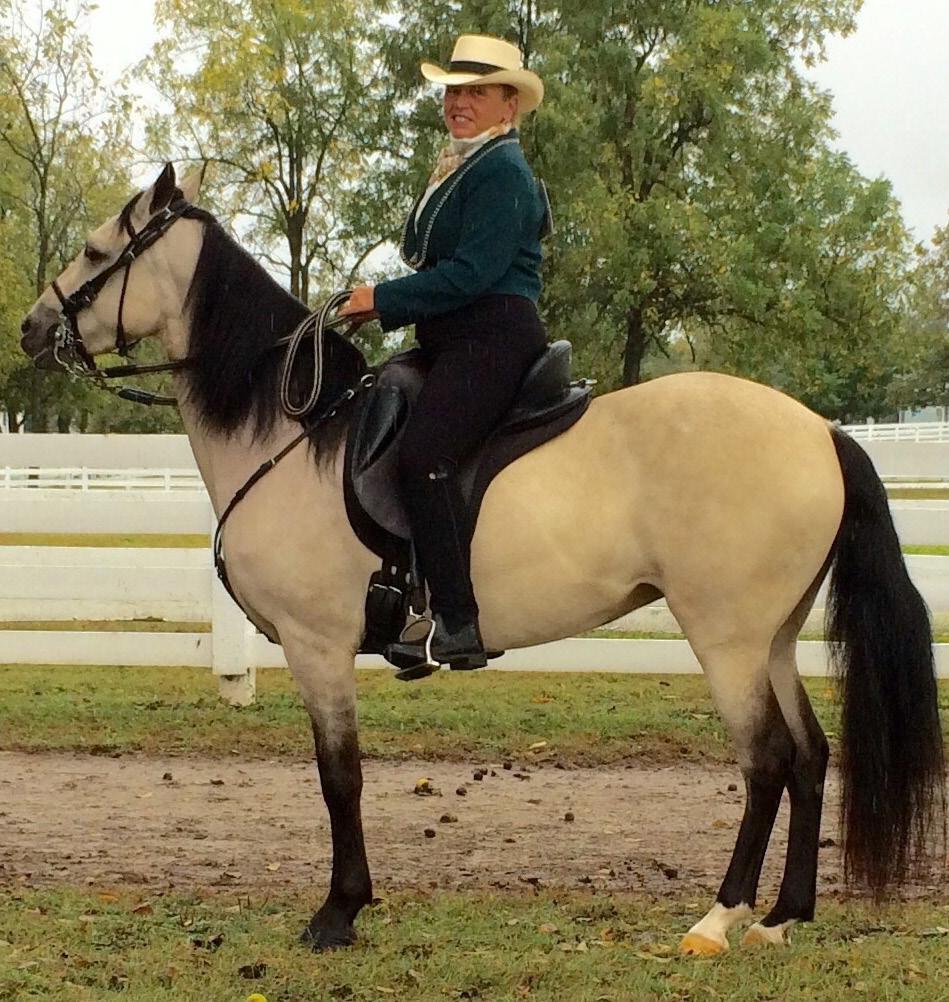
Jeanne Griggs is a dedicated member of PFHA and Piedmont PFHA exhibiting great horsemanship and sportsmanship qualities, always offering her sincere congratulations to her opponents. She is very willing to assist and support others with a gracious and appreciative attitude. When it comes to sharing her love of horses, Jeanne is very generous with the youth of our association and to the youth in her community. Whether it’s lending her horse to a youth to compete, taking her horse to community events to give ‘pony’ rides, or competing in a costume class with a youth, Jeanne is willing to accommodate others. Jeanne has been successful in the show ring at local, regional and national level in many divisions. An avid trail rider, Jeanne has participated in the Trail Horse Test, qualifying her mare, Amapola de Eco as a senior trail certified horse.
Jeanne has devoted countless, selfless volunteer hours, serving the breed in leadership at the local and national level. In January, having completed the PFHA requirements, she became a PFHA Certified Steward and is in the process of completing the USEF requirements to become a USEF licensed steward. Jeanne’s contributions to our breed, her desire to promote the breed, her love and appreciation for the horses and her ‘never met a stranger’ personality make her the perfect recipient for the Amateur of the Year Award.
The PFHA Youth of the Year Award provides special recognition to one PFHA Youth Rider who has achieved excellence as a PFHA Youth Rider at PFHA shows or other Paso Fino programs and events at the regional and/or national level as demonstrated by honors, awards, and commendations. The candidate must exhibit conduct becoming of a sports enthusiast including but not limited to integrity, honest rivalry, and graceful acceptance of results. Finally, the candidate must exhibit excellence in skill of riding, exhibiting, and the care and well-being of their horses. PFHA Youth Committee is proud to present the 2020 Youth of the Year to Billieanna Miranda.
Nominated by Mills Equestrian Center, Billieanna has been a youth rider there since 2017, demonstrating her abilities to ride a range of horses,
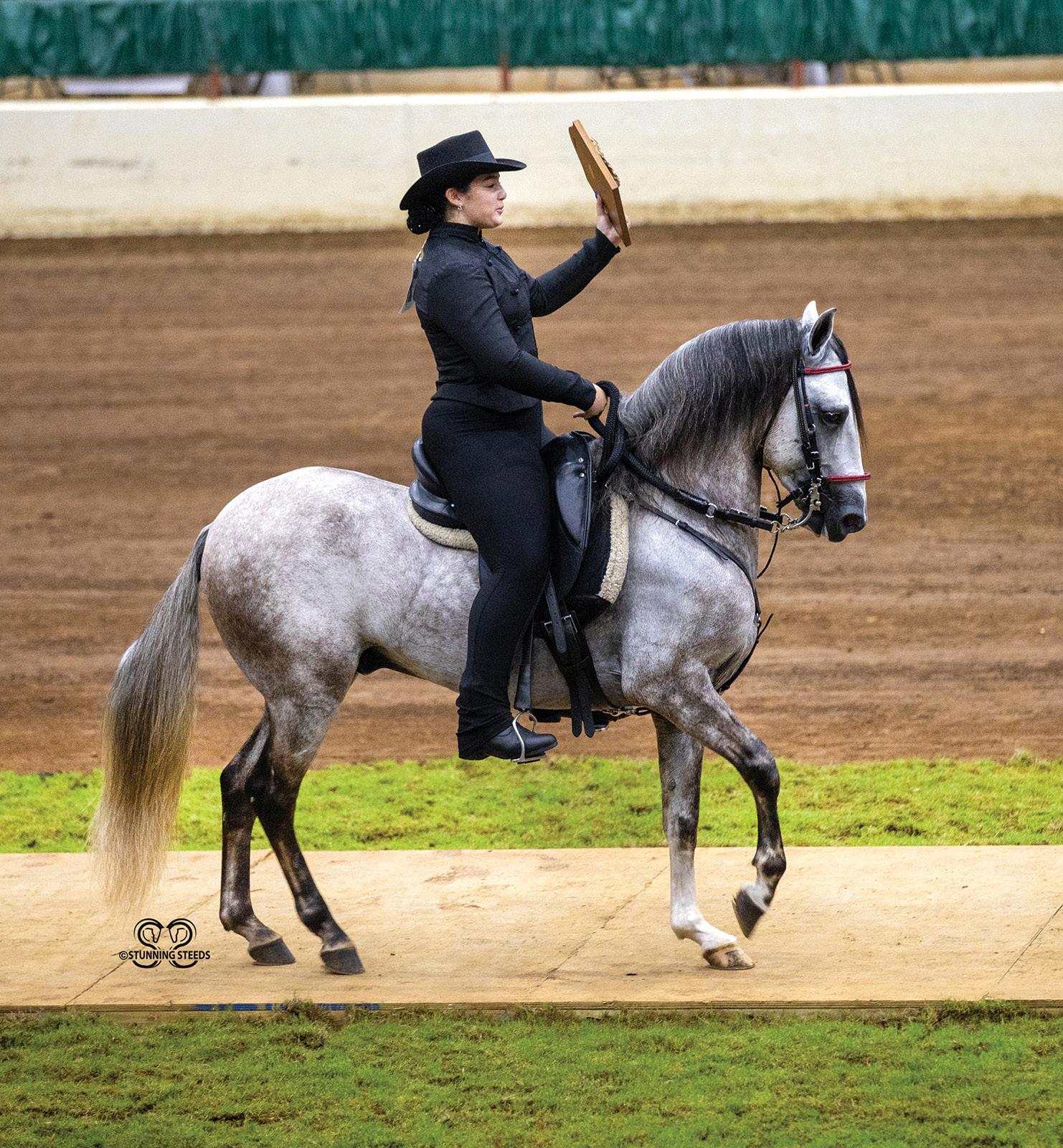
from the most difficult to the best easy-going horse on the farm. She exhibits outstanding horsemanship and shows very well carried equitation. Billieanna has consistently performed at the highest level at regional shows and became the Grand National Equitation Rider with Dalia De Las Arias. Billieanna has actively promoted the Paso Fino by participating in exhibiting at the 4-H Shows, Ocala Breeders Supply Store one day exhibition, and The Live Oak International exhibition 2020.
“Whether inside the showring or on a trail ride Billieanna’s passion and enthusiasm makes her a true ambassador for the Paso Fino Horse,” shares the leadership at Mills Equestrian Center.
For more information about The Paso Fino Horse Association, visit www. pfha.org or call 1-859-689-3700.
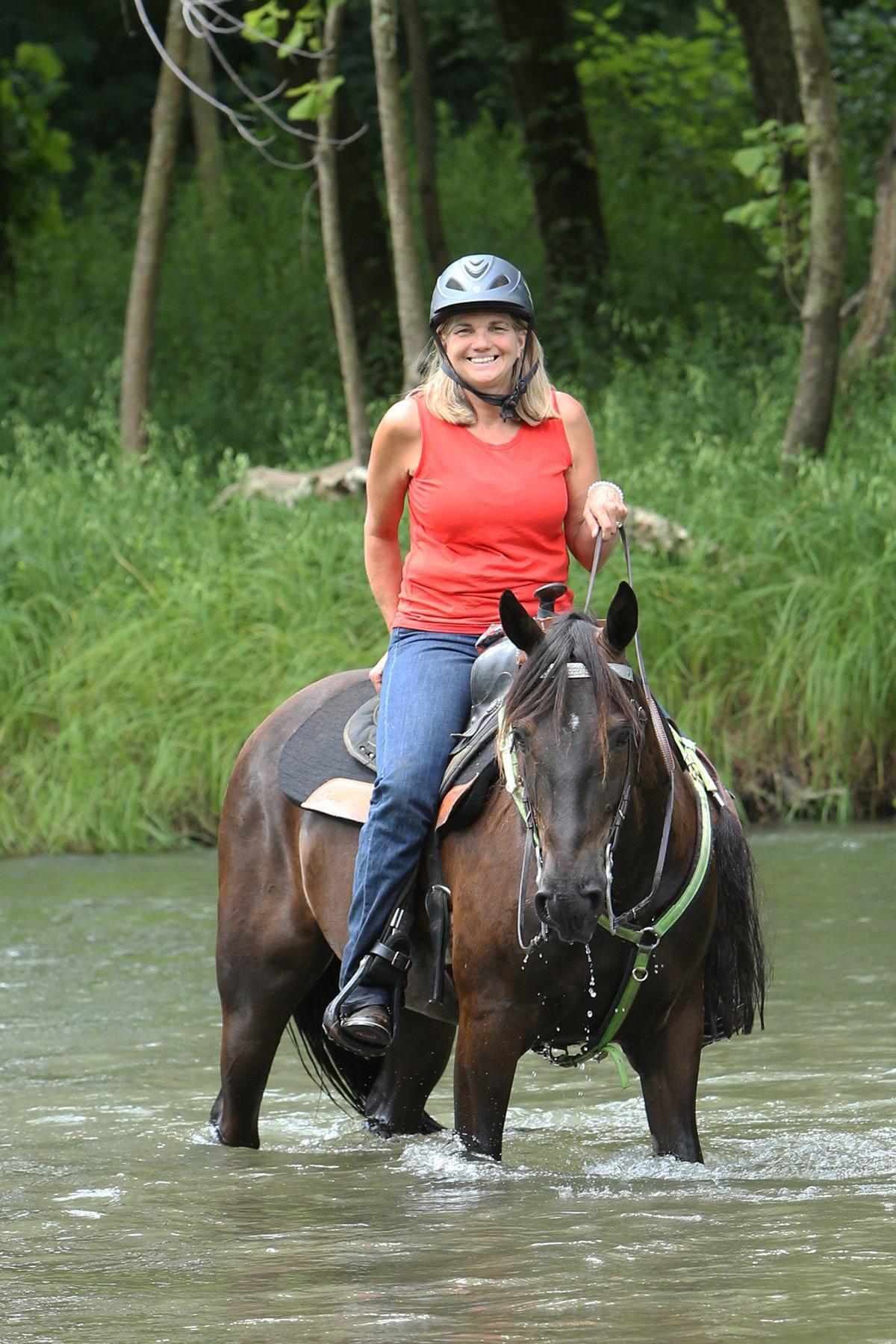
“Have I told you how much I love this horse?” These words are music to the ears of Anita Hughes Dunham, owner of Hughes Stables, in Kidder, Mo., some 60 miles north of Kansas City. Anita knows her breeding program and what she’s aiming for, but you will be hard pressed to hear her toot her own horn, brag or pat her back.
Anita and husband Van Durham have four children; two are into horses and two, not so much. The family’s two-story farmhouse sits on 65 acres for the horses with an adjacent 115 acres devoted to its Angus herd and fields of high-quality Brome hay. Its Facebook page reads, “[It is] a small, family-run operation that focuses on the best aspects of nature and nurture when it comes to sound, naturally gaited horses.”
mares: three Missouri Fox Trotters and two Tennessee Walking Horses, but no breeding stallions of its own right now. There were three foals born in 2019, five in 2020, and Anita looks to breed again in 2021.
The gaited horse has a natural way of going. Anita explains, “The babies are born with it, gifted with natural timing, rhythm, and head nod. It is natural and easy for them to flat walk. The ‘way of going’ is how they move or travel.
“The walk is the same for all breeds of horses. The optional gait, or intermediate gait, is what sets gaited horses apart--ours either foxtrot or have a four-beat running walk.”
The working stable has five brood-
Anita is crystal clear about the Hughes Stables breeding goal. “We
By Janet de Acevedo Macdonald
want to breed forever horses for people.”
Friend and fellow FOSH board member Alece Ellis, who holds judging cards for multiple gaited breeds plus an Independent Judges Association license, is an avid fan of Hughes Stables-bred horses.
“Her [Anita’s] horses have good minds. They are cooperative ‘yes’ horses, which is why they sell and contributes to why they win!”
To further her point, Ellis notes that Hughes Stables doesn’t advertise. Other than its Facebook page (https:// www.facebook.com/ hughesstables), it has no online or social media presence. Its reputation for sound, well dispositioned horses precedes it by wordof-mouth from horse lovers well beyond the gaited world.
When Anita considers her breeding program, there are lines she looks for in pedigrees. An oldie-but-goodie is the black stallion Midnight Sun, one of the leading sires of the Tennessee Walking Horse breed, and a two-time World Grand Champion in 1945 and 1946.
Knowing this fact, 22-year-old Tennessee Walking Horse Generator’s Mac Attack, owned by David and Melanie Lehman of Marissa, Ill., has sired many Hughes Stables’ foals. It should come as no surprise he has five crosses to Midnight Sun in his pedigree.
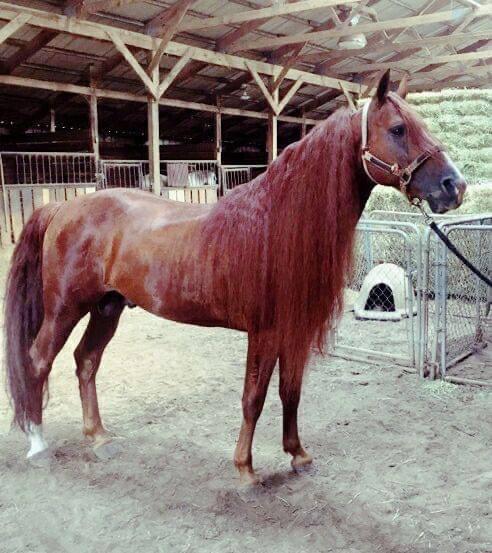
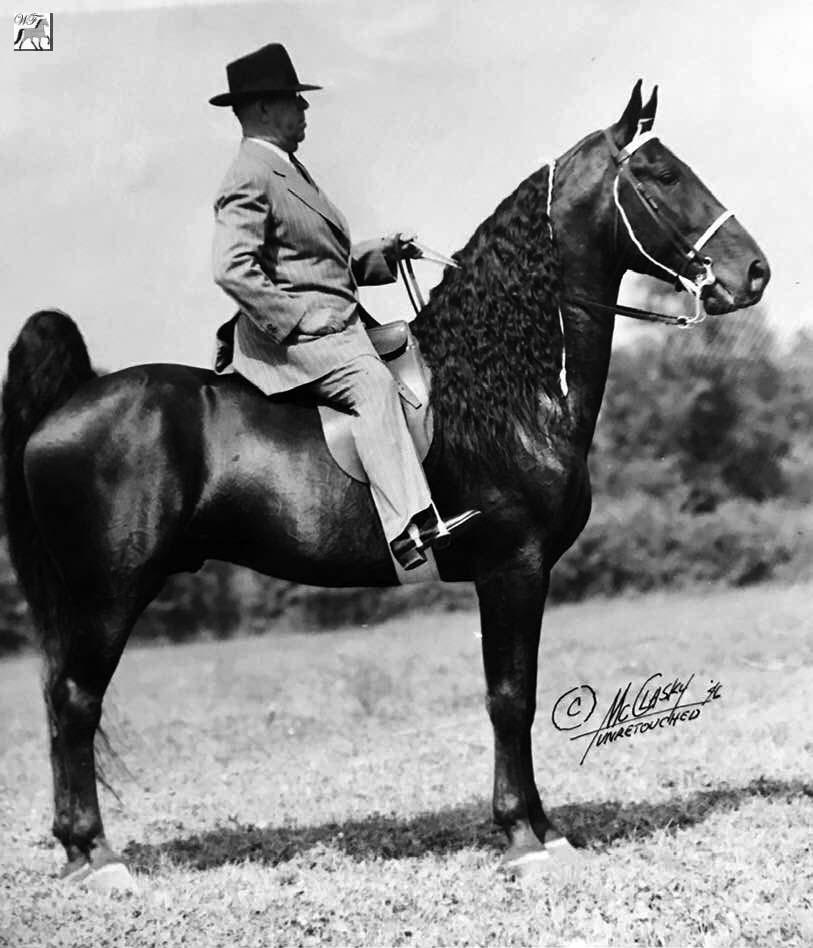
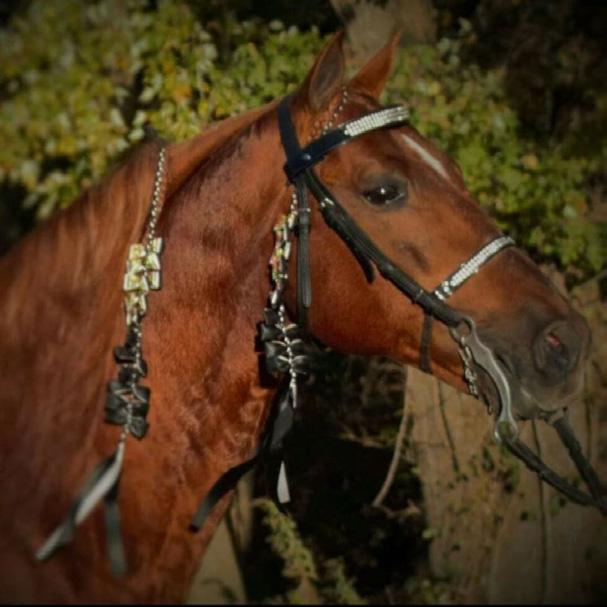
The late Sensations Pride B, who was owned by Tom and Donna Struemph of California, Mo., had both Missouri Fox Trotter and Tennessee Walking Horse bloodlines. Pride’s get can be found throughout Anita’s program, including Bama, her daughter Cheyenne’s stallion.
The 2001 Fox Trotter stallion Jester’s Charming Legend, owned by Brian Oglesby of Perry, Mo., is another of the chosen breeding sires.
Hughes Stables has two 3-year-old mares sired by Big Whiskey, a Missouri Fox Trotter owned by Monica Daugherty, and they are getting ready to start them under saddle. Anita likes their dispositions and conformation. Of course, the Midnight Sun spotted on the tail female line can’t hurt.
“Mac and Pride are definitely the two stallions that we have bred to the most and are the core stallions for our breeding program,” says Anita.
The core principals of the Hughes Stables breeding program are straightforward. The horses are bred to be well-rounded, sound-minded trail horses. Gait, conformation, ‘way of going’ and disposition are all must-have components.
“We’ve taken mares out of our breeding program because of their [bad] dispositions,” says Anita. “We breed horses that are not spooky and not stupid.”
Luther and Vonnie Hughes established Hughes Stables in the 1970s and began breeding, training, and showing Missouri Fox Trotters. In the 1980s Hughes Stables extended its interests to include Pleasure Walking Horses and Tennessee Walking Horses. Its program doesn’t include
pads, chains, bands, or other action devices--just flat shod, barefoot, and easy-going horses.
By all accounts, Luther was a gifted trainer and rider, with Vonnie as the essential ground person telling the rider which small tweaks will get the most out of the horse—ask for a little more or less headset or change in speed. At shows, the ground person not only coaches, but also keeps track of which classes the riders are in and helping with tack changes and clothes. Luther and Vonnie’s teamwork were hand-in-glove.
Not surprisingly, as kids, Anita and her sister accompanied mom and dad and also showed horses.
Anita has been the Hughes Stables trainer for the past decade. Unexpectedly, 11 years ago, management of Hughes Stables changed in an instant when Luther Hughes had a horse accident that left him invalid and still in a care facility today.
At the end of April 2020, Anita retired after 35 years with the USDA as a Resource Conservationist. Like most retirees, she too finds it interesting how her days remain as busy, or busier, than when she was employed.
Daughter Cheyenne, 28, and son Garrison, 22, are the Hughes Stables third generation. Cheyenne has a 7-year-old Fox Trotter stallion—Pride
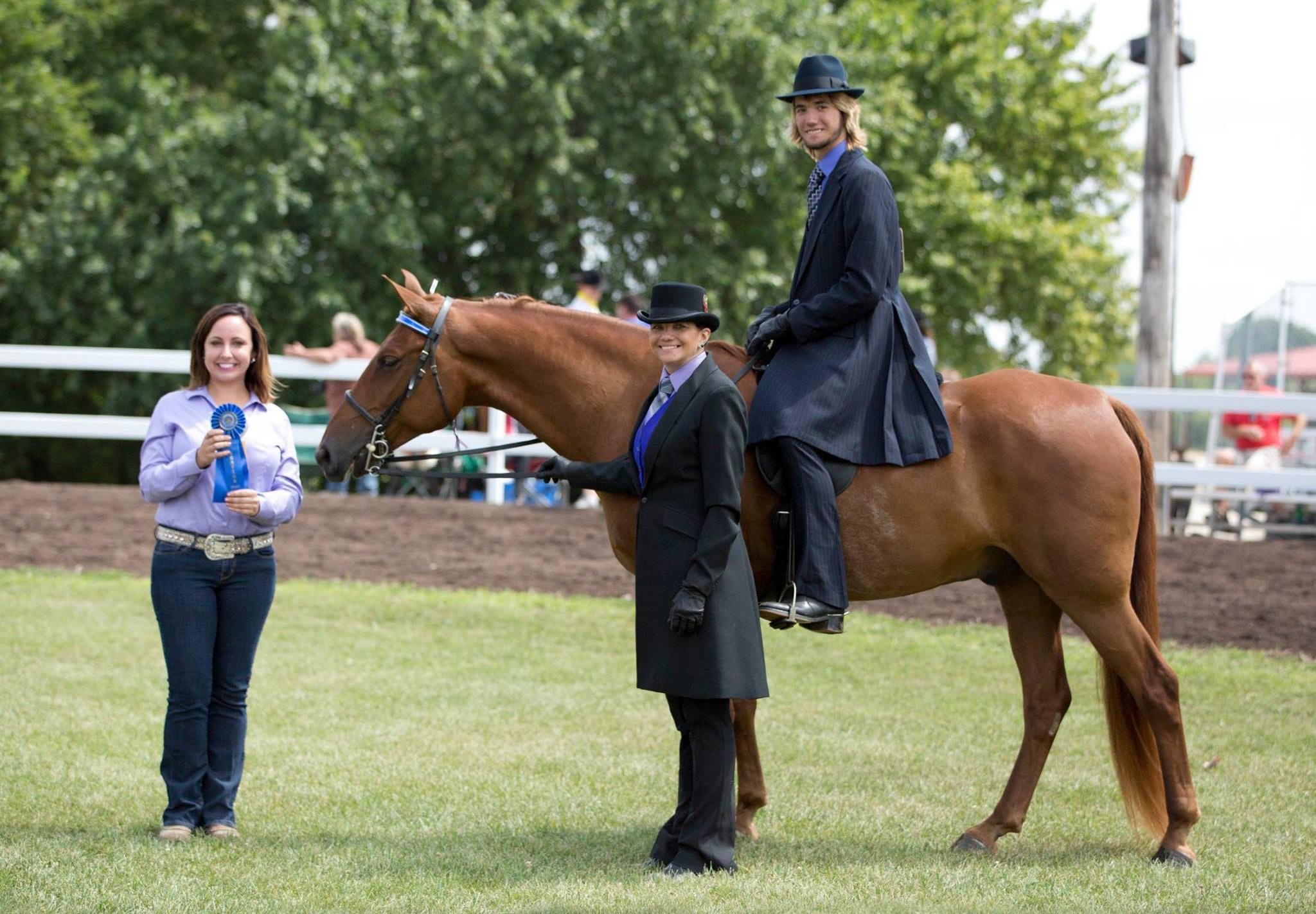
and Prejudice—sired by the late Sensation Pride B, that she calls Bama. This dynamic duo graduated to cattle sorting and ranch horse riding when rail classes got a bit too boring. Garrison is the ground person, lifter-ofall-things-heavy, and all-around fixer.
Primarily, the Dunhams show on a local Pony Express horse show circuit. They nominate for the Missouri Horse Show Association and just started showing at the big Fox Trotter shows in Ava, Mo. the last two years. Of course, the local circuit was canceled for 2020 due to the COVID-19 pandemic.
Alece Ellis also applauds the mentoring that Hughes Stables does in
the show ring and on the trail. Ellis recalls the 2019 Missouri State Fair when many of the youth riders were showing Hughes Stables horses together in several classes. All were cheering for and encouraging one another. Why? Because that is what’s modeled by the Dunhams, and above all else, it is what’s valued. Hughes Stables regardless of its success never has and does not now put on airs.
When Anita was pressed to talk about winning accolades, the Hughes Stables humble struck again with a gentle quip, “No one likes you much when you’re winning.” The inability to toot one’s own horn is so refreshing.
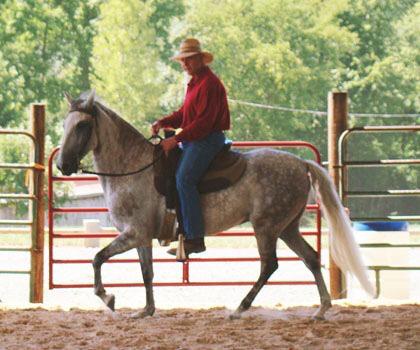
Most of us would like to get our horse to gait on a loose or very light rein. If horses learn from release of pressure, why would we hold pressure on the mouth to make him or her gait? When we teach a horse to maintain gait, we might have just a feel on the reins, and when the horse gaits we release. Of course in early training, the horse will fall out of gait when we release. We add feel again and when gait comes, we release and so on. In the beginning, we only work for short periods. It doesn’t take the horse long to figure out when he gaits, he gets release and comfort.
Everything we teach, we must release when the horse gives the right answer. As I travel the country doing clinics, I see most riders don’t have the connection they want with their horses. Most riders spend their time with their horses trying to teach them how to be safe for them. They work on teaching the horse not to spook, not to go too fast, not to do things that make us feel unsafe when we ride. Very few riders spend
By Larry Whitesell
time teaching the horse what he needs in order to feel comfortable or safe. Riders don’t see how the horse perceives what is happening, or interprets the rider’s wishes.
Riders teach horses movements like turn on the forehand or haunches, leg yield, back, stop, etc. When you teach a movement instead of how to perform the movement, then the movement becomes a trick. When you trail ride and the horse becomes energized, tricks don’t work. Does his brain comprehend what you want his feet to do? The horse performs a movement to get a release with no real understanding of what his feet are doing and how to do the movement in balance with relaxation.
Lightness comes from the feet, not the mouth. If his brain understands how the aids connect to his feet, he will always perform in balance. There is resistance when we pull on a rein, and the feet are sticky or go in the wrong direction. If the horse understands the aid, and his feet go where we ask, then the horse feels light.
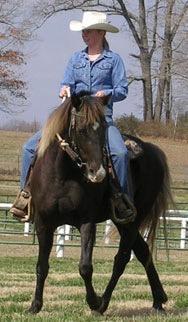
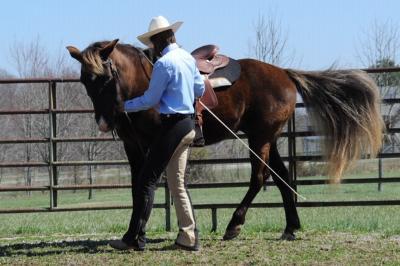
Left: Jen asks her mare to cross her left hind leg in front of the right hind leg.
Above: Here is an example of teaching the horse how the reins talk to the feet. Jen can touch the leg with the whip to make the horse focus on a particular leg as she uses a rein.
Don’t get stronger bits or pull harder. Teach the horse how to answer the rein or leg with his feet. Pulling harder only makes more resistance and tension. A major problem is that riders teach the whole movement at once instead of breaking it down in to small pieces.
An example of this is teaching a horse to turn. If you hold the rein until the horse turns 90 degrees, you are teaching the movement. When you hold the rein for the entire movement, there is no release until the movement is completed. No real reward for the feet carrying the horse in the correct direction. If you touch the right rein and as soon as he steps one step right, you release, you are teaching him how to answer the rein with his feet. You build on this until he understands turning
right by answering the reins with his feet. His feet bring his shoulders right, he doesn’t just fall to the right.
If you hold pressure through the entire movement, the horse learns to move away from discomfort or pain. When you present pressure and release as soon as the horse takes a step, then the horse learns to seek comfort. There is a difference between a horse that moves away from pressure and a horse that learns to seek comfort. If I close my fingers on a rein, my horse turns to prevent me from applying pressure. I never have to take the slack out of my reins to turn, stop, back or any movement. If I had to hold pressure to get him to preform a movement, it would cause anxiety and worry in my horse. I don’t want my horse to escape pressure, but instead under-
stand how to look for comfort. He knows there is always a place where there is no pressure.
I want the horse to give in his mind and not just the body. It is easy to make a horse do something with his body, but can you get him to do it mentally? A horse that is mentally with you will not spook, run away, or be buddy sour. He sees his rider as security.
It is important to break everything down in the beginning. When a horse learns how you control his feet and that you won’t take him out of balance, he will relax and do his job. He will be light and soft and allow you to control him.
If, for example, you pull on his mouth to back-up, and hold his mouth until you want to stop backing, why would the horse want to back-up? He will back to get away from pain instead of backing to find comfort. You have to release every step. If a rider is constantly in the mouth, the horse may run away because he has learned that if he runs away the rider will pull him to a stop and then release the rein. So running away can get relief from the constant nagging. The horse knows that if he follows the other horses or stays with them, the rider leaves his mouth alone. But as soon as he separates from the other horses, the rider uses his mouth a lot more. If the rider can learn to guide her horse’s feet without offending him, he will mentally be with her.
Too often, riders use reins to prevent the horse from going out the gate, or get to close to another horse, or come off the rail. When you use a rein to prevent a horse from doing something, you are saying the rein has no meaning. If a rein says don’t do something, the horse has no idea what it is he is not supposed to do. Then you use your rein to turn after saying it means don’t turn. Confusion leads to what we consider bad behavior. In reality, the horse is just doing what he was taught. We need to understand how the horse perceives what we do. We only see it from our point of view, which leads to misunderstanding.
If you work on your horsemanship, you are working on becoming a better communicator for your horse. Once the horse is good, you should be working for the next level, which is more softness, more roundness, more forward in lightness. If we just settle for what we have, the horse becomes complacent. Keep it interesting for the horse.
www.whitesellgaitedhorsemanship. com
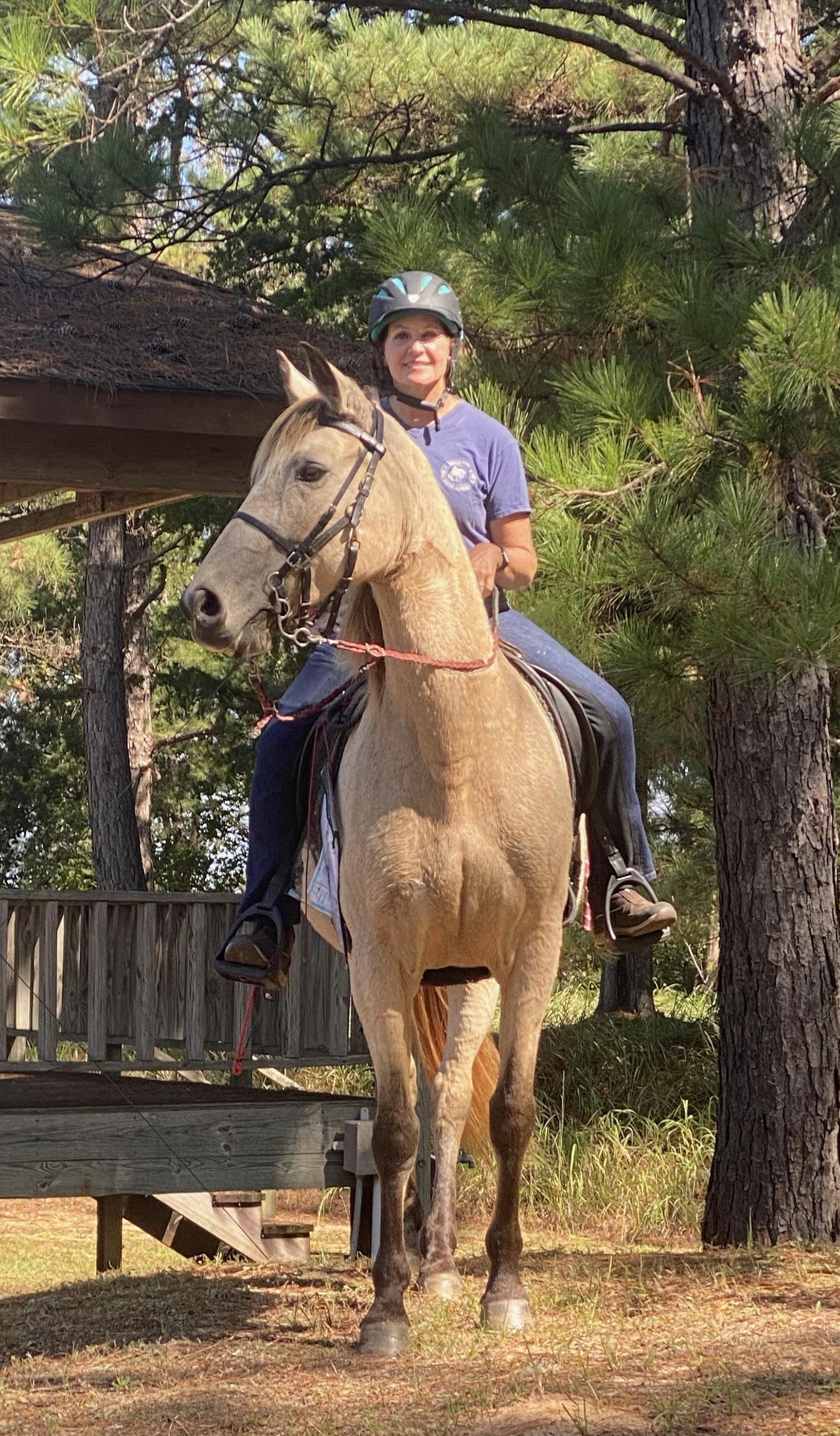
The 2019 Limited Distance High Mileage Lightweight and tied for Overall High Mileage was Patty Lucas and her 14-year-old Tennessee Walking Horse Pa Pa’s Alabama Express. A rider for more than 50 years, Patty lives in Birmingham, Ala. She was kind enough to answer a few questions about herself and her mare so we could get to know her a little better.
SA: Of all the equestrian disciplines available to you, what made you choose to participate in distance/endurance riding? Was there something special about it that appealed to you?
PL: I have trail ridden since I was a child. Riding competitive trail seemed natural. It gave me some goals to better my horsemanship skills and increase my horse’s skills.
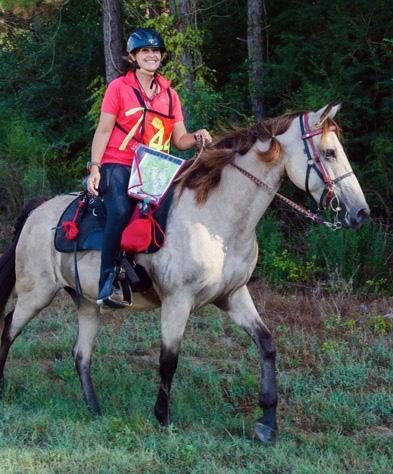
SA: What is the conditioning routine that you do with your horse and also for yourself in order to compete safely and successfully in distance/ endurance riding?
PL: I stay fit with exercise from walking to Yoga, tennis and of course riding is key for me.
My horse gets a variety of exercise from long, slow distance at least twice a week on various terrain from hilly to flat to shorter activities such as groundwork and exercising around the barn. We trailer out to our favorite places such as Oak Mountain State Park or Russell Lands in Alexander City, Ala.
SA: Of all the places you have traveled with your horse, which one is your favorite ride and why?
PL: My favorite place is Eastfork Stables in Jamestown, Tenn. The trails are beautiful, but technical. The views are exquisite there!
SA: Are people surprised to discover that you are riding a gaited horse in distance/endurance riding?
PL: I think there are those that still think gaited horses are just for the show ring or hacking about the trails for pleasure. I have to say, my mare steps right up to the task. Her temperament is steady and calm, and she has no quit in her.
SA: What misconceptions about gaited horses in distance/endurance riding would you like to dispel?
PL: Your gaited horse can do a lot more than you think!
SA: Many times people say, “Oh, I’m going to try that!” after reading the award releases. What would you tell people they have to be willing to do in order to do this sort of riding? Is there some sort of “discipline” gene that distance/ endurance riders have to possess?
PL: I don’t think there is a discipline gene, but just a desire to try new things, a love of riding, a commitment to being a better horsewoman and a desire to own a steady, fit horse.
SA: Do you have a favorite saddle or other equipment that you prefer? Why?
PL: I use a Trekker treeless saddle which is lightweight for me to handle, cooler, and less weight on the horse.
SA: What ride do you want to do but haven’t done yet?
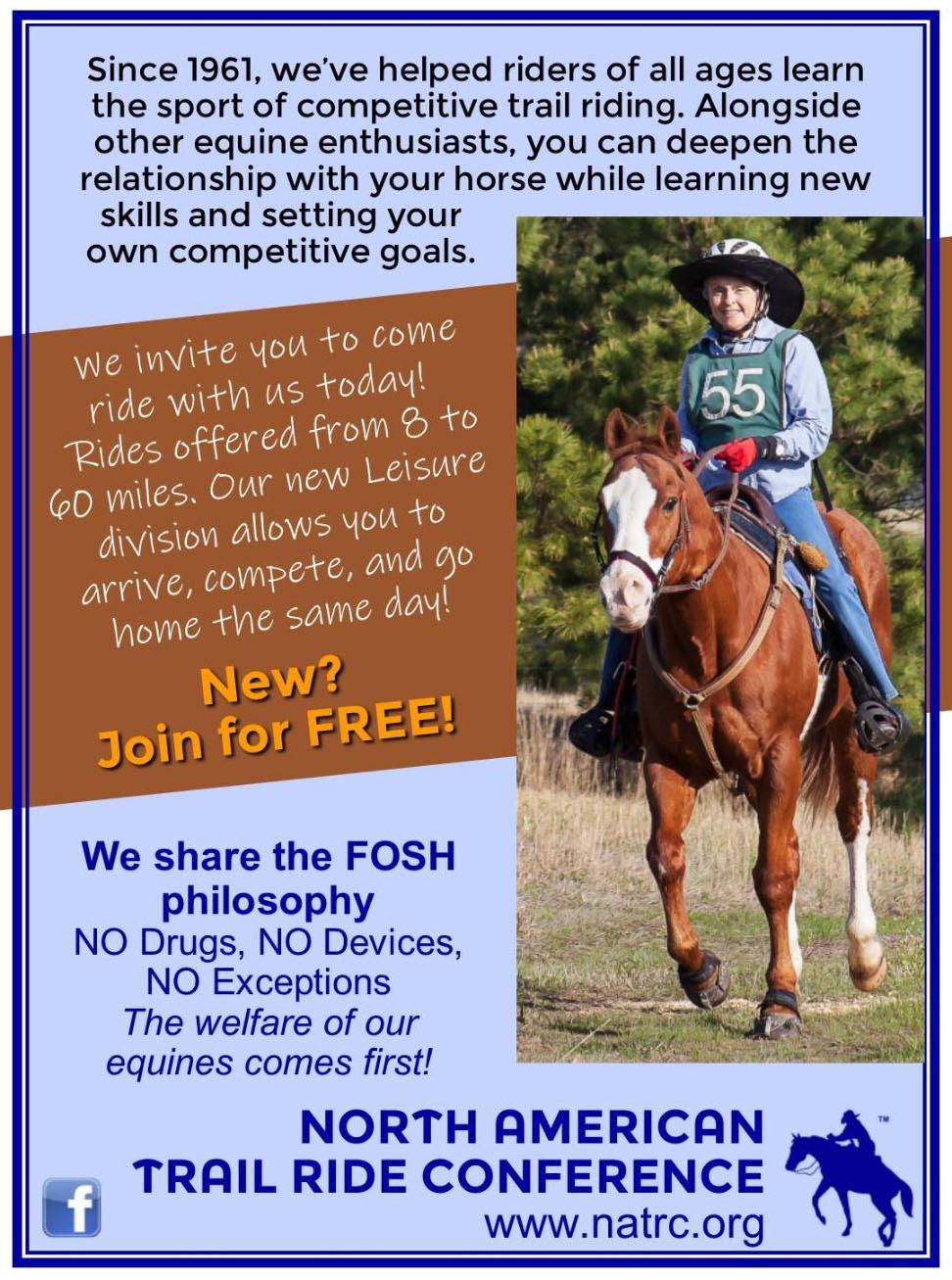
PL: I am in Region 5 of NATRC (North American Trail Ride Conference), which are all states east of Mississippi. I want to do an out-ofregion ride, which I plan on trying in 2021.
SA: How long have you been involved with the FOSH program?
PL: I have been involved with FOSH for three years. NATRC had a National convention in 2017 in Tennessee. I met a FOSH representative there that spoke to our group. I decided to join that year.
SA: Why did you decide that FOSH was worth joining for you and your interests?
PL: It seems NATRC and FOSH have similar goals. I love to see gaited breeds step out of the stereotypical arenas and accomplish new challenges.
SA: If there was one thing that people would be surprised to know about you and/or about your horse, what would that be?
PL: We both are quite competitive. We both appear laid back, but are a fierce team. (Grin)
SA: Do you have a favorite trail snack for you and for your horse? What is it and why did you chose it?
PL: For competitions, I like to soak a few alfalfa cubes in a quart bag and give as a treat throughout the ride. This allows for my horse to keep her gut moving and give her a bit of energy.
My favorite snack is an apple or a granola bar I can share with my horse.
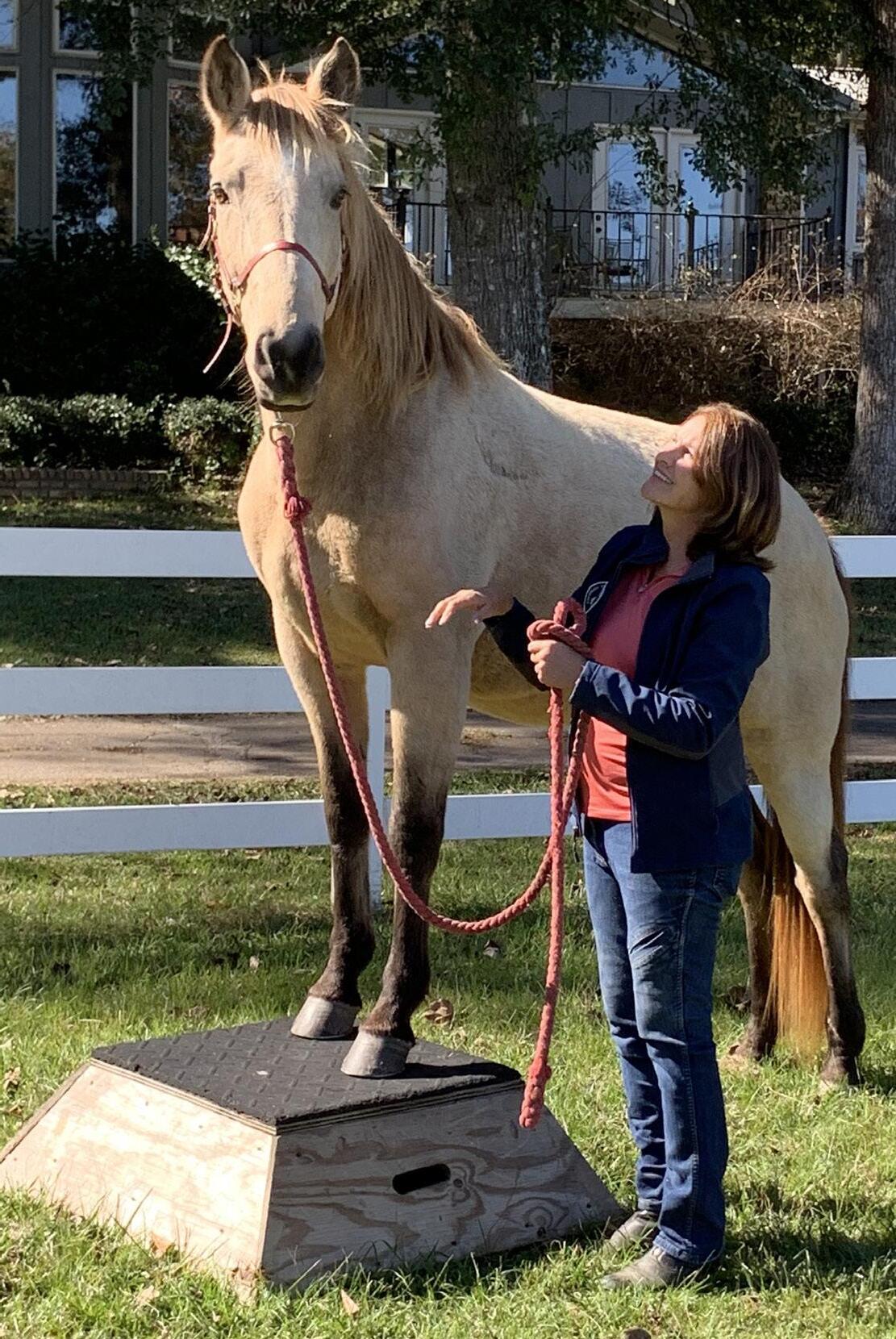
Reprinted with permission. www.murdochmethod.com
Do your hands tend to wander apart when you ride? Does one hand drift more than the other? Do you lean to one side to turn instead of remaining upright? Here’s an easy exercise to find out just how much your need your hands to steer.
Next time you ride notice what you do with your hands when you ride circles and turns. Do you pull one hand back, down or out? Do you wait until the last minute to ask your horse to turn? Do you forget to turn from your seat even when you know this is what you should be doing?
Sometimes hands seem to have a mind of their own. You know you don’t want to pull on your horse. But you find that one hand takes over when you think your horse isn’t listening. Crossing your thumbs when you ride will give you feedback about how much you want to use your hands.
Many riders are very “one-sided” or “right-handed”. If you are one of
By Wendy Murdoch
those riders the following exercise awkward at first. Developing more awareness through non-habitual movements such as Feldenkrais® Awareness Through Movement® lessons will improve your coordination and use of both sides and allow your horse to go both ways more easily. You can find Feldenkrais classes and practitioners I your area by going to www.feldenkrais.com.
To feel what it is like doing non-habitual movements clasp your hands together. Notice which thumb is on top. Look at how you have your fingers interlaced. Unlace your fingers and interlace them again with the opposite thumb on top. How does this feel? What is different in your shoulders? Does your body feel different in places other than your hands?
Return to your habitual pattern. Notice what happens to your breathing, shoulders, and degree of overall comfort. Change the interlacing of your fingers back and forth a few times. Some people have to do this very slowly threading each finger in the new position. This is fine. It is
your attention to the process that is important.
Does the non-habitual interlacing feel more comfortable after switching 10 times? Or do you still have to think about where each finger goes? If so continue to switch back and forth for a while. Stop and notice which way your fingers are interlaced. Is this the habitual or non-habitual way? Switch and feel what it’s like the other way. Notice that the non-habitual movement has become easier, more familiar and you don’t have to think about it so much. By paying attention to what you are doing you build new neural pathways in your brain so that you have a choice about which way to interlace your fingers. This concept can be used in many ways to improve your riding.
While mounted hold your reins in both hands. Cross your thumbs one over the other. Notice which way you crossed them. Keep the thumbs crossed as you ride. Do you want to pull both hands to the side to turn? Do you feel stuck, like you can’t turn at all? Do you want to let go of your thumbs because you feel like this is a “stupid lesson”? If you find yourself frustrated and your horse not listening it is time to reexamine your seat. Turning should come from your pelvis not your hands!
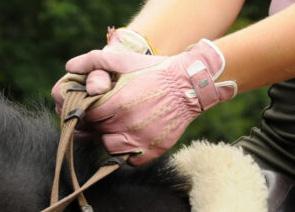
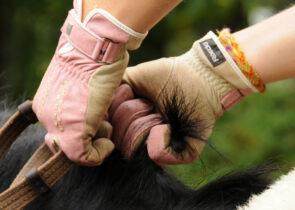
Catch a piece of mane with your pinky finger if you want to move your hands across the horse’s neck. This will not stop you but makes you more aware when your hand crosses the neck. To turn think of pointing your belly button where you want to go let your shoulders follow your seat. Repeat this lesson crossing your thumbs the non-habitual way. How is this different? Is it more difficult to turn your horse or keep you hands in the middle? Switch the thumbs back and forth until the non-habitual way is as comfortable your habitual way.
Use this Murdoch Minute to keep a drifting hand in place and prove that you can turn without pulling on your horse’s head. When both the habitual and non-habitual way feels the same you will be more balanced on your horse and remember to enjoy the ride!
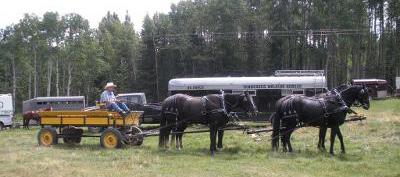
This photo was taken near Millarville, Alberta, Canada. The owner, driver and breeder is J. Glenn Robinson. His dream was to drive a matched team of Tennessee Walking horses he bred. Over a period of 26 years, Glenn used his horses for show, trail riding, packing, demonstrations, parades (both riding and driving) and driving. He wanted horses that were excellent examples of the multi-purpose ability of the breed.
Editor’s note: Many people enjoyed the John Henry profile in our last issue. In case you didn’t hear, he made his comeback ride the end of October at Camp Far West. Bruce Weary posted updates on the American Endurance Ride Championship’s (AERC) Facebook page. This is what he had to say on November 1 after the race was over.
One of the things I harp on in my posts is that you don’t really know how your horse handled the ride by just what the post-ride vet check indicates. Horses can show problems an hour after vetting through successfully, or that night, or the next day, or the next.
Some things never change.
I owned John Henry for a few years before Dr. G. (Susan Garlinghouse) grabbed him, and I can tell you, he showed up with greatness. He finished Tevis for me, after six previous failed attempts, with only eight months of conditioning.
ach. It has been truly remarkable to watch his story unfold. If you’re reading this, you probably think so, too.
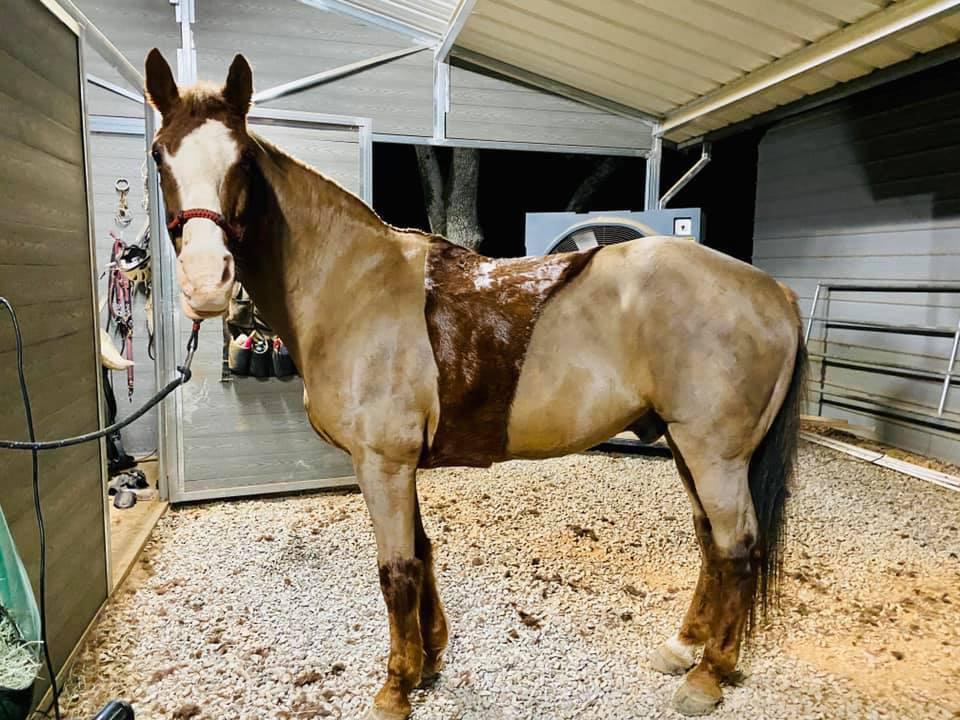
And, he was a runaway freight train at 2:00 in the morning.
With that in mind, here is Jeremy’s report on John Henry today: ‘Jeremy says legs are tight and cold; he’s acting like he didn’t do a thing; totally full of himself and ripped his overnight sheet whilst hoovering down an alarming amount of food.’
But, while he was capable of great feats from the start, Dr. G. has truly tapped his genetic potential and brought him to a whole new level of athletic performance. It’s like I found Superman, and thought he was great, until Dr. G. handed him a can of spin-
I know Susan was having kittens yesterday until John Henry crossed the finish line successfully, but I had no doubt he would do it. Primarily because I knew she wouldn’t put him in a ride if his leg wasn’t golden and also just because he’s John Henry. We plan to post here about his rides over the next several months as he machetes his way through the ride season toward a Tevis attempt next July. My wife, Dayna, is slated to ride him that day, and I think she’s a good choice because she knows him; she’s completed Tevis several times; and knows how to bring a horse in looking good. There are so many people pulling for him, we anticipate quite a following, and there may even be T-shirts involved. Stay tuned.
Friends of Sound Horses (FOSH) partnered with North American Western Dressage (NAWD) to offer gaited horses the opportunity to compete in the 3rd annual Gaits Wide Open (GWO) Championship Show. The show was available to enter from October 1 through October 31. Competitors submitted videos to be judged by IJA Judge Alece Ellis and USDF Judge Laura Wolfe. There were several new faces this year, which was great! Overall statistics include: 27 tests were submitted and judged; breeds represented were Tennessee Walking Horse, Paso Fino, Missouri Fox Trotter, and Rocky Mountain Horse; and eight states were represented (NJ, MI, NC, VA, MO, PA, CA, ID).
By Lyn Montgomerey
I was scrolling through Facebook one evening and received a notice through the gaited distance program for the FOSH/NAWD Gaits Wide Open show. I had been watching a few groups this year offer virtual classes and dressage tests, but I never decided to take the leap. I had struggled with some riding issues and
wasn’t ready to get back into competition, and with the added stress and limitations due to the COVID pandemic, showing seemed to be on the back burner for me.
As I clicked the link to Gaits Wide Open on the NAWD website, I became excited to see how much opportunity was there to showcase the relationship between horse and rider, not only through dressage tests, but trail, ranch riding, and ground work. FOSH was offering an incredible opportunity of two free tests to the first 50 riders. I thought, well I am going to jump on this then figure it out later.
Rider
Jenn Wallace
Elizabeth Puckett Carter
Jenn Wallace
Elizabeth Puckett Carter
Jenn Wallace
Jenn Wallace
Jenn Wallace
Jenn Wallace
Jenn Wallace
Mary Lynne Carpenter
Marianne K Jolley
Marianne K Jolley
Marcia Van Oyen
Roey Mobley
Roey Mobley
Julie Lamberton
Julie Lamberton
Julie Lamberton
Julie Lamberton
Adrienne Dalessio
Adrienne Dalessio
Audrey Stiegler
Audrey Stiegler
Madison Christiano
Madison Christiano
Horse
Bodacious Blue
Gypsy Lady’s Dream
Bodacious Blue
Gypsy Lady’s Dream
Beaucoups Dangerous Ruby
The Spirit
The Spirit
Beaucoups Dangerous Ruby
Hopin for a Miracle Terminator
Rebel Ridge Godiva
Rebel Ridge Godiva
Dixie’s Midnightt Blue
Weighted average 76.704% Champion
Res Champ 73.217% 3rd
4th
5th 68.211% 6th
El Tresor
El Tresor
Seabreeze Savaje Vaquero Chance
Seabreeze Savaje Vaquero Chance
Garcia DelAradecido Muerto
Garcia DelAradecido Muerto
76.804% Champion
75.315% Res Champ
63.870% 3rd
63.833% 4th
63.185% 5th
62.565% 6th
Calif de Color Sin Par
Calif de Color Sin Par
Touche Sin Par
Touche Sin Par
70.500% Champion
63.500% Res Champ
53.800% 3rd
48.474% 4th
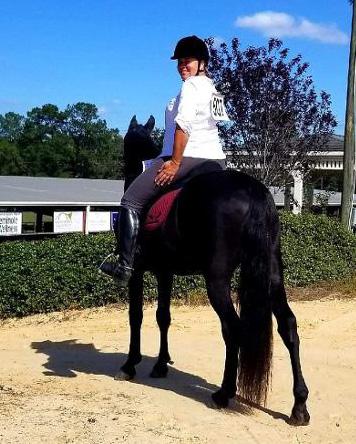
I entered my 8-year-old gelding Hugo and my trainer Roey Mobley in the Training Level IJA tests (Pictured together here.) She started developing his canter last year, and we have been working in training level all year. They are in North Carolina, and I am in California, so I phoned her and said, well I signed you up, here are the tests, and let me know how it goes. We both chuckled a bit, and I said I am eager to try this virtual show, and I hope to get my horse at home ready for some tests, too. Roey had not participated in any virtual shows either, and she and the girls at the barn planned a “dressage day.”
Well, technology can be challenging, along with a huge rain that had come in the night before and add a gelding with a big “personality” that day, equaled one good test and one with a bit of a blow up at H.
When the call came in, Roey said, “Well, we have one test of two to use.” She sent over both copies, and boy, the second test was beautiful, until the dreaded H incident. She had said through the course of this first experience there were some filming challenges, an off course, a blow up, and the scare of slipping in some mud. My take on it was that we submit both videos. Real life tests don’t get a start and a stop, and I am good with that.
Although we had an opportunity to re-submit tests for a better score, we had the challenge of time and co-
ordination. We had some great feedback from both judges. I was thrilled with how the show was organized, and the help we received from show management.
Unfortunately I didn’t have a chance to meet the deadline with my own rides at home, but I did get a chance to dig deeper into the opportunities that NAWD and FOSH had to offer, and I joined the organizations. The programs offer a sense of confidence for the amateur rider, an opportunity for people that don’t ride to compete in-hand, and a place for professionals. I already started looking on the calendar for the next event. There is no place like home, and this gives you a chance to share your hard work and relationship with your animals. So, my say on the virtual experience is take the leap!
By Lee McLean of Keystone Equine High River, Alberta Canada www.keystoneequine.net
I’ve been teaching a gal who is having some sort of existential crisis about her horsemanship.
After one ordinary lesson, she was bent over and out of breath. She asked me to think about her situation, for a bit, then respond on Keystone. Generously, she wanted to help other riders.
So. Let’s talk about ’riding roughly’... or, if you prefer, riding with a lack of polish.
Many of us, of a certain age, began riding before there were ‘horse whisperers’, so to speak. There were no gurus, beyond the monthly arrival of The Western Horseman in the mail box, to take the side of the horses. Riding lessons were for city kids riding out of urban stables. They certainly were not for us.
We were self-taught, more or less, trying to emulate the grainy photos we saw in the magazines. Good results were often a case of good luck over good management… and while I believe there were fewer overall wrecks and accidents in the old days, due to the forgiving nature of stoic
family-type horses, I doubt we were presenting a prettier picture, overall.
I, too, grew up in an environment where I could ride anywhere I wanted, unaccompanied by any adult so long as I was riding bareback. I can still sit a hard-running horse without a saddle, should the need arise. I remember how long it took me to keep my stirrups once I began riding with a saddle and because it was the 1960s and 70s, “Heels down, with your toes visible beyond your knees!” I learned a lot about brace.
We knew nothing about keeping our hands low ‘n’ slow. We knew nothing about getting a soft feel. We knew nothing about riding with our legs. The only good thing about this, few of us were riding horses who knew any of these things, either. Just look at old pictures of sliding stops in reining classes. Even the big name trainers had those front ends off the ground, the horses’ heads in the air, their mouths agape.
If we were fortunate enough to find a riding program somewhere along the way, one that taught the subtleties of correct riding, we were given some of the tools to attempt change. It is so much harder to alter a lifelong habit, than it is to learn anything anew! Riding is no different.
Added to this, if we never once had the opportunity to ride a beautifully schooled, correct horse, we don’t know how riding is supposed to feel.
Back to my conversation with this other woman. She is suddenly aware of the fact that she’s “riding roughly,” which are her words, not mine. She knows that her hands are too fast. She knows that she has limited control over her legs and the aids she is trying to give. She is strug gling with isolating individual body parts. She has never, until late middle age, had an actual riding lesson with a qualified teacher. She has never once in her life, ridden a ‘finished’ horse. She doesn’t un derstand the time-hon ored lingo of ‘going large’, ‘reversing on the diago nal’, ‘riding a 20m circle’, ‘going into her corners’, asking for the ‘half halt’…
in our riding is the first step toward achieving it.
For the remainder of our summer lessons, we simply swapped horses. She rode my schooled horse to get an understanding of what she was missing, while I rode her horse, to give it an idea about responding to classical aids.
She is fifty-something years old and is just now realizing that she doesn’t know what she longs to know. She is starting to crave riding into lightness, rather than tugging. Drawing one leg back into the rocking canter, rather than the ol’ kiss ‘n’ kick.
I smiled and if not for social distancing, I’d have given her a great big hug. Because realizing that we are lacking sophistication and subtlety
Both horse and rider are still learning that an inside leg and a little tweak of the fingers are an excellent substitute for pulling on the reins, as though one is starting a chainsaw. Both are learning that corners and transitions, sustained speed and balance, are the end game of what was once just ‘staying on and steering.’ Both are learning that they no longer are satisfied with ‘riding rough’.
I reminded her that this gig is a lot like playing the piano. Some people are content, all their lives, with hammering out Chopsticks… while others long to make beautiful music.
We will all start somewhere; we will all end somewhere. The journey, itself, is up to us.
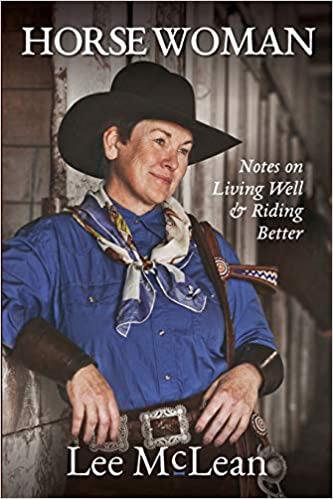
Check out her book, Horse Woman: Notes on Living Well & Riding Better, available on Amazon.
By Bill Coon, FOSH Board Member
This paper is not an “I thought about this subject last night,” but for the last 15 years, an ongoing effort on my part to understand the horse’s hoof. I will include thoughts from folks who are diligent in studying the structure of the horse’s hoof and have proven their research is valid. To use the information in this paper, permission was granted by the Russell Meerdink Company Ltd. and Ms. Marjorie Smith.
I will be quoting Dr. James R. Rooney, DVM, from his book the “The Lame Horse.” He is diplomate emeritus of the American College of Veterinary Pathologists and is the retired Director of the Gluck Equine Research Center, Department of Veterinary Science, University of Kentucky.
Further, I will have excerpts from the web site of Ms. Marjorie Smith, www. barefoothorse.com. Please visit her site.
References will be made to the research of Dr. Robert Bowker, DVM and of Pete Ramey at www.hoofrehab.com.
I would like to start with an illustration of the hoof taken from the bottom view. This illustration is courtesy of Marjorie Smith. (Figure 1)
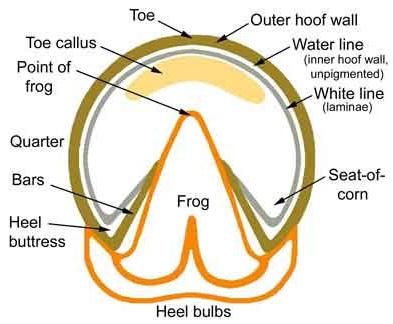
One of the terms used in this drawing that I was unaware of was the description of the white line. The white line is the laminae that holds the hoof wall, or horn, to the distal phalanx, or the coffin bone. The white line is a pigmented structure; yellowish you might say. The water line is the inner hoof wall laminae and is unpigmented. The color is white. The water line and white line are two different structures within the horse’s foot. Both perform an essential function of holding the hoof wall to the foot’s internal structures; primarily the third phalanx or coffin bone. I will refer to this drawing’s terminology often throughout this paper.
Figure 2 provides the configuration of the horse’s foreleg. This figure exposes the three bones of the foot
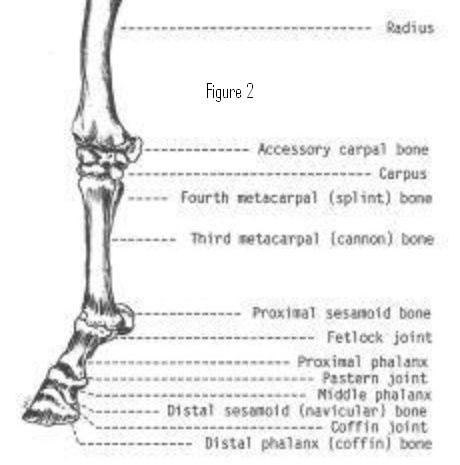
that cause the unsound hoof. They are the middle phalanx, the distal sesamoid bone (navicular) and the distal phalanx (coffin bone).
As quoted on Ms. Smith’s web site, “The horse is a creature of wideopen, dry plains and mountain slopes -- except for the wide-footed breeds of northern Europe, which are adapted to living in marshes. The horse’s native environment includes extremes of heat and cold. The ground is dry, hard, and often rocky. Rivers or water holes are scarce. The wild horse’s food is the dry, sparse, bunch-grasses of low-rainfall areas and a variety of forbs, shrubs, roots, and bark.
“Wild horses walk a daily circuit of about 20 miles (30 km) to find food, water, and other ‘amenities’ such as minerals, herbs, shelter from storms,
and safe places to sleep. All this walking wears and shapes their feet to perfection.
“The horse is exactly designed to live well in that environment. Every part of his body, and the social life of the herd, is fashioned for a strenuous life -- and he requires extremes to stay in peak health. Horses have lived this way for millions of years, far longer than human beings have existed. The horse is a successful species -the design works!
“The horse’s hoof is a masterpiece of living design, built to handle awesome mechanical requirements. We can sustain it by providing what it needs. We can set up ‘natural boarding’ for our horses to promote their health in captivity. This would provide an environment similar to what their internal structures were designed to do.”
The following is taken from The Lame Horse Dr. James R. Rooney.
“The digit is defined generally as all those structures from the fetlock joint to the ground while the foot is defined as all those structures from the coronary band to the ground.
The major components of the foot are the hoof capsule and the laminae, which connect it to the distal phalanx (coffin bone), the digital cushion², the lateral and medial cartilages of the foot and the associated vessels and nerves. The essential
feature of the hoof mechanism is the absorption of the energy of impact and loading during the first half of the support time and the release of much of that energy during the second half of support.”
² Digital Cushion - The pad of fat and connective tissue in the back of the foot which cushions impact of the foot with the ground. In the feral or non-shod horse the pad is fibro cartilage, not fat.
“As the foot retracts to impact with the ground, it lands nearly flat-footed at the slow walk. As the speed increases, the heel impacts first, followed by the quarters and, finally, the toe. At impact, the thin walled heels and quarters expand outward, the moving and bending of the elastic horn of the heels and quarters absorbing energy. At the same time, the pastern is rotating downward, pressing the middle phalanx down and back upon the digital cushion. The cushion expands outward, pressing against the cartilages of the digit (medial and lateral), spreading the quarters even more.”
Comments on the above paragraph
In the above paragraph, Dr. Rooney explains what happens to the internal structures of the foot as the foot contacts the ground. In actuality, in the majority of shod horses, the function of pressure on the digital cushion and lateral cartilages never happens due to the steel horse shoe. Ground contact is essential for the development of the internal struc-
tures and shod horses do not develop these structures into fibro-cartilage. These structures remain soft.
Continuing from The Lame Horse
“It is often assumed that the frog contacts the ground immediately, pressing upward against the digital cushion (so-called frog pressure). It is more reasonable, and in fact the case, that the middle phalanx presses the cushion down upon the frog, and that the frog touches the ground secondarily, if at all. The frog, normally soft, is poorly adapted for taking the immediate shock of the impact.
The frog and bar are not unlike a complex leaf spring designed to absorb impact energy. The leaf spring – the bars – bend down and tend to straighten as the springy digital cushion is driven down on them by the middle phalanx. Immediately after impact (or simultaneously at the flat-footed walk) the toe contacts the ground and a compressive force is exerted upward through the multiple horn tubules that constitute the hoof wall.
These horn tubules are built in a
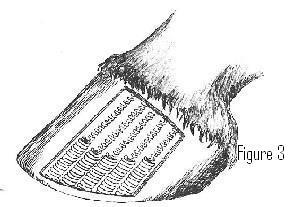
spring-like spiral pattern admirably adapted to yield with a compressive force and store energy. (Figure 3)
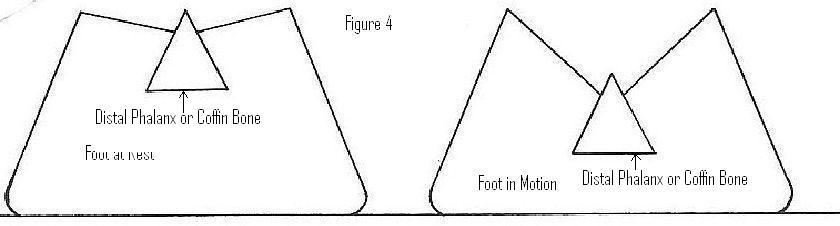
“The hoof wall is connected to the distal phalanx (coffin bone) through an interlocking of the insensitive laminae of the horn wall with the sensitive laminae attached to the coffin bone. The coffin bone ‘hangs’ in laminar slings inside the hoof capsule. (Figure 4)
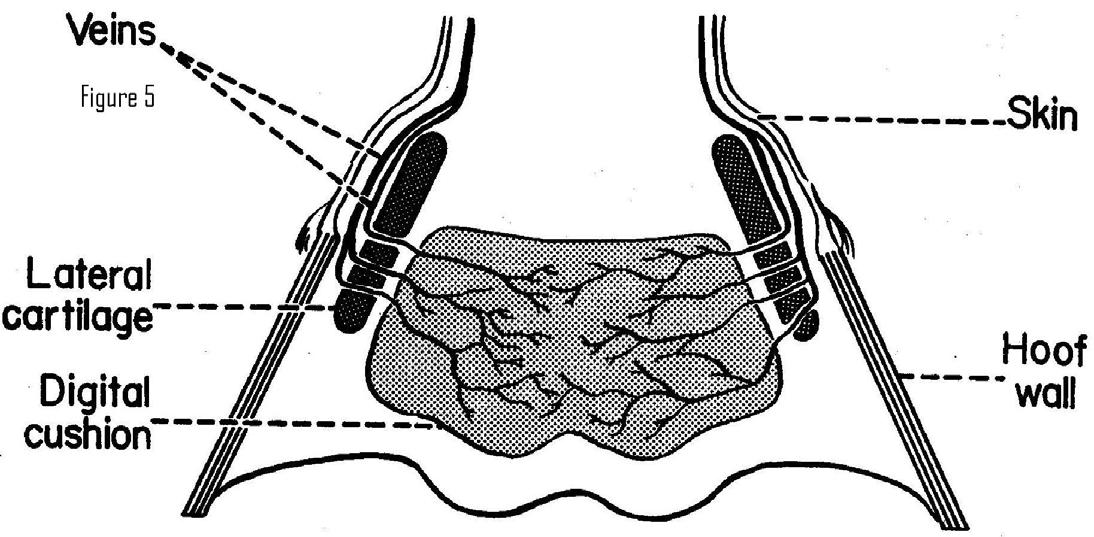
a pressure relief plate. Blood in the axial plexus (in veins in the digital cushion) is heated and moved outward by the pressure exerted on the cushion by the middle phalanx, shunting through the cartilage to the plexus of veins between the cartilage and the hoof capsule. This is no doubt an important part of the shock-absorbing mechanism of the foot. The force applied to the cushion compress it with some of that
“Roughly, we may say that the hoof wall – the hoof capsule – absorbs the energy and force coming up from the ground while the frog, digital cushion, bars, distal phalanx, and laminae absorb the force and energy coming down – the bodyweight of the horse. The sum of the forces up and down equals zero when the system is working properly (the downward force in called minus and the upward plus; thus zero when in equilibrium.
“The function of the cartilages of the foot (medial and lateral cartilages) is not completely clear. Since there is a very rich plexus of veins on both sides of the cartilages with numerous interconnections through the cartilage, it may be that the cartilage is
‘compression energy’ being converted to heat. The heat is ‘picked up’ by the blood in the veins. The blood moves through the cartilage and up the larger veins of the leg; the heat being dissipated at least when the blood passes through the lungs if not before. The mechanism is not unlike that of the radiator cooling system of an automobile.
“The pressure developed in the digital cushion, however, is surely great enough to shut down the thin-walled veins, stopping the blood flow. By having the veins pass through the stiff cartilage, the venous shunts from the cushion to the plexus between the cartilage and the hoof capsule would be protected from such a shutdown. (Figure 5)
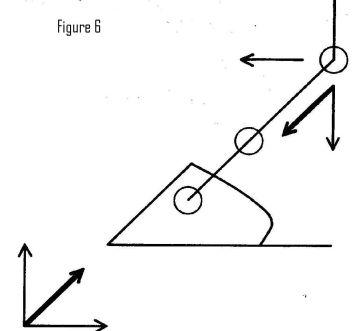
“The sensitive and insensitive laminae, which form the sling between the coffin bone and the hoof wall, are extremely important tensile elements, as we shall see later in the discussion of laminitis. For now, the important point is that the primary laminae (ones which can be seen with the naked eye when the horn, hoof wall, is removed) are oriented parallel to the forces experienced by the foot. This is shown in the following depiction of a standing horse. (Figure 6)
“The forces exerted on the foot of a standing horse. The two heavy arrows are the primary forces and the construction and orientation of the laminae. A resultant force is the ‘result’ of adding together two other forces, in this case, the downward force of body weight and the horizontal force of the tendinous resistance to that body weight.
Normally the forces on the foot are always parallel to the primary laminae, not just when the horse is standing. That has to do with the changing direction of the forces through the support phase of the stride. The body weight and the tensile force in the deep flexor tendon
are the major forces and considering them throughout support is difficult.
For the standing horse, it is not so difficult. Body weight, acting as the down arrow and, because of tendinous resistance, also in the direction of the horizontal arrow, end up as an oblique downward force through the pastern. In the standing horse there is static equilibrium between the downward force exerted by the body weight and the ‘pushing back’ against that force by the ground, the forces shown to lower left. It is clear that the resultant force, the darker arrow in both instances, is parallel to the horn tubules in the hoof wall.”
Read part 2 of “The Horse’s Hoof” in the next issue of The Sound Advocate. Jenn Wallace & Bodacious Blue

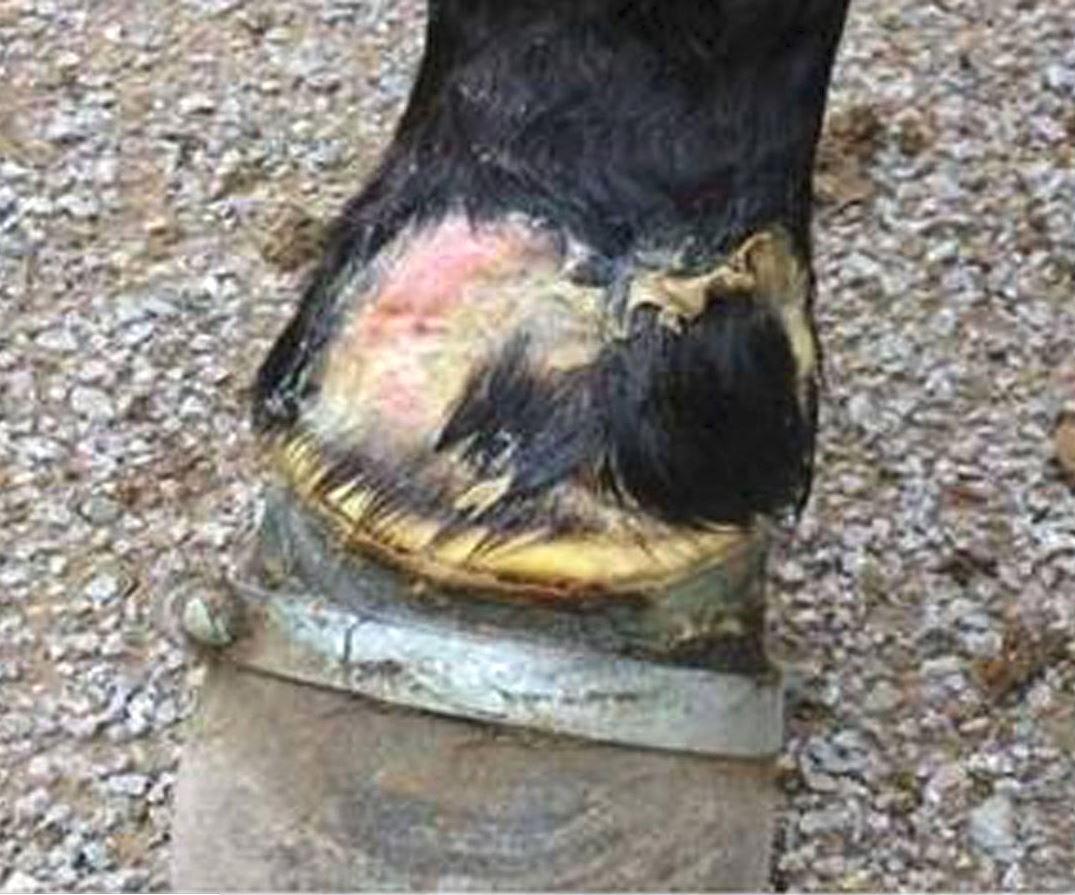
“Soring” is the use of painful training techniques to create a flashy unnatural gait in horses. Tactics include applying caustic agents (diesel fuel, hand cleaner, etc.) to the front legs and then wrapping the legs overnight. The flesh is sore when the wraps come off, chains are used to bang on this area during training. Also injections of irritants above the hoof, tacks under the band huge weighted (”stacked” or “padded”) shoe in place, and the hoof into the quick and/or green nailing.
These training methods cause the horse to attempt to avoid the pain by picking up his front feet faster and higher and shifting his weight back onto his hind legs in a crouching stance. This grotesque gait is called the Big Lick.


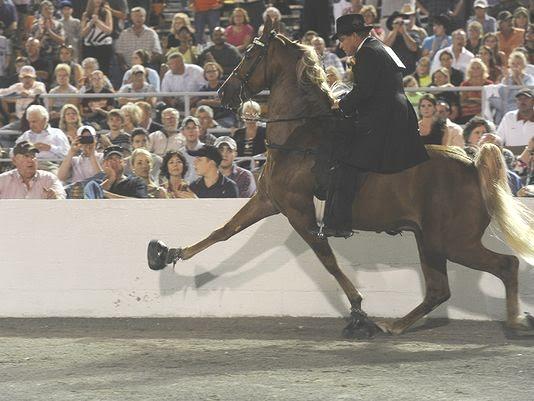
Soring was made illegal in 1970 by the Horse Protection Act, but the shoes and chains are not illegal—YET. Soring itself still goes on Penalties are nearly non-existent, and enforcement is so lax that it persists in about 200 trainers impacting over 10,000 horses. Inspectors are directly employed by show managers, creating a clear conflict of interest. Dye and short-acting topical anesthetic creams are used to mask pain and scarring during inspections. The overwhelming majority of sored horses are Tennessee Walkin g Horses, but two other breeds, the Racking Horse and the Spotted Saddle Horse, are also impacted.
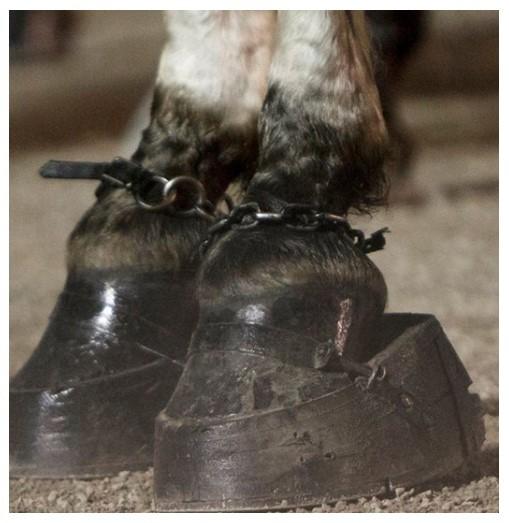

Shoes, stacks, bands and chains on a Big Lick Tennessee
Walking Horse. The horse’s hair has been dyed to try to hide the scars from soring chemicals
After years of education and lobbying by animal welfare groups, the bipartisan Prevent All Soring Tactics (PAST) legislation was passed in July 2019 with an overwhelming majority in the U.S. House of Representatives. The PAST Act would finally eradicate soring by eliminating the use of large stacked shoes and ankle chains in the show ring and by eliminating the industry’s self-policing scheme, replacing it with licensed USDA inspectors. It would also increase penalties for those who break the law. U.S. Senate leadership refuses to bring it to the floor for a vote, despite half of the Senate having signed on as cosponsors. With many other senators (including previous cosponsors) expected to support the bill, there are clearly enough votes for passage. But the bill cannot progress unless Sen. Mitch McConnell (RKY) brings it to the Senate floor for a vote.
The PAST Act would close loopholes in the Horse Protection Act. Because the U.S. Department of Agriculture has allowed the industry to police itself, those who hurt horses face minimal repercussions, get deferred disqualifications, and are typically allowed to continue carrying out the abuses that got them disqualified in the first place. PAST would replace the self-policing system with third party, independent inspectors who are trained, licensed and assigned by the USDA. The bill would also ban the devices integral to soring (the stacks and chains) and would strengthen penalties for soring.
Sen McConnell is a long-time supporter of the Big Lick industry. He and Sen. Rand Paul (R-KY) are co-sponsoring competing legislation introduced by Sen. Lamar Alexander (R-TN) and supported by those engaged in horse soring, which would allow the industry to continue policing itself with no accountability. This sham alternative bill would actually make the problem worse by further weakening the USDA’s already limited authority and handing off more power to the perpetrators. It would do nothing to end the use of chains, heavy stacked shoes and other soring devices, or to establish meaningful penalties. Sen McConnell has not yet realized that supporting the Big Lick is bad politics.

Every major veterinary, equine, animal welfare and law enforcement organization in the U.S. has endorsed this bill (AVMA, AAEP, American Horse Council, ASPCA, USEF, National Sheriffs Association, Humane Society Legislative Fund, Association of Prosecuting Attorneys, and over 100 more ) The PAST Act is the right answer.
Absolutely not. There are many owners and trainers that never use soring to enhance the performance of their horses. Known as “flat shod” horses, these animals have natural movement and are enjoyed by tens of thousands of riders across the country. In fact, the majority of Walking Horses are flat shod. It is only a small minority of trainers who resort to the shameful practice of soring and stacked shoes—they sometimes call them “padded” shoes to try to make them sound more like a therapeutic shoe than a torture device. The entire Tennessee Walking Horse community is brought down by the actions of a few bad actors.
The latest USDA statement, as reported in the Walking Horse Report published May 21, 2018, said that “the vast majority of Horse Industry Organizations (HIOs) that inspect padded horses did not detect any HPA noncompliance when USDA was not present at a show.” USDA went on to say: “It is highly unlikely that exhibitors only present noncompliant horses for inspection when USDA is present at a horse show….USDA remain(s) very concerned about HIOs, especially those inspecting padded horses, whose rate of noncompliance is zero when USDA is not present…” Latest statistics for October 2017 to March 2018, reported in the same article, are: When USDA is not present, 3.48% fail inspection. When USDA is present, 8.17% fail, and many are not even presented for inspection (withdrawn from the show before being inspected). The reported numbers are also skewed because the totals include flat shod Tennessee Walking Horses, who are not sored but are inspected. This makes the percentage of sored horses look smaller than it is.
Last published statistics when USDA itself did inspections at the 2015 championships (“the Celebration”): an appalling 40.28% of “padded” horses were disqualified.
If you live in Kentucky, contact Sens. McConnell and Paul and tell them their alternative bill is not what you want. You want the PAST Act, S. 1007. If you live anywhere else in the United States, look up your senators and urge them to cosponsor and work to pass the PAST Act. Let’s make this the year soring ends, as Congress intended nearly a half century ago.
FOSH is a nonprofit 501(c)(3) organization that welcomes owners of all gaited horses. We support the gaited horse in all equine disciplines, including dressage, distance competitions, English and Western pleasure, and many other styles of riding. FOSH offers judges training and licensing and sponsors numerous shows. FOSH is a national leader in promoting, supporting and protecting gaited horses. To that end, FOSH is known for its work to end soring of Tennessee Walking Horses through its activism, outreach, and 60 years archive of soring articles, www.stopsoring.com.
Principle #1
All FOSH events adhere to the requirements of the Horse Protection Act.
Principle #2
Horses are to be treated with dignity, respect, and compassion.
Principle #3
Horses must be presented as sound in both body and mind.
Principle #4
The preferred way of going is natural, correct, and without exaggeration.
Principle #5
Shoeing is intended only for the protection of the foot and its structure. Where practical, barefoot horses are both welcomed and encouraged.
Principle #6
Handlers and riders are expected to use training techniques and equipment that conform to the highest humane standards as recognized by the general equestrian community.
Principle #7
Exhibitors have a duty to conduct themselves in an orderly, responsible, and sportsmanlike manner.
FOSH is a national leader in the promotion of natural, sound gaited horses and in the fight against abuse and soring of Tennessee Walking Horses. For more information about FOSH or to become a member, please visit www. fosh.info or call 1-800-651-7993.
Southern Comfort promotes activities highlighting the smooth ride and versatility of all gaited breeds. Pursuits include trail riding, competitions, shows, exhibitions, clinics and many other equine activities. The club promotes horse safety and friendship for all that are interested in horses. Owning a horse is not a requirement. SCGHC is based in southwestern Idaho and is a flat shod exclusive club with members contributing and supporting various interests using sound, natural horses. www.gaitedhorseclub.com
The Chesapeake Club is celebrating over 25 years of promoting the versatile, naturally gaited, horse. As a member of the Maryland Horse Council, we have been the voice of the gaited community and through demonstrations, clinics and guest speakers, a resource for other disciplines to learn about the gaited breeds in our region. Members enjoy monthly trail rides, newsletters, parades, clinics, social gatherings, and friendly help. We welcome all breeds, riding styles, and experience levels from beginners to professionals. Cpwhclub. wordpress.com or jacquiecowan@comcast.net
Plan for your next lifetime partner! Come breed with us! Offering frozen semen (12 stallions in 2020) or reservations for Future Foals “do Summerwind” The Marchador is Brazil’s national horse, harking from Iberia, but bred there for 200 years. Expect to be impressed! http:// futurefoal.net or call Lynn @ 602-999-3915
Easy gaited in color. Rare gaited Morgans located in the Heart of America near beautiful Lake of the Ozarks; for photos, videos and available horses. Talk to Jim or Vali Suddarth at 417-286-4720 or gaitedmorgans@missourimorgans.com
The information is current as of this writing. However, COVID-19 continues to cause event postponements and cancellations. To get the most updated information, please contact the person listed for the event.
Larry Whitesell 3-Day Clinic
December 4 - December 6 Scottsdale, AZ
Contact: Lynne 602-300-6177 lbombinski@cox.net
Jo Anne Behling, Wauwatosa, WI
Esther L. Bell, TN
Pamela Brand, Carlisle, PA
Sarah Bushong-Weeks, Denver. CO
Julie Church, Pagosa Springs, CO
Mary & William Church, Pagosa
Springs, CO
Luella DeBono, Eden Prairie, MN
Beverly Foster, St. Augustine, FL
Nancy Gillespie, Pullman, WA
Cristine Holt, Dubuque, IA
Jane Howlett, Pocatello, ID
Marty Irby, Semmes, AL
Marjorie Lacy & Walking Horse News, Edson, Alberta
Sue De Laurentis, Dripping Springs, TX
Bobbie Jo Lieberman
Dianne Little, Calgary, Alberta
Debbie Locke, Mack, CO
Ann Loveless, Ashtabula, OH
Patricia Mayer, East Aurora, NY
Maggie MacAllister, Staunton, VA
Janelle T. McCoy, Prague, OK
Frank Neal, Nashville, TN
Lori Northrup, Ellicottville, NY
Anne Northrup, Ellicottville, NY
Shellie Pacovsky, Bainville, MT
Denise Parsons
Anita Rau, Catlett, VA
Debbie Rash, Chino, CA
Southern Comfort Gaited Horse Club, ID
Bucky & Nancy Sparks, Cortez, CO
Marcy Wadington, Canon City, CO
Leslie Weiler, Pagosa Springs, CO
Laura Wyant, Chesire, OR
An Anonymous Donor
Yankee Walkers of New England

Please consider adding FOSH to your list of worthy causes in making a taxfree charitable deduction or help us to promote legislation, education, and training that protects and helps gaited horses, simply by renewing your own membership or giving a gift membership to a kindred spirit.
We know you have many choices when it comes to giving. Thank you for considering FOSH.
All annual memberships include a digital, bi-monthly issue of the Sound Advocate & educational packets. Mail to: FOSH 6614 Clayton Rd. #105, St. Louis, MO 63117
Type of Membership (check one)
Annual: Single ___$30 Annual Family ___$50 Annual Youth <18 ___$20 Lifetime__$600 Organization Membership (for your gaited horse club or association) ___ $50
Please print neatly.
Enclosed: $____________________
How did you hear about FOSH?