
The Sound Advocate
Sound Advocate
Friends of Sound Horses, Inc. 6614 Clayton Rd. #105 St. Louis, MO 63117
800-651-7993 * info@fosh.info * www.fosh.info
Board of Directors
President - Teresa Bippen Missouri Tbippen1957@yahoo.com
Secretary/Treasurer-Alece Ellis
Director at Large-Bill Coon VP IJA Program-Dianne Little Tennessee Utah Alberta, Canada treasurer@fosh.info wbotis@gmail.com ddlittle@telus.net
VP Programs/Gaited Sport Horse
Director at Large-Anita Dunham VP HIO/DQP-Lisa Harris Dianne Little Missouri Tennessee Alberta, Canada dunhamanita@gmail.com ddlittle@telus.net
Executive Advisory Committee
Keith Dane Kirsten Kuzmanic Maggie MacAllister Hawaii Arizona Virginia kirstenk38@gmail.com breezewood@mgwnet.com
Patti Potts Pauline Stotsenberg Missouri California pottspa@gmail.com ps@yesteryearfarms.net
Editor
Stephanie J. Ruff Florida editor@fosh.info
FOSH Mission Statement
To promote all “sound,” naturally gaited horses, with a specific emphasis on Tennessee Walking Horses. (In this context, sound means not “sored”.)
Importance is placed on education in regards to the humane care for the emotional, mental and physical wellbeing, training, and treatment of all gaited horses.
FOSH will only support flat shod or barefoot horses and will never endorse any event that uses stacks and/or chains as action devices, or any mechanical, chemical, or artificial means to modify the natural gaits of the horse.
To these ends, FOSH focuses on three areas for gaited horses:
1) educating people about sound horse training principles; 2) supporting sound shows, events and activities; 3) working to end soring.
FOSH is a 501(c) (3) non-profit organization. All donations are tax deductible to the extent permitted by law. Your donation to support the FOSH mission is needed to advance the goals set forth by FOSH in conjunction with its formal mission statement.
Publication Guidelines
The Sound Advocate is a digital magazine published quarterly by Friends of Sound Horses, Inc. Reproduction of any article is prohibited without the express written permission of FOSH.
FOSH accepts unsolicited submissions, but reserves the right to edit any and all submissions for content, style and space constraints. FOSH further reserves the right to refuse advertising for any reason.
At no time shall the publisher’s liability exceed the total cost of the revenue from advertising in the issue involved in any dispute.
All show suspensions and show results are printed as they are received from the reporting agencies. FOSH does not guarantee their accuracy.
FOSH does not endorse the content of any advertisement in this publication, nor does it warrant the accuracy of any advertisement.
Readers are urged and cautioned to use due diligence and to thoroughly research, including asking for references, before following through with any transaction.
FOSH does not endorse any trainer, educator, clinician, style of natural training, tack, or horse equipment to the exclusion or preference of any other. Each horse is an individual and may respond differently to particular methods.
Articles published by FOSH reflect the views and opinions of the writers and do not reflect, necessarily, those of FOSH.
Publication Information
Subscribers: The Sound Advocate is a benefit of membership. To ensure that you receive your issues, be sure that your e-mail address is current. To change an e-mail address, contact dunhamanita@gmail.com.
Submission of Articles, Calendar Dates, News and Photos: Send to tbippen1957@yahoo.com. Photos may not be embedded in text and must be submitted as jpeg format, minimum of 300 dpi. The deadline for each issue is the 15th of the preceding month when the issue is to be released. Submissions will not be accepted after the deadline, but may be carried over to another issue. Submissions will not be returned to the submitter.
Member’s Advertising Rates
Back Cover $300
Inside Front Cover $275
Inside Back Cover $275
Full page $125
Half page $75
Quarter page $60
Business Card $25
Directory $25
Discounts for Multiple Issues
2 issues - 10% off total fee
4 issues - 20% off total fee
6 issues - 30% off total fee
Ads will be accepted in pdf, tif or jpeg formats. Text and photos must be e-mailed separately by the 10th of the month when the issue is released. Photos must be 300 dpi. Camera-ready ads are emailed at 300 dpi. Materials should be emailed to editor@ fosh.info.
All advertisements must be paid in advance by check, money order, or credit card. Payments should be made out to FOSH and mailed to:
6614 Clayton Rd. #105 St. Louis, MO 63117
More FOSH information can be found online. Find us at www.fosh.info.
Like us on Facebook and follow us on Twitter.


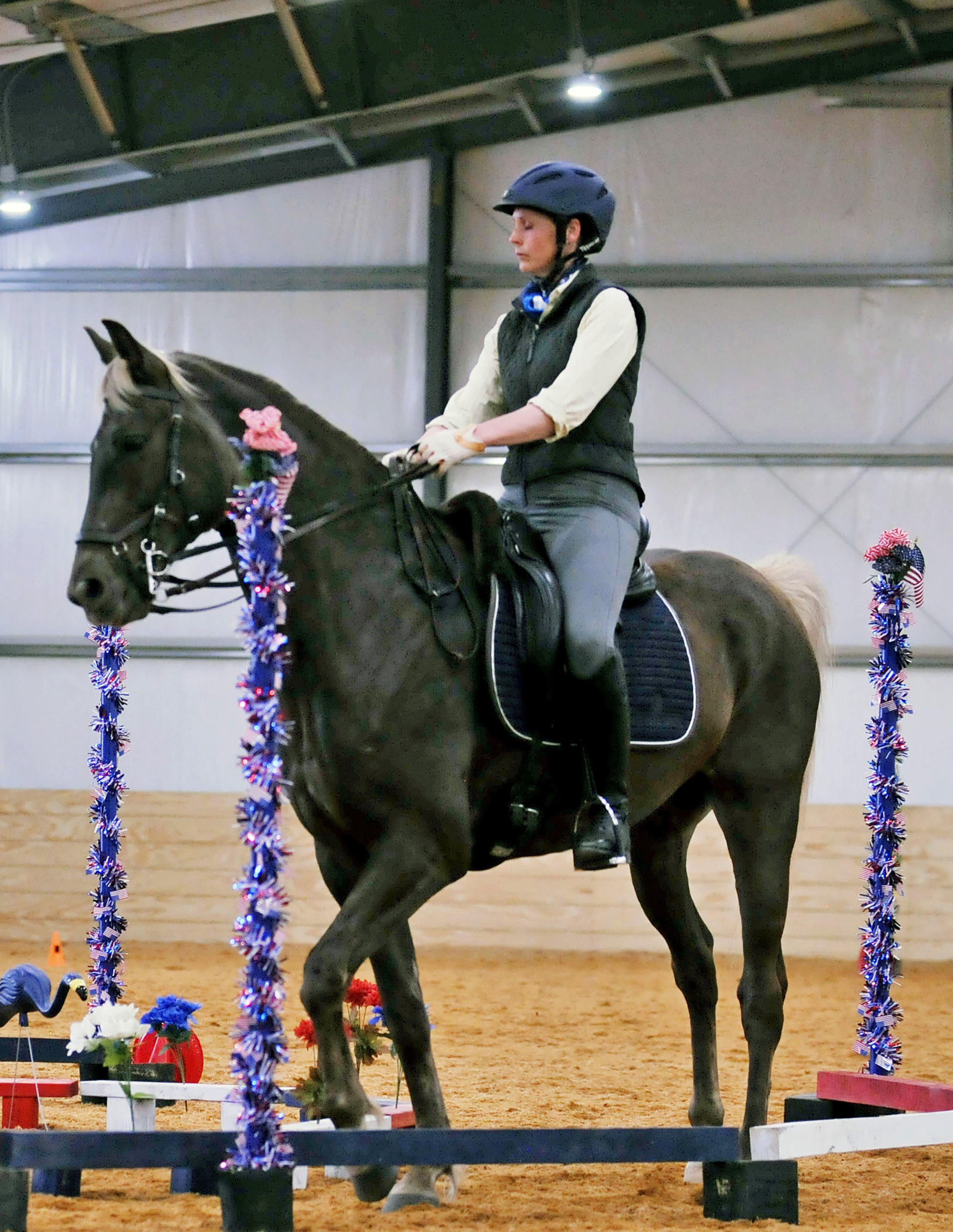
On the cover: Whiskey River, Rocky Mountain Horse shown by Hilary Hoffman, participates in Ease Of Handling (EOH) at the ERAHC Working Equitation, May 8-9, 2021, at Three Bulls Equestrian in Bulls Gap, TN. Photo credit: In Focus Equine Photography - www.InFocusByBruce. com Phone - 240-793-9316.
In ThIs Issue:
From the President...

Dear FOSH Friends and Supporters,
I hope you are enjoying your spring and early summer riding weather. Several of us in the Midwest had a recent teleconference and lamented that this was one of the chilliest and windiest springs we could ever remember. As one individual remarked, “We had a real spring!” I agree—it was a real spring with wild breezes and volatile ups and downs (mainly downs as I sadly looked over dozens of my tulips bent under a cover of snow in mid-April).
I’m sure most of you are finished with the shedding process by now. Every year I marvel how Shiloh (a MFT) sheds such vast amounts and Dusty (TWH) has only about 1/4 of the coat of Shiloh. I was told by Shiloh’s previous owner that it was because he was born in Indiana, and Indiana has colder winters than Missouri; however, I have no idea if that is scientifically accurate. In
addition to hours of brushing, there is also that first spring ride. Mind you, it has usually been six months since our last ride unless November or March are unusually warm. I confess the first ride is never my favorite as I feel like I am steering a tank—a tank that is suspicious of everything in his home pasture because now I’m on his back. Each ride is substantially better, and I am soon back to using light as a feather aids and Shiloh becoming a brave, trusty steed for the upcoming year.
Onto our beautiful issue with many interesting articles. I was especially pleased to see Working Equitation featured. I held a Working Equitation clinic in St. Louis two years ago with Erica and Howard Peet. It was fun and interesting to hear the Peets discuss their experience with Working Equitation and why they enjoyed the discipline so much. Interestingly, the Peets train Andalusians, which is a far cry from our gaited horses; however, they were eager to learn more about gaited horses and were very supportive of all the gaited horses with which they were competing.
There were two aspects that I remember in particular from our conversations: (1) No horse is perfect in every phase of the competition, which means the placings change in meaningful ways throughout the competition and (2) As a fairly new discipline with so many newbies, the comradery and mutual support is a refreshing change from the hard core, highly competitive show rings with which many exhibitors experienced previously. The latter aspect is one that I likened to the FOSH shows
Continuted on page 29.
An Issue Full of Variety

This issue has a bit of everything. Are you a fan of the Rocky Mountain Horse? Learn more about our cover horse in this issue. Years ago I rode a Rocky Mountain. He was big...very big and was a bit barn/buddy sour. Boy he could spin on a dime to try to get back to the barn. But I absolutley love their coloring. So memborable.
Working Equitation is featured here as well. I admit I’ve never seen working equitation in person, but I’ve watched some championship rides on YouTube, and they are incredible. And I learned something putting this article together. I did not know that Working Equtation actual ly had different categories. See? You
learn something new about horses every day.
There’s a great article about barns. If you own your own property, a barn is one of the most prized structures on the farm. Whether you build your own or are looking to buy a farm, the features you want in a barn are so important. Take time to figure it all out before taking the plunge.
And finally, this issue introduces you to a great friend of mine, Dr. Debra Powell. She has written an article on the basics of insulin resistance, which is an issue that faces many owners with older horses. I’ve known “Dr. Deb” for over 25 years when we were in graduate school at the University of Kentucky. We’ve maintained a connection one way or another since then. She is one of the smartest, and most modest, equine nutritionists you will find. Not only that, she is an expert on using therapeutic modalities on both horses and dogs. Hopefully she will write more for FOSH in the future.
So whatever your interests, do some reading and then get out there and enjoy your horses!
Stephanie Stephanie J. Ruff Editor, editor@fosh.info
Advocacy Update

Horse Industry, Senate Allies Urge USDA to Reinstate Horse Protection Rule
The horse industry and its allies in Congress are lobbying the new Administration to bring back the 2017 Horse Protection Act (HPA) rule promulgated by the U.S. Department of Agriculture (USDA) to end the practice of soring. In early 2017, the outgoing Obama Administration issued a final HPA rule to stop the practice of manipulating a horse’s limb to induce an accentuated gait. The rule mirrors the industry endorsed “Prevent All Soring Tactics” (PAST) Act by taking common sense measures to protect certain Tennessee Walking Horses and Racking Horses from this type of mistreatment. Unfortunately, the Trump Administration suspended the HPA rule four years ago and never reinstated it.
In early March, the horse industry and its allies launched a campaign to urge U.S. senators to contact USDA
Secretary Vilsack by signing a letter advocating for reinstatement of the 2017 HPA rule. The American Horse Council (AHC), to cite one example, initiated outreach to its grassroots, which delivered more than 650 letters to the Senate during a four-week period. Within the context of the final letter, a bipartisan group of 48 senators went on the record on April 29 to request that Secretary Vilsack bring back the 2017 rule.
“I support the humane treatment of all animals and the responsible training of horses,” said Sen. Crapo (R-ID), a long-time champion of the horse industry. “That’s why I’m proud to lead a group of bipartisan senators in urging the USDA to use their rulemaking authority and protect horses from this inhumane treatment.” To view a copy of the bipartisan letter to USDA, please click here: https://www.horsecouncil.org/ wp-content/uploads/2021/05/HPAhorse-soring-letter-Senate-4-29-21. pdf.
TWH Iron Ruler In Memoriam

Thank you to Patricia Lee for the donation to FOSH in memory of the stallion TWH Iron Ruler (1992-2020). He was bred by Betty Freeman by Ironworks out of the mare Enlighten.
TWH Iron Ruler was the sire of over 100 horses. Our condolences on the loss of such a beautiful stallion.
Blair Dyberg Memoriam

Our sincere condolences go out to Lori Dyberg on the loss of her husband Blair. (May 8, 1953 - April 4, 2021) Blair Martin Dyberg of Wetaskiwin, Alberta, passed away on Sunday, April 4, 2021 at the age of 67 years.
Lori and Blair were featured in Issue 3, 2020 of The Sound Advocate as the champion and reserve champion intro level dressage.
The above photo was posted by Lori on her Facebook page in memory of her husband.
A Classical Makeover Racehorse to Classical Dressage
Article by Cody Harrison
Classical riding is not a technique for training but rather principles to guide your training. These are some of the principles that guide classical trainers.
• Help the horse to feel good in his work.
• Help the horse understand, so force is not needed.
• Show the horse how to enjoy his work.
• Help the horse to stay healthy.
• Have compassion and patience for your horse.
Any riding horse can become a Classical Dressage horse; all there needs to be is patience and a clear understanding of classical riding. So long as there was no physical damage done in the previous discipline preventing the horse from its natural movement. Your veterinarian can help you determine if your horse has physical limitations.
This article features Truck! He is a 16.3 hand Thoroughbred off the track racehorse. His previous owner said Truck was a hard keeper, and he was about 75 pounds underweight. (Still in racehorse body condition) She had him for six months and wanted to do dressage with him, but afterward changed her mind and decided to do a different discipline.
When I went to try him out for the first time, it was a little rough. I did not have my own saddle with me. The saddle they had for him was about 2” too small in the seat, and the stirrups
were 6” too short! I was not very comfortable, to say the least. I am sure that the saddle was not even close to fitting him either. He did not feel very good being ridden. He held his head a little on the high side, which dropped his back, causing it to be tight. I could feel tension in most of his body. He moved with short choppy steps at walk, trot, and canter. He was not clear in his mind of what was expected of him, and it caused him to be hesitant. He was very sensitive and had some fear of feeling trapped. Bending to the left was not something he was too keen on doing. I was not able to get his left lead, which is odd for a racehorse. I only rode him for 15-20 minutes, and that felt like a long time, given how uncomfortable I was in the saddle.
Thinking back on it, I am not sure what attracted me to him at the time. My only thought was that I think I can turn him into what I am looking for, and at the time, my budget was minimal for a horse purchase. He cost me $1,500, a fairly standard price for a used racehorse. Truck raced for five years and won a little over $40,000.

Before we get started on his transformation to becoming a Classical Dressage horse, let’s first look at how things are done on the track, so we know what needs to change.
• A minimal amount of groundwork.
• Training consists primarily of conditioning. (Now you have a fit horse who does not know anything about life outside of racing.)
A racehorse conditioned body.
• The muscle groups that are most used in racehorses are the hamstrings for pushing and the pectoral muscle group for pulling. (The muscles needed to carry a horse’s weight in a collected position are the top line muscles.)
• Forwardness is only worked on when galloping.
• Most racehorses have a hotter temperament.
• Go fast, turn left!
Once Truck got to his new home, we started our training by showing him how to relax. He did not need to be so intense about his work anymore. I wanted to get started on his top line right away. Without the proper strength to support collected balance, I would not be able to change his current movement. I started this by work-in-hand and teaching him how to lunge correctly. I used a cavesson in the beginning. This is because most racehorses do not trust the bit, nor do they understand what the bit means. Starting from ground zero is always a good place to start a makeover.
a full range of motion. As the range of motion becomes greater, the muscles get stronger.
Truck was scared of the whip when he arrived. He did not run from it but rather just got balled up and could not move. We worked this out in the first few weeks with lunging and work-inhand. He needed to learn that the whip was not going to discipline him. The whip is only to help explain what he needs to do. What direction and with what energy. It is crucial that your horse understands the tools you use and that they are comfortable with them.
There has to be a balance of forward and down when stretching.
I ask him to lower his head as much as he can while lunging and doing work-in-hand. The work-in-hand at this point is a mild should-in. I want his nose to be somewhere between the bottom of his chest and his knees. No lower than the knees or the horse will lose the forward part of the stretch. There has to be a balance of forward and down when stretching. His top line was not only weak, but it was very tight. In order to build any muscle, it has to relax and contract. If a muscle is always tight, it will only get shorter and tighter but never become stronger. They will also develop a shorter range of motion as time goes on. Truck already knew how to contract the muscles that we need to make stronger. However, he did not know how to relax them so that the muscles could make
Most of getting Truck to relax was not just asking him to lower and stretch; it was getting him to let go of the idea that he needed to protect himself mentally. With a horse that is sensitive and has a hot temperament, it is more critical with HOW you do things, not as much as what you do. Training needed to be done in a calm, relaxed, and slow manner. Asking very little and rewarding often. As the mental relaxation comes, the physical relaxation quickly follows, with little needing to be done to achieve it. Once a horse can maintain physical and mental relaxation, you can now begin to shape your clay. Put your horse in the needed position for his work. Clay is much easier to shape than cold, stiff steel.

During his first six months of training, it was
First trail ride.
mostly lunging, work-in-hand, and some trail riding. Going up and down hills helps build up a horse’s back and top of their rump. It was the work-in-hand that allowed him to start to relax and bend better to the left. At this time, he began to move more freely and to be willing to shorten his frame some without tensing his neck and back. In this slightly shorter frame, he was able to start to be more forward rather than fast.

Truck is now starting to trust what is being asked of him, and he is beginning to enjoy his people. He is now ready to move to more work under saddle. I also started to incorporate cavalletti. When we started to school over cavalletti, I found out how big of a BABY he really was!!! Knowing that he is sensitive, we put leg wraps on all four legs and bell boots on his front. Even with all the leg protection, if he hit a pole for whatever reason (balance, distance was off, etc.), he would be threelegged lame for the next ten strides! After that, he would go back to being perfectly sound. It was almost as if he thought it was going to hurt more than it did. With this mindset, he became very hesitant to go over the cavalletti. This caused him to lose forwardness as he approached the cavalletti, which prevented him from committing to the stretch that was being asked of him. When this happens, take it slow. We did lots of walking over the cavalletti.
This allows him more time to observe and process what is happening. Eventually, he became comfortable with all the exercise at the various heights and began to really build up his back and free his shoulders.

After his first year of training, he hit a wall. His wall was just the simple fact that he was not ready for the next step. Physically he was ready; he could do all he needed to take the next step. Mentally, he was not ready.
As the mental relaxation comes, the physical relaxations quickly follows.
The next step in his training was to begin shortening the frame a little more to start on more collected work. When I asked for his frame to become a little shorter than what we had been working on previously, I could feel his nerves and stiffness start to return. I gently tried for a few days in a row, and after not being able to achieve the frame with relaxation, I decided to wait a little longer.
After another month, I tried again, same results. At this point, I realize that he has not yet completely let go of his past from the track. So, even though physically he is ready for what I want from him, I have to wait for his brain. I decided that while I wait on that to happen, I will use him for some lessons. He was a lesson horse for over a year. He could only be used for intermediate riders and up due to his sensitivity of feeling trapped. He
Lunging with a forward trot.
Cavalletti exercises.
did lessons 3-4 times a week. Just walk, trot, canter, should-in, and some leg-yields.

Once I began to notice him sitting more in his canter transitions and stepping farther under with his hind legs during lateral work, I started to think he may be ready now. Ready he was. When I asked him to shorten his frame, he did so without any tension. Not only did he shorten his frame, but I could feel him grow taller under me. This was the first time that I really felt him lift and support his back. Exciting!! Now we can do things! Over the next six months, his position became stronger, more consistent, and he stayed relaxed. His canter to walk transitions and walk to canter transitions started to keep their balance. Another six months goes by, and we are working on Piaffe and lead changes. This was about a three-year process for Truck.
People that did not know Truck was a Thoroughbred would often ask, “what kind of Warmblood is he?”
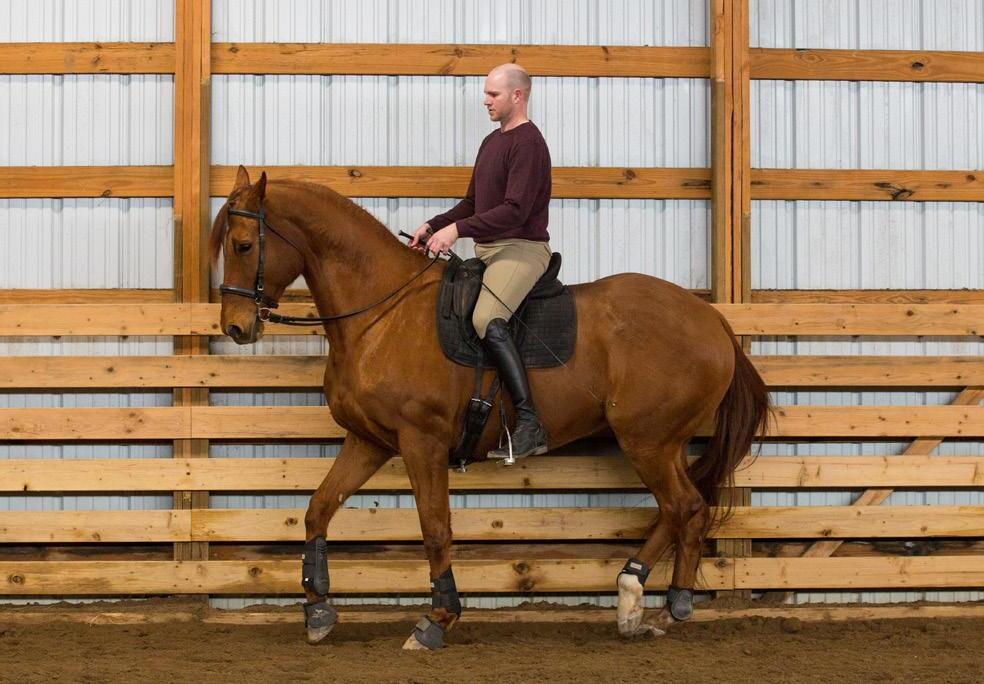
Listen to your horse. Feel your horse. They will tell you if they can or cannot do what is being asked. If they cannot, then you must find out why. Once you find out why, then you can decide how you will go about helping them.
It is our responsibility as horse owners to be responsible for our horse’s well-being.
It is important to remember that most often times, retraining a horse takes longer than if they started training in that discipline to begin with. There is nothing wrong with someone changing their mind about what they want to do with their horse as long as the horse is ok with it and they are suited for it. Don’t try to team rope on a Saddlebred or jump a Clydesdale. Can they do it? Yes. Will their bodies hold up? No. It is our responsibility as horse owners to be responsible for our horse’s well-being.

Thank you for reading this article. Please reach out to us if you are interested in clinics, lessons or training. We would love to get to know you and your horse and help you build your partnership with Classical Dressage training. Info@CH-Equine.com
For more information about Cody Harrison please visit our website at www.CH-Equine. com

Like & Follow us on FaceBook at CH Equine.
Lengthening the stride & frame in trot.
Starting Piaffe.
Haunches-in at canter.
The Growing Sport of Working
Working equitation (WE) is intended to promote competition between traditional styles of riding used during fieldwork in various countries and also to act as a showcase for traditional riding costumes and equipment. Working equitation became a competitive sport in 1996 along with its first European championship being held in Italy the same year. Working equitation is recognized as a sport in many countries, mostly in South America and Europe, all countries have their own governing body of the sport. The sport tests the horse and rider’s partnership and ability to maneuver obstacles. There are four different levels of working equitation: novice, intermediate, junior and advanced. At advanced level, the rider must ride with just one hand, most commonly their left hand, on the reins.
Competition events may be individual or for teams, and are in three or four parts, in this order:
DRESSAGE TRIAL
The first of the Working Equitation trials is the Dressage trial. During this trial, the horse and rider ride a

pattern of movements prescribed by the official test for their level. WE dressage tests are performed in a 20 x 40 meter “short court”. The judge scores each movement on a scale of 0-10, and provides Collective Marks at the conclusion of the test for gaits, impulsion, submission, rider and presentation.
EASE OF HANDLING
Ease of Handling (EOH) is the second trial comprising a Working Equitation competition. The EOH trial is required at all performance levels–
of Working Equitation
Introductory, Novice A/B, Intermediate A/B, Advanced, and Masters.
As with the Dressage trial, the judge scores each obstacle on a scale of 0-10 and also provides Collective Marks for transitions/navigation, gaits, impulsion, submission, and rider.
SPEED TRIAL
The third trial in a Work-
ing Equitation competition is the Speed trial. This is a test of a horse and rider’s ability to navigate obstacles with accuracy as quickly as possible. It is thrilling to watch!
The Speed trial is first encountered by horse/rider pairs competing at the Novice A level. Riders soon learn that precision in the obstacles, coupled with strategic course lines, translate to winning speed rounds.
CATTLE TRIAL
During the Cattle trial, a team of three or four riders work together as each rider separates a designated cow from the herd and moves it across the enclosure to a holding pen.

The Cattle trial is not always offered at WE competitions, but it is a crowd and competitor favorite when it is


available. Riders use the same tack/ attire for this trial as they did for Dressage, EOH, and Speed.
USAWE ORGANIZATION
USAWE is a non-profit organization incorporated in the State of Colorado. We are in the process of filing for federal 501(c)(3) recognition. USAWE was formed in 2020, when
WE United and the Confederation for Working Equitation consolidated into a single national organization. The decision to merge into USAWE was unanimously supported by the Boards of both prior WE organizations.
The merger is the culmination of many months of work, and we are

excited about the future!
USAWE is structured into distinct geographical Regions. The purpose of Regions is to provide geographically-based representation in the governance of the organization as well as for awards. The Regions are:
• Region 1: Alaska, Washington, Oregon, Idaho, and Montana.
• Region 2: California, Nevada, Utah, Arizona, Hawaii, and U.S. territories in the Pacific.
• Region 3: Wyoming, North Dakota, South Dakota, Nebraska, Kansas, and Colorado.
• Region 4: New Mexico, Texas, Oklahoma, Arkansas, and Louisiana.
• Region 5: Minnesota, Iowa, Missouri, Wisconsin, Illinois, Michigan, Indiana, Ohio, and Kentucky.
• Region 6: New York, Vermont, New Hampshire, Maine, Massachusetts, Rhode Island, Connecticut, New Jersey, Pennsylvania, Delaware, Maryland, West Virginia, Virginia, and the District of Columbia.
• Region 7: Tennessee, Mississippi, Alabama, North Carolina, South Carolina, Georgia, Florida, and US territories in the Atlantic.
• International: All locations outside the United States of America.
The USAWE logo was designed by Alexandra Crippen of Crippen Designs.
The logo represents the four trials of Working Equitation and highlights the diversity for which the sport is known in the United States.
The first image depicts a mule being ridden in western tack and attire in the Dressage trial.
The second image showcases an Iberian horse in traditional Iberian tack and attire performing in the EOH trial.
The third image shows a horse of indeterminate breeding and a rider in English tack and attire, competing in the Speed trial.
Together, all three riders represent a team competing together in the Cattle trial. Although the cow is not shown directly, the three teammates are working in concert. The image is intended to elicit the feeling of excitement and movement as the team moves their designated cow toward the holding pen to the far right, off the page. (Think of it as a “silent cow”, much as the letter “e” at the end of a word is often referred to as “the silent ‘e’” in recognition of its existence without being read aloud).
For more informatin, visit https://usawe.org/.
2020 Working Equitation

Congratulations Kris and Gambler’s Jackpot, 2020 Friends of Sound Horses Overall Gaited Champion in Working Equitation and Confederation for Working Equitation L2 Novice A Champion (a level that requires cantering between obstacles spaced 30 feet apart).
One is never too old to learn, laugh, ride and have FUN! Kris Blacklock, (WI) always adored horses. It wasn’t until she turned 45 that she and her daughter Michelle jointly purchased and started riding their first horse, a Morgan gelding who’s now 28 years old. At age 64, Kris enjoys Working Equitation, Equestrian Drill Team, Traditional Dressage, Western Dressage, Freestyle, Obstacle Challenges, Cow Working Trail Riding, Ranch Riding and tests their partnership at Liberty with Gambler’s Jackpot, a 13-year-old Rocky Mountain Horse acquired at age three and Boon Ocean Blue, a 7-year-old American Quarter Horse acquired at 15 months of whom Kris has done all the training. Riding goals include using the progressive training of dressage to develop confidence, balance and athleticism.
As an active member of several equestrian organizations, Kris’s passionate love of dressage and its value as a foundation to all disciplines is evident. Kris consistently offers fresh ideas, actively promotes horsemanship and hosts a variety of educational activities, events and learning opportunities for equestrians of all ages regardless of breed, tack or attire preference.

Equitation Champions
Congratulations to Pam Jordan and her horse Jedadian. They were The Confederation of Working Equitation’s L1 Reserve Champion for Working Equitation.
“The Confederation of Working Equitation is the greatest event,” said Pam. “Jedadiah and I love it. Thank you Doreen Atkinson for bringing this event to us. It is wonderful to compete with all different breeds of horses and riders of all levels of expertise.
The obstacles are wonderful because they are things you may have to navigate anytime you ride, especially if you trail ride. Everyone is friendly and willing to help you and your horse learn how to navigate the obstacles. We are so blessed to have this activity to help you gain confidence with you and your horse. Thank you Working Equitation!


Insulin Resistance in Horses: An Understanding of this
When people hear “my horse is insulin resistant” …Have you ever wondered what that really means? In order to understand this metabolic issue, you first need to understand what insulin is and how it works. Most of the cells within our body use glucose, a sugar that we get from the foods that we eat. Glucose supplies energy to all of our cells and is the main source of fuel for our brain. Ingested food is ultimately broken down and absorbed into the bloodstream from the small intestines and portions of the large intestines in horses. When carbohydrates (sugars and starches) are eaten, the end product is one type of sugar, called glucose. Once in the bloodstream, glucose can be used immediately for energy or stored to be used later. However, the glucose needs help getting from the blood stream into the body’s tissues and cells.
Ever wonder what your pancreas does? Well, one of the functions of the pancreas is to produce a hormone called insulin. There are cells, called beta cells, within the pancreas that are sensitive to the amount of glucose circulating within the bloodstream. When the beta cells of the
pancreas detect a rise in blood glucose, they will trigger the pancreas to release insulin into the bloodstream. Insulin travels through the bloodstream to the body’s cells and allows the cells to let glucose in.
Once inside the cell, glucose is converted into energy for the cell to use or to store for later use. As glucose moves from the bloodstream into the cell, blood glucose levels start to decrease and the beta cells of the pancreas slow down their making of insulin and thus the release of insulin into the bloodstream. So, without insulin, cells within the body cannot survive.
In the case of insulin resistance, the horse loses sensitivity to insulin. Glucose stays in the bloodstream, therefore stimulating more insulin to be produced to try and get it out. At this stage, the horse now has high blood levels of glucose or hyperglycemia and high blood levels of insulin or hyperinsulinema.
So what causes this to occur? There are complex mechanisms leading to or resulting in the horse having insulin resistance. It is unclear whether
Horses: Metabolic Issue
By Debra Powell, PhD, PAS
insulin resistance is a symptom resulting from some other metabolic dysfunction or if it is the primary disease…kind of what came first, the chicken or the egg? Because insulin resistance is difficult to diagnose, the scientific community is now using the term insulin dysregulation to describe the abnormal dynamic relationship between glucose and insulin.
Some horse breeds like Arabians, Morgans, Tennessee Walkers, ponies and some Warmbloods may carry a genetic risk for insulin overproduction. Other horses may produce more insulin in response to glucose in association with obesity. In this case, the horse’s body becomes less sensitive to the actions of insulin, so it calls for even more insulin to be produced in order to manage the glucose entering into the bloodstream. This becomes a vicious cycle because over time the body keeps having to make greater and greater amounts of insulin in order to compensate for the fact that the insulin isn’t managing the blood glucose. Insulin resistance can develop over time. It is believed that horses consuming regular meals that are high in soluble carbohydrates (ie. grains)
will have repeated rises in blood glucose followed by a resultant rise in blood insulin. Over time, these peaks in insulin causes a decrease in the tissue’s sensitivity or response to the insulin.
Many horses that are overweight are at risk of or may be insulin resistant. What you need to understand is that in this case, there may be a disconnect between calories the horse consumes and calories used.

To explain further, when a horse consumes more calories than he needs, the horse will store those calories as fat. When the horse is using more calories than he is consuming, he will use the fat that he has stored. So, if you overfeed your horse and the horse does very little or no work, it will increase his fat stores. Fatty tissue produces inflammatory proteins that can affect insulin signaling, thus the tissues will not respond normally when insulin is present.
Horses that have Cushing’s Disease may also develop insulin resistance. Cushing’s horses have an increase in cortisol production – a hormone that counteracts the effects of insulin by promoting glucose production and release into the bloodstream by the liver. Cortisol also promotes fat development within the abdomen which can also impair insulin function. Insulin resistance is also considered a predisposition to laminitis - hoof failure caused by separation of the laminae from the inner hoof wall. High levels of insulin in the blood can directly cause laminitis. This occurs when insulin activates a similar receptor known as insulin-like growth factor (IGF) receptor in the lamellar cells of the hoof. This pushes the hoof into a growth cycle and disrupts the way the hoof lamellae normally attach to each other. In addition, insulin resistance coupled with laminitis might also be caused by a lack of energy in the hoof cells due to the insulin’s inability to cause glucose to be taken up into the cells.
Diagnosing horses with insulin resistance can be done a few different ways. But as a starting point, your veterinarian may evaluate your horse’s resting insulin concentrations. If a horse has a resting blood insulin concentration of greater than 20µU/ml, there is evidence to conduct further diagnostic tests. Typically, these horses should not have access to grain or pasture for several hours prior to the test.
So what can be done for horses with insulin resistance? Diet & exercise!!! Let’s look at diet first. Limiting your horse’s soluble sugar intake is one key. That means no lush green pastures, limited to no soluble carbohydrates in the ration (limited to no grains and no molasses), and no sugary treats (ie. peppermints, sugar cubes), although one or two carrots or a small apple (100 g) per day will be acceptable as a treat.
If your horse is overweight, feeding to promote weight loss is your first step towards improving your horse’s insulin sensitivity. General recommendations are to feed horses at 1.25% of their body weight as hay, balanced with protein, vitamins and minerals. A concentrated vitamin-mineral supplement (hay balancer) is ideal for horses needing to lose weight. An equine nutritionist can recommend how many grams of protein, vitamins and minerals your horse will need. Feeding warm season grass hays such as Teff or some species of Bermudagrass will have
naturally low-sugar concentrations. If you are feeding a cool season grass hay such as Orchardgrass or Timothy, you need to make sure it has been tested to contain a low-sugar content. Alfalfa hay can also be used. Alfalfa has a relatively low soluble sugar content but care in feeding this legume is with overall caloric content. Based on a hay analysis, an equine nutritionist can recommend the appropriate type and amount of hay. Ideally you are looking for a hay that has a soluble carbohydrate concentration of 15% or less with 10% as the recommended percentage.
If your horse is at good weight but insulin resistant, calorie source is important. These horses should be fed a low soluble sugar hay. The same types of hays that were recommended for the overweight horse will be what is recommended for the horse at good weight. Additional calories needed to maintain weight should come from concentrates that are high in fiber, such as beet pulp without molasses or rice bran and oil. Treats will be the same as recommended for the overweight horse.
If your horse has no condition that limits his ability to exercise, exercise has been shown
to increase insulin sensitive in horses, regardless of his level of fatness. In my own studies looking at obese versus lean mares, obese insulin resistant mares showed a 60% improvement in insulin sensitivity with short-term, low-intensity exercise (i.e. trotting 15 minutes).
Prevention is the best step to minimizing the development of insulin resistance. Because excess feeding and lack of exercise are two major risk factors, making sure the total energy intake meets the requirements of the horse. Maintaining a healthy weight and body condition for your horse can be accomplished by providing a balanced diet utilizing grass hay or pasture and adding a concentrate only if your horse needs the additional calories to maintain weight. As exercise has a favorable impact on the insulin sensitivity of the horse, daily exercise routines can also prevent this illness from developing.

Horizon Structures Presents How Much is Too Much?
The often misquoted line, “ If you build it, they will come,” spoken by actor Kevin Costner in the film Field of Dreams (1989), could well be used in the realm of horse barn building and buying.
As most horse barn owners know, there is almost never an empty stall
in a barn. When you start on your new barn project the idea of adding a few extra stalls, ‘ just in case,’ is a sure fired way to be the proud owner of more horses than you currently embrace as part of your equine family.
When the average equestrian em-

Series: Horse Barn Buying ~
barks upon the quest for a new horse barn their mission is usually to provide housing for their existing equine partners plus some storage space for hay and supplies. For a horse business owner, the vision of dollars rolling effortlessly into their bank accounts as local Equus aficionados clamber for a stall in the barn, can overwhelm the sensibilities of even the most stoic and savvy personage. But just how much barn is too much?
Where should this appetite to plan for future needs, meet budget constraints and realistic requirements?
Here are a few ‘heads up’ on the smart way to figure things out without overspending or under thinking the size and design of a new horse barn purchase:
Flexibility in Design
Generally it is cheaper to build up rather than out. While this is certainly true for human housing, horses won’t be climbing staircases to the 2nd story to go to bed! So actually, aside from the addition of loft space for use as storage or recreational space, anticipated extra needs for stalls are best off added at ground level.
The most flexible ‘add-on’ barn design is the shedrow. Not only can Dutch doors, overhangs and certain stall spaces left open on the front side for easy access for storage supplies, be encompassed in the design, the shed row doesn’t have to sit in a row at all. Boomerang shapes, L-shaped, U-shaped and 4-sided courtyards can all result in functional horse stalls and offer privacy plus protection from wind and poor weather.
Modular built construction can be quickly set up and placed on site, and with forethought in site placement and design, additions can be implemented as needed to address future needs.
Can You Have Just One?
Horses? Probably not. Horse barn? Probably yes, unless you are a professional trainer/competitor or are running a horse boarding operation.
A well-designed layout can make a relatively simple horse housing structure such as a low profile barn, extremely serviceable for the backyard horse owner. Stalls with exterior access Dutch doors to paddock spaces with an overhang can add shelter and free daily ingress and egress for the equine occupant. Interior room
for hay, bedding, feed and tack storage can be incorporated, and a small aisle for tacking up and grooming time is the ideal solution for a budget friendly set-up.
If you plan to stable more than 1-4 horses, a separate structure to provide storage for provisions needed in large quantities may be necessary. The ability to also incorporate a quarantine stabling space is also a great idea if a high volume of through traffic is anticipated for horse sales, show horses that will extensively travel to compete or a rescue operation. Quarantine space is also very useful for the busy boarding barn for use when a horse is suspected of a contagious disease or needs a quiet space to recuperate from illness or surgery.
Financial Sens
The amateur horse owner is often strapped for cash flow and the idea of plonking down a large cash outlay for construction of a horse barn can be beyond financial reach. However, larger horse barn building entities often offer affordable means to finance the cost of the barn via 3rd party lenders with whom they regularly work.
Ensure that what you borrow is doable on a month-to-month basis, and that the total outlay for the new barn project will be provided in a ‘to the penny’ quote. Pre-fabricated and modular horse barns are an ideal solution as they involve less mess and stress throughout the construc-
tion time, are quicker to implement and can be quoted as a final price that includes delivery and set up expenses.
If you contemplate building a horse business then the financial outlay should be viewed as a capital expense that can be depreciated/amortized over time, with the possibility of interest payment deductibility against business income. Cash flow management is critical in any business and consultation with a tax professional can exact great benefit in the decision making process when it comes to barn acquisition.
Plan in Stages
Unless you are fortunate enough to be endowed the physic powers, it is probably best not to overspend past the monthly amount you can afford to pay-off on a loan or have saved for the barn purchase. For business owners a solid business plan with a conservative projected income stream based on present income levels will identify the current needs versus future wants.
However big or small the horse barn facility ultimately required, it is prudent to plan its design in stages unless you have an unlimited budget and/or are blessed with financial security.
The ‘extra’ items in a barn build, such as style selection in siding materials and design decisions such as inclusion of designated wash stalls, can all add to the initial capital ex-
pense of the barn.
Look for a quality construction in the barn that will provide longevity, low maintenance to save on labor costs in the future and work with a company that includes many items as standard without making additions for every detail. Make a list of needs versus wants, and address the former list first before making a selection of the wants list. A bit like buying a car – you test drive a low end model, but once you sit in the mid level model it’s likely that the 1st car simply won’t do as it’s lesser size and features are seemingly now insufficient.
It’s always a great idea to know the full marketplace and costings when considering any major purchase, but be realistic about what will work per-
fectly well for the job at hand and what niceties you wish to add to give pleasure rather than add functional benefit.
Never be shy to ask the construction company for advice about where costs may be saved. Collaboration with a knowledgeable and trustworthy partner throughout the construction design and purchasing process can yield more ‘bang for your buck’ and bring ideas to the table that you might not have thought about. Many companies will also offer discounts on multiple purchases, and loyalty deals for returning customers.
About Horizon Structures:
One horse or twenty, there’s one thing all horse owners have in common… the need to provide safe and secure

shelter for their equine partners. At Horizon Structures, we combine expert craftsmanship, top-of-the-line materials and smart “horse-friendly” design to create a full line of sheds and barns that any horse owner can feel confident is the right choice for their horses’ stabling needs.
All wood. Amish Made. Most of our buildings are shipped 100% pre-built and ready for same-day use. Larger barns are a modular construction and can be ready for your horses in less than a week. All our barn packages include everything you need –
Horizon Structures also sells chicken coops, equine hay feeders, green-
houses, dog kennels, 1 and 2 car garages, storage sheds and outdoor living structures and playsets.
Headquartered in South-Central Pennsylvania, Horizon Structures, LLC is owned by Dave Zook. Dave was raised in the Amish tradition and grew up working in the family-owned shed business. He started Horizon Structures in 2001 in response to an ever-increasing customer demand for high quality, affordable horse barns.
For additional information about the company or their product line, please visit their website at https://www. horizonstructures.com

Horizon Structures LLC, Atglen, PA
Media Contact: NAS@NikkiAlvinSmithStudio.com
Tel: 607 434 4470
https://www.HorizonStructures.com
Written by Nikki Alvin-Smith.
Please visit https://nikkialvinsmithstudio.com/ to learn more about her affordable services.
Photos courtesy of Horizon Structures.


www.ch-equine.com






I’ve attended—people enjoying potlucks and helping each other change clothes and tack, lending reins to the unfortunate soul whose reins broke and helping pin numbers on each others’ backs.
We hope your summer riding is fun and that you are able to participate with others now that the pandemic is on a decline. Ride some beautiful circles with your friends and start planning to compete in our annual gaited dressage video competition during the month of October.
Happy Trails, Teresa
Teresa Bippen FOSH President, Tbippen1957@yahoo.com
President’s Letter continuted.
GE ING TO KNOW... ROCKY MOUNTAIN HORSE
Courtesy of the Rocky Mountain Horse Association.
www.rmhorse.com
The history of the Rocky Mountain Horse from 1890 to the latter part of the 1900s carries little or no documentation and few facts that can be proven beyond the shadow of doubt. Everyone who personally witnessed the breed’s beginnings (back to the 1800s) is deceased, and we have been left with only verbal history passed down from generation to generation. Thus, all that can be recorded at this point in time are the stories recollected by living descendants.
The Rocky Mountain Horse breed originated in the United States in the late 1800s, in the foothills of the Appalachian Mountains of eastern Kentucky. At the time of its beginnings, there was no understanding of the need to document anything about these horses. The people living in this region were quite unaware that one day their utility horses would become the foundation of a special breed of horse. The existence of these horses was practically a secret for many years to all but the inhabitants of this region.
During the late 1800s and early 1900s, the rural inhabitants of

eastern Kentucky considered these saddle horses to be horses for all seasons. They were sure-footed, easy-gaited, and the mount of choice for postmen, doctors, and traveling preachers. People used them for plowing small fields, herding cattle, traveling through the steep and rugged trails, and driving the buggy to church on Sunday. Horses were not a luxury, but a necessity. Every horse had to earn its keep and be extremely versatile. It was not a matter of having horses around to use every once in a while; these horses were worked hard, every day. At the end
of the day they were exhausted, but possessed enough stamina to continue on, day after day.
The families of eastern Kentucky who owned these horses were not wealthy and could not afford to spend a lot of money on the upkeep of their horses. Unlike Kentucky Thoroughbreds that were typically owned by wealthy people, the gaited horses of eastern Kentucky received no special care, and as a result most of the weak ones did not survive. These horses withstood the harsh winters of eastern Kentucky with minimal shelter, and they were often fed “fodder”, a kind of rough silage. Some had to exist on whatever sustenance they could find. So, like deer, they ate the bark off trees when they were hungry. Only the horses that survived these extreme conditions lived to reproduce their kind.
The Rocky Mountain Horse Association’s (RMHA) rendition of the history of the breed states there was a gaited colt brought from the Rocky Mountain region of the United States to the foothills of the Appalachian Mountains in eastern Kentucky around 1890. He was referred to as “the Rocky Mountain Horse” by the local Kentucky people because of the area of the country from which he had come. He is the horse credited for the start of the Rocky Mountain Horse breed. Little is known about this foundation stallion, but oral history indicated he was chocolate-colored with flaxen mane and tail, and
he possessed a superior gait. The stallion was bred to the local Appalachian saddle mares in a relatively small geographical area and the basic characteristics of a strong genetic line continued. This prized line of horses increased in numbers as years went by, and these are the horses known today as Rocky Mountain Horses.
Sam Tuttle was the most prominent breeder of Rocky Mountain Horses for the first three quarters of the twentieth century. With the advent of better roads and means of travel, the population of gaited horses in the United States began to decline. The exception was the less developed area of the Appalachian Mountains. Gaited horses were still needed for travel where there were no roads, and therefore they were preserved in that area.


Even through the hard times of the Depression and World War II years, Sam Tuttle kept a sizable herd of thirty to forty horses on his farm. Sam is considered as the man most responsible for the survival of the Rocky Mountain Horse.
TOBE was the primary Rocky Mountain stallion used in Sam’s breeding program. In the 1950s, many people were selling their stallions, and the horse population in general was rapidly declining due to tractors and farm machinery available. Even so, breeders remembered TOBE, and he was always in demand for stud service. People brought their mares to TOBE from several different states, and he was as famous in Estill Coun-
ty as MAN O’ WAR was in Lexington, Kentucky.
Everyone who rode TOBE fell in love with him. TOBE’s offspring were always in demand, and Sam never had any trouble selling all the Rocky Mountain Horses he could produce. In the early 1960s, Sam Tuttle managed the trail riding concession at the Natural Bridge State Park in Powell County, Kentucky. He had as many as fifty horses there, including TOBE. This stallion was often seen tied to the hitching post alongside all the mares. He became quite well known in the ten or so years he was ridden there.
Besides breeding, TOBE was used as a trail horse. He carried Sam, and sometimes the trail guides who worked for Sam, with sure-footed ease over mountainous terrain for many years. Although Sam would allow other people to ride TOBE occasionally, it was always a ride closely supervised. He loved to show off his beloved stallion, but also kept a close eye on him. Everyone who rode TOBE enjoyed his gentle temperament and comfortable gait. It amazed people to think the well-mannered horse they were riding was indeed a breeding stallion. TOBE was used for breeding until July of his thirty-fourth year, and he passed on his gait, disposition, and other great qualities to his offspring.
It has been said that TOBE’s progeny followed in his “perfectly-timed” footsteps. TOBE fathered many fine
horses before his death at the ripe old age of thirty-seven. One outstanding trait passed on to his get was longevity, as many of his offspring were still breeding into their late twenties and early thirties. This brief history of the Rocky Mountain Horse® is an excerpt from the book Rocky Mountain Horses.
Breed Standard
The United States Patent and Trademark Office defines the Rocky Mountain Horse® as “a Horse having a medium height, a broad chest, an ambling four-beat gait, a gentle temperament and a solid body color.” All Rocky Mountain Horses will demonstrate the gait, conformation and gentle temperament as stated in the Bylaws of the Rocky Mountain Horse® Association, Inc.
Gait
The Rocky Mountain Horse® naturally demonstrates a smooth ambling gait that glides forward. The horse moves out with a lateral gait in which one can count four distinct hoof-beats that produce a cadence of near equal rhythm. The speed may vary but the four beat rhythm remains constant. The gait may technically be described as the simultaneous but asynchronous motion of the legs on the same side of the body followed by the movement of the legs on the opposite side. The gait is initiated with the hind leg. The length of stride for both hind and foreleg should be nearly equal. The Rocky Mountain Horse moves his feet with minimal ground clearance
and minimal knee and hock action. Because the gait does not waste motion, it enables the horse to travel long distance with minimal tiring.
Conformation
The height of the Rocky Mountain Horse will be no less than 56 inches (14 hands) and no more than 64 inches (16.0 hands). Medium sized bones, with medium sized feet in proportion to the body. A wide and deep chest with a span between the forelegs. The fore and hind legs should be free of noticeable deformity. Sloping shoulders (ideally with an angle of 45 degrees). Bold eyes, well-shaped ears and a face that is neither dished nor protruding. The head should be of medium size in proportion to the body with medium jaws. The neck should be gracefully arched, medium in length and set on an angle to allow natural carriage with a break at the poll. The horse must have a solid body color. There shall be no white above the knee or hock except on the face where modest amounts of white markings are acceptable. Excessive facial markings such as a “bald faced” horse are not acceptable.

Murdoch Minute
No. 68: Improve Your Leg Aids
Reprinted with permission. www.murdochmethod.com
Do you tighten your hips when you use your leg aids? Do you pull your heels in and up or grip with your knees? Does your horse resist instead of moving forward? Drawing your heels up to use your leg often blocks the response you are looking for from your horse. Here’s a quick tip to learn how to use your leg aids without disturbing your leg position.
Next time you ride notice what you do with your legs when you ask your horse to go forward. Do you alter your leg position to apply your leg? Do you raise your heels or grip with your calves? Do your knees turn out? Do you put more weight on your seat when you lift your heels?
Many riders have a good leg position when they are not using leg aids, but do not know how to maintain that position when asking the horse to go forward. Most riders are not shown how to properly use the leg to ask the horse to go forward. They find any means that seems to work including turning the toe out and rais-
By Wendy Murdoch
ing the heel. Then, as this restricts the rider’s hips and thus the horse, they resort to spurs. Using spurs for forward motion further engrains this poor habit because spurs are centered at the heel of the boot. In this instance both the horse and the rider have not been taught how to go forward correctly. Unfortunately, if this fault is not caught at the beginning of a rider’s career, it becomes ingrained and is a difficult habit to break.
The inside of the calf and ankle are to be used to ask the horse to go forward because this ensures that the rider’s hips are able to follow the horse the moment he responds. If the horse does not understand this or is sluggish then the whip needs to be used immediately after the calf/ ankle bone closes. (depending on what part of your leg is touching the horse). If you have dirt on the back seam of your boot you are turning your foot out too much! Check your boots. The inside of the calf should have a worn mark, not the back of the boot. To help you use the inner calf/ankle bone for a leg aid do the following exercise.


Stand with your knees and anklebones together with your feet slightly turned out. This is not a ballet exercise so make sure your feet only a little angled. Bend your knees and
Photo 1. (top) The rider has turned her foot out and pulled her heel up to use her leg to ask the horse to go forward which restricts her hips.
Photo 2. (middle) Stand with your anklebones and knees touching. Bend your knees and make a circle with your pelvis over your feet.
Photo 3. (bottom) Use the inside of the calf and/or anklebones to ask your horse to go forward.
keeping them bent.
Make a circle with your pelvis over your feet. You do not have to make a very large circle. It is more important that the circle is round and your pelvis remains the same distance from the ground at all points on the circle. Are there places on the circle that are difficult for you? Do you want to straighten your knees as you go around the back of the circle? You can work in front of a friend or a mirror to make sure you aren’t straightening your knees. If you are this indicates there is an area in your hip joints you don’t want to use.
Put your heels together and go up on toes similar to applying a leg aid with your heels. Be careful. Now try to make a circle with your
pelvis again. Notice how this makes the circle very difficult and perhaps not even be able to do parts of the circle. Feel how this restricts your hips. This is what is happening with your hips when you use your legs in this way to apply a leg aid. Is it clear now why your horse doesn’t want to go forward?
Use this Murdoch Minute to learn to use your inner calf and anklebone for leg aids. When you can make circles easily in both directions your hips will be more fluid and your horse will be more willing to move forward.
And always remember to – enjoy the ride!

“Soring” is the use of painful training techniques to create a flashy unnatural gait in horses. Tactics include applying caustic agents (diesel fuel, hand cleaner, etc.) to the front legs and then wrapping the legs overnight. The flesh is sore when the wraps come off, chains are used to bang on this area during training. Also injections of irritants above the hoof, tacks under the band huge weighted (”stacked” or “padded”) shoe in place, and the hoof into the quick and/or green nailing.
These training methods cause the horse to attempt to avoid the pain by picking up his front feet faster and higher and shifting his weight back onto his hind legs in a crouching stance.
This grotesque gait is called the Big Lick.
WHO IS DOING THIS—ISN'T IT ILLEGAL?



Soring was made illegal in 1970 by the Horse Protection Act, but the shoes and chains are not illegal—YET. Soring itself still goes on. Penalties are nearly non-existent, and enforcement is so lax that it persists in about 200 trainers impacting over 10,000 horses. Inspectors are directly employed by show managers, creating a clear conflict of interest. Dye and short-acting topical anesthetic creams are used to mask pain and scarring during inspections. The overwhelming majority of sored horses are Tennessee Walkin g Horses, but two other breeds, the Racking Horse and the Spotted Saddle Horse, are also impacted.


WHAT IS BEING DONE?
After years of education and lobbying by animal welfare groups, the bipartisan Prevent All Soring Tactics (PAST) legislation was passed in July 2019 with an overwhelming majority in the U.S. House of Representatives. The PAST Act would finally eradicate soring by eliminating the use of large stacked shoes and ankle chains in the show ring and by eliminating the industry’s self-policing scheme, replacing it with licensed USDA inspectors. It would also increase penalties for those who break the law. U.S. Senate leadership refused to bring it to the floor for a vote despite half of the Senate having signed on as cosponsors. The bill was not brought to the floor because then Senate Mjority Leadr Mitch McConnell (R-KY) refused to allow it to be brought to the floor for a vote. As we are now in the 117th Session of Congress, the PAST Act will need to be reintroduced in both the House and the Senate.
HOW WOULD THE PAST ACT PREVENT SORING IF NOTHING ELSE HAS?
The PAST Act would close loopholes in the Horse Protection Act. Because the U.S. Department of Agriculture has allowed the industry to police
itself, those who hurt horses face minimal repercussions, get deferred disqualifications, and are typically allowed to continue carrying out the abuses that got them disqualified in the first place. PAST would replace the self-policing system with third party, independent inspectors who are trained, licensed and assigned by the USDA. The bill would also ban the devices integral to soring (the stacks and chains) and would strengthen penalties for soring.
Shoes, stacks, bands and chains on a Big Lick Tennessee Walking Horse. The horse’s hair has been dyed to try to hide the scars from soring chemicals
WHY IS SENATOR MCCONNELL AGAINST PAST?
Sen McConnell is a long-time supporter of the Big Lick industry. He and Sen. Rand Paul (R-KY) are cosponsoring competing legislation introduced by prevision sessions and supported by those engaged in horse soring, which would allow the industry to continue policing itself with no accountability. This sham alternative bill would actually make the problem worse by further weakening the USDA’s already limited authority and handing off more power to the perpetrators. It would do nothing to end the use of chains, heavy stacked shoes and other soring devices, or to establish meaningful penalties. Sen. McConnell has not yet realized that supporting the Big Lick is bad politics.
WHAT GROUPS ENDORSE THE PAST ACT?


Open lesions and scarring are the results of soring.
Every major veterinary, equine, animal welfare and law enforcement organization in the U.S. has endorsed this bill (AVMA, AAEP, American Horse Council, ASPCA, USEF, National Sheriffs Association, Humane Society Legislative Fund, Association of Prosecuting Attorneys, and over 100 more.) The PAST Act is the right answer.
ARE ALL TENNESSEE WALKING HORSES SUBJECTED TO THIS AWFUL TORTURE?
Absolutely not. There are many owners and trainers that never use soring to enhance the performance of their horses. Known as “flat shod” horses, these animals have natural movement and are enjoyed by tens of thousands of riders across the country. In fact, the majority of Walking Horses are flat shod. It is only a small minority of trainers who resort to the shameful practice of soring and stacked shoes—they sometimes call them “padded” shoes to try to make them sound more like a therapeutic shoe than a torture device. The entire Tennessee Walking Horse community is brought down by the actions of a few bad actors.
IS IT REALLY AS BAD AS PEOPLE SAY IT IS? GIVE ME OFFICIAL NUMBERS
The latest USDA statement, as reported in the Walking Horse Report published May 21, 2018, said that “the vast majority of Horse Industry Organizations (HIOs) that inspect padded horses did not detect any HPA noncompliance when USDA was not present at a show.” USDA went on to say: “It is highly unlikely that exhibitors only present noncompliant horses for inspection when USDA is present at a horse show….USDA remain(s) very concerned about HIOs, especially those inspecting padded horses, whose rate of noncompliance is zero when USDA is not present…” Latest statistics for October 2017 to March 2018, reported in the same article, are: When USDA is not present, 3.48% fail inspection. When USDA is present, 8.17% fail, and many are not even presented for inspection (withdrawn from the show before being inspected). The reported numbers are also skewed because the totals include flat shod Tennessee Walking Horses, who are not sored but are inspected. This makes the percentage of sored horses look smaller than it is.
Last published statistics when USDA itself did inspections at the 2015 championships (“the Celebration”): an appalling 40.28% of “padded” horses were disqualified.
HOW CAN I HELP?
If you live in Kentucky, contact Sens. McConnell and Paul and tell them their alternative bill is not what you want. You want the PAST Act, S. 1007. If you live anywhere else in the United States, look up your senators and urge them to cosponsor and work to pass the PAST Act. Let’s make this the year soring ends, as Congress intended nearly a half century ago.
About Friends Of Sound Horses (FOSH)
FOSH is a nonprofit 501(c)(3) organization that welcomes owners of all gaited horses. We support the gaited horse in all equine disciplines, including dressage, distance competitions, English and Western pleasure, and many other styles of riding. FOSH offers judges training and licensing and sponsors numerous shows. FOSH is a national leader in promoting, supporting and protecting gaited horses. To that end, FOSH is known for its work to end soring of Tennessee Walking Horses through its activism, outreach, and 60 years archive of soring articles, www.stopsoring.com.

FOSH Sound Principles

Principle #1
All FOSH events adhere to the requirements of the Horse Protection Act.
Principle #2
Horses are to be treated with dignity, respect, and compassion.
Principle #3
Horses must be presented as sound in both body and mind.
Principle #4
The preferred way of going is natural, correct, and without exaggeration.
Principle #5
Shoeing is intended only for the protection of the foot and its structure. Where practical, barefoot horses are both welcomed and encouraged.
Principle #6
Handlers and riders are expected to use training techniques and equipment that conform to the highest humane standards as recognized by the general equestrian community.
Principle #7
Exhibitors have a duty to conduct themselves in an orderly, responsible, and sportsmanlike manner.
FOSH is a national leader in the promotion of natural, sound gaited horses and in the fight against abuse and soring of Tennessee Walking Horses. For more information about FOSH or to become a member, please visit www. fosh.info or call 1-800-651-7993.
FOSH Directory
Gaited Clubs
Southern Comfort Gaited Horse Club
Southern Comfort promotes activities highlighting the smooth ride and versatility of all gaited breeds. Pursuits include trail riding, competitions, shows, exhibitions, clinics and many other equine activities. The club promotes horse safety and friendship for all that are interested in horses. Owning a horse is not a requirement. SCGHC is based in southwestern Idaho and is a flat shod exclusive club with members contributing and supporting various interests using sound, natural horses. www.gaitedhorseclub.com
Chesapeake Plantation Walking Horse Club
The Chesapeake Club is celebrating over 25 years of promoting the versatile, naturally gaited, horse. As a member of the Maryland Horse Council, we have been the voice of the gaited community and through demonstrations, clinics and guest speakers, a resource for other disciplines to learn about the gaited breeds in our region. Members enjoy monthly trail rides, newsletters, parades, clinics, social gatherings, and friendly help. We welcome all breeds, riding styles, and experience levels from beginners to professionals. Cpwhclub. wordpress.com or jacquiecowan@comcast.net
Breeders
Summerwind Marchadors and Future Foal Breeders
Plan for your next lifetime partner! Come breed with us! Offering frozen semen (12 stallions in 2020) or reservations for Future Foals “do Summerwind” The Marchador is Brazil’s national horse, harking from Iberia, but bred there for 200 years. Expect to be impressed! http:// futurefoal.net or call Lynn @ 602-999-3915
Missouri Morgans
Easy gaited in color. Rare gaited Morgans located in the Heart of America near beautiful Lake of the Ozarks; for photos, videos and available horses. Talk to Jim or Vali Suddarth at 417-286-4720 or gaitedmorgans@missourimorgans.com


OUR FOREVER FRIENDS
FOSH Lifetime Members
Jo Anne Behling, Wauwatosa, WI
Esther L. Bell, TN
Pamela Brand, Carlisle, PA
Sarah Bushong-Weeks, Denver. CO
Julie Church, Pagosa Springs, CO
Mary & William Church, Pagosa
Springs, CO
Luella DeBono, Eden Prairie, MN
Beverly Foster, St. Augustine, FL
Nancy Gillespie, Pullman, WA
Cristine Holt, Dubuque, IA
Jane Howlett, Pocatello, ID
Marjorie Lacy & Walking Horse News, Edson, Alberta
Sue De Laurentis, Dripping Springs, TX
Bobbie Jo Lieberman
Dianne Little, Calgary, Alberta
Debbie Locke, Mack, CO
Ann Loveless, Ashtabula, OH
Patricia Mayer, East Aurora, NY
Maggie MacAllister, Staunton, VA
Janelle T. McCoy, Prague, OK
Frank Neal, Nashville, TN
Lori Northrup, Ellicottville, NY
Anne Northrup, Ellicottville, NY
Shellie Pacovsky, Bainville, MT
Denise Parsons
Anita Rau, Catlett, VA
Debbie Rash, Chino, CA
Southern Comfort Gaited Horse Club, ID
Bucky & Nancy Sparks, Cortez, CO
Marcy Wadington, Canon City, CO
Leslie Weiler, Pagosa Springs, CO
Laura Wyant, Chesire, OR
An Anonymous Donor
Yankee Walkers of New England
Upcoming Events
The information is current as of this writing. To get the most updated information, please contact the person listed for the event.
MAY
Larry Whitesell 3-Day Clinic
May 28 - May 30 Brighton, CO
Carrie 720-312-9139 info@ch-equine.com
JUNE
Larry Whitesell 5-Day Clinic
June 1 - June 5 Brighton, CO
Carrie 720-312-9139 info@ch-equine.com
Larry Whitesell 5-Day Clinic
June 14 - June 18 Baxter, TN
Jennifer 931-267-6723 info@gaitedhorsemanship.com
AUGUST
Larry Whitesell 5-Day Clinic
August 10 - 14
Augusta, ME
Teresa 207-557-0476 teresa@whisperingwoodsstables.com
Larry Whitesell 3-Day Clinic
August 20 - August 22
St. Croix Falls, WI
Patti 715-483-9292 patti@rnrranchandtack.com
Larry Whitesell 5-Day Clinic
August 23 - August 27
St. Croix Falls, WI
Patti 715-483-9292 patti@rnrranchandtack.com
SEPTEMBER
Larry Whitesell 3-Day Clinic
September 24 - September 26 West End, NC
Jennifer 508-245-6428 Jennifermw1@yahoo.com


Please consider adding FOSH to your list of worthy causes in making a taxfree charitable deduction or help us to promote legislation, education, and training that protects and helps gaited horses, simply by renewing your own membership or giving a gift membership to a kindred spirit.
We know you have many choices when it comes to giving. Thank you for considering FOSH.
FOSH Membership Application and Order Form
All annual memberships include a digital, bi-monthly issue of the Sound Advocate & educational packets. Mail to: FOSH 6614 Clayton Rd. #105, St. Louis, MO 63117
Type of Membership (check one)
Annual: Single ___$30 Annual Family ___$50 Annual Youth <18 ___$20 Lifetime__$600 Organization Membership (for your gaited horse club or association) ___ $50
Please print neatly.
Name: _______________________________________________________________________
Enclosed: $____________________
How did you hear about FOSH?