The Sound Advocate
Volume 4, Issue 1, 2021 A Champion for

Volume 4, Issue 1, 2021 A Champion for
Friends of Sound Horses, Inc. 6614 Clayton Rd. #105 St. Louis, MO 63117
800-651-7993 * info@fosh.info * www.fosh.info
President - Teresa Bippen Missouri Tbippen1957@yahoo.com
Secretary/Treasurer-Alece Ellis
Director at Large-Bill Coon VP IJA Program-Dianne Little Tennessee Utah Alberta, Canada treasurer@fosh.info wbotis@gmail.com ddlittle@telus.net
VP Programs/Gaited Sport Horse
Director at Large-Anita Dunham VP HIO/DQP-Lisa Harris Dianne Little Missouri Tennessee Alberta, Canada dunhamanita@gmail.com ddlittle@telus.net
Keith Dane Kirsten Kuzmanic Maggie MacAllister Hawaii Arizona Virginia kirstenk38@gmail.com breezewood@mgwnet.com
Patti Potts Pauline Stotsenberg Missouri California pottspa@gmail.com ps@yesteryearfarms.net
Editor
Stephanie J. Ruff Florida editor@fosh.info
FOSH Mission Statement
To promote all “sound,” naturally gaited horses, with a specific emphasis on Tennessee Walking Horses. (In this context, sound means not “sored”.)
Importance is placed on education in regards to the humane care for the emotional, mental and physical wellbeing, training, and treatment of all gaited horses.
FOSH will only support flat shod or barefoot horses and will never endorse any event that uses stacks and/or chains as action devices, or any mechanical, chemical, or artificial means to modify the natural gaits of the horse.
To these ends, FOSH focuses on three areas for gaited horses:
1) educating people about sound horse training principles; 2) supporting sound shows, events and activities; 3) working to end soring.
FOSH is a 501(c) (3) non-profit organization. All donations are tax deductible to the extent permitted by law. Your donation to support the FOSH mission is needed to advance the goals set forth by FOSH in conjunction with its formal mission statement.
The Sound Advocate is a digital magazine published quarterly by Friends of Sound Horses, Inc. Reproduction of any article is prohibited without the express written permission of FOSH.
FOSH accepts unsolicited submissions, but reserves the right to edit any and all submissions for content, style and space constraints. FOSH further reserves the right to refuse advertising for any reason.
At no time shall the publisher’s liability exceed the total cost of the revenue from advertising in the issue involved in any dispute.
All show suspensions and show results are printed as they are received from the reporting agencies. FOSH does not guarantee their accuracy.
FOSH does not endorse the content of any advertisement in this publication, nor does it warrant the accuracy of any advertisement.
Readers are urged and cautioned to use due diligence and to thoroughly research, including asking for references, before following through with any transaction.
FOSH does not endorse any trainer, educator, clinician, style of natural training, tack, or horse equipment to the exclusion or preference of any other. Each horse is an individual and may respond differently to particular methods.
Articles published by FOSH reflect the views and opinions of the writers and do not reflect, necessarily, those of FOSH.
Subscribers: The Sound Advocate is a benefit of membership. To ensure that you receive your issues, be sure that your e-mail address is current. To change an e-mail address, contact dunhamanita@gmail.com.
Submission of Articles, Calendar Dates, News and Photos: Send to tbippen1957@yahoo.com. Photos may not be embedded in text and must be submitted as jpeg format, minimum of 300 dpi. The deadline for each issue is the 15th of the preceding month when the issue is to be released. Submissions will not be accepted after the deadline, but may be carried over to another issue. Submissions will not be returned to the submitter.
Back Cover $300
Inside Front Cover $275
Inside Back Cover $275
Full page $125
Half page $75
Quarter page $60
Business Card $25
Directory $25
Discounts for Multiple Issues
2 issues - 10% off total fee
4 issues - 20% off total fee
6 issues - 30% off total fee
Ads will be accepted in pdf, tif or jpeg formats. Text and photos must be e-mailed separately by the 10th of the month when the issue is released. Photos must be 300 dpi. Camera-ready ads are emailed at 300 dpi. Materials should be emailed to editor@ fosh.info.
All advertisements must be paid in advance by check, money order, or credit card. Payments should be made out to FOSH and mailed to:
6614 Clayton Rd. #105
St. Louis, MO 63117
More FOSH information can be found online. Find us at www.fosh.info.
Like us on Facebook and follow us on Twitter.


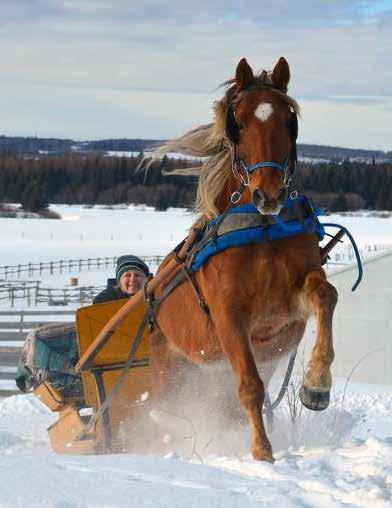
On the cover: A beautiful snowy scene with Windi Scott of Mayerthorpe, Alberta, Canada driving her Tennessee Walking Horse, Future’s Precious Brick. Photo by Dale Derman.
From the President
From
In Memoriam - Bobbie Clark Rapp p. 9
Birds of a Feather p. 12
Dear FOSH Friends and Supporters,
Happy 2021! We hope you and your equine friends are surviving the rough and tumble of the recent winter weather. Of course, some people take this opportunity to enjoy their horses in an entirely different manner just like in our cover photo.
With the new administration installed, I want to bring you up to date on what is transpiring on our work to end soring. First up, FOSH strongly supports the adoption of a USDA Horse Protection Act regulation which would end the use of chains within 30 days and stacks and industry self-inspections in one year. This Rule received over 100,000 supporting comments in 2016 and unfortunately was shelved in January 2017. The Rule is ready to go, and
FOSH communicated its support of Rule adoption to Biden’s USDA transition team in mid-December. At that time, we expressed our deep concerns about the pseudo anti-soring bill being promoted by some groups in Congress. Thankfully, that bill did not pass. It was our opinion that the bill completely gutted the Horse Protection Act and would have made it much worse for the horses than the current situation. We are closely monitoring the current situation with the Rule as are various members of Congress. If we need your support to contact either the USDA or Congress to support the regulation, we will let you know.
As you are probably aware, the PAST Act must be reintroduced in this 117th Congress—both in the House of Representatives and the Senate. At this time, the members of Congress who will introduce the Bill have not been identified. Congressman Ted Yoho (FL-R) retired, and because this is a bipartisan bill, another Republican will be introducing the PAST Act with a Democratic Congressperson. After the bill is introduced, we will ask you to contact your congressional representatives for their support. As the House vote in 2019 was overwhelmingly in favor (333-96), we hope this is a sign that many will quickly sign on again to cosponsor the bill. Regarding the Senate vote, our chances are better now that Senator Mitch McConnell is no longer the Senate Majority Leader; however, we will know more later in the
I’m a dressage rider, and I’m a firm believer that dressage basics can help all types of riding. Now give me a minute and don’t stop reading yet. Just because I’m a dressage rider doesn’t mean I’m not a well-rounded rider. I do all sorts of things with my dressage horses - trail ride, jump and obstacles are done on a regular basis.
But the foundations of dressage, rhythm, relaxation, balance, submission and straightness (of horse and rider for that matter), can help all riders and horses regardless of breed or discipline. I’ve worked with riders
who ride all types of horses doing all types of things. I’ve worked with riders who focused on endurance, barrel racing, hunters, jumpers, and trail riders. The thing they had in common? They all wanted to ride in better balance, and you know what? Dressage basics will do that.
So I want to encourage everyone to consider learning simple dressage concepts. And FOSH will reward you for trying. Consider doing a virtual show. It’s a great way to give dressage a try in the safety of your own barn. You will receive feedback that can help you with your riding and relationship with your horse.
Last year at this time many of us were enjoying the open gaited show in Ocala, Fla. Unfortunately this year it’s just another victim of COVID-19. This has lasted so much longer than we ever imagined. Hopefully as the year progresses, we will start to have more shows, rides and other events. In the meantime, continue to stay safe and healthy and enjoy time with your horses.
Stephanie Stephanie J. Ruff Editor, editor@fosh.info
By Keith Dane
Animal protection organizations are reacting to a National Academies of Sciences, Engineering and Medicine report that evaluated methods of detecting horse soring and that underscores the urgent need to eliminate the current system of self-policing in the Tennessee walking horse industry.
Soring is the cruel practice of intentionally inflicting pain on the legs and hooves of Tennessee walking horses and related breeds to force the exaggerated show ring gait known as the “big lick.” The report is the culmination of a thorough study lasting over a year conducted by veterinarians and other experts in animal health and behavior brought together by the National Academies.
Sara Amundson, president of the Humane Society Legislative Fund, and Kitty Block, president and CEO of the Humane Society of the United States, reacted to the report with the following statement:
“The recommendations on methods of detecting horse soring underscore the need to eliminate the failed system of industry self-policing that has enabled this cruel abuse for decades. Though some in the Tennessee walking horse industry hoped that the study would enable them to continue their abuse, the National Academies have delivered a thorough report that recognizes palpation as the gold standard for detection of soreness, embraces an enhanced rule on scarring and offers other constructive proposals designed to achieve more robust enforcement of the Horse Protection Act.
Last year, we fought off attempts to enact an eleventh-hour proposal which would have blocked these recommendations and other vital reforms provided for in the U.S. Department of Ag-
riculture’s 2017 anti-soring rule that we’re urging the Biden administration to swiftly reinstate. The Prevent All Soring Tactics (PAST) Act, which an overwhelming bipartisan majority of members of the House of Representatives approved in the last Congress, goes even further to protect horses, and we’ll be championing its passage in the 117th Congress.”
We fight the big fights to end suffering for all animals. Together with millions of supporters, we take on puppy mills, factory farms, trophy hunts, animal testing and other cruel industries. With our affiliates, we rescue and care for thousands of animals every year through our animal rescue team’s work and other hands-on animal care services. We fight all forms of animal cruelty to achieve the vision behind our name: a humane society. Sub-
scribe to Kitty Block’s blog, A Humane World. Follow the HSUS Media Relations department on Twitter. Read the award-winning All Animals magazine. Listen to the Humane Voices Podcast.
The Humane Society Legislative Fund is a social welfare organization incorporated under section 501(c)(4) of the Internal Revenue Code and formed in 2004 as a separate lobbying affiliate of the Humane Society of the United States. The HSLF works to pass animal protection laws at the state and federal level, to educate the public about animal protection issues, and to support humane candidates for office. Visit us on all our channels: on the web at hslf.org, on our blog at animalsandpolitics.com, on Facebook at facebook.com/humanelegislation and on Twitter at twitter.com/HSLegFund.
session. Enough about soring. . . and onto riding.
This issue should have plenty to get you warmed up for equine activities. We are keeping our fingers crossed that you have some great spring rides and try something new this year. The video dressage is proving to keep everyone interested in a discipline they never dreamed they would try. Although some readers miss the live shows, others flourished without the hassles of hauling their horse and having a set ride time. Maybe this flexibility appeals to you? FOSH will be holding its annual dressage show the month of October so you have plenty of time to practice. Safe riding and don’t forget your helmet!
For the Horse, Teresa
Teresa Bippen FOSH President, Tbippen1957@yahoo.com
April 02, 1940 - December 08, 2020
Bobbie Clark Rapp, 80, of Le Mars, Iowa and formerly of Pahrump, Nevada, passed away on Tuesday, December 8, 2020 at Sanford USD Medical Center in Sioux Falls, SD. Her family will be having private services at a later date.
Bobbie Carole Barnes was born on April 2, 1940 to Marion Earl and Shirley Francis (Holcomb) Barnes. She was born and raised in southern California and attended Garden Grove High School. After graduating high school, she worked for many years as a switchboard operator for the Pacific Bell Telephone Company.
Bobbie was united in marriage to Armond Clark in 1964 and later divorced. They purchased an old dairy farm in Corona, California. Bobbie built that into a thriving horse boarding and training facility where she specialized in Tennessee Walking Horses. She was a pioneer in the horse training industry as a woman in those days. She attended horse shows in California and Tennessee, she was the first TWH group to ride in the Rose Parade every year and she was a judge for the FOSH Organization and traveled to horse shows
and clinics all over the United States. Many people today that are successful horse trainers were her one time students that she taught to ride. She loved horses and worked hard for her success.
Bobbie was united in marriage to Robert Rapp in 1981 and they were married for 30 years. In 1994, they moved to Pahrump, Nevada and Bobbie obtained her real estate license and began working for Century 21. While there she won many awards and pins for her sales records. Bobbie later became a real estate broker and owned and operated her own real estate firm, Legacy Trails.
Bobbie enjoyed bowling with her friends and was on the local bowling team. She was an accomplished bowler and was in the 500 club. She had many dogs and horses that were loved and cherished. Boots, Finale, Pure Gold, Shadow, the Schipperke dogs, Sparticus, only to name a few. Her dogs Chance and Precious are living on the farm in Iowa. She retired in 2019 due to her health and moved to Le Mars to be closer to family.
Bobbie left behind many friends in Nevada: Leah and Ty, Roger, Jerry, Cindy, Terri, Shirley, Janet, Lori, Carol, Howard and Laura, and many others.
Bobbie is survived by her brother, Edward Earl Barnes and his wife, Crystal, of Post Falls, Idaho; niece, Dena (Scott) Plendl of Le Mars; nephews: Bryan (Tara) Barnes of Huntington Beach, California, and Eric Barnes of Tucson, Arizona; and numerous great nieces and nephews. Bobbie is preceded in death by her parents and husband, Robert ‘Bob’ Rapp.
From Dianne Little - One of the original IJA judges, Bobbie was a dancer, bowler, horse trainer, instructor, stable owner, businesswoman and a person who enjoyed life.
I met Bobbie in 2001 at the FOSH Nationals in Denver. Since that initial meeting, Bobbie and I spent time inside and outside the ring. Bobbie held strong opinions about horses. We did not always agree, but I never doubted that Bobbie’s opinions were based on experience and respect for the horse.
She promoted and was involved with sound TWH organizations in California in the 1970’s. She told me she became an IJA judge because she wanted to make a difference for the Tennessee Walking Horse.
This is the biography Bobbie submitted for the FOSH website.
“I started showing horses at the age of four. Through the teen years, I showed Quarter Horses, (Western on
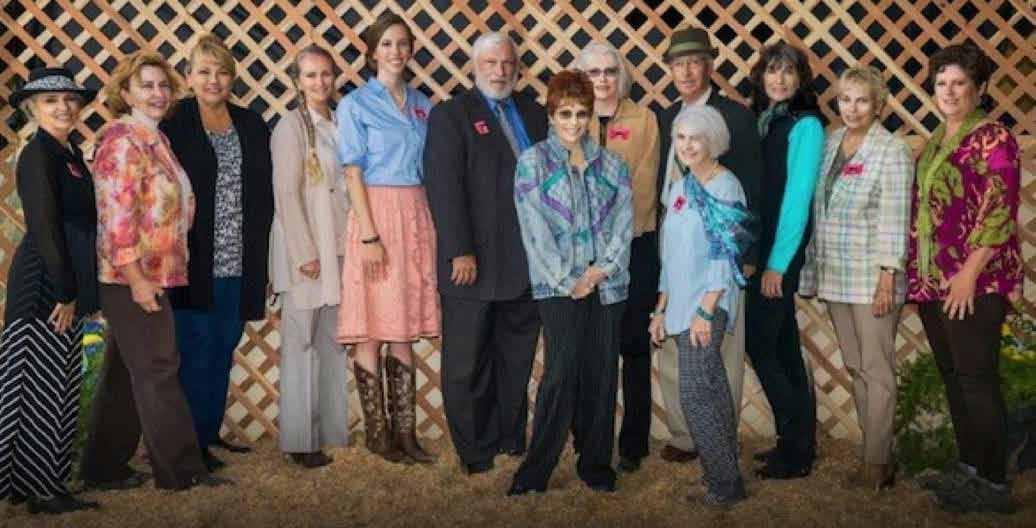
the rail, equitation); reining, (worked for Ronnie Richards); Thoroughbreds, (English rail work, equitation, and over fences on hunters): Arabians; Saddlebreds (both three-gaited and five-gaited); and worked in polo.
“After I was injured in a car wreck and unable to ride walk-trot horses for any length of time, I remembered a ride on a Walking Horse. I bought my first Walking Horse in 1964.
“I opened the boarding and training Silly Filly Stable in 1965 in Corona, Calif. After an apprenticeship, I trained both Walking Horses and Fox Trotters and taught the owners how to ride.”
Very factual, but it does not describe the Bobbie her students and fellow judges knew. This is what others remember about Bobbie.
“Bobbie would always tell you like it was. I loved when Bobbie would dance in the barn aisle – how she loved to dance! She taught me how to work and breathe horses. When I was in high school, she hired me to clean stalls all night long during the summer and then feed in the morning and then work horses. It kept me out of a lot of trouble!”
“Bobbie was a force of nature! I met her in the early 70’s and learned so much from her and Owen Daniels about Walking Horses. Decades later, it was surreal to judge the International show in St. Louis with her.” “I laughed with and learned from
Bobbie - two of the most important things in life. Thank you dear lady. Keep knocking down those pins!!!!”
“She was a mentor to me.”
“She gave me the courage and confidence to follow my dream with horses.”
“The best education was ring stewarding for Bobbie.”
“She taught me so much about life and horses. You didn’t just show up at the barn and jump on your horse. You groomed them, bathed them and learned all about their anatomy and conformation. And boy she demanded you ride them in good form!”
“She inspired me as a judge and made me determined to win!”
“Many times, she would ride for the best of show class. Watching her, learning from her was a true gift. I am blown away. May she ride with the angels for eternity.”
The last clinic Bobbie attended was in 2016 at the LA Equestrian Centre in Burbank, Calif. It seems fitting the show was organized by NPWHA, one of the first Sound Horse Organizations. It was traditional that after a clinic Bobbie attended, the agenda included a lively game of bowling orchestrated by “bsillyfilly” who even brought her own ball.
Heading south for the winter months is a popular option for horse owners. Read on to learn about the experiences of two horse owners who make the annual trip south for the winter.
Julie Dillon Mason, New Hampshire and Williston, Florida
Q. How long have you been traveling to Florida for the winters?
A. For the last two winters, my two horses and I have been “snowbirding.” We stay from January until late April.
Q. What made you want to start making the trip?
A. We have lived in New England for twenty years where the riding season can be limited. I’m a southern native and have a love of traveling with my horses to ride in faraway places. Now that I’m retired, I’ve decided I will be spending as much time adventuring in the saddle as possible. Several of my friends have retired and have resettled in the
Ocala area, and their stories and offers to host my visits were just too tempting to resist! I’m very grateful to them as their welcoming spirit has made our annual commutes possible.
Q. What types of horse-related activities do you do while you are there? How do these differ from what you do at home?
A. Prince Jester’s Request, my Missouri Foxtrotting Horse gelding, was foaled in Ocala and was born with a passion for the show ring. Here in New England, there are few opportunities to show with other gaited horses. When we travel to Florida, he is in his bliss! “Jesse” and I take advantage of the many opportunities to compete in the gaited horse shows offered in the Ocala area. Showing with all gaited breeds at the Florida Horse Park is a real thrill!
Apache’s Sterling Moondust is our Tennessee Walking Horse gelding. Also known as “Earl the Pearl,” he is the consummate trail buddy. “Jesse” can be coaxed, but will never be a devoted fan.
In Williston, “Earl” and I have had the honor and privilege to train and participate with some of our worldclass U.S. Pan American endurance champions and their coaches. We were thrilled to be encouraged to participate in the Intro 12-mile class that was offered specifically for uninitiated horse and rider teams. There was much to learn! The hosts, participants and judges were warm and patient with our efforts to follow and fulfill all of the required protocols. Earl danced fluidly into
By Hope Ellis-Asburn
his flat walk from the starting point and stayed in a four-beat rhythm during every transition throughout the course. When he returned for his vetting at the finish line, he was still moving like a metronome! “Earl the Pearl” is a joy to ride, and he represented the Walking Horse admirably!
Q. What types of preparations are involved with making the trip?
A. Preparation is part of the enjoyment! The support of family and friends makes the yearly migration an “excellent adventure” from the planning stages of departure to our safe return back home. Matthew, my husband of 42 years, encouraged me to do this for years so he is my greatest facilitator, and I give thanks every day that he loves our horses almost as much as he loves me! Matt gets all the credit for encouraging my cross-country trips and adventures with our horses!
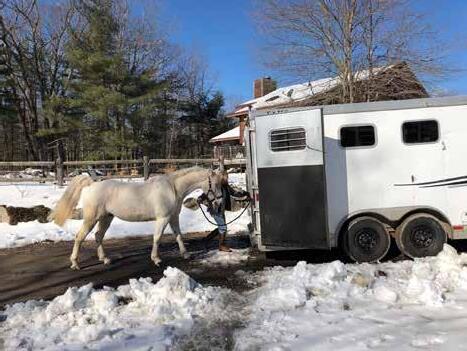
Beyond support planning the journey south is just a matter of deciding on your routing. If that entails multiple days, making appointments for comfortable layovers should be done several weeks in advance with follow-up calls to the owners and proprietors. There are websites available that list places that provide well-appointed accommodations in every state.
Folks often ask me how do we make a twelvehundred-mile drive. My answer is one town and state at a time! It is magical to watch New England’s snow-covered meadows vaporize into a soft fold as we reach the Mason-Dixon Line. This is where the land becomes ever greener and just beyond the deep south’s perpetual flower show begins. Our route of choice is not the shortest or fastest as we head south and west away from the eastern seaboard, keeping us insulated from the heavy traffic and hub of the big cities. Most important is that it allow us to appreciate the beauty of the land and the seasons as they unfold in the view ahead.
your local veterinarian. Check on recommended inoculations for your destination region to be sure your horses are protected during your stay there. Keep in mind that an important part of your return planning is to have an appointment with a local vet to arrange for travel health papers required for the trip.
If you are traveling to and from the state of Florida, you are required to stop at the Agricultural Inspection Stations at the border where your travel and health papers will be checked. Be sure to have your papers ready and be aware the officers often request that the trailer be opened for visual inspection of the horses.
Packing for your trip will vary depending on your rig. With my truck and living quarters trailer serving as both hauling vehicle and campsite cabin, there was room for all of my creature and people comforts. So, my priorities are focused on hauling as much transitional hay for the horses as possible for the three-day journey and the first few weeks of our stay.
Your horses will need travel papers and health certificates reflecting rabies vaccination and a negative Coggin’s test dated within thirty days from your departure provided by
Then there’s the fun of stocking the closet for three seasons of clothing and filling the refrigerator with comfort food from home. I’ve considered
the option of finding an all-inclusive seasonal cabin with a barn for the horses so that I can travel with a smaller trailer. Depending on your preferences, there is an almost endless spectrum of configurations for accommodating your “snowbird” winter. Once you’ve decided what works for you, do your research and make reservations well in advance.
It is critical to have a pre-planned, friendly destination to begin your first winter visit. Our first year, we were fortunate as we had three invitations to visit various areas and friends throughout the winter. However, it did feel a little like a “Goldilocks” experience in that every place was beautiful and accommodating, but the third destination was just right! Perhaps this was because we had a glimpse of what other areas and amenities were available. It is very important to know your destination is a good fit, but it may take some wandering to discover your special winter community and place.
Q. Do you have a funny story to
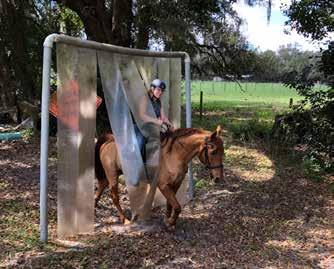
A. I’ve mentioned that Prince Jester’s Request (aka “Jesse”) finds his bliss in the show ring. Nothing illustrates this more than when Jesse and I had the opportunity to attend the all-breed gaited show hosted by the Southern States Rocky Mountain Horse Club during our last Florida winter. It was a thrill for me as this was a rare treat to be among other gaited horse owners in the show ring but for Jesse, it was an exciting and joyful return to his special purpose in life.
Before entering each of our classes my normally well-behaved gentleman gelding began to leap into the air like a kite in the wind. In the warm-up arena, he flung himself toward the entry gate to attempt to attend every class regardless of the category. During gaps in our classes instead of resting in his stall, Jesse stood on his hind legs to peer over the back wall to watch the other horses in the show ring.
Once in his classes, he found his place on the rail shining like a copper penny, changing tempo in mid-step with each transition. Every gait was perfectly timed with the organist’s ever-changing melodies. It is a joy to ride this wondrous little dancing machine! And while he loved collecting his ribbons, he was determined to stay for the next class! So, getting him back out of the gate to leave the arena required several side passes and leg yields.
Now that we are back home in New Hampshire, we are refining our work at Third Level in the Dressage Arena. Jesse likes that too. But I promised him we would also be showing up for as many rail classes that New England has to offer!
Jolley Stars and Stripes Farm, Fincastle, Virginia and Fort Lauderdale, Florida
Q. How long have you been traveling to Florida for the winters?
A. We have been coming for the winter for the past 14 years. We stay down two and a half months.
Q. What made you want to start making the trip?
A. Since we are retired and not a fan of the cold weather, we decided to first try it, and we liked being here so we continued. We had some very cold and wet, snowy winters in Virginia that were not to our liking!
Q. What types of horse-related activities do you do while you are there? How do these differ from what you do at home?
A. In the beginning, we drove to Tampa to the state fair where my friend Kathy Parrish brought her Rocky Mountain horses. I was lucky to be able to show two of them. We helped with the show and with FOSH related activities. One year I was invited to the IJA clinic to help with the discussion of the RMHA rules. I learned so much about judging in general at that meeting! We attended these shows for 3 years.
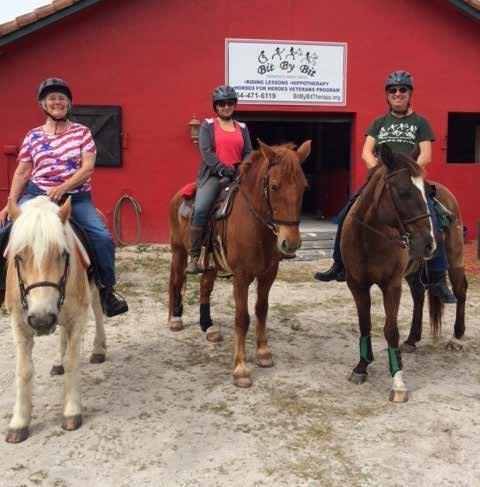
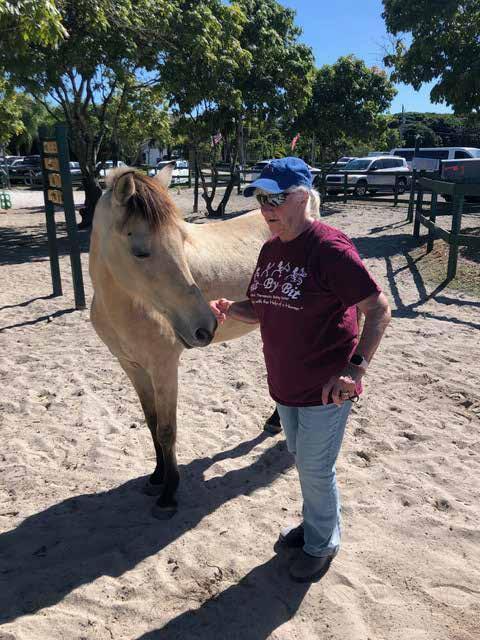
After that, we both got involved with Bit-By-Bit Medical Therapeutic Riding Center in Davie, Fla. My main “job” is to lead horses for the therapist and also to sidewalk a client when necessary. Other tasks include pretty much the same things that I do at home, bring horses into the barn, groom, and saddle, unsaddle, clean stalls, sweep the aisle and pick-up poop in the riding ring. We try to get the horses out on relaxing trail rides which are great for them to have a change of venues, and I get a chance to ride alongside the Bit-byBit staff.
We helped out with a FOSH Gaited Charity Horse Show in Ocala, Fla. for the past two years. Joe and I set up the obstacle course and helped run it so the judge could follow the rider. If something got knocked down or pushed away, we were there to put it back together.
At home, we take care of seven Rocky Mountain horses. Many of the tasks are the same as at Bit-By-Bit. In the summer, we put most of them in the barn during the day when the
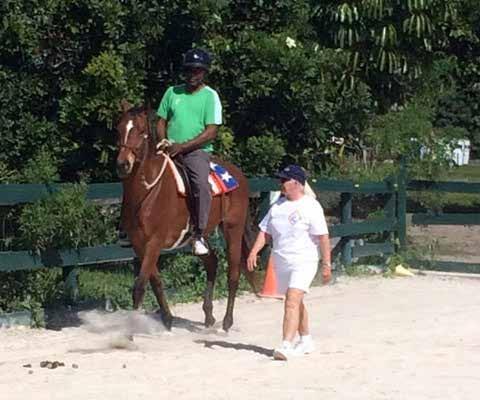
sun is the strongest, and the flies are bad. I trail ride and show several of our horses. My main gelding passed his Junior and Senior Trail Requirements from the Paso Fino Association. He will go for his Master Requirements hopefully this spring.
We made a dressage ring last summer in a grassy pasture that we don’t put the horses on. That is where I tried my hand at the FOSH Virtual Dressage. I did two tests. I also participate in Trail Obstacle Competitions. This past year our showing and trail competitions have mostly been virtual.
Q. What do you do with your horses while you are away? What types of preparations are involved with making the trip?
A. We have two wonderful ladies who take care of them. One lady comes every day to check on them and helps the other lady put in two large rolls [of hay] about once a week. Another young lady, who is a
nurse, has a horse at our farm. She also helps out as needed; especially if there is an emergency or anything out of the ordinary. Our granddaughter, Brooklynne, and her family also come by when they can as they live close by. Brooklynne rides several of the horses, and if the weather is good, she will be riding for sure!
To prepare for the trip, we make sure all the horses are healthy and have a good routine for the winter. We have heated automatic waterers in the fields so they have plenty of good water to drink. We have a heater in the tack room set around 40-50 degrees to keep it from freezing anything. Seven barn stalls are available if needed. Twenty-eight 800 lb. rolls of hay are all stored under cover which is sufficient for the winter months. All outside water con-
Training Level – Live performance
Northfork Cotton Trim - TWH
Owned by Lori Dyberg
Wetaskiwin, Alberta, Canada
10 Tests with an average score of 65.1
Introductory Level – Live Performance
Northfork Cheerful Chipper - TWH
Owned by Blair Dyberg
Wetaskiwin, Alberta, Canada
11 Tests with an average score of 63.04
Working Equitation Dressage Novice Level 2 – Live Performance
Oldie’s Bit A Honey Gold - TWH
Owned by Claire Gosnell
Evergreen, Colorado
3 Live Tests with an average score of 64.08
nections are turned off at the barn and the house. The well spigots stay on. We usually head home in early March so we may have an additional snowfall after we return home. Then the mud begins!
Q. Do you have a funny story to share?
A. At the horse show in Ocala in 2019, the wind was blowing strongly. We were carrying the flags for a flag ceremony celebrating the branches of the military.
I was riding Tara Stone’s Rocky Mountain stallion, High Voltage. As I was entering the ring to Anchors Away, I had the Navy flag, my
flag flew right over my face and I couldn’t see a thing. Trying to hold a flag up, hold the reins and guide the horse made it a little difficult to try and move the flag.
Finally, the wind shifted and the flag went back behind like it was supposed to do. The horse was a trooper through it all!
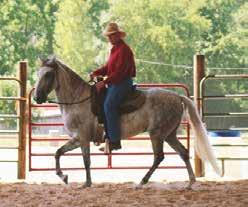
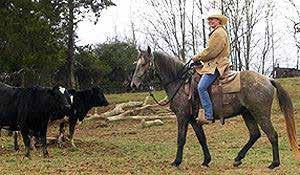
Probably the thing I hear most when doing clinics around the country is that the rider wishes to have a bond with her horse. I think we all want that. I think most riders don’t get the connection they want because they have the path to bonding backwards. People try to do things with their horse to bond so the horse will be safe to ride. I believe you have to make the horse feel safe before he will bond.
When you do activities with your horse, can you make him comfortable. Do you make sure he doesn’t lose his balance when you ride? Have you built a communication where you don’t constantly use his face to stop, turn and
back? Do you always prepare him before you ask him to do something so he can put his posture and feet where he needs them to carry out your wishes?
In order to train a horse so he feels safe and comfortable, you must teach him how you will communicate to his feet. You must show him how to balance himself when you ask him to do things with you on his back.
After you have taught the horse to move away from pressure, have you continued his education until he knows what to do to prevent pressure being applied. If you have to pull on his face or push on his ribs to get a turn, stop or back, then don’t ex-
By Larry Whitesell
pect him to look for you when he is in trouble.
If you are taking slack out of a rein, does your horse know what to do to prevent you from actually putting pressure on his mouth? That would include gaiting or collection. In dressage, that would be the classical school or riding with feel.
The horse is going to bond with the rider who he feels can get him to safety and make him comfortable. He will bond with an empathetic leader - one who helps keep his balance.
If you need stronger equipment or stronger aids, the horse does not clearly understand the question. Communication makes stron-
ger relationships. Don’t blame the horse for being heavy in the bridle or resisting because you are the teacher. When sports teams don’t win, they don’t fire the team, they fire the coach. Learn how to explain yourself better.
Riders who feel they can’t trust their horse will stay in the arena or continue to do more groundwork. If you have done several weeks of groundwork, and your horse is not safe to go out, your ground exercises aren’t working. If you think your student will bond if you make him sit at his desk in the classroom and do math for months, it won’t happen. Instead you start to get behavior issues. Once he knows how to add and subtract, you have to take him out in the world and put math to real life situations.
Bonding happens out doing a job like trail riding. The horse sees purpose in what you are teaching. It makes you more of a teammate instead of his boss. You start to do things to-
gether instead of you controlling every step.
Obstacle courses are good once or twice, but doing obstacles as a method of making the horse safe becomes stressful and a trick. Take him out in real life and do real obstacles that come up on the trail. Solve problems together.
The horse is going to bond with the rider who he feels can get him to safety and make him comfortable.
Be careful not to dominate the horse into submission. That is training where we get the horse to physically do a task by threatening discomfort if he doesn’t do it. Good training would present the horse
with a task in a way he would look for the most efficient, comfortable way to do it and would be given time to search for the answer. The horse learns to solve problems instead of reacting. When teaching in early training, strong equipment or strong aids make the horse rush to answers, which not in his best interest.
An example of training the physical without attention to the mental is disengaging the horse. There are two methods. I see great horsemen like Chris Cox and Buck Brannnaman who disengage by moving the horse and bending the horse through the length of the spine and putting the inside hind leg under the horse’s center of gravity.
I also see people who are taught to chase the hind end around, stiffening the ribcage, misusing the hind end joints, and the hind leg stepping out from under the body of the horse, causing him to lose balance. This results in the horse tensing his body and mind. One
method regains control by domination while the other actually creates relaxation and balance. Which method would help the horse “bond” with the handler?
A true leader shows his followers how to be more comfortable and efficient in their jobs. A leader is not demanding, but expects a lot. The leader understands how to get his followers to make it their idea to do what is wanted. A leader can gain control mentally and not just physically.
A bully can get control physically until the followers feel more jeopardized by following than not following. Horses that spook, run away, are buddy sour are just letting their rider know that they are safer somewhere else. If your horse sees you as security, it wouldn’t make sense for him to leave you.
you really need them, they are not around.
I’m sure the horse knows if you are there for him, or if your work is just to make him safe for you. He can test you. If he becomes afraid and tenses up, do you take hold of his mouth and grip your legs and try to control him to save yourself? Or can you relax him and make him feel
burning building leaving him in the fire.
If you have to use your reins to prevent the horse from rushing, spooking, joining up with his buddy, going out the gate, etc., he is giving you a clear message that he is not interested in bonding.
safe? That takes knowledge from both horse and rider on how to communicate, and the horse has to have been put in some situations where you have helped him get through it.
I can’t explain in a short article how to change this, but it isn’t hard. It takes a little time and effort. If your horse bonds, you should be able to ride anywhere in any equipment. This is what we all want. We need to seek out how to get our horses mentally and physically with us so we can enjoy them, and they enjoy being with us.
www.whitesellgaitedhorsemanship.com
Do you know people who are nice in order to get what they want? If
If you take hold of his mouth and grip with your legs, you are saving yourself, and he knows it. He is not going to bond with someone who runs out of the
Reprinted with permission.
www.murdochmethod.com
Is it cold where you live? Do you feel stiff when you mount up? Have you been sitting at a desk or driving your car for hours before riding? Are you still wound up from your day? Before you ask your horse to move it would be a good idea to consider spending a few minutes warming up your body in preparation for your ride. Here’s a simple exercise to get you going.
Next time you ride notice if it is difficult for you to get your leg across the saddle. Are your shoulders tight? Do you feel stiff in your hips? Riding when you are stiff will have a direct effect on your horse’s ability to move and runs the risk of injury for both of you. It is important for you to be limber enough for him to respond correctly so take a few moments to warm up. This will benefit both you and your horse.
Warming up is important for many reasons. When you are cold your blood concentrates toward the middle of your body leaving the extremities, your fingers and toes. A few
By Wendy Murdoch
minutes of warm up increases blood flow to your tissues. This makes the muscles more pliable, increases the amount of oxygen reaching your muscles and at the same time prepares you mentally for your ride. In addition it improves coordination and reaction time meaning that you will be able to respond to your horse much more quickly than when you are cold.
In the winter months a good grooming begins the process. I take my horse for a brisk walk on a loose rein around the outside of the hill field before heading to the arena. This allows him to warm up at his own pace. The increase blood circulation warms his muscles, and the ligament/tendon/fascial system, which has very little blood supply. This system becomes pliable from the body heat generated. Once the ligament/ tendon/fascial system is warm it is like a stretchy elastic system. If you ask your horse to work hard before this is warm you take the risk of tearing and damage because this system is stiff an unpliable when cold. Even in warm climates warming up is important but takes less time.
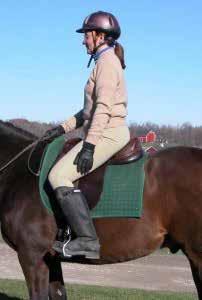
Photo 2. She reaches toward her horse’s flank and stifle. Be careful if you have a sensitive mare.
3. The
is reaching back toward the horse’s hip joint. Notice she is looking toward her hand and her foot is quietly resting in the stirrup.
To warm you up and improve your pliability in the saddle, start with your horse standing still, both reins in one hand. Reach back with your other hand and see how far down your horse’s flank you can go without leaving the saddle. If you have a mare, you want to make sure she is not ticklish about her flanks! Do not brace against your stirrups. If your horse is quiet, you can drop them to ensure that you are not pushing.
How far toward your horse’s stifle can you go easily? Come up and repeat the motion several times without straining, as this will only increase the tension in your body. Where do you have to let go in order to reach further? What is happening in your ribs, neck, shoulder and hips? If you are careful not to force this movement you may find that by repeating it a few times you will go further with less effort.
Reach toward your horse’s hip joint and return. Repeat several times. Again pay attention to any holding or
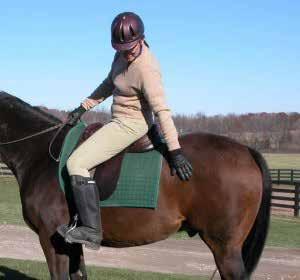
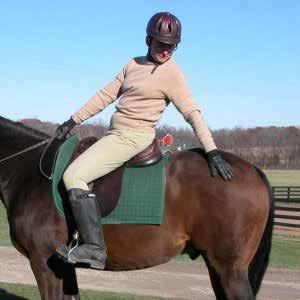
tension you may discover as you do this movement. You can make a series of rays each time by returning to the starting position and changing the angle slightly going from the flank to your horse’s dock. Repeat with the other hand and find out if it is harder or easier on this side. Once you have the idea you can also try this exercise at the walk and trot.
Use this Murdoch Minute as a reminder that it is important to warm up before your ride. It is equally important to cool down afterward.
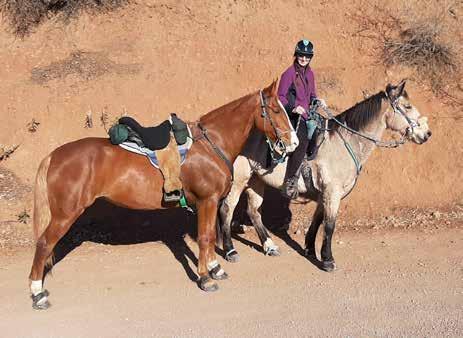
FOSH member and endurance competitor Brenna Sullivan, a gaited endurance rider in Northern California, hit the jackpot when she bailed a 7-year-old Tennessee Walking Horse (TWH) from a kill pen in 2020. Brenna was kind enough to answer some questions and tell their story.
Do you know how your horse came to the kill pen?
Luckily, Banner came through the auction and kill pen with her papers. Because of this, we were able to track down her last registered owner who was gracious enough to share some of her history. Banner was bred for Big Lick and put in training as a young mare. She was up on pads for about seven months. Apparently, when the padded market declined, she was pulled from training and they attempted to breed her. When she didn’t take, she was put out to pasture and eventually run through a sale.
She ended up in the Sexton kill pen in Tennessee and was seen on Facebook by a man down in San Diego who bailed her out the day before her ship date.
He got her back to health and worked on restarting her for a couple months. She was very reactive and had some anxiety that resulted in dangerous behavior under saddle. But he did a wonderful job in patiently working through her issues enough to be able to ride her again. I got her from him as a project in December of 2020.
I started by ponying Banner out on the trail for the first couple weeks and just letting her decompress. Eventually I started riding her, and she took to the trail like she’d done it all her life.
Are people surprised to discover that you are riding a gaited horse?
At least in endurance, there are more people riding gaited horses than there used to be. As more people do incredible things with their gaited horses, I think there is an increasing interest from many who would traditionally ride Arabs. The take-away is that the right gaited horse can absolutely do endurance riding at any distance: 25s, 50s and 100s. They are just as capable over
the miles and just as sound over the years.
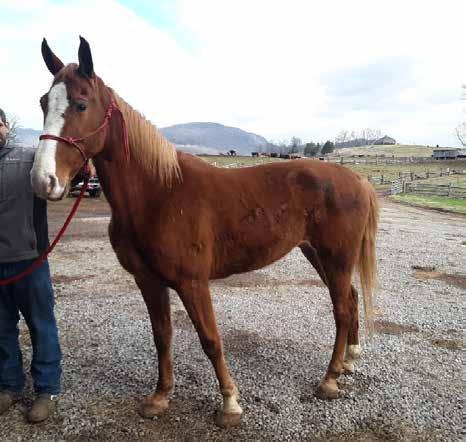
However, I would like more people to see them as what they are. Only the handful of exceptional individuals will be able to compete with Arabs in terms of speed. And I think it’s a disservice to our horses when we think of competing in those terms. Gaited horses, as a whole, do not have the metabolics of those elite race-bred Arabs, and no amount of conditioning is going to bridge that divide. Coming into the sport with a chip on your shoulder or “something to prove” is not the right attitude.
able to top ten a few rides, he’s not going to win Tevis. But he CAN be a Decade Team horse. He CAN win the AERC National Mileage Championship. He CAN be a 10 x 100 mile finisher.
But the wonderful thing about the sport is that it’s an umbrella with lots of goals. If a gaited horse ever wins Tevis, I’ll eat my words!
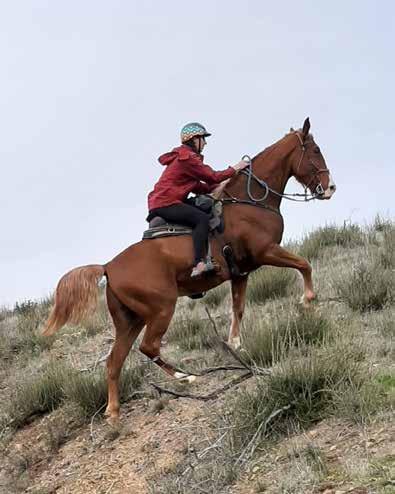
If there was one thing that people would be surprised to know about you and/or about your horse, what would that be?
Where gaited horses can be competitive with any breed is in mileage and longevity. I like to tell people that while your gaited horse might be
I think somebody out on the trail might be surprised to learn that Banner used to be on stacks and trained for Big Lick. I know I had some mis-
conceptions about that side of the breed before I met her. I had always heard that the exBig Lick horses were bad choices for trail riding as they were too big, too pacey, too trippy and too high strung. There are some that will say that these lines have ruined the natural, square gait of the breed. I think there is some truth in that, as the stacked show horses are bred for an exaggerated movement that really has no place in a sound, all-around and smooth trail horse.
Then there are also horses that end up in that situation because they are lame, dangerous or have some other underlying problem. Instead of being responsible, the owner dumps them, with no information following them and no way to track them back.
When you rescue from a kill pen, you are taking a chance. No matter the outcome, you have to be prepared to take responsibility for that horse.
But Banner really seems to like the trail and has incredible hill climbing ability. I would like more people to see the potential in these bloodlines and give these ex-show horses a second chance.
Many people are interested in rescuing a horse. What advice would you give those people? Horse rescue is a tricky thing; there are horses that come through auction and kill pen all the time that shouldn’t be there. Through misfortune or happenstance, they fall through the cracks. Banner is one of these; she is very sweet and a beautiful, capable and athletic horse.
There are many amazing stories of people who took that chance and ended up with amazing, long-term riding partners. If somebody is interested in rescuing a horse, one of the things to do is to show up at a local livestock auction or peruse Craigslist. Get a horse from a local rescue who goes to livestock auctions to out-bid kill buyers. Try to intercept these horses before they end up in the kill pen pipeline. “Bailing” horses out of kill pens do support those business models and there is some borderline ethical concerns in that.
That said, I’m sure glad Banner was bailed out.
What goals do you have for you and your horse?
Banner is a new addition to our herd. I would love to do endurance with her, but frankly, not every horse is suited for it. Having a horse with the drive and desire to get down the trail is the most important factor, followed by soundness, followed by mental and physical ability. You just don’t know these things until you spend a year conditioning them. So far, she has a wonderful attitude and has been a pleasure to work with.
I’d love to get back to Tevis one day. Is Banner the one to get me there? Who knows, but I can’t help but dream!
How long have you been a member of FOSH and why did you decide that they were worth joining for you and your interests?
see in padded classes. They are an incredible breed with a lot of athleticism and heart.
Sky won FOSH’s HW Distance Champion in 2016 and 2017 as well as Overall Mileage Champion in 2017. In that year, she completed 855 miles and was five miles short of making top ten AERC National mileage for the year. We made Regional standings, national Pioneer standings and completed two 100s, including Tevis. She was an amazing endurance partner and friend.
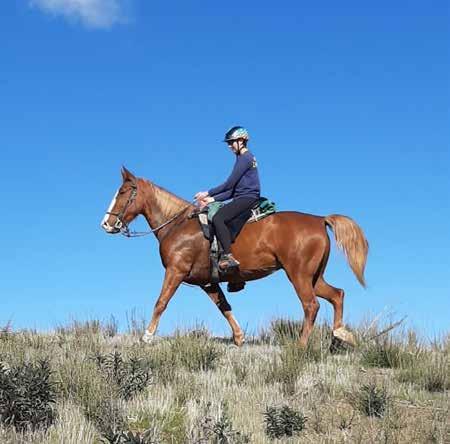
Unfortunately, I lost Sky to blood cancer in 2019. I was absolutely devastated, and it has taken a while to get my appetite back for endurance
I have been a FOSH member since 2015. I participated in the gaited distance programs with my TWH mare Sky. I have always been so happy to support FOSH and their efforts because I want more people to see gaited horses (and especially TWHs) as much more than what you
riding. But I’m ready to start conditioning Banner and seeing where our path leads. She’s got the same amazing disposition, big heart and amazing work ethic as Sky did.
By Dr. Eleanor Kellon
Forage first is always the rule of feeding horses, but in winter it may not be enough. Staying warm takes a lot of calories.
Every horse has a LCT – lower critical temperature. This is the environmental temperature (air temperature + wind chill) below which the horse has to spend calories to maintain his normal body temperature – and it sure is costly! It has been shown in people that just 10 minutes of shivering burns as many calories as an hour of moderate exercise. To make things worse, very cold horses stop eating, drinking and moving around.
Even if not cold enough to shiver, the need to divert calories into heat generation means the horse needs to eat more to maintain body condition too. The usual estimate is an extra 10% of hay for every 10 degrees below the LCT, so a horse normally eating 20 lbs of hay a day would need 22 if the temperature is 10 degrees lower than his LCT.
Determining the LCT is a little tricky. Foals and older horses are less tolerant of cold than healthy adults. Horses with a lot of body fat or very dense winter coats have a lower LCT than thin horses with short coats.
Wet coats lose their insulating properties. Horses with the ability to get out of the wind and precipitation will have lower requirements than those exposed.
A horse in good body condition with a thick coat may have a LCT as low as 5° F while a thin one with a poor coat will start to chill off at 40° F. Young foals and weak seniors rarely tolerate temperatures below 32° F.
The easiest way to work around the issue of exactly what the LCT might be is to feed hay free choice. Unless the horse has metabolic syndrome they will usually regulate their hay intake to match their needs. However, some horses will need more.
Always check the horses’ body condition every two weeks in winter, making sure to actually feel through the coat to assess fat coverage over the ribs. Many scenarios can result in the horse not getting sufficient calories from free choice hay, including:
* Teeth in poor repair
* Poor chewing efficiency
* Poor fiber fermentation
* Competition from herd mates for hay and/or water (horses with insufficient water reduce their hay intake)
* Poor body temperature regulation increases requirements
* Pregnancy
Horses that have trouble handling loose hay may do well with supplemental feeding of hay cubes or pellets. Since hay has the advantage of providing heat during gut fermentation, this is a good first choice. However, hay is also low in calorie yield so you may have to go to more dense sources like brans, grains or beet pulp. Fat supplementation is especially helpful in this scenario since all the horse needs is extra calories and fat supplies 5X the calories of average grass hay and triple that of plain oats. The Coco-EQ line of liquids and granular high fat sources provides unparalleled palatability with the highest quality cold pressed, unrefined and virgin fats.
By Joyce Harman, DVM, MRCVS
We’ve all heard the old saying, “you can lead a horse to water, but you can’t make him drink.” Well, that’s true. Low grade dehydration is definitely a problem in the winter. In fact, keeping your horse hydrated in the winter months is as important as during the summer.
On average, a horse drinks five to 10 gallons of fresh water per day, and like humans, the need for water var-
ies. But regular water consumption is extremely important, especially to digest hay or dried forage in the winter that have lower amounts of water content, less than 20 percent. This is as opposed to the grasses and pastures horses graze in the warmer months that have naturally higher levels, about 75 percent or more. With dehydration, you will notice dry manure. Dehydration can significantly increase the chance of impaction colic and other serious problems. The best way to determine if your horse is dehydrated is to do a skin pinch test on the side of the horse’s neck.
In a well-hydrated horse the skin should be elastic and immediately snap back to flat skin. If it stays puckered up, you probably have dehydration. Older horses may have lost their skin elasticity, so you may want to consult with your veterinarian. Also, take a look at your horse’s eyes, nostrils and gums. They should be moist and pink. If not, you may have dehydration problems.
Some horses will drink more if the water is warm; however, encourage them to drink cool water. The problem with warm water is that when it cools down, the horse won’t drink the cold water. They will want warm water. It’s not necessarily the best
thing unless you’re committed to warming the water routinely. You can use warm water as a treat on a cold windy damp day. To encourage drinking, you can add some salts and electrolytes or add flavorings, but make sure they are drinking it. Again, they may get used to the additives and refuse to drink plain water. So keep it to a minimum unless you’re committed to warming water or adding electrolytes or flavorings every time.
Also keep watch on the water buckets. Prevent the water from freezing. If ice forms on the top, a horse will probably not break the ice to get to the water. Frozen water or eating snow will not accomplish the same level of hydration as plentiful, fresh water. Another way to increase water intake is soaking food, including hay, in water. A wet mash adds a few quarts to food.
If your horse loses weight in the winter don’t worry. It’s actually a natural thing. Horses like cold weather. Horses that live in the wild often live in colder regions where there is not much food in the winter. They naturally lose weight. When springtime comes and the spring grasses, your horse can eat the spring grass without worry about weight. It’s far more difficult to manage overweight horses, especially in the spring. Winter weight loss between 25 to 50 pounds is usually fine throughout the winter. Your horse will be ready for spring grass with a much safer and natural metabolism.
You should watch your older horse’s weight. Use your weight tape. Make sure to use it regularly, especially for horses that wear blankets frequently. If you are your horse’s sole caretaker, sometimes we don’t “see” the weight loss, so it’s best to use a weight tape on a regular basis. This will help you judge the food intake or to add extra calories if needed.
It is important to establish a winterization plan to keep your horse healthy and avoid injuries throughout the cold months. Low grade dehydration is a problem for many horses in the winter. Try to encourage your horse to drink cool water so you are not committed to constantly warming water or adding flavorings or electrolytes. Add water to food for extra hydration. Your horse may lose weight in the winter, but this is natural. Your horse will be ready to consume spring grasses and maintain a healthy weight after the winter.
Adapt to your horse’s individual needs – not just the temperature outside or your perceptions about the horse based on your own needs. Let horses be horses in the winter and enjoy the colder months with them!
Portions of this article are from a live webinar featuring Dr. Joyce Harman, DVM. Watch the full presentation at https://youtu.be/sryv0Tz1trc.
By Bill Coon, FOSH Board Member
In the first part of this article, I have tried to present the function of the horse’s foot, most of the foot’s parts and how these parts work together to perform their function. I will now present information in three areas to help with the health of the horse and the horse’s hooves. The areas are break-over, heel-first landings, and one cause of laminitis (founder).
In reference to laminitis it has been said that “90% of domestic horses have mild to severe laminitis” due to the manner in which we humans house and feed our horses. This condition relates directly to the health of the horse. The horse will show sign of lameness since both front hooves have the same pain. Thus the horse just continues doing what is being asked to do.
The figures below represent break-
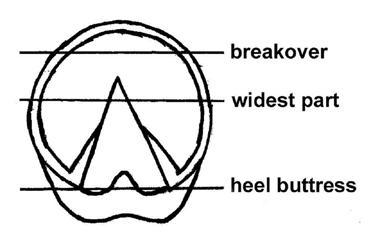
A hoof balanced for heel-first landing. The distance from the break over line to the widest part of the hoof is shorter than the distance from the widest part to the heel buttresses.
overs.
At this point, I would like to quote Ms. Marjorie Smith: This is her response to my question on toe length [4½ inches] relative to the health of the horse and break-over.
“Toe length is a critical dimension for the soundness of a hoof. In order to be completely sound, the foot must land heel-first when going on a level surface. Hind feet are almost always able to land heel-first, due to the zigzag arrangement of the hind-leg joints. Front feet, due to a different joint arrangement, are only able to land heel-first if the hoof is trimmed to a natural shape, e.g. the wall is trimmed to the “live” sole plane. The toe is beveled or backed-up so that in a toe with totally straight growth from the coronet to the ground-zero forward flare -- the break-over
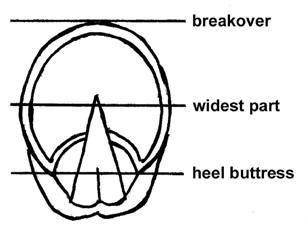
An imbalanced hoof with long heels (which moves the buttresses forward) and a flared toe (which moves the breakover forward). The” widest part” stays at about the same position.
is in the middle of the ‘water line’ or inner non-pigmented layer of wall.
“Any toe-wall that rests on the ground forward of that break-over -- a flat-bottomed wall, a toe grown longer than the sole plane (hooves grow forward), a forward-flared toe (white line separation), or a foot with shoes that are not rockered back to the correct break-over point -- puts the moment of break-over late. Such a foot does not have time to swing far enough forward to land on the heel. In practice, a horse that has been shod is likely to have some forward flare, which necessitates beveling or backing-up the toe to the edge of the sole (which grows forward of its correct position along with the flared toe), until the toe has grown straight with a tight white-line connection to the middle phalanx (coffin bone).
“The heels can be approximately 1/8 inch longer than the sole plane to give the digital cushion some protection in horses with an under-developed digital cushion, which is most domestic horses and especially those that have been shod more than a few months and those that were stalled as foals. Heels longer than about 1/8 inch can also change the balance of the foot and prevent heel-first landing, no matter what the toe angle is. Heels trimmed to the sole plane (or into the sole) will generally be sore, as they don’t protect an under-developed digital cushion enough, and the horse will land toe-first to protect his heels.
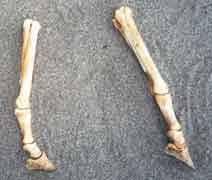
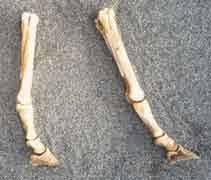
When the foot lands toe-first, the pastern bones must change from an upward curve as the toe lands, to a downward curve when the foot becomes weight-bearing. When the foot lands heel-first, the pastern bones are already in a downward curve (full extension of the joints) and the curve doesn’t have to change orientation when the foot becomes weight-bearing.
“Everything about the horse’s hoof works better when the foot lands on the ground heel-first. The hoof capsule flexes in such a way that you get the best shock absorption, the best circulation and balanced wear. The digital cushion is tough, and the frog and heels are wide; they are able to protect the foot from amazing amounts of hard work.”
The sole plane is defined as that part of the hoof, viewed from the bottom, that protects the third phalanx and the internal structures from the ground. The sole is three eights of an inch thick and should not be trimmed.
“Hooves that land consistently toefirst will eventually get an inflamed impar ligament (holds the navicular bone in place), due to incorrect
movement of the pastern bones when landing on the toe. It is now believed that impar ligament inflammation comprises much of what we have called ‘navicular syndrome’. Further, the heel-first landing provides the best circulation (needed for healthy laminae / white line) and reshapes contracted heels.
“When a horse lands toe-first, or flat, over a long period of time, ‘navicular’ pain is likely to develop, and the oval shape typical of shod hooves is very slow to re-shape to a round foot.
“If a front foot is landing toe first on level ground, look for one or more of the following -- these are the most common hoof difficulties.
“Forward flared toe causes late break-over, which in turn gives the front leg too little time to fully extend forward for a heel-first landing. Even a slight flare delays break-over. Forward flared toe comes from the mechanical forces of horseshoes, which tend to deform the hoof capsule in a forward direction, over time. If your horse’s toe-first landing is due to forward flared toe, you need to ‘back up’ the toe to the edge of the sole. Soft, undeveloped digital cushion (a shock absorbing tissue just above the frog, which is supposed to be tough and fibrous), due to horseshoes, which prevent frog contact with the ground, or the horse did not go many miles per day as a foal, or currently does not go many miles per day, on firm ground, which toughens the digital cushion.
“In most domestic horses, especially those that have been shod for a long time, the horse will deliberately land toe-first to avoid concussion on the soft digital cushion. The heel should be left 1/8 to 1/4 inch (2 to 5 mm) longer than the sole in the seat of corn (after any chalky sole material is scraped away), to give some protection to the digital cushion while still allowing frog contact. Generally, the horse will let you know, by increased or decreased lameness, whether you have trimmed the heel to just the length he needs.”
“Triangle foot” as worn by “wild horses” shows:
-- short heels (comfortable); -- coffin bone is “ground-parallel” (level);
-- pastern is sloped for good shock absorption.
“Box foot” trim used by many farriers shows: -- long heels (painful); -- coffin bone is not ground-parallel; -- pastern is upright with a loss of shock absorption.
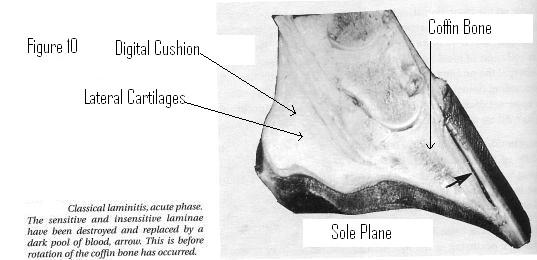
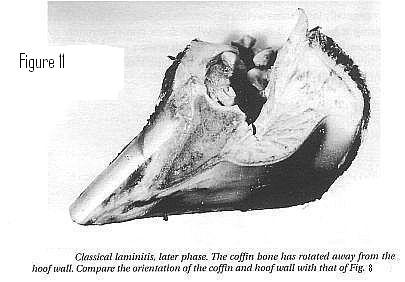
The “standing up”, if you will, of the hoof in normal shoeing increases not only the possibility of heel pain, but also the probability of stretching the white line or sensitive laminae. This, in some cases, is called white line disease. So, if this form of shoeing causes the above issues with the foot, long toes does also, with toe first landing since the heels of the foot hurt. The horse does not show any pain since both feet hurt equally
and have grown accustomed to what is taking place. If the above conditions work into full laminitis (founder), then the horse does show the pain in the front hooves. Refer to the following figures.
The following definitions and explanations are courtesy of Marjorie Smith’s website:
“Most of the problems we see in the hooves of domestic horses are related to flaring of the hoof wall. Transition pain is due to flaring which allows the coffin bone to settle down and bruise the sole corium. Founder is essentially a big flare. Contracted heels are due to a forward-flared toe. Navicular pain is related to a forward-flared toe causing the foot to land toe-first.
”Except for laminitis, where inflammation of the laminae allows the white line to stretch or separate, flares are the result of incorrect mechanical forces which pry the wall away from the coffin bone.”
“A flare is separation of the hoof wall, away from the coffin bone. Often the wall curves outwards at the bottom like the bell of a trumpet. You can feel even the slightest flare with your hand, and you can generally see a flare by looking at the hoof wall with your eye or camera at ground level, and moving around the foot to see all parts of the wall.
“A flare due to laminitis or longterm mechanical stress (shoes or a pulled-forward toe) often is straight in outline and may be difficult to recognize. The angle of the wall changes abruptly, high up -- sometimes so close to the coronet that you can’t see where it changes.
“Flare tells us that white line stretching or separation has occurred and the hoof wall is not attached to the coffin bone in that area. Flare and white line separation are the same thing. When you look at the sole of a flared foot, the white line beside the flare is dirty (stretched) or makes a small groove (separated) between the wall and the sole. To say it the other way around, you will find a flare where the white line is dirty or grooved.
“When the white line has pulled
apart -- like pulling the two sides of Velcro (hook and loop fastener) apart -- the two sides cannot re-attach to each other. A new connection must grow down from the coronet (hairline) -- just as, if you tear part of your fingernail, you have to wait for the fingernail to grow out from the quick.
“Most flares occur at the bottom of the wall where ground contact mechanically starts to pry the wall away from the bone. Occasionally, a hind foot that is overgrown in the toe but short in the heel will form a bulge (‘bull-nose’) halfway up the toe wall. The white line at the bulge is stretched because the unusual mechanical forces in this shape of a hoof pull the wall away from the bone.
“A founder is a flare so severe that the coffin bone falls away (rotates at the P2-P3 joint) downwards at the toe. Founder can result either from inflammation of the laminae (laminitis) or from mechanical forces in an overgrown or badly trimmed foot.
“Flares are painful. The hoof wall is fingernail and is attached to the bone by the same strong, but tender, material that holds fingernails on. You can see the stripes of your own laminae through your fingernails. Flaring feels something like having your fingernail pulled off. Laminitis (inflammation of the white line) is so painful the horse will stand in the ‘founder stance’ (forelegs out in front of the shoulder and moving
weight to the hind quarters). Even a mechanical flare is painful enough to make the horse noticeably unsound -- sometimes people think their horse is being lazy, but the horse peps up again when you get the white line tightened up.
“Wild horses don’t often have flares. A horse living in ‘horse country’ going 20 miles (30 km) daily on rough, dry ground wears its feet to an efficient ‘mustang roll’ or rounded bevel that cannot flare. In unusual conditions -- a rainy season with lush grass -- wild hooves do get overgrown and begin to flare. The flared wall chips, cracks and breaks away, giving the horse a rough-looking, but workable hoof until dry conditions return.”
Flares in domestic horses
“Flares are common in domestic horses. Mechanical flares happen when a hoof is overgrown or imbalanced. If the horse lives in a wet climate, the softened hoof flares more easily than a dry-climate hoof. In addition, we see laminitic flares in these same wet areas because the grass is lush and full of sugars, and many horses sooner or later become insulin-resistant. (See www.safergrass.org.) Pasture grasses have been bred for high sugar content to raise milk production in dairy cattle. Excellent recommendations for care of the insulin-resistant horse.
“Hooves that live on wet, poorly drained ground, or during a wet season, need much more frequent care
than hooves on dry terrain. Here in the Northeast USA, it is a constant struggle to keep hooves from flaring and horses from going unsound. We have to trim every two to three weeks -- 10 days during the spring -- and renew the mustang roll between trims. Just a few days’ overgrowth allows a new flare to form which can make the horse unsound for weeks.
“The combination of ‘horse-unfriendly’ climate, together with the lack of movement in domestic horses’ lives, makes hoof care a major part of the horse’s upkeep in this climate. We are starting to recommend walking the horse up to half an hour daily on pavement, to give better concussion. This strengthens the white line by increasing circulation in the hoof.”
In Conclusion: The reasons for all the material presented here is to show that excessive toe length can cause a great deal of grief for the horse. To quote from Dr. Bowker“Short toes are the best thing you can do to a foot!”
His simple recommendations, which he calls the Physiological Trim, are short toes, short heels, and trimming for the 1/3-2/3 balance of the foot: 1/3 of the foot in front of the apex of the frog and 2/3 behind it. Flares are prevalent in domestic horses and these flares cause the horse stress.
As long as we humans nail steel shoes on horses, we will continue to see the above issues with horses.
In my experience with steel shoes nailed to the foot, the foot gets oblong in shape rather than round. If one was to look at the natural foot of a feral horse – the foot is round, not oblong. The oblong shape is due to the steel shoe – the toe tends to extend to form this oblong shape and from this shape flares start to occur, along with contracted heels, thus causing heel pain and since we humans put the steel shoes on our horses from a very early age, the frog, digital cushion and the lateral cartilages never hit the ground. Therefore are never stimulated, so these structures remain soft and lack the fibro-cartilage strength of a natural hoof.
I don’t expect anyone to stop shoeing their horses. The purpose of the paper is to show another perspective of the horse’s foot. This research is the basis for the IJA rule change – the rule change is not to put anyone or horses at a deficit in showing horses, but to put forth an effort to get the horse to a more natural and healthy foot. This paper will be followed up with a few more, hopefully not this lengthy, papers on the horse’s foot. Yes, I will go into shoeless or barefoot in these later papers. I would not expect any one to follow suit unless the perspective human does an extraordinary amount of reading of the web sites that follow in this paper.
OK, I’ve said quite a bit about the internal and external structures of the foot. What do these folks that I have
quoted think a healthy and natural horse hoof should look like? The following figure is the bottom view of a healthy foot. Courtesy of Marjorie Smith.
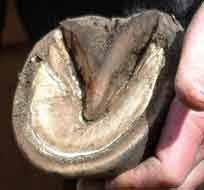
“Domestic hooves will not be as short as this example. Most of our horses don’t travel enough daily miles on hard ground, to have a totally healthy, tight white line. The white line is weakened and stretchy, therefore the coffin bone (which hangs underneath the sloped hoof wall) has a lower position inside the hoof capsule. In domestic horses we can expect toe lengths of about 3 1/4 to 3 3/4 inches (8 to 9.5 cm) measured from the hairline to the ground. In the above photo, the hoof length is 3 inches.
“If you try to trim a domestic hoof as short as this, you will have to thin the sole to do it, and this will make your horse very sore.”
I will go into the domestic trim to achieve the above foot in later papers. And yes, this is a barefoot horse that has been barefoot quite a while. Again, the average domestic horse that has been shod its entire life will have more of an oblong shape to the hoof and the frog will not look like the frog in photo above. The frog of the domestic horse will look narrower and not as healthy.
I will also go into the healthy foot and the effect on gait in later papers.
With all the above: This is the reason for the four and one half inch rule change. The health of the horse is the primary objective.
The Lame Horse by Dr. James Rooney is available from the Russell Meerdink Company, Ltd., 1555 South Park Avenue, Neenah, WI 54956 or on-line at www.horseinfo.com.
Marjorie Smith - www.barefoothorse. com.
To quote from The Horse’s Hoof –“Robert Bowker VMD PhD is a Professor of Anatomy and Director of the Equine Foot Laboratory at Michigan State Univ. College of Veterinary Medicine. His most important role is that of veterinary researcher, and through funding support from the AQHA and Grayson Jockey Club, Dr. Bowker has been able to spend the last decade and a half studying the function of the equine foot. Much of his research has been on the microscopic level, and through the dissection and study of literally thousands of cadaver hooves.”
Pete Ramey – www.hoofrehab.com.

“Soring” is the use of painful training techniques to create a flashy unnatural gait in horses. Tactics include applying caustic agents (diesel fuel, hand cleaner, etc.) to the front legs and then wrapping the legs overnight. The flesh is sore when the wraps come off, chains are used to bang on this area during training. Also injections of irritants above the hoof, tacks under the band huge weighted (”stacked” or “padded”) shoe in place, and the hoof into the quick and/or green nailing.
These training methods cause the horse to attempt to avoid the pain by picking up his front feet faster and higher and shifting his weight back onto his hind legs in a crouching stance.
This grotesque gait is called the Big Lick.


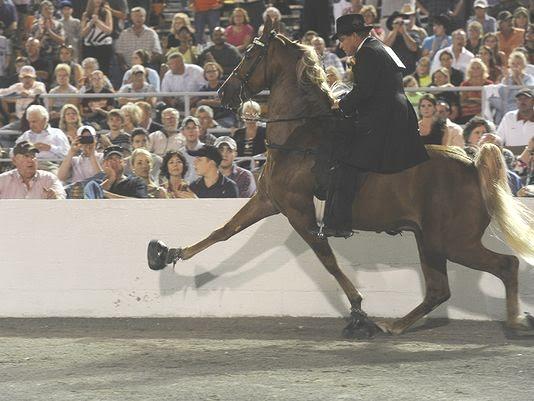
Soring was made illegal in 1970 by the Horse Protection Act, but the shoes and chains are not illegal—YET. Soring itself still goes on. Penalties are nearly non-existent, and enforcement is so lax that it persists in about 200 trainers impacting over 10,000 horses. Inspectors are directly employed by show managers, creating a clear conflict of interest. Dye and short-acting topical anesthetic creams are used to mask pain and scarring during inspections. The overwhelming majority of sored horses are Tennessee Walkin g Horses, but two other breeds, the Racking Horse and the Spotted Saddle Horse, are also impacted.

After years of education and lobbying by animal welfare groups, the bipartisan Prevent All Soring Tactics (PAST) legislation was passed in July 2019 with an overwhelming majority in the U.S. House of Representatives. The PAST Act would finally eradicate soring by eliminating the use of large stacked shoes and ankle chains in the show ring and by eliminating the industry’s self-policing scheme, replacing it with licensed USDA inspectors. It would also increase penalties for those who break the law. U.S. Senate leadership refused to bring it to the floor for a vote despite half of the Senate having signed on as cosponsors. The bill was not brought to the floor because then Senate Mjority Leadr Mitch McConnell (R-KY) refused to allow it to be brought to the floor for a vote. As we are now in the 117th Session of Congress, the PAST Act will need to be reintroduced in both the House and the Senate.
The PAST Act would close loopholes in the Horse Protection Act. Because the U.S. Department of Agriculture has allowed the industry to police
itself, those who hurt horses face minimal repercussions, get deferred disqualifications, and are typically allowed to continue carrying out the abuses that got them disqualified in the first place. PAST would replace the self-policing system with third party, independent inspectors who are trained, licensed and assigned by the USDA. The bill would also ban the devices integral to soring (the stacks and chains) and would strengthen penalties for soring.
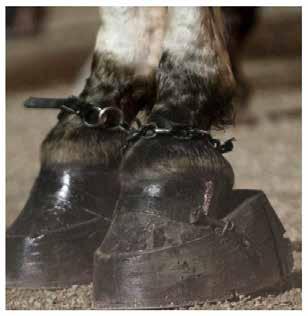
Sen McConnell is a long-time supporter of the Big Lick industry. He and Sen. Rand Paul (R-KY) are cosponsoring competing legislation introduced by prevision sessions and supported by those engaged in horse soring, which would allow the industry to continue policing itself with no accountability. This sham alternative bill would actually make the problem worse by further weakening the USDA’s already limited authority and handing off more power to the perpetrators. It would do nothing to end the use of chains, heavy stacked shoes and other soring devices, or to establish meaningful penalties. Sen. McConnell has not yet realized that supporting the Big Lick is bad politics.
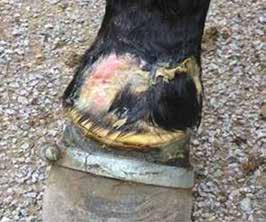

Open lesions and scarring are the results of soring.
Every major veterinary, equine, animal welfare and law enforcement organization in the U.S. has endorsed this bill (AVMA, AAEP, American Horse Council, ASPCA, USEF, National Sheriffs Association, Humane Society Legislative Fund, Association of Prosecuting Attorneys, and over 100 more.) The PAST Act is the right answer.
Absolutely not. There are many owners and trainers that never use soring to enhance the performance of their horses. Known as “flat shod” horses, these animals have natural movement and are enjoyed by tens of thousands of riders across the country. In fact, the majority of Walking Horses are flat shod. It is only a small minority of trainers who resort to the shameful practice of soring and stacked shoes—they sometimes call them “padded” shoes to try to make them sound more like a therapeutic shoe than a torture device. The entire Tennessee Walking Horse community is brought down by the actions of a few bad actors.
The latest USDA statement, as reported in the Walking Horse Report published May 21, 2018, said that “the vast majority of Horse Industry Organizations (HIOs) that inspect padded horses did not detect any HPA noncompliance when USDA was not present at a show.” USDA went on to say: “It is highly unlikely that exhibitors only present noncompliant horses for inspection when USDA is present at a horse show….USDA remain(s) very concerned about HIOs, especially those inspecting padded horses, whose rate of noncompliance is zero when USDA is not present…” Latest statistics for October 2017 to March 2018, reported in the same article, are: When USDA is not present, 3.48% fail inspection. When USDA is present, 8.17% fail, and many are not even presented for inspection (withdrawn from the show before being inspected). The reported numbers are also skewed because the totals include flat shod Tennessee Walking Horses, who are not sored but are inspected. This makes the percentage of sored horses look smaller than it is.
Last published statistics when USDA itself did inspections at the 2015 championships (“the Celebration”): an appalling 40.28% of “padded” horses were disqualified.
If you live in Kentucky, contact Sens. McConnell and Paul and tell them their alternative bill is not what you want. You want the PAST Act, S. 1007. If you live anywhere else in the United States, look up your senators and urge them to cosponsor and work to pass the PAST Act. Let’s make this the year soring ends, as Congress intended nearly a half century ago.
FOSH is a nonprofit 501(c)(3) organization that welcomes owners of all gaited horses. We support the gaited horse in all equine disciplines, including dressage, distance competitions, English and Western pleasure, and many other styles of riding. FOSH offers judges training and licensing and sponsors numerous shows. FOSH is a national leader in promoting, supporting and protecting gaited horses. To that end, FOSH is known for its work to end soring of Tennessee Walking Horses through its activism, outreach, and 60 years archive of soring articles, www.stopsoring.com.
Principle #1
All FOSH events adhere to the requirements of the Horse Protection Act.
Principle #2
Horses are to be treated with dignity, respect, and compassion.
Principle #3
Horses must be presented as sound in both body and mind.
Principle #4
The preferred way of going is natural, correct, and without exaggeration.
Principle #5
Shoeing is intended only for the protection of the foot and its structure. Where practical, barefoot horses are both welcomed and encouraged.
Principle #6
Handlers and riders are expected to use training techniques and equipment that conform to the highest humane standards as recognized by the general equestrian community.
Principle #7
Exhibitors have a duty to conduct themselves in an orderly, responsible, and sportsmanlike manner.
FOSH is a national leader in the promotion of natural, sound gaited horses and in the fight against abuse and soring of Tennessee Walking Horses. For more information about FOSH or to become a member, please visit www. fosh.info or call 1-800-651-7993.
Southern Comfort promotes activities highlighting the smooth ride and versatility of all gaited breeds. Pursuits include trail riding, competitions, shows, exhibitions, clinics and many other equine activities. The club promotes horse safety and friendship for all that are interested in horses. Owning a horse is not a requirement. SCGHC is based in southwestern Idaho and is a flat shod exclusive club with members contributing and supporting various interests using sound, natural horses. www.gaitedhorseclub.com
The Chesapeake Club is celebrating over 25 years of promoting the versatile, naturally gaited, horse. As a member of the Maryland Horse Council, we have been the voice of the gaited community and through demonstrations, clinics and guest speakers, a resource for other disciplines to learn about the gaited breeds in our region. Members enjoy monthly trail rides, newsletters, parades, clinics, social gatherings, and friendly help. We welcome all breeds, riding styles, and experience levels from beginners to professionals. Cpwhclub. wordpress.com or jacquiecowan@comcast.net
Plan for your next lifetime partner! Come breed with us! Offering frozen semen (12 stallions in 2020) or reservations for Future Foals “do Summerwind” The Marchador is Brazil’s national horse, harking from Iberia, but bred there for 200 years. Expect to be impressed! http:// futurefoal.net or call Lynn @ 602-999-3915
Easy gaited in color. Rare gaited Morgans located in the Heart of America near beautiful Lake of the Ozarks; for photos, videos and available horses. Talk to Jim or Vali Suddarth at 417-286-4720 or gaitedmorgans@missourimorgans.com
Jo Anne Behling, Wauwatosa, WI
Esther L. Bell, TN
Pamela Brand, Carlisle, PA
Sarah Bushong-Weeks, Denver. CO
Julie Church, Pagosa Springs, CO
Mary & William Church, Pagosa
Springs, CO
Luella DeBono, Eden Prairie, MN
Beverly Foster, St. Augustine, FL
Nancy Gillespie, Pullman, WA
Cristine Holt, Dubuque, IA
Jane Howlett, Pocatello, ID
Marjorie Lacy & Walking Horse News, Edson, Alberta
Sue De Laurentis, Dripping Springs, TX
Bobbie Jo Lieberman
Dianne Little, Calgary, Alberta
Debbie Locke, Mack, CO
Ann Loveless, Ashtabula, OH
Patricia Mayer, East Aurora, NY
Maggie MacAllister, Staunton, VA
Janelle T. McCoy, Prague, OK
Frank Neal, Nashville, TN
Lori Northrup, Ellicottville, NY
Anne Northrup, Ellicottville, NY
Shellie Pacovsky, Bainville, MT
Denise Parsons
Anita Rau, Catlett, VA
Debbie Rash, Chino, CA
Southern Comfort Gaited Horse Club, ID
Bucky & Nancy Sparks, Cortez, CO
Marcy Wadington, Canon City, CO
Leslie Weiler, Pagosa Springs, CO
Laura Wyant, Chesire, OR
An Anonymous Donor
Yankee Walkers of New England
Please consider adding FOSH to your list of worthy causes in making a taxfree charitable deduction or help us to promote legislation, education, and training that protects and helps gaited horses, simply by renewing your own membership or giving a gift membership to a kindred spirit.
We know you have many choices when it comes to giving. Thank you for considering FOSH.
All annual memberships include a digital, bi-monthly issue of the Sound Advocate & educational packets. Mail to: FOSH 6614 Clayton Rd. #105, St. Louis, MO 63117
Type of Membership (check one)
Annual: Single ___$30 Annual Family ___$50 Annual Youth <18 ___$20 Lifetime__$600 Organization Membership (for your gaited horse club or association) ___ $50
Please print neatly.
Name: _______________________________________________________________________
Enclosed: $____________________
How did you hear about FOSH?